







Abstract
Parenting has a prominent role in predicting children’s externalizing behaviors (EB). Although parenting behavior has been shown by prior research to mediate the relationship between parenting self-efficacy (PSE) as the cognitive aspect of parenting and child EB, the role of children’s cognitive aspects in the relationship is not yet well understood. To improve understanding of the relationship between PSE, children’s EB, and children’s cognitive aspect, the current study aims to investigate the mediating effect of children’s executive function (EF) on the relationship between PSE and children’s EB in early childhood. Questionnaire data on PSE, child EF, and child EB were collected from 217 mothers of typically developed children aged 3 years to 8 years in Indonesia. Hayes PROCESS analysis revealed an indirect effect of maternal PSE on child EB that is mediated by child EF when socioeconomic status is controlled. With this indirect effect accounted for, the direct effect of maternal PSE on child EB disappears, suggesting a full mediation effect. Specifically, the relationship between PSE and child EB is fully mediated by inhibitory control, but only partially mediated by working memory. The discovery indicates that children’s EF deficit may increase child EB, along with a decrease in maternal PSE. These findings imply that in providing EB intervention for children, it is necessary to consider PSE and children’s EF.
Introduction
Externalizing behaviors (EB) characterized by disinhibited behaviors such as aggressivity, hyperactivity, inattention, and delinquency (Willner et al., 2016) are relatively common occurrences in early childhood, with manifestations that include losing temper, argument/defiant behavior, and aggression to people/property/animal (Hong et al., 2015). During the early childhood period, children develop their autonomy but are still lacking in the ability to regulate their own behavior, therefore increasing the tendency for EB to occur (Barnes et al., 2013; Rhee et al., 2018). As such, children ultimately rely on their parents to direct their behavior. Past studies have found parenting behavior as a factor that significantly influences children’s EB (Fass et al., 2018; McKee et al., 2008; Sulik et al., 2015).
Parenting behavior is fundamentally driven by parenting self-efficacy (PSE), which is defined as a parent’s estimation about their role as a parent or their perception about their ability to direct the behaviors and development of their children in a positive way (Coleman and Karraker, 2000). Compared to parents with low PSE, parents with high PSE who believe in their parenting ability are better able to practice their knowledge and skills (Coleman and Karraker, 2003), emphasize children’s strengths rather than focus on their own parenting challenges, can adjust their parenting skills to the children’s needs (Mouton et al., 2018), and can perform their parenting roles more effectively (Albanese et al., 2019).
Since the 1990s, studies on PSE, especially with regard to its relevance to child adjustment, has often been conducted in Western cultures, with results that robustly suggest that PSE plays a crucial role in child functioning (i.e. Albanese et al., 2019; Jones and Prinz, 2005). Yet in the East, such as in Indonesia, the role of PSE in child development is less explored (i.e. Sumargi et al., 2015). While studies in the Western world have investigated the roles of various parenting constructs in children’s outcomes, parenting style appears to be the parenting construct predominantly studied in Indonesia (Haslam et al., 2020; Riany et al., 2017, 2022), while emotional and cognitive aspects of parenting have not received much attention. To date, only one study on Indonesian parents have explored the various protective and risk factors of parenting practices in a more comprehensive manner, specifically by addressing PSE, dysfunctional parenting practices, parental stress, family relationship, and parental teamwork, each of which was found to be significantly correlated with children’s emotional and behavioral problems (Sumargi et al., 2015). Such a finding seems to suggest that among Indonesian parents, PSE may play a contributory role in the manifestation of child problem behaviors.
In contrast to Western fathers, Eastern fathers, including those in Indonesia, are less involved in parenting and are more focused in their role as the bread-winner (Yeung, 2013). As such, Indonesian mothers are expected to act as primary caregivers, while fathers mainly assume the responsibility of the provider, despite the currently evolving view of fathers as having a complementary role in childcare (Yulindrasari and McGregor, 2011). Culturally, Indonesian mothers are presumed to have a greater natural inclination to care for children, which explains why mothers are more frequently perceived as an expert in child-rearing (Yulindrasari and McGregor, 2011). Such demands and cultural norms in Indonesian parenting practices may consequently lead to the establishment of a mother’s mindset that she is obliged to care for children mainly because she has the capability to do so. This phenomenon suggests that the parenting culture in Indonesia can influence a mother’s beliefs in her own child-rearing abilities. As such, PSE may prove to be one of the most important parenting aspects to be explored in the Indonesian population.
In line with the basic theory of PSE, namely the ground theory self-efficacy (Bandura, 2001), it is predicted in the present study that parents with high PSE believe they can cope well with any parenting challenge, not easily give up, and be more adept at directing their children’s behavior, ultimately resulting in better regulation of children’s behavior. Conversely, children of parents with low PSE are expected to display poorer behavior regulation due to the parents being less able to direct their children’s behavior.
In accordance with this prediction, previous research have indeed discovered that PSE is significantly associated with a multitude of childhood behavior problems, including EB (Benedetto and Ingrassia, 2018; Jackson et al., 2009; Sumargi et al., 2015). PSE can contribute to children’s EB both directly and indirectly, through the mediating effect of parenting (Benedetto and Ingrassia, 2018; Jones and Prinz, 2005). Among others, maternal depression (Weaver, 2008) and corporal punishment (Fass et al., 2018) have previously been found to mediate the relationship between PSE and children’s EB. In the authors’ knowledge, no past research has looked at the mediating role of child-related factors in explaining the relationship between PSE and childhood problem behavior, despite their contribution in the manifestation of children’s behavior. Considering that EB displayed in early childhood is generally attributable to the child not yet mastering optimal behavior regulation (Breitenstein et al., 2009) and that child self-regulation is commonly measured through the child’s Executive Function (Zhou et al., 2012), the current research will explore the mediating role of child Executive Function in the relationship between PSE and child EB.
Executive Function (EF) refers to a set of cognitive processes that plays a role in directing, monitoring, and regulating an individual’s behavior (Baggetta and Alexander, 2016). EF encompasses three main components, namely inhibitory control, working memory, and cognitive flexibility (Diamond, 2013). Children with low EF find it challenging to inhibit their intentions, memorize multiple instructions simultaneously, find new alternatives, adjust their behavior to conform to social rules, and avoid repeating the same mistakes (Diamond, 2013). These cognitive difficulties often manifest as impulsive and uncontrolled behaviors, defiance toward parents, and aggressive behaviors, all of which are considered forms of EB. A meta-analysis study by Schoemaker et al. (2013) revealed that a low EF is consistently found as a reliable indicator of children’s EB. A robust correlation between children’s EF and their EB suggests the possibility that EF acts as a mediator in the relationship between PSE and children’s EB, and exploration of the dynamics among the three variables may prove to be compelling.
As discussed earlier, parenting is regarded as a factor that contributes to EB. In addition to influencing children’s behavior, parenting is also known to affect children’s cognitive abilities. During the course of the rapid development of EF in early childhood, children rely on their parents for the appropriate stimulation and the fostering of their self-regulation skills (Best and Miller, 2010; Diamond, 2013; Fay-Stammbach et al., 2014). Yet previous studies investigating the role of parenting in children’s EF have focused more on the behavioral aspects of parenting (e.g. Fay-Stammbach et al., 2014; Hertyas et al., 2019; Hutchison et al., 2016) and emotional aspects of parenting (e.g. Hutchison et al., 2016; Joyner et al., 2009), but less so on the cognitive aspects of parenting (e.g. Gärtner et al., 2018; Huang, 2008; Weaver et al., 2008). In fact, sufficient PSE is necessary for enhancing children’s development, including the development of children’s higher-order cognitive processing. In particular, parents who have adequate efficacy in their ability to discipline their children and who establish routines for the children to follow tend to perceive their children as having better self-regulation (Huang, 2008). In line with this discovery, more recent research by Gärtner et al. (2018) has shown that PSE is associated with the inhibitory control component of childhood EF needed to regulate children’s behavior.
Based on the research evidence presented thus far, it can be inferred that children’s EB, PSE, and children’s EF are interrelated. First, children’s EB is theoretically influenced by PSE and children’s EF. Moreover, past evidence also suggests that PSE could predict children’s cognitive abilities, especially those related to self-regulation. In other words, there exists the possibility that PSE may also be associated with children’s EF. Viewed from a theoretical perspective, it is possible that children’s EF acts to mediate the relationship between PSE and children’s EB. To account for this shortcoming, the present study aims to investigate the association between PSE and children’s EB among children aged 3–8 years, more particularly by examining the mediating role of EF. Given that EF components are separate but interrelated constructs (Miyake et al., 2000), in this research, the mediating role of each EF component (i.e. inhibitory control and working memory) will also be examined individually.
In this study, several covariates are controlled, the first of which is parental involvement. Studies have found that mothers play a more significant role than fathers in the relationship between PSE and children’s behavioral problems (Murdock, 2013; Slagt et al., 2012). Taking into account the fact that mothers are usually the primary caregivers in Indonesian families, only data obtained from mothers will be included in the statistical analysis. Furthermore, socioeconomic status (SES) was also found to be associated with both maternal PSE (Weaver, 2008) and children’s EF (St. John et al., 2019). Based on this reason, in the current study, SES is controlled through statistical means. Participants are grouped into three SES classes (low, middle, high) based on the criteria used in the 2012–2013 National Socioeconomic Survey (Badan Pusat Statistik, 2015) conducted by Indonesia’s Central Bureau of Statistics.
The current study is uniquely relevant to the current context of the COVID-19 pandemic. Due to the rapid and global spread of the SARS-CoV-2 virus, what used to be normal daily activities such as work, school, outdoor play, and social gatherings are heavily restricted. People around the world, including children, are required to hastily cope with significant life changes as a result. Daily routines are disrupted (Prime et al., 2020), which greatly impacts children’s mental health. Study have found that children display more EB during the COVID-19 pandemic compared to before (Di Giorgio et al., 2021). Along with the increase in children’s EB during the pandemic, research on the role of parenting, especially PSE, in children’s EB becomes pertinent. The results of the current study are expected to provide parents with some guidelines on the management of children’s EB through the cognitive perspective of parenting and the cognitive perspective of the child, particularly in the time of the COVID-19 pandemic.
Methods
Study design and participants
The present study was undertaken as a project within the Executive Functions Research Laboratory at the Faculty of Psychology, Universitas Indonesia. Therefore, data collection was carried out along with other projects belonging to the same laboratory. The study protocol complied with the ethical standards in psychology, Universitas Indonesia’s Research Ethical Code of Conduct, and the Indonesian Psychology Association’s Ethical Code of Conduct. The procedures of the study had also passed the review of the Committee on Reseach Ethics of the Faculty of Psychology, Universitas Indonesia.
All participants were Indonesian female citizens who resided with their respective conjugal families (i.e., father, mother, and children) in Indonesia. The sample included 217 mothers aged 25–49 years old (M mother age = 32.73, SD mother age = 4.37) with children aged 3 years (36 months) to 7 years 10 months (94 months; M child age in months = 62.68, SD child age in months = 17.03) who are physically and mentally healthy, have no history of developmental problems, and with no prior experience in psychological therapy. The number of male and female children of the mothers were approximately equal (male children = 106, female children = 111). The children’s educational level varied widely and included those who had yet to start school, those attending preschool/playgroup, those who attended kindergarten, and those in first and second grades of primary school. The majority of the participants belonged to the middle SES group (lower SES = 12.0%, middle SES = 68.2%, upper SES = 19.8%). Data obtained from mothers whose children were suspected/diagnosed with any psychological/developmental disorder (e.g. Dyslexia, speech delay, ADHD, ASD) or had previously participated in developmental therapy (e.g. sensory integration therapy, speech therapy, occupational therapy) were excluded from the analysis.
Procedure
Primary data collection was conducted from August until November 2020 through social media and instant messaging applications (i.e. Instagram, Twitter, Group Whatsapp). Participants were requested to fill a two-part online questionnaire through Google Form. Prior to filling in the first part of the questionnaire, participants gave an informed consent to voluntarily participate in the study and to be contacted at a later time for the completion of the second part of the questionnaire. Overall, 658 participants completed the first part of the questionnaire. Data from 435 participants were eliminated due to varying reasons, including having children who were under three or over 8 years old, not living as a conjugal family, having children who showed signs or symptoms of psychological/developmental problems, questionnaires having been filled out by fathers instead of mothers, and unwillingness to continue with the study. Following the elimination, data from 223 participants remained. Of the 223, six outliers were found and were eventually excluded from the study, resulting in a total of data from 217 participants that were eligible for statistical analysis.
Measurements
Me as a parent (MaaP)
In the present study, MaaP (Hamilton et al., 2015) was used to assess maternal PSE that covered a wide range of ages from 6 months to 15 years (Wittkowski et al., 2017). MaaP consists of 16 items (e.g. “I have confidence in myself as a parent”) scored on a 5-point Likert scale (strongly disagree, disagree, mixed feelings, agree, strongly agree). Four of the items were scored in reverse. For each participant, the scores from all items were summed to obtain a maternal PSE score that ranged from 16 to 80. A higher score indicates a mother’s higher efficacy in her own parenting abilities. The Indonesian language version of MaaP was found to have good reliability within the population of Indonesian parents (α = 0.903).
Childhood Executive Functioning Inventory (CHEXI)
In the present study, CHEXI was used to assess child EF. CHEXI was initially created to assess EF deficits in children aged 4–12 years (Thorell and Nyberg, 2008). However, CHEXI has also been used for children aged 3 years (Camerota et al., 2018). CHEXI consists of 24 items with 5-point Likert scale (definitely not true, not true, partially true, true, definitely true) and comprised of four subscales: working memory (9 items, e.g. “Has difficulty remembering lengthy instructions”), planning (4 items, e.g. “Has difficulty with tasks or activities that involve several steps”), inhibition (6 items, e.g. “Has a tendency to do things without first thinking about what could happen”), and regulation (5 items, e.g. “When something needs to be done, he/she is often distracted by something more appealing”). CHEXI produces three separate final indices, namely an EF index, an inhibition index, and a working memory index. The EF index is obtained by summing the scores from each item. The inhibition index is obtained by summing scores from the inhibition and regulation subscales, whereas the working memory index is calculated from the sum of the working memory and planning subscales. The higher the score in each index, the higher the deficit in EF. The reliability of the Indonesian language version of CHEXI among Indonesian parents was good (α = 0.942).
MacArthur Health and Behavior Questionnaire 1.0 (HBQ 1.0) externalizing/ADHD symptoms scales
HBQ 1.0 is a parent-report inventory developed by Armstrong and Goldstein (2003) to measure the physical and mental health, as well as the daily functioning, of children aged 4–8 years. Previously, HBQ 1.0 has been used for children aged 3–7 years (Tarullo et al., 2016). HBQ 1.0 can be administered either as a whole or partially, by administering specific parts of the scale only (Armstrong and Goldstein, 2003). In the present study, only the externalizing/ADHD symptoms scale was used to measure children’s EB. Externalizing/ADHD symptoms scale consists of 46 items scored on a 3-point Likert scale (never or not true, sometimes or somewhat true, often or very true) and is divided into six subscales: oppositional defiant (9 items, e.g. “Argues a lot with adults”), conduct problem (12 items, e.g. “Lies or cheats”), overt hostility (4 items, e.g. “Gets in many fights”), relational aggression (6 items, e.g. “Tells others not to play with or be a peer’s friend”), inattention (6 items, e.g. “Distractible, has trouble sticking to any activity”), and impulsivity (9 items, e.g. “Has difficulty awaiting turn in games or groups”). The scores from each item are summed to obtain children’s EB scores. A higher score on the scale indicates a higher level of EB displayed by the child. The Indonesian language version of the externalizing/ADHD symptoms scale of HBQ 1.0 had good reliability (α = 0.926) for use with Indonesian parents.
Data Analysis
All collected data were initially examined to ascertain fitness with the required criteria, followed by the elimination of data that were found to be unsuitable. Next, a series of statistical analyses were conducted, beginning with a check of outliers using boxplot and the elimination of such outliers. Afterward, Pearson correlations were run on SPSS to uncover the relationships among variables. Lastly, a Bias Corrected Bootstrapping set at 95% confidence interval and 5000 samples was performed using PROCESS ver 3.5 macro in SPSS to examine the mediating effect of children’s EF on the relationship between PSE and children’s EB. Additional mediation analyses were run to confirm the mediating effect of each EF component, inhibitory control and working memory, on the relationship between PSE and children’s EB.
Results
Correlation between parenting self-efficacy, children’s executive function, and children’s externalizing problem behavior
Correlational analyses were first conducted on the three variables to determine their interrelations. In general, the three variables were shown to be significantly correlated with one another (see Table 1). Based on the results of the Pearson’s tests, a significant negative relationship between PSE and EF deficit was found, r(216) = −0.372, p < 0.01, implying that higher PSE was associated with lower perceived EF deficit. A significant negative relationship was similarly found between PSE and child EB, r(216) = −0.247, p < 0.01, which suggests that the higher the parents’ PSE, the lower their perception of their children’s EB. In contrast, EF deficit and EB were discovered to be significantly and positively correlated, r(216) = 0.475, p < 0.01. The positive relationship between the two variables implies that higher EF deficits in children are likely to be accompanied with higher levels of EB.
Correlations among the main variables.
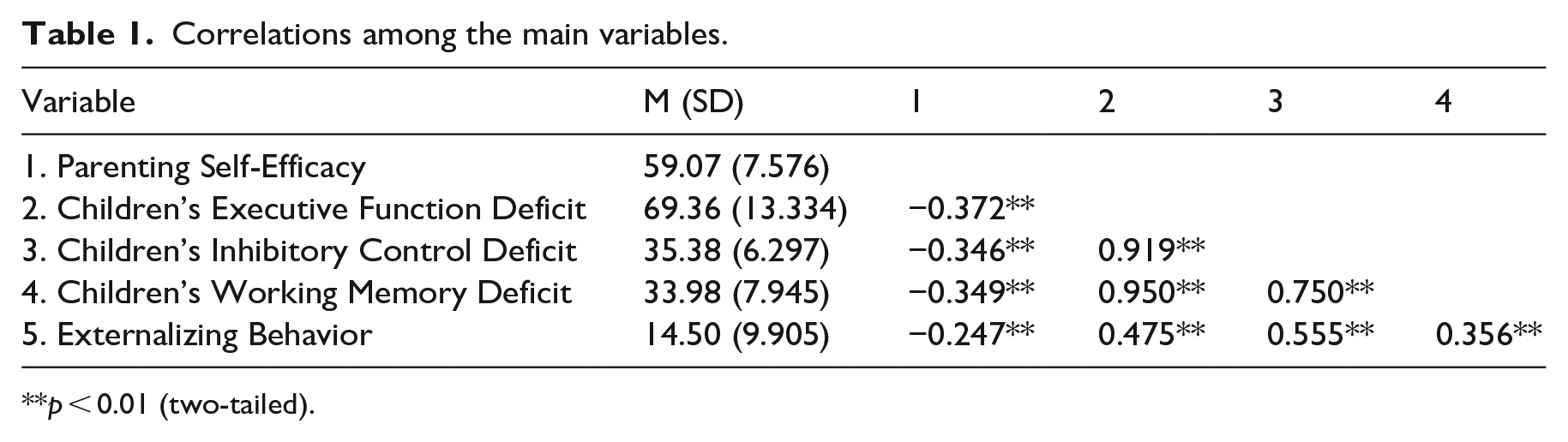
p < 0.01 (two-tailed).
Mediation analysis
A mediation analysis was conducted through bias-corrected bootstrapping with 95% confidence interval and 5000 samples using PROCESS ver 3.5 macro in SPSS. In the first model tested, PSE was included as a predictor (X), child EF deficit as a mediator (M), and child EB as an outcome (Y). The socioeconomic status of the family was additionally included as a covariate variable. Based on the results of the mediation test as shown in Figure 1, significant associations were found between PSE and child EF deficit (path a; β = −0.65, p < 0.01), as well as between child EF deficit and child EB (path b; β = 0.33, p < 0.01). After child EF was included as a mediator, the coefficient of PSE on child EB decreased from −0.32 (p < 0.01; path c) to −0.11 (p = 0.20 ; path c’), thus failing to reach statistical significance. In addition, an indirect effect through child EF deficit was found to be significant (β = −0.22, SE = 0.05, 95% CI [−0.31, −0.13]), indicating that child EF deficit fully mediates the relationship between PSE and child EB, even after controlling for socioeconomic status.
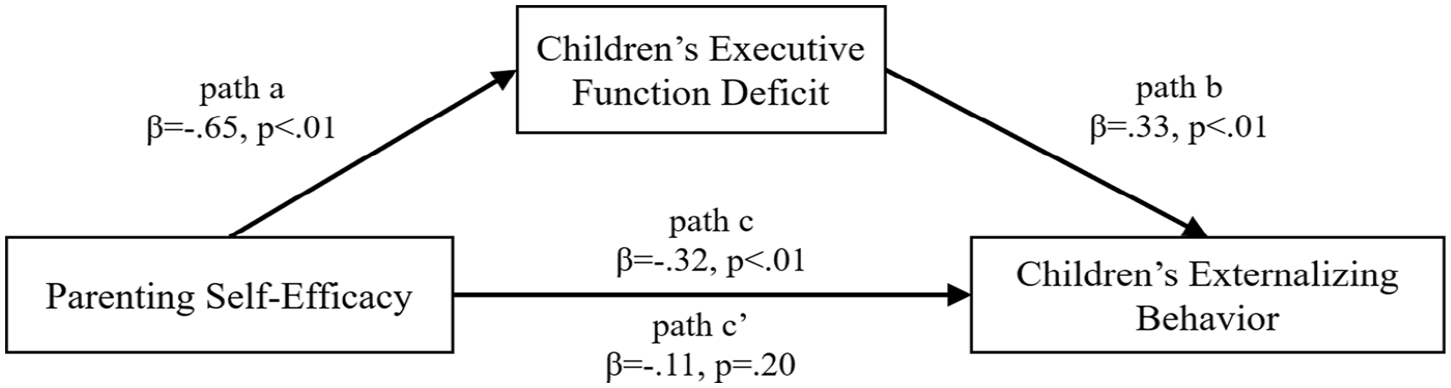
Children’s EF deficit as a mediator between PSE and children’s EB.
In the second model of mediation analysis, inhibitory control was included as a mediator (M) in the relationship between PSE (X) and child EB (Y), with socioeconomic status as a controlled covariate. Based on the mediation analysis shown in Figure 2, PSE was found to be significantly associated with child inhibitory control deficit (path a; β = −0.29, p < 0.01), and child inhibitory control deficit was similarly found to be significantly associated with child EB (path b; β = 0.84, p < 0.01). The inclusion of inhibitory control as a mediator was followed by a reduction in the coefficient of PSE on child EB, from −0.32 (p < 0.01; path c) to −0.08 (p = 0.30; path c’), which failed to reach statistical significance. In addition, an indirect effect through inhibitory control was found to be significant (β = −0.24, SE = 0.05, bootstrapped 95% CI [−35, −0.14]), which suggests that inhibitory control deficit fully mediates the association between PSE and child EB, even after controlling for socioeconomic status.
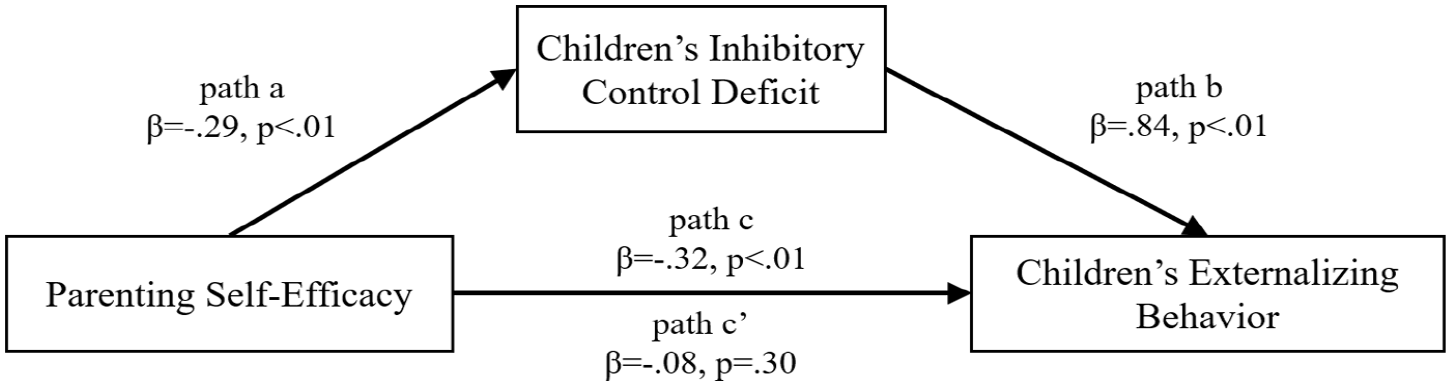
Chidren’s inhibitory control deficit as a mediator between PSE and children’s EB.
The third mediation analysis accounted for the role of working memory as a mediator (M) in the relationship between PSE (X) and child EB (Y), once again controlling socioeconomic status as a covariate. Based on the analysis displayed in Figure 3, the association between PSE and child working memory deficit (path a; β = − 0.37, p < 0.01) and the association between child working memory deficit and child EB (path b; β = 0.38, p < 0.01) were both found to be significant. When working memory was included as a mediator, the coefficient of PSE on child EB was reduced from −0.32 (p < 0.01; path c) to −0.18 (p < 0.05; path c’), but the reduced coefficient was still significant. Similarly, an indirect effect through working memory was found to be significant (β = −0.14, SE = 0.04, bootstrapped 95% CI [−22, −07]), hence demonstrating that child working memory deficit partially mediates the relationship between PSE and child EB when socioeconomic status is controlled.
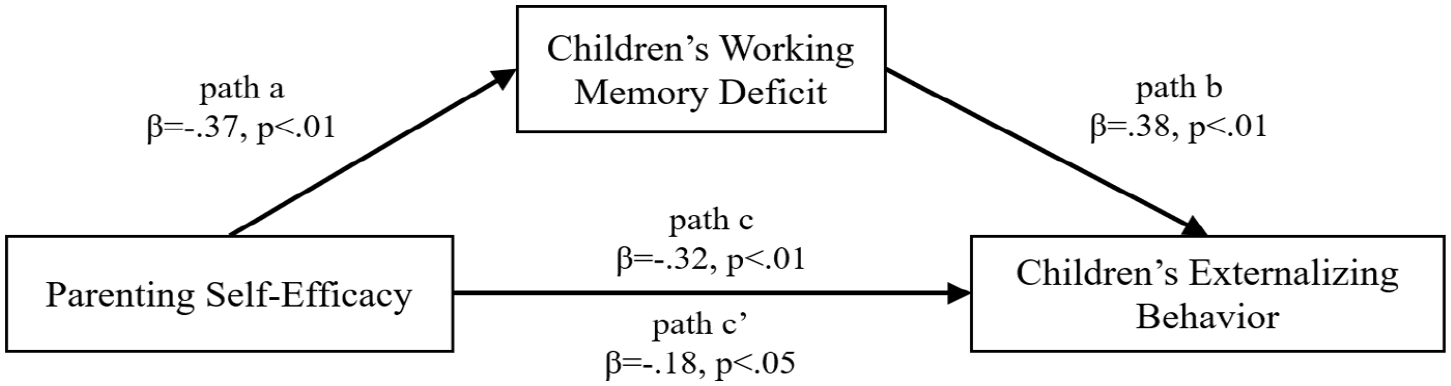
Children’s working memory deficit as a mediator between PSE and children’s EB.
Discussion
This study aimed to explore the relationships among PSE, child EF, and child EB. First, the relationship between PSE and EF in 3- to 8-year-old children was investigated, as research in the area is currently still lacking. Secondly, through this study, the role of child EF as a mediator in the relationship between PSE and EB in children aged 3–8 years was examined.
Based on the results of the study, PSE appeared to contribute significantly to the prediction of child EF. Parents who are confident in their own parenting skills tend to raise children with better EF abilities, as reflected in the fewer EF deficits displayed by the children. This particular finding is consistent with prior studies that examined the correlation between PSE and various cognitive functions (Coleman and Karraker, 2003; Gärtner et al., 2018; Huang, 2008; Weaver, 2008). The results further supplement the interpretation of Coleman and Karraker’s (2003) and Weaver’s (2008) discovery, in that PSE was found to not only be associated child’s global cognitive functions, but also with EF, which refers to the higher-order cognitive function required for monitoring and regulating one’s thought processes and behaviors.
The role of PSE in predicting child EF can possibly be explained by the extent to which parents provide a range of stimulating activities for nurturing children’s cognitive skills. In the current study, mothers with higher PSE were more likely to perceive themselves as having the capacity to devise an assortment of cognitive development activities that are engaging for children. This notion is reinforced by the finding of Korucu et al. (2019) that at-home activities can predict child EF. Additionally, mothers with high PSE evaluate themselves as being able to guide their children’s behaviors when the children misbehave. Through their guidance, mothers are in fact training children to inhibit their dominant behaviors and to learn to adapt to the demands of the environment (Fay-Stammbach et al., 2014). In other words, mothers are, in fact, indirectly enhancing children’s EF abilities through the behavioral guidance they provide for the children.
In addition, this study also expands upon the findings of Gärtner et al. (2018) with regard to the measured constructs and the children’s age range. In particular, the cognitive construct measured in this study was more integrated, thus suggesting that PSE correlates with the holistic measure of EF, while the measure of cognitive function in Gärtner et al. (2018) study was limited to only the inhibitory control component of EF. Specifically, inhibitory control only includes the ability to control attention, thoughts, emotions, and behaviors by suppressing both internal and external urges (Diamond, 2013). On the other hand, EF encompasses a set of higher cognitive abilities (inhibitory control, working memory, cognitive flexibility) needed to control and monitor behaviors (Baggetta and Alexander, 2016). The discoveries of the present research show that sufficient maternal PSE not only influences children’s ability to control their attention and impulses, but also affects children’s working memory and their EF capacity in a more global sense.
In this study, when EF is excluded as a mediator, PSE appears to contribute directly to child EB. This finding reinforces prior results indicating that PSE is a predictor of child EB (Albanese et al., 2019; Benedetto and Ingrassia, 2018; Jackson et al., 2009), especially among Indonesian mothers (Sumargi et al., 2015). Within the context of its dynamics with child EB, PSE has previously been found to serve as both predictor and outcome (Jones and Prinz, 2005). The current study’s discovery, however, is consistent with the role of PSE as a predictor of child EB. In essence, parents with high PSE are confident in their parental competence and are able to overcome parenting challenges, including child EB (Bandura, 2001). As such, when facing childhood problem behaviors, these parents are able to implement more positive and effective parenting strategies while minimizing the use of coercive parenting, thus resulting in decreased child EB (Albanese et al., 2019; Jones and Prinz, 2005).
Interestingly, when EF is included as a mediator, PSE does not appear to have a direct contribution in child EB. The mediation analysis of the study revealed that as a whole, child EF acts as a mediator in the relationship between PSE and child EB. Parental confidence in their own parenting abilities is associated with a lower occurrence of child EF deficit, which in turn reduces the manifestations of EB. Such a mechanism suggests that PSE may not be directly related to child EB, but instead requires the intervening role of child EF. Parents who are confident in their parenting skills are perhaps more devoted to the task of ensuring their children develop optimal EF, which in turn lowers the occurrence of EB. Furthermore, the findings of the current study are considered novel because they simultaneously affirm several mediation models that were previously investigated separately, namely that PSE contributes to child EB (Benedetto and Ingrassia, 2018; Jackson et al., 2009; Sumargi et al., 2015), that PSE contributes to children’s cognitive abilities (Coleman and Karraker, 2003; Gärtner et al., 2018; Weaver, 2008), and that child EF abilities contribute to the child EB (Schoemaker et al., 2013), resulting in a more comprehensive depiction of the interrelationships among PSE, child EB, and child EF.
Another novelty of the research lies in the fact that each of the two EF components (i.e. inhibitory control and working memory) has its separate mediational dynamics in the relationship between PSE and child EB. That is, inhibitory control functions as a full mediator, while working memory was found to be a partial mediator, indicating that the mediating role of working memory in the relationship between PSE and child EB is not as robust as the mediating effect of inhibitory control. Two results from past research may help account for these diverging effects of inhibitory control and working memory. First is the finding that inhibitory control, when compared with working memory, has a larger effect size on child EB (Schoemaker et al., 2013), and the second is the discovery of a significant relationship between PSE and inhibitory control (Gärtner et al., 2018).
Results of the mediation analysis in the current study imply that in dealing with children’s EB, an effective parenting strategy may need to focus not only on the manifestations of the problem behaviors, but also on children’s self-regulation related cognitive skills (i.e., EF). A low EF has been suggested to be predict child EB (Schoemaker et al., 2013), such that if parents merely target the management of EB without bolstering their children’s EF, children’s EB can potentially linger. Conversely, parents’ deliberate attempt to enhance their children’s EF may be followed by fewer problem behaviors, as children will be better able to self-regulate and to control their behaviors. It is therefore pertinent that parents facilitate children with a variety of activities that can strengthen children’s self-regulation skills or their EF abilities in particular, such as through the provision of stop-think-act games, turn-taking board games, memory games, and games that demand concentration and attention (Korucu et al., 2019).
The endeavors undertaken in the present research appear to be relatively novel, as to our knowledge, no past study has yet explored the unique interrelations among the three variables investigated in this research. Interestingly, the current findings are consistent with the discovery by Sulik et al. (2015) that EF mediates the relationship between parenting and child EB. However, in contrast with prior research (Sulik et al., 2015), the present study offers a new perspective demonstrating that in addition to parenting behavior, the cognitive aspects of parenting also play a similar role in predicting children’s EF and EB. Furthermore, in the context of the Indonesian population, the results of the current study offer a unique contribution because as stated at the outset, prior research have placed more emphasis on the exploration of the effects of parenting style on children’s behavioral outcomes (Haslam et al., 2020; Riany et al., 2017, 2022) and less so on other aspects of parenting. Unfortunately, to date, there remains a shortage of studies that specifically address the possible cross-cultural variations in the effects of PSE on child development, including ones that compare Indonesia with other countries. This can then serve as evidence that the cognitive aspect of parenting is of the same importance as the behavioral aspect, and that it should be considered as one possible target of intervention when attempting to reduce EB through enhancement of child EF.
Through this study, it can be inferred that PSE plays an essential role in children’s development. In addition, PSE is also needed to help parents make psychological adjustments (Jones and Prinz, 2005). The Covid-19 pandemic brought with it a multitude of drastic changes in daily life (Prime et al., 2020), which results in both children and parents having to adapt to such changes. Past research has also shown that sufficient PSE is necessary for building a family’s resilience in the face of changes, which is perhaps due to the parents being more motivated to build positive interactions with their children in the midst of Covid-19 pandemic-related challenges (Gambin et al., 2020). On the other hand, parents who cannot maintain adequate PSE during the pandemic may lose faith in their own ability to overcome pandemic-related obstacles and childhood problem behaviors, which would in turn hinder optimal parenting practices and would adversely influence their children’s cognitive and behavioral development. Therefore, ensuring that parental PSE remains sufficiently high is especially important during the COVID-19 pandemic.
Limitations and future directions
Despite the unique findings of this study, it is not without limitations. One such limitation arises from the use of parental self-report to measure child EF abilities, which was chosen to avoid physical contact that would have otherwise increased the risk of COVID-19 transmission among the researchers and participants of the study. However, assessment of child EF using parental self-report tends to be less accurate, as the measurement is limited to the parents’ perception of their children’s EF abilities. Many factors can cause parents to misperceive a child’s true abilities. Therefore, as a follow-up to the present study, it would be ideal if the measurement of child EF is attempted through a direct performance test in the future, once the threat of the pandemic is over.
Aside from the drawback pertaining to the use of parental self-report, the measurement of EF in this study was limited to two EF components, namely inhibitory control and working memory, due to the limitations in the measurement instrument used. Cognitive flexibility, which is another component of EF (Miyake et al., 2000), was not addressed and was therefore missing from the analysis. Therefore, to provide a more thorough comprehension of the mediating role of EF, future research should ideally assess and explore the potential contribution of the cognitive flexibility component of EF in the relationship between PSE and child EB.
Considering the cultural aspects of parenting practices in Indonesia, a number of factors, including father involvement in caregiving and familism culture, may potentially influence the level of parental PSE and its contribution in both child EF and child EB. At present, it is highly likely that fathers are relatively involved in child-rearing, providing complementary care alongside mothers (Yulindrasari and McGregor, 2011). Furthermore, in familism culture, child-rearing is usually not the sole responsibility of the nuclear family, and instead often entails the participation of the extended family (Riany et al., 2017). Thus, another limitation of the study is the failure to examine the involvement of individuals outside the primary caregivers in providing childcare, suggesting that future research may need to account for the participation of fathers and the extended family in child-rearing.
Based on the above rationalizations, several modifications of the current study should be made in further research on the topic. First, when face-to-face interaction is feasible, EF measurement should be carried out through a performance test. However, for as long as the circumstances surrounding the pandemic prevent performance tests from being administered directly, it would be ideal to have a version of the EF measurement tool be available for online administration. Furthermore, subsequent research can be carried out on clinical populations; for example, on children diagnosed with EB or with other behavior disorder. Future studies can additionally explore the effectiveness of PSE intervention used in conjunction with pediatric EF intervention for reducing EB in children.
Footnotes
Acknowledgements
We would like to thank Hanifah Nurul Fatimah, Claudya Carolina, and Inge Uli Wiswanti who provided feedback and support in completing this paper, as well as to all families who have participated in this study. The HBQ was made available free of charge by the John D. and Catherine T. MacArthur Foundation Research Network on Psychopathology and Development (David J. Kupfer, Network Chair).
Funding
The author(s) disclosed receipt of the following financial support for the research, authorship, and/or publication of this article: This research was fully funded by PUTI Q2 Research Grant 2020-2021 from Universitas Indonesia. (No: NKB-1794/UN2.RST/HKP.05.00/2020).
