






Abstract
This qualitative study explores the experiences of parents in urban india as they navigate the process of selecting a preschool for their children, particularly in light of the challenges presented by the COVID-19 pandemic, which started in March 2020. In this study, “preschool” refers to formal early childhood education programs for children before entering primary school (typically serving children aged 3–5). This research examines the factors influencing parental decision-making, including the perceived importance of play-based learning, health and safety protocols, school proximity, and teacher qualifications. The study also explores the range of parental emotions experienced during this transition, from anxiety to excitement, as their children begin their preschool education. Using narrative analysis, the study involved interviews with 12 parents of children aged 3–7 who had recently enrolled their children in preschool. The findings highlight the significant influence of children’s perceived responses to the preschool environment on parental satisfaction and subsequent decision-making. The COVID-19 pandemic emerged as a key contextual factor shaping both the transition process and preschool selection criteria. This research highlights the active role parents play in seeking enriching early learning environments for their children. It also suggests the need for educational policymakers to support high-quality preschool education, particularly by fostering effective parental engagement, to facilitate smoother transitions for families and bridge the gap between quantitative educational targets and the qualitative dimensions of parental experience.
Introduction
Early childhood education (ECE), focusing on the ages 3–5, is a critical period for children’s development. These years represent “windows of opportunity” for acquiring essential competencies, including language fluency, social skills, symbolic thinking, and cognitive abilities, which are foundational for both academic success and lifelong learning (Kaul, 2019). Recognizing the significance of ECE, the global community, through the United Nations, established Sustainable Development Goal 4 (SDG 4). SDG 4 aims to ensure inclusive and equitable quality education and promote lifelong learning opportunities for all, with Target 4.2 specifically focused on providing quality early childhood development, care, and pre-primary education to prepare all children for primary school (United Nations, 2023). In line with this global commitment, the Indian education system, as articulated in the National Education Policy (NEP) 2020, places considerable emphasis on Early Childhood Care and Education (ECCE).
The Indian ECCE landscape and policy framework
In alignment with SDG 2030, the Indian education system strives to provide universal access to high-quality preschool/early childhood education. Early Childhood Care and Education (ECCE), a term widely used in India for preschool education and early learning services, encompasses education, health, nutrition, and socialization services for children from birth to 8 years. The National Education Policy (NEP) 2020, a comprehensive framework for the Indian education system, integrates ECCE into a holistic educational approach (Ministry of Education, Government of India, 2020).The NEP promotes a play-based, activity-centered, and child-focused approach to learning, emphasizing holistic child development (Ministry of Education, Government of India, 2020). Parental involvement is widely recognized as a crucial factor in children’s development and academic achievement. Consequently, supporting parent engagement has become a key focus of various policies aimed at enhancing ECCE quality. The ECCE curriculum framework highlights the importance of fostering positive partnerships between early childhood staff and parents through ongoing communication, including progress reports, conferences, personal notes, and information about events and activities. Furthermore, ECCE teachers and caregivers are encouraged to actively involve parents in supporting their children’s learning at home, thereby increasing parental confidence and engagement (Ministry of Women and Child Development, Government of India, 2020).
The gap between policy and practice and the need for research
Despite these policy efforts to strengthen ECCE, significant gaps remain between policy and practice, and parental experiences are often overlooked in research. While the focus frequently remains on achieving quantitative targets, the qualitative aspects of ECCE, such as parental experiences and perceptions, have received less attention (Mishra, 2012). In this paper, the terms “early childhood education” and “preschool education” are used interchangeably, reflecting the common usage of “preschool education” by parents in India, while academic literature and policy documents typically use “early childhood education.”
Theoretical framework
The transition from the familiar home environment to the structured setting of preschool is a significant event for both children and their parents. While much attention is paid to children’s adjustment, parents’ experiences during this transition are less explored. This transition involves substantial changes in children’s environments, routines, and social interactions as they move from the care of primary caregivers to a formal setting with unfamiliar adults and peers. In a Turkish ethnographic study, the authors highlighted that children often experience a cultural shock when transitioning from a familiar home environment to a structured preschool setting, especially when sociocultural norms significantly differ from school expectations (Yanık Özger and Yaşar, 2023). Chick and Meleis (1986) proposed transition theory, emphasizing the dynamic and subjective nature of transitions, which provides a valuable framework for understanding this process. The theory highlights the importance of considering individual factors such as temperament, prior experiences, and support systems in shaping each child’s transition experience. Successful navigation of this transition involves adapting to new roles and expectations within the preschool context while maintaining a sense of continuity with their home identity. The theory also underscores the multifaceted nature of transitions, encompassing the process, the temporal aspect, and individual perceptions. Time plays a crucial role, encompassing the preparation for preschool, familiarization with the concept of school, and the process of selecting a suitable and affordable institution. This process is not linear but involves a dynamic interplay of gains and losses, requiring children to develop new coping mechanisms and social skills.
According to transition theory, triggers initiate the transition process. These triggers can be developmental, related to natural life stages, or situational, arising from external circumstances. The developmental trigger in this context is the child’s age and the associated shift in roles as they enter the preschool years. This developmental progression necessitates a change in their primary environment and activities, prompting responses from both parents and children as they prepare for this new phase. This preparation may have been further complicated by the extended home-bound period many children experienced due to the COVID-19 pandemic. The second trigger is situational, as parents must select an appropriate preschool. This involves significant changes in their circumstances as they research different options, visit schools, and make decisions based on various criteria. Parental responses to this transition are influenced by various personal conditions, including their knowledge of early education, beliefs about their parental role during this transition, and their sense of planning and readiness. Parents often view preschool as a crucial determinant of their child’s future educational trajectory.
Factors influencing parental preschool choice
The commonly agreed elements that parents look for in any preschool are sensitivity to children’s physical and emotional needs, opportunities for exploratory learning, stimulating engagement with other children, and mother tongue instruction (Kaul, 2019). Parents have educational beliefs and preferences that put them into a dilemma while making decisions (Dahari and Ya, 2011). The urban population is driven by the motive of maintaining social class even while selecting the preschool for their children. Currently, in India, preschool services are available through three distinct channels: public, private, and non-governmental (Kaul and Sankar, 2009). Several studies point to widespread parental dissatisfaction with the performance of government schools. They argue that government schools are fast losing their enrollments to private providers as private providers tend to meet parents’ expectations (Chudgar and Quin, 2012). Persuasions and promises made by various marketing propaganda, advertisements, and brands also confuse many parents (Dahari and Ya, 2011). Multiple factors in preference that influence parents’ choice of preschool education in Malaysia are safety/security, quality of teaching, hygiene/cleanliness, and religious values. Some additional factors included curriculum, class size, nutrition, location, and distance of the preschool from home. These factors were significantly influenced by socioeconomic factors such as the education level of parents and household income; socio-demographic characteristics such as ethnicity, gender, and occupation of parents (Dahari and Ya, 2011). Parents discovered that in the process of searching for schools, they were searching for someone like themselves, where children get continuity of their home environment, continuity in mothering, continuity in values, affection, and acceptance of the child (Dustin, 2017). The third trigger is related to organizational rules and functioning, as parents navigate through the requirements and procedures of enrolling their children in preschool. This phase is influenced by external factors, such as the admission process, school policies, and financial considerations. Parents in urban and rural areas demand from preschools varies vividly.
Parental beliefs and expectations
Parents’ responses to this transition are influenced by various personal conditions. Their level of knowledge and skills related to early education, their beliefs about what is expected of them as parents during this transition, and their sense of planning and readiness all come into play. Parents view preschool education as determining various decisions regarding their child’s education. Parents’ beliefs regarding preschool education were primarily influenced by their level of education and literacy practices at home (Okobah, 2018). Parents who sent their children to preschool believed it significantly influenced academic readiness and socio-emotional development and helped children become more socially adept (Manigo and Allison, 2017). Parental expectations play a significant role in determining the objectives and priorities of early childhood practices. According to a study, the characteristics of preschool education that parents valued included well-educated, genial, and experienced teachers, an age-appropriate curriculum, and a well-designed physical and social environment (Şahin et al., 2013). In contrast, parents who did not send their children to preschool viewed a significant drawback as a lack of teacher training and preferred to view themselves as the best teachers for their children (Duncan and Magnuson, 2013). Parents’ anxiety was also a factor in the research, which had not been previously explored in the literature (Hatcher et al., 2012).
Comparative studies and community influence
Literature reveals that reveals that even within a relatively uniform system like Sweden’s, community-specific practices and a lack of shared routines can affect the consistency and quality of early transitions (Søe et al., 2023). A comparative investigation into the developmental outcomes of children attending government and private preschool education was conducted by Young Lives India. The study revealed that the aspirations of better-off families determined the age of entry into preschool (Singh and Mukherjee, 2017). Parents who had enrolled their children in private and government preschools emphasized the urgent need for age-appropriate curricula and recognized that the benefits of high-quality education extend beyond cognitive achievement (Singh and Mukherjee, 2017). In a comparative study across Assam, Rajasthan, and Telangana, significant variation was found in children’s transitions to primary education, with community norms, state-specific policies, and service outreach efforts playing a critical role in shaping participation trajectories. The presence and effectiveness of community-based actors like Anganwadi workers significantly influenced parental attitudes toward preschool, with Telangana exhibiting strong outreach and uptake, unlike Rajasthan where poor infrastructure and limited awareness hampered ECE engagement (Alcott et al., 2020). Community conditions become vital as well during transition. According to the theory, individuals in the phase take help from others who have gone through the transition already or are in the process.
Methodology
This research employed a qualitative methodology, utilizing Catherine Kohler Riessman’s narrative analysis framework (Riessman, 2005) to explore parents’ experiences of selecting a preschool for their children. Riessman’s approach, grounded in social constructionism, emphasizes that meaning is constructed through language and discourse, recognizing narratives as active constructions of reality (Riessman, 2005).
Research question
What are the experiences of parents while they navigate through the transition process of home to preschool and selection of preschool for their children?
Participants
Twelve parents residing in urban areas of Karnataka, Kerala, Delhi, and Mumbai (India) participated in this study. Their children were aged between 3 and 7 years, and all parents had recently navigated the process of selecting a preschool. Purposive sampling was used to recruit participants. A recruitment flyer was circulated through social media platforms (WhatsApp, LinkedIn) and email, resulting in 25 initial responses. Potential participants were contacted by the researcher. Due to scheduling conflicts and eligibility criteria (child’s age, recent preschool selection experience), 13 participants were excluded. The final sample comprised 12 parents.
Procedure
Individual, in-depth, semi-structured interviews were conducted to gather narrative data. Before conducting interviews, ethical approval was obtained from the Institutional Review Board. Informed consent was obtained from all participants prior to the start of the interview process. Participants were provided with a detailed information outlining the study’s purpose, procedures, potential risks and benefits, their right to withdraw at any time without penalty, and how their data would be handled. They were given ample time to ask questions and were assured of the confidentiality and anonymity of their responses. Each interview lasted approximately 40 minutes, was audio-recorded with participant consent, and subsequently transcribed verbatim. Participants were informed that they could request the recording to be stopped or any portion of the interview to be removed at any time. An interview guide, validated by two experts in qualitative research, guided the interviews. The questions focused on participants’ recent experiences of making decisions about preschools, including their experiences visiting different schools and ultimately selecting one. All data collected during the study, including audio recordings, transcripts, and any associated field notes, are stored securely on a password-protected computer accessible only to the researchers. Data will be stored for 5 years after the completion of the study and then permanently destroyed.
Data analysis
Data analysis followed Riessman’s (2005) narrative analysis framework, which views personal stories as meaning-making processes. Narratives were analyzed using a combination of structural and thematic techniques. Structural analysis focused on identifying key narrative components such as turning points, emotions, and resolutions in parents’ experiences. It involved examining the form and organization of each narrative, focusing on temporal sequencing (beginning, middle, end), plotlines, character development (how participants portrayed themselves and others), and the use of narrative devices (metaphors, imagery).Thematic analysis involved coding interview transcripts to identify recurring patterns and experiences (Braun and Clarke, 2006). Thematic analysis involved identifying recurring themes, patterns, and meanings across the narratives. After initial coding, themes were refined through iterative review, and inter-coder reliability was ensured by cross-checking themes with an independent qualitative researcher. After initial coding of transcripts to identify key concepts, further codes were grouped into broader themes reflecting shared experiences, and the meaning of themes in relation to the research question. To enhance the rigor and trustworthiness of the analysis, reflexivity and validity were prioritized. Reflexivity, involving critical self-examination of the researcher’s assumptions and biases (Nowell et al., 2017), was maintained through researcher journaling and peer debriefing. Validity was addressed through member checking, sharing interpretations with participants for feedback, and thick description, providing rich contextual detail to enhance transferability (Creswell and Poth, 2018).
Results
Narrative analysis was conducted on the 12 transcribed interviews. The process included reading and rereading the transcripts and identifying patterns/themes. A core narrative was then configured relating to the objective of the research.
“COVID baby” goes to preschool
The cohort of children currently attending preschool belongs to the “COVID baby” category, having been born between March 2020 and December 2021, during the early phases of the COVID-19 pandemic (which was declared a pandemic by the World Health Organization in March 2020). These children began preschool between 2023 and 2024, experiencing early socialization challenges due to prolonged home isolation. The pandemic-enforced restrictions inadvertently led to families being confined to their homes, significantly impacting children’s social development. Recognizing the significance of social interaction in a child’s growth, parents felt inclined to seek preschool solutions. For most parents, preschool was a space that would open children to be social and have interaction. The decision arose as a default response due to the prevailing situation.
“It was by default. We were homebound. She went into a shell. Purely based on social interaction, I wanted to put her into a setting.” (Participant 6) “So my first thing was she was stepping into a brand new world, it was not like I was able to carry her around to make her understand that see there is a world outside, we were just locked up. But the biggest thing that I had in my mind is she does not have any, she’d never had any human interaction.my first two criteria was to get human interaction and proximity” (Participant 11)
After the COVID epidemic, the number of preschools in and around the area increased and increased public, private and brand preschools adds to parents’ feeling of pressure. Despite a plethora of options, parents encountered a paucity of schools aligning with their criteria.
“I feel overwhelmed with the kinds of options that were available. But again, when we kind of started looking at options, there were not many that fit the kind of requirement that we had.” (Participant 2)
What is a “preschool”?
Parents uniformly emphasize a dynamic learning atmosphere where play/activity based learning forms the cornerstone. Most of them looked for environments that foster creativity, engagement, and hands-on exploration.
“We were looking at a Montessori kind of environment, because that is more activity based.” (Participant 2)
Participants 1 and 11 emphasized having an environment that supports physical activity along with curriculum and activity/play based learning.
“We wanted to focus on a format, where they had equal importance to physical, physical activity, and curriculum” “I also have a sports background. So for me having that sports environment was one criteria that I was looking for”
Proximity holds a crucial role as parents seek schools that are conveniently located. Easy access to the school enables smoother routines and efficient management of drop-offs and pickups. Proximity emerged as a significant determinant with 10 out of 12 parents highlighting its importance.
“So for me, the primary thing was proximity.” (Participant 7) “Distance was our first criteria” (Participant 8)
As children step out of their comfort zone for the first time, ensuring a secure and safe environment is paramount for parents. They seek schools that prioritize safety measures and provide a sense of security for their children.
“One of the things I always look for the safety that the school has, is to come for that well secured area where the kids can roam around within, but she’s kind of secluded from the outside world.” (Participant 4) “Something small, we prefer something small and approachable. . . And of course it should be safe.” (Participant 10)
Financial aspects play a pivotal role in preschool decisions. Parents balance the affordability of fees with the desired educational quality and facilities. For four parents, fees came up as a primary factor.
“Fee becomes another important factor” (Participant 3) “That was also one criteria financially, can I afford the fee was something that we looked into” (Participant 8)
Parents wanted the children to have a happy time at preschool, hence the nature of teachers became an important factor for them. The intention of putting children at preschool for some parents was around introducing them to the aspects of schooling and to start love learning.
“We just wanted to develop her interest in learning, because that’s the first time she was experiencing some kind of school. So we just wanted to create interest” (Participant 5) “And I also made it very clear in my mind that I should make her fall in love with learning. I should not make her fall in love with the result.” (Participant 8)
Establishing a strong connection between teachers and students came across as another important factor. They seek schools where teachers are not only educators but also approachable and supportive figures.
“So we discussed it with the other children who are already studying, and they were saying that the teachers are not our teachers. They are like our friends.” (Participant 12)
During the decision making process, parents utilized their familiarity, validation, and insights from their social networks to narrow down the choices. The suggestions of peers, combined with the appeal of a well-regarded reputation, aided in simplifying the decision-making.
“It was easy for us to sort of pick up because her cousin was going to the same school we didn’t need too much validation, because we had already seen him. we don’t want to get into the regular exam from Junior Kg format. And we also wanted to focus on a format, where they had equal importance to physical, physical activity, and curriculum. I’m not saying this is the only school who does that. I’m sure there are other schools too. But we didn’t really have to go search too much. Because we knew this and we were quite convinced.” (Participant 1)
Families living in apartments mainly relied on other parents who had their children going to preschool.
“And a lot of people recommended the school that she’s currently going through, in fact, everybody recommended that I go there. And it’s walking distance also. So it was, you know, a short short thing for us that, you know, I’m gonna put my daughter here.” (Participant 6)
The transition is never smooth and one parent took the process lightly and put her into the nearest school without any reference or validation and found out in 1 month that it did not match with what they wanted and had to change the school. That parent experienced regret in not searching for a preschool rigorously at the first time.
“Actually we didn’t check much. We first thought, let’s just put her in the near school and then we went ahead with it but the play based curriculum was not working for my child and we shifted to the school where my brother’s children are studying” (Participant 9)
“Love at first sight”
For parents who had their elder child going to school already, younger children were mostly familiar with the concept of school making it easier for them to start a conversation. Some children were already excited about attending school, this familiarity played a role in shaping their outlook about schools. Other parents introduced the idea of school to their children in a positive manner, often involving direct interactions with teachers. These interactions left the children excited and eager about the prospect of attending school.
“He knew the concept of school through his sister. . . he came out of the room happy.” (Participant 1) “But in general, I gave her this idea that you have to start going to school. . . enjoy. Yeah, so I gave her an idea.” (Participant 6)
Parents were also keen on familiarizing the child with the environment before they had to start going to preschool on a regular basis. They focused on ensuring a child’s comfort with the school, environment, teachers and facilities.
“We did take him when we went to the site of the school visit once, just to see how he is liking the whole environment” (Participant 2) Went to the class and saw classrooms, play materials and the environment, Interacted with the people and teachers there (Participant 9)
Some parents found their child’s enthusiasm and happiness to engage with school materials and the environment as key factors in deciding to enroll them. Parents were keen on noticing what children’s initial response to the school environment and people. The focus was on the overall experience rather than solely academic aspects. The parents expect children to fall in love with the school at the first visit and have positive responses.
“So, we went in and the teacher came in, and they had a 15-minute interaction. It was not an interview at all, it was a conversation that he had, and he came out of the room happy. You know, he came out of the room happy saying that this is fun. You know, so that, that I vividly remember that, you know, expression on his face and the enthusiasm that he carried out, He was happy and it stuck to me” (Participant 1)
One of the participants reflected on her experience of her child resisting to go to school and how that could be stemming from him not being asked about his interests and his idea about going to preschool. The parent realized that it was a mistake on her part to not include her child in the process. She said “I find it very sad because I kept preparing him that, you know, he’d go to school and there’ll be a teacher taking care of him and all of it. But it was only like, literally, but thanks for asking this because I now realize how much I really didn’t ask him, son if he wants to go to this. I think that’s a good question. You asked to make me think about how concerned I should have been about my child’s best. But no, I did not involve my child in the process at all” (Participant 3)
Most parents relied on the child’s response to the preschool to be the final criterion for selection. Some children did not like the preschool environment and some children cried and resisted being in that environment, and parents decided not to go ahead with that particular school.
Plethora of emotions
Parents experience a wide range of emotions during the process of transitioning their child to preschool. These emotions seem to span from extreme anxiety and stress to a more optimistic and relaxed outlook. The heightened anxiety appears to stem from concerns related to the challenging COVID-19 situation, where parents are understandably worried about their child’s adaptability. Additionally, there is a notable sense of confusion surrounding the child’s temperament and emotional responses to this transition.
“I speak for myself here. I was very anxious. In terms of how would a child cope from a setup where he has not seen outside world at all, in terms of health in terms of education, There were a lot of emotions around how he will go, even if it is going to be a half a day in terms of, you know, how will he manage was the predominant feeling.” (Participant 1) “My only concern was, I didn’t know how much time it would take for (child’s name) to settle down. Because I’ve never seen her interacting with anybody else” (Participant 11)
On the other hand, for two parents, happiness emanated from revisiting their own school days and recollecting cherished memories that spontaneously resurfaced in their minds.
“I was kind of happy about her going into a school, getting into new activities, getting to know more people, interacting with more people, getting new friends, having a teacher, many of those aspects, as well as quite happy about it” (Participant 4)
Figure 1 illustrates the intricate process of preschool selection, characterized by its non-linear progression as parents navigate back and forth. At the heart of this process is the children’s response, serving as the ultimate determining factor. The flowchart visually portrays this journey however it might not always be phase wise as some phases can happen simultaneously for some parents. A notable instance involves a parent who, due to the absence of well-defined criteria and adequate social discussion, withdrew from an initial choice, subsequently revisited the process, and ultimately finalized a selection. This underscores the importance of every facet within the process and highlights its pivotal role in ensuring a seamless transition and fostering a gratifying learning experience for both parents and children.
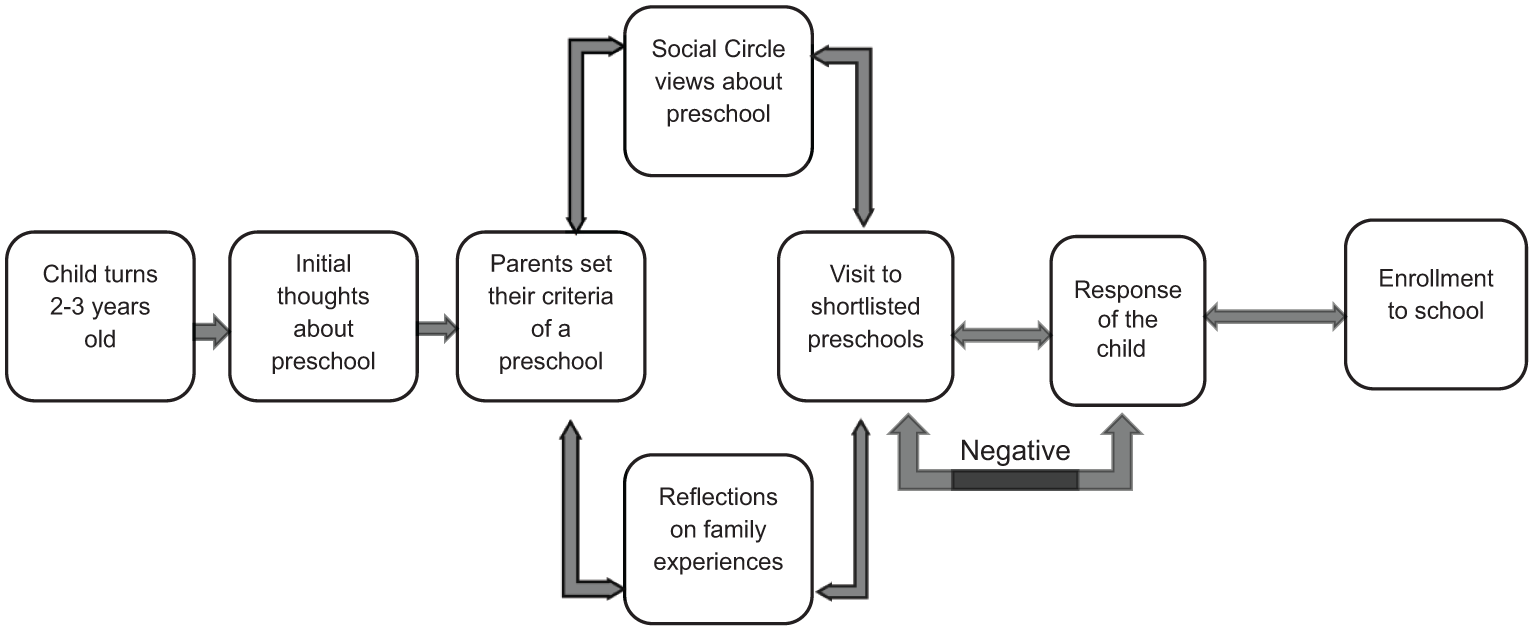
Process of selection of preschool.
Discussion
Parental experiences in preschool selection: A complex transition
The experience of parents while going through the selection process of a preschool is a relatively understudied topic in India, especially among urban populations. The purpose of this study was to understand the experiences of parents while transitioning to selecting a preschool for their child and then going to preschool after being homebound for their initial 2–3 years after birth due to COVID-19. The results of this study demonstrate that all parents went through a similar process starting with initial thoughts regarding how their home-bound baby manages a preschool, followed by defining criteria for the perfect preschool, then gathering data from social circles and remembering their own family life examples of children going to preschool. After shortlisting preschools, parents typically visit some or all of them, with the majority subscribing to the idea of a “love at first sight” concept. They are eager to gage their children’s immediate reactions to the school environment and teachers, viewing their children’s response as a crucial decision-making factor. This underscores the child-centric approach adopted by most parents, making it challenging to distinguish and separate the parents’ feelings from their children’s feelings. Then looking into all the other factors parents go on selecting a preschool and sending their children there. The definition of a preschool varied from parent to parent while the concern regarding their children not having any social life earlier emerged as a common theme for all parents within the context of pandemic. Thus some parents were really anxious and scared of how their children are going to react and respond while some other parents were really excited as their child is first stepping into a social world where they will potentially make a lot of memories that they will cherish for lifelong.
Parental beliefs and influences on preschool choice
According to Choice theory (Glasser, 1999) , beliefs govern behavior and what parents believe about preschool and early childhood education governs and decides the type of preschool that their child will be. Literature states that this belief is usually dependent on the level of education of parents and the literacy practices of home (Manigo and Allison, 2017). The results of this study appeared to agree on this concept, as all the parents were well educated and most of them working thus they firmly believed in the importance of early childhood education. Drawing from parent’s beliefs, parents knew what exactly they were looking for in a preschool and this was related to the child’s happiness and the expected educational and functional outcomes that they wanted to achieve.
The influence of urban context and cultural factors
The urban context of this paper also informs the factors that influence parental choice of preschool. Parents are most inclined to a preschool system that is play based or activity based rather than the traditional method. Only 1 parent from the 12 chose a preschool based on their religious values, all other parents had either distance or the play based method as their first criteria. This is contradictory to the findings of a study conducted in Malaysia where the primary factors were safety, quality of teaching, hygiene and religious values (Dahari and Ya, 2011) Parents in India took safety and hygiene as implicit requirements of any educational institution.
Social support and the transition process
Placing the results within transition theory, it explains how individuals going through transition seek help and support from other individuals who have either already experienced this transition or are in the process of transition (Parker, 2005). Parents in this study also shared how speaking to their social circles gave them references, suggestions, and reassurance. Social support theory states a hypothesis that social support alleviates the detrimental effects of adverse life events (Cobb, 1976). It states a hypothesis that social support alleviates the detrimental effects of adverse life events, a concept further explored in the context of the COVID-19 pandemic and its impact on parental stress (Loades et al., 2020).
Emotional impact of the transition
The transition has definitely caused an emotional rollercoaster, as the 12 parents explained that their feelings were at extremes. They were either extremely anxious and stressed or highly excited about their children going to preschool. Viewing the transition as a dynamic process, theory states that the process ends with the start of a new journey. By the end of the process of school selection, parents visited the school and enrolled their children in a particular school that aligned with the parents’ beliefs, criteria, and their children’s interests. The first few weeks were initially difficult for the children; however, all parents explained their relief in the present, as the children have now adapted well to the new context. Parents find relief in consistent interactions with their preschool teachers and receiving updates. This underscores the need for such support structures to be in place to ensure parents’ ease throughout the transition and their peace of mind as their children go to preschool.
Conclusion
This study explored the complex process of parents’ transition as their children enter preschool, particularly in the context of the COVID-19 pandemic. It highlights the critical considerations of urban parents when choosing a preschool, providing insights into their experiences during this significant transition. Urban parents emphasized the importance of play-based learning, safety, and teacher quality in their decision-making. The child-centric approach deeply influenced their choices, with the child’s immediate response to the school environment being a key factor. While preschool transition involves growth in independence and socialization, educators and parents must remain cautious about introducing overtly competitive environments. Evidence suggests that excessive competition, particularly with a strong emphasis on winning, can induce anxiety and diminish children’s intrinsic motivation to learn (Tsiakara and Digelidis, 2021). We next add our recommendations and acknowledge the limitations of the study.
Recommendations
Based on the study findings , recommendations can be made. Preschools should prioritize play-based learning and create child-friendly environments, as these are highly valued by urban parents. Establishing strong communication channels between teachers and parents is crucial for alleviating parental anxiety and building trust (Epstein et al., 2018). Preschools should also offer transition support programs to facilitate a smoother adjustment (Pianta, 2016). For parents, engaging in open communication with their children, seeking support from social networks, and considering multiple factors beyond their child’s initial reaction are recommended. Policymakers should invest in high-quality early childhood education and develop resources to support parents during this transition.
Limitations
This study has several limitations. Given the small sample size of 12 parents in an urban setting, the findings are not generalizable. Instead, this study provides in-depth insights into the nuanced experiences of urban parents navigating preschool selection. The reliance on self-reported narratives may introduce bias, and further research with a larger, more diverse sample could build on these findings. Additionally, the study was conducted during the COVID-19 pandemic, which may have uniquely influenced parents’ experiences (Loades et al., 2020). The findings may not fully reflect parental experiences in a post-pandemic context.
Footnotes

Funding
The authors received no financial support for the research, authorship, and/or publication of this article.
Declaration of conflicting interests
The authors declared no potential conflicts of interest with respect to the research, authorship, and/or publication of this article.