






Abstract
Children’s screentime is commonly viewed as passive and problematic. Current focus on reducing the time children spend using digital technologies has meant screentime is quantified often at the expense of considering the quality of children’s digital interactions. These ‘clocking’ practices tend to overlook the potential for children’s digital play to foster movement and relationships with others. Building upon childhood scholarship that has suggested children’s experiences of time are not always linear, nor in line with adults’ expectations, we consider alternative temporalities in relation to children’s screentime. We explore video data from weekly digital playgroups in the Children’s Technology Play Space (CTPS), a living lab for the Australian Research Council Centre of Excellence for the Digital Child, focused on movement to highlight that children’s play can intersperse between the digital and the physical, and at times can concurrently be both. As such, we challenge the assumption that screentime is always sedentary. Considering how interactions between children, adults, nonhuman things, and digital technologies such as Augmented Reality (AR) enabled varied movement and imagination, we invite conceptions of children’s sedentary screentime to be re-thought.
Sedentary screentime
Screentime is a contemporary facet of childhood threaded through public consciousness, family routines, educational curricula, and policy debate. The significant research attention screentime has received in part reflects growing concerns about the increasing prevalence of digital technologies in children’s lives (Mannell et al., 2024) and the possible implications for physical and socio-emotional health (Aliyas et al., 2025). The result, however, is screentime has become synonymous with sedentary digital activity, despite ambiguity about what constitutes screentime. Public health research, for example, distinguishes between time spent using a screen-based device (e.g. smartphone, tablet, computer, television) while being stationary, sedentary or active (Tremblay et al., 2017). Although sedentary screentime – engagement with digital screen-based technologies involving sitting, lying or reclining and low energy expenditure – increases the likelihood of adverse health outcomes for children (Poitras et al., 2017; Sanders et al., 2024), screen-based behaviours may ‘be performed while being sedentary or physically active’ (Tremblay et al., 2017: 10). Screentime is not necessarily passive.
Nor is screentime necessarily problematic (Livingstone and Franklin, 2018: 434). The educational opportunities and social connection possibilities afforded by digital technologies, including fostering co-learning and digital literacy skills (Kervin and Comber, 2021) and enabling relationships with (distant) family members or friends, are often why they become a normal and justifiable part of family routines (Lewis et al., 2023, 2024; Zabatiero et al., 2024) as well as early childhood education (Australian Government Department of Education (AGDE) , 2022; Kervin et al., 2019). Despite this, in everyday conversations, screentime is considered a homogenous activity (Livingstone and Franklin, 2018), and the ‘sedentary’ is rarely qualified. In this paper, we underscore the interwoven but contingent nature of passive and problematic understandings of screentime by rethinking the temporal and relational possibilities arising from screentime. We contend with assumptions that screentime is inevitably passive and problematic and consider how this reinforces time-based restriction surrounding children’s digital technology use.
Whilst we would like to broaden understandings of children’s screentime, we acknowledge the considerable public health research suggesting screentime should be limited for children. For instance, reviews and meta-analyses indicate that higher levels of screentime, particularly television viewing, may be adversely associated, although sometimes weakly, with a range of health and developmental outcomes among children including unhealthy weight (Poitras et al., 2017; Sanders et al., 2024), cognitive and learning outcomes (Mallawaarachchi et al., 2024; Poitras et al., 2017; Sanders et al., 2024), psychosocial development (Mallawaarachchi et al., 2024), attention deficit hyperactivity disorder (Liu et al., 2024), and myopia (Ha et al., 2025). Based on this evidence, 24-hour Movement Guidelines in Australia and other jurisdictions recommend that sedentary screen time should be ‘no more than 1 hour’ for children aged 2–5 years and ‘limited to no more than 2 hours per day’ for children 5–12 years, (although a distinction is made for ‘recreational’ sedentary screentime for children over 5 years of age; Australian Government Department of Health, 2018).
‘Dose limits’, however, have been criticised internationally as unrealistic, not supported by dose-response evidence, and not reflective of the opportunities afforded by quality interactions with digital technologies (Straker et al., 2023). As Sanders et al. (2024: 87) conclude, ‘current guidelines may be too simplistic, mischaracterise the strength of the evidence or do not acknowledge the important nuances of the issue’. As such, consideration of screen use – which accounts for contextual factors and the nature of digital interactions – is needed (Kervin and Verenikina, 2017; Mallawaarachchi et al., 2024). Shifting the conversation from the quantity of screentime to the quality of screen use focuses on what children – and co-users – do with technologies rather than assume passive and problematic consumption (Kervin and Verenikina, 2017); it moves beyond normative understandings of screentime and asks we do more than count minutes.
Whilst time is at the heart of the conversations regarding children’s screentime, little conceptual attention has been given to the notion of time. As such, we follow Mannell et al.’s (2024) call for greater theoretical engagement with screentime by considering the temporal multiplicity of children’s digital play. We ask, what if the problem was not the screens per say, but rather, was time? And not the length of it, but our understanding of it in children’s lives? If we reconsider children’s relationship to time, might we shift thinking from screen use quantity to quality?
Drawing upon examples from digital playgroups at the Children’s Technology Play Space (CTPS), a living lab for the Australian Research Council Centre of Excellence for the Digital Child based at the University of Wollongong’s Early Start Institute, we contend that counting (and hence limiting) screentime forgets the ever-present possibilities for movement in children’s post-digital lives (Edwards, 2023). Our emphasis on movement rather than physical activity is deliberate. While a public health perspective defines physical activity as ‘any bodily movement produced by skeletal muscles that results in energy expenditure’ (Caspersen et al., 1985:126), our focus on movement shifts away from outcome-oriented and individualised understandings that ‘perpetuate privileged ideas of how movement should happen’ and takes account of the ‘complex, entangled’ ways movement may be(come) meaningful to children (Land and Todorovic, 2021: 241).
Exploring the relationship between sedentary – screen – (and) time, the analysis presented below considers children’s alternative temporal experiences of screentime as situational, rhythmic, iterative, and intermittent; in other words, not easily measured or counted. We acknowledge that children’s relationship to time in their digital play is not a given and aim to expand what is valued and valuable about children’s screentime. In short, we re-think time with the hope of moving the screentime conversation beyond ‘the boundaries of binaries’ such as active/passive and positive/problematic that are ‘unrepresentative of the realities of children’s and families’ digital lives (Hood and Tesar, 2019: 310).
Re-thinking child and (screen)time
Chronological understandings of time are deeply embedded in conceptions of childhood as a particular phase in a lifespan, both located in pasts (as bodies age) and/or futurized (as capacity yet-to-be realised) (Duhn, 2016; Murris, 2016; Tesar, 2016). As Duhn (2016: 378) suggests, ‘childhood as a concept is steeped in assumptions about time’, determining what is appropriate, for whom and when. Even in early childhood education, children’s activities are organised by the clock (Pacini-Ketchabaw, 2012: 155): The clock structures both the arrangement of children and educators in the classroom and the very practice deployed throughout a regular day. At the same time, it produces particular knowledges about what it means to be an educator and what it means to be a child in an early childhood classroom. The clock is fundamental to how early childhood education is understood, organized, and enacted.
We recognise the resonances between these ‘early childhood clocking practices’ which characterise children as ‘unruly human beings in need of intervention’ (Pacini-Ketchabaw, 2012:155–158), and how children’s digital activities are organised, timed, or time-bound by governments, educators, parents, or devices themselves. Recent research by Healy et al. (2024) has drawn attention to the temporal multiplicities parents adopt to understand children’s engagements with digital technologies. Drawing upon Bergson (1913/2001) theorisations of time, these authors highlight parents’ subjective experience of time during the pandemic, a felt sense of time going quickly and slowly, occurring alongside clock or calendar time which predominantly shape narratives of screen use. While this meant some had ‘given up’ using clock-time to parent children’s screentime, for others, anxieties surrounding responsible parenting still resulted in time-bound regulatory practices (Healy et al., 2024: 63). Indeed, chronological time often determines how children’s digital lives are understood as problematic or filled with future potential (Livingstone and Blum-Ross, 2020), organised in daily learning or household routines, and enacted in line with assumptions, restrictions, and occasional resistances (Lewis et al., 2023, 2024). Building upon this, we consider the temporal multiplicities in children’s play with digital technologies, rather than parent’s disciplining of them. Although we acknowledge that for children, time is often ‘under adult control to give or take’ (Moxnes and Aslanian, 2022: 282).
How might we recognise temporal multiplicity in children’s digital play? Whilst children’s development towards adulthood usually means ‘bringing children into the experience of chronological time’ (e.g. through education) (Kohan and Weber, 2020: 3), there are occasions when adults can become attuned to children’s experiences of time. For Weber (2020: 44) this requires ‘getting lost in the situation of play’ to appreciate children’s situational experience of time: In chronological time there is only past and future, but no present, no lingering in the moment, no getting lost in the situation of play.
Children’s alternative temporal experiences may also be highlighted when ‘child’ and ‘adult’ times appear to be out-of-sync, such as moments when children ask questions that adults do not expect (Moxnes and Aslanian, 2022; Peach and Haynes, 2025) or when children’s movements emerge non-linearly, for instance, returning to exhibits in museum spaces (Hackett and Somerville, 2017; MacRae et al., 2020). Taking notice of these moments can draw attention to children’s rhythms (Duhn, 2016; Moxnes and Aslanian, 2022), and how different temporalities materialise in children’s relations with adults and nonhuman others to ‘set new things in motion’ (MacRae et al., 2020: 138; Peach and Haynes, 2025).
Noticing these rhythms and moments ‘out-of-sync’, however, requires holding both time ‘as a universal linear constant defined by physics’ and temporality – as non-linear, complex and diverse experiences in the ‘thick present’ (Facer, 2019:6) – in connection. Time and temporality, like child and time, are entangled concepts (Murris and Kohan, 2021).
Following Murris and Kohan (2021), we do not condemn chronological time but contend that this appreciation of time is inadequate on its own for understanding children’s screentime. This is because chronological time takes on a universal, objective neutrality; ‘in chronos every “moment” is qualitatively the same as any other moment’, making it difficult to attend to chrono-logics underpinning policies and practices (Murris and Kohan, 2021: 592). Instead, we attend to temporalities that are dis/continuous, including critical moments of significance (karios) and playful, unbound ongoing flows (aion) (Murris and Kohan, 2021). The hope is that these ‘philosophical and methodological moves’ allow us to re-think screentime: Through thinking and doing differently with time, alternative relations appear – mundane, unheard, unspoken childhoods become extraordinarily powerful. The grand narratives that bind the field of early childhood to particular conceptions of time fall apart. (Tesar, 2016: 363)
Below, we focus on the relationship between children’s movement and digital technology use as a way of noticing the temporal multiplicities of children’s play, even within ‘designated areas or periods of time’ of physical-digital play (Pettersen et al., 2025: 2).
Method
This paper draws upon a subset of visual-audio data generated from a series of eight ‘digital playgroups’ in the CTPS between July and September 2024. The CTPS is a ‘living lab’ for the Australian Research Council Centre of Excellence for the Digital Child and part of the ‘Discovery Space’, a children’s museum situated on the University of Wollongong campus. The CTPS engages children (aged birth–8 years) and their families in playful digital experiences, where technology supports and extends child-led exploration and activities (Kervin et al., 2024). The CTPS serves as a research-translation space where children and families’ attendance is voluntary and free flowing, meaning they can move between the CTPS and Discovery Space. Although the activities might differ from everyday screen use, they provide inspiration for possible play with digital technologies, sharing ideas and insights that may be applied in children’s home or educational environments.
Ethical approval for research conducted in the CTPS was provided by the University of Wollongong Human Research Ethics Committee [2022/107]. Across all research projects conducted during digital playgroups, upon entering the space parents, carers or guardians are informed that activities are part of ongoing research exploring, with children, digital learning and play. Parents, carers or guardians are provided participant information sheets and consent is sought using an online form. The research is verbally explained to children and their assent continually monitored. Audio-visual, photographic and observational data are collected using mounted and hand-held devices in ways that mitigate against unwanted intrusions whilst providing rich possibilities for learning about children’s worlds (Haggerty, 2020). In the CTPS, children are often invited to participate in the generation of data, for instance through art-making, taking photos or commenting on data. This offers tangible opportunities for children to explore research participation with researchers, actively contribute to data generation, and comfortably withdraw or express their wishes (e.g. articulating that they do not want a photo to be shared). Children and families are made aware that they can continue to take part in activities after withdrawing or stopping participation. We acknowledge the complex asymmetries of power in research with children and focus on cultivating an ethic of care that is attentive to ‘both the possibilities and risks in seeking to do better by children’s perspectives’ (Haggerty, 2020: 11).
During July–September 2024, 94 children visited the space and engaged with activities focused on children’s movement (Table 1). Activities were designed and adapted iteratively, drawing upon research regarding children’s physical activity and digital technology use (Cliff et al., 2017). Types of movement promoted through the activities included sitting upright, running, jumping, crawling, balancing, stretching, twisting, turning, transition from lying, push up, cyclical arm movements, and fine motor skills (such as, tapping on the screen, scrolling). Soft animal toys and sensory objects were available across all activities and themed music played in the space.
Overview of activities.
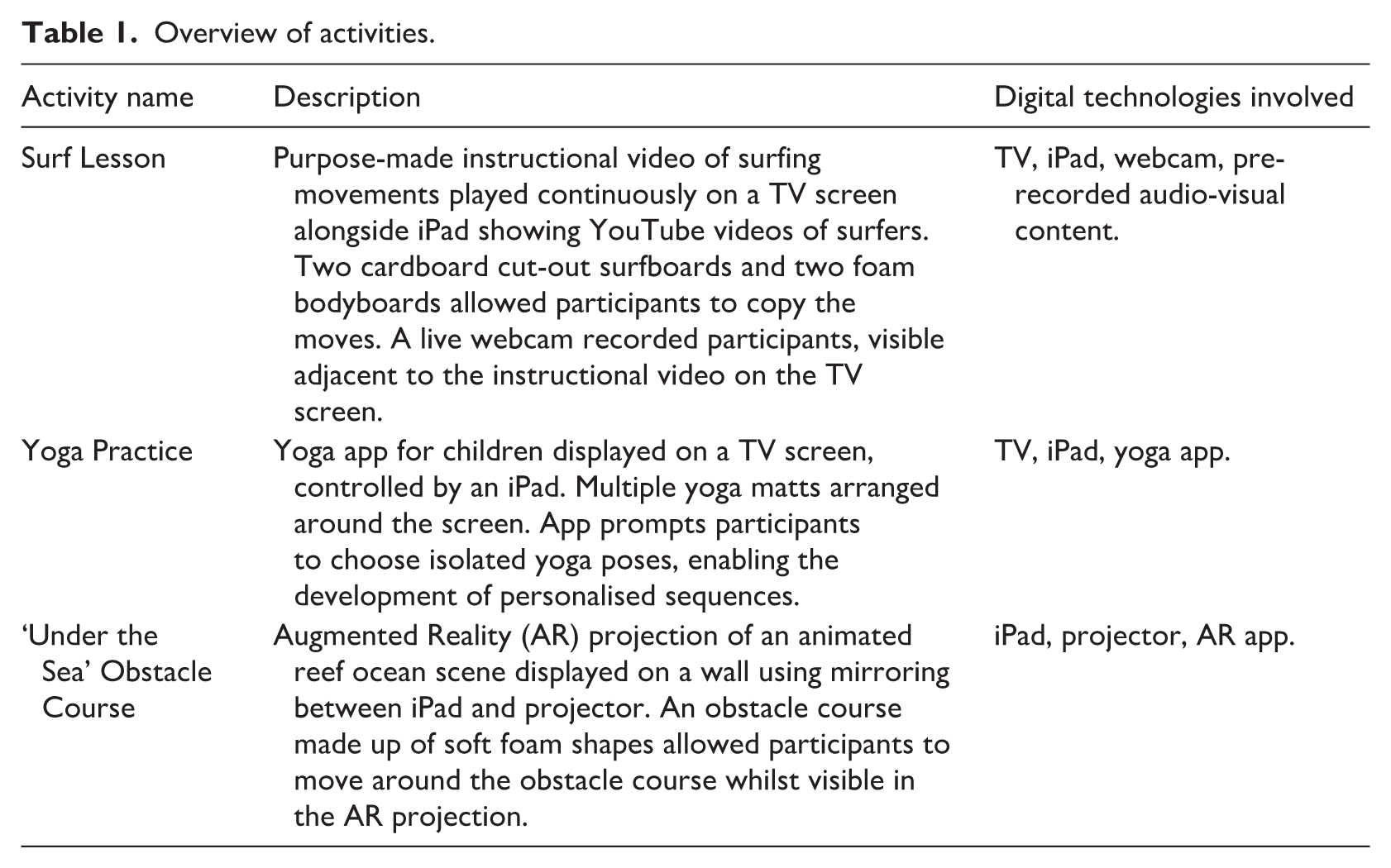
The activities generated over 10 hours of video data (obstacles: 8 hours; surfing: 45 minutes; yoga: 1 hour 27 minutes), ranging from a few seconds to 1 hour in duration; most were under 5 minutes. Data that resonated with the team and seemed relevant to the research questions became the focus of analysis. The research questions included: How does the use of (non-)digital technologies in the CTPS support movement?; How does children’s play with (non-)digital technologies make visible temporal aspects of their movements and interactions?; What do these movements contribute to our understandings of children’s screentime?
In the analysis, we took up Hackett and Somerville’s (2017: 377) proposal of ‘staying for a while with the notion of movement within our data to see what emerges’. We worked with different yet complimentary quantitative and (post-)qualitative (Rautio, 2021) approaches to consider what multiple analytical frames might tell us about children’s screentime. For Rautio (2021) post-qualitative approaches do not replace quantitative/qualitative methods but experiment with them to think about research, data, and analysis differently. Concepts, theory and the specifics of the research context are foregrounded such that, rather than applying methods, what emerges from and with analytical processes becomes central. For us, rhythm, pace, intervals, and flows were significant in the relationship between children’s movement, screen engagement, and interaction with other children, adults, or objects. We problematised each aspect of children’s sedentary – screen –time, engaging with the data multiple times, using various analysis techniques. We paid attention to how the data became ‘sticky’, causing us to pause, re-think and re-analyse (MacRae et al., 2018). We experimented with slowing the speed of the video data and noting the number of seconds when children looked at the screen either when moving or still, interacting or not interacting. As a result, the analysis itself played with different notions of time and did not follow a linear trajectory from ‘raw’ to ‘synthesised’ data but unfolded iteratively (Murris and Kohan, 2021).
Findings: Movement episodes from the CTPS
The three episodes described below detail interactions occurring during the ‘Under the Sea’ Augmented Reality (AR)-obstacle course. Table 2 provides a brief description about each episode.
Description of data episodes.
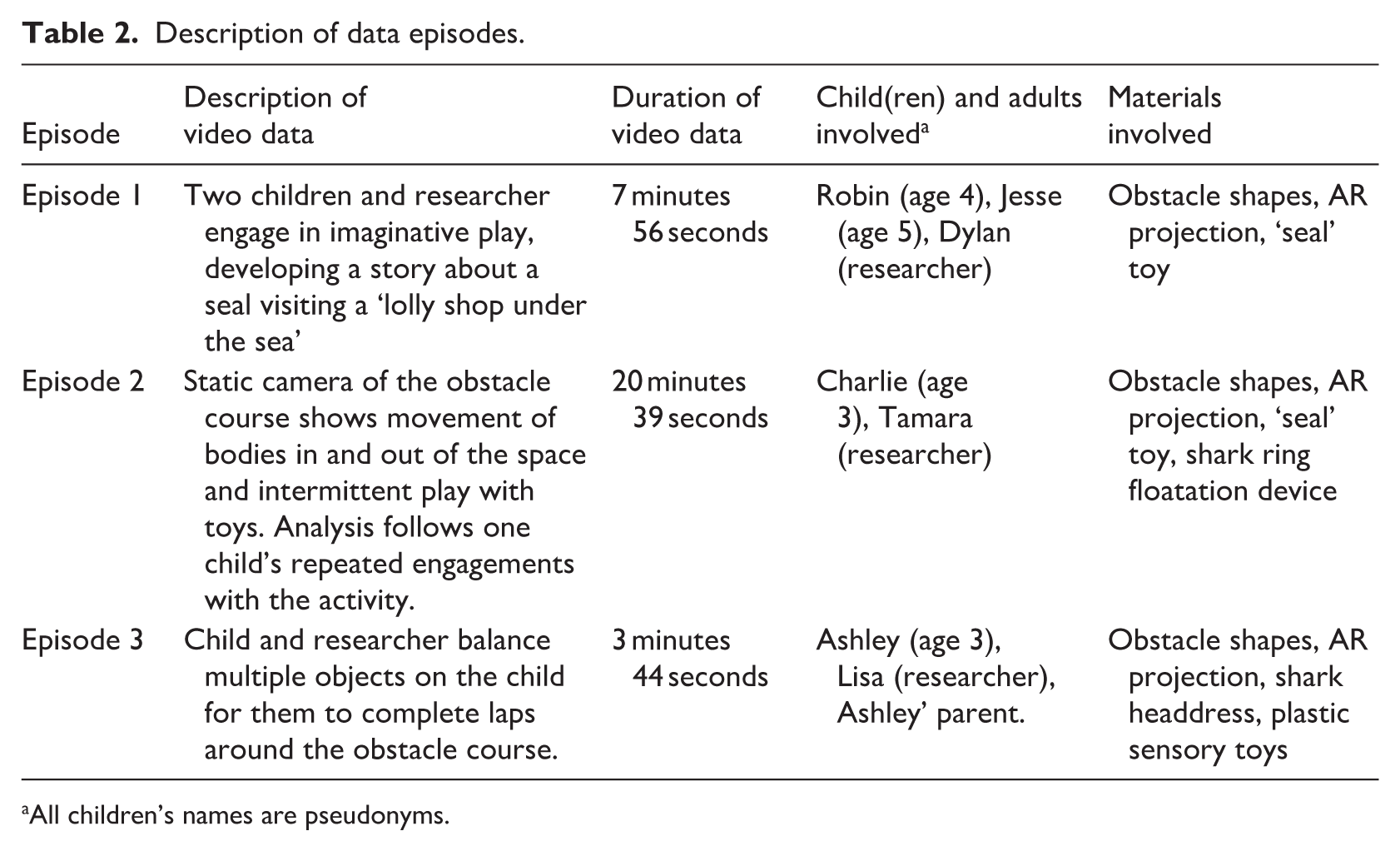
All children’s names are pseudonyms.
Episode 1 – The dis/continuity of screentime
Robin, Jesse and Dylan (researcher) move around the obstacle course. They jump between spongy red cubes (or ‘rocks’) and traverse along foam balance beams, ‘swimming’ in the water (Figure 1). The obstacles and AR ocean scene provoke imaginative play. For instance, when Dylan slips from an obstacle, Robin suggests a shark is ‘trying to eat you, it’s got your foot!’. They also throw and catch a toy ‘seal’ whilst jumping and falling from the ‘rocks’. Their movement around the obstacle course coincides with collaboratively generating a story about the underwater environment, as the researcher asks, ‘where might the seal like to visit underwater?’ and Robin replies, ‘a lolly shop!’. As they continue moving, Jesse joins in the play, suggesting it is a ‘seaweed’ lolly shop. A scenario unfolds involving the seal selecting a lolly, which Dylan delivers in exchange for ‘six seaweed bucks’.
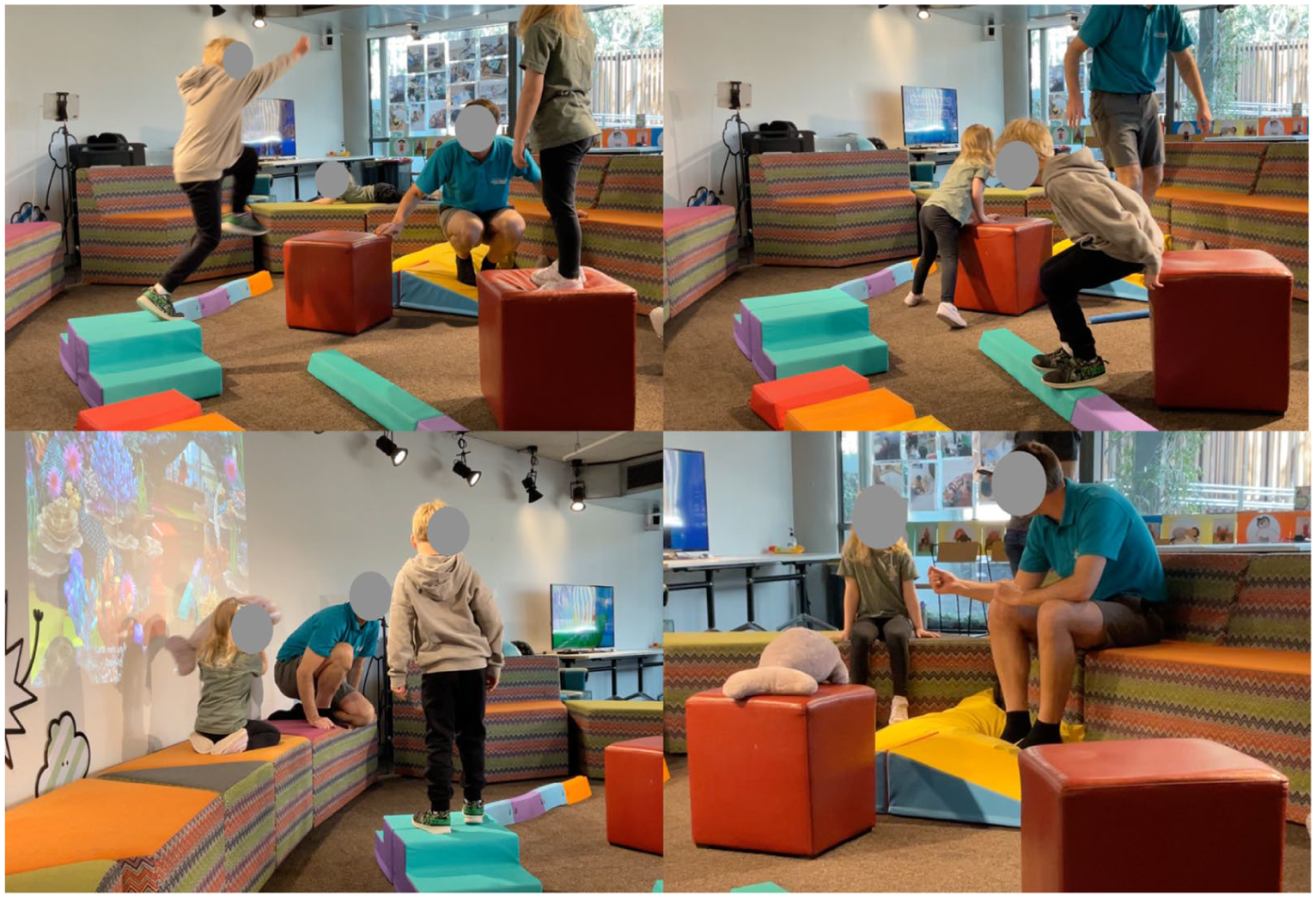
Children and researcher leaping between obstacles, taking the seal to the ‘lolly shop’ where researcher offers an imaginary lolly.
The storytelling encouraged and extended children’s participation in the obstacle course. Following each other, taking turns, and stopping to craft the narrative slowed the pace of movement, inviting pauses where children and adults sat or crouched on the obstacles and sofas. Using quantitative video analysis, we slowed the pace of our viewing, coding each second of footage and noticing whether each child was sitting or standing still; interacting with others; and looking at the AR projection (‘screen’).
During the 7 minutes and 56 seconds of video footage, Jesse spent 2:56 minutes not moving, 2:31 of which involved interacting. From a total of 30 seconds spent looking at the screen, 19 seconds involved them interacting. In other words, 93% of the time, Jesse did not directly engage with the screen, and when they did, they were also mostly interacting. For 4:31 minutes Robin was sitting or standing still, however, for 4:10 of this time they were also interacting. Whilst Robin spent double the amount of time as Jesse looking at the screen (1 minute in total) they spent 42 seconds of this ‘sedentary screen time’ interacting. Jesse moved more, Robin interacted more; both interacted for most of the time spent sedentary or engaging with the screen.
This suggests the AR projection provided the context for movement (e.g. trying to stay out of the water, leaping between rocks), and the imaginative engagement (such as being eaten by a shark or seal toy visiting the seaweed lolly shop). Children, adult researchers, and objects shared in the intensity and interactivity of the encounter and ‘need[ed] time to. . .tune their bodies to what is going to happen next’ (Moxnes and Aslanian, 2022: 284). Screentime supported embodied thinking, multi-modal storytelling, and invited things into motion, into play.
Interestingly, when each second is treated the same – when we assume time as chronological, universal units (Murris and Kohan, 2021) – Robin appears to move less and engage with the screen more than Jesse. Yet, when we focus on Robin’s sedentary engagements with the AR, screentime becomes conducive to quality digital interaction involving co-play (Kervin and Verenikina, 2017). This makes visible how stops, pauses and the ever-present AR projection – the dis/continuity of screentime – deepened the interactions between them, inspiring transitions between being sedentary and moving. Paying attention to this temporal variation permits moments of screentime – including sedentary screentime – to be understood as what Hackett and Somerville (2017: 374) describe as, ‘movement within in-the-moment becoming’. Stops, pauses and sitting to engage with the AR projection (or sedentary screentime) become significant (karios) and intense (aion) moments (Murris and Kohan, 2021), holding potential for different kinds of movement and multi-modal communication between researcher and children (Hackett and Somerville, 2017).
Episode 2 – Flows in and out of the activity
In analysis of this episode, we followed Charlie, a toy ‘seal’ and a shark rubber ring as they moved in and out of the activity. Rather than being recorded by a researcher with hand-held device, this episode was generated by a ‘static’ iPad mounted in the corner of room. This disruption to a human-centric gaze is echoed in our (re)presentation of the data, organised in the form of a storyboard (Figure 2). Although progressing linearly, we have kept the data in this form to illustrate the pervasiveness of chronological time in our initial analysis.
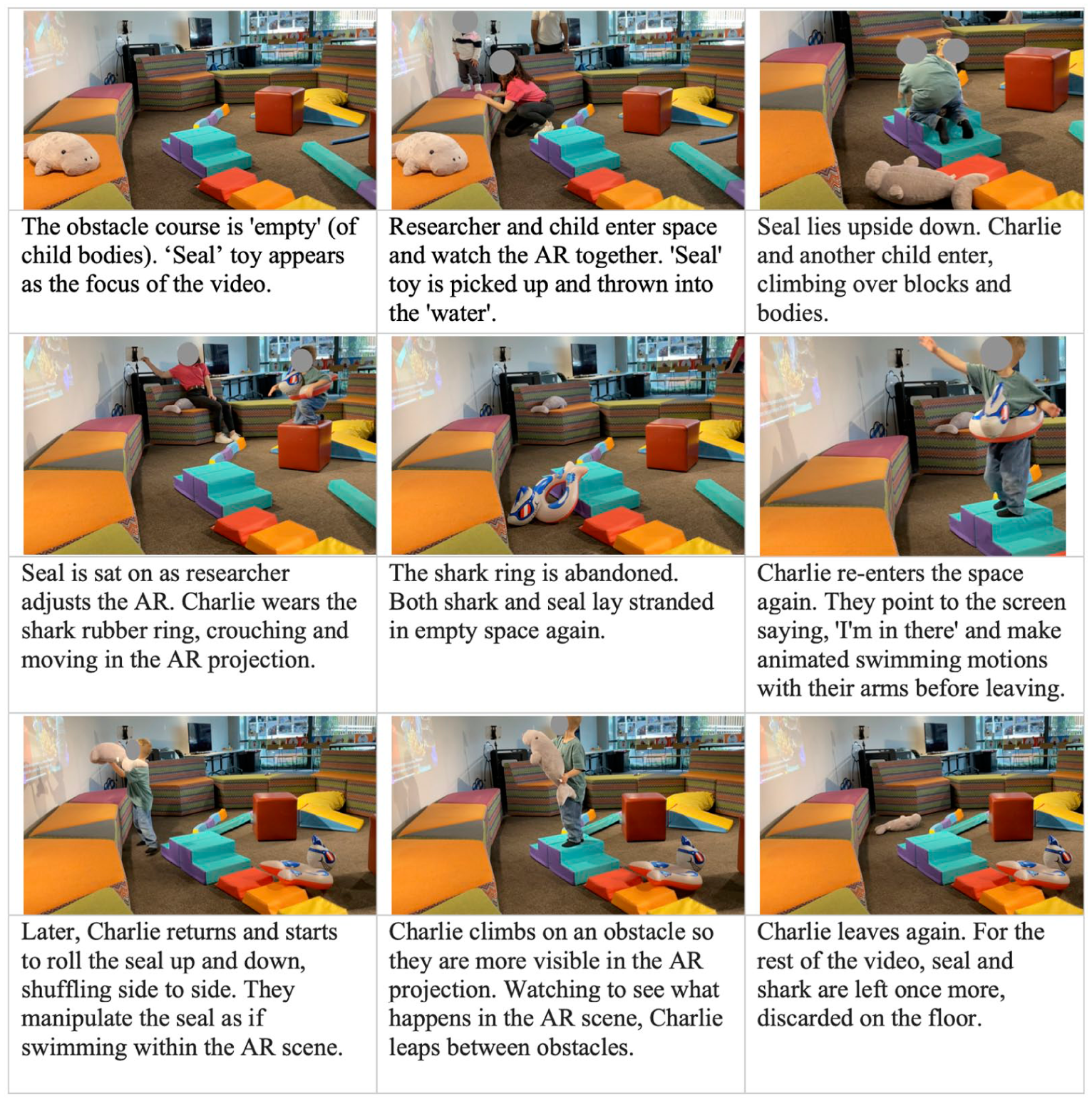
Storyboard of the seal toy and shark rubber ring as they are repeatedly played with and discarded by children.
In this episode, toys, researchers and child bodies flowed into, out of, and within the AR obstacle course. Charlie made several repeat visits to the activity, familiarity giving rise to different types of movement with each return (Hackett, 2014). As Charlie became more animated, the real-virtual space of the AR obstacle course provided possibilities for distinctive movements, such as climbing, crouching and ‘swimming’. As they ‘swam’ with the shark rubber ring and seal toy, Charlie connected the physical materiality of the objects with the virtual environment of the AR.
For Charlie, screentime was situational and responsive to the affordances of both digital (AR) and non-digital (seal toy, shark rubber ring, red cube box) materials. Scollan and Farini (2020: 37) describe such activities as ‘hybrid-transitions’ in which children ‘display a type of agency that concerns their epistemic status’. Charlie directed the screentime and engaged in iterative, discovery-based learning across real/virtual spaces (George et al., 2020) – moving bodies (including their own and seal/shark toys) so they could be ‘in there’, in the underwater scene.
By repeatedly returning to the AR obstacle course (MacRae et al., 2020), Charlie’s engagements troubled our expectations of children’s play being a single, enduring encounter. Charlie’s (and the seal and shark toy’s) movements in and out of the activity drew our attention to rhythmic flows (aion), out-of-sync with what we anticipated. By attuning to the richness of re-engagements, alternative rhythms (Duhn, 2016) of screentime beyond continuous and linear ‘clock-time’ emerged. Likewise, these re-engagements disrupted the expected need for screentime limits; there did not need to be adult intervention to organise ‘unruly’ child bodies within the digital experience (Pacini-Ketchabaw, 2012), as Charlie dis/re-engaged on their own in a more fluid, non-chronological experience of screentime.
Episode 3 – Un/bounded rotations
Ashley moved around the obstacle course balancing an array of colourful sensory objects on their arms (Figure 3). Together with the researcher, Lisa, Ashley completed laps around the obstacle course. Lisa helped Ashley place a shark headdress on their head and load hoops and rubber sensory strings onto their arms. Monitoring the objects’ movement, Ashley adjusted the pace and rhythm of their motion around the course. When the objects fell, Ashley stopped, seeking help from Lisa and their parent to re-loop the strings. Once reassembled, Ashley and strings continued around the AR obstacle course.
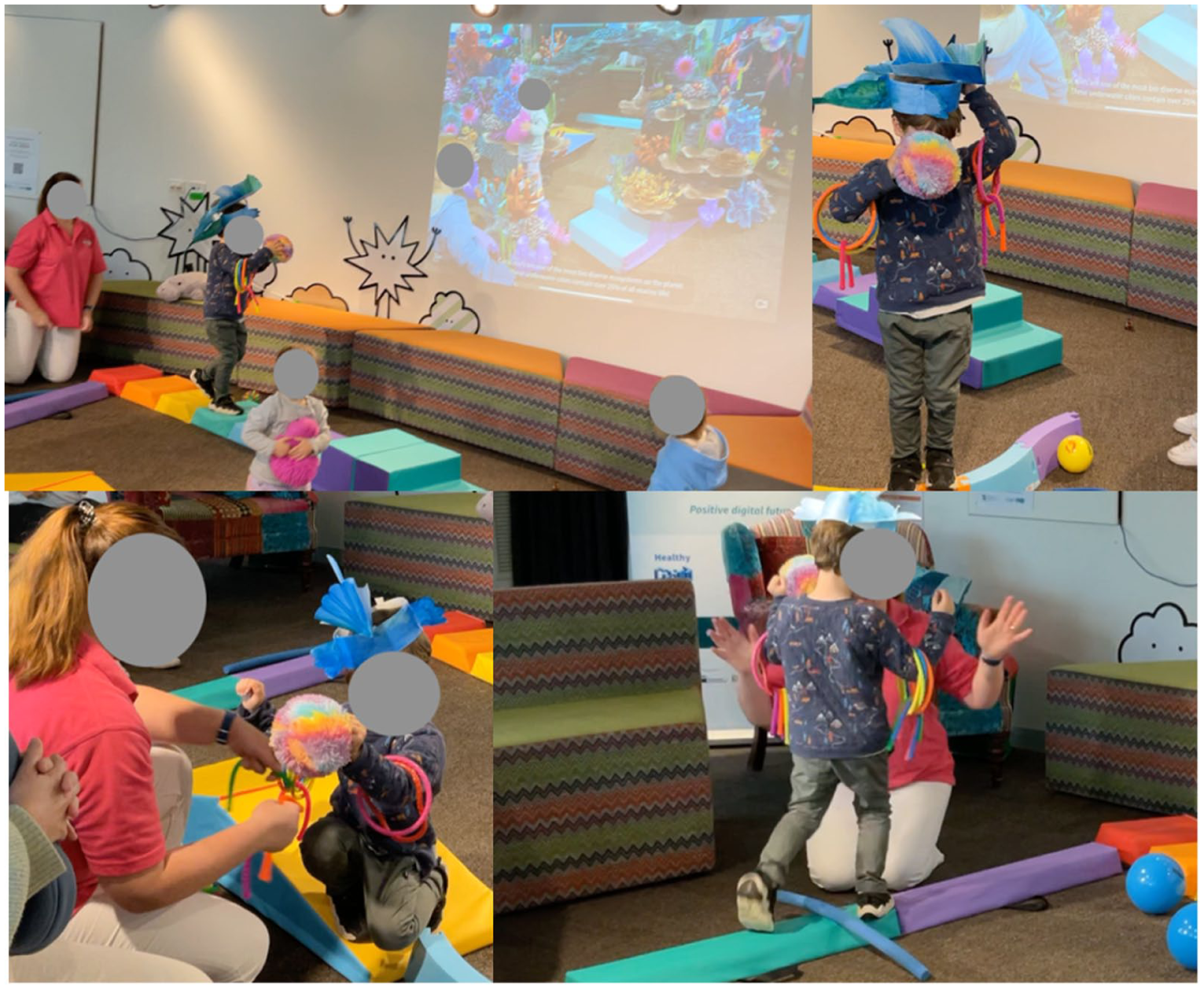
Child navigating the obstacle course whilst balancing with a shark hat and sensory toys.
This episode caught our attention as we noticed Ashley did not just want to balance on objects (obstacles) but with objects (sensory toys). We considered how we might mimic this with-ness (Wargo, 2019) in the (re)presentation of the episode, blurring the boundaries between child, AR ocean scene and sensory toys: How might it feel to float? To tread our path together with poise. To hang on and over rounded plastic. To feel the friction beneath us. Let’s sway and swing – and maybe even swim – in a real/virtual underwater adventure. Our colourful plumage draws attention to the motion of our frolic. Like a shoal of fish that trick the light with circular motion, we move together, bending around the digital illusion, twisting into ab/normal positions. The un/bounded rotations of our worlds unsteady our balance, displace our rhythm, disrupt our course. Warm hands and hurdles manipulate our assembly. Our wait and weight. . .just right as we perch. Let’s continue to teeter, stretching to hold ourselves up. To float.
This episode allowed us to explore the connections between linearity (e.g. start to finish) and repetitions (e.g. circular motions and the challenge to continue) (MacRae et al., 2020). Initially, we noticed Ashley’s clockwise rotations around the obstacle course’s circumference. Yet, playfully re-writing the episode surfaced the relationality between child-adult-sensory toys-AR obstacle course, suggesting the movements, rotations, and interactions between child-adults-objects were not completely bound by the chrono-logics of the start/end of the game (Peach and Haynes, 2025). Instead, continuity materialised as Ashley became ‘lost in the situation of play’ (Weber, 2020: 44).
As sensory toys fell from Ashley’s arms a different kind of temporal intensity was generated; each lap was not about the endpoint but an opening for ongoing connection and continued possibility. Disrupting the ‘search for rationality’ (e.g. what Ashley was trying to achieve) and the ‘assumption that thoughts exist first in the mind, then are actioned by the body’ (MacRae et al., 2018: 511), we considered how intention and movement emerged together: Thinking in movement is thinking that begins in the body and emerges through the body’s exploration of its possibilities for moving, being and sensing (MacRae et al., 2018: 511).
This ‘thinking in movement’ was perhaps most visible in Ashley’s stillness, required to balance on and with objects, which emerged through sensing, adjusting, and (re)collaborating. Such movement brings focus to the ‘thick present’ (Facer, 2019: 6), where possibilities (e.g., for balancing/falling) are held at the cusp. Ashley’s play was not only bounded by an arbitrary start/end of the AR obstacle course or game but also aligned with cyclical time (aion) that can refer to an unbounded duration, enduring, ongoing, playful (Murris and Kohan, 2021). Temporalities co-exist, overlap, are multiple. In this way, the (re)representation of data allowed us to think with our initial interpretation of Ashley completing laps and acknowledge that, as Murris and Kohan (2021) note, cyclical time (aion) is also linearly sequenced, a combination of different times.
Discussion
Through our analysis, the three episodes of children’s engagement with digital and nondigital technologies enabled understandings of children’s sedentary screentime to be reconceptualised. Whereas (chronological) time is at the forefront of conversation around screentime, these episodes shift thinking towards appreciation of children’s multiple temporal experiences, providing nuance to binary distinctions whereby screentime is considered active or passive, positive or problematic. Whilst we acknowledge the important contributions of public health research advocating for children’s healthy engagements with digital technologies, our aim has been to provide empirical examples that enrich understandings of screentime as also active, social, imaginative, and non-linear.
Across the episodes, our analysis focused on how screentime was experienced by attending to the temporal and relational influences upon children’s movement. The use of AR was crucial, transforming what possibilities for movement were available. The AR ‘under the sea’ projection offered opportunities for varied movement, serving as a ‘digital pivot’ supporting children to conceptualise the real world as the virtual world (Fleer, 2017). The AR allowed children and adults to change the meaning of objects in their physical-digital play, such as red cubes becoming ‘rocks’ (Verenikina and Kervin, 2011) and facilitated children to develop a ‘virtual imaginary situation’, in which, ‘new actions are possible’ (Fleer, 2017: 227–228).
The combination of the AR ocean scene and obstacle course generated movement which: (a) would not necessarily have been present without opportunities for multiple narratives (e.g. real-virtual play allowed for varied play); (b) encouraged movement not normally expected (e.g. swimming motions); and (c) offered opportunities for play of varying intensity and interactivity (e.g. co-play, prolonged engagements, moving in and out of the activity). This aligns with research that suggests the mixed reality of AR supports children to develop movement and motor skills (Adhe et al., 2024), promotes spatial thinking through interactive discovery (George et al., 2020), and encourages social interaction as well as ‘persistence, concentration and creativity’ in early childhood (Madanipour and Cohrssen, 2020: 8). For example, Robin and Jesse’s storytelling, Charlie’s returning to the AR projection on multiple occasions, and Ashley’s perseverance, brought attention to children’s movements in real-virtual worlds; each encounter deepening and prolonging their experience. These two words – deep and prolonged – are typically avoided in relation to children’s screentime (Bittner, 2021).
With each episode, children’s exploration of the AR and possibilities for imagination were extended by the material affordances of the objects. The combination of digital (AR) and non-digital (obstacles, soft toys, music) stimulated immersive, engaging experiences that encouraged movement through providing real-time feedback, whereby ‘children [could] see the results of their actions and make adjustments accordingly’ (Adhe et al., 2024: 1097). Each interaction between the children, materials, obstacle course and AR provoked ‘small thresholds of change. . .[that] remind us about the relationality at the heart of movement’ (MacRae and MacLure, 2021: 269).
Collectively these episodes suggest that by broadening our understandings of young children’s experiences of screentime, beyond the chronological and sedentary, we might illuminate how children’s digital lives do not always conform with (adult) expectations about when and how things should happen. The episodes suggest children’s screentime may be dis/continuous (Murris and Kohan, 2021), involving stops, pauses, inspired transitions, and differential (re-)engagements, despite its ever-present nature. In this way, children’s screentime may become non-chronological, generating moments of significance, opportunity and flowing intensity that indicate rich potential for quality digital experiences.
Additionally, this paper has demonstrated the potential for interdisciplinary and mixed methods approaches that combine philosophical and public health perspectives to re-think screentime. Future research might contribute further nuance to understanding children’s screentime by engaging in interdisciplinary studies of both screen use quantity and quality. Being aware of the chrono-logics and adult influences upon our analysis (Peach and Haynes, 2025), we encourage future exploration of children’s perspectives on time and temporality in relation to their screen use. We also recognise that for some this analysis may be limited as these episodes may not represent typical screentime – not being screen-based or digital ‘enough’. However, given the very meaning of ‘enough’ is what is at stake in conversations about children’s (over)use and sedentary use of digital technologies, and that ‘for many young people, the distinction between online and offline practices is superfluous’ (Dixon et al., 2024: 67), these episodes illustrate how screentime need not be condemned for its presence in children’s lives and play (Edwards, 2023; Pettersen et al., 2025). Children’s purposeful engagement with the technology was part of how children and adults responded, played, imagined and moved together. As even our quantitative analysis suggests, whilst measuring screentime duration may provide some indication about children’s digital experience, it cannot be divorced from the social, material, temporal, and relational conditions of its use (Lewis et al., 2024; Pacini-Ketchabaw, 2012).
Conclusion
In this paper, we have suggested that children’s screentime – including moments of sedentary screentime – are much more open to temporal variation (dis/continuity) (Murris and Kohan, 2021) and relational influences (the situations of play) (Kervin and Verenikina, 2017) than is currently appreciated. As such, there is a need to shift understandings of children’s screentime away from discouraging and dichotomous binaries (e.g. active vs passive, positive vs negative) (Hood and Tesar, 2019). Given that debates have largely focused on how much screentime is acceptable, theoretical engagement with notions of temporality add to the discussion by considering how screentime is experienced by children. Considering the temporal multiplicity of children’s screentime – stops, pauses, flows, repetitions, rhythms and rotations – rather than solely prioritising ‘clock-time’, is an important part of ensuring the quality of screen use is at the forefront of parent and educator decision-making about digital technology use (Kervin et al., 2019; Livingstone and Franklin, 2018). This is also likely to more appropriately reflect the ‘non-chronological lived times of many families’ (MacRae et al., 2020: 140) and their digital technology use (Lewis et al., 2023; Straker et al., 2023). By acknowledging that children’s relationship to time in their digital play is not a given, and not always in line with adult expectations, we may expand what is valued and valuable about children’s screentime and offer ways to re-think screentime beyond the clock.
Footnotes
Acknowledgements
We gratefully acknowledge the contributions of Jessica Mantei, Clara Maria Rivera and Tamara Gulic Phoenix and the expertise they bring to the research activities of the Children’s Technology Play Space, University of Wollongong. We thank Kate Lewis for her insights on an early draft of the manuscript.

Ethical considerations
This study was approved by the University of Wollongong Human Research Ethics Committee, approval number [2022/107].
Consent to participate
Informed written consent was obtained from all parents or carers of child participants involved in the study. Verbal assent was obtained from children, and verbal and non-verbal assent cues were monitored.
Consent for publication
Informed consent for publication was provided by all parents or carers of child participants.
Funding
The authors disclosed receipt of the following financial support for the research, authorship, and/or publication of this article: This work was funded by the Australian Research Council Centre for Excellence for the Digital Child (CE200100022).
Declaration of conflicting interests
The authors declared no potential conflicts of interest with respect to the research, authorship, and/or publication of this article.
Data availability statement
Data has not been made available due to ethical considerations and restrictions.