







Abstract
Police work is becoming extremely complex, challenging, demanding, and ill-structured, which calls for better problem-solving and decision-making skills from police workers. Participatory action research approach is applied to understand how training methodologies can contribute to creative thinking, exploration of alternatives and democratization, consequently enhancing the problem-solving and decision-making skills of field-level police workers. A series of five sessions with two groups of police workers provided substantial insights that informed the research methodology, the learning experience of participants and the relative value of various training delivery modes for improving problem-solving and decision-making skills. The methodology gave opportunities to the researcher and the participants to reflect on processes and learn from the feedback. The study reveals that the training must seek to give voice to the learners and help them to discover an agency through which they can critically reflect on the needs of their job and fulfil them. This study reflects on the question of rigour and relevance in PAR and provides directions for future research.
Introduction
The origins of the modern police force lie in the attempt to establish a ‘moral ordering of urban spaces and populations’ (Helms, 2007, p. 291). These origins are linked to the need to institute normative scripts of good citizenship and inscribe dominant moralities on public spaces (Imrie & Raco, 2003). Police workers perform the role of disciplining and punishing transgressions of these dominant moralities, and act as agents of social control and regulation (Foucault, 1979). While performing the role of ensuring security of life and property and enforcing justice, police workers face many practical problems and conflicting situations. It is, therefore, interesting to examine the dilemmas faced by police workers while performing their work.
This study draws from the researcher’s experience as a police officer in the Indian State of Gujarat to reflect on the training initiatives that could enhance the decision-making and problem-solving skills of police workers. Training initiatives can draw from the techniques of Freire (1972) who calls for a critical pedagogy where the ability of human beings to reflect on the contradictions and problems facing them is respected. Such training initiatives can lead to a problem-solving praxis where dilemmas in all their complexity are considered and creative solutions are found.
Policing context and training needs
The Gujarat Police is governed by the Indian Police Act 1861, inherited from the colonial legacy of India. The British legislated this Act with a limited purpose of perpetuating British rule in India (Joshi, 1999). The political system changed after independence in 1947 but the police system largely remained unaltered; this archaic Act continues to govern it; courts continue to distrust it; politicians and bureaucrats continue to exercise control over it; the managerial philosophy, value system and ethos has largely remained what it was; it continues to remain unaccountable to the public; and its organizational structure has largely remained unchanged (Joshi, 1999). In fact, the need for broader police reforms has existed since colonial times when the police force was regarded as being oppressive and inefficient (Alexander, 2006).
The job of the police is inherently conflictual and risky even while performing basic functions such as prevention, detection of crime and maintenance of law and order (Lal, 1999). Of late, police workers have been exposed to intense social and psychological pressures as they often have to engage with issues of violence and deviance, and take decisions from a range of choices such as pressing charges in court or issuing warnings or counselling the delinquents or resolving issues by holding meetings with the parties concerned. Increasingly, they also have to engage with issues relating to terrorism, insurgency, resistance and subversion undermining the authority of the State and threatening the sanctity of constitutional and political institutions (Lal, 1999). While rules exist to guide police workers, everyday action is embedded in a context where multiple stakeholders articulate plural voices. In the sense of enacted action, the structures of police work are held in tension between multiple social voices. Police work assumes particular significance as the meanings and metaphors of the State can powerfully emerge through the instrumentalities of the police. Thus, police work is becoming increasingly complex, challenging, demanding, and ill-structured, which calls for better decision-making and problem-solving skills in police workers.
The study of crime patterns and trends makes evident that the advancement in technology and communication has led to emergence of newer crimes, for example, cyber-crimes, environmental crime, etc. These newer forms of crime have increased the complexity of police job manifold, which calls for a corresponding response. But, the paradox in the current state of police training is that most of the training curricula do not address the needs of modern-day policing. The training programmes are mostly designed around such standard topics as criminal law and investigative procedure, firearms training, crowd control and proper use of force, traffic enforcement, etc. There is a need for training curricula which enhances the decision-making and problem-solving skills of police workers, and helps them to work in concert with communities (Birzer, 1999).
The training system in the Gujarat Police has existed for around 50 years in one form or another, and it caters to the need of more than 68,000 police workers, who join the police force at different levels. In addition to the basic training imparted at the entry level, the police workers are given in-service and specialized training in different phases. The sheer scale and diverse needs, for which the police workers are trained, makes the exercise structurally complex (Remington & Pollack, 2007).
At present the training of the Gujarat Police is looked after by ADGP (Training), a staff officer of the Director General of Police. Currently, there are four training facilities located in i) Junagadh, ii) Chowky (Sorath), iii) Vadodara and iv) Karai, Gandhinagar. The four distinct primary tasks that enable exploration into why various training facilities were set-up, and how its purposes are translated into action, are shown in Figure 1.
The four distinctive primary tasks of police training facilities.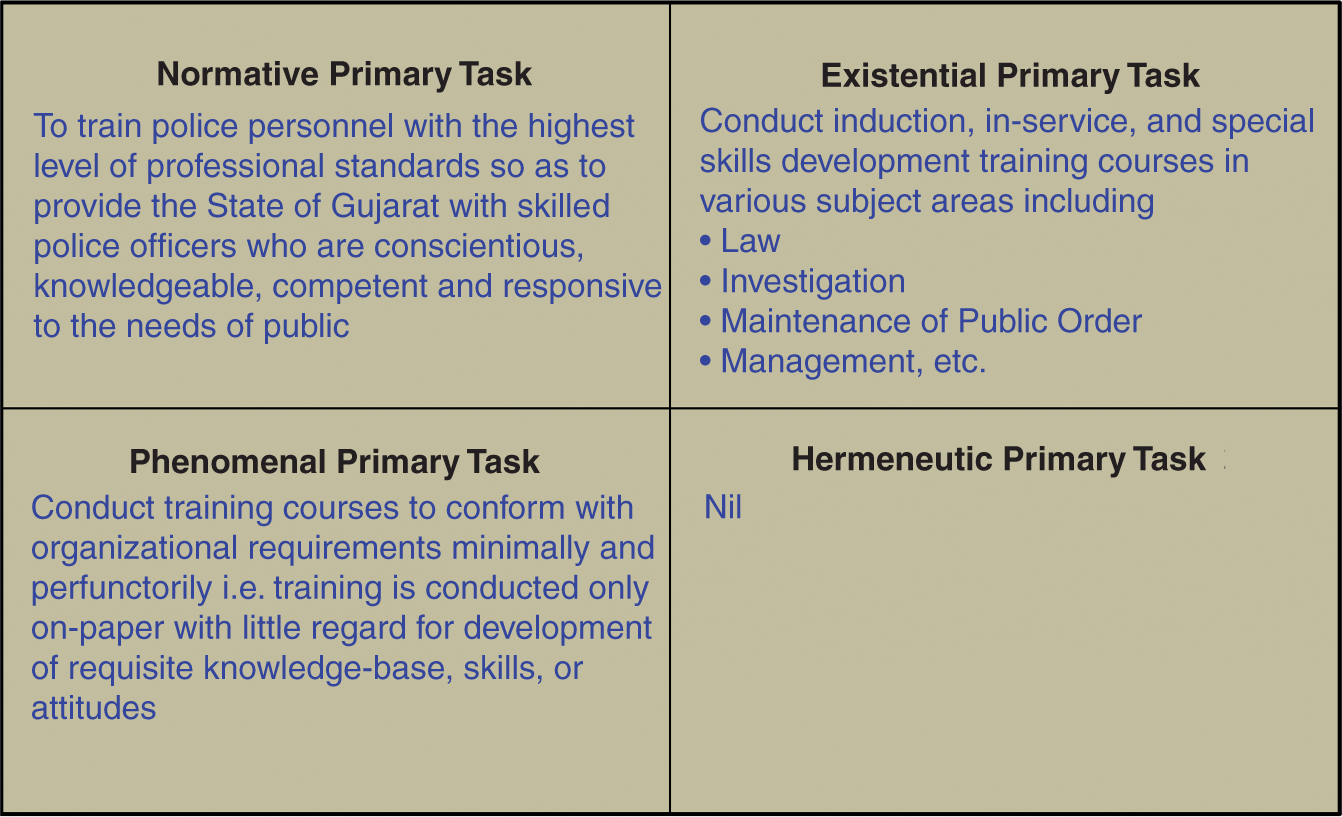
Although various training delivery techniques such as seminar, case-based learning, simulation, discussions, etc., are employed in the Gujarat Police; the training methodology is predominantly structured on the concepts of conventional pedagogical learning theory, that is, through lecture method. ‘Pedagogy literally means the art and science of teaching children’ (Knowles, Holton, & Swanson, 1998, p. 61). This mode of instruction constructs training as a dissemination exercise where an expert instructor delivers knowledge to participants (Knowles et al., 1998). While it may be useful in a learning phase where participants have very little knowledge of the subject matter, it restricts dialogues and deep engagements with participants who are familiar with the subject matter through their experiences (Knowles et al., 1998).
Critical pedagogy and learning
Freire’s (1972) Pedagogy of the oppressed opened up understandings of how human beings must not be understood as empty receptacles that can be filled with the enlightening agency of education. Human beings are moral, aesthetic agents whose deliberations with each other enable them to form judgements of right and wrong (Monchinski, 2008). Education in this sense can be compared to the processes of exposing, proposing and politicizing (Marcuse, 2009). Politicization here refers to problematizing everyday issues, and discerning the conflicts that underlie everyday phenomena (Monchinski, 2008). In the context of police work, it represents an understanding of the underlying dilemmas of work, and various social, ethical and professional choices that need to be made during the course of discharging one’s duty.
In training initiatives, democratization as an ideal can be pursued by understanding the significance of uncertainty, dialogue and struggle as processes which help human beings to critically reflect on phenomena and their roles in them (Roberts, 2005). Training processes can facilitate the construction of historically situated narratives, and encourage an explicit sense of concern for cultural others (Arnett, 2002). Training initiatives can reinforce a culture of respect by uncovering the choices available to human beings through the processes of history (McLaren, 1999).
Research approach
Action research (AR) links theory and practice through positive social changes and reflections on theory. Boog, Keune, and Tromp, (2003) defined AR ‘as scientific social research which is participatory and practice-oriented, which aims to find solutions to social problems and to emancipate individuals and groups confronted with such problems’ (p. 419).
Participative action research (PAR), the method chosen in this study, refers to the process through which the researchers and the stakeholders (those who potentially benefit from research results) work together in the designing and conducting of all phases of the research process, which includes formulation of questions, design, data collection and analysis, dissemination, utilization (McTaggart, 1991; Whyte, 1991). PAR finally aims to achieve the goal of taking action to resolve the problem that is at the root of the research context (Graves, 1991; McTaggart, 1991; Whitney-Thomas, 1997).
The participatory nature of action research allowed the field-level police workers and the training staff to participate in the identification of in-service training issues, especially regarding problem-solving and decision-making, and this hermeneutic or interpretative research approach actively involved both the researcher and the participants (Boog et al., 2003). The action researcher’s responsibility includes a contribution to research in terms of the substantiation or improvement of existing theories and a contribution to practice by offering practical improvements in the problem situation explored (Checkland, 1981; Elden & Chisholm, 1993). Such interventions may generate controversies, which could threaten the status quo in the organization (Eden & Huxham, 1996), and reflections on this context offer another rich source of data.
McNiff (1988) explained that the method of AR ‘involves a self-reflective spiral of planning, acting, observing, reflecting and re-planning’ (p. 7). The research process consists of four stages: i) planning; ii) action; iii) observation; and iv) reflection (Davison, 2001). In the planning stage, the researcher first examines the situation and plans activities to address identified problems (Davison, 2001). In the action (or intervention) stage, the researcher endeavours to solve the problem or manage the change process (Davison, 2001). In the observation stage, data pertaining to the situation or phenomenon are gathered (Davison, 2001). Finally, the reflection stage involves interpreting the data and the consequences of action (Davison, 2001). This feeds forward into the next planning stage and initiates the next cycle in the methodological process (Figure 2). The reflective stage is considered by some to be the most critical part of the cycle (e.g. Lau, 1997, cited in Baskerville, 1999). Additional cycles of activities continue till a desired end-state is accomplished (Zuber-Skerrit, 1991).
Action research model (adapted from Stringer, 1999).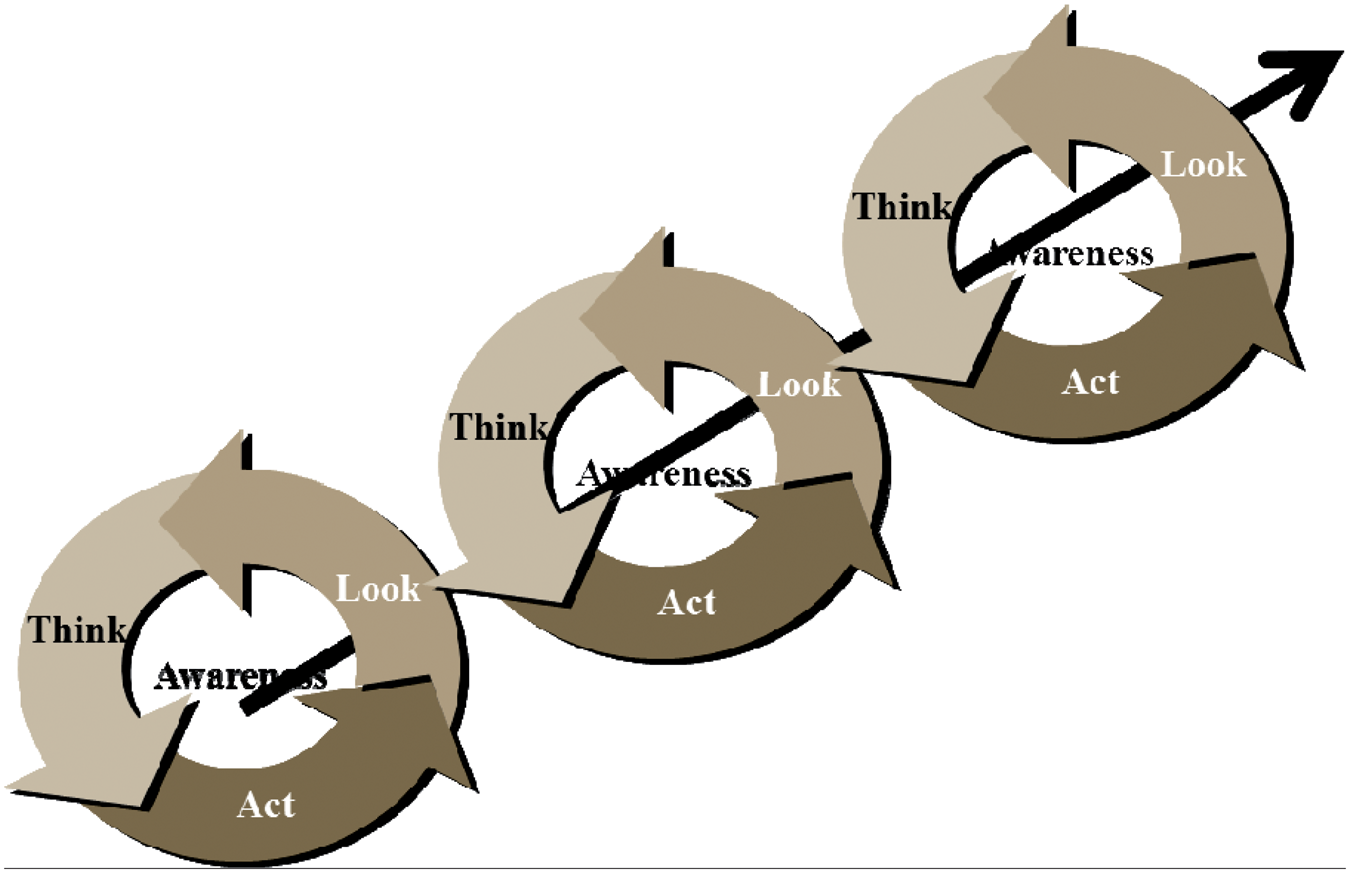
This study involved several cycles of Stringer’s (1999) ‘look, think, act routine’; the first involving interaction with the staff in management positions, the second with the staff in training positions and a third with members on the front line.
Researcher’s unique position and challenge
As an officer in-charge of training at one of the police training schools, the researcher was immersed in the training system. He had the opportunity to interact with the heads of the other training institutes, training instructors, training programme developers from other training institutes. This interaction gave the researcher a greater understanding of the training system and allowed him to easily inject himself into the larger system, which involved the DGP’s office and other related units. But as a researcher, he had a new perspective about it. In essence, as a training in-charge, he could be found within the system looking outside whereas as a researcher he could be found outside of the system looking in, which is where the research question lies. Figure 3 shows these relationships.
Boundaries as a supervisor and as a researcher.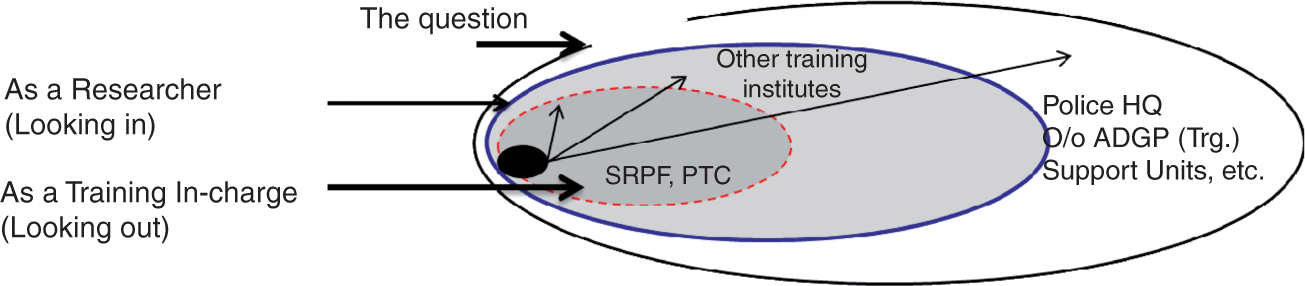
Being involved in the system helped the researcher to consider an ethnographic approach to this research. The researcher pursued qualitative measures using Stringer’s (1999) continuous spiral of the ‘the ‘‘look, think, act’’ routine’ (p. 18). Greenwood (1999) explains that observing is an early and critical phase in the development of the research process, wherein the researcher opens himself to the phenomenon being studied and attentively observes what is being experienced. This is perhaps where the researcher was as a participant but in his role as both a participant and a researcher, he was more focused and his involvement had more depth of meaning. He was no longer just a person within the system who was affected by it. Now, as a researcher, he had an opportunity to help address some of its challenges.
Data and process analysis
In this section, the functioning of the Gujarat Police Academy (GPA), protocols used, case environment, stakeholder characteristics and scenarios employed are discussed. After the initial two cycles of PAR, groupware software (Group Support Systems [GSS], windows based software) was used to support a series of problem-solving cases with the police workers in GPA. One composite ‘cycle’ of activities is presented to indicate how planning, executing, observing and reflecting on events occurred in the case.
The Gujarat Police Academy (GPA), Karai: Introduction and protocols
The GPA, Karai is the State level police training academy, which was established in 1998; primarily to impart basic, in-service and specialized training to probationary IPS officers, directly recruited Deputy Superintendents of Police, Superintendents of Police, and directly recruited Sub-Inspectors of Police.
A significant amount of preliminary information was gathered while talking to the key and primary stakeholders. The purpose of the study was discussed with the DGP, ADGP (Training), Joint Director, GPA, and other senior officers in the State Police Headquarters, who responded enthusiastically to the idea of the research. Detailed discussions were held with the Assistant Director (Indoor) and the training instructors about the current practices of imparting in-service training to the field-level police workers, particularly with respect to problem-solving and decision-making skills. In general, they were of the view that the present mode of imparting training largely through instructional method was appropriate as it had numerous advantages: i) it allowed the instructor to set the stage for a new area of learning and place the topic in perspective; ii) it stimulated participant’s interest in the subject; iii) it helped in integrating and synthesizing a large body of knowledge from several fields or sources; and iv) it facilitated clarification of difficult concepts. The researcher explained to them that despite these advantages, lecture method by its nature lends itself to the teaching of facts while placing little emphasis on problem-solving, decision-making, and analytical thinking. The researcher suggested that problem-based and collaborative learning approach was more suitable for in-service training, especially because the field-level officers come with rich experience. The responses to this was that the lecture-cum-discussion method of training allowed for involvement of participants after the lecture, and they were free to question, seek clarifications and even challenge the instructor. The views of the researcher were not thrust on them. We decided to conduct sessions in both the modes and observe the differences and seek the opinion of the participants. The field-level police workers (hereafter ‘participants’) who were undergoing the Quick Reaction Team (QRT) course participated in this study. They came from variety of backgrounds within the police force and had varying experience which ranged from two to 12 years in the service. They also brought with them differing levels of skills (in typing, communicating, leadership, consensus building), prior knowledge. We selected group dynamics activity for this project as it required focused group discussions, deliberation, decision-making and problem-solving by groups.
Scenarios employed
In collaboration with the two training instructors, three problem-based scenarios, all of which incorporated issues that were realistic and relevant to police work in Gujarat were developed. Participants were requested to submit themes from which scenarios could be developed. Participants were eager to work on scenarios which posed challenges to them, and where no clear course of action and ready-made solution were available. However, the finer details of the scenarios were prepared by the researcher and instructors. Inviting suggestions from participants indicated a cooperative learning context of democratic participation where the emphasis was on the voice of participants than on any pre-conceived notions of success (Kanpol, 1999).
A total of 600 Pakistani nationals, who are continuing to stay in Gujarat despite expiry of their visas, have to be repatriated to Pakistan by 31 March 2011. Your task is to discuss:
How this process should operate in reality? What constraints or implications for manpower or resources are involved and so on? You should attempt to come up with a plan of action. More than 160 people have died in the recent hooch tragedy in Ahmedabad City. The Ahmedabad City police under pressure from Gujarat Government and NGOs have undertaken to crack down on the illegal trade of illicit country-made and foreign-made liquor and bring the bootleggers to court.
Devise a policy for attacking this illegal trade – both in terms of cross-border and indigenous manufacturing, smuggling and retailing of illicit liquor clandestinely. You should aim to come up with a plan of action as a solution. You should consider all resource implications likely to arise, as well as any other complications. Gujarat has recently experienced an upsurge in the manufacturing and smuggling of spurious drugs by the unscrupulous elements in the State. You have been tasked to crack down on this menace and bring these unscrupulous elements before the court of law.
Devise a policy for attacking this illegal business – both in terms of manufacturing and smuggling, and retailing of spurious drugs. You should try to come up with a plan of action as a solution. You should consider all resource implications likely to arise, as well as any other complications.
Session proceedings
Two training instructors were involved in the study, one for the first three sessions and another for the remaining two sessions. A total of five sessions involving 10 groups of six participants each were organized, each group tackling one of the scenarios described above. Different sessions were held with the same participants. The scenarios were introduced to the participants only with the purpose of making them understand and appreciate the different learning contexts such as the use of group software systems and any changes to the scenarios that specific instructors introduced. This helped in gauging the learning of participants emerging from different methods and to compare the quality of solution arrived at by the same group under different learning context.
First session (2 December 2010)
We adopted the lecture-cum-discussion mode of training in this session. It was conducted in a classroom setting and both the groups were made to sit together. One of the training instructors, who was conversant with the issues involved with scenario 1, delivered a two-hour lecture followed by half-an-hour discussion. The Joint Director, GPA and Asst. Director (Indoor) were also present in this session.
The training instructor presented the factual and legal issues related to scenario 1 in a direct, logical and consistent manner. He also narrated his own experiences that inspired the participants. But the communication was mostly one-way and the participants remained largely passive throughout the session, including the time period during which discussions were allowed. During the discussion session, proficient oral skills mattered and time constraints adversely affected the discussion opportunities. Furthermore, movement towards a workable solution and formulation of a plan of action did not happen. The discussions and deliberations were largely unfocused and unstructured. A few participants dominated the discussion and there was a complete lack of cohesion. Although, the task was to be performed as a group, there was no manifestation of any group process.
Second session (4 December 2010)
Realizing the shortcomings of the lecture-cum-discussion method of training, we decided to adopt seminar-cum-discussion method for imparting training in this session. It was held in syndicate rooms. This session was also planned to last for two-and-a-half hours. The participants were divided into two groups of six each and they were asked to discuss scenario 1 in separate syndicate rooms. Scenario 1 was employed again for two reasons: i) to gauge the learning of the participants from the previous session, ii) to observe the difference in the quality of solution and action plan formulated by the groups. The Joint Director, GPA and Asst. Director (Indoor) were also present in this session.
The training instructor and the researcher acted as facilitators. We initiated the discussion initiated by introducing the participants with the scenario by making a small presentation of 15 minutes. We asked the participants to pool their ideas and experiences, and come up with an effective and realistic plan of action to tackle the scenario 1 presented to them. We observed that though everyone was encouraged to actively participate and take responsibility, not everyone participated in the process and a few participants dominated the proceedings. Some participants in fact did not participate at all. It was also found that the discussion often went off the track and the focus was lost.
After completion of the session, the researcher, Assistant Director (Indoor) and the training instructor had informal discussions with the participants. It was realized that the strong hierarchy and regimentation in police organization often made it difficult for the relatively junior participants to participate in discussions openly and freely. Social pressure to conform to the majority view also prevented open discussion. Lack of coordination among the group members ensured that the task of coming up with a plan of action was not completed. The group discussions were dominated by a few. As a consequence, reflective and dialogic learning processes could not be implemented. Research has also shown that the results could be uncertain (Becker, 1997; Glaser & Bassok, 1989) when participative processes are implemented in hierarchical contexts. We believed that a less threatening environment with reduced regimentation and cultural barriers to communication was necessary to facilitate open and free discussions among the group members (Davison & Jordan, 1998).
The challenge before us was how to create a less threatening environment. This issue was discussed with the ADGP (Training) and Joint Director, GPA and we decided to use groupware software (Group Support System [GSS]), which was procured by the academy in 2008 but had never previously been used.
Group Support Systems: A groupware software
Group Support Systems (GSS) is a networked, computer-based information system which facilitates interactive group discussions among people who may be communicating face-to-face or remotely, synchronously or asynchronously (Khorsow-Pour, 2003). GSS comprises a set of software tools used to provide focus and structure to group deliberations, while reducing the cognitive cost of communication, and easing the burden of information access as group participants make a joint cognitive effort towards achieving a goal (Davison, 2001). Participants type their contributions into a PC and the system immediately makes each contribution available to all other participants. In this way, participants do not forget what they want to say while waiting for their turn to speak and anonymity is also ensured (Nunamaker, Briggs, Mittleman, Vogel, & Balthazard, 1997).
Facilitation of GSS sessions
Facilitation of GSS sessions is extremely critical for achieving the desired results from the use of GSS (Griffith, Fuller, & Northcraft, 1998; Yoong, 1998). The facilitator guides the participants in the GSS-enabled environment (Dickson, Lee Partridge, & Robinson, 1993) and should be neutral in facilitating and consciously refrain from making direct contributions to the final outcome. There is, however, a paradox in the facilitator’s role; she or he is expected to influence without being influential and, similarly, she or he is expected to improve the group’s efficiency, effectiveness and commitment without affecting the content of the decision (Griffith et al., 1998). While Dickson et al. (1993) suggest that groups prefer free discussion and deliberations over well-structured meetings, GSS literature recommends that best results emerge from well-defined agendas and plans (Watson, Ho, & Raman, 1994).
Session proceedings in GSS-enabled environment
Three more sessions in a GSS-enabled environment were conducted in the computer laboratory of GPA. Three sessions were held in which two groups worked in parallel on different scenarios within the same computer laboratory. Each session lasted for two-and-a-half hours. Owing to the lack of comfort of the training instructor with the GSS environment, the researcher agreed to facilitate these sessions on the basis of a problem-based collaborative learning approach.
One of the issues being explored was whether the less threatening environment enabled by GSS led to a more free exchange of thoughts among the participants. Its effects on vocal and dominant participants in previous sessions were also to be explored. Furthermore, it was important to know whether the technology enabled environment led to better outcome(s). An informal research question thus related to the need to encourage contribution of all participants in discussions and to enhance their problem-solving skills.
A detailed introduction and demo of the working of the GSS technology was given to the participants to enable them to understand the technology. They were encouraged to use GSS as per their convenience and it was not mandatory for them to use it. The software allowed the participants to communicate in English as well as in the vernacular language. While all the participants could speak Gujarati and Hindi fluently, only 20–25 percent could speak in English. The medium of instruction of the training course was Gujarati but we held the GSS sessions in English. The participants were free to express themselves either in English or in Gujarati or in Hindi. Some of the participants had weak typing skills making participation difficult. Both the training instructors could communicate in English fluently.
Because of limitation of time, detailed data collection from each participant was virtually impossible (Niederman, Beise, & Beranek, 1996). The information from the participants was obtained during informal discussions with them in before and after each session. Face-to-face and telephone conversations with other training instructors helped in planning sessions and reflections. The conversations of the researcher with participants were completely task-oriented and the researcher didn’t try to influence the outcome(s) of the group discussions (Griffith, Fuller, & Northcraft, 1998).
The researcher also collected structured data from all the participants at the end of each session using an online instrument (Davison, 1997, 1999). This aimed to measure the perceptions of participants regarding five important aspects of meeting processes: i) communication; ii) discussion quality; iii) teamwork; iv) status effects; and v) efficiency. Data collected through this instrument were analysed to improve the facilitation technique in subsequent sessions.
A composite cycle: Planning, acting, observations and reflections
Prior to the third session, the other training instructor did not make any additional efforts towards planning. He did not show any interest in technology supported learning or PAR, and expected that the researcher would give the required technical assistance and facilitate the sessions. He preferred an ad hoc approach to management of sessions. He felt that this process best reflected real-life situations through which groups worked to find solutions. Besides, as the groups worked through the scenarios assigned to them, he used to introduce additional comments through the GSS which added to task uncertainty. For example, in the Pakistan nationals visa scenario, he informed the participants that the Gujarat Government had decided to repatriate the Pakistan nationals through the sea route. Similarly, in the illicit liquor scenario, it was announced that the government was contemplating bringing in new legislation awarding punishment for murder under Section 302 of the Indian Penal Code. Likewise, in the spurious drug scenario, the participants were informed that the government had decided to establish a multi-task agency to handle this problem.
Third session (14 December 2010 – first session under the GSS-enabled environment)
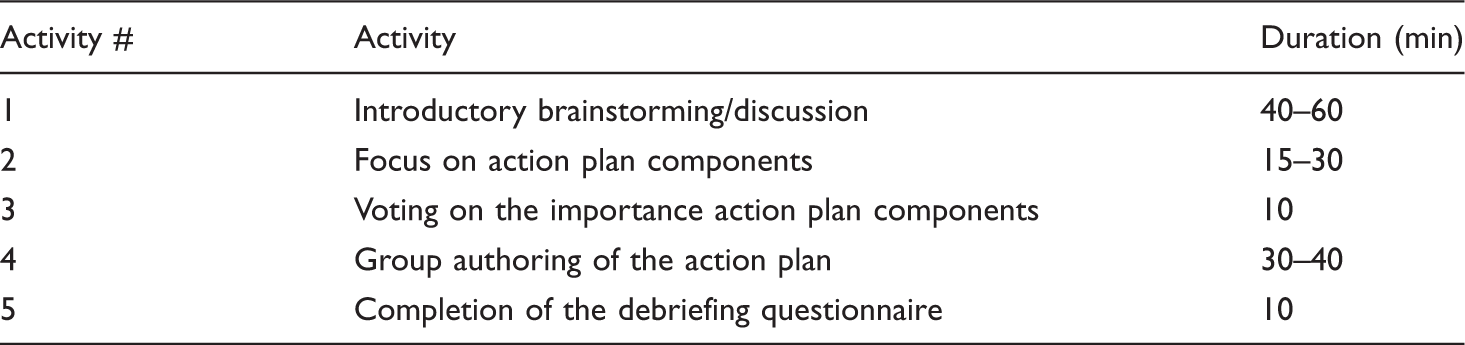
The training instructor and the researcher had no preconceived notion of how the discussions would proceed. Therefore, it was thought that a flexible facilitation style was most appropriate to enable collaborative learning. The groups spent time anonymously discussing the case scenario in the GSS. The participants then generated a list of possible action plan components and voted on their relative importance. Finally, they listed the most important points towards the solution.
The GSS-enabled environment improved basic group processes such as communication, idea generation and evaluation, decision-making, planning and record-keeping. Participants who were passive in previous sessions were able to actively participate in the group process this time. Also some of the participants made unique contributions which had not come up in the previous sessions. A positive interdependence emerged among the group members. They shared common goals and assumed complementary roles. The groups, however, could not complete the task and write the plan of action.
Fourth session (16 December 2010) and fifth sessions (18 December 2010)
After the third session, the training instructor was transferred from the academy and was replaced by another training instructor. The new training instructor was extremely enthusiastic about using GSS, but played a much less involved role, attending only the fourth session, presuming that the researcher would take the leading role in facilitating the content and processes of the sessions.
Activities in the informal agenda
The analysis of the data collected through an online instrument from participants at the end of sessions revealed some significant findings: while the communication was perceived to be effective and quality of discussion to be generally high, the third session was not rated as very efficient. This was most likely because of the ad hoc approach of the training instructor. However, in the subsequent sessions this improved considerably. Generally, with increase in the comfort level of the participants with the GSS technology the satisfaction level of the participants with the session process enhanced gradually.
The participants observed that as the GSS environment enabled them to discuss many topics and ideas simultaneously it made the communications and discussions more thought-provoking and interesting. However, it was generally believed that while the GSS environment might be beneficial for initial deliberations and brainstorming direct face-to-face interactions at a later stage was necessary. Some participants, particularly those who did not regularly use computers at work, complained about the lack of familiarity with the GSS interface design. A few participants also disapproved the use of GSS as it depersonalized their interactions. As regards the use of such systems by themselves in the future, one participant observed that ‘GSS is a good tool for meeting/deliberations/discussions, especially with those people with whom we may like to avoid head on confrontations.’
Reflections on the techniques and methods
While the adverse consequences of personal criticism were avoided, in the spirit of collaborative learning, ideas were still put through a process of critical analysis. The quality of work, complexity of considerations improved and cultural barriers to communication were overcome. A non-threatening environment facilitated a free exchange of ideas. Moreover, the researcher was also constantly involved in an action learning experience. This meant that in consultation with participants, the researcher was constantly reflecting on how the training process could be improved to achieve better learning outcomes.
In the planning stage, the training instructor did not wish to pay much attention to detailed planning at all. The first session was held on the principles of conventional pedagogy in which the training instructor delivered lectures and at the end inviting responses of the participants. Since an encouraging response was not received from the participants, the second session was held in a seminar-cum-discussion mode without the GSS-enabled environment. But in this session as well, the participants did not actively participate in the discussions. Thereafter, it was decided to hold the sessions in a GSS-enabled environment. In the first session of the GSS-enabled environment, the training instructor believed that an ad hoc style of session management with the participants making spontaneous decisions would be the most effective process. It is interesting to consider his behaviour in the context of the tendency of individuals to plan ahead in order to avoid uncertainty in future events. The first training instructor seemed to promote uncertainty, requiring the participants to be responsible for their own problem-solving and by injecting his own comments into their discussion, constantly changing the data and context of the scenario. He argued that such shifting circumstances are common for police officers, and scenarios needed to be made realistic by incorporating such changes.
In subsequent sessions, though some components of uncertainty by introducing comments during the deliberations were retained, a semi-formal agenda was used to aid the participants to structure their deliberations and discussions. This approach worked well in subsequent sessions but gave a new insight in respect of orthodox ‘problem-discussion-solution’ scenarios. The persistence of the first training instructor on his ad hoc session management style highlighted the tensions in PAR planning and the fact that formal, rigid plans may not always be effective.
In the execution stage, familiarity with GSS and the typing skills of participants were important challenges. Another barrier was that the participants did not view the AR investigator as a researcher but as a senior police officer of the department. The initial barriers were however overcome with researcher explaining the purposes of the study to the participants.
In the observation stage, data was collected from the participants in two ways: i) by conversation with them, and ii) through the online instrument administered at the end of each session (third, fourth and fifth sessions). These data confirmed that the ad hoc style of session management which was followed during the earlier sessions might adversely affect the quality of learning of the participants and proper utilization of time. This supported the decision to introduce a semi-formal agenda in the subsequent sessions.
In the reflection stage, rich perspectives were drawn in two ways: i) from the participants through the online instrument administered at the end of each session, and ii) from the conversations with the two training instructors, and Assistant Director (Indoor). The observations of the researcher and reflections on conversations with others formed the basis of interpretations. In order to ensure that the researcher’s views did not dominate other views and his subjectivity adversely affects the generalizability of the findings, the interpretations of the researcher were discussed with the participants throughout the research process.
Rigor and relevance in participatory action research
PAR is generally criticized for lack of thoroughness. Along with rigour, relevance is an important aspect of research (Senn, 1988). In this study, relevance was emphasized through recognition of the processes that help in the improvement of problem-solving skills of police workers.
PAR by its nature and process cannot be completely planned and requires constant adaptation (Checkland, 1981). In this case, the researcher therefore went along with the conventional pedagogy design of the training team, so that comparative evidence pertaining to different approaches could be obtained. The flexible facilitation method helped the researcher to be reflective and modify facilitation style in later sessions, thereby helping in collaborative learning.
Through a composite cycle of planning, acting, observations and reflections, PAR can aid an action researcher to draw detailed, context-rich descriptions and help in positive interventions. Continuous reflections and discussions with participants in this case helped in arriving at the realistic and implementable solution of GSS-based training through a semi-structured agenda. In order to increase the rigor of this action research exercise, data were drawn from multiple sources (Jick, 1979) such as the Assistant Director (Indoor), other training instructors and the participants in the training program, and using different techniques such as conversations and structured instruments. This study became more rigorous when inputs of participants were used to restructure the training program, for instance, the movement from an ad hoc style to a semi structured process in the GSS environment. Thus, deep dialogues with participants created the basis for change (Argyris, 1993).
Conclusion
A PAR methodology was used to do this study. Each session was subjected to rigorous cycles of planning, executing, observing and reflecting, which eventually helped in improving the problem-based learning process for the participants as well as the researcher. While certain challenges to the PAR approach were encountered, these experiences afforded a new learning environment, wherein the techniques and methodology being used could be re-evaluated.
This study shows how reflective learning models in a non-threatening environment enabled by GSS technology could be effectively used to enhance problem-solving and decision-making skills of field-level police workers. The study showed that GSS technology can be effectively used in giving voice and agency to learners, especially in police organization as it helps in creating a non-threatening environment. Additionally, technology supported learning, as a dialogic approach to reflective learning, should be revived by this study, which extends the domain of its application out of the traditional education sector.
The success of the study is, however, limited to the study itself as even though the officers, including the ADGP (Training); Joint Director, GPA; Assistant Director (Indoor); training instructors and the participants, largely perceived the GSS environment to have contributed positively to the learning experience of the participants, it is not clear whether the Gujarat Police will implement it on an operational and regular basis. When the findings of the research were discussed with ADGP (Training) and Joint Director, GPA, shortly after the last session about how GSS could be made a permanent feature as one of the training aids in the academy, they reacted positively appreciating its utility, but commented that the feedback of the training instructors was that the system was incompatible with their existing systems, and that they had little time for testing and implementing a new system. The training instructors saw GSS technology as a threat to the status quo: they would not only need to understand the principles of problem-based collaborative learning approach, but also learn new skills for handling GSS technology. Olesen and Myers (1999) have explained that implementing a new system that threatens the status quo is quite difficult, particularly when the gatekeepers or key users of computer systems exercise significant powers of veto.
This study significantly contributes to the training practices in the Indian police; a PAR approach in this field has been made for the first time. It opens up several possibilities of how training initiatives could create a conscientious, creative police force that is committed to the ideals of justice. Training interventions which give voice and agency to police workers could go a long way in enabling them to confidently and actively participate in effective decision-making to address issues of justice.
The study also gave insights for further research in two key areas. First, a detailed study on the role of facilitator role in problem-based collaborative learning approach is warranted. Areas for future research should include: i) the influence of technical expertise in facilitating problem-solving groups; ii) procedural guidance during group problem-solving; and iii) the impact of facilitator training on trainers with varying levels of technical expertise. Second, additional research focusing on the influence of computer technology and groupware software on group problem-solving activities needs to be conducted.
Footnotes
Acknowledgements
I thank the anonymous reviewers for their insightful comments and suggestions, which significantly contributed to improving the quality of the article. I am also grateful to Srinath Jagannathan for his constructive comments and painstaking efforts in reading through the earlier drafts of this article. His thoughts were particularly useful in enriching the theoretical framing of this article. The article reads far better due to his efforts, and any inadvertent errors that still remain, are of course only mine.