







Abstract
This article describes experiences formed in connection with a case study in Sámi schools. The Sámi people live in the northern part of the North Calotte region and among the world’s Indigenous peoples. The development of culture-based education aims to diminish the dominance of the national curricula. The aim of this article is to understand factors that influence teachers’ views and how teachers experience culture-based education in terms of a decolonizing process. The case study was conducted in a Critical Utopian Action Research framework with future workshops. The future workshops began as collaborative self-criticism and dreaming of education and then moved to the implementation of Indigenous culture-based teaching activities in local teaching practices. The teachers expressed that they felt trapped between demands made by the national curricula and their desire to implement culture-based teaching, but they nevertheless had many ideas for themes via which culture could be linked to teaching. Through knowledge exchange between the participants in the case study, the teachers ‘rediscovered’ knowledge and reinterpreted that knowledge in a teaching setting. The teachers’ autonomy was strengthened and the teachers’ active efforts empowered them.
Keywords
Introduction
This article addresses the development of culture-based education and the experiences acquired from a research case involving local schools in Sapmi. Sapmi is an area that extends across the northern part of the North Calotte region and was inhabited by the Sámi people before the establishment of the national borders of what are now Sweden, Norway, Finland and Russia. Education for Sámi children differs between these countries and this article focuses mainly on education in Sweden. In Sweden, Sámi children can receive their education in Sámi schools. The teaching in Sámi schools is equivalent to national teaching, but Sámi schools are legally obligated to take account of and develop the Sámi language and cultural heritage (Skolverket, 2011). There is a separate Sámi-language syllabus, but there are no special syllabi for the other school subjects. It is therefore up to each individual teacher to implement teaching that takes account of the Sámi language and culture. In Norway, Sámi syllabi were introduced in 1987 and the first Sámi curriculum was put into use in 1997. The Sámi curriculum is a step in the right direction; nevertheless, the Sámi curriculum is more or less an adaptation of the Norwegian one. Hirvonen (2004) highlighted the fact that schools must develop new activities, teaching methods and ideas to achieve a Sámi-culture-based education.
In an earlier evaluation performed in Sweden, Sámi school teachers expressed a wish for curriculum change through the implementation of culture-based teaching (Skolverket, 2002), and because action research has been previously used in two Sámi schools (Balto, 2008; Balto & Johansson, 2007; Johansson, 2009), I choose to conduct an action research case study (Jannok Nutti, 2010) with the aim of implementing culture-based teaching. The study has been further discussed in subsequent publications (Jannok Nutti, 2013a, 2013b, 2013c). In this article, I will undertake the further analysis of the research experiences, process and outcome of developing and implementing Sámi-culture-based teaching activities – or Indigenous-culture-based teaching activities because the Sámi people are among the world’s Indigenous peoples. Indigenous culture-based curriculum development can be seen as an attempt to reduce the dominance of the national curricula and increase the sustainability of Indigenous cultures. The aim of the article is to understand the factors that influence teachers’ views regarding the implementation of Indigenous-culture-based teaching and how teachers experience this process in terms of decolonization. The article takes as its point of departure the following research questions: What challenges and possibilities did the teachers’ experience concerning culture-based mathematics teaching? What kind of activities did the teachers develop, and how did they experience the process and outcome of the work?
Theoretical and methodological background
The originator of action research is often assumed to be Kurt Lewin, who was particularly concerned with raising the self-esteem of minority groups and increasing equality by means of action research (Adelman, 2014). Subsequent researchers have developed the content of action research. Adelman argued that two deficient rhetorical strategies have arisen since Lewin: action research for greater effectiveness with a link to democratic practice or the same without that link, which occurs more frequently according to Adelman. The framework of Critical Utopian Action Research, as conceptualized by Nielsen and Aagaard Nielsen (2006), takes into account social learning as a particular value. Of particular importance in the methodology is the researcher’s democratic obligation to maintain focus on a democratic interest that goes beyond narrow interests. The challenge is to develop communication arenas in which a new understanding of the context can emerge across various perspectives, from the knowledge and experiences of experts to local knowledge and everyday-life perspectives. To develop a common communication arena in which various socioecological relationships can be addressed from both a scientific-expert perspective and an everyday-life perspective, these various perspectives are considered equally legitimate in defining the matter of concern. The exchange of knowledge and the dynamics of learning are essential in the framework, as Egmose (2015) highlighted. In this case study, it was crucial to make the democratic social learning process central insofar as neither I, the researcher, nor the individual teachers, as participants, had an answer to the question of how Sámi-culture-based mathematics teaching could be performed at the outset. Thus, all participants could participate on an equal footing.
Drewes Nielsen (2006) underlined that the Critical Utopian Action Research process involves future workshops with local stakeholders. The main purpose of the future workshop, initiated by Robert Jungk (Jungk & Muller, 1987), is to create a basis for a joint critique of the establishment, which will enable the development of a proposal for a desired future (Vidal, 2006). The idea of the future workshop is to provide an opportunity to develop utopias that are not limited by the everyday limitations of what can actually be done. A future workshop has three phases: first, the critique phase; then, the utopian phase and, finally, the realization phase. The critical phase involves a brainstorming session; the utopian phase involves the collective creation of dreams and visions and, in the realization phase, the collective ideas are developed into proposals for change, which are then developed into concrete implementation plans (Drewes Nielsen, 2006). Change is seen as an integral part of action research, both as a means of solving problems and as a means of gaining more knowledge about a phenomenon. In addition, one learns more by participating in the process of change than by merely being an observer. The cyclic process is central, and the research allows for feedback and active participation on the basis of cooperation, mutual learning and shared expertise.
Action research can highlight the perspectives of excluded knowledge systems by bringing Indigenous knowledge into educational systems. The term ‘Indigenous’ refers to an internationally recognized identity for Indigenous peoples that emerged in the mid-1970s (Kuokkanen, 2007). Indigenous peoples, whatever their historical, political, social, economic and geographical differences, share certain experiences of colonialism, as well as ways of viewing the world on the basis of a holistic philosophy that encompasses a close relationship with the natural environment (Kuokkanen, 2007; Smith, 2004/2012). How to use nearby nature and its resources was traditionally an important collective system of knowledge and skills that Indigenous people used to enhance their livelihood for centuries, and this knowledge has been passed down from generation to generation, both orally and through work and practical experiences (Porsanger & Guttorm, 2011; Sara, 2004). Children gain knowledge by participating in activities. They learn by observing, listening to instructions or stories and trying things out (Balto, 2005; Sara, 2004; Jannok Nutti, 2007). The key to the upbringing of Sámi children can be expressed through the concept of birget (Balto, 1997), which means becoming financially independent and able to survive. Traditionally, managing to survive required knowledge and skills in specific areas of life. Today, the concept does not have the same implications as it did in earlier times, but culture-based knowledge is still part of a common understanding and a weave of meaning that connects various people and generations together (Bergstrom, 2001).
The Critical Utopian Action Research framework, as conceptualized by Nielsen and Aagaard Nielsen (2006), described action research as being linked to the vision of a sustainable democratic lifestyle. The development and implementation of Indigenous-culture-based teaching can increase cultural sustainability and be part of ‘rebuilding our nations, peoples, communities, and selves by restoring Indigenous ecologies, consciousness, and languages and by creating bridges between Indigenous and Eurocentric knowledge’ (Battiste, 2000, p. xvii). In another, earlier evaluation (Barnombudsmannen, 2008), young Sámi complained about a lack of Sámi culture-based teaching. On the basis of that complaint, I conducted another action research case study (Jannok Nutti, 2011), in which young people developed teaching aids to serve two teaching aims. One set of materials was developed by the participants with the aim of teaching others about young Sámi people’s lives today. They wished to show that they live a life similar to other Western youth, with cafe visits and so on, but that they were still a bit different from other young people because their everyday lives were connected to culture-specific activities, such as reindeer herding and crafts. The other set of materials was developed with the aim of the participants learning more about Sámi culture themselves, and here, the focus was on more traditional culture-based knowledge. The youths wanted to reclaim, reformulate and reconstitute Indigenous cultures and languages, as expressed by Tuhiwai Smith (2004/2012). This process includes a deconstruction of the consequences of colonialism, or a decolonization process. According to Laenui (2000), the process involves the following:
cultural rediscovery and recovery, mourning, dreaming, commitment and action.
This decolonization focus has been questioned. Graham Smith (2000) criticized actions on the basis of colonization and suggested instead that Indigenous people should focus on pro-active initiatives. However, although teachers can express a willingness to promote school change, they do not always act due to various personal, cultural and structural barriers (Bedford, 2009), and as Keskitalo, Maatta, and Uusiautti (2013) stressed, colonization can be such a barrier. Bedford (2009) showed that teachers became agents for school change and conducted actions to achieve desired goals and that their actions recovered an empowered teacher role (Bedford, 2009). The concept of ‘empowerment’ was interpreted as ‘a process that increases the drive, ability and possibility of an individual group to act on a problem in concern’ (Bedford, 2009, p. 55). The concept of ‘empowerment’ is criticized by Indigenous and feminist researchers (Kuokkanen, 2007; Townsend, Zapata, Rowlands, Alberti, & Mercado, 1999), who argue that it can be interpreted as giving others influence; instead, the term ‘self-empowerment’ should be used. However, in Bedford’s (2009) action research, the concept of ‘empowerment’ signified the teachers’ own choices to act and achieve change in their own teaching, in alignment with their goals, is consistent with the concept of ‘self-empowerment’.
Earlier research on culture-based mathematics teaching renewal
In Alaska, collaboration with the local community was an important factor in the process of incorporating Yup’ik Inuit knowledge into education. This culturally sensitive teaching fundamentally changed the teacher’s role and the community’s relationship with education (Barnhardt, 1990; Lipka, Mohatt, & the Ciulistet Group, 1998). In mathematics, knowledge that is considered to be a familiar part of practice outside of school can be reconstructed as a task in a textbook. According to Gellert and Jablonka (2009), however, recalling everyday knowledge can cause problems because some students rely too heavily on such knowledge when solving mathematical word problems. However, research in Alaska (Lipka & Adams, 2004) has shown that pupils can do well in mathematics if given opportunities to integrate familiar knowledge into mathematics learning. Culture-based curricula can therefore create learning opportunities for pupils. Meaney (2001) showed that there is a tension between teachers’ and parents’ desires that Maori children should, on the one hand, grow up with a strong Maori identity and, on the other, be successful in school. This tension was also visible in studies of Sámi schools (Balto, 2008; Johansson, 2009). Teaching in Sámi schools in Norway is organized by the teachers on the basis of textbooks, and these are merely Sámi translations of national textbooks (Pettersen, 2006). However, the translated textbooks give pupils an opportunity to learn subjects in their own language and can strengthen the language (Utsi, 2004). In Sámi schools in Sweden, mathematics teaching is based on the national textbook, despite requests on the part of teachers, parents and pupils for culture-based mathematics teaching (Skolverket, 2002). Barnhardt (1990) pointed out that to achieve successful school change, schools need positive school leaders because such leaders play an important role in the success of school-change implementations.
The Sámi educational context
Until the mid-1900s, educational institutions for Sámi children were designed according to the interests of the dominant culture (Hyltenstam, Stroud, & Svonni, 1999), and the role of the Sámi language and culture in education varied. Education was previously used to further the spread of the Swedish language, religion and culture. Today is a governmental authority, the Sámi School Board, responsible for Sámi schools and the providing of Sámi culture-based teaching and teaching in and on the Sámi languages. The Sámi languages are divided into three main languages, with numerous dialects or varieties. In Sweden, the North, Lule and South Sámi languages are taught in schools. Northern Sámi has the largest number of speakers and is spoken by an estimated 15,000–17,000 people across the entire Sámi area; around 500 people speak Lule Sámi, and a similar number speak Southern Sámi. Further the Sámi Parliament was established to promote and improve the Sámi people’s opportunities to maintain and develop the Sámi languages, culture and livelihoods. Nomadic reindeer herding is intimately connected with Sámi culture and traditions, and approximately 10% of the Sámi population in Sweden now work in reindeer herding. Other traditional Sámi livelihoods include hunting, fishing and duodji, or crafts. Contemporary Sámi livelihoods also include tourism, media, food and design. There are also a number of professional, academic and administrative positions at Sámi institutions.
Still the Sámi people strive to maintain the Sámi languages, culture and livelihoods, and the need to promote and make space for excluded Indigenous knowledge systems is stressed by many Indigenous researchers and also multicultural researchers (for example, Banks, 2004). Banks’s (2004) theoretical multicultural teaching model was used in the analyses of the teaching activities in this case action research study (Jannok Nutti, 2010). Hirvonen (2004) also used Banks’s model to analyse the Sámi curriculum reform in Norway. Banks’s model has four multicultural approaches. In the first approach, multiculturalism is seen as a supplement to teaching, and the teaching focuses on heroes, holidays and discrete cultural elements. Hirvonen stated that the teaching in many Sámi schools outside of the majority-Sámi-speaking areas in Norway used this approach. In the second approach, concepts and themes are added to the teaching content, without changing the structure of the teaching. The Sámi schools in the majority-Sámi-speaking areas in Norway use this approach; in these areas, the national content is merely translated into Sámi languages. In the third approach, the structure is changed to enable pupils to view concepts, issues, events and themes from diverse perspectives. In the fourth approach, elements of all the other approaches are included in teaching, in combination with a teaching perspective that encourages pupils to become actively involved in social and political affairs, thus enabling pupils from different cultural and social groups to experience an equal education. Hirvonen’s (2004) conclusion was that Sámi schools cannot be deemed multicultural according to the fourth approach until all the teachers are bilingual and have a thorough knowledge of Sámi culture and all teachers consciously promote multiculturalism, multilingualism and multiple identities in school.
Hirvonen, like Banks (2004), used the term ‘multicultural’, which is often replaced with the term ‘intercultural’ today. I therefore supplemented Banks’s model with Lahdenperä’s (2008) distinction between ‘multicultural’ and ‘intercultural’. The concept of ‘multicultural education’ can be interpreted as addressing the traditions and knowledge of different cultural groups, while the term ‘intercultural education’ can be understood as a way of allowing different cultural groups to meet, communicate and learn from each other’s traditions and knowledge. Intercultural education is a way of encountering a multicultural society with the ambition of transforming it. The concept of ‘multicultural teaching’ can be interpreted as teaching that encompasses the traditions and knowledge of different cultural groups, while the concept of ‘intercultural teaching’ can be understood as a way of allowing different cultural groups to communicate and learn from each other. Intercultural teaching is thus a way of encountering a multicultural society with the ambition of changing it so as to develop and implement teaching on the basis of various cultures. The participating teachers and I belong to the Sámi culture and attempt to reflect on our personal cultural background in relation to our lives as teachers and researchers. Being sensitive to alternative voices is, according to Egmose (2015), important in validating the research and critically reflecting on the fieldwork in a broader perspective.
Method of the action research case study
The case study ran over a period of three years, between 2007 and 2010. The case study’s sites were Sámi schools in Sweden. In Sweden today, there are five Sámi schools offering primary education for grades 1–6, preschool classes for children aged 6, and preschool education for children aged 1–5. During the case study, there were 20 teachers, responsible for teaching in grades 1–6 and in preschool classes and the total number of pupils and children in grades 1–6 and preschool classes was 153 pupils/children during school year 2007–2008, 135 pupils/children during school year 2008–2009, and it was 168 pupils/children during school year 2009–2010. The last school year, after the third seminar workshops, preschool teachers working in the preschool departments were invited to attend the case study. On each preschool, 1–2 preschool teachers were working. The total number of children in the age between 1 and 5 years was 188.
The case study was conducted through future workshops. According to Drewes Nielsen (2006), a future workshop should be organized with plenum and group sessions. In the critical phase, the question ‘What’s wrong?’ is in focus. Then comes the utopian phase, with dreams and visions, which takes as its point of departure the question ‘Where would we like to go?’ Finally, in the realization phase, the question is ‘How can our dreams become reality?’ (Drewes Nielsen, 2006). The actions taken in the schools included the following:
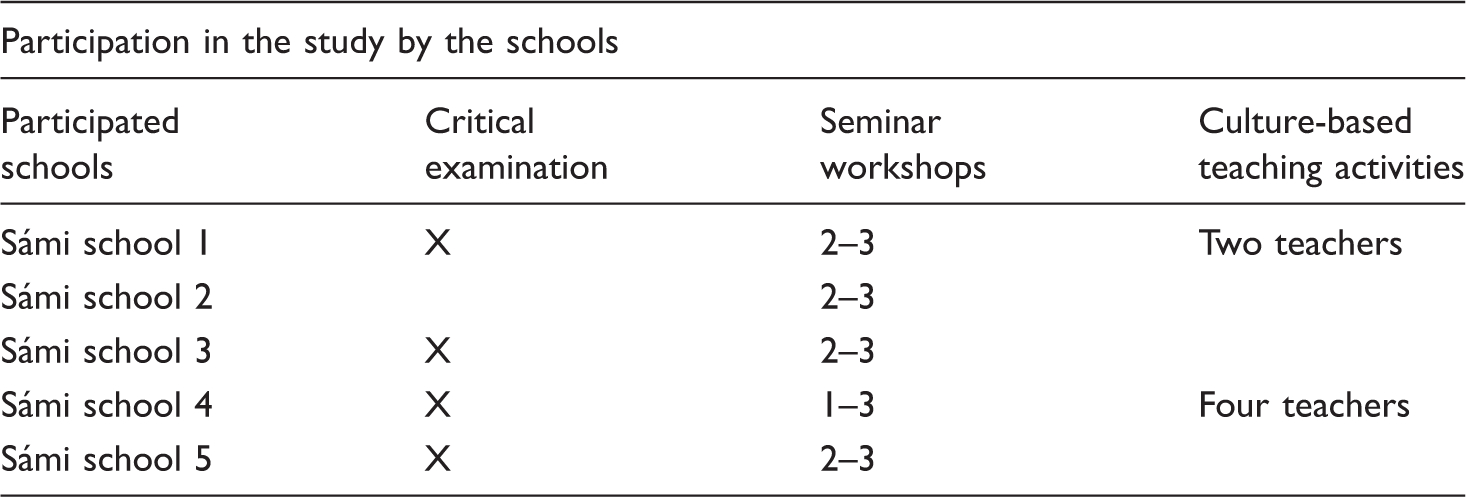
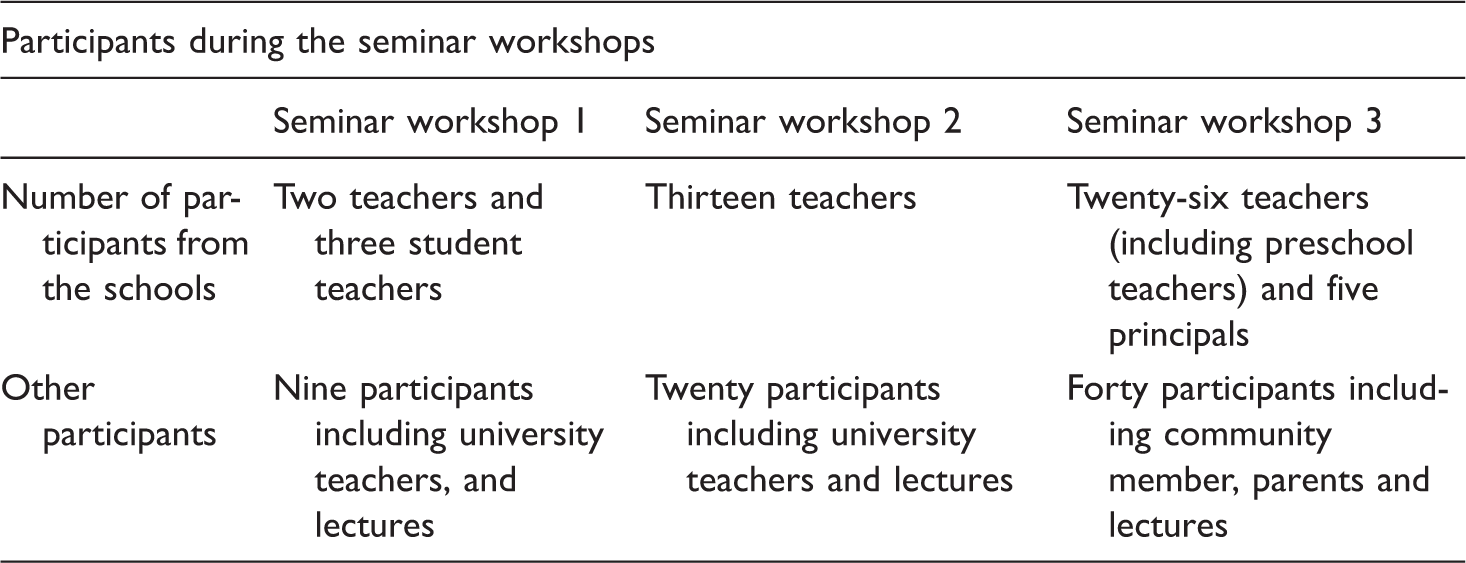
A critical phase that started with the following question: When critically reviewing your local teaching practice, what challenges and opportunities do you experience in practice regarding the implementation of Sámi-culture-based teaching and the obligation to take into account and develop the Sámi language and cultural heritage? The critical phase continued into a utopian phase, in which the teachers discussed their ‘dream Sámi school’. The critique and dream sessions were conducted together with school teachers in four Sámi schools (see Table 1). My researcher role was focused on framing and steering the process. The phases were documented by log notes. A realization phase was conducted in which the participants collaboratively continued to imagine their dream school. Three seminar workshops were conducted from 2007 to 2009. The aim of the seminar workshops was to shape visions and potential goals for the realization of Indigenous-culture-based teaching activities. During the first seminar, teachers from one Sámi school participated; on the second occasion, teachers from all school participated and the third and final workshops were attended by teachers and principals from all five Sámi schools (including the preschool sections), as well as some parents from one school (see Table 2). During the seminar workshops, my role was to act as a facilitator. Egmose (2015) pointed out that one blind spot of the facilitation perspective is that the researcher does not pay attention to what is not happening or to alternative routes for the process. I put together programs that took into account the teachers’ expressed critiques and utopias. During the national and international seminar workshops, culture-based teaching experts participated, together with the teachers and myself. My experiences as researcher was connected to my earlier research project (Jannok Nutti, 2007), there I investigated culture-based mathematical knowledge. Both projects were part of an ongoing effort to promote and strengthen Sámi culture-based mathematics teaching.
1
In connection to the earlier presented evaluation (Skolverket, 2002), the seminar workshops were documented via photos and log notes. After the workshops, new teaching activities were developed and implemented in the local Sámi schools. The teaching activities created by six teachers were developed and implemented in two Sámi schools (including one Sámi preschool department), in collaboration with the children, pupils, parents, grandparents and elders (see Table 1). After the first seminar workshop, two teachers developed and implemented teaching activities, and after the second, two more teachers joined the work with development and implementation of teaching activities. Then after the third workshop, two preschool teachers started to develop and implement activities. In the school context, the realization phase was documented by the teachers themselves through documents, photos and notes and also by observations. During the observations, the researcher participated in and documented the proceedings by means of video recording. Before, during and after the implementation of the culture-based teaching activities, I conducted single-reflection dialogues with the teachers. During the dialogues, teachers’ videos, photos and written documents were used as tools to support the teachers’ attempts to recall their own thoughts during educational practice. Reflection on one’s thoughts during educational practice also influences future activities, and by changing practice, the teachers become both producers and consumers of knowledge (Ronnerman, 2000, 2003). At the end of the action research study, single-reflection dialogues were conducted with the six teachers. The dialogues started with questions such as ‘How do you describe your experience of Sámi-culture-based teaching activities?’ and ‘How did you experience your participation in the case study?’ The dialogues were documented by means of sound recording and log notes. The reflections were transcribed, and the transcript text and log notes were analysed. Participation in the different parts of the study by the schools. Number of participants during the seminar workshops.
The action research case study was led and planned by the researcher, who also led and actively participated in the seminars and supported the teachers in their development and implementation of the teaching activities during the study. The teachers and I interacted with each other during the seminar workshops, and between the workshops, the interaction between us in the project took part on the local school level. The process proceeded from the data collection to the final analysis of the transcribed material. In analysing the transcript data material, I began with basic coding to identify concepts connected to the research question. Labels were assigned to units of texts from transcripts and log notes, forming the basis for the identification of concepts throughout the dataset.
Teachers’ criticism of and visions for Indigenous teaching practice
The teachers felt trapped between the demands made by the national curricula and syllabi and their wish to implement Sámi-culture-based teaching. The teachers expressed strong feelings about the related stress because they felt that culture-based teaching was time-consuming. Teaching in the schools was therefore determined by the textbook – as one teacher said, ‘What is easier than to follow the book!’ (Jannok Nutti, 2010, p. 60, my translation). The teaching was also directed by national textbooks, not Sámi textbooks. The teachers chose to use national textbooks rather than Sámi textbooks, with the justification that Sámi textbooks were merely translated national textbooks, not Sámi-culture-based textbooks. In addition, the teachers said that the Sámi textbooks were written in Sámi dialects spoken in Norway or Finland, dialects that the teachers felt that a majority of the pupils had not mastered.
The teachers still saw benefits from culture-based teaching, and once in a while, they introduced culture-based theme work in school. However, the teachers felt that they had neither the knowledge nor the time to develop culture-based teaching. The teachers also expressed doubts about culture-based teaching. One of them said, ‘Traditions are good, but do they help the pupils become successful?’ (Jannok Nutti, 2010, p. 61, own translation). The teachers felt that they had to provide the pupils with the best opportunities to perform well on national tests and also equip pupils for their further national education. The critical question for the teachers was whether culture-based teaching prepares pupils for the upcoming national tests and helps pupils achieve the objectives expressed in the national syllabi. The teachers said that some of the parents had negative attitudes towards Sámi-culture-based teaching because they doubted that Sámi-culture-based teaching would provide the best preparation for the pupils’ further education. National textbooks with the concepts the pupils would later use in national schools thus seemed to be the appropriate choice with regard to providing pupils with the best foundation. The teachers also felt that they lacked the knowledge and opportunities to carry out culture-based teaching, especially culture-based mathematics teaching.
The outcome of the critical part of the session was the identification of a number of challenges, such as restrictive national curricula and national tests, the lack of Sámi syllabi and Sámi culture-based teaching aids written in the Sámi dialects spoken in Sweden, the lack of time, personal and economic resources with which to develop and implement Sámi-culture-based teaching, the lack of knowledge regarding what culture-based teaching could be, critical parents and, finally, a lack of pedagogical discussions regarding how to develop and implement culture-based teaching. Because the teachers expressed a need for more collaboration and pedagogical discussion, the initial critique exchange, in itself, answered this request. The common communication space allowed a collective critique of the teaching in school, instead of focusing on feelings of personal inadequacy and ambivalence regarding culture-based teaching.
On the basis of criticism of teaching practice, the teachers moved towards expressions of dreams and ambitions. They expressed many ideas for themes that could link Sámi culture to mathematics teaching. The teaching could, for instance, embrace Sámi measurements and methods of measuring, as well as livelihoods such as fishing; hunting; reindeer herding; berry-picking; duodji, or Sámi craft; the goahti, or tipi, and the eight Sámi seasons. They expressed a fear that unless Sámi-culture-based knowledge is passed on to young people, it will disappear. The teachers also emphasized that they have some problems reaching the national goals within the Sámi-language curriculum. They felt that more teaching in the Sámi language would enhance pupils’ opportunities to reach those goals. The teachers thought that culture-based teaching was important because it would give Sámi children the opportunity to learn about earlier generations’ lives and their own inheritance, and they felt that children could thereby gain a strong Indigenous identity. One of the teachers expressed this point with an example: Think of a situation in which pupils, for instance, make a Sámi craft object in school and bring it home discover that their parents already have similar older craft objects, objects that have been made by their parents or grandparents; through such discoveries, the pupils can feel that they possess the same skills and knowledge as their parents and grandparents, and this can connect generations together, as Bergstrom (2001) pointed out that culture-based knowledge can.
The teachers also emphasized that it is important to include elders’ knowledge in teaching, and grandparents were cited as important sources of knowledge that must be used more often in school. In one school, the teachers emphasized that their collaboration with the parents made their creative and entrepreneurial teaching approach possible. The parents were very active, both by giving practical support and by providing ideas for possible projects. In one school, the teachers had previously chosen a textbook in mathematics on the grounds that it contained some tasks with content taken from everyday life in the north, and the teachers felt that the pupils ‘loved’ to work on these tasks. The teachers felt that Sámi-culture-based teaching and familiar content from the pupils’ everyday lives was a way to make the teaching more relevant and interesting for the pupils. Pupils’ interests were highlighted as being important to take into account. As one teacher pointed out, we need to involve pupils in the work of developing culture-based teaching. The participating teachers underlined that because they belonged to another generation and had different experiences of the culture than the children today, they needed to include the children’s views. One teacher asked, ‘What do our children want to learn? What is important for them?’
Mutual learning on the basis of social dreaming and knowledge
My earlier research on Sámi-culture-based knowledge focused on Bishop’s (1988) mathematical culture-based activities (Jannok Nutti, 2007). According to Bishop, culture-based mathematics can be described in terms of six activities: counting, locating, measuring, designing, playing and explaining. Sámi-culture-based mathematics includes, for example, different names for reindeer herds according to the estimated number of reindeer in the herd, the Sámi cardinal points and methods of navigation and Sámi body measurements and measuring methods (Jannok Nutti, 2007). This research was not connected to teaching, so to make this connection, other teachers were invited to present a concrete school development project with mathematics teaching on the basis of culture. The teachers had, as suggested earlier, expressed a lack of knowledge of culture-based mathematics teaching, and the presentations played the role of concrete examples. Because the textbook was regarded by the teachers as one central obstacle, a researcher (Johansson, 2003) was invited to present her experiences from textbook and curriculum research. The lectures’ triggered the communication between the participants. On the basis of this social collaboration, the teachers could start to imagine how mathematics teaching could be connected to Sámi culture.
This view of mathematics teaching helped the teachers see how culture could be connected to teaching. The research field of ethnomathematics was also an important factor in the teachers’ conclusion that culture-based mathematics was valuable and in helping them make efforts towards developing culture-based mathematics teaching. One of the teachers expressed that now that she knows that such a research field exists, she feels that it is more important to achieve a culture-based mathematics teaching. The concept of ethnomathematics was described by earlier research as the search for mathematical skills and performance within various groups and cultures (D’Ambrosio, 1985) and the study of the mathematical ideas of traditional peoples (Ascher, 1991). The research field was presented through examples taken from other Indigenous communities, and the use of ethnomathematics in schools in Sweden was highlighted. The teachers immediately suggested concrete examples from their cultural contexts. The exchange during the workshops opened up a new social, formal space for knowledge exchange, and during the social learning environment at the workshops, teachers gained new ideas. During the decolonization process, the ‘dreaming’ concept (Laenui, 2000) was visible. Using this concept, the teachers’ collectively began to re-think Sámi culture-based knowledge. Afterwards, one teacher said that they would probably not have been able to implement the teaching activities without this collaboration and knowledge exchange.
Researchers from the Math in a Cultural Context project (Lipka et al., 1998) provided examples of and views on culturally sensitive teaching during a practical workshop with the teachers. During the practical work in the workshop, a number of culture-based activities were highlighted for potential use as Sámi-culture-based mathematics teaching activities. The working method from Alaska furthermore provided a method via which collaboration with parents can take place given a fundamentally altered teacher’s role (Lipka et al., 1998). The teachers developed their collaboration with the parents and grandparents via support from the experience exchange with the researcher from Alaska, whose collaborative working method functioned as a model of how teachers could connect with and involve families and others to develop and implement culture-based teaching. Based on this, the teachers used various methods to regain Sámi culture-based knowledge and integrate it into the teaching activities. They invited parents, grandparents and elders with cultural knowledge to the preschool and primary school or simply spoke to them and implemented the knowledge thus obtained within teaching. One teacher first interviewed elders from the community, with the initial aim of developing her own traditional knowledge, and then incorporated that knowledge into teaching. Another teacher invited a grandfather to participate in a session outside of school to share his knowledge obtained as a reindeer herder with the pupils. On that occasion, the grandfather acted as an expert, and he showed and told the pupils how and why reindeer herders measure snow depth. Two other teachers invited a father to participate during a school project on grouse hunting. The father acted as an expert and shared his knowledge with the pupils, but the two teachers were also learners. One of them was interested in the practical work, while the other was more interested in his stories. After the activity, the father was invited to the teachers’ room, where informal knowledge exchange took part; there, the teachers had a further opportunity to learn about the theme. One of the most important factors for the teachers was to build up a common arena for knowledge exchange; here, the knowledge exchange and social learning from the seminar workshop resulted in a continued knowledge exchange on the local school level, and the culture-based teaching example functioned as a social learning arena for both the pupils and the teachers. The actions performed to gain knowledge in order to implement activities in school can be understood in terms of a decolonizing process involving the ‘rediscovery’ and ‘recovery’ concepts (Laenui, 2000). The teachers began to ‘rediscover’ and ‘recover’ Sámi-culture-based knowledge and reinterpret this culture-based knowledge within a teaching setting.
Indigenous teachers’ renewal actions in the local school practice
In local practice, the teachers designed and implemented renewal actions with Sámi-culture-based themes, such as reindeer herding, grouse hunting and measuring snow depth. The teachers’ teaching actions were carried out as Sámi cultural thematic work with ethnomathematical content, multicultural school mathematics with Sámi cultural elements and Sámi intercultural mathematics teaching (Jannok Nutti, 2010; 2013a, 2013b, 2013c) on the basis of Banks’s (2004) first three multicultural teaching approaches. The Sámi cultural thematic work with ethnomathematical content activities was teaching activities with Sámi measurements. Traditional body measurements were used in the context of a grouse hunting theme for the construction of traps, while snow depth was measured with the help of an invited reindeer-herding father in one school and a reindeer-herding grandfather in another school. The traditional body measurements were used in the same way as reindeer herders use traditional Sámi body measurements in the natural environment (Jannok Nutti, 2007). The applied knowledge was closely linked to the cultural practice in its context and can be analysed as an attempt to recreate original activities in the teaching institutions. Although a multicultural strategy was employed, there were no intercultural aims, because the Indigenous knowledge was given a place in teaching, without the school having any influence over the teaching activities. The aim of the thematic activities was not to facilitate interaction between the Indigenous culture and the school culture. The activities were therefore not intercultural according to Lahdenperä’s (2008) definition, but they did implement a decolonization perspective in that the teaching content focused on Indigenous knowledge on the basis of Sámi-culture-based mathematics or ethnomathematics.
The culture-based teaching tasks were developed on the basis of everyday activities, such as cooking, baking, sports, reindeer herding and fishing. These teaching activities were interpreted as multicultural school mathematics with Sámi cultural elements. Several of the teachers also attempted to bring familiar phenomena and examples from everyday life into the teaching. For example, one of the teachers developed mathematical tasks in connection with a local story book. The teacher felt that the pupils liked the work and also that they understood how to solve the tasks. She said that she often talks with the pupils to find out about their interests and attempts to adapt the teaching to ensure that she reaches the pupils. The teaching activities that the teachers designed and implemented, which were interpreted as Sámi intercultural teaching, consisted of an intercultural approach in which the teachers provided teaching based on traditional Sámi knowledge. In one activity, for example, traditional body measurements were converted into the metric system. The target for the activity was that pupils should learn both Sámi traditional measurements and standard units of measurement while also gaining more experience in estimating length. The multicultural school mathematics with Sámi cultural elements activities connected the pupils’ everyday lives with the teaching task. The teacher, like the other teachers, felt that bringing familiar themes and examples from the pupils’ everyday lives into teaching was a way of making the teaching more relevant and interesting for the pupils. It is important, according to Gellert and Jablonka (2009), that mathematics tasks are presented in such a way that their purpose cannot be misunderstood by the pupils. Pupils should not over-interpret the cultural content. With regard to the tasks based on the storybook, the teacher felt that the pupils understood that the tasks were to be solved as mathematical problems, not as everyday tasks.
The teaching activities that were interpreted as Sámi intercultural teaching consisted of an intercultural approach in which the teachers provided teaching based on traditional Sámi knowledge. The structures of the teaching activities were changed to give the pupils an opportunity to deal with themes and knowledge on the basis of both Sámi culture and the national school culture. Here, the ‘intercultural’, as defined by Lahdenperä (2008), was visible: an interaction took place between the various knowledge systems. The activity in which the traditional measurements were converted to the metric system was an attempt to reinterpret culture-based knowledge in the light of standardized measurements. The intercultural teaching activities that were developed and implemented were conducted on the basis of various cultures, specifically Sámi-culture-based knowledge and national school mathematics. The activities were, exactly as Lahdenperä highlighted, a way of confronting multicultural society with the aim of change. The intention was that the teaching would require the use of culture-based knowledge and school mathematics. Banks’s (2004) fourth and final approach, the Social Action Approach, requires a major school change, with teaching that enables pupils to critically reflect on and discuss important social issues from multiple perspectives.
The actions empowered the Indigenous teachers
The national government, via the shape of the national curriculum, with its national tests and the future national education, limited the teachers’ opportunities to work with culture-based teaching. The teachers mentioned this limitation, and they also stated that a majority of parents shared this opinion. Therefore, the teachers’ decision to use national textbooks in the mathematics teaching seems to be due to their desire to prepare the pupils for further studies in national compulsory school. That is, the teachers felt that the pupils would have a ‘better’ starting point for their future education if they had already used national teaching materials in the Sámi schools, teaching materials with the concepts and content the pupils would meet later on. The teachers’ desire to give the pupils culture-based mathematics teaching was considered less important than using national teaching material, given the assumption that this would prepare the pupils for future success in national compulsory school. There is apparently a conflict between the teachers’ wish to give the pupils Sámi-culture-based teaching and, at the same time, an education equal to that provided in the national school; i.e. there was a conflict between providing the pupils with specific Sámi cultural knowledge and preparing them for further education. Meaney (2001) has shown a similar tension between teachers’ and parents’ desires that Indigenous children should, on the one hand, grow up with a strong Indigenous identity and, on the other, be successful in school. This tension was also visible in other studies of Sámi education (Balto, 2008; Johansson, 2009), but the teachers’ autonomy, as Indigenous teachers, was strengthened throughout the action research case study. The teachers tried to reflect on their personal cultural backgrounds in relation to the teaching activities so that the teaching activities would be conducted on the basis of multiple Sámi cultural perspectives. They tried to reflect on their pupils’ backgrounds and ensure that each pupil could connect to the content of the activities. The teachers actively engaged in culture-based teaching, and their commitment to this work was significant. Their actions empowered them as Indigenous teachers, as well as acting as a decolonization process that included the concepts of ‘rediscovery’ and ‘recovery’, ‘mourning’, ‘dreaming’, ‘commitment’ and ‘action’ (Laenui, 2000). The process began with an initial vision of Indigenous-culture-based teaching, and on the basis of this vision, the teachers began to ‘dream’ and freely re-think Sámi traditional knowledge. The teachers started to ‘rediscover’ and ‘recover’ Sámi traditional knowledge in a teaching context. One teacher said, ‘I have become more aware of Sámi culture. I have gained a new perspective regarding how to use traditional knowledge in teaching. The fact that I took part in knowledge exchange during seminars changed my view of traditional knowledge. [It is important because] sometimes, you can become blind; now, I am interested in learning more’ (Jannok Nutti, 2010, p. 84, my translation). To develop Sámi-culture-based teaching activities in local practice, the teachers collaborated with family members and elders from the communities, and during this collaboration, a knowledge exchange took place in which both the children and the teachers became learners.
Today, Sámi culture-based knowledge is regarded as less important than other types of knowledge, especially in mathematics teaching. The teachers expressed amazement several times that there was an ethnomathematical research field, and they used the presented Sámi-culture-based mathematics (Jannok Nutti, 2007) and the teaching material developed in Alaska (Lipka et al., 1998) as starting points for development and implementation work in their own school contexts. The teachers also felt that the earlier research justified their own work on developing and implementing culture-based mathematics teaching. One of the Sámi teachers said that she tried to ‘raise awareness of Sámi knowledge in different settings so that it can become more valuable. Of course, it is valuable, but [I am doing this] so that everyone sees it as valuable’ (Jannok Nutti, 2010, p. 94, my translation). Another teacher said, ‘It is important, because the most important issue is that the parents are positive because if they are negative, the pupils also become negative’(Jannok Nutti, 2010, p. 94, my translation). One of the teachers even started to question her belief in the existence of negative parents and said, ‘they [the negative ones] may not even exist … but maybe it’s just my own fear of talking to those I think are negative, which makes me think they [are]’ (Jannok Nutti, 2010, p. 94, my translation). Some parents probably are negative, however, most likely because of their desire that the school prepare their children to meet the future demands of education, as shown in similar research (Meaney, 2001), in which both a desire for and a fear of culture-based teaching were expressed. Culture-based teaching can be seen as an endeavour aimed at diminishing the dominance of the national curricula and increasing the autonomy of Indigenous cultures.
During the case study, mathematics teaching was – and it still is – based on national textbooks, despite the desire for culture-based teaching. The focus on the textbooks is a consequence of factors such as a lack of time and the absence of a specific Sámi curriculum, in addition to a lack of knowledge and competence in designing and implementing culture-based teaching. Although the teachers expressed a desire to implement culture-based teaching, they also felt that they lacked the time and knowledge to develop such teaching. Thus, the teachers expressed this desire but seemed to lack confidence, and one of the teachers stressed that it was simply easier to go by the book. Over the course of the case study, through collaborative work during seminar workshops, the teachers acquired new knowledge that they used as a starting point for teaching activities. The activities were implemented in local practice on the basis of teachers’ ideas, interests and knowledge. Whether the implementation of ‘best practices’ can actually generate further school change is up to the school as a whole, but as Barnhardt (1990) emphasized, collaboration with communities and positive school leaders play important roles in achieving successful culture-based school change. The teachers also expressed that they felt that it was important to have support from principals. One teacher said, ‘The principal has supported me all the time. She even said, “This must continue, for it must not stop once the project ends”’ (Jannok Nutti, 2010, p. 100, my translation). The teachers indicated that further collaboration would be important in enabling continued work related to the development and implementation of culture-based teaching. The teachers also self-critically emphasized their own role as an obstacle to the achievement of culture-based teaching. As one teacher put it, ‘It is up to you as a teacher to do something’ (Jannok Nutti, 2010, p. 100, my translation). However, the teachers felt that they did not have enough time or knowledge, and this feeling gave rise to stress. Stress was also caused by the teachers’ desire that the children should benefit from the transformed teaching. Nevertheless, the teachers’ involvement mainly gave rise to new dreams and visions, and all of the teachers expressed a wish to continue their collaborative work with developing teaching activities and pointed out their own responsibility for realizing school change.
A majority of the challenges and obstacles faced when implementing culture-based teaching that were initially highlighted by the teachers could not be solved on the basis of the case study, but they could be temporarily solved within the framework of the study when the teachers had the chance to exchange knowledge and work collaboratively. As Bedford (2009) observed, although teachers had the will and knowledge to act, at times, they did not have the ability to act. Although the teachers initially felt that the challenges seemed to prevent them from implementing teaching, what they did in the action research case study temporarily removed the obstacles. The teachers’ way of working with the activities demonstrated that they could overcome these challenges. In addition, the challenges almost became opportunities when their criticism of the lack of teaching materials and curriculum during the action research forced them to be creative. Although the lack of teaching materials meant that the teachers had to be creative, it did not necessarily make them creative, because teachers can be creative irrespective of the teaching materials at hand. Had teaching materials been available, the teachers might have been able to focus their creativity on other developmental areas.
The teachers ‘rediscovered’ knowledge in a school context through fruitful collaboration with others. The teachers reinterpreted the knowledge in a teaching setting; this made the implementation work gratifying. The process gave the teachers positive experiences, but they also experienced feelings of inadequacy. They were almost sad that they were unable to implement more extensive culture-based teaching. Through their feelings of inadequacy, ‘mourning’ was also visible. Furthermore, the teachers felt that they did not have enough time or knowledge, and this gave rise to feelings of stress. Stress was also caused by the teachers’ desire that Sámi children benefit from culture-based teaching and being unable to do more to realize these dreams.
Final comments
The aim of this article was to understand factors that influence teachers’ views of implementing Indigenous-culture-based teaching and how teachers experience the process in terms of a decolonizing process. The Critical Utopian Action Research framework was chosen because it is linked to democratic practice and the vision of a sustainable democratic lifestyle. This action research case study started with the vision of teaching based on Indigenous knowledge systems. Culture-based teaching is aimed at diminishing the dominance of the national curricula and increasing the autonomy of Indigenous cultures. The advantage of culture-based teaching is that it provides Indigenous children the opportunity to learn culture-based knowledge and develop a strong cultural identity. Ethnomathematics teaching can also give children the opportunity to learn mathematics on the basis of their culture. These advantages can, at the same time, be disadvantages because the Sámi culture does not imply the same things for all children and some of the children may not feel that it is important knowledge for them; if not, the intention to connect teaching to children’s everyday culture will not function as intended. In the study, the Indigenous teachers engaged in collaborative knowledge exchange and actively worked to develop and implement new activities, teaching methods and visions for culture-based teaching. The teachers’ actions and their commitment to developing and implementing activities empowered them, and a decolonization process was visible. This was a positive experience for the teachers, but the teachers were also sad that they were unable to implement more extensive culture-based teaching. Through their feelings of inadequacy, ‘mourning’ was also visible, but for the most part, the teachers’ renewal actions led to new visions and a wish to continue Indigenous school-change actions.
The difficulties with engaging the teachers included the feeling that mathematics teaching based on national textbooks seemed to be an appropriate choice in terms of providing pupils with the best preparation for future education. The teachers also felt that when Sámi textbooks were simply translated national textbooks, this did not lead to culture-based teaching, which is in line with Pettersen (2006). The teachers also said that when Sámi textbooks were written in Sámi dialects that a majority of the pupils had not mastered, they used national textbooks rather than Sámi textbooks. The Sámi mother-tongue speakers were thereby deprived of an opportunity to learn mathematics in their own language, but the other pupils were also prevented from enhancing their Sámi lingual skills. That was one of the positive outcomes of having translated textbooks, as Utsi (2004) also pointed out. However, this dilemma can be avoided because Lipka and Adams (2004) found that culture-based teaching produced good pupil results. Pupils may be able to both acquire culture-based knowledge and succeed academically, and it is important to reflect on the concept of birget, or managing on one’s own (Balto, 1997), which Balto stated is the key to up-bringing. In an educational context, it could mean teaching that provides Sámi children with knowledge adapted to a modern Sámi community in which both traditional Sámi knowledge and national school knowledge are included. From this perspective, the concept does not necessarily imply a choice between mathematics based on Sámi culture and school mathematics but teaching that unites Sámi traditional knowledge and the Sámi language with school mathematics and mathematical concepts in the national language by building bridges between these two contexts, as Battiste (2000) asked for. The challenge is to develop common communication arenas in which a new understanding of the local context can emerge across various perspectives so that issues can be addressed from both a scientific and an everyday-life perspective. In this study, knowledge was exchanged via communication between researchers, teachers and cultural knowledge experts, such as parents, grandparents and elders. The teachers subsequently implemented the knowledge thus obtained into teaching. However, the children took no part in this, except through the teaching activities. It is thus necessary to further develop communication arenas that also take into account Indigenous children’s voices.
Footnotes
Acknowledgements
The study was initially conducted by Jannok Nutti at Luleå University of Technology in collaboration with the Sámi School Board in Sweden. I want to express my warm thanks to the Sámi preschools and Sámi schools, and to the Sámi School Board, and especially warm thanks to all the teachers who participated in the action research study as well as the children and pupils who participated in culture-based teaching activities – and to Luleå University of Technology, which was responsible for the study. I would also like to thank Dr. Mary Brydon-Miller for leading the review process of this article. Should there be any comments/reactions you wish to share, please bring them to the interactive portion of our blog on the associated AR+| ActionResearchPlus website:  .
.
Declaration of Conflicting Interests
The author(s) declared no potential conflicts of interest with respect to the research, authorship, and/or publication of this article.
Funding
The author(s) received no financial support for the research, authorship, and/or publication of this article.