







Abstract
How can sociopolitical theories inform participatory action research and what are the implications for development? I answer this question by reflecting on a research, training, and networking project that I conducted with small-scale rooibos tea farmers in postapartheid South Africa. My research team was comprised of community-based farmer leaders who sought representation in an industry marked by acute inequalities. Guided by Freire’s theory of conscientization, we employed a multi-paradigmatic framework to address questions pertaining to governance and identity. Theoretical training enabled my team to systematically interrogate differential power dynamics, illuminating the sociopolitical terrain. In return my co-investigators taught me to embrace a more situated understanding of power, helping us to shift the relations of research and practice. Yet we were unable to scale up outcomes due to material barriers, suggesting that knowledge alone is not power. Our experience illustrates the limitations of conscientization as a model for participatory development as well as its potential for delivering a multi-paradigmatic theory of social transformation.
Introduction
Small-scale rooibos tea farmers operate in an industry that has yet to reconcile the structural relations of colonialism and apartheid. Although the indigenous and mixed race peoples of the South African Cederberg traditionally produced rooibos, this population was dispossessed of land and barred from markets (Nel, Binns, & Bek, 2007). Today, most coloured rooibos producers farm small plots in impoverished rural areas. To improve livelihoods, communities have formed into cooperatives and acquired Fairtrade and organic certifications that support access to socially responsible buyers (Raynolds & Ngcwangu, 2010). Yet farmers have struggled to overcome skills disparities wrought by an apartheid-era educational system that groomed whites for professional work and other races for menial labor (Keahey). In 2009, a small farmer cooperative was decertified and in 2010, I worked with farmers, professionals, and scholars to address this issue. Guided by Freire’s (1970) theory of conscientization, we employed participatory action research (PAR) to co-develop a project that brought farmer leadership training to communities and producer concerns to industry networks. This article focuses on our efforts to build sociopolitical capacity through the interrogation of power.
According to Jacoby and Kothari (2014), social theories have not impacted development in practice, meaning that these are failing to provide people with a practical frame of reference for navigating sociopolitical environments. The rooibos project responded to this gap by engaging theories of power as a multi-paradigmatic framework for research, learning, and action. My coverage of our engagement demonstrates the potential of multi-paradigmatic conscientization, both as a means of capturing crosscutting power dynamics and as a strategy for challenging the assumptions that give elite actors power over research and practice. Our experience also illustrates the limitations of conscientization theory, providing critical insight into the systemic forces hindering this praxis of liberation.
Participatory development emerged in the mid-20th century as a critique of mainstream research and practice. Recognizing the role of top-down interventions in disenfranchising impoverished people, it calls for bottom-up approaches that address issues from the vantage point of local inhabitants (Mohan, 2014). Yet the routinization of participatory methods has enabled development agencies to tokenize the notion of stakeholder inclusion, replicating inequity in practice (Cooke & Kothari, 2001). With its emphasis on local control, PAR provides the means for addressing these problems. As a social justice epistemology grounded in the anticolonial action research tradition of the global South, PAR calls for emancipation through fully collaborative cycles of action and reflection (Cordeiro, Soares, & Rittenmeyer, 2016). To reduce the potential for cooptation, elite practitioners are tasked with confronting the beliefs that give them power by learning how to “relate to facts and to other human beings, free from fears, illusions, images, and colonizing concepts” (Rahnema, 1990, p. 222).
PAR is buttressed by the theory of conscientization. Paulo Freire, a Brazilian educator with an interest in knowledge democratization and agrarian reform, developed this theory by working with rural communities in Brazil and Chile to improve literacy and develop political capacity (Holst, 2006). According to Freire (1970), conventional education models train people to become passive receptors of detached knowledge. Far from liberating the masses from systems of oppression, top-down learning approaches reproduce the conditions of oppression by teaching marginalized groups the superiority of elite ways of knowing. This has given rise to a “culture of silence” that ultimately alienates and dehumanizes us all (Freire, 1985, p. 72). Recognizing that the evolution of consciousness cannot be achieved without local knowledge and agency, Freire emphasizes the importance of combining knowledge and action through a process of nonhierarchical co-learning. As consciousness is constituted in the dialectical relationship between the material and ideal, theory and practice must be in constant dialogue. For Freire and Vittoria (2007), theory without practice is “mere abstract thinking, just as practice without theory would be reduced to naïve action” (p. 97).
Freire’s praxis of liberation is suitable for political mobilization in postcolonial Africa, where rural communities suffer from high rates of illiteracy and poverty, and where paternalistic education and development approaches reinforce oppressive power structures (Nyirenda, 1996). It also has informed South African development. During apartheid, the Black Consciousness Movement embraced all nonwhite populations as “black” and used conscientization to build political resistance to white supremacist rule (Hadfield, 2016). In postapartheid South Africa, conscientization theory has been applied to adult literacy programs in connection with the African philosophy of Ubuntu which promotes interrelational learning and growth through connection to difference (Quan-Baffour, 2014). This praxis of liberation is implicitly embedded in action research projects that seek to build local awareness of political rights as well as options for rural livelihood activism (Kepe & Hall, 2017).
It is within this context that the rooibos project developed. 1 The following two sections present the theoretical framework that my research team used to map the sociopolitical terrain and detail our methods of engagement. I then share findings pertaining to: (1) leadership perspectives on governance and identity, (2) our negotiation of power in practice, and (3) my development of relational awareness. Finally, I analyze lessons learned. While multi-paradigmatic conscientization supported knowledge integration and empowered us to democratize engagement, our efforts to realize systemic change proved unsuccessful. Insufficient resources and geographic distances led to the collapse of the leadership network after project completion and institutional blockages impeded further investments. These findings suggest that conscientization theory is useful in explaining how transformative relations can be achieved in localized arenas during periods of in-depth connection, but that it struggles to account for the systemic barriers that separate communities of praxis across space and time.
Theories of power
Sociopolitical theories may be separated into the five broad paradigms listed in Table 1. To begin, traditional theories of power encompass what Alford and Friedland (1985) term the pluralist, managerial, and class perspectives. Pluralism prioritizes questions concerning social cohesion, human agency, and democratic organization, with ideal change viewed as an incremental process achieved through civic engagement. Managerialism focuses on bureaucratic organization and elite decision-making, with change viewed in relation to effective leadership or the rationalization of power. The class perspective focuses on issues pertaining to economic inequality and the subordination of labor to markets, with change viewed through the lens of class consciousness and labor struggle.
Sociopolitical toolbox.
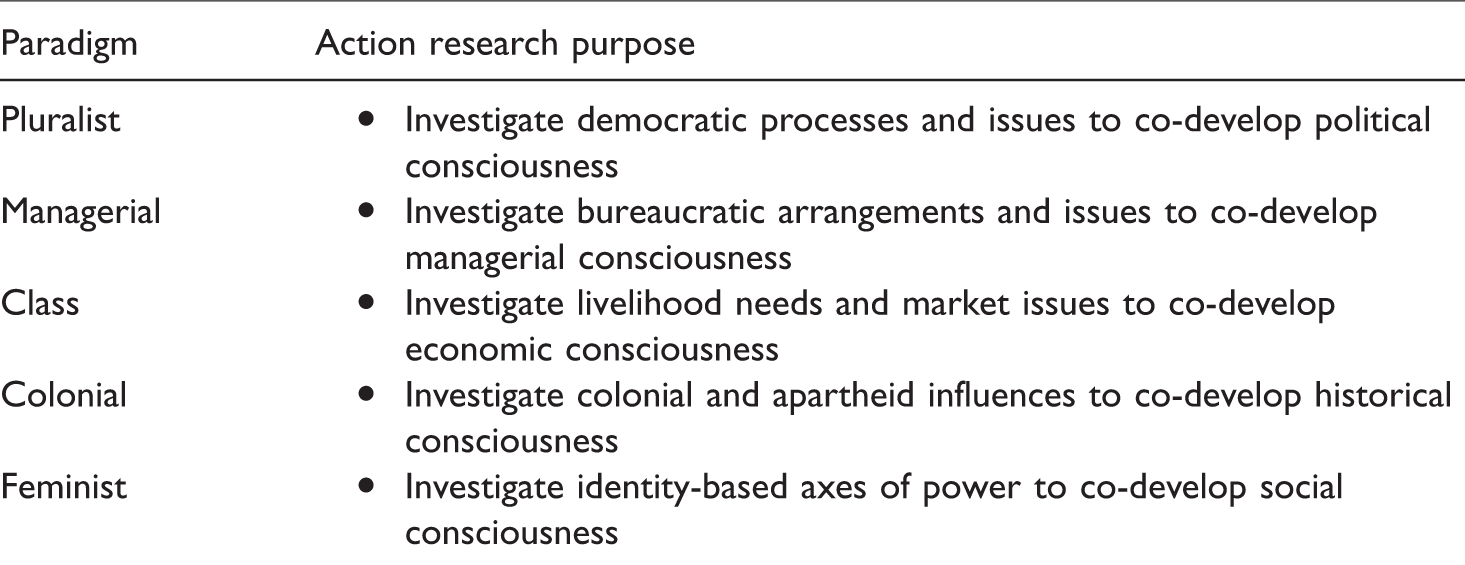
Subaltern theories of power encompass the colonial and feminist paradigms. Postcolonialism examines the role of Western epistemology in propagating power relations that objectify and exploit the subaltern “other,” with change viewed as a process of reclaiming cultural alterity, or the state of being different (Gandhi, 1998). Decolonial feminism elucidates the collusion of colonialism, capitalism, and patriarchy as a sociohistorical system of oppression, with change viewed as a rejection of colonial caste logic (Mendoza, 2015). Intersectional feminism notes that a matrix of domination is established through identity-based axes of power, with change viewed as a process of building solidarity across difference (Collins & Bilge, 2016).The subaltern discourse also identifies the research arena as a site for enacting transformation. In particular African scholars are forming “multi-paradigmatic research perspectives” that bring local worldviews into scholarship (Chilisa, Major, & Khudu-Petersen, 2017, p. 327).
My research team engaged these five paradigms to query the sociopolitical terrain in which we operated. However, rather than representing a starting point, we came to theory over time. When considering how to bring scholarly perspectives into dialogue with co-investigators, my primary objective was to prioritize local knowledge and agency. I thereby proposed a range of themes for potential inquiry then worked with the leaders to develop engagement via a multi-stage process. They insisted on employing a multi-paradigmatic lens. Not only did individual leaders articulate a range of perspectives, but the team as a whole felt the inclusion of different paradigms would help us generate more holistic understanding. Whereas pluralist and managerial perspectives guided our inquiry into the governance processes shaping rooibos politics, class and subaltern perspectives allowed us to investigate the inequities hindering producer engagement.
Research methods
This study comprised part of a participatory development project that occurred throughout 2010. Funded by an international agency that supported collaborative research and capacity building exchanges with small-scale producers, it encompassed over 80% of small-scale rooibos tea farmers, most of whom resided in remote coloured communities located in a Moravian Church mission station. Although the project involved a range of actors, it was driven by the farmer leaders, myself, and the lead project trainer who was a white South African female with expertise in agrarian certifications and rooibos livelihoods.
The year-long project unfolded during three phases of approximately four months in duration. During the first phase, the training partner and I made several community visits to determine interests. A large producer cooperative had lost its Fairtrade and organic certifications due to resource and skills shortages; thus, farmers asked us to help them develop a grassroots leadership network that would bring knowledge and skills directly into their communities. We responded by facilitating capabilities workshops in seven locations, each of which culminated in democratic elections for a community-based male/female leadership team, with 13 people elected into this role. 2
Action research design and fieldwork largely occurred during the second project phase, which began with a multi-day leadership workshop during which sessions were devoted to project planning. Talking with the leaders about potential research topics, I suggested the possibility of incorporating a sociopolitical component given their interest in securing representation within the rooibos industry. The leaders expressed a strong interest in this line of inquiry, leading us to discuss potential themes to guide engagement. With no idea as to how they would respond, I provided the leaders with full control over selecting appropriate themes. They desired to investigate all of the power dimensions that I mentioned and suggested additional ones. 3 The session ended with me asking whether the leaders would like to participate more fully in research. They demanded involvement in fieldwork. I responded by working with the training facilitator to integrate a research training component into the project and brought the leaders into research design, data collection, and data analysis.
The leaders were respondents as well as co-investigators in an interpretive research project that employed participatory and qualitative methods. Table 2 lists the sociopolitical research process that we co-developed, with the first three steps occurring during the second project phase during community-based fieldwork. To begin, I facilitated training in methods with leadership pairs in their communities. This process also involved working with leaders to obtain a representative sample of farmers in their area. We then conducted farmer interviews, with the leaders working as translators and co-interviewers. Next, I facilitated an introduction to power then conducted private interviews with each leader to solicit individual perspectives. These sessions were conducted prior to theoretical training, enabling my co-investigators to express their voice in a safe space and then to bring that voice into subsequent workshops.
Sociopolitical research, learning, and action.
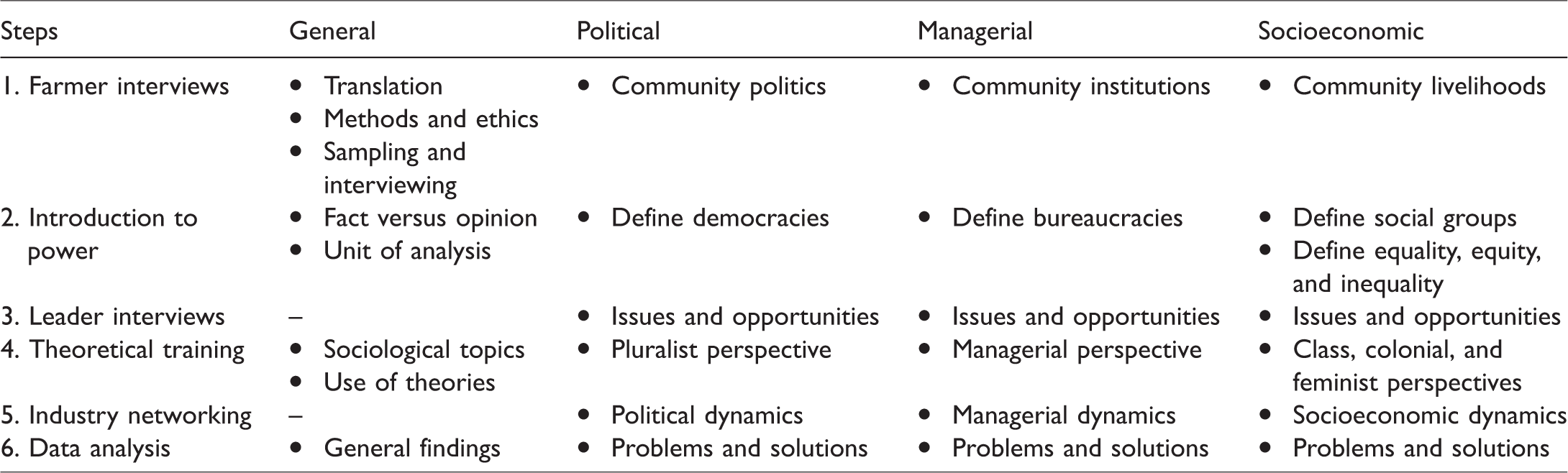
The third project phase began with training in theoretical perspectives. These dialogic learning sessions occurred prior to a series of networking activities, allowing us to connect theories of power with participant observation of industry and Fairtrade governance. We then reconvened for a multi-day workshop that included a half-day data analysis session, wherein the leaders examined interview and observation findings then identified key issues through dialogue, written reflections, and consensus-building activities. The leaders subsequently traveled to Cape Town, where they presented findings to scholars, industry, and development actors at a policy seminar hosted by the University of the Western Cape. The project ended with the leaders conducting farmer workshops that brought industry information back into their communities.
Positionalities
The demographic composition of the leadership project reflected global power imbalances, meaning that we had to learn how to talk about power in a way that would unite us. Most of the facilitators and half of the leaders were women, giving us parity in terms of gender, but race and class imbalances were acute. The facilitators and nearly all industry and development actors were white and college educated. The leaders were comprised of small-scale farmers, with most residing in remote areas and lacking access to computers. All but one leader was coloured and only the white leader—who had married into his community—had attended university. Some of my co-investigators had more financial security than others, but all identified as working class and nearly all had endured significant economic hardship.
As the lead field researcher, I entered the arena as a foreign white female with African and agrarian development expertise, but without previous involvement in South Africa. While my foreign status set me apart, it also freed me from conforming to the cultural dynamics shaping national race relations. I resided almost entirely in familial homes in rural and semi-rural coloured areas in order to become acculturated into coloured, rather than white South African society. I studied Afrikaans intensively and conversed in a mixed tongue with the leaders who helped teach me their language. As the next section shows, our interrogation of differential power dynamics laid the foundation for multi-paradigmatic conscientization.
Research findings
Leadership perspectives on governance and identity
The leaders were most familiar with community power relations; thus, our study largely operated at this level of analysis, although networking activities enabled us to examine broader dynamics during latter stages. As this section discusses, farming communities were democratically organized with adult citizens accorded a vote in public meetings. In mission communities, the Moravian Church administered access to local resources, and in other areas land was either privately owned or rented. Cooperative managers engaged with state, industry, and nongovernmental agencies to develop commercial activities, but few farmers interacted with external actors, and social inequalities became more significant at higher levels of analysis. Rather than selecting any one theoretical explanation of power, my co-investigators maintained different perspectives and came to consensus by embracing a multi-paradigmatic worldview.
First, leaders like Rochelle 4 strongly believed in the value of democracy, but noted that “problems are easy to create” in democratic societies. Anton likewise felt uninformed voting was an issue. In his words, “some people may not know something but they just put up their hand. They make bad decisions, for example, because they want to vote for a friend who is not qualified, who cannot do the work.” Frank and Olivia said voter turnout was low due to an overreliance on local leaders as well as the tendency of middle-aged men to dominate public meetings, and Helen noted that the political influence of farming communities was limited. The leaders agreed that industry and Fairtrade networks failed to ensure farmer inclusion in practice, even when organizations formally followed democratic protocols. They concluded that umbrella networks should appoint small-scale farmers to their boards and fund their involvement rather than relying upon development professionals to represent producer interests.
Second, according to the leaders of mission communities, Church governance was not always transparent, but Moravian administrators played a critical peacekeeping role. In addition to providing conflict resolution services, the Church managed scarce natural resources in a relatively equitable manner, although males and elders had somewhat greater access. Rooibos cooperatives were democratically organized, but these were almost entirely managed by local coloured males. The largest group was embroiled in conflict, and farmers viewed voting board members out of power as their only means of influence. More broadly, the leaders saw state, industry, and nongovernmental agencies as rationalized entities that failed to coordinate development efforts; and David queried Fairtrade’s decision to decertify his cooperative rather than working with farmers to resolve managerial issues. 5
Third, the leaders agreed that class was a primary source of inequity. Olivia, who hungered for tertiary education, talked about her lack of social mobility, stating, “I am working class. I can’t go to university.” Many leaders recognized a historical correlation between class and race, with Rochelle stating that “coloured people struggle from the bottom to get something, but white people have a platform to stand on that was given to them by apartheid.” Yet the leaders were divided in their views on race. According to Johan, “we live in a democratic society, so it’s more about what you do than your skin color that affects your life chances.” At higher levels of analysis, the farmer leaders were among the few nonwhite people present at rooibos and Fairtrade events, although a couple of processing firms were in the process of training a coloured worker for management in response to legislation that has stipulated the entry of marginalized groups into commercial leadership.
Fourth, the leaders concurred that women experienced greater livelihood barriers while men encountered more rigid gender roles. 6 Women were less mobile and struggled to access managerial positions whereas men struggled to accrue the resources required to marry and fulfill expectations of manhood. Elders of both sexes were more established and commanded greater respect. Young adults were accorded a vote in community meetings, but were expected to listen rather than to lead. Fearful of youth flight, some elders encouraged young adults to become more involved in local organizing by nominating young women and men to run in leadership elections and exhorting participants to vote for “the future of the community.” At higher levels of analysis, some white women and coloured males worked in Fairtrade and development agencies, but rooibos actors were almost entirely male and white.
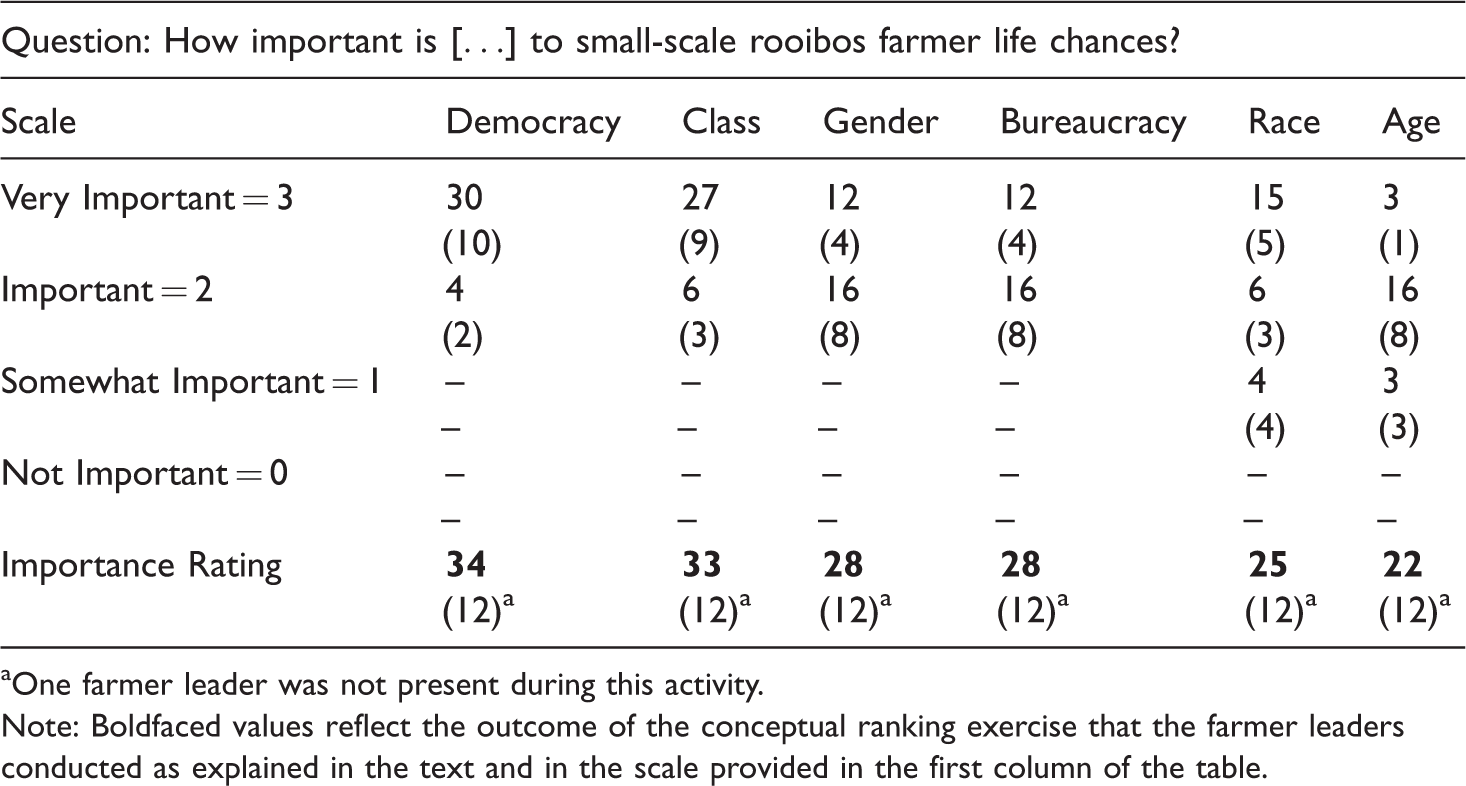
My co-investigators individually gravitated toward a range of theories, but saw value in one another’s insights and collectively embraced a multi-paradigmatic worldview. Table 3 presents the outcomes of a final ranking exercise, conducted during the data analysis session. The leaders stressed the importance of democracy because they felt political representation would enable them to advocate for small famer interests and secure greater access to development resources. However, their strong ranking of class also demonstrates a clear understanding of structural inequities, and many of the leaders were as cognizant of intersectional power imbalances as they were of bureaucratic problems. After presenting these concerns at the policy seminar, the leaders facilitated break-out sessions to begin working on solutions. As a result, Dirk was appointed to an industry board to represent small farmer interests. In the next two sections, I discuss our negotiation of power then reflect on how our engagement led to a shift in my worldview.
Conceptual ranking.
aOne farmer leader was not present during this activity.
Note: Boldfaced values reflect the outcome of the conceptual ranking exercise that the farmer leaders conducted as explained in the text and in the scale provided in the first column of the table.
Negotiating power in practice
Sociopolitical inquiry enabled us to become conscious of internal power imbalances. Project facilitators asked the leaders to evaluate performance after each round of action; thus, improvements generally were driven by open and friendly dialogue. However, in one instance, the leaders became angry, leading us to make immediate changes. In terms of research, my co-investigators demanded greater authority as our talks on power progressed. By the end of our first round of engagement, the newly elected leadership group clearly stated their desire for participatory research. During a next-round discussion on research ethics, my research team demanded control over how findings would be presented. I responded by: (1) working with project partners to organize a policy seminar that enabled the team to take control of disseminating findings to a regional audience; and (2) asking the leaders what I should consider when publishing our work. My team said that I was free to publish our findings, but insisted that I take care to respect their Church.
In terms of training and networking, the leaders became frustrated with the project when attempts to meet emergent demands caused facilitators to overestimate what was feasible. In an attempt to stretch funds, theoretical training occurred during a scheduled visit to Cape Town, at which time the leaders also attended a multi-day Fairtrade conference. They were exhausted by the intensive schedule, not to mention the lack of Afrikaans translation in most Fairtrade sessions. 7 Angered by their inability to vote in proceedings due to cooperative decertification, some of the male leaders staged a walkout. The lead project trainer and I dialogued with the leaders who stated that they desired a more reasonable working pace that would provide them with greater room for reflection. We responded by cancelling some activities and committed to ensuring more reflection time in subsequent actions.
Despite these issues, the combination of research, training, and networking helped the leaders connect local knowledge with theory and empirical observation. During the Fairtrade conference, they energetically debated sociopolitical dynamics during breaks. At one point, a group of leaders discussed a vote that had just occurred, with one taking the view that Fairtrade elites had used voting to push through a predetermined agenda. Another felt this was an example of good management rather than elite coercion as the vote dealt with a technical matter. A third leader changed the topic, stating that nearly all of the farmers attending the conference were white and that more coloured farmers and farmworkers should be present at sessions that claimed to be organized in their interest. The leaders were aware of inequitable relations prior to sociopolitical training, but theories helped us systematically unpack dynamics.
Developing relational awareness
I found that trust would not have been established without talking frankly with the farmer leaders about power. As I operated from a position of white privilege and “expert” authority, the leaders initially were guarded and deferential. A crucial turning point occurred after an initial workshop with the newly elected farmer leaders, at which point I conveyed my anxiety about being perceived as a white person in a position of dominance. Bernadine said she “felt bad when we met the first time” due to a fear of being exploited by experts “who make a living off the poor.” I admitted that I was complicit as this research would further my career, but Bernadine said she had changed her mind as we were “bettering ourselves together” through a project we would co-develop. During his private interview, David also talked about the inequitable dynamics of South African development relations. When asked to talk about race, he stated: Whites that come here to work, they are the experts. You may have good qualifications, but they are the experts and people don’t want to be bossed around by experts who are white. Some white experts boss people around. People don’t respond or show their displeasure, but they are angry.
A few weeks later I opened dialogue on project relations with Bernadine during a break from fieldwork. I began by asking how she felt about the leadership project, and upon hearing her positive commentary, probed deeper by asking if she felt pressured to act more like experts. Bernadine stated that apart from being encouraged to become more confident, she didn’t feel pressured to change her sense of self. I shared what I had written in my journal, and after pausing to consider, Bernadine said perhaps the project was changing both of us in ways we could not see. She asked if I recalled our earlier conversation, now some months in the past, and told me to remember that “we are both working to better ourselves.” In my final journal entry, I wrote about the importance of not becoming “detached from the experience” as it “it was through relationships that I was able to learn” what the project had to teach.
I was not the only member of the research team to shift my understanding. Prior to fieldwork, several co-investigators engaged in a heated discussion regarding the lack of communication within the decertified cooperative. Some female leaders said the problem could be resolved by bringing women into management because, in their view, “women are better at communication.” Some male leaders disagreed because, in their view, “men are better at management.” The research team continued to interrogate gender, reaching consensus during data analysis. At that point, every leader ranked gender as important or very important to life chances, including some male leaders who had previously ranked it as not important. The team concurred that: (1) men and women had different leadership skills, (2) these skills were equally valuable, and (3) both groups needed managerial training.
In the following section, I share practical and theoretical lessons learned. Although we found that multi-paradigmatic conscientization enabled individuals to become more open to difference, supporting the potential for multi-paradigmatic theory building, we were unable to surmount material and institutional barriers, suggesting the need to problematize the link between grassroots action and systemic transformation.
Multi-paradigmatic conscientization in praxis
According to Muhammad et al. (2015) PAR offers scholars an opportunity to transcend “personal and cultural biases that can develop through the achieved status of rigorous academic training” (p. 1058). During our engagement, my co-investigators challenged my perceptions of power and identity. When discussing age as an aspect of identity, Bernadine stressed cultural difference, stating “we don’t really categorize people as teens or so on as they do in the city.” Ernest refused to identify as a member of any race, for he saw racial designations as an instrument of apartheid that could only reify the condition of separateness. Insights such as these enabled me to move from discrete and ideological thinking to a more situated and relational awareness of power. By project end, I no longer claimed to be a post-Marxist scholar, and this loss of identity initially was decentering. This is not to say that I had forsaken critical social theory, but rather that the process of multi-paradigmatic conscientization had taught me to become consciously open to intellectual diversity.
African postcolonial theorists argue that scholars can neither transcend the false dualism of Western epistemology nor realize social justice in praxis without investing in multi-paradigmatic theory building (Chilisa, 2009). The multi-stage praxis of sociopolitical conscientization enabled my research team to integrate seemingly oppositional worldviews by culturally situating theories of power. It is important to remember the broader sociopolitical context in which our work took place. As members of the South African polity, the farmer leaders were witnesses to the birth of a multiracial democracy that has espoused the values of pluralism while remaining the most unequal country in Africa (Newman & De Lannoy, 2014). The leaders embraced pluralism in spirit, but recognized that farmer livelihoods were curtailed by systemic scarcity (Keahey, 2018). When analyzing research findings, my co-investigators concluded that pluralism was an ideal theory of power that was problematic at the level of community governance and unrealized at higher levels of engagement. To combat institutionalized inequities resulting from colonialism and apartheid, the team queried how to restructure production and trade arrangements to better reflect the pluralist ideals of stakeholder participation and democratic decision-making.
While developing their presentation for the policy seminar, the leaders arrived at a prescription for social change that united: (1) a socially conscious demand for the inclusion of male and female farmers in research and action, (2) an economically conscious demand for restitution through the provision of material resources that marginalized farming communities require to participate in agrarian markets and governance, (3) a managerially conscious demand for institutional transparency and coordination, and (4) a politically conscious demand for development to democratize engagement by placing communities rather than experts at the center of action. In addition to identifying a clear vision for agrarian research and practice, this prescription represents a preliminary attempt at delivering a multi-paradigmatic theory of social transformation.
Despite these successes, systemic barriers sundered our engagement. On the positive side, we brought PAR into alignment with alter-globalization movements by developing methods for improving the delivery of Fairtrade support services (Keahey et al., 2016). Yet we were unable to secure multi-year funding to scale up impacts and the leaders lacked the telecommunication tools needed to maintain connectivity. Demonstrating the instability of what we achieved in practice, the umbrella rooibos organization that appointed Dirk to its board recently reformed as a wholly commercial entity, leaving small-scale farmers unrepresented in industry governance. 8 In terms of multi-paradigmatic theory building, my research team was unable to embark upon next-stage data analysis. Similarly to other researchers, I have encountered institutional barriers that discourage PAR scholars from involving participants in data analysis (Stanton, 2014). While my co-investigators were involved in first-stage analysis, a lack of funding, geographic distances, and my placement in a publish-or-perish environment have prevented me from bringing the team back into the latter stages of analysis through the more time-consuming development of co-authored publications.
These issues suggest the failure of conscientization theory to fully account for the institutional power structures and systemic inequities separating communities of praxis across space and time. To problematize this issue, PAR must confront two contradictions. First, as a dialectical Marxist and postcolonial theorist, Freire refused to conflate “revolutionary consciousness with achieving human awareness through dialogue” as the purpose of conscientization was to change the social order (McLaren, 1992, p. 12). Yet his praxis of liberation has tended to deliver individualized, localized, and incremental shifts in power, which are more in line with pluralist views of social change. Here, the question is whether a bottom-up praxis of liberation is capable of engendering systemic transformation. Second, as institutions control access to resources and space for engagement, systemic change is unlikely to occur without embedding a norm of diversity, equity, and inclusion into institutional structures. Yet efforts to reform development in practice have led to the managerial rationalization of participatory methods, reversing their emancipatory power (Cooke & Kothari, 2001). Here, the question is whether conscientization theory can inform institutional practices in ways that transcend elite cooptation.
These contradictions are significant, but as historical beings, humans are in a continual process of becoming (Freire, 2014). Multi-paradigmatic conscientization enabled the farmer leaders to identify and transform the relations of research and action, offering a clear framework for theory building as well as participatory development. If PAR is to scale up impacts, we must gain the capacity to confront systemic barriers. We must learn how to harness power by reforming institutional standards to support more inclusive models for research and action. Elite practitioners must also relinquish power by placing marginalized people at the center of engagement, not simply in terms of project planning and data collection, but also in terms of institutional management and data analysis. These will not be easy tasks to fulfill, but my experience with multi-paradigmatic conscientization has taught me that the spark for change kindles in paradox and is brought to life through the joining together of difference.
Conclusion
This article has discussed a leadership project with small-scale rooibos tea farmers in postapartheid South Africa. Reflecting upon our pursuit of sociopolitical conscientization, I have: (1) discussed our use of theories of power as a method for research and action, (2) shared our methods for integrating local and scholarly knowledges, and (3) problematized implications for multi-paradigmatic theory building and participatory development. Responding to producer demands to seek representation in industry governance, the project began by holding community elections for farmer leaders who co-developed a research, training, and industry networking initiative. Comprised of myself and farmer leaders, the research team implemented a multi-step strategy. We concluded fieldwork with a policy seminar, enabling my co-investigators to share research findings with industry and development interests. The project achieved several successes, including the establishment of multi-paradigmatic conscientization and the procurement of small farmer representation in industry governance. However, our ability to generate lasting change was stymied by a combination of material and institutional barriers that call into question the revolutionary potential of Freire’s praxis of liberation.
For those who commit to nonhierarchical co-learning, conscientization is transformative at an interrelational level. PAR in development is susceptible to cooptation by elite actors who fail to confront the beliefs that give them power (Rahnema, 1990, p. 201). Multi-paradigmatic conscientization provides the means to disrupt this complacency. From my co-investigators, I learned that scholars should challenge the academic training that leads us to overly concretize what we think we know. Indeed, there is a fine distinction to be made between theory and ideology (Fals-Borda, 1996). When knowledge is fluid and evolving, theories can be effective tools for identifying and addressing social inequalities, but when knowledge is dogmatic and unyielding, theories become ideological weapons that reinforce elite power. By moving from abstract and discrete understanding to situated and relational awareness, I gained the capacity to relinquish control. Time and resources are needed to change the politics of development, and it is unclear whether grassroots conscientization can engender systemic social change. However, if the goal of social justice is to build democracy in action by learning how to diffuse power, then the methods presented in this article are suitable for praxis.
Footnotes
Authors’ note
This study was part of a broader project that included several partners, including the Center for Fair & Alternative Trade (CFAT), the Institute for Poverty, Land and Agrarian Studies (PLAAS), and Sandra Kruger & Associates, a South African consultancy firm that provides integrated capacity building in sustainability standards and certifications. The farmer leaders also were central project partners. While I have used pseudonyms to protect their individual standpoints due to the sensitivity of the topic, the acknowledgment below lists the real names of my research team in recognition of their co-ownership of this study.
Acknowledgement
I am grateful to the following co-investigators who were actively involved in research design, data collection, and first-stage data analysis: Pierre Apollis, Malcolm Baard, Craig Bantom, Elize Farmer, Adam Hoorns, Sharmaine Kupido, Eunice Marais, Elizabeth van Neel, Hennie van der Westhuizen, Jonene van der Westhuizen, Berna-Leigh Veloen, Rodger Witbooi, and Paul Zimri. We welcome and invite your comments and reactions at our action research community’s interactive ARJ blog housed at AR+  .
.
Declaration of conflicting interests
The author(s) declared no potential conflicts of interest with respect to the research, authorship, and/or publication of this article.
Funding
The author(s) disclosed receipt of the following financial support for the research, authorship, and/or publication of article: The project was funded by the Horticulture Collaborative Research Support Program (HortCRSP Grant Number 09-002945-10).