







Abstract
The purpose of this article is to explore the authors’ and the co-authors’ reflexivity in feminist participatory action research, conducted in three kindergartens in Indonesia, aiming to disrupt traditional gender discourses in early childhood education settings. Kindergarten is one of the most gendered spaces that perpetuate the binary between femininities and masculinities. This research takes place in Indonesia, one of the most populous Muslim countries in the world. The first part of the study deals with our own reflexivity as university lecturers, middle class and Muslim women, and we use these as a departure point to understand multiple positioning taken by our nine co-researchers as kindergarten teachers, women as well as Muslims and how these influence their gender understanding. The second part of the study discusses the journey of our co-researchers from having gender blind to more gender flexible attitude. As the co-researchers began to acknowledge their personal values, they were better able to apply gender flexible pedagogies to their kindergarten context. The co-researchers also demonstrate different forms of action in implementing gender flexible pedagogy. Our study suggests continuous reflexivity and the possibility of translating gender flexible pedagogy into the co-researchers’ local context were essential factors in this action research.
Introduction
Early childhood education (ECE) has always been perceived as one of the most gendered spaces that continue to promote the binary between femininity and masculinity (Blaise, 2005, 2013; Davies, 2003; MacNaughton, 2005; Warin & Adriany, 2015; Xu, 2019). In the Indonesian context, studies by Adriany (2019a, 2019b) also demonstrate how ECE is structured in a way that continues to police gender norms.
Early childhood education is also very much gendered because it has always been considered as a feminine profession (Heikkilä & Hellman, 2017). One of the factors underlying the low numbers of male teachers in ECE is their stereotyping as less masculine (Adriany, 2015; McCormack & Brownhill, 2014; Yulindrasari, 2017). Another reason for their low participation is the gender binary thinking that situates care and education separately (Xu, 2019). Care, all over the globes, is constructed as part of women’s work and in the gender construction that sees femininity as something of lower value than masculinity, and care is not seen as an integral part of education (Warin, 2014).
It is quite interesting that even though research situates ECE a gendered space, it is often viewed as an innocent area that does not encourage specific gendered behaviour (MacNaughton, 2000). In fact, many teachers adopt a rather gender-blind attitude (Warin & Adriany, 2015). At the same time, young children in kindergarten are often constructed as yet to understand issues such as gender. Hence, gender issues continue to be silenced in ECE (Browne, 2004). However, traditional gender discourse often operates freely and unselfconsciously in the classroom. In the meantime, some teachers’ gender-blind attitude makes them ‘explicitly promote and re-enforce particular performances of masculinity and femininity’ (Adriany, 2019b, p. 252). Very often, teachers appear unaware that exists an issue of power relations between different groups of children, where it would potentially exclude another child because of their non-conforming gender behaviour (Hellman et al., 2014; Paechter, 2007).
Warin and Adriany (2015) have suggested the need to develop gender flexible pedagogy in the early years. This concept is informed by feminist post-structuralism that views gender as something fluid and situated within specific discourses (Butler, 1990, 1993; Kamler, 1999; Paechter, 2006).
This study is built upon previous research but adopts a feminist participatory action research (FPAR) approach in order to encourage gender flexible pedagogy in kindergartens in Indonesia. This project aims to raise awareness of and sensitivity about the extent to which ECE teaching practices might reinforce traditional gender discourse. Also embodied within our research is an idea to encourage teachers to question existing practices and their taken for granted gendered nature, and to move beyond them. It is hoped that the research would encourage ECE teachers to start thinking about disrupting the gendered nature of ECE.
Early childhood education and gender discourses in Indonesia
Just like the practices of ECE all over the globes, ECE in Indonesia is very much gendered (Adriany, 2019a, 2019b; Adriany & Warin, 2014; Yulindrasari, 2017). This is the result of both religious and biological deterministic discourses that emphasize the fixed, unchallenged nature of gender, despite the fact that there exist non-binary gender categories among the indigenous groups in Indonesia (Blackwood, 2005). Because it is rooted in the religious discourse, any act to transgress gender construction is often seen as deviant from the religious teaching (Boellstorff, 2004).
In Indonesia, religion plays an important role in people’s daily activities. From more than six religions in the country, Islam is the most influential one (Van Bruinessen, 2002) and therefore one of the dominant discourses that shape gender construction (Robinson & Bessell, 2002; Wieringa, 2015). However, the practice of Islam in Indonesia is multifaceted. It ranges from those with a puritan inclination to the most liberal (Van Bruinessen, 2011). However, the past 10 years has witnessed a rise of more radical viewpoints with an obvious resistance to feminism (Wieringa, 2015). An example of this is the ‘Indonesia without feminism’ hash-tag (#IndonesiaTanpaFeminis) that went viral (Fachriansyah, 2019). Despite the long history of the Indonesian women’s movement for gender equality, even since the pre-colonial times (Blackburn, 2004), feminism is still often seen as representing foreign values.
In addition to being constructed under a dominant Islamic discourse, gender construction in ECE in Indonesia is also influenced by developmentalism, a school within educational practices that is informed by developmental psychology (Walkerdine, 1998). Developmentalism sees young children as undergoing certain stages of development. This paradigm would likely view young girls playing with baby dolls or boys playing with cars as part of their normal development (Burman, 2008; Edwards et al., 2009). For example, MacNaughton (2000), in her research, has demonstrated that boys play with blocks more often than girls, and the teachers do not pay attention to this because they believe it is part of the natural development of young boys. As a result, many gendered practices in ECE are taken for granted and never problematized.
Developmentalism may also lead to child-centredness. While this is often celebrated because it sees young children in a more democratic way, it often situates teachers as powerless and unable to interfere in children’s play (Henry, 1996). Research by Adriany (2015) also indicates how the notion of child-centredness very often restrains teachers from intervening in children’s play, even when there exist unequal power relations between boys and girls.
Notes on methodology: Combining feminist and action research approaches
As mentioned earlier, this study combines a feminist approach and action research. We borrow an understanding of action research from the FPAR framework of Reid & Frisby (2008) which sees action research as a tool to dismantle injustice in the society. At the same time, we also turn to the FPAR framework to achieve social justice and social equity in the classroom (MacNaughton, 2009). As previously mentioned, kindergarten is often regarded as a non-political and non-gendered space. It is the work of feminist poststructuralists that brings politics into ECE (Campbell, 1999).
Our approach is also informed by the fourth generation of action research that is influenced by the poststructuralist paradigm (Kemmis et al., 2013; MacNaughton & Smith, 2001), which sees reality as something constructed and historical; hence, there is no objective truth (Harding, 1987, 1991). Each ‘truth’ always carries multiple meanings and each is situated within a specific discourse that carries certain power relations (Foucault, 1980; Hook, 2007).
One of the key features in combining feminist and action research is that feminist research is oriented towards working with people rather than working for people (Heron, 1996). This is predicated on the epistemological presumption that critiques the assumptions positioning social sciences (Coffey, 1999). There are established ideas in the social sciences about the dichotomies of mind versus body; reason versus emotion; objectivity versus subjectivity and researcher versus participants (Coffey, 1999; Harding, 1987, 1991; Stanley & Wise, 1993). Feminist poststructuralists question these binaries, believing that such dualism is inadequate and hence there is a need to integrate them in the research process (Stanley & Wise, 1993). For a feminist researcher, the distinction between researcher and research participants is also questioned. Therefore, the participants in this research are seen as co-researchers engaged in the process of constructing and reconstructing meaning.
We conducted this research over the span of three years from 2017 to 2019. We followed the interconnected phases from Lorenzetti & Walsh (2020, p. 6) that involved ‘community development prior to the research; cohesion and trust-building among the co-researcher team; leadership and praxis of the co-researcher team and post-study sustainability of the work’ as shown in Figure 1. It is often questioned where the action is within FPAR, since it might appear to be not clearly prescribed. However, as Reid et al. (2006) argue, FPAR is not merely a method but rather it is framework that allows us to seek social justice by inviting our co-researchers as actors to initiate the changes. At the same time, FPAR also values the reflective process. In fact, as Reid et al. (2006, p. 317) argue, FPAR aims to ‘create spaces for collective reflection in which new descriptions and analyses of important situations may be developed as the basis for new actions’. This belief informs the way we have conducted this research. Instead of seeing stages from Lorenzetti & Walsh (2020) as a linear and sequential process, we accommodate all the phases throughout our research, with reflexivity and negotiation of power as a key part in all stages. Interconnected phases of feminist participatory action research.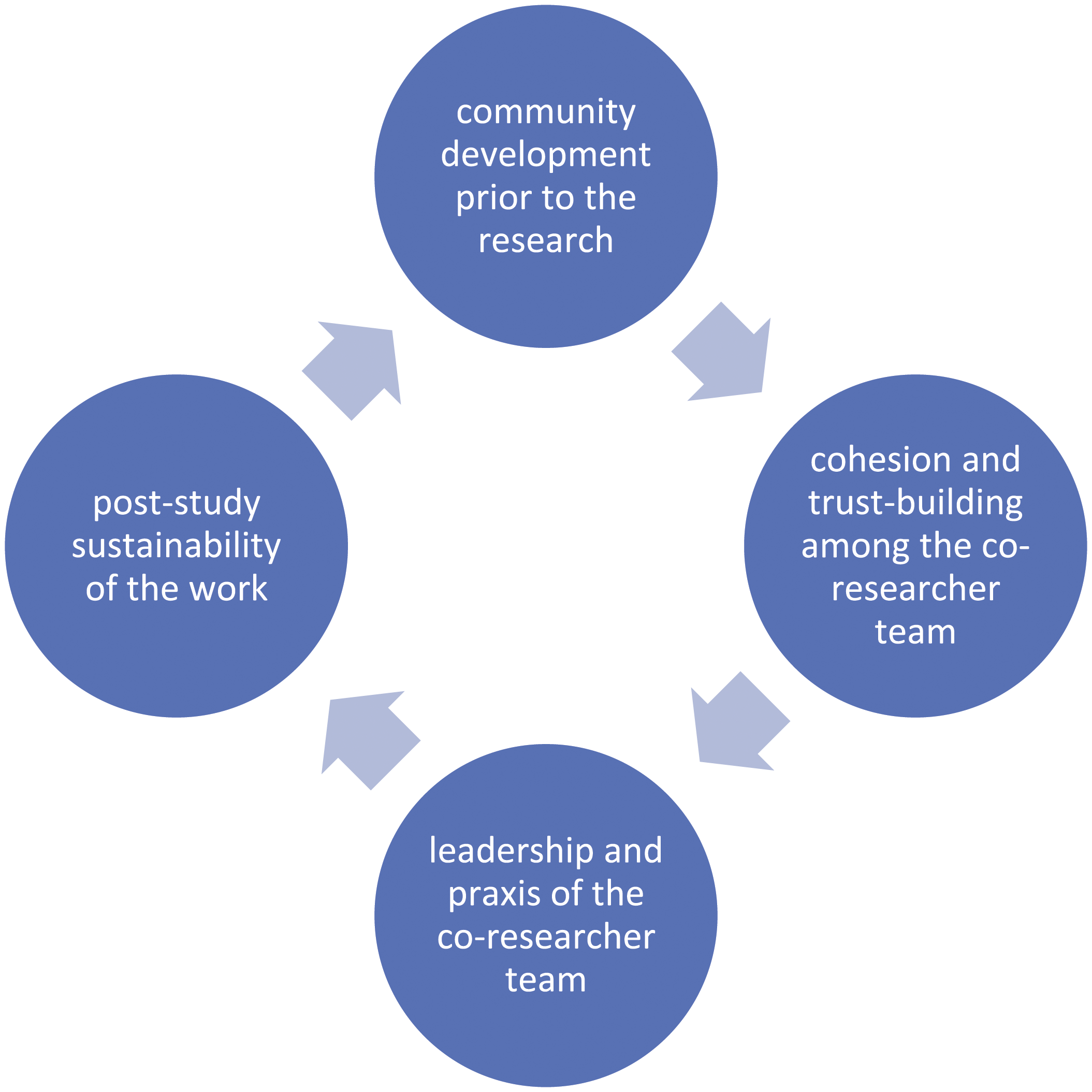
In this action research project, there were nine teachers from three kindergartens in Bandung, Indonesia, participating as our co-researchers. They were Ria, Ina and Siti from Star Kindergarten; Ida, Rini and Euis from Flag Kindergarten and Yeni, Heni and Ita from Colourful Kindergarten. Adhering to the ethical procedures and respecting their choices that their identity remains confidential; all names of people and kindergartens were pseudonyms. We came to know them through our fieldwork in their kindergartens in 2017. The fieldwork was an essential stage to establish community development prior to the action research.
Central to our research was also the inclusion of children voices. Our understanding of feminist values has led us to uphold the idea that children have agency and their voices should be fully respected (Rosen & Twamley, 2018). In fact, we adopted FPAR because we were aware that the prevailing gender inequity in the classroom had the potential to exclude some children for their non-conforming gender behaviour. We believe that ultimately children will become the primary beneficiaries of our research, although in this study we focus our discussion on the experiences of working together with the teachers.
Unpacking our reflexivity and position in the research process
Central to FPAR is the researchers’ reflexivity and positionality (Lorenzetti & Walsh, 2020). This tenet refers to an understanding shared by the researchers that their research would be ‘shaped by their socio-historical locations, including the values and interests that these locations confer upon them’ (Hammersley & Atkinson, 2007, p. 18). Thus, the research was not carried out in a vacuum but within the context of the issue being studied, which might affect the researcher as much as the researcher’s presence might affect the field site.
This research was initiated by three authors, academics who work at the same institution. We consider ourselves as feminists and each of us has been doing research on gender in educational settings for more than 10 years. We often felt that despite the fact we had been conducting research on gender for more than a decade, it appears that little change has taken place in the education setting and it makes us frustrated. Yet, on reflection, we considered that this might indicate a broken link between research and practice. The three of us then decided to conduct an action research project because central to action research is ‘an orientation to knowledge creation that arises in a context of practice and requires researchers to work with practitioners’ (Bradbury-Huang, 2010, p. 93). In the words of Reid & Frisby (2008, p. 94) words, action research ‘can help feminist researchers move out of the academic armchair by engaging in more transformative research’. Therefore, our research objective is to initiate and create social transformation.
In our reflective retrospection, we deemed it necessary to make the personal visible. Despite our strong commitment to justice and gender equality, we are all aware of our privilege. All of us are middle class, educated women with doctoral degrees, life and educational experiences in universities in Global North countries. Our understanding of gender and feminism, to some extent, is influenced by the Western construction of knowledge. Therefore, the co-researchers might also see us as an extension of the so-called Western forces trying to impose foreign values on them. As mentioned, there is a growing resistance towards feminism in Indonesia which is often perceived as an alien concept. At the same time, our positions as university lecturers might also create an unbalanced relation with the co-researchers. The co-researchers, like kindergarten teachers in many other countries, are often regarded as having a lower social status compared to lecturers and receive a low salary as well. As a result, the co-researchers might have perceived us as superior. This awareness assisted us in navigating the power relationship between us.
Establishing trust and relationship with our co-researchers
In FPAR, researchers and co-researchers serve mutual relationship and act as allies (Reid & Frisby, 2008). The researchers need to navigate power relations with the co-researchers by avoiding colonial practices such as ensuring that we do not impose their power or do not appreciate the voices of the co-researchers (Tuhiwai Smith, 2005). Considering that there was already scepticism among our co-researchers regarding, among others, feminism and existing privileges, it is important that the research to be carried out cater to, respect and appreciate the different voices and experiences of participants.
Our co-researchers shared our identities as Indonesian, heterosexual and Muslim women. These similarities established a common ground in that. We share similar experiences that facilitated an understanding towards the issues at hand. For example, as women, we all experience some degree of gender discrimination. At the same time, being Muslims, we are aware of the discursive meanings of Islam. Islam is often constructed, especially in the Western context, as a religion which is not compatible with feminist values. The discourse in the Western media often perpetuates the idea that Muslim women are oppressed and do not possess any agency. The ban of the niqab in French and Belgium for instance also shows how the veil is seen as a signifier for women’s oppression. Even in a country like Indonesia, there has been a similar but not identical history related to the wearing of the veil. Of the authors, Vina Adriany (VA) and Safrina Noorman (SN) have worn the veil since their younger days. I was only 15 when I decided to use it. I remember that during that time, there was a tension between the Islamic community and the state which had forbidden the wearing of veils. My family resisted my idea of wearing the veil. My mother worried that I would not have any boyfriend if I wore veil. I also had to experience some degree of discrimination in the school. My PE teacher banned me to participate in the activities because I did not wear the school’s PE uniform. I was also threatened with expulsion from high school. The experience of being excluded due to what I wear has actually led me to develop interest in studying feminism. The experience of being discriminated however continued even when I became an adult. I remember that during my PhD in the UK, I attended a gender conference in Europe where one of the speakers discussed the rising of radicalism, with the veil seen as its signifier. Some participants actually confronted the speakers by saying that she could not generalize all Muslim women. Nevertheless, being the only covered woman in the room, I felt so uncomfortable. I also felt that my presence in the conference was somehow invisible and silenced. At the same, it was during my stay in the UK, my empathy with LGBT communities also grew because I saw some commonalities in terms of being a minority. I learnt that there was a space for all persons from minorities background to be allies in order to resist the discrimination in the society (VA’s journal).
Safrina Noorman decided to wear her veil when she was older. She already had two children and was, at that time, doing postgraduate study in Sydney, Australia. The decision was made because she observed the many discriminations experienced by her friends in Indonesia and had thought that in Australian people seemed to pay less attention to what other people were wearing and tended to refrain from asking personal questions. Of course, people paid attention and asked questions. Actually, there were times when wearing the hijab in the early 1990s felt like putting oneself in the way of explicit abuse. However, I realized at the same time that I finally welcomed even looked forward to personal curious questions. The experience of wearing the hijab as a minority has built in me the belief that communication was a breaker of barriers and a bridge to more equity (SN’s journal).
Hani Yulindrasari (HY) however has different experiences in relation to veil: I had worn the veil since I was 14 years-old. Like VA, I also started wearing it when it was forbidden and wearers were stigmatized as religious fanatics. However, I also experienced enormous support from families for deciding to wear the veil at such a young age. I decided to wear it voluntarily but then realized that it was not only fabric and fashion, but also seen as a symbol of righteousness and piety. I started to feel that my morality was being constantly monitored because of it. The social expectation to be always on the right Islamic path pressured me to the point that I could not explore myself as a teenager. It is important to underline that the situation was completely different from now. Now, the veil might not be a barrier for girls to do any activity such as dancing, playing music in a band, and singing. After 3 years of wearing the veil, I wanted to take it off but I could not, because I did not want to embarrass my family. I kept wearing my veil until I went to Australia for my Master’s degree. Being thousands of miles away from my family gave me time to think about who I was, and explore different interpretation of the veil. I decided to stop wearing the veil without feeling less of a Muslim woman. During the research, however, there was a time when I was worried about how the participants might perceive me because of negative sentiment towards feminism, as mentioned before (HY’s journal).
Our experiences with the veil illuminate the hijaphobias that we encountered. As Joosub and Ebrahim (2020) explain, there are dualities within hijaphobias. One is rooted in Islamism and the other one is predicated on Islamophobia in the West. Without any doubt, the Islamist hijaphobia perpetuates the desire to police women’s bodies, while the Western one sees the hijab as a threat to women’s freedom (Joosub & Ebrahim, 2020). Both discourses speak in the name of Muslim women, without taking into account the discursive meaning of the veil. Muslim women’s agency is also missing from the debate. In our research, we attempt to go beyond the dichotomy of Islamist versus Western hijaphobias. Being women who wear the veil (VA & SN), we know for sure that it does not stop us from being feminists. At the same time, we also realize that veil can be controlling and hegemonic as experienced by HY. We translate the complexity of the veil and Islam as our point of departure to understand our co-researchers’ gendered- and religious-based experiences of prejudice and we see this as a possibility for them to understand feminist values. We attempt to understand the struggle and this allows us to develop more empathy with our co-researchers who are active and committed graduate teachers, three of whom are the kindergarten principals, and highly involved in teachers’ organizations. They completely challenge the ideas of Muslim women as helpless and vulnerable.
In order to establish a reciprocal relationship with our co-researchers, we invited them to the Focus Group Discussion (FGD) in 2018. Although the term ‘FGD’ might appear to be very formal, the event was actually an opportunity for each of us to talk and express our feelings. During the FGD, it was evident that all our co-researchers still believed that gender was something that cannot be changed and negotiated, as evidenced by the following comment: I think gender means differences between man and woman. You know, there is this clear difference what it means to be a man and what it is to be a woman (Ria).
Another co-researcher, Ita said that the main difference between men and women lies in the biological difference between them. In her responses, it is clear that our co-researchers were still holding on to the essentialist and biological understanding of gender (Adriany & Warin, 2014). Realizing how pervasive traditional gender discourse was in our co-researchers’ way of thinking, we then presented the findings from our earlier fieldwork in their schools. The aims were to demonstrate the gendered nature of their kindergartens and teaching practices. The co-researchers were quite surprised by the results as they had always believed that they treated the boys and girls equally. This belief is very common among ECE teachers and, as previously mentioned, many hold a gender-blind attitude and never thinking that gender is an issue in their teaching, while in fact it is very much part of their practice (MacNaughton, 2000). On a more positive note, the co-researchers were very enthusiastic and we noticed how the findings led them to become more reflective with their teaching practices, as indicated in the following comments: I always think I treat the boys and girls equally… I did not realize that I have actually overlooked girls in so many ways (Ina).
Another interesting finding during the FGD was teachers’ astonishment toward the finding that illustrates imbalanced power relations between the boys and the girls in the kindergarten. Through our fieldnotes, we showed the co-researchers how certain areas in the kindergarten, such as an outdoor space, have been masculinized or role-play area feminized because they were mainly dominated by boys or girls. Apparently, the issue of power relations among boys and girls is often silenced in ECE (Paechter, 2006). Teachers’ lack of understanding on the micro-political nature of power is evident in this example (MacNaughton, 2005), and again, it was very illuminating to see how the co-researchers used the FGD to reflect on their teaching practices.
We then proceeded to the next stage. Here, using the co-researcher’s experiences, we invited them to unpack the notion of gender. We started by discussing the difference between gender and sex. Our intention was to show the teachers that gender is a socially constructed concept that can be challenged, negotiated and re-constructed. Each of the researchers and co-researchers shared the experiences of being women, and whether or not we had experienced discrimination or sexism in our life due to our female identity. The co-researchers appeared to be very enthusiastic in this session. They told us about their experiences as a daughter, a wife, a mother, and a kindergarten teacher. Yeni, for instance, told how she was raised by a very strict father who did not let her to do martial arts, something that she continues to regret. Heni mentioned how she realized that the low salary she has as a kindergarten teacher was due to the feminization of the concept of caring. Euis also said how sometimes she finds it difficult to negotiate the demands of her domestic work and her job.
List of themes.
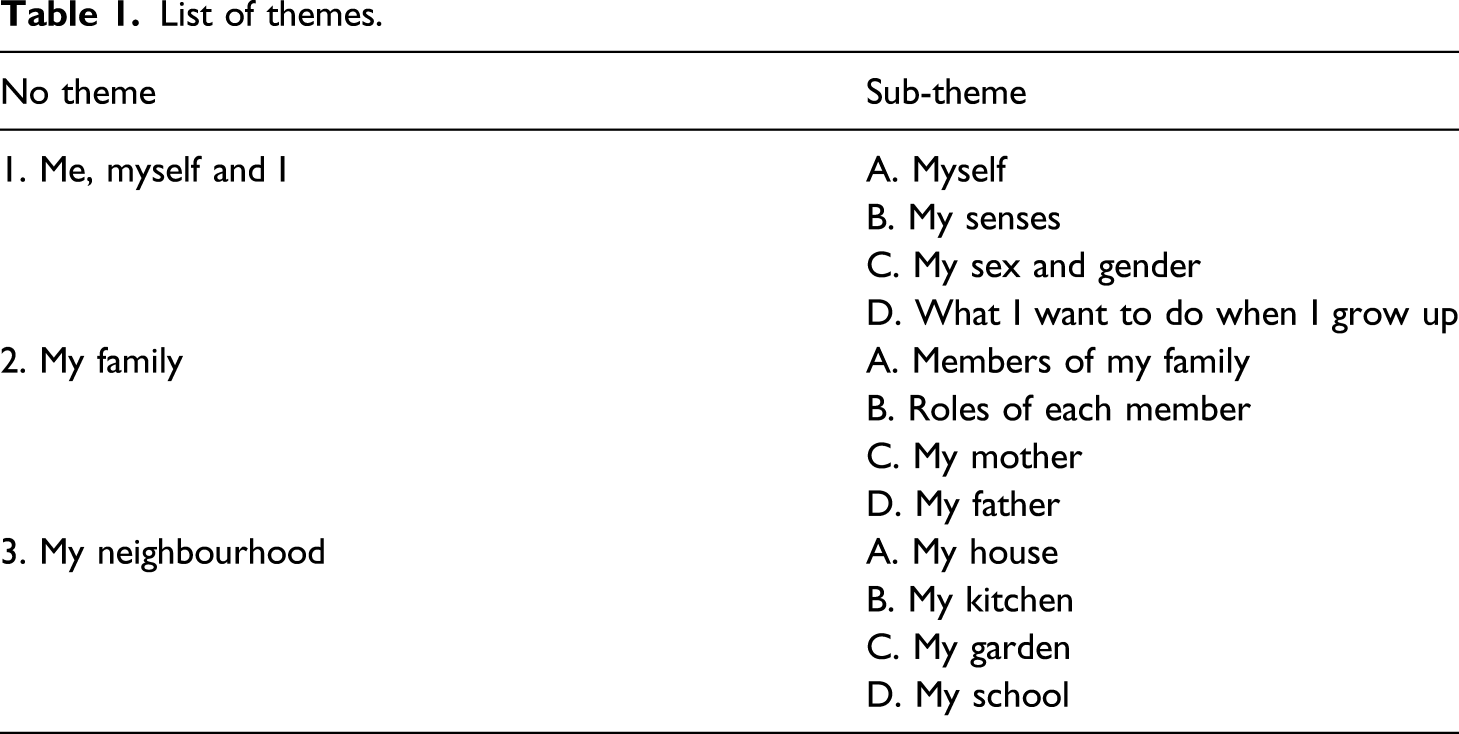
We then proceeded to micro-teaching where each person was asked to teach using the plan and the materials they had developed. When one co-researcher taught, others would observe and comment on their teaching. During this stage, we noticed that there was a growing understanding among the co-researchers about the concept of gender as something fluid. Siti was very concerned when Ida explained the difference between boys and girls. Siti thought that Ida’s approach perpetuated the differences between boys and girls. Siti challenged Ida to deconstruct her teaching by inviting children to think differently about girls and boys. I think we need to go beyond physical differences between boys and girls. If we keep on saying that boys have short hair and girls have long hair, we are not going anywhere. You just need to tell the children that there are boys with long hair and there are also girls with short hair, and that is completely fine (Siti).
It might appear that the session had a top-down approach, but we argue that it was something that we had to do, considering the previous gender-blind attitude of our co-researchers. The session was not in the form of a lecture but rather took the form of a reflective session in which we all participated. Euis said that she found the FGD a safe space where she could discuss her experiences of being a woman and how it helped her realize the nature of Indonesian gendered society. At the same time, Heni also said that the FGD enabled her to rethink her teaching practices. In this way, the FGD sessions were described as a place for ‘planning and debriefing’ (Lorenzetti & Walsh, 2020).
Many forms of action
Central to feminist values is an appreciation that every discourse carries multiple meanings. Within FPAR methodology here is no single, fixed model of action research. In our research, it was evident that each of our co-researchers translated the sub-themes and adapted them for use in their kindergartens. It is in fact through different ways of implementation, the leadership and praxis of our co-researcher as explained by Lorenzetti & Walsh (2020) was shown. Hence, in this section, we will explore the co-researchers’ voices to illuminate the changes they have undergone resulted from their engagement with gender flexible pedagogy approach.
Decolonizing Islam
As we have elaborated before, Islam plays important roles in all the kindergartens. Every morning, the schools’ activities are commenced by praying according to Islamic ways. At the same time, as explained before, all the co-researchers are Muslims and they are all wearing veils which demonstrate how Islam is part of their identities. Despite the teachers’ initial reluctant to embrace the notion of gender equality, but after being involved in this research, they are willing to create a space where Islam and feminism can co-exist together.
One of our researchers, Ria, admitted that initially she thought Islam and feminism were not compatible. However, she now believes that Islam is a religion that promotes equality between men and women. This new thinking led her to engage in the process of decolonizing gender discourses. She sought an alternative discourse within Islam that offers space for gender equality. In another captured conversation, she told us: “Being involved in this research inspires me to dig into my religion to learn if it actually promotes gender equality. I was very surprised that there exists various interpretation within Islam that supports gender equality. I feel like they have been concealed all these years and all I know is only the dominant interpretation. Now, I am very determined to ensure that I represent female characters whenever I talk about Muslim historical figures with my students. I also now try to make sure that the girls (in my kindergarten) can be elected as leaders in the school’s assembly” (Ria).
Ria’s account illuminates the process in her thinking from initially see Islam and feminism as two binary opposition to a belief that there might exist a hybrid space for the two to negotiate with one another. We interpret Ria’s journey as an act of decolonizing Islam which means that in embracing gender flexible pedagogy in her teaching, she remains faithful to her belief, while at the same time opening up possibilities for feminist values. She is becoming a feminist not by rejecting her belief, but rather diving into another meaning of Islam. She does not only accept feminism but she also seems to realize that there exist multiple realities within Islam.
Undoing gender
The process of decolonizing gender as well as Islam has invited the co-researcher to continue undoing their gender. One of the co-researchers, Ina admitted that throughout the years she had been gender blind, not realizing how gendered her teaching practices were. She believed that after participating in this project, she had become more reflective in her teaching to ensure that she was not promoting gender inequalities, as demonstrated in the following fieldnotes: The children and Ina sat down on the mat. Ina showed a picture of a mother and a father. She then explained that the mother is the one who gave birth to the baby, while the father is helping taking care of the baby. (Researchers’ Fieldnotes, 31st July 2019) The children and Ina sat down on the mat. Ina opened the book, ‘My Father’. She showed a picture of a father combing his daughter’s hair. She asked the children, “What is the father doing?”. The children replied, “He is tying her hair”. “You see, a father can also comb his child’s hair.” She then asked the children, “What else can a father do?”. The children gave various answers, she then replied, “A father can also cook, he can also clean the house”. One of the children said that his father has a moustache. Ina laughed but then she said, “You know some women have moustaches too”. The children looked surprised. Ina smiled and said, “It’s true!”. (Researchers’ Fieldnotes, 5th August 2019).
The above fieldnotes illustrate Ina’s thinking during the process. While in the first fieldnote, she seemed to still emphasize the biological differences between men and women; in the second, it was quite evident that she challenged herself to go beyond the biological differences between man and woman. In so doing, she was engaged in the process of doing and undoing her gender (Butler, 2004; Vogt et al., 2015).
Using gender lens pedagogy
The process of undoing the co-researchers’ gender has enabled them to use gender lens pedagogy in their teaching. They, now attempt to accommodate the gender flexible pedagogy in the kindergartens. The gender lens pedagogy allows them to focus on the issue of power. They become concern with questions such as which children have access to play, which do not have, who is included, who is excluded, and on what basis the inclusion/exclusion happens. Ita also said that now the teachers enacted more active roles. As we mentioned previously, the teachers often tended to assume that young children do not understand the issue of gender. In another captured conversation, Yeni explained: Whenever the children are playing, I try to see who has more access, who is included, and who is excluded. By paying attention to all these, I have become aware that the boys tend to prohibit the girls from playing in the tree house. I try to interrupt by encouraging the boys to ask the girls to play together. At first, the boys were reluctant but after I told them that boys and girls can play together. Slowly, they are willing to play together (Yeni).
This project, according to the teachers, is not only important for changing their understanding on gender, but at the same time it gives opportunities for the children to expand their understanding and construction of gender, as can be seen in the following statement from Heni: During the role play, one of the children, Ali, surprisingly picked up a role as a mother. First, other children resisted it. They say only a girl can become a mother. But Ali confidently said that even a boy can become a mother. I was actually very surprised to hear it coming from the children (Heni).
The above quote illustrates not only children’s capacity to resist to the dominant gender discourse, but more importantly it also shows that children have more freedom to negotiate their gender, provided there is a safe space for them to transgress traditional gender play. The safe space is made possible through the gender flexible pedagogy.
Conclusion: Post-study sustainability of work
The findings from our project illuminate the possibility to conduct FPAR in a kindergarten setting. Throughout the research project, we attempted to remain faithful to our feminist values, that is, to deliver social justice and gender equity in the classroom while ensuring that our co-researchers were participated.
The findings demonstrate the co-researchers’ willingness to work together with us as a key factor that helped this research achieve its goals. One of the main reasons why they seem to be eager to do this research lies in the fact that they have been actively involved since the beginning of this research process. We have been very transparent with our research agenda and the fieldwork that we did in the first year of our research helped teachers to reflect on the gendered nature their teaching. This recognition became the cornerstone for us to continue to engage with them in the reflective process. As our co-researchers revealed during our final evaluation meeting, the project has enabled them to be more sensitive in their teaching practices. They became conscious about possibilities to differentiate and/or overlook the boys or the girls. At the same time, they also became more thoughtful in making sure that their words, actions, and attitudes did not promote traditional gender discourses in their kindergartens. As indicated by Rini in her comments: It has been an eye-opening experience. I know realize that many things that I took for granted, are actually very gendered. At the same time, this project also allows me to be more creative in my teaching. I try to make sure that the gender equality message is coming through in my teaching. Once, I showed the children the picture of a father doing the laundry. The children were very enthusiastic about it (Rini).
Because Islamic influence in Indonesia is quite pervasive, one of the highlighted findings in our research lies in the co-researchers’ willingness to negotiate their understanding on Islam. Their acceptance towards gender flexible pedagogy in their schools indicates their willingness to find a space for Islam and feminism to meet, as articulated by Ina: I used to think that as a Muslim, we don’t need to fight for gender equality. But now I realize, gender inequalities are real and these issues also affect pupils in our kindergarten (Ina).
The co-researchers’ reflection suggests a change in the teachers’ attitudes and practices from those which are gender blind to a more gender sensitive. During the evaluation meeting, the co-researchers were also inspired to continue this approach. This might indicate possibilities to have post-sustainability of the work (Lorenzetti & Walsh, 2020). Euis expressed her wishes to include other kindergartens in our city. She believes that the project must be continued and that more teachers need to be included in it.
Continuous reflexivity is also another feature that contributed to the success of the research. We have all been thoughtful about our positionalities as academics, teachers and women. Realizing the gendered nature of our own experiences has helped us to better understand the significance of this project. As for us, the authors, our own reflexivity help us continues to negotiate the research objective. We appreciate our co-researchers’ enthusiasm to work together in this project, while at the same time understand how pervasive traditional gender discourse is in our society. Hence, together we continue to develop trust, while promoting leadership and praxis of the co-researcher team (Reid & Frisby, 2008).
However, because the traditional gender construction has been strongly embedded, we notice that there are still issues that should be addressed in future research. One such concept is our co-researchers’ understanding of gender as still limited to two gender categories, namely male and female. While they are now more open to the possibilities for children to construct non-traditional gender activities or cross-gender activities, they continue to demonstrate their thinking about gender in term of the male and female binary. The heteronormative discourse is still found to be very strongly anchored among the teachers in these ECE setting. We realize that the road for gender equity is both long and revolutionary, and at the moment our work is trying to create a first step to dismantle the dominant gender discourse. Our finding hence also serves as an invitation to continue our research and to decolonize further gender discourses in the country.
Footnotes
Acknowledgements
We are also thankful to all our co-researchers who have trusted us and shared this journey with us.
Declaration of conflicting interests
The author(s) declared no potential conflicts of interest with respect to the research, authorship, and/or publication of this article.
Funding
The author(s) disclosed receipt of the following financial support for the research, authorship, and/or publication of this article: This study was supported by Indonesia Ministry of Education, Culture, Research and Technology.
