







Abstract
This article outlines and reviews many of the proposals for the structure and argument of 1 John. The article has two elements: first, it groups together scholars who use similar techniques to divide 1 John into its parts and so discern a structure; second, it outlines the methods used to analyse the relationships between the constituent parts of the structure and in so doing evaluates many of the proposed understandings of the argument of 1 John.
One of the enigmas that plagues the interpretation of 1 John is the issue of its literary structure and argument. This difficulty, and its implications for understanding 1 John, are widely acknowledged, with the result that some scholars are pessimistic about the possibility of describing the structure. However, the importance of understanding the argument for interpretation has meant scholars have not stopped trying. So in commenting on 1 John’s structure Dodd (1946: xxii) notes that any ‘attempt to divide the work into orderly paragraphs and sections must largely be arbitrary, and will indicate only in a broad way the succession of topics’. Yet Grayston (1984: 4) comments that ‘despite the common agreement that the Epistle lacks a discernible structure of logical progression of thought, even the most pessimistic critics attempt an analysis’. Finally Hiebert (1991: 25) concludes that by ‘its very nature, any systematic outline of [1 John] must leave much to be desired. Yet for practical study some outline of it is much to be desired’.
As a result of this, the motivation to understand the structure and argument of 1 John has spawned a large number of proposals. Apart from the usual section at the start of commentaries there are books (Malatesta 1973; Sherman and Tuggy 1994), theses (Wu 1998; Luna 2004), chapters in books (Häring 1892; Feuillet 1972; Longacre 1992; Watson 2003), and journal articles (du Rand 1979; Klauck 1990; Hansford 1992; Thomas 1998; Tollefson 1999; Jensen 2012) devoted to the topic. Further, there is even a review like this one written to survey the research in the area (Olsson 1999).
The aim of this article is to critically review the main proposals found in this body of secondary literature. It will not just present each proposal for critique but will attempt to show common methods and assumptions used when describing the structure and argument of 1 John. By pursuing this method, it hopes to demonstrate the links and dependencies between the proposals in order to bring some clarity to the topic and enable further research.
In order to achieve this aim, the article has two main sections. First, it presents the techniques used for demarcating the units in the text of 1 John which result in the description of its structure. After explaining each technique, a couple of representative exponents are cited and interacted with in order to demonstrate the relative merits of that approach. Other scholars who also follow that procedure are cited but not interacted with. The options for identifying units include thematic analysis, source criticism, literary analysis, text-linguistic methods, and appealing to ancient rhetorical practice. The first section is devoted to the structure of 1 John. Second, having observed the method for dividing the text into units, the article examines the means by which scholars relate these units to each other. The different ways of analysing the relationships of the units result in different understandings of the argument. The options for interpreting the links between units include an association of ideas, a cyclical or spiral form argument, a parallel to John’s Gospel, and chiasm. Thus the second part is a discussion of the proposed argument of 1 John.
There is some overlap in the methods used to demarcate the text of 1 John and relate its units to each other, in particular, those that appeal to ancient rhetoric. It is hoped that the heuristic method of analysing the structure separate to the argument will reveal scholarly dependencies, show scholarly processes, and as a result explain the large number of current proposals.
The Structure of 1 John
Locating the divisions of the text of 1 John and so describing its structure is commonly acknowledged to be difficult. Segovia (1982: 33) states that the ‘structure of 1 John has proved to be a crux interpretum for students of the Letter over the years’. Likewise Burge (1996: 147) comments that the ‘literary structure of 1 John has remained an enigma in the history of intepretation’. Akin (2001: 37) recognizes that ‘Few issues are more difficult in Johannine studies than the structure of 1 John’. Rensberger (2001: 14) notes that it ‘is also necessary to say something about the way 1 John is put together, its structure—or rather, its lack of structure, for every attempt to provide a comprehensive outline of 1 John ultimately fails’. Finally Painter (2002: 116) remarks that there ‘are considerable problems concerning the structure of 1 John’.
Yet this widely acknowledged difficulty does not stop scholars proposing a structure for 1 John. There are five main methods experts have used to locate the divisions in 1 John enabling them to describe its structure: thematic analysis, source criticism, literary criticism, linguistic analysis, and appeal to ancient rhetorical practices.
Thematic Units
The first method for discerning the units that comprise 1 John involves identifying the main themes and locating transitions between these themes. The transition between themes indicates the boundary of units. The main themes scholars identify are ethical (love, righteousness) and christological. Each theme is in a different genre—ethical is parenetic and christological is doctrinal. Three scholars who represent this method are Häring (1892), Law (1979), and Strecker (1996).
The apparent father of the thematic approach is Häring (1892) who identified twin themes of ethics and Christology. Häring argues that the twin themes are located in three groups: the first group (1.5–2.27) has the themes side by side but does not explicitly relate the themes; the second group (2.28–4.6) contains an indication of the relationship between the themes in 3.24-25; while the third group (4.7–5.12) contains the themes intermingled. This results in the following proposal:
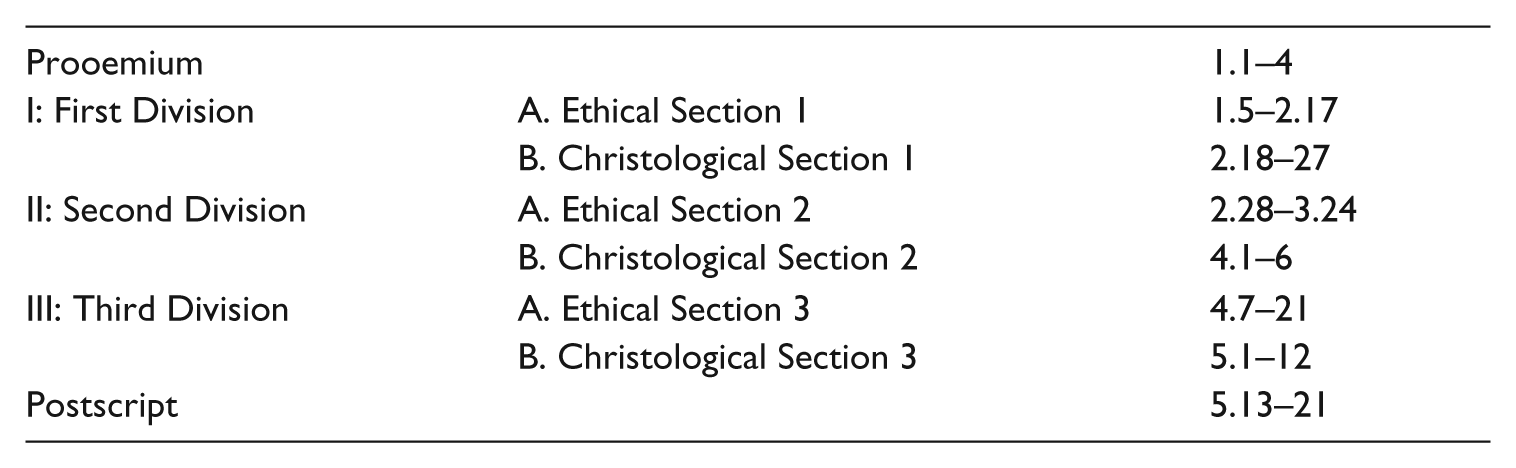
Scholars who follow Häring’s divisions of 1 John include Brooke (1912: xxxiv), Bruce (1979: 29), Bogart (1977: 15), Segovia (1982: 35), Burdick (1985: 86-88), Painter (2002: 116), Jones (2009: 6-7), and von Wahlde (2010: 200).
Law (1979: 24) also used the thematic approach to come independently to a very similar structure to Häring’s. Law understands 1 John to have a spiral form of argument that ‘works with a comparatively small number of themes, which are introduced many times, and are brought into every possible relation to one another… And the clue to the structure of the Epistle will be found by tracing the introduction and reappearances of these leading themes’. Law argues that ‘righteousness, love and belief’ are the three key themes that provide ‘tests’ for the reader to use in order to gain assurance, the aim of 1 John (5.13). These themes occur in three cycles:
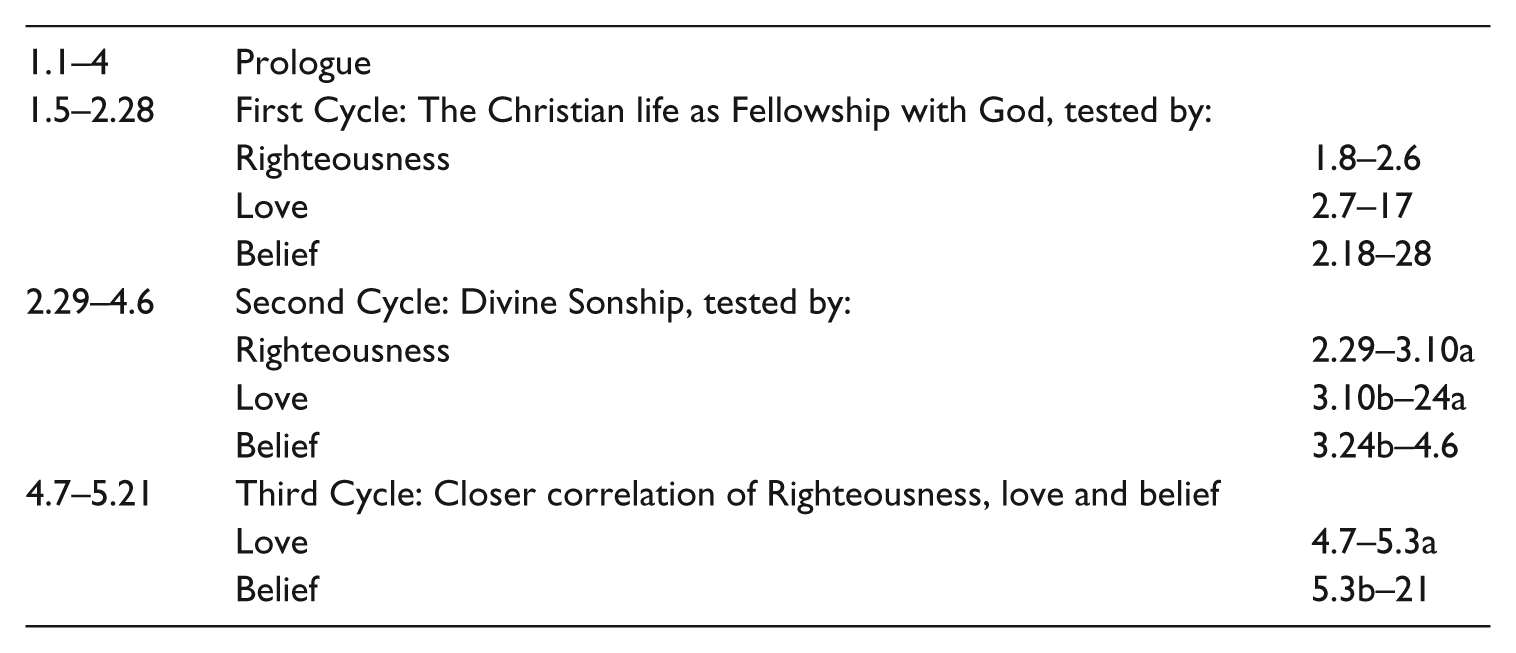
Stott (1988) follows a modified version of Law’s understanding of the structure of 1 John based on the idea of the ‘tests’.
The strength of both Häring and Law’s suggestions is the acknowledgment of repeated themes throughout 1 John. However, the rationale for choice of themes is a weakness. Häring groups all ethical teaching together resulting in a lack of clear definition of the themes. Law, on the other hand, separates out the ethical teaching into two themes but provides no justification for why ‘righteousness, love and belief’ are chosen above the other possible themes. Further, the themes themselves are not tied to particular vocabulary. So the first thematic unit on ‘belief’ (2.18-28) does not contain any occurrences of the πιστ* word group. Additionally, both suggested structures seem to break down in the third division/cycle where the themes are more mixed, and in the case of Law’s suggestion, the theme of righteousness does not exist.
The third example of dividing 1 John on the basis of thematic concerns is Strecker (1996) who organized 1 John into parenetic and doctrinal parts by distinguishing different genres used in 1 John. Strecker divided 1 John into six sections, with an alternation between parenetic (1.5–2.17; 2.28–3.24; 4.7–5.4a) and dogmatic sections (2.18-27; 4.1-6; 5.4b-12).
The strength of this proposal is its recognition of different genres within 1 John. However, Strecker gives little justification for recognizing each genre and its division from the last genre other than citing Häring (1892) as support. The relationship between the two genres also seems to be ill defined. That they alternate is nothing more than observation. Strecker fails to explain why the genres alternate and what the link(s) is/are between each section. Further, Strecker’s method does not allow for parts within the sections identified by genre. For instance, the first parenetic section (1.5–2.17) seems to be made up of a few smaller parts, the most obvious of which is 2.12-14 that clearly has a different form (poetical?) to the parts surrounding it.
Using themes to suggest a structure for 1 John has the strength of being based on commonly recognized themes (ethical and christological). However, the main weakness with this method is that, because the themes are not associated with particular vocabulary, there is difficulty in demarcating the exact extent of these themes and thus demarcating units.
Source Criticism
The second method for discerning the units that comprise 1 John is source criticsm. The difficulty in ascertaining a structure for 1 John caused some scholars to look for sources that lay behind 1 John and whose use could account for the present form of the text. These scholars suggest that the author of 1 John modified sectarian Jewish documents or the Johannine Tradition. There are two scholars who are representative of this method: O’Neill (1966) and Bultmann (1973).
The first example of a scholar who uses source criticism to demarcate the units of 1 John is O’Neill (1966). He argues that the author of 1 John is a Jew who is reworking Jewish source documents with ‘Christian’ teaching in order to lead other Jews to faith that Jesus is the Christ. O’Neill appeals to other first-century Jewish documents (the Qumran literature) to justify his identification of the source documents. He identifies twelve units (1.5-10; 2.1-6, 7-11, 12-17, 18-27, 2.28–3.10, 10b-19, 19b-24; 4.1-6, 7-18, 4.19–5.13, 13b-21) and distinguishes Christian additions from the original Jewish sectarian documents. O’Neill (1966: 1) states that the ‘progression of thought from one paragraph to the next is usually unclear, but the thought of each paragraph usually runs parallel to that of a neighbouring paragraph, or to that of some other paragraph in the Epistle’. Houlden (1994: 24) is one scholar who agrees with O’Neill’s understanding that paragraphs run parallel to each other.
The strength of O’Neill’s work is his understanding of 1 John in its Jewish literary context (Bultmann 1973: 2; Lieu 1993: 459). However, there are some weaknesses in his presentation resulting in his suggested structure not being adopted within scholarship. Some of O’Neill’s analysis of units runs against the literary features of the text. For example, O’Neill argues that 1.5-10 is a unit. This division fails to see the triple pattern of contrasting conditional statements in 1.5–2.2, the third of which occurs in 2.1-2. Further, the theme of ‘sin’ continues in 2.1-2 indicating that it is the conclusion of 1.5-10 and not the start of a new unit (see Callow 1999). Similarly, Brown (1982: 46) notes that O’Neill’s source theory does not account for the similarities between 1 John and John’s Gospel. He approvingly quotes Marshall’s evaluation of O’Neill’s work, that it ‘is completely speculative and has won no adherents’ (Marshall 1978: 30).
A second scholar who uses source criticism to identify units in 1 John is Bultmann (1927; 1951; 1973). Bultmann argues that a written source (Vorlage) preceded 1 John and underlies the text. This written source was reworked in light of letter writing conventions to make 1 John more epistolary. Bultmann (1973: 43-44) states that attempts ‘to find a train of thought in 2.28–5.12 are futile. The whole section 2.28–5.12 is obviously not a coherent organic composition, but rather a compendium of various fragments collected as a supplement to 1.5–2.27’. That is, 1 John has two sections, the first of which (1.5–2.27) is an annotation of an original written source, and the second (2.28–5.12) is a collection of other sayings thrown together with no structure or argument. Bultmann notes that Windisch (1951), Braun (1951) and Nauck (1957) follow his proposal with slight alterations.
Bultmann is able, through this source and then redaction criticism, to explain the apparent lack of structure in 1 John. However, his argument is entirely hypothetical and does not explicate 1 John’s structure in its final form. Bruce (1979: 29-30) is scathing in his assessment of such source criticism when he concludes, ‘If attempts to trace a consecutive argument have not been successful, attempts to distinguish sources have been even less so… Source criticism is as barren an exercise in the study of this epistle as it is in the study of the Fourth Gospel.’
The strength of source criticism is in situating 1 John within the first-century Jewish and Christian documents on the basis of parallels between 1 John and other texts. However, the acknowledgement of similarities between texts does not provide any real clues as to the structure of 1 John. The hypothetical sources do not make the structure any clearer; rather they are cited to explain why the structure is so convoluted. This has led to the present rejection of source criticism as a means for identifying the units within 1 John. As Segovia (1987: 134) comments, ‘I believe…that any major separation of 1 John into distinct literary layers, even if from a maximalist orientation…should be avoided at all costs—source criticism of such proportions is no longer a viable option with respect to 1 John; in the end, such positions are thoroughly unwarranted and unnecessary.’
Literary Devices
The third method for discerning the units that comprise 1 John involves the observation of the use of literary devices. The types of devices that scholars observe in 1 John that give the text unity but also indicate constituent parts include hook words, inclusion, characteristic terms, announcement of the subject, triplets, repetition, and parallelism. There are three scholars who are representative of this method: Malatesta (1973), Brown (1982), and Hansford (1992).
Malatesta (1973) follows the literary method developed by Vanhoye (1963) to analyse the structure of Hebrews. Vanhoye observed five literary devices that link sections in Hebrews (hook words, inclusion, characteristic terms, announcement of the subject, and change in genre). Malatesta uses the first three of the categories in his introduction and the fourth (announcement of the subject) in his headings (observable in 1.5 for example). The only device not used is the ‘change in genre’, a difficult category to use when there is no general scholarly agreement. As a result, Malatesta proposes a three-part structure to 1 John that contains corresponding sections of ethic, charity and faith in each part, except the last where ethic is missing:
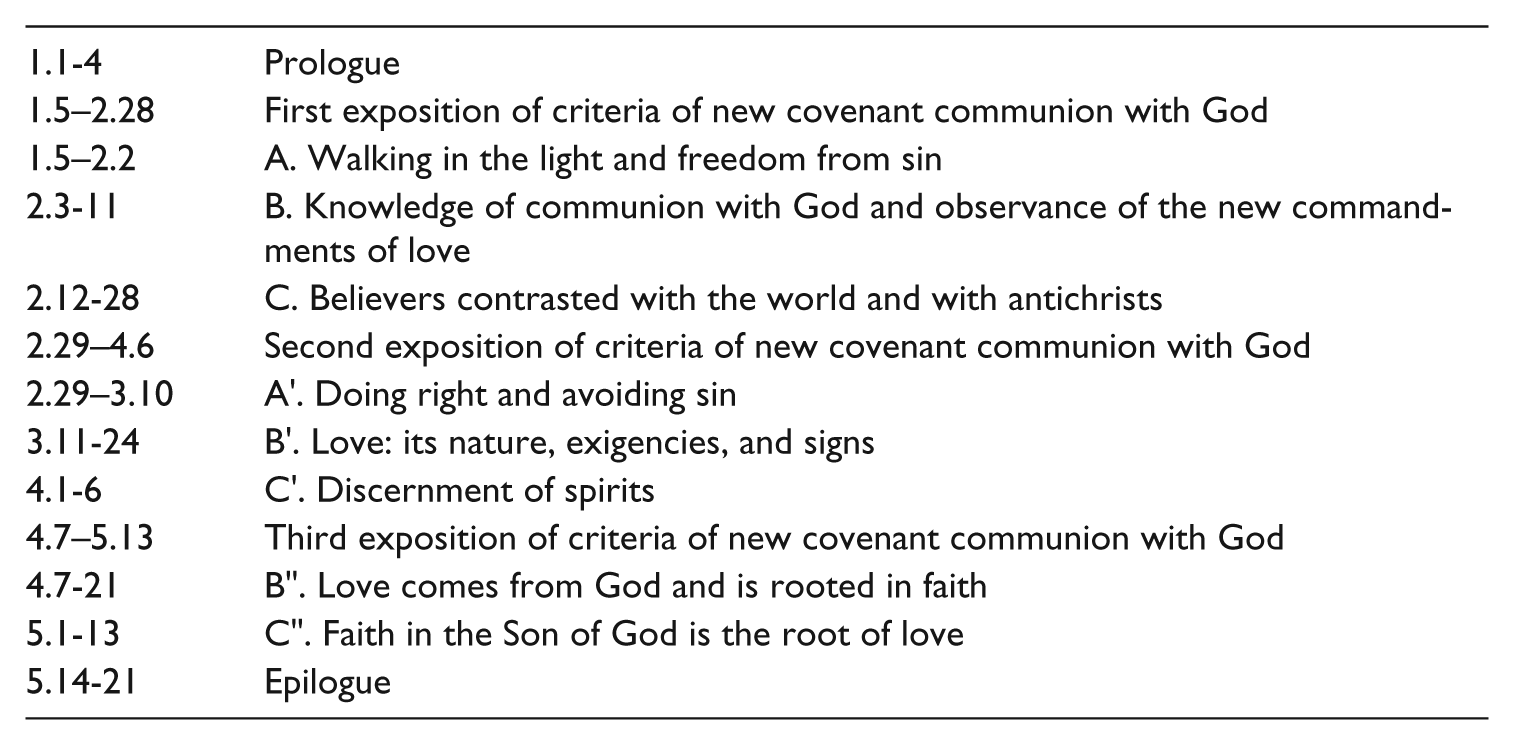
The strength of Malatesta is that he builds on the recognition of first-century literary devices indicating links between sections. However, Malatesta’s proposal also has some weaknesses. He provides no detailed reasoning for his divisions of the text. Part A (ethic) is missing in the third section, breaking the pattern. The division at 2.29 on the basis that God is just seems incorrect because it probably refers to Jesus and not God. The themes that Malatesta sees for the sections are inconsistently used in each section. Light and darkness are only found in 1.5–2.11 and not in the rest of the first section; righteousness is only found in 2.28–3.12 and not in the rest of the second section; and love is present in all the sections not just the third.
The second example of a scholar who uses literary devices to observe the breaks in 1 John and thus propose a structure is Brown (1982: 118-19). Brown recognizes the unquestioned units in 1 John (2.12-14, 15-17; 4.1-6) and then notes some writing patterns in order to ascertain a series of other units. The writing patterns include:
the use of triplets resulting in four units (1.6–2.2; 2.4-11; 2.18-28; 5.18-20)
ἐὰν εἴπωμεν ὅτι contrasted with ἐὰν in 1.6-2.2; ὁ λέγων in 2.4-11; (καὶ) ὑμεῖς in 2.18-28; οἴδαμεν (δὲ) ὅτι in 5.18-20.
the occurrence of inclusio, confirming 2.18-28 as a unit and suggesting 4.1-6
2.18-28 is about the last hour and starts with παιδία and ends with τεκνία; 4.1-6 starts and ends with references to the spirit(s).
the category of repetition (2.29-3.10 contains 7 uses of πᾶς ὁ followed by a participle).
This allows Brown to identify units within 1 John along with hinge verses that facilitate transitions but make precise demarcation and division difficult (2.27, 28, 29; 3.22, 23, 24; 5.12, 13). Brown further proposes that 1 John has two main parts, a proposal made on the basis of the repetition of the phrase ‘This is the message’ (1.5; 3.11), a phrase that indicates the theme of each part (‘Light’ in 1.4–3.10 and ‘Love’ in 3.11–5.12). Scholars who follow Brown include Akin (2001: 46-47), von Wahlde (2010: 200-202), and, with slight modification, Berge (1997). We will return to consider Brown’s understanding of how these units are related to each other in the second half of this article.
The strength of Brown’s method is its attention to the literary devices of triplets, inclusio and repetition used in 1 John. However, its weakness is the uncertainty about the purpose of the devices. For instance, sometimes Brown cites repetition to demonstrate the unity of a section (the uses of πᾶς ὁ followed by a participle in 2.29–3.10) but on other occasions the same device signals a break (‘This is the message’ in 1.5—ἔστιν αὕτη ἡ ἀγγελία, and 3.11—αὕτη ἐστὶν ἡ ἀγγελία).
The third example of a scholar who uses literary observations to identify the structure of 1 John is Hansford (1992). Hansford builds on some of Law’s (1979) observations concerning the poetic nature of 1 John arguing that it was constructed out of parallelisms. This leads Hansford to propose a complicated poetical structure of 18 strophes. Hansford divides the text into clauses/cola and then notes the use of a set of key words in each strophe with a different but overlapping set in the next strophe. The boundaries of each strophe are marked by a simple chiasm of key words or phrases.
Hansford’s strengths are found in his attention to detail, his identification of hook words and chiasm indicating the boundaries of each strophe, and his observation of poetic parts of 1 John. However, Hansford fails to explain the relationship between each strophe; his insistence that the whole of 1 John is poetry seemed forced in some places (especially 2.18-28), his analysis lacks effective headings in describing the content of each section, and the fact he acknowledges the strophe 2.12-17 contains two substrophes (2.12-14 and 2.15-17) seems to weaken his hypothesis.
So, observation of literary devices in 1 John has the strength of locating divisions of the text on the basis of patterns in 1 John, patterns that are historically conditioned, being observed in other first-century Greek documents. However, the one real weakness with this method is the ambiguity surrounding which patterns show continuity and which reveal division. This was most evident in Brown’s appeal to repetition to signal the unity within units but also the division of the overall text into two main parts.
Text-Linguistic Analysis
The fourth method employed to ascertain the units that comprise 1 John is text-linguistic analysis. This method combines the suggestions from the thematic method with the observed literary devices and argues that meaning is found at the level of the paragraph rather than the clause. Accordingly, it involves a synthesis of two of the previously discussed methods resulting in proposals that are able to explain more of 1 John’s structure. There are three scholars who are representative of this method: du Rand (1979), Longacre (1992), and Sherman and Tuggy (1994).
Du Rand (1979: 29) argues for a three-part structure, the first having the theme of fellowship, the second filiation and the third love. He splits 1 John into cola and then groups these cola together to form pericopes, sections and divisions. The groupings are based on semantic and stylistic observations (parallelisms). The boundaries of pericopes, sections and divisions are identified by the lack of semantic and stylistic smoothness between units. The relationship between units is primarily determined by the content of each unit. He proposes the following structure:
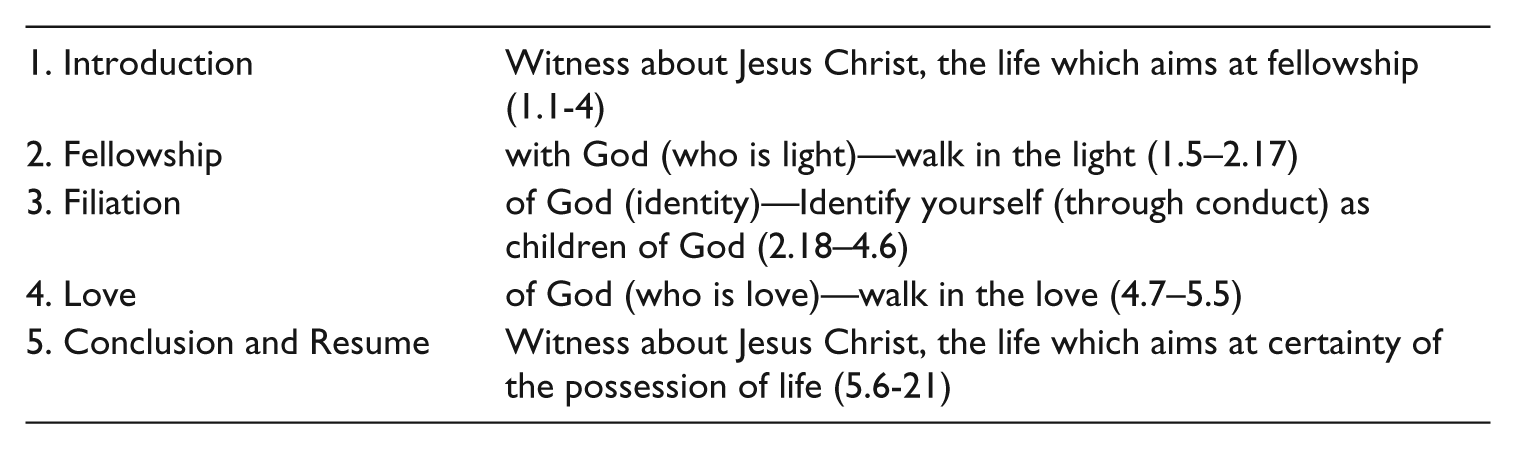
The strength of du Rand is his close and thorough analysis of 1 John, moving away from finding meaning at the level of the clause to the paragraph. However, his method is strongly semantic resulting in a loss of syntactical links between units. He lacks consistency in reasons for commenting on topics and does not place 1 John within the literary world of the first century.
The second example of a scholar who uses discourse analysis in order to ascertain the structure of 1 John is Longacre (1992). He divides the book into paragraphs based on the use of vocatives. Then, after considering the occurrence of γρ£φω, he argues that the book has three parts (introduction—1.1–2.29, body—3.1–5.12, conclusion—5.13-21). The verb types allow Longacre to argue that the book is not expository but rather hortatory resulting in Longacre identifying twin doctrinal and ethical peaks (places where there is a concentration of imperatives) at 2.12-17 (E), 2.18-27 (D), 4.1-6 (D) and 4.7-21 (E). These peaks reveal the main point of the book. Finally, by studying the pre/post peak paragraphs, Longacre suggests a macrostructure statement—the readers should believe that Jesus is the Son of God and love one another (3.23; 5.1). This macrostructure statement acts as the control for a top-down approach.
The strength of Longacre’s method is that it is both bottom-up and top-down, not forcing labels onto the text. His observation of the different kinds of verbs used convincingly argues for a hortatory understanding of 1 John and makes for easy identification of the peaks. However, Longacre’s method has some weaknesses. The use of vocatives is not consistent throughout 1 John. A vocative ends the paragraph 3.19-24 rather than starting it; the paragraph 5.1-12 does not start with a vocative; and the series of vocatives in 2.12-14 being explained as marking the introduction to the paragraph 2.15-17 is unconvincing. Longacre’s identification of three main parts on the basis of the occurrence of γράφω seems flawed. Just because γρ£φω does not occur between 3.1 and 5.12 does not mean that this is a separate section. Further, there seems to be some unity conveyed in the tense of γράφω because the tense-form change in 2.14 (from present to aorist) is maintained throughout the rest of 1 John. There is no analysis of the pre- and post-peak paragraphs of the first peak. This seems unusual since the justification of the top-down approach is found in the analysis of the pre- and post-peak paragraphs of the second peak. Finally, there seems to be no attention to first-century literary conventions. The discourse analysis used by Longacre is divorced from the historical situation.
The third example of scholars who utilize discourse analysis to ascertain the structure of 1 John are Sherman and Tuggy (1994). They apply a discourse analysis to 1 John that examines semantic, lexical and structural coherence in the text. Sherman and Tuggy note the frequent use of main motifs and key words as well as the structural elements involved in a hortatory discourse. Boundaries are identified on the basis of summary passages, chiasm, a change in subject, a series of performatives, and inclusio. The result is the following three-part structure:
Sherman and Tuggy’s work is based on a close reading of the text of 1 John and pays particular attention to the logical associations between each unit. It is sensitive to the first-century milieu making use of chiasm and inclusio in its location of boundaries. However, as a result of Sherman and Tuggy’s stress on coherence, there is a failure to explain adequately the rationale for demarcating the units in the text. The stress on the genre of 1 John as hortatory discourse seems to lead to the text being squeezed into a logical shape that the text may not have. So for example the poetical features/parts of the text (2.12-14) are lost for logical connectivity.
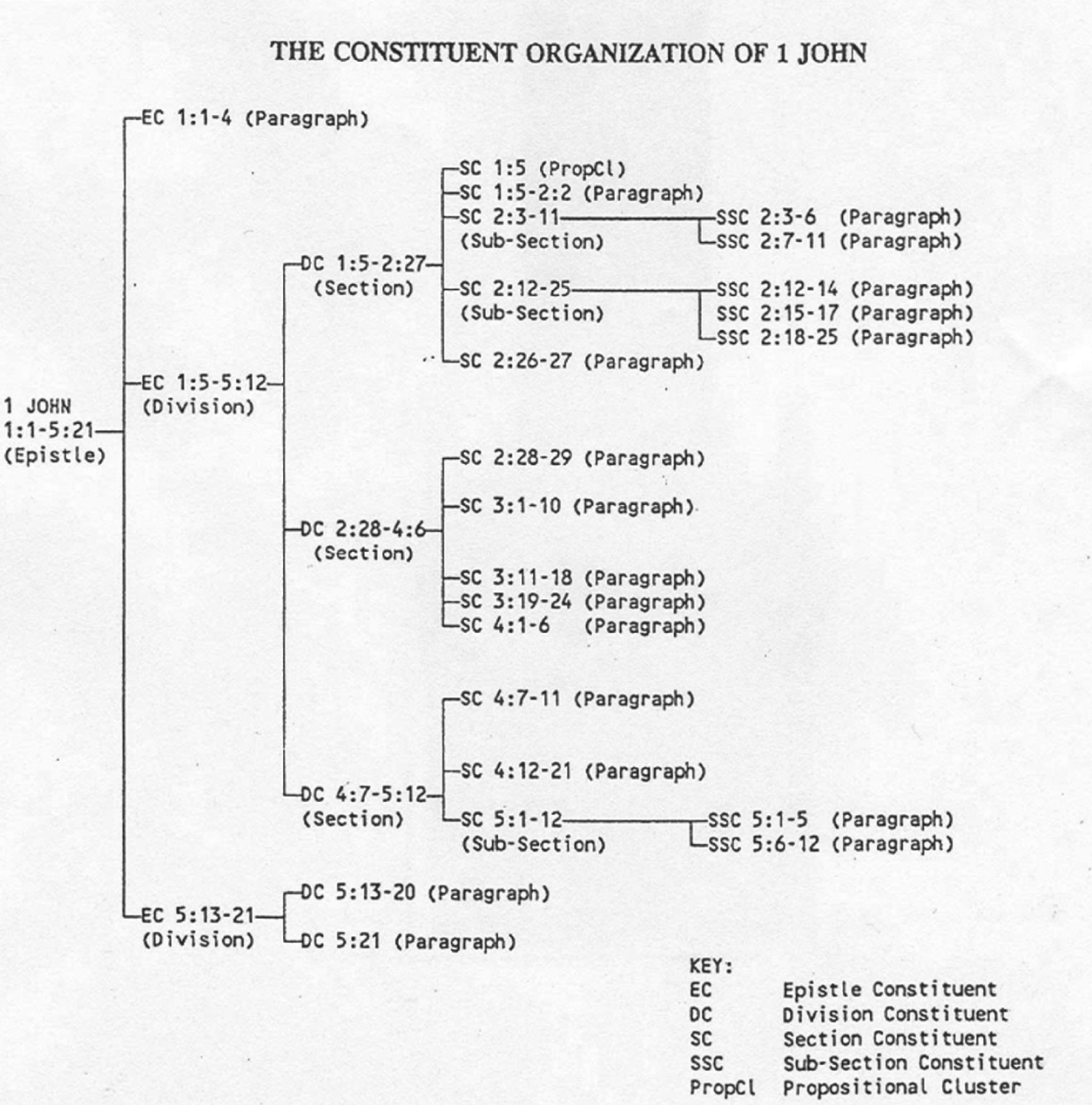
Overall, the text-linguistic method has a couple of strengths: it synthesizes the good elements of both the thematic and literary methods while also moving the analysis from the clause to the paragraph level. However, each of the exponents reviewed has weaknesses that reveal the difficulty of ascertaining the structure of 1 John.
Ancient Rhetoric
The final method scholars use to ascertain the units in 1 John and thus uncover its structure is appeal to ancient rhetoric. By identifying the rhetorical genre that 1 John fits into, scholars are able to identify the constituent parts of 1 John according to the parts of the argument required in that genre. As Witherington (2006: 436) states, ‘if we ask the vexing question about the structure of 1 John, we may say that rhetoric helps us somewhat to decipher it’. That is, scholars use the categories of ancient rhetoric to divide the text up. These units are then related to each other according to their function within the argument. In one sense, this method could be discussed in the next section of this article on the argument of 1 John. However, it is included here because some scholars use it to identify the structure of 1 John. Three examples of scholars who appeal to ancient rhetoric to ascertain the structure are Vouga (1990), Watson (2003), and Witherington (2006).
Vouga (1990) approaches 1 John as a piece of deliberative rhetoric aimed to persuade the readers to some future course of action. Deliberative rhetoric usually contains an introduction that builds rapport between the audience and the speaker (captatio benevolentiae), followed by a description of the issue at hand (narratio), the central point being argued (propositio), the arguments for this central thesis (probatio), the thesis’s application in the lives of the audience (exhortatio), and finally a summary of the argument and appeal to the audience for a sympatethic response (peroratio). In terms of 1 John, Vouga identifies each of these units in the argument along with the standard prescript (1.1-4) and Epilogue (5.13-21). He argues that 1.5-2.17 explains the content of 1.1-4 (captatio benevolentiae), 2.18-27 describes their historical situation of the schism (narratio), 2.28-29 is the central call to remain in Christ (propositio), 3.1-24 gives the reasons for this call (probatio), 4.1-21 exhorts the church to love (exhortatio), and 5.1-12 calls for unity (peroratio) before the letter ends with the epilogue (5.13-21). This results in the following structure:
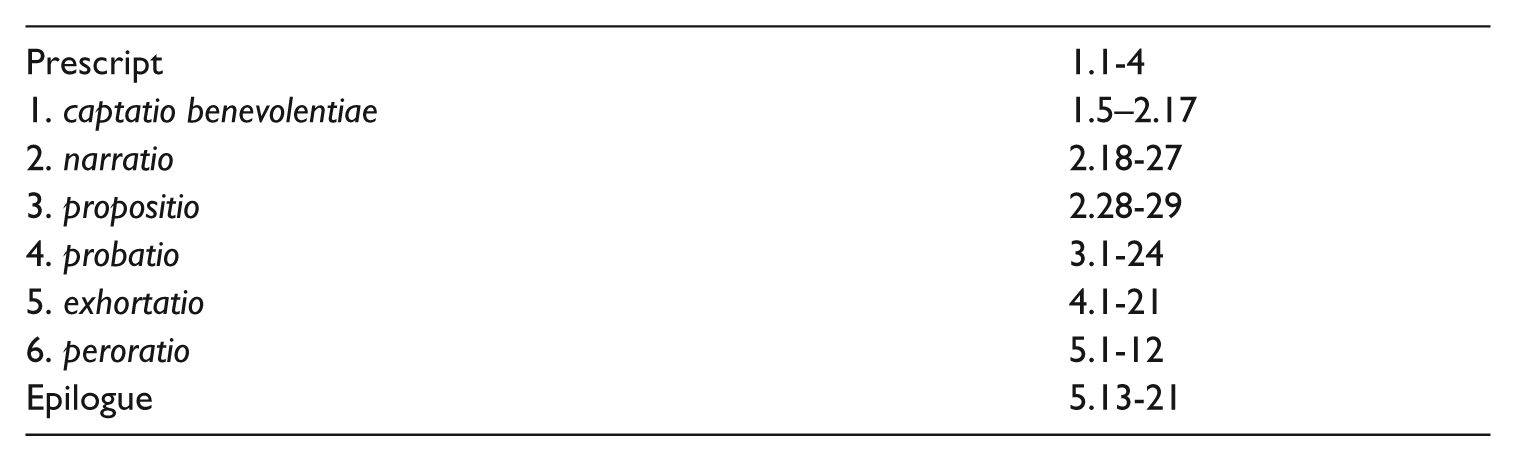
Even though Vouga’s proposal has the advantages of understanding 1 John within its first-century historical context and explaining how the overall argument fits together, it has not won a following. Klauck (1990) criticizes Vouga’s identification of the unit boundaries, Edwards (1996: 36) finds Vouga unconvincing because ‘his study forces the text unnaturally into classic patterns and some of his subdivisions are quite unconvincing (e.g. the idea that the whole of 1.5–2.17 is a captatio benevolentiae)’, and Olsson (1999: 387) criticizes the description as ‘showing obvious signs of “labelling”’.
A second scholar who uses categories of ancient rhetoric to understand the structure of 1 John is Watson. Watson (1989) first applied the rhetorical categories of Distributio, Conduplicatio, and Expolitio in analysing 1 Jn 2.12-14. Although this study did not examine the structure of 1 John as a whole, it demonstrates the value of using ancient rhetoric to interpret the letter. Watson extended this method further identifying 1 John as epideictic rhetoric (1991) and examining the use of amplification in 1 John (1993). Finally in 2003, Watson analysed the Exordium (1.1-4) and Peroratio (5.13-21) of 1 John. Although none of this work proposes a detailed structure of 1 John, Watson’s work is the basis for Kruse’s (2000: 29-32) understanding of 1 John’s structure and Witherington’s proposal.
Witherington (2006: 431) identifies 1 John as epideictic rhetoric because it is repetitive, ‘seeks to strengthen adherence to values already adopted or embraced by the audience and also to draw out the implications of those values’. The historical situation of a split within the community requires this sort of rhetoric to bring healing and encouragement. Witherington cites the study of Watson (1993) on amplification in 1 John as a key indicator that 1 John is epideictic. He explains (2006: 435) that instead ‘of the “probatio” being a series of arguments proving a proposition or thesis statement, it is dedicated to amplifying and expanding and expounding on certain key ideas and themes that are already familiar and accepted’. Since 1 John is epideictic, Witherington argues that we should not expect tight formal arguments which you would find in deliberative or judicial rhetoric. So he suggests the following structure:
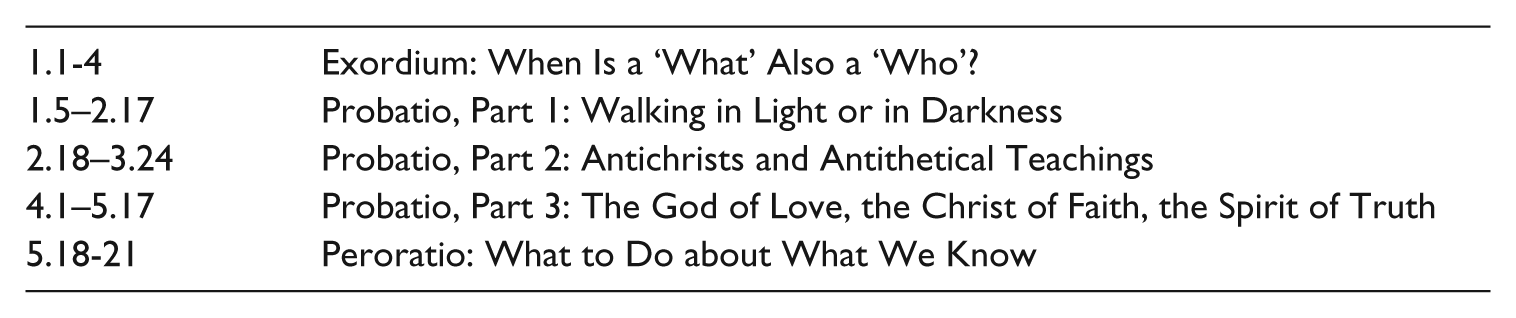
The strength of Witherington’s proposal is its appeal to a first-century rhetorical practice. The apparent lack of formal links between units is explained as being due to the epideictic form of 1 John. However, the identification of 1 John as epideictic does not help ascertain the units that comprise the text and thus the structure. The units are identified by theme or topic since each is an amplification or exposition of a familiar theme. This means that Witherington’s overall structure is open to the same sorts of criticisms levelled at scholars who use a thematic approach to split 1 John into its constituent parts. Witherington’s proposal is a more historically nuanced thematic approach.
The overall strength of appealing to the conventions of ancient rhetoric, at both the macro-level to ascertain the structure and at the lower level to explain the links between paragraphs, is in interpreting 1 John in its first-century context. However, the lack of structural and semantic features that coincide with such rhetorical appeal means that the proposed structures have crucial weaknesses.
The Argument of 1 John
The second section of this article examines the ways that scholars have understood the parts of 1 John to be related to each other—the argument. Just as the division of 1 John into its constituent parts is acknowledged as difficult, so too is tracing the links between the parts. Bruce (1979: 29) states, ‘Attempts to trace a consecutive argument throughout 1 John have never succeeded’. A couple of generations before Bruce, Brooke was even less positive about the possibility of tracing the argument: ‘While some agreement is found with regard to the possible divisions of the First Epistle into paragraphs, no analysis of the Epistle has been generally accepted. The aphoristic character of the writer’s meditations is the real cause of this diversity of arrangement, and perhaps the attempt to analyse the Epistle should be abandoned as useless’ (Brooke 1912: xxxii). Even though Brooke thinks this exercise ‘should be abandoned as useless’, many scholars have still attempted it. The next section reviews five of these attempts: there is no developed argument, there is an association of ideas, there is a cyclical or spiral form argument, it is parallel to John’s Gospel, and it is chiastic.
No Developed Argument
Some scholars see no developed argument in 1 John but rather a series of sentences and paragraphs that are hapazardly arranged. So Parker (1956: 303) states, ‘1 John makes almost as good sense when read backwards, sentence by sentence’. Brown (1982: 128) suggests an overall argument for 1 John but denies that there is a logical sequence between the units, even to the point of stating that ‘one can drop out almost any unit…without noticeably upsetting the sequence and without any loss of sense in 1 John’. Kruse (2000: 31-32) argues that there is no ‘developing argument through the letter’ because 1 John is an epideictic piece of rhetoric and therefore does not require a clear, structured argument. Finally, O’Neill (1966: 2) contends that 1 John is not ‘a continuous letter, but rather…a tract made up of self-contained sections’.
Association of Ideas
Other scholars acknowledge the difficulty in ascertaining a logical argument in 1 John but propose that paragraphs are related to each other through an association of ideas (Schnackenburg 1992: 13; Rensberger 2001: 15). So Marshall (1978: 26) states that ‘it seems preferable to regard the Epistle as being composed of a series of connected paragraphs whose relation to one another is governed by association of ideas rather than by a logical plan’. But this association of ideas ‘does not mean that John is illogical’. Additionally, Lieu (2008: 15) admits that it is hard to find the limits of paragraphs ‘in what may otherwise seem a disjointed “stream of consciousness”’ but ‘in some themes there is a development of thought, and it would not be possible to reorder the sections without damage to the argument’. That is, there is a relationship of units to each other (an argument), even though it is difficult to describe. The ‘stream of consciousness’ that Lieu refers to seems to be the association of ideas between units that when taken together build to develop particular thoughts/arguments.
Cyclical or Spiral
A significant number of scholars (Dodd 1946: xxi-xxii; Lenski 1966: 366; Segovia 1982: 35; Grayston 1984: 4; Burdick 1985: 91-92; Hiebert 1991: 24; Loader 1992: xiii; du Rand 1994: 182; Houlden 1994: 22-23) recognize a spiral form to 1 John’s argument in which the ideas from one paragraph are returned to later in the letter and discussed further.
Law (1979: 5) is commonly regarded as the father of this suggestion with his recognition that 1 John ‘works with a comparatively small number of themes, which are introduced many times, and are brought into every possible relation to one another’. It is argued that the themes circle around and slowly spiral in towards the overall point being made. So Edwards (1996: 36) states that ‘1 John’s structure has aptly been described as spiralform: it moves from one subject to another by association of ideas, and then returns to a subject already discussed’.
A representative of this approach is Tollefson (1999: 84) who focuses on 1 John’s rhetorical elements and argues that it should be understood as a dialectic discourse in which the author uses antithesis and dualism to convince the audience of the truth. He proposes the following three-part structure:
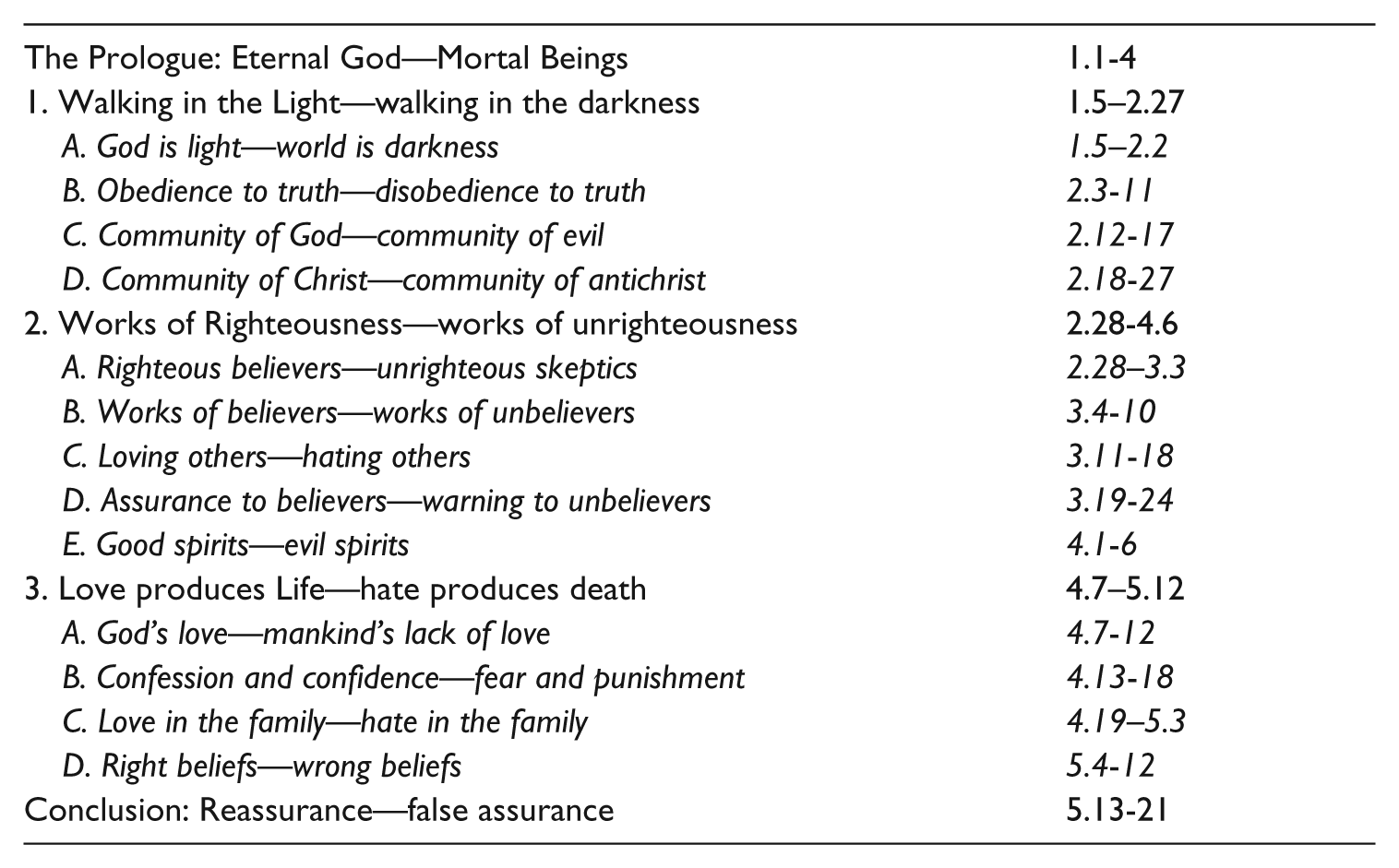
Tollefson assumes a tripartite structure and then reads the text in light of his understanding of dialectic discourse, outlining the major dialectic themes (certainty, fellowship, the nature of God, the opposition). These themes link the sections together and tracing them reveals a dynamic argument that introduces a topic and then returns to it later developing it further. Tollefson argues that this reveals the circular nature of the argument of 1 John.
Parallels to John
Brown (1982: 123-29) follows the basic idea of Feuillet (1972) of a parallel between the structure of 1 John and John’s Gospel. Both prologues use the same vocabulary and grammar, have similar movements of thought, and a clause in each prologue is picked up in the opening body of the writing. The conclusions seem parallel (Jn 20.31 and 1 Jn 5.13), and are followed by additional material (John 21 and 1 Jn 5.14-21). Brown acknowledges that there is no clear break between the parts as in John’s Gospel but proposes that there is a break after 3.10 because it gives reasonably proportionate parts. Each part begins the same way—‘This is the message’ (the only two times this expression is used in 1 John), and the definition supplied by the author in each case sets the theme for the respective parts. Brown then traces the themes through each part. This results in the following structure and argument:
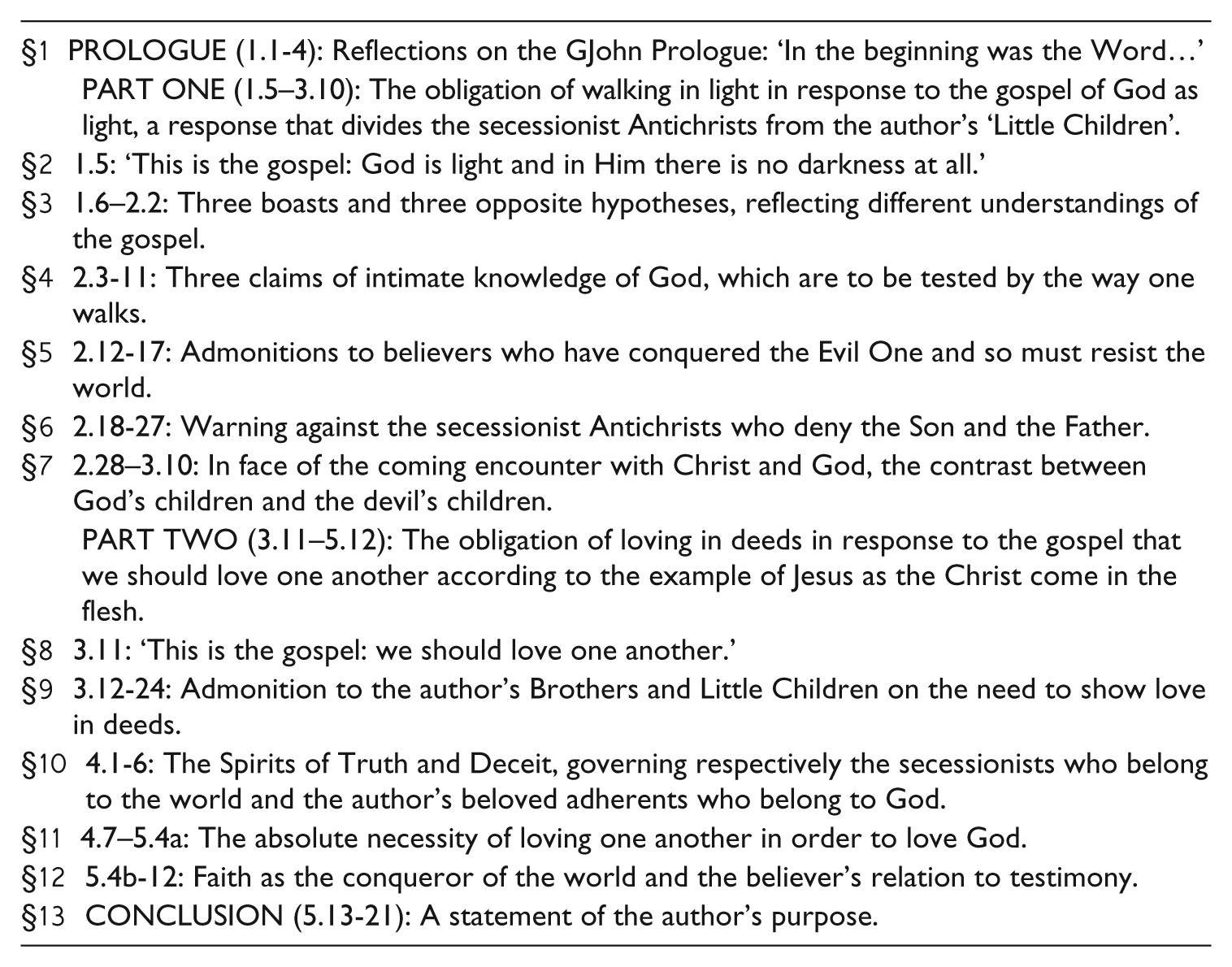
Brown’s overall two-part structure is followed by von Wahlde (2010: 202) but has weaknesses. First, the distinction between 1 Jn 5.14-21 as an epilogue and John 21 as an expanded conclusion seems to weaken his point of comparison. Second, the reasons for the break at 3.10 are not convincing. Why should proportionality be a reason for division? The use of the phrase ‘this is the message’ is actually slightly different in 3.11 (1.5—ἔστιν αὕτη ἡ ἀγγελία, 3.11 – αὕτη ἐστὶν ἡ ἀγγελία), and even though ἀγγελία is only used in 1.5 and 3.11, its cognates are used in 1.2-3 (ἀπαγγέλλω) and 2.25 (ἐπαγγελία and ἐπαγγέλλομαι). In particular, the reference in 2.25 (αὕτη ἐστὶν ἡ ἐπαγγελία) is strikingly similar in form to 1.5 and 3.11 yet is not understood to mark a new section. Further, Brown’s argument that ‘light’ is the theme of the first half is unlikely because though φῶς just appears in the first half of 1 John, it only occurs in the first half of the first half (i.e. not after 2.11) and then merely six times. Brown’s reading of the paragraphs following 2.11 with reference to this theme seem forced. Brown’s defence of the second part, via tracing the theme of love, also has problems. The love commandment in John’s Gospel is in the second part but love occurs throughout the Gospel, as it does in 1 John.
Chiasm
Two scholars have argued that the argument in 1 John is chiastic in structure—Berge (1997) and Thomas (1998).
Berge (1997: 147) builds on Brown’s idea of parallel structures between 1 John and the Fourth Gospel but suggests that the parallels also reveal ‘a common chiastic or concentric literary pattern’:
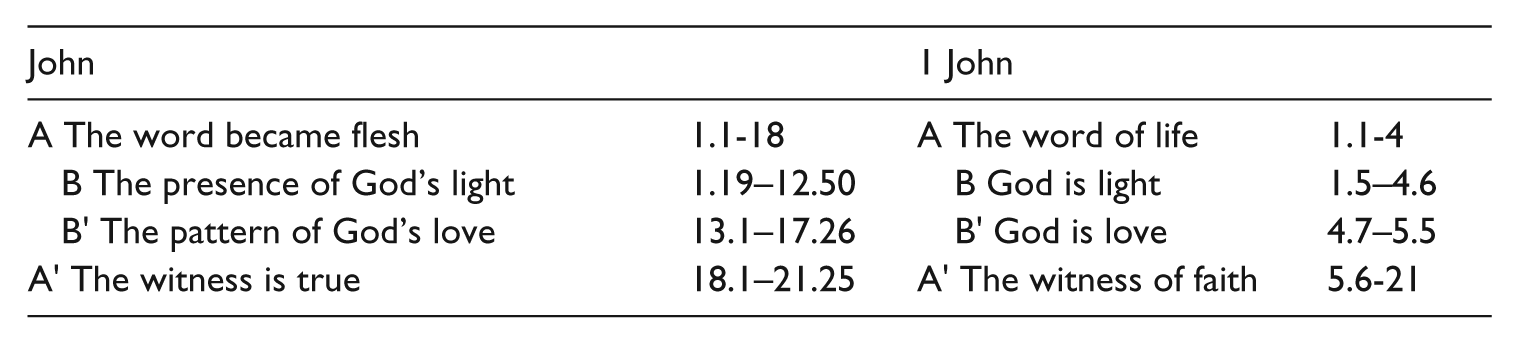
This suggestion suffers from the same weaknesses as Brown’s discussed above. Further, the evidence cited to support the chiastic arrangement is not strong. For instance, how are ‘God is light’ and ‘God is love’ parallel to each other?
Thomas (1998) follows Brown’s method for dividing the text into parts and again suggests that 1 John has a chiastic argument. After examining the relationship between sections, Thomas notes a series of parallels between the sections. These parallels are mirrored across a central part (3.11-18) resulting in Thomas observing a chiastic argument to 1 John.
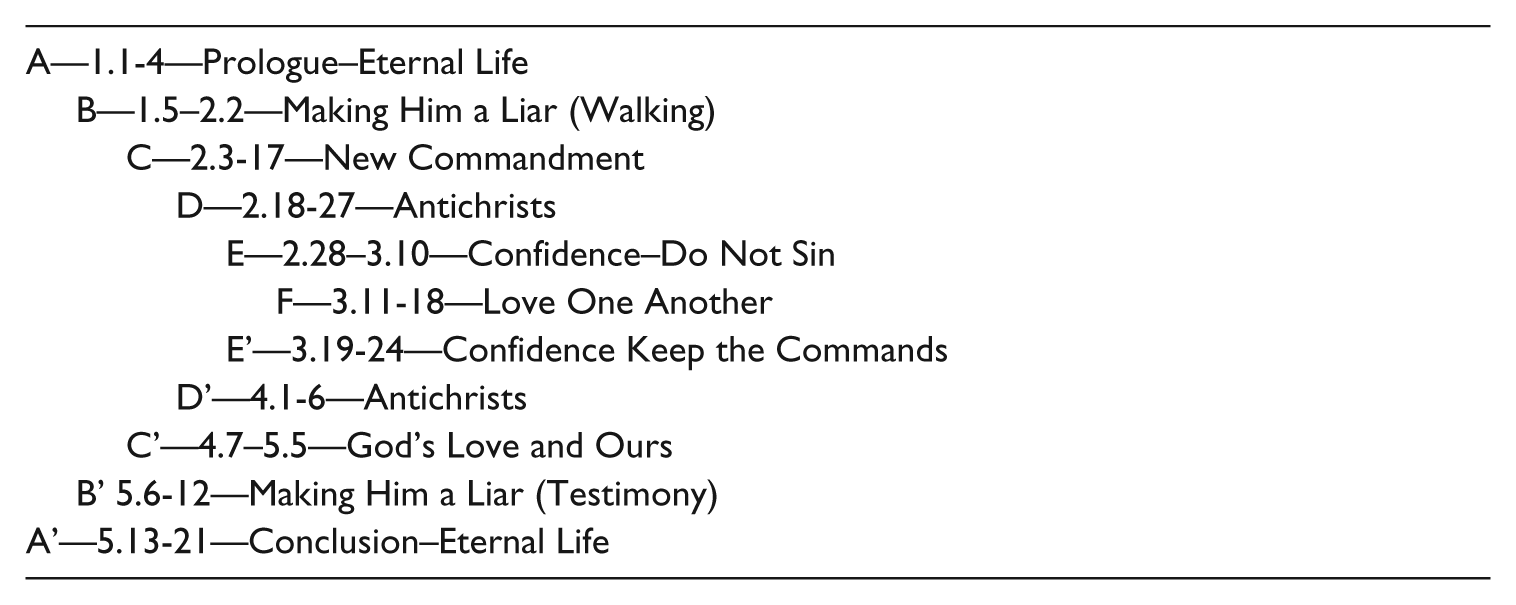
Thomas’s strength is in his observation of repetition in 1 John and especially repetition across sections. However, these seem forced and often lack lexical precision. So, in describing the parallels, Thomas admits that they are ‘articulated somewhat differently’ (1998: 374), are based on ‘thematic similarities’ (1998: 375), and require ‘additional exploration to determine the extent of the parallel passages’ similarities and differences’ (1998: 380). That there are similarities between units is widely recognized but to say they are parallel requires a higher level of accuracy and argumentation. Further, Thomas cites approvingly Brown’s identification of literary parts but then seems to disregard this in his structure. So, for example, Brown divides 2.4-11, from 2.12-14 and 2.15-17, yet Thomas combines these into one section—2.3-17. This inconsistency suggests that the division of the text is not based solely on Brown’s literary criteria but is also dependent on the chiastic structure opening Thomas up to the charge of labelling.
Conclusion
This article has reviewed many of the methods scholars have used to propose the structure and argument of 1 John. It presented and assessed five ways that scholars have broken 1 John into its constituent units (thematic, source critical, literary, text-linguistic, rhetorical). The second part of the article then examined how scholars have understood these units to be related to each other (not at all, association of ideas, cyclic or spiral, parallels to John’s Gospel, chiastic). It would seem from this survey that no consensus has been reached on the structure and argument of 1 John, which is why I have made my own contribution to the ongoing discussion (Jensen 2012).