







Abstract
This paper presents a study on the implications for road safety of the use of passing beams during the day. The genesis of the problem and conditions that have led to the use of passing beams by vehicles during the day is presented first. Then, the photometric requirements for passing beams are evaluated in terms of their signal role, comparing them with the requirements for daytime running lights. The main part of this paper presents a report on field tests carried out under real road conditions. The tests were done in order to measure the impact of using passing beams by day on the distance at which the oncoming vehicle could be detected. Also, the correctness of the estimation of relative positions of oncoming vehicles at the same or different distances was examined with different combinations of passing beams on or off in the tested vehicles. The research confirms the effectiveness of using passing beams during the day and the need to harmonize the obligation to use passing beams.
1. Introduction
The use of passing beams (also known as low beams or dipped beams) during the day or daytime running lights as a light signal has a history that has been quite widely described in some publications. 1 Initially, switching such lights on was limited to driving under bad weather conditions (rain, heavy clouds, etc.). This is why quite early the need to signal the presence of vehicle and its participation in the traffic during the day, in the front view, was noticed. 2 At the same time, scientific research clearly showed that visibility on the road, accuracy and speed of noticing any objects could significantly depend on the luminance of the object to be noticed,3,4 as well as on the luminance of the background, the time assigned for observing, the angular dimensions of the observed target, and the observer's individual characteristics. Vehicles equipped with traditional passing and driving beam headlights, could not fulfil this additional signal function, these lights being designed to meet other needs. Although in the earlier years there were some attempts to use driving beams for this purpose, it was noticed that their high luminance was associated with glare. Thus, on the one hand, high luminance helps with the detection of an oncoming vehicle; on the other hand, too bright a light causes glare. 5 This was the reason for introducing daytime running lights on vehicles, their photometric characteristics being adapted to the needs of signalling a vehicle in motion during the day. 6
Daytime running lights were mainly created because passing beams were designed to not illuminate the eyes of oncoming drivers. This philosophy directly leads to reducing the luminance of the passing beams seen from the point of view of the oncoming vehicle. Therefore, the idea of equipping the vehicles with daytime running lights was a result of the obvious conclusions and analysis of the need for this type of light and inability to signal a vehicle heading towards the driver with the use of traditional passing and driving beam headlights during the day.
And thus, daytime running lights become a fact. The CIE developed some appropriate recommendations. 6 Newly produced cars began to be gradually equipped with daytime running lights. However, what to do about the older vehicles previously produced and equipped with a traditional set of passing, driving and fog lights? Their number on the roads was still very high. Different legislative bodies in different countries produced different answers to this question. Recognizing the imperfection of passing beams (too low luminance in the directions above the horizon), there were attempts to use driving beams run at a reduced voltage for this signalling function during the day. However, they failed. This idea required some installation modifications because the light changed its white colour, from white to yellow and red as the voltage was reduced. Faster battery discharges and frequent lamp replacements were reported. As a consequence, for older cars, there was a return to the use of passing beams (despite their low luminance) as a substitute for daytime running lights.
In some countries, the statistics and data on road accidents were of importance for legislation on the need to signal the presence and movement of a car during the day by switching its lights on. The increased number of vehicles on the roads, unfavourable viewing conditions, especially during autumn and winter, were considered to be one of the reasons for an increase in number of accidents. Such thinking mainly occurred in the Scandinavian countries, as well as in Central and Eastern Europe.
There are both supporters and opponents of the use of passing beams in cars during the day. Opposed opinions are given by some scientists, drivers and police. The effect of this opposition is reflected in the legislation in many countries, where, on the one hand, sometimes the use of passing beams during the day is required by law, in others a specific law has not yet been passed, and yet in others regulations forcing people to use passing beams in their vehicles during the day have been withdrawn. This confusion may be a result of unreliable, random and non-objective studies of this issue. This paper faces up to these shortcomings, presenting the results of research carried out under real road conditions with a large group of the respondents who were presented with some specific situations related to road traffic for evaluation purposes.
2. The literature
The problem of if or when to use passing beams during the day has been discussed in a large number of transport, safety and lighting technology journals and magazines. This abundance results from the importance of this problem and its relation to traffic safety, as well as some controversial opinions on the issue, which always leads to discussion. This abundance of publications always generates a problem: How to systematize a series of statements given by scientific and professional authorities who base their arguments on different grounds? Among the publications, one group of statements based on the analysis of statistical data is evident. Another group consists of statements by researchers in the form of opinions created on the basis of a theoretical analysis of the problem. A third group consists of the publications in which the basis is some simulation research based on visualizations. The final group consists of data collected in the real world. Unfortunately, there are very few publications of this sort. This can be explained by the difficulty in arranging such research and its high costs.
The basic statistical source of information on the impact of using passing beams during the day on road safety is a paper 7 that captures the results of analyses of data from the USA, Finland, Norway, Denmark, Sweden and Canada. It shows a reduction of between 5% and 17% in the number of accidents of three types: collisions involving a pedestrian, collisions involving a cyclist, as well as frontal and side collisions between vehicles.
The theoretical analysis of the relationship between using passing beams during the day and traffic safety is evident in the work of Helmers,8,9 Engel, 10 Conners, 11 Jenkins 12 and Gerathewohl. 13 In their publications, these researchers positively evaluate the practice of using passing beams during the day, simultaneously highlighting the four most important issues. First, it is easier to observe a vehicle with the passing beam on and this feature does not require the driver to actively search for the object. Second, the vehicle visibility during the day is strongly dependent on the luminance distribution in the surroundings. 14 According to Padmos, 15 the vehicle visibility depends on its luminance, size and colour contrast. In order to make the passing beams increase the visibility, their luminance should significantly exceed the luminance of the surroundings. Attention is also drawn to the fact 16 that the visibility of an object on the road, apart from the eye-catching features (high luminance of headlamp), is determined by non-perception features, including the driver's previous experience, expectations and motivation.
There are many publications in which the conclusions are based on the responses given to visualizations of different road situations with and without the passing beams as well as the results of research done in the laboratory.17–21 The objectives of these studies are different, depending on the hypothesis being tested, but the conversion of real road conditions into a simulation always prompts an irrefutable argument: simulation research is limited by the maximum luminance of the simulation media (screen), which distorts the correctness of the real road situation assessment. This can be demonstrated on the basis of simple calculations. The luminance of headlamp switched on in the direction of the oncoming driver's eyes is about 10,000 cd/m2 (for larger headlamps) and about 50,000 cd/m2 (for smaller headlamps), whereas in the simulated image, the luminance of the same headlamps is usually in the range 200–500 cd/m2, i.e. about 100 times lower in luminance than in reality. Therefore, the visibility analysis based on the simulation is burdened with the underestimated luminance value of observers (33–50).
The literature shows that research done under real road conditions when the respondents could assess the same road situation, at the same time, with a leading part played by a real vehicle with the headlights turned on is very rare. This paper is actually characterized by such a feature: a real road and real vehicles being evaluated by numerous groups of the respondents.
3. Photometric specifications
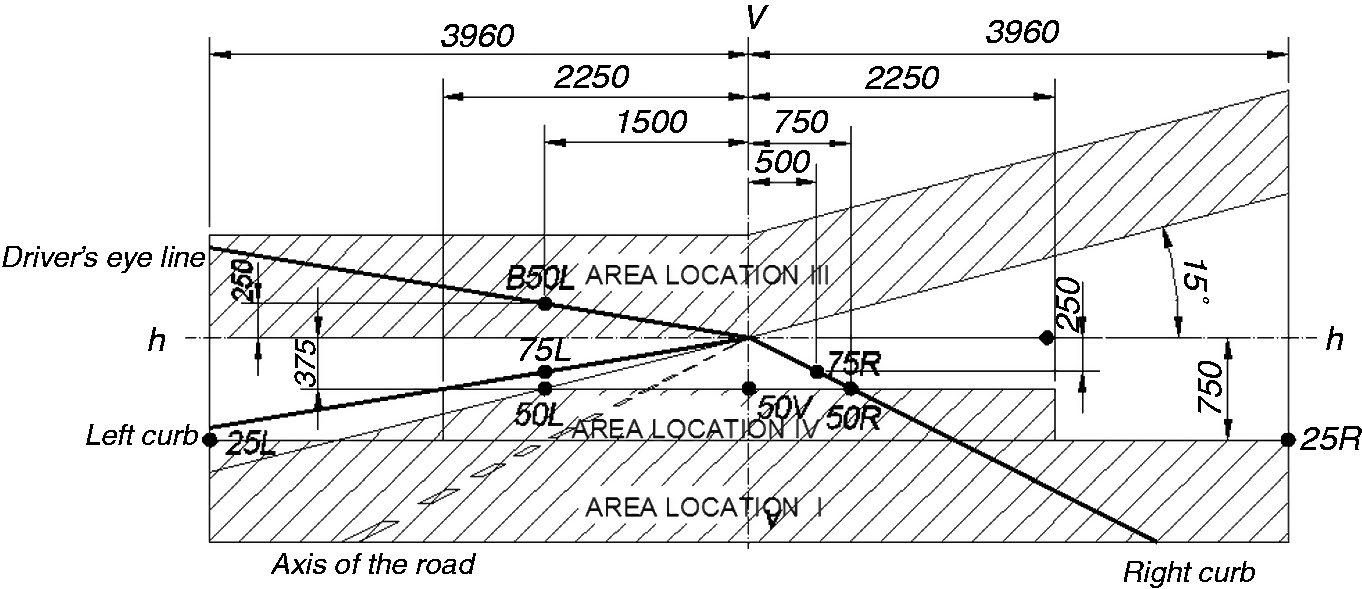
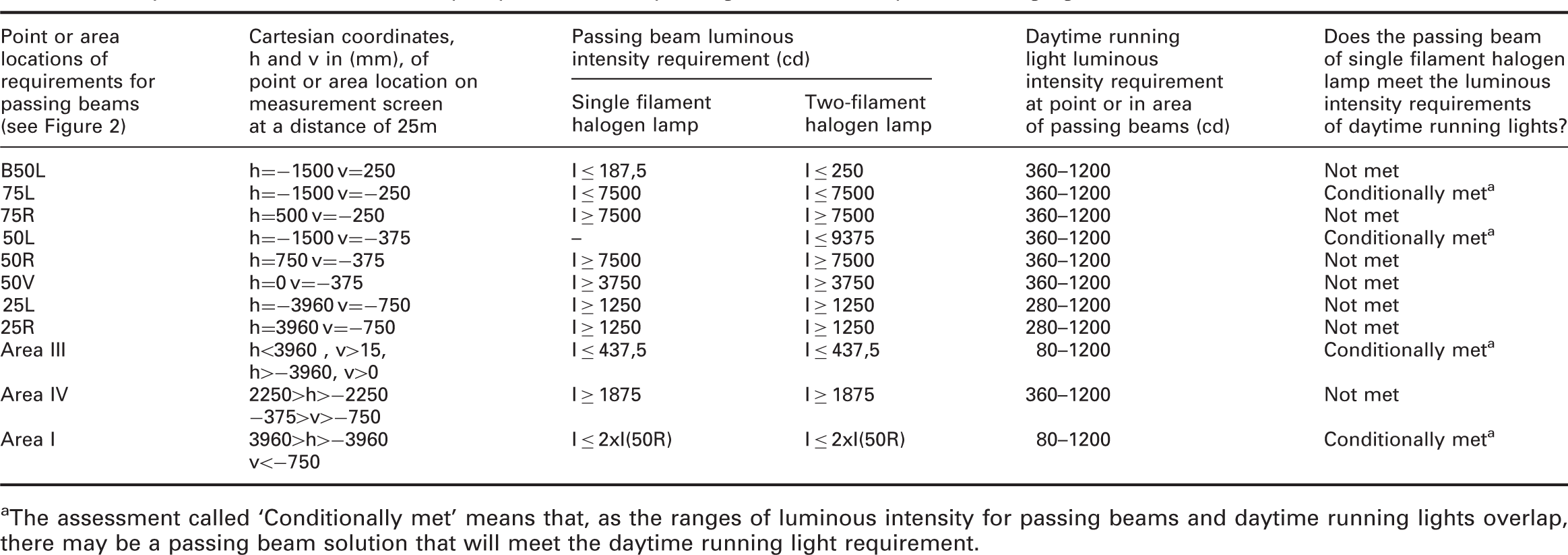
The idea of using passing beams during the day as a means of signalling the presence and movement of vehicles on the road still represents a substitute for the use of daytime running lights. In Poland (as well as in other countries), it applies to vehicles that have not been equipped with daytime running lights by a car manufacturer. A comparison of the photometric requirements of both types of lights is of interest in order to answer the question whether the passing beam is an acceptable substitute for the daytime running light. Figure 1 shows that the required lighted area for passing beams is much smaller than that required for daytime running lights. Also, in terms of the luminous intensities (Table 1) in the directions and areas characteristic of passing beams (Figure 2), the required luminous intensity values are too low in most cases to replace daytime running lights.
Areas to be lit by passing beams (grey field) and daytime running lights (white field) Location of measuring points and areas for luminous intensities for passing beams, delivered on a screen at a distance of 25 m Comparison of luminous intensity requirements for passing beams and daytime running lights The assessment called ‘Conditionally met’ means that, as the ranges of luminous intensity for passing beams and daytime running lights overlap, there may be a passing beam solution that will meet the daytime running light requirement.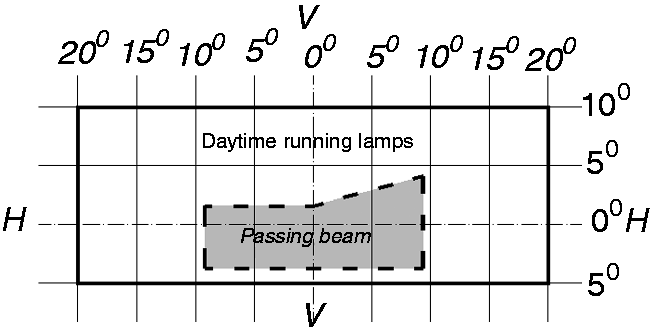
In view of these conclusions, it seems reasonable to ask the following question: What benefits for traffic safety does having passing beams switched on during the day in the approaching vehicle provide for drivers? A decision was made to examine this problem under real traffic conditions, on a real road, with the participation of real vehicles and appropriately located respondents.
4. Field tests
4.1. Arrangement and course of tests
A straight, horizontal road outside the city was chosen for the purposes of these tests. It was over 2000 m long. The road was level, covered with asphalt and was about 7 m wide. Figure 3 shows the location of the road where the research was conducted.
An image of the road where the tests were done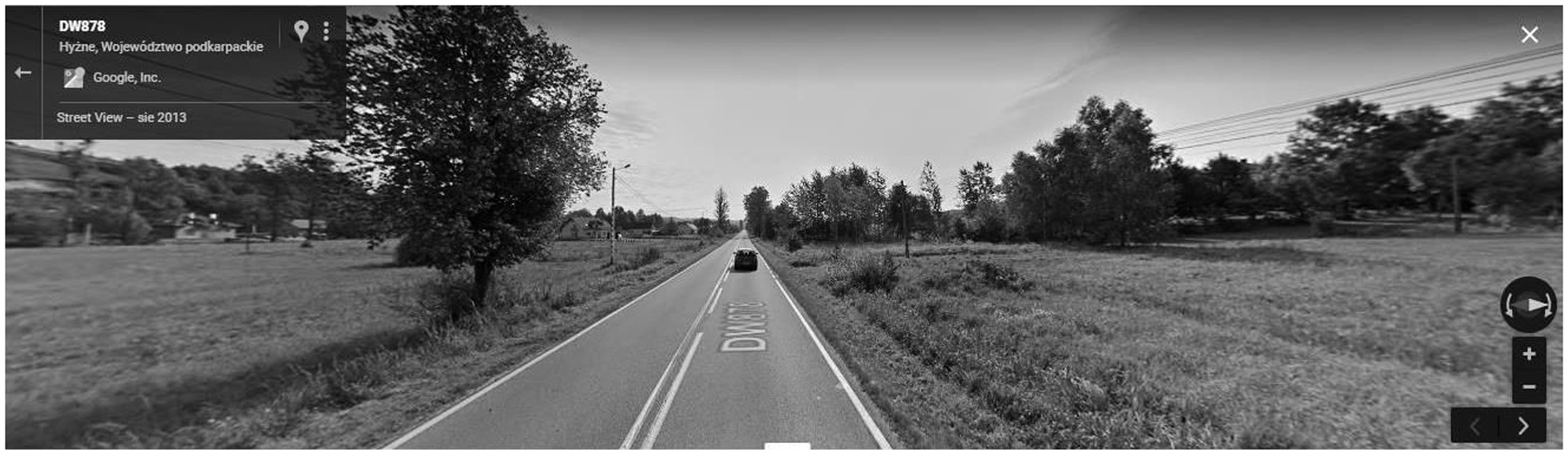
The vehicles used in the research were two passenger cars, one with a bright (silver metallic) body and the other with a dark (black) body (Figure 4). Both had headlamps equipped with traditional H4 halogen lamps. Both cars had a similar mileage and usage period in road traffic. Both had their passing beams adjusted to the correct alignment before the tests started.
The vehicles, dark (black) and bright (silver metallic), that participated in the tests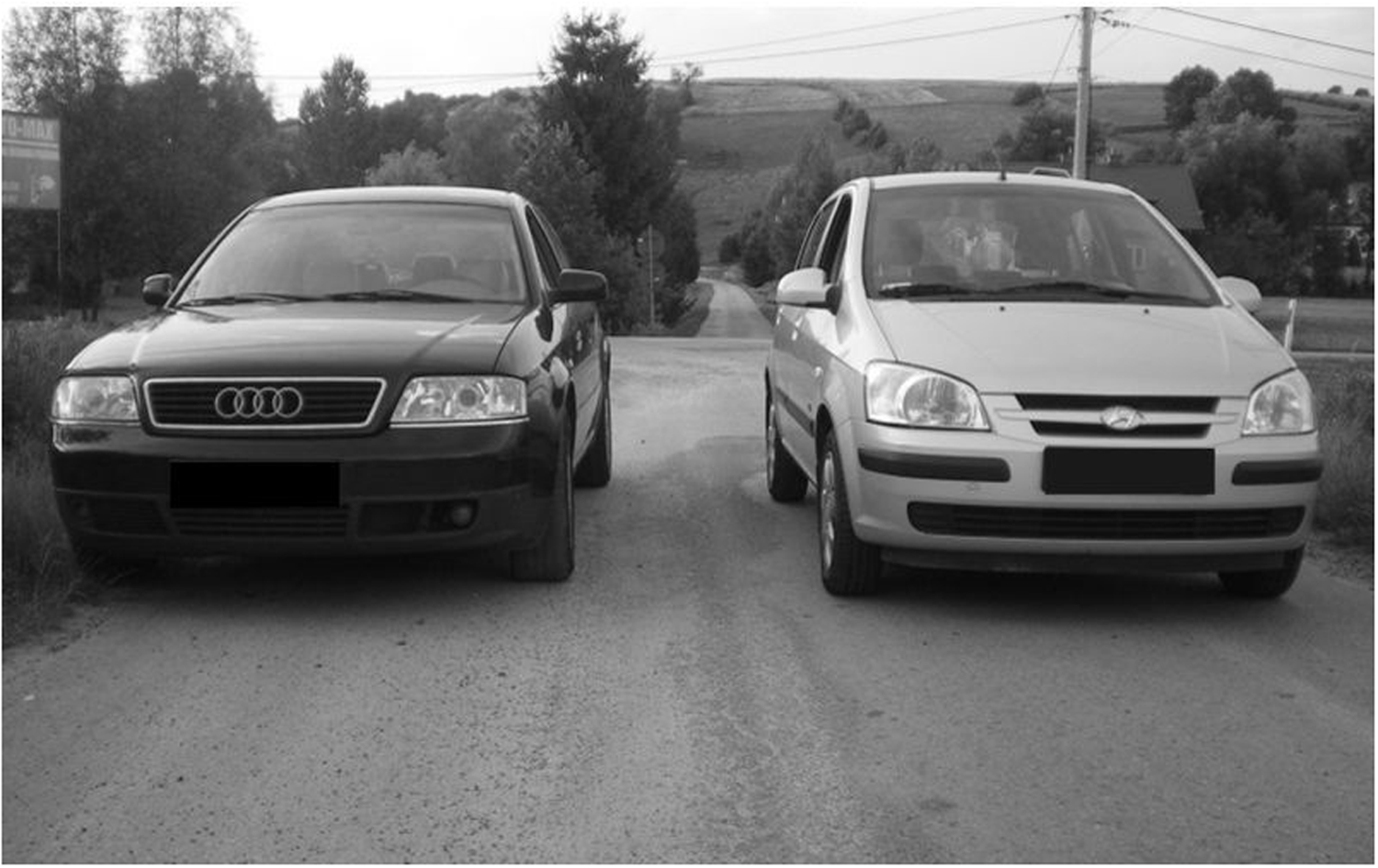
The respondents consisted of young people aged between 21 and 23 years and their number, depending on the day of research, varied from 33 to 50 people. They stood in the same place at the beginning of the test section of the road when the vehicles with the passing beams switched on or off were approaching. In some cases, when the test purpose required it, other traffic was excluded from the road, and in the other cases, the tested vehicles participated in the natural vehicle movement on the road. The respondents, depending on the purpose of the research, could freely observe the road or, if necessary, had their backs turned towards the approaching test cars and at a given sign, turned towards the test vehicles to observe the traffic situation for between 3 and 4 seconds (this is the time for which a driver can look in any direction while driving without losing a regular driving track).
The tests were carried out under weather conditions corresponding to moderate clouds, from June to November. The test road section was located approximately in the east-west direction (Figure 3) and the observers were facing east (the vehicles were coming towards the west).
4.2. Purpose
The general purpose of the research was to examine the impact of using passing beams during the day on various aspects of road safety under real road conditions, including:
Checking the change (i.e. increase/decrease) in the distance at which an approaching vehicle would be noticed, Checking the correctness of assessing the relative positions of vehicles situated closer/farther away/at the same distance to the observer when the passing beams were on or off.
4.3. Results
The impact of having the passing beams on was measured by the time elapsed after the vehicle started to move (t = 0) from a distance that excluded the chance of seeing the vehicle to the moment when it was detected by each of the respondents (50 people). First, the distance at which both vehicles were invisible regardless of whether their headlights were on or off was determined. This was found to be 2000 m. From this distance, at a sign given by the researcher, the vehicle started moving at a constant speed of 10 km/h and the respondents turned on their stopwatches. When the oncoming vehicle was noticed by a respondent, that respondent stopped their stopwatch. The experiment was repeated four times: for each of the vehicles and for both switching states of the passing beams. The average time for all respondents and the range of variability in the times are shown in Figure 5. The information shown in Figure 5 should be interpreted as follows: for example, the silver metallic car with the headlights switched off was noticed on average after 138.7 seconds, the first observer seeing it after 19 seconds, while the last observer to detect it only saw it after 332 seconds. These times can easily be converted to the relevant distances because the vehicles were moving at a constant speed of 10 km/h.
Mean and range of times for detection of bright and dark vehicles with and without their passing beams on during the day
On the basis of these results, it is concluded that, regardless of vehicle body colour, switching on the passing beams always causes the earlier detection of the approaching vehicle. Vehicle body colour also plays a role because, as shown in Figure 5, the silver metallic vehicle is seen earlier than the black vehicle, regardless of whether the passing beams were switched on or off. The obtained research results were tested using both parametric (t-test) and non-parametric (Friedman test, Wilcoxon test) statistics. It was found out that these differences in detection times for passing beams on or off were statistically significant (p < 0.05).
In a second experiment, the question as to whether the simultaneous presence of vehicles with passing beams switched on and off during the day could have an impact on the correctness of assessing the relative positions of the vehicles by oncoming drivers was one of the main reasons for carrying out the tests. This was not only a consequence of the authors' own experiences but also a result of many observations reported by the other road users. This test was done on the road under static conditions. The observers (33 people) stood with their backs towards the tested vehicles at a distance of 175 m from the nearer car and 200 m from the farther one. At a sign given by the researcher, the observers turned round for 3–4 seconds to assess the situation on the road and answer the question (i.e. to choose the option on a piece of paper: ‘the left car is closer’ or ‘the right car is closer’.
A hypothetical road situation, in which a pedestrian crossing the road might be hit by an unnoticed vehicle, was the starting point for establishing the distance of observation. Assuming that the time of crossing the 7-m wide road by the pedestrian is 7 seconds, the distance was determined for a vehicle that was moving at a speed of 90 km/h so that it would have a chance to stop before it reached the pedestrian. This distance was 175 m (taking into account the driver's reaction time and braking distance). Both vehicles were placed at this distance. Three scenarios of mutual vehicle positions were used (columns in Figure 6): Both vehicles at the same distance, the metallic silver vehicle closer (25 m), the black vehicle closer (25 m), and four switching states for each of them (A – both vehicles with the passing beams switched on, B – the metallic silver vehicle with the passing beams on, C – the black vehicle with the passing beams on, D – both vehicles with the passing beams off). In this way, 12 road traffic situations were tested, and a percentage of correctly assessed relative vehicle positions was recorded for each of them. The results of this stage of the research are presented in Figure 6.
Percentage identifying which of the two vehicles is nearer with the passing beams switched on and off during the day. Column 1 both vehicles at the same distance. Column 2 metallic silver vehicle closer. Column 3 black vehicle closer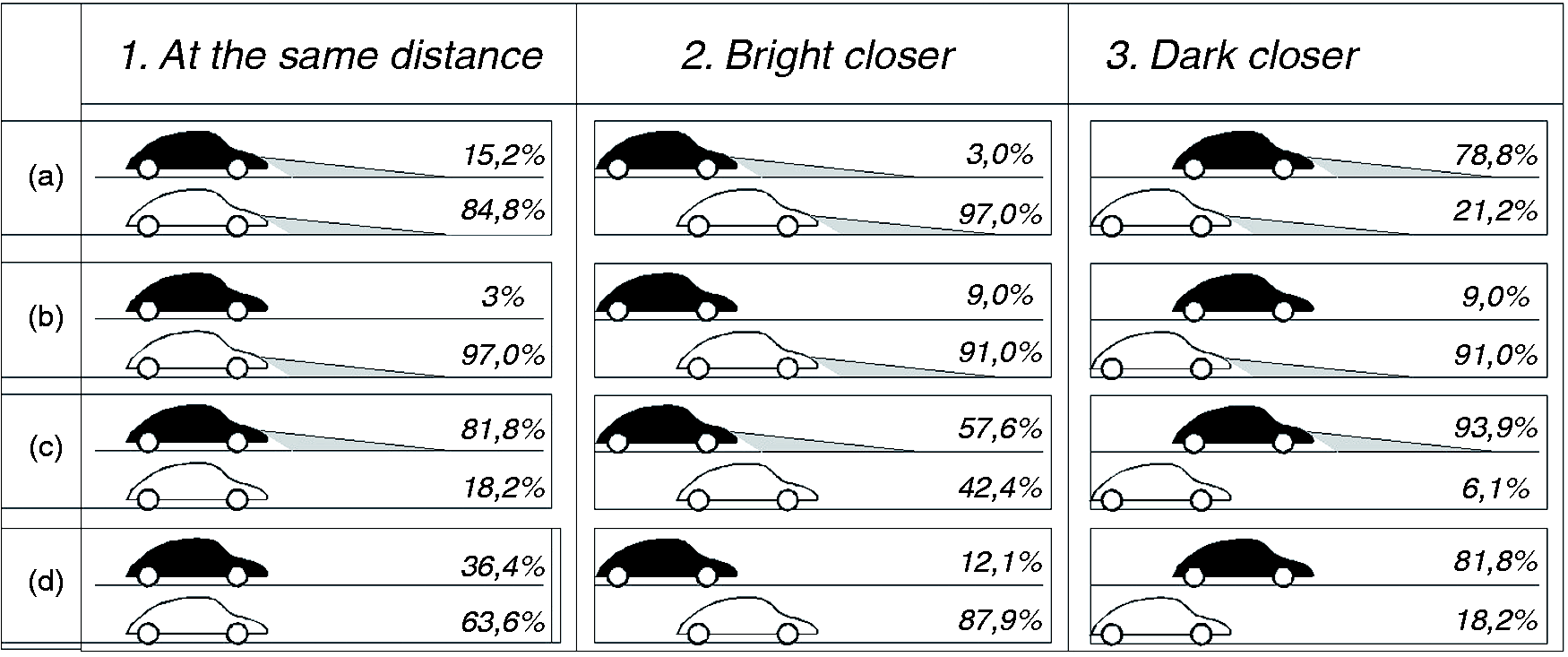
How should the results presented in Figure 6 be interpreted? For example, the situation marked as 3B says that 91% of the observers assessed that the metallic silver car with its passing beams on was closer, although, in fact, it was 25 m farther away from the observers than the black car with its passing beams off. These findings allowed us to draw some interesting conclusions.
Switching the passing beams on, according to the respondents, places the approaching car closer to the observer and this fact does not depend on the relative positions of the two tested vehicles (situations 1B, 1C, 2B, 2C, 3B, 3C). The vehicle body colour is also a factor bringing the vehicle closer to the observer (situations 1A and 1D), but this factor is weaker than switching the passing beams on.
Two situations were identified, in which most respondents mistakenly assessed the relative positions of the vehicles. Ninety-one per cent of the respondents estimated that the metallic silver vehicle with the passing beams on was closer, even though it was, in fact, located farther away (3B). Similarly, 57.6% of respondents reported that the black car with its passing beams on was closer, although, in fact, it was further away than the white car with passing beams off (2C).
The results also show that when both cars have the passing beams switched on (2A, 3A) or both have them switched off (2D, 3D), most respondents correctly assess the relative positions of the two vehicles. Further, when the two vehicles are at the same positon and both have their passing beams on (1A) or both have them off (1D), the metallic silver vehicle is judged to be closer than the black vehicle by the majority of respondents.
Chi square tests were used to carry out the statistical assessment of experiment 2. The expected values for each relative location were the percentages associated with the two vehicles when both vehicles had their passing beams switched off (1D for situation 1, 2D for situation 2 and 3D for situation 3). These tests confirmed that situations 1B and 1C were statistically significantly different from situation 1D (both p < 0.001), thereby demonstrating that switching on the passing beams on one vehicle makes that vehicle appear nearer. Situation 1A is also statistically significantly different from 1D (p < 0.011), but in this case, the difference arises from the two vehicles' colours as both have their passing beams on. For situation 2, only 2C approached statistical significance (p < 0.07) again indicating that switching on the passing beam of one vehicle makes that vehicle appear nearer. For situation 3, only 3B was statistically significantly different from 3D (p < 0.001), although 3C approached statistical significance (p < 0.07). Again, these findings indicate that switching on the passing beams on one vehicle makes that vehicle appear nearer.
5. Conclusions
The conducted research and analysis of the results allow us to draw the following conclusions:
In terms of photometry, the passing beam is a weak replacement for daytime running lights because its angular coverage is much lower and the required luminous intensity values within this area do not meet most of the luminous intensity criteria for daytime running lights. In spite of this negative photometric evaluation, switching on passing beams during the day makes it possible to see an oncoming vehicle earlier. The explanation for this phenomenon may be the fact that in the direction of the oncoming driver's eyes (B50L) and in the direction of the road axis, the luminous intensities required by the standards22,23 is only slightly different from the actual luminous intensity values of the passing beam in these directions (Table 1 and Figure 2), and in the tested situations the respondents were close to the road axis. A similar effect was noted as far as vehicle body colour is concerned. A lighter vehicle is seen from a longer distance than a darker one. Switching passing beams on during the day always, according to the respondents, makes it appear closer to the observer. To avoid a threat of incorrect assessment of the relative positions of two oncoming vehicles, the use of passing beams during the day should either be forbidden or their common use should be obligatory for all road users. Freedom in this area may lead to some dangerous situations related to not noticing a closer located vehicle with its passing beam off. The results support the arguments for mandatory use of passing beams during the day. These results should be treated rather cautiously in terms of their universality. The research was carried out in a specific place, at a specific time, under specific weather conditions with a people of a limited age range. Therefore, it should be acknowledged that their representativeness applies to similar conditions under which vehicles may be seen by people observing them directly ahead.
The authors also believe that the research in this area should be continued, checking the issues raised in this paper. One interesting study would be to use two identical vehicles with the same body colour. Such tests will allow for a clear assessment of the impact of switching the passing beams on, avoiding any distorting impact of car body colour on the results.
Footnotes
Declaration of conflicting interests
The authors declared no potential conflicts of interest with respect to the research, authorship, and/or publication of this article.
Funding
The authors received no financial support for the research, authorship, and/or publication of this article.