







Abstract

While the de Boer scale is widely used to measure discomfort from glare, commonly in studies of pedestrian-scale outdoor lighting, its design has several problems that lead to noise in the data and in turn to continued disagreement about the prediction of discomfort.
1
The de Boer scale is a 9-point categorical scale in which the odd numbered categories are labelled with magnitude descriptors (Figure 1). Example of a 9-point scale used for evaluation of discomfort from glare. This version was used in the study by Schmidt-Clausen and Bindels
3
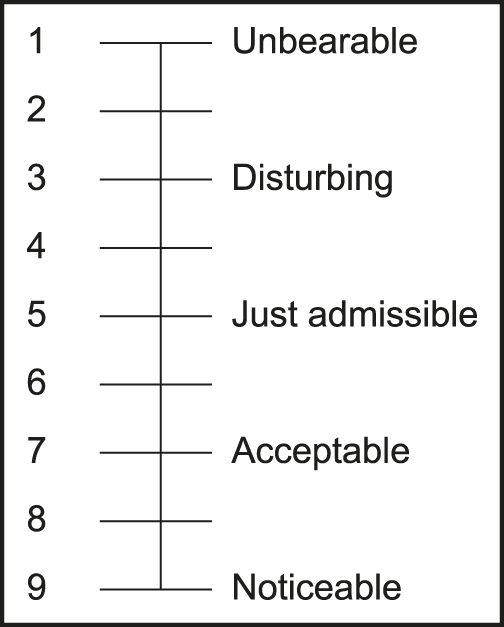
Problems with the scale include uncertainty about what the magnitude descriptors mean, 2 inconsistent labelling of discomfort magnitudes between studies, in some versions it is not possible to respond that there is no discomfort, the anomaly that the higher number (9) is the lower degree of discomfort, and that it is uncertain where lies the borderline between comfort and discomfort (BCD). Note, for example, that while Schmidt-Clausen and Bindels 3 cited de Boer and Schreuder 4 as a source for their scale (Figure 1) the labels of points 7 and 9 were satisfactory and unnoticeable in that source.
We propose here an alternative approach for rating discomfort from glare (Figure 2), as developed through discussions in the IESNA technical committee Discomfort Glare in Outdoor Nighttime Environments, and at the workshop on methods for measuring discomfort from glare at the CIE 2021 midterm conference. This is a two-step procedure. First, the subject is asked, “While viewing the scene as instructed, are you experiencing discomfort from glare?” with the response options being ‘Yes’ or ‘No’. This provides a participant with an equal opportunity to respond that discomfort is or is not being experienced. If the response to this first step is ‘Yes’, then the second step is to evaluate the degree of discomfort using a 6-point scale. In this scale, only the end points are labelled, with descriptors intended to be less ambiguous than those of the de Boer scale, and in which the higher number (6) corresponds to higher amount of discomfort. The two steps allow two approaches for analysing discomfort: the percentage of responses indicating that glare was experienced, and the mean rating for the second part. The two steps further allow analysis of the percentage of people expressing discomfort as a means of estimating the BCD. The proposed two-step rating procedure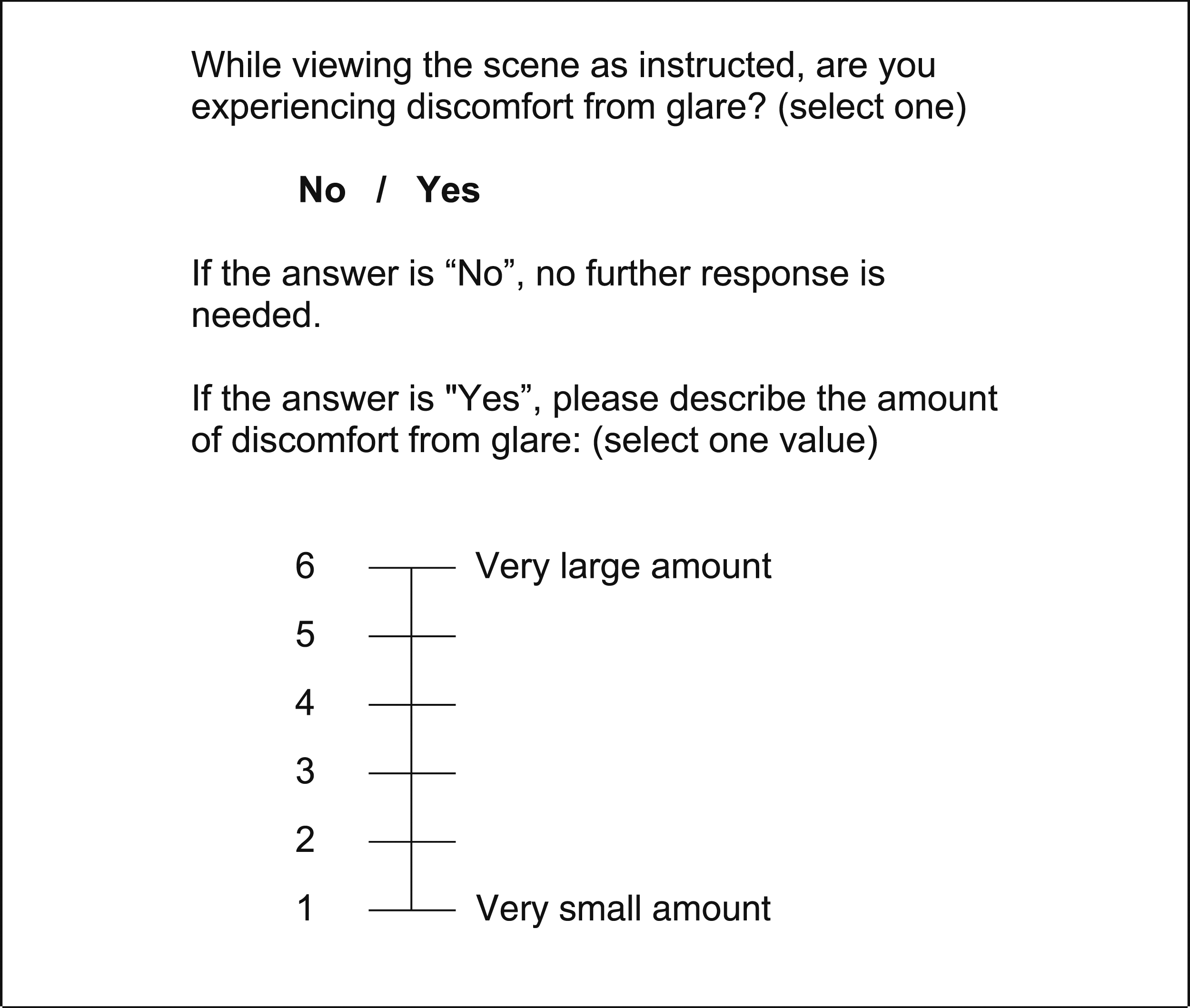
We offer this proposal in the hope that other researchers will consider using it, either as the main evaluation scale or in parallel with a researcher’s preferred scale. We do not propose that this will solve ongoing issues in the evaluation of discomfort from glare, but that it is an attempt to reduce the noise in responses. We do not propose that the scale originally devised by de Boer was incorrect, but that time and language translation have introduced changes, the significance of which was not immediately apparent. Finally, while this discussion has focussed on outdoor lighting, we suggest that similar issues are associated with studies of indoor lighting and might hence consider using the proposed two-step approach to evaluation.