







Abstract
The daily timings of our behavioural activities and physiological functions are regulated by the master biological clock in the brain. Disruption of these circadian rhythms can lead to poor performance and poor health. Consistent exposure to bright days and dim nights is necessary for circadian entrainment and, thus, for good sleep and good health. Since we spend most of our lives indoors, we often must rely on electric lighting for circadian entrainment. Surprisingly perhaps, current lighting practice does not purposely support circadian entrainment. A perceived barrier to promoting circadian entrainment with electric lighting is the absence of a standard test method for assessing the efficiency of luminaires for providing circadian-effective light to building occupants. Proposed is a measure for quantifying luminaire efficiency based on the electric power (watts) needed to reach the circadian stimulus criterion (CS = 0.3) at the eyes of a standard observer, termed Standard Observer Watts (SOWatt). The present paper describes how SOWatt can be applied to ceiling mounted, accent and table-top luminaires.
1. Introduction
1.1 USEPA fuel economy estimates
In 1973 the United States Environmental Protection Agency (USEPA) began publishing fuel economy data for various vehicles on the road using a pre-existing emission-level testing procedure. 1 A test vehicle is operated on a laboratory dynamometer for a simulated 7.5-mile city drive as well as for a simulated highway drive. Exhaust emissions are measured, from which fuel efficiency is calculated. Beginning in 1977, manufacturers were required to label all of their vehicles with the USEPA fuel-efficiency results for that vehicle type as well as the range of fuel efficiency for similar vehicles of a defined ‘car line’, such as compact, sedan, sports utility vehicle (SUV), light-duty truck and so on. 1 As is well understood by the public, these laboratory findings only characterize the potential fuel efficiency of a vehicle and not necessarily the fuel efficiency exhibited by a particular driver of that vehicle type. The way in which the vehicle is operated affects actual fuel efficiency; the proportion of city and highway driving affects fuel efficiency in particular. Other factors such as tyre inflation and fuel type will also affect a vehicle’s actual fuel efficiency. Importantly, however, the fuel economy estimates provided by USEPA will generally differentiate vehicle types (e.g. in general, SUVs are less efficient than compact cars) and vehicles within types. Figure 1 is one example (2008) of the EPA fuel-efficiency label required for all cars sold in the United States. 2
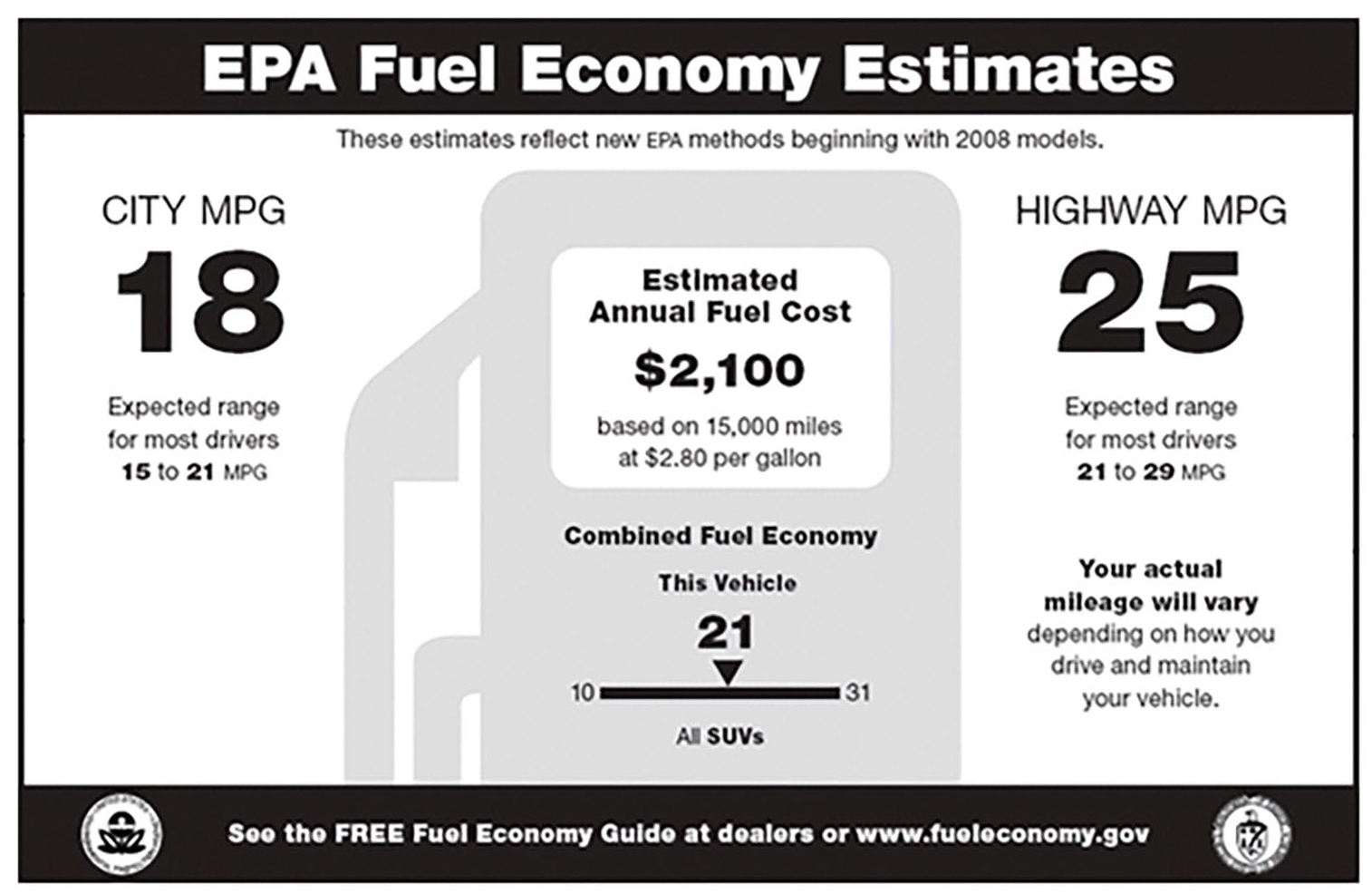
Example of the USEPA fuel economy estimates label for vehicle models years 2008–2012 2
1.2 Proposed healthy lighting economy estimates
There is a great deal of interest in healthy lighting, or more specifically lighting that supports circadian entrainment where a person consistently sleeps at night and is wakeful and productive during the day.3–7 To be entrained to this natural 24-hour cycle, our eyes (and only our eyes) need to be consistently exposed to bright days and dim or dark nights. We now know that building interiors do not generally provide circadian-effective bright light during the day and, due in large part to increased use of self-luminous devices, do not necessarily provide circadian-ineffective dim light at night.8–12 This may lead to circadian disruption which, in turn, results in poor sleep at night and sleepiness during the day.
Much like where a person drives largely determines fuel efficiency (e.g. city vs. highway), when a person’s eyes are exposed to bright and to dim light largely determines whether the benefits of circadian-effective light can be achieved. And analogous to tyre inflation and fuel type, several characteristics of the lighting in addition to exposure timing affect circadian entrainment – specifically, the amount, spectrum, distribution and duration of lighting exposure. Empirical research and mathematical modelling provide the foundations for defining circadian-effective and circadian-ineffective lighting.13,14 A metric based on this research, circadian stimulus (CS), ranging from 0.1 at threshold to 0.7 at saturation, was developed to characterize both the spectral and absolute sensitivities of the human circadian phototransduction mechanisms in the retina.13,14
Based largely upon that research and modelling, Underwriters Laboratory’s (UL) Design Guideline for Promoting Circadian Entrainment With Light for Day-Active People, Design Guideline 24480 (UL DG 24480) 4 was published to provide lighting design guidelines for achieving circadian entrainment for day-active and night-inactive building occupants. Specifically, this guidance requires that the building occupant should continuously receive an amount of circadian-effective light at the eyes equivalent to CS ⩾ 0.3 for a minimum of 2 hours during daytime, preferably in the morning. UL DG 24480 includes ‘Informative General Research and Supporting Science’ and details about ‘Circadian Entrainment’ that describe the scientific foundations for the design guideline. Among the ‘practical considerations’ in this background material, UL DG 24480 recommends that no part of the luminaire should produce a luminance (in the direction of the occupant) greater than 8500 cd m−2. Whereas discomfort glare calculations are more complicated,15–18 this simple luminance limit minimizes the likelihood of occupants experiencing visual discomfort from luminaires meeting the design criterion of CS ⩾ 0.3. Similarly, suggestions are offered to minimize wasted lighting energy through temporal controls, high wall reflectance values and the use of local luminaires.
UL DG 24480 is, as the title suggests, application-based, meaning that implementation of circadian-effective lighting requires specific information about the spaces being occupied. In addition to the characteristics of the luminaires, wall reflectance values, workstation partition heights, window locations and directions of view will affect the amount and distribution of circadian-effective light reaching a person’s eyes. Therefore, there are an almost infinite number of possible circadian-effective light outcomes, but to be effective they should have one thing in common: to deliver circadian-effective light during the day to the occupant’s eyes. Most designers and architects who are interested in delivering circadian-effective light understand this point. This means that to have circadian-effective lighting in a room during the day, most designers and architects understand that finished surfaces should be highly reflective, room partitions should be low and the luminous intensity distribution emitted by the luminaire should provide illumination to the vertical plane at the eyes, not simply on the horizontal plane at the work surface. Much like the USEPA rating system for motor vehicle fuel efficiency, we have developed a test procedure for rating luminaire efficiency in terms of delivering circadian-effective light to building occupants. And like the USEPA rating system where it is widely understood that driving behaviour influences actual fuel efficiency, the rating system developed here for luminaires does not guarantee the delivery of circadian-effective lighting to occupants in practice.
The goal of the present paper is to introduce a standard testing procedure for luminaires that could be used to deliver circadian-effective light to a building occupant’s eyes. As already noted, these measurements do not guarantee that circadian-effective lighting will actually be achieved in a building. Importantly, however, keeping all other architectural factors constant, the proposed circadian-effective measurements should predict the relative performance of different luminaires in most architectural spaces. Naturally, some types of luminaires will be more efficient than others, but the reason for selecting a luminaire type would rarely depend solely upon its effectiveness for delivering circadian-effective light to building occupants. Rather, cost and aesthetics can play a significant role in luminaire selection, just as it is with selecting a motor vehicle. So, just like the USEPA fuel-efficiency ratings are to be compared within a given ‘car line’ (e.g. compact, SUV, sedan, light-duty truck), we propose that the standard testing procedure results for a given luminaire be reported along with others within a given ‘luminaire line’ (e.g. ceiling-mounted, pendant, wall-washing). The proposed testing procedure facilitates comparisons of circadian effectiveness within and across ‘luminaire lines’ by providing an absolute electric power (watts) value to achieve CS ⩾ 0.3.
2. Method
A standard test configuration was created to evaluate a luminaire’s potential to provide circadian-effective lighting. This standard configuration includes a standard observer seated at a table. Like the USEPA test for fuel economy, the standard test configuration and standard observer simulate common and important elements of a space (e.g. inter-reflectance from the surfaces of ceilings, walls, floors and furniture) that could affect the electric power needed to reach a criterion CS level.13,14 Tables 1 and 2 and Figure 2 define the standard test configuration and the location of the standard observer.
Environmental factors used in testing
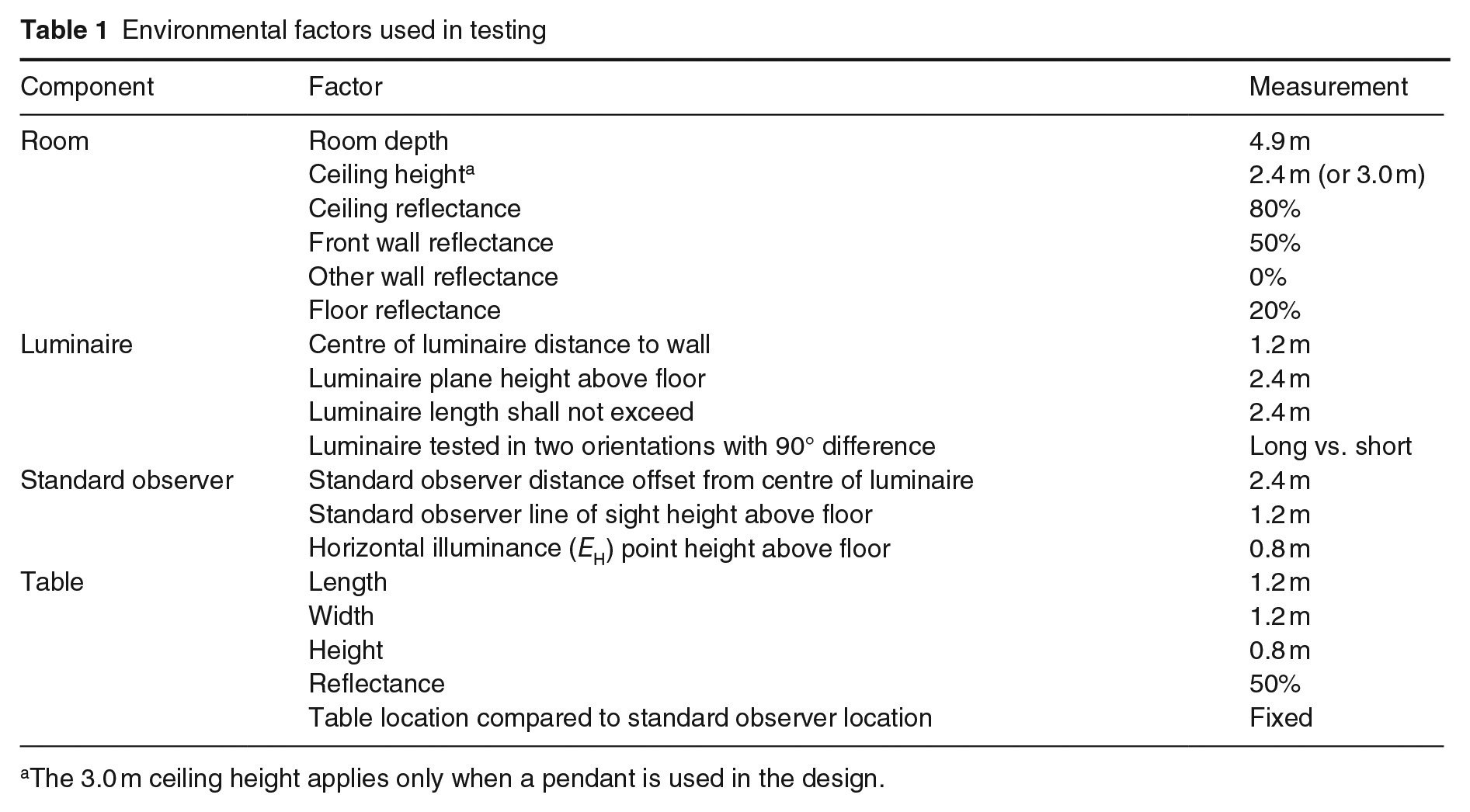
The 3.0 m ceiling height applies only when a pendant is used in the design.
Luminaire factors used in testing
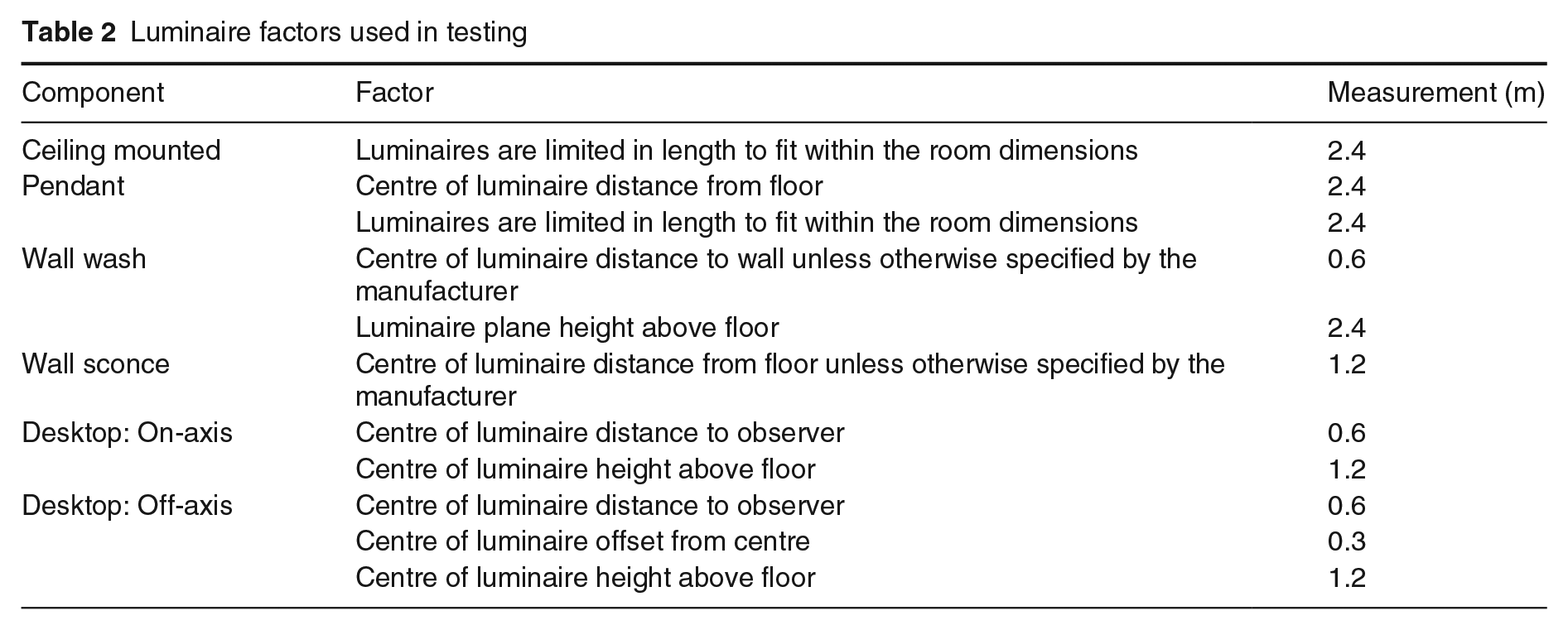
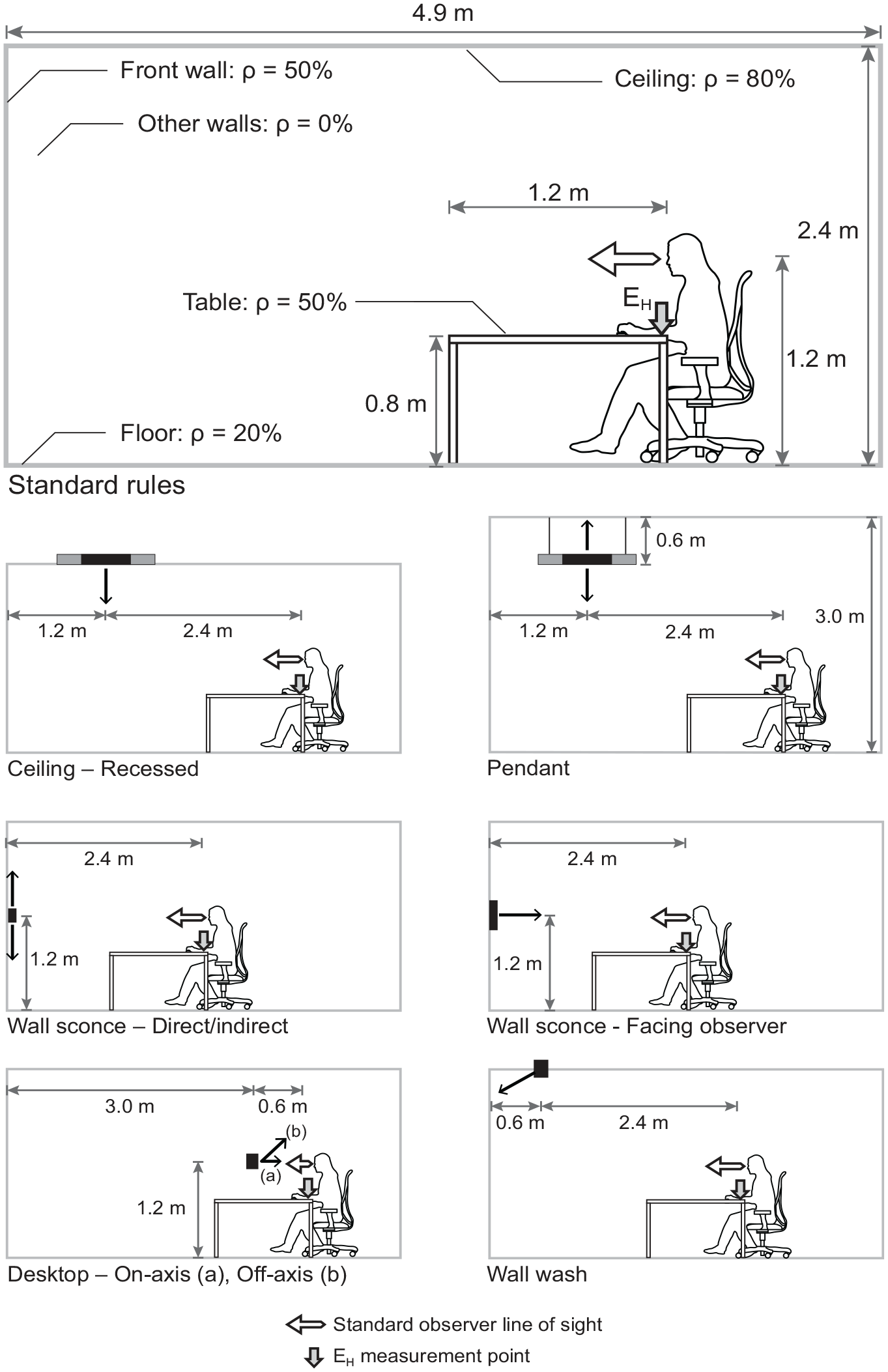
Illustration of standard configuration rules and luminaire-dependent variables for the major luminaire lines tested in this publication. The black rectangles or squares represent the luminaires. Where present, the black rectangles represent the luminaires’ long orientation, and the constituent grey rectangles represent the luminaires’ short orientation. The bold black arrows represent the primary direction of light emitted by the luminaires. EH = horizontal photopic illuminance
The measure chosen to characterize the potential of a luminaire to provide circadian-effective light is the electric power (watts) required for the luminaire to reach the CS criterion CS = 0.3 for the Standard Observer Watt (SOWatt). The most circadian-effective combination of luminaire orientation, intensity distribution and spectral power distribution (SPD) will be associated with the lowest wattage needed to reach CS = 0.3.
To properly represent the amount of light reaching the standard observer, both direct and reflected light need to be quantified. The geometrical configuration of the standard observer’s horizontal line of sight with respect to the luminaire and the front wall realistically combines the potential effectiveness of direct light from the luminaire and that of the indirect light reflected from the ceiling, front wall and the task surface. Because the reflectance values of the side and back walls have little effect on the spectrally weighted irradiance at the eyes of the standard observer, they were assumed to have a reflectance value of 0, which can be practically realized with black felt curtains (see Supplemental Material S1. Important considerations for environmental factors used in testing).
Usually, luminaire luminous intensity distributions are not radially symmetric. Depending upon the orientation of the luminaire with respect to the standard observer, more or less light can reach the eyes. Therefore, two electric power values (watts) can be generated for a given luminaire and SPD combination, one where the long dimension of the luminaire is oriented perpendicular to the standard observer’s line of sight and one where the short dimension is oriented perpendicular to the standard observer’s line of sight. Note that because Illuminating Engineering Society (IES) photometric data files 19 do not account for luminaires’ physical dimensions, the short and long orientations used here typically (but not always) correspond to the IES photometric planes of 0° and 90°, respectively.
The following results were based upon photometrically realistic simulation software calculations (AGi32, version 19.15 rev. 0-06-MAY-2020; Lighting Analysts, Inc., Littleton, CO, USA). Details regarding the underlying assumptions for the simulations are provided in Supplemental Material S2. Underlying assumptions for lighting simulations. Other commercially available simulation software can be used to determine SOWatt values, but importantly, the underlying assumptions in the calculations generated by the different software programs have not been standardized. Therefore, different software programs may produce slightly different SOWatt values. It is also important to note that a photometric laboratory adhering to the conditions specified in Tables 1 and 2 and Figure 2 can be physically realized, thereby making it possible to obtain SOWatt values from actual luminaires.
3. Results
3.1 SOWatt calculations
Table 3 lists the characteristics for three selected luminaire configurations (all with similar optics) and shows how the electric power (watts) required for each luminaire to reach the CS criterion CS = 0.3 for the standard observer (SOWatt) are affected by luminaire orientation, the SPD and the luminous efficacy of the light source. For measurement position, refer to Figure 2 and Tables 1 and 2.
Summary of characteristics needed to determine SOWatt
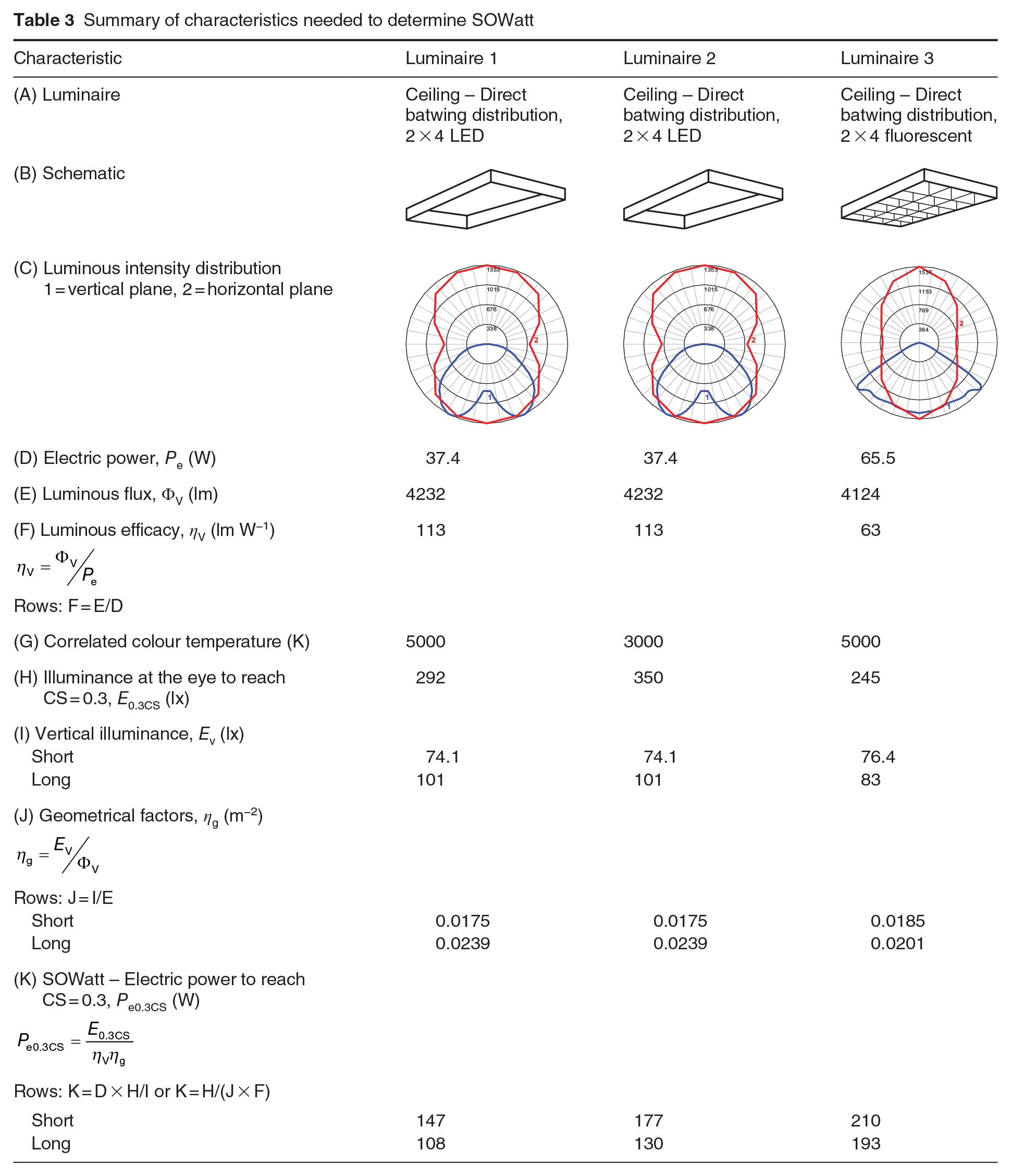
The following describes each row in Table 3:
Rows A through G describe the characteristics of the three luminaires; Luminaires 1 and 2 have the same optics but have different LED light sources which have been chosen to have the same electric power, luminous flux and luminous efficacy to help show how SPD alone can influence the final value of SOWatt.
Row H provides the photopic vertical illuminance (E0.3CS, in lux) needed to reach a level of CS = 0.3 at the eyes of the standard observer, which is determined by the luminaire light source’s specific SPD and, thus, CCT (row G). These values represent the illuminance-to-CS spectral factor for determining SOWatt for that light source/SPD and are independent of the luminaire optics.
Rows I through K are each subdivided into two rows, ‘short’ and ‘long’, that describe the orientation of the luminaire with respect to the standard observer. The long orientation designation means that the longer dimension of the luminaire is perpendicular to the standard observer’s line of sight whereas the short designation means the shorter dimension is perpendicular to the standard observer.
Row I shows the photopic vertical illuminance (EV, in lux) at the standard observer’s eyes that the luminaire achieves with the standard test configuration.
Row J provides the geometrical factors ( η g) needed for determining SOWatt, which are independent of the luminaire’s SPD.
Row K provides SOWatt values (W). Pe0.3CS presents the electric power required for the luminaire to reach the criterion CS = 0.3 (SOWatt), combining the geometrical factor for a given orientation (row J), the spectral factor for a given SPD (row H) and the luminous efficacy for a given light source (row F). The greater the geometrical and luminous efficacy factors (rows F and J) and the lesser the illuminance-to-CS spectral factor (row H), the lower the electric power needed to reach CS = 0.3, or SOWatt.
3.1.1 Geometrical factor: Intensity distribution
Row J (ηg) is an efficacy factor that can be interpreted as the ‘geometrical factor’ for the luminaire, irrespective of the light source SPD or its luminous efficacy. This factor is in units of inverse square metres (m−2), which is not intuitively obvious. In effect, the values in row J represent how effectively the standard observer eye illuminance (lm m−2) utilizes the total luminous flux (lm) emitted by the luminaire (i.e. (lm m−2)/lm = m−2). Thus, the fewer the lumens needed to be generated by the luminaire to reach the criterion illuminance at the eyes of the standard observer (row H), the more geometrically efficacious the luminaire. Another way to think about this term is that a more geometrically efficacious luminaire would distribute the amount of flux needed for a CS = 0.3 over a smaller area resulting in a higher illuminance.
3.1.2 Spectral factor: SPD
As can be seen in row H, though different sources, the two 5000 K light sources (an LED SPD and a fluorescent lamp, CIE F8 SPD) both require lower photopic illuminance at the standard observer’s eyes than the 3000 K light source (LED) to reach CS = 0.3. However, although the LED and fluorescent lamp luminaires both have the same 5000 K CCT ratings and the photopic illuminance values for CS = 0.3 are fairly similar for both, they are not exactly the same given their different SPD. It should also be noted that the photopic illuminance values are the same for a given SPD for both orientations of a given luminaire. Thus, the values in row H can be interpreted as ‘spectral factors’ for the luminaires irrespective of the luminaire orientation (short vs. long) or the luminous efficacy of the light source (row F) (see Table 3).
It should be emphasized that there are innumerable ‘white’ SPDs available, compounded by the fact that luminaire reflectors and refractors may not be spectrally flat. For accurate characterization of the circadian effectiveness of the luminaire, the actual SPD emitted by the luminaire and reaching the eyes must be known. It should be noted that some ‘tunable’ luminaires are designed to be operated in two or more modes. For those luminaires, each mode will have different electric power values needed to reach CS = 0.3 (i.e. SOWatt). Electric power values needed to reach the criterion level of circadian-effective light should be provided for a minimum of two modes in such cases, representing the two extreme settings of the ‘tunable’ luminaire.
3.1.3 Luminous efficacy
Finally, rows D and E are used to determine the luminous efficacy of the luminaire (row F). For the examples in Table 3, the fluorescent lamp luminaire has a lower luminous efficacy than the LED luminaire for the same CCT and similar optics. Lower luminous efficacy requires greater SOWatt. Luminous efficacy depends on the conversion efficiency from electric power to radiant power as well as the spectral distribution of the radiant power. The previous discussion of spectral dependency (Section 3.1.2) included only the conversion from illuminance to CS and not the conversion from radiant flux to luminous flux that is considered here.
3.2 Luminaire lines
USEPA organizes automobiles into different ‘car lines’ where each ‘line’ has been designed to meet a different set of customer needs. For example, SUVs are designed to carry a large amount of cargo or number of passengers whereas compact cars are designed to minimize initial and operational costs. Although every automobile manufacturer has a different offering within a ‘car line’, USEPA enables the public to compare all cars within that ‘car line’ in terms of fuel efficiency.
Analogously, there is a wide variety of ‘luminaire lines’, each designed to accomplish different lighting design goals. Ceiling mounted, recessed downlights are designed to efficiently deliver illuminance to the horizontal task surface, whereas wall-mounted sconces are designed to provide luminous elements within the observer’s field of view. Luminaires have been organized into different ‘luminaire lines’ for comparison in the Supplemental Material S2. Underlying assumptions for lighting simulations, where the watts needed to reach the CS = 0.3 criterion (SOWatt) are provided for the long and short dimensions of the luminaire. Table 4 shows, without regard to orientation, the highest, lowest and mean values of SOWatt for different ‘luminaire lines’.
Range of wattages needed to reach CS = 0.3 for various ‘luminaire lines’
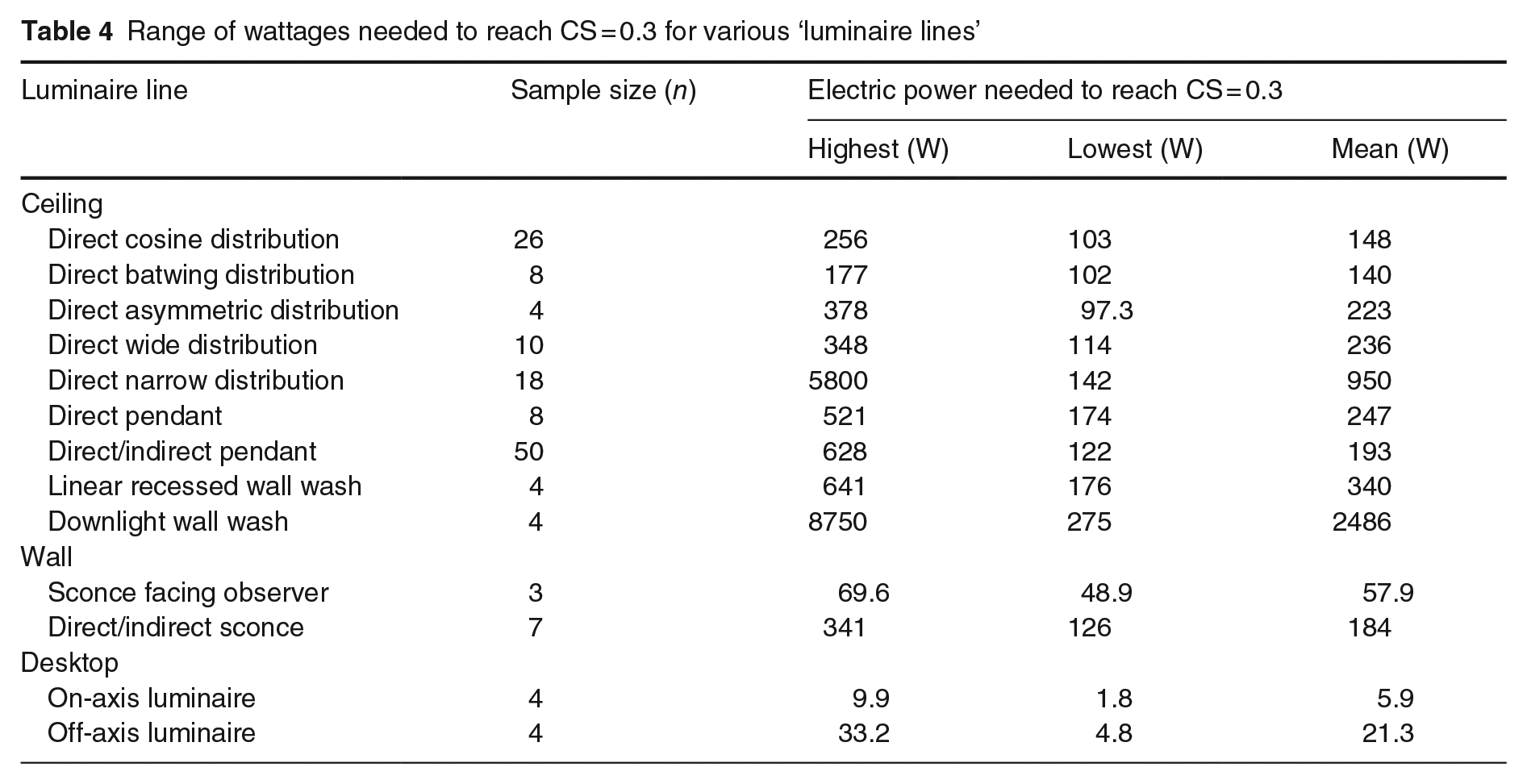
It should be no surprise that the ‘desktop luminaire line’ is the most efficient (lowest average SOWatt) ‘luminaire line’ because of their proximity to the standard observer. In contrast, the ceiling downlight wall wash ‘luminaire line’ is the least efficient (highest average SOWatt). Importantly however, there is a wide range of SOWatt values within every ‘luminaire line’ and, moreover, there is overlap between ‘luminaire lines’. Therefore, nearly any luminaire type can provide circadian-effective light to occupants if applied correctly, so lighting professionals are not necessarily restricted to a single luminaire type to support circadian entrainment.
Similarly, lighting professionals are not restricted to a particular CCT. Figure 3 also shows a great deal of overlap between SOWatt values for the 3000 K and 5000 K luminaires in Table 3.
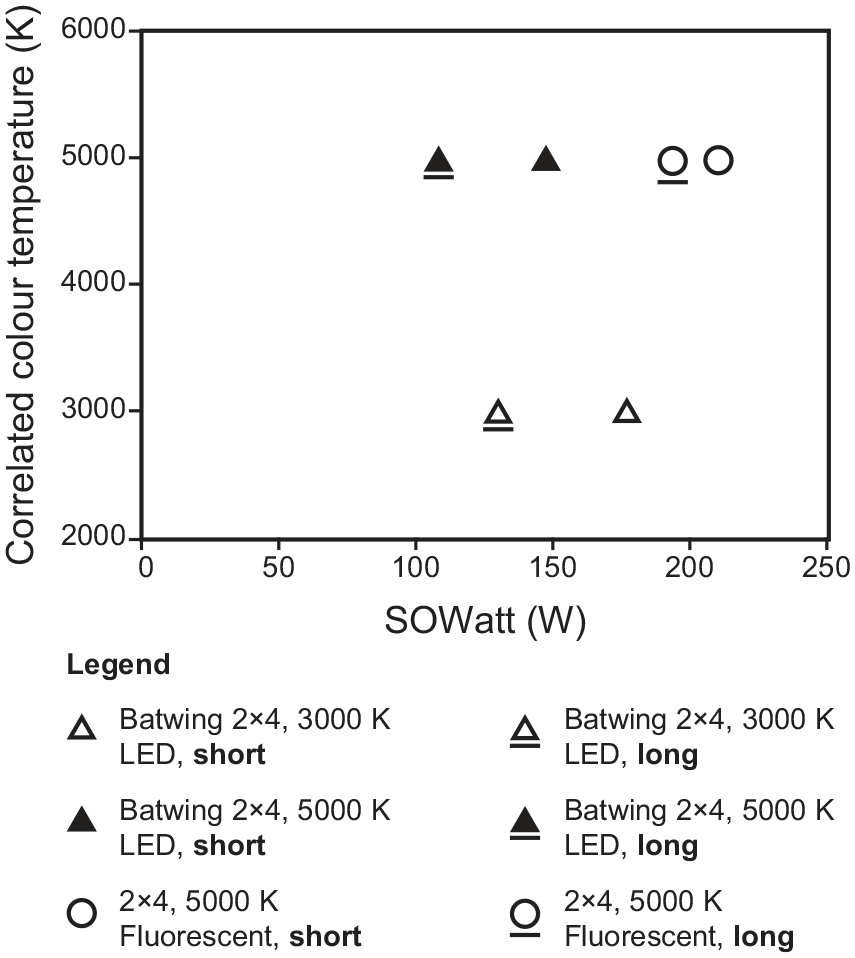
Comparison between CCT and wattage needed to reach CS = 0.3
3.3 Proposed healthy lighting economy estimates label
Finally, Figure 4 emulates the well-recognized and well-accepted USEPA car fuel economy label in Figure 1. It was designed to capture in a familiar and simple graphic form the results of luminaire testing for providing circadian-effective light. All luminaires are measured in terms of SOWatt, the electric power needed under defined test conditions to reach a daytime criterion level of CS = 0.3 as employed in UL 24480 and developed by the Light and Health Research Center at Mount Sinai School of Medicine (formerly the Lighting Research Center at Rensselaer Polytechnic Institute). For comparison, Figure 4 also reports melanopic equivalent daylight illuminance (EDI) 20 along with the photopic illuminance EV.
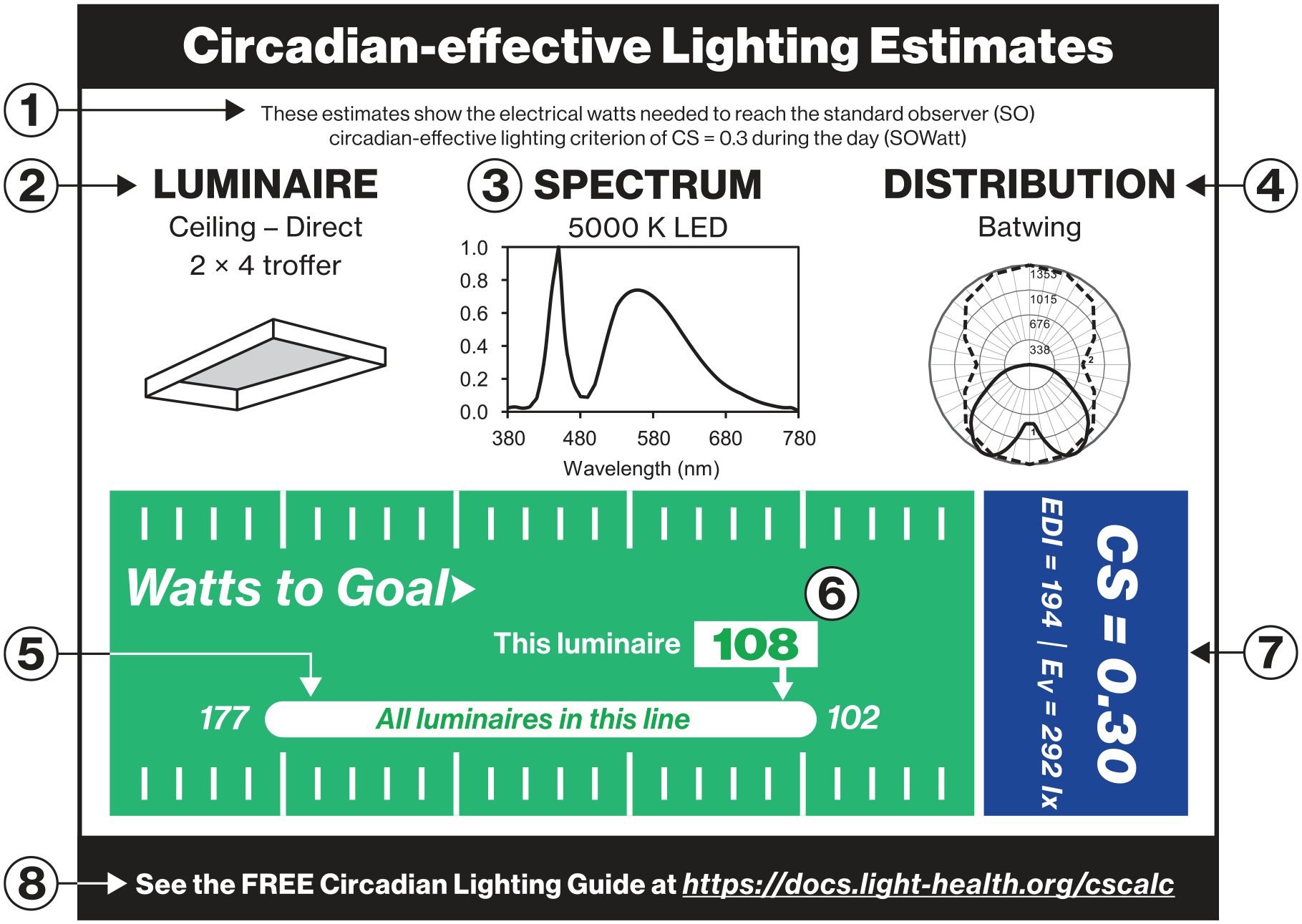
Proposed healthy lighting economy estimates label, with keyed elements as follows: (1) Information about the label’s meaning. (2) The ‘luminaire line’ (Ceiling-Direct) and type (2 × 4 troffer) with a graphical representation of the form factor of the luminaire. (3) The CCT and the relative SPD of the light source. (4) The type of light distribution with a polar plot showing the luminaire’s luminous intensity distributions in both the vertical (solid line) and horizontal planes (dashed line). (5) The range of wattages needed to meet the criterion value of CS = 0.3 of all luminaires in the same ‘luminaire line’. (6) The wattage needed by the luminaire to meet CS = 0.3 and how it compares to others in the same ‘luminaire line’. (7) The circadian-effective lighting criterion value of CS = 0.3 and the associated melanopic EDI (symbol
4. Discussion
Light isn’t just for vision anymore. By focusing on the role that light has on visibility, the industry has created a long tradition for providing lighting products and applications for human vision in outdoor, commercial and industrial settings. Because lighting also affects our non-visual circadian system, it seems incumbent on the lighting industry to begin to provide products and applications for human health. Recognizing that this social obligation is new for the lighting industry, it is necessary that new products and applications follow. To do so, new enabling tools are needed for lighting professionals. The present paper provides the foundation for such a tool.
A standard testing procedure for assessing luminaires was developed that can be actualized both virtually and in reality. Luminaires of all types can be compared in terms of their ability to provide a criterion CS (CS = 0.3) under defined test conditions. These luminaires can also be compared in terms of other luminous efficiency functions because the SPD of the light source is known, such as the universal luminous efficiency function (Uλ), 21 the action spectrum of melanopsin, smel(λ) 22 used in EDI 20 and, of course, the photopic luminous efficiency function, V(λ). Since there are many types of luminaires, each aimed at addressing different design objectives, ‘luminaire lines’ were conceptualized so that luminaires within a particular ‘line’ could be more easily compared. The measure used to make these comparisons is the electric power (watts) required for the luminaire to reach the CS criterion CS = 0.3 for the standard observer, or SOWatt for short. As electric utilities become increasingly interested in the non-energy benefits of lighting, 23 the SOWatt metric provides a convenient and useful scale for supporting and promoting energy-efficient circadian-effective lighting.
Supplemental Material
sj-pdf-1-lrt-10.1177_14771535221145606 – Supplemental material for Standard observer watts: Evaluating the efficiency of circadian-effective luminaires using a standard observer methodology
Supplemental material, sj-pdf-1-lrt-10.1177_14771535221145606 for Standard observer watts: Evaluating the efficiency of circadian-effective luminaires using a standard observer methodology by MS Rea, A Bierman, A Thayer, C Jarboe and M Figueiro in Lighting Research & Technology
Footnotes
Declaration of conflicting interests
The authors declared no potential conflicts of interest with respect to the research, authorship, and/or publication of this article.
Funding
The authors disclosed receipt of the following financial support for the research, authorship, and/or publication of this article: The authors wish to acknowledge support from the Light and Human Health Partnership at Mount Sinai (Axis Lighting, iGuzzini, USAI Lighting and GE Lighting). David Pedler of the Light and Health Research Center provided indispensable editorial assistance.

Supplemental material
Supplemental material for this article is available online.
References
Supplementary Material
Please find the following supplemental material available below.
For Open Access articles published under a Creative Commons License, all supplemental material carries the same license as the article it is associated with.
For non-Open Access articles published, all supplemental material carries a non-exclusive license, and permission requests for re-use of supplemental material or any part of supplemental material shall be sent directly to the copyright owner as specified in the copyright notice associated with the article.
