






Abstract
The International Commission on Illumination recently issued a position statement advocating for proper light at proper time, specifically recommending a melanopic equivalent daylight illuminance of 250 lx at eye level during daytime. However, the statement also cautions that avoiding glare from windows requires ‘advanced lighting design guidance’, implying a conflict between achieving healthy lighting and managing daylight-induced glare. This study examines this potential conflict. Through theoretical analysis and a user study across six locations, we found that between the recommended illuminance levels for healthy lighting and the vertical illuminance levels at which glare becomes an issue lies a difference of a factor 10 roughly. This provides façade designers with considerable flexibility in selecting appropriate shading solutions. Furthermore, vertical illuminance levels between 250 lx and 1000 lx from daylight typically reduce perceived glare from façades. A supporting simulation study positioned a sample office in three European climates and employed typical shading devices and controls, confirming these findings for positions up to 2 m from the façade. For deeper room positions in multi-user spaces, solutions become more complex and require advanced lighting design, with higher diffuse transmittance shading appearing beneficial. Overall, the results demonstrate that healthy daytime lighting through daylight does not inherently increase glare risk.
1. Introduction
Daylighting has become a critically important aspect of the built environment. Its significance is evident not only for energy conservation and successful building design but also for occupant well-being, productivity, work satisfaction and performance.1–3 Recent discoveries regarding a novel photoreceptor in the human eye – most sensitive to short wavelengths and influential in regulating circadian rhythms – have deepened our understanding of light’s impact on health4–6 and led to indoor light exposure recommendations for daytime, evening and nighttime from experts in the field. 7
At the same time, building and lighting research widely acknowledges that daylight glare is a primary cause of occupant interactions with shading devices and a major source of dissatisfaction.8,9 Glare is consistently recognized as one of the most important factors in visual discomfort.10–12
Recognizing the crucial impact on health, the International Commission on Illumination (CIE) has highlighted the importance of providing ‘proper light at the proper time’ by publishing a recent position statement. 13 In this document, the CIE recommends a minimum melanopic equivalent daylight illuminance (melanopic EDI, or mEDI) of 250 lx at eye level during daytime and suggests limiting exposure to a maximum of 10 lx in the 3 h prior to sleep. However, the statement also underscores the complexity of achieving such lighting conditions without inducing discomfort from glare, particularly from daylight entering through windows. CIE warns that avoiding glare under these circumstances requires ‘advanced lighting design guidance’.
This claim suggests a potential tension when aiming to achieve ‘integrative lighting’ purposes, particularly between designing environments with ‘healthy lighting’ that supports circadian needs and reducing the risk of daylight-induced glare. In non-residential spaces, glare is a common concern that can compromise visual comfort and functionality. Thinking further about that concern would prompt questions about the practicality of relying on daylight (the most circadian light) as the primary light source while maintaining recommended health-focused lighting standards.
The impact of shading devices on circadian lighting potential has been explored in several studies, albeit to a limited extent. One investigation, 14 focusing on the Seattle climate, used point-in-time simulations for 21st March and 21st September. It found that horizontal awnings and fully retracted horizontal blinds had a minimal effect on circadian potential. In contrast, electrochromic (EC) glazing with lower transmittance levels (18% and 6%) significantly reduced the available circadian stimulus.
Two other studies developed shading control strategies that aim to balance glare protection with the maximization of circadian light exposure.15,16 Conducted in Lausanne (Switzerland) and Manipal (India), both reported successful implementations of their algorithms, achieving the dual objectives of visual comfort and circadian efficacy.
A further study applied the IES-LM-83 blind control algorithm in a building in Golden, Colorado, United States. 17 Following the standard’s protocol, blinds were fully closed to prevent glare whenever direct beam illuminance on the work plane exceeded 1000 lx for more than 2% of the analysis area. This criterion triggered frequent blind closure, which in turn limited circadian light exposure. As a result, the target of 275 equivalent melanopic lux was not met for more than 39% of the relevant occupied hours.
Differently, Giovanni et al. 18 investigated to what extent existing office spaces could meet the circadian recommendations set by CIE in terms of melanopic EDI: daylighting circadian contribution was determined through annual Lark v2 simulations in four offices located in Turin (Italy, 45°N). The shades (venetian blinds) were controlled through a logic based on the simplified daylight glare probability (DGPs): during the annual simulation, blinds were assumed to be operated at each time-step when DGPs was found to be over 0.40 (threshold between tolerable and disturbing glare) at any desk in the office, or retracted for the condition DGPs <0.40. Comparing two similar offices, one facing south (with an annual activation profile of the blinds of 12.6% of occupied hours) and one facing north (no activation), allowed the influence of blinds use on the melanopic EDI across the space to be assessed: the use of blinds in the south-facing space reduced the percent of hours where the CIE recommendations (melanopic EDI ≥250 lx) were met from 76% (in the north-facing office) to 59% (−22.4%).
Given these varying findings and the central tension highlighted by the CIE, the objective of this contribution is to critically evaluate whether this stated conflict is justified. Specifically, we aim to determine if achieving recommended melanopic EDI levels through daylight necessarily increases the likelihood of glare. To address this issue, we conducted theoretical analyses and examined findings from user assessment studies in diverse settings worldwide. Finally, through a simulation study employing typical glare protection systems across three different European climates, we quantify the practical implications of shading use by calculating the annual frequency, during daylight hours, with which recommended melanopic EDI levels are achieved.
2. Background and assumptions
2.1 Discomfort glare from daylight
Glare is defined by CIE as a ‘condition of vision in which there is discomfort or a reduction in the ability to see details or objects, caused by an unsuitable distribution or range of luminance, or by extreme contrasts’ (CIE S 017:2020 19 ). Although the main causes of discomfort glare are still not understood, several studies20–22 suggest, based on empirical data, that glare arises from two main effects: (1) contrast effect: excessive contrast in the field of view and (2) total-amount effect: excessive light entering the eye (see also CIE 252:2024). 23
These key findings, plus Velds, 24 identified vertical illuminance as a reliable predictor of daylight-induced glare and informed the core equation structure of the DGP. This metric combines the ‘amount of light’ and ‘contrast effect’ as separate additive terms in its equation and was formulated by Wienold and Christoffersen 25 through user assessments involving 76 subjects under very diverse daylight conditions, as part of the European ECCO-build project (contract No.: ENK6-CT-2002-00656). In a cross-validation study 26 by seven research groups using user assessment data from six different locations (Argentina, Denmark, Germany, Israel, Japan and United States), DGP was found to be the most robust and best performing glare metric for daylight scenarios. The DGP metric is widely used and adopted by several European standards (EN17037, EN12464 and EN14501) as well as part of the BREEAM V7 building certification. The amount of light effect in DGP is modelled as linear function of the vertical illuminance (see first term of Equation (1)).

where Ev is the vertical illuminance at eye level (lx), L s,i is the luminance of i-th glare source (cd m−2), ωs,i is the solid angle of glare source (sr), Pi is the position index of i-th glare source (–) and i = 1, 2, …, n is the index over all n glare sources.
The formulation of the equation leads to following behaviour: in scenarios with low contrast, the vertical illuminance is the dominant driver for glare (dominance of first term in the equation). For high contrasted scenarios, the position weighted contrast (dominance of second term in the equation) source gets the main driver for glare.
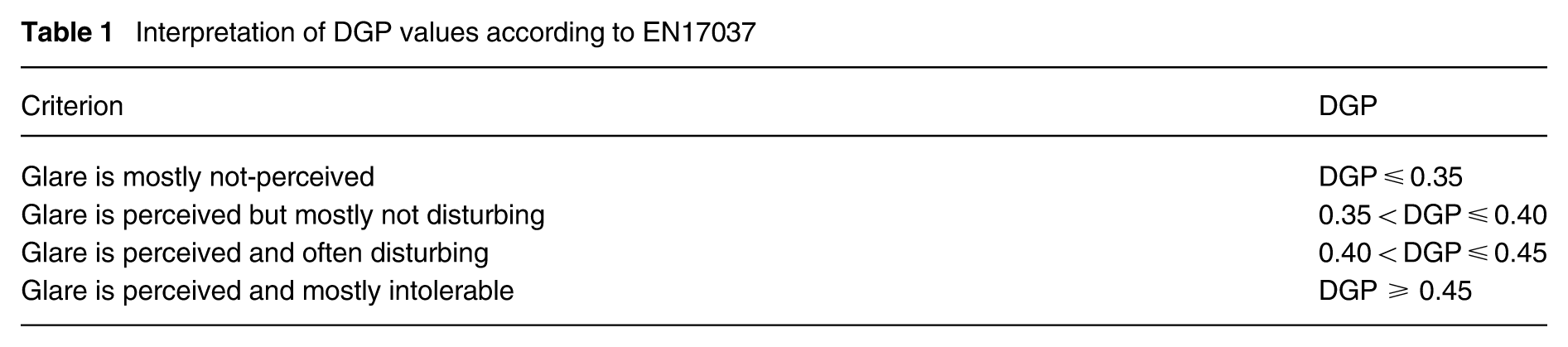
DGP was developed using a four-point ordinal subjective response scale introduced by Osterhaus and Bailey. 27 Table 1 shows the relationship between the model’s values and the interpretation of Osterhaus and Bailey’s four-point scale, used in EN17037.
Interpretation of DGP values according to EN17037
3. Method
3.1 Theoretical considerations using the DGP equation
The first part of the evaluation is a theoretical analysis using the DGP equation. Different assumptions about glare sources are tested, including a ‘no-glare-source’ scenario, where glare results are calculated only from the amount-of-light effect, with no identifiable glare source. This applies to situations like users sitting near high-transmittance, scattering shading devices entirely covering the window (e.g. white roller shades or white venetian blinds in cut-off mode). In such situations, the average luminance in the field of view is very high and the contrast between task and the façade is rather small.
We also calculated DGP values for scenarios with small, medium and large-sized glare sources, assessing for such cases the dependency on the vertical illuminance. Most glare equations, including DGP, Unified Glare Rating (UGR) and CIE Glare Index (CGI), incorporate the position index P, a factor developed by Luckiesh and Guth 28 that quantifies how perceived discomfort changes with a source’s location in the field of view. Accordingly, a position index of 5 is used for all small and mid-sized glare-source scenarios, representing a sun altitude of approximately 40°. This configuration reflects a realistic scenario where the sun is within the field of view, assuming a viewing direction towards the façade – typically considered the worst-case seating position for glare likelihood. For the large glare source, a position index of 2 was used assuming a ‘glowing’ shading more or less in viewing direction. To illustrate the selected position index values, isolines for P = 5 and P = 2 are superimposed on a fisheye image of a typical experimental setup used to evaluate fabric shading systems (see Figure 1).
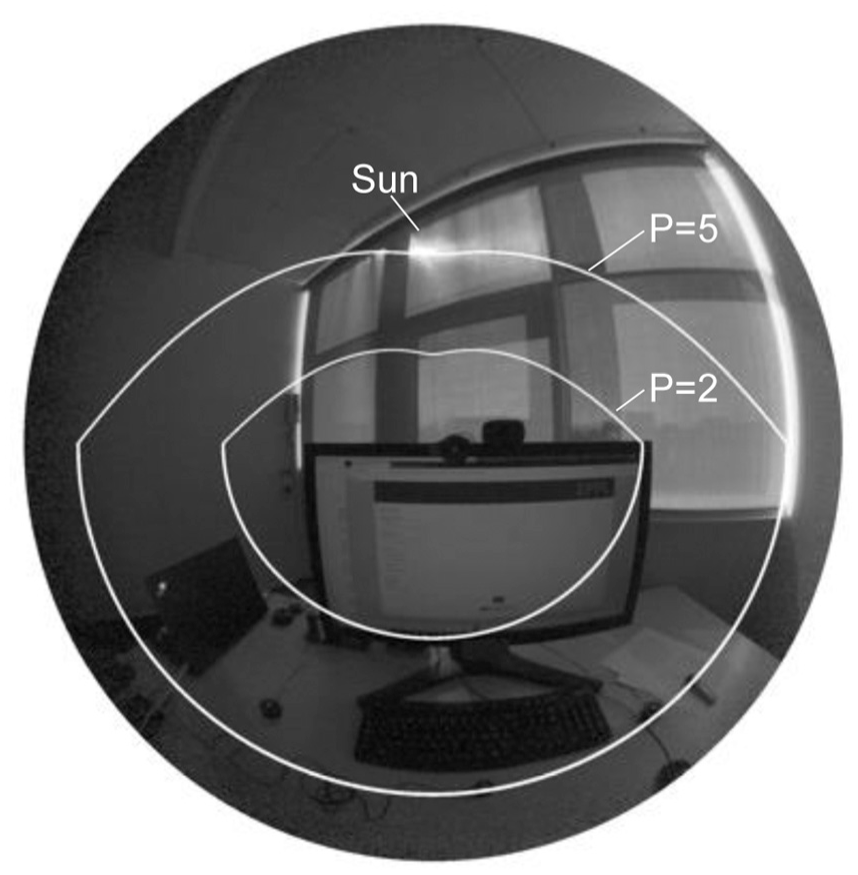
Superimposed isolines for position index values of 5 and 2 in a typical experimental setup used to evaluate fabric shading systems (here: pearl-coloured fabric with τvis,n-h = 0.12 and τvis,n-n = 0.03)
Overall, these five scenarios cover most realistic daylight glare scenarios that could occur in real environments and are summarized in Table 2.
Overview of the theoretical glare scenarios
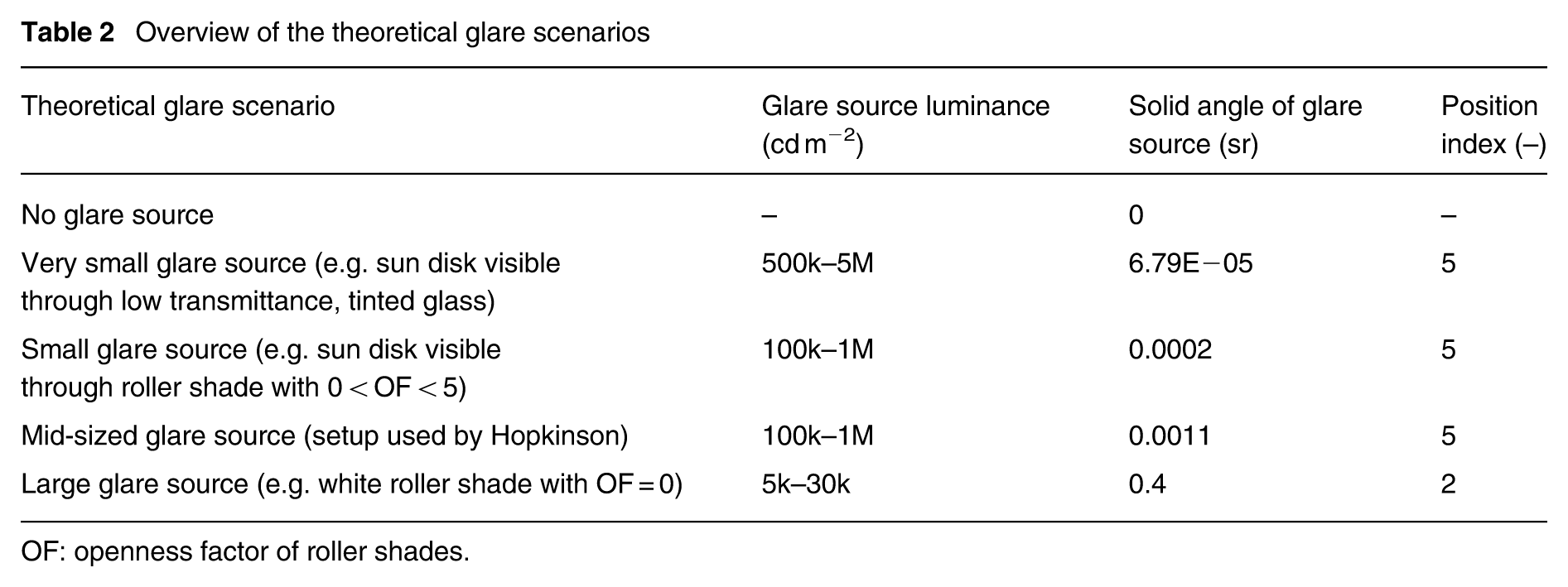
OF: openness factor of roller shades.
3.2 User assessment data
This study employs the cross-validation data analysis by Wienold et al. 26 to identify a vertical illuminance (Ev) threshold at eye level above which discomfort glare is likely to occur. The original cross-validation analysed a combined dataset of 1159 points from six countries (Argentina, Denmark, Germany, Israel, Japan and the United States) involving seven independent research groups. In that analysis, ordinal glare sensation votes were dichotomized into binary variables – for example, non-disturbing glare (imperceptible and noticeable) versus disturbing glare (disturbing or intolerable). These binary outcomes were evaluated using receiver operating characteristic (ROC) curve analysis, where the true positive rate (TPR, or sensitivity) is plotted against the true negative rate (TNR, or specificity) across thresholds of the analysed glare metrics (see Figure 2). TPR represents the correct prediction rate for disturbing glare, while TNR indicates the correct prediction rate for non-disturbing or no glare. The same method was applied to a second binary classification distinguishing no glare from noticeable (or stronger) glare. While several glare metrics were analysed in the cross-validation study, we assess in this study the vertical illuminance (Ev) only.
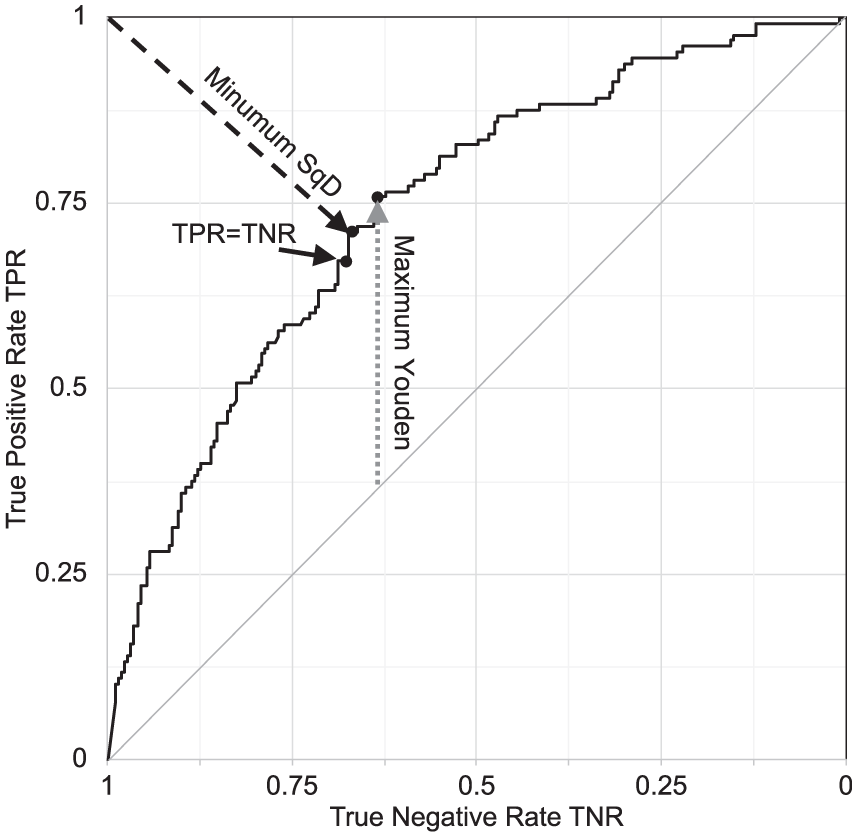
Methods for determining the optimal threshold from an ROC curve: minimizing the SqD to the upper-left corner, maximizing the Youden index and locating the point where the TPR equals the TNR. The average value derived from these three methods was used
Optimal threshold values were determined by averaging the results from three standard ROC threshold selection methods:
Minimizing the squared distance (SqD) from the ROC curve to the upper-left corner.
Maximizing the Youden index.
Identifying the point on the curve where TPR equals TNR.
Using 2000 bootstrap iterations, optimal thresholds for the vertical illuminance Ev were calculated for two primary classifications: between imperceptible and noticeable (BIN) glare and between noticeable and disturbing (BND) glare.
Through the design of this study that included a large range of glare stimuli and the usage of ROC analysis, range effects influencing the threshold determination were minimized.
A more detailed description of the applied methods can be found in Wienold et al., 26 as well as in the related correspondence. 29
3.3 Simulation study
For the simulation of typical shadings, we modelled a south-facing, multi-user office with two or more occupants (Figure 3). The primary occupants, whose behaviour is considered for the control algorithm, were positioned 1 m from the façade, while the analysis also accounted for potential occupants seated further back into the room, at distances of 2 m, 3 m and 4 m. We investigated three typical viewing directions: (i) parallel to the window (labelled as 0°); (ii) 45° towards the façade (labelled as 45°) and (iii) perpendicular to the façade (labelled as 90°). The simulations were conducted for three European climate zones – Central (Frankfurt), Northern (Stockholm) and Southern (Rome) – to capture varied environmental conditions, using climate files retrieved from https://climate.onebuilding.org/. Room visible reflectance values were assumed to be purely diffuse and assigned typical values (0.2/0.5/0.7 for floor, walls and ceilings, respectively). Two sensors were placed on each desk (0.75 m above the finished floor), with positions illustrated in Figure 3 to detect direct sunlight, plus a vertical sensor at the eye level (1.2 m above the finished floor) of each primary occupant (with 1 m distance from the facade). The glass-to-wall ratio for the geometry is 0.55, while the glass-to-floor ratio is 0.25.
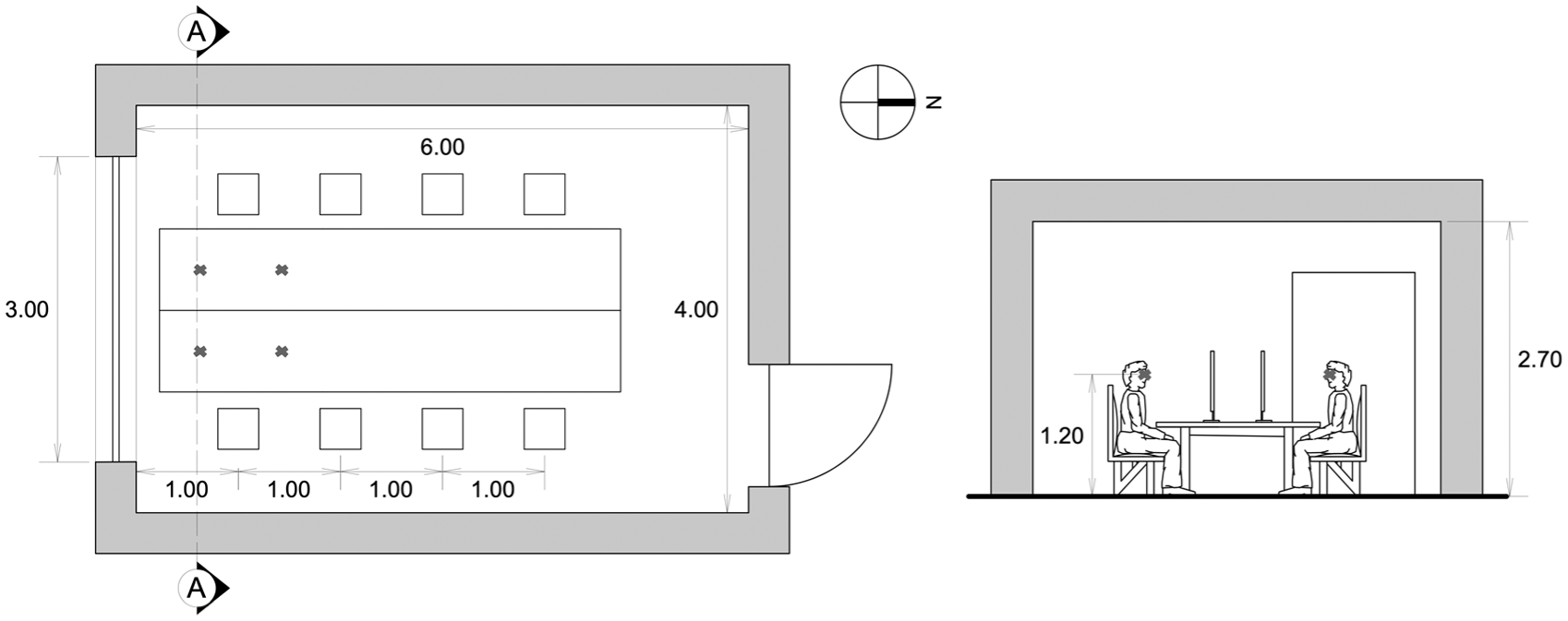
Office floor plan (left) and section (right)
We evaluated three façade systems (see Figure 4):
A double-pane low-e glass with an exterior-mounted black roller shade.
A double-pane solar control glass with an interior-mounted pearl roller shade.
A double-pane EC glazing.
The basic assumption for calculating the melanopic EDI in this study is that only the glazing is changing the relative spectral distribution, while the fabric roller blinds and all internal surfaces are considered as colour-neutral. Although a wide range of colour options for shadings and particularly for fabrics is available, colour-neutral choices are most commonly selected by architects and building owners. These are therefore the most frequently applied colours, not only for aesthetic reasons but also to achieve high colour rendition in the space. With this ‘colour-neutral’ assumption, the melanopic EDI can be easily obtained through the multiplication of the photopic vertical illuminance with the melanopic daylight efficacy ratio (mel-DER) of the glazing. For the EC glazing, separate illuminance calculations are performed for each glazing unit, and the results are added, while the other unit(s) are simulated as opaque but with the same reflectance properties as the active unit(s). This simplification implies that any potential spectral shifts caused by shading fabrics or reflections from exterior or interior surfaces are disregarded.
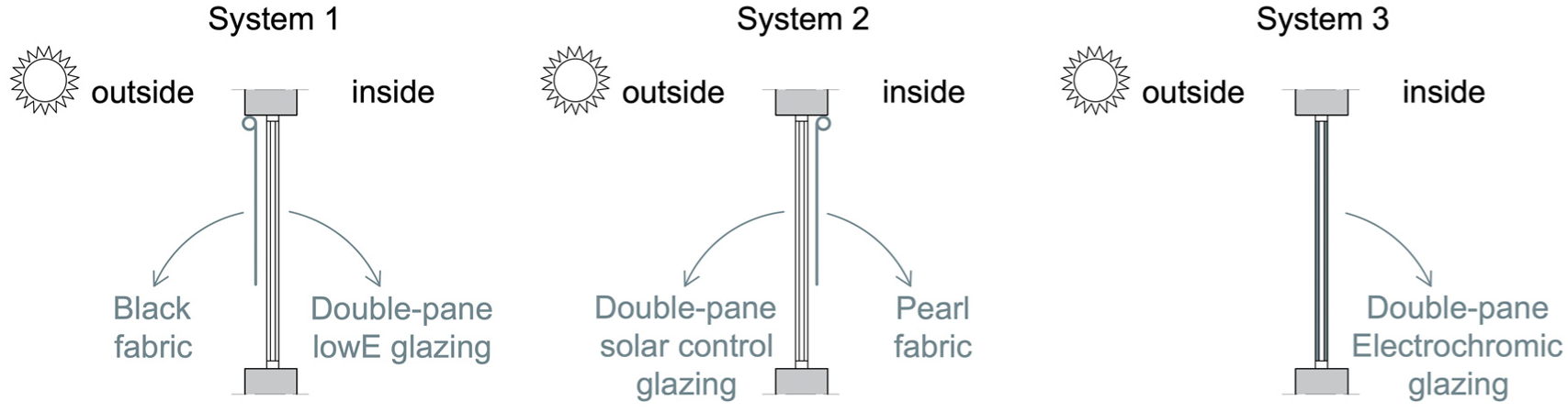
Facade systems evaluated
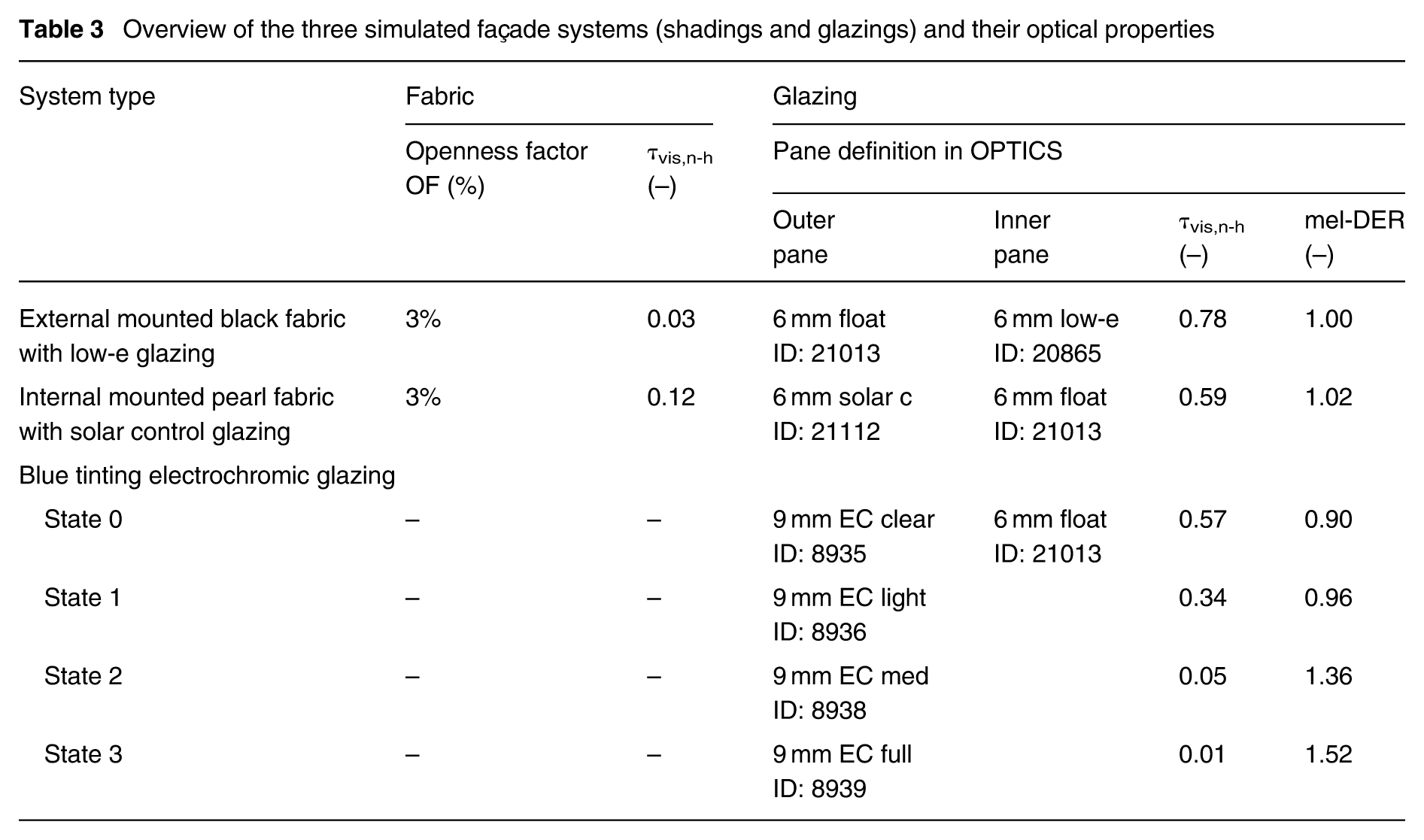
To accurately determine the mel-DER for each glazing type, they were first modelled in the WINDOW and OPTICS software from the Lawrence Berkeley National Laboratory (Berkeley, California, US). The spectral output was subsequently integrated into an Excel computation tool designed to determine the colorimetric and photobiological properties of light transmitted through glass and other optical materials. 30 This tool provides a final report where the information regarding the mel-DER is represented. The layers used in OPTICS and the resulting optical, photopic and melanopic properties of the three systems are summarized in Table 3. Overall, the mathematical product of (photopic) transmittance and the mel-DER of the different glazing types can serve as an indication of the fraction of photobiological effective light passing through the glass.
Overview of the three simulated façade systems (shadings and glazings) and their optical properties
The angular transmittance of fabric shadings was modelled with an isotropic model, 31 that was developed based on measured data. The normal–normal transmittance τvis,n-n of the fabric, needed as input to the model, was assumed to be equal to the openness factor (OF).
To limit the simulation effort, we discretized the height of the fabric into quarter-step increments. For the EC glazing, we assumed two controllable panes in a stacked configuration. Both options are illustrated in Figure 5.
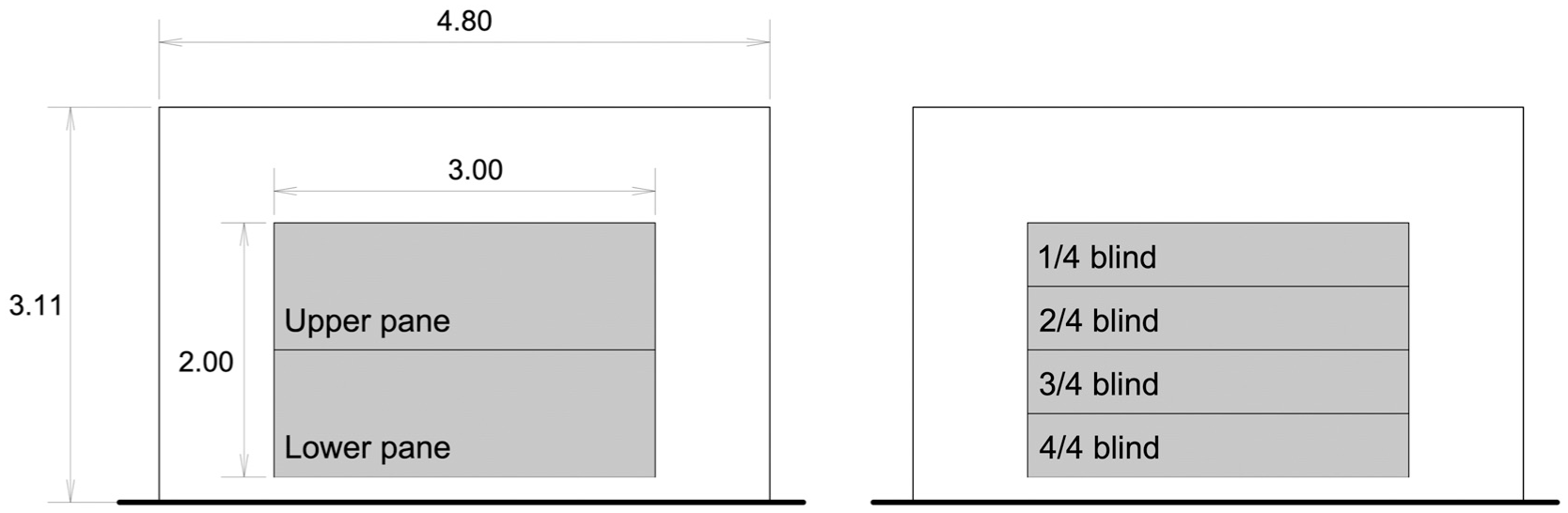
Elevations with EC glazing (left) and with fabric (right)
We evaluated three shading activation algorithms:
(1) Never activated: Fabrics always completely up and both EC-panes always in state 0.
(2) Always completely activated: Fabrics always completely down and both EC-panes always in state 3.
(3) Manual control of an active, aware user with an additional typical automated overheating-summer control that is offered by most shading manufacturers. For the user interaction with the shading, we assume the occupant behaviour as in this manner: as soon as the sun is visible and DGP is larger than 0.35, then the shading will be activated to a height/state so that the DGP value stays lower than 0.35 providing glare protection to the user. In addition, in case of high sun intensity at the façade (>450 W m−2) and the desk is hit by the direct sunlight, the blinds are lowered even more to avoid a high contrast between desk and visual task (e.g. computer screen). This simulates a disturbing reflection on the desk triggering a shading interaction. A similar control is applied to EC, however, by considering only direct sun on eye level and desk without DGP calculation in the control process. Summer overheating control was applied to external black fabric + low-e glazing (system 1) and EC glazing (system 3) only. In system 1, this control is activated when the running weekly outdoor temperature is higher than 17°C and the irradiance at the façade is larger than 150 W m−2. If these conditions happened, then the fabric is lowered to three-fourths of the height. In system 3, the EC switched to either state 1 or 2 for the lower pane and states 1, 2 and 3 for the upper pane based on specified thresholds for weekly outdoor temperature (ranging between 17°C and 20°C), and for the façade irradiance (ranging between 150 W m−2, 250 W m−2 and 450 W m−2). More details can be found in Sabeti et al. 32
To calculate the 95th percentile of DGP and the vertical (photopic) illuminance, we used Raytraverse,33,34 a RADIANCE-based simulation environment optimized for hourly based annual daylight glare simulations.
For the annual evaluation, we calculated two key metrics:
(1) the 95th percentile DGP.
(2) melanopic DA (‘melanopic daylight autonomy’, mel-DA) that we define as the percentage of daylight usage hours during where the melanopic EDI exceeds 250 lx at eye level. 7 We also defined daylight usage hours as the hours between 8.00 AM and 6.00 PM local time that also falls within natural daylight hours, that is, between local sunrise and sunset, while; weekends were excluded. The total number of usage daylight hours varies slightly across climates due to differences in sun-up durations, with the following annual totals: Frankfurt – 2529 h; Stockholm – 2401 h and Rome – 2595 h.
4. Results
4.1 Theoretical analysis
The results of the theoretical analysis are presented in Figures 6 to 8. In the scenario without a glare source (Figure 6), a DGP value of 0.35 – representing the borderline BIN – is reached at 3236 lx, while a DGP value of 0.4 (borderline BND) is reached at 4088 lx.
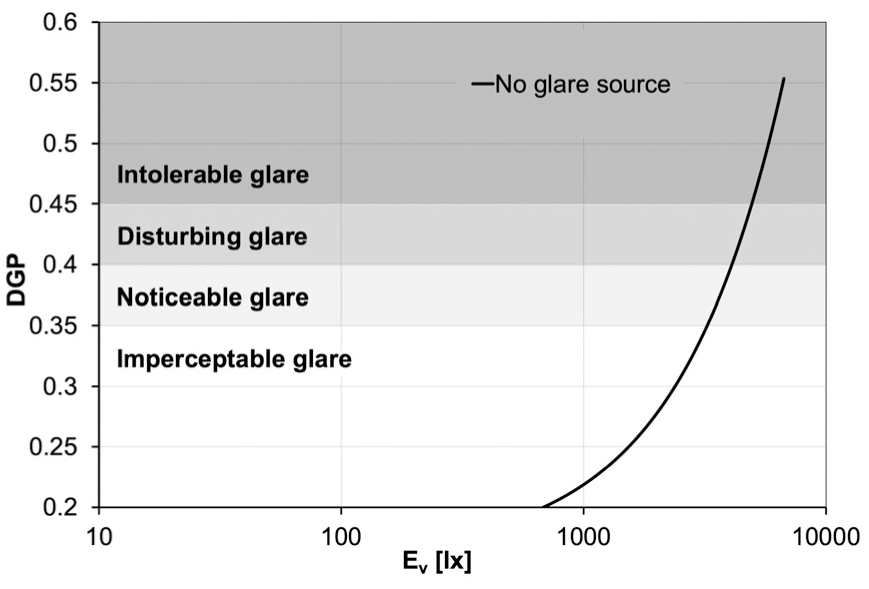
Theoretical DGP as function of Ev without glare source. Background grey shading indicates glare level categories according to EN17037
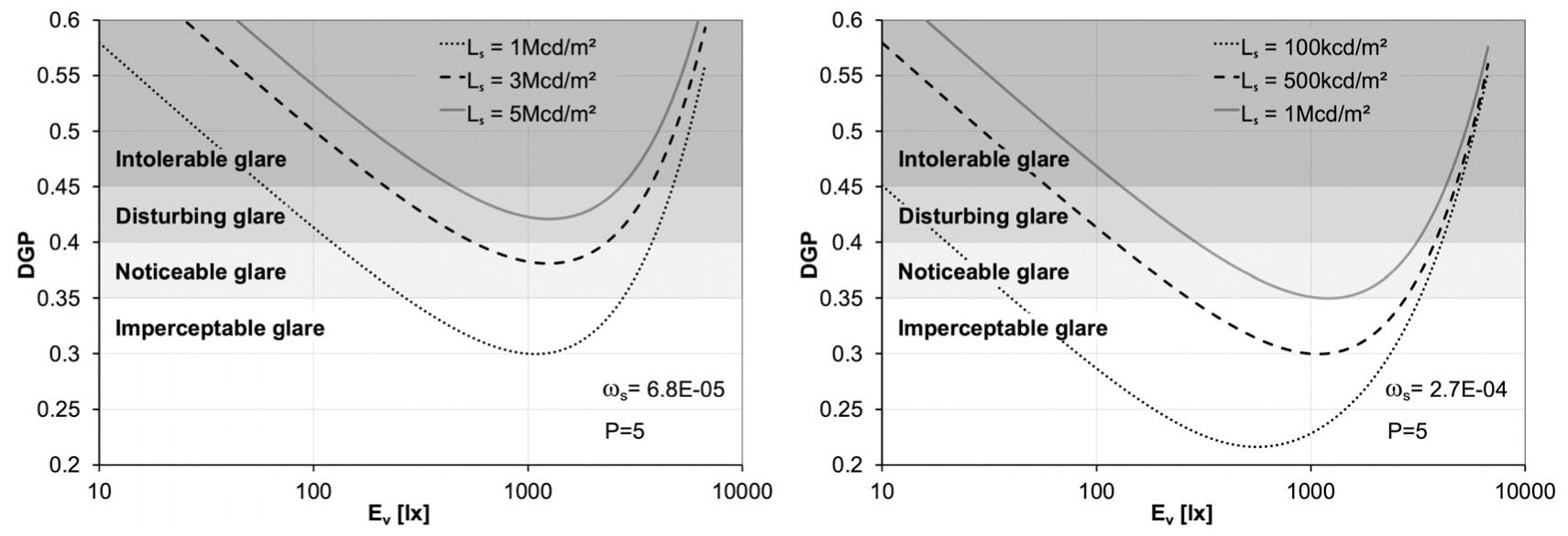
Theoretical DGP as function of Ev for mid- and large-sized glare sources (left: sun disk seen through glass without scattering; right: sun disk seen through fabric shade with slight scattering). Background grey shading indicates glare level categories according to EN17037
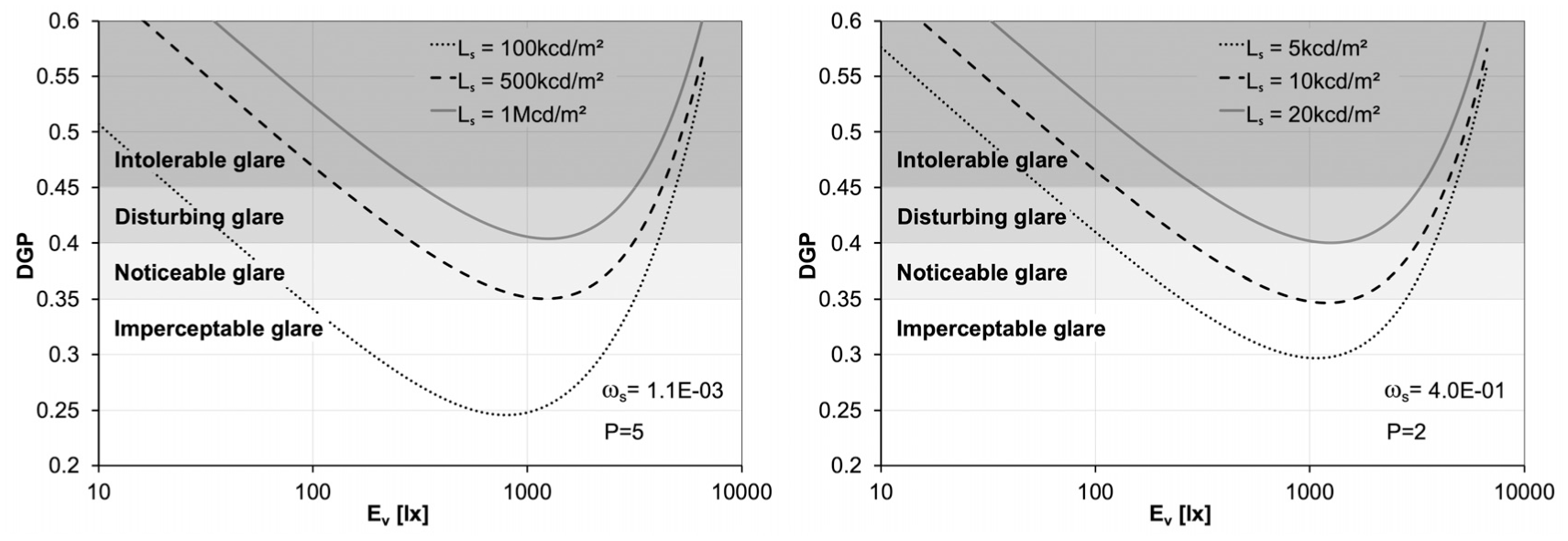
Theoretical DGP as function of Ev for small glare sources (left: glare source size used by Hopkinson; right: large-sized glare source, e.g. translucent white fabric shade). Background grey shading indicates glare level categories according to EN17037
In all scenarios with a glare source – independently of its size – increasing the vertical illuminance up to approximately 700 lx to 1000 lx reduces the DGP and therefore the glare perception. For Ev values beyond 1000 lx, glare begins to increase slightly. A more pronounced increase in glare is observed only beyond 2000 lx where the amount-of-light effect becomes increasingly dominant. This global minimum of glare is clearly visible in Figures 7 and 8.
This result is generally expected, as contrast plays a dominant role in glare perception within the low Ev range. An increase in Ev results in a higher adaptation level which, for a given glare source, results in a lower glare perception. It is only beyond 2000 lx that the amount-of-light effect becomes the more dominant factor.
This means in return that for Ev levels below 2000 lx, the magnitude of perceived glare depends mainly on the ability to reduce the sun-disk luminance and not on the illuminance level itself. Practically, this means that in the sun direction, the transmittance should be as low as possible, but the total light transmittance can, or should, be high enough that roughly 1000 lx at the eye level is reached. Even 2500 lx are not problematic in terms of glare if the sun disk is not or only slightly visible (≤500 kcd m−2), as long as the forward-scattering of the shading does not cause a ‘large’ glare source (ω ≤ 0.003).
4.2 User assessments
The ROC analysis of the cross-validation study determined the following Ev thresholds: 2484 lx for the borderline BIN, and 3359 lx for the borderline BND. These results were obtained in experiments with real-world shading devices in realistic settings, which included situations with glare sources. This explains their lower values compared to those derived from the theoretical analysis omitting glare sources.
As most shading devices in the cross-validation study effectively reduced the visibility of the sun disk, these empirical values also confirm the finding of the theoretical analysis: that illuminance levels at the eye up to 2500 lx are per se not problematic in terms of glare.
4.3 Simulation study
This section presents results quantifying the impact of the various shading devices analysed in the study and their operation on achieving through daylight the CIE-recommended threshold for melanopic EDI at eye level during standard working hours (08.00 to 18.00), considering only hours when daylight is present. The analysis focuses on the frequency of sufficient circadian light exposure, given that glare protection is an integral component of the control strategy. The tested shading systems were selected to provide a reasonable degree of glare protection – corresponding to classes 3 and 1 according to standard EN 14501 – for a viewing direction parallel to the façade (0°). It is acknowledged that for more façade-facing orientations (e.g. 45° or 90°), fabrics with lower OFs or a higher protection class may be required to achieve comparable glare control.
4.3.1 Influence of climate
The proportion of daylight-usage hours achieving the CIE-recommended melanopic EDI of 250 lx (mel-DA) is presented in Figure 9 as a function of room depth for the three climates and façade configurations, each assessed with either a permanently deactivated or a permanently activated shading function. These two extreme shading configurations allow the influence of the climate to be evaluated, as a control of the blinds will always lie between these two extreme conditions.
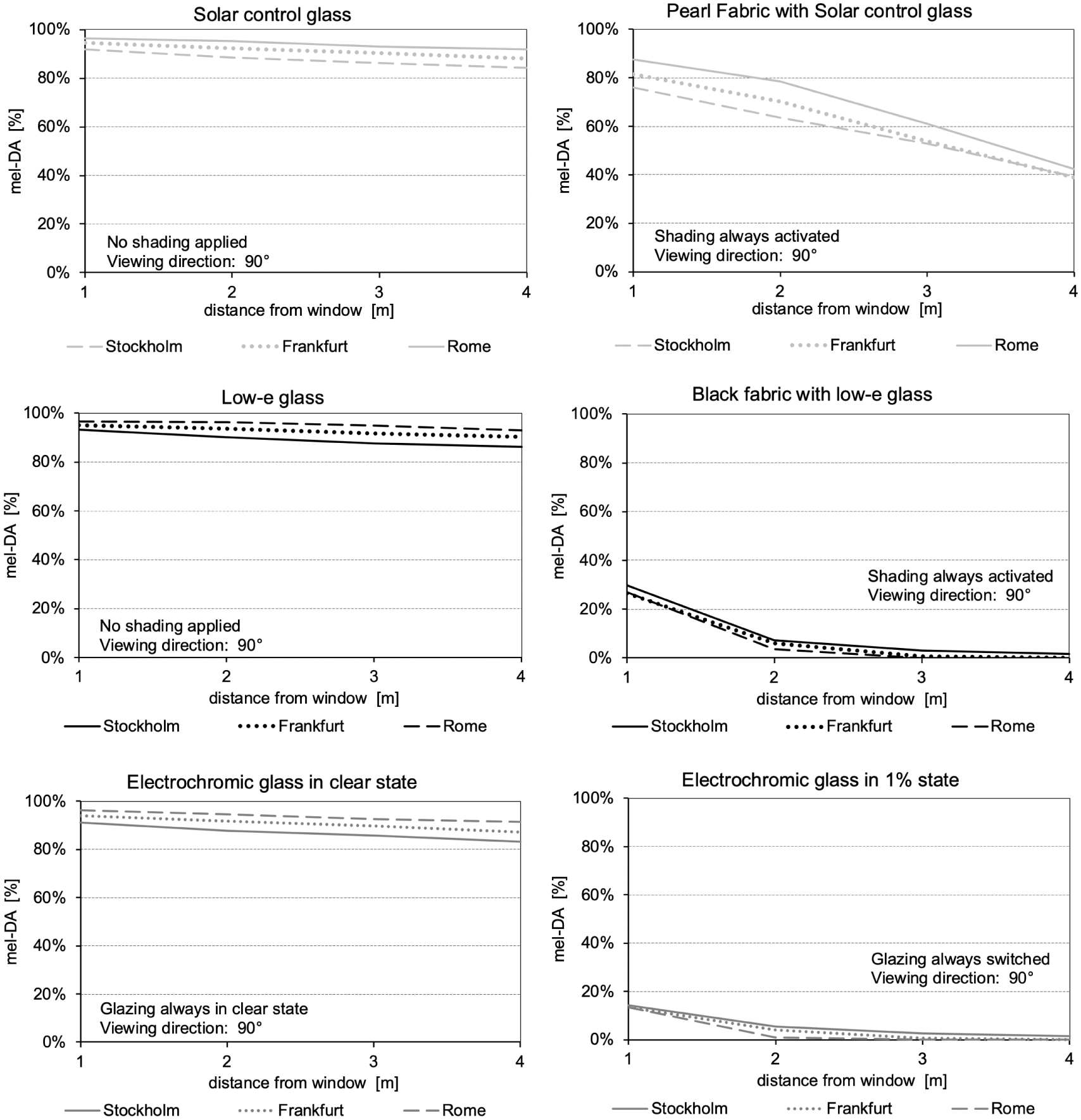
mel-DA for different climates as function of room depth for the three investigated façade systems. Left column: No shading activated; EC-glass in clear state. Right column: Shading always activated; EC, always in 1% state
When the shading is deactivated (left column of Figure 9), daylight availability remains high. At a 90° viewing orientation facing the façade, mel-DA levels exceed 85% even at a distance of 4 m from the window.
Conversely, activating the shading system substantially reduces the availability of daylight, an effect that intensifies with greater room depth (see right column of Figure 9). Under permanent full shading, the transmittance properties of the shading device itself become the dominant factor in how often the melanopic EDI recommendation is met. This is evident when comparing the results of the year-round fully activated pearl fabric facade to the other two options: even at a 3-m distance, the melanopic EDI illuminance of 250 lx is exceeded for more than 50% of daylight usage hours, while the other two options meet that recommendation for less than 10% of the time already at a 2-m distance.
From this result, it is evident that shadings with a lighter colour which are capable of scattering and/or redirecting light are more fail-safe regarding potential user error as they still provide in the closed states a significant amount of daylight to support non-visual effects.
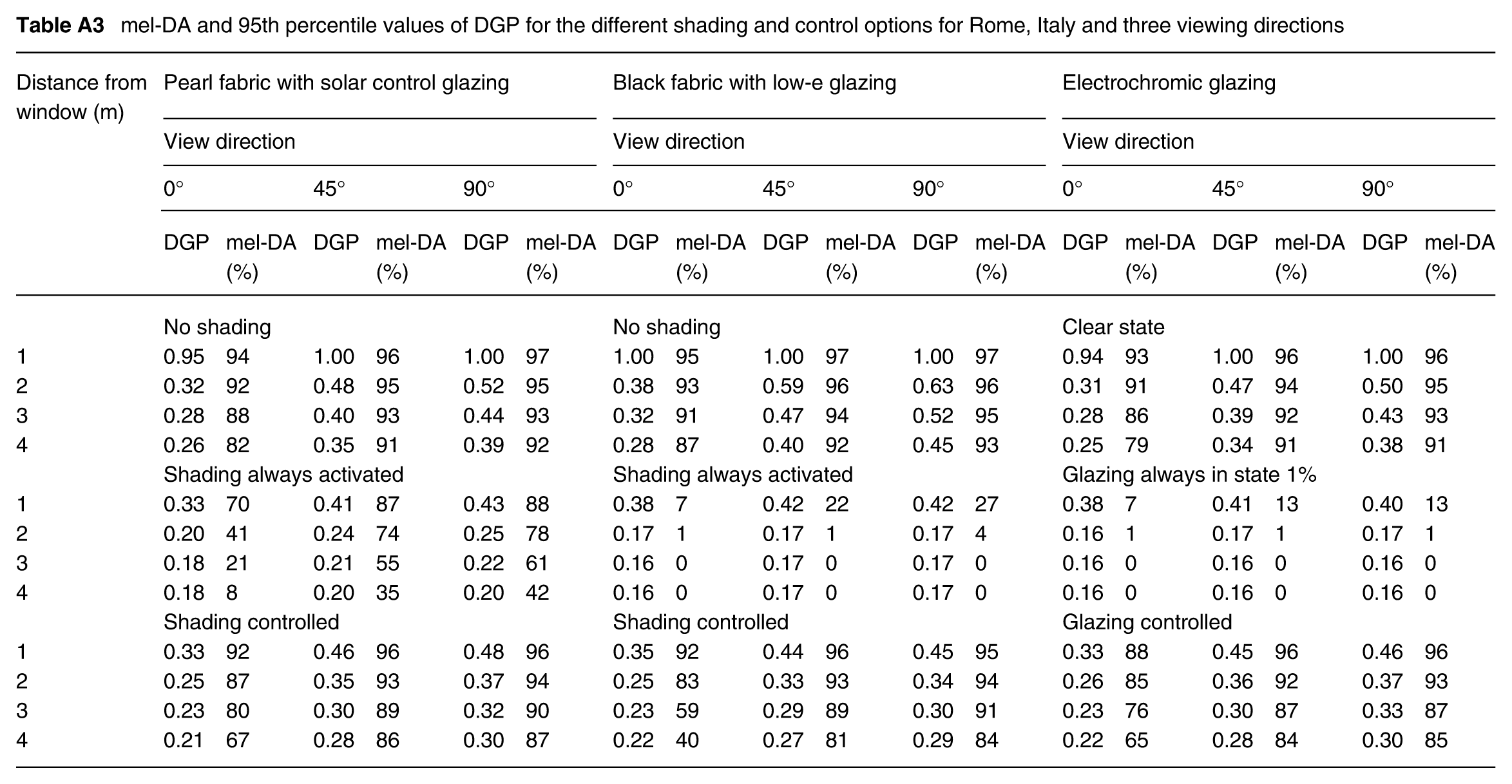
Under these two extreme shading conditions, variations among climates and glazing types were minimal, leading to a subsequent focus on the representative Frankfurt climate for in-depth analysis. However, the mel-DA and 95th percentile DGP values for all facade options and shading controls are reported in Table A1 for Frankfurt, Germany, in Table A2 for Stockholm, Sweden and in Table A3 for Rome, Italy.
4.3.2 Influence of shading and its usage
The impact of a shading control strategy – applying automatic overheating protection in summer with a year-round glare-based manual override (detailed in Section 3.3) – on mel-DA is presented in Figures 10 to 12. The analysis considers two occupant viewing directions. The first is the standard parallel direction (0°), which represents the recommended orientation for typical desk-based work and was the basis for the glare criteria for the shading control. The second is a 45° viewing direction towards the window, acknowledging that occupants in such a seating arrangement frequently turn to look outside.
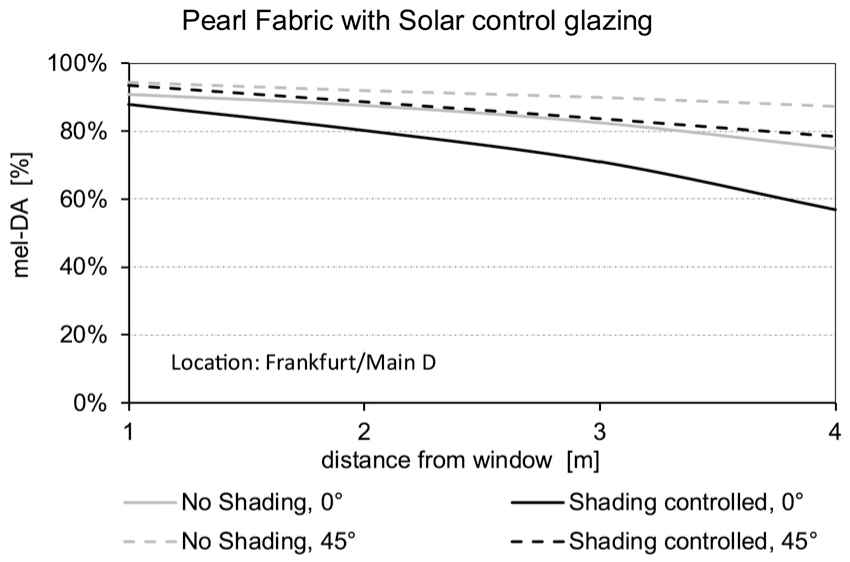
Influence of the usage of a pearl fabric shading device on the mel-DA for parallel and 45° façade-facing viewing direction. For comparison, the mel-DA is also shown when no shading is used at all
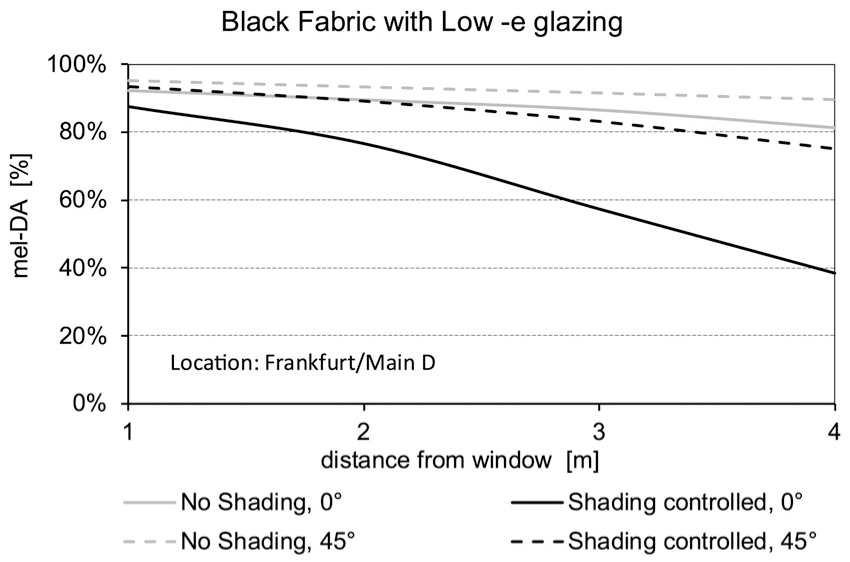
Influence of the usage of a black fabric shading device on the mel-DA for parallel and 45° façade-facing viewing direction. For comparison, the mel-DA is also shown when no shading is used at all
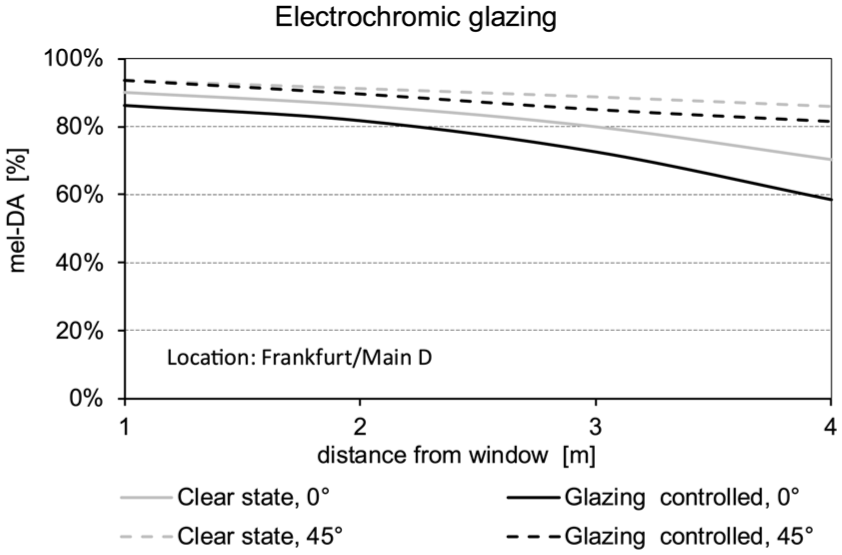
Influence of the usage of a EC glazing system on the mel-DA for parallel and 45° façade-facing viewing direction. For comparison, the mel-DA is also shown when the glazing is in clear state throughout the year
The results show that up to 2 m distance, even for the conservative assumption of constant parallel viewing direction (0°), mel-DA stays above 80% of the daylight usage time for all investigated shadings that include also a black fabric that, in general, does not support daylight provision.
The results also demonstrate that the reduction in mel-DA due to the control algorithm is less pronounced for the 45° viewing direction even for deeper room distances. For instance, at a 3 m room depth, mel-DA for the pearl fabric façade decreases from 90% (shading never active) to 84% (with control). For the other two shading options the reduction in mel-DA is even lesser. In contrast, the standard parallel (0°) viewing direction shows a more significant sensitivity to control and fabric type. For the black fabric, mel-DA at 3 m drops substantially from 87% to 57%. The reduction is moderate for the pearl fabric (from 82% to 71%) and the EC glazing solution (from 80% to 73%) under the same conditions.
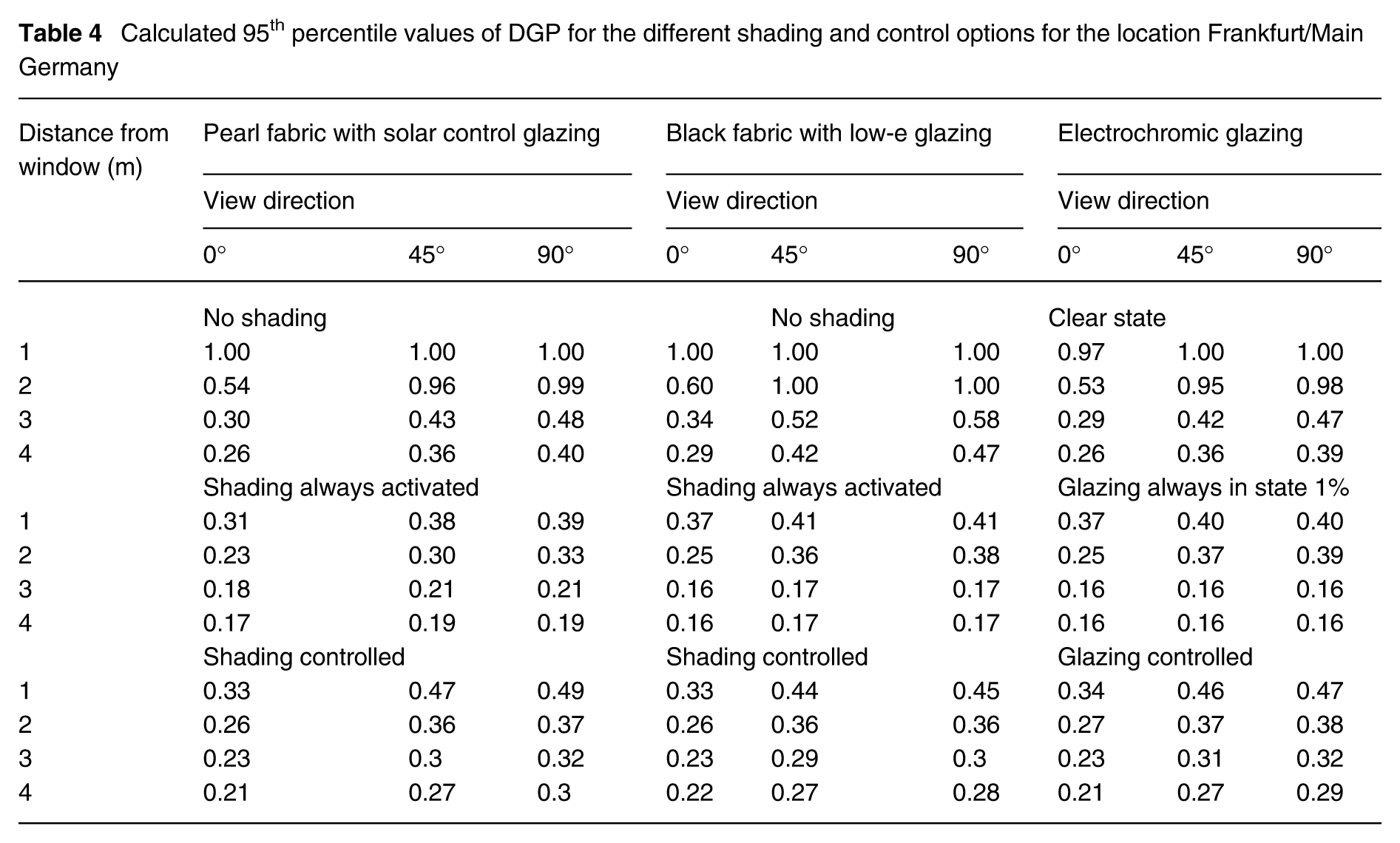
Complementary annual glare analysis is summarized in Table 4, which presents the 95th percentile values of the DGP for the Frankfurt climate. As anticipated, without any shading, glare levels are problematic for positions up to 3 m from the façade. The results with active shading confirm that both the selection of shading materials and the simulated user-behaviour control maintain DGP values below the 0.35 threshold for the parallel (0°) viewing direction (Table 4).
Calculated 95th percentile values of DGP for the different shading and control options for the location Frankfurt/Main Germany
5. Discussion
The findings from the theoretical and the user assessment studies indicate that there is roughly one order of magnitude between the recommended melanopic level and the illuminance level where glare starts to become a problem. This allows substantial freedom in the choice of shading systems and their controls, which can be strategically leveraged by façade designers.
The results of the simulation study indicate that the evaluated shading strategy provide effective glare protection independent of the three investigated climates, thereby validating the selection of systems analysed. Furthermore, the findings demonstrate that, when an appropriate control strategy is applied, the annual frequency at which the recommended melanopic EDI threshold of 250 lx is achieved is only slightly reduced for seating positions close to the façade (up to 2 m) compared to scenarios where shading devices are not activated. This outcome is consistent across the shading solutions investigated.
For deeper room layouts with multiple users, the situation becomes more complex. When shading closure is triggered by an occupant near the façade, daylight penetration into positions 3 m and deeper from the façade depends strongly on the material properties and shading type. In this context, darker-coloured fabrics are not beneficial for daylight penetration and, consequently, for non-visual effects in the deeper areas of a room. The potential advantage of a better view-through is minimal, as the OF typically must be kept below 3% to achieve reasonable glare protection. Therefore, lighter-coloured materials that scatter and redirect the incoming light generally offer a better overall benefit, especially if obstructions block the direct access to the sky for deeper room positions. For instance, fabric shadings with higher diffuse transmittance, such as the tested pearl fabric, can still provide the recommended melanopic EDI for over 70% of daylight hours. Lighter-coloured fabrics do not necessarily cause more glare and the existing classification in EN14501 overrates the glare risk for such fabrics. 35 Similar mel-DA values are achieved through EC glazing for cases where obstructions do not block the sky for deeper room positions. These outcomes consider that users, even in a parallel seating position, frequently look towards the window, especially when seated further away from the facade. Venetian blinds with lighter colours could be expected to provide even higher light levels in such deeper spaces. Comparing the mel-DA values for silver-coloured venetian blinds (ρ = 0.55, not fully light-coloured) calculated for another study that will be published later confirms this assumption for a parallel view (in Frankfurt climate): at 3 m and 4 m depth, the mel-DA is higher than for the other shading options evaluated in this study (see Table 5).
Comparison of mel-DA values for the parallel viewing direction (0°) in Frankfurt/Main Germany
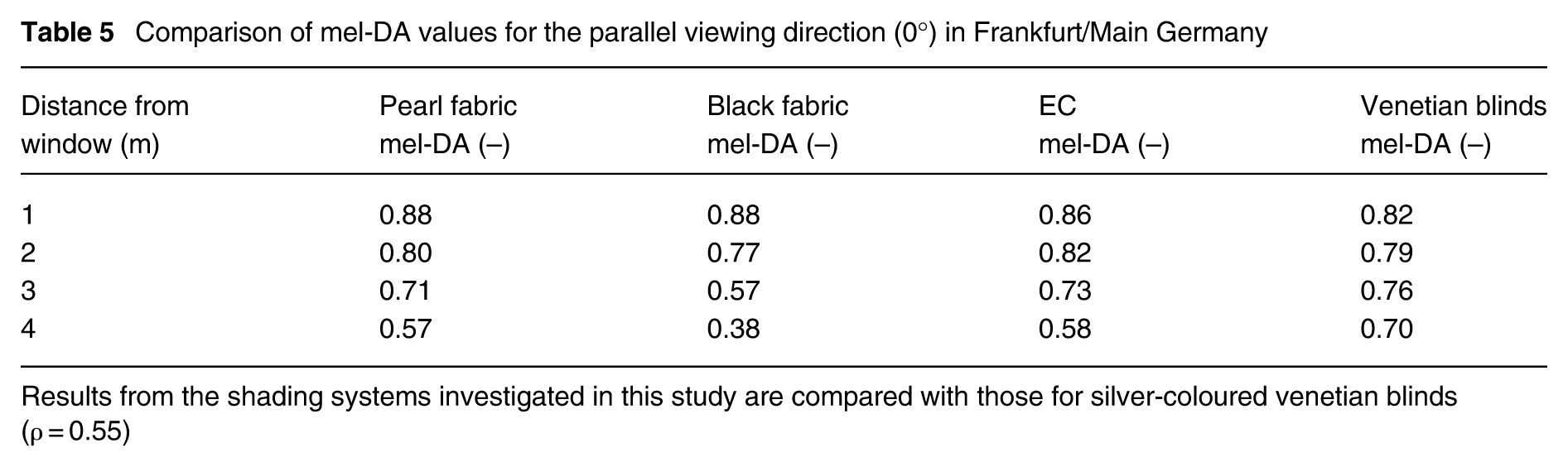
Results from the shading systems investigated in this study are compared with those for silver-coloured venetian blinds (ρ = 0.55)
Moreover, the main viewing direction of the users of a space can additionally influence both the choice of shading material and how it is operated by the user. As our control was based on a user sitting in 1-m distance to the façade in parallel viewing direction, higher glare values occur, as expected, for viewing directions facing the façade, which is not a recommended viewing direction. For deeper room positions, viewing directions slightly towards the façade might be beneficial to improve the light levels at the eye – but the contrast between working task and average façade luminance has to be considered to avoid extremes.
Another noteworthy – although expected – result is that shading systems maintained in a fully deployed state throughout the year do not offer superior glare protection compared to systems that are only partially deployed to selectively block direct sunlight. This phenomenon can be attributed to the behaviour of the DGP metric, which exhibits a negative gradient in the range of vertical illuminance levels below 1000 lx. In these cases, the increasing adaptation level reduces the perceptual contrast between the solar disk and the visual tasks, thus reducing perceived glare.
Overall, the results suggest that glare protection systems do not inherently compromise the provision of healthy daylight levels, quantified through mel-DA.
6. Limitations
A limitation of the present study is that it does not address the specific challenges associated with very deep open-plan office layouts and deep building geometries. In such configurations, which are particularly common in North America, workstations located near the façade often trigger the deployment of shading devices to mitigate glare. However, this activation of the shadings typically reduces the amount of daylight that penetrates into the deeper zones of the interior space. As a result, areas further away from the windows may receive insufficient daylight, potentially preventing the attainment of recommended illuminance levels for visual comfort and health: electric lighting with good melanopic performance is needed in these areas to reach the melanopic EDI recommended values.
Moreover, the scope of the simulation study was limited to a single office geometry without obstructions, a fixed façade orientation and viewing direction and three European climate zones. Although the analysis incorporated two widely used shading systems – fabric roller shades and EC glazing – paired with standard control strategies, other shading technologies, such as venetian blinds, and alternative control algorithms were not included. As obstructions limit the sky visibility, especially for deeper room position, it can be expected that non-redirecting shading solutions as the black fabric or EC glazing will be outperformed by light-coloured fabrics or venetian blinds. Nonetheless, the selected configurations are considered broadly representative of a wide range of real-world conditions.
This study applied a standard overheating protection control to all shading solutions but did not assess its specific effectiveness. That analysis is reserved for a complementary, forthcoming publication.
While the chosen assumptions and boundaries provide a robust foundation for the study, expanding the analysis to include a broader range of spatial layouts, climatic contexts, façade orientations, façade systems and controls would strengthen the generalizability of the findings. Nevertheless, based on the underlying principles of visual adaptation and daylight dynamics, no fundamental deviation from the observed results is expected.
7. Conclusions and outlook
The findings from both the theoretical analysis and user assessments suggest that achieving a melanopic EDI of 250 lx at eye level does not inherently increase glare risk. In fact, the results indicate the opposite: as daylight vertical (photopic) illuminance increases – up to approximately 1000 lx – potential glare is actually reduced, primarily due to higher levels of visual adaptation, which diminish the perceived contrast of the solar disk.
The simulation study further supports this conclusion by demonstrating that the use of conventional shading devices, when applied thoughtfully, does not substantially reduce the duration during which melanopic EDI exceeds the 250 lx threshold for user position close to the façade (up to 2 m in our geometry).
For multi-user spaces and deeper room positions, an optimal solution considering both glare protection and providing daylight levels at the eye above recommendation levels becomes more challenging and does indeed require more advanced lighting design. In such cases, shading solutions with higher diffuse transmittance – such as light-coloured fabrics or venetian blinds – appear beneficial for supporting non-visual effects and are potentially more fail-safe regarding user errors in shading operation.
In summary, our results indicate that there is no fundamental conflict between designing for biologically effective daylight and managing visual comfort with respect to glare. With appropriate choice of the shading solutions and daylight control strategies, it is possible to support both health-related lighting goals and visual well-being.
Future work will expand this analysis to include a detailed evaluation of thermal performance and also broadening the scope of the investigated systems to also encompass venetian blinds.
Footnotes
Appendix A
mel-DA and 95th percentile values of DGP for the different shading and control options for Rome, Italy and three viewing directions
| Distance from window (m) | Pearl fabric with solar control glazing | Black fabric with low-e glazing | Electrochromic glazing | |||||||||||||||
|---|---|---|---|---|---|---|---|---|---|---|---|---|---|---|---|---|---|---|
| View direction | View direction | View direction | ||||||||||||||||
| 0° | 45° | 90° | 0° | 45° | 90° | 0° | 45° | 90° | ||||||||||
| DGP | mel-DA (%) | DGP | mel-DA (%) | DGP | mel-DA (%) | DGP | mel-DA (%) | DGP | mel-DA (%) | DGP | mel-DA (%) | DGP | mel-DA (%) | DGP | mel-DA (%) | DGP | mel-DA (%) | |
| No shading | No shading | Clear state | ||||||||||||||||
| 1 | 0.95 | 94 | 1.00 | 96 | 1.00 | 97 | 1.00 | 95 | 1.00 | 97 | 1.00 | 97 | 0.94 | 93 | 1.00 | 96 | 1.00 | 96 |
| 2 | 0.32 | 92 | 0.48 | 95 | 0.52 | 95 | 0.38 | 93 | 0.59 | 96 | 0.63 | 96 | 0.31 | 91 | 0.47 | 94 | 0.50 | 95 |
| 3 | 0.28 | 88 | 0.40 | 93 | 0.44 | 93 | 0.32 | 91 | 0.47 | 94 | 0.52 | 95 | 0.28 | 86 | 0.39 | 92 | 0.43 | 93 |
| 4 | 0.26 | 82 | 0.35 | 91 | 0.39 | 92 | 0.28 | 87 | 0.40 | 92 | 0.45 | 93 | 0.25 | 79 | 0.34 | 91 | 0.38 | 91 |
| Shading always activated | Shading always activated | Glazing always in state 1% | ||||||||||||||||
| 1 | 0.33 | 70 | 0.41 | 87 | 0.43 | 88 | 0.38 | 7 | 0.42 | 22 | 0.42 | 27 | 0.38 | 7 | 0.41 | 13 | 0.40 | 13 |
| 2 | 0.20 | 41 | 0.24 | 74 | 0.25 | 78 | 0.17 | 1 | 0.17 | 1 | 0.17 | 4 | 0.16 | 1 | 0.17 | 1 | 0.17 | 1 |
| 3 | 0.18 | 21 | 0.21 | 55 | 0.22 | 61 | 0.16 | 0 | 0.17 | 0 | 0.17 | 0 | 0.16 | 0 | 0.16 | 0 | 0.16 | 0 |
| 4 | 0.18 | 8 | 0.20 | 35 | 0.20 | 42 | 0.16 | 0 | 0.17 | 0 | 0.17 | 0 | 0.16 | 0 | 0.16 | 0 | 0.16 | 0 |
| Shading controlled | Shading controlled | Glazing controlled | ||||||||||||||||
| 1 | 0.33 | 92 | 0.46 | 96 | 0.48 | 96 | 0.35 | 92 | 0.44 | 96 | 0.45 | 95 | 0.33 | 88 | 0.45 | 96 | 0.46 | 96 |
| 2 | 0.25 | 87 | 0.35 | 93 | 0.37 | 94 | 0.25 | 83 | 0.33 | 93 | 0.34 | 94 | 0.26 | 85 | 0.36 | 92 | 0.37 | 93 |
| 3 | 0.23 | 80 | 0.30 | 89 | 0.32 | 90 | 0.23 | 59 | 0.29 | 89 | 0.30 | 91 | 0.23 | 76 | 0.30 | 87 | 0.33 | 87 |
| 4 | 0.21 | 67 | 0.28 | 86 | 0.30 | 87 | 0.22 | 40 | 0.27 | 81 | 0.29 | 84 | 0.22 | 65 | 0.28 | 84 | 0.30 | 85 |
Acknowledgements
A previous version of this paper was presented at the CIE 2025 Midterm Meeting Conference.
Declaration of conflicting interests
The authors declared no potential conflicts of interest with respect to the research, authorship, and/or publication of this article.
Funding
The authors disclosed receipt of the following financial support for the research, authorship, and/or publication of this article: This research was conducted within the framework of the SWICE consortium and was supported by the Swiss Federal Office of Energy (SFOE).
