







Abstract
Studies investigating the effects of coloured lighting on specific affective dimensions remain limited. Based on Russell’s circumplex model and Cacioppo’s evaluative space model, this empirical study investigates the psychological effects of six coloured lighting conditions – red, green, blue, yellow, cyan and magenta on affective dimensions of Pleasure, Activation, Negative affect and Positive affect. We analysed whether different coloured lighting leads to significant differences in affective outcomes, and whether Positive affect and Negative affect are independently, mutually or inversely elicited under coloured lighting exposure. A total of 351 valid responses were collected. Results indicated that under the six coloured lighting conditions, all four affective dimensions differed significantly, and Negative affect and Positive affect were independently elicited by coloured lighting. The findings suggest that the distribution captured by the Pleasure–Activation affective model directly reflects the overall effect of coloured lighting on individuals’ levels of pleasure or activation, whereas the Negative–Positive affective model may indicate the capacity of different coloured lighting to elicit positive or negative affective response. For instance, among the six lighting conditions, red lighting showed the highest activation level and the lowest pleasure level. Within the Negative–Positive affective model, red lighting also exhibited the highest level of Negative affect and the second-highest level of Positive affect.
1. Introduction
1.1 Light perception and affective responses
Light influences human functioning not only through vision but also through the non-visual pathways.1,2 Evidence to date suggests that light exposure can affect circadian timing and melatonin-related processes, modulate alertness, and may also be associated with mood and broader psychological functioning.3–5 Classical visual photoreception is mediated by rods and cones, which primarily support image formation. The discovery of intrinsically photosensitive retinal ganglion cells (ipRGCs) and their melanopsin content in 2002 revealed an additional retinal pathway involved in non-image-forming responses to light. 6 This finding established a functional distinction between visual and non-visual pathways of light perception. Melanopsin is the photopigment expressed in ipRGCs, with a peak spectral sensitivity at approximately 480 nm. 7 Melanopic equivalent daylight illuminance (melanopic EDI) is commonly used as an index of the effectiveness of a light stimulus for melanopsin stimulation and related non-visual responses. 8 Consequently, ipRGCs exhibit intrinsic photosensitivity and are capable of responding directly to light independently of rod and cone input. These cells project photic information to multiple non-image-forming visual centres, including the suprachiasmatic nucleus, the olivary pretectal nucleus and limbic-related brain regions involved in the regulation of emotional and cognitive states.9,10 Emerging evidence suggests that lighting chromaticity and spectral characteristics may be associated with human psychological responses11–13; however, the current evidence base remains limited and further research is needed, particularly in longitudinal and ecologically valid contexts.
In practice, the visible spectrum is commonly considered to span approximately from 380 nm to 780 nm. 14 Within this range, different wavelengths are perceived as different colours. 15 Unsaturated colours, such as pink or purple variants like magenta, are absent because they result from the combination of multiple wavelengths rather than a single one. The physiological and behavioural impacts of lighting environments vary with light intensity, exposure duration and time of day; moreover, spectral composition is another critical parameter in environmental lighting. 16
1.2 Emotional effect of coloured lighting
The colour of indoor lighting affects emotions, spatial impressions and preference-related behaviours.17–20 Together with the level of illumination, the colour of lighting could influence the emotion as part of the mental model.11,21,22 A substantial portion of existing studies examined the effect of lighting on emotion through the correlated colour temperature (CCT) of the light source.23–28 Wu and Wang reported that, in a restaurant context, low CCT warm white lighting (2700 K LED) emphasised pleasure more than high-CCT cool white lighting (5600 K LED), whereas the high-CCT condition elicited greater arousal than the low-CCT condition. 23 Similarly, Park and Farr found that in a retail environment, 5000 K was perceived as more arousing than 3000 K, while 3000 K was perceived as more pleasurable than 5000 K. 24
In addition to hue, some studies explored the effects of saturation and brightness on emotion.12,29–32 Wilms and Oberfeld reported, based on Self-Assessment Manikin (SAM) ratings via an LED display, that higher saturation and greater brightness are associated with higher arousal. For valence, the hue effect depends on saturation; achromatic colours generally yield lower valence than chromatic colours, and valence ratings are highest for colours that are highly saturated and bright. 12 Weijs et al., 29 using virtual reality, showed that under specific combinations of saturation and lightness, arousal was higher in red environments than in blue ones; when effects were considered independent of hue, lower lightness (darker) environments elicited higher arousal than medium-lightness environments.
For the measurement of positive and negative emotions, a substantial proportion of studies conceptualise them as two poles of a single dimension (pleasure–displeasure), for example, by using the valence dimension of the SAM.12,29 Li et al. 33 employed electroencephalography and the Pleasure–Arousal–Dominance (PAD) scale, providing empirical evidence that illuminance significantly influences valence. They indicated that specific combinations of light colour and illuminance can promote positive emotions, such as the combination of purple light at 20 lx. Zhou et al., 34 based on experiments involving participants with depressive tendencies, found that a lighting condition of 1500 lx at 6500 K was associated with a transient positive mood state, and that coloured light was more likely to trigger negative emotions than white light. Using the Check-All-That-Apply (CATA) and the Two-Dimensional Mood Scale (TDMS) questionnaires, Liu et al. 32 revealed that light sources with high saturation frequently led to negative moods, whereas under medium saturation, warm-coloured lights usually generated positive moods.
1.3 Inconsistencies and gaps in existing research
Although a growing body of evidence suggests that coloured lighting affects psychological and emotional states, the findings on its effects on human emotion remain inconsistent. Among various hues, evaluations of red lighting are relatively consistent, reporting that it is associated with emotional changes and high arousal.35–37 However, findings concerning blue and pink lighting remain inconclusive.35,36,38–40 Whereas Lee and Lee 36 found that blue lighting elicited higher pleasure, Xie et al. 35 and Han and Lee 56 reported that blue lighting showed an advantage with respect to dejection, depression and irritability. While Reithinger et al. 38 reported no differences between pink and white lighting in terms of emotional valence and arousal, Ortiz-García-Cervigón et al. 41 used an LED-based ambient illumination setup in which pink was operationalised as a hue-defined lighting condition hue = 330° in the hue, saturation and value (HSV) model generated by RGB LED strips and analysed as part of the warm-colour group. Within that setup, warm-coloured lighting, including pink, was perceived as more tense and less pleasant than cold-coloured lighting.
Among studies examining the psychological and physiological effects of coloured lighting, most have focused on red, blue and green light – particularly the former two.12,42–47 However, research exploring a broader range of colours remains limited. Litscher et al. 43 investigated the effects of red and blue lighting on heart rate and found that blue light stimulation significantly improved emotional state, as evidenced by a significant reduction in stress scores. D’Agostin et al. 44 reported that red lighting illumination enhanced sympathetic nervous system activity, whereas blue light did not produce the same effect. Compared to red light, blue light improved subjective discomfort ratings. Daytime exposure to red light increased autonomic arousal, indicating a shift in the balance between sympathetic and parasympathetic activity. Furthermore, Araujo et al. 45 showed that blue light activated the parasympathetic nervous system.
1.4 Present study
Given the lack of consensus regarding the emotional effects of certain coloured lighting conditions and the limited range of colour types examined in previous studies, further research is warranted. In the present study, we selected the debated hues, blue and magenta, together with the less-studied cyan and yellow, and included red and green so that the six lighting conditions comprised the three primaries and the three secondaries. All lights were set to high saturation at a matched illuminance level. Specific on-site measurement parameters are provided later. This study employed Russell’s circumplex model to evaluate categories of emotional affect. In the circumplex model, emotions are represented along the dimensions of pleasure and activation, collectively referred to as core affect.48–50 In addition, according to the evaluative space model, people’s evaluations of a target as ‘good’ or ‘bad’ are in fact independent. A target can simultaneously possess both good and bad attributes; in other words, Positive and Negative affect are two independent dimensions rather than opposite ends of a single continuum.51,52 Therefore, the observational items in this study were divided into two groups, each grounded in one of these theoretical frameworks, the circumplex model and the evaluative space model.
We hypothesise that the six colours of lighting will produce significantly different effects on the four emotional dimensions: Pleasure, Activation, Negative affect and Positive affect. Furthermore, we hypothesise that different coloured lighting conditions significantly influence the mutual activation, reciprocal inhibition or independent activation of Positive affect and Negative affect.
Lighting plays a fundamental role in enabling visual perception and shaping human perceptual and emotional experience in both indoor and outdoor environments. Coloured lighting, in particular, is widely used in urban design to create the atmosphere of nighttime city life and in architectural contexts such as healthcare environments, leisure spaces and entertainment venues. Nevertheless, lighting conditions are not always designed in ways that fully support human well-being. A better understanding of how coloured lighting affects mood and psychological states may therefore help inform improvements across a range of built environments. In this sense, research on the relationship between coloured lighting and emotion is relevant not only to human well-being but also to the development of evidence-based lighting design applications.
2. Method
The study aimed to explore psychological responses in terms of Pleasure, Activation, Negative affect and Positive affect under different coloured lighting environments.
2.1 Participants
This study targeted adults with normal colour vision, screened using the Ishihara colour vision test. An a priori sample size calculation was conducted using G*Power software (version 3.1.9.6; Heinrich-Heine-Universität Düsseldorf, Düsseldorf, Germany). First, a repeated-measures ANOVA (within-subjects factors) within the F-test family was used as an approximation (f = 0.25, α = 0.0125, power = 0.80, 6 measurements, corr = 0.5, ε = 0.75), yielding a required total sample size of N = 30. Second, given that participants might complete only three of the six conditions (i.e. a partially repeated-measures design), we applied a conservative adjustment to obtain Ntarget ≈ 30 × (6/3) = 60. The actual recruited sample substantially exceeded this conservative estimate. A total of 115 students and staff members from the Central Academy of Fine Arts participated in the experiment, after excluding individuals with colour vision deficiency.
2.2 Light stimuli
The experiment was conducted in the Architectural Lighting Laboratory (Room B204, Basement Level 2) of the School of Architecture, Central Academy of Fine Arts. The experimental space measured 3.27 m in height, with a floor area of 5.5 m × 7.0 m (Figure 1). A total of 14 coloured LED bulbs were evenly distributed across the ceiling. The bulbs used were PHILIPS E27 smart LED bulbs (8 W; colour rendering index = 90). Six colours were generated using an RGB colour system through a designated mobile application, including three primaries (red, green and blue) and three secondaries (magenta, yellow and cyan).
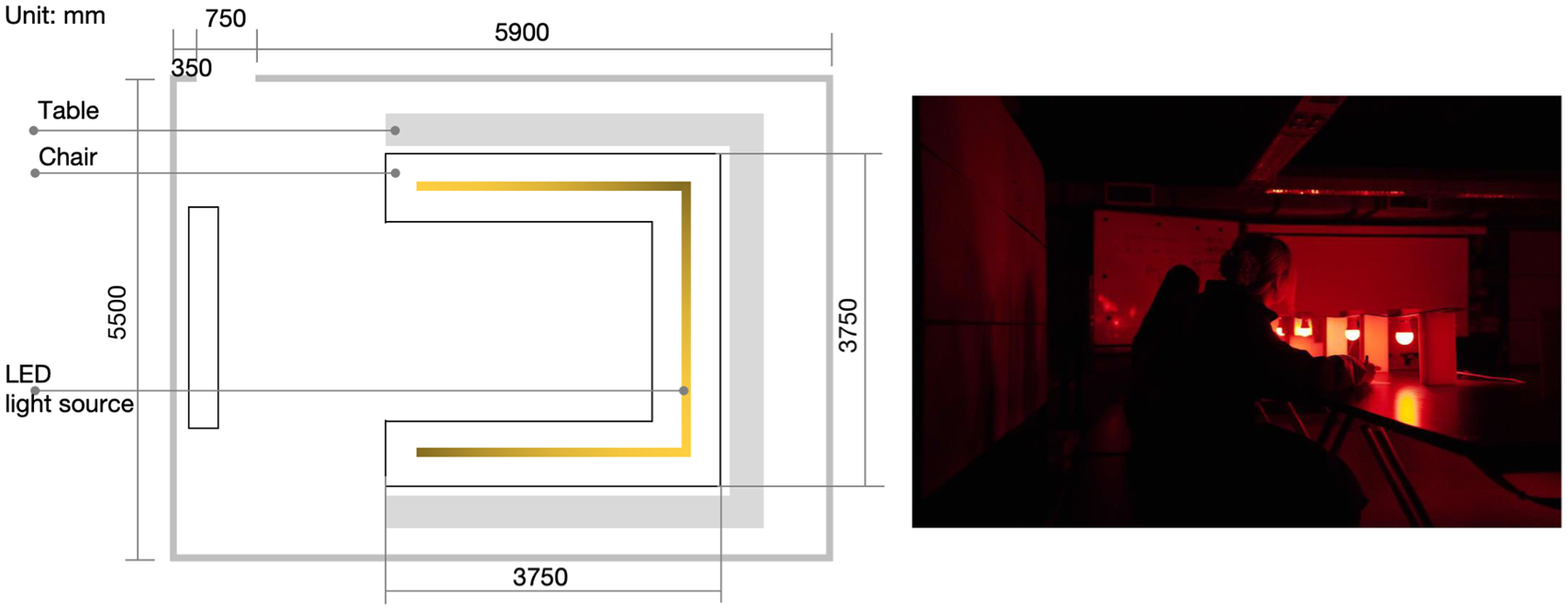
Laboratory layout and the ‘red’ lighting scene
The experiment was conducted between October and November 2024. The indoor environment of the laboratory was climate-controlled using an air conditioning system, maintaining a temperature of 20°C and a relative humidity of 50%. As the laboratory was located underground and windowless, the space remained fully enclosed during the experiment, with air movement considered negligible. According to China’s national standard Architectural Lighting Design Standards (GB/T 50034-2024), the recommended illuminance level was determined by comprehensively considering typical residential spaces (measured on a horizontal plane 0.75 m above the floor), corridors and stairwells, performance-related public buildings, as well as theatres and concert halls. The illuminance was set to 150 lx on the horizontal plane at a height of 0.75 m above the floor as the baseline in this experiment.
Due to precision limitations, the measured illuminance deviated by no more than ±2% from the target value. Measurements were performed using a spectral irradiance colorimeter (model SPIC-300, EVERFINE Corporation, Hangzhou, China), under the CIE 1964 10° standard observer condition. Photometric metrics and melanopic EDI were measured and are presented in Table 1. The illuminance output Ev from this spectral irradiance colorimeter already accounts for the effect of the photopic luminous efficiency function V(λ). The in situ measurements taken in the actual laboratory environment represent the combined light field, that is, a mixture of direct light from the source and reflected light from surrounding surfaces. The spectral power distributions (SPDs) of the six coloured lighting conditions, measured in situ, are presented in Figure 2.
RGB settings, colorimetric characteristics, and photometric and melanopic EDI of the six lighting conditions
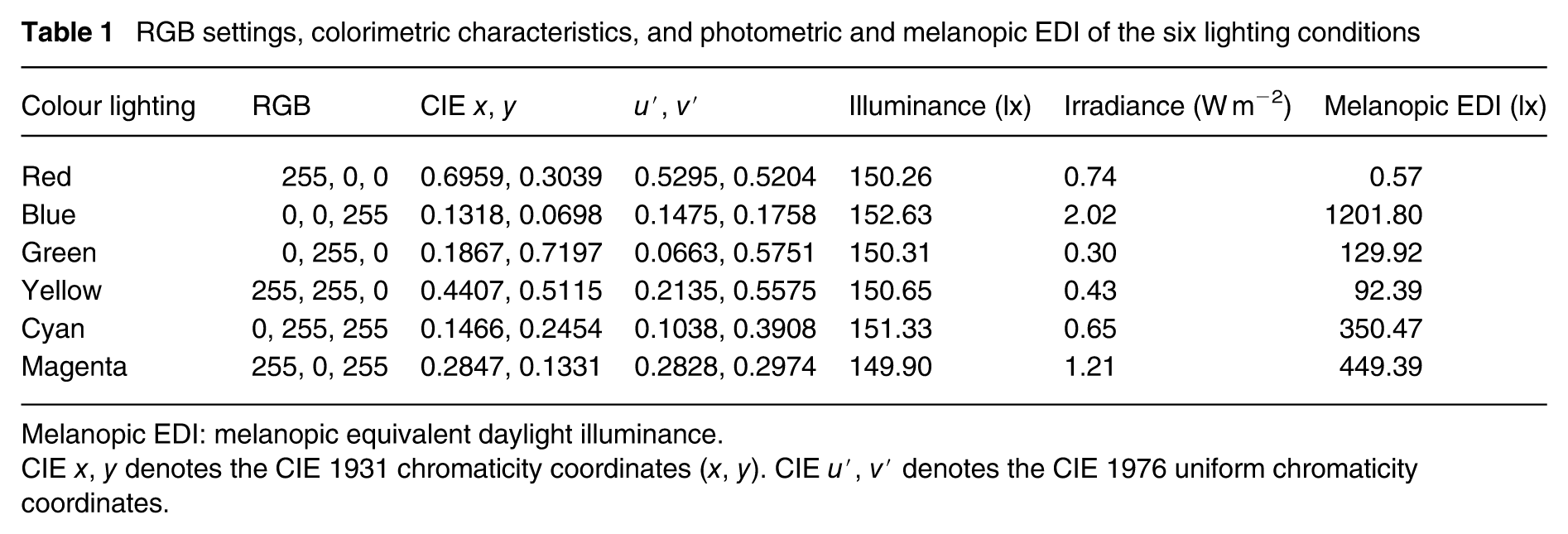
Melanopic EDI: melanopic equivalent daylight illuminance.
CIE x, y denotes the CIE 1931 chromaticity coordinates (x, y). CIE u′, v′ denotes the CIE 1976 uniform chromaticity coordinates.
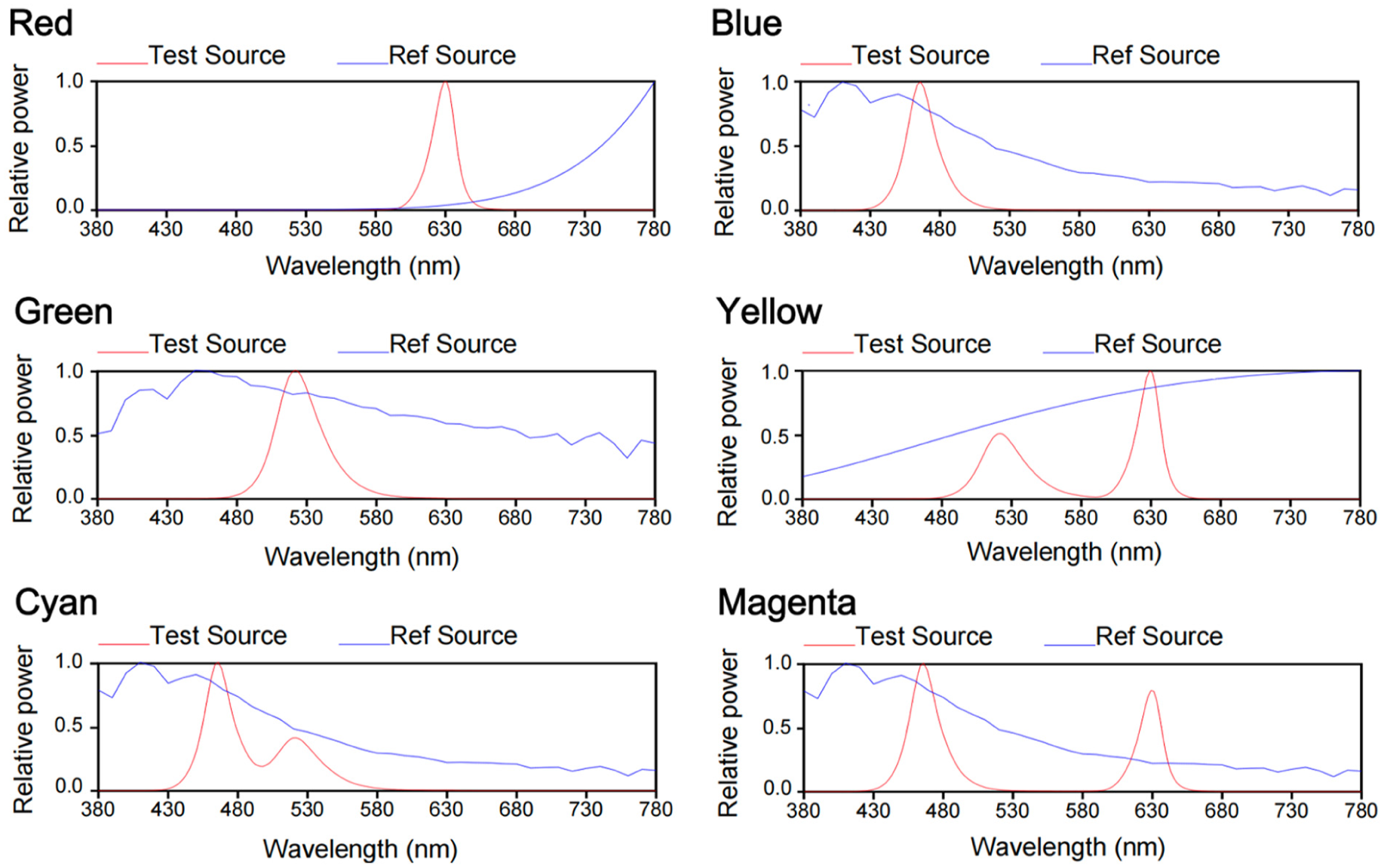
SPDs of the six coloured lights
2.3 Measurements
This study did not directly measure Pleasure–Activation using the SAM. Instead, 10 pairs of semantic differential terms were selected within the circumplex model and administered in a questionnaire. An exploratory factor analysis (EFA) was then conducted on these 10 items, extracting variables strongly associated with pleasure and activation by rotating the loading matrix. In the subsequent confirmatory factor analysis (CFA), observational variables with weak explanatory power were removed through standardised regression. After EFA and CFA, the retained items were treated as equally weighted indicators for calculating the final scores for pleasure and activation.
Similarly, Negative and Positive affect were not measured directly. Rather, another 10 adjective items (derived from the Positive and Negative Affect Schedule (PANAS)) were assessed in a questionnaire, and the same procedures as described above for the circumplex model were applied to obtain the final measures of Negative affect and Positive affect. Participants were required to rate their direct subjective feelings across a total of 20 items for each lighting condition.
2.3.1 Pleasure–Activation
The evaluation of Pleasure and Activation was based on Russell’s circumplex model of affect,50,53 which provides a theoretical framework for emotional assessment under coloured lighting conditions. Ten pairs of bipolar semantic differential items were used to measure subjective emotional responses: Pleasure–Displeasure, Happy–Sad, Elated–Gloomy, Excited–Tired, Ebullient–Lethargic, Activation–Deactivation, Tense–Calm, Jittery–Placid, Upset–Serene and Distressed–Contented. Each item was rated using a 7-point Likert scale. For example, in the Pleasure–Displeasure pair, responses ranged from −3 (‘very pleasurable’) to +3 (‘very displeasurable’).
2.3.2 Negative–Positive affect
Negative or Positive affect intensity under coloured lighting conditions was further assessed using ten items derived from the PANAS, based on the bipolar structure of affective states.54,55 The scale included the following: inspired, alert, excited, enthusiastic, determined, afraid, upset, nervous, scared, and distressed. Each item was rated using a 7-point Likert scale. For example, for the item inspired, participants rated their emotional intensity from 1 (‘not at all’) to 7 (‘extremely’).
2.3.3 Procedure
Participants were provided with a detailed explanation of the experimental procedures and precautions before signing an informed consent form. Three primary colours and three secondary colours were used as the environmental lighting stimuli. Participants were randomly exposed to the coloured lighting conditions. First, a randomly selected light condition was presented for 3 min, during which participants completed a paper-based questionnaire (the questionnaire items are described in the ‘Measurements’ section). After the 3 min, participants rested for 1 min to reduce eye strain. The next trial then began, and the procedure was repeated. To minimise potential interference from colours entering participants’ field of view, all laboratory personnel and participants were required to wear achromatic clothing, that is, garments with no hue and only lightness.
2.4 Factor analysis
Each participant was required to complete three conditions, and nine participants voluntarily completed all six coloured lighting conditions. In total, 372 sets of questionnaire responses were collected. Data cleaning was performed based on criteria such as missing values and incomplete responses. As a result, data from one participant (three sets), two participants (six sets each), one participant (two sets) and four participants (one set each) were excluded. After cleaning, the final dataset comprised 351 valid responses from 112 participants. Specifically, the dataset comprised 60 valid responses for the red light condition, 59 for the green light condition, 58 for the blue light condition, 59 for the yellow light condition, 59 for the cyan light condition and 56 for the magenta light condition.
Before conducting structural and validity testing, reverse-scored items, those with scoring directions opposite to theoretical expectations, were recoded to ensure consistency in the interpretation of scores. An EFA was performed on the 10 items evaluating participants’ emotional responses to the coloured lighting conditions. The Kaiser-Meyer-Olkin (KMO) measure of sampling adequacy was 0.835, indicating good suitability for factor analysis. Bartlett’s test of sphericity was significant (p < 0.001), suggesting that the correlation matrix was not an identity matrix and that the data were appropriate for factor extraction. Two components with eigenvalues greater than 1 were extracted. The component matrix was rotated, and only observed variables with loadings ≥0.50 were retained (Table S1). One item was removed during this process. The final solution yielded two factors: Factor 1 (Pleasure) included six items: displeasure–pleasure, sad–happy, tense–calm, jittery–placid, upset–serene and distressed–contented. Factor 2 (Activation) included three items: tired–excited, lethargic–ebullient and deactivation–activation.
An EFA was conducted on the 10 items assessing the Negative and Positive affect under each lighting condition. The KMO measure of sampling adequacy was 0.864, and Bartlett’s test of sphericity was significant (p < 0.001), confirming the suitability of the data for factor analysis. Two components with eigenvalues greater than 1 were extracted. The component matrix was rotated, and only items with factor loadings ≥0.50 were retained. In Table S2, one item was excluded during this process. The final factor solution yielded two dimensions: Factor 1 (Positive affect) included three items: inspired, excited and enthusiastic. Factor 2 (Negative affect) included six items: alert, afraid, upset, nervous, scared and distressed.
CFA was conducted using IBM SPSS Amos software (version 29.0.0.0; IBM Corp., Armonk, NY, USA). In the standardised regression weight output, the item sad–happy showed a loading of 0.494, indicating a relatively weak contribution to the Pleasure factor. As it fell below 0.50, this item was removed from the model (Table S3). After item removal, the Cronbach’s alpha values were 0.845 for Pleasure and 0.757 for Activation, indicating acceptable to good internal consistency. CFA was also conducted on the Negative–Positive affective model. All six observed variables under the Negative affect latent factor and all three under the Positive affect latent factor had standardised loadings exceeding 0.50, supporting the appropriateness of the factor–indicator relationships (Table S4). The Cronbach’s alpha values were 0.921 for Negative affect and 0.803 for Positive affect, demonstrating strong internal reliability. Both models exhibited good convergent validity, indicating that the constructs were measured accurately and reliably. The scales demonstrated high internal consistency and robust construct validity.
3. Results
Statistical analyses were conducted using IBM SPSS Statistics version 27.0. Among the participants, the largest age group was 18 years to 26 years (88%), followed by 27 years to 35 years (6%) and 56 years to 65 years (3.4%). The sample included 239 female participants (68.1%) and 109 male participants (31.1%), with a higher proportion of females, reflecting the gender distribution typical of the Central Academy of Fine Arts. Of the 351 valid data sets, 321 were collected from students (91.5%), with the remaining data from faculty members and staff at the university’s property management office. Regarding the distribution of colour lighting conditions: 60 samples were collected under red light, and 59 each under green, yellow and cyan light. Blue light was tested in 58 samples, and magenta light in 56 samples, indicating an overall balanced distribution across the six coloured lighting conditions.
Given that the experimental design involved an unbalanced partial repeated-measures structure, this study adopted a linear mixed model (LMM) to examine the effects of coloured lighting on Pleasure, Activation, Positive affect and Negative affect, which is capable of accommodating both unbalanced designs and missing data. This approach accounts for both fixed effects (the overall influence of lighting conditions) and random effects (individual differences among participants), making it well-suited for repeated-measures designs. The simplified model specification is shown in Equation (1):

where:
y = dependent variable (Pleasure, Activation, Positive affect or Negative affect)
C = fixed effect (six lighting conditions: red, green, blue, yellow, cyan, magenta)
For example, the model for Pleasure can be expressed as Equation (2):

where:
β 0 = overall intercept (average baseline across participants)
β Colour[j] = fixed effect of colour condition (six levels)
u 0i = random intercept for participant i
εij = residual error
Before proceeding with further analyses, tests for residuals to evaluate model assumptions were conducted on the emotional scores for Pleasure, Activation, Negative affect and Positive affect under the six lighting conditions. As shown in Figure 3, visual inspection of the residuals versus predicted values plots indicated no obvious heteroscedasticity or systematic patterns, suggesting that the assumption of homogeneity of variance was adequately met.
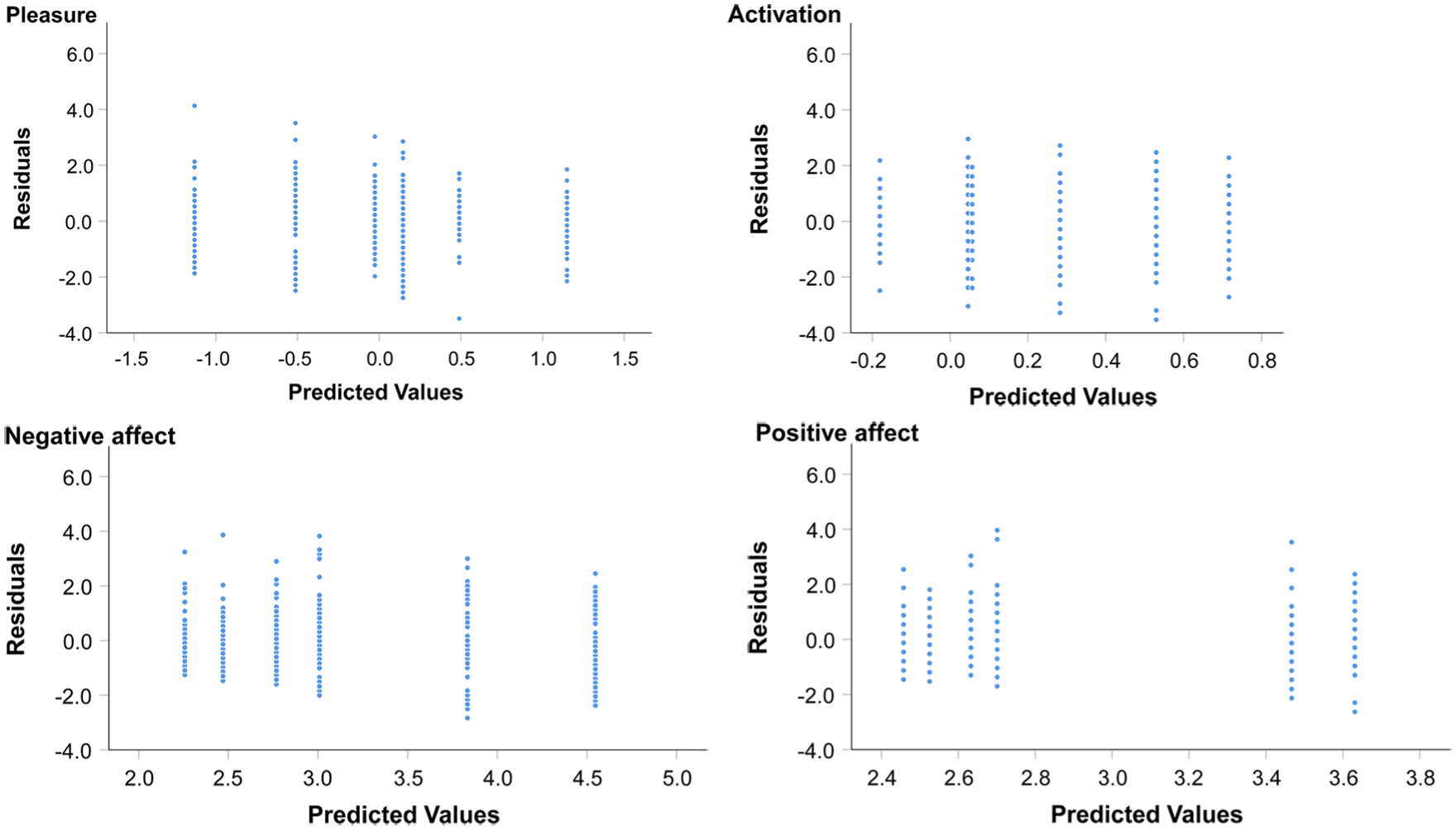
Residuals versus predicted values for the four dimensions
3.1 Pleasure–Activation
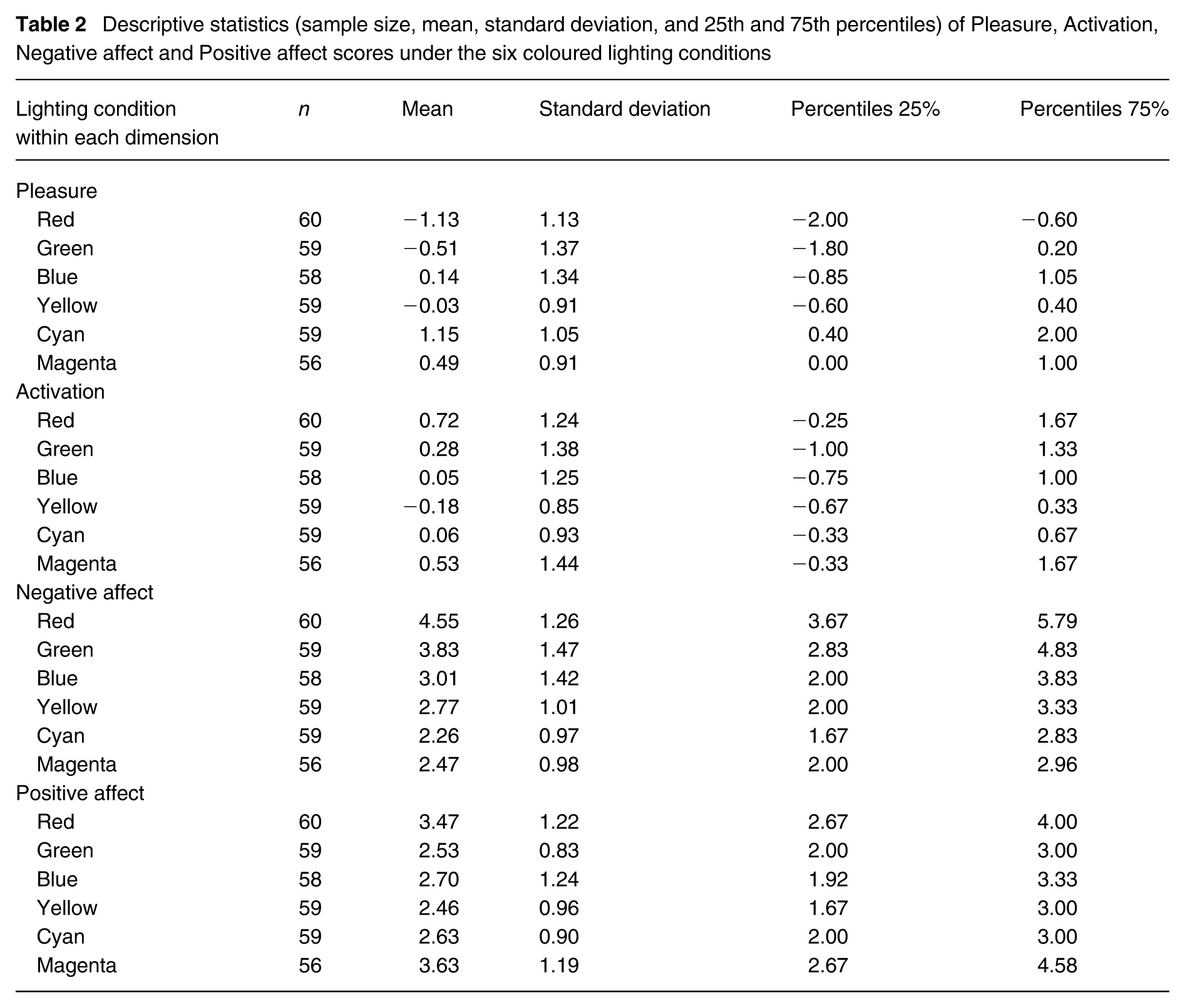
The results in Table 2 show that the red light condition yielded the lowest mean Pleasure score (M = −1.13, SD = 1.13). By contrast, the cyan light condition produced the highest mean Pleasure score (M = 1.15, SD = 1.05). The ranking of Pleasure scores from highest to lowest was cyan, magenta, blue, yellow, green and red. Overall, the scores ranged from 1.15 to −1.13. Participants’ responses to magenta and yellow lighting were relatively concentrated, indicating greater consistency in emotional evaluations under these two lighting conditions. By contrast, ratings under green and blue light were more widely dispersed, suggesting greater individual variability in perceived emotional experience.
Descriptive statistics (sample size, mean, standard deviation, and 25th and 75th percentiles) of Pleasure, Activation, Negative affect and Positive affect scores under the six coloured lighting conditions
A LMM was conducted with colour condition as a fixed effect and participant ID as a random effect (Table 3). The results revealed a significant main effect of colour in pleasure, F(5, 345) = 28.566, p < 0.001. The hypothesis that the six coloured lighting conditions exert significantly different effects on pleasure was supported. The results in Table S5 show that post hoc pairwise comparisons with Bonferroni adjustment indicated that pleasure under cyan was significantly higher than under all other colours (all p < 0.05). Red also produced significantly lower pleasure compared to green, blue, yellow, cyan and magenta (all p < 0.05).
Results of the linear mixed-effects model
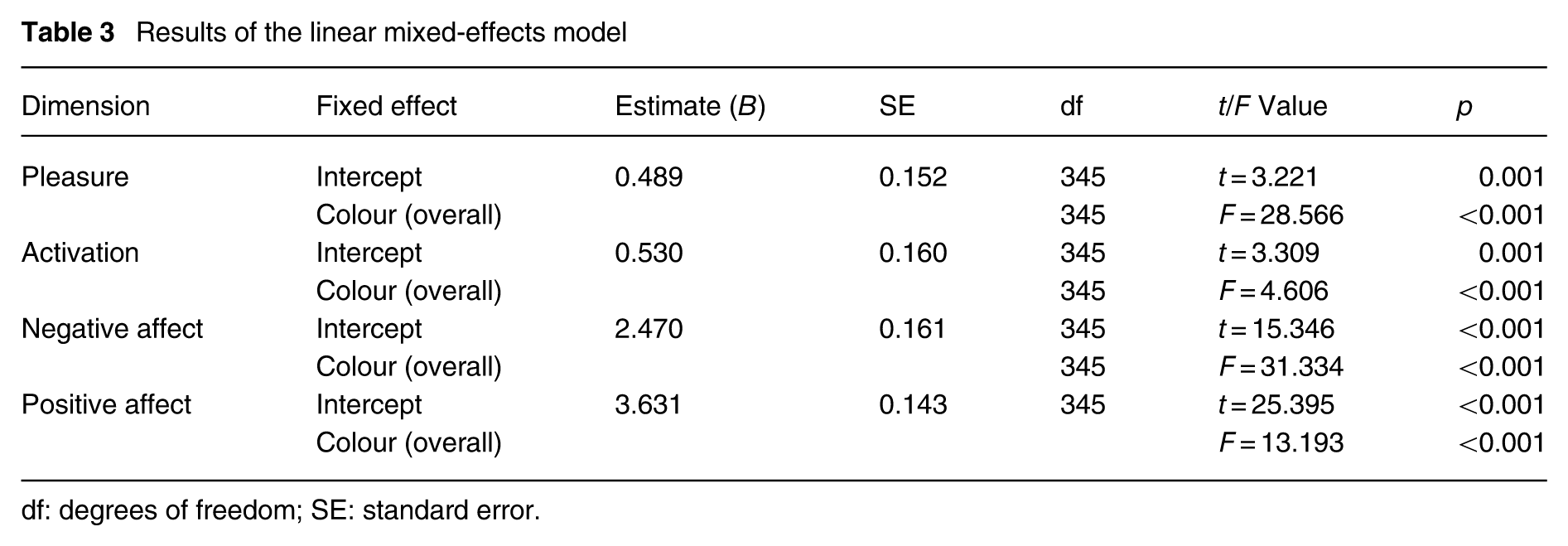
df: degrees of freedom; SE: standard error.
According to Table 2, the yellow light condition yielded the lowest mean Activation score (M = −0.18, SD = 0.85), indicating that participants were more likely to experience a low-activation state under yellow lighting. By contrast, the red light condition produced the highest mean Activation score (M = 0.72, SD = 1.24), suggesting that red lighting was most effective in the activation state. The order of Activation scores from highest to lowest was red, magenta, green, cyan, blue and yellow, with values from 0.72 to −0.18. Scores under yellow and cyan lighting were relatively concentrated, reflecting more consistent emotional responses among participants. By contrast, ratings under magenta and green light showed greater dispersion, suggesting more individual variation in perceived activation.
Table 3 also presents the results of an LMM for activation. Results revealed a significant main effect of colour in activation, F(5, 345) = 4.606, p < 0.001. The hypothesis that the six coloured lighting conditions exert significantly different effects on activation was supported. In Table S6, post hoc pairwise comparisons with Bonferroni adjustment showed that activation under red was significantly higher than blue, yellow and cyan. Yellow also produced significantly lower activation compared to magenta.
3.2 Negative–Positive affect
As shown in Table 2, the cyan lighting condition resulted in the lowest mean Negative affect score (M = 2.26, SD = 0.97), indicating that participants were least likely to experience negative emotional states under cyan lighting. By contrast, the red lighting condition produced the highest Negative affect score (M = 4.55, SD = 1.26), suggesting a greater tendency towards negative emotion. The descending order of Negative affect scores was red, green, blue, yellow, magenta and cyan, with values ranging from 4.55 to 2.26. Responses under cyan and magenta lighting were relatively concentrated, indicating greater consistency in participants’ evaluations. Conversely, responses under green and blue lighting were more dispersed, reflecting greater individual variation in perceived negativity.
Table 3 presents the results of an LMM for Negative affect. Results revealed a significant main effect of colour on Negative affect, F(5, 345) = 31.334, p < 0.001. The hypothesis that the six coloured lighting conditions exert significantly different effects on Negative affect was supported. In Table S7, post hoc pairwise comparisons with Bonferroni adjustment indicated that Negative affect under red was significantly higher than under all other colours (all p < 0.05). Green also produced significantly higher Negative affect values compared to blue, yellow, cyan and magenta. In addition, blue produced significantly higher Negative affect compared to cyan.
The yellow lighting condition yielded the lowest mean Positive affect score (M = 2.46, SD = 0.96), suggesting that yellow lighting was less effective in positive emotional states, such as excitement or inspiration. Participants under yellow lighting were more likely to experience lower levels of positivity compared to other lighting conditions. By contrast, the magenta lighting condition resulted in the highest mean Positive affect score (M = 3.63, SD = 1.19), indicating that participants were more likely to experience elevated positive emotions under magenta lighting. The descending order of Positive affect scores across the lighting conditions was as follows: magenta, red, blue, cyan, green and yellow, with values ranging from 3.63 to 2.46.
Table 3 presents the results of a LMM for Positive affect. Results revealed a significant main effect of colour in the Positive affect condition, F(5, 345) = 13.193, p < 0.001. The hypothesis that the six coloured lighting conditions exert significantly different effects on Positive affect was supported. Post hoc pairwise comparisons with Bonferroni adjustment indicated that Positive affect under red was significantly higher than under green, blue, yellow and cyan (see Table S8). Magenta also produced significantly higher Positive affect results compared to green, blue, yellow and cyan.
3.3 Affective model positioning of different coloured lighting
Based on the above results, a two-dimensional quadrant diagram was generated to map the six coloured lighting conditions – red, green, blue, yellow, cyan and magenta – within both the Pleasure–Activation (Figure 4) and Negative–Positive affective models (Figure 5). Red lighting was positioned in the high-activation and high-displeasure quadrant, meanwhile strongly elicited both Positive affect and Negative affect simultaneously. Green lighting was associated with moderate activation and moderate displeasure, meanwhile elicited relatively high Negative affect and relatively low Positive affect. Blue lighting was located in the low-activation and slightly pleasurable zone; meanwhile, moderate elicitation of both positive and negative affective states. Yellow lighting was associated with mild deactivation and neutral pleasure, meanwhile elicited low levels of both Positive affect and Negative affect. Cyan lighting was situated in the high-pleasure but low-activation quadrant, meanwhile elicited low Negative affect and relatively low Positive affect. Magenta lighting was mapped at moderate levels of Pleasure and Activation while eliciting relatively high Positive affect and relatively low Negative affect.
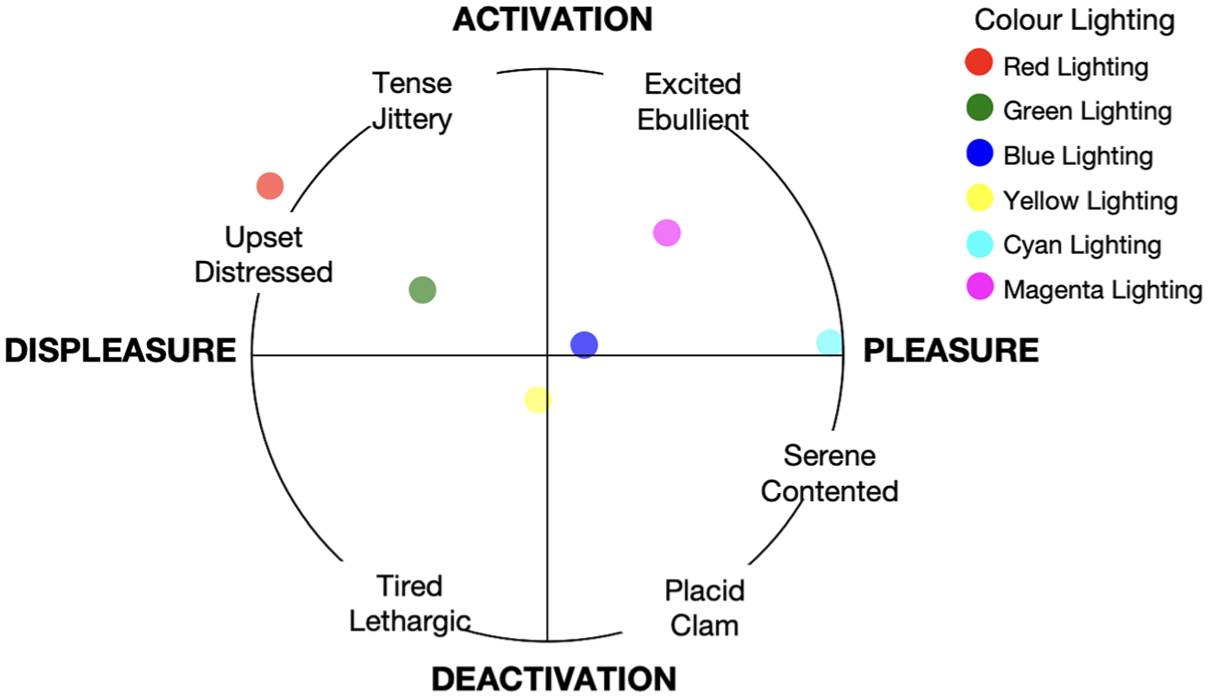
Distribution of six coloured lighting conditions within the Pleasure–Activation affective model
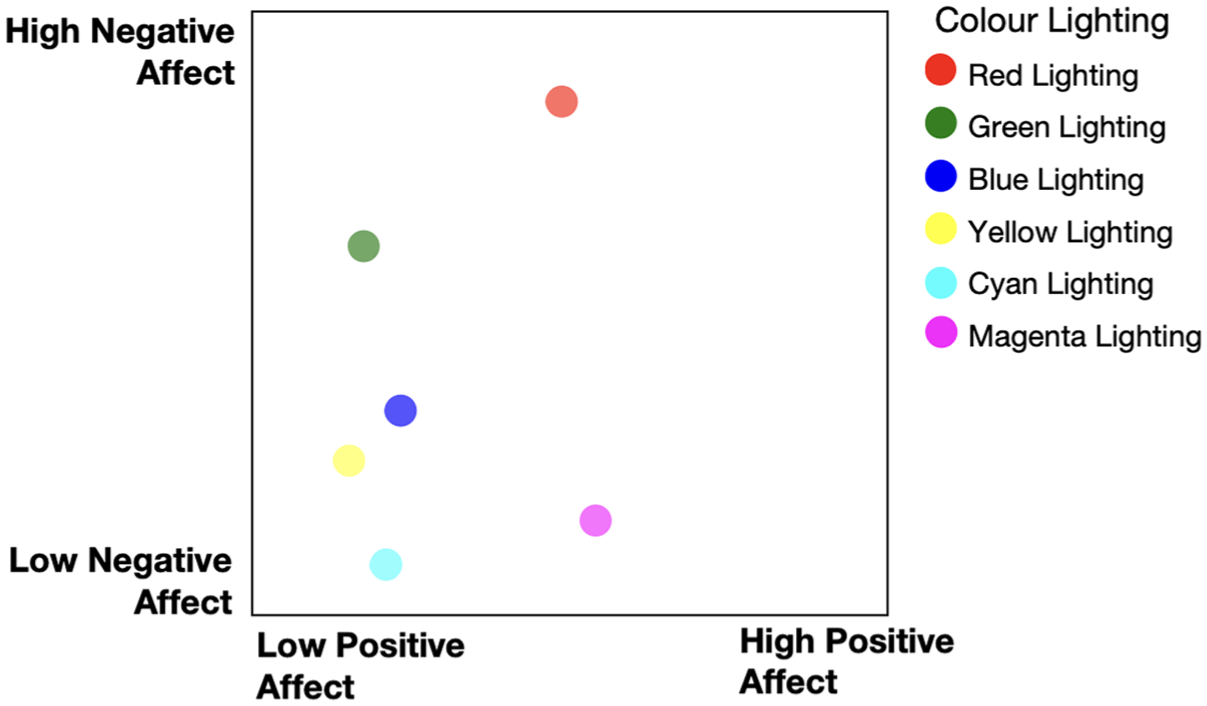
Distribution of six coloured lighting conditions within the Negative–Positive affective model
3.4 Affective model positioning of different coloured lighting
Across the six coloured lighting conditions, the correlation coefficients between Negative affect and Positive affect ranged from −0.224 to 0.156, indicating a generally weak relationship between the two affective dimensions (Table 4). Under the red lighting condition, the Spearman correlation coefficient between Negative affect and Positive affect was −0.084 (p = 0.524), which was not statistically significant (p > 0.05). Similarly, for the remaining five lighting conditions, all p-values were greater than 0.05, and the 95% confidence intervals for the correlation coefficients crossed zero. These results further support the conclusion that under all six coloured lighting conditions, Negative affect and Positive affect were not significantly correlated. Therefore, the findings suggest that Negative affect and Positive affect are independently elicited under coloured lighting exposure (Figure 6).
Spearman’s rho confidence interval for Negative–Positive affect
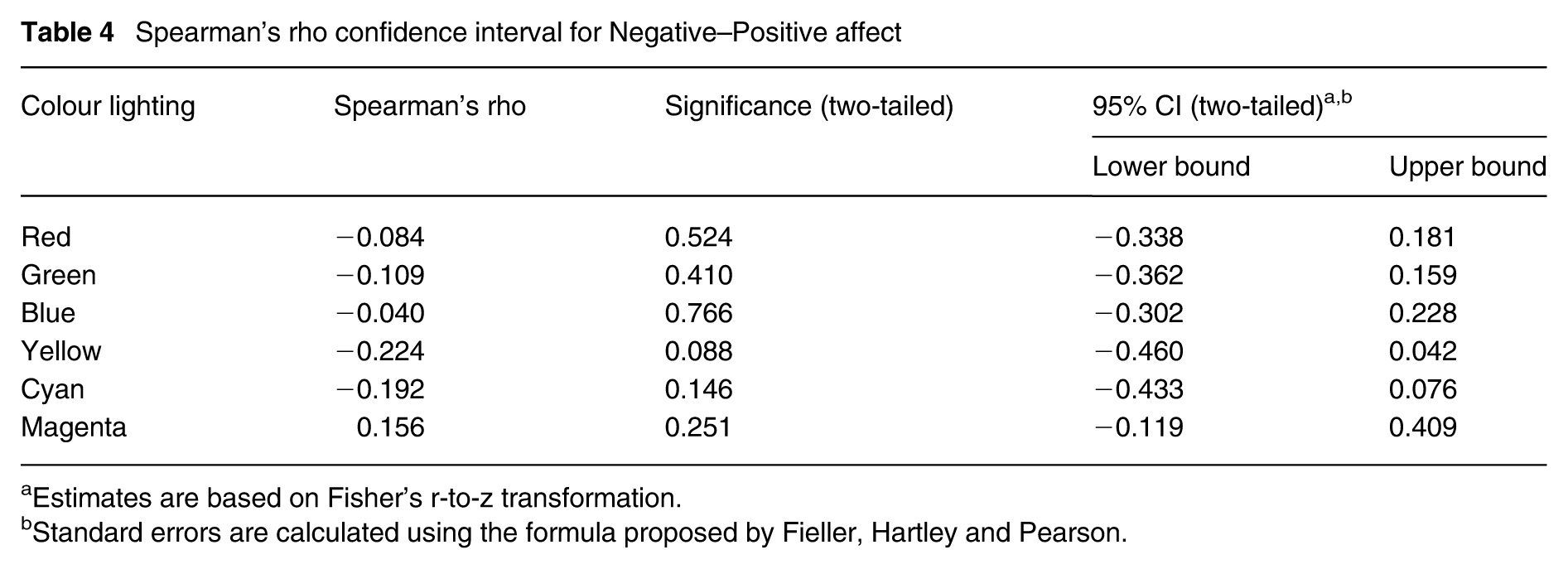
Estimates are based on Fisher’s r-to-z transformation.
Standard errors are calculated using the formula proposed by Fieller, Hartley and Pearson.
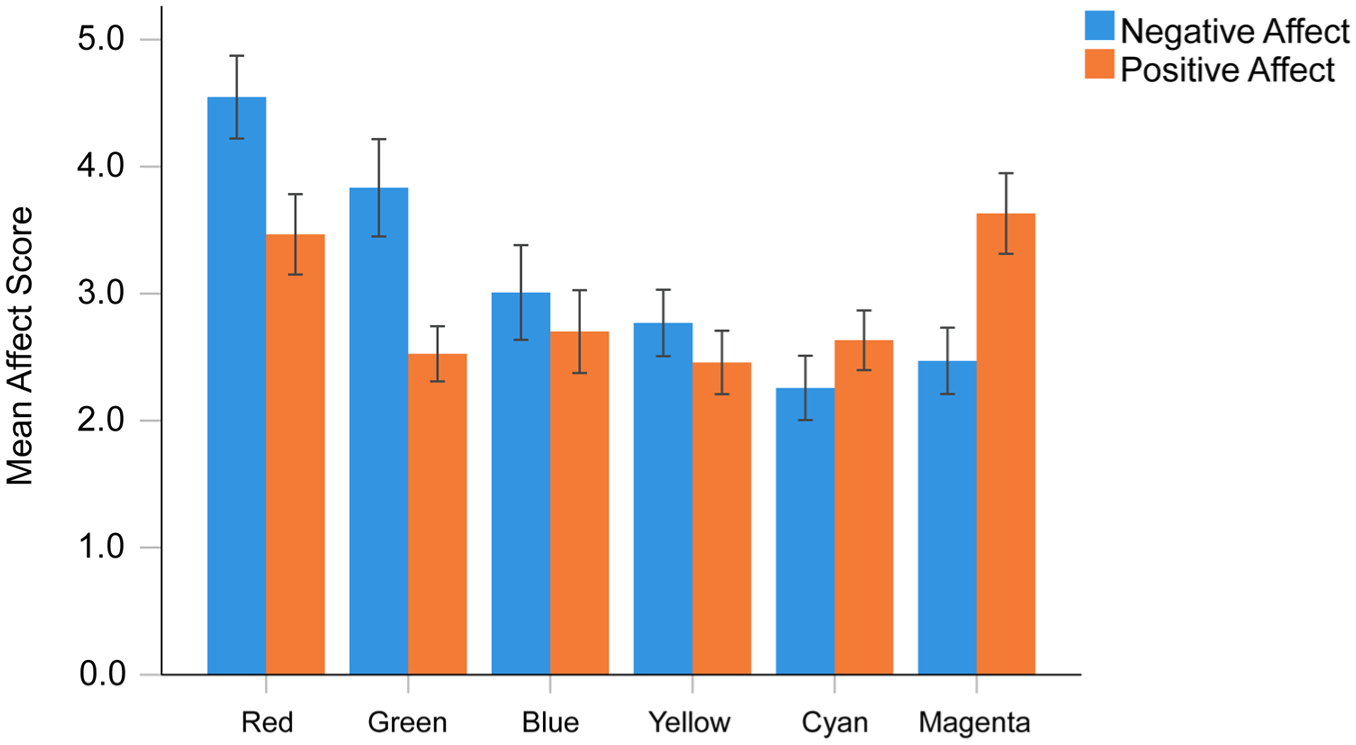
Means scores and error bars in Negative affect and Positive affect across coloured lighting conditions
Meanwhile, under the magenta lighting condition, which showed a positive correlation coefficient between Negative affect and Positive affect, the significance level was 0.251 (p > 0.05), indicating that the assumption of mutual elicitation did not reach statistical significance. Therefore, the hypothesis that ‘Negative and Positive affect are mutually elicited under the six coloured lighting conditions’ is not supported. As shown in Table 4, negative correlation coefficients between Negative affect and Positive affect were observed under red (p = 0.524), green (p = 0.410), blue (p = 0.766), yellow (p = 0.088) and cyan (p = 0.146) lighting. All values exceeded the 0.05 threshold, indicating that the correlations were not statistically significant. Thus, the hypothesis that ‘Negative and Positive affect are inversely elicited under the six coloured lighting conditions’ is not supported.
4. Discussion
4.1 Affective responses to coloured lighting conditions
The purpose of this study was to investigate affective responses in terms of Pleasure, Activation, Negative affect and Positive affect under six coloured lighting conditions: red, green, blue, yellow, cyan and magenta. In addition, the study explored whether Negative affect and Positive affect were independently, mutually or inversely elicited under these lighting conditions. The results demonstrated that the six coloured lighting environments significantly influenced participants’ affective responses across all four dimensions—Pleasure, Activation, Positive affect and Negative affect. Moreover, Positive affect and Negative affect were found to be independently elicited. These findings build upon prior research,36,42,56 which has shown that lighting colour is associated with emotional experience, and that red, green, blue and yellow lighting conditions can produce distinct differences in Pleasure and Arousal. The current study extends this knowledge by demonstrating that coloured lighting also significantly affects the elicitation of Positive and Negative affective states, and that such elicitations occur independently of one another.
The findings provide an important and innovative extension to the dimensional understanding of how coloured lighting influences affective states, as articulated by the Negative–Positive affective model. According to the experimental results, participants’ Negative–Positive affect under different coloured lighting conditions does not correspond to the valence dimension (i.e. pleasure–displeasure) in dimensional models of emotion (Pleasure–Activation affective model). This is because, under the tested coloured lighting conditions, the reported Negative affect and Positive affect appeared to be independent rather than negatively correlated.
This study tends to propose that the distribution captured by the Pleasure–Activation affective model directly reflects the overall effect of coloured lighting on individuals’ levels of pleasure or activation, whereas the Negative–Positive affective model may indicate the capacity of different coloured lighting to elicit positive or negative affective response. Some studies indicate that Positive affect and Negative affect are independent—or nearly independent—dimensions.57–59 Watson and Tellegen 60 even proposed the ‘the two-factor structure of affect’, offering a more nuanced and complex account of affective states that allows.
Among the six lighting conditions, red lighting exhibited the highest activation level and the lowest pleasure level. Within the Negative–Positive affective model, red lighting also exhibited the highest level of Negative affect and the second-highest level of Positive affect. These results on the relationship between red lighting and pleasure are consistent with the findings of Lee and Lee, 36 who identified red as the least pleasurable lighting colour, with significantly higher arousal levels than other colours (green, blue, yellow, orange and purple). Similarly, Han and Lee 56 found that, among a group of healthy university students in their 20s, red lighting resulted in higher scores on depression–dejection, anger–hostility and confusion–bewilderment compared to yellow and white lighting. Our current findings showed that red lighting is not inherently pleasurable and may reflect that red lighting is highly effective at eliciting affect in situ and may amplify occupants’ sensory perceptions; whether pleasure or displeasure, these feelings can be intensified.
Blue lighting was associated with a moderate level of pleasure and ranked the second lowest in activation. Contrary to our findings, as well as those of Lee and Lee 36 and Theodorson and Scott, 42 other studies reported that blue lighting showed an advantage with respect to dejection, depression and irritability.35,56 For instance, Han and Lee 56 found significant differences in depression–dejection, anger–hostility and confusion–bewilderment scores across lighting conditions based on the Korean Edition of the Profile of Mood States (K-POMS), with blue lighting yielding higher scores than red, yellow and white lighting. By contrast, the present study found that blue lighting yielded higher scores on the pleasure dimension than yellow and red lighting. Our study further suggests that, within the Negative–Positive affective model, blue lighting may reflect a slightly greater capacity to elicit Negative affect than Positive affect. Previous animal studies have shown that light can directly regulate mood-related processes through melanopsin-expressing ipRGCs. 61 Given the role of the thalamus, evidence from human neuroimaging studies suggests that blue light-related modulation of thalamic activity may bias affective processing towards vigilance-related dimensions rather than Positive affect. 62 Overall, its affect-eliciting capacity appears moderate and stronger than that of yellow lighting.
Quantitative research into the effective consequences of cyan illumination remains limited. To our knowledge, only the studies by Kuijsters et al. 63 and Pak et al. 37 have addressed evaluations of Pleasure and Arousal under cyan lighting conditions. Kuijsters et al. 63 used cyan lighting as the primary stimulus in Activating ambience and white lighting in Neutral ambience. Their results indicated that the ambience dominated by cyan lighting elicited stronger physiological activation compared to the neutral white-lighting ambience. Pak et al. 37 reported that the pleasure score under cyan LED lighting was higher than that under magenta and yellow lighting; however, in the emotional arousal dimension, the score under cyan lighting was lower than that under magenta and yellow lighting. Pak et al.’s 37 evaluation regarding the pleasure level of cyan lighting is consistent with this study. However, their assessment of arousal differs from the results of our research: our study suggests that, in terms of arousal (i.e. activation), the score under cyan lighting is lower than that under magenta lighting, but higher than that under yellow lighting. Furthermore, within the Negative–Positive affective model, cyan lighting exhibited the lowest level of Negative affect and a relatively low level of Positive affect among the six lighting conditions. Our current findings showed that cyan lighting is inherently pleasurable, and may reflect that cyan lighting is not particularly effective at eliciting affect in situ– whether pleasure or displeasure.
Within the Pleasure–Activation model, yellow lighting tends to be perceived as neutral on the pleasure dimension in this study. Our assessment of the pleasure level of yellow lighting is consistent with the findings of Lee and Lee 36 and Pak et al. 37 However, on the activation dimension, the present study shows that yellow lighting exhibits the lowest activation level among all six coloured lighting conditions. In this respect, our assessment of yellow lighting’s activation level differs from that of Lee and Lee, 36 who reported that yellow lighting’s arousal (i.e. activation) level is higher than that of green and blue lighting. Furthermore, with respect to the Negative–Positive affective model, our findings may reflect that yellow lighting is the least effective at eliciting Positive affect, as well as a relatively low effectiveness at eliciting Negative affect. These may indicate that, among the six colours, yellow lighting is conducive to an affectively neutral (even ‘unmoved’) state.
Within the Pleasure–Activation model, green lighting in the present study ranks lower than all other colours except red on the pleasure dimension. Pak et al. 37 reported that green lighting was more pleasurable than blue, a finding that differs from both our results and those of Lee and Lee. 36 In terms of activation, our results showed that green lighting ranked below red but above blue and yellow. Among the six coloured lighting conditions, green lighting showed moderate activation, but it was more likely to elicit displeasure than pleasure in participants. However, Lee and Lee 36 reported that green lighting had lower arousal levels than both red and yellow lighting, and Pak et al. 37 reported that green lighting showed lower arousal than both red and blue. Within the Negative–Positive affective model, our findings suggest that green lighting is more effective at eliciting Negative affect than Positive affect.
Additionally, in view of the previously discussed divergences in the literature on magenta lighting, our results showed that under magenta lighting, pleasure and activation levels were the second highest; effectiveness in eliciting Positive affect was the highest, while effectiveness in eliciting Negative affect was the second lowest among the six lighting conditions. This indicates that magenta lighting is inherently pleasurable, and may reflect that, despite its relatively strong activation effect, it is less effective at eliciting Negative affect and more effective at eliciting Positive affect.
The range of Activation scores across the six coloured lighting conditions was narrower than that of Pleasure, suggesting that coloured lighting may have a greater influence on the pleasure dimension than on activation. Similarly, Positive affect showed a narrower score range than Negative affect. This may be because Positive affect tends to reflect the capacity to elicit participants’ positive emotions, whose range of scores across was smaller in natural states, leading to more tightly clustered ratings; Negative affect is more susceptible than Positive affect to variations in lighting conditions. Across the six hues, Negative affect received higher average scores than Positive affect, indicating a stronger effect on Negative affect. From the perspective of emotional processing mechanisms, negative emotions are often associated with potential threats and stress responses and are more readily triggered by environmental changes such as lighting colour. However, environmental changes alone are typically insufficient to elicit Positive affect. By contrast, Negative affect may arise with mere variations in lighting conditions. This aligns with Fredrickson’s broaden-and-build theory,64–66 which suggests that Positive affect is more closely linked to psychological expansion and resource building and is usually elicited by pleasant or relaxing contexts, but is relatively insensitive to immediate environmental shifts. The colour–emotion association is more pronounced for Negative affect, whereas changes in Positive affect typically require more multifaceted stimulation conditions. 67 In affective neuroscience, negative emotions such as fear are rapidly triggered through the amygdala’s quick route, whereas positive emotions are more closely tied to the dopamine-based reward system and thus often emerge at later stages. Negative affective responses can be elicited through unconscious processing mechanisms and may not always require explicit cognitive appraisal. 68 A faster ‘low-road’ pathway conveys relatively unprocessed sensory input from the thalamus directly to the amygdala, enabling prompt reactions to potential danger before conscious awareness is formed. 69 The ventral striatum and midbrain dopamine regions constitute core nodes of the reward circuit. 70 Positive incentive processing involves dopaminergic mechanisms,71,72 and positive incentives are more context-dependent because they rely on value-based appraisal and cortical integration.73,74 Compared with the rapid, automatic ‘low-road’ responding to negative cues, reward-related valuation processes typically unfold in relatively later neural time windows. Together, the psychological mechanisms of emotional response, the relationship between colour and emotion, and neuroscience findings on emotion regulation collectively support that, under varying coloured lighting environments, participants show a wider rating range for Negative affect than for Positive affect, with more pronounced effects on Negative affect.
4.2 Significance
This study further validates the Pleasure–Activation circumplex model, originally proposed within the framework of core affect theory, as an effective structure for describing basic categories of emotional responses under coloured lighting conditions. Moreover, this research innovatively integrates the factor-analysis-validated Negative–Positive affective model together with the Pleasure–Activation model into an evaluation framework for emotional responses to coloured lighting. The study suggests that by evaluating participants’ affect level under various coloured lighting conditions, it is possible to infer the effectiveness of different colours in eliciting either Negative or Positive affect. The dual-model measurement system refines and supplements the standards for affective evaluation in coloured lighting contexts.
Our results indicate that, in coloured-lighting contexts, Negative affect and Positive affect function as independent dimensions that jointly contribute to the evaluation of emotional responses, while the Pleasure–Activation affective model provides the basis for categorising emotional experience. This study confirmed that Negative affect and Positive affect are independently elicited under coloured lighting conditions. The Spearman correlation analysis supported this conclusion by demonstrating that a high level of Negative affect under a specific lighting condition does not necessarily imply a low level of Positive affect, and vice versa. For example, among the six coloured lighting conditions tested, red lighting simultaneously exhibited the highest level of Negative affect and the second-highest level of Positive affect. By contrast, cyan lighting showed the lowest Negative affect and a relatively low level of Positive affect. This study’s assessments of affective elicitation for specific-coloured lights enrich the empirical evidence base on coloured lighting and emotion.
This research may provide insights and references for relevant designers and decision-makers in practical applications. Namely, to select coloured lighting with specific affective capabilities according to the intended purpose of a spatial environment. For example, if the goal is to amplify people’s emotional experiences, to draw their perception and stimulate their feelings, red lighting would be an appropriate choice; thus, entertainment spaces with such a goal might consider adopting it. If, instead, the aim is to maintain a pleasant sense of calm, cyan lighting may be a promising option, as suggested by its position in the affective models in our experiment, potentially making it suitable for leisure-oriented settings where a calm atmosphere is desired. Similarly, in healthcare environments or urban public spaces, specific combinations of coloured lights can elicit targeted emotional responses or shape the intended spatial atmosphere. Such applications help translate the research findings into real-world contexts, and this study also contributes to the scientific development of affect-oriented lighting products.
4.3 Limitations
Given the current stage and research perspective, this study focused on validating the emotion models and formulating testable hypotheses; accordingly, it has certain limitations in its research scope, objects of study and methodology.
First, regarding the sample and research scope, the majority of recruited participants were students from the authors’ university, with a small number of university staff, resulting in a relatively narrow age range. Consequently, it was not possible to explore how age differences influence emotional responses to coloured lighting within sociodemographic variables. Moreover, the findings of this study cannot be generalised to older age groups. In addition, participants shared a relatively homogeneous educational and cultural background, which restricted the investigation of how occupational identity or cultural context might affect the emotional responses elicited by coloured light. Therefore, the sample in this study may be biased by the participants’ shared cultural backgrounds and intelligence levels. Moreover, this study focused on six highly saturated chromatic lighting conditions (red, green, blue, yellow, cyan and magenta) and did not examine other hues or spectral compositions. Importantly, fully chromatic ambient lighting may not always be appropriate in practical settings. In the real world, a more feasible approach may be to use white lighting while enriching or attenuating specific wavelength bands, or to use predominantly white ambient lighting, complemented by localised chromatic accents. Future research should employ more diverse samples and move beyond simply adding more hues by systematically comparing different spectral strategies, thereby broadening the scope of this research.
Secondly, in terms of methodology, this study constructed an emotional evaluation framework based on the Pleasure–Activation affective model and the Negative–Positive affective model. The self-report measurements relied on participants’ accurate awareness of their own feelings, which introduces the potential for subjective judgement bias. Additionally, during the emotional assessment of coloured lighting based on the Pleasure–Activation affective and Negative–Positive affective models, certain semantic pairs translated from English to Chinese, such as pleasure–displeasure and happy–sad, showed high covariance between error terms in the later stage of data model validation. This suggests the possibility of collinearity among items. Accordingly, the question of how to render foreign-language formulations of emotional models into Chinese – so as to express and distinguish them effectively, or even to reconceptualise them in Chinese – emerged as an issue during this study. The meanings and boundaries of relevant emotion items may vary across cultural contexts, and the cross-cultural equivalence of the emotional evaluation framework remains uncertain. Therefore, the present findings should be interpreted with caution. Future research should strengthen cross-cultural validity by conducting cognitive interviews on item interpretation, testing measurement invariance across language groups, and including bilingual or cross-cultural comparison samples. Furthermore, after conducting EFA on the data from both models, two factors (i.e. latent variables) were extracted from each. One latent variable had three observed indicators. When a latent variable has only three indicators, the model is just identified (i.e. the degrees of freedom are zero) in theory. Under such circumstances, the model fit indices cannot provide useful information; attention should instead be directed to indicators such as factor loadings. Within the overall model, the small number of indicators for one latent variable may impose overly strong local constraints, thereby reducing the model’s ability to fit the data as a whole.
5. Conclusion
We show that six coloured lighting conditions, red, green, blue, yellow, cyan and magenta, exert significant effects on Pleasure, Activation, Negative affect and Positive affect levels of affective responding. The results suggest that Positive affect and Negative affect are independently elicited in coloured-lighting contexts, rather than being mutually exclusive or inversely related. These findings are novel in that they extend previous research on the relationship between lighting colour and emotional experience, showing that different coloured lights are not only significantly distinguishable on Pleasure and Activation but also exhibit differential effects on the elicitation of Positive affect versus Negative affect. In sum, the results of this study support the potential of coloured lighting as an intervention for modulating or altering individual emotions and should be regarded by lighting-product and spatial designers as a useful addition to methods for shaping emotional experience. For example, when a spatial atmosphere needs to be guided through a transition from highly aroused joy to a calmer state tinged with slight loss, lighting designers may choose to create a shift from coloured lighting with high Positive affect and Pleasure scores to coloured lighting with low Negative affect and Positive affect scores, as well as relatively low Pleasure scores.
Supplemental Material
sj-docx-1-lrt-10.1177_14771535261450373 – Supplemental material for The impact of coloured lighting on Pleasure–Activation and Negative–Positive affective dimensions
Supplemental material, sj-docx-1-lrt-10.1177_14771535261450373 for The impact of coloured lighting on Pleasure–Activation and Negative–Positive affective dimensions by Q Li in Lighting Research & Technology
Footnotes
Acknowledgements
The author would like to thank Prof. Zhigang Chang for facilitating access to the Architectural Lighting Laboratory at the Central Academy of Fine Arts, which made the experimental work possible.
Declaration of conflicting interests
The author declared no potential conflicts of interest with respect to the research, authorship and/or publication of this article.
Funding
The author received no financial support for the research, authorship and/or publication of this article.

Supplemental material
Supplemental material for this article is available online.
References
Supplementary Material
Please find the following supplemental material available below.
For Open Access articles published under a Creative Commons License, all supplemental material carries the same license as the article it is associated with.
For non-Open Access articles published, all supplemental material carries a non-exclusive license, and permission requests for re-use of supplemental material or any part of supplemental material shall be sent directly to the copyright owner as specified in the copyright notice associated with the article.
