






Abstract
1. Introduction
For roads lit according to the P classes of lighting, two primary characteristics of the amount of light are the average and minimum horizontal illuminance.1,2 These are derived from spot measurements of horizontal illuminance measured at each node in a regularly spaced array across the illuminated area. 3 Average illuminance is the arithmetic mean of the illuminances at each node (although that is rarely stated, and the median average may be the more appropriate measure 4 ), and minimum illuminance is the lowest illuminance of any node in the array.
Uniformity is a measure of the variation in illuminance across the array of nodes. It is defined by the CIE as the ‘quotient of minimum illuminance and average illuminance on a surface’, 5 in other words, the ratio of the minimum illuminance to the average illuminance. This article raises three inconsistencies in the definition of target values of illuminance uniformity on roads lit using the P classes1,2: changes with time in design recommendations, changes within a class and changes possible within the definition. The aim of raising these observations is to prompt discussion to support the revision of lighting design standards.
2. Changes in design recommendations
Current guidance for P-class lighting, as given in CIE 115:2010 and EN 13201-2:2015, provides recommended values for average and minimum illuminance for each of the six P classes.1,2 They do not separately define uniformity, but instead, uniformity is implied by the stated average and minimum illuminances, and in all cases this is 0.20.
The implied value of uniformity has varied with time and with illuminance. Consider the British Standard for road lighting: Table 1 shows the average and minimum illuminances for each lighting class recommended in successive versions of British Standard 5489 since 1989, and the uniformity implied by these. As shown in Table 1, the implied uniformity has varied from 0.20 to 0.50. In the 1989 and 1992 standards, there was a different uniformity for each class, with uniformity increasing from 0.29 to 0.50 as average illuminance increased. In 2003, the uniformity in each class was either 0.20 or 0.33, with the lower value applied to lighting classes in the middle of the range. Since the 2013 issue, uniformity has been set at 0.20 in each class.
Average (Eave) and minimum (Emin) illuminances (lx) in each class for subsidiary roads as recommended in British Standard BS 5489 since 1989, and the uniformity (U) calculated from these values
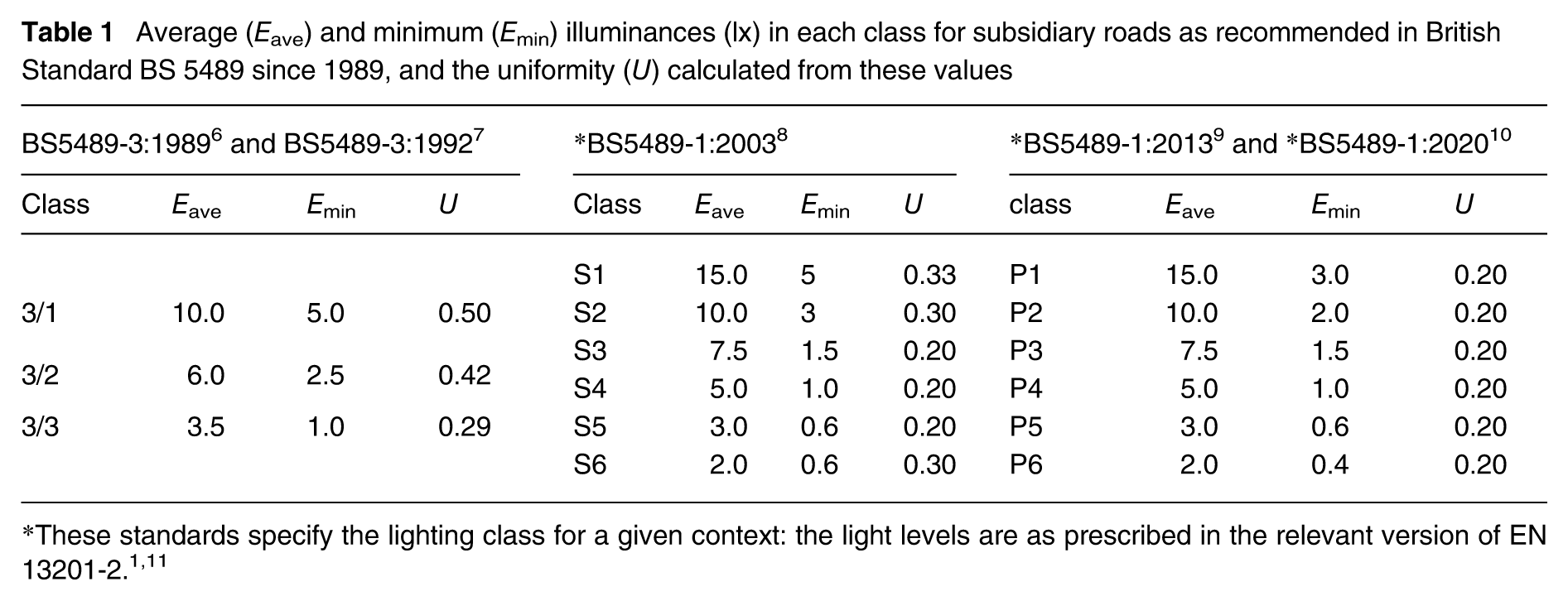
The implied uniformity has not remained constant for a given illuminance. For an average illuminance of 10 lx (class 3/1, S2 and P2 of successive versions of the standard), it has decreased from 0.50 in 1989 and 1992, to 0.30 in 2003, and to 0.20 since 2013.
There have been variations in the uniformities recommended in other national standards. In his summary of lighting standards for ‘street lighting codes’ published in the period 1959 to 1965, mainly for European countries, de Boer (Table 5.3, p. 204) 12 shows that luminance uniformities ranged from 0.25 to 0.60.
The first version of CIE guidance for road lighting, CIE 012-1965, 13 described uniformity qualitatively, with a higher (‘very good’) uniformity recommended for the higher light level and a lower uniformity (‘satisfactory’) for the lower light level. Quantitative uniformity criteria were introduced in CIE 012-2:1977, 14 and these were set to 0.40 for all lighting classes. Those first two CIE road lighting reports focussed on the needs of motorists. Specific criteria for pedestrian road lighting were introduced in CIE 115:1995, 15 in which the implied uniformities ranged from 0.13 to 0.375, the value increasing for higher average illuminances, but in CIE 115:2010, they were changed to 0.20 for each lighting class. 2 In parallel to recommendations for road lighting, CIE has issued guidance for lighting in urban areas, with specific requirements for roads, walkways and cycle paths in different areas, and this guidance tends to recommend higher uniformities than does its guidance for road lighting. In CIE 92:1992, 16 the implied uniformity ranged from 0.25 to 0.5, while the guidance given later in CIE 136:2000 tended to increase the uniformity from 0.4 to 0.5 in pedestrian situations but decreased it from 0.5 to 0.3 for cycle paths. 17
In CIE 012-2:1977, the required uniformity was 0.4 for all lighting classes. 14 A possible source for this was CIE 31:1976, which stated ‘A minimum value of Lmin/Lave= 0.4 is found to be necessary in the range forLavefrom 1 to 3 cd/m 2 ’. 18 This is suggested to be ‘based on Schreuder’s tunel [sic] entrance research as summarized by De Grijs (1971)’ but the author was not able to access the cited document.
The author has also been unable to establish why the value of uniformity might change in different circumstances and why it is now set to 0.2 for all P class roads. That information would enable a discussion of whether it is suitable and/or optimal, whether it should vary with lighting class, and whether it should change over time according to changes in technology and road users.
3. Changes within a class
The second inconsistency in uniformity arises from the assumption that while the average illuminance in a class may exceed the prescribed value, so long as it does not reach the average illuminance of the next class, the required minimum illuminance remains unchanged. Consider class P2: a lighting installation with an average illuminance of 3.0 lx and a minimum illuminance of 0.6 lx would have a uniformity of 0.20. While the average illuminance is permitted to rise above 3.0 lx, the minimum illuminance can also rise but is not required to do so, meaning that an installation giving an average illuminance of 4.9 lx and meeting the minimum illuminance of 0.6 lx would still meet the requirements of class P2 despite a uniformity of only 0.122.
Figure 1 shows the range of uniformities permitted when the lighting classes are specified using average and minimum illuminance. As the average illuminance gradually increases from the minimum for that class, the uniformity gradually reduces, making a sudden jump to the higher value when the average illuminance reaches the value defined for the next class. One way to avoid this would be to specify the minimum uniformity instead of (or, in addition to) the minimum illuminance.
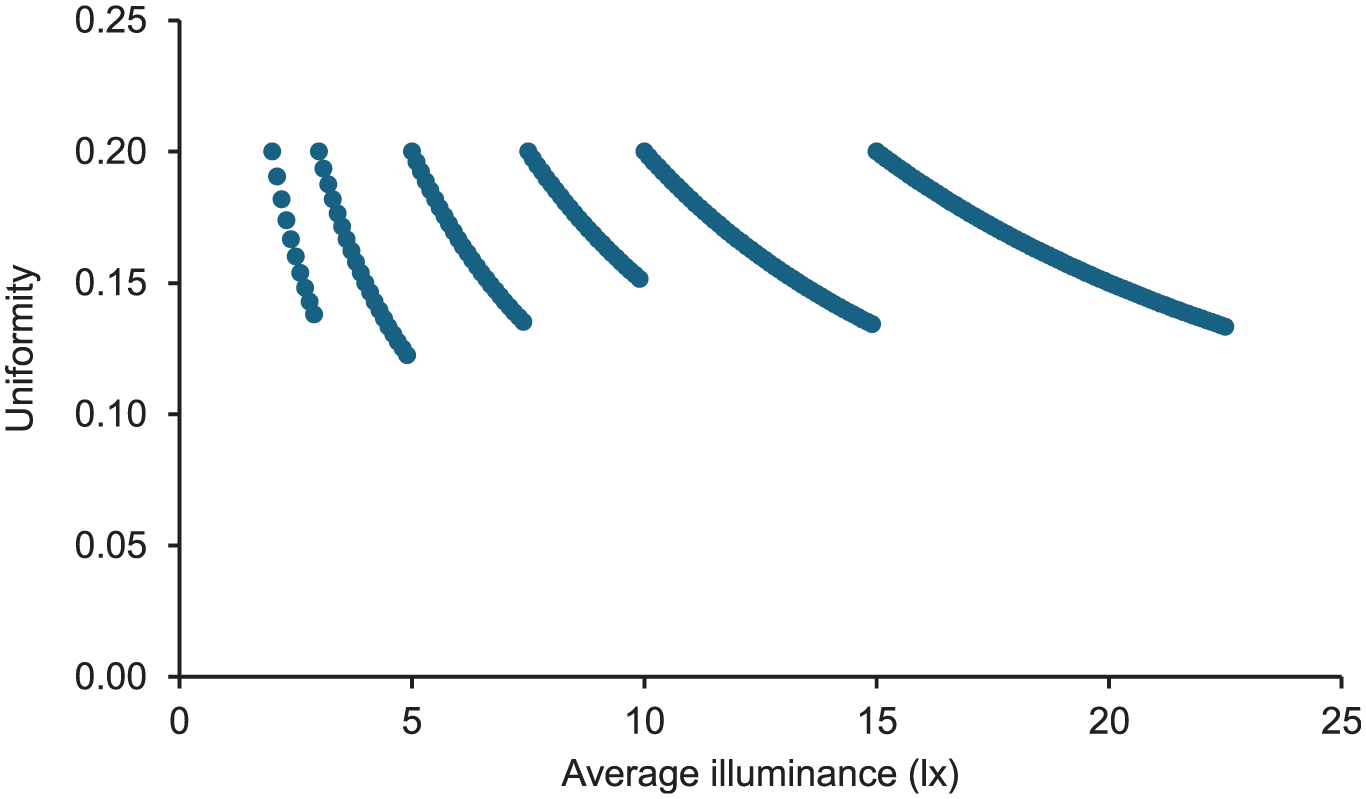
Variation in uniformity with average illuminance for the P-class lighting conditions, assuming that the minimum illuminance remains unchanged
4. Changes within the definition
When defined as the ratio of minimum to average illuminance, uniformity is easy to comprehend and an easy value to calculate, but it is not necessarily the most appropriate definition because it does not provide a consistent relationship between the uniformity value and the possible visual effect.
The minimum illuminance is the lowest illuminance of any of the nodes in the measurement array. As a single value, it is more susceptible to measurement or calculation error than a value such as average illuminance, which is derived from the illuminances of multiple nodes. As the smallest value of the array, it may be a statistical outlier, leading to an underestimate of uniformity. If the true minimum illuminance of a lit area does not fall on a measurement node, it will be missed, and a higher minimum value will be used instead, leading to an inflated estimate of uniformity. An alternative approach to characterising the variance in illuminance would be to use a statistical measure such as standard deviation. This has the potential to improve the robustness of the measure of variance in illuminance by sampling across the entire illuminated area rather than using only the one minimum illuminance value in the calculation. 19 Whether that would be a beneficial change remains to be tested.
Uniformity says nothing about the rate of change of illuminance, that is, whether the transition between locations of different illuminance occurs over a short or long distance. The same uniformity value may present an unnoticeable or a dramatic change in illuminance depending on the distance. One proposal to address this was the relative maximum luminance slope (Smax).18,20 This defined the maximum luminance variation over any 3 m along (or 1 m across) the road, expressed as a percentage of the average road surface luminance. That proposal did not reach design guidance, with one reason given for its omission being that ‘It is, however, not easy to handle in practice’. 18 Given that light distributions tend to be regular (a maximum illuminance near the lamppost and a minimal illuminance midway between successive lampposts), then lamppost spacing could be used as an approximate measure of the rate of change. A greater lamppost spacing would indicate a slower rate of change in illuminance, although that would also depend on the other factors that affect the spatial distribution of light. Such a proposal remains to be tested.
5. Proposals
To give confidence that lighting recommendations are robust and optimal, it would be useful to establish an empirical basis for the implied target value of uniformity, either as the basis for current guidance or as evidence for new guidance. To improve the consistency of application, it would be useful to specify uniformity explicitly in guidance and to explore alternative approaches to characterising the spatial variation in illuminance.
