Abstract
The present study aims at testing the relationship between societal vulnerability and self-reported offending using the Belgian data of the second International Self-Report Delinquency Study (ISRD-2). Societal vulnerability is a much-discussed covariate of adolescent offending. We test the hypotheses that violent values, self-control and troublesome youth group involvement are key mechanisms that mediate the relationship between societal vulnerability and offending. We found an indirect path of societal vulnerability for offending through violent values, self-control and troublesome youth group involvement, but there remains also a direct impact. The implications of these findings for policy and future studies of offending are addressed.
Introduction and research questions
At the beginning of the 1980s, Vettenburg, Walgrave and Van Kerckvoorde (1984) proposed an integrative theory of serious offending: the societal vulnerability theory (SVT). The key assumption of the SVT is that an accumulation of negative experiences or contacts with official societal institutions (ranging from schools to probation officers and juvenile courts) may lead to an unfavourable societal perspective, just as was outlined later by Sampson and Laub (1997) in their theory of cumulative disadvantage. The accumulation of negative experiences may have a psychological impact because they could direct individuals towards specific social-psychological coping strategies that help them to handle these incurred frustrations (Agnew, 1992). Offenders may persist because the so-called labelling process helps the offender to adapt the deviant master status and thus offending becomes reinforced. 1
Although the relationship between societal vulnerability and offending has received some empirical support in the past few decades (Vettenburg, 1988; Vettenburg and Huybregts, 2003), there has been little research into the mechanisms that translate societal vulnerability into offending.
Various mechanisms have been identified that explain why societal vulnerable groups exhibit higher levels of serious offending. In the present study we examine the role of violent values, self-control and troublesome youth group involvement. Violent values is one frequently reported intervening mechanism that relates structural background characteristics to offending (Hawkins et al., 1998). Self-control has also consistently been mentioned as a key mechanism that directly affects offending (Evans et al., 1997; Gottfredson and Hirschi, 1990). Troublesome youth group involvement has been mentioned within subcultural theories of offending. Early scholars such as Miller (1958) referred to the important role of socioeconomic status (SES) in shaping crime-prone values among gang members. More recently, and much under the influence of the work of the Eurogang working group (for example, Esbensen and Weerman, 2005), scholars point to the independent effect of troublesome youth group involvement on offending (Pauwels et al., 2011). The question examined here is whether these mechanisms, that is, violent values, self-control and troublesome youth group involvement, mediate the relationship between societal vulnerability and frequencies of self-reported offending. The aim of the present enquiry is to identify statistical paths through which societal vulnerability is related to adolescent offending. The analyses are conducted on a property crime scale and a violent crime scale, which allows us to get some preliminary insight into the robustness of the findings.
Societal vulnerability theory
Both societal groups and individuals in society are defined as ‘societally vulnerable’ when they derive little benefit from their contacts with societal institutions and additionally are mainly and recurrently confronted with the negative effects of these institutions (Vettenburg, 1988). The term ‘vulnerability’ refers to a state involving a heightened risk of contacts that have a negative effect. Vulnerability is by definition an interactional concept. One is always vulnerable to something, in our case societal institutions. The potentiality of societal vulnerability lies in the structural position of the population group, namely its belonging to a lower societal stratum. A key characteristic of the lower strata is that they share an increased risk of lacking the authority to have their own culture integrated into and accepted by the socially recognized culture. This implies that the interests of the members of low-SES groups are less defended, that their specific needs and requirements are not adequately met and that they experience serious difficulties in protecting themselves against the negative labelling that surrounds them. This cultural aspect explains why societally vulnerable people or groups cannot call on social institutions to reduce inequality. As a result, they will start developing their own coping strategies when trying to solve problems related to their state of vulnerability. These strategies may include delinquent behaviour. Within the theoretical framework of SVT, societal vulnerability is explicitly recognized as a cumulative process. A key characteristic of vulnerable groups is that they are confronted with a series of social institutions throughout the entire life course.
In the process of becoming societally vulnerable, social bonds play a crucial role. Young people with few or no bonds to society offend at a higher rate (Hirschi, 1969) and are at risk of developing a street-oriented lifestyle. The main argument is that adolescents who are freed from their ties to society no longer have any stakes in conformity and have nothing to lose. The development of social ties interacts with social institutions and is essentially related to the cultural gap between adolescents and institutions. Schools play a crucial role in the process of socialization (Gottfredson, 2001). Schools differ with regard to their pupil and staff composition (for example, pupils with poor conduct standards, well-trained staff members) and social climate (informal control). Therefore the school also has an important function with regard to the development of vulnerability among pupils. Schools can make a positive offer: they can teach pupils to read and to write, they can help them to acquire skills and attitudes. Pupils can fully benefit from this offer if they meet certain conditions, for example, if they can express themselves fluently and if they are willing to accept authority. As a consequence, pupils who meet these standards generally tend to develop a series of ties at school that will subsequently attach them to society at large.
The socialization process is, however, much less favourable for pupils who fail to meet these standards. Children from lower social strata are often less well prepared for school, since what they learn at home bears little relation to what they are taught at school (Nicaise, 1997). As a result they are at risk of not being accepted by their teachers (Vettenburg, 1988). Such pupils fail to develop personal ties between teachers and themselves. As a consequence, they are at risk of quickly being negatively labelled (that is, stigmatized as stupid and unruly). In addition, teachers expect them to perform inadequately and hence give few positive stimuli (which can result in a self-fulfilling prophecy; see Rosenthal and Jacobson, 1968). These pupils are consequently less committed to their school tasks and as a result they will effectively end up knowing less, performing badly and losing social prestige. They will gradually start feeling incompetent themselves. Adjustment to school discipline becomes less meaningful (what do they have left to lose?) and more difficult; as a consequence, they will be punished more frequently. They internalize less the norms and values of the school. They tend to show a positive attitude towards violence and a low level of self-control.
In addition, it has been argued that pupils who suffer bad experiences and therefore develop negative expectations of the future start seeking each other’s company (Preveaux et al., 2004; Staff and Kreager, 2008). They look for support among their peers and as a result they will start developing their own system of anti-values. In this group, prestige is gained not through adjustment to conformist values but through challenging these values.
These characteristics – the lack of social ties, the feeling of stigmatization, the development of a negative self-image – initiate a process that leaves its mark on these pupils’ values systems (violent values) and poor self-control. In the presence of similarly stigmatized adolescents, at-risk adolescents are propelled into a downward spiral of societal vulnerability. They drift away from conformity and the risk of serious offending grows. A child starting its social career in a societally vulnerable family risks ending up in a downward spiral of increasing societal vulnerability. In SVT, this process is not considered to be fatal or deterministic. SVT points to the risk of being hurt in the downward spiral of coping with vulnerability. The root cause of this problem is that family culture and school culture are not in tune. This is related to the fact that school and society are interwoven. As a result, the school makes a conditional offer, which in turn requires ‘control’ over whether these conditions are met and the application of ‘sanctions’ when these standards are not met. Some social groups (such as working-class groups and immigrant groups) share some cultural elements that hardly fit the dominant culture propagated by the school and other social institutions (Bourdieu and Passeron, 1970; Nicaise, 1997). The wider the gap between the dominant culture and these subcultures, the greater the risk that members of such a group will be confronted solely by ‘control’ and ‘sanctions’ in their contacts with social institutions. Societal vulnerability may start developing when the number of negative contacts outweighs the number of positive contacts with institutions. The disadvantageous nature of one’s socioeconomic position plays a role with regard to the triggering of offending only when it is accompanied by negative sociocultural and psychological consequences. SVT highlights the role of social contexts and the operation of social institutions themselves in both creating and maintaining problems related to offending. SVT explicitly distinguishes itself from naive and unidirectional explanations of offending that only study processes of labelling by social institutions; SVT stresses the importance of taking into account societal vulnerability as an interactional concept that should not be omitted when studying human behaviour.
As argued above, SVT stresses the importance of pupil–teacher interactions and school commitment, a finding that has been demonstrated in many empirical studies of adolescent offending (Elliott and Voss, 1974; Rutter et al., 1979; Welsh et al., 1999). In Belgium, a number of studies that departed from SVT were conducted between 1984 and 2000. These studies support elements of SVT. In the study ‘School experiences, delinquency and societal vulnerability’ (Vettenburg, 1988) empirical evidence was found for the fact that a more emancipatory relationship between pupil and teacher negatively correlates with pupils’ problem behaviour. This finding was corroborated in the study ‘Feelings of insecurity and antisocial behaviour’ (Vettenburg and Huybregts, 2003). These findings suggest that individual differences in offending can to a large extent be explained by the quality of pupils’ relationship with their teachers and by the extent to which young people are being monitored by their parents. In the aforementioned studies, the quality of the relationship with the teacher appeared to be the strongest predictor of offending in all subgroups under investigation (that is, within sub-groups by gender and type of education). Moreover, the extent to which parents monitor their children’s whereabouts appears to have a curbing effect on offending. The study of Vercaigne et al. (2000) shows that, although the socioeconomically most marginalized groups run a greater risk of offending, this risk materializes only if this unfavourable status coincides with a lack of parental control, serious disciplinary problems at school and unstructured routine activities (Osgood et al., 1996). If these negative elements are absent, there is a strong likelihood that these young people will be less involved in offending than young people from families with a medium or higher SES. These results illustrate that it is not the SES itself that leads to offending, but an accumulation of unfavourable experiences with social institutions, the educational climate in the family, integration into school (especially), and relationships with peers.
The mechanism of violent values, self-control and troublesome youth group involvement on offending
Early studies of SVT stressed the importance of taking into account negative interactions with social institutions, but it has never really been tested whether key mechanisms of contemporary aetiological perspectives may act as mediators of the relationship between societal vulnerability and offending. We therefore investigated the direct and the indirect effects of societal vulnerability on young people’s offending. For the indirect effect, we investigated the role played by the variables violent values, self-control and troublesome youth group involvement. 2
The criminological literature provides ample support for the relationship between violent values (attitudes favourable to the violation of law) and low self-control on the one hand, and troublesome youth group involvement and offending on the other.
People who exhibit high levels of conventional moral beliefs are those most likely not to get involved in offending. Violent values is a key mechanism in explaining individual differences in offending. Values that are favourable to the violation of laws have been an important variable in many theories of offending. Sutherland (1947) stressed the importance of learning norms that approve of law-breaking in his classic book Principles of Criminology, which contains the definitive version of his differential association theory; control theories, in contrast, stipulated the role of social bonds in socialization. In his social learning theory, Akers (2006) further refined ideas stated in Sutherland (1947) and argued that violent beliefs are an important learning mechanism, especially through the principles of reinforcement. Peers play an important role in the formation of violent beliefs. Similarly, subcultural theories of offending point to the role of social learning and the role of significant others. In short, attitudes that are supportive of law-breaking are stable covariates of offending (Svensson et al., 2010). Therefore it is important to consider violent beliefs when one wants to assess the strength of the relationship between societal vulnerability and offending.
Self-control has consistently been found to be a modest to strong correlate of both crime (Brownfield and Sorensen, 1993; Grasmick et al., 1993; Pratt and Cullen, 2000; Turner and Piquero, 2002) and analogous acts of offending, including substance use/abuse (Arneklev et al., 1993; Cochran et al., 1994; Gibbs and Giever, 1995; Piquero and Tibbetts, 1996; Sorenson and Brownfield, 1995).
More recently, attention has been paid to the concept of self-control in the explanation of troublesome youth group involvement (Kissner and Pyrooz, 2009; Pyrooz et al., 2012; Pyrooz and Decker, 2012). 3 Although self-control theory was originally developed to explain individual differences in offending, the model also fits the explanation of troublesome youth group involvement (Esbensen and Weerman, 2005; Hope and Damphousse, 2002). Gottfredson and Hirschi (1990) highlight the importance of opportunity facilitating criminal and analogous behaviour, such as joining a troublesome youth group. Previously, Hope and Damphousse (2002) found empirical evidence for the negative relationship between self-control and gang membership, and Pauwels (2010) found evidence for the existence of a strong positive effect of impulsivity and aggression (two major dimensions of low self-control) on troublesome youth group involvement, even when controlling for background characteristics, social bonds, deviant beliefs and exposure to criminogenic moral settings. Thus, troublesome youth group involvement and offending seem to have some overlapping causes (Esbensen et al., 2009). For a very long time, some scholars have also identified gang membership as having a causal effect on offending (Klein, 1971; Thrasher, 1927). Few scholars questioned the temporal order of offending and gang membership. Thornberry et al. (2003) identified three reasons for the effect of gang membership on offending: selection, facilitation and enhancement. Selection implies that a gang is simply a collection of people with shared individual deficits such as poor self-control. In other words, the gang itself has no causal influence on offending. The causal effect of the gang extends beyond mere opportunity, deriving from the features of the gang itself (for example, organization, rivalries; see Kissner and Pyrooz, 2009). Enhancement combines selection and facilitation effects. This ‘kinds of groups and persons’ model is supported when there is evidence of a selection effect – more delinquent youths are recruited into gangs – and this leads to a facilitation effect whereby offending is increased during gang membership relative to non-gang youths with similar criminal propensities. In the present study, troublesome youth group involvement is considered to be an important mechanism that mediates the effect of societal vulnerability on offending, all other things being equal, and we expect troublesome youth group involvement to have an independent effect on offending because of the specific subcultural and situational characteristics of the gang itself.
Hypothesized direct and indirect effects of societal vulnerability
The principal goal of this study, namely the identification of direct and indirect effects of societal vulnerability on offending, is reached by examining all possible statistical paths from societal vulnerability on offending. Statistical paths represent a hypothesized and tested relationship. We recognize that no path analysis can be equal to a real test of causal relationships, but we argue that the inverse is true: if some causal effect exists in the real world, the statistical effects should be found (see also the discussion in Wikström, 2007).
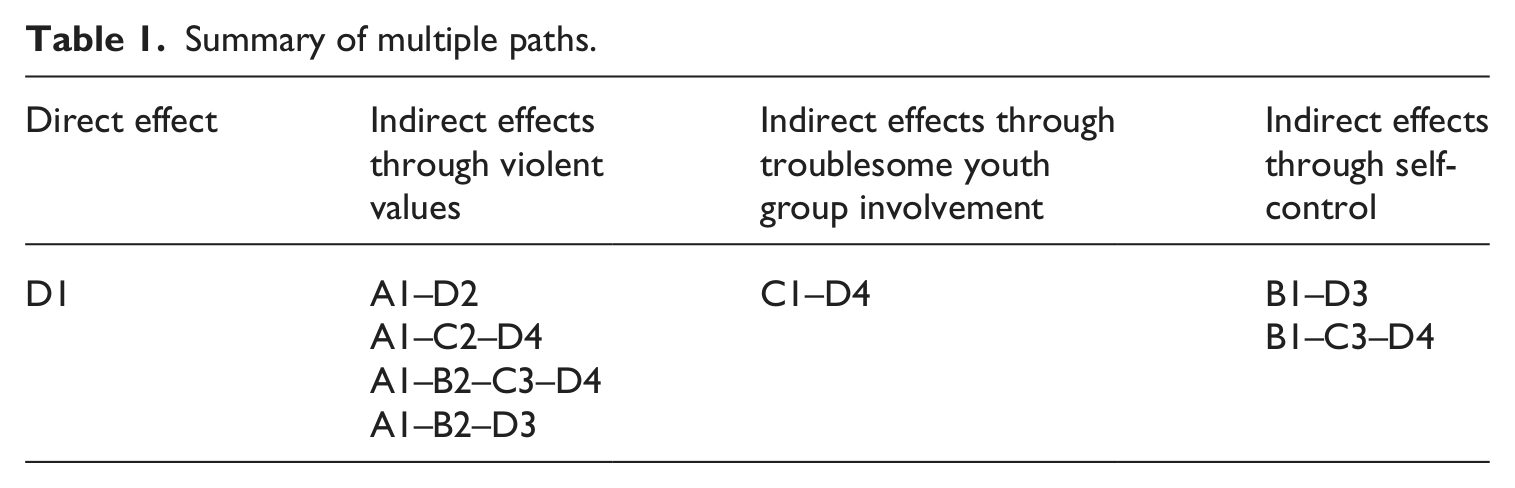
Table 1 summarizes all possible statistical paths that depart from societal vulnerability and lead to offending. Every effect has been given a unique code, so that it is easy to compare our findings with the hypothesized relationships in the path diagram (Figure 1), which represents all tested paths (arrows) from societal vulnerability to violence and property crime.
Summary of multiple paths.
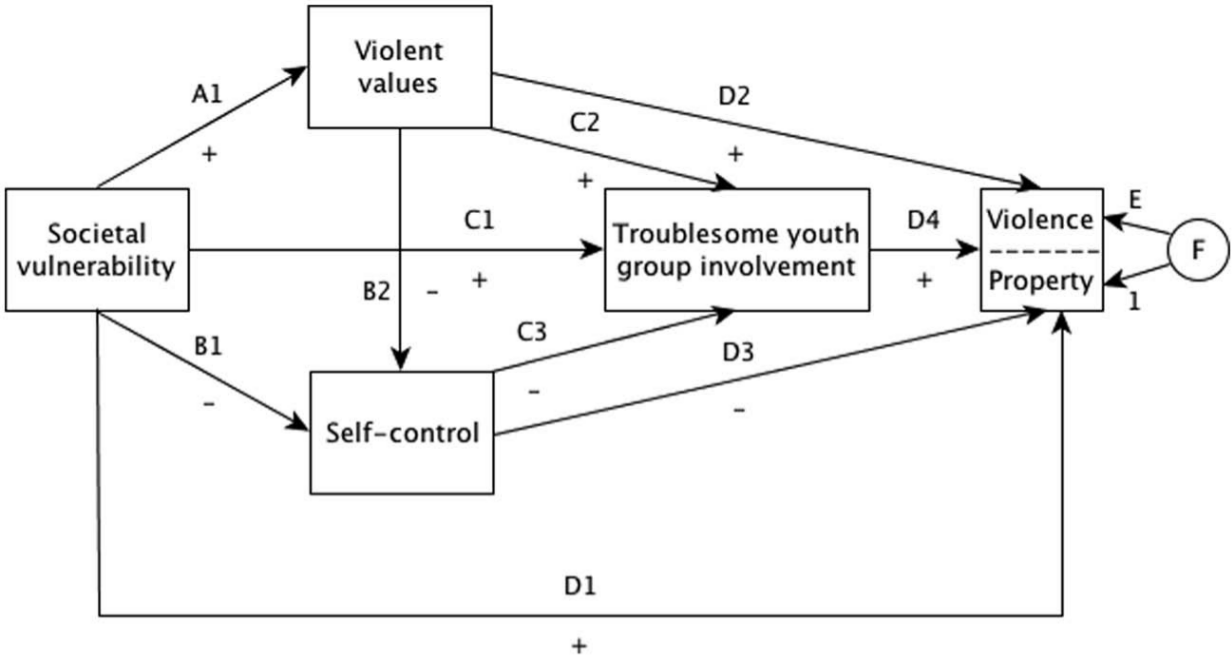
Path diagram of direct and indirect effects of societal vulnerability on offending.
Data
ISRD-2
The first International Self-Report Delinquency Study (ISRD-1) was launched in 1992 by the Research and Documentation Centre of the Dutch Ministry of Justice (WODC). The study was based on self-report delinquency data collected in 12 countries, most of which belong to the European Union (Junger-Tas et al., 1994, 2003). In 2003, the idea of repeating the study emerged; 31 countries participated in ISRD-2. The survey was carried out in 2006 by means of a standardized questionnaire (Junger-Tas et al., 2010; Vettenburg et al., 2010).
The Belgian city samples
In Belgium, the research team responsible for the ISRD-2 survey opted for a city-based sampling strategy, as proposed by the ISRD-2 Steering Committee. Four cities were chosen in the two Belgian regions; two cities in Wallonia and two in Flanders. All cities have quite similar characteristics. Two of the selected cities belonged to the group of metropolitan cities in Belgium and two were rather small, although similar in terms of demographic background characteristics. We surveyed both male and female students in the seventh, eighth and ninth grades (as per the US school system). In Belgian terms, the respondents were in the first three years of the secondary school system. Out of 93 schools, 43 agreed to participate (29 out of 64 for the two medium-sized cities and 14 out of 29 for the two small cities). In other words, 46.3 percent of the contacted schools agreed to cooperate in the survey. Within each school, a random sample of one to three classes was taken, depending on the number of study years organized by the school. Finally, 148 classes were visited. In total, the research team received 2247 (paper-and-pencil) questionnaires. The sampling and the methodology are described in detail elsewhere (Vettenburg et al., 2010).
Measurement of constructs
Offending
In our analyses, offending is the dependent variable. Adolescents were asked if they had ‘ever’ committed one or more offences in a series of 11 offences. On the basis of the factor analysis, two sub-scales were created: violent offences and property offences (see Table 3 in Appendix 1). Violent offences comprise snatching, carrying a weapon, group fight, robbery and assault; property offences comprise vandalism, shoplifting, burglary, bicycle, car or motorbike theft, and stealing from a car (1 = committed this offence, 0 = never committed this offence). After performing a categorical factor analysis to check dimensionality, the sum-scores per factor were calculated. In order to gain insight into the generalization of findings, a distinction was made between a property offences scale and a violent offending scale. Generalists would expect to see that the model holds for both offending scales.
Societal vulnerability
Societal vulnerability was measured by creating one overall additive index that measures the key dimensions of societal vulnerability. 4 In constructing the overall additive index of vulnerability, we used the principle of working with dichotomous risk scores on 14 indicators. Respondents were given a dichotomous risk score, where 1 symbolizes the ‘at risk’ end of the distribution and 0 measures the ‘not at risk’ end of the distribution. The following two dimensions were taken into account: (1) vulnerability at the family level and (2) societal vulnerability at the adolescent level.
societal vulnerability at the family level: the educational level of the parents (1 = no parent with a secondary educational level, 0 = everything else), SES work (1 = neither parent has a paid job, 0 = everything else), comfort at home (1 = two or fewer comfort items answered positively), neighbourhood status (1 = less than or equal to 2; 0 = higher than 2), mother tongue spoken at home (1 = no official language of Belgium spoken, 0 = French or Dutch), lifetime prevalence of physical violence in the family (1 = yes, 0 = no), immigrant status (1 = first or second generation, 0 = no immigrant status).
societal vulnerability at the adolescent level: attachment to parents (1 = below or equal to the average scale score, 0 = everything else), relation to school teacher (1 = below or equal to the mean scale score, 0 = everything else), attachment to school teacher (1 = below or equal to the average scale score, 0 = everything else), commitment to school (1 = below or equal to the mean score, 0 = everything else), time spent on homework (1 = less than half an hour on a regular weekday; 0 = half an hour or more), repeated a grade (1 = repeated once or more, 0 = never), achievement (1 = below average, 0 = average or above).
Violent values
The present study measures violent values with regard to defensive or retaliatory acts of violence. We used an attitudinal scale as a measure of deviant attitudes with regard to the use of violence. The five items refer to positive attitudes towards the use of violence (for example, ‘A little bit of violence is part of having a good time’), as is common in studies on the effect of violent values on offending (for example, Oberwittler, 2004). Cronbach’s alpha was 0.753. High scores refer to high levels of violent values. A factor analysis was conducted on the scale and all items have sufficiently high factor loadings on this one-dimensional factor.
Self-control
Self-control was measured by combining 12 items (for example, ‘I react immediately without taking a break to reflect’). The indicators resemble the items of the well-known scale constructed by Grasmick et al. (1993). The questions refer to the key characteristics of low self-control: preferring simple tasks over complex tasks, impulsivity, risk-seeking behaviour, temper, self-centredness and physical activities. All items were collapsed into a general scale. High scores referred to high levels of self-control. Cronbach’s alpha was 0.808. A one-factor solution indicated that no item had unacceptable factor loadings. We preferred the overall composite because we did not use the entire 24-item scale that allowed all dimensions to be measured with a sufficient number of indicators, thus allowing us to create robust sub-scales (for example, Arneklev et al., 1999).
Troublesome youth group involvement
Troublesome youth group involvement was measured by means of a funnelling technique; that is, we combined the answers to one filter question and three follow-up questions. The leading question was ‘Some adolescents have a steady group of friends to do things together or to hang around outside. Do you have such a group of friends?’ The three follow-up questions were: (1) ‘Do the members of this group spend a lot of time with each other in public places such as parks, on the streets, or a shopping mall in the neighbourhood?’ (2) ‘Do the members approve of illegal things (i.e. things that are not allowed by law)?’ (3) ‘Are there some members of this group who have engaged in illegal activities (i.e. activities that are not allowed by law)?’ Respondents were categorized as involved in a troublesome youth group if they answered affirmatively to these four questions.
Analysis plan
Observations of offending typically result in count variables with highly skewed distributions owing to a high number of zeros. A regular Poisson or negative binomial regression is not sufficient for this kind of distribution. Therefore, zero-inflated Poisson modelling (ZIP) was used in this analysis. ZIP modelling uses a mix of two models to handle the high number of zero counts (Atkins and Gallop, 2007). The model assumes two groups of observations: a group that can be called ‘always zero’ and a group that is ‘not always zero’. The ‘not always zero’ group is fitted by a Poisson model. Simultaneously, a logistic regression is used to fit the probability of belonging to the ‘always zero’ group. Because of the aggregated sampling design – students within schools – standard errors were adjusted by means of sandwich estimators (Muthén and Satorra, 1995).
The path model involved five different dependent variables of three different types: two continuous variables, one dichotomous variable and two count variables. Each type of outcome variable needs a different type of analysis. Linear regression is used for violent values and self-control, logistic regression for troublesome youth group involvement and ZIP regressions for violent offences and property offences. The linear regression coefficients have a simple linear interpretation. The coefficient is the estimated increase in the dependent variable for a one-unit change in the independent variable. The results of the logistic regression are interpreted in terms of odds ratios. Odds ratios reflect the increase from a certain factor in the estimated odds for a one-unit increase in the independent variable. The ZIP regressions consist of two parts: a zero-inflation part and a count part. The zero-inflation part models whether or not a youngster has committed an offence. The result is a logistic regression model that can be interpreted in terms of odds ratios. The count part models the frequency of offences. The result is a Poisson regression model, which can be interpreted in terms of rate ratios. Rate ratios reflect the difference in the estimated frequency of offences between groups with a one-point difference in the independent variable (Atkins and Gallop, 2007; De Smet et al., 2011). Finally, a correlation is fitted between violent offences and property offences. Therefore, a latent variable is modelled with a variance equal to 1 and loadings of violent offences and property offences. The loading of property offences on the factor is set to 1. The coefficient for the loading of violent offences is an estimate for the correlation. 5 The model is fitted in MPlus 6.11 (Muthén and Muthén, 2010).
Results
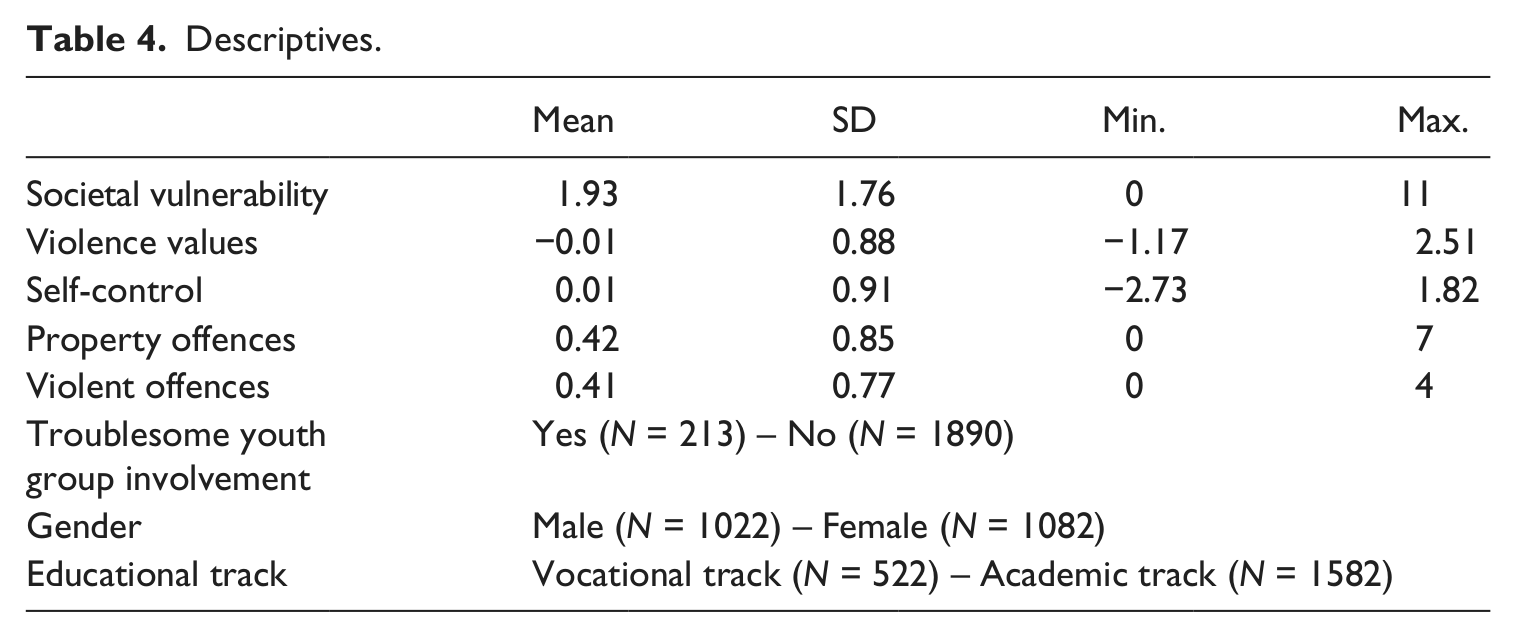
Analytically we distinguish two measures of offending by applying the model to ‘violent offences’ and ‘property offences’. On average, adolescents have approximately equal scores on both scale constructs (violent offences: mean = 0.41; property offences: mean = 0.42). The descriptives for all variables can be found in Table 4 (see Appendix 1). Table 2 shows the path analyses performed for violent and property offences.
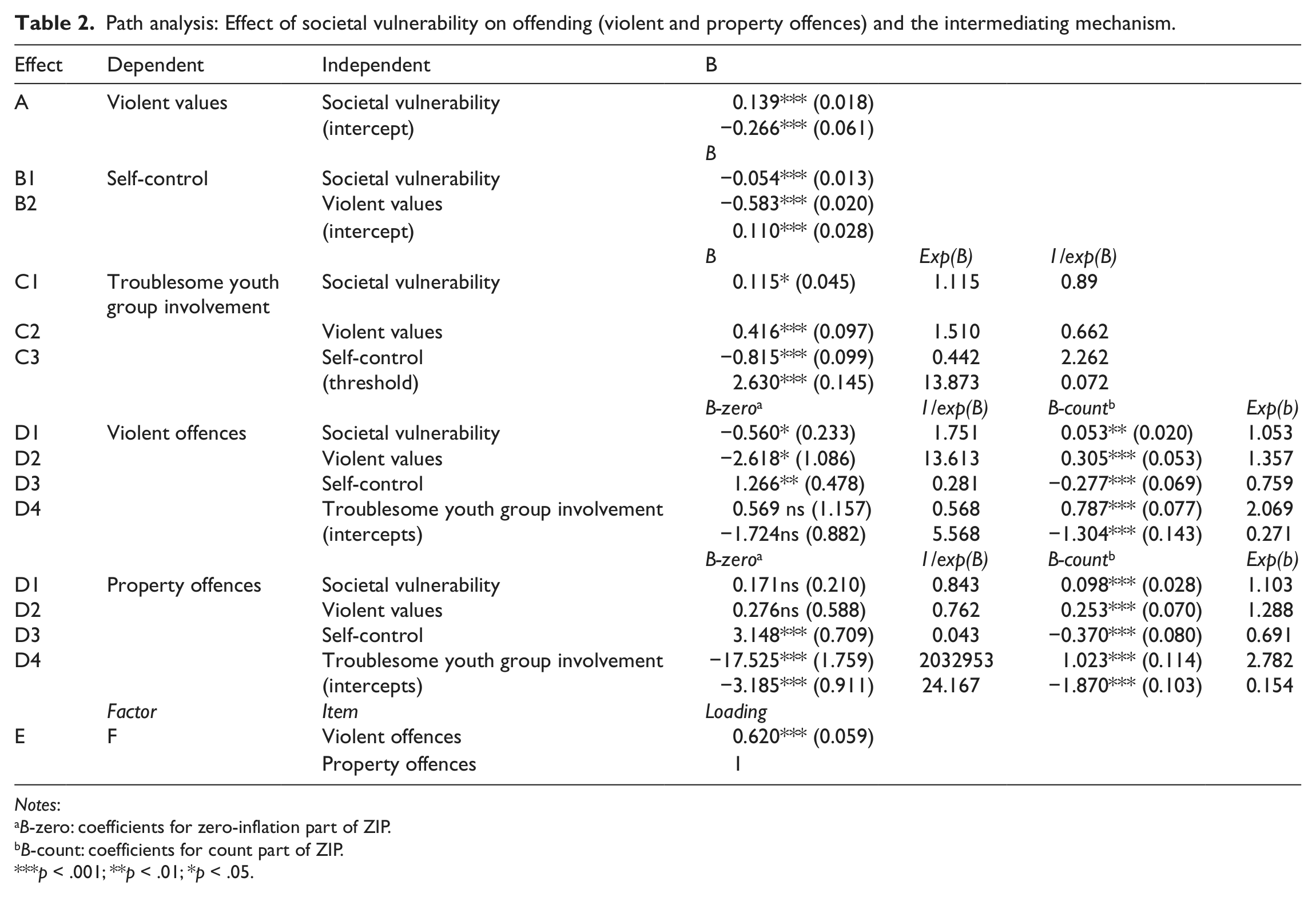
Path analysis: Effect of societal vulnerability on offending (violent and property offences) and the intermediating mechanism.
Notes:
B-zero: coefficients for zero-inflation part of ZIP.
B-count: coefficients for count part of ZIP.
p < .001; **p < .01; *p < .05.
Violent offences and property offences
Table 2 shows a positive correlation between violent and property offences (effect E), indicated by a reasonably high loading of 0.62, controlling for the independent variables. This result could be expected given that the factor analysis also showed a high correlation between the two factors (see Table 3 in Appendix 1).
For the dependent variables violent offences and property offences there is a hypothesized direct effect of four variables: societal vulnerability, violent values, self-control and troublesome youth group involvement. On top of these direct effects, the path model also indicates several indirect effects. In the following results, we restrict ourselves to the hypotheses stated above; that is, we discuss the direct effect and the indirect effects of societal vulnerability on both violent offences and property offences.
Societal vulnerability and violent offences
Controlling for violent values, self-control and troublesome youth group involvement, there is evidence for a direct positive effect between societal vulnerability and violent offences (Table 2). Societal vulnerability discriminates between adolescents who never reported a violent offence and those who did report violent offences. The odds ratio (OR) is 1.75 (p < .05). Thus, for a one-unit increase in societal vulnerability there is an estimated increase of 75 percent in the odds of committing a violent offence. Societal vulnerability also influences the frequency of violent offences. The rate ratio (RR) is 1.05 (p < .01). Thus, for a one-unit increase in societal vulnerability, a 5 percent increase in the frequency of violent offences is estimated. This can indicate that societal vulnerability influences the persistency of violent offenders.
Indirect effects are also hypothesized and modelled. Calculating the coefficients for the total indirect effects of societal vulnerability on violent offences is – to our knowledge – not possible with current software. This is owing to the zero-inflation characteristic of violent offences. It is possible, however, to interpret the results intuitively in terms of ‘positive’ and ‘negative’ effects.
As stated above, there are seven indirect effects of societal vulnerability on violent offences in the path model. The indirect effect through violent values is positive, since the direct effect of societal vulnerability on violent values (B: 0.14; p < 0.001), the direct effect of violent values on violent offending (OR: 13.61; p < .05 – RR: 1.36; p < .001) and the direct effect of societal vulnerability on troublesome youth group involvement (OR: 1.12; p < .05 ) are positive and the direct effect of violent values on self-control is negative. In other words, a high level of societal vulnerability increases offending through an increase in violent values, a decrease in self-control and an increase in the odds of belonging to a troublesome youth group. The remaining indirect effects are mediated effects of societal vulnerability on troublesome youth group involvement and self-control through violent values. The indirect effect of societal vulnerability through violent values and through troublesome youth group involvement on violent offending is positive. A high level of societal vulnerability increases one’s level of violent values (0.14; p < .001), which in turn increases the probability of troublesome youth group involvement (OR: 1.51; p < .001), which ultimately is translated into higher frequencies of violent offending (RR: 2.07; p < .001). The indirect effect through self-control and troublesome youth group involvement is positive. A higher level of societal vulnerability negatively affects one’s level of self-control (B: −0.05; p < .001). Low levels of self-control increase the probability of troublesome youth group involvement (OR: 0.44; p < .001), which in its turn translates into high frequencies of violent offending (RR: 2.07; p < .001).
Summarizing, all indirect effects of societal vulnerability are statistically significant, just like the direct effect. Higher odds of ever committing violent offences and a higher frequency of violent offences are estimated for youngsters with a higher degree of societal vulnerability.
Societal vulnerability and property offences
After controlling for the above-mentioned variables, a direct positive effect of societal vulnerability on committing property offences was found. Societal vulnerability does not discriminate between youngsters who never reported a property offence and those who did. However, societal vulnerability affects the frequency with which adolescents report property offences. The rate ratio is 1.103, so, for a one-unit increase in societal vulnerability, a 10 percent increase in the frequency of property offences is estimated. The findings for the indirect effect are similar to those for violent offences. All indirect effects of societal vulnerability on property offences are positive and thus enforce the finding of the direct effect.
Conclusion and discussion
The analyses reveal the existence of multiple statistical paths from societal vulnerability to offending, measured as two constructs referring to violent offences and property offences. We found that a positive attitude towards violence, low self-control and troublesome youth group involvement affect the occurrence of adolescent offending. This applies to both violent and property offences. The statistical effect of societal vulnerability is still significant when the intervening mechanisms are held constant. In other words, irrespective of these individual characteristics, societal vulnerability partly explains the variance in offending. The results clearly suggest that a multitude of indirect effects can be distinguished. Societally vulnerable young people tend to develop a higher tolerance of violence, lower self-control and a stronger troublesome youth group involvement. Our findings yield empirical support for the assumption that societal vulnerability can explain individual differences in frequencies of offending using a violent offending scale and a property offences scale that included both less serious and more serious offences. Because the results were nearly identical, one may question the necessity for different aetiological models. Some scholars distinguish between at least two types of juvenile crime: delinquency as an age-related phenomenon, and serious offending or offending as a manifestation of an emerging lifestyle (Moffitt, 1993; Rutter et al., 1979). 6 Previous studies of SVT have assumed that societal vulnerability fits the explanation of serious offending and belonging to the life-course-persistent group better than the explanation of minor offences. The present study included both moderate and rather serious offences and empirically distinguished between the actual reporting of a violent or property crime and violent crime and it revealed that societal vulnerability has a stronger impact on the frequency with which adolescents report both violent offences and property offences than on the actual reporting of both offences. This pattern was found to be fairly identical for both offence types.
These findings are valuable not only from a theoretical perspective but also for policy-making. Only a limited effect is to be expected of policy measures and interventions seeking to intervene exclusively on either individual (for example, reinforcing young people’s self-control) or situational and structural characteristics. Moreover, individual characteristics are also related to societal factors of the environment in which adolescents grow up. Our analyses indicate the importance of both individual and structural factors for offending. We argue that prevention should be guided towards the main causes of offending, but effective and durable prevention should also aim at the ‘causes of the causes’ of offending (Esbensen et al., 2001; Wikström, 2007). It is essential that, if the process of societal vulnerability is to be reversed, the culture of vulnerable groups should be seen as a cultural variant and not as a culture that is inferior to the dominant culture. Given the major importance of the school in the vulnerability process, it is also evident that policy-makers should develop measures to achieve this cultural appreciation within the school.
The present study has some important limitations that need to be taken into account. First, the data are cross-sectional, which impedes any statements about causal relationships. Moreover, the ISRD-2 data were used to verify the theoretical model of societal vulnerability. The ISRD research was not launched with the explicit goal of testing SVT. Although a large number of indicators of this theory were included, some others were absent (including negative experiences with welfare and judicial organizations). In other words, the general measure of societal vulnerability was calculated on the basis of a limited number of indicators. To fully understand the enduring effects of societal vulnerability, panel studies are required. Non-reciprocal effects are difficult to test empirically (Matsueda and Heimer, 1997). Technically, it is not possible to describe the feedback loop whereby committing an offence and the social reaction to it influence the societal vulnerability of young people. Perhaps even more important with regard to the dynamic nature of relationships between ‘causes and effects’, future studies of SVT may benefit from distinguishing between exit from and entry into troublesome youth groups. Emerging research on troublesome youth groups reveals that joining and leaving such a group affect offending for the worse (entry) and for the better (exit) (see Melde and Esbensen, 2011; Sweeten et al., 2012). Our path model merely illustrates the importance of violent values, self-control and troublesome youth group involvement as key mediating mechanisms. Finally, we used only the Belgian data from the ISRD database. To make the comparison with the other countries, societal vulnerability should be measured identically in the participating countries. To date this has not been the case. The Belgian research team posed additional questions referring to the concept of societal vulnerability in the optional module of the questionnaire. Finally, SVT assumes that an accumulation of negative experiences may affect serious offending. Future studies should include a broader range of societal reactions (for example, schools, the police and juvenile courts).
Footnotes
Appendix
Descriptives.
| Mean | SD | Min. | Max. | |
|---|---|---|---|---|
| societal vulnerability | 1.93 | 1.76 | 0 | 11 |
| Violence values | −0.01 | 0.88 | −1.17 | 2.51 |
| Self-control | 0.01 | 0.91 | −2.73 | 1.82 |
| Property offences | 0.42 | 0.85 | 0 | 7 |
| Violent offences | 0.41 | 0.77 | 0 | 4 |
| Troublesome youth group involvement | Yes (N = 213) – No (N = 1890) | |||
| Gender | Male (N = 1022) – Female (N = 1082) | |||
| Educational track | Vocational track (N = 522) – Academic track (N = 1582) | |||