







Abstract
Selection, opportunity and learning have been proposed as possible mechanisms linking adolescents’ offending to that of their peers. This study tests competing hypotheses derived from these theoretical accounts, focusing on the so far unresolved question of the context specificity of peer effects. I investigate whether offending behaviour by the peer group of adolescents shown in one context is related only to adolescents’ own offending in the same context or also to offending in other contexts. Using data from the Edinburgh Study of Youth Transitions and Crime and applying random intercepts logistic regression models, I find evidence for context-specific peer effects of theft in different contexts. Peers’ self-reported theft in any context is related to adolescents’ self-reported theft in the same context but, with one exception, not to adolescents’ theft in other contexts. These results support learning as an important mechanism explaining peer similarity in offending, possibly alongside opportunity, while contradicting selection as an alternative explanation. Theoretically, the article argues for complementing learning theories with situational theories of action to obtain a more comprehensive picture of what adolescents learn from their peer group.
Keywords
Introduction
The relationship between adolescents’ offending and the delinquent behaviour of their peer group 1 is one of the best-established facts in criminology (Akers, 1998; Warr, 2002), yet theoretical propositions as to why this relationship exists differ to a large extent. Broadly speaking, three different mechanisms have been proposed in the literature to account for it. First, friendship selection has been proposed by some authors. Self-control theory (Gottfredson and Hirschi, 1990), for instance, claims that self-control is the reason for similarity in offending behaviour between adolescents and their peers. Friendships of adolescents high in self-control are expected to be more stable than friendships of adolescents with low self-control. As a result, adolescents high in self-control are expected to befriend adolescents with levels of self-control similar to their own, whereas adolescents with low levels of self-control ‘end up’ befriending each other because of a lack of alternatives. Because self-control is also seen as the main predictor of offending, this is thought to culminate in a spurious similarity of peers regarding offending. Second, opportunity has been raised as a possible mechanism linking juvenile offending with that of their peers. The routine activity approach (Felson and Boba, 2010; Osgood et al., 1996) considers time spent with peers as offering more opportunities for delinquency, but time spent with peers is considered as more criminogenic than time spent without peers, irrespective of the peer group’s involvement in offending (Haynie and Osgood, 2005). No causal link between adolescents’ offending and offending by their peers is proposed. Similarity in the offending behaviour of adolescents and that of their peers, though, would be expected if they engage in similar routine activities. If the daily lives of friends are similar, for example because of the time they spend together, this could result in similar offending behaviours on the part of adolescents and their peers. Third, the literature stresses the role of the peer group as an important learning context. According to social learning theory (Akers, 1973, 1998), for example, adolescents imitate the behaviour of their peers, acquire beliefs regarding offending as well as relevant skills in their peer group, and are differentially reinforced for their behaviour depending on their peer group. Peers’ offending behaviour would therefore be causally related to adolescents’ offending.
Because all three different mechanisms expect a correlation between adolescents’ offending and that of their friends, one needs to derive more specific implications in order to adjudicate between them. Previous attempts to do so have produced inconsistent evidence (for example, Haynie and Osgood, 2005; Matsueda and Anderson, 1998; Rebellon, 2012; Sijtsema et al., 2010; Svensson and Oberwittler, 2010). Applying longitudinal network models to data on complete networks, Weerman (2011), for example, reports evidence in favour of influence processes, while finding no evidence for either selection or time spent with peers. Using the same statistical method, however, Knecht et al. (2010) report evidence in support of selection processes but not of influence. Hence, there is still a great need for research that tests the different perspectives on why juvenile offending is related to that of their peer group.
The current study contributes to this task by exploring the so far unresolved question of the context specificity of peer effects, that is, whether the offending behaviour of the peer group shown in one context is related only to adolescents’ offending in the same context or if it is related to offending in any context. For example, peers’ offending behaviour at home could be predictive of adolescents’ offending at home but not of adolescents’ offending in other contexts (signifying context specificity), or it could be predictive of adolescents’ offending in general irrespective of context (signifying the absence of context specificity). Investigating this question is of strategic value, because it allows a competing test of selection, opportunity and learning accounts. As will be argued below, self-control theory, as one important proponent of the selection perspective, expects no context specificity of peer effects at all, whereas the routine activity approach, representing the opportunity perspective, expects context specificity in some contexts but not in others. Social learning theory, as the most influential learning approach, is ambiguous regarding the question of context specificity. Context specificity in all contexts, as well as no context specificity at all, would be in line with social learning theory, as would be a combination of both patterns.
This ambiguity makes it difficult to conduct a critical test of social learning theory (see Warr, 2002: 78–9) and is rooted in the theory’s exclusive focus on how people learn, while leaving open what exactly it is they learn that results in offending behaviour. In order to arrive at more specific expectations regarding the learned content, I complement social learning theory with two recent theories of action: the model of frame selection (Kroneberg, 2006, 2011) and situational action theory (Wikström, 2006; Wikström et al., 2012). As theories that address the interplay of individual and situational determinants of offending, they can be used to derive expectations about the learned content that should be relevant in explaining offending behaviour. According to both theories, context specificity of peer effects should be present in all contexts.
Context specificity of peer effects
Perhaps owing to the finding that offenders are versatile rather than specialized in their offending behaviour (see, for example, Farrington, 2003; Gottfredson and Hirschi, 1990), so far only little research is concerned with the relation of offending in different contexts, that is, whether or not the same individuals offend across different contexts and to what extent the same causes are responsible for offences committed in different contexts (for notable exceptions, see De Coster and Kort-Butler, 2006; Nansel et al., 2003; Weerman et al., 2007). This notion also holds true for the context specificity of peer effects. Although peer effects are the subject of a myriad of criminological publications (for reviews, see Akers, 1998; Warr, 2002) and despite recent studies that further enhance our understanding of this crucial relationship (for example, Haynie, 2002; Haynie and Osgood, 2005; McGloin, 2009; McGloin and O’Neill Shermer, 2009; Payne and Cornwell, 2007; Weerman and Bijleveld, 2007), only very few studies deal with peer effects on offending in different contexts.
As an exception, one strand of research in the peer pressure literature focuses on the multidimensionality of peer pressure (see Brown et al., 1986; Clasen and Brown, 1985; Ngee Sim and Fen Koh, 2003). Based on a distinction introduced by Clasen and Brown (1985), peer pressure is recognized in several domains: peer involvement, school involvement, family involvement, conformity to peer norms and misconduct. In a study by Ngee Sim and Fen Koh (2003), susceptibility to peer pressure in four of these domains was related to behaviour in accordance with pressures in the particular domain. 2 Although these findings indicate the possible importance of context specificity in peer effects in general, treating misconduct as a single homogeneous domain precludes addressing the more particular question of the context specificity of offending.
Only one study directly addresses the context specificity of peer effects on offending. Kiesner et al. (2003) investigate the role of the peer group in problem behaviour in school and in delinquency out of school. 3 They analyse a cross-sectional sample of 458 Italian juveniles using structural equation modelling. Besides an expected correlation between in-school and out-of-school offending, they also report context-specific peer effects in their global model. Problem behaviour in school and delinquency out of school are significantly related to the corresponding behaviour in the juveniles’ peer groups. However, they do not test for peer effects across contexts (that is, the effect of peers’ in-school problem behaviour on out-of-school delinquency and the effect of peers’ out-of-school delinquency on in-school problem behaviour). As such, it remains unclear whether the relationship between adolescents’ offending and their peers’ offending is context-specific.
Theoretical considerations: Selection, opportunity, and learning
Given the lack of studies concerning the context specificity of peer effects, it is unsurprising that no theory directly addresses this topic in its propositions. As already indicated in the introduction, however, this question can be utilized to compare the propositions of different theoretical notions as to why adolescents’ offending behaviour is related to that of their peers. For this purpose, hypotheses regarding the context specificity of peer effects are derived from the general propositions of different theoretical viewpoints, representing three possible mechanisms (selection, opportunity and learning) that link adolescents’ offending behaviour to that of their peers.
One of the major theories proposing friendship selection as the major cause of the relationship between adolescents’ offending and their peers’ offending is self-control theory (Gottfredson and Hirschi, 1990). According to self-control theory, offending behaviour is primarily the outcome of low self-control, a character trait acquired during the childhood years and stable thereafter (Gottfredson, 2008; Gottfredson and Hirschi, 1990). Gottfredson and Hirschi (1990) claim that self-control is a prerequisite of lasting relationships and that adolescents with low self-control are therefore unable to establish and sustain meaningful friendships. Whereas adolescents with high levels of self-control are expected to maintain their mutual friendships, their friendships with adolescents low in self-control should dissolve. Owing to a lack of alternatives, adolescents with low levels of self-control are expected to befriend each other. As a result, ‘birds of a feather flock together’, meaning that juveniles befriend others with similar levels of self-control. Correlations between peer offending and own offending are thought to be spurious artefacts caused by these processes of friendship selection. Because self-control is a general character trait and does not vary between contexts, self-control theory does not expect any context specificity of peer effects. Perpetration of delinquent acts in any context should (spuriously) be related to friends’ offending in all relevant contexts because of the association of self-control and offending:
The routine activity approach (Cohen and Felson, 1979; Felson and Boba, 2010) is the theory most closely related to the concept of opportunity. The basic idea is that criminal involvement is contingent on the number of criminogenic settings a person encounters in everyday life, that is, settings in which crime is a viable action alternative owing to an existing target and the absence of guardians. Peer influence is not a postulated mechanism in this theory. Although settings in which peers are present are in general thought to be more criminogenic than settings without peers present, especially during unsupervised and unstructured activities (Osgood et al., 1996), this situational influence is expected for all peers, irrespective of their involvement in offending (Haynie and Osgood, 2005). From the routine activity perspective, then, the similarity of adolescents’ offending behaviour and that of their peers should be the result of similar routine activities. One possible means by which such similarity could arise is time spent together. Spending time together is an important part of friendship and during this time adolescents and their peers are subject to the same situational characteristics (for example, the same degree of supervision and activity structure), resulting in similarity of opportunities to offend. This could even be exacerbated if adolescents tend to nominate as their friends those with whom they spend the most time. Another possible factor is spatial proximity. Activity fields in adolescence are spatially constrained to a large extent (Wikström et al., 2012). To the degree that friendships are formed more often when these activity fields overlap, this would also result in the similarity of the routine activities of adolescents and their peers. Both arguments apply to contexts that adolescents share with their peers, such as the public sphere or, to a lesser degree, school. However, they do not hold for contexts not shared by adolescents, such as home. Reported offending at home does not refer to the same home for different adolescents, implying differing degrees of opportunities to offend in this context. Routine activity theory therefore expects context-specific peer effects in contexts that are shared but not in those not shared:
The most prominent learning approach in criminology, and probably also the theory most closely connected to peer effects on offending, is social learning theory (Akers, 1973, 1998). According to this theory, delinquent behaviour is learned in the same way as conforming behaviour: through reinforcement processes and imitation. The behavioural skills as well as the ‘definitions’ (a catch-all term covering all relevant internalized beliefs, for example norms and neutralizations) shown and rewarded in a person’s social environment are learned, whereas behaviours and definitions absent or punished in a person’s social environment are not. Consequently, social learning theory views delinquent friends as a major cause of offending, and the relationship consistently found between peer offending and one’s own offending is regularly cited as positive evidence for social learning theory (see, for example, Akers, 1998; Akers and Jensen, 2008). Concerning the context specificity of these influence processes, though, social learning theory is remarkably ambiguous. As a very general theory, it does not define the specificity of learned behaviours and definitions, but asserts that general as well as specific definitions are important (Akers, 1998: 78–9). If a juvenile’s friends regularly shoplift, for example, it is left open whether this affects her/his definitions about stealing in general or whether this affects only definitions about stealing from shops.
4
Both context-specific peer effects and peer effects that are not specific are therefore in line with the theory. In addition, a combination of context-specific and general peer effects would also be supported by social learning theory. Which of these possibilities applies, then, is an empirical question. Consequently, two non-exclusive hypotheses are formulated and the degree to which each of them applies will be tested empirically:
The ambiguity of social learning theory concerning the question of context specificity stems from its focus on how people learn, while leaving open exactly what it is they learn that results in offending behaviour. One way of arriving at more detailed expectations regarding the specificity of learned content relevant to offending is to consider situational theories of action. Two current action-theoretic approaches, the model of frame selection (Esser, 2001; Kroneberg, 2006, 2011) and situational action theory (Wikström, 2006; Wikström et al., 2012), focus on the context-dependence of human action and are therefore well suited to inform hypotheses about context specificity. Although neither of these theories is a theory of learning, that is, neither provides a detailed account of how people learn, 5 as explicit theories of action they do have clear propositions about content, that is, about what it is that people differ in that makes offending more or less likely given particular circumstances.
Central to both theories is the insight that, in a given setting, people perceive only a very limited set of action alternatives, and that this set of action alternatives differs between individuals. According to the model of frame selection, which action alternatives are perceived in a given setting mainly depends on internalized ‘scripts’, that is, mental constructs indicating the usual and/or normatively expected behaviour, and the degree to which these scripts are linked to the current setting (Kroneberg, 2006, 2011).
6
Similarly, situational action theory posits a person’s internalized moral rules as the main individual factor determining whether offending is perceived as an action alternative in a given setting: [People] vary in their action-relevant moral rules (the specific moral rules of relevance to breaking particular kinds of rules of conduct, such as the use of violence, and the specific circumstances in which such use may be seen as a morally justifiable action alternative) and the strength of these moral rules . . . . The likelihood that a person will perceive a particular crime as an action alternative in response to a motivator depends on his or her action-relevant moral rules and their strength. (Wikström et al., 2012: 16, emphasis in the original)
Both theories, then, stress the context-dependence of action decisions and of the relevant inter-individual differences. Accordingly, if the peer group acts as an important learning context, whatever the actual learning process, both action-theoretic approaches would expect context-specific peer effects on adolescents’ offending rather than general peer effects:
Current study
Investigating for the first time whether peer effects on juvenile offending are context specific, the aim of the current study is to further our knowledge about the mechanisms lying at the heart of peer effects in juvenile offending. The hypotheses derived from different theories representing three possible mechanisms connecting adolescents’ offending with that of their peers (selection, opportunity and learning) are tested using data from the Edinburgh Study of Youth Transitions and Crime (McVie, 2001, 2003; Smith, 2004). Analyses focus on theft in different contexts. More specifically, theft at home, theft at school and shoplifting are analysed. This focus on one definite delinquent act is important, because it ensures the focus is on context specificity and rules out alternative explanations of the findings such as offence-specific peer influences (that is, stronger peer effects for some offences than for others). Using a general crime index could lead to biased results if certain offences were more likely to happen in one context than in another (for the notion of offence types being linked to certain contexts, see, for example, Felson et al., 2012).
Another possible source of bias is the tendency of juveniles to overestimate the similarity between their own behaviour and that of their peers. This leads to inflated estimates of peer effects if reports of juveniles about their peers are used as measures of peer offending (Bauman and Fisher, 1986; Boman et al., 2012; Jussim and Osgood, 1989; Kandel, 1996; Young et al., 2011). The question of the context specificity of peer effects is about behavioural similarity to an even larger extent than mere similarity in offending, and this could aggravate the already severe problems of those measures. To circumvent these pitfalls, self-report information of designated peers is used to measure their offending behaviour.
Separate random intercepts logistic regression models are run for theft in each different context while including peer behaviour in all contexts among the set of predictors. In each model, the coefficients of peer delinquency in the different contexts are compared in order to judge whether peer effects are context specific.
Data
The data set used comprises the second and third waves of the Edinburgh Study of Youth Transitions and Crime (ESYTC; see McVie, 2001, 2003; Smith, 2004), a prospective longitudinal study of one complete cohort of pupils in Edinburgh who started secondary school in 1998. 7 Nine schools containing 7.8 percent of the pupils refused to participate in the study, resulting in 4468 eligible study participants in wave 1. This eligible sample was subject to minor changes between waves owing to pupils moving out of or into the study area. Response rates in reference to the eligible sample in waves 2 (1999) and 3 (2000) were highly satisfactory at 95.6 percent and 95.2 percent, resulting in 4299 and 4296 participating pupils respectively; Of the 4133 pupils participating in both waves in question, 4012 reported at least one friend in wave 3 and they constitute the basis for all subsequent analyses.
Unlike most data sets on juvenile offending, ESYTC data simultaneously fulfil two prerequisites set by the research question. First, they ask participants to nominate friends who are also participating in the study, allowing for a more direct assessment of peer offending than would be possible using proxy information. As already mentioned, this is crucial given the tendency of respondents to exaggerate the similarities between them and their friends. Among the publicly accessible waves 1 to 4 of ESYTC data, friendship nominations were assessed only in wave 3. The empirical analyses therefore centre on data collected in wave 3 but also include predictors from wave 2. Secondly, unlike in most other data sets, several context-specific questions about one identical offence are asked in ESYTC. Respondents answered separate questions about theft at home, theft at school and shoplifting, therefore allowing for analyses of context specificity.
Measures
The dependent variable in all models is whether or not the respondent reports having stolen in the relevant context during the previous year in wave 3. Questions were worded ‘During the last year, did you steal something from a shop or store?’, ‘During the last year, did you steal money or something else from school?’ and ‘During the last year, did you steal money or something else from home?’ Response categories were ‘Yes’ and ‘No’, which were coded as 1 and 0, respectively.
The central independent variables are the involvement of the peer group in the same offences. In wave 3, respondents were asked to name up to three friends who were also participating in the study. Of those who provided at least one friend, 82 percent named three friends, 14 percent named two friends and 4 percent named one friend only. Using information from these friends’ interviews, variables were constructed for each of the three contexts, indicating the fraction of the peer group who reported having stolen in the relevant context in the previous year. Variables range from 0 (no friend stole in the corresponding context in the last year) to 1 (all friends stole in the corresponding context in the last year). 8
Several control variables are included in the models to control for unobserved heterogeneity and to ensure the robustness of the findings. All models control for prior offending, sex, age, time spent with peers, parental monitoring and parental acquaintance with respondents’ friends. Prior offending is taken from wave 2 data and measured using four variables. Three variables are constructed analogous to the dependent variable, indicating whether the respondent reported stealing in one of the three contexts in wave 2. An additional variable measures general delinquent involvement. The variable is coded 1 if the respondent reports at least one of a series of delinquent behaviours (theft at home, theft at school, shoplifting, violence, carrying a weapon, vandalism, spraying graffiti, arson) and 0 otherwise. Sex is included as a dummy variable (male = 1). Because the sample consists of one age cohort, the age of the respondents is quite homogeneous. Nonetheless, age in months at the beginning of data collection for wave 3 is included as a control variable. Time spent with peers is measured by two items. Respondents answered how often they go to friends’ houses in the evening or on weekends and how often they go out with friends in the evening or at weekends. Answer categories were ‘Most evenings’, ‘At least once a week’, ‘Less than once a week’, ‘Hardly ever or never’. Variables were coded to a range from 0 (‘Hardly ever or never’) to 3 (‘Most evenings’) and the mean of all the measures was computed (α = 0.60) and used in the statistical analyses. Three questions are used to control for parental monitoring in wave 3. Respondents were asked how often their parents knew where they were going, who they were going out with and what time they would be home when going out during the previous year. Answer categories were ‘Always’, ‘Usually’, ‘Sometimes’ and ‘Never’. Variables were coded to a range from 0 (‘Never’) to 3 (‘Always’) and the mean of all three measures was computed (α = 0.72) and included as a control in the statistical models. Parental acquaintance with respondents’ friends was assessed by asking ‘How many of your friends do your parents know?’, with response categories ‘None of them’, ‘One or some of them’ and ‘All of them’. Because only very few respondents answered ‘None’ (<2 percent), the first two categories were collapsed, resulting in a dummy variable: ‘None/some’ is coded 0; ‘All’ is coded 1. Table 1 shows the number of non-missing values, range, mean and standard deviation for all model variables.
Descriptives of model variables.
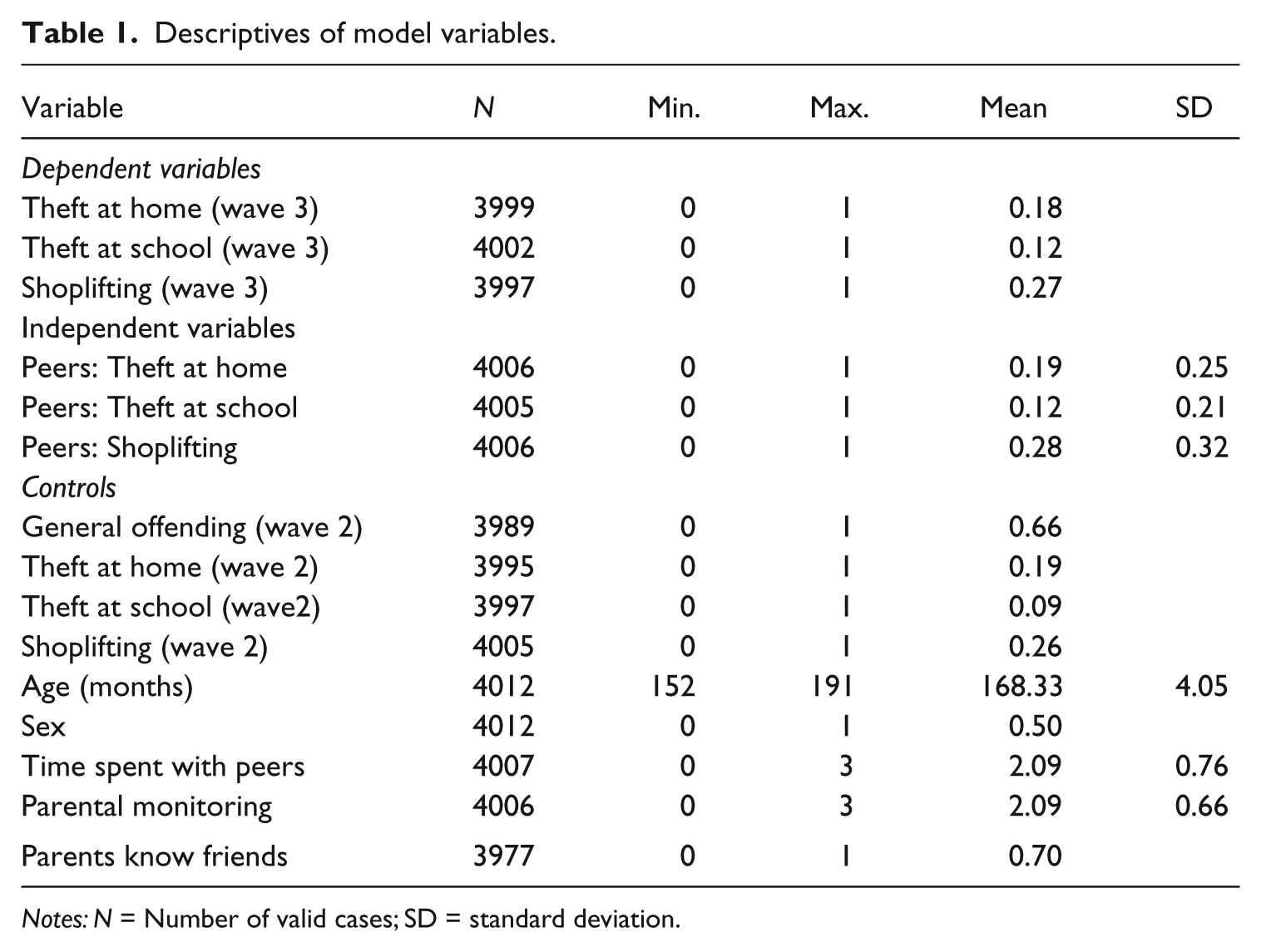
Notes: N = Number of valid cases; SD = standard deviation.
Analytical strategy and model specification
As a first step, bivariate results are shown in order to gain an impression regarding the context specificity of peer effects. Polychoric correlation coefficients between adolescents’ and their peers’ self-reported theft are compared across contexts. Stronger correlation coefficients within contexts than across contexts would be indicative of context specificity, whereas any deviation from this pattern would be evidence against the context specificity of peer effects.
Given the well-known finding of offender versatility, though, it seems likely that the same adolescents often offend in different contexts. This could bias the bivariate results, requiring a more sophisticated, multivariate modelling strategy to adequately test the formulated hypotheses. The paper therefore proceeds to such multivariate models. Because of the binary outcome variable and the clustering resulting from sampling in schools, random intercepts logistic regression models are suitable for these analyses (Rabe-Hesketh and Skrondal, 2008; Snijders and Bosker, 2012) and are employed in all multivariate models. The models do not include any variables at the school level or any random coefficients; interpretation of coefficients is therefore similar to interpretation of regular logistic regression models without random intercepts.
Separate models are estimated for the three outcome variables (theft at home, theft at school, shoplifting) and all three peer variables are included as predictors, alongside controls. Because the scale for all three peer variables is the same, coefficients for the three peer variables can then be compared in each model to assess the degree of context specificity of peer effects. In each context, significantly higher coefficients for peer behaviour in the corresponding context than for peer behaviour in differing contexts would support the notion of context specificity. In the model predicting theft at home, for example, this would imply a stronger effect of peers’ theft at home than the effects of peers’ theft in the other two contexts. Any deviations from this pattern would be evidence against context specificity in the relevant context. In particular, similar coefficient patterns in all three models would strengthen the notion of a general relationship between peers’ and adolescents’ offending irrespective of context (for example, with all three coefficients being of similar size and not significantly differing from each other in all models). 9
The significance of differences between coefficients is assessed using Wald tests. The results are interpreted in relation to the hypotheses derived in the theoretical part of the paper.
Comparing coefficients between different logistic regression models is problematic (Mood, 2010) and these problems could even be aggravated in the models used owing to the included random intercepts. Effect sizes in the different models should therefore not be compared and interpretation is restricted to comparisons of coefficients within models. Because the research question does not require comparisons between models, no attempts are made to achieve comparability of coefficients between models.
Results
Table 2 shows polychoric correlations of adolescents’ self-reported theft at home, theft at school and shoplifting with theft reported by their peers for the same three contexts. Adolescents’ behaviour in all three contexts is more strongly related to peer behaviour in the same context than to peer behaviour in the other contexts, although the differences in some instances are rather small. These findings support the notion of context specificity. However, as expected, the behaviour of adolescents across contexts is highly correlated, indicating that the same adolescents offend across different contexts. The same is true for peer behaviour. The bivariate results are therefore likely to be biased, necessitating a multivariate approach that tests for peer behaviour in different contexts simultaneously.
Polychoric correlations of adolescents’ and peers’ theft in three contexts.
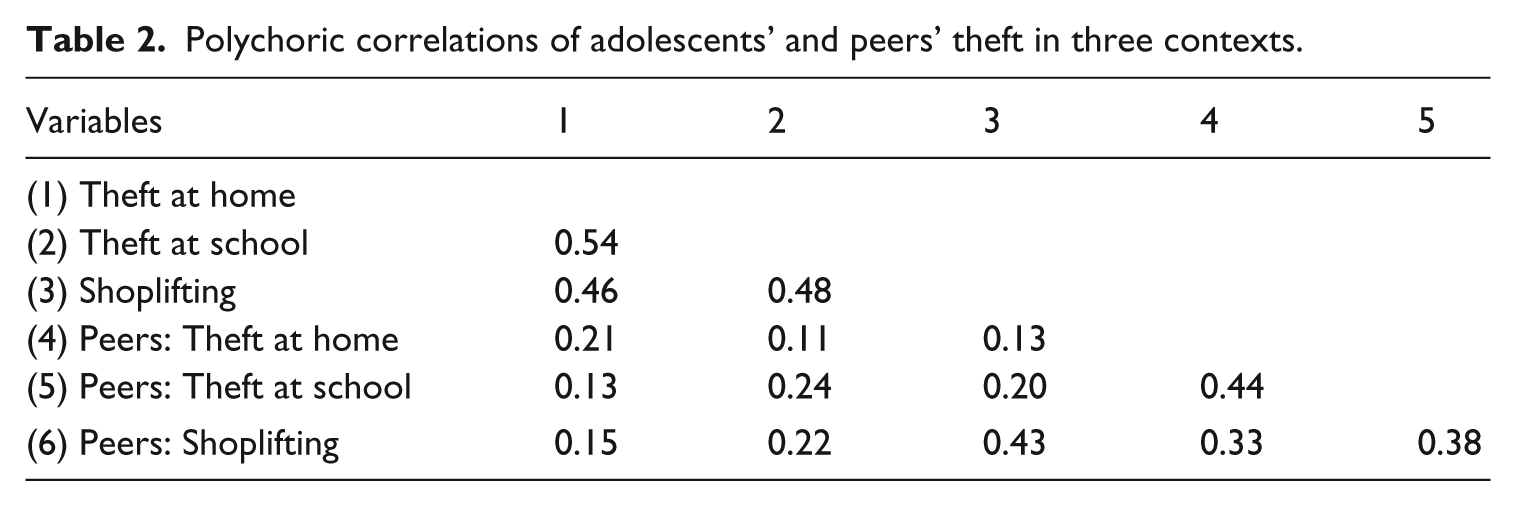
Table 3 shows results of random intercepts logistic regression models predicting theft at home, theft at school and shoplifting. Coefficients of peer offending for all three contexts, alongside controls, are included in each model as predictors, mitigating the likely bias in the bivariate results. The effects of the control variables are as expected. If parents closely monitor their children and know their children’s friends, it is less likely that their children steal in any context. The coefficients are significant, with the exception of parental acquaintance with respondents’ friends in the shoplifting model. Time spent with peers has a positive and significant effect in the shoplifting model but not in the other two models. As already reported in prior analyses with the same data set (Smith and McAra, 2004), males are significantly less likely to steal at home than are females. No significant sex differences are found in the theft at school and the shoplifting models. Age is not significant in any model. Given the homogeneity of the sample regarding age (>90 percent were born within a 12-month period), this was expected. Offending in wave 2 is significantly related to every outcome measure in wave 3.
Random intercepts logistic regression models of theft in different contexts on theft by peers and controls.
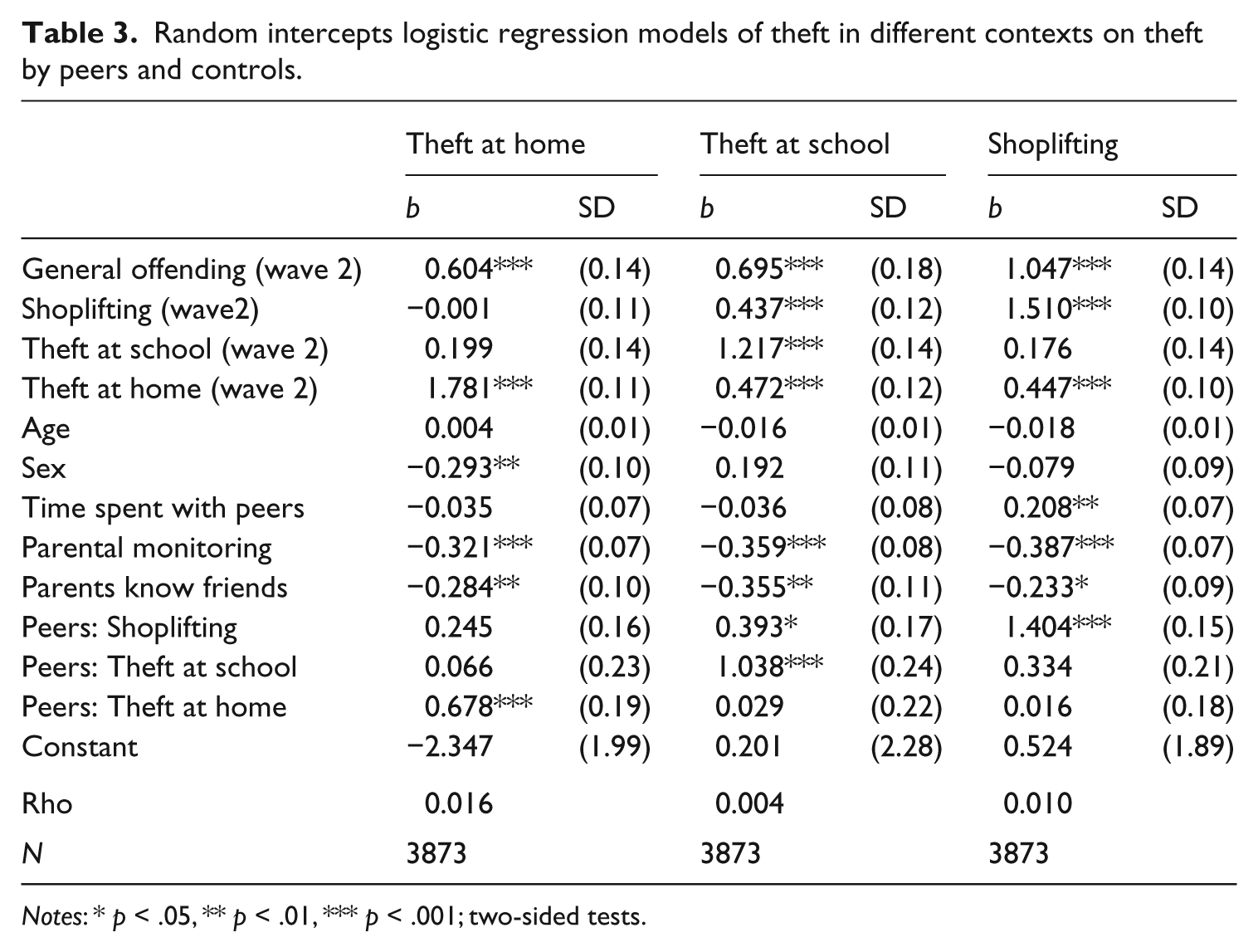
Notes: * p < .05, ** p < .01, *** p < .001; two-sided tests.
Turning to the question of the context specificity of peer effects, context-specific peer effects are significant in all three models. Theft at home in the peer group is significantly related to respondents’ theft at home; theft at school in the peer group is significantly related to respondents’ theft at school, and shoplifting in the peer group is significantly related to respondents’ shoplifting. The only significant peer effect apart from these is the effect of peers’ shoplifting on respondents’ theft at school. These findings are clearly at odds with the notion of general peer effects and support the argument of context specificity.
However, this is not yet sufficient to reliably establish the existence of context-specific peer effects. In addition, coefficients of context-specific peer effects should be significantly higher than coefficients of peer effects not corresponding to the particular context. To test this notion, a series of Wald tests is performed comparing the relevant coefficients in each model. Table 4 shows the p-values retained by these Wald tests. As the hypotheses for the comparisons are directional, the p-values of one-sided tests are given. All Wald tests retain significant differences (p < .05) except for the contrast between peers’ stealing at home and peers’ shoplifting in the model predicting theft at home. These results foster the proposition of context specificity of peer effects. Self-reported theft in any context, with one exception, is significantly more strongly related to theft committed by peers in the same context than to theft committed by peers in other contexts.
Wald tests comparing coefficients of peer variables in the random intercepts logistic regression models.
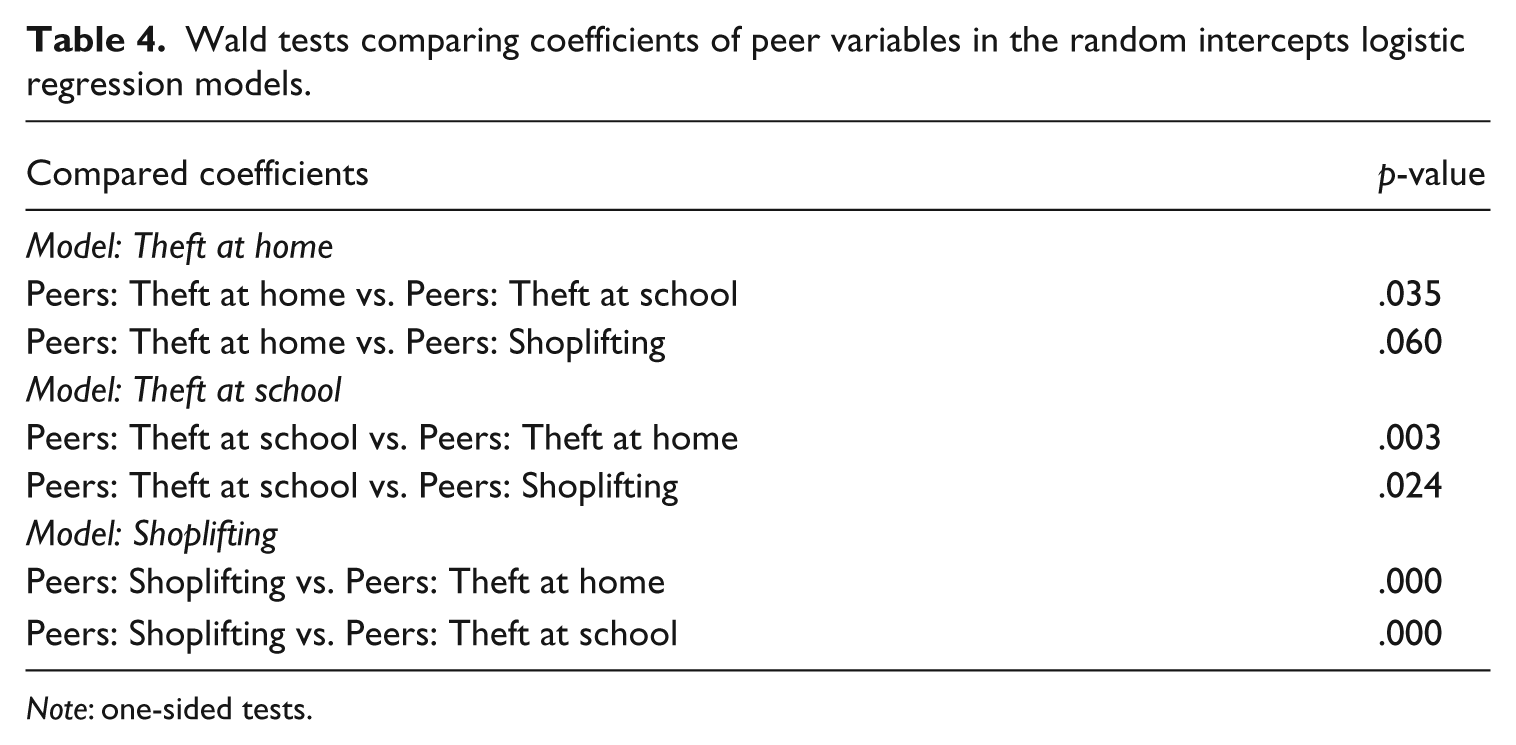
Note: one-sided tests.
The reported findings paint a clear picture regarding the theoretical expectations in favour of those hypotheses expecting context-specific peer effects. The findings do not confirm expectations of self-control theory, which expected no context specificity at all (Hypothesis 1). Nor do they confirm expectations of the routine activity approach, because context specificity was found also for theft at home, not just for theft at school and shoplifting (Hypothesis 2). Concerning social learning theory, the results are in accordance with the more specific variant that expected context specificity in all contexts (Hypothesis 3b), while conflicting with a more general reading of the theory expecting non-specific peer effects across contexts (Hypothesis 3a). It is noteworthy that the findings are also in line with expectations of current theories of action (Hypothesis 4), underpinning the possible merit of combining theories of learning with action-theoretic approaches.
Discussion
The purpose of the current study was to competitively test hypotheses of different theories representing three possible mechanisms that could result in the well-known association between the offending of adolescents and the offending of their peers. The so far unresolved question of the context specificity of peer effects, that is, whether juvenile offending in one context is related only to peer offending in the same context or to peer offending in any context, was employed in order to assess theoretical propositions representing selection, opportunity and learning as possible relevant processes. In a series of random intercepts logistic regression models, peer effects on theft in different contexts (home, school, the public sphere) were analysed to provide an empirical assessment of the relevance of context specificity.
The results indicate that peer effects on juvenile offending are context specific. If an adolescent’s friends steal at home, that adolescent is more likely to steal at home him/herself, and analogous results are obtained for theft at school and shoplifting. Peer offending in differing contexts, in contrast, is not related to adolescents’ offending. With the exception of a significant relationship between peers’ shoplifting and adolescents’ theft at school, no significant peer effects across contexts emerge in the logistic regression models. These findings are at odds with the notion of selection as proposed by self-control theory, but are in line with learning as the most relevant mechanism. In particular, the results conform to a learning framework that is also informed by recent theories of action, namely the model of frame selection and situational action theory. Although these theories are not learning theories themselves, the results show that they can advantageously be used to derive specific expectations about learned content.
No definite conclusions can be drawn with respect to opportunity. The context-specific results regarding theft at home, contradicting Hypothesis 2, conflict with the notion of opportunity as the sole mechanism that explains peer similarity in offending. However, a combination of opportunity and learning could lead to the obtained results, as can learning on its own. Prior studies have already combined these two approaches in their analyses (for example, Haynie and Osgood, 2005) but more research is needed to firmly establish the role of opportunity in the emergence of peer similarity regarding offending.
The rich ESYTC data used in the statistical analyses allowed us to adequately tackle the research question regarding the context specificity of peer effects on juvenile offending. On the one hand, peer offending was measured using self-reports of designated peers rather than proxy information, thereby avoiding problems caused by projection bias. On the other hand, perpetration of the same offence – theft – could be investigated for several contexts, circumventing possible bias owing to certain offences being tied to certain contexts. Contrasting with these strengths, there are also some limitations that should be taken into account when evaluating the empirical results. The probably most severe problems could arise as a result of co-offending. Many delinquent acts by juveniles are committed in groups (Erickson and Jensen, 1977; Warr, 1996). This could be problematic if some offences reported in the questionnaires were committed together by more than one youth taking part in the study. If these persons also nominated each other as friends, this could lead to an overestimation of context specificity. Unfortunately the data at hand do not allow us to control for co-offending. However, given that theft from home does not refer to the same home for different respondents, the problem exists only with regard to shoplifting and theft at school, and not with regard to theft at home. Because the coefficient patterns are very similar for all models, I believe that the conclusions drawn are justified. Nonetheless, subsequent studies should try to tackle this possible bias, for example by asking respondents about co-offenders in their reported delinquent acts. Another limitation is the use of only one offence (theft) in the statistical analyses. For a more comprehensive picture, the context specificity of the peer effects of different offences (for example, violence in different contexts) could be assessed. Because only context-specific information about one offence was included in the data set used, this was not possible in the current study, but should be addressed in studies yet to come. Finally, no self-report data for friends outside the classroom were available, and the analyses were therefore restricted to peers in the same class as respondents. Inclusion of out-of-school friends would allow for comparisons of different segments of the peer group that are linked to different contexts. It seems likely that peer effects might be context specific not only regarding peer behaviour, as was shown in the empirical results of this paper, but also regarding the context in which adolescents mostly meet these peers. Although self-report data on out-of-school friends are not readily available in most data on juvenile offending yet (for an exception, see Kiesner et al., 2003), addressing these questions would be a great way to expand on the reported findings once suitable data become available.
Notwithstanding these qualifications and the ensuing need for further research, the reported findings have important implications regarding criminological theorizing. The results support theoretical claims that argue in favour of a causal link between adolescents’ offending and offending by their peers. Theories negating these processes, such as self-control theory, therefore might need to rethink their strict rejection of peer influence. In addition, it has been shown that explicit theories of action can be employed to specify hypotheses derived from learning approaches. Given the promising results and the importance of explicit and testable hypotheses for theory development, further integration of theories of action and learning approaches seems a fruitful endeavour.
Although the main aim of the current study was to competitively test the expectations of different theories, the explicit evidence in favour of the context specificity of peer effects on offending behaviour is also important in and of itself. Adding the results to the findings of De Coster and Kort-Butler (2006), who, with a completely different research question and theoretical framework, alongside general relationships also report context-specific influences of experienced strain on offending behaviour, further investigating the context specificity of offending rather than treating offending as homogeneous across contexts might be worthwhile over and above the question of the context specificity of peer effects.
Footnotes
Funding
This research received no specific grant from any funding agency in the public, commercial or not-for-profit sectors.