







Abstract
Strict safe storage regulations are a cornerstone of the Swedish gun control legislation. The rationale is that, by limiting the number of guns a licensed gun owner may own and requiring them to have their guns locked up in gun safes when not in use, legal guns may be prevented from ending up in the hands of criminals through theft. This study, the first full population data study of gun thefts in Sweden, investigated all reported gun thefts in Sweden from 2003 and 2010 and in the county of Stockholm from 1995 to 2010. The analysis revealed that actual thefts from legal gun owners are very rare both in absolute terms and when compared with the number of gun owners, with legal guns and with burglaries. Most firearms that were stolen were properly stored in gun safes, a proportion that also increased to almost 100 percent during the period. The most common method of theft is to steal the entire gun safe. Further, the analysis revealed that official reports on gun thefts have serious errors; 16 percent of police reports on gun thefts referred to cases in which no modern firearm requiring a licence had been stolen.
Introduction
In an international comparison, Sweden has very restrictive legislation on civilian gun ownership. At the same time, however, the country has many civilian gun owners. In 2011, 619,000 people held approximately 1.8 million licences, making Sweden one of the countries with the highest gun ownership rate in the world. 1 Hunting and sport shooting are popular pastime activities and common in all social strata (see, for example, Mattsson et al., 2008).
The cornerstone of the Swedish firearms control policy is that prospective gun owners must meet strict requirements in order to be granted a licence, and that licensed gun owners must store their firearms in approved gun safes in order to prevent legal guns from ending up in the hands of criminals through theft. The legislature and the regulating authority (the National Police Board, RPS) believe that fewer legal guns lead to less criminal gun use, especially with reference to the fact that firearms may be stolen and later used in crime. 2 As a result, Sweden has severe restrictions also on the number of guns a licensed hunter or sport shooter may own. The requirements on safe storage have increased over time, with the latest in 2002. Neither the actual incidence of thefts of firearms, nor how firearms stolen had been stored, has previously been studied.
The purpose of this analysis is to examine: (1) how many firearms have been stolen from private individuals; (2) how these firearms had been stored; (3) the methods used to steal the firearms; and (4) the types of firearms stolen and if they are of a type, model or appearance that makes them suitable for criminal use. In addition, the study examines (5) whether the changes in the theft rate are driven by changes in the home burglary rate and/or the introduction of new, stricter storage regulations. In addition to these research questions, the study also allows the assessment of the quality of the statistics provided to policymakers by the regulating authority (the National Police Board). 3
One advantage of studying an issue in a small country such as Sweden is that the number of cases is so limited that it is possible to examine all cases over a long period of time (2003–10).The use of a complete dataset eliminates the risk of selection bias and allows for more robust conclusions.
Previous research
The relationship between the availability of guns and the crime rate has been treated extensively in international research (see Hepburn and Hemenway, 2004), and in recent years also in several Swedish studies. Hagelin (2012) examined the firearms used in serious crimes and found that crimes committed with weapons of previously legal origin are very rare (Hagelin, 2012: 10). During the period 2000–10, out of 971 reported serious crimes involving firearms (murder, manslaughter or robberies against banks or post offices), a total of 9 acts, that is, less than one case a year, were committed with firearms stolen from legal gun owners. In addition, five or six stolen guns were found in connection with crimes being prepared. 4
The issue has also been studied by Granath (2011) and Ekström et al. (2012). These studies reached similar conclusions to that of Hagelin: that it is highly unusual for legal or previously legal guns to be used in crimes (Ekström et al., 2012: 97, 134, 168). Instead, criminals usually use weapons smuggled into Sweden from Eastern Europe (Ekström et al., 2012: 16, 69, 134). For a compilation of further international research, see, for example, Kleck (1997: 22–3), Kates and Mauser (2004: 620, n82) and Wellford et al. (2004: 6–10). The relationship between firearm ownership and crime is outside the scope of this paper, but the question is relevant because the storage requirements are often justified by the assumption that an increased supply of legal firearms leads to increased crime. 5
Although the safe storage of firearms in order to prevent thefts is a foundation of Swedish gun control legislation, the storage of guns or the nature of gun thefts have never previously been studied. Also, internationally, there is limited research in this area. Lott and Whitley note that, ‘[d]espite the active policy debate on guns, there has been surprisingly little similar research on the safe storage of guns’ (Lott and Whitley, 2001: 662). They also recognize that the political demands for more stringent storage regulations, which have been raised in the US, are not backed by empirical research: ‘While we know of no empirical evidence that has been provided to back up this claim, it has been an issue that has been raised in legislative debates of safe-storage laws’ (Lott and Whitley, 2001: 661). In addition, there are some articles in medical journals on gun safekeeping in the US (Cummings et al., 1997; Grossman et al., 2005; Hemenway et al., 1995; Johnson et al., 2004) but they are not focused on thefts. Further, there are some studies on thefts of firearms in Australia (Baker and McPhedran, 2007; Borzycki and Mouzos, 2007; Bricknell and Mouzos, 2007; Mouzos, 2002; Mouzos and Sakurai, 2006). The Australian studies cover many of the topics also covered in this paper, including how stolen firearms had been stored, methods of gaining access to the firearm and the reporting of thefts.
A difference that must be taken into consideration is that the US debate about safe gun storage is largely centred on trigger locks or other devices that will prevent guns from being accidentally discharged, whereas the Swedish rules stipulate firearms are locked in a gun safe in order to prevent thefts. There are also significant differences in gun safekeeping regulations between Sweden and Australia. This means that, even if the international research had been more extensive, the ability to generalize would have been limited.
Licensing and storage policy in Sweden
Legally held firearms, as well as the storage of legally held firearms, are regulated in Sweden by the Weapons Act (Vapenlagen 1996:67) and the Weapons Ordinance (Vapenförordningen 1996:70), together with National Police Board directives.
An individual licence is needed for every firearm, and the applicant must show that he or she has a ‘need’ for a specific firearm in order to be approved. As a general rule, only hunting, sport shooting or gun collecting are approved needs. In theory, licences may be granted for protection, but in practice no such licences are ever granted. In order to be eligible for a licence for a rifle or shotgun for hunting, or a handgun for sport shooting, the applicant must also pass tests including shooting skills. To obtain a handgun licence, membership and six months of active training in an approved shooting club are also required.
Since 1996, the Weapons Act stipulates that firearms must be kept in ‘a gun safe or an equally safe storage space’. In 2000 the National Police Board regulated that an approved gun safe is one that meets the requirements of Swedish Standard SS3492; however, gun owners were given until July 2002 to conform to the new regulation. Guns rendered permanently inoperable and pellet guns, even though they may require licences, may be stored in another safe way, for example in a locked gun rack. Until 2002, the storage of firearms in gun safes that did not meet the SS3492 requirements or in locked gun racks was allowed.
According to the post-2002 regulations, a gun safe must weigh 150 kg (330 lbs) or be bolted to the floor or wall. In addition, the key to the safe (if it does not have a combination lock) must be kept so that unauthorized individuals cannot get hold of it. The failure to comply with storage regulations (including the improper safekeeping of keys) may lead to the revocation of the gun owner’s licences. Licences may be revoked even if no guns are lost or stolen.
Methodology and data
My study is based on all police reports in Sweden relating to the theft of firearms from private individuals (theft from homes or holiday homes, offence codes 0836 and 0837) during the period 2003 to 2010. Here I have examined and coded 1155 crime reports relating to 2855 ‘weapons’. A significant number of the reports, albeit coded as reports of theft of firearms from homes or holiday homes, referred to other types of crimes or no crime at all. 6 The year 2003 is the starting year because new regulations on gun safekeeping (requiring gun safes of type SS3492) became effective on 1 July 2002. Between 2003 and 2010 gun owners faced the same set of regulations regarding storage.
Because one purpose of the study is to assess whether the new regulations on safe storage, which were introduced in 2002, have had any effect on gun thefts, I have also examined all reports relating to thefts of firearms from private individuals in Stockholm County from 1995 to 2010. Here 371 reports covering 828 thefts of ‘weapons’ were examined. The proportion of reported thefts of firearms must be assumed to be very high, even if the firearms stolen had not been stored properly. Because firearms are licensed and registered, legal gun owners would be likely to be in trouble if their firearms were to be found at, for example, a crime scene and not previously reported stolen. Insurance companies also require thefts to be reported in order to reimburse losses.
I have coded all stolen weapons by type: functional weapons; weapons rendered permanently inoperable; antique weapons; weapons not requiring a licence (for example, low-power pellet guns, muzzle loaders manufactured before 1890); gun parts; non-weapons. Modern firearms requiring a licence have then been coded by type (rifle, shotgun, or combination gun, such as bockbüchsflinte or drilling; handgun; fully automatic weapon); storage modes (approved gun safe; gun safe SS3492; other approved storage; unapproved storage); and method of theft (safe stolen; safe broken open; lock picked; lock opened with key; robbery). 7 From the total number of ‘weapons’ reported stolen, I have then removed non-weapons, weapons not requiring a licence, antique weapons and weapons belonging to the Swedish Armed Forces (kept at home by members of the Home Guard). 8
Furthermore, I have discarded all reports of crimes not including any weapons at all (but erroneously coded by the police as ‘gun thefts’) as well as all duplicates. Thus, only actual thefts of modern firearms requiring a licence (those subject to safe storage rules) are analysed in this paper.
In addition, in order to examine whether the weapons stolen are of a type that might be of interest for later criminal use (according to the National Police Board: handguns and fully automatic weapons), 9 I have also coded all handguns stolen in Stockholm County according to manufacturer, model and calibre. 10 Data collection and analysis were performed between November 2011 and August 2012.
Results
How many guns have been stolen?
During the period studied, on average 279 weapons (modern firearms requiring a licence) were stolen each year (max: 334; min: 190) on 105 occasions a year (max: 123; min: 81) (see Figure 1).
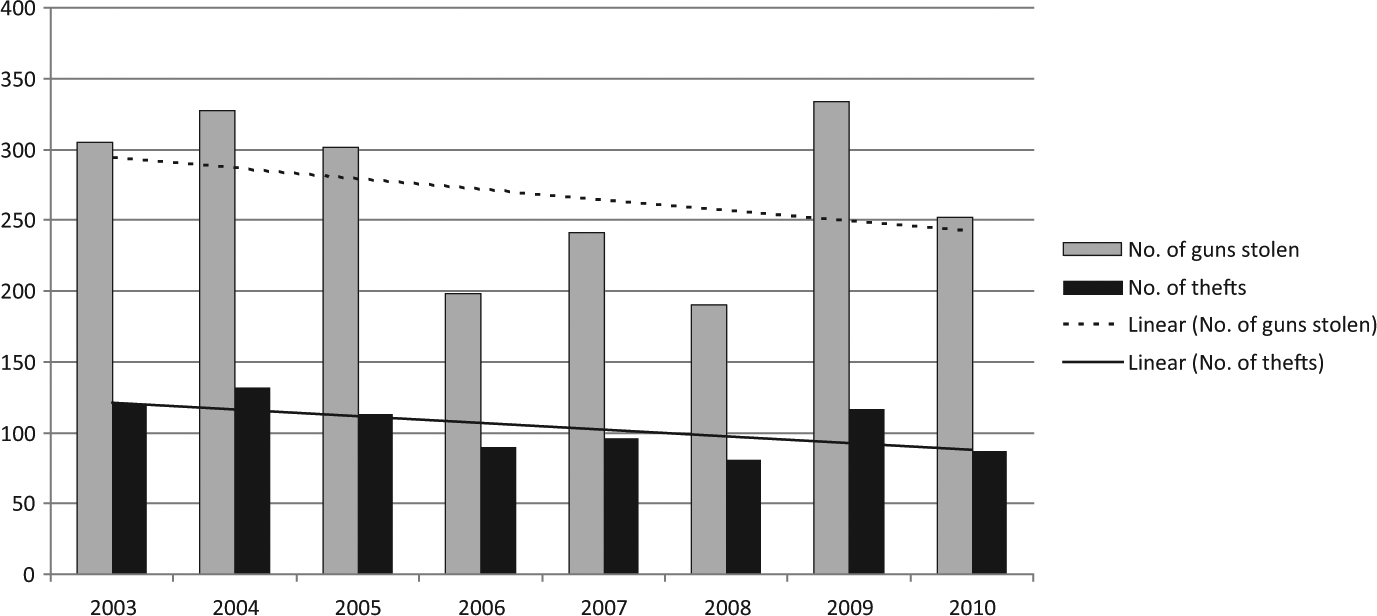
Number of thefts and number of guns stolen plus linear trends in Sweden (all counties), 2003–10.
Seen in relation to both the total number of legal firearms and the total number of burglaries, and in absolute numbers, theft of legal firearms is a very unusual crime in Sweden. In 2010, there were 3,829,973 households and 622,154 gun owners in Sweden. 11 Assuming that there was only one individual gun owner (who of course can have more than one gun) per household, there were guns in 16 percent of Swedish households. In the same year, 19,800 residential burglaries took place; at 87 of these, firearms were stolen. 12 Thus, firearms are stolen at a rate of 4 per 1000 residential burglaries. The 2010 figure also corresponds to a rate of 0.14 burglary thefts where guns were stolen per 1000 legal gun owners.
Some margin of error must, however, be granted. Both firearm owners and residential burglaries are unevenly distributed across Sweden, so there are local variations in the rate. It is, however, clear that the number of thefts of firearms in relation to the total number of residential burglaries is significantly lower than the gun owners’ share of households. Had the thefts corresponded to the gun owners’ share of households, the number of gun thefts would have been 64 times greater. This very significant difference may be explained by the fact that the burglars did not find the gun safe during the burglary or they deliberately refrained from stealing any guns because this would increase the risk of being detected or caught. In Sweden, the likelihood that a burglary will be investigated by the police is significantly higher if guns are stolen, and the proportion of burglary thefts including firearms solved is also much higher than burglary thefts not involving firearms. 13
The longer time period (1995–2010) studied for Stockholm County shows the same downward trend as for Sweden as a whole. However, because the number of yearly thefts is low, annual variation is correspondingly larger (see Figure 2). In both Stockholm County and Sweden as a whole the number of thefts and the number of firearms stolen have declined at approximately the same rate. This is probably caused by the fact that burglars steal indiscriminately and take whatever firearms are available.
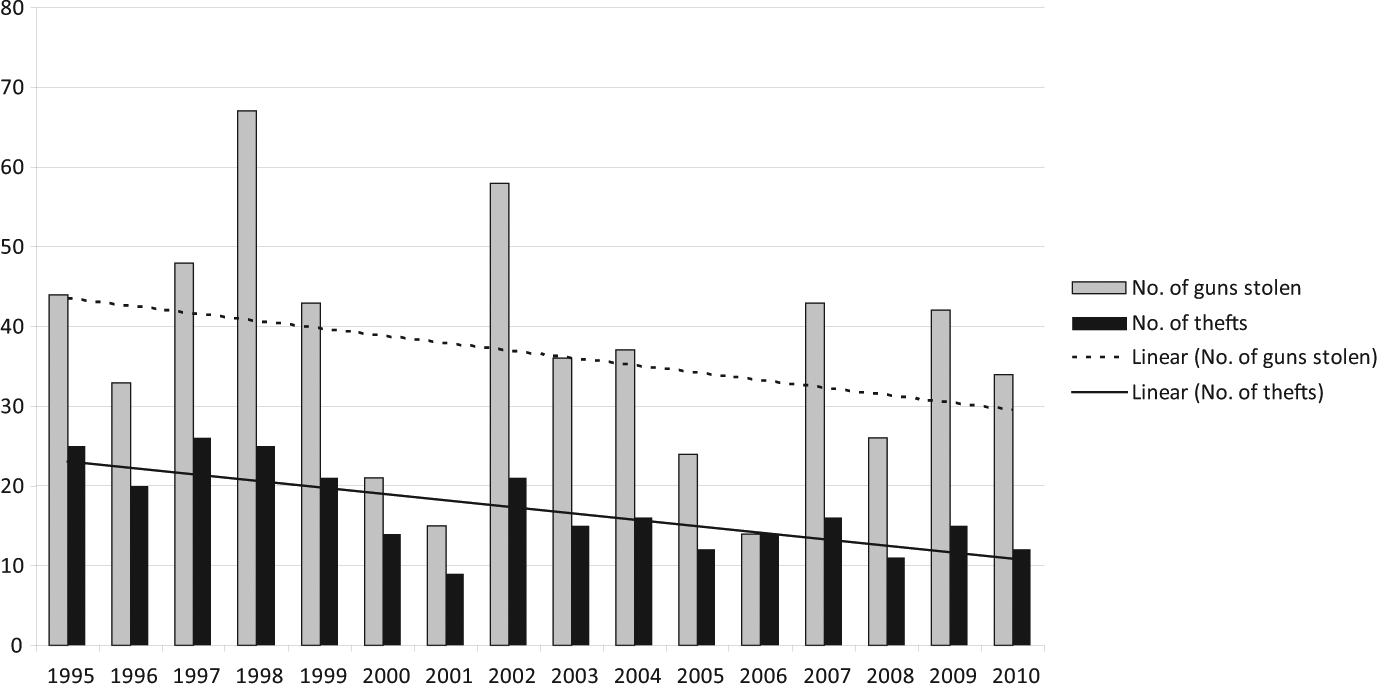
Number of thefts and number of guns stolen plus linear trends in Stockholm County, 1995–2010.
What types of weapons have been stolen?
Out of the 2231 licensed modern firearms stolen during the period 2003–10, a total of 1002 (45 percent) were rifles, 830 (37 percent) shotguns, 277 (12 percent) handguns and 122 (6 percent) combination weapons. Only one civilian fully automatic weapon was stolen during the period (a submachine gun stolen in the county of Dalarna in 2003). In addition, a number of items that do not belong to the category of modern firearms were stolen, including 77 gun parts (barrels, bolts and slides and other miscellaneous parts), 60 weapons manufactured before 1890 and 391 non-gun objects (air and spring rifles, spear guns, dummies, etc.).
The thefts of gun parts (primarily bolts for repeating rifles) primarily took place in 2003, that is, the first year after the introduction of the new storage regulations. One possible explanation is that rifles then were still stored disassembled (as the previous regulation allowed) and the bolt was stored separately from the rest of the gun, which was locked to a gun rack.
How have stolen guns been stored?
The most common method of theft is theft of the entire gun safe. Of firearms stored in an approved gun safe, 53.6 percent were stolen by this method. The second most common method was that the safe was opened with a ‘hidden’ key found by the burglars; 35.0 percent of guns otherwise stored properly were stolen this way. A smaller proportion of the guns (11.3 percent) were stolen by breaking into the gun safe (using saws or drills). During the entire eight-year period studied, there is only one sure case in which the lock to the gun safe was picked. In this specific case (in 2010), the perpetrator (a relative of the victim) was helped by a locksmith. In addition, there are five reports in which the victim stated that the lock had been picked but where the circumstances indicated that the safe instead had been opened with a key found by the burglar.
I have also found that, historically, a relatively large proportion of firearms stolen had not been stored correctly. However, the share of improperly stored stolen firearms has fallen sharply. In 2003, 32 percent of the weapons stolen were not properly stored; in 2009, the share had dropped to almost zero. One possible explanation is that the new storage rules were not uniformly adopted immediately, possibly because the weapon owners were not aware that the storage rules had been changed.
Based on the nature of the crimes, I can also conclude that burglaries focused exclusively on firearms are extremely rare. An indication of this is that I have found only two cases of selective thefts, that is, where only some of the victim’s ‘weapons’ had been stolen. Nor have I found any cases of burglary in which only firearms were stolen. In every reported case other items besides guns were stolen as well. I have also found a number of cases in which the gun safe had been opened but the guns had not been stolen. That gun parts or inoperable guns have been stolen in addition to modern firearms further indicates that burglars have not primarily been looking for weapons for use in a future crime. One reason why gun safes might be of interest to burglars, even if they are not interested in guns, is that cash or other valuables are commonly stored in the safes. From the police reports, I have found that victims in a number of cases stored large sums of cash (30,000–50,000 SEK) in their gun safes.
How does safekeeping affect the risk of theft?
In order to determine if the more stringent storage regulations that took effect in 2002 have had any impact on the thefts, I have examined all thefts of firearms in Stockholm County seven years before and after the new directive. During the period 1995–2001 there was an average of 20 thefts (of modern firearms requiring a licence) a year; during the period 2003–9 there was an average of 14 thefts a year. However, there is no difference in the trend before and after the new stricter regulation; the trend fell at the same rate throughout the entire period (Figure 3). The yearly variance is also high.
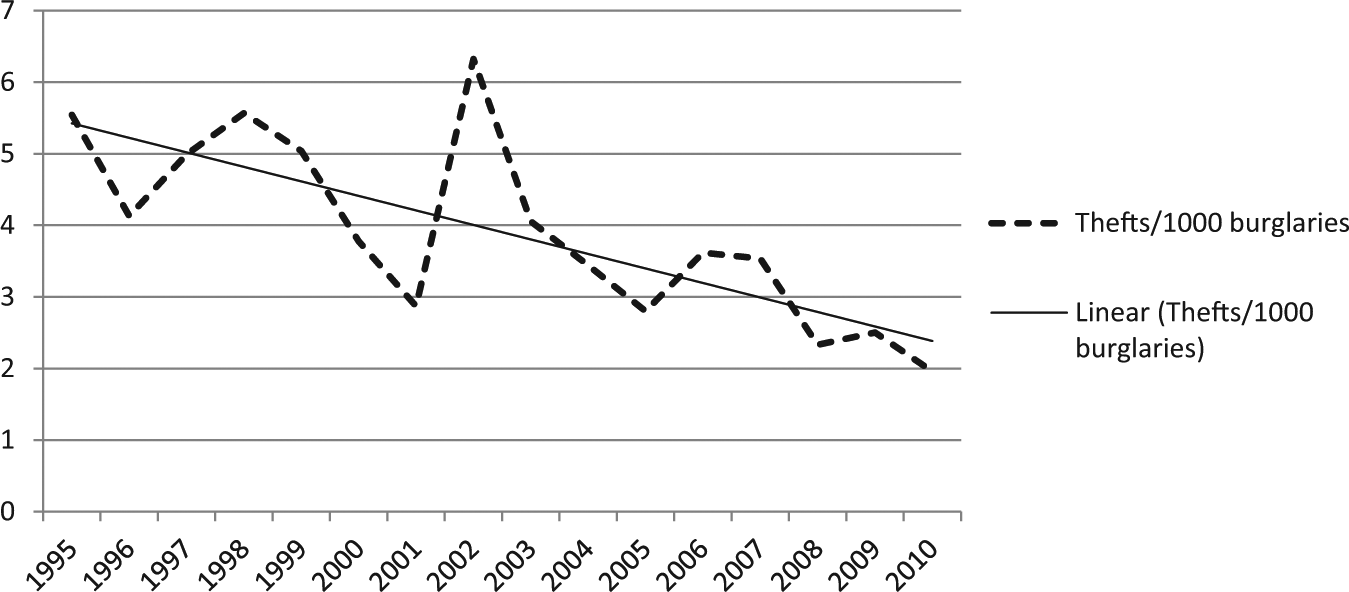
The proportion of burglary thefts in residential homes where guns were stolen (gun thefts per 1000 burglaries) in Stockholm County, 1995–2010.
At the same time, it can be observed that the proportion of burglaries in residences where firearms have been stolen has steadily declined during the period (Figure 3). During the period, modern firearms requiring a licence were stolen at an average of about 3 per 1000 burglary thefts (falling from 5 to 2 per 1000 burglaries at the end of the period).
Both for Stockholm County (1995–2010) and for Sweden (2003–10), significant drops in the proportion of firearms thefts per 1000 burglaries can be observed. As seen in Figures 4 and 5, both the number of thefts of firearms (in absolute terms) and thefts of firearms as a proportion of residential burglaries has declined at approximately the same rate.
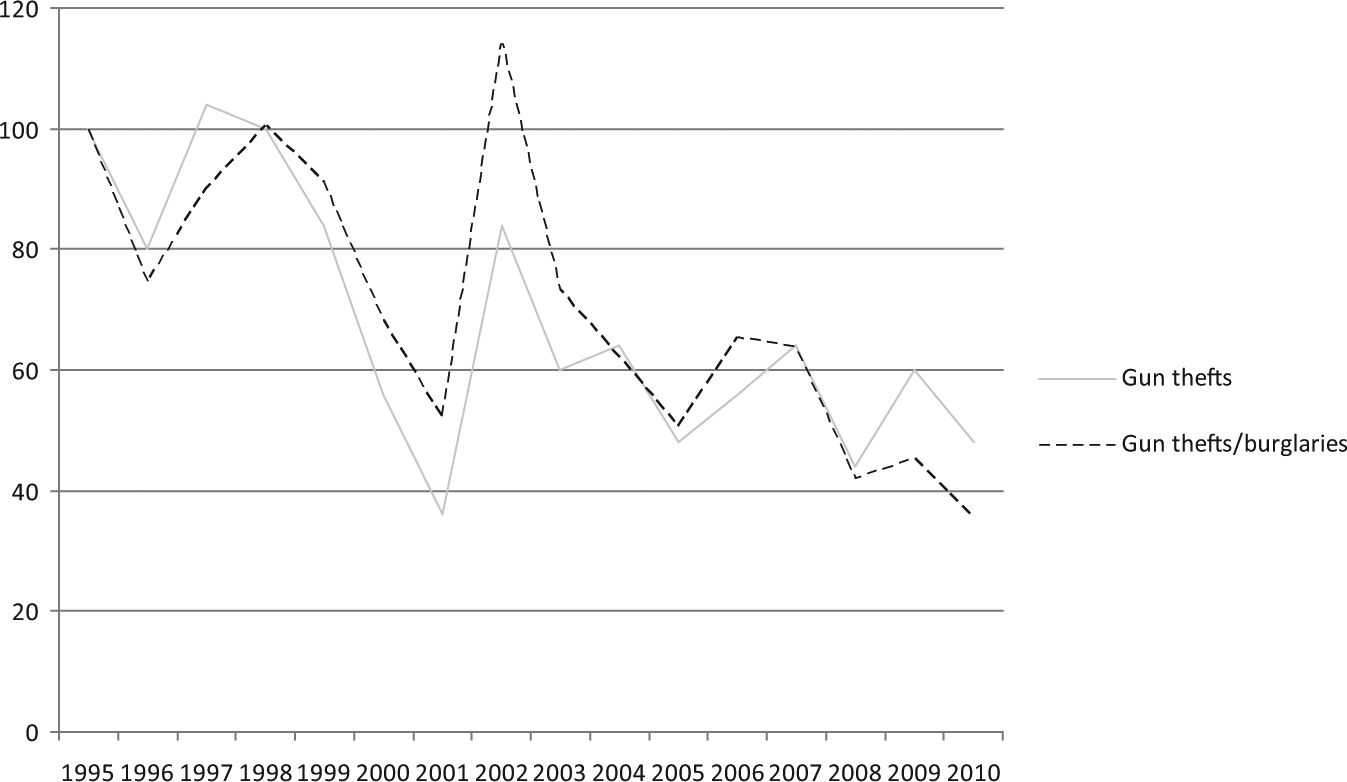
Thefts of firearms and thefts of firearms as a proportion of residential burglaries in Stockholm County, 1995–2010 (index 1995 = 100).
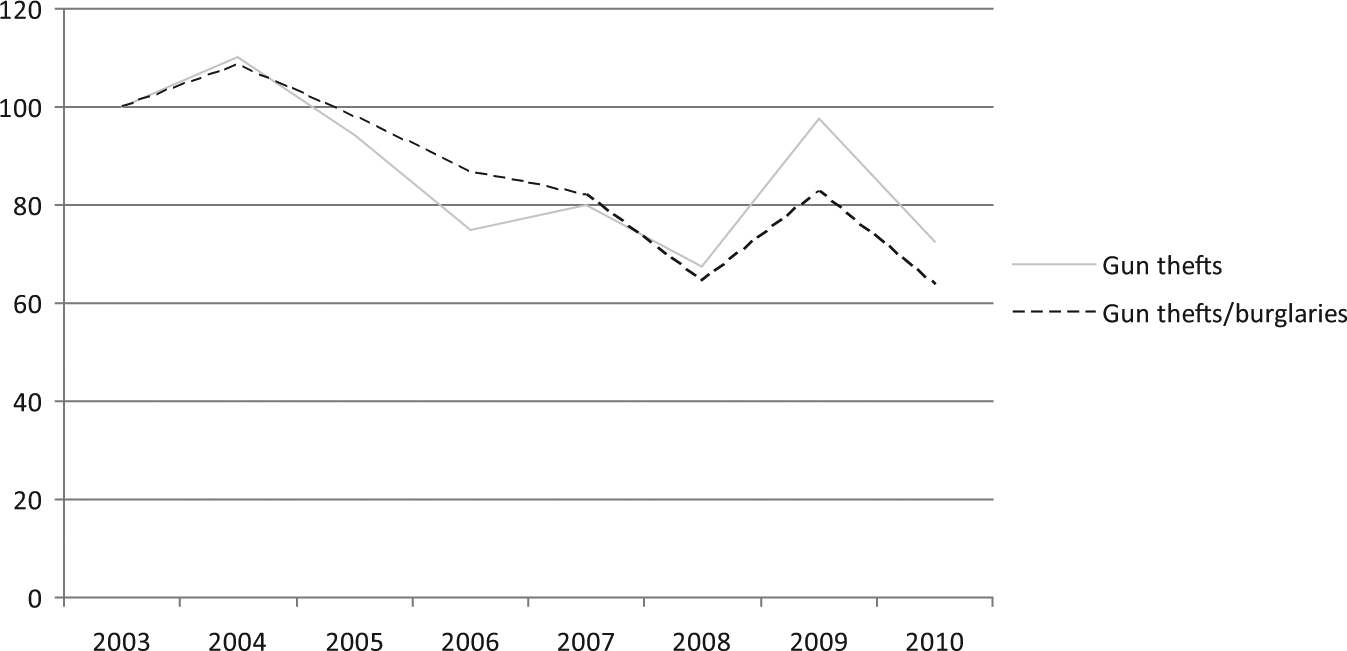
Thefts of firearms and thefts of firearms as a proportion of residential burglaries in Sweden (all counties), 2003–10 (index 2003 = 100).
The findings can be interpreted as that the previous (pre-2002) storage requirements were sufficient to deter most thieves without a specific interest in firearms. Another explanation may be that many gun owners voluntarily met the more stringent storage standards even before it became mandatory. The new stricter regulations were announced in 2000 and most gun safes sold before the changes (from 1996 onwards) probably met the requirements for SS3492. However, this is an area that requires more research.
Relationship to the National Police Board reported figures
The National Police Board has been tasked with providing annual reports to the Swedish Justice Department on gun thefts. Instead of reporting stolen weapons separately, the National Police Board reported them along with weapons ‘unaccounted for’. The latter category includes firearms that are registered but for some reason cannot be found (firearms missing from the estate of deceased gun owners), but also firearms that, owing to deficiencies in the management of the gun registry, are registered despite the fact that the firearm does not exist, is registered under a different serial number, has been scrapped but not removed from the registry or is an ‘inventory loss’ within the Swedish Armed Forces. 14 When I compared the ‘guns stolen or unaccounted for’ with the number of actual thefts, I found that only a small proportion of these weapons include modern firearms requiring a licence stolen from private individuals (see Table 1). In its reports to the Department of Justice, the National Police Board has assumed that ‘approximately 50 percent’ of firearms reported as ‘stolen or unaccounted for’ are stolen from private homes.
Guns reported as ‘stolen or unaccounted for’ by the National Police Board and guns actually stolen from private individuals, 2003–6.
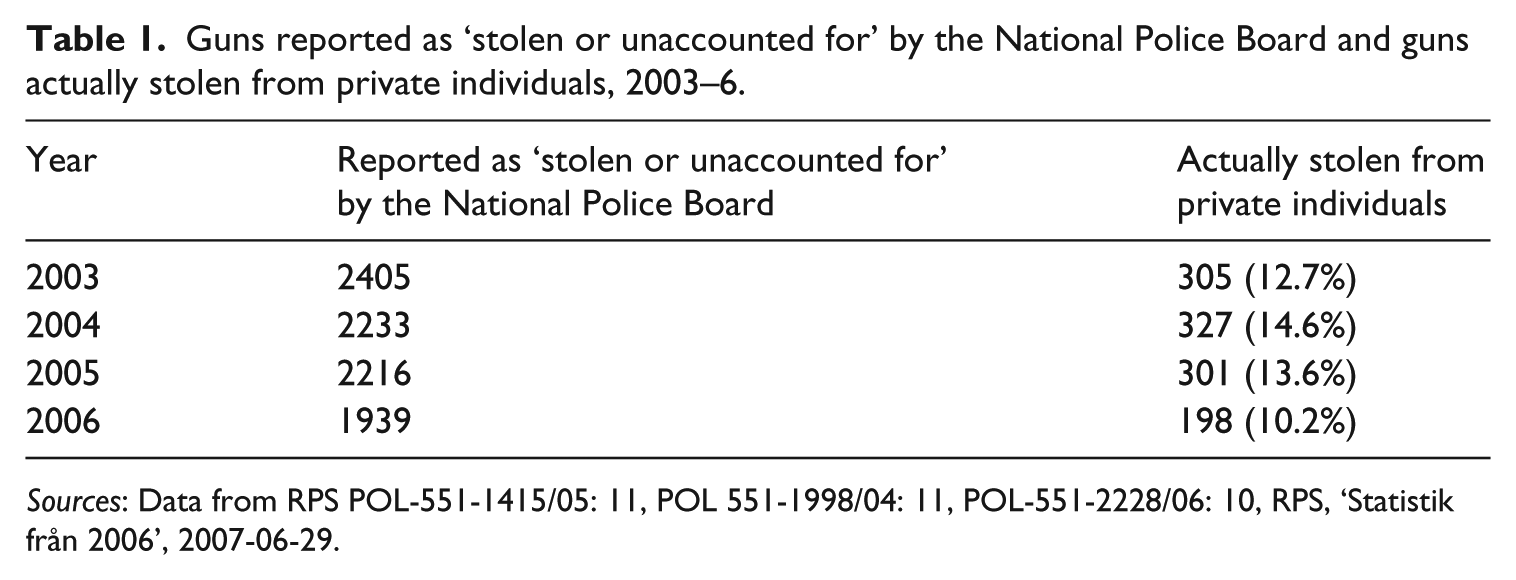
Sources: Data from RPS POL-551-1415/05: 11, POL 551-1998/04: 11, POL-551-2228/06: 10, RPS, ‘Statistik från 2006’, 2007-06-29.
I have compared these figures for each year and found that only between 10.2 percent and 14.6 percent of the ‘stolen or unaccounted for’ guns were actually stolen from private individuals. For certain categories of weapons, the percentages are even lower. For example, during the same period, 9.0 percent (126 of 1143) of the handguns and 0.6 percent of the automatic weapons (1 of 176) reported as ‘stolen or unaccounted for’ were actually stolen from private legal gun owners; these are the types of weapons that the National Police Board describes as the most attractive in criminal circles.
The difference between the figures reported by the National Police Board and the actual number of thefts from civilians has also increased over time. This applies both to weapons in general and to individual categories of weapons. In 2003, 9.9 percent of handguns reported ‘stolen or unaccounted for’ were actually stolen; in 2006 the corresponding proportion was 6.7 percent. At the same time, no fully automatic weapons have been stolen from private individuals since 2003, making the proportion effectively 0 percent. 15 Thus, comparing the numbers reported with actual numbers shows that the National Police Board, in its reports to the legislator, has grossly exaggerated the number of legal guns stolen.
The attractiveness of stolen firearms
In its reports to the Department of Justice, the National Police Board has assumed that handguns and fully automatic weapons are especially attractive to thieves. 16 My study on theft of handguns in Stockholm County 1995–2010 shows that a large part of the weapons stolen, even if they belong to the category of firearms (handguns), are not of such a model, design, calibre, function or appearance that they are very attractive to criminals (for example, muzzle loaders, competition firearms such as pistols for the 25 or 50 m ISSF pistol events, weapons rendered permanently inoperable, or weapons of obscure or obsolete calibre). Out of 75 handguns stolen, 23 (30 percent) are of such a nature that they can be judged to be less suitable for criminal activity.
Thefts of fully automatic weapons
Fully automatic weapons are often considered to be particularly attractive to criminals and therefore more likely to be the target of thefts than other weapons. Despite this, Hagelin (2012: 10) has shown that no previously legal fully automatic weapons were used in serious crimes during the period 2000–10. During the same period, my survey shows that only one civilian fully automatic weapon was stolen (a submachine gun used for competitive shooting that was stolen in the county of Dalarna in 2003). 17 All other automatic weapons stolen during the period studied were weapons belonging to the Swedish Armed Forces.
Summary and concluding discussion
For the first time, all thefts of civilian firearms in Sweden between 2003 and 2010 (and for Stockholm County between 1995 and 2010), as well as how all stolen firearms had been stored, has been studied. I have examined a total of 1155 crime reports, covering the theft of 2855 ‘weapons’. Out of these, about 84 percent turned out to be modern firearms requiring a licence; the remainder were weapons not requiring a licence, gun parts, weapons rendered permanently inoperable, antique weapons or pure coding errors (cases where no theft had occurred). Rifles made up 45 percent of firearms stolen, 37 percent were shotguns, 12 percent were handguns and 6 percent were combination guns. Only one theft of a civilian fully automatic weapon was reported during the period.
The number of firearms stolen is low and falling. During the period examined, on average 279 guns on 105 occasions were stolen annually. Theft of firearms thus corresponds to about 4 per 1000 residential burglaries (in Stockholm County about 2 per 1000). At the same time, gun owners make up 16 percent of Swedish households. Of weapons stolen, the vast majority were properly stored in gun safes, a proportion that also increased significantly during the period. In 2003, 32 percent of firearms stolen were not stored in approved safes (something that can probably be explained by the fact that the regulations changed the year before and many guns were still stored in the previously approved way); in 2010, the percentage of firearms not properly stored was close to zero.
The study shows that the most common method of theft is to steal the entire gun safe. This type of theft constituted 53.6 percent of thefts of firearms stored correctly. The remainder were accessed using a key found by the burglars (35.0 percent) or by breaking into the safe (11.3 percent). In one case the lock to the safe had been picked. This, however, was a special case in which a locksmith was involved.
My study further shows that, based on the circumstances of the crimes described in the crime reports, it is unlikely that few thefts have been specifically targeted at firearms intended for future criminal use. That only two selective thefts have taken place, as well as a large number of inoperable firearms, gun parts or spring and air guns not requiring a licence have been stolen, gives further indication to this, even though the small number of gun thefts prevents solid conclusions. The information obtained from the crime reports also indicates that gun safes might be very interesting to burglars not looking for weapons because it is common for gun safes to contain cash or other valuables, in addition to the guns. I have also found that a significant proportion (30 percent) of the handguns stolen in Stockholm County are of such a model, function or appearance that they are less suitable for criminal activity.
Further, the study shows that the reported estimates of civilian guns stolen given by the National Police Board to the legislator have been grossly exaggerated. It is also found – contrary to claims made by the National Police Board – that automatic weapons have rarely been stolen from private individuals. The extent to which these figures have had policy effects, in the sense that they formed the basis of regulation, is not possible to determine. The regulatory changes that took place during the examined time period are, however, almost entirely focused on restrictions on legal civilian gun ownership, rather than on measures aiming at other potential sources of illegal weapons, such as smuggling. Because the National Police Board also has the right to issue directives and recommendations on gun licensing and safekeeping, it cannot be ruled out that its own misleading numbers on the risk of thefts from legal gun owners may have influenced its regulations. This is an area where further research is required. 18
Since thefts of legal firearms, both in absolute terms and as a share of residential burglaries, have been so rare during the entire period covered by the study, it is hard to draw any firm conclusions about the effectiveness of the storage regulations. However, the almost nonexistent use of stolen legal firearms in serious crime (Hagelin, 2012) lends some support to the hypothesis that the Swedish storage regulations have met the requirements because they prevent legal weapons ending up through theft in the hands of people who intend to use them for criminal activity. At the same time, the fact that thefts declined at the same rate both before and after the introduction of new stricter safe storage regulations in 2002 also indicates that the pre-2002 regulations were good enough in this respect.
Footnotes
Acknowledgements
Data collection for this study was performed by Michael Ericsson, Mid Sweden University. I am grateful for funding for data collection provided by members of ‘Swedish Forum’ and for access to data and other services provided by Carina Vangstad at the Swedish National Police Board. Thanks to Julia Branting, Christer Holmgren, Gary Mauser and Mike Winnerstig for valuable comments. All remaining errors are the responsibility of the author.
Funding
My research received no specific grant from any funding agency in the public, commercial, or not-for-profit sectors.