






Abstract
In recent years, theorization and research on citizens’ trust in the police have expanded enormously. Compared with citizens’ trust, police officers’ trust – both in citizens and in supervisors – has attracted very little attention. Further, it is striking that, although scholars have pointed to police officers’ procedural justice as a key factor for building public trust in the police, the question of how trustworthy police behavior can be achieved has hardly been theorized. To help fill in these gaps and understand police officers’ functioning, I offer a work relations framework. The building blocks for this approach come from different scientific disciplines: criminology, psychology, management, and political science/public administration. Theoretical elements and empirical indications from different fields are combined into a framework that aims at widening the scope of police research. More specifically, it identifies origins and consequences of police officers’ trust and origins of officers’ trustworthy behavior.
Introduction
Trust relationships are assumed to improve the working of government institutions. Therefore, their origins and consequences have attracted a lot of scholarly attention. However, this attention is unbalanced: theorization and research have extensively addressed the issue of citizens’ trust, but they have hardly focused on public officials’ trust. That is surprising, as it takes two to tango.
This general pattern strikingly recurs in the criminological literature on the police. In recent years, theorization and research on citizens’ trust in the police have expanded enormously (see below), whereas the other side of the relationship – police officers’ trust in citizens – has attracted little attention. This also holds for police officers’ trust in their supervisors. Theorization on police officers’ trust is very limited and only a few explorative studies have been carried out on this topic. Ethnographic research on police culture has dealt with the closely related topic of suspicion, but its main focus has not been explaining variation in this attitude and identifying the consequences of this variation. Further, it is remarkable that, although scholars have pointed to police officers’ procedural justice as a key factor for building public trust in the police, the question of how trustworthy police behavior can be achieved has hardly been theorized. In this article I take steps toward filling in these gaps. Taking a multidisciplinary approach, I develop a work relations framework that can be used to study police officers’ attitudes and behaviors toward supervisors and citizens. I argue that both officers–supervisors relationships and officers–citizens relationships will improve when supervisors give leadership based on internal procedural justice.
In short, the theoretical framework I present comprises three key points. First, I claim that officers’ trust in both supervisors and citizens is linked to their perception of the way supervisors deal with officers. I emphasize the importance of neutrality, respect, voice, and accountability as constituting aspects of internal procedural justice. Second, I claim that the levels of officers’ trust have an impact on their functioning. Trust in supervisors motivates compliance with supervisors (and with the policies of the organization) and cooperation with supervisors. Trust in citizens promotes police responsiveness and cooperation with citizens. Finally, I claim that (perceived) internal procedural justice encourages police officers to produce external procedural justice.
Before I elaborate more in detail on these points, I give an overview of research and theorization on citizens’ trust in the police and procedural justice. This overview will be useful to formulate my work relations framework in a structured and clear way.
Citizens’ trust in the police
Worldwide academic topic
In recent years, research on citizens’ trust in the police and other government institutions has expanded enormously. Inspired by theories that attribute important positive consequences to citizens’ trust in government institutions (Easton, 1965a, 1965b; Putnam, 1993, 2000; Tyler, 2011; Tyler and Huo, 2002), scholars have been trying to find out what implications this attitude (and a lack of it) has and where it stems from.
With regard to citizens’ trust in the police, the main body of literature has, for many years, been produced in the US. In the past decade, however, this has changed drastically. Developments in a number of counties (for example, the UK, Australia, and Belgium) toward establishing a research community studying citizens’ trust in the police and efforts of individual researchers elsewhere have turned trust in law enforcement into a worldwide academic topic: over recent years, it has been an object of study in both developed countries (for example, Jackson et al., 2013; Murphy et al., 2014; Van Craen and Skogan, 2014) and developing countries (for example, Kwak et al., 2012; Sun et al., 2012; Tankebe, 2008). Moreover, researchers have started to apply a comparative approach to countries in one or more continents (for example, Cao et al., 2012; Hough et al., 2012; Kääriäinen, 2007).
Explaining citizens’ trust: Procedural justice
Several years of cumulative research indicate that an explanation of citizens’ trust in the police must give a prominent place to perceptions of procedural justice. The importance of procedural justice has been confirmed by studies in different countries (for example, Jackson and Sunshine, 2007; Murphy et al., 2014; Sunshine and Tyler, 2003; Tankebe, 2008) and among many ethnic groups (for example, Murphy, 2013; Tyler, 2001, 2005; Van Craen, 2013). As a consequence, this stream of research and the theory on which it builds strongly determine our current thinking about public trust in the police.
At a theoretical level, the most influential contribution on the relationship between procedural justice and trust in the police is Tyler’s version of procedural justice theory. This approach starts from the idea that people’s reactions to authorities are shaped by judgments about how those authorities make decisions and how they treat people over whom they exercise authority. Working from this premise, Tyler (2001) states that trust in the police is primarily determined by one’s judgment of the fairness of police behavior and procedures. More specifically, he argues that public trust is linked to citizens’ perception that the police treat people equally and respectfully, and to their perception that the police are open to citizen input and give an explanation for their decisions or actions (Sunshine and Tyler, 2003; Tyler, 2005). By linking these behaviors to a conceptualization of trust that involves a belief in the goodwill or benevolence of other persons (Tyler, 2011; Tyler and Huo, 2002), Tyler’s statements imply that procedurally fair behavior generates trust in the police because citizens infer from it that the police have good intentions.
Besides Tyler, Stoutland (2001) too has played an important role in conceptualizing and anchoring the relationship between procedural justice and people’s trust in law enforcement. She states that, in studying trust in the police, we have to ask not only about their competence and efficiency in safeguarding public order, but also about the extent to which the police show respectfulness and care about citizens’ concerns. On the basis of ethnographic research, she particularly emphasizes the significance of respectful treatment: ‘Respect was such an important expectation for community members that it often seemed to be the largest factor in determining whether they granted credibility to the police department’ (Stoutland, 2001: 250).
A third key contribution in the process of theorizing a link between procedural justice and citizens’ trust in the police has been made by Jackson and Sunshine (2007). According to these scholars the police are assessed from a concern for the norms and values that buttress social life. Citizens would expect the police to typify and defend the value structure of their community. Therefore, a police force would gain trust if it embodies the norms and values of the community. In Jackson and Sunshine’s view, a concrete way for the police to show that they embody the moral structure is to treat citizens respectfully and fairly.
In recent years, in the US and Europe the idea of police fairness as a key antecedent of public trust has been embraced by many scholars studying police–citizen relationships (for example, Dirikx and Van den Bulck, 2014; Hough et al., 2010; Skogan and Frydl, 2004; Van Craen and Skogan, 2014). However, this idea has also been theorized in several other contexts. Building on the work of Tyler, Australian researchers have argued that people look for cues that provide information about the intentions and motives of the police. By generating such cues, procedurally fair decision-making and treatment would strengthen the belief that the police have the right intentions and motives, which is considered the core of trust (Murphy et al., 2014). A similar emphasis on procedural justice can be found in the work of Goldsmith (2005) on trust in law enforcement in developing countries and new democracies, and in the work of Tankebe (2008) on police trustworthiness in transitional societies in Africa.
Consequences of citizens’ trust
Tyler’s procedural justice framework not only presumes that (perceived) procedural justice increases citizens’ trust in the police, but also states that the generated trust encourages supportive public behavior. In his theorization on process-based policing, Tyler (2005: 325, 327, 333) argues that trust in the police ‘shapes public cooperation’, increases citizens’ ‘deference to the directives of the police’, and ‘motivates compliance with the law’. This claim too has been confirmed by studies in different countries (Dirikx and Van den Bulck, 2014; Jackson et al., 2012; Murphy et al., 2014; Tyler and Huo, 2002) and among many ethnic groups (Jackson et al., 2013; Murphy, 2013; Sunshine and Tyler, 2003; Tyler, 2005).
The origins of process-based regulation go back to the work of Thibaut and Walker (1975). Four decades ago, these researchers demonstrated the implications of procedural justice in the context of court decisions. Thibaut and Walker showed that citizens were more willing to defer to court decisions when they felt that the court procedures were fair. Tyler (2001) has elaborated this idea and has stressed the mediating role of trust in the relationship between on the one hand procedural justice and on the other hand compliance and cooperation: ‘When the public believes that the police abuse their authority, trust in the police declines, leading to less willing cooperation with the police by members of the public’ (Tyler, 2005: 339). The link between compliance/cooperation and trust in this process-based policing model is based on the idea that people’s willingness to comply and cooperate with the police increases when they believe that the police have good intentions (which is considered to be the essence of trust; Tyler and Huo, 2002).
Other scholars who have contributed to developing and disseminating the idea of trust-based compliance and cooperation are Stoutland (2001) and Skogan and Frydl (2004). The former author stressed that ‘if police sincerely work to build trust . . ., residents have reasons to become eager for police protection and ready to cooperate with law enforcement’. In line with this, Skogan and Frydl (2004: 291) emphasized that, ‘if citizens trust the police, they will call them when they need help and help them identify offenders’.
Today, these ideas continue to underpin reflections on police–citizen relationships. Murphy et al. (2014), for instance, state, in a discussion of the implication of findings from the world’s first randomized experimental field trial of procedural justice policing, that, if members of the public have repeated experiences of fair treatment by police, then over time their willingness to cooperate or comply with police can be enhanced through the effects of increased trust and confidence (see also, Dirikx and Van den Bulck, 2014; Roberts and Herrington, 2013). Alongside this classic approach, variants have been proposed that draw our attention to the potential mediating role of moral alignment with the police, felt obligation to obey the police, and perceived legality of the police (Hough et al., 2012; Jackson et al., 2013).
The broader picture: Institutional trust
To conclude this review, I briefly mention theoretical work that has hardly influenced thinking on citizen–police relationships, but that in the field of political science is considered the foundation of theorization on the role of trust in shaping citizens’ cooperation and compliance with public authorities. In the classic works A Framework for Political Analysis (1965a) and A Systems Analysis of Political Life (1965b), David Easton stated that political systems convert the demands of citizens into outputs (decisions and actions). This can proceed more or less smoothly. Easton argued that political systems have difficulties in producing and implementing outputs when supportive attitudes are lacking among the public. Supportive attitudes would make it easier for a political system to collect resources from citizens and would lead citizens to accept the generated outputs voluntarily. In the alternative case – when political systems have to force people – the political process would involve excessive costs, social as well as financial.
One of the most comprehensive tests of Easton’s arguments on the role of supportive attitudes has been carried out by Marien (2011). Her analyses on data derived from the 1999–2001 European Values Study showed that lower levels of institutional trust – measured as trust in parliament, the justice system, the armed forces, and the police – are associated with less preparedness to comply with the law. More specifically, distrusting citizens have a more condoning attitude toward tax evasion and are more tolerant toward fiscal fraud and false social security claims than trusting citizens. The study showed that the relationship between institutional trust and abiding by the law exists in a broad variety of European countries.
Police officers’ trust
Unexplored academic topic
The aim of this article is to complement the reviewed literature by shifting the focus from citizens’ attitudes toward public officials’ attitudes – and more specifically police officers’ attitudes. Theorization and research on police officers’ trust are rare. Yet it may be as crucial for policing as citizens’ trust. Yang (2005: 273) noted that ‘a theory of improving citizens’ trust in government is incomplete without an explanation of administrators’ trust in citizens because trust is mutual and reciprocal’. In line with this, but focusing specifically on the domain of public safety, Kääriäinen and Sirén (2012) stated that fruitful cooperation between the police and citizens requires ‘mutual trust’: citizens’ trust in the police and police officers’ trust in citizens. It really surprised them that ‘research in the field of policing has focused only on the first part of this equation’ (Kääriäinen and Sirén, 2012: 277). Therefore, they conducted an explorative study on officers’ trust in citizens and opened a discussion on the issue. What they did not touch upon, however, is that there are two other – closely related – gaps. The first concerns officers’ trustworthy behavior. It is remarkable that, although scholars have repeatedly pointed to police officers’ procedural justice as a key factor for increasing citizens’ trust in the police, the question of how trustworthy police behavior can be achieved has not been dealt with comprehensively. Some authors (Schafer, 2013; Tankebe, 2011; Tyler, 2011) have suggested that it may be linked to the quality of interaction and communication inside police organizations, but this link has barely been theorized (for some exceptions, see below). The second related gap is officers’ trust in supervisors. In a high-profile theoretical article, Bottoms and Tankebe (2012) identified the relationship between junior power-holders and senior power-holders as a topic that deserves much more attention in police research. My review of the trust literature confirms that they are right. Only a few empirical studies have been carried out on officers’ trust in supervisors (De Angelis and Kupchik, 2009; Wheatcroft et al., 2012) and theoretical reflections on this topic are equally scarce (for some recent first steps and contributions, see Roberts and Herrington, 2013; Schafer, 2013).
To help fill in these three gaps, I present a theoretical framework that can be used to study and explain officers–supervisors and officers–citizens relationships. This framework links concepts of procedural justice theory to insights from several other streams and disciplines. Two key concepts are trust and procedural justice. I follow the approach that stresses people’s belief in the good intentions or goodwill of others as a cornerstone of trust (see above; for similar conceptualizations in political science, see, for example, Uslaner, 2004). I also follow the approach that considers neutrality, respect, voice, and accountability to be important aspects of procedural justice (see above). Yet the theorization on trust and procedural justice will be further elaborated. I will shift the focus and deal with the identified loopholes from a multidisciplinary perspective.
The theoretical framework I present here comprises three main points. First, I claim that officers’ trust in both supervisors and citizens is linked to their perceptions of internal procedural justice. Second, I argue that the levels of officers’ trust have an impact on their functioning. Trust in supervisors motivates compliance with supervisors (and with the policies of the organization) and cooperation with supervisors. Trust in citizens promotes police responsiveness and cooperation with citizens. Finally, I claim that (perceived) internal procedural justice encourages police officers to produce external procedural justice. In the next sections, I elaborate in detail on each of these points.
Explaining officers’ trust: Internal procedural justice
To develop my theoretical framework I make a distinction between ‘external’ and ‘internal’ procedural justice. With the former concept I refer to the way the police deal with citizens. With the latter concept I refer to the way supervisors deal with police officers. Further, my work relations perspective starts from the idea that internal procedural justice shapes relevant attitudes and behaviors. This general idea covers several more specific statements. Thus, I claim, amongst other claims, that internal procedural justice determines officers’ trust in supervisors and officers’ trust in citizens.
The foundations underpinning the statement that internal procedural justice determines officers’ trust in supervisors come from four research areas. The first pillar is the reviewed literature on citizens’ trust in the police. Building on this literature, I argue that both internal and external procedural justice fulfill a similar role in shaping trust in authority. Like citizens, officers do not like biased or rude treatment. Further, they expect supervisors to listen to their views and give explanations for decisions that affect them. Fair treatment and fair decision-making influence officers’ self-worth and lead them to make inferences about the extent to which supervisors are benevolent and have good intentions. Put another way, fair internal procedures – based on neutrality, respect, voice, and accountability – are crucial for supervisors to gain the trust of officers.
A second building block is justice research that has been carried out in non-police organizations. Meta-analytic reviews of organizational justice studies have made it clear that procedural justice influences quite a number of employees’ attitudes, among them trust (Cohen-Charash and Spector, 2001; Colquitt et al., 2001, 2013). Tyler (2011), for instance, showed that employees’ trust in supervisors and management is strongly influenced by perceptions of fair decision-making and just interpersonal treatment (see also Tyler and Degoey, 1996). A few qualitative studies suggest that these relationships occur in police services as well. Wheatcroft et al. (2012) found that participative and transactional leadership styles promote trust in police leaders. Therefore, they proposed the appointment of supervisors ‘who are driven by deeper principles of accountability and openness to diverse points of view’ (Wheatcroft et al., 2012: 409). This approach is shared by Schafer (2013), who reported similar indications.
My view on internal procedural justice and trust in police supervisors is further grounded in Whitener et al.’s (1998) ‘exchange relationship framework’, a product of the management literature. This theory states that, in employee–manager relationships, trust is generated through a reciprocal exchange of social benefits. Considering managers as initiators of trust, Whitener et al. (1998) argue that managerial trustworthy behavior provides employees with social rewards, which increases the likelihood that employees will reciprocate and trust them. Managerial trustworthy behavior is conceptualized as consisting of five dimensions: behavioral consistency, behavioral integrity, sharing of control, communication, and demonstration of concern. These five features of managers’ actions and behaviors are identified by Whitener et al. (1998) as the key factors shaping employees’ trust in managers. I note that, although the exchange relationship framework is characterized by its own terminology and emphases, the conceptualization of managerial trustworthy behavior links up with the idea of internal procedural justice.
Finally, the claim that internal procedural justice determines officers’ trust in supervisors is based on elements of general strain theory, a leading criminological framework (yet not in the field of police research). This theory states that strains generate negative emotions (disappointment, frustration, dissatisfaction, anger, etc.) and, under certain conditions, increase the probability of a hostile attitude. Agnew (1992: 50; 2001: 320) defined strains as ‘relationships in which others are not treating the individual as he or she would like to be treated’. He classified the most common strains in three categories: events/conditions that involve goal blockage, the loss of positive stimuli, and the presentation of negative stimuli. I infer from general strain theory that internal procedural unfairness can involve different types of strain. Biased and disrespectful treatments imply the presentation of negative stimuli. Not allowing officers to give input is a case of goal blockage. And making decisions that affect officers – for instance, changing their tasks, watch, or beat – without giving them an explanation often results in a painful loss of positive stimuli. According to general strain theory, such strains increase the likelihood of negative emotions and even increase the probability of a hostile attitude when they are chronic or repetitive. Therefore, I assume that the perception of (frequently) being treated unfairly by supervisors erodes officers’ trust in supervisors and may lead to distrust.
The approach outlined so far expands the role that in the literature on the police has been ascribed to procedural justice. It supplements the external procedural justice framework with the claim that internal procedural justice is key to explaining police officers’ trust in supervisors. Yet I take the internal procedural justice argument a step further still. Building on Rothstein and Stolle’s (2008) institutional theory of generalized trust, I argue that officers’ perceptions of internal procedural justice not only have a ‘particularized’ effect on their trust in the people who treated them (un)fairly, but also have a more ‘generalized’ effect on trust in other people. In other words, I claim that officers’ perceptions of internal procedural justice influence their trust not only in supervisors but also in citizens.
Rothstein and Stolle (2008) argue that citizens’ generalized trust (that is, trust in other people in general) is related to the fairness of order institutions. They emphasize that police officers’ and judges’ behaviors function as important signals to citizens about the moral standard of the society in which they live. Their behaviors lead citizens to make inferences about other people in society. For instance, if the police are not fair and cannot be trusted, then most other people can surely not be trusted. By acting fairly, public authorities set the tone, encourage citizens to behave fairly, and motivate citizens to expect that other people will behave in a similar way. Such behavior and expectations would breed generalized trust. By contrast, order institutions that engage in corruption and discrimination would undermine generalized trust. Their activities and treatments divide citizens into distinct social and ethnic groups, and set people by the ears. Further, their unfair behavior may be interpreted as a cue that corrupt and discriminatory behavior by fellow citizens will be tolerated. In such an atmosphere, generalized trust in other people is unlikely.
Translating Rothstein and Stolle’s (2008) line of thought from a citizen perspective to an officer perspective, I argue that supervisors’ behaviors function as important signals to officers about the moral standard of the society in which they work. Being high-ranked representatives of the government and the law, police supervisors are expected to play an exemplary role. If they are not fair and cannot be trusted, it may be interpreted as a cue that nobody can be trusted. If police leaders do not respect the law, it may be considered unlikely that ordinary citizens will respect the law. Corrupt, discriminatory, and other unlawful practices by supervisors shape officers’ inferences about other people in society and guide their observance of citizens’ behavior. Unjust practices by supervisors focus officers’ attention on similar phenomena in the broader society. Consequently, they lead officers to observe these phenomena more frequently, which undermines their trust in citizens. Furthermore, I gather from general strain theory that the perception of frequently being treated unfairly by supervisors causes a chronic or repeated strain that may result in ‘a general dislike and suspicion of others’ (Agnew, 1992: 61). In contrast, daily positive experiences with fair and lawful behavior by supervisors contribute to the belief that this is a common type of behavior. By acting fairly, supervisors set the tone, encourage officers to behave fairly, and motivate officers to expect that most other people will behave in a similar way. This expectation breeds generalized trust. So, I claim that officers’ perceptions of internal procedural justice will influence their trust not only in supervisors but also in citizens.
Consequences of officers’ trust
The second point of my theoretical framework is that police officers’ trusting attitudes matter. More specifically, I claim that the levels of officers’ trust determine their level of cooperation, compliance, and responsiveness. A first foundation for this claim comes from the policing literature reviewed above. Theorization and research on citizens’ attitudes and behavior indicate that citizens’ trust in the police inspires supportive public behavior: citizens’ preparedness to comply with the police (and the law) and cooperate with the police. I extrapolate this knowledge to officers–supervisors relationships and argue that officers’ trust in supervisors motivates compliance with supervisors (and with the policies of the organization) and cooperation with supervisors. Officers will be more willing to comply and cooperate with supervisors when they believe that supervisors are benevolent and have good intentions. In the strict sense, a similar extrapolation to officers–citizens relationships is not possible, because officers do not have to comply with citizens. However, they do have to take into account citizens’ views and meet their concerns. Considering this difference, I expect that officers’ trust in citizens will motivate police responsiveness and cooperation with citizens (for instance in some form of community policing). Research carried out among public officials working in different functional areas has signaled the importance of trust in citizens. Yang (2005) demonstrated that the level of public administrators’ trust in citizens influences the degree to which they are committed to citizen participation in the administrative process. Administrators with high trust in citizens were found to be more inclined to encourage citizen participation than administrators with low trust in citizens.
Another pillar underpinning the view that trust fosters supportive behavior (in officers–supervisors relationships) is (contemporary) social exchange theory. ‘Social exchange’ comprises actions contingent on the rewarding reactions of others, which over time provide for mutually rewarding transactions and relationships (Cropanzano and Mitchell, 2005). Blau (1964) differentiated social exchange relationships from those based on economic exchange. Social exchange engenders diffuse obligations that are unspecified and is based on trust in an open-ended stream of transactions; economic exchange, on the other hand, consists of explicit, precise obligations to be rendered at a specific time and can be enforced by the terms of a contract, thus obviating the need for trust. Contemporary social exchange frameworks state that fair treatment by supervisors encourages employees to redefine their working relationship as one of social exchange, with beneficial workplace behavior serving as an exchangeable resource (Colquitt et al., 2013; Cropanzano and Rupp, 2008). These approaches consider trust to be an aspect of social exchange quality that mediates the relationship between organizational justice and reciprocative behaviors. They define trust as positive expectations about the words, actions, and decisions of a trustee (Colquitt et al., 2013) and state that trust makes social exchange relationships more viable (Colquitt et al., 2013; Cropanzano and Rupp, 2008; Konovsky and Pugh, 1994). Broadening Organ and Konovsky’s (1989) reflection on trust and organizational citizenship behavior, one can argue that trust promotes reciprocative behaviors because it leads employees to believe that their beneficial workplace behaviors in turn will be responded to by supervisors with positive and rewarding reactions. In the literature on organizational justice and social exchange, much attention has been given to organizational citizenship behavior as an exchangeable resource, but compliance and cooperation can be viewed as forms of reciprocation for received benefits as well.
A recent meta-analytic test indicated that in non-police organizations the relationship between procedural justice and organizational citizenship behavior is partially mediated by indicators of social exchange quality, among them trust (Colquitt et al., 2013). Some organizational justice studies scrutinized the mediating role of trust in generating compliance or cooperation, and concluded that trust motivates these behaviors among workers and employees (Tyler, 2011; Tyler and Degoey, 1996). In line with this, there are indications that trust encourages collaboration and compliance within police services. A qualitative examination of the interpersonal relationships between senior investigating officers and lead commanders in high-profile critical incidents led Wheatcroft et al. (2012: 406) to conclude that ‘where clear lack of trust exists conflict and lack of cooperation ensue’. Further, a survey among police officers indicated that supervisory procedural fairness – which I consider to involve trust building (see above) – promotes officer compliance (Bradford et al., 2014).
Finally, the claim that the levels of officers’ trust determine their level of cooperation, compliance, and responsiveness draws on the police culture and community policing literature. Skogan and Hartnett (1997) have pointed to the role of cynicism in the formation of police officers’ behavior. High degrees of cynicism decrease officers’ inclination to implement new initiatives announced by their leaders. They also decrease officers’ inclination to be receptive to suggestions formulated by civilian co-workers and citizens. Skogan and Hartnett (1997: 76) have labeled the process of rectifying attitudes of cynicism ‘a battle for the hearts and minds of the patrol force’. They found that it was easier to win this battle – more specifically to gain support for top down initiated community policing initiatives – when officers were satisfied with management’s and supervisors’ reasonableness and the way they treated employees – put another way, when officers perceived that management and supervisors engaged in trust-building behavior. More recent research in this field has revealed similar (Myhill and Bradford, 2013) and complementary findings. A four-year ethnographic study by Wood et al. (2004) concluded that police officers’ attitudes toward others influence key aspects of their functioning. Firstly, they determine the extent to which officers obey supervisors and seek autonomy from hierarchical authority. Secondly, they determine the extent to which officers are prepared to take direction from and collaborate with the citizens they serve and protect. Crucial for understanding these behaviors is the degree to which officers have developed an us-versus-them attitude. This attitude expresses a feeling of being part of a distinct social group and implies a lack of trust in non-officers, including citizens and supervisors. Wood et al. (2004: 141) observed that a strong us-versus-them stance incites officers to operate ‘with as much autonomy – from the community and from supervisors – as they can manage’.
Explaining officers’ trustworthy behavior
The final point of my theoretical framework is that internal procedural justice is key to promoting external procedural justice. As noted above, many empirical studies have shown that citizens’ trust in the police is strongly determined by (perceptions of) the fairness of officers’ behavior. Given this importance of external procedural justice, it is necessary then to raise the question of how it can be achieved. What makes officers behave procedurally fairly? Or, to put it another way, what leads them to engage in trustworthy behavior? I argue that (part of) the answer to this question is to be sought in the way supervisors deal with officers. I claim that the extent to which police officers’ behavior toward citizens is guided by the principles of neutrality, respect, voice, and accountability depends on the extent to which supervisors’ behavior toward officers is characterized by these principles.
The thesis that external procedural justice is related to internal procedural justice is not completely new. In recent years, a number of authors have hypothesized this link (Schafer, 2013; Tankebe, 2011; Tyler, 2011). However, papers that have theorized this relationship, that have identified mechanisms that explain this relationship, or that have tested it empirically are scarce. So far, the literature seems to offer two main explanatory mechanisms. First, it suggests that internal and external procedural justice are indirectly linked through officers’ compliance with rules and orders. Research has shown that fair supervision increases officers’ compliance with supervisors and the policies of the organization (Bradford et al., 2014; Tyler et al., 2007). Further, researchers have argued that compliance may involve (forms of) external procedural fairness (Haas et al., 2015; Tyler et al., 2007). Up to now, this mechanism has not been tested in all its aspects. Yet there is limited empirical evidence that seems to support it. A recent study by Haas, Van Craen, Skogan, and Fleitas (2015) showed that perceptions of internal procedural justice are positively associated with officer endorsement of rules and regulations on the use of force.
Besides indications that internal and external procedural justice may be indirectly related through compliance with orders and policies, the literature also contains indications that this relationship may be mediated by officers’ identification with their organization and officers’ self-legitimacy. Bradford and Quinton (2014) found that when police officers feel fairly treated by their organization they identify more strongly with it and establish a firmer sense of their own legitimacy. These factors, in turn, were found to enhance support for procedurally just policing. Likewise, theorization and research by Tankebe and Mesko (2015) suggest that officers’ self-legitimacy mediates the relationship between the perceived fairness of supervision and officers’ inclination to use force against citizens. I note that Bradford and Quinton’s study indicated that identification with the police organization and self-legitimacy are very strongly correlated, which has raised the question of whether the former shapes the latter or whether these mediators are two aspects of the same thing. This question could not be answered yet.
The first steps that have been taken to explain and understand the relationship between external and internal procedural fairness provide valuable insights, which can be further developed. Yet these accounts are partial explanations, which need to be complemented. Indirect links through compliance and self-legitimacy/organizational identification are not the only ways in which the relationship between fair policing and fair supervision can be conceptualized. In this section, I identify a number of additional mechanisms that link internal and external procedural justice.
The first one is supervisor modeling. This mechanism is derived from social learning theory (Bandura, 1971). Social learning theory argues that people learn how to behave by observing and imitating other people’s behavior (which is called ‘modeling’). Observers are most likely to imitate models with high status, power, or competence, because these model attributes lead observers to believe that the model’s behavior is appropriate to the situation or has been rewarded in the past. In the management and organizational psychology literature, it has been argued that employees learn how to behave in their work context by observing and imitating other people in the organization (Weiss, 1977). The high status, power, and/or competence of supervisors increase the likelihood that employees will choose them as role models. Supervisors’ behaviors signal to employees the expectations and intended norms of the organization. This information encourages emulation by those at lower levels, especially when employees infer from supervisors’ social characteristics that engaging in similar behavior may lead to organizationally mediated rewards.
Research in commercial organizations has demonstrated that supervisor modeling shapes ethical behavior (Ruiz-Palomino and Martinez-Cañas, 2011) and pro-environmental behavior (Robertson and Barling, 2013), among others. Given these indications, I consider it plausible that police officers model internal procedural justice in their dealings with citizens. When officers watch their supervisors engage in procedurally fair behaviors, they learn how they can engage in such behaviors themselves and that those behaviors are expected, valued, and rewarded. These perceptions may encourage officers to imitate their supervisors and behave in a similar way. There is, further, reason to assume that they imitate internal procedural unfairness. Tests of social learning theory have revealed negative behavior modeling as well. This issue has been studied a great deal in the context of child–parent relationships. Muller et al. (1995), for instance, used a social learning approach to explain the intergenerational transmission of aggressive behavior. They found that an individual’s tendency to manifest aggressive behavior is a consequence of the observational learning that takes place when receiving corporal punishment from his or her parents. Extrapolated to my subject of reflection, modeling of negative behavior implies that officers imitate supervisors’ procedurally unfair behavior. Verbally aggressive behavior by supervisors, for instance, will lead officers to believe that this type of conduct is an appropriate way to exercise authority, make people comply, and/or solve problems. This will encourage them to engage in similar behavior.
A second mechanism that may account for the relationship between internal procedural (un)fairness and external procedural (un)fairness is that internal procedural unfairness increases the probability of displaced aggression. To clarify this mechanism I combine elements of general strain theory (Agnew, 1992) and frustration–aggression theory (Dollard et al., 1939). As indicated before, I take from general strain theory that being treated unfairly by supervisors is a strain that causes negative emotions (such as frustration and anger). These negative emotions are uncomfortable and thus create a pressure to reduce the degree of emotional tension. One way to do this is through aggression. Constraining factors, however, make it unlikely that aggravating supervisors will become the target of this aggression. It has been argued that, when retaliation or punishment is feared from aggravating persons, aggression toward these persons will likely be controlled and redirected toward or displaced onto less powerful targets (Dollard et al., 1939; Marcus-Newhall et al., 2000; Miller, 1941). Because, in the case I am reflecting on, aggression toward supervisors would lead to disciplinary sanctions or even dismissal, one may expect that it will be displaced onto other targets, among them citizens. The probability that citizens will become targets of displaced aggression is increased by the context of police–citizen interactions. Psychological theorization and research suggest that interactions that take place in a negative setting are likely to serve as a trigger for displaced aggression (Marcus-Newhall et al., 2000). Therefore, because many police–citizen contacts occur in a negative context, it is highly probable that citizens will be ‘chosen’ as targets. By arousing negative emotions among officers, internal procedural unfairness will thus increase the likelihood that officers are verbally aggressive toward citizens or use excessive force toward them.
Further, internal procedural unfairness may produce external procedural unfairness by undermining officers’ morale and job satisfaction. Research in private companies has demonstrated that procedural injustice decreases employees’ happiness at work and job dedication (Brown et al., 2005; Murphy and Tyler, 2008). Likewise, surveys among police officers have shown that the level of organizations’/supervisors’ procedural justice determines the degree to which officers are satisfied with their organization as a place to work (Myhill and Bradford, 2013) and the extent to which they engage in extra-role activities (Bradford et al., 2014). When officers’ morale and job satisfaction are low because of unfair supervision, they will not be inclined to make much effort. They will do only the minimum. It is thus unlikely that demoralized officers will spend much time listening to citizens’ views or be interested in people’s suggestions to tackle disorder and crime problems. Nor will they endeavor to be accountable. This implies that their level of external procedural fairness will be low.
Finally, I expect that internal procedural justice has an impact on external procedural justice through officers’ trust in citizens. In the previous sections I have argued that the way in which supervisors deal with officers shapes officers’ trust in citizens and that officers’ trust in citizens, in turn, influences their inclination to be responsive to citizens and cooperate with them. Elaborating on this, it seems plausible to anticipate that officers’ trust in citizens also determines the likelihood that they will deal with citizens in a fair way. For instance, police officers will be more inclined to listen to citizens’ views or treat them with respect when they believe that citizens have good intentions. Likewise, Westmarland (2010) has argued that officers’ preparedness to give the public a voice in priority-setting depends on their trust in citizens.
Conceptual model and hypotheses
The theoretical arguments developed in the previous sections are an attempt to explain police officers’ functioning. I think the framework has the potential to help us understand both officers–supervisors and officers–citizens relationships. However, as for every theoretical approach, it is eventually empirical testing that has to prove its value and generalizability. To facilitate this process, I present a conceptual model and a set of hypotheses that may guide empirical evaluations. The conceptual model is shown in Figure 1.
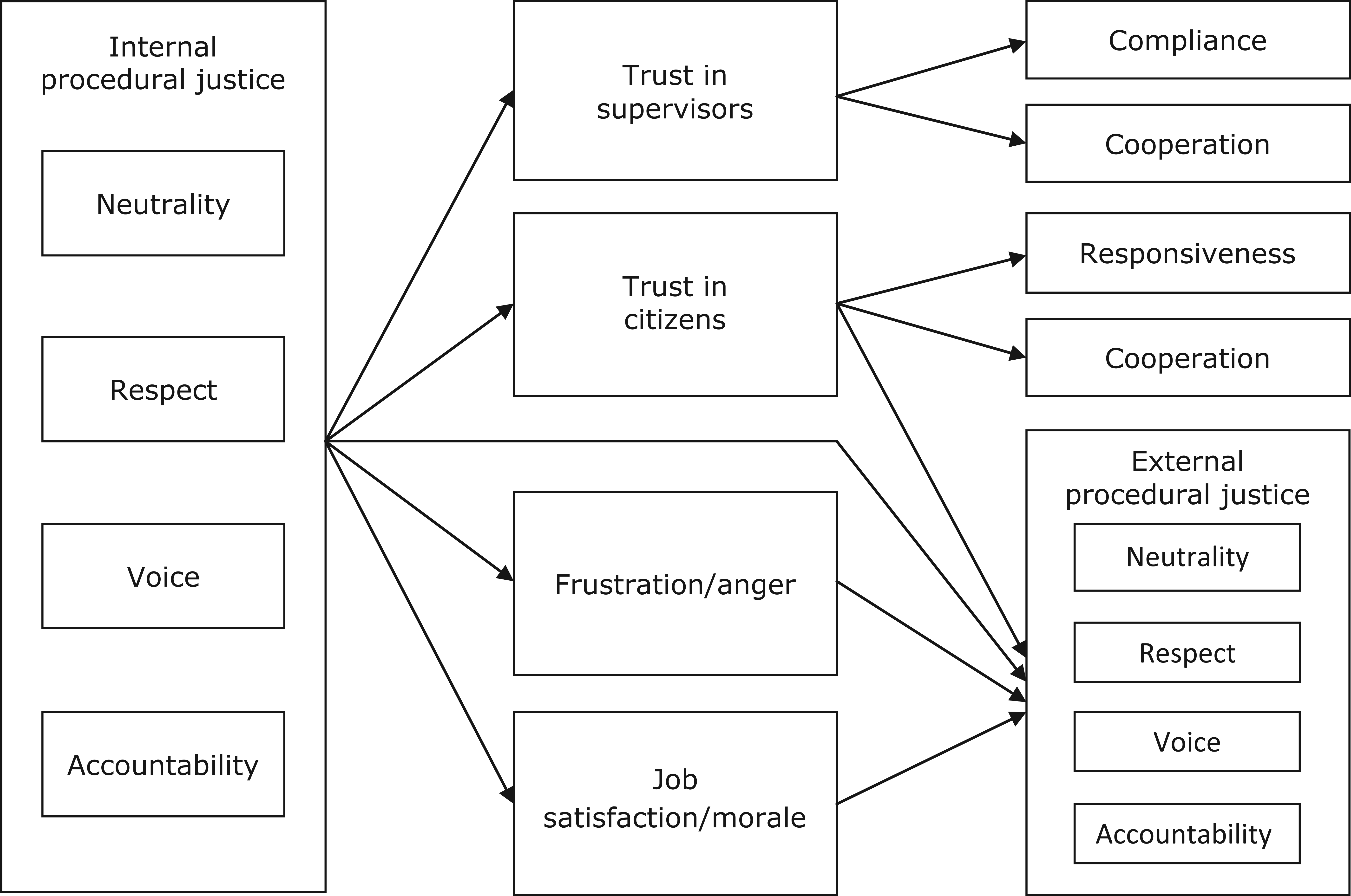
Work relations framework: Conceptual model.
Based on this conceptual model, I formulate the core hypotheses on which we should focus to test the work relations framework. Table 1 provides an overview of what I consider to be the 10 key hypotheses.
Work relations framework: Core hypotheses.
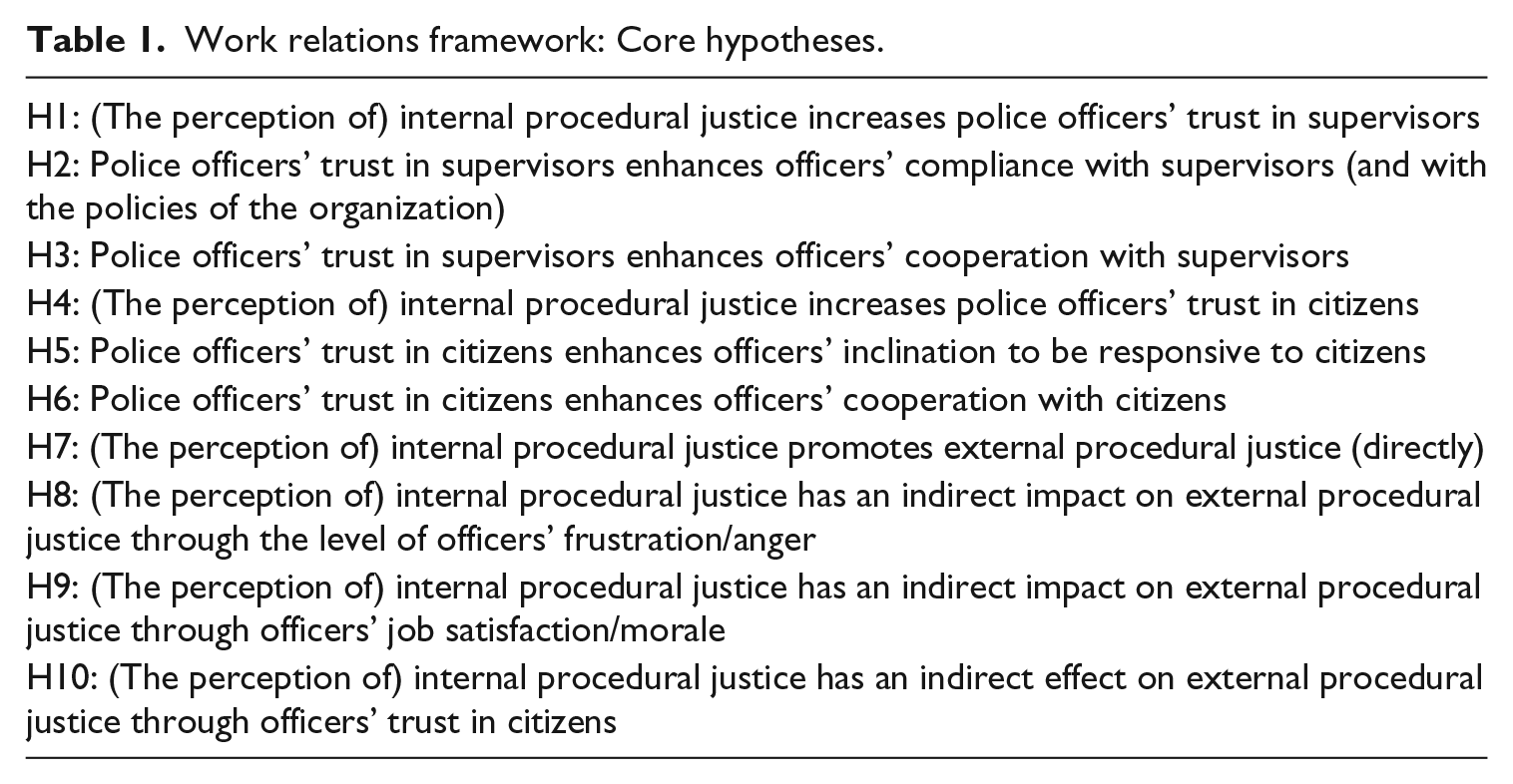
To clarify some issues and indicate the potential importance of elements that are only implicitly included in the conceptual model and hypotheses, I discuss Figure 1 and Table 1 in some explanatory notes. A first one concerns hypotheses 1 and 4. They state that internal procedural justice influences both trust in supervisors and trust in citizens, but this does not have to imply that the two effects are equally strong. It seems likely that the impact on officers’ trust in supervisors will be greater than on their trust in citizens. The point is, however, that the impact of internal procedural justice reaches beyond officer–supervisor relationships to shape officers’ trust in citizens too. Internal procedural (un)fairness generates more than just internal (dis)trust.
Secondly, I note that the set of core hypotheses summed up in Table 1 can – and should – be further expanded. To avoid overkill and not lose sight of the broader picture, I use the general terms internal and external procedural justice here. However, when conducting empirical research it may be interesting to zoom in on the different aspects of procedural justice. With regard to internal procedural justice, we could measure the relative impact of its subdimensions, and with regard to external procedural justice we could assess how strongly its subdimensions are influenced by the suggested determinants. This will yield a more detailed – yet also more complex – picture. To illustrate the underlying complexity, I take the difference between the modeling thesis and the displaced aggression thesis. The first mechanism suggests that external (dis)respect is determined only by internal (dis)respect. The second mechanism, however, leads us to expect that external disrespectful behavior may also be shaped by other forms of internal procedural unfairness.
Finally, I think that an approach that stresses the importance of trust in shaping the relationship between internal procedural justice and officers’ behavior can be complemented by and combined with approaches that have theorized other mediators. Authors have suggested that procedural justice in police organizations and officers’ obedience may be indirectly related through values (Tyler et al., 2007), organizational commitment (Tankebe, 2010, 2011), or organizational identification (Bradford et al., 2014). Although only a limited number of studies have tested these claims and the preliminary findings are mixed, it could be valuable to further reflect on them and theorize how values, organizational commitment, and/or organizational identification together with trust shape the relationship between internal procedural justice and officers’ compliance. Inspiration could be taken from, amongst others, contemporary social exchange theories, which consider trust in supervisors and organizational commitment to be two aspects of social exchange quality (Colquitt et al., 2013).
Conclusion
In the criminological literature, much attention has been given to citizens’ behavior, the traditional police culture, and peer influence as explanations of police officers’ attitudes and behaviors. Studies carried out in different eras and countries have stressed that the way officers treat citizens depends on the degree to which citizens challenge their definition of the situation, their safety, their identity, and their authority (Easton et al., 2009; Loftus, 2010; Van Maanen, 1974, 1978). Officers’ identity and definition of authority, in turn, have been found to be a function of (their commitment to) the traditional culture of policing and it has been shown that assessments of situations, policing styles, and reactions to confrontations and disrespect are learned from fellow officers (Haarr, 2001; Loftus, 2010; Van Maanen, 1974, 1978). In the past, many studies of police–citizen relationships have overlooked or played down supervisors’ role in shaping the way officers think about and deal with citizens. The absence of direct supervision when officers patrol the streets and the autonomy officers have in carrying out their job may have led researchers to assume that supervisors can exert relatively little influence on how officers treat the public. Yet I observe an increasing interest in the role supervisors may play in this respect, and more particularly in the link between supervisors’ actions and the behavior of their officers. A few recent studies focusing on this relationship suggest that changing supervisory styles and procedures is a promising route to achieving changes in the way officers treat citizens (Bradford and Quinton, 2014; Haas et al., 2015; Tankebe and Mesko, 2015). In this article, I have presented a work relations framework that complements and refines this approach.
The expounded theoretical framework also links up with and complements developments in the (non-criminological) literature on organizational governance and regulatory compliance. Recently, Gray and Silbey (2014) have identified organizational actors’ constructions of regulators as important factors explaining compliance and cooperation. Based on ethnographic research in different types of organizations (an industrial factory, trucking companies, and university laboratories), they found that many regulated actors view their regulators as a threat or as an obstacle (or as a combination of both). The construction of regulators as a punitive threat implies that regulators are seen as seeking evidence only of non-compliance and being preoccupied with issuing citations or other forms of punishment. Regulators are perceived as an obstacle when regulated actors find them to lack awareness of ‘what really goes on at work’, when regulated actors feel that regulators ‘have no idea how the job is done’ and, consequently, their rules are considered to be an obstacle to doing the job well or to remaining safe while working. Gray and Silbey observed that these constructions of regulators lead to non-compliance and ‘looking compliant’ behaviors among the regulated (that is, they ignore the rules in practice except for times when the regulator comes around or they misrepresent facts and figures in logbooks/reporting documents in order to appear compliant).
A minority of regulated actors, however, were found to perceive regulators as allies, which means that they see them as agents with whom they can collaborate to produce both their desired service/product and compliance. The likelihood that regulated actors construct regulators as allies increases, Gray and Silbey state, when they interact frequently with each other and engage in a continuous set of transactions. I note that my framework puts similar emphasis on two-way communication by flagging up the principles of voice and accountability. Another important factor in the construction of regulators as allies, according to Gray and Silbey, is that they must be viewed as credible. This means that they are acknowledged to possess relevant expertise and knowledge. If this is the case and regulators are not preoccupied with punishing (minor forms of) non-compliance, regulated actors are more inclined to follow instructions honestly, consult regulators, and ask for assistance. My framework adds to this that for regulators to be constructed as allies they should be perceived not only as credible but also as trustworthy. This involves that, besides being seen as agents who cultivate two-way communication, they must be viewed as agents who treat regulated actors respectfully and equally. Moreover, my framework suggests that when regulated actors experience and interpret regulators as allies not only will they respond to them in a constructive way (that is, be cooperative and compliant), but they will be more likely to behave constructively in dealings with customers or citizens as well (that is, be cooperative and responsive).
I expect that, in addition to yielding cumulative scientific knowledge, evaluations of the work relations framework will have important practical implications. Because of the focus of this article, I limit my discussion to implications in the field of policing. First, empirical tests will examine whether providing leadership based on internal procedural justice is beneficial for police organizations. I expect research to conclude that, when departments apply such an approach, fewer resources are needed to enforce compliance and cooperation. As a consequence, police leaders can concentrate their efforts more effectively on pursuing the long-term management objectives and social missions of the police organization. Second, I expect studies to show that providing leadership based on internal procedural justice is beneficial for the broader society. When supervisors’ behaviors reflect the principles of neutrality, respect, voice, and accountability, citizens will enjoy more responsiveness, cooperation (for instance in some form of community policing), and procedural fairness. It is important for police chiefs to realize that the way supervisors deal with officers has consequences that reach far beyond the organizational setting.
Summarizing all this, I propose – and will aim to prove the relevance of – an approach that could be labeled ‘fair policing from the inside out’. Creating a trusting and trustworthy police force starts inside the organization: by setting a good example and setting the right tone, supervisors can positively influence police officers’ attitudes and behaviors. The increased emphasis on officers’ fairness and citizens’ trust makes deliberation within police organizations on supervisory styles and processes inevitable.
Footnotes
Funding
The author(s) disclosed receipt of the following financial support for the research, authorship, and/or publication of this article: Maarten Van Craen is an FWO-supported postdoctoral researcher at the University of Leuven. His research interests include citizen–police relationships and work relationships within police organizations.