







Abstract
How are human smuggling operations organized? This paper presents an empirical in-depth study of the structure and activities of a smuggling ring operating between the Horn of Africa and Northern Europe via Libya. It relies on a unique set of novel data sets manually extracted from an extensive police investigation launched after the 2013 Lampedusa shipwreck, in which 366 migrants lost their lives. The evidence includes wiretapped conversations on both sides of the Mediterranean. Using a number of network analysis techniques, this paper reconstructs the structure of the ring and investigates the determinants of coordination among its actors. This paper is the first work to offer a formal network modelling of human smuggling operations. It shows that, rather than being internalized within a single organization, activities are segmented and carried out by localized and rudimentary hierarchies with a small number of high-centrality actors operating at various stages along the smuggling route. Coordination is more likely to occur vertically than horizontally, indicating that higher-level smugglers are largely independent and autonomous. There are also indications of competition among them. Finally, even in rings involved in the supply of a truly transnational commodity, the local dimension still plays a crucial role. The implications for criminal justice responses to human smuggling are discussed.
Introduction
In the early hours of 3 October 2013, a fishing boat en route from Libya started to list and then quickly capsized within sight of the Italian island of Lampedusa – right in the middle of the Mediterranean. The boat was carrying a large number of migrants hoping to enter Europe illegally. The shipwreck claimed the lives of 366 people – one of the worst tragedies to have occurred in the Mediterranean (Nelson, 2014). 1 The Italian authorities responded by setting up a large-scale search-and-rescue operation nicknamed ‘Mare Nostrum’. They also launched an extensive criminal investigation into the organization of such journeys across the Mediterranean. For the first time, the elite Anti-Mafia unit with the Palermo Prosecutor’s Office was tasked with investigating smuggling operations on both sides of the Mediterranean. As it turned out, the smugglers involved in that fatal journey had not been deterred by the tragedy, and continued their operations after the shipwreck. The evidence collected during the 18-month international investigation offers a unique opportunity to examine smuggling operations from within and to gain in-depth knowledge of the mechanisms underpinning such operations.
The aim of this work is to expand on the existing literature on human smuggling by adopting a systematic and quantitative approach to the study of the structure of smuggling operations. It combines content analysis of court data and social network analysis techniques to reconstruct patterns of coordination among smugglers empirically. More generally, this work contributes to debates about the organization of illegal markets, particularly their supply side, as well as the structure of criminal networks (see, among others, Campana, 2016b; Morselli, 2014; Varese, 2013; Von Lampe, 2016: Ch. 5).
The paper focuses on the Central Mediterranean smuggling route, that is, the sea route from Libya to Europe via Italy. The European Border and Coast Guard Agency recorded a total of 369,908 illegal border-crossings associated with this route between 2013 and 2016 (Campana, 2017). Finally, this paper interprets human smuggling as an illegal form of trade in which the commodity exchanged is primarily the illegal entry into one or more countries, in accordance with the definition of smuggling set out in the 2000 UN Protocol. Analytically, this sets smuggling apart from human trafficking, as in the latter the commodity exchanged is primarily control over a person (see Campana and Varese, 2016; also Bilger et al., 2006; Kleemans, 2011; Kleemans and Smit, 2014).
Structure of the paper
This paper proceeds as follows. The next section discusses some theoretical issues related to the organization of human smuggling operations. Then I present the data and the methods for this study. After reconstructing the structure of the smuggling network under scrutiny using a network analysis approach, I offer an explanation of the structure observed by means of formal modelling of tie-formation in the network under scrutiny. I then delve more deeply into the determinants of tie-formation and offer some robustness checks. This is followed by some qualitative evidence to support and complement the quantitative evidence discussed. I conclude with a discussion of relevant policy implications.
The organization of human smuggling: Some theoretical issues
Migrant smuggling has received increased scholarly and policy attention in recent years (Kyle and Koslowski, 2011: vii–viii; Triandafyllidou and Maroukis, 2012; see also Düvell, 2006). Researchers have explored a number of different aspects of human smuggling, including the motivations behind the decision to enlist the services of a smuggler (Antonopoulos and Winterdyk, 2006); the financing behind smuggling operations (Koser, 2008); the role of personal networks of migrants in channelling information (Bilger et al., 2006; Herman, 2006); the interactions between migrants and smugglers (Bilger et al., 2006; Van Liempt and Doomernik, 2006); the profile of smugglers (Kleemans and Van de Bunt, 2003; Zhang, 2008) and their motivations to enter the smuggling trade (Sanchez, 2015; Zhang, 2008); and the potential harm to smuggled migrants (Weber and Pickering, 2011). Fewer studies have focused on the organization of human smuggling operations – particularly the interactions among smugglers.
Ko-lin Chin and Sheldon Zhang, both independently and jointly, have produced insightful ethnographic studies on the structure of human smuggling operations from China to the United States (Chin, 1999; Zhang, 2008; Zhang and Chin, 2002). They noted that Chinese human smuggling organizations differ in their structure from the traditional triad societies, as the former ‘are made up of decentralized associations of criminals of diverse backgrounds, and the relationships among core members are mostly horizontal’ (Zhang and Chin, 2002: 759; also Chin, 1999). Interactions tend to take place within small groups of friends and relatives, with each group focused on a specific set of tasks (Zhang, 2008: 145). Soudijn (2006) identified similar organizational arrangements among Chinese smugglers operating in the Netherlands. Crucially, he notes that ‘no evidence was found of a central organization controlling any (let alone all) smuggling operations, either from the Netherlands or from abroad’ (Soudijn, 2006: 127). He maintained that the level of coordination among different groups operating at different stages was minimal, and rejected the ‘chain’ metaphor often used to describe smuggling operations (Soudijn, 2006: 131).
Through a series of interviews conducted in Turkey, Içduygu and Toktas (2002) explored the organizational arrangements underpinning the movement of Iraqi and Iranian irregular migrants. They described the smuggling operations as ‘a loosely cast network, consisting of hundreds of independent smaller units which cooperate along the way’ (Içduygu and Toktas, 2002: 46). Smugglers would adopt a ‘hand-to-hand’ approach, that is, handing over migrants directly to another smuggler after a border crossing (Içduygu and Toktas, 2002: 46). Sanchez (2015: 44) investigated smuggling operations between the US and Mexico and found no evidence of ‘the existence of a single, centralised, power providing operational or logical support in any of the smuggling groups identified’. The exact opposite seems to be the case, as she notes that ‘there was never any kind of leadership’ (Sanchez, 2015: 44).
Other authors, however, have advanced a different view, suggesting that smugglers may adopt a hierarchical structure. Juhász (1999; cited in Salt, 2000: 46) describes the smuggling organizations operating in Hungary as ‘well-organized’ and with a ‘hierarchical structure’, including a top echelon exerting control over several units. Okólski (2000: 74) examined the case of Poland and maintained that, in smuggling networks, there exists an ‘informal leadership, which takes care of, or at least controls, the entire process or a given route, and ensures its security’. He also suggested that ‘there undoubtedly exists the “management level”, which comprises leaders of criminal organizations in major cities or whole regions of all countries involved – origin, transit and destination’ (2000: 74; see also Salt, 2000).
In relation to the Central Mediterranean route, Pastore et al. (2006: 111) concluded that, before the fall of Gaddafi, ‘the available evidence does not point to highly structured transnational entities but rather on a complex network of small- and medium-sized organizations’. They also added that ‘the gangs which organize the journey only sell migrants the service of the crossing as far as the shores of Sicily; no cases have been discovered of traffickers having connections on Italian territory to help with arrivals in Sicily’ (Pastore et al., 2006: 111). 2 Coluccello and Massey (2007: 87) described the smuggling between Libya and Lampedusa as characterized by ‘fluid and flexible networks’. Massari (2015: 29) describes the journey from the home country of the migrants to Libya as self-organized, with smugglers working ‘on an independent basis, and their services seems to be unplanned, without the form of hierarchical coordination found within a more structured criminal network’. A recent report by Abdel Aziz et al. (2015: 24) on smuggling in the Mediterranean notes that ‘small and ephemeral groups participate in the business as well as highly professionalised networks. The players in the smuggling market can be organised in a large variety of ways, from structured criminal groups to individual occasional smugglers.’
The current literature provides important insights into the phenomenon. Yet it still suffers from two important limitations. Firstly, most studies have derived their evidence from interviews with migrants (with a few notable exceptions, for example Zhang and Chin, 2002). However, migrants seldom have complete information on the smuggler’s side of the operations, and they may draw a highly distorted picture. For instance, Bilger et al. (2006: 78) describe the figure of the ‘organiser’ as a person who ‘controls the whole process’. This is derived from interviews with smuggled migrants, but the interviewees themselves have ‘emphasised that they never got in contact with the “organiser” personally’ (Bilger et al., 2006: 78). Secondly, the studies are qualitative in nature and based mostly on anecdotal evidence: no systematic quantitative analysis of interactions among smugglers has yet been conducted. Furthermore, the term ‘network’ is often used in a ‘fuzzy’ way (see, for example, Abdel Aziz et al., 2015; Coluccello and Massey, 2007; Içduygu and Toktas, 2002; Pastore et al., 2006) and without offering a formal modelling of the structure and determinants of such networks.
This work attempts to address the limitations in the existing literature by drawing on a set of novel data sets coded from the wiretapped telephone conversations between smugglers (supplemented and triangulated with other sources; see the next section for details). Secondly, it will offer the first formal modelling of a network structure in relation to human smuggling operations and will explore the drivers underlying this structure.
Throughout the paper I will use the term ‘network’ in an instrumental way to indicate a joint set of actors and relationships among them, and not to indicate a specific form of organization (the latter view is expressed in Powell, 1990; see Campana, 2016b, for a discussion). I will interpret a tie between two smugglers as a proxy for coordination. The latter is defined as the act of intentionally coming together to achieve a certain goal. 3
Theoretically, this places the analysis within the broader literature on coordination in illegal markets (Campana and Varese, 2013; Neske, 2006; Reuter, 1983 and 1985). More generally, the issue of how coordination among smugglers is achieved is similar to the problem that all entrepreneurs face, namely whether transactions should be internalized within a single organization or carried out on the market by independent players (Coase, 1937: 388; Williamson, 2005: 7). In the first case, hierarchies function as a coordinating mechanism whereas, in the latter case, prices do this. Neske noted that understanding the coordination mechanism is a ‘central question’ in studying human smuggling, and warned that this is ‘a question which is relatively difficult to answer and even more difficult to prove’ (2006: 135). I will now turn to an empirical and systematic exploration of this issue.
Data and methods
The data for this study come from a systematic analysis of the evidence collected during a large-scale investigation conducted by the Anti-Mafia Prosecutor’s Office in Palermo, Italy. The investigation lasted for 18 months and involved several European countries (Interview 1). This is the largest investigation into human smuggling ever to have been carried out by the Italian authorities; for the first time, investigative techniques and legal instruments developed to fight the Sicilian Mafia have been used to tackle human smuggling (Interview 1; Interview 2). The investigation cast a wide net over smuggling operations on both sides of the Mediterranean, and uncovered a major smuggling ring operating between the Horn of Africa and Northern Europe via Libya and Italy. This ring was responsible for the arrival on Italian shores of at least 4670 migrants in 13 boat landings ([Court files] DDA, 2015a: 51–2).
The bulk of the evidence for this work was systematically extracted through a manual content analysis of two indictments prepared by the Prosecutor’s Office and totalling some 800 pages (referred to in the text as DDA, 2014, and DDA, 2015a). These documents include transcripts of wiretapped telephone conversations between smugglers who were active at all stages of the smuggling process, testimonies collected from migrants upon their arrival in Sicily, and background information about the offenders against whom arrest warrants were issued. Additionally, I have acquired and analysed the meta-data on the telephone calls exchanged between a sub-set of smugglers. Finally, I have supplemented the evidence from the court files with interviews with key informants conducted during a field trip to Palermo and Lampedusa. Interviewees included the prosecutor in charge of the criminal case as well as members of the police special team tasked with the investigation (see the Reference list for details). 4 Police investigations and court files have been extensively used as sources of information when studying organized crime (see, among others, Gambetta, 1993; Graebner Anderson, 1979; Paoli, 2003; Reuter, 1983; Varese, 2011). Previous studies have relied on this type of evidence to build network data sets in relation to a variety of criminal phenomena, ranging from Mafias (Calderoni and Piccardi, 2014; Campana and Varese, 2013; Varese, 2013) to drug trafficking (Bright et al., 2012; Malm and Bichler, 2011; Morselli, 2009; Natarajan, 2006) and human trafficking (Campana, 2016a; Mancuso, 2014; Morselli and Savoie-Gargiso, 2014). This is the first work to offer a formal modelling of interactions among migrant smugglers. 5
Based on the evidence collected, I was able to build two novel network data sets recording interaction among smugglers. To improve the validity and reliability of the data, I adopted a two-stage procedure. First, two coders independently extracted nodes and ties from the court files (I was one of the coders). 6 Next, the coders discussed the inclusion of each single node and tie, as well as their associated attributes, into the final data sets (on issues of validity and reliability associated with content analysis, see Krippendorff, 2004). The evidence meets the prerequisites for the quantitative analysis of telephone intercepts discussed in Campana and Varese (2012), that is, no self-censorship, adequate coverage and size. As for the boundaries of the network, I took the pragmatic decision to consider them to be where the police file ends – this is in line with other studies that have used similar evidence (Calderoni, 2012; Morselli, 2009; Natarajan, 2006; Varese, 2013; see also Campana and Varese, 2012). Network data sets have the same list of actors on both rows and columns, while the number of ties exchanged between each pair of actors is recorded in the cells. This type of matrix allows for patterns of relationships to be formally analysed (on social network analysis, see Borgatti et al., 2013; Robins, 2015).
The first network data set records the contacts exchanged among all the individuals identified and operating at any stage of the smuggling process (N actors = 292). These contacts were manually extracted from all the sources available: content of wiretapped telephone conversations between smugglers, testimonies of migrants and investigative reports (N ties = 1056). They all relate to business activities (for example, organizing sea journeys, managing safe houses, purchasing train or bus tickets, collecting information about specific crossings, organizing car pick-ups and transfers, arranging and monitoring payments; see also the section on ‘Payments, agreements and reputation’ for some examples); contacts established in relation to strictly personal matters were excluded. This data set offers the broadest possible representation of the smuggling ring, covering its activities during the entire process from the Horn of Africa to the Nordic countries. To minimize biases related to the data collection strategy, the network data are treated as binary and undirected. 7 In addition, this data set considers only interactions among smugglers, and does not include contacts between smugglers and migrants.
The second network data set focuses on a sub-set of smugglers based in Italy (N actors = 28). For this set of actors it was possible to reconstruct the entire telephone traffic associated with their lines (meta-data). I was then able to build a data set recording the universe of telephone calls exchanged among this sub-set of smugglers in just under a month of enhanced surveillance (N telephone calls = 39,292; N unique ties = 210). 8 In this network, ties have no direction but they are valued. Because we know the exact number of telephone calls exchanged, this data set is able to capture the strength of the interaction between each pair of actors.
Finally, for both network data sets I built a companion standard ‘actors-by-variables’ data set recording a number of attributes for each actor (node). Attributes include gender, smuggling stage, role, task and – for a sub-set of actors – nationality and age. I will discuss these attributes in detail in the next sections.
A number of network analysis techniques were then applied to explore the structure of the smuggling ring. To explore tie-formation among actors, I applied a regression technique specific to network data, namely quadratic assignment procedure (QAP) regression (Dekker et al., 2007; Krackhardt, 1987, 1988; also Campana, 2016b). 9 Network data are relational by definition and therefore violate the assumption of non-independence of observations postulated by standard regression models (Krackhardt, 1988: 360). QAP techniques offer a solution to the problem of auto-correlation, or non-independence of observations, and provide a method for testing hypotheses based on a permutation-based nonparametric test of dependence between two or more square matrices of the same size (Dekker et al., 2007: 565–6; also Campana, 2016b). When the dependent network matrix includes valued ties, this approach is similar to that of multiple linear regression, and results can be interpreted in the same way. When the dependent network matrix includes binary ties, the approach is similar to that of logistic regression, and results can be interpreted accordingly. The method adopted for the permutations is double semi-partialling (Dekker et al., 2007).
Before I turn to the results of the analysis, I will briefly discuss the extent to which the evidence does not relate to an unusual or peripheral case. Firstly, the investigation was prompted by a deadly shipwreck. Tragically – yet crucially from a methodological perspective – chance seems to have played a pivotal role in the unfolding of the tragedy, thus making this fatal journey akin to a random draw from the (unknown) distribution of journeys out of Libya. The vessel involved was not markedly less safe than the average boat carrying migrants (if anything, the opposite was true: Interview 1); nor did the smugglers do anything to make this specific journey more dangerous than the average journey (all migrants’ boats tend to be overcrowded). This is confirmed by how the events unfolded. According to testimonies from survivors, the fatal accident began with an engine fault (again, a fairly typical occurrence in these journeys); the ‘captain’ then decided to set a blanket on fire to attract attention but accidentally dropped it and ignited a fire on board (Nelson, 2014). The sight of flames created panic on board: passengers stampeded to one side of the vessel, causing it to list and then quickly capsize (Nelson, 2014). In addition, both the nationality of the migrants on board and the route travelled by the migrants appear to be fairly typical. A large majority of the migrants on board, if not all, are believed to have been Eritrean (DDA, 2014, 2015a; Interview 1). The (scant) qualitative evidence on the nationality of migrants enlisting the services of the smuggling ring under scrutiny also points in the same direction with regard to nationality (DDA, 2015a, 2015b). According to the International Organization for Migration (IOM. 2015: 84), Eritreans were the second-largest nationality group among migrants arriving in Italy in both 2013 and 2014, accounting for 23 per cent and 20 per cent respectively of the arrivals. This indicates that the ‘slice’ of the smuggling market we are observing is a rather prominent one. Secondly, the East African route along which the ring was operating, that is, from Sudan through the Libyan desert, then Tripoli and crossing into Europe, has been independently identified by IOM as one of the main smuggling routes on the African continent (2015: 84; see also Stevis, 2015).
The structure of the smuggling network
Overall, 292 actors have been identified as part of the smuggling ring under investigation (this figure does not include migrants). Table 1 offers a summary of their characteristics.
Summary of characteristics of all offenders (N = 292).
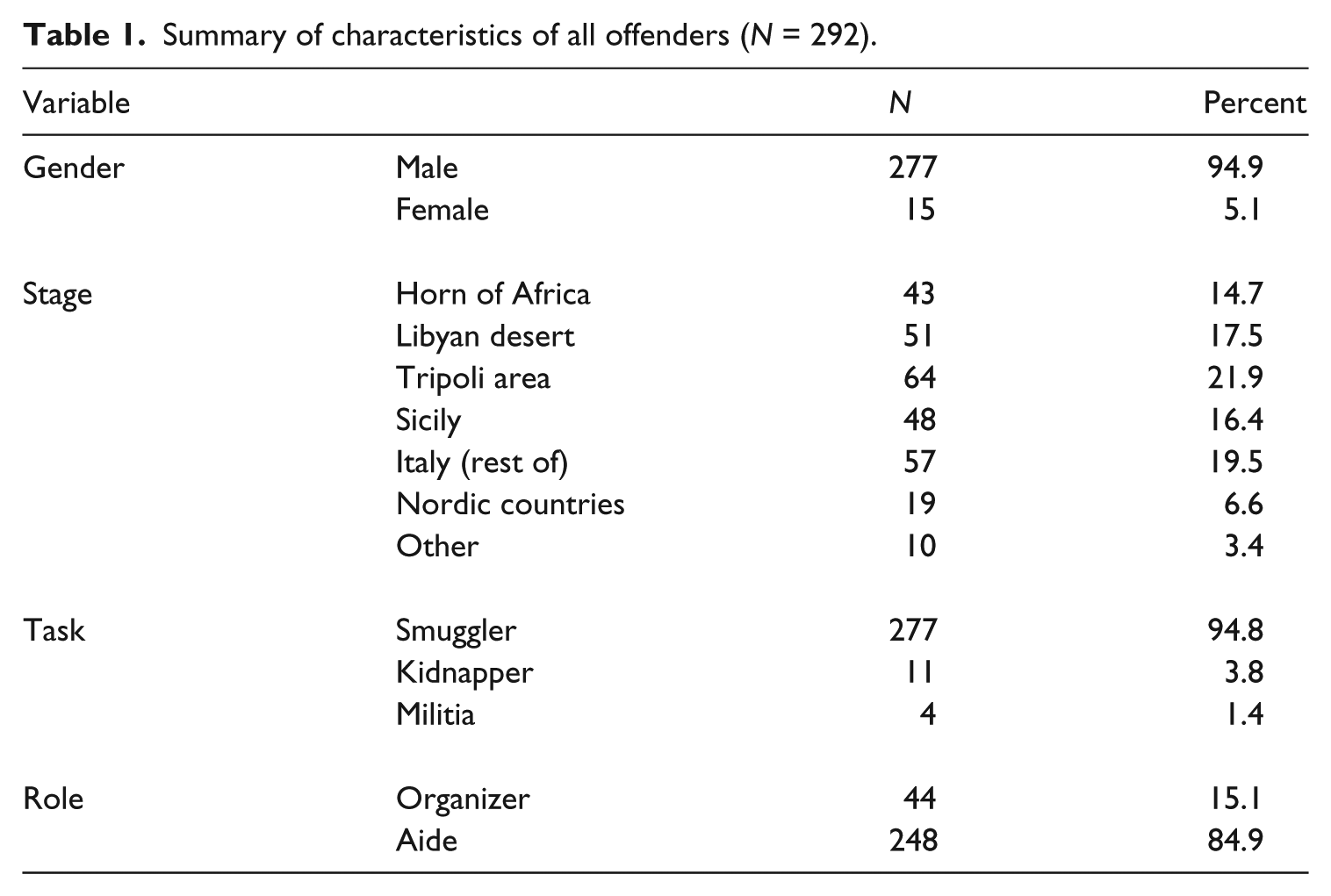
The overwhelmingly majority of the actors involved in the smuggling ring are male (95 percent). The ring under scrutiny was involved in facilitating the movement of migrants from the Horn of Africa to Europe, particularly Nordic countries. This movement can be broken down into subsequent geographical (macro) stages: Horn of Africa (beginning of the journey); en route through the Libyan desert; Tripoli area; Sicily (that is, point of entry into the EU); en route through the rest of Italy; Nordic countries (main destination countries). Based on the content of the wiretapped telephone conversations and other evidence, each actor has been assigned to a specific stage. Overall, 96.6 percent of the actors are located along the main smuggling route. However, the reach of the network extends well beyond it, and includes actors located in Dubai, Israel, Canada, Turkey, Germany, the Netherlands and the United Kingdom (DDA, 2014, 2015a).
The network includes mainly individuals involved in activities directly related to the movement of migrants (that is, ‘smugglers’). However, two other figures also emerge: a sub-set of actors who specialize in kidnapping for ransom and some militia members. The first operate in the Libyan desert and the latter are corrupt ‘officials’ in charge of detention centres in the Tripoli area who would accept bribes from smugglers to free migrants (DDA, 2014 2015a).
Not all the actors in the network appear to occupy the same position of authority. Based on the wiretapped conversations and other evidence, I was able to identify two main roles: ‘organizer’ and ‘aide’. Organizers are individuals who give orders but do not receive them; they are in a position to make pivotal decisions regarding smuggling operations – this is in line with Bilger et al.’s (2006) description of ‘organisers’. Aides, on the other hand, are individuals who receive orders and/or are highly dependent on organizers for their activities. Organizers make up some 15 percent of the actors and the remaining 85 percent occupy a lower-ranking position. 10
Figure 1 offers a graphical representation of the overall network of offenders. 11 Each node (dot) in the figure represents an individual. The graph is generated using a force-directed algorithm based on the principle that nodes connected by a tie should be drawn next to each other (Fruchterman and Reingold, 1991). Therefore, the relative position of each node in the graph is meaningful. The size of each node indicates its degree centrality, that is, the number of ties each individual exchanged with any other individual in the network. 12 On average, the distance between any two individuals is 3.8 steps (average path length: Robins, 2015: 25). Interestingly, there are no disconnected components within the network. This indicates that every single actor can potentially be reached by any other actor regardless of the stage with which they are associated. Coordination has the potential to flow throughout the network, for instance from the Horn of Africa to Sweden. Yet a closer look at the spatial pattern in Figure 1 reveals a clear tendency towards clusterization. This is confirmed by a clustering analysis using a Markov clustering algorithm (Van Dongen, 2008). 13
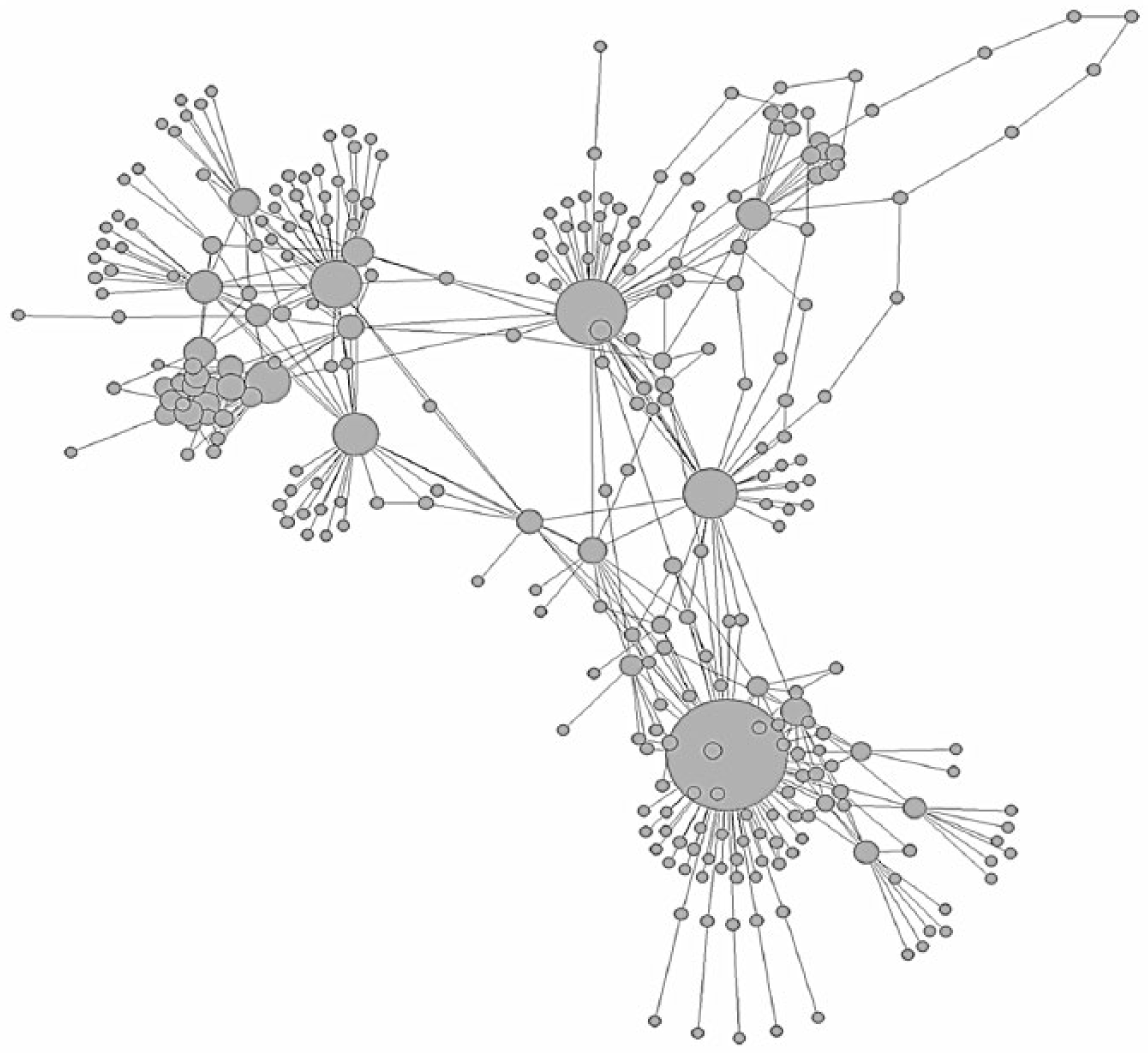
The smuggling network.
The figure also shows that the actors involved in the smuggling ring have different levels of centrality (indicated by the size of the nodes, see also Figure 2 in the Appendix). The top two actors are smugglers based in Tripoli and they were both independently coded as ‘organizers’. The third top actor is a smuggler based in Sudan, involved mainly in the sale of smuggling services at the beginning of the journey, with direct links with local communities in the migrants’ home countries (mostly Eritrea and Ethiopia: DDA, 2014). He was also classified as an organizer. Then we have an aide based in the Tripoli area followed by an organizer based in Rome, another organizer based in Sicily, and the ‘head’ of the group ‘specializing’ in kidnapping for ransom operating in the Libyan desert. 14 On average, organizers possess a higher degree centrality (8.27) than aides (2.79), and this difference is statistically significant. 15
Explaining coordination in the smuggling network
The tendency towards clusterization and the presence of a handful of high-centrality actors suggest that not all contacts within the network are equally likely to be established. In other words, coordination is more likely to happen between certain actors than others (coordination is expressed in the network as the presence of a tie between two actors). What then makes actors more likely to coordinate?
I now explore the determinants of such coordination through formal modelling of tie-formation within the network under scrutiny. To do so, I use as the dependent variable the binary network matrix recording the presence of a contact (tie) between each pair of individuals included in the ring. As independent variables, I have built a number of network matrices recording whether two actors share the same gender; whether they operate in relation to the same stage of the journey; whether they share the same task; and, finally, whether they occupy the same role. Table 2 presents the results of two QAP logistic regressions for network data modelling the determinants discussed above.
Tie-formation among all offenders (N = 292).
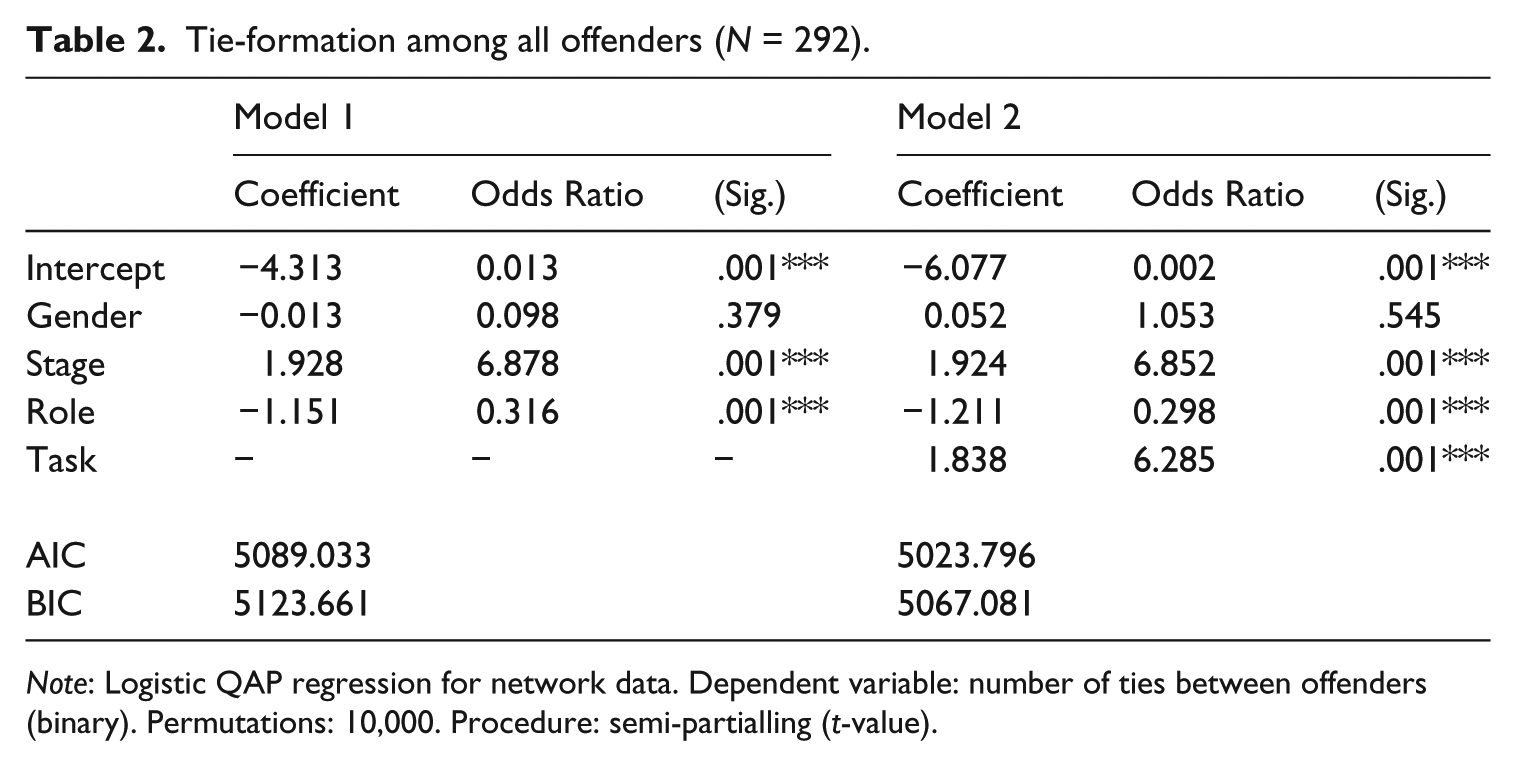
Note: Logistic QAP regression for network data. Dependent variable: number of ties between offenders (binary). Permutations: 10,000. Procedure: semi-partialling (t-value).
Both models show a strong effect of ‘stage’ and ‘role’ in explaining tie-formation (both effects are statistically significant). Actors who operate in relation to the same stage of the journey are almost seven times more likely to establish a tie between them. This result suggests that, even in networks involved in the supply of a truly transnational commodity, namely the movement from the Horn of Africa to Northern Europe, the local dimension is still crucial. Secondly, actors who share the same position in the network as captured by their role (that is, organizer vs. aide) are more than three times less likely to establish a tie. This indicates that coordination is more likely to take place across roles (that is, between organizers and aides) rather than within roles (for example, between fellow organizers). This finding is consistent with the idea that organizers are independent of each other, and possibly to some extent in competition with each other.
This also holds true if we include in the model the task performed by each actor. Individuals involved in the same task are six times more likely to establish a tie. This suggests that there is a clear separation between actors involved in the provision of smuggling services, in kidnapping for ransom and in the ‘management’ of detention centres. Smugglers are more likely to coordinate with fellow smugglers, kidnappers with other kidnappers, and militia members with other militia members. This goes against narratives that conflate these separate sets of activities under the same ‘smuggling’ label.
Overall, the market for smuggling services appears to be segmented, both geographically and organisationally (on segmentation in illicit markets, see Reuter, 1985: 9). There is quantitative evidence of rudimentary hierarchies active in the network under scrutiny (see Figure 1 and the variable ‘Role’ in Table 2). However, the reach of these hierarchies tends to remain local in scope and there is no indication that the network is a single hierarchical organisation (in addition, there is no evidence of any centralized accounting system). The available evidence shows that these hierarchies are coupled with some form of division of labour. The main one is between smugglers, protectors (militia) and kidnappers. 16
Further evidence on coordination
To deepen our understanding of coordination and check the robustness of the findings discussed above, I now turn to the second network data set. This relates to the sub-set of 28 smugglers who were put under enhanced surveillance by the authorities. Table 3 offers a summary of the characteristics of these actors.
Summary of characteristics of offenders under enhanced surveillance (N = 28).
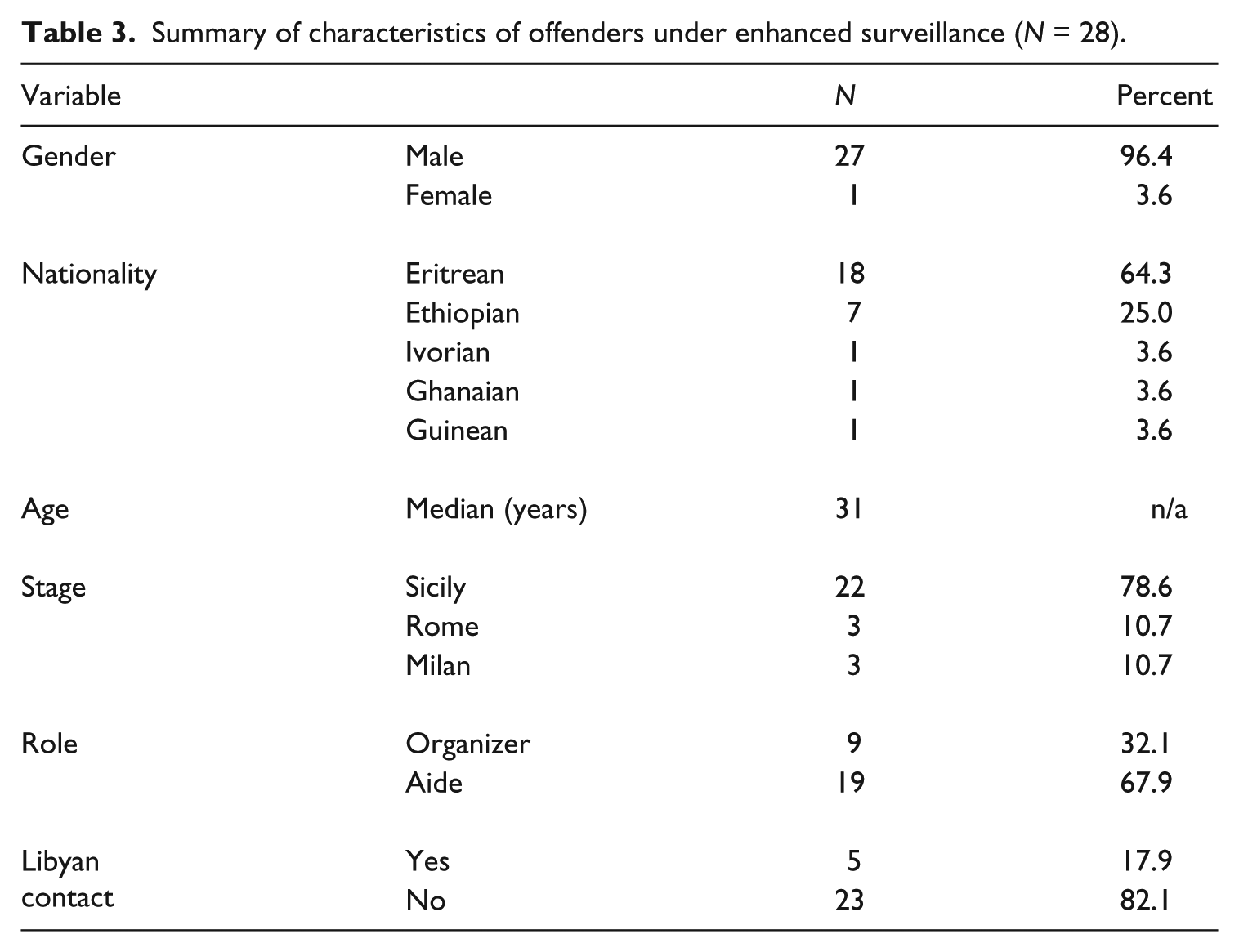
In line with the results for the overall network, actors included in this sub-network are overwhelmingly male. The gender ratio mirrors that recorded for the overall network. The median age at the beginning of the investigation was 31 years. 17 All the actors are involved in the provision of smuggling services (no kidnappers or militia members were identified in this sub-network). The large majority of smugglers were born in either Eritrea or Ethiopia. 18 Thanks to the additional information available for this sub-set of actors, I was able to develop more fine-grained coding for the stage: Sicily (that is, point of entry into the EU); Rome (normally the first stop en route to the North); and Milan (where arrangements for travel through Switzerland, Austria and Germany are often made). Secondly, I was also able to record for each smuggler whether he or she had direct access to a smuggler based in Libya. As the flow of migrants is unidirectional, this variable captures the ability of an Italian-based smuggler to tap directly into the market opportunities generated in Libya, and therefore offers a proxy for the level of market opportunities available to him or her (see the next section for an example of the business agreements made between smugglers situated on the two sides of the Mediterranean).
For this set of actors it was possible to reconstruct the entire telephone traffic associated with their lines, and thus build a network matrix recording the universe of conversations exchanged between them. Because we know the exact number of telephone calls exchanged by each pair of actors, we can now model coordination as a continuous variable, thus capturing the strength of each dyadic interaction. This network matrix is the dependent variable in both models shown in Table 4. 19 As independent variables, the models include a number of network matrices recording whether two smugglers share the same gender, the same nationality, or the same role, as well as their age difference and whether they operate in connection with the same stage in the journey. Model 4 introduces an extra factor, namely whether the two smugglers both have direct access to a Libyan-based smuggler.
Tie-formation among offenders under enhanced surveillance (N = 28).
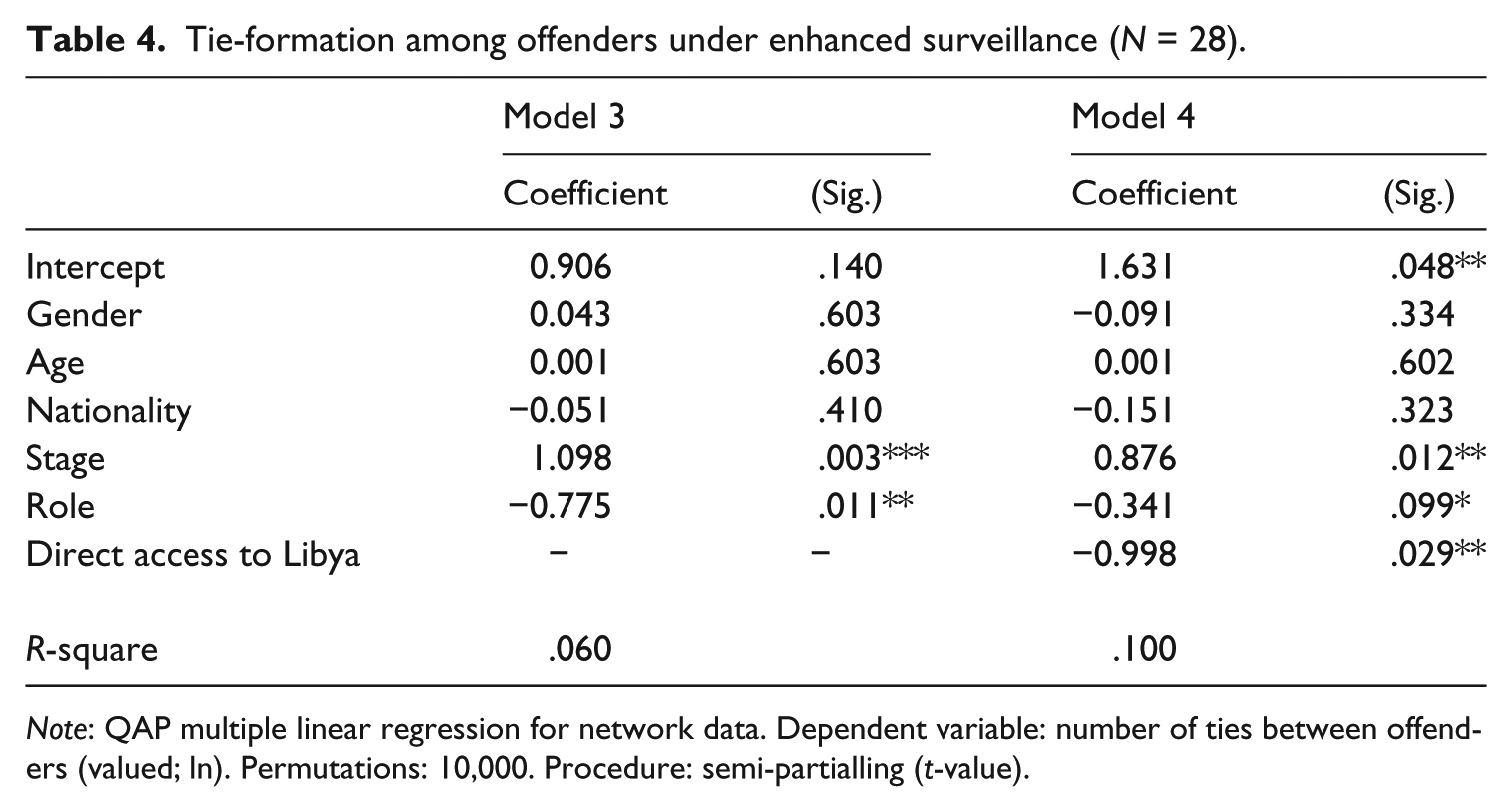
Note: QAP multiple linear regression for network data. Dependent variable: number of ties between offenders (valued; ln). Permutations: 10,000. Procedure: semi-partialling (t-value).
Gender, age difference and nationality do not show any relevant effect on tie-formation (note that, for gender, this is in line with the findings for the whole network). Both models confirm the importance of being associated with the same stage in the journey when explaining coordination among smugglers. This effect is strong and statistically significant in both models. It is worth noting that this analysis is based on telephone calls, so there is no technical reason for this to be the case. Rather, one could argue that this is the result of operational decisions.
Furthermore, in this network, organizers tend not to coordinate with fellow organizers. Rather, coordination appears to take place between organizers and aides. This is in line with the findings for the overall network and offers further support for the idea that there are rudimentary hierarchies within the network and that organizers are independent of each other. Model 4 includes a measure of the market opportunities available to each actor (‘Direct access to Libya’). Crucially, smugglers who have such access tend not to coordinate among themselves. The effect is negative, statistically significant and rather strong. Business opportunities tear cooperation apart. This result is consistent with a market characterized by competition, and this holds true even at the local level: this is a far cry from, for instance, how Mafia-like organizations operate. It is also a major departure from how the public discourse is often framed, that is, around the presence of kingpins who can exert some sort of monopolistic control over a certain route (for evidence, see Campana, 2017).
Payments, agreements and reputation
The content of the wiretapped telephone conversations, as well as testimonies collected from migrants, offers additional qualitative evidence on the mechanisms underpinning smuggling operations. 20
The system of payments in place supports the idea that operations are segmented. First, there does not appear to be any centralized system to collect payment for the entire journey. Rather, migrants are normally asked to pay for each leg separately. According to the testimony of an Eritrean migrant, the payment for the sea crossing was made once they reached Tripoli (it is possible that the ‘friends’ in Sudan are in reality smugglers): Once in Tripoli, we collected information through some friends in Sudan on who was organizing the journeys to Sicily. They told us that a person called Isaias was based there, so we called him.. . . I have personally spoken to him on the phone to arrange for the journey for my sister and myself. He asked for $3,600 for both of us. (DDA, 2014: 28)
This is confirmed by another Eritrean migrant: ‘To bring us to Sicily, Isaias asked for $1,600; [the money] was paid to a person in Israel he had indicated’ (DDA, 2014: 39). The same applies to operations on the other side of the Mediterranean, as emerges from a transcript of a wiretapped telephone call between two smugglers, one based in Libya (Isaias) and the other in Sicily (Dawit): ‘Isaias asks Dawit what is his role in all of this. Dawit explains that he picks people up from the [Reception] Centre with some cars …. After that, he organizes the journey to Rome, and he charges €150 per person, of which he gets €50.’ (DDA, 2015a: 55–6). The segmentation of payments is similar to what Triandafyllidou and Maroukis (2012: 55) observed in relation to the journeys made by sub-Saharan Africans, whereby migrants were ‘making use of local smuggling networks’ and paying for each leg separately (see also Massari, 2015). However, in one telephone conversation, a smuggler based in Sudan (that is, at the beginning of the journey) tells his aide that he can also collect the money for the sea crossing and pay it directly to the smuggler based in Libya (DDA, 2014: 131). As he explains over the telephone, this would avoid migrants being kept in ‘safe houses’ in Libya for too long, that is, until the relatives have transferred the money for the crossing (DDA, 2014: 131). In a sense, this is offered as a ‘premium’ services to migrants; however, not all Sudan-based smugglers seem to adopt this strategy, because it increases the operational cost for them. More generally, payments are made through legitimate money transfer agencies, but often smugglers and migrants alike rely on hawala (DDA, 2015a: 13, 76, 103, 107–8, 151, 153, 231, 245, 278). Hawala is an informal money transfer system based on trust; it is comparable to non-banking financial institutions such as Western Union or MoneyGram (see Varese, 2016). Migrants are normally requested to make their payment in advance of the next leg (DDA, 2014: 63). 21
The wiretapped telephone calls also offer further evidence of independence among top-level smugglers. The following transcripts describe an agreement between Isaias, who is based in Libya and involved in organizing sea crossings, and Dawit, who is operating in Sicily: Isaias tells him that he will give his [Dawit’s] number to all the people he will send [to Italy] so that he will give him [Dawit] some work, since all the other organizers do like this, they give the people they send the contacts of people in Italy who will then take care of them. (DDA, 2015a: 55–6)
Dawit, in turn, ‘contracts’ some services out to independent smaller-scale smugglers, as emerges from the following telephone call: ‘Dawit tells him that there are eight people there, the person says not to give them to anybody else and that he is coming [to pick them up]’ (DDA, 2015b: 470). More generally, there seems to be no exclusivity clause in the working agreements between smugglers based in Sicily and those based in Libya, as emerges from a wiretapped telephone conversation to Dawit: [Dawit] apologizes to the woman for being very busy at the camp; he works with people who are sent to him by Ali, Isaias and Muhammad, and he is busy the whole day with transporting people to the city with three, four cars, and that he has a house available where he can put people up. He confides to the woman that all of them, Ali, Isaias and Muhammad, have his phone numbers. (DDA, 2015a: 166)
This conversation shows that multiple independent smugglers operate not only in Sicily but also in Libya. This is confirmed by another wiretapped telephone conversation between Isaias and Dawit: [Isaias] asks if the boats are coming in, [Dawit] replies that two of Muhammad’s boats have already arrived, and 1000 people of Mebratu [arrived] four days ago, while today a boat with 1000 people has arrived, but he still does not know who owns it. [Isaias] asks him if they are all fellow countrymen [Ethiopians and Eritreans], and [Dawit] confirms. (DDA, 2015a: 173)
A similar picture emerges from a telephone call made by Yusef, a top-level smuggler based in Sudan: Yusef asks Samuel if there is any news. Samuel replies that he has been there [in the Reception Centre] for 28 days, and two of Muhammad’s boats have arrived in the last two days. Yusef then complains, asking why the guy isn’t sending ‘ours’ … while the others keep sending people. (DDA, 2014: 30)
This excerpt suggests competition among smugglers, as Yusef is clearly concerned about his competitors being able to offer a better service to migrants (and, as a consequence, his losing ‘clients’). The same Yusef discussed with Isaias details of the October 2013 tragic journey in which both were involved: ‘Isaias asks Yusef what is the total number of his migrants [on board], and Yusef replies 109, of whom 68 have died’ (DDA, 2014: 31). This conversation shows that Isaias was working with multiple smugglers at the same time as there were a total of 518 migrants on board that ship.
Reputation seems to play a key role in the market for human smuggling. During a telephone call, the same Yusef as above claims to have paid ‘compensation’ to the families of the victims of the October 2013 sinking, as emerges from the following transcript: [Yusef] continues saying that his fellow countrymen trusted him, and he is extremely sorry for what happened; contrary to other organizers, he had personally notified the families who have lost somebody in the shipwreck, and he had even sent 5000 dollars to his village and to the village named ‘Adi Hargets’ for the relatives of the victims from these areas. (DDA, 2014: 131)
In another conversation, Yusef reproaches Isaias for sending out an overcrowded boat (DDA, 2014: 133). Additionally, keeping a positive collective reputation is also a cause of concern for Yusef. In a conversation with Isaias, he suggests he should talk to another smuggler ‘who has embarked some people against their relatives’ will’ (DDA, 2014: 134). He then goes on to explain that ‘such behaviour is wrong … and it hurts everybody, and gives the example of a group of people who share the same house whose bathroom is dirty, and it reflects badly on everybody, not just on the person who has made the bathroom dirty’ (DDA, 2014: 134).
Finally, a conversation between the same Yusef and Isaias offers additional support for the idea that individuals involved in kidnapping for ransom are a separate group from ‘genuine’ smugglers: During a journey many things can happen: to be arrested or not be able to leave for so many reasons that only God can know; however, when the migrants are kidnapped and they are forced to pay a very high ransom, in these cases he can intervene and mediate with the kidnappers. (DDA, 2014: 33)
Although part of separate groups, smugglers and kidnappers have the ability to establish contacts should the need arise (as, indeed, shown by the network structure in Figure 1).
Conclusions
This work has explored the organization of human smuggling across the Mediterranean and sought to understand in an empirical and systematic way how such operations are structured. It is the first work to have offered a formal modelling of smuggling operations.
The research has shown that the smuggling ring operating along the route from the Horn of Africa to Europe via Libya does not appear to be a single organization. Rather than being coordinated by a single hierarchy, transactions tend to take place among largely independent actors. This is a major departure from the model adopted by Mafia-like organizations, and is similar to that observed by Zhang and Chin (2002) in relation to Chinese human smuggling. Yet the network under scrutiny presents evidence of localized and rudimentary hierarchies, with some degree of division of labour. In addition, there is a very small number of high-centrality actors operating at various stages along the smuggling route. This shows that, even in largely ‘flat’ networks, there is still a need for coordination. Overall, the extent of such coordination appears to be larger than Soudijn (2006) described in the case of Chinese smuggling but is still localized and segmented – contrary to Bilger et al.’s (2006: 78) observation that organizers control the whole process. In addition, contrary to what Pastore et al. (2006) have observed, coordination does take place across the Mediterranean.
A closer look at how coordination is achieved within the network has uncovered three key findings. Firstly, even in networks involved in the supply of a truly transnational commodity, namely the movement of migrants from the Horn of Africa to Northern Europe, the local dimension is still crucial. Smugglers who are involved in the same stage of the journey are more than six times more likely to coordinate. This holds true even when we consider only telephone calls as a proxy for coordination and exclude direct contacts. Secondly, coordination is more likely to take place across roles, that is, between organizers and aides. This supports the idea that there are multiple rudimentary hierarchies in the network. In addition, it suggests that higher-level smugglers are mostly independent of each other and organize their activities autonomously. Thirdly, there are indications of competition among smugglers. This is a far cry from the idea that smuggling markets are characterized by the presence of kingpins who can exert monopolistic control over a certain route. 22
Moreover, it is worth noting that there is no evidence of any involvement of the Sicilian Mafia in smuggling activities taking place in Sicily, despite the latter being a key stage in the smuggling route. This includes the payment of protection money. Crucially, the paper has shown that the roles of smuggler and of racketeer remain clearly distinct. Additional evidence from the African side of operations also shows a clear separation between smugglers, kidnappers and militia.
From a policy perspective, the polycentric nature of the network and perhaps even more so the considerable level of autonomy possessed by higher-level smugglers pose a formidable challenge to the authorities. The presence of multiple independent smugglers in competition among themselves makes it likely that, following the removal of an individual smuggler, the remaining smugglers will try to seize this opportunity to acquire his ‘market’ share. These challenges are exacerbated by the fact that high-centrality actors operate in a number of different jurisdictions along the smuggling route. Criminal justice responses require the adoption of coordinated actions to tackle these multiple localized clusters of offenders simultaneously. These actions include information-sharing and coordinated police operations. This coordination should involve all countries along the route, although it may be challenging to engage non-EU countries. Constant monitoring to identify newcomers and/or rising players needs to be also in place (the ‘organizer/aide’ distinction may assist in systematizing the intelligence collected). In addition, authorities may wish to tarnish the reputation of smugglers. In a competitive market, reputation is indeed crucial, and the evidence discussed has shown how much value high-level smugglers place on their reputation, both personal and collective. Finally, given the separation between protectors and smugglers, a separate set of policies should target the former to reduce opportunities for the latter (in line with what Shortland and Varese, 2014, suggested for Somali piracy). Overall, land-based policies are likely to be more effective than naval operations (on this, see also Campana, 2017). In addition, a wider set of policies to reduce the demand for smuggling services could also be devised. For instance, the adoption of schemes that resettle refugees directly from conflict zones would be a step in this direction.
Finally, this work has offered a systematic analysis of a ‘slice’ of a much broader phenomenon. There are no strong methodological reasons to believe that this ‘slice’ is unusual. However, its findings relate mainly to smuggling operations from the Horn of Africa to Europe via Libya (East African route), and different routes may show different arrangements. Yet the findings are consistent with the results of a macro-level analysis of medium-term smuggling trends for both the Central Mediterranean route and the Eastern Mediterranean route – which also point to the presence of competitive enterprises and low barriers to entry (Campana, 2017). Further research is certainly needed to generate formal modelling of smuggling operations in relation to more routes.
Footnotes
Appendix
Acknowledgements
I am most grateful to Gery Ferrara, prosecutor with the Palermo Anti-Mafia Office, for his generosity in terms of time and for his invaluable assistance with the data collection. I was most fortunate to have the opportunity to meet and spend time with the team investigating human smuggling within the Palermo Police Force, and my heartfelt thanks go to Carmine Mosca and Giuseppe Mauro for being such generous hosts. I was fortunate enough to have received the assistance of Chiara Petrucci during the coding of the court files. Finally, I owe a debt of gratitude to Nynke Niezink, Ken Okamura, Peter Reuter, Julian Roberts and Federico Varese for their invaluable comments on an earlier version of this paper as well as to the Editor and two anonymous referees. I am also grateful to Carlo Amenta, Caroline Lanskey, Ludovica Ioppolo and Monica Usai, as well as audiences at the London School of Economics, at the Universities of Oxford, Cambridge, Essex, Kent and Bordeaux, and at the European Society of Criminology and the American Society of Criminology conferences.
Funding
The author(s) disclosed receipt of the following financial support for the research, authorship, and/or publication of this article: This work was supported by a grant from the Cambridge Humanities Research Grants Scheme, University of Cambridge, which I gratefully acknowledge (Co-PI with Prof Loraine Gelsthorpe).