






Abstract
Several studies have covered wide-ranging features of terrorist groups and organization from both a state-centric and a strictly group analysis perspective. Rather than offering insights to determine the ‘nature’ of these forms of violence, this article focuses on states’ perception and process of construction of terrorism based on allegations of being criminals, religious extremists or psychologically disturbed people. It does so by reconstructing the determinants of the way French policy-makers have understood, communicated and approached the terrorist enemy since the 9/11 attacks. More than 150 documents, including parliamentary debates and strategic documents, have been analysed so as to understand the evolution of the image of the threat, its connection to crime and the political implications of this representation.
Introduction
In contrast to the past, it is argued, terrorism in Europe today represents a global threat embodied by single individuals or groups of people claiming allegiance to international Islamic fundamentalist groups while, more often than not, holding citizenship of European countries. Among these countries, France is possibly the one facing the highest threat, with 15 attacks perpetrated between 2015 and 2017. However, France is also one of the European countries with the strongest experience in counterterrorism. With 13 laws promulgated for anti-terrorist purposes between 2001 and 2017 and more than 14 counterterrorism military operations abroad, the debate in the country has, for a long time, been centred on the nature of the threat. French policy-makers have indeed largely engaged in debating to what extent their country is subject to the terrorist threat both internationally and domestically. Yet, the academic debate has largely overlooked the way policy-makers have understood the threat and how – if at all – this representation has changed across time and political contexts. On these premises, the questions this article seeks to answer are as follows: in what terms does terrorism in the post 9/11 era constitute a security threat for French policy-makers? How are terrorism and crime related in this discourse?
In other words, my aim in this article is to study France’s perception and process of construction of the terrorist threat, based on allegations of being criminals, religious extremists or psychologically disturbed people. More specifically, in line with the purpose of this Special Issue, I hope to offer insights into the dominant interpretation concerning the relationship between terrorist and criminal behaviour in France.
Hence, the core contribution I intend to make is to provide empirical data on the role of perceptions and threat evaluation at work in policy dynamics (Hagmann, 2013). These are, indeed, the type of questions that should not be tackled through theoretical considerations alone, but also asked empirically (Hay and Smith, 2005). In order to do so, the work is based on content and discourse analysis of French parliamentary debates and strategic documents released between 2001 and 2015. This means that, using ‘discourse as data’ (Wetherell et al., 2001), I investigate the perceptions and motivations of important actors dealing with the fight against terrorism. This stance puts the work in line with the critical terrorism studies (CTS) approach, which is interested in shedding light on the understanding of dominant knowledge as the consequence of social processes constructed through language, discourse and intersubjective practices (Jackson, 2005, 2015; Jarvis and Lister, 2015).
In the first part of the article I will provide a historical recollection of the scholarship focusing on the role of perceptions and discourse in the understanding of the security threat. Then, after presenting the theoretical and methodological approach on which this research is based, I will move to the empirical analysis, focusing on the results collected with respect to interpretations of terrorism between 2001 and 2015. I shall first provide a quantitative overview of the origins of the threat and the favoured target of terrorism according to French policy-makers; we will then learn about the deeper meanings associated with terrorism and the relationship with crime. To enhance our understanding of the way policy-makers design and implement security measures, it is still largely necessary today to focus on what type of conceptual relationship between these two threats policy-makers see and use in the formulation of policies. Interestingly, because of their transnational nature, both terrorism and crime offer the possibility to investigate both the domestic and the international behaviour of the countries that aspire to fight them.
From an objective threat to a constructed one? How perceptions and discourse matter in counterterrorism
Counterterrorism policies are often about politicians and policy-makers making difficult choices that take different operational levels into consideration (that is, international, national and sub-national), striking a balance between multiple and diverse interests (Chowanietz, 2016). Game-changing socio-historical moments, such as terrorist attacks, are seen to increase public pressure and demands for state action. Nonetheless, the way states approach this security question, in the short as well as the long run, usually takes different directions. These differences raise interesting questions that remain largely unexplored. What elements can help us understand a state’s behaviour in the face of the terrorist menace? Why is it relevant to study how states perceive the threat?
From a counterterrorism perspective, a debate still exists with respect to the existence of an objective threat with intrinsic characteristics or whether terrorism is the object of a discursive social construction. With the exception of the few models developed to account for the threat derived from non-military factors such as intentions, credibility (Fearon, 1995; Schelling, 1960; Schelling and Affairs, 1966; Walt, 1985) or misperception (Jervis, 1976), traditional theoretical approaches within International Relations usually focus on the degree and level of the threat in order to understand counterterrorism preferences. Shapiro and Byman (2006), for instance, rely on the geographical location of the threat and on state capabilities. Accordingly, the USA’s decision to prioritize a military reaction to terrorism – as opposed to a criminal one – would be the consequence of the absence of ‘Islamist terrorism’ within its national borders. European states would respond differently to the menace because of a different degree of exposure to it, and ‘these variances are natural and unavoidable because the terrorist threat is objectively different in the individual EU members’ (Bures, 2010: 68). From a strategic studies perspective, a growing number of studies emphasize the characteristics of the threat to explain variance in counterterrorism strategies. Thucydides himself was a pioneer in stressing the role of perceptions in security dynamics by advocating what today would be referred to as ‘threat assessment’ (Stein, 2013; see also Thucydides, 1951).
Yet, building on the ‘constructive turn’ (Checkel, 1998) and its focus on the perceptions of policy-makers, a whole series of studies started challenging the assumption of an objective existence of security issues for states. By highlighting the crucial roles played by norms, ideas and socialization in states’ definitions of security (Katzenstein, 1996; Onuf, 1989; Ruggie, 1998), constructivist scholars insist on a conceptualization of ‘reality’ as an ontological process open to intersubjective interpretation. This means that terrorism is no longer understood as a mere physical fact, but rather as a social construction (Gunning, 2007; Jarvis, 2009), built and reinforced through discourse (Spencer, 2010, 2012) so that ‘we all make terrorism what (we say) it is’ (Onuf, 2008: 54). Building on a series of non-traditional approaches within International Relations (Waever et al., 1993), a menace to security, it is argued, can no longer be stated a priori. Therefore, diverse meanings might be attached to the same act of political violence (and to terrorism more specifically), which makes diverse types of reaction possible (Doty, 1993). This is the basis for the binary opposition between the state and the terrorist in which the process of identity construction has a central role (Fisher, 2015). By reinforcing its criticism of traditional studies on security affairs, CTS has become a recognized and solid sub-discipline of ‘traditional’ studies of terrorism (Jackson, 2016a; Jackson and Sinclair, 2012; Jackson et al., 2009). Specifically, many scholars have contributed to challenging the objectivity of terrorism as a threat (Booth, 2008; Burke, 2008; Zulaika and Douglass, 2008). CTS scholars, indeed, insist on the constitutive effects of language on meanings with the specific objective of deconstructing the dominant discourse on terrorism while studying the impact of that dominance (Hutchings and Miazhevich, 2009; Jackson, 2007; Jarvis and Lister, 2013, 2016). To CTS, investigating the way states construct and discuss the terrorism threat is a way to shed light on how such a threat might serve the pursuance of other political interests and agendas.
All these approaches have produced substantive evidence of states’ subjective responses to terrorism across Western countries (De Graaf, 2011; Foley, 2013; Hewitt, 2007), as well as worldwide (Bartolucci, 2010; Unal, 2012; Weinblum, 2015). Many have addressed the question of the representation of Islam and Muslim communities in Western countries, including France, revealing the dynamics of the construction of an alleged ‘Islamic’ threat (Bowen, 2010, 2012; Norton, 2013; O’Brien, 2016; Polonska-Kimunguyi and Gillespie, 2016; Scott, 2007). Few others have directly addressed the question of the terrorism–crime nexus (Basra and Neumann, 2016) from a counterterrorism perspective as well (Crelinsten, 2014; Makarenko and Mesquita, 2014; Spalek and McDonald, 2010). Despite being currently in the spotlight in Europe, France nevertheless remains surprisingly understudied. In fact, studies on the French reaction to current forms of terrorism have mostly focused on the military strategies employed (Lequesne, 2016; Schmitt, 2017; Tenenbaum, 2017) and on historical approaches (Chowanietz, 2016; Gregory, 2003; Shapiro and Suzan, 2003); a few critical investigations of the French political response have recently been produced (Beauchamps, 2017; Boussaguet and Faucher, 2017). Nonetheless, we still know very little about how one of the most targeted European countries understood, discussed and approached its terrorist challenge in post-9/11 politics.
Theoretical and methodological approach
As mentioned, my aim in this article is to reconstruct France’s perception and process of construction of terrorism based on allegations of being criminals, religious extremists or psychologically disturbed people.
By building on constructivist and critical approaches to terrorism, I propose the need to focus on discourse so as to gain insights into how political actors responsible for the fight against terrorism have understood the threat and, eventually, to shed light on the potential implications of this understanding. This section clarifies how discourse is understood, along with the methodological structure on which this study is based.
First of all, discourse is relevant because the discussion of ‘terrorism’ as a threat requires a process of identification that simultaneously creates a differentiation with respect to other actors (Campbell, 1992; Neumann, 1996), meaning from the state itself and, then, from other forms of collective violence (Der Derian, 1992). Therefore, discourse is understood first as social: a representation of a set of collective meanings, code, and habits that individuals refer to in order to decipher interaction and, subsequently, make themselves understood by other actors. The social character of discourse (Hansen, 2006) entails connections between individuals, and between individuals and objects, based on a shared understanding of this mutual connection. Nonetheless, discourse is also understood as political. This means that discursive interactions can become a source of the reproduction and, eventually, the new production of specific meanings, norms and senses of identity.
At the methodological level, like Fairclough (1995, 2010), the paper expects to uncover the system of normative beliefs that exist ‘unconsciously’ and ‘consciously’ as the basis of political ideas and preferences and that serve to perpetuate unequal power relations. Yet, in order to gain the most from the empirical work in terms of the quantity and quality of references to terrorism, I adopt a mixed strategy for data analysis. The data have been analysed with quantitative content analysis (QCA) and critical discourse analysis (CDA). Through QCA, the purpose is to progressively identify the most relevant texts, in order to systematize, to the greatest degree, data collection for discourse analysis. Hence, QCA is employed to gain insights into the frequency and density of conceptual categories in relation to the whole corpus of texts. The aim is to quantitatively assess the incidence of conceptual concordances between terrorism and identifying adjectives or features across the whole set of texts. For CDA, conversely, the relevance lies in the quality of the conceptual category. Specifically, CDA allows an in-depth and context-sensitive analysis of the political language. In this sense, ‘discourse is about the production of knowledge through language’ (Hall, 1992: 291). Such an in-depth analysis is needed to account for knowledge production within the discourse on terrorism through the use of distinctive language. Hence, by building on Jackson’s (2005, 2007, 2008, 2016b) approach to CDA, the aim is to destabilize dominant interpretations and to highlight the politics behind seemingly neutral knowledge and its political and ethical implications.
The data collection includes parliamentary debates, governmental communications and strategic documents such as White Papers over a period of 15 years, namely 2001–15. As a result, a corpus of approximately 150 documents and around 2500 pages in French was employed for the analysis. 1
Who are they? Empirical insights from the French debate on terrorism
As stated, states might have diverse interpretations of the threat depending on what they consider to be their defining framework of collective identity, shared norms and values (D’Amato, 2019, forthcoming). As Ronald Crelinsten (2009: 19) argues, ‘how we conceive terrorism determines to a great extent how we go about countering it and what resources – money, manpower, institutional framework, time horizon – we devote to the effort’.
Data by Europol offer a preliminary idea of the most recent efforts against terrorism in France. 2 In 2016, 5 jihadi-type attacks were reported, with 429 people arrested for jihadi terrorism, 68 of whom were convicted. 3 In addition, 18 attacks were conducted by ‘separatists’, with 26 people arrested but no convictions. In 2017, 11 jihadi attacks were reported, but also 1 left-wing and 42 separatist types of attack. In terms of arrests, 373 people have been arrested for connections to jihadi terrorism and 114 convicted, in addition to 13 arrests and 8 convictions for ‘separatist’ terrorism, along with 10 arrests for left-wing and 15 for right-wing types of attack. Yet, other than a preliminary idea of the focus of French investigative and judicial efforts, these data do not say much about policy-makers’ understandings of terrorism. Such an emphasis, indeed, seems still very much needed to better comprehend the emphasis on jihadi attacks (and arrests) when they do not constitute the majority of terrorist attacks.
In order to do this, interesting insights can be gained by looking at the results of the first phase of the empirical research conducted in this work, which responded to a series of preliminary questions: Where does the threat come from? What is the main target of this form of violence thought to be? To whom, or to what, is it perceived to be most dangerous?
Table 1 answers the first question. 4 Here, the analysis reveals two interesting points. First, and most obviously, the analysis shows that there has been a gradual and substantial rise in the relevance of ‘terrorism’ as a discussion topic over the years. Yet, despite their global echo and their centrality in internal affairs, the events of 9/11 do not seem to represent a pivotal moment in the conceptualization of the terrorist threat in France. As a matter of fact, in the immediate aftermath of the attacks, references to the different natures of terrorism remain overall stable. It is mostly at the end of 2003 and in 2004 that the debate on terrorism appears to increase in both frequency and saliency. More specifically, an increasing number of references concern the domestic dimension of the threat, revealing that the menace is primarily being viewed as internal. Moreover, although the religious interpretation of terrorism appeared as early as 2002, although only at the international level (n = 8; 1.28percent), it was not until 2005 that the nature of terrorism was decisively discussed as ‘religious’ at the domestic level (n = 19; 3.04 percent) as well as the international level (n = 15; 2.40 percent).
The relevance of different understandings of terrorism, 2001–15 (percent).
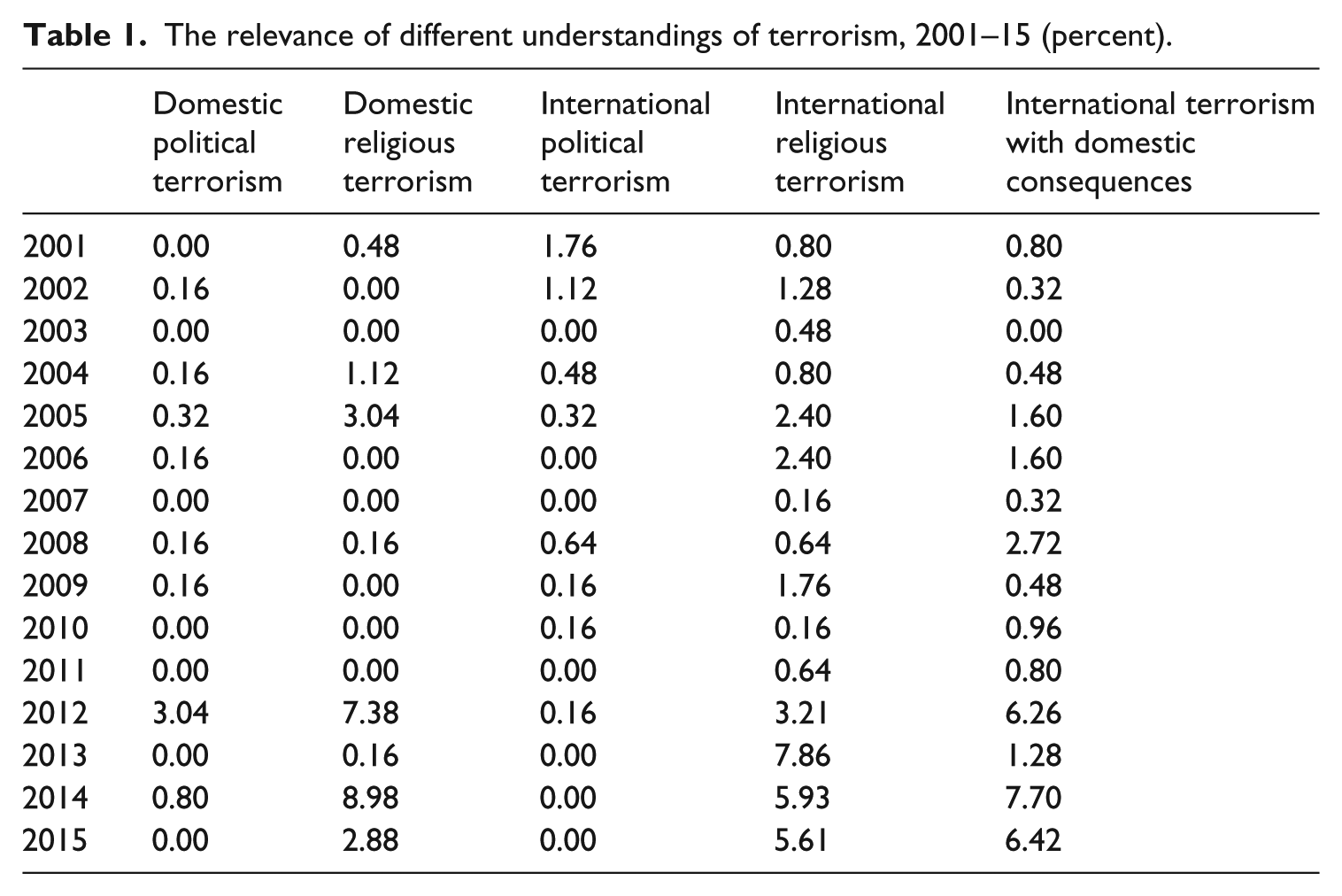
The increasing references to religion in the discussion of terrorism could safely be understood as responding to the occurrence of two major terrorist attacks in Europe, namely the 2004 Madrid train bombing (11-M) and the 2005 suicide bomb attacks in London (7/7) whose responsibility was claimed by Al-Qaeda, operating through local cells. 5 It is after 2010, however, that the religious association with acts of terrorism becomes dominant, at both the international and the domestic level. Keywords such as ‘jihad’ or ‘jihadism’ do not appear in French discourses before 2010. In fact, it is only from 2010 onwards that they come into common usage in counterterrorism debates. Moreover, in 2012 the domestic interpretation of religious terrorism (n = 46; 7.38 percent) is twice that of the international one (n = 20; 3.21 percent). Overall, the analysis seems to suggest that policy-makers are progressively favouring religious categorizations of terrorism over political ones. Further insights into the way policy-makers discuss the threat can also be gained by looking at the evolution of the interpretation of international terrorism as increasingly dangerous for domestic affairs, which grew from a total of 5 references (0.80 percent) in 2001 to 40 (6.42 percent) in 2015.
Interestingly, the answers provided by Table 2 to the second set of questions are also quite informative about French policy-makers’ attitudes to terrorist attacks. The variance in percentages clearly displays that current forms of terrorism are considered to be the main threat to the national sense of identity and shared cultural features.
The target of the threat for French policy-makers, 2001–15) (percent).
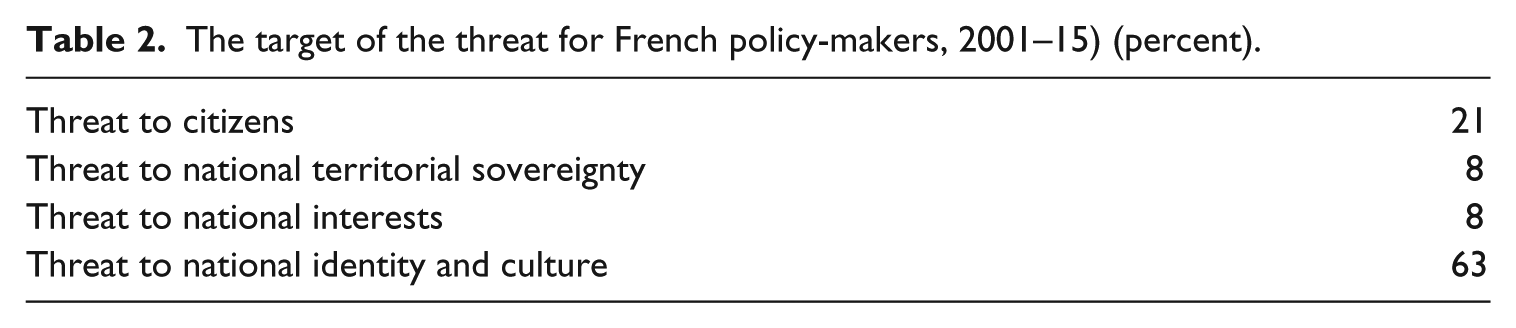
The table suggests that French policy-makers have brought into public view a specific attention to values and sense of identity when discussing terrorism-related affairs. In fact, whereas only 21 percent of the references cite terrorism as a threat to the physical safety of citizens, about 63 percent of the references see it as a threat to national identity and culture. This implies that, on the other side of the coin, the sense of security (and protection against terrorism) is also essentially understood in normative terms.
This preliminary overview opens the way for a deeper investigation of the conceptualization of terrorism as a threat. More specifically, a more focused attention to the language about terrorism can offer greater insights in line with the interest of this Special Issue, namely the relationship between terrorism and crime, in the French political debate. Hence, building on the CTS approach to CDA, I now turn my attention to the conceptual overlapping between these two threats through a deeper investigation of the associated meanings. Specifically, within the corpus under analysis, I selected a smaller number of sources that were chosen as key texts on the basis of two criteria. First, they were chosen if they had a substantial focus on the conceptualization of terrorism as a particular type of criminal activity. Second, I assembled texts and specific quotations that represented practical evidence of partial meanings and understandings in the French discourse on the alleged connection between the two phenomena. Unfortunately, space does not allow a comprehensive illustration of the findings. In discussing each of these sets of records, I therefore provide quotations that have been selected as representative in relation to the mentioned criteria. The hope here is not only to assess how these two conceptual sets of records have been used and connected in the debate concerning the terrorist challenge in the country but also to elaborate on the potential political implications.
Facing a non-state transnational threat: Terrorism and crime in the post-9/11 world
According to the French political discourse, current forms of terrorism are, for the most part, highly decentralized and atomized. This ‘clustering’ into small cells is, indeed, thought to have a strong correlation with the ability to cross boundaries and borders quite easily and, it will be argued, what makes terrorism often overlap with transnational crime. Indeed, this fragmentation offers more possibilities for groups to transnationalize their presence and activities so as to become a global menace. From policy-makers’ perspectives, the decentralized nature of terrorist organizations allows them potentially to be in and/or attack any country in the world.
If there are no threats at our borders any more, everyone knows, there are no more borders to threats either. This is the other side, already well known, of globalization.
6
Yet, over the years, the issue of the decentralization of terrorist organizations has become even more circumscribed. From the level of local cells, the focus progressively narrows down to make investigations of single individuals (and their activities) the authorities’ priority.
The terrorist situation in France has evolved. Groups are more decentralized, more mobile, more restricted and paths are individualized. Our law must adapt to this situation in order not to let down the sovereignty of our Republic.
7
In this sense, in the aftermath of the 9/11 attacks, France’s security debates often approach terrorism and organized crime as interchangeable. According to discourses involving these two threats, especially between 2001 and 2005, current forms of terrorism and crime are the consequences of an increasingly interconnected world, that is, globalization. Their transnational nature makes it particularly problematic because their activities do not affect states singly.
Criminal organisations are being structured on a global scale and their resources match or outclass certain States. Terrorist networks have modified their ways of functioning and are able to resist the most effective State security apparatuses.
8
More specifically, data seem to confirm a criminalizing approach to terrorism more than the opposite. In fact, in the process of law-making, terrorism frequently appears discussed as a specific form of criminality.
The third strongest point of this bill is the practical application with respect to the most organized and serious criminality such as human trafficking, procurement, assassination, extortion in organized groups, drug trafficking, counterfeit money, terrorism or conspiracy.
9
Nonetheless, despite the typical domestic view of both terrorism and crime, it is interesting to note that more than mere internal and policing problems, both phenomena are increasingly approached from a military standpoint.
The integration of terrorism and organized crime in the questions linked to national defence is relatively recent, a phenomenon that goes back to the 1980s. The 1994 White Paper on defence has officialised this state of affairs by claiming ‘certain forms of aggression as terrorism or, in its multiple consequences, drug trafficking, can threaten the security or the integrity of the country.
10
The evolution of the strategic context, the European construction, the emergence of transnational criminal networks, terrorist threats make the old distinction between internal and external national security less relevant.
11
Other than emphasizing a tighter relationship between terrorism and organized crime, however, discussions on terrorism by French policy-makers also clarify in what ways the two phenomena overlap. Specifically, by looking at the dominant discourse, terrorism and crime are connected along two dimensions: religion; and social exclusion and marginalization. In the following, I will address these two conceptual features.
Religion
In the post -/11 era, French policy-makers have repeatedly expressed their view that contemporary terrorists are extremists prone to crude and blind violence, religious fanatics and hateful brainwashers.
Europe is a target and France even more as we embody everything that our enemy wants to fight: human and civil rights, freedom of thought and expression, equality between men and women. Secularism and, in the end, the art of living with a certain idea of civilization. The French Republic is in danger because is completely and totally incompatible with the pan-Islamist project of a worldwide Caliphate.
12
What derives from the religious categorization of terrorism extracted from the data is the idea that the distinction between internal and external menace becomes fuzzy. Religion appears to be a key ideological bond between international terrorism and domestic cells. Moreover, the majority of discourses dealing with the nexus between religious extremism and terrorism are based on similar patterns of chains of deduction. Extremism itself is, it is argued, the consequence of a radical interpretation of the Quran. Given that a radical interpretation may arguably always exist, radicalism appears to be a natural, or at least entirely possible, movement within Islam as a faith. Therefore, radicalization can be easily understood as the first step towards (that is, the cause of) violence. On this premise, ‘conversion’ becomes central to understanding violence for policy-makers.
But what are you doing in order to punish those thousands of individuals of pure French stock (Français de souche) converted to Islamic integralism who contribute to terrorism? In my understanding this should be our first preoccupation.
13
Young people are usually singled out as the main target of hate-speakers. Owing to their naivety and sense of adventure, youths seem to represent a perfect target for terrorist proselytism. Debates, indeed, often refer to two different levels of conversion: conversion of non-Muslims to Islam and/or conversion of moderate Muslims to extremism.
Some groups use the vulnerability of certain young people lacking of points of reference in order to guide them towards the path of radicalization and encourage them to move on to action.
14
This is an exception, you would tell me. Unfortunately, they seem to multiply: Mohamed Merah, Zacarias Moussaoui, Mehdi Nemmouche, not forgetting converted individuals such as Richard Robert or Hervv Djamel Loiseau. Today, you are saying yourself that thousands of our compatriots are entering the jihadist ranks, rejecting France, its values and our desire to live together, and becoming murderers in Syria.
15
Hence, it is safe to argue that, despite the French experience with religiously defined terrorist organizations during the 1980s and with transnational Algerian Islamist groups’ actions during the 1990s, it was not until the post-9/11 era that the religious extremism–terrorism nexus started solidifying and becoming a common, established form of knowledge. This might arguably be considered a case of a shift in identity becoming a matter of national security. In fact, the evolution of this narrative has concretized (radical) Islam’s position – in its most extreme manifestations – as the enemy of France. In the aftermath of the Charlie Hebdo attacks, 16 this representation found much more space for expression.
I have already said this in front of this Assembly: France is at war against terrorism, jihadism and radical Islam.
17
Our enemy is the radical, fundamentalist Islam that has launched a challenge to our civilisation.
18
In line with the general aim of the article, however, it is relevant to focus on a specific angle of this debate. Conversion is in fact also a key concept in the formulation of the connection of terrorism with crime through the religious paradigm. Specifically, it appears that religion for French policy-makers constitutes a facilitator for criminals to turn into terrorists. In contrast to the international level, however, here policy-makers specifically focus on petty crime. In this regard, religion seems to have transformative effects on ‘mere’ criminals.
This Islamism is hybrid. It is characterized by a mix of criminality and perverted religion … Terrorists, for the most part, stem from criminality.
19
It is better to redevelop a community police force in sensitive zones, which is vital to respond to problems and prevent a shift of criminality into a form of religious radicalization that can lead to terrorism.
20
Interestingly, in French discourse, the conceptualization of terrorism as a security threat has gradually lost the typical collective imaginary associated with it. The attention of the discourse converges, more and more, on the individual dimension of the question. Indeed, in the discussed security panorama, individuals and individual stories of terrorism occupy a prominent role and they are, therefore, put under the spotlight of counterterrorism policy formulations. Thus the single individual seems to be more and more the centre of attention, labelled as ‘homegrown terrorists’ or ‘lone wolves’. The debate around these forms of terrorist action has intensified significantly, especially since the ‘Merah affair’ in 2012. 21
His motivations had no ambiguity. His direction leaves no doubts. Mohammed Merah acted in the name of a violent ideology, a radical Islamism that despises France, that despises our Republic, for our engagement in Afghanistan for example, and its ideal of secularism.
22
Accordingly, the clustering of terrorist activities into groups and radicalized random individuals allegedly emerge as one of the most challenging and problematic dimensions of new forms of terrorism: the threat does not have a clear face. The threat does not present a public or accessible representation of itself. This means that, in the opinion of policy-makers, the post-9/11 type of terrorism is more dangerous because it is extremely difficult to uncover its structure, its organizational mechanisms and, therefore, its potential. Understandably, this assessment is based on the fact that accurate and reliable knowledge about the threat is the quintessential prerequisite for fighting it.
This new terrorism is composed of split, atomized cells which make any modelling impossible.
23
A focus on the unknown is a typical approach in the field of counterterrorism (Zulaika, 2012). This emphasis on the unknown usually conveys the idea that, irrespective of how much or how little knowledge we have of the enemy, we have a moral imperative to do something. As de Goede (2012: 9) puts it, ‘uncertainty and lack of knowledge can no longer be regarded as an excuse for inaction in the face of a potentially catastrophic threat’.
However, by focusing on the relationship with crime, there are two specific domestic hubs of radicalization that are predominantly discussed: prisons and banlieues (economically depressed neighbourhoods) as spaces of social exclusion and marginalization. These represent the most-mentioned social contexts where, it is argued, what can be called an ‘Islamization of criminal behaviour’ is most likely to occur. Here, as I will show further in the article, is where religion meets the second dimension of the terrorism–crime relationship, that is social exclusion and marginalization, to produce terrorism. In the following, we will learn more about how these elements and conceptual levels are intertwined in the French political discourse.
Social exclusion and marginalization
The encounter between crime and religion, it is said, makes the recourse to terrorist violence more likely. As mentioned, according to French policy-makers this is mostly possible in the micro spaces of socialization, such as prisons and banlieues. Debates from 2012 onwards increasingly focus on disentangling the processes of domestic radicalization through the interaction between terrorists and ‘at risk’ individuals.
This new terrorist threat is often generated within our popular districts. Personal shifts towards radical Islam can lengthen a criminal past, in a pseudo-redeeming manner, sometimes started during detention or on leaving prison. This risk justifies particular attention to individual histories and to the development of a Muslim chaplaincy.
24
Mr Prime Minister, it is imperative to fix the blocking of our social ladder and the state of neglect of our popular neighbourhoods. If no concrete, dynamic and efficient action is taken soon, these areas risk turning, in the long run, into reservoirs for terrorists.
25
Although a few terrorists, generally Corse and Basque, abstain from proselytism, this is not the case with radical Islamists. Many cases of ‘conversion’ by common law criminals have also been reported, supporting the durability and the creation of terrorist networks during time in prison…
26
This is because, according to this view, individuals living in marginalized environments are more likely to be attracted by terrorist propaganda. From this particular perspective, ‘potential’ terrorists are mostly portrayed as ‘victims’ because, in light of their marginal position within French society, they would represent the preferred target of terrorist propaganda.
This text represents the start of the response to this new terrorism that is evolving in relation to technological and sociological changes, to this terrorism that spreads these ideas to the most vulnerable in our districts.
27
The ‘Merah affair’ has tragically launched a new era of ‘lone wolfs’, marginalized individuals with confused demands, with spontaneous actions and variable links with the external terrorist universe, introduced to their radicalization by modern means of communication.
28
The relevance of the narrative emphasizing the dynamics of social exclusion and marginalization as interpretative lenses of the relationship between terrorism and crime is also identified in a minority discourse on the fight against terrorism. In fact, in the discussions on the use of coercive powers within the French territory, some French MPs took a critical stance against repressive governmental measures. Such opposition, however, confirms the relevance of social exclusion in the relationship between terrorism and crime. More specifically, these opposing voices raise two arguments conveying the idea that the increasing recourse to coercive means by governmental forces is a betrayal of national founding principles. Specifically, their arguments focus on: (a) policy isolation; (b) the risk to social cohesion from the absence of a social vision in security policies.
In opposition to the governmental discourse, one of the main arguments concerned the policy isolation of the measures taken against terrorism. Policy isolation stands for the lack of alternative measures to prevent terrorist attacks from happening and people turning to terrorism, apart from the typical security ones. Over the years, several policy-makers have indeed emphasised that a simplistic repressive approach cannot be the solution to terrorism. Indeed, this critique calls for a more honest analysis of the causes of terrorism and for a more comprehensive policy approach, able to deal with the numerous aspects and dimensions of the issue.
We consider that, for our part, our anti-terrorism legislation is already very repressive and that the fight against terrorism has to become a fight against what nourishes it, that is, people’s misery and their humiliation by dominant behaviours.
29
In this view, policy isolation is extremely dangerous because the real causes are not addressed and, consequently, terrorism will persist. Accordingly, there are indeed issues of inequalities (which might actually be fuelling radicalization) that are made invisible by the fight against terrorism.
The second line of argument concerns the risk to social cohesion. By identifying ‘at-risk categories’ within the population, such as young people or ‘radical Muslims’, the repressive approach undermines the sense of nation and democratic society, putting at risk the Republican values that repressive measures intend to protect. By establishing strong causal correlations between terrorism and behaviours that are considered intrinsic to a large section of the population, the consequence is to fragment society and essentialize differences. This is a counter-argument developed in the aftermath of the attack on the Twin Towers, especially by members of the opposition, namely the Socialist, Communist and Green parties. The risk, it is argued, is an amalgam between believers and terrorists. According to this view, what is actually missing is a problematization and reconceptualization of the sense of society.
This text risks damaging the social cohesion of our country. Everyone living in France has the right in every place and in all circumstances to have their opinion respected and to be treated equally, but we have here a law of social stigmatization.
30
In other words, the sense of insecurity fostered by the dominant narrative on terrorism is jeopardizing a more lofty vision of society. These policies should, on the contrary, be the result of an intense reflection on the sense of living together.
The temptation towards complete repression translates this exasperation into a lack of one vision of society for its citizens and, therefore, the inability of the public authority to play its role in a transparent and coherent way.
31
Discussion of the findings and conclusion
This article aimed to enter the debate on European jihadists by exploring the representation of French policy-makers in the post-9/11 era. More specifically, through a combination of QCA and CDA, I investigated the dominant interpretations of terrorism in France by also focusing on the connection drawn between terrorism and crime in the political discourse. The approach of French policy-makers to terrorism and crime in the post-9/11 world is relevant not only in itself, but also for what it can reveal about broader attitudes to the terrorist question in Europe today.
First of all, the French case showed that the discussion of terrorism and crime after the 9/11 attacks entails a strong connection with two different but interrelated factors: religion and social exclusion and marginalization. In fact, although religion is mostly discussed as a main source of terrorist violence, the analysis showed that there are two specific domestic hubs of radicalization that are predominantly highlighted: prisons and banlieues. This is where the two dimensions – religion and social exclusion and marginalization – overlap to produce terrorism as a result of the encounter between criminal behaviour and religious practices and beliefs. For French policy-makers, it has been found, terrorism is in many instances the product of such a combination.
In this respect, the French case was relevant to shed light on a twofold dynamic: not only have French policy-makers developed an understanding of terrorism as a sort of ‘Islamization of criminal behaviour’, but, facing forms of terrorist-crime, or, rather, criminal terrorism, the French sense of national security progressively lost its collective imaginary. French political discussions between 2001 and 2015 manifestly intensified references to a series of presupposed national values and shared norms when describing both the terrorist menace and interaction with the criminal world. An explicit opposition is highlighted and reinforced between the set of Republican values, norms and relative sense of identity and the religious values and characteristics associated with terrorism, especially jihadi terrorism. Interestingly, the analysis of the discourse revealed that this alleged new terrorism has been increasingly understood and discussed as a threat to national values more than to citizens’ physical safety. In addition, not only was the way policy-makers debated terrorism affairs and policy solutions intrinsically charged at the normative level, but the connection made with criminal activities also reinforced the normative understanding of terrorist violence. In fact, what makes all of this even more interesting is that terrorist behaviour is to some extent increasingly understood as the final stage of a religious path undertaken by common criminals – what has been defined here as a process of ‘Islamization of criminal behaviour’. In this sense, the religious interpretation of terrorism acquires an interesting new element that aligns this article with the general interest of this Special Issue. Indeed, policy-makers have emphasized and established a representation of terrorist events as the result of an arithmetical formula that adds religious claims to criminal behaviour. Once these categories are present, terrorism seems to be the most likely outcome. That said, it seems safe to argue that any religious practice or behaviour associated with suspected or convicted criminals is, indeed, today a common indicator of potential political violence. The result is a representation of terrorism as an extreme form of religious criminality that might nonetheless reinforce discrimination and securitizing religious and social practices more than violent behaviour (Ragazzi, 2016a, 2016b).
This same paradigm entails the systematization of a set of specific features that are mostly associated with violent behaviour. In line with the representation of international terrorist organizations, specific characteristics of the individual are highlighted. For instance, religious-related behaviour, criminal convictions or networks, as well as the anti-French normative narratives of these individuals are usually on the radar of policy-makers. Critical stances towards shared Republican values, for instance, are seen as a first dangerous step towards radicalization and violent behaviour. All these elements imply a rethinking of the traditional understanding of national security. The French nation, and more specifically the French sense of nation and national security, are in danger even if confronted solely with individuals putting into question its founding values and practices. An opposition is created, then, between an individual and the security of a whole national community on the grounds of individual beliefs.
Footnotes
Funding
The author(s) received no financial support for the research, authorship, and/or publication of this article.