







Abstract
The role of forgiveness in restorative justice (RJ) remains peripheral because interpersonal forgiveness has been considered a ‘gift’ that should not be forced on victims in RJ. In this article, we aim to advance the role of forgiveness in RJ. However, we do not focus on interpersonal forgiveness. We instead focus on another dimension of forgiveness: self-forgiveness for offenders. Because self-forgiveness is linked with both RJ and desistance, self-forgiveness has the potential to function as a catalyst to connect RJ with desistance. Drawing on their relationship, we offer a process-based model of how offenders may or may not desist through RJ. We conclude by offering implications for research on RJ.
Introduction
Since its emergence in the field of criminology, scholars have discussed what restorative justice (RJ) can offer to its participants, such as victim participation and offender accountability (for example, Zehr, 2002). The extant literature highlights numerous benefits that RJ holds for participants including emotional and psychological restoration for victims and positive behavioural change on the part of offenders (for example, see a review by O’Mahony and Doak, 2017). Forgiveness, however, has rarely been a focus of discussion in RJ literature (Armour and Umbreit, 2018; Shapland, 2016). There are reasons why forgiveness has received scant attention in RJ literature. For example, forgiveness in RJ is a complex concept that requires consideration of interactions between various stakeholders as well as the context of offending (Armour and Umbreit, 2006). Given the difficulty of exploring such complex dynamics, with the notable exception of recent research conducted by Armour and Umbreit (2018), the lack of studies on forgiveness in RJ is understandable. Yet there may be a more probable reason for the dearth of studies on forgiveness in an RJ context. That is, the assertion that forgiveness should not be aimed for in RJ, but rather it should be considered a ‘gift’ (Blyth, 2016a). As a result, the role of forgiveness remains peripheral in RJ.
We aim to advance the role of forgiveness in RJ. However, we wish to stress that it is not our intention to oppose the above discourse on forgiveness as a gift in RJ. We wholeheartedly concur that forgiveness should not be forced on victims in RJ. In this article, we instead focus on another dimension of forgiveness: self-forgiveness for offenders (Webb et al., 2017). 1 To our knowledge, self-forgiveness has similarly lacked attention in RJ literature. Even if self-forgiveness is referred to in RJ literature (for example, Blyth, 2016b; Shapland, 2016), it is mentioned only briefly. The role of self-forgiveness in RJ has yet to be deeply probed. Understanding the role of self-forgiveness in RJ is important because it may be associated with desistance (McConnell, 2015; Tangney et al., 2005). Although the conceptual link between RJ and desistance has been discussed elsewhere (for example, see Maruna 2016), little is known about how RJ is theoretically linked with desistance. In our view, self-forgiveness can serve as a catalyst to connect RJ with desistance. Exploring the role of self-forgiveness in RJ will contribute to filling a gap between theory and practice in RJ, particularly in terms of how offenders may or may not start to desist through RJ.
In this article, we first discuss why forgiveness should be considered a ‘gift’ in RJ practices. Second, we describe what self-forgiveness is. Third, we argue why self-forgiveness is important for offenders based on the benefits of self-forgiveness, including its link with desistance. Fourth, we consider the relationship between self-forgiveness and RJ. Finally, we offer the role of self-forgiveness in RJ. Specifically, using self-forgiveness as a catalyst between RJ and desistance, we propose a process-based model of how offenders may or may not desist through RJ. We conclude by offering implications for future research.
Forgiveness as a ‘gift’ in restorative justice
RJ may have the potential to facilitate forgiveness because a theoretical relationship exists between RJ and forgiveness. This theoretical link particularly lies in an interactive process within RJ. As noted elsewhere (for example, Rossner, 2013), the most important component of RJ is the interaction between victims and offenders through face-to-face dialogue. Offenders are given an opportunity to be held accountable for the harms they have caused to the victims, while victims are given an opportunity to express the harm they experienced as a result of the offender’s actions. Ideally, it is in this bilateral process of RJ that forgiveness may occur. Humanistic communication with offenders may allow victims to deal with their negative feelings caused by the crime, to see offenders as a real human beings and to promote their empathy towards offenders (Umbreit et al., 2015; see also Mauss, 1966; Stein, 1989, for how empathy arises through interactions between people).
Empirical research has shown that forgiveness occurs in RJ. In research conducted in multiple locations in Australia and the UK, Sherman et al. (2005) reported that the rate of the victims forgiving the offenders in RJ conferencing ranged from about 30 percent to 70 percent across the research sites. Evaluating youth justice conferencing in Northern Ireland, Campbell et al. (2006: 77) observed that about 80 percent of victims ‘expressed some level of forgiveness toward the young person [the offender]’. In their interviews with victims of serious violent crimes who participated in victim–offender mediation in the US, Umbreit et al. (2006) noted that, of the 24 who referred to forgiveness in the interviews, 15 victims reported that they had forgiven the offenders. Furthermore, in their evaluation of family group conferencing in New Zealand, Maxwell et al. (2004) reported that about half of young offenders felt that they experienced some sense of forgiveness.
Despite these theoretical and empirical links between RJ and forgiveness, as philosophers argued in the context of historical injustice (for example, see Derrida, 2001; Ricoeur, 2004), RJ scholars have almost unanimously agreed that forgiveness needs to be considered as a ‘gift’ that should not be a pursued outcome (Armour and Umbreit, 2018; Chapman and Chapman, 2016; Van Stokkom, 2008). It is Braithwaite (2002) who has perhaps most systematically articulated such a role of forgiveness in RJ. Braithwaite (2002) has proposed three types of standards for RJ: constraining, maximizing and emergent. The constraining standards contain elements that must exist in the RJ process, such as respectful listening and equal concern for all stakeholders. The maximizing standards are those that, if present, increase the likelihood of the dialogue process becoming ‘restorative’. They include, for example, restoration of human dignity and restoration of damaged human relationships. Emergent standards, such as forgiveness, remorse, apology and mercy, may occur in RJ only as a result of the participants’ emotional engagement with the process and with each other. According to Braithwaite (2002: 571), forgiveness should be considered an emergent value of RJ because it can be meaningful only when it is derived from ‘a genuine desire in the person who forgives’. Forgiveness in RJ should thus be considered a ‘gift’ because forcing or pressuring victims to forgive offenders is morally wrong (Fiddes, 2016). Whether to forgive offenders or not must entirely be up to victims in RJ (Armour and Umbreit, 2006; Zehr, 2002). As a consequence, the role of forgiveness has rarely been discussed in the RJ literature (Armour and Umbreit, 2018; Shapland, 2016).
What is self-forgiveness?
Whereas the above discussion applies to interpersonal forgiveness, forgiveness has another dimension: self-forgiveness (Webb et al., 2017). Snow (1993: 79) argued that ‘[s]elf-forgiveness can be a second best alternative to interpersonal forgiveness in situations in which full forgiveness is not or cannot be achieved . . . because of its centrality in restoring our capability for agency after we have wronged or harmed others’. This certainly is the case for RJ because interpersonal forgiveness must not be forced on victims in RJ. To discuss the role of forgiveness in RJ, we focus on self-forgiveness for offenders.
The RJ literature has paid scant attention to interpersonal forgiveness and even less to the topic of self-forgiveness. To our knowledge, self-forgiveness in the RJ literature has been briefly mentioned in relation to face-to-face dialogue (Blyth, 2016b; Shapland, 2016), spirituality (Bender and Armour, 2007) and custodial settings (Armour et al., 2005; Newell, 2007; Toews, 2016). What is common in this literature is that self-forgiveness has not been clearly defined. An exception might be Blyth (2016b: 70), who, drawing on Gulliford (2004), suggested that ‘[i]ntrapersonal forgiveness is inward directed, embracing the self’ and ‘concerns the feelings, thoughts, and behaviour associated with forgiveness within the individual seeking to forgive’. The lack of definition of self-forgiveness is the problem not only in the RJ literature but also in the literature in general. Because self-forgiveness is a relatively new concept that has recently experienced rapid growth in the literature (see McConnell, 2015), scholars in different disciplines have proposed different definitions of self-forgiveness (for example, see Enright and the Human Development Study Group, 1996, for psychology; Williston, 2012, for philosophy; and Bryan et al., 2015, for traumatology).
Research suggests that self-forgiveness is both an iterative and a sequential process. Jenkins (2018) found from interviews with 19 criminal offenders who had committed a variety of offences including petty theft, sexual assault, drug trafficking, armed robbery and first-degree murder that, for many, self-forgiveness was a conscious decision wherein the forgiveness was not focused on the crime or the harm they had caused to others, but was centred on self-harms; the damage done to their own lives as a result of their criminal actions. Self-forgiveness was depicted as a ‘day to day’ process and an ‘ongoing journey’ of self-reflection and self-acceptance wherein offenders said they had to continually ‘revisit’ their notions of personal worth in light of their criminal actions. Self-forgiveness is also a sequential process as some offenders insisted that they must cease offending and have a positive input into the community prior to forgiving themselves. It is debatable whether it is self-forgiveness that is aroused by the generosity or empathy of others. For some, forgiveness received from family or from victims motivated them to be ‘better people’ and move forward with their life in a manner that facilitated positive growth. For others, receiving forgiveness would not alleviate the psychological or emotional burden of their crimes. As one offender said, ‘whether they forgive me or not, I still have to live with what I’ve done’ (Jenkins, 2018: 200).
Self-forgiveness first requires taking responsibility for one’s own wrongdoing. Like interpersonal forgiveness, self-forgiveness does not entail excusing, condoning, justifying or forgetting the wrongdoing. For self-forgiveness to be genuine, the wrongdoer must acknowledge what they have done to the victims as well as show remorse and willingness to restore relationships. This argument is demonstrated in research conducted by Wenzel et al. (2012). Using hypothetical scenarios of and participants’ experiences of transgressions, they examined what distinguishes ‘genuine’ self-forgiveness from pseudo self-forgiveness. Their study focused on the process of achieving self-forgiveness because both genuine and pseudo self-forgiveness are somehow associated with positive self-regard, and existing studies that focused on the outcomes of self-forgiveness could not reveal the differences between genuine and pseudo self-forgiveness. Their findings indicated that the difference between genuine and pseudo self-forgiveness lies in the degree of responsibility acceptance. Pseudo self-forgiveness occurred when offenders downplayed their responsibility in order to maintain their self-esteem. Instead, genuine self-forgiveness occurred when offenders fully acknowledged their responsibility for their wrongdoing and reaffirmed the violated values. This difference between genuine and pseudo self-forgiveness is important when considering the continuation of offending because ‘there can be no motivational change, as the offender already is motivated to act benevolently toward the self’ (Hall and Fincham, 2005: 627). In other words, without a commitment to shared values through genuine self-forgiveness that involves a full acknowledgement of responsibility, offending may continue.
There are differences between self-forgiveness and interpersonal forgiveness. Self-forgiveness is distinct from interpersonal forgiveness in terms of conditionality. Whereas interpersonal forgiveness is conditional because it depends on victims’ willingness to forgive offenders, self-forgiveness is unconditional because it is ultimately a self-reflection process undertaken by the offenders that is focused on their own wrongdoing (Hall and Fincham, 2005). Self-forgiveness is also different from interpersonal forgiveness in terms of whether it requires reconciliation. Whereas interpersonal forgiveness does not indicate reconciliation between victims and offenders, self-forgiveness requires the offenders to reconcile with themselves. To forgive themselves, offenders need to face what they have done to the victims (Kim and Enright, 2014).
Why does self-forgiveness matter for offenders?
Self-forgiveness can benefit wrongdoers in multiple ways. Self-forgiveness has been found to hold emotional (for example, Woodyatt and Wenzel, 2013), psychological and physical (for example, Davis et al., 2015) benefits. Perpetrators of crime often suffer significant painful and destructive after-effects as a result of their actions, such as shame, guilt and self-condemnation (Jenkins, 2018). Self-forgiveness may be important in terms of helping offenders address and perhaps heal from these self-created harms.
Self-forgiveness is also related to self-esteem, self-trust, more empathy for the victim and a greater desire for reconciliation (Woodyatt and Wenzel, 2013). According to Wohl, DeShea and Wahkinney (2008: 9), ‘the process of self-forgiveness may be the catalyst for personal growth’ because those who self-forgive are more likely to feel, act and think constructively towards the self and see themselves as worthy. This benefit is evident in a recent study of criminal offenders’ perceptions of offence-related effects and the meaningfulness of forgiveness (Jenkins, 2018). Jenkins (2018) found that over half (58 percent, N = 19) of the offenders viewed self-forgiveness as an important element in their efforts to better understand, address and overcome the harm they caused as a result of their offences. Most wrestled with feelings of shame, guilt, psychological and emotional distress, and negative self-worth consequent on their crimes. Although self-forgiveness did not come easily to offenders, those who forgave themselves, or strongly desired to do so, identified numerous benefits of self-forgiveness. Offenders credited self-forgiveness with helping them to reflect critically on the underlying causes of their criminal behaviour, to separate their worth as a person from the ‘bad’ act they committed, to challenge, if not totally repudiate, the degrading labels affixed to them because of their crimes, to cease ‘beating’ themselves up over their wrongdoing and to commit to future law-abiding behaviour (Jenkins, 2018).
Among these benefits, what we see as the most important and relevant to RJ is the link between self-forgiveness and identity transformation. Through a process that involves acknowledging their wrongdoing, gaining an understanding of the issues that led to their wrongdoing, learning self-compassion, committing to future moral behaviour and desisting from seeing themselves as a ‘moral monster’ (Griswold, 2007), offenders undergo a change of heart. Having morally improved, the offender is able to legitimately forgive themselves (Murphy, 2003). As McConnell (2015: 153) put it, offenders may then start to desist from crime because they ‘recognize they cannot change the past, but choose to continue to respect themselves and others by altering the future [behaviour] (Dillon, 2001; Holmgren, 2002; 2012)’. As such, ‘positive value reorientation and personal esteem restoration are each necessary components of self-forgiveness’ (Griffin et al., 2018: 723).
Owing to this transformative effect on identity in its process, self-forgiveness may facilitate change towards desistance. According to desistance theories, such as redemption script (Maruna, 2001) and feared self (Paternoster and Bushway, 2009), offenders may need to transform their identity of self to start desisting from crime. By examining narratives of ex-prisoners who were still involved in crime and those who ceased offending, Maruna (2001) found that those who desisted ‘portrayed and understood themselves as defiant rebels all of their lives’, whereas those who were still engaged in offending described their lives in ‘very much deterministic, almost mechanical terms’ by referring to ‘a cycle of poverty, stigma, and criminal associates’ (Maruna et al., 2004b: 225). Self-forgiveness, which involves a reconstruction of morality and self and a commitment to future moral behaviour, may be an important precursor to change towards desistance.
Research supports this sequence because it suggests that identity reconstruction precedes change towards desistance. To examine how subjective factors, including motivation and hope, influence the desistance process in comparison with social factors, such as unemployment, LeBel et al. (2008) conducted a prospective, longitudinal study. In their study, offenders were interviewed about their perceptions of self and offending before their release from prison. Analysing the reconviction and reimprisonment of offender-participants during the 10-year follow-up period, their findings showed that having a positive self, such as a ‘belief in one’s ability to “go straight”‘, before their release from prison contributed more to the desistance process than social factors (LeBel et al., 2008: 154). Interviews with offenders who were not involved in self-report offending during a two-year probation supervision, King (2013: 155) also found that these offenders started to construct their identity as a desister in the early phase of their desistance process because they ‘sought to identify alternative future identities and potential courses of action that could facilitate longer-term moves away from crime’. To examine whether identity transformation precedes change towards desistance, Rocque et al. (2016) employed a prospective, longitudinal study. In this study, data were collected over 20 years from three cohorts of individuals who were aged 12, 15 and 18 when the data collection started. Analysing how the identity changes over time and how it relates to offending behaviour, they found that an increase in pro-social identity occurred before the decrease in the level of involvement in offending.
What is the relationship between self-forgiveness and RJ?
Self-forgiveness is conceptually compatible with RJ. This relationship is evident when considering RJ as an intervention to deal with the aftermath of crime. Similar to therapy interventions on recovery from addiction by endorsing self-forgiveness (Baker, 2008; McGaffin et al., 2013), RJ can function as a ‘tool’ or ‘setting’ to promote self-forgiveness. In other words, RJ can help offenders meet the conditions necessary for the development of self-forgiveness.
Participation in RJ processes can help offenders achieve genuine self-forgiveness. In RJ, offenders are treated and listened to fairly, which helps to nurture repentance within offenders (Braithwaite, 2000). RJ encourages offenders to be actively engaged in making amends for the harm they caused rather than passively taking responsibility by merely admitting their offence (Braithwaite and Roche, 2001). This effect is evident in empirical research on RJ. Using a quasi-experimental design, Calhoun and Pelech (2013) examined victims’ perceptions about offender responsibility, indicating that victims who participated in RJ were more likely to feel that the offender took responsibility than were victims in the conventional justice system. In an experimental study conducted in Thailand, Boriboonthana and Sangbuangamlum (2013) also showed that more offenders who participated in RJ perceived that they were held accountable for their offending than offenders who participated in the conventional justice system. Furthermore, reanalysing the Reintegrative Shaming Experiment data, Kim and Gerber (2012) demonstrated that offenders who attended RJ were more likely to show a willingness to repay the victim and society and to feel remorse than were those who were processed in the conventional justice system.
For self-forgiveness within offenders to occur, offenders may need to recognize that their wrongdoing is forgivable. This recognition is important for offenders ‘to begin the process of moral transformation’ (Szablowinski, 2012: 687) because it ‘enables perpetrators to understand the past in a way that relieves from [the] irreversibility’ of their offending (Chapman and Chapman, 2016: 149). Drawing on longitudinal research design, Hall and Fincham (2008) examined the process of how self-forgiveness is achieved and what factors contributed to self-forgiveness. Their findings indicated that self-forgiveness increased gradually after offending. Their findings also suggested that the process of achieving self-forgiveness was facilitated by reparation to victims as well as by forgiveness from victims or a higher power, such as God.
These findings help serve to establish the relationship between self-forgiveness and RJ. For offenders to forgive themselves, forgiveness from victims is desirable but not required. The message that offending is forgivable can be derived from people other than victims (Szablowinski, 2012). Given the characteristic of forgiveness in RJ as a gift and the lower prevalence rate in comparison with other RJ outcomes, such as consistently high levels of satisfaction and fairness (Doak and O’Mahony, 2018), the ‘forgivable’ message may be more likely to come from supporters of offenders in RJ than from victims. RJ may facilitate self-forgiveness in offenders because supporters, such as family members and close friends, are present in RJ. The support shown to offenders by their loved ones can convey to them the message that they are loved and cared for and that what is needed is for them to make amends for what they have done.
Related to this supportive environment in RJ is how offenders and offending are viewed in RJ. Braithwaite’s (1989) reintegrative shaming is considered to be one of the representative theories for RJ (Suzuki and Wood, 2018). According to this theory, reintegrative shaming is more effective than stigmatizing shaming for offender reintegration because reintegrative shaming encourages acceptance of the offender as a person while the offender’s’ wrongful actions are condemned. Because self-forgiveness involves admitting one’s own wrongdoing, it entails self-condemnation, which subsequently produces negative emotions, such as shame and guilt (Woodyatt et al., 2017). To achieve self-forgiveness, these negative emotions need to be reduced or released from offenders (Hall and Fincham, 2008). RJ can be helpful in promoting the self-esteem of offenders because research has shown that reintegrative shaming is more likely to occur in RJ than in criminal courts (Strang et al., 2011). By treating offenders with respect, RJ can promote self-forgiveness because it helps offenders ‘declare the wrongdoing as being peripheral to their self, as not being representative of who they really are, thereby maintaining positive self-regard’ (Wenzel et al., 2012: 625). RJ can help offenders reconcile with negative emotions as a result of acknowledging their wrongdoing while being accepted by other participants in RJ (Ahmed et al., 2001).
The reparative behaviours common to RJ processes, such as victim compensation and apology, may also help offenders achieve self-forgiveness. The RJ process normally consists of two processes – storytelling and outcome discussion – and participants are expected to reach a reparative agreement about what offenders should do to make amends to victims. According to a meta-analysis conducted by Latimer et al. (2005), offenders who participated in RJ were more likely to complete the reparative agreement than were offenders who were ordered to make restitution in other interventions. In addition to Hall and Fincham (2008), other research has shown that engagement in reparative behaviours can promote self-forgiveness. Carpenter et al. (2014) examined the relationship between conciliatory behaviours and self-forgiveness and how they are interlinked with each other. Using past experiences of participants and a hypothetical transgression case in an experimental setting, they found that conciliatory behaviours, such as apology, confession and restitution, can aid in achieving self-forgiveness. Additionally, their findings revealed the mechanism of how self-forgiveness was promoted by reparative behaviours. By engaging in conciliatory behaviours, offenders may start to feel that self-forgiveness is morally appropriate, resulting in a higher likelihood of achieving self-forgiveness because involvement in reparative behaviours decreases guilt in offenders (Carpenter et al., 2014).
What is the role of self-forgiveness in RJ?
We have delineated the links between self-forgiveness and desistance, and between self-forgiveness and RJ, respectively. We are not the first to discuss these relationships. Some scholars have already (although briefly) suggested the links between self-forgiveness and desistance (for example, McConnell, 2015) and between self-forgiveness and RJ (for example, Tangney et al., 2005), respectively. Yet, to our knowledge, each relationship has not been discussed as extensively. More importantly, the relationship between them all together has yet to be explored.
In our view, self-forgiveness can play a major role in connecting RJ with desistance among other variables related to RJ. The effect of RJ in reducing reoffending may be inconclusive because, whereas some research has reported a positive impact of RJ on reducing recidivism (for example, Sherman et al., 2015), other studies found minimal or no effects (for example, Livingstone et al., 2013). This failure of RJ in reducing reoffending may be understandable because RJ may be ‘only one of many factors in an offender’s life – bad friends, traumatic life events and the failure to succeed are just some of the subsequent life events that can lead someone to re-offend’ (Maxwell, 2008: 93). However, existing but limited empirical research on RJ and desistance research has shown how RJ supported change towards desistance. Interviewing offenders who participated in RJ in the UK, Claes and Shapland (2016: 317) noted that RJ may ‘have the possibility to foster agency, change the narrative, alter cognitive mindsets and create a shift in the identity of the (ex-)offender’. Lauwaert and Aertsen (2016) interviewed offenders who had participated in RJ in Belgium. In their study, offenders reported that RJ helped their desistance process because it helped to induce a conscience for their wrongdoing. These findings shed light on the link between RJ and desistance, but we need to take into account the fact that RJ is a time-limited and one-off intervention (Hayes, 2007) that cannot deal with the underlying problems of offending (Lofton, 2004). Although offenders face numerous obstacles in their everyday life to desistance, such as unemployment, the circumstances that lead offenders to crimes are not addressed in RJ (Courakis and Gavrielides, 2018; Hansen and Umbreit, 2018; Walgrave et al., 2019). Given the profound effects of the challenges facing offenders in their everyday life, for RJ to be what Giordano et al. (2002) call a ‘hook for change’ or what Sampson and Laub (1993) call a ‘turning point’ to start desisting from crime, offenders may need something more that connects RJ and desistance. RJ can offer important conditions to achieve self-forgiveness, and self-forgiveness may be an important precursor to change towards desistance. Thus, self-forgiveness may serve as a catalyst to connect RJ with desistance.
Based on this link, we propose a process-based model of how offenders may or may not start to desist from crime through RJ. To develop our model, we build on a path model of self-forgiveness proposed by Wohl and McLaughlin (2014: 429). Put simply, this path model offers four possible paths of self-forgiveness: genuine self-forgiveness, pseudo self-forgiveness, no need for self-forgiveness and no self-forgiveness. Genuine self-forgiveness can occur when offenders accept full responsibility by internalizing attribution of their wrongdoing. This condition leads to an increased likelihood of change towards desistance. Pseudo self-forgiveness can occur when offenders acknowledge only partial responsibility or neutralize their wrongdoing. This situation may result in a continuation of offending because these offenders do not challenge their morality and self. Where offenders deny their responsibility by externalizing the attribution of their wrongdoing, they feel no need for self-forgiveness. These offenders are more likely to continue their offending behaviours. Even when offenders accept full responsibility for their wrongdoing, some offenders may not forgive themselves. In this case, ‘the wrongful behavior is likely to cease, but negative psychological and physiological effects will typically ensue’ (Wohl and McLaughlin, 2014: 431).
We consider Wohl and McLaughlin’s (2014) path model useful to develop our model for the following two reasons. Unlike other models of self-forgiveness (see Hall and Fincham, 2005; McConnell, 2015), it describes the aftermaths of self-forgiveness in terms of behavioural changes. This characteristic fits with our purpose to explain how offenders may or may not start to desist from crime through RJ. In addition, it shows not only a path in which genuine self-forgiveness occurs but also a path in which offenders fail to achieve self-forgiveness and to discontinue wrongful behaviours. As Daly (2002) observed, RJ is not always ‘successful’. As Walgrave (2011: 135) put it, it is necessary to develop knowledge on ‘what restorative justice can achieve or not’. However, the number of such studies on RJ is limited to date (for example, Rossner and Bruce, 2018). It is important to account for not only how offenders can achieve self-forgiveness and subsequently start to desist from crime through RJ, but also why they fail to do so. For these reasons, we have decided to develop our process-based model based on Wohl and McLaughlin’s (2014) path model of self-forgiveness. We are interested in how the RJ process fits in with these models and what elements unique to RJ can add to it.
Before describing our model, we discuss a limitation of its scope. Our model does not focus on the interactive process of RJ, although we are aware that it is an important feature of RJ. The success of RJ may depend on the core sequence between victims and offenders, such as expressions of offenders’ genuine remorse followed by victims’ mercy (Retzinger and Scheff, 1996). Even if offenders are reluctant to acknowledge their responsibility at the beginning of RJ, full acceptance of responsibility may be elicited from interactions with empathetic victims (Hayes, 2006). Yet, we focus solely on an offender perspective because achieving self-forgiveness is ultimately offenders’ self-reflection process on their own wrongdoing (Hall and Fincham, 2005). Although acknowledging the responsibility for wrongdoing is an important condition for offenders to achieve self-forgiveness (Woodyatt et al., 2017), our model does not offer reasons why some offenders accept only partial responsibility or fail to acknowledge their responsibility in RJ. Our focus is not on how and why offenders accept or deny responsibility in RJ. Our focus is on what may occur in offenders’ behaviours as a result of taking or denying responsibility in RJ. With these limitations in mind, we elaborate on our model.
Our process-based model of self-forgiveness in RJ is described in Figure 1. Our model provides three main paths towards desistance from or persistence of offending. The paths are differentiated by the extent to which offenders accept their responsibility because acknowledging responsibility for wrongdoing is an important prerequisite for self-forgiveness (Woodyatt et al., 2017). There are three starting points of the paths: (1) full responsibility, (2) partial responsibility and (3) denial of responsibility.
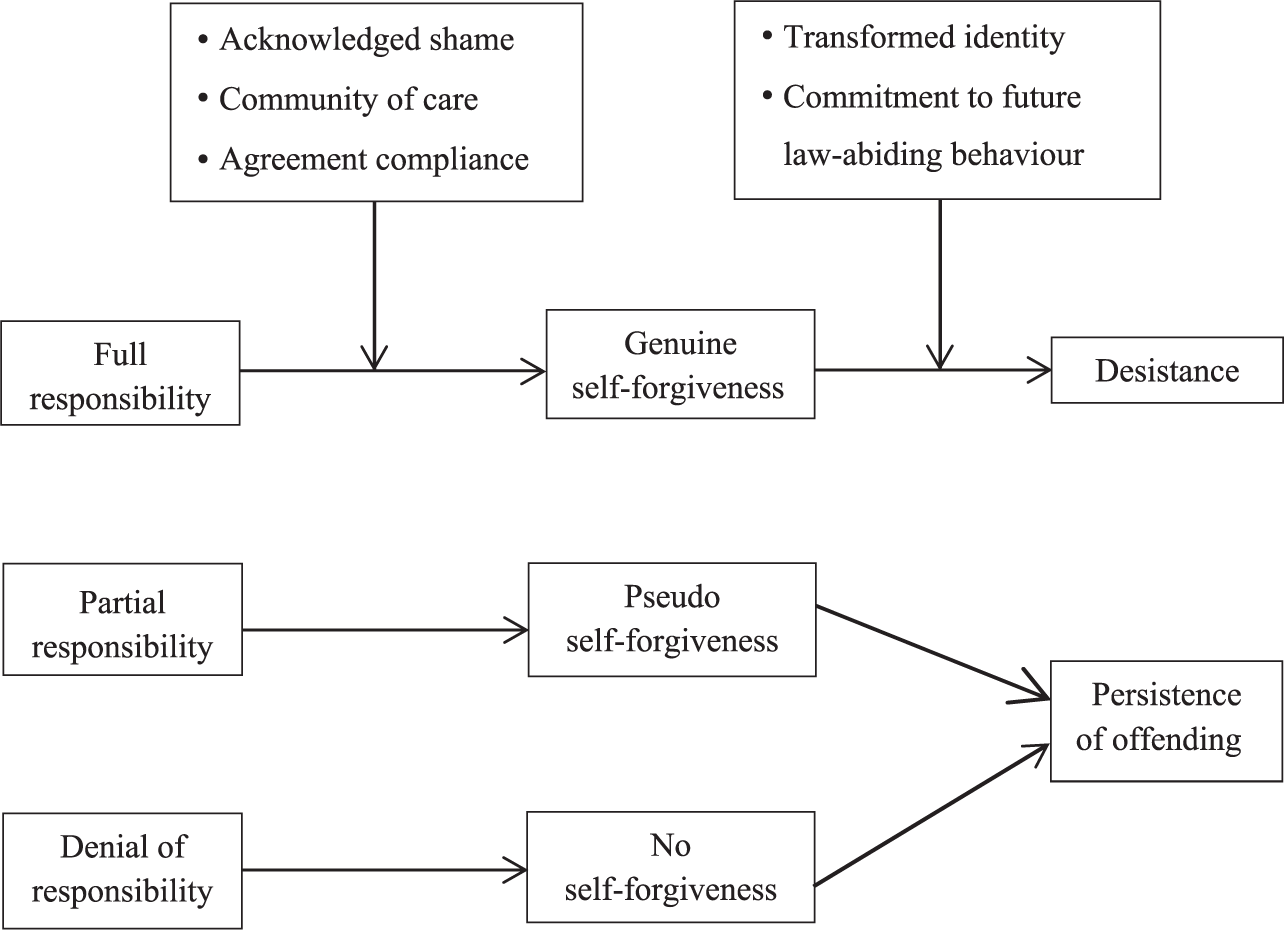
Process-based model of self-forgiveness in RJ.
When offenders acknowledge what they have done to the victims and show remorse and a willingness to restore relationships in RJ, it is considered that they accept their full responsibility. This acceptance means that they are in the process of achieving genuine self-forgiveness (Wenzel et al., 2012). This process can be facilitated in RJ by care and support from the community of care, which can subsequently help offenders to discharge negative feelings, such as shame, and complete the agreement plan to make amends for victims. Once offenders achieve genuine self-forgiveness, they have a transformed identity of positive self and reconstructed morality. These together encourage offenders to commit to future law-abiding behaviours. As a result, these offenders have an increased likelihood of being on the path to desistance.
On the other hand, not all offenders accept their responsibility in RJ. Some offenders may take only partial responsibility or deny responsibility by blaming victims or failing to clearly express their remorse (for example, see Kenney and Clairmont, 2008; Rossner and Bruce, 2018). When offenders do so, what they can achieve is only either pseudo self-forgiveness or no self-forgiveness. This may still be the case even when offenders receive support and care from their family members and friends who are present in RJ or complete the agreement plan for victims because accepting full responsibility needs to be the first step towards genuine self-forgiveness (Woodyatt et al., 2017). Without genuine self-forgiveness, offenders may not reflect o their own morality that leads them to the wrongdoing in the first place. As a consequence of failing to transform their identity as a ‘moral monster’, they may be more likely to continue their offending.
Conclusion
Because interpersonal forgiveness should be considered a ‘gift’ in RJ, the role of forgiveness in RJ remains peripheral. To develop the role of forgiveness in RJ, we have focused on another dimension of forgiveness: self-forgiveness for offenders. Self-forgiveness is associated not only with RJ but also with desistance. Self-forgiveness can play the role of connecting RJ with desistance. Building on these relationships, we have offered a process-based model of how offenders may or may not desist through RJ.
Our process-based model of self-forgiveness in RJ is significant because it fills the void in RJ literature. Recent RJ scholarship has been shifting its research focus from ‘what works’ to ‘how it works’ (Suzuki and Wood, 2017) because little is known about how, in what conditions and for whom RJ works (O’Mahony and Doak, 2017). Following this trend, different scholars have focused on different aspects of the RJ process and outcomes, such as procedural justice and legitimacy in RJ (Miller and Hefner, 2015). To our knowledge, what is lacking in these attempts is to connect RJ with desistance. Using self-forgiveness as a catalyst between RJ and desistance, our process-based model bridges this gap in RJ literature.
Although our model contributes to the RJ literature, it is necessary to conduct empirical research based on our process-based model. Because our model is theory based, it remains speculative without examining how it fits in with the reality of RJ practice. Future research is important because our model may show an over-simplified sequence of RJ, self-forgiveness and desistance. Self-forgiveness is ‘a process that unfolds over time’ (Hall and Fincham, 2008: 194). In other words, it may require a long time for offenders to achieve self-forgiveness. This process may be even longer when the offence is more severe (Hall and Fincham, 2008). Likewise, desistance is also a (long) process, in which offenders often experience lapses and relapses of being involved in offending (Abrams and Terry, 2017). Given this commonality between self-forgiveness and desistance as a complex, long process, the sequence proposed in our model may not necessarily be what happens; for example, some offenders may forgive themselves as a result of desistance because they are no longer involved in any antisocial behaviour. Or, offenders who already forgave themselves before RJ may be more willing to restore relationships with victims by making amends and offering an apology. Because our model is hypothetical at this stage, we may have merely offered a novel way of exploring forgiveness in RJ. It is important to test our model empirically. We conclude our article by providing implications for research.
To conduct research on the role of self-forgiveness in RJ, we need a measurement to examine whether or not offenders achieve self-forgiveness. Because self-forgiveness is a relatively new concept in the literature (McConnell, 2015), a variety of scales to measure self-forgiveness exists. According to Strelan (2017: 78), who reviewed existing scales of self-forgiveness, a common problem of the existing measurements for self-forgiveness is that they lack ‘a mechanism for identifying when a respondent is a pseudo self-forgiver’. Tangney et al. (2005: 151–2) argued that this problem arises because the existing measures for self-forgiveness ‘essentially measure an outcome – an endpoint – without assessing crucial elements of the process that lead up to that outcome’. In other words, the existing measurements of self-forgiveness do not allow us to distinguish between genuine and pseudo self-forgiveness because they do not ‘capture critical aspects of the process that leads to the outcome of a self at peace with the self’ (Tangney et al., 2005: 152, emphasis in the original). To address this problem of the measurement for self-forgiveness, Woodyatt and Wenzel (2013) developed Differentiated Process Scales of Self-Forgiveness (DPSSF). Unlike other existing measurements for self-forgiveness, DPSSF conceptualizes genuine self-forgiveness as ‘the culmination of a transformative learning process’ that involves engagement in self-reflection and reparative behaviours as well as commitment to change (Strelan, 2017: 82). The validity of DPSSF has been confirmed by Woodyatt and Wenzel (2013) because their finding showed that only those who achieved genuine self-forgiveness had increased self-esteem and empathy. Given the distinct paths in our model, genuine and pseudo self-forgiveness need to be distinguished. We suggest employing DPSSF to test our model.
Because our model suggests a causal relationship between RJ, self-forgiveness and desistance, a research design to empirically test our model should be longitudinal. In particular, what Farrall (2006) calls ‘qualitative longitudinal research’ may be beneficial. Desistance scholars emphasize the importance of examining ‘secondary’ desistance – ‘the movement from the behaviour of non-offending to the assumption of the role or identity of a “changed person”‘ – rather than ‘primary’ desistance, which indicates ‘any lull or crime-free gap in the course of a criminal career’ (Maruna et al., 2004a: 19). This type of research requires exploring offenders’ ‘thoughts, emotions, identity traits, and feelings that change as social circumstances do’ (Cooley and Sample, 2018: 498). Our model is in line with this trend in the desistance research because our model suggests that self-forgiveness, which involves the reconstruction of morality and self and a commitment to future moral behaviour, may be an important precursor to change towards desistance.
Drawing on the proposed research design, we suggest the following data collection strategies. First, the RJ process needs to be observed to explore whether it helps offenders meet the conditions necessary for the development of self-forgiveness. After participation in RJ, the level of self-forgiveness within offenders needs to be examined by using DPSSF. Finally, it is necessary to investigate whether or not ‘secondary’ desistance, which entails an identity transformation (Maruna et al., 2004a), occurs, and how it is related to self-forgiveness. Based on the collected data, researchers can examine whether self-forgiveness facilitates change towards desistance through RJ as described in our model.
When examining the proposed sequence in our model, it may also be beneficial to address another problem in the literature of self-forgiveness. Research suggests that whether offenders can achieve self-forgiveness may depend on various factors, such as gender and personality (for example, Tangney et al., 2005; Rangganadhan and Todorov, 2010). Yet, there is not much research on this topic to date. The roles of gender and race in RJ have also not attracted attention in the literature (Gavrielides, 2014; Österman and Masson, 2018). Further, extant desistance literature suggests that desistance processes may vary by gender (Rodermond et al., 2016), race (Glynn, 2014) and ethnicity (Calverley, 2013). Given these common scarcities of research, following the variation research approach proposed by Hayes and Daly (2003), future research should also examine how ‘variability’ – differences within offenders – influences self-forgiveness through RJ. For example, it may be important to examine whether the proposed sequence in our model varies in terms of offenders’ gender and race. Examining this question while testing our model will yield fruitful knowledge on how, for whom and in what conditions RJ facilitates change towards desistance.
