







Abstract
Starting from the premise that a better understanding of the legal efforts to implement European norms regarding human rights in prisons cannot overlook prisoners’ subjective experiences of rights, this article addresses the issue of prisoners’ complaints in Romania. Using survey data on a sample of 557 prisoners, it first seeks to examine how often prisoners lodge formal complaints and on what grounds, and how their complaints are framed. Second, employing models drawn from the legal mobilization literature, it tries to identify which are the individual and institutional determinants of prisoners’ complaints. Third, based on a unique qualitative (content) analysis of the comments prisoners made at the end of the survey, the article examines how prisoners articulate their discourse on rights’ claims. The article concludes by pointing to the relevance of institutional status variables as determinants of prisoners’ complaints and to the development of prisoners’ discourse embracing legal and procedural languages.
Introduction
The topic of prisoners’ rights is surprisingly under-researched among EU states. Most of the few existing studies examine the impact of European principles and regulations on domestic prison policies (Cliquennois and Snacken, 2018; Van Zyl Smit and Snacken, 2009). Although this scholarship contributes to a better understanding of the legal improvements in different states under the control of European monitoring and judicial mechanisms, it tends to overlook the impact of these legal changes on prisoners’ experiences of rights. The even fewer sociological and criminological studies focus mainly on prisoners’ perceptions of living conditions and deprivations of rights (Drenkhahn et al., 2014). How prisoners understand and articulate their rights; how they make use of the grievance system and practise human rights; in short, how they come to develop human rights consciousness and become litigants are under-investigated issues – a gap that this article tries to fill.
Considering that a focus on prisoners’ subjective experiences of rights contributes to the critical assessment of the legal efforts to implement the European norms regarding human rights in prisons, this article investigates the issue of prisoners’ claims to human rights in Romania. It first examines how often prisoners lodge formal complaints and on what grounds, and how they frame their complaints. Second, employing models drawn from the literature on legal mobilization, it identifies which individual and institutional characteristics influence prisoners to make formal complaints. Third, it examines how prisoners articulate their discourse on rights’ claims through the internalization of the European terminology of human rights.
The article employs quantitative and qualitative analyses of data collected from a survey of 557 prisoners. A qualitative analysis of the comments that prisoners made at the end of the questionnaire complements the statistical methods used to identify the determinants of prisoners’ claims. This approach has the capacity to ‘generate depth data or “stories”’, allowing ‘respondents to write whatever they want in their own words, with little structure imposed by the researcher’ (O’Cathain and Thomas, 2004: 25). Hence, prisoners’ comments represent a useful set of data for analysing the structure of prisoners’ discourse about rights, including the style and the vocabulary used to describe the complaints.
Focusing on what rights in prison mean to prisoners, the article goes beyond the purely theoretical discussion of rights. As indicators of human rights consciousness, prisoners’ views and the dynamics of their rights claims are explored in a broader discussion about power and resistance. According to Salle and Chantraine (2009), such an analysis is the first step toward a systematic empirical enquiry to identify and explain the conditions and the effective means for the law to enter the carceral realm and to produce change because the claiming practice has the potential to transform the prison institution and the way it functions. Therefore, our analysis of the dynamics of claims can provide explanations of how prisons change to comply with the requirements of both a democratic society and the European recommendations.
Unlike previous studies conducted mostly in the US and Western Europe, the current article focuses on Romania. This particular context can provide unique insights into human rights in prisons, in general, and within the framework of the legal control of European monitoring and judicial mechanisms, in particular. The legal discourse on human rights entered Romanian prisons recently during the negotiations for accession to the EU. Despite the exemplary law now in force, 1 the number of cases brought by prisoners to both domestic and European courts has increased. Romania occupies the first place among EU states in terms of applications submitted by prisoners to the European Court of Human Rights (ECtHR), becoming subject to a pilot judgment on prison conditions. We assume that the new law offered new opportunities to undertake prison litigation and/or that a new human rights consciousness among prisoners emerged. We test the latter hypothesis, while shedding light on how prisoners practise human rights in relation to the European legal framework.
Theoretical framework
The legal consciousness perspective (Ewick and Silbey, 1991/92) represents the key approach for understanding prisoners’ subjective experiences of rights. A transversal dimension of this perspective is the focus on ‘law in action’ rather than on ‘law in books’, which emphasizes the role of the individual as an ‘implicit agent in the creation and transmission of legal meaning’ (Gould and Barclay, 2012: 331).
In its constitutive version, the legal consciousness perspective targets people’s knowledge and interpretations of the law and their relevance for social action (Halliday, 2019). It interrogates ‘the ways in which people make sense of law and legal institutions’ (Ewick and Silbey, 1991/92: 734). In this perspective, legal consciousness shapes itself in the interplay between compliance with ‘law hegemony’ and ‘tactical resistance’ (Ewick and Silbey, 1991/92: 734). This duality perhaps finds its best expression in prison, a ‘total institution’ (Goffman, 1961), ‘structurally anti-democratic’ (Chantraine and Kaminski, 2008) but, paradoxically, displaying a ‘conspicuously legal character, one where explicit rules govern every aspect of behavior’ (Calavita and Jenness, 2013: 52). The dominance of law in prison is thus evident, given its ubiquity in the everyday lives of prisoners. Yet, prisoners are not ‘passive’ receivers of law; they do resist it in various forms. To understand the dynamic of law power vs. resistance in the specific context of prison, the concept of penal consciousness (Sexton, 2015, 2012) becomes central. As an underlying notion of legal consciousness, it refers to the variety of experiences and meanings prisoners attach to the laws and rules that govern the prison institution. In line with the ‘law in action’ principle, it holds that prisoners are a ‘new class of organizational actors’, ‘subjects with agency and power (albeit in limited amounts). . . . involved in the construction of penality’ (Sexton, 2015: 133).
The instrumental version of the legal consciousness perspective (known as the legal mobilization literature) complements the constitutive version, being interested in why and in what circumstances people decide to turn to the law to solve their problems. Therefore, the emphasis is on behaviour, as reflected for instance in the act of raising formal complaints (Hoffmann, 2003: 694). A central question under this approach is how people come to frame their problems in terms of rights and claim their rights. In the specific context of prison, this can be interpreted as the direct effect of the global process of human rights diffusion and circulation. A socio-cultural dimension thus becomes evident. Rights claims are socially constructed by prisoners within the three-stage ‘pyramid of disputes’ (Felstiner et al., 1980/81; Calavita and Jenness, 2015): naming an injurious experience, blaming someone for that experience, and claiming that the situation should be resolved. By framing their problems in terms of human rights and taking action, prisoners push the rights discourse onto the public agenda, being in a position to ‘influence public understanding, organize experience and guide action’ (Gordon and Berkovitch, 2007: 244).
Prior studies
Empirical investigations of human rights consciousness among prisoners are scarce. There is no previous study on how prisoners in Romania exercise their rights and only few sociological works in other contexts (see Calavita and Jenness, 2013; Kritzer, 2010). In their study of Californian prisons, Calavita and Jenness argue that the grievances system fuels ‘inmates’ rights consciousness’ (2013: 4), which further shapes the prisoners’ ‘self-identity as rights-bearing subjects’ (2013: 48). The grievance system represents the main, and probably the only, available means for prisoners to oppose unbearable conditions and instances of injustice in prison.
Studies on legal mobilization conducted among non-prison populations have assumed that both individual and institutional factors have an influence on the likelihood of people filing formal complaints, but the findings are inconclusive. Some of these studies found that several socio-professional status variables (that is, higher education level, higher incomes) brought significant differences in people’s claiming behaviour (Genn, 1999). Others failed to identify a clear pattern of influence: ‘the probability that a claim will be made, is somewhat more dependent upon problem-specific factors than on claimants’ capacities’ (Miller and Sarat, 1980/81: 554–5). Studies carried out among prisoners found significant differences between complainers and non-complainers, for instance in relation to residential location and attribution of blame (Calavita and Jenness, 2013; Kritzer, 1991; Patel et al., 2008). Rostaing (2007) pointed to the relevance of the juridical argumentation in prisons, and Easton (2013) emphasized the importance of conviction length: ‘given the time it takes to bring a claim, prisoners serving longer sentences are more likely to bring claims as reflected in the litigation’ (2013: 480).
Our study tests whether different variables influence prisoners’ claims in Romania in an integrated four-factor model based on: (1) individual characteristics (for example, age at interview, level of education, occupational status, and residential location); (2) institutional status (for example, prison regime, length of prison sentence, time served, prior incarceration, and self-blame for the incarceration); (3) rights concern (for example, frequency of discussions about rights with the outside community, the prisoner community and prison staff, and attendance at meetings with non-governmental organizations acting in the field of human rights); and (4) the claiming atmosphere inside prison (for example, perception of other prisoners making complaints).
The Romanian context
After the fall of communism in December 1989, Romania made important steps toward the inclusion of prisoners’ rights discourse on the legislative agenda. The country abolished capital punishment in 1990, and became a member of the Council of Europe in 1993, and ratified the European Convention on Human Rights (ECHR) and the European Convention for the Prevention of Torture and Inhuman or Degrading Treatment or Punishment one year later. Yet, it was only in the mid-2000s, during the negotiations for accession to the EU, that the communist prison law (L23/1969) was replaced by a new law (L275/2006), drafted in accordance with the European Prison Rules (EPR). Before its effects could become visible, another new prison law was passed in 2013, following the adoption of a new Criminal Code. Its norms of implementation were adopted only in 2016. The law (L254/2013) follows the EPR even more closely, but we should also note some differences. For instance, the aim of imprisonment is defined, first, in terms of crime prevention, and only second in terms of prisoners’ reintegration into society, in sharp contrast to the EPR, which focus on prisoners’ human rights (Rule 1) and the normalization of prison life (Rule 5). In this way, the Romanian law emphasizes safety and security in society, as reflected in other penal variables such as the length of imprisonment (much higher than the EU average) (Aebi and Tiago, 2020).
The 2013 law has not solved the main problems in Romanian prisons (that is, overcrowding, poor hygiene, poor quality of nutrition, etc.), which have sparked radical responses from prisoners. In 2016, protests were organized in more than half of Romanian prisons. Prisoners were asking for better conditions of detention, more opportunities for prison work and faster procedures for conditional release. The number of prisoners’ applications to the ECtHR have also increased considerably, as noted in 2017 by the ECtHR president, Guido Raimondi, who mentioned a 108 percent increase in the number of cases against Romania, mainly related to conditions of detention (European Court of Human Rights, 2017).
The ECtHR applied the pilot judgment procedure in 2017, following the case of Rezmives and Others v. Romania, 2 ‘finding that the applicants’ situation was part of a general problem originating in a structural dysfunction specific to the Romanian prison system’. The Court asked for ‘measures to reduce overcrowding and improve the material conditions of detention’ and both preventive and compensatory remedies. A system of compensatory measures was introduced by Law 169/2017, which stipulated a six-day reduction in the prison sentence for every 30 days served in unacceptable prison conditions (Article 551). This decision prompted heated public debates, and the attempts of the Ministry of Justice to adopt normative acts, stipulating pardon and amnesty for certain categories of prisoners, faced strong political and public resistance, culminating in mass protests in Romania, which also resulted in the abrogation of Law 169/2017.
The right to petition in Romanian prisons
Prisoners’ right to petition is guaranteed by Law 254/2013, defining ‘petition’ as ‘any request or report filed with public authorities, public institutions, and judicial bodies, national and international institutions’ (Article 63(2)).
The European bodies responsible for overseeing the compliance with prisoners’ rights found several infringements of this right. For example, on its latest visit to Romania, in 2018, the European Committee for the Prevention of Torture and Inhumane or Degrading Treatment or Punishment (CPT) found that there was both a strong perception among prisoners that supervising judges lacked independence and a low level of trust in the grievances system (Council of Europe, 2019: 83). Fear of retaliation discouraged prisoners from lodging complaints. Furthermore, many prisoners did not have paper and pen to write a complaint, and the grievances boxes were not available in every unit of the prisons, ‘which meant that prisoners had to hand their complaints over to prison officers to be given to the supervising judge’ (Council of Europe, 2019: 83).
Methodology
This article is part of a broader study, using a questionnaire-based survey conducted among Romanian male prisoners, that examined prisoners’ perceptions of the practice of human rights in Romanian prisons. It employs both quantitative and qualitative data analyses, in line with the multi-method research design promoted in the socio-legal mobilization literature (Nielsen, 2010), to investigate sensitive social behaviours and/or vulnerable categories of people. Prisoners falls into such a category as a ‘captive vulnerable population’ (Roberts and Indermaur, 2008); moreover, researching claiming behaviour in prison is difficult owing to prisoners’ hesitancy to talk about it. Consequently, we used statistical analysis to describe how often and on what grounds prisoners lodge complaints and how they frame their claims, and also to identify the determinants of prisoners’ claims. In addition, we employed a qualitative content analysis to explore how prisoners articulate claims in their own words.
Prison settings
The study was conducted in 16 out of 34 Romanian prisons for male adult offenders (9 of maximum security and closed regime, 6 with an open or semi-open regime and 1 with a mixed profile). All 16 units have been dealing with overcrowding, with one prison exceeding an occupancy level of 200 percent (according to the CPT standards) and three just below this level. The survey was conducted between June and September 2016, a period marked by significant protests by prisoners. The study could be carried out only with the approval of the National Administration of Penitentiaries and the authorization of each prison director.
Participants
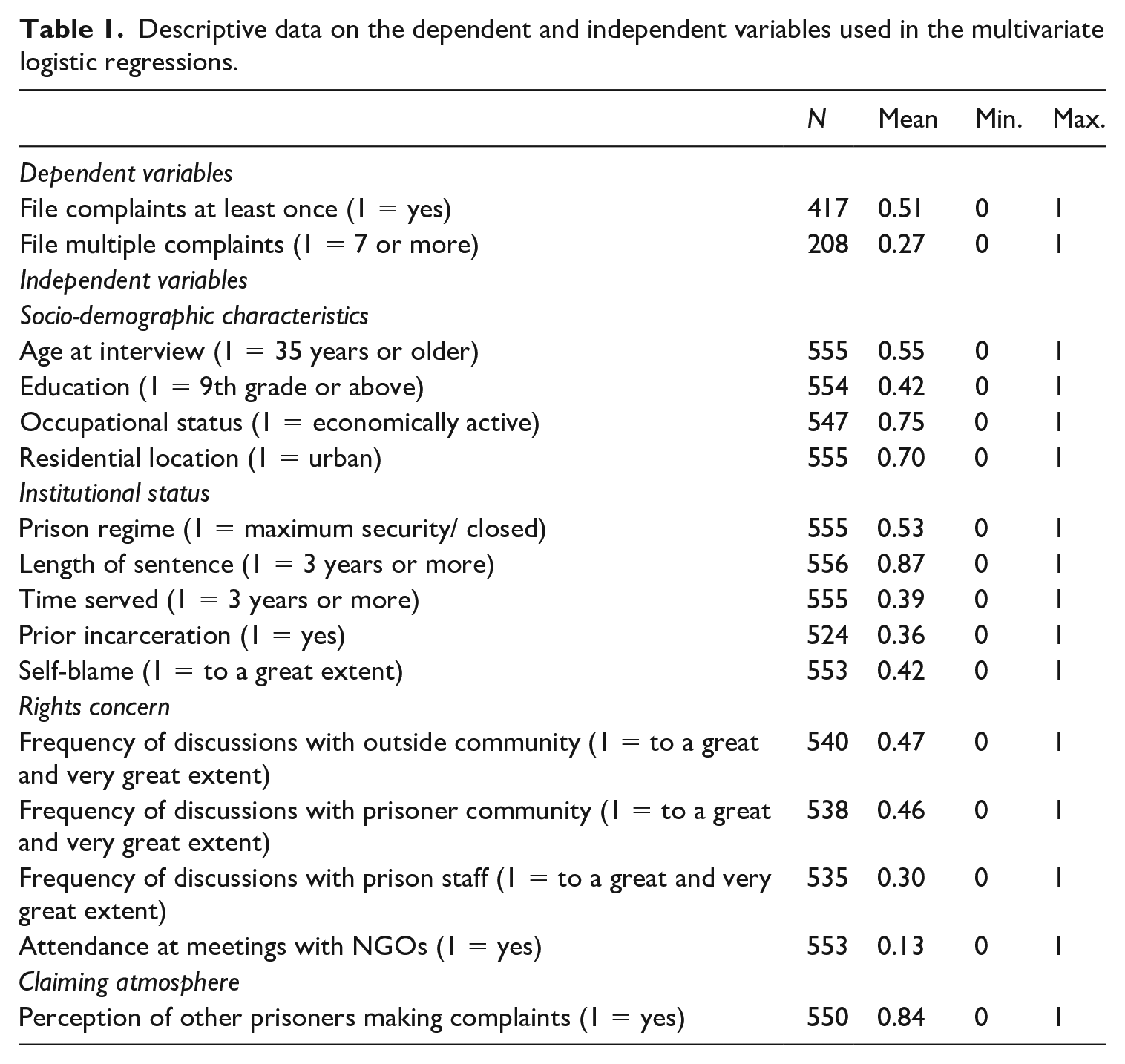
The sample consisted of 557 prisoners drawn from the population of adult male prisoners, convicted through a court final decision. The survey was self-administered 3 and comprised a 10-section questionnaire. 4 One of these sections concerned prisoners’ claims. Respondents could also fill out a comment section at the end of the questionnaire, an opportunity taken by 194 participants (35 percent). They represent the sub-sample used for the qualitative content analysis. Compared with the general sample of respondents (see Table 1), they were relatively similar in terms of education (46 percent had reached 9th grade or above, including college, vs. 42 percent) and age (average of 40 years vs. 38 years). In slightly higher proportions, they were incarcerated in maximum security and closed regimes (62 percent vs. 53 percent), had prior incarceration (41 percent vs. 36 percent), were serving longer sentences (on average, 111 months vs. 93 months), and filed complaints to a greater extent (on average, 10 vs. 7 complaints).
Descriptive data on the dependent and independent variables used in the multivariate logistic regressions.
Data analysis
Descriptive statistics were employed to describe how often prisoners lodge complaints, on what grounds, and how their complaints are framed. Then two multivariate logistic regressions were used to identify what factors influence prisoners to make claims. These analyses tested four sets of independent variables: (1) individual characteristics, (2) institutional status, (3) prisoners’ concerns regarding their rights, and (4) the claiming atmosphere in prison. Both the dependent and independent variables are described in the following section. Finally, qualitative content analysis was conducted to answer the third research question: what frames do prisoners use to explain their claiming behaviour? Specifically, two sets of prisoners’ statements were used to explore (a) how they name and prioritize the reasons for filing complains, and (b) the frame patterns of claiming behaviours, based on their accounts of their personal experiences.
Measures
Dependent variables
Prisoners’ claims were first operationalized as the action of filing a complaint. The sub-sample of prisoners who stated that their rights were violated (N = 420) was asked whether or not they filed a complaint. The answers were dichotomous distributed as 1 = yes (51.1 percent); 0 = no (48.9 percent). Second, prisoners’ claims were measured as the action of filing multiple complaints. This was a compound variable, constructed first by summing up prisoners’ responses to the question: How many complaints have you submitted to these institutions? The variable was then dichotomized around the mean value, as 1 = 7 complaints or more (26.9 percent), 0 = fewer than 7 complaints (73.1 percent). 5
Independent variables
Several sets of independent variables were used to identify the determinants of prisoners’ claims. First, we included four individual characteristics, all dichotomously recoded: age at interview (1 = 35 years old or more – 55.1 percent; 0 = otherwise); 6 level of education (1 = 9th grade or above, including college – 41.7 percent; 0 = otherwise); 7 occupational status before incarceration (1 = economically active – 75.0 percent; 0 = otherwise); 8 and residential location before incarceration (1 = urban – 69.9 percent; 0 = otherwise). We hypothesized that older, higher-educated and economically active prisoners, who lived in an urban setting before incarceration, were more likely to complain than were their counterparts.
Second, five variables related to prisoners’ institutional status were included, all recoded dichotomously: prison regime (1 = maximum security and closed regime – 53.2 percent; 0 = otherwise); length of prison sentence (1 = 3 years or more – 86.7 percent; 0 = otherwise); time served (1 = 3 years or more – 38.7 percent; 0 = otherwise); prior incarceration (yes = 1 – 35.9 percent; no = 0); self-blame for the incarceration (1 = to a great extent – 41.8 percent; 0 = otherwise). 9 We assumed that prisoners held in maximum security and closed regimes are more likely to complain, as are prisoners convicted to longer sentences and those who had already served 3 years or more in prison. We also assumed that prisoners who take the blame for their incarceration are less prone to file complaints.
Third, a set of variables measuring rights concern among prisoners was considered: frequency of discussions about rights with the outside community (1 = to a great and very great extent – 47.2 percent; 0 = otherwise); 10 frequency of discussions about rights with the prisoner community (1 = to a great and very great extent – 45.9 percent; 0 = otherwise); 11 frequency of discussions about rights with prison staff (1 = to a great and very great extent – 30.1 percent; 0 = otherwise); 12 attendance at meetings with NGOs acting in the field of human rights (1 = yes – 13.4 percent; 0 = otherwise). Our hypothesis was that prisoners are more likely to formulate rights’ claims if they have frequent discussions with the outside community, the prisoner community and prison staff about their rights, as are those who attend meetings with NGOs.
Finally, perception of other prisoners making complaints was introduced in the statistical models. Prisoners were asked whether they believe that the other prisoners file complaints when they consider that their rights have been violated. The answers to the question were dichotomously distributed: 1 = yes – 83.8 percent; 0 = no. We expected that prisoners who share that perception are more likely to complain.
Results
How often do prisoners lodge complaints, and on what grounds, and how are their complaints framed?
The results show that 75 percent of prisoners consider that their rights have been violated in prison. Of these, only half declared that they had filed a complaint at least once during their current incarceration. In total, these respondents lodged 1424 complaints (from a minimum of 1 to a maximum of 86), with an average of 7 complaints/prisoner. Almost one-third formulated a single complaint, 41 percent between 2 and 6 complaints, and 27 percent filed 7 or more complaints. The highest number of complaints were addressed to the ECtHR rather than to Romanian institutions, a finding explained by the fact that Romania suffers from a lack of effective domestic remedies (also denounced by the ECtHR).
Prisoners were also asked in open-ended questions about the reasons that they filed complaints. 13 The results show the existence of seven general frames (see Table 2):
(1) living conditions (with direct mentions of specific EPR norms on prison conditions, including overcrowding, accommodation, personal space, hygiene, and nutrition);
(2) procedural justice (including complaints about specific civil, penal and prison laws provisions in Romania);
(3) specific sets of human rights violations in prison as stipulated by the Romanian prison law (that is, the right to life, the right to work, the right to petition, etc.);
(4) violation of human rights in general (usually with reference to domestic and European laws and provisions);
(5) torture and degrading treatment (with a focus on Article 3 of the ECHR, and direct references to it);
(6) discrimination (with direct reference to it); and
(7) other abuses.
General frames of prisoners’ complaints.
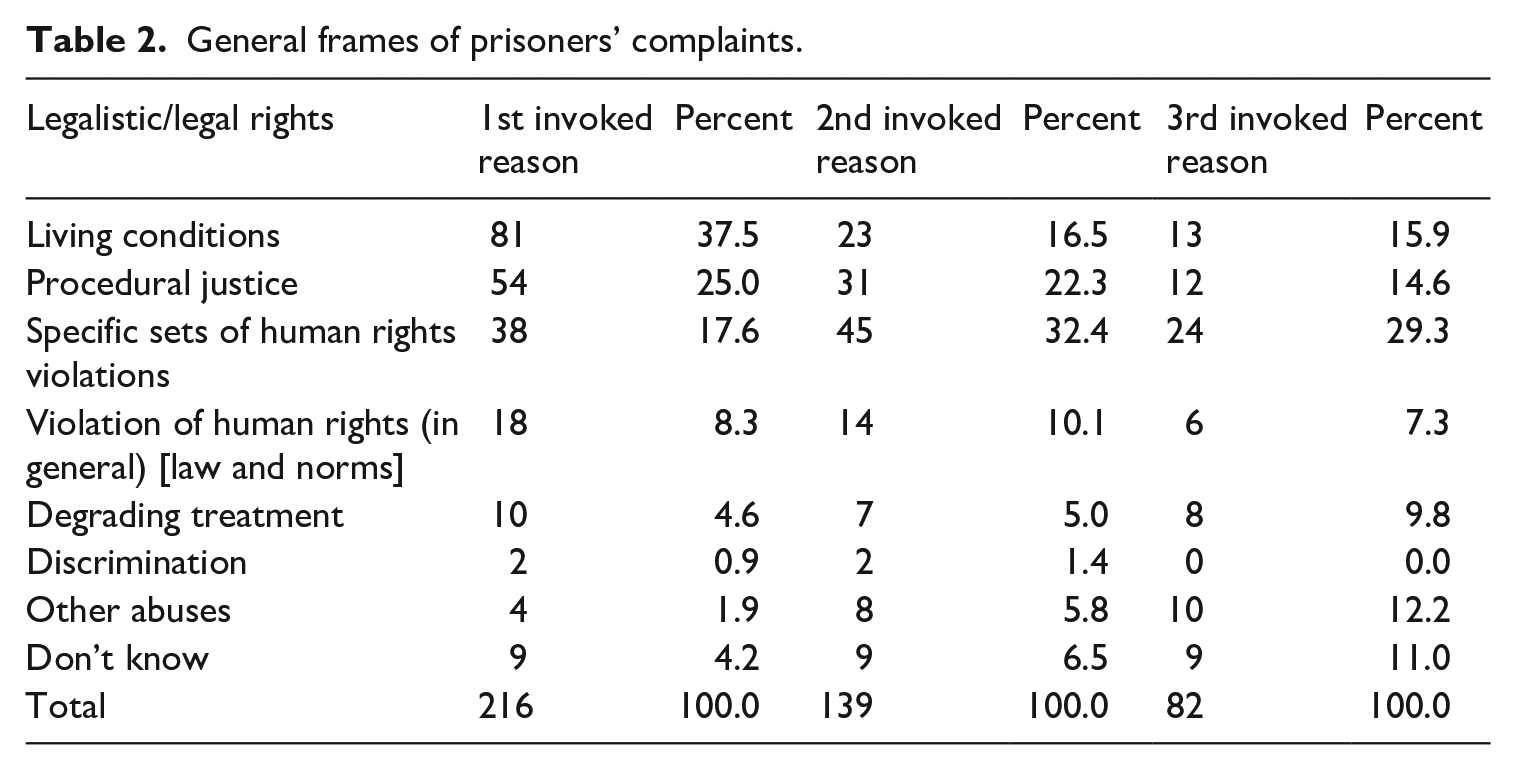
These general frames also point to prisoners’ preference to use legal domestic and European vocabulary when they talk about the object of their complaints. This is revealed, for instance, when they invoke both human rights violations and degrading treatments in prisons. In addition, the internalization of the European terminology of human rights is evident when prisoners invoke Article 3 of the ECHR as the object of their complaints, with a focus on degrading and inhuman treatments. However, instead of using the classic expression ‘prohibition of torture’, some prisoners preferred to use the formula ‘physical and/or emotional torture’.
What factors explain variations in claiming behaviour among Romanian prisoners?
The second goal of the current study was to examine the impact of individual and institutional factors on prisoners’ claiming behaviour. Table 3 shows the results of multivariate logistic regression analyses. Only a few independent variables turned to be significant discriminators.
Multivariate logistic regression analyses.
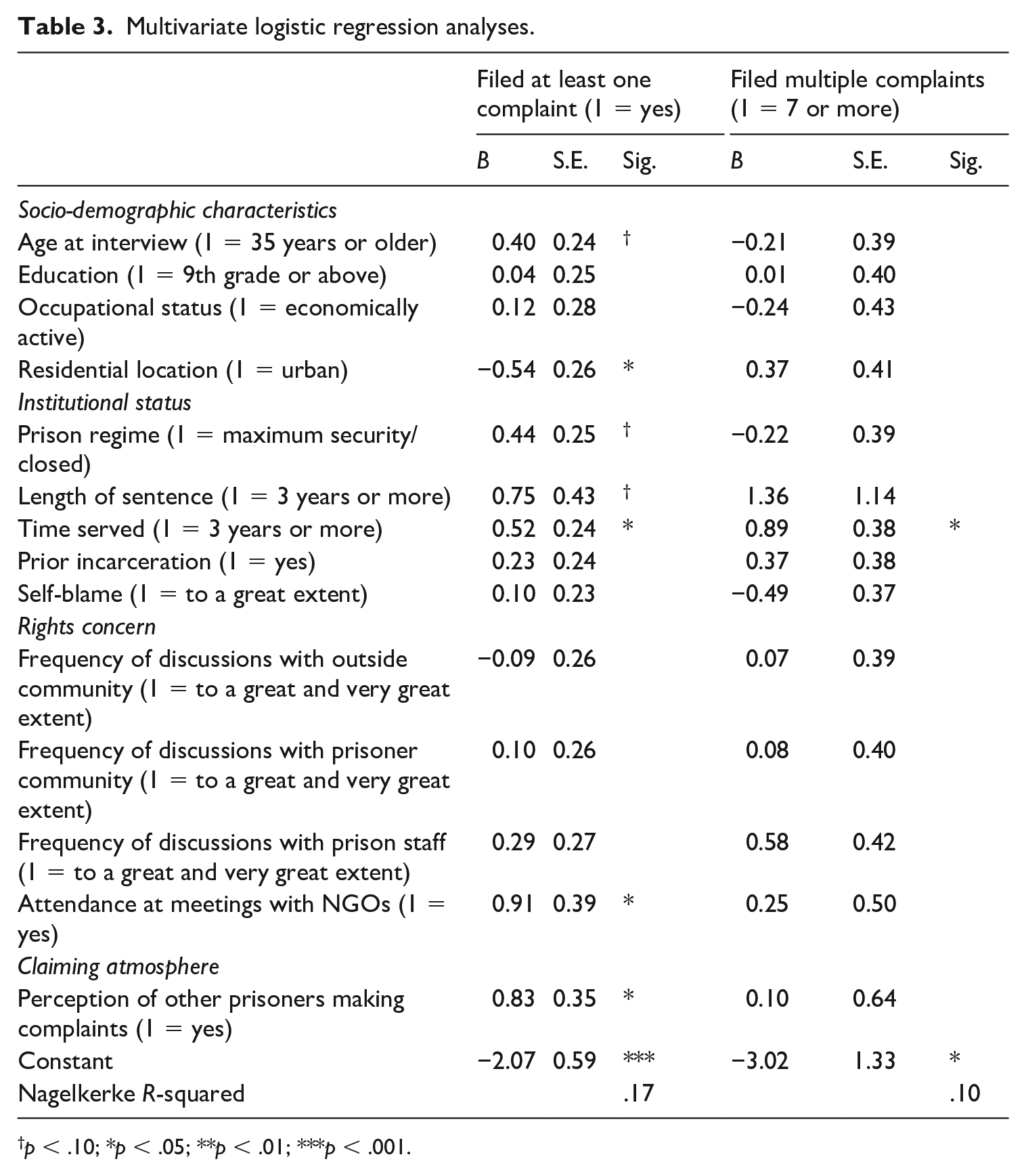
p < .10; *p < .05; **p < .01; ***p < .001.
As regards the first model, which tests the differences between complainers and non-complainers, only four variables turned out to be relevant:
(1) residential location: contrary to our assumption, prisoners living in urban settings before incarceration are less likely to file complaints;
(2) time served: prisoners who had already served 3 years or more of the current prison sentence are more likely to file complaints;
(3) prisoners who attended meetings with NGOs are more likely to file complaints;and
(4) prisoners who have the perception of a rights claims atmosphere in prison are more likely to file complaints.
With respect to the second model, scrutinizing the differences between high-rate and low-rate complainers, time served was the only independent variable significantly related, in the expected direction: prisoners who had already spent at least 3 years in prison are more likely to have filed a higher number of complaints.
How do prisoners frame their explanations about claiming behaviour?
Most of the comments recorded in the final section of the questionnaire are concluding remarks related to respondents’ personal experience in prison, feelings and hopes regarding the need for change, examples of abuses or violations of human rights or expressing dissatisfaction related to the prison administration, the prison system and staff mentality. We identified six general characteristics (see Table 4):
(a) a rhetoric of victimization and justification for their claiming attitude;
(b) the omnipresent expression of a profound hope for change;
(c) forms of personal engagement for change, including prisoners’ recommendations;
(d) expressions of dissatisfaction with prison;
(e) direct references to human and prisoners’ rights;and
(f) prisoners’ gratitude for participation in the survey.
Rights frames articulated by prisoners in their comments.
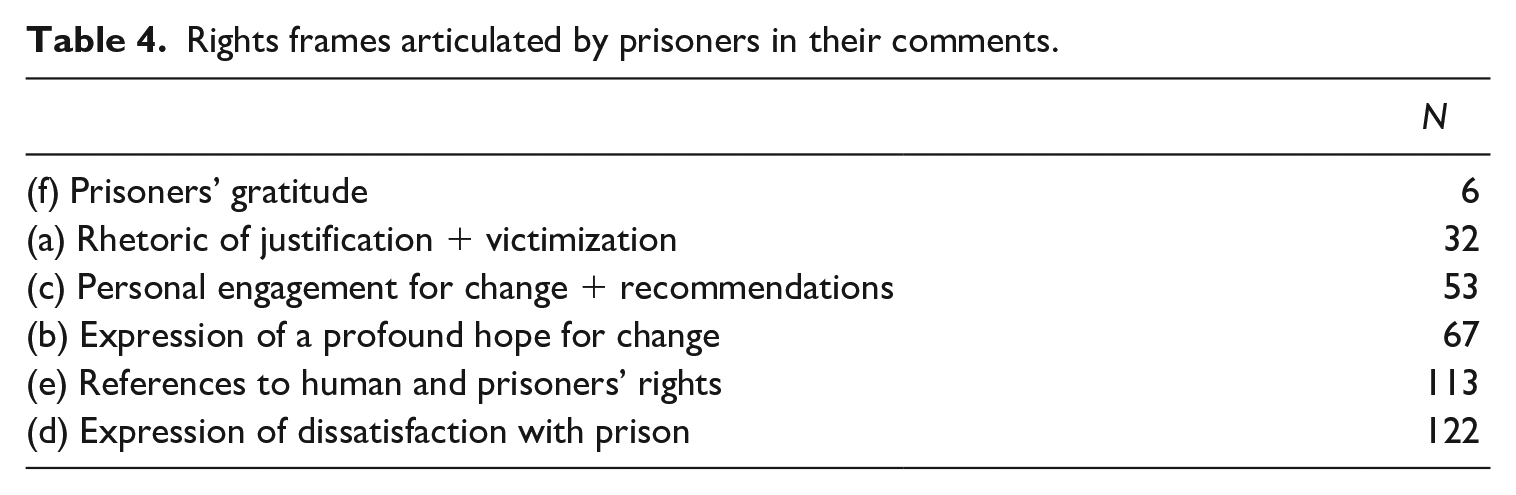
Six comments express gratitude regarding prisoners’ participation in our study, labelled as a questionnaire, an interview, an activity in prison, a programme, an educational programme or a civic education programme. Most of the comments (122) refer to dissatisfaction with prison. A relatively similar number of comments (113) refer to specific rights violations as stipulated by domestic law (overcrowding, nutrition, personal space, daily walk, individual plan and participation in activities, work, correspondence, petition, visits, transfer). These two frames are also the most interconnected ones: only three of the comments framed as references to human and prisoners’ rights (frame (e)) do not contain correlated references expressing prisoners’ dissatisfaction with prison (frame (d)).
The associations between these six frames were further analysed via cross-tabulation and the corresponding chi-square statistics. 14 The results showed that there are no significant associations between frame (a) – a rhetoric of justification for their claiming attitude and victimization – and frame (b) – the omnipresent expression of a profound hope for change; between frame (a) and frame (c) – forms of personal engagement for change, including prisoners’ recommendations; or between frame (a) and frame (d) – expression of dissatisfaction with prison. In other words, in equal proportions, both prisoners who used the rhetoric of justification for their claiming attitude and prisoners who did not use this rhetoric also expressed hope for change as well as dissatisfaction with prison. Instead, frame (a) is significantly related to frame (e) – direct references to human and prisoners’ rights: a higher proportion of prisoners who did not use a rhetoric of justification for their claiming attitude (61.7 percent) than those who did (40.6 percent), made references to human and prisoners’ rights.
Frame (b) – the omnipresent expression of a profound hope for change – is significantly associated with frame (c), frame (d) and frame (e). More prisoners who expressed the hope for change than those who did not also deployed forms of personal engagement for change (46.3 percent vs. 17.3 percent). The latter category expressed dissatisfaction with prison and made direct references to both human and prisoners’ rights in a higher proportion than those who expressed hope for change (78.0 percent vs. 34.3 percent and 70.1 percent vs. 35.8 percent, respectively).
Frame (c) – forms of personal engagement for change, including prisoners’ recommendations – is further significantly associated with frame (d). Prisoners who did not discursively adopt forms of personal engagement for change expressed dissatisfaction with prison in higher proportions than those who did adopt such forms (73.0 percent vs. 35.8 percent). The association with frame (e) only approaches the level of statistical significance.
Frame (d) is significantly related to frame (e) – direct references to human and prisoners’ rights. Prisoners who expressed dissatisfaction with prison chose to make direct references to both human and prisoners’ rights in higher proportions than those who did not (79.5 percent vs. 22.2 percent). Both frame (d) and frame (e) are further related with frame (f) – prisoners’ gratitude for participation in the survey. All those who expressed gratitude for participation in the survey were among those who did not express dissatisfaction with prison and did not make direct references to human and prisoners’ rights.
Prisoners’ attitude to claiming reveals itself in their statements in the comments section of the questionnaire. Their accounts return to the naming, blaming and claiming model. Although this section was not intended for their experiences of complaints, many prisoners used it to repeat individual experiences of complaints, showing the central role of legal mobilization in the daily temporality of detention.
In terms of naming, direct circumstances leading to complaints are introduced with a bureaucratic vocabulary. Claims/requests/applications, appeals, complaints, petitions are the most used nouns, generally in the plural, to describe examples of rights violations’ experiences. These examples are also describing the ‘risks’ associated with the adoption of a claiming behaviour in prison:
In the case of appeals or complaints filed by prisoners, they are very harshly criticized or severely enforced (they suspend our participation in work, they move us to another penitentiary, or they take us out of work altogether).; If we claim our rights, we are threatened that we will not benefit from conditional release and that we will have problems during detention.
In terms of blaming (and naming as well), prisoners’ comments deploy a very wide range of personal experiences of filed – and mostly failed – complaints:
(1) Testimonies on violations of the right to petition: ‘We are not allowed to lodge complaints’; ‘Our applications go to trash, they are not registered, so I don’t get a registration number, or responses’.
(2) Critical evaluations start with the illegitimacy of refusals and make use of legal-based arguments: ‘Our requests are rejected for no reason’; ‘Prisoners’ rights are not being respected; all the claims I have filed for my rights are not approved for unjustified reasons. They violate my right to visits without a separation device at least once a month, even if I have filed applications to participate in work or classes. The reason is that I do not participate in activities, but how can I participate if I’m not given this possibility?’; ‘For 2 years I was not asked to participate in any of the activities outlined in my individual plan, even if I have filed applications in this sense’.
(3) When mentioned, the activity of the supervising judge is a reason for dissatisfaction: ‘I filed a complaint with the judge for serious health problems; I received postponement and the complaints I have filed were not resolved’; ‘I did file a request for rights with Mr. supervising judge and he [name] started threatening me that he would make a disciplinary report’.
(4) Positive outcomes of complaints are rarely mentioned (‘My application for lucrative activities [work] was approved’) or are a pretext for comparisons between prisons and their cultures: ‘In penitentiary X [name], my rights were violated; I was banned from petitioning. . . Penitentiary Y [name] is totally the opposite, here I have the right to petition if I feel I need to do so, where the management makes efforts to improve the conditions of detention and where moral values and social rules are respected.’
Discussion and conclusions
The study of prisoners’ claims is relevant for understanding whether the European norms regarding human rights have the power to achieve their social effects. Starting from this premise, the current article addresses the issue of prisoners’ complaints in Romania, where the legal discourse on human rights has penetrated the prison realm relatively late and with delays. Despite these legislative postponements, prisoners show an active complaining behaviour, as documented by ECtHR statistics as well by the findings of our study. Half of prisoners who consider that their rights have been violated in prisons have filed complaints at least once during their current incarceration. Half have not. The result is in line with the general attitudinal framework influencing individual legal decision making (see Epp, 1990: 145–7).
Although this active complaining behaviour among Romanian prisoners is prompted by the difficult prison conditions, it might also be related to a more general perception of a rights’ deficit at the societal level. According to a national survey commissioned by APADOR-CH, almost 80 percent of the interviewed population considered that human rights are respected to only a small extent or not at all in Romania (IRES, 2015). The national courts – one of the institutional actors that should defend human rights – are among those considered to be often violating them. This might also explain why our participants stated that they addressed the highest number of complaints to the ECtHR and not to the Romanian institutions.
According to human rights consciousness explanations, the introduction in Romania of a legal framework for prisoners’ rights provided prisoners with ‘persuasive new information and ideas that influences their values and beliefs’ (Simmons, 2009: 143). A new (individual and/or collective) identity becomes available – that of rights holders – that gives them ‘a sense of political identity, legitimacy, and efficacy’ (Simmons, 2009: 141–3). In this process, prisoners learn to name injurious experiences and to expose them, not only as a means of ‘adjudicating disputes’, ‘but as a weapon to enhance their power and influence’ (Merry, 1979: 919). Hence, by making claims for their legally stipulated rights, prisoners become ‘less powerful in a relationship of power’ (Ewick and Silbey, 2003: 1336). Their action can thus be seen as an expression of political resistance (Rubin, 2015: 27) intended to maintain pressure for improving prison conditions (Jacobs, 1980) in Romania in the context of EU oversight.
The frames used by respondents to motivate their claiming behaviour, although not different from the object of their complaints to the ECtHR, further show prisoners’ internalization of the domestic and European legal vocabulary. Violation of human rights, violation of prisoners’ rights, overcrowding, Article 3, individual plan, visits with or without a separation device, lucrative activities or the right to. . . are some of the most popular examples. They document the way legal terminology is used in order to construct both a personal meaning of human rights in prison and a corresponding behaviour (see McCann, 2008).
The literature on legal mobilization underlines the need to examine which factors explain variations in claiming behaviour (Kritzer, 2010: 261). This area is still understudied, and this article has tried to contribute to it through a model of analysis that combines individual and institutional status factors.
‘Time served’ was found to be the only variable that differentiates both between claimers and non-claimers and between high-rate and low-rate claimers. This means that prisoners who had already served a longer period in prison are more likely to file complaints, but also to file more claims (similar to the findings of other studies such as Calavita and Jenness, 2013; Durand, 2014). Several factors can explain this situation, including the time it takes to file a complaint and the level of dissatisfaction, which increases with the time served. Over time, prisoners develop the capacity to identify and name problems (Calavita and Jenness, 2013), to develop human rights consciousness and to take action.
Significant differences were further revealed only when it comes to discriminating between claimers and non-claimers. Prisoners who interact with NGO members and those who perceive that other prisoners are formulating rights claims were more likely to complain. Their ‘juridical socialization’ (Rostaing, 2007), a process in which prisoners learn how to build a juridical argument and to defend themselves, could explain our finding, which is supported by the fact that, in Romania, counselling is the main activity of NGOs acting in the field of prisoners’ rights. However, developing human rights consciousness is not straightforward; it is a slow and complex process, which implies ‘a shift in subjectivity’, ‘a new sense of self that incorporates rights and testing it experimentally to see if it makes a difference’ (Merry, 2006: 181). It depends ‘not only [on] educating people about the availability of rights’ but also on institutional support (Merry, 2003: 381).
Our study also showed that prisoners incarcerated in maximum security institutions with closed regimes have a higher probability of filing complaints. Previous literature indicates that prisoners’ complaints are a response to debilitating conditions (Thomas, 1988), and these high security prison regimes have such conditions. On the one hand, these regimes have more restrictive environments that expose prisoners to severe physical, social and material deprivations (Sykes, (2007 [1958]), some verging on infringements of human rights. On the other hand, control is tighter and security measures are harsher, deepening the conflict between the need to maintain safety in prison and compliance with human rights.
We found that the classic variables documented as discriminators in general studies on legal mobilization did not yield the same results in our study on prisoners, especially with respect to those variables measuring the socio-economic status of prisoners before incarceration. Level of education and occupational status did not seem to differentiate between complainers and non-complainers; this was perhaps because prison erases the socio-economic differences. An alternative explanation is the use of ‘jailhouse lawyers’ (Milovanovic and Thomas, 1989: 50): prisoners who do not have the educational resources to file a complaint on their own can still do this with the assistance of another prisoner ‘knowledgeable in law who helps other prisoners shape or translate the personal troubles and problems of prison life into legal issues and claims’.
The qualitative content analysis has shown that prisoners’ experience of human rights after the ‘introduction’ of human rights in Romanian prison law tends to favour an emergent attitudinal change. This consists of a more positive personal identity labelling of prisoners via the omnipresent expression of a profound hope for change (frame b), still coexisting with the traditional rhetoric of justification for their claiming attitude and victimization (frame a), but considerably reduced in this new attitudinal context. This finding contradicts Durand’s (2014) results underlying French prisoners’ feeling of unworthiness, and the pre-eminent negative labelling of their social identity in prison.
Moreover, the abundance of references to human and prisoners’ rights (frame e) balances in a constructive way the traditional expression of dissatisfaction with life in prison (frame d), considering the use of human and prisoners’ rights violations as the main argument for expressing dissatisfaction. This new perception spectrum allows them to use legal vocabulary to name injurious experiences (see Kritzer, 2010) in a legitimate way. As a result, the emergent positively labelled attitudinal context is also encouraging prisoners to develop feelings of trust and personal engagement for change (frame c) via the formulation of recommendations. In this context, the legislative changes reinforce these emergent attitudes, in line with recent findings on legal mobilization stating that ‘human rights practice is rooted in real bodies of law’ (Dancy and Fariss, 2018: 89). The emergent minority of Romanian prisoners who claim the application of their rights in a sustained and repeated manner (see Rostaing, 2007) are, in fact, the new legal voice of prisoners in Romania.
We can thus assume that the introduction of human rights in the prison law encouraged Romanian prisoners to develop human rights consciousness that turns them into litigants by using ‘the legal vocabulary’, because human rights are about to become ‘popular’ (Dancy and Fariss, 2018). Some mechanisms through which prisoners adapt to this legal mobilization pattern, as documented by Risse and Sikkink (1999), were emphasized by both our quantitative and our qualitative analysis: information, personal reflection and debate with a focus on the role of the in-prison dialogue on human rights, and furthermore the development of discursive strategies of persuasion and argumentation shaping their interests and legitimating their claims via the use of procedural style and vocabulary.
To conclude, these results help us to better understand how prisoners articulate their rights, how they make use of the grievance system and how they actually practise human rights in the specific context of the prison, with the associated potential negative consequences and disappointments of their claiming behaviour. Prisoners develop a human rights consciousness driven via the transversal axis ‘hope for change’, which becomes rather the focus of their comments on recommendations. After naming, blaming and claiming for their rights violations in prison, they formulate remedies and practical solutions for internal conflicts with staff and/or other prisoners, for work and training in the most developed economic sectors in the region where the prison is located, for improving educational activities in order to fulfil the real aim of detention. The results are in line with Lobel’s (2007) findings on extra-legal activism, proving individuals’ engagement in finding practical solutions for social change, which are advanced at the limits of the law, where alternative remedies might be considered possible. In this broader context, past negative experiences of complaints become marginal in intensity, and more an adequate resource or argument for their hopes for change, made possible by the introduction and circulation of human rights discourse into prisons.
Future research on prisoners’ human rights consciousness could be linked to prison climate or prison performance. In general, prisoners’ perceptions and experiences with rights could be one of the regime dimensions used to assess ‘prison performance’, along with the ‘moral’ ones such as ‘fairness’, ‘order’ and ‘safety’ (see Liebling, 2004). In this way, the research can respond to the impetus of bridging the ‘worlds of “moral measurement” and “human rights standards” in penology’ (Liebling, 2011). The qualitative data collected via the comments that prisoners left at the end of the questionnaire, where they were actually free to mention anything, are a strong indicator of what really ‘matters’ for them in prison – what are their hopes and their most pressing needs, in short, what do they ‘feel most strongly about’ (Liebling, 2004: 432). The frames we identified based on prisoners’ comments could be a basis for comparison between prisons, in which prisoners frame their discourse about rights rather positively (that is, in terms of hope for change and recommendations) and in which they frame it rather negatively (that is, in terms of victimization and dissatisfaction).
Footnotes
Funding
The author(s) disclosed receipt of the following financial support for the research, authorship, and/or publication of this article: This article is the outcome of research funded by the Romanian National Authority for Scientific Research and Innovation, CNCS-UEFISCDI, project number PN-II-RU-TE-2014-4-2967: ‘Prisoners’ Rights. Romania in the European Context’ (2015–2017). We did not receive financial support for the authorship and/or publication of this article.
