






Abstract
Institutional Anomie Theory has been widely used in the study of criminal phenomena. Institutional Anomie Theory offers a macro explanation of crime because it locates the cause of crime in the anomie created by the combination of a cultural overemphasis on monetary success and restricted economic opportunity. In such a context, the economy dominates the social macrostructure and non-economic social institutions (family, education, polity) may counterbalance (Merton's approach) or reinforce (Messner and Rosenfeld's approach) economic pressures. Institutional Anomie Theory has been tested with multivariate regression and with multilevel modelling. Neither of these statistical approaches addresses the question of which combinations of institutions lead to criminal behaviour. This study attempts to fill this gap by using the fuzzy-set qualitative comparative analysis which allows multiple causality and asymmetric analysis of high and low crime rates. Based on the Institutional Anomie Theory theoretical model, this study demonstrates the existence of conditions for corruption and homicide in Organisation for Economic Co-operation and Development countries. The results are generally consistent with Merton's approach. It is shown that economic pressures combined with weak social institutions condition the extent of corruption and homicide in Organisation for Economic Co-operation and Development countries. However, there are differences between the two types of crime. The results also suggest that there is no symmetry in the causal combinations between high and low crime rates. The implications of these findings are discussed.
Keywords
Introduction
In market societies, economic pressures and market values are highly relevant in guiding citizens’ behaviour (Messner and Rosenfeld, 1994). All OECD (Organisation for Economic Co-operation and Development) economies operate on the basis of the market system and have experienced a compression of market values in recent decades (‘American dream’) as competition has intensified due to the free movement of capital and people and profound changes in communication technologies.
Despite these economic and social changes, Castles and Obinger (2008) show that although we live in an era of convergence and globalisation, ‘country clustering is, if anything, more pronounced than in the past’ (Castles and Obinger, 2008: 321). Notwithstanding the differences between OECD countries in the degree of adoption of market values, they are embedded in an international context that has exacerbated social pressures for the pursuit of economic success. This provides an appropriate framework for using Institutional Anomie Theory (IAT) to understand instrumental crime, i.e., crime motivated by the offer of monetary rewards (Messner and Rosenfeld, 1994: 85).
Anomie is a social phenomenon that can lead to the proliferation of instrumental crime when society's primary focus is on the ‘ends’ of economic success, rather than the nature – legitimate or illegitimate – of the ‘means’ used to succeed.
The concept of anomie was first introduced by Durkheim ([1897] 1979) to explain patterns of suicide development over time, between groups, and between societies. Merton (1938, 1957) adapted this approach to the level of institutional macrostructure. The author recognised that social structure cannot guarantee the outcome that is expected under the prevailing value system: universal access to legitimate means to achieve material success. Anomie arises in societies that culturally value wealth and economic well-being. When there are blocked opportunities, that is, when it is not possible to achieve the ‘ends’ by legitimate means, individuals are encouraged to commit instrumental crime. Major social institutions such as family, education, religion and polity, may serve as a counterbalance to economic pressures and mitigate the effects of anomie (Merton's approach).
Messner and Rosenfeld (1994) revised the concept of anomie. Rather than focusing exclusively on the constraints of the economy as the primary source of structural pressures to commit crime, they examine the criminogenic influence of a variety of social institutions. For Messner and Rosenfeld (1994), economic pressures can become so densified in a materialistic society that, in contrast to Merton's approach, important social institutions (family, education, religion) 1 become subordinate to economic values and intensify the pressure for material success (Messner and Rosenfeld's approach).
IAT is a macrosocial theory with the unit of analysis usually defined at country level. As is stated by Chamlin and Cochran (1995: 414): ‘anomie theory has the potential to make a major contribution to the understanding of variations in the rate of crime across, and within, macro social units’.
The intentional homicide rate of countries (rate of homicides per 100,000 persons) is the most studied crime in IAT literature, because measures of less serious crime tend to be less reliable due to substantial differences in definition and reporting across countries (Kokkinos and Vryonidou, 2020). However, most homicides are not committed in the pursuit of some economic interest. According to Maume and Lee (2003: 1144), there is a difference between what are known as instrumental and expressive forms of violence: ‘Instrumental homicides entail lethal violence in pursuit of some material gain. Hence, the “violence” is only instrumental to some material goal. (…) Expressive homicides are committed in the context of an argument, a lover's quarrel, or a fit of rage’. Thus, a caveat should be noted in IAT studies that use homicide rates, since international crime statistics do not distinguish instrumental homicide from expressive homicide (Hughes et al., 2015: 106). Given this difficulty, it is advisable to add to the analysis a form of crime that is always instrumental in character, such as corruption. However, the comparability of international corruption statistics suffers from the same drawbacks as for all other crimes except homicide: differences in definitions and reporting between countries.
Moreover, given the hidden nature of corruption, direct measures are difficult to find or inappropriate. For example, the number of convictions for corruption depends on the effectiveness of the country's judicial system. Therefore, one often finds in the literature the use of perceptions as indicators of the extent of corruption in a country. However, the use of perceptions also presents some difficulties, since they may be influenced by many cultural and contextual factors.
In this study, corruption is defined as perceptions of abuse of public power for private gain.
Corruption is a form of ‘white-collar’ crime, i.e., non-violent crime committed in the course of a legitimate occupational context. Homicide can be included in ‘common’ crime, i.e., violent crime not necessarily linked to professional concerns (Friedrichs, 2010: 5, 13). There is a considerable body of literature in Criminology that identifies some differences between ‘white-collar’ crime and ‘common’ crime (e.g. Benson and Simpson, 2009). In terms of offenders, there are differences in terms of age, genre, education, professional status, social status and recidivism rates (Ribeiro et al., 2019). The situational context and society's response to both types of offending is also different, as are the problems associated with victimisation (Friedrichs, 2010). This study seeks to examine whether there are differences between these types of crime in relation to anomie.
The most relevant innovation of this study is the use of fuzzy-set qualitative comparative analysis (fsQCA) methodology to understand how IAT explains crime. Previously, empirical studies on IAT relied on multivariate analysis, which allows analysing the net effects of the independent variables on the dependent variable. This is not adequate in the case of IAT, as acknowledged by several authors (e.g. Bjerregaard and Cochran, 2008a: 41; Piquero and Piquero, 1998: 80), because the core of the theory postulates that crime can result from the interaction of multiple institutions. There are some studies on IAT that have included the possibility of interactions between institutions (e.g. Cullen et al., 2014; Hirtenlehner et al., 2013; Hughes et al., 2015; Schoepfer and Piquero, 2006), but with three variables at maximum (Baumer and Gustafson, 2007) and individual variables could not interact with all other variables. According to Chamlin and Cochran (1995: 420), ‘The inclusion of several multiplicative terms in a single equation substantially increases problems with multicollinearity and parameter redundancy’. With fsQCA these difficulties do not arise because it allows the analysis of multiple causality, i.e., different pathways or combinations of causes that may lead to crime. 2 FsQCA is suitable for developing macro studies (Ragin, 2000). Cases (countries) are considered in terms of their broad similarities and differences based on different configurations of conditions. Unlike multivariate regression, where the absence of relevant variables invalidates the interpretation of the results, fsQCA is concerned only with whether the causes postulated by the theory or their combinations are necessary or sufficient conditions for the occurrence of an outcome (crime).
With fsQCA it is also possible to infer non-symmetry, so the simple reversal of the pathways leading to high crime rates does not necessarily yield pathways that lead to low crime rates.
However, fsQCA is not exempt from limitations. Some difficulties that had been identified by Chamlin and Cochran (1995: 415) remain unresolved by fsQCA: ‘using macro-level data, how does one measure the “dominance of the economy in the institutional balance of power,” “the effectiveness of noneconomic institutional controls” or “anomie”?’ The inability to overcome these difficulties means that empirical research on IAT consists only of partial and indirect tests to verify the theory (Bjerregaard and Cochran, 2008a: 42).
Given all this, the aim of this study is to analyse how IAT explains corruption and homicide, by answering the question of what combinations of institutions lead to crime in OECD countries. There are three specific research questions: (1) to find out whether IAT arguments are causal conditions (necessary or sufficient) for the occurrence of corruption and homicide in OECD countries; (2) to inquire whether there are differences in causality between ‘white-collar’ crime (corruption) and ‘common’ crime (homicide); (3) to investigate whether causal combinations differ between high and low crime rates.
The paper begins with a review of the relevant literature, followed by the development of the research questions to be investigated. Then the empirical study is presented and the results are discussed.
Research on institutional anomie theory
According to Messner and Rosenfeld (1994), the dominant value system in market societies is characterised by ‘American dream’ values, which are a cultural structure of achievement, individualism, universalism and materialism (Cullen et al., 2004). Achievement refers to assessment of personal worth based on the outcome of efforts. Individualism is a cultural value that subordinates relationships to personal goals and likely leads to more egoistic ethical decision making. Universalism is a cultural value that promotes equality of opportunity creating expectations that all will be judged on similar criteria rather than on particularistic relationships. Materialism is a focus on monetary rewards.
Messner and Rosenfeld (1994) emphasise the role in generating anomie of the values of the ‘American dream’ in interaction with a social structure dominated by economic pressures. The model of the IAT is shown in Figure 1 (adapted from Dolliver, 2015: 749).
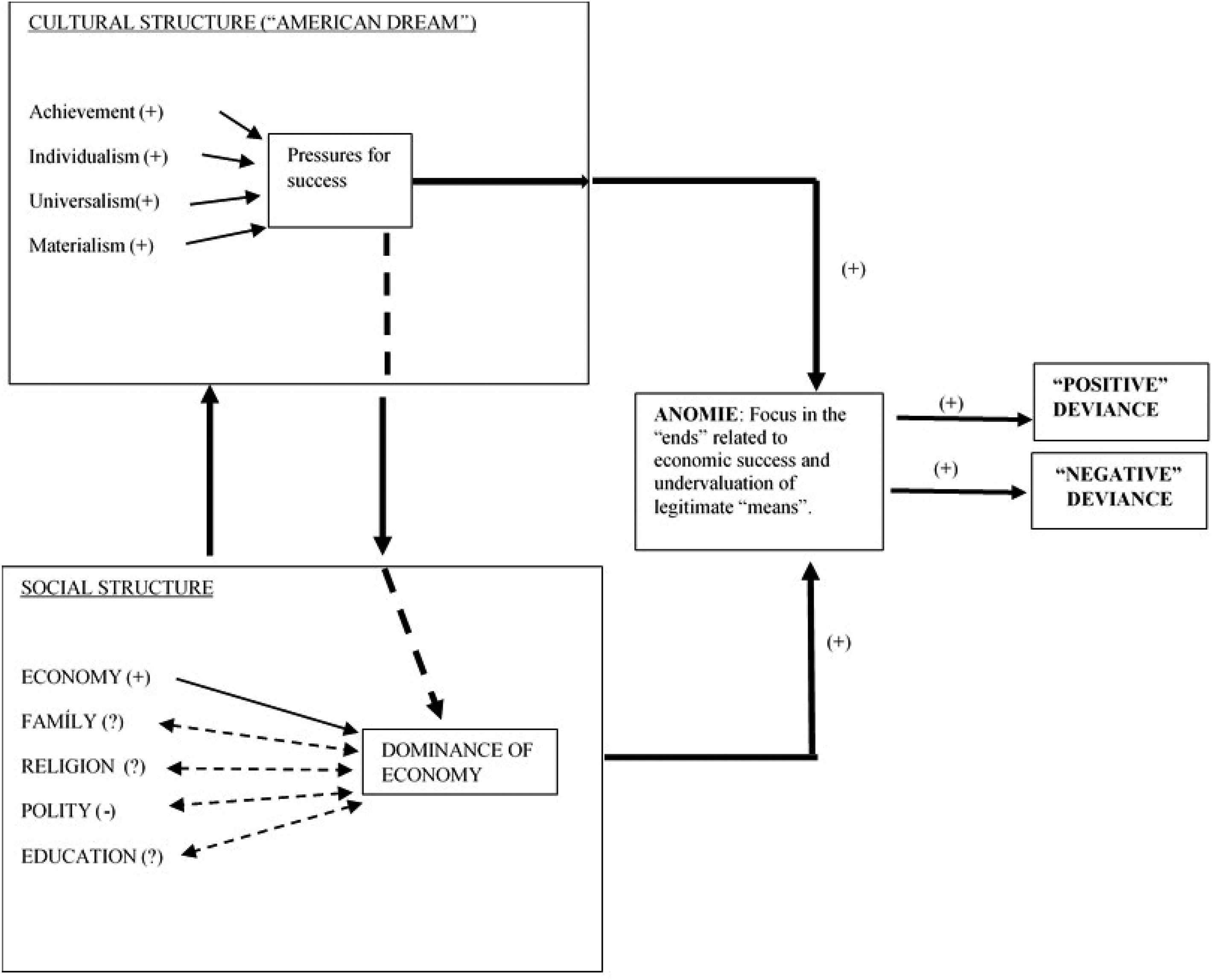
Institutional Anomie Theory (IAT) model.
Figure 1 depicts a society dominated by a cultural structure composed of cultural values typical of the ‘American dream’ that leads citizens to focus on economic and material success. This cultural structure interacts with a social structure where the economic dimension acquires dominance over other social dimensions (family, education, religion and polity). The dominance of economic pressures coupled with the cultural context of economic and material success feeds the focus on the ‘ends’, along with a reduced emphasis on the legitimacy of the ‘means’, leading to a state of anomie. This social context is favourable to deviant behaviours. Deviance can be ‘positive’, allowing individuals to break with the ‘status quo’ and use their creativity to launch new businesses, but it can also be ‘negative’, resulting in value-destroying actions, such as crime (Cullen et al., 2014).
As mentioned earlier, the most used dependent variable in IAT studies is the intentional homicide rate (e.g. Chamlin and Cochran, 2007; Cochran and Bjerregaard, 2012; Dolliver, 2015; Levchak, 2015; Maume and Lee, 2003; Messner and Rosenfeld, 1997).
Property crime is the second dependent variable that most often appears in IAT empirical studies (e.g. Baumer and Gustafson, 2007; Chamlin and Cochran, 1995; Hannon and DeFronzo, 1998; Kim and Pridemore, 2005; Schoepfer and Piquero, 2006; Stults and Baumer, 2008).
There are few studies applying IAT to white-collar crime (e.g. Cullen et al., 2014; Hirtenlehner et al., 2013; Schoepfer and Piquero, 2006). None of them addresses corruption.
The IAT independent variables are proxies to the influence of institutional and cultural structures. A small number of studies include only one single independent variable that reflects the tensions between economic and social institutions: a ‘decommodification’ index. A low level of the ‘decommodification’ index means strong pressure from the economic dimension and vice-versa. According to Messner and Rosenfeld (1997: 1394), this index ‘refers in the most general sense to the empowerment of the citizenry against the forces of the market’. There has been some debate about the composition of the ‘decommodification’ index. The seminal work of Esping-Andersen (1990) uses measures of the degree of ‘decommodification’ of pension, sickness and unemployment benefit programmes to evaluate welfare states. IAT studies use a ‘decommodification’ index based on the combination of Social Security spending, unemployment benefits and other social government spending (Jensen, 2002; Kittleson, 2012; Levchak, 2015; Messner and Rosenfeld, 1997; Savolainen, 2000). Scruggs and Allan (2006: 56) note that ‘there are conceptual and empirical drawbacks to using spending as the primary (let alone exclusive) empirical basis for evaluating welfare states’. Thus, the ‘decommodification’ index may not be able to capture all the tensions between the economy and other social institutions. To overcome this problem, the majority of the IAT's empirical studies use multiple variables to measure the impact of different social dimensions rather than subsuming everything into a single index. In these empirical studies, the economic dimension is recorded separately from other social dimensions and, in some cases, from cultural values. There are authors who also consider the possibility of interactions between social institutions and cultural values (e.g. Cullen et al., 2014; Hirtenlehner et al., 2013; Hughes et al., 2015; Schoepfer and Piquero, 2006).
In models that separate economic pressures from social institutions, inequality (measured by Gini coefficients and other indicators) is the most commonly used variable to measure economic dimension pressures (e.g. Bjerregaard and Cochran, 2008a, 2008b; Cullen et al., 2014; Hughes et al., 2015; Maume and Lee, 2003). But there are studies that measure economic pressures with poverty (e.g. Baumer and Gustafson, 2007; Dolliver, 2015).
Inequality has been considered advantageous over other measures of the economic dimension because it can also express the pressure of ‘American Dream’ values (effect of neoliberal culture), since the resulting market distribution of income tends to be unequal (Smith, 2016).
Regarding the crime of corruption, inequality is more adequate than poverty because the perpetrators usually have long-term jobs and occupy positions of some importance that give them access to opportunities to commit such crimes (Benson and Simpson, 2009). Their economic pressures do not come from poverty. Regarding homicide, there is an intense and inconclusive debate underway as to which variable, poverty or inequality, should be associated with this form of crime (Pridemore, 2011; Rogers and Pridemore, 2020; Santos et al., 2018). Since one of the objectives of this study is to compare the results for both crimes, the same variable is preferable and therefore, inequality was chosen. Moreover, the use of Gini coefficients attenuates the contrast between inequality and poverty because, as noted by Pare and Felson (2014: 452) and Rogers and Pridemore (2020: 1), they measure poverty as well as inequality. Almost all studies on IAT using Gini coefficients show that they are related to homicide and other crimes, contrasting with the study by Zhao and Cao (2010) where this result was not confirmed.
With regard to social institutions, the social dimensions most commonly included in IAT studies are family, education, religion and polity. According to Cullen et al. (2004), stable families reduce self-centeredness and provide emotional stability and self-control, allowing for greater resilience to economic pressures. Marital and family breakdown leads to social disorganisation, reduces informal social controls, increases criminal activity and other forms of deviance. However, according to Messner and Rosenfeld's approach, the family may also be subject to economic pressures. An institutional imbalance with economic dominance ‘weakens the external social controls associated with institutional attachments (…) noneconomic institutions (…) such as families and schools, are less capable of fulfilling their distinctive socialisation functions’ (Messner and Rosenfeld, 1997: 1397). Or, as Cullen et al. (2004: 413) note, ‘when individuals’ economic roles dominate their other roles in society, such as family membership, the calculating and utilitarian logic of the marketplace leads to a loss of social control and a more egoistic seeking of ends through deviant means’.
Family strength has primarily been measured by the ratio of divorces to marriages (e.g. Dolliver, 2015; Levchak, 2015; Stults and Baumer, 2008). Most studies concluded that the stronger the family institution, the smaller the impact of the economic dimension on crime levels (e.g. Chamlin and Cochran, 1995; Cullen et al., 2004). However, Schoepfer and Piquero (2006) found no significant relationship between family and crime.
In terms of education, for Bjerregaard and Cochran (2008a) and Cullen et al. (2004), the education system is an important social institution that, together with the family, plays an important role in the socialisation of individuals by passing on the basic norms and beliefs from generation to generation. The education system instils values that reduce the pressure to commit crimes, discourages selfishness, promotes respect for others and rejects violence. Education leads individuals to take more responsibility for themselves and the environment in which they operate. However, in another perspective, according to Messner and Rosenfeld's approach, education can also be guided by economic goals. The education system promotes the development of skills and competencies that enable individuals to find opportunities for economic success. Messner and Rosenfeld (1994: 78) state that ‘education is regarded largely as a means to occupational attainment, which in turn is valued primarily insofar as it promises economic rewards’. When subordinated to the economic structure, this social institution fails to offer alternative definitions of self-worth and achievement that could serve as a counterbalance to anomic pressures.
Various indicators have been used to measure the impact of education (e.g. the percentage of individuals enrolled full-time in higher education, education spending as a percentage of GDP; average education spending per school-age person) and the evidence is mixed. Several studies (e.g. Cullen et al., 2004; Piquero and Piquero, 1998) concluded that higher levels of education lower crime rates. In a different vein, there are studies that found no significant relationship between education and crime (e.g. Bjerregaard and Cochran, 2008a, 2008b; Schoepfer and Piquero, 2006).
Religion has not been included in IAT studies as frequently as family or education. Particularly in European countries, its inclusion presents difficulties because there are different predominant religions in Europe and they may have different views on how to respond to economic pressures. Therefore, it would not be advisable to reduce religion to a single variable or set.
The most commonly used measure to capture the strength of religion is the number of adherents per 1000 people. Almost all IAT studies that included religion found that higher levels of church membership were associated with lower levels of crime (e.g. Baumer and Gustafson, 2007; Chamlin and Cochran, 1995; Salimath, 2006). The results of Kittleson (2012) are different as no significant relationship was found between religion and crime.
Unlike religion, polity has often been seen as relevant in balancing economic pressures. Messner and Rosenfeld (1994: 108) suggest ‘that greater involvement with political institutions may express a sense of public altruism and thereby reduce the level of anomie within macrosocial units’. When people feel supported by political institutions, they are less likely to be under pressure when faced with blocked opportunities.
In IAT empirical studies the most used indicator of polity is the percentage of voting age individuals who voted in parliamentary/presidential contests (e.g. Baumer and Gustafson, 2007; Maume and Lee, 2003; Schoepfer and Piquero, 2006). Most studies found that greater participation in elections is associated with lower levels of crime. Baumer and Gustafson (2007) is one of the few exceptions in which polity was not significant.
As for the findings on the role of social institutions, most studies conclude that social institutions (family, education, religion and polity) mitigate anomic influences on instrumental crime, which is consistent with Merton's approach.
Some studies also included a variable of ‘social welfare support’ measured by Social Security expenditures and other welfare expenditures as the percentage of the Gross Domestic Product (e.g. Altheimer, 2008; Baumer and Gustafson, 2007; Hirtenlehner et al., 2013). But, Messner and Rosenfeld (1997) note that the inclusion of welfare measures along with Gini coefficients can be problematic as they may overlap in measuring the economic dimension. The measurement of welfare is also controversial, especially when the assessment of welfare is based on expenditure (Scruggs and Allan, 2006). ‘Social welfare support’ is not directly considered in this study as Gini coefficients are calculated based on disposable income (after taxes and transfers), which already takes into account the effects of welfare as a result of the interaction of the economy, welfare programs and market values.
There are even studies on the IAT that have included proxies to ‘American dream’ values (e.g. Dolliver, 2015; Hirtenlehner et al., 2013; Hughes et al., 2015; Nam et al., 2014). In some of them, cultural variables are indicated as interacting with social dimensions. Their results are mixed and inconclusive. As previously stated, cultural variables probably overlap with measures of economic dimension, namely inequality.
The number of studies that have found empirical support for the IAT (e.g. Baumer and Gustafson, 2007; Chamlin and Cochran, 1995; Cullen et al., 2014; Weld and Roche, 2017) is close to the number of studies that have found no evidence for the IAT (e.g. Cochran and Bjerregaard, 2012; Cullen et al., 2004; Dolliver, 2015; Hirtenlehner et al., 2013). As noted by Hughes et al. (2015: 4): ‘On balance, then, the accumulated evidence is mixed. Although some findings support theoretical claims regarding social structure and crime, they have not been robust to changes in measurement and generally are of limited value …’
One reason for the lack of statistical significance of the results could be methodological issues. As mentioned earlier, there are problems in the empirical application of IAT that are difficult to overcome and that resulted in only partial testing of the theory. IAT has mainly been tested using multivariate regression and, more recently, multilevel modelling (e.g. Baumer and Gustafson, 2007; Nam et al., 2014; Pare and Felson, 2014; Zito, 2019). None of these empirical methods allow for the combination of all causal conditions theoretically based on IAT.
Research questions
As indicated above, the aim of this paper is to find the pathways, i.e., the conditions that influence two different crimes: corruption and homicide, based on IAT arguments. An attempt is made to answer specific research questions.
The main question is whether IAT arguments are causal conditions (necessary or sufficient) for the occurrence of corruption and homicide in OECD countries. A second research question is whether there are differences in causality between ‘white collar’ crime (corruption) and ‘common’ crime (homicide). The third research question focuses on whether there are differences in causality between high and low levels of crime.
Method
Procedure
The methodology employed in this research is the fuzzy-set qualitative comparative analysis (fsQCA), based on Ragin (2000, 2008). FsQCA is one of the variants of qualitative comparative analysis (QCA). QCA uses Boolean algebra to implement principles of comparison in the qualitative study of macro social phenomena and is well established in the Social Science literature. Roig-Tierno et al. (2017) provide a bibliometric analysis of QCA. They found 469 articles based on the QCA methodology in its three variants (fsQCA – 222, crisp-set QCA – 236, multi-value QCA – 11) encompassing a wide range of research areas. Approximately 80% of the articles were published in journals indexed in the Social Science Citation Index of the Journal Citation Index (Roig-Tierno et al., 2017: 20).
In conventional QCA variables are categorical with values ‘zero’ or ‘one’, according to whether each case belongs to a set or not. In turn, fsQCA allows for gradations in set membership (continuous variables). In fsQCA membership values to conditions are assigned on a scale from 0.0 (non-membership) to 1.0 (full-membership), with 0.5 as the cross-over point or point of maximum ambiguity. This allocation is known as set calibration.
Some examples of fsQCA applications to OECD countries are found in Choi and Cho (2018), Giner et al. (2019) and Madanipour and Thompson (2020).
FsQCA allows establishing necessary and sufficient conditions. According to Ragin (2008), a condition (‘independent variable’) is necessary when it is present in all instances of the outcome (‘dependent variable’) and is sufficient if a particular outcome emerges whenever the condition is present. For example, condition A is necessary for outcome K if in each case the degree of membership in A is consistently greater than or equal to the degree of membership in K (K is a subset of A). Condition A (or a set of conditions, e.g. B and C) is sufficient for K if in all cases the membership in condition A (or in the set of conditions B and C) is consistently less than or equal to the membership in K (A is a subset of K).
There are two key concepts related to QCA: consistency and coverage. Following Ragin (2000), consistency refers to the percentage of causal configurations of similar composition which result in the same outcome value. If the consistency of a configuration is low, it is not supported by empirical evidence. Normally in fsQCA studies, according to Fiss (2011), to consider that a condition is a necessary condition, the consistency of this condition must be at least 0.9 (i.e. 90%) and to consider that a condition (or a combination of conditions) is a sufficient condition, the consistency of the condition must be at least 0.75 (i.e. 75%). According to Ragin (2008), the consistency of a solution that considers all the pathways of sufficiency must be higher than 0.75 (75%).
Coverage refers to the number of cases for which a configuration of conditions is valid. Unlike consistency, the fact that a configuration coverage is low does not imply less relevance. ‘In cases where a result occurs through multiple causal configurations, a single configuration can have low coverage but nevertheless be useful to explain a set which causes a particular outcome’ (Roig-Tierno et al., 2017: 17). However, according to Ragin (2000), a value greater than 0.5 (50%) for the solution coverage (coverage of all pathways) is appropriate.
The use of QCA methods in macro studies of crime has several advantages. First, the validity of the results does not require many cases. Second, it allows the analysis of multiple causality, i.e., different pathways or combinations of causes that may lead to crime. Finally, with fsQCA it is possible to infer non-symmetry, so that pathways leading to high crime rates may be different from pathways leading to low crime rates.
Smith (2016) is a pioneer in applying QCA methodology to IAT. She used crisp-set QCA and found that IAT institutions and their combinations are pathways to ‘high serious crime’ (homicide, robbery, aggravated assault and burglary) at the state level in the United States. However, her study is not cross-national and does not use fsQCA. With fsQCA, it becomes possible to create sets of strong/weak institutions and define the degree to which each case belongs to different conditions in order to infer which combinations of (strong/weak) institutions are necessary or sufficient conditions for crime to occur.
FsQCA implies a great complexity in data processing. Computer algorithms developed by electrical engineers in the 1950s provide techniques for simplifying this type of data. In this study, the data was computed using the software package fsQCA 3.0 developed by Charles Ragin and Sean Davey, which uses the Quine-McCluskey algorithm. 3
Research cases and data
This study focuses only on OECD countries, because according to Ragin (2000), it is necessary to maintain some homogeneity between cases that will be instances of or candidates for the same outcome. However, there are major differences between OECD members. As already noted by Castles (1998) and confirmed by Castles and Obinger (2008), there are different ‘families of nations’ in the OECD, which differ according to common characteristics in areas such as social policies (e.g. welfare systems), labour markets and other social and cultural dimensions. Nevertheless, they are grouped according to a common reference, namely countries committed to democracy, market economy and OECD policy standards.
Data collected for almost all variables refer to the three-year average of 2013, 2014 and 2015. Data for electoral contests refer to the latest available results of two parliamentary/presidential elections, depending on the country's system of government.
Of the 35 OECD member countries, six countries were excluded. This is the case for Estonia and Latvia because they only became OECD members in 2015 and 2016, respectively. Australia, Belgium, Luxembourg and Turkey were not included in the study because they have compulsory voting and could not be compared with countries with voluntary voting. Thus, 29 countries (cases) were included in the study: Austria, Canada, Chile, Czech Republic, Denmark, Finland, France, Germany, Greece, Hungary, Iceland, Ireland, Israel, Italy, Japan, Mexico, Netherlands, New Zealand, Norway, Poland, Portugal, Republic of Korea, Slovakia, Slovenia, Spain, Sweden, Switzerland, the United Kingdom and the United States.
Measures
As aforementioned, there are two outcomes in this study: corruption and homicide. ‘Homicide’ is, as indicated previously, the most studied crime in IAT literature. It is measured by victims of intentional homicide per 100,000 population (UNODC) (0–…). 4 ‘Corruption’ is measured by the index of perceptions of corruption developed by Standaert (2015): Bayesian corruption index (0–100%). 5
Conditions (causes) based in IAT arguments are: ‘Inequality’, measured by the Gini Index (disposable income, after taxes and transfers) from the Income Distribution OECD database – OECD.stat (0–1) 6 ; ‘Divorce’ (strength of family), measured by the crude divorce rate – divorces per 1000 people from the OECD Family Database (0–…) 7 ; ‘Education’, measured by the tertiary educated population aged 25–34 years (% in same age group) in ‘Education at a glance: educational attainment and labour-force status’, OECD stat (0–100%) 8 ; ‘Polity’, measured by voter turnout in the latest two electoral contests with data from the voter turnout database collected by IDEA – Institute for Democracy and Electoral Assistance (0–100%). 9
‘Religion’ and ‘Social Welfare Support’ were not included due to the reasons discussed earlier.
Models of key conditions
Given the possibility of asymmetry allowed by the methodology fsQCA, the necessary and sufficient conditions for high corruption, low corruption, high homicide and low homicide were examined separately.
The models of key conditions for high and low corruption are
Corruption = f(Inequality; Divorce; Education; Polity) – (high corruption model). ∼Corruption = f(Inequality; Divorce; Education; Polity) – (low corruption model). Homicide = f(Inequality; Divorce; Education; Polity) – (high homicide model). ∼Homicide = f(Inequality; Divorce; Education; Polity) – (low homicide model).
The models of key conditions for high and low homicide are
Calibration thresholds
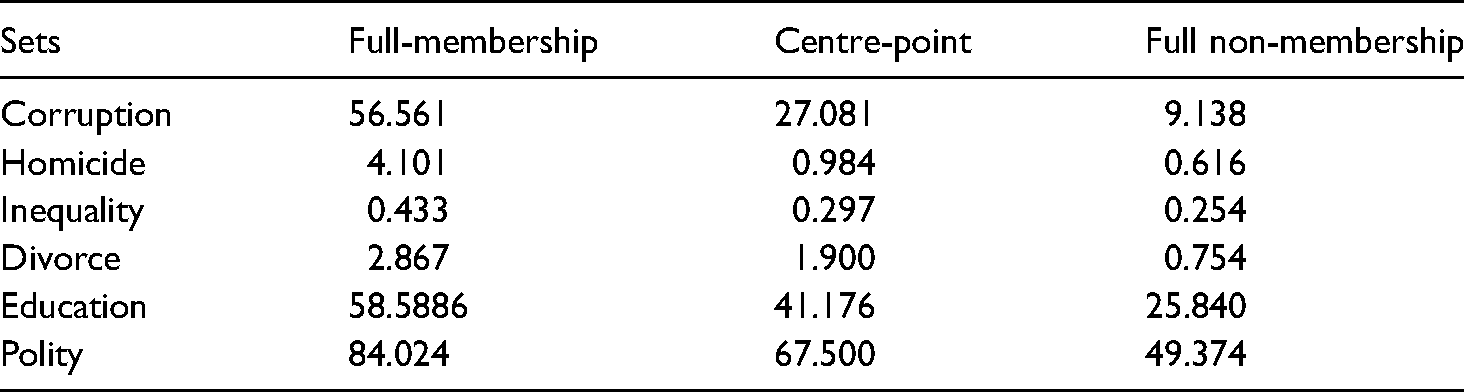
As mentioned earlier, fsQCA requires calibration, i.e., deciding how to define membership in sets. Applications of fsQCA in most areas of social sciences use two different calibration methods: the direct assignment method and the transformational or indirect assignment method. Direct methods draw on expert knowledge to provide membership scores. Indirect methods use a function that transforms existing data into an interval or ratio scaled baseline variable. According to Ragin (2000), the direct method should be used when content and theoretical knowledge relevant to set membership is available. However, it often happens that there is no clear theoretical guidance on the values assumed by the quantitative measures. In this case, the use of indirect methods may be appropriate. For the sets included in this study, no clear theoretical guidance on the definition of the anchor values was found. Therefore, an indirect method was chosen: the percentage approach. Choi and Cho (2018: 4417) point out that: ‘one general method used for calibration is by using three anchor values (percentiles 0.95, 0.5 and 0.05) to convert raw data to fuzzy score’. Accordingly, in this study, the fsQCA allows partial membership of cases to a set based on three anchor values (percentiles 0.95, 0.5 and 0.05), with full membership equal to 0.95 or higher (e.g. for corruption, it means a case that is full member of high corruption or full non-member of low corruption), a crossover point of maximum ambiguity equal to 0.5 and full non-membership equal to 0.05 or lower (a case that is full non-member of high corruption or full member of low corruption). The anchor values for the calibration of the sets (variables) are in Table 1.
Sets and fuzzy-set qualitative comparative analysis (fsQCA) calibration thresholds.
Data for the sets (variables) and calibrated data are given in Tables A1 and A2 of the Appendix.
Results
Necessary conditions
Table 2 reveals that the consistency of all conditions is lower than 0.9, thus none of the IAT's arguments is a necessary condition for the occurrence of high or low corruption.
Necessary conditions for membership in high/low corruption.
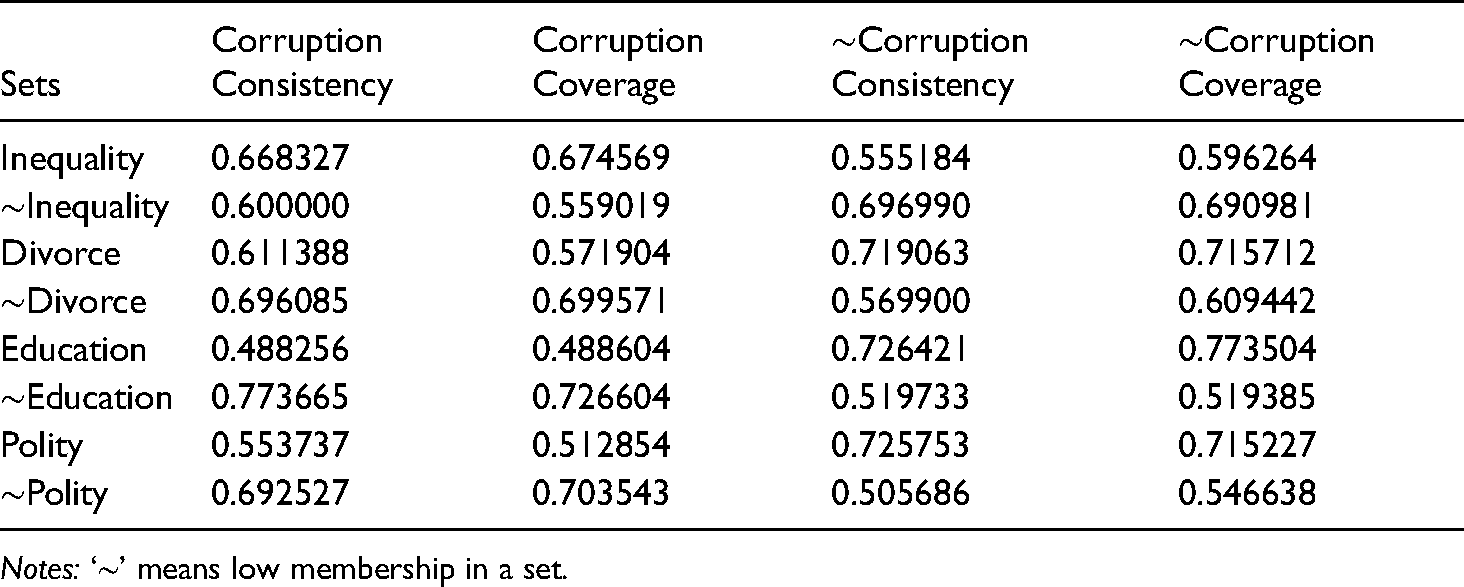
Notes: ‘∼’ means low membership in a set.
According to Table 3, the consistency of all conditions is lower than 0.9, thus none of the IAT's arguments is a necessary condition for the occurrence of high or low homicide.
Necessary conditions for membership in high/low homicide.
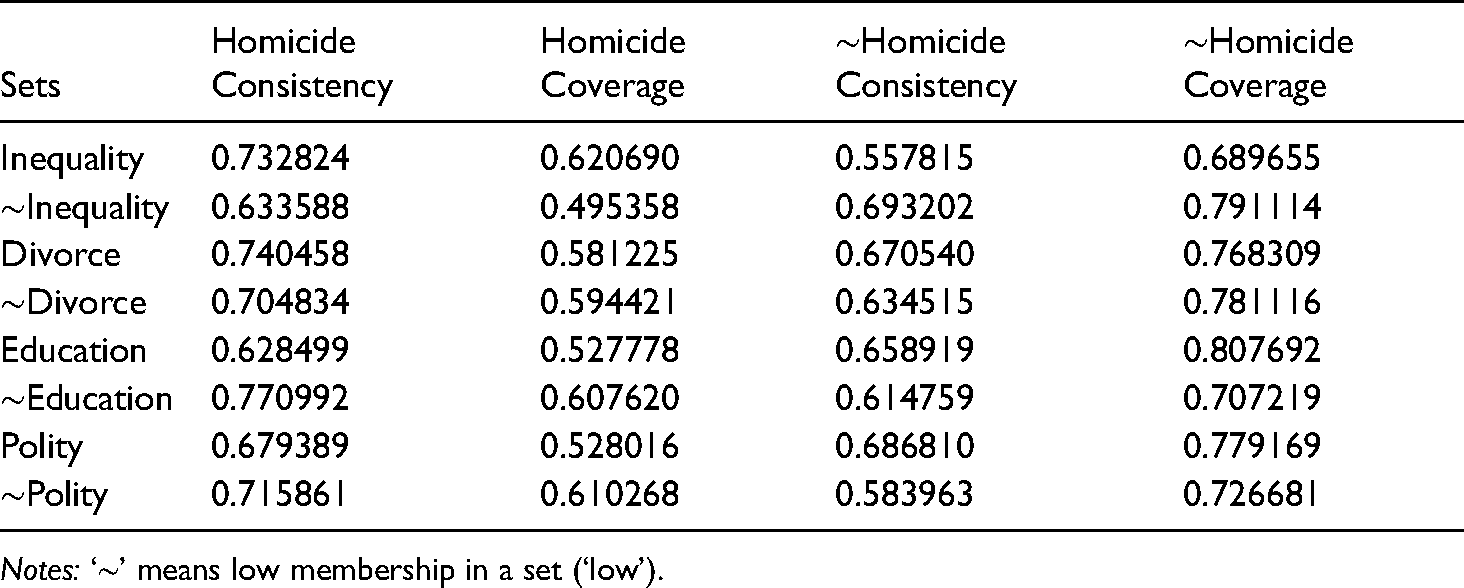
Notes: ‘∼’ means low membership in a set (‘low’).
Sufficient conditions
As mentioned before, the main aim of the current study is to find the combinational effects of conditions for high and low corruption and for high and low homicide. The results are presented for the so-called ‘intermediate solution’, that allows for the inclusion of assumptions by theoretical guidance. 10 The assumptions included in the ‘intermediate solution’ relate only to inequality and polity (assumption of high inequality and low polity with high corruption and with high homicide; assumption of low inequality and high polity with low corruption and with low homicide). No assumptions were made about education and divorce because, as noted earlier, they can offset (Merton's approach) or amplify (Messner and Rosenfeld's approach) the pressures of the economic dimension.
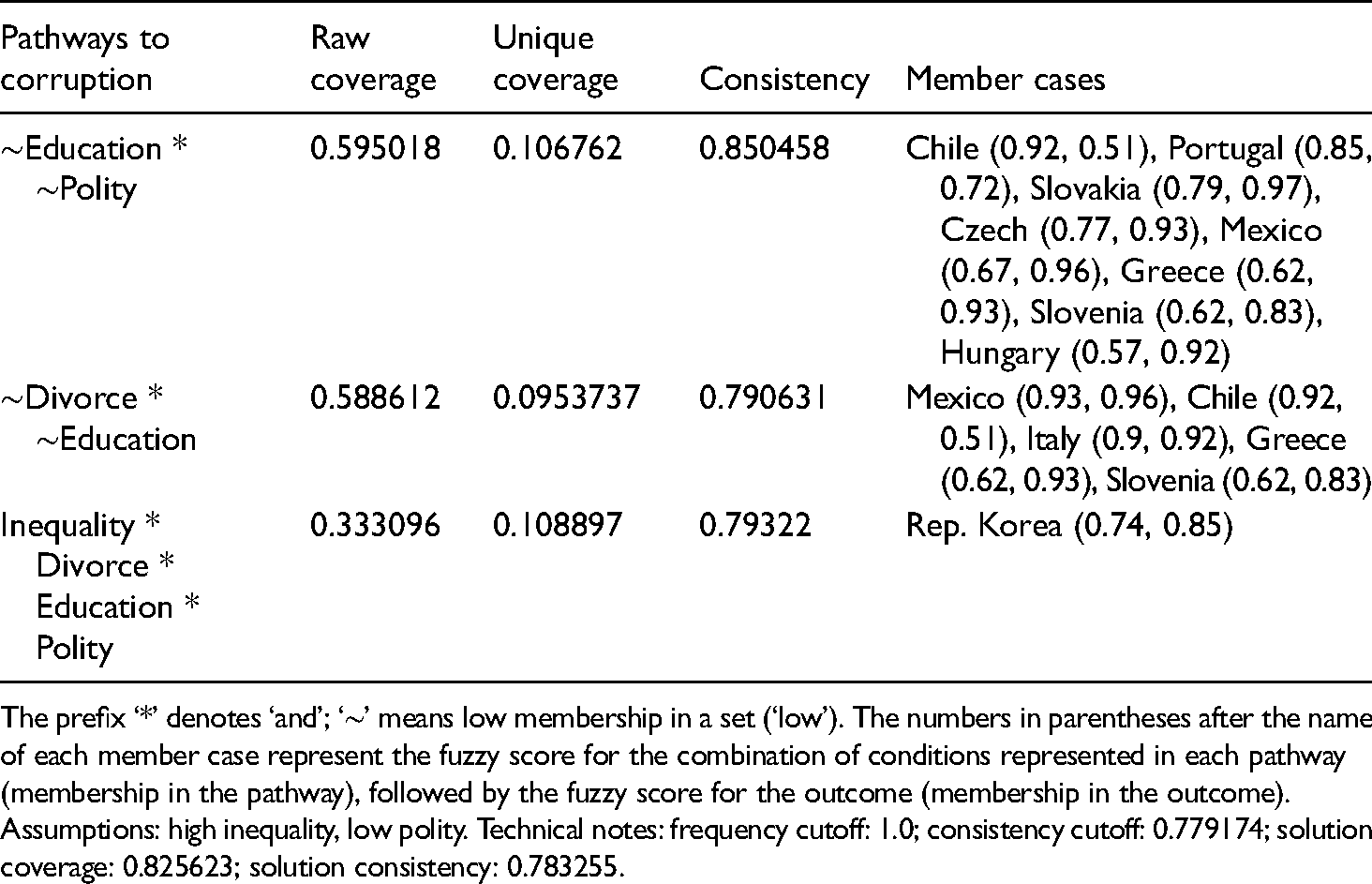
Table 4 shows the analysis of sufficient conditions for high corruption.
Sufficient conditions for membership in high corruption.
The prefix ‘*’ denotes ‘and’; ‘∼’ means low membership in a set (‘low’). The numbers in parentheses after the name of each member case represent the fuzzy score for the combination of conditions represented in each pathway (membership in the pathway), followed by the fuzzy score for the outcome (membership in the outcome). Assumptions: high inequality, low polity. Technical notes: frequency cutoff: 1.0; consistency cutoff: 0.779174; solution coverage: 0.825623; solution consistency: 0.783255.
As shown in Table 4, the sufficiency analysis identifies three distinct pathways to high corruption. First, a low level of education combined with a low level of people's commitment to political institutions (polity) constitutes a sufficient condition for high corruption. Second, low divorce combined with low education is a pathway to high corruption. Of the five countries included in this pathway, only Italy is also not included in the first pathway. Third, a combination of four conditions – high inequality, high divorce, high education and high polity – is a sufficient condition for high corruption. This pathway diverges sharply from the other two. Only the Republic of Korea fits this pathway. It is beyond the scope of this paper to examine the specifics of this country in more detail to shed light on the divergence.
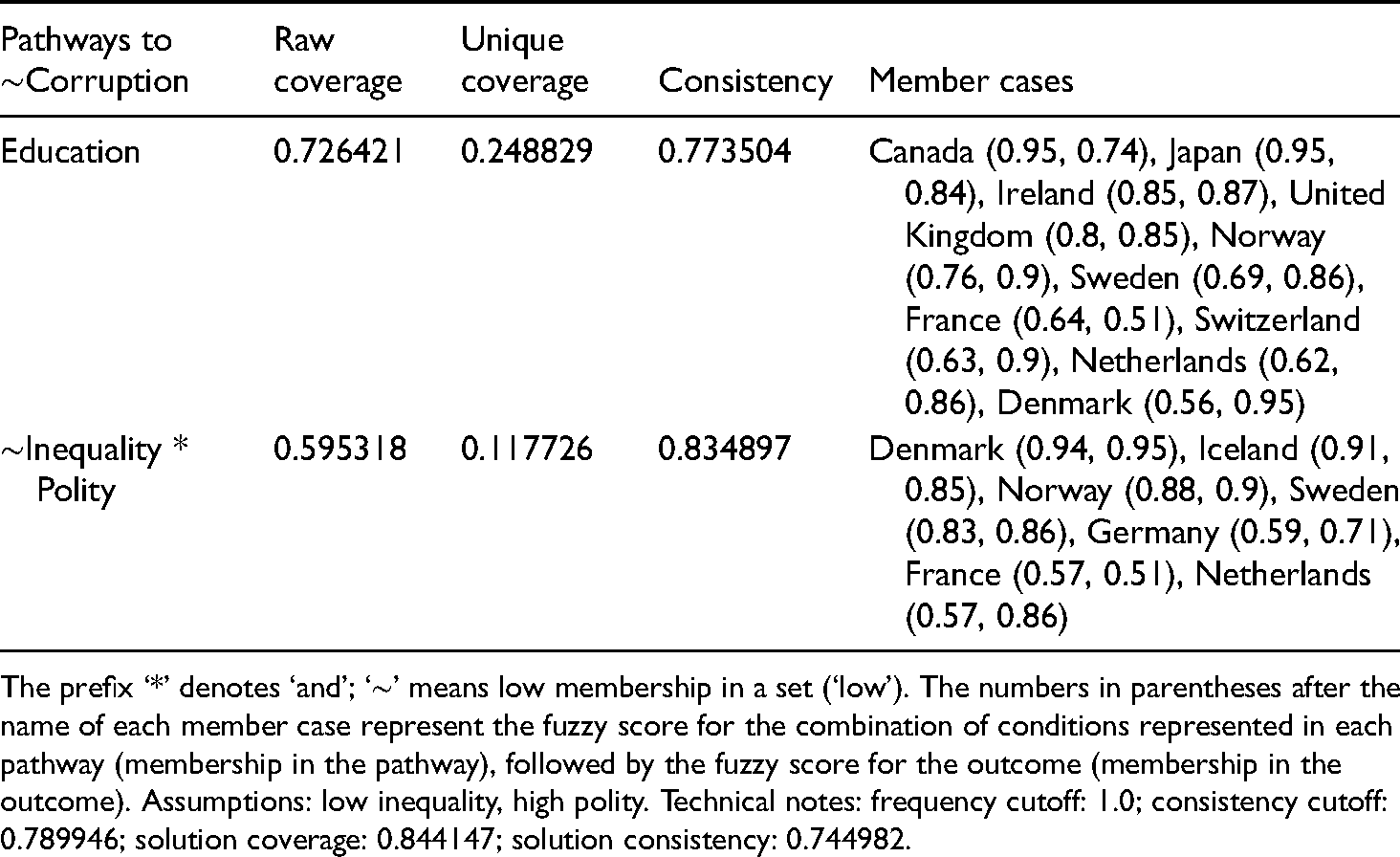
Table 5 shows two different pathways to low corruption. First, high education is a sufficient condition for low corruption. Second, low inequality combined with high polity is a sufficient condition for low corruption.
Sufficient conditions for membership in low corruption.
The prefix ‘*’ denotes ‘and’; ‘∼’ means low membership in a set (‘low’). The numbers in parentheses after the name of each member case represent the fuzzy score for the combination of conditions represented in each pathway (membership in the pathway), followed by the fuzzy score for the outcome (membership in the outcome). Assumptions: low inequality, high polity. Technical notes: frequency cutoff: 1.0; consistency cutoff: 0.789946; solution coverage: 0.844147; solution consistency: 0.744982.
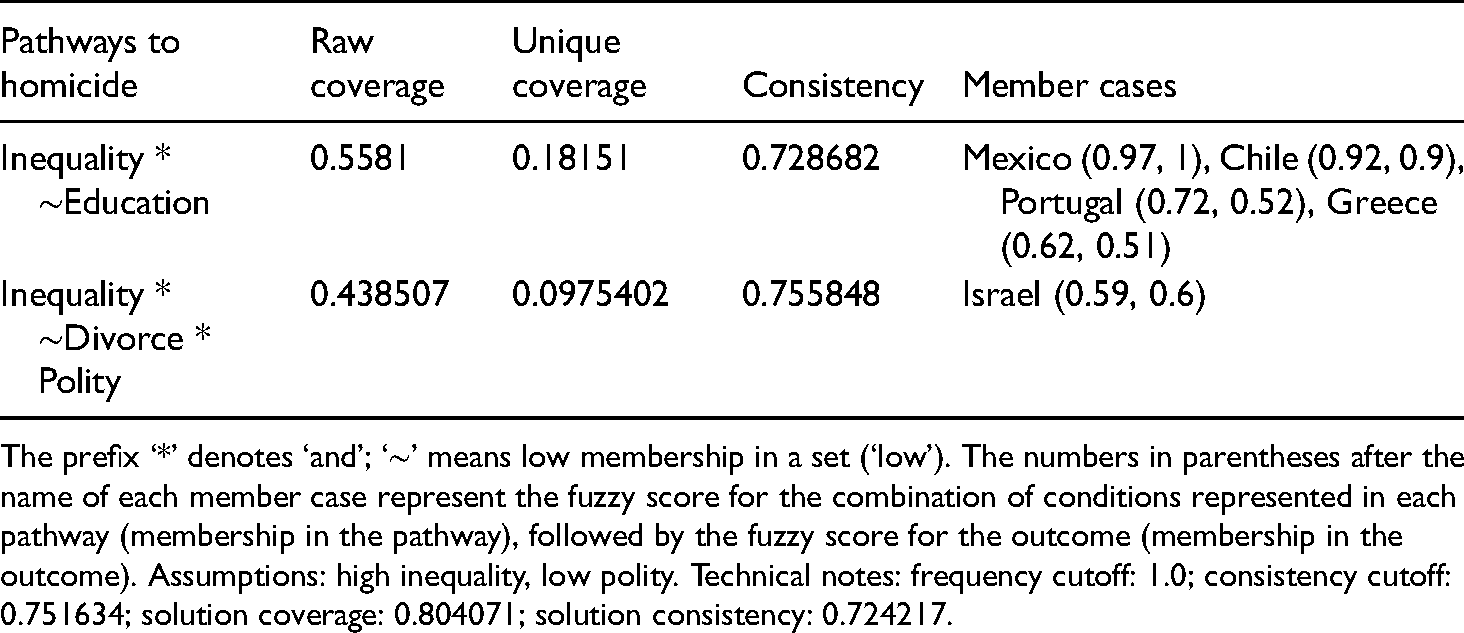
As shown in Table 6, the overall solution consistency for high homicide is slightly lower than 0.75, which may indicate low consistency. This means that the results for high homicide should be viewed with caution. The analysis of sufficiency identifies two distinct pathways to high homicide. First, high inequality combined with low education is a sufficient condition for high homicide. Second, high inequality combined with low divorce and with high polity constitutes a sufficient condition for high homicide. Only Israel fits this pathway. It is beyond the scope of this paper to examine the specifics of this country in more detail in order to clarify the differences between it and other countries with high homicide rates.
Sufficient conditions for membership in high homicide.
The prefix ‘*’ denotes ‘and’; ‘∼’ means low membership in a set (‘low’). The numbers in parentheses after the name of each member case represent the fuzzy score for the combination of conditions represented in each pathway (membership in the pathway), followed by the fuzzy score for the outcome (membership in the outcome). Assumptions: high inequality, low polity. Technical notes: frequency cutoff: 1.0; consistency cutoff: 0.751634; solution coverage: 0.804071; solution consistency: 0.724217.
As can be seen in Tables A1 and A2 of the Appendix, the United States shows a high homicide rate (the US is second only to Mexico), but it is not included in the fsQCA pathways that are sufficient conditions for high homicide. Could the homicide rate of the US be explained by the IAT? The high level of inequality and the high divorce rate point in that direction: The US has the third highest level of inequality in the sample (strong economic pressure) and the highest divorce rate (weak family). However, its level of education is very high (it is the seventh country in the sample). But, if Americans view the education system essentially as a means of acquiring skills for an occupation and value it by the possibility of achieving an economic return (Messner and Rosenfeld's approach), then the high homicide rate experienced by this country is consistent with what is predicted by the IAT.
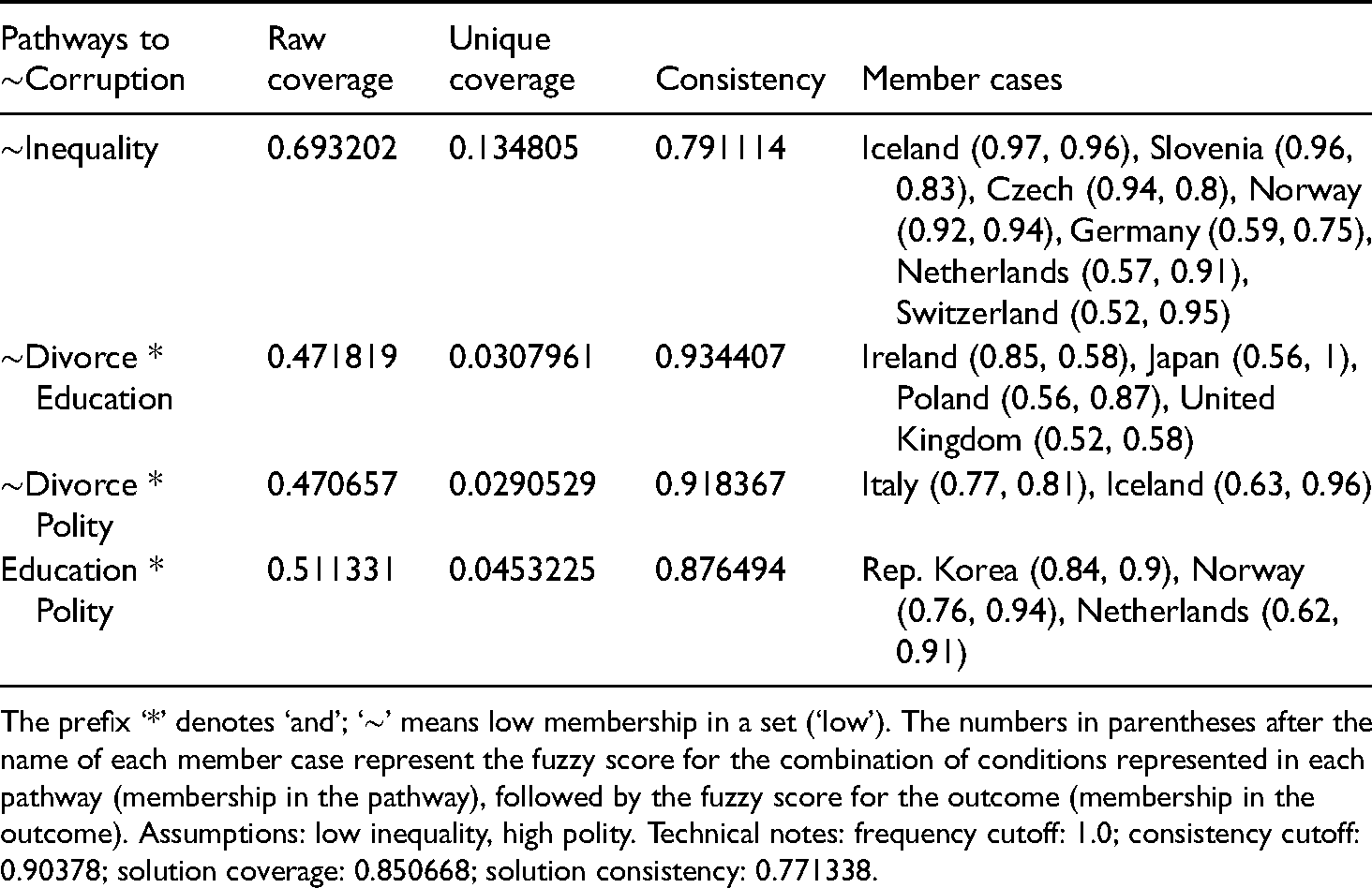
According to Table 7, the sufficiency analysis identifies four different pathways to low homicide. First, low inequality is a sufficient condition for low homicide. Second, low divorce combined with high education is a sufficient condition for low homicide. Third, low divorce combined with high polity is a sufficient condition for low homicide. Finally, high education combined with high polity constitutes a sufficient condition for low homicide.
Sufficient conditions for membership in low homicide.
The prefix ‘*’ denotes ‘and’; ‘∼’ means low membership in a set (‘low’). The numbers in parentheses after the name of each member case represent the fuzzy score for the combination of conditions represented in each pathway (membership in the pathway), followed by the fuzzy score for the outcome (membership in the outcome). Assumptions: low inequality, high polity. Technical notes: frequency cutoff: 1.0; consistency cutoff: 0.90378; solution coverage: 0.850668; solution consistency: 0.771338.
Discussion
This study aimed to find necessary and sufficient conditions for corruption and homicide in OECD countries. The theoretical arguments are grounded on the institutional anomie theory (IAT). After a brief review of the literature concerning IAT, a macro-level empirical study was developed using the fsQCA methodology. The results answer three research questions.
The first research question is whether the IAT arguments are causal conditions (necessary or sufficient) for the occurrence of corruption and homicide in OECD countries. The results show that none of the IAT arguments is a necessary condition for the occurrence of high or low levels of corruption or homicide. Thus, both types of crime can occur in OECD countries regardless of their levels of inequality, divorce rates, education and political participation.
As for the sufficient conditions, the results for high corruption show that corruption does not seem to be associated with the pressure of the economic dimension, as inequality is not part of the sufficient conditions for high corruption. However, the results are not completely at odds with what Merton's approach to IAT predicts, as the weakness of social institutions (education, polity) is part of the pathways that are sufficient conditions for high corruption. The pathway combining low education and low voter participation in electoral contests (low polity) may indicate low levels of control over public decision-making. According to Williams (2015), the accountability of public decision-making depends on the ease of access to information. To be accessible, information must be understandable. It is doubtful that a population with low education will be able to understand the complex decision-making processes of public entities. Add to this the problem of low voter turnout and the lack of oversight of public officials becomes more plausible. Low polity weakens democracy and may increase opportunities for corruption. Sung (2004) and Kolstad and Wiig (2016) showed that where democracy is weak, corruption is high.
The presence of low divorce in the second pathway for high corruption is in some ways an unexpected result. It could signal the existence of social pressure or more restraint in social behaviour, especially in relation to moral or religious ties. Further research is needed to explain the results for divorce.
The pathways that are sufficient conditions for low corruption are consistent with what is expected under Merton's approach to IAT. It is noteworthy that a high level of education is a sufficient condition for low corruption.
The results for high and low homicide are in line with what is expected from Merton's IAT approach: high economic pressure (high inequality) together with low education forms a sufficient condition for high homicide; low inequality and strong social institutions, namely low divorce, high education and high polity are combined in the pathways that are sufficient conditions for low homicide.
Overall, the results are broadly consistent with Merton's approach to the IAT, confirming the empirical results of other IAT studies: economic pressures and the countervailing role of social institutions help explain the levels of corruption and homicide in OECD countries. These findings suggest a particular relevance of the role of education in conditioning both types of crime. However, the way education influences crime may differ between corruption and homicide. In the first case, it might measure the ability to access information that allows control of public decision-making; in the second, it might capture the ability to overcome blocked opportunities in the economic dimension. This is a topic for further research.
The second research question seeks to find out whether there are differences in causality between ‘white-collar’ crime and ‘common’ crime. The results show no profound discrepancy between the two types of crime, although there are some differences. Economic pressures condition homicide more than corruption. This result is consistent with the literature on white-collar crime, as it has been shown that white-collar criminals are usually not at the bottom of the income distribution, but on the contrary are employed and occupy high career positions, which gives them access to opportunities to commit ‘white-collar’ crimes (Benson and Simpson, 2009). Polity conditions corruption more than homicide. This is also an expected result since, as mentioned above, polity can be seen as an indicator of the ability of the electorate to control public decision making. Corruption arises precisely in a context of low visibility of public decision making (Warren, 2004).
The last research question aimed to find out whether the causal pathways for high or low levels of crime are different, i.e., whether there is a causal asymmetry between high and low levels of crime. In the case of corruption, there is partial symmetry because education and polity are part of the pathways for high and low corruption. However, in the case of inequality and divorce, there are differences. Low inequality is part of a pathway for low corruption, but high inequality is not part of a pathway for high corruption. Low divorce is part of a pathway for high corruption, but high divorce is not part of a pathway for low corruption. There are also some differences for homicide, as divorce and polity are part of pathways for low homicide but not for high homicide. In short, the results show that asymmetry should not be ruled out in studies of institutional anomie.
There are some policy implications from the preceding analysis. First, there is evidence that education can have positive externalities in reducing corruption and homicide. Therefore, public investment in education needs to take this type of social benefit into account. Second, citizen engagement in democracy (polity) conditions the level of corruption, so it will be important to take measures to increase citizen participation in politics. This can include investing in improving political institutions and increasing transparency in public decision-making, thus helping to reduce corruption. Third, policies to reduce social inequality can have a positive impact on reducing the homicide rate. This implies pursuing policies that increase economic opportunities for the most disadvantaged. A final lesson to keep in mind is that policies cannot be isolated. Instead, they must combine improvements across different institutional dimensions simultaneously. As the results show, there are multiple pathways to corruption (high or low) or homicide (high or low) that combine more than one IAT argument.
Conclusions and limitations
The main conclusion of the study is that Merton's approach of IAT helps to explain the occurrence of corruption and homicide in OECD countries. Another significant finding is the important role of education in conditioning the extent of both types of crime. It is also noteworthy that citizens’ commitment to democracy (polity) conditions the level of corruption. Finally, the study provides evidence of some differences between ‘white-collar’ crime and ‘common’ crime, as well as causal asymmetry between high and low levels of crime.
One limitation of the study, beyond the limitations of the fsQCA described in Roig-Tierno et al. (2017: 17-18), is the impossibility of generalising the results to any set of countries other than OECD, because the analysis is qualitative, i.e., based on cases. Changing the set of cases may lead to substantial changes in the results. Another limitation of the study stems from the fact that the indicators are very general and under-densified as this is a macro-level study.
Footnotes
Acknowledgements
The author thanks Professors Angela Peixoto, Pedro Sousa and Daniel Hanna for their helpful comments.
Declaration of conflicting interests
The authors declared no potential conflicts of interest with respect to the research, authorship and/or publication of this article.
Funding
The authors received no financial support for the research, authorship and/or publication of this article.
