







Abstract
Whereas many research studies have discussed the impact of music programmes in a prison setting, few studies have investigated the impact of music programmes that take place outside the prison and are intended for formerly incarcerated individuals. The current study aims to fill this void by examining the experience of formerly incarcerated individuals who participated in a group music programme intended to assist them on their journey towards rehabilitation. Five formerly incarcerated individuals who participated in the Sounding Out Programme (SOP), a group music programme funded by the Irene Taylor Trust in London, were interviewed for this research. In addition, three programme staff members were interviewed in order to gain further perspective on the process. Content analysis of the interviews indicated the emergence of four central themes: improved social bonding, a sense of hope and life purpose, a sense of achievement, and transformation. These findings are discussed in light of the Good Lives Model (GLM). Accordingly, the SOP assisted both formerly incarcerated individuals and programme staff members in attaining the following GLM primary goods in life: community, relatedness, knowledge, spirituality, excellence in work and play, excellence in agency, and creativity.
Keywords
Introduction
The transition from prison to life in the community is challenging and may consequently have deleterious effects on health and wellbeing. Studies show that release from prison is associated with a high risk of hospitalization (Alan et al., 2011), homelessness (Metraux and Culhane, 2004), drug-related death (Merrall et al., 2010), deterioration of the immune system (Stephenson et al., 2005), sexually transmitted diseases (MacGowan et al., 2003), self-harm (Borschmann et al., 2017) and suicide (Haglund et al., 2014). Interventions are necessary to support people released from prison, to reduce, and it is hoped eliminate, problematic outcomes. Accordingly, post-release intervention programmes include agencies outside the prison system such as health promotion programmes (Grinstead et al., 2001), substance abuse treatment (McCollister et al., 2003), religious rehabilitation programmes (Morag and Teman, 2018) and employment rehabilitation programmes (Peled-Laskov et al., 2019).
Whereas many research studies discuss the impact of music programmes in a prison setting (for a qualitative meta-synthesis, see Kougiali et al., 2018), few empirical studies have investigated music programmes designed for incarcerated individuals following their release (Bensimon and Gilboa, 2010; Tuastad and O’Grady, 2013). The current study aims to fill this void by examining the experience of people participating in a group music programme in London, which was designed to assist formerly incarcerated individuals on their journey towards rehabilitation.
Music programmes in prison and after release
Studies on music programmes in prison have focused on the therapeutic and educational benefits, showing that music programmes improve incarcerated individuals’ wellbeing. Such studies were done in European countries such as the UK (Henley et al., 2012; Kyprianides and Easterbrook, 2020), the Netherlands (Hakvoort, 2002) and Norway (Gold et al., 2014), and in other countries such as the US (Cohen, 2012), China (Chen et al., 2014) and Israel (Bensimon et al., 2015).
Researchers indicate that music programmes in prison give participants a sense of freedom. Incarcerated individuals reported the ability to temporarily and symbolically escape the authoritative institutional environment and experience a sense of freedom, hope, happiness and joy (Bilby et al., 2013; Brewster, 2010; Cohen, 2007; De Viggiani et al., 2010; Harbert, 2010; Kougiali et al., 2018; Tuastad and O’Grady, 2013; Winder et al., 2015). Pratt (1990) claimed that music can create an ‘enclave of autonomy’, a non-physical space of alternative psychological reality that can function as an imaginary ‘new life’ within the existing one. This imaginative space may enable incarcerated individuals, who are still physically behind bars, to mentally and intellectually exit the prison, thus fostering their hope for a better future after serving their sentence.
A meta-synthetic approach examined 12 qualitative studies that explored the therapeutic potential of music programmes in various prisons. It suggests that such programmes are perceived by participating incarcerated individuals as a liberating process and enable noncoercive personal development (Kougiali et al., 2018). It indicates that music breaks the routine of prison experience and may create affective liberating spaces where incarcerated individuals can escape mentally in order to cope and hope for a better future before returning to their daily lives. In addition, music can act as a positive force that may assit in constructing personal identity in prison. This idea accords with what DeNora (1999) terms ‘music as a technology of the self’, that is, music as a means for expressing identity and constructing personal narrative. Herrity (2018) applies this concept by exploring how music consumption is utilized as a coping strategy in prison. Herrity claims that in the harsh environment of prison, where there are fewer ways of expressing identity and less latitude to do so, music is an important means for making the self. Music can open a space of freedom to imagine and formulate a non-criminal self, thus providing a means for reconstituting identity.
Although an increasing number of researchers are studying music programmes in prisons, very few investigate music programmes designed for formerly incarcerated individuals. In the Norwegian programme ‘Music in Custody and Liberty’, formerly incarcerated individuals participated in various music activities such as song writing, recording, performance, and jamming and group playing in bands. The findings show that music constituted a central part of the participants’ personal development, especially in areas such as motivation, mastery, confirmation, self-image and self-esteem. The programme was also effective in preventing drug/alcohol abuse and criminality, and in fostering positive social interactions (Tuastad and O’Grady, 2013). Another study (Bensimon and Gilboa, 2010) examined the use of the Musical Presentation technique in a halfway open house rehabilitation programme for formerly incarcerated individuals. This technique enables people in a group setting to portray themselves through musical pieces of their choice while receiving feedback from their peers. Results show that this tool enhanced the participants’ sense of purpose in life. In view of the paucity of studies examining the impact of music programmes on formerly incarcerated individuals, the current study aims to fill in the void by examining a music intervention programme that was designed for incarcerated individuals’ rehabilitation following their release.
The current study
Upon release, the community responsibilities of formerly incarcerated individuals, such as employment and family, increase tremendously. These responsibilities may impede their ability to attend programmes that might be helpful to their social reintegration. Hence, persuading such individuals to voluntarily participate in rehabilitation programmes once they are released is a major challenge (Wolfer, 2019). The purpose of the present research was to examine the experience of a group music intervention programme for formerly incarcerated individuals. More specifically, the research questions were as follows: (1) What are the participants’ most meaningful recollections regarding their experiences in this programme, and (2) Did the participants’ experience change as a result of participating in the programme and, if so, what aspects of their lives/themselves did they think had changed?
Method
Research approach
The methodology employed in this research was based on the phenomenological approach. This approach focuses on how an experience relates to the individual and their narrative regarding that experience (Moustakas, 1994). Phenomenological studies concentrate on exploring the meaning and interpretations that research participants ascribe to a given phenomenon (Van Manen, 2014). This method is particularly suitable for the purpose of the present research, which explores the meaning of a music programme experience for formerly incarcerated individuals.
Participants – The Sounding Out Programme for formerly incarcerated individuals
The participants in this study took part in a music intervention programme called The Sounding Out Programme (SOP) of the Irene Taylor Trust (ITT), UK. The Trust’s basic assumption is that music can break down barriers and help incarcerated individuals and formerly incarcerated individuals who have lived on the fringes of society to become valued members of the community. 1 The SOP began in 2012, in response to a need and a desire to support formerly incarcerated men and women. Candidates are invited to an interview in which they receive information about the SOP and its requirements, and then they become part of the project. The dropout rate at this point is very low because relationships have already been forged and both sides are committed to making it work. The SOP consists of intensive week-long creative projects and performances, acoustic projects, training opportunities and regular meet-up and play sessions. One part of the programme is a five-day intensive music-making workshop. In the workshop, they form a band together with professional musicians, who serve as staff members, and create original and innovative music. At the end of the workshop, formerly incarcerated individuals and staff members get together and perform their music in front of an audience. The ITT remunerates the SOP participants with the understanding that they have work commitments and that monetary compensation may help make the programme feel like a professional engagement. The ITT staff maintain regular contact with participants during and after their time in the SOP to make them aware of projects and opportunities as they arise and to support them through the programme. In this study, five of the participants were formerly incarcerated individuals (hereinafter referred to as ‘participants’) – four males and one female, their age ranging from mid-twenties to mid-fifties. The offending histories of the participants were varied. However, all the participants were on licence and had served custodial sentences of a minimum of three years. Two of the five had spent the previous 20 years periodically offending and returning to prison at regular and frequent intervals. At the time of participation in the SOP, none of the participants was employed or in the process of training or studying a profession, and all five were receiving state benefits.
Three other participants (two males and one female) were ITT staff members (hereinafter referred to as ‘staff-participants’), their age ranging from mid-forties to fifties. Two of the staff-participants were male and served as professional musicians in the core project team. The third staff-participant was a female who served as the Artistic Director of the ITT. She has worked using music in criminal justice settings since 1984 and founded the ITT in 1995.
Procedure
I contacted potential participants, requesting their cooperation. Details of the potential participants were received from the ITT. All the participants were interviewed five years after participating in the SOP. All interviews were audio-recorded and later transcribed. All the participants signed an informed consent form, which included their permission to be interviewed. I assured the participants that their personal information would be safeguarded and that the final report would not include names or any other identifying details. Prior to the interviews, an ethics approval was received from the Ethics Review Board of Bar-Ilan University.
Data collection and analysis
Information was collected from both participants and staff-participants via semi-structured open-ended interviews (Cunningham et al., 2011). The interviews were based on the guided interview technique and included questions such as: What experience/activity was most meaningful for you as a participant in this programme? In which areas do you perceive change as a result of participating in the programme? How did you perceive the staff members/formerly incarcerated individuals who worked with you? What imprints has the programme left in your life? The thematic analysis examined the data sentence-by-sentence, and often word-by-word, in order to identify the main categories and subcategories emerging from the interviews (Guba and Lincoln, 1981).
Findings
The findings emerging from the analyses of the interview data point to four major themes. The first theme, improved social bonding, relates to the participants’ experience of feeling a sense of belonging and bonding, to the development of supportive interpersonal skills and to the staff’s non-judgemental approach and emotional validation. The second theme, a sense of hope and life purpose, relates to the participants’ and staff-participants’ hopes for the future and aspirations to define purpose in their lives. The third theme, a sense of achievement, relates to the participants’ pride, either related or unrelated to musical achievements. Lastly, the fourth theme, transformation, relates to the participants’ general impression that being part of the SOP has changed their path in life. These four themes will be explicated through a selection of representative quotations from the participants. For confidentiality purposes, the names of the quoted participants will be represented by random capital letters.
Improved social bonding
This theme describes the general atmosphere of the programme, which was characterized by close relationships and feelings of connectedness. The group music activities enabled the participants to experience a sense of belonging and bonding, a non-judgemental approach and a feeling of being significant and valuable. According to the participants’ reports, these positive relationships enabled them to improve their interpersonal skills.
Feeling a sense of belonging and bonding
Participants described how taking part in the SOP fostered a feeling of belonging to a meaningful group and thus enabled bonding. ‘A’ described how the mere engagement in making music provided this kind of feeling: I felt I belonged to a group, to a band, and we were making some amazing music and then going on stage and performing it. (A, participant)
The bonding experience, which lasted five years after the end of the SOP, was expressed in terms of love for brothers and sisters, as described in the following quotations from ‘B’ and ‘C’: All the guys are my brothers and sisters . . . It was the people that made it so special. It was the other human beings there. It was all the people involved in the song writing who sparked each other. And that was what did it for me. That’s why we are still in touch and we are still friends to this day, five, six years later. (B, participant) It was the first time I felt like I belonged somewhere. I didn’t just make friends. I created a family. I think it’s the first time I felt I had a big family. (C, participant)
‘D’, one of the staff-participants, noted the importance of the programme in creating a social network and a sense of belonging for the participants: I think it was a kind of support network somehow, just being part of the world, being involved with other human beings and having a sense of belonging. I think it was very important. (D, staff-participant)
A non-judgemental approach and emotional validation
An intensive programme such as the SOP, which brings together people from different cultural backgrounds, creates quite a few challenges for its participants, including the need to fully accept each other. In the SOP, it was evident that the non-judgemental approach was present, as can be seen from the following quotations from ‘E’ and ‘A’: I always felt appreciated in the programme. I always felt respected. I always felt like I could voice my own opinion. I always felt like whatever I was saying, people always looked at me and listened – whatever my opinion was. (E, participant) In general, I always felt that, whatever music activity I was involved in, whatever music I made, I was a full participant. Even if I didn’t have a vocal part in a certain song or wasn’t doing a thing, I still felt like it was my band, my songs. (A, participant)
The analysis revealed that the atmosphere that existed during the musical activity enabled the participants to experience emotional validation because they felt they were heard, acknowledged, recognized and understood by the others: You’d be seated in that corner and you’d hum a melody to yourself, like ‘I’m thinking hmmmm [‘E’ hums]’ – and there would be somebody over there saying: ‘That sounded good! Do that again!’ and you’d think: ‘I didn’t realize somebody was listening.’ And it was like: ‘Oh my God – I was doing that for myself and someone heard it.’ There was so much that made me feel like I was in this world and I didn’t want to leave it . . . That validation, I cannot get it anywhere else. (E, participant)
Although the staff-participants were professional musicians, they treated the participants as equals. They acknowledged that the participants might possess musical skills that are superior to their own and that the participants are able to contribute musically just as much as they can. The reciprocal and egalitarian nature of this interpersonal communication reflects recognition and respect for the participants’ capabilities: They were much more, I mean a hundred times more proficient and capable of playing this kind of music than I was. When ‘G’ plays the drums it’s just incredible, it’s just – it’s so powerful. And there were times when formerly incarcerated individuals whose job was to play the bass couldn’t be there, and I played instead. I mean, I can somewhat play the instrument, but of course the sound is nowhere near the profound way he plays the bass. The same goes with the drums. I can play a bit on the drums but the way ‘S’ plays the drums it’s just beautiful, he produces such an amazing sound. (F, staff-participant)
Developing supportive interpersonal skills
Interpersonal skills developed in the SOP through musical interaction. The participants shared personal issues with the group through voice, music and lyrics, thus creating interpersonal communication. The Artistic Director of the ITT, who has profoundly influenced the social atmosphere in the programme, explained how the musical engagement in the SOP served as a fertile ground for interpersonal communication: It’s about this process of sharing something that is really quite personal, quite intimate. You are sharing your voice, you are sharing your lyrics. And all these things, when skilfully put together, I think it harmonizes a group . . . It could be a variety of styles or it could be a particular lyric that you know is very personal for one person – yet they have shared all those with the group. (The Artistic Director of the ITT)
The participants reported that working intensively for five days in a group setting and practising towards a performance posed many interpersonal challenges. However, they felt that those challenges eventually helped them develop their interpersonal skills: I think the programme gave me life skills such as the ability to work under pressure and the ability to work with different personalities . . . And I think working with others in that programme really did help because we had a lot of challenging moments that helped us develop within us invaluable skills. (A, participant)
In some cases, the staff-participants’ reactions during challenging interpersonal situations served as a behaviour model of positive communication for the participants: I learned so much from the Artistic Director. She does not get upset about anything. She’s never really said: ‘Oh, it’s not working, we have to stop this.’ Any time there is a problem or something goes wrong, she finds a solution without raising her voice . . . I’m now working with vulnerable people, working with a staff, working in the community and I realize that I’ve learned quite a lot from the Artistic Director and I take that with me. I have to work with people and there is no point if I shout at someone. It was probably once in my nature and probably still is in a way, but I’m not gonna get anywhere by shouting at people. (E, participant)
Participants claimed that the SOP enabled them to share their story and contribute their knowledge and support to others in need: I’ve gained a lot from this project. I can say that, five years later, I’ve worked with multiple youth programmes. And for me, personally, it’s rewarding that I’m able to tell my story, to give some type of guidance and share my knowledge. (C, Participant)
Finally, participants described how the interpersonal norms in the SOP, such as sensitivity and understanding, enabled them to support others in need: I think it’s always been that sort of experience that has enabled me to support others. It [the programme] has helped me move forward at work, because I do a lot of support work. I support young people, I help with their education. I help them choose a career, I help them find a job or work with other organizations to support them. I think the sensitivity and understanding that was extended to me has given me insight as to how to help and support others, if that makes sense. (E, participant)
A sense of hope and life purpose
According to the participants, taking part in the programme raised their hopes of fulfilling their dreams for the future. It also instilled in them the drive and aspiration to develop themselves through music: It gave me hope, it gave me a drive towards something, because by participating in this programme I realized that I still wanted to continue to make music. (C, participant)
The ongoing connection of ‘G’ with the ITT after participating in the SOP gave him hope and meaning for the future: We know there will be more gigs, more rehearsals, more to come. So it’s not just one. There’s hope. Every year we do two or three gigs, two or three concerts. Every year. (G, participant)
As regards the Artistic Director of the ITT, it was evident that her role within the ITT, including the SOP, was extremely fulfilling: There was not even one day when I didn’t want to get up and go to work throughout my 35 years on the job. I mean . . . some days are not going to be as exciting as others and things might go wrong but there is always something to look back on and something to look forward to or something you are in the midst of. (The Artistic Director of the ITT)
A sense of achievement
The SOP gave participants an opportunity to experience a sense of achievement. This could be related to their musical capabilities and output or to a broader sense of accomplishment in life. For example, participants said that the mere ability to complete the whole five intensive days of the programme was a life achievement: I’ve never completed anything. I’d always start something but had a reason not to continue. And this programme gave me the opportunity to start and finish something for the first time in my life. (C, participant)
A sense of achievement was also felt regarding the musical activities and performances, which led to a sense of pride: I feel really proud that we’ve done some excellent [music] stuff. There’s something I can look back on and say: ‘I have achieved that.’ You feel a sense of achievement. My mom and dad came to our concerts, my family and sons. They came and they enjoyed it and I felt proud. (G, participant)
‘F’, a staff-participant, worked with participant ‘X’, who did not take part in this study, and helped her overcome difficulties and eventually feel a sense of achievement: ‘X’ was not very confident with singing. ‘X’ was quite nervous, you know, performing in a group like that, and having to rehearse, having to go over things with people, trying to make it better – that was a real challenge for ‘X’. And ‘X’ got really nervous. It was too much for ‘X’, so there was a lot of talking with ‘X’ during breaks, saying: ‘It’s okay, it’s okay, you just keep doing what you’re doing. It’s okay. It sounds great, there are just a few bits that sound a bit low, and you just need to . . . it’s going to be fine, it’s cool, it’s cool.’ Yeah, ‘X’ found it a real challenge actually, but ‘X’ did it. (F, staff-participant)
Transformation
Although not fully aware of how it happened, the participants attributed their shift to a non-offending life style to participation in the SOP. In one case, remorse and apology through song writing reflected a milestone in the change process. Several participants described the intra-personal process of adopting a new anti-stigmatic identity as crucial to the change.
Changing the path of life
Participants reported that taking part in the SOP changed the course of their life, turning them into law-abiding citizens. The participants stressed the role of music in this process. ‘B’ described it as rehabilitation through music and emphasized its role in gaining confidence and the strength to make a change in his life: It was my rehabilitation and it was important that I did it through music. I don’t think I would have been the person I am today without the Trust you know, that’s the truth. And it has had a great effect, lasting several years already. You can’t always see it as such, but when you look back upon it – you see it . . . It gave me the confidence to think straight and go down the right path rather than choosing the wrong path as I had done in the past. (B, participant)
‘G’ said most explicitly that, had he not participated in the programme, he would have continued with a criminal life after his release: Normally I’d come out of prison and start doing stuff. But I had wanted to join the programme so much – so I thought – I’m not gonna get into trouble now. (G, participant)
‘A’ also attributed his post-release achievements to the SOP, which, according to him, turned his life around: I definitely see the programme as a big part of my life, especially a big part of my after-prison life, in terms of how I was able to turn my life around. It’s given me a good core, and a good basis to go further on from there. Because I don’t know what it would have been like without this experience. It just had a massive influence on me, being able to do all the things that I am doing today. It played a massive part, yeah. (A, participant)
‘C’ shared a song titled ‘Apology’, a song he wrote and composed to express his sincere apology to those who had suffered from his actions and imprisonment. ‘C’ referred to the song as one of the most important milestones in his rehabilitation process and acknowledged the suffering he had caused to his children and his mother: I’ve had a good upbringing. I was raised right so everything I did is not a reflection on my parents or my mom or anything like that. And when my mom came to court, she found out things that she probably wouldn’t have ever wanted to know first hand like that . . . Until I wrote that song, I’d never apologized to anybody or given any type of explanation. I hadn’t shown any remorse. I never sat down and told my children where I’d been. They always believed I had been in the army. So that in itself, it kind of made me sit down and do something. So I put it all there on the table. I let it all out and that is what I did. ‘Apology’ was definitely a song which I think I needed to write. It was a big big big weight off my shoulders as well. (C, participant)
‘C’ mentioned that the publicity of his song made it easier for him to commit to the transition he wished to make in his life: Once you apologize, you can’t keep apologizing for the same thing. So I knew that by writing that song and . . . you know . . . verbally making those apologies to people, I had to make dramatic changes, without having to come back and apologize again by going down that same path again. So I had to make sure and know that I was ready for those transitions. (C, participant)
Adopting an anti-stigmatic identity
A few participants mentioned going through an inner change. It seems that the SOP facilitated an introspective process through which participants could adopt a new anti-stigmatic identity. For example, ‘C’ talked about adopting a new identity as a musician rather than a drug dealer: Me personally – I can tell you that the programme made me look inside myself and say: ‘This is what I can do [play music in the SOP]. I’m not just some drug dealer’ or ‘I’m not just this person’. (C, participant)
In other cases, the feedback received from community members following the music performances encouraged inner change. ‘A’ described how feedback enabled him to stop perceiving himself as a criminal: I think that the first performance in the church was the most meaningful part of the programme because having those people come and watch a performance like that from us such a short a time after being released, it was like saying: ‘Hold on, he is doing something completely different now, he’s changed, he’s changing his life around.’ It’s just the music, it’s just a band, but it had that power. (A, participant)
Discussion
The purpose of this research was to examine the meaning of a music programme experience for formerly incarcerated individuals. Four central themes emerged from the analysis. The first theme, improved social bonding, relates to the participants’ growing sense of belonging to and bonding with the group, their development of supportive interpersonal skills and support for those in need. Analysis of the relationship with staff-participants in the SOP showed that participants felt that the staff’s non-judgemental approach and emotional validation were important factors in the creative process. The second theme, a sense of hope and life purpose, relates to how taking part in the SOP reinforced the aspirations of participants and staff-participants to identify purpose in their lives and gave them hope for the future. The third theme, a sense of achievement, relates to the participants’ pride in their musical achievements. Lastly, the fourth theme, transformation, relates to the participants’ narrative that being part of the SOP has changed their life and turned them into law-abiding citizens.
The Good Lives Model (GLM), which was first introduced by Ward and colleagues (Ward, 2002; Ward and Brown, 2004; Ward and Gannon, 2006; Ward and Marshall, 2004; Ward and Maruna, 2007; Ward and Stewart, 2003), may serve as a useful theoretical framework for explaining the significance of participants’ experiences in achieving desistance. This is a strengths-based rehabilitation model that aims to identify aspirations and fundamental values, as well as areas of strength and competencies, in individuals in the criminal justice system by encouraging the development of knowledge, skills, opportunities and resources that reduce the risk of further offending. It enables them to meet their needs, assists them in pursuing their interests, and thus helps them to live happy, meaningful and constructive lives.
A central assumption of the GLM is that offending occurs as a result of problems in the way individuals seek to attain the following 10 primary human goods:
Life – healthy living and functioning.
Knowledge – how well informed individuals feel about things that are important to them.
Excellence in work and play – striving for excellence and mastery in work, hobbies or leisure activities.
Excellence in agency – autonomy, power and self-directedness.
Inner peace – freedom from emotional turmoil and stress.
Relatedness – intimate, romantic and familial relationships.
Community – connection to wider social groups.
Spirituality – finding meaning and purpose in life.
Pleasure – feeling good in the here and now.
Creativity – expressing oneself through alternative forms.
These 10 primary goods in life were identified through an extensive review and synthesis of psychological, social, biological and anthropological research, and are claimed to be crucial for the wellbeing of all humans. Identifying the primary goods that are most important to each incarcerated individual is a fundamental component of assessment because successful rehabilitation depends on attaining those specific primary goods in a personally meaningful, rewarding and non-harmful way (Yates et al., 2010; Yates and Ward, 2008). Criminogenic needs are defined as obstacles that block or otherwise frustrate the prosocial attainment of primary human goods. They are therefore directly targeted in rehabilitation as a crucial step towards attaining primary goods (Willis et al., 2013).
In the current study, the findings are compatible with seven of the GLM’s primary goods: relatedness, community, knowledge, spirituality, excellence in work and play, excellence in agency, and creativity (Ward, 2002; Ward and Brown, 2004; Ward and Gannon, 2006; Ward and Marshall, 2004; Ward and Maruna, 2007; Ward and Stewart, 2003; Willis et al., 2013; Yates et al., 2010; Yates and Ward, 2008). Table 1 briefly shows the parallel between the major themes and sub-themes of the current study and their related GLM primary human goods.
Major theme A – improved social bonding – accords with three of the GLM’s social primary goods – community, relatedness and knowledge. These primary goods are reflected through the following three sub-themes:
Themes of the current study and their related GLM primary human goods.
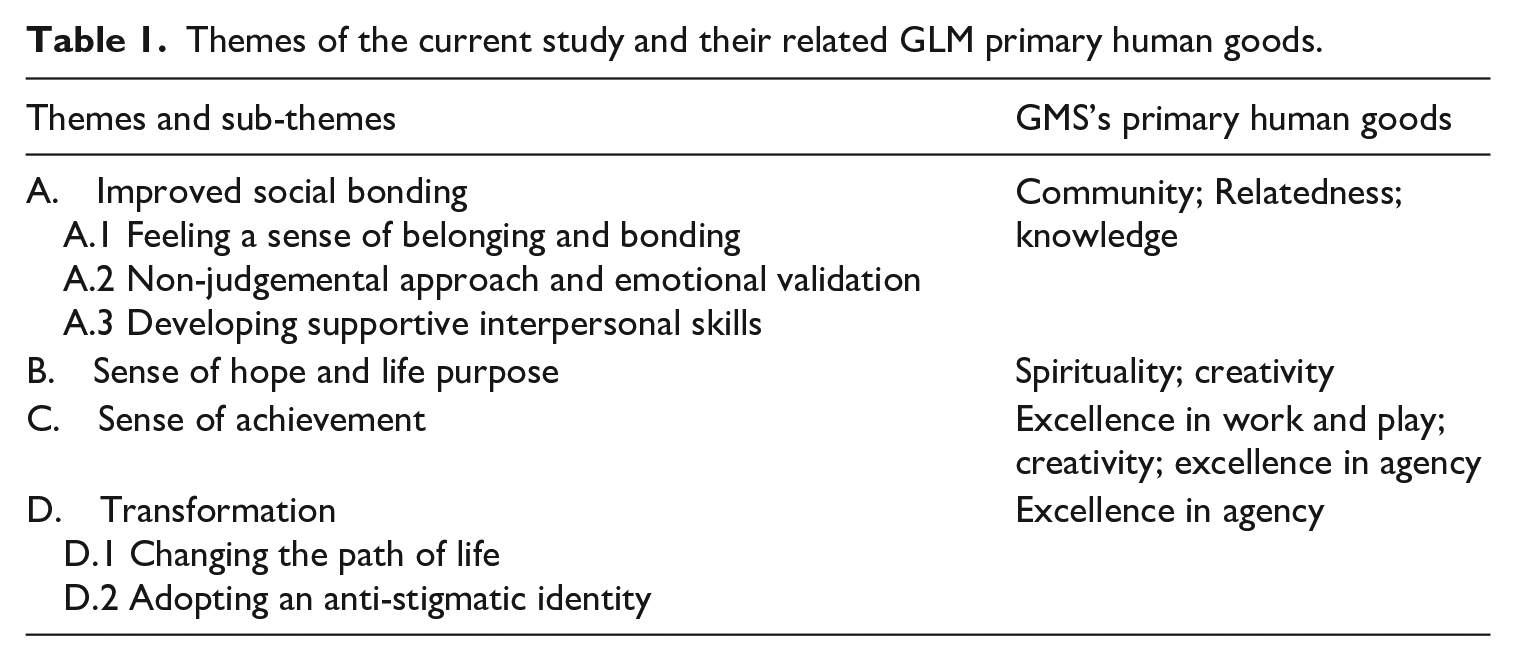
Sub-theme A.1 – feeling a sense of belonging and bonding – reflects the ability of a group music activity to create a quick connection between people. These findings accord with the GLM’s primary good community, which means being part of or belonging to a group of people who share common interests and values. This can be explained by the contagious effect of a strong musical rhythm to which people usually respond unconsciously by moving their head or limbs in time with the rhythm (Scherer and Zentner, 2001). In addition, during group discussions, it is impossible to speak simultaneously and gain a sense of group bonding because speaking requires individuality in order to be intelligible. However, in group music playing, it is possible to achieve a sense of group bonding because simultaneous playing of pitch intervals produces a harmonious blending of sounds and tempo regularity leads to motor synchronicity (Brown, 2000). The connection found in this study between group music activities and quick bonding is in line with studies showing that rhythm, volume, tempo, timbre, structured songs and song writing in group music activities may foster belonging and quick bonding (Bensimon et al., 2008; Felsenstein, 2013).
Sub-theme A.2 – non-judgmental approach and emotional validation – reflects the atmosphere that existed during the musical activity and enabled the participants to build close relationships and experience emotional validation because they felt they were heard, acknowledged, recognized and understood by the others. These findings accord with the GLM’s primary good relatedness, which means having a close and mutual relationship with other people. In addition, it resembles Erskine and colleagues’ (Erskine, 1998; Erskine et al., 1999) notion of relational needs. These needs can be met through social connectedness and are vital to the process of growth and healing (Erskine, 1997; Erskine et al., 1999). The relational need of acceptance is the need to be accepted by someone stable and dependable, someone who can provide protection, encouragement and information (Erskine, 1998). Accordingly, in this study, the participants’ experience of a non-judgemental approach is in line with this relational need and with studies in music therapy showing that music, as a nonverbal and thus less judgemental means of expression, may easily address the need for acceptance via voice mirroring (Austin, 2001), music improvisation (Bright, 1999) or recognizing the individual’s need to test boundaries, for example, by allowing clients to play music as loudly as they wish (Bensimon, 2020). Another relational need that is connected to this study is emotional validation, which is achieved by conveying to others that their presence, words and responses make sense and are understandable in their current situation (Linehan, 1997). In this study, the participants’ experience of emotional validation is compatible with the need for emotional validation through music, which was termed ‘musical validation’ by Bensimon (2020). Musical validation was found to be achieved through rhythm. It accentuates the present moment beat-by-beat, thus providing a physical feedback of existence that strengthens the sense of being and validates the individual’s presence.
Sub-theme A.3 – developing supportive interpersonal skills – was attained as a result of the programme’s environment of positive communication, which was characterized by close friendships and feelings of connectedness. According to the participants’ reports, the positive environment helped them improve their interpersonal skills. These findings accord with the GLM’s primary good knowledge, which means learning about oneself and other people, even in rehabilitative settings. These findings are in line with studies showing that social music making improves interpersonal skills among incarcerated individuals (Cohen, 2009; Gardstrom, 1996; Mendona, 2010; Silber, 2005; Wilson et al., 2009) and between formerly incarcerated individuals and the community (Henley et al., 2012). Social music making may also encourage mutual support among incarcerated individuals, for example, when a musical group plays a series of harmonic chords in the background to accompany and support a soloist (Silber, 2005).
Theme B – sense of hope and life purpose – describes how taking part in the SOP’s rehearsals and performances enhanced participants’ aspiration to fulfil their purpose in life and fostered hope. This is equivalent to the GLM’s primary good spirituality, which is defined as having meaning and purpose in life. Low score ratings regarding purpose in life have been documented among incarcerated individuals (Addad, 1987) and therefore Viktor Frankl’s (1969, 1997) theory of the search for meaning may be of relevance for the rehabilitation of incarcerated individuals. Accordingly, purpose in life means having goals and hopes, and believing that life is fulfilling and worthwhile even in deplorable prison conditions. From this perspective, the present findings indicate that intensive engagement in music enabled participants to enhance their sense of purpose in life. This accords with Frankl’s (1969, 1997) idea that purpose in life may be found through the ‘actualization of creative values’, that is, discovering creativity within oneself by helping others, by taking part in political activities or creative art. This notion is further supported by a study on the effectiveness of music in a rehabilitation programme for participants, which indicated that music intervention enhanced the sense of meaning in life (Bensimon and Gilboa, 2010).
Since finding meaning in life was achieved through creative means, it may also overlap with the GLM’s primary good creativity. Creativity is defined by the GLM as the desire to create something, do things differently or try new activities. The use of creative music activities to increase the wellbeing of incarcerated and formerly incarcerated individuals is well known (Bilby et al., 2013; Brewster, 2010; Chen et al., 2014; Cohen, 2012; De Viggiani et al., 2010; Gold et al., 2014; Hakvoort, 2002; Henley et al., 2012; Kougiali et al., 2018; Tuastad and O’Grady, 2013; Winder et al., 2015). The justification for using music activities with incarcerated and formerly incarcerated individuals rests on several reasons. First, talking therapies may be distressing and intrusive whereas listening to music and making music are perceived as safe and enjoyable and are also universal to all cultures (Carr et al., 2012; Pavlicevic, 1997). Second, music is a creative mode of expression and can thus function as a way for people to relate to their healthy self (Pavlicevic, 2002). Third, according to people in custody, musical creativity provides a sense of freedom and liberty, thus enabling non-coercive personal development (Kougiali et al., 2018). In sum, good life can be achieved via creative activities that promote meaning and purpose in life and can thus play an important role in the rehabilitation of formerly incarcerated individuals.
Theme C – sense of achievement – refers to the participants’ pride in being able to complete the SOP and successfully take part in the performances. This resembles the GLM’s primary good excellence in work and play, which means engaging in meaningful work or striving for excellence in hobbies and leisure activities such as playing a musical instrument. A sense of musical achievement also overlaps with the GLM’s primary good creativity, which relates to the SOP as a whole since musical creativity is SOP’s essence. Lastly, the GLM’s primary good excellence in agency is defined as seeking independence, being assertive, making one’s own plans in life and fulfilling them. This may accord with the participants’ sense of achievement, which reflects the positive expression of capabilities and a sense of accomplishment in life.
Theme D – transformation – accords with the GLM’s primary good excellence in agency as reflected in sub-theme D.1 – changing the path of life – a change that the participants attributed to the process they went through in the SOP. This dramatic change may have taken place as a result of sub-theme D.2 – adopting an anti-stigmatic identity – since the SOP enabled an introspective process through which participants could adopt a new anti-stigmatic identity in the direction of a new non-criminal narrative identity. According to the GLM, changing a narrative identity may be associated with adaptation to a new life style. It is argued that, by gradually changing the internal and external conditions required to achieve primary goods, the individual’s sense of who they fundamentally are begins to change from incarcerated individual to restored citizen, eventually enabling the individual to adopt a positive lifestyle (Ward and Maruna, 2007; Whitehead et al., 2007). The idea of changing a narrative identity through music accords with the phrase ‘music as a technology of the self’ (DeNora, 1999) and its application to incarcerated individuals (Herrity, 2018). Accordingly, music is a means for repairing the rupture to the self-narrative that was caused by incarceration. Music can help construct narratives of life after prison by serving as a tool for imagining a free future self and a means of formulating narratives of desistance. The current findings add that this strategy can also be used as a coping mechanism upon release from prison.
Conclusions
The purpose of the present research was to examine the meaning of a group music programme for formerly incarcerated individuals. The main implication of this study is that such a programme may assist formerly incarcerated individuals in attaining the GLM’s primary goods. The findings showed that an intensive and relatively short group music activity, which included musical performances, served as a means for experiencing better community skills, relatedness, knowledge, spirituality, creativity, excellence in work and play, and excellence in agency, which are seven of the GLM’s primary goods. It is evident that the SOP experience left a deep impression on the participants even five years after its completion. This points to the importance of designing creative group programmes when accompanying formerly incarcerated individuals on their journey towards rehabilitation.
Several features of the group music activities enabled participants to perceive the SOP as a growing experience. First, the group music activities enabled quick bonding. This may have been possible owing to the ability of musical interaction to facilitate synchrony, which in turn releases endorphins, the hormone involved in social bonding (Tarr et al., 2014). Second, social music making may have improved the participants’ interpersonal communication and skills. In group music activities, individuals simultaneously listen to their own playing, pay attention to others people’s music, and listen to the group product as a whole without the necessity of eye contact (Brown, 2000). Such multitasking interpersonal activities promote the development of social skills (for example, Silber, 2005). Third, the group music activities promoted acceptance and emotional validation. This is in line with findings pointing to music as a means for addressing the need for acceptance by accepting the individual’s needs and by musically validating the individual’s presence as ‘is’ (Bensimon, 2020). Fourth, taking part in SOP’s rehearsals and performances enhanced the aspiration of the participants to fulfil their purpose in life and fostered hope. This is in line with Frankl’s (1969, 1997) theory of searching for meaning and his idea of ‘actualization of creative values’. It is also in line with findings showing that music intervention enhanced formerly incarcerated individuals’ meaning in life (Bensimon and Gilboa, 2010). Fifth, as a creative activity, the findings accord with numerous studies showing an association between group music making and increased wellbeing among incarcerated individuals owing to the ability of group music making to provide an experience of freedom, hope, happiness and joy (Bilby et al., 2013; Brewster, 2010; Chen et al., 2014; Cohen, 2012; De Viggiani et al., 2010; Gold et al., 2014; Hakvoort, 2002; Henley et al., 2012; Kougiali et al., 2018; Tuastad and O’Grady, 2013; Winder et al., 2015. Finally, and probably most crucially, the SOP places special emphasis on building a community composed of formerly incarcerated individuals who interact musically with musicians from the community in a non-judgemental, non-authoritarian, egalitarian and cooperative manner. Through musical interaction, this strength-based approach provided its members with community, relatedness, knowledge, and spirituality, with improved skills at both work and play as well as enhanced agency and creativity. It enabled the development of socially safe spaces within the music group, promoted autonomy and helped conceptualize an agentic self. Programmes such as SOP are needed because post-prison reintegration and adjustment depend not only on personal and situational factors, but also on a social environment of peers and community (Visher and Travis, 2003), a setting that SOP provides.
The present study has several limitations. First, all the participants were interviewed five years after finishing the SOP and some of the details of their experiences had probably been forgotten by then. It should be noted that, although this may be construed as a weakness of the methodology, the fact that the participants kept in close contact with the ITT five years after finishing the project may reflect their feelings of belonging and bonding. Future studies should examine the SOP during and immediately after the end of the project and define its role in providing a technology of the self. Second, this is the first study to examine a single group participating in the programme. For the findings to be richer, there is room for more comprehensive qualitative and quantitative research that includes more groups and programmes. Finally, the study is not gender balanced because it included only two women (one participant and one staff-participant). Since research shows that there are gender differences in processing musical information (Koelsch et al., 2003) and in needs upon release (Gueta and Chen, 2019), future studies should include a more gender balanced sample.
Footnotes
Acknowledgements
Thanks are given to the Irene Taylor Trust for opening the door for research as well as to the study participants for sharing their personal meaningful experiences.
Funding
The author(s) received no financial support for the research, authorship, and/or publication of this article.
