







Abstract
Money muling is an urgent problem among young people. Money mules refer to individuals whose bank account is used to hide and launder the profits of financial-economic cybercrimes. They are key actors in the cybercriminal ecosystem. In order to add to the current body of knowledge and better understand and disrupt pathways into cybercrime, this study explores which individual factors relate to previous exposure to money mule recruiters. Drawing upon existing literature, we developed a survey that measured a number of key demographics and social-psychological variables related to cybercrime involvement. This survey was completed by around 2000 Dutch individuals, aged 16–25. Generalized estimating equation binary logistic regression models revealed that a history of being approached by money mule recruiters was associated with being male and living in large cities, as well as with attitudes in favour of money muling and a higher perceived likelihood of being approached in the future. However, follow-up analysis revealed that relationships were dependent on whether young people were approached in the physical world or online, in which recruiters on social media discriminated less in their potential targets.
Despite popular belief, financial-economic cybercriminals rarely work alone. Most of the time, there is a group of different people with various responsibilities and tasks behind cybercrime (Hutchings, 2014; Leukfeldt et al., 2017a, 2017b, 2017c, 2017d; Loggen and Leukfeldt, 2022; Lusthaus et al., 2024; Roks et al., 2021). Together, these individuals constitute a cybercriminal network. In general, networks consist of core members who initiate and coordinate the attacks, facilitators who offer specific criminal services (e.g., falsifying identity documents, recruiting money mules) and money mules who are used to cash and launder illegally obtained money (Bulanova-Hristova et al., 2016; Leukfeldt et al., 2017a, 2017b, 2017c, 2017d; Lusthaus et al., 2024).
Money mules are people who provide cybercriminals with access to their bank accounts. Although the money mules are not part of the core group of criminals, they do play a key role in the execution of financially motivated cybercrimes such as phishing, banking malware and fraud. Criminals transfer stolen funds from victims directly to accounts of money mules, rather than using their own bank account. After this, the money is often quickly withdrawn, used to buy cryptocurrency, luxury products or gift cards, or additionally transferred to other money mules. This construction allows the actual perpetrators to remain undetected and to launder the illegally obtained money (Aston et al., 2009; Europol, 2023; Hutchings, 2014; Leukfeldt et al., 2017a, 2017b, 2017c, 2017d; Loggen and Leukfeldt, 2022; Lusthaus et al., 2024; Nazzari, 2023; Oerlemans et al., 2016; Roks et al., 2021). Without money mules, law enforcement would be able to track down the actual offenders more easily. Hence, money mules are a vital, essential link in the cybercriminal process.
Since money muling is regarded as a form of money laundering within the context of the law, that is, performing transactions through which money generated by a criminal activity appears to have come from a legitimate source, it is associated with a number of legal penalties, including a criminal record, incarceration and high fines (Europol, 2023; Oerlemans et al., 2016; Raza et al., 2020). Money mules are also very likely to be detected by their own banks, as banks monitor illicit transactions. Because of this, being a money mule can have major financial and social consequences, ranging from being denied the possibility to open a bank account for years and obtaining a mortgage to having to pay back all of the stolen funds to victims (e.g., Raza et al., 2020; Spithoven et al., 2021). This is even more relevant given that some money mules can be considered victims themselves, as they concern vulnerable individuals who have been manipulated or forced to cooperate (e.g., Bekkers et al., 2020; Bekkers and Leukfeldt, 2023; Pickles, 2021; Spithoven et al., 2021).
Since money mules are essential players in the cybercriminal ecosystem, and those involved can suffer the consequences for years to come, it is surprising that relatively little research has been conducted on this topic. The few studies on money mules that do exist have shown us that young adults may be a particularly vulnerable target group to be recruited into cybercriminal networks, as they are relatively easy to manipulate and sensitive to receiving a financial reward and gaining status among their peers (Arevalo, 2015; Aston et al., 2009; Bekkers et al., 2020; Bekkers and Leukfeldt, 2023; Europol, 2023; Leukfeldt and Jansen, 2015; Leukfeldt and Kleemans, 2019; Oerlemans et al., 2016; Wissink and Quint, 2021). Exploratory research in the Netherlands shows that up to 9% of young people have been approached by money mule recruiters at some point, and up to 1% actually were money mules (Bekkers et al., 2023). This happens both online on social media and offline on the street, sport clubs and nightlife, in which young people are being offered to earn up to thousands of euros/dollars (Bekkers et al., 2023; Bekkers and Leukfeldt, 2023; Europol, 2023; Hutchings and Holt, 2015; Leukfeldt and Kleemans, 2019). Research would thus benefit from more knowledge as to why young people are open to recruiters and which individual factors may increase the likelihood of exposure to recruiters in offline environments as well as online environments.
The current study
The aim of the current study is therefore to explain previous exposure of young people to money mule recruiters. In our case, recruitment refers to the different processes leading individuals to the involvement into criminal groups as money mules (see also Calderoni et al., 2022). Examples include being exposed to money mule recruitment messages on social media, being addressed on the street to exchange bank account details for money, and to hear positive experiences about money muling from friends. Here, we explicitly distinguish between young people who were approached offline and young people who were approached online, considering that these are possibly different target groups, as noted by scholars (Hong and Lee, 2024). In the next section, we focus on deviant subculture literature and risk perception literature to help identify the relevant social-psychological variables that may relate to money muling. Although other factors likely also play a role, this explorative study captures some of the most common explanations for money muling mentioned in literature, focusing on social-psychological influences (Bekkers et al., 2023; Bekkers and Leukfeldt, 2023; Leukfeldt and Kleemans, 2019; Rani et al., 2024; Spithoven et al., 2021) and demographics (Hong et al., 2024; Hong and Lee, 2024). These factors help explain why some young people are targeted by money mule recruiters, while others are not. Specifically, certain individuals may be actively targeted due to specific traits (e.g., being unemployed), while others self-select into exposure to recruiters due to shared characteristics and low risk perceptions (see also Weerman, 2003). Thereafter, we present the results of three generalized estimating equation (GEE) logistic regression models. This analysis was based on a survey that was completed by around 2000 young Dutch people. We used a history of being approached by money mule recruiters as the outcome variable, with the various demographics and social-psychological variables as the independent variables.
Cybercrime involvement mechanisms
Deviant subcultures
At a meso-level, previous research on offline offending consistently shows that social ties are of great importance when it comes to the involvement of individuals in organized crime, as they create a level of trust among offenders and provide access to other offenders and to people whose conventional jobs, knowledge or skills are used to execute a crime (Calderoni et al., 2022; Comunale et al., 2020; Kleemans and De Poot, 2008; Kleemans and Van de Bunt, 1999). This is why Kleemans and De Poot (2008) proposed the term ‘social opportunity structure’: social ties provide access to the necessary components and resources to become involved in organized crime. The relationship between social environments and individual criminal behaviour is indeed one of the most consistently observed phenomena in psychological and criminological research overall, especially in adolescence (Gallupe et al., 2019; Monahan et al., 2009; Pratt et al., 2010; Warr, 2002).
In the case of cybercrime, it is evident that money mules are also recruited via social ties (Arevalo, 2015; Bekkers and Leukfeldt, 2023; Leukfeldt, 2014; Leukfeldt et al., 2017a, 2017c; Leukfeldt and Kleemans, 2019). They are approached on social media and exposed to non-personalized recruitment messages, or they are directly targeted by friends, family or vague acquaintances from the local neighbourhood (e.g., Bekkers and Leukfeldt, 2023; Leukfeldt and Kleemans, 2019). Here, being approached by money mule recruiters is attributed to engaging in deviant subcultures, where fraudulent activities are normalized and where subcultural participants use slang, have habits and engage in marginalized behaviours that define their group characteristics as opposed to the larger community (Bekkers et al., 2023; Bekkers and Leukfeldt, 2023; Leukfeldt and Kleemans, 2019). Deviance and delinquency are prime examples of activities that subcultures form around, as is also documented in the cases of hacking (Holt, 2007) and youth gangs (Shelden et al., 1997), for example.
A central characteristic of subcultures is that individuals tend to conform to the perceived norms and values within a group, which may incite members to commit a crime (Herbert, 1998). That is, deviant subcultures revolve around attitudes and thinking styles that favour criminal behaviour. Such pro-criminal attitudes, in literature also used interchangeably with the terms rationalizations or techniques of neutralization, provide the encouragements and justifications to engage in behaviours that are considered deviant or against existing norms. This has indeed long been recognized as one of the key criminogenic needs that empirically relate to the onset and persistence of criminal behaviour (Andrews et al., 2006; Maruna and Copes, 2005; Maruna and Mann, 2006; Sykes and Matza, 1957). Money mules who got arrested indicate that – from their perspective – there are no actual victims as a result of their actions, that it is not a crime to commit fraud in the first place or that the security of the victims just should have been better (Leukfeldt and Kleemans, 2019). Others deny responsibility and attribute their behaviour to causes beyond their control, stating, for instance, that they are in debt and therefore rightfully needed the money, or because they were misled by people who they thought could actually be trusted (Arevalo, 2015).
However, it is not only the ruling attitudes and beliefs in a subculture that influence individual behaviour per se; it is also how subcultural participants experience, perceive and interpret the opinions of others. This is referred to in psychological literature as ‘subjective norms’, or the perceived social encouragement or pressure to perform or not perform certain behaviours (Ajzen, 1991; Fishbein and Ajzen, 1977). In other words, the views and opinions of other subcultural participants related to money muling serve as subjective norms: if individuals perceive that other people in their social cluster approve of money muling, and think it is likely they will be exposed to such individuals, it may increase the openness of young people to recruiters (e.g., Bekkers et al., 2023; Leukfeldt and Kleemans, 2019).
Taken together, we have a number of expectations based on literature related to deviant subcultures:
H1: Higher levels of attitudes in favour of money muling are related to a higher likelihood of having been approached by money mule recruiters in the past. H2: Higher levels of subjective norms in favour of money muling are related to a higher likelihood of having been approached by money mule recruiters in the past. H3: Higher levels of perceived likelihood of being approached by money mule recruiters in the future are related to a higher likelihood of having been approached by money mule recruiters in the past.
Risk perception
When it comes to delinquent behaviour, there are always risks involved in terms of detection, apprehension and punishments. The same goes for money muling; this is a risky behaviour, or an action that entails the possibility of loss, in this case in the form of severe punishments with consequences that can last for years to come. Next to subcultural dynamics, perceptions of risks are therefore key in understanding the exposure of young people to risky situations in which they are confronted with money mule recruiters (Bekkers et al., 2023; Bekkers et al., 2024; Bekkers and Leukfeldt, 2023).
Originally coined in classic psychological literature, risk perception can be defined as an individual's personal assessment of risk (Fischhoff et al., 1978; Weinstein, 1988). In decades of risk perception research, it is argued that behaviour is motivated by an evaluation or appraisal of the likelihood of being exposed to risk and of the severity of exposure (see also Fishbein and Ajzen, 1977; Rogers, 1975, 1983; Weinstein, 1988). Those young people who take risks perceive fewer risks associated with the behaviour than those young people who do not take the risk, generally speaking (e.g., Brewer et al., 2004; Johnson et al., 2002). The concept of risk perception may especially be relevant in the behaviour of young adults and adolescents due to their ongoing psycho-social development: cognitive and emotional assessments of risk are generally held to improve through childhood into adolescence and adulthood. So, the younger the adolescents are, the less accurate their perception of risk will be (Arnett, 1992; Boyer, 2006; Lavery et al., 1993).
In the context of crime, risk perception refers to (1) the likelihood of being detected, arrested, convicted and/or incarcerated when committing an offence and (2) the perceived consequences of the sentence in terms of length or strictness of the supervisory conditions (Apel, 2013). In line with the Rational Choice Perspective (Clarke and Cornish, 1985; Cornish and Clarke, 2017), the assumption is that being aware of such risks will decrease the likelihood or even stop individuals from offending, as the perceived costs of committing crime outweigh the perceived benefits (Pratt et al., 2006). Within this line of reasoning, a low risk perception is expected to be related to more delinquency and more exposure to risky situations.
Literature makes clear that young people may have disturbed views about the illegal nature and consequences of money muling. That is, a recent study found that many young people grossly underestimate the likelihood of being caught by the police or by banks when money muling, and very few actually know what the consequences can be in the first place (Bekkers et al., 2023). Similarly, individuals that have been arrested for money muling reported to the police that they were not aware of having committed a criminal offence or of having collaborated with criminals (Leukfeldt and Kleemans, 2019). In other words, those with high risk perceptions regarding money muling are perhaps more likely to avoid risky situations in which they are confronted with money mule recruiters, while those with low risk perceptions may be more likely to be exposed to deviant peers and to be pressured or forced to cooperate (e.g., Bekkers et al., 2020; Pickles, 2021; Spithoven et al., 2021).
Next to estimates about the risks of money muling, literature stresses the role of coping responses towards such risks in the form of self-efficacy. This construct refers to the extent to which individuals consider themselves capable of performing certain behaviours (Bandura, 1977). Self-efficacy is cited as one of the most powerful predictors of behavioural change (Ajzen, 1991; Fishbein and Ajzen, 1977; Rogers, 1975, 1983). It was initially used to predict health behaviours such as smoking and weight control (e.g., Strecher et al., 1986) and has since been applied to a variety of contexts, including criminal behaviour and crime desistance and resistance. For instance, it is proposed that a higher self-efficacy relates to increased intentions to desist from crime (Bottoms and Shapland, 2011), that self-efficacy can distinguish between recidivists and non-recidivists (Benda, 2001), and that beliefs about one's ability to resist criminal opportunities ‘may be a necessary if not a sufficient condition for an individual to be able to desist from crime’ (LeBel et al., 2008: 154). Thus, the less young people consider themselves capable to reject offers for bank account details, the more likely they are to be exposed to risky situations.
Considering insights from risk perception literature, we have the following expectations:
H4: Higher levels of perceived likelihood of detection are related to a lower likelihood of having been approached by money mule recruiters in the past. H5: Higher levels of perceived consequences of detection are related to a lower likelihood of having been approached by money mule recruiters in the past. H6: Higher levels of resistance self-efficacy are related to a lower likelihood of having been approached by money mule recruiters in the past.
Materials and methods
Procedure
Data were collected by means of an online survey compiled in cooperation with more than 200 undergrads from Saxion University of Applied Sciences. These student-informants (Weiss, 1995) approached young people in their social network, either online or offline, to fill out the survey as part of a course on research skills. The student-informants were instructed on how to recruit respondents, emphasizing the importance of representativity in terms of age, gender and level of education, and encouraging students to recruit among peers with a lower level of education specifically, as they were expected to be biased towards peers of their own higher level of education. They recruited respondents in duos, with a minimum of 30 respondents per duo in a total timespan of 3 weeks. Due to the nature of this data collection, clustered observations within informants are to be expected. This way, a total of 3321 individuals were recruited for the study in the period from May 2021 to July 2021.
An additional round of data collection, specifically among 11 post-secondary vocational education schools, was conducted as an attempt to increase the number of lower-educated respondents, as they appeared to be under-represented in the initial sample. We distributed an e-mail with information about the study and a link to the questionnaire among teachers of such schools. They were asked to let their students complete the questionnaire. We also organized a webinar for teachers about the topic of money mules to provide them with the necessary background information and to further assist in administering the questionnaire. Within the timespan of a few weeks, we recruited an additional 75 respondents in March and May 2022. Thus, eventually, a total of 3396 individuals began answering the questionnaire. Some of these were aged below 16 or above 25 years of age, who we filtered out due to ethical considerations and for respondents to meet the Dutch census of the youth population (Statistics Netherlands, 2024a). As a result, we were left with 3225 respondents. Only 69.6% (n = 2243) of these respondents reached the end of the questionnaire, which may have been related to the perceived length of the survey or the topic of the questionnaire. Because of these large amounts of missing data, we chose to only include the 2243 respondents who completed the questionnaire. Item missing values were still possible since items were not mandatory, which were particularly observed for the demographic variable ‘city size’ (12.1% of the responses were missing). Also, for some items, it was possible to provide open-text answers in addition to the multiple choice options. Such responses were treated as missing values as well in order to avoid misinterpretations. A total of 1909 respondents had no missing values at all.
The survey included a short description of the concept of money mules at the start to prevent misunderstandings. 1 Completing the questionnaire generally took 5–10 minutes (the 5% trimmed mean of the duration time was approximately 6 minutes). Our research design was approved by the Internal Review Board of Saxion University of Applied Sciences. Respondents were notified about the procedure and purpose of the study using informed consent and could quit participation at any given point. The current study is based on the same dataset as Bekkers et al. (2023).
Variables
Since little is known about the phenomena of money muling, we initially developed our items by means of observations and small-scale preliminary studies regarding money muling among schools in the Netherlands. We then used research on deviant subcultures, money muling and social-psychological explanations of behaviour to further scope our items and to embed the survey in existing literature (e.g., Ajzen, 1991; Bekkers et al., 2023; Cialdini, 2007; Rogers, 1975, 1983; Spithoven et al., 2021; Weinstein, 1988). For the purposes of this paper, the original Dutch items were translated into English by the authors of this paper in cooperation with a native English speaker.
A history of being approached. With one dichotomously answered item, we asked respondents whether they were ever approached by money mule recruiters at some point in the past. If answered with ‘yes’, a follow-up question appeared asking respondents how they were approached, that is, on social media or physically. Respondents could also answer with ‘other’; these respondents were excluded from further analysis.
Attitudes in favour of money muling. Attitudes in favour of being a money mule were measured by three items (‘Being a money mule is useful’; ‘Being a money mule is acceptable’; ‘Being a money mule is cool’). The scale ranged from 1 = ‘totally disagree’ to 5 = ‘totally agree’.
Subjective norms in favour of money muling. Subjective norms in favour of money muling were measured by the following 5-point scale items (1 = ‘totally unacceptable’ to 5 = ‘totally acceptable’): ‘To what extent do people in your group of friends find it acceptable to be a money mule?’; ‘To what extent do people in school find it is acceptable to be a money mule?’; ‘To what extent do people of your age and gender find it acceptable to be a money mule?’.
Perceived likelihood of future exposure. The perceived likelihood of being approached by money mule recruiters in the future was measured by one statement (1 = ‘very unlikely’ to 5 = ‘very likely’): ‘How likely do you think it is you will be approached to be a money mule in the next twelve months?’.
Perceived likelihood of detection. Perceived likelihood of detection was measured by two items: ‘If you were a money mule, how likely do you think it is that your bank would find out?’; ‘If you were a money mule, how likely do you think it is that the police would apprehend you?’. These items were answered on a 5-point Likert scale, ranging from 1 = ‘very unlikely’ to 5 = ‘very likely’.
Perceived consequences of detection. This construct was measured using nine items related to consequences for the individual that is discovered by banks or apprehended by police. Respondents could indicate in the survey whether they thought these consequences would apply if they would be discovered. In the case of banks, the items were: ‘The bank would block my account’, ‘The bank would notify the police’, ‘I would be registered as having committed fraud and would no longer be allowed to open a bank account with any bank’, ‘I would not be able to take out a loan in the future’. In the case of the police, the items were: ‘I would be prosecuted for committing a crime’, ‘I would be sentenced’, ‘I would end up with a criminal record’, ‘I would no longer be eligible for a certificate of good conduct’ and ‘I would have to compensate the victims for their losses’.
Resistance self-efficacy, as measured with one statement: ‘I am capable to refuse a request from someone to access my bank account’. The scale varied from 1 = ‘totally disagree’ to 5 = ‘totally agree’.
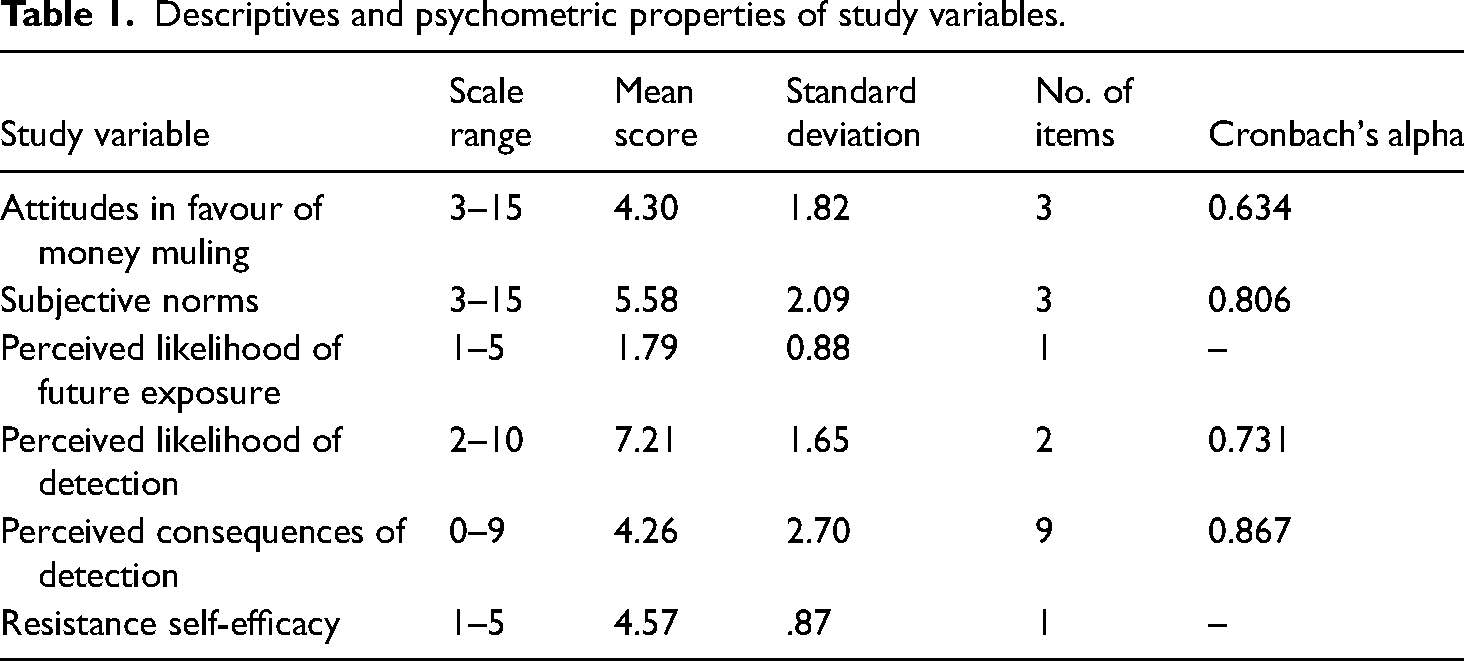
In Table 1, we describe the descriptives and psychometric properties of our study variables. All variables showed acceptable internal consistencies (Nunnally and Bernstein, 1994), meaning our measurements were generally reliable. Pro-criminal attitude was the exception, but considering that the value was only slightly below the recommended threshold of 0.700 (Nunnally and Bernstein, 1994) and that this is an exploratory study, we chose to include the construct in the analysis as is. The mean scores on attitudes in favour of money muling and subjective norms were quite low and distributed to the left, which means that most respondents showed low levels of deviant attitudes and subjective norms. Similarly, most respondents did not consider it likely to be approached by money mule recruiters in the future, indicating these young people are not part of risky social environments. Finally, virtually all participants perceived themselves as capable of resisting requests for access to their bank accounts.
Descriptives and psychometric properties of study variables.
Participants
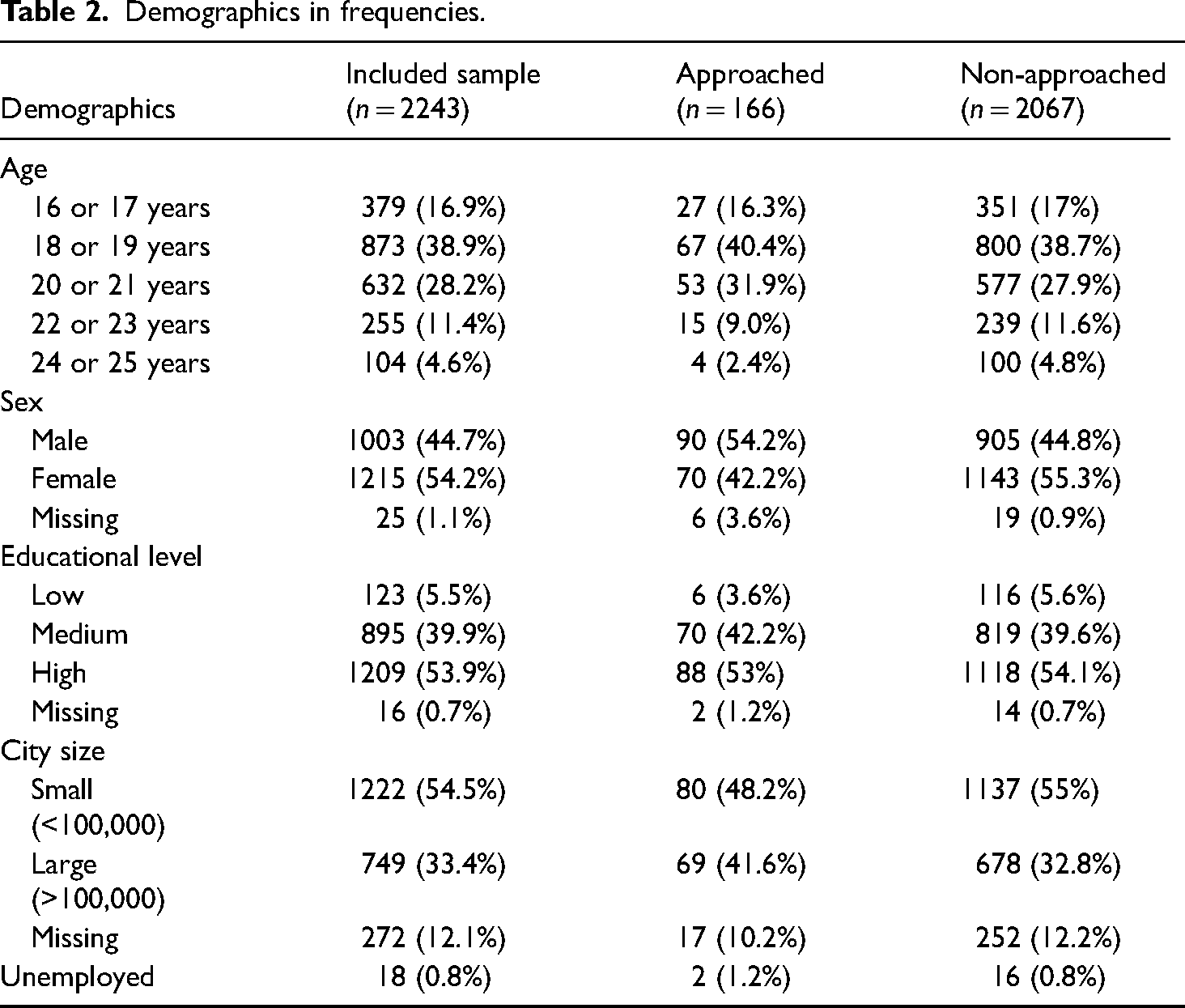
A total of 2243 respondents reached the end of the questionnaire. Item missing values are observed in up to 12% of the cases, depending on the specific variable. The demographics of these respondents are described in Table 2. A total of 166 respondents (7.4%) indicated to have ever been approached by money mule recruiters. Of these individuals, 41 respondents (24.7%) were approached only offline or both offline and online, and 116 respondents (69.9%) were approached only online. In those with valid responses, 1003 respondents were males (45.2%), and 1215 respondents were females (54.8%). This is roughly in line with broader distributions in the Netherlands (Statistics Netherlands, 2024b). The average age in our sample was around 19.5 years. Regarding current level of education, 2 it was observed that in the complete sample more than half had a high level of education (54.3%; n = 1209), while 40.2% (n = 895) had received a medium level of education and 5.5% were schooled at a low level (n = 123). This distribution is not in line with the youth population of the Netherlands, where around 40% has a low level of education (Statistics Netherlands, 2024d). However, it may be the case that the actual difference between level of education in our sample and the Dutch youth population is smaller than it seems. That is, Statistics Netherlands (2024d) measured the highest completed educational level, but some young people in their sample may simply be too young to have reached and completed a high level of education. Their educational level is therefore automatically set on low, which may reflect an underrepresentation of higher educational levels in the data from Statistics Netherlands compared to our sample. Still, we conducted an additional round of data collection to reach lower-educated individuals, but the number of recruited individuals was not enough to make a difference. Furthermore, 54.5% (n = 1222) reported to live in a city with less than 100,000 people, while 33.4% indicated to live in a city with more than 100,000 inhabitants (n = 749). The latter are considered large cities in the Netherlands. Finally, 18 respondents (0.8%) were unemployed. A total of 11 participants (0.5%) admitted to have been a money mule in the past, that is, provided bank account details to money mule recruiters.
Demographics in frequencies.
Analytical strategy
The aim of the current analysis was to provide more insight into the factors that relate to a history of being approached by money mule recruiters. With this, we can explore why some young people are susceptible to become involved in cybercrime, while others are not. In order to test our hypotheses, we ran a GEE binary logistic regression model (e.g., Hanley et al., 2003), with a history of being approached as the outcome variable and the various demographics and social-psychological predictors as the independent variables. Subsequently, we ran two other GEE binary logistic regression models as follow-up analysis to focus specifically on those who were approached offline and those who were approached online. Respondents who were approached both offline and online were included in the offline group. Respondents were excluded by means of listwise deletion. We chose to apply the GEE approach to correct for intracluster correlation. Clustered data were observed, for instance, in the dependent variable: some student duos recruited more than five individuals who were previously approached, while most student duos recruited none or only one individual who was previously approached. We report the odds ratios (OR) with corresponding 95% confidence intervals (95% CI). ORs of 1.5, 2.5 and 4 correspond to Cohen's d values of small (0.2), medium (0.4) and large (0.8) effect sizes, respectively (Maher et al., 2013). We met recommendations of a minimum of 10 events per variable for logistic regression analysis (Bijleveld et al., 2018). In addition to the regression models, we also report the area under the receiver operating characteristic (AUC) curve as a measure of discriminative performance of the models (see, for instance, Fazel et al., 2012), due to the low occurrence of the outcome variable in our sample. Values closer to 1 indicate that the scale is better able to distinguish those who were approached from those who were never approached. Following approximations reported by Rice and Harris (2005), AUCs of 0.56, 0.64 and 0.71 correspond to small, medium and large effect sizes, respectively.
Results
Table 3 shows the results of the three GEE binary logistic regression models. The groups that were included in these models were respondents who were never approached (n = 1760), respondents who were approached in general (n = 142), respondents who were approached offline (n = 33) and respondents who were approached online only (n = 101).
Results of GEE binomial regression analyses.
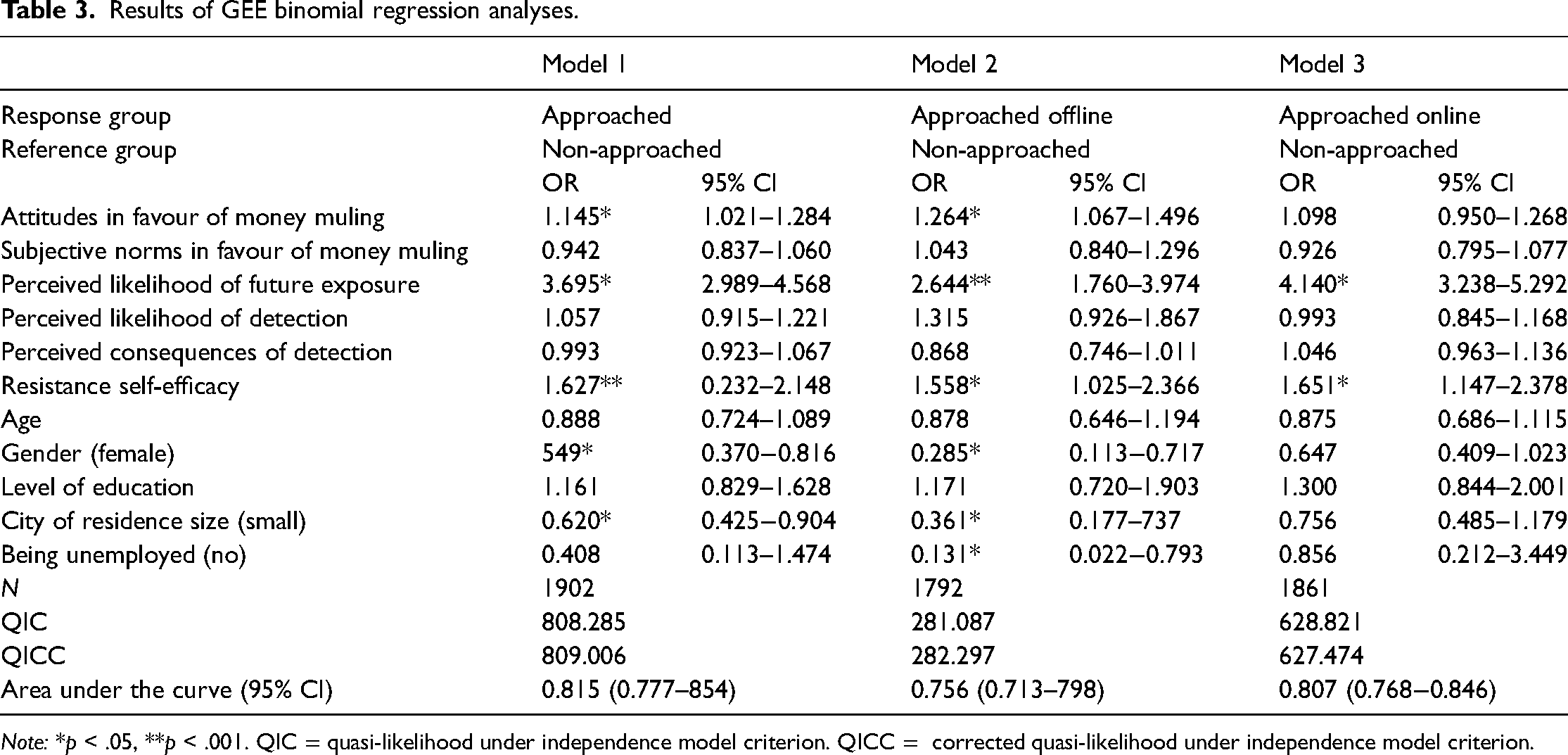
Note: *p < .05, **p < .001. QIC = quasi-likelihood under independence model criterion. QICC = corrected quasi-likelihood under independence model criterion.
Model 1 concerns the main analysis, in which we describe the relationship between the independent variables with a history of being approached in general, that is, either offline or online. As for the demographics, being male and living in large cities were associated with a higher likelihood of having been approached in the past. Furthermore, it was found that higher levels of attitudes in favour of money muling were associated with a higher likelihood of having been approached by money mule recruiters in the past. Higher levels of the perceived likelihood of being approached in the next 12 months were also related to a higher likelihood of having been approached by money mule recruiters in the past, which showed a medium effect size. The other independent variables were unrelated to a history of being approached.
In Model 2, we focused specifically on those who were approached offline. We found similar relationships as in Model 1 with similar effect sizes. The exception to this was being unemployed: being unemployed was associated with a higher likelihood of having been approached in the physical world at some point in the past. This variable related specifically to offline recruitment.
Model 3 shows a somewhat different picture. That is, only two variables were able to distinguish those who were approached online from those who were never approached. A higher perceived likelihood of future exposure to recruiters was associated with a higher likelihood of having been approached by recruiters online, which showed a medium effect size. Also, higher levels of resistance self-efficacy were associated with a higher likelihood of having been approached online at some point in the past. In other words, it seems relevant to distinguish between being recruited online and offline, in which money mule recruiters online seem to discriminate less in who they target.
The area under the curve of all models was between 0.756 and 0.815, which means they corresponded to large effect sizes (Rice and Harris, 2005). This means our set of variables is well able to discriminate between young people who are never approached by money mule recruiters and young people who are approached at some point.
Discussion
The purpose of this article was to gain more insight into the factors that relate to young people having a history of being approached by money mule recruiters. Greater understanding at an individual level as to why some young people are exposed to cybercriminals, while others are not, can significantly add to the body of literature and can be used in practice to identify the relevant areas and target groups for intervention and prevention. To accomplish this, we used existing literature on deviant subcultures and risk perception to identify key social-psychological factors that may relate to money muling, in addition to a number of demographical variables (e.g., Bekkers and Leukfeldt, 2023; Bekkers et al., 2023; Leukfeldt and Kleemans, 2019; Rani et al., 2024). We developed a survey based on this literature, which was completed by around 2000 young people from the Netherlands. By means of GEE binary logistic regression, we analysed which factors relate to a history of being approached by money mule recruiters. To the best of our knowledge, our data represent one of the first large-scale exploratory studies on the processes associated with money muling involving the youth population, thereby providing unique and valuable insights into a target group that is difficult to reach but susceptible to becoming involved in cybercrime.
Explaining exposure to money mule recruiters
In this section, we reflect on the findings of the current study in light of the hypotheses. As for the subculture variables, the analysis revealed that having attitudes in favour of money muling, for instance, thinking money muling is ‘cool’ or ‘useful’, and thinking it is likely to be approached by money mule recruiters in the future, was associated with a history of being approached by recruiters, in line with our hypotheses. This means that our first and second hypotheses are confirmed. Thinking it is likely to be approached by recruiters in the future in particular showed noticeable effect sizes throughout the analyses. These young people quite possibly share their social cluster with recruiters or other money mules, have been approached before, and may experience social pressure or social acceptance to engage with cybercrime offenders. They may not agree immediately but eventually do give in to the pressure experienced repeatedly, whether from general recruitment messages or from targeted approaches (e.g., Bekkers et al., 2024; Bekkers and Leukfeldt, 2023; Leukfeldt and Kleemans, 2019). In the current sample, around 7% of those who were approached actually provided their bank account details (see also Bekkers et al., 2023), but it requires additional research to investigate – in cooperation with financial institutions and the police – why a proportion of the young people who were approached actually gave in to recruiters, while others did not.
The third hypothesis, however, is disconfirmed, considering that subjective norms that approve of money muling were unrelated to a history of being approached. This may be because our sample is biased towards people who come from higher levels of education and neighbourhoods in rural areas in the Netherlands close to the university where data collection took place; it may be that money muling is more often perceived as normal or acceptable among specific social clusters and in certain geographical locations, for example, larger cities, which we missed in the current data collection (Hong and Lee, 2024).
As for the risk perception variables, it appeared that perceived likelihood of detection and perceived consequences of detection were unrelated to a history of being approached, whether offline or online. This means that the fourth and fifth hypotheses are disconfirmed. Perhaps young people do not perceive themselves to be at risk for becoming involved in cybercrime, or do not fully understand the actual likelihood of detection and the consequences of detection for themselves. In other words, young people may not view money muling as a risky event that entails the possibility of loss in the first place (Fischhoff et al., 1978; Weinstein, 1988). It is therefore recommended for intervention efforts to increase risk perceptions among people regarding money muling, focusing both on the likelihood and consequences of being caught (see also Bekkers et al., 2024). It may also be that our measurements of risk perception did not actually measure what we wanted to measure; we recommend to further validate our constructs. Furthermore, we observed that a higher resistance self-efficacy relates to a history of being approached, contrary to what we expected. The sixth hypothesis is thus disconfirmed. Perhaps past exposure and successful denial increases the perceived capability to resist future attempts as well. It is also possible that young people wrongfully assume they will be able to turn down recruiters once more, therefore possibly overestimate themselves.
As for demographics, being male and living in a large city were associated with previous exposure to money mule recruiters (Hong et al., 2024; Hong and Lee, 2024). The sub-analyses confirmed such a relationship for being approached in the physical world, but not for being approached on social media; online recruiters seem to be less selective in who they target and address a broader target audience (e.g., Bekkers and Leukfeldt, 2023; Hong and Lee, 2024). This implies that offline recruiters reflect existing social ties, such as friends, family or vague acquaintances, while online recruiters are more likely to be strangers. Previous research indeed found that recruiters on social media are willing to travel long distances in order to obtain bank account details, going beyond initial social clusters (Bekkers and Leukfeldt, 2023). Here, they seem to have few criteria regarding the individuals they seek, besides being 18 years of age, since these individuals have bank accounts with higher withdrawal limits (Bekkers and Leukfeldt, 2023). The money mule recruiters that operate physically, on the other hand, may address young people via their private social network or within their neighbourhoods, and thus operate within certain locations and social circles (e.g., Bekkers et al., 2020; Hong and Lee, 2024; Leukfeldt and Kleemans, 2019). Similarly, being unemployed also related only to having been approached physically, indicating that individuals in financial distress or in vulnerable positions are accessible to offline recruiters and indeed form a specific target group (Hong and Lee, 2024).
Future research
For a greater understanding of the cognitions and perceptions of young individuals towards money mules, we encourage researchers to use qualitative methods in future efforts, considering that it is difficult to reach a sufficient number of actual money mules for statistically meaningful analysis. For instance, researchers could conduct interviews to elaborate further on the motivations behind participating in fraudulent activities, on the recruitment methods used by cybercriminal networks and on the factors that lead to desistance and resistance. It would also be of value for future research to include factors such as empathy and agreeableness as predictors of money muling (e.g., Walters, 2018), since high levels of these traits may increase the likelihood that young people comply with recruiters, especially if requested by a close friend or family member. Also, of course, we did not study causal relationships, and we do not know whether individual characteristics influenced the likelihood of exposure, or that exposure influenced the perceptions and attitudes of our respondents. That is why we would recommend longitudinal research designs. Due to the role of peers and the social context, it may also be valuable to focus on social learning perspectives as a theoretical explanation for money muling (e.g., Akers, 1998). This theory, as well as rational choice models (e.g., Cornish and Clarke, 2017), might very well fit this topic. Similarly, we encourage more in-depth research regarding the interaction between risk perceptions and attitudes, which we could not cover in this study. Here, especially the perspective of Situational Action Theory (Wikström, 2004, 2010) might be a valuable contribution to current criminological literature on money mules. For instance, it may be that young people with dismissing attitudes towards money muling do not need to be able to resist temptations to money mule because they are not tempted or provoked in the first place. Specific circumstances likely influence this relationship, such as being forced to cooperate, experiencing peer pressure or being intoxicated. There is need for more refined measurements than ours in this study to be able to explore such dynamics and to test propositions and hypotheses associated with Situational Action Theory in the case of money muling.
Limitations
Attention should be given to a number of limitations of the current study. Firstly, because this is one of the first large-scale studies on money mules amongst non-juridical populations, our measurement tools have not been adequately tested in this specific context. A number of those scales also consisted of solely one item. While the items were derived from the existing literature and the constructs showed good psychometric properties overall, it is advised for future research to validate our measurements further in other target groups.
A second point is that our sample lacks generalizability. For instance, respondents with a lower level of education were under-represented in the current sample compared to the youth population of the Netherlands, while females were overrepresented. This is partly due to our non-random snowball-like sampling method: the initial respondents concerned students from a specific university, and the peers they recruited for this study likely belong to the same social class or come from the same neighbourhood. Hence, data were clustered.
Likewise, a third point is that the robustness of participant recruitment may have been influenced by the fact that the sample was recruited by inexperienced students and not by experienced researchers. Although students were thoroughly instructed on how to collect data and senior researchers closely supervised the process, the data quality might have been better in terms of response and representativeness when the senior researchers would have recruited respondents themselves.
A fourth and final point is that we can make no inferences about causal relationships. Based on our data, as with every cross-sectional study (De Vaus, 2001), we do not know if previous experiences with money mule recruiters have influenced the perceptions and attitudes of our respondents, or vice versa. Our research should be considered exploratory in nature, and additional research using longitudinal data is needed to provide better insights into developmental trajectories and interrelations between environmental factors and personal characteristics.
Conclusion
Nowadays, young people are confronted with the temptations of making money fast by providing others with access to their bank accounts (e.g., Rani et al., 2024; Bekkers and Leukfeldt, 2023; Bekkers et al., 2023). They are approached in the physical world as well as on social media, and by giving in to those recruiters, young people play a key role in the execution of financial-economic cybercrimes (e.g., Bulanova-Hristova et al., 2016; Hong and Lee, 2024; Leukfeldt et al., 2017b). This study sought to explain why some young people are exposed to money mule recruiters using a large sample of young people from the Netherlands. Findings indicate that young people who were approached in the past show attitudes in favour of money muling, think it is likely they will be approached in the future, and consider themselves capable of refusing future requests. Males living in large cities who are unemployed seem to be particularly at risk of being approached, but only in the physical world; recruiters may discriminate less when operating online. More longitudinal research is needed to investigate causal relationships and dynamics between environmental factors, life events and individual characteristics. Such endeavours are necessary if we are to protect society against the ever-growing threats of cybercrime.
Footnotes
Declaration of conflicting interests
The author(s) declared no potential conflicts of interest with respect to the research, authorship, and/or publication of this article.
Funding
The author(s) disclosed receipt of the following financial support for the research, authorship, and/or publication of this article: This work was supported by the Taskforce for Applied Research SIA of the Dutch Research Council under Grant RAAK.PUB06.032.
