







Abstract
While the use of media by police forces has been widely studied, films produced by public police organisations have only been scarcely researched. Such films, however, allow us to observe how police forces seek to reproduce their symbolic power. Through a qualitative content analysis, this article examines image films produced by Swiss police forces, a genre of film that aims to represent the operation of an organisation, focusing on how they represent policing. The research shows that Swiss police forces present themselves as crime-fighters, as organisations with unlimited tasks and as helping and listening to the public. Officers are portrayed as well-educated, professional and courteous, as human and as part of the local community. This conveys an image of police forces and officers as legitimate and trustworthy. At the same time, police forces are portrayed as consisting of and interacting primarily with white Swiss German speakers. In this way, these films delineate the boundaries of membership through a selective inclusion of these demographic groups.
Introduction
The relationship between the police and the media, and the engagement of the former with the latter in general, has been the subject of a substantial body of academic research. Scholars have investigated police engagement with journalists (Lee and McGovern, 2014; Mawby, 2002; Reichertz et al., 2012; Reiner, 2013), the representation of policing in reality television (Lee and McGovern, 2014; Pudlat, 2012; Reichertz, 2012) and their use of social media platforms such as X or Instagram (Walsh and O’Connor, 2019). Nevertheless, academic engagement with films produced by police organisations remains limited (but see Carrier et al., 2021; Koslicki, 2021; Pudlat, 2012, 2017; Walby and Joshua, 2021). To date, research into this topic has been absent in Switzerland, as there is a paucity of Swiss policing studies in general (Hagmann and Wolf, 2023; Staubli, 2016).
The objective of this article is to examine how policing is represented in image films of Swiss police forces and to identify the implications of these depictions. To start, I will characterise image films and explain the Swiss policing context. I will then present the theoretical framework that guides my analysis. Subsequently, I will describe my research methodology and then present the results and my analysis.
Image films and Swiss police forces
The focus of this article is on image films, 1 a genre that originated in the context of corporate marketing. The objective of such films is to provide an overview of a company's operations and to influence public perception (Zimmermann, 2009). They frequently adopt the narrative structure of feature films (Bauernschmidt, 2014), while being shorter in duration than the latter, but nevertheless having a longer runtime than advertisements (Henze, 2005 cited in Bauernschmidt, 2014).
As I will show, a multitude of public police forces in Switzerland have also started producing such films. These forces are structured in accordance with the federal system of governance, with the majority of public policing duties being fulfilled by the respective police forces of the 26 cantons (Mohler, 2020; Tschannen, 2016). Nevertheless, there are instances wherein forces are established at sub-cantonal or municipal levels (Mohler, 2020). Meanwhile, police forces at the federal level are only tasked with specific responsibilities, such as border policing or the investigation of transnational crimes (Mohler, 2020).
Theoretical framework
Scholars have conceptualised a range of ways in which police forces exert power, mapping their coercive, symbolic and epistemic powers (Boutros, 2024). In this analysis, I will draw on the scholarship around the symbolic power of police forces, ‘which is the ability to produce and mobilize moral meanings to shape people's values, perceptions and beliefs’ (Boutros, 2024: 496). Adapting Bourdieu's concept of symbolic power, scholars have conceptualised how policing communicates ‘meaning about the nature of order, authority, morality, normality, subjectivity, and the like’ (Loader, 1997: 5). This concept allows us to understand policing as ‘an interpretive lens through which people make sense of, and give order to, their world’ (Loader and Mulcahy, 2003: 45) and interpret their past, present and future (Loader, 1997).
However, the symbolic power of the police and the meanings attributed to the institution are not merely a product of chance, but are also actively cultivated by police forces through image work (Bullock, 2018; Lee and McGovern, 2014; Manning, 1997; Mawby, 2002; Schneider, 2016a). This can, for instance, happen through deliberate clothing choices for police officers and rules on engagement with the public (Mawby, 2002). It is however evident that the predominant proportion of the population forms their perception of law enforcement not through direct interactions with officers but rather through various forms of media, including news reports, fictional portrayals and social media content (Bullock, 2018; Donovan and Klahm, 2015; Lee and McGovern, 2014; Reiner, 2013; Skogan, 1994). Consequently, a significant proportion of image work is facilitated through traditional and social media (Brodeur, 2010; Lee and McGovern, 2014; Mawby, 2002; Reichertz et al., 2012). For instance, police departments may disseminate press releases predominantly concerning incidents that will depict the forces in a favourable light (Lee and McGovern, 2014; Mawby, 2002). In the contemporary era, social media platforms have emerged as a predominant instrument through which law enforcement agencies seek to manage their public image (Bullock, 2018). On these platforms, law enforcement agencies portray themselves as professional and efficient (Lee and McGovern, 2013; O'Connor, 2017; Schneider, 2016a), represent themselves as part of local communities, as listening and engaging in dialogue and depict officers in a caring fashion, and from a human side (O'Connor, 2017; Schneider, 2016a, 2016b). Overall, they ‘attempt to cultivate a sanitized image, presenting themselves as expert and professional crime-fighters, as well as community-minded public servants’ (Walsh and O’Connor, 2019: 5).
Consequently, the analysis of police forces’ engagement in image work provides insights into ‘how the social meanings of policing are produced’ (Loader and Mulcahy, 2003: 43) and thereby, how the symbolic power of police forces is maintained (Walby and Joshua, 2021). The analysis of films produced by police forces themselves offers a particularly fruitful avenue for understanding the reproduction of this power, as images move us in more intense ways than other ways of perceiving (Carrabine, 2015; Heidt and Wheeldon, 2021), while the focus of these films on providing an overview of the functioning of police departments creates an illusion of objectivity while hiding the fact that the content of these films is selectively curated and not a neutral representation of reality (Carrabine, 2012; Koslicki, 2021; Leishman and Mason, 2013; Valverde, 2006). An examination of these image films thus enables the investigation of the manner in which police forces influence their symbolic meaning through this powerful medium.
Research methods
My objective for this research was to examine how policing is presented in image films produced by Swiss police forces. As there is a paucity of research on policing in Switzerland (Hagmann and Wolf, 2023; Staubli, 2016), I decided to employ exploratory content and semiotic analysis (Altheide and Schneider, 2013; Valverde, 2006), allowing to identify both latent and manifest themes in representations of policing. In order to identify shared topics across the films, I focused on cantonal and sub-cantonal forces from the German-speaking region of Switzerland, 2 anticipating greater homogeneity between films within one language region (cf. Zierhofer, 2005).
To identify relevant image films, I conducted a search on the websites of all German-speaking cantonal police forces and of public police departments of the 50 largest German-speaking cities of Switzerland. Furthermore, I searched for their corresponding names on YouTube and included (relevant) videos suggested by the website's algorithm. I selected films labelled as image films or films that fit into the aforementioned definition, providing an overview of multiple aspects of the functioning of a police department, either on their own, or as part of a series of films that were published separately. I excluded films from analysis that were not labelled as image films and included a call for potential recruits to apply, in order to avoid the examination of recruitment films. This strategy enabled me to identify 20 image films 3 produced by 17 police forces operating in 13 cantons (out of a total of 19 predominantly German-speaking cantons). The duration of the films ranges from 2 minutes and 55 seconds to 34 minutes and 39 seconds, with an average length of 12 minutes and 9 seconds. The films were uploaded to the internet between 2011 and 2023. However, this does not allow for a clear assertation on their date of their production, as they might have been created earlier. Nevertheless, it provides an insight into the period of their dissemination online.
Online dissemination of these films occurs via various social media platforms, such as Instagram, X and YouTube (e.g. Kantonspolizei Basel-Stadt, 2019b; Stadtpolizei St Gallen, 2017a; Stadtpolizei Zürich, 2019a) with views on YouTube ranging from 1,996 to 206,685, averaging 35,525. Additionally, these films are presented offline at recruitment events, tour of police headquarters, trade or farmers’ fairs, exhibitions, police museums, lectures, school visits and, in a shortened version, as advertisements in cinemas (persönlich.ch, 2023; Polizei Basel-Landschaft, 2012).
I imported the image films into the qualitative data analysis software ‘NVivo’. I began by creating thematic codes that emerged from the literature on police use of social media. These codes were centred around police forces portraying themselves as trustworthy and legitimate through community engagement, friendliness and efficiency. Through watching each film at least four times, I identified additional themes, such as the use of language, the socio-structural characteristics of the people portrayed, the portrayal of dangers, and the different tasks of officers. I also used Microsoft Excel to code some of these themes to provide an indication of their proportion, although it should be noted that this approach is not intended to yield definitive numbers on the prevalence of themes (O'Connor, 2017).
Two notes regarding the analysed socio-structural characteristics are warranted: firstly, the analysis of specific characteristics from audio-visual cues, particularly race, is not without its challenges. The following interpretations of these categories are shaped by my own positionality as a white cisgender male researcher from a Swiss background, which aligns with dominant norms in this country. This might influence my interpretations herein, as I might fail to grasp certain nuances. In order to address this issue, I conducted multiple viewings of all films and discussed the coding with colleagues from different ethnic backgrounds, when I had reservations. Nevertheless, it is important to note that the interpretations presented herein reflect my personal perspective and should be regarded as one possible reading among a multitude of others.
Secondly, a note regarding language, a socio-structural factor which is often overlooked in analysis, even though it can serve as an important factor through which group membership is constituted (Gumperz, 1982). In order to analyse this factor in the context of Switzerland, it is essential to understand the significance of dialects. In the German-speaking region of Switzerland, over 30 distinct but mutually intelligible dialects are spoken, which differ significantly from the standard German language. As a result, individuals from Germany and Austria often encounter significant difficulty in comprehending these dialects (Watts, 1988). The collective designation for these dialects is ‘Swiss German’. The majority of Swiss German-speaking individuals perceive their dialect as their native language and utilise and hear it in various contexts, including in cantonal parliaments, courts, on radio and television, and in everyday conversations (Watts, 1999). Conversely, standard German is predominantly employed in education settings and in written communication (Watts, 1988). The use of such a dialect thus serves as a significant factor in the construction of in- and exclusion, whereby individuals who speak standard German are perceived as outsiders. As Watts (1999: 75) succinctly states: In the German-speaking part of Switzerland command of a Swiss German dialect takes precedence over the command of standard German in evaluating whether a person is or is not a ‘good Swiss’.
Results
The analysis of the films revealed that police officers were depicted engaging in three primary activities: combatting crimes, fulfilling a wide array of tasks and operating without direct interaction with the public. Additionally, the films depicted similar geographical settings and behaviour of police officers, while individuals with similar socio-structural attributes were frequently portrayed.
Crime-fighting
The notion of police forces as crime-fighters was a pervasive theme, evident in films of all police forces analysed (n = 17). Criminal offences, which were depicted on at least two occasions included motoring offences (n = 10, in films of 58.82% of police forces), robberies (n = 7, 41.18%), burglaries (n = 7, 41.18%) and other physical violence (n = 5, 29.41%).
Police forces are depicted as responding to these crimes in three distinct ways. In cases of minor motoring offences, offences are frequently tracked using a technical device and drivers subsequently fined on the spot (see e.g. Kantonspolizei Appenzell-Ausserrhoden, 2017, 4:33–5:25). It should be noted, however, that the response to motoring offences is depicted for a markedly shorter duration than that observed in the case of other offences.
In responding to these other crimes, police officers either identify the perpetrator (and secure the evidence required to prove their status as offenders) and/or arrest them. This approach is almost invariably depicted as successful, with instances of failure being not shown on any occasion. Four different reasons for how and why police officers are successful in identifying offenders are shown. Firstly, there is a notable emphasis on the fact that investigators operate within teams, with the majority of films depicting multiple individuals working in an investigation unit (e.g. Kantonspolizei Thurgau, 2022a, 0:54–1:02), while these units are depicted as being closely integrated with the wider police department (e.g. Kantonspolizei St Gallen, 2023). Secondly, these units are depicted as operating with remarkable swiftness and efficiency. Upon receiving a case, they are shown to commence work without delay, questioning individuals as soon as possible, in some instances, while they are still bleeding on the side of a road (Kantonspolizei Appenzell-Ausserrhoden, 2017, 9:47–10:34). Thirdly, the investigators are depicted as sharp and perceptive, demonstrating an ability to swiftly and accurately discern the underlying implications of the evidence presented and able to draw the right conclusion from the evidence very quickly. In several films, for example, officers locate the whereabouts of an accomplice by interpreting clues they found in the belongings of an already arrested perpetrator (Kantonspolizei Appenzell-Ausserrhoden, 2017, 24:36–25:04; Luzerner Polizei, 2016, 6:40–6:48). Lastly, the police are depicted as having access to a plethora of sophisticated technical resources, which enable them to effectively investigate criminal activities. For instance, forensic technicians are frequently depicted utilising cotton swabs and adhesive foil to secure evidence at crime scenes, subsequently examining the results in laboratories (e.g. Kantonspolizei Solothurn, 2014b, 2:36–3:04; Kantonspolizei Zürich, 2017b, 2:25–2:50), police officers are depicted simulating the course of events in car accidents (e.g. Kantonspolizei Zürich, 2020, 1:15–1:41), and divers are shown to be recovering evidence from lakes (e.g. Kantonspolizei Thurgau, 2022b, 1:15–1:30).
Regarding the arrest of offenders, officers can regularly be seen putting handcuffs on suspects, with the action frequently shown in close-up. Apart from this common theme, however, films show greater variations regarding arrests. Around half of the forces (n = 9, 52.94%) devote significant screen time to officers using ‘naked coercive force’ (Waddington, 1999: 26), meaning the use of tactics that expose offenders to significant risk of physical harm. For instance, special forces are shown storming perpetrators’ homes and overpowering them (e.g. Schaffhauser Polizei, 2016, 7:10–7:40); police dogs chase, apprehend and bite fleeing individuals (e.g. Regionalpolizei Zofingen, 2014, 13:30–13:48); and offenders’ tyres are purposefully destroyed in high-speed pursuits (Luzerner Polizei, 4:39–4:58). These scenes are usually accompanied by fast-paced music. Furthermore, films emphasise to the viewer how dangerous the offenders are. This is achieved by depicting perpetrators threatening members of the public with knives (e.g. Polizei Basel-Landschaft, 2012, 12:42–13:03), shooting at police officers with guns (e.g. Kantonspolizei Zürich, 2011, 10:37–10:49), or by having officers inform the viewer that such situations are unpredictable and that their own security must be prioritised (e.g. Zuger Polizei, 2012, 07:47–08:14).
While some other forces also depict special forces (n = 3; 17.65%), these are only shown briefly and as a subordinate activity of the forces (e.g. Kantonspolizei Nidwalden, 2021, 1:59–2:06). These forces and others who depict or imply arrests rather emphasise different activities for apprehending offenders. These films often show officers using various tactical strategies to deceive and apprehend their opponents. Examples include pursuing suspects into a dead end (e.g. Stadtpolizei Winterthur, 2018, 8:03–8:11) and surrounding them from multiple directions (e.g. Kantonspolizei Basel-Stadt, 2019a, 2:05–2:11). Furthermore, officers are depicted as being much stronger than offenders, therefore being able to overpower them, offenders often also shown realising that any resistance would be futile (Kantonspolizei Bern, 2014, 4:23–4:37).
Wide array of tasks
Prevention
The overwhelming majority of police forces (n = 16, 94.12%) portray their work as encompassing a multifaceted range of responsibilities extending beyond merely fighting crimes. All the forces in question represent themselves patrolling their designated areas in a variety of ways, including on foot, by car, bicycle, and even by boat. Additionally, a significant number of the forces (n = 8, 47.06%) depict themselves operating emergency call centres. Additionally, police officers are shown engaging in the policing of fan groups at football games (Stadtpolizei St Gallen, 2017b, 4:04–5:18), the monitoring of animal welfare standards (Kantonspolizei Bern, 2014, 7:17–7:32), and the preparation to deal with a number of additional scenarios, such as responding to oil spills (Kantonspolizei Thurgau, 2022b, 0:56–1:05).
Moreover, numerous films depict police officers engaged in preventive traffic control measures, including speeding checks and alcohol tests (n = 8, 47.06%). It is noteworthy that police forces frequently appear to feel compelled to justify these checks, for instance by stating that they have reduced accidents (Polizei Basel-Landschaft, 2012, 05:11–05:22) or expressing regret about this aspect of their work. To illustrate, in the film depicting the activities of the Regionalpolizei Zofingen (2014, 8:04–8:10), the narrator makes the following statement: ‘Radarkontrollen gehören halt dazu, auch wenn man sich damit nicht gerade beliebt macht’ ('speed control is part of the job, even if it does not make you popular’).
However, preventive activities are not merely depicted in a controlling manner, but also through the depiction of police officers responsibilising individuals. For instance, police officers are portrayed as educating children on appropriate behaviour in traffic (e.g. Stadtpolizei St Gallen, 2017b, 3:19–3:34) or instructing older individuals on how to avoid becoming victims of burglary (Kantonspolizei Solothurn, 2014b, 5:50–6:22).
Helpers, listeners and positive interactions
Furthermore, police officers are depicted in a more informal manner. They are shown as ‘helpers’: pointing individuals in the right direction (Kantonspolizei Bern, 2014, 9:11–9:13) or forming a search party (usually including a rescue dog) to look for people who have become lost in the forest (e.g. Stadtpolizei Zürich, 2019b, 3:24–3:32). They are frequently portrayed assisting at traffic accidents by providing first aid (Kantonspolizei Zürich, 2021, 3:33–3:36), working with other emergency services (Kantonspolizei Solothurn, 2014c; Stadtpolizei St Gallen, 2017b, 1:39–2:08), or providing pastoral care to injured individuals (Schaffhauser Polizei, 2016, 6:52–7:10). In instances of such incidents, they are frequently represented as the initial responders, even preceding other emergency services (Kantonspolizei Zürich, 2020, 0:32–0:34; Regionalpolizei Zofingen, 2014, 14:39–15:45).
Additionally, numerous films depict the police as ‘listeners’. For instance, they are shown taking notes of what individuals say (Regionalpolizei Lenzburg, 2011, 1:50) or responding promptly to tips received via their emergency hotline (e.g. Kantonspolizei Basel-Stadt, 2019a, 2:32–2:44). Other police forces have also implemented their representation as ‘listeners’ on a meta-level. For example, one of the films of Kantonspolizei Solothurn (2014d) simply depicts members of the public articulating their security concerns. In a similar vein, Kantonspolizei Bern (2014) incorporated segments into their film, in which they posed questions to individuals regarding their expectations of police service, the responses to these questions then being addressed in subsequent parts of the film.
Moreover, numerous films also simply depict police officers engaging in ‘positive interactions’ with members of the public. To illustrate, the Stadtpolizei Zürich (2019b, 4:05–4:13) depicts two young women taking selfies with officers and policemen distributing stickers to children. Furthermore, officers can be observed chatting to fruit vendors (Stadtpolizei St Gallen, 2017b, 2:55–3:02), and individuals are depicted conveying praise to the police, telling them ‘fahred witer so’ (translating to ‘way to go’, [Kantonspolizei Bern, 2014, 9:02–9:04]), or visibly thanking officers (Kantonspolizei Basel-Stadt, 2019a, 1:08).
In relation to crime-fighting
The wide array of tasks is not presented as being in opposition to crime-fighting. Rather, the two are presented as existing harmoniously alongside each other in the day-to-day lives of officers, often even complementing each other. For example, films often depict police officers as being part of the local communities in which they operate, which enables them to arrive quickly at crime scenes (Polizei Basel-Landschaft, 2012, 3:12–3:41). Across forces, the balance between these two areas of work varies: four forces (23.53%) devote over two-thirds of screen time to crime-fighting, four others (23.53%) prioritise the opposite, and the remaining nine (52.94%) show an evenly balanced split.
Police officers without members of the public
A third common theme that emerged from the data was the representation of police officers outside of direct encounters with the public. I identified four sub-themes in this category. Firstly, films regularly depict officers being educated. Some police forces elucidate the duration and nature of the training undergone by police officers (e.g. Kantonspolizei Bern, 2014, 7:40–8:19), while other films underscore the notion that training is an ongoing process, portraying police forces engaged in simulated rescue missions (Schaffhauser Polizei, 2016, 4:20–4:49) or reinforcing their marksmanship skills (e.g. Kantonspolizei Zürich, 2017a, 1:52–2:05). Additionally, some films adopt a narrative structure that follows the experiences of young recruits during their practical training, illustrating the methods through which they are instructed (Schaffhauser Polizei, 2016). Secondly, there are numerous portrayals of police officers during their work breaks. However, these depicted breaks are invariably interrupted by incoming radio messages, summoning officers to urgent tasks, which leads to terminations of their rests (Kantonspolizei Nidwalden, 2021, 2:33–2:44; Regionalpolizei Zofingen, 2014, 14:12–14:32; Zuger Polizei, 2012, 4:26–4:50). A third common theme is the portrayal of police officers as individuals who have insecurities and show emotional responses. In the film of Zuger Polizei (2012, 0:00–0:19), the protagonist, speaking off-screen, states that on his first day as a police officer, he felt as though he was unable to cope with the demands of the role. In the film of Stadtpolizei Winterthur (2018, 1:34–1:43), a police officer discloses the emotionally taxing nature of missing person searches. Similarly, in the film of the Polizei Basel-Landschaft (2012, 7:19–7:28), an officer reveals that she had tears in her eyes during a mission and adds: ‘das isch ok, au für e Polizistin’ (‘this is okay, even for a policewoman’). Lastly, the films depict police officers in their personal lives, without an immediate connection to a policing task but as integral members of their communities. They are shown with their family, for instance eating breakfast with them (Polizei Basel-Landschaft, 2012, 0:37–0:44) or viewing a drawing created by one of their children (Kantonspolizei Zürich, 2011, 1:22–1:27). Officers are also depicted engaging in leisure activities, such as drinking beer with friends (Zuger Polizei, 2012, 7:34–7:54), jogging in the local countryside (Stadtpolizei St Gallen, 2017b, 0:08–0:22), and playing music in a carnival guild (Kantonspolizei Solothurn, 2014d).
Behaviour and setting
In their professional capacity, law enforcement officers are depicted as consistently exhibiting a friendly and respectful demeanour. For example, they are observed greeting individuals in a polite manner during traffic controls, providing them with explanations of the process (Kantonspolizei Bern, 2014, 6:41–6:50) or portrayed as talking to suspects in a considerate manner (Kantonspolizei Zürich, 2011, 8:41–8:50). Similarly, in the film of Kantonspolizei Nidwalden (2021, 2:41–2:50), officers simply tell the viewer that one of the most important aspects of their role is how they interact with members of the public. Furthermore, the work of police forces is frequently clearly situated within the local area where the police forces are based. For instance, the film of Kantonspolizei Bern (2014, 2:00–2:03) depicts officers cycling in front of the ‘Zytgloggeturm’, a local landmark, the Stadtpolizei St Gallen (2017b, 1:19) features officers regulating traffic at the ‘Viehschau’, a local tradition and Kantonspolizei Basel-Stadt (2019a, 0:07–0:17) depicts officers patrolling next to the local river, with further landmarks visibly recognisable in the background.
Socio-structural characteristics
Lastly, I observed that image films predominantly portrayed individuals with certain socio-structural characteristics. In the course of my research, I accorded particular attention to the variables of race and language. The findings will be presented in turn for offenders, supported people and police officers.
Offenders
Regarding the identifiable offenders, 4 I coded all offenders in total, with a subsequent breakdown of the data by the offences which were depicted on multiple occasions. Furthermore, I also coded the risk of harm to offenders through the use of ‘naked coercive force’ (Waddington, 1999: 26; cf. Dorriety, 2005) such as the utilisation of special forces, police dogs and the deployment of live ammunition against offenders, as the literature suggest that these means are mainly employed against individuals who are not considered to be members of the citizenry (Waddington, 1999).
I found that, in all categories, the vast majority of offenders depicted were white and spoke Swiss German (Table 1). This constitutes an underrepresentation of People of Colour, and, at maximum, an accurate representation of non-Swiss German speakers. 5
Offenders with discernible race and language by repeatedly depicted crimes; use of naked coercive force against offenders by race and language.
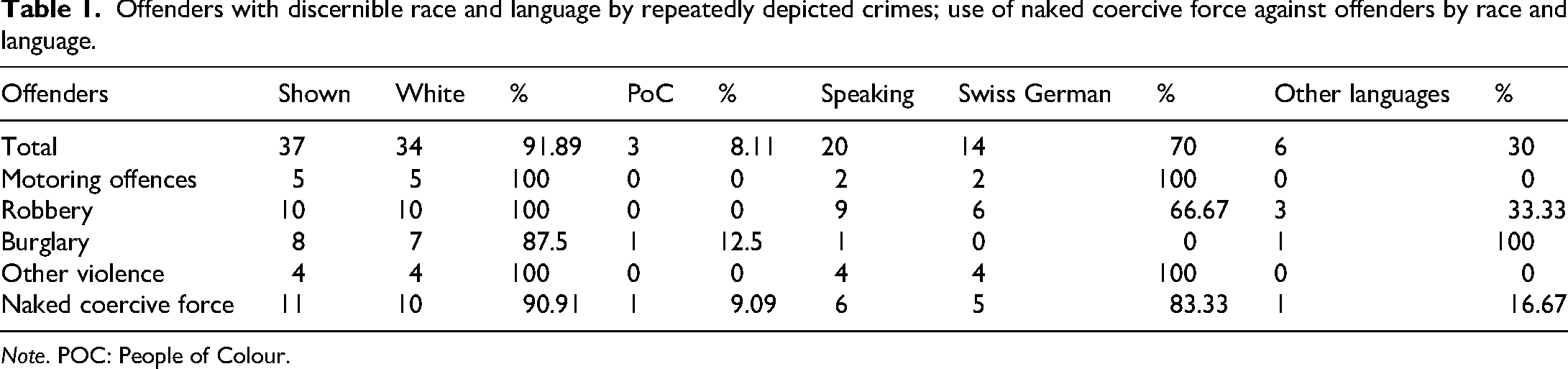
Note. POC: People of Colour.
Supported people
Subsequently, I examined the individuals who were being supported by police officers. The codes were developed from the themes that emerged from the preceding analysis. Consequently, the categories included individuals who were assisted (including through responsibilisation), whose concerns were listened to, who were depicted as having positive interactions with the police, and who were portrayed as victims of crime who received assistance from the police. 6
There is an even greater overrepresentation of white individuals who speak Swiss German (Table 2), compared to the general population. 7 This discrepancy is further accentuated when one considers that, first, all of the racialised individuals who were helped seem to represent tourists, given that they were seeking directions in locations that are well-known tourist attractions. Second, four of the individuals who were speaking French were featured in the video produced by the Kantonspolizei Bern, a police force based in a canton in which French is an official language.
Supported people with discernible race and language by type of interaction with the police.

Note. POC: People of Colour.
Police officers
Lastly, I investigated the characteristics of the individuals who were being portrayed as police officers. All the depicted officers were white, with the exception of an assistant policeman from the Stadtpolizei Zürich (2019b, 4:13–4:20), who is shown opening a tram door for an injured person. Moreover, with the exception of three individuals, all police officers spoke Swiss German. However, these figures are once again even more profound, as two of the three officers act as narrators of their respective films, for which using standard German is more common in Switzerland, even for people who normaly use Swiss German (Watts, 1988, 1999). It is notable that the majority of officers utilise the hyperlocal dialect, to the extent that Kantonspolizei Nidwalden (2021, 3:13–3:18) opted to include subtitles for an officer coming from a different region of Switzerland.
Discussion
Analysing these films, I argue that they represent policing as a necessary, legitimate and trustworthy endeavour, but only involving white Swiss German speakers. This serves to manage the public image of the police force as well as to delineate the boundaries of membership in society, which I will discuss in turn.
Image management
I argue that police forces shape their public image through the use of image films in a way that is favourable to their legitimacy and trust. This entails two key elements: firstly, films depict the roles and functions of the police as necessary and the police forces as the actors to fulfil these functions and secondly, they portray the conduct of officers in a favourable manner.
Necessary function
Examining the symbolic power of the police, scholars have identified the strong imaginative effects that policing produces (Loader, 2020; Reiner, 2013). As Loader and Mulcahy (2003: 43–44) observed: the idea of policing also brings to the fore sensations of order, authority, and protection; it makes it possible for people to believe that a powerful force for good stands between them and an anarchic world, that the state is willing and able to defend its citizens.
The portrayal of such dangers is a common feature of Swiss police force image films. The recurrent portrayal of violent criminal acts serves to underscore the prevalence of serious and grave deviance. Serious offences are depicted at a significantly higher frequency than they are the subject of police attention. When the figures for depicted crimes are compared with police crime data, it emerges – for instance – that only 0.32% of all recorded crimes are robberies (Bundesamt fur Statistik, 2025a), whereas in the analysed image films, 41.2% of all police forces depict this offence. Concurrently, the focus on the wide array of tasks, such as officers responding to accidents, escaping snakes (Kantonspolizei Zürich, 2017a, 2:30–2:49), or oils spills, and their search for missing individuals, creates a sense of an endless array of potential dangers that the police are equipped to handle.
In addition to the portrayal of these risks, police forces indeed depict themselves in these films as the ‘thin blue line’, as the last defence against total chaos, by showing that they are equipped and willing to address the dangers mentioned above. The depiction of police officers utilising a range of strategies, including the deployment of force, canine units to locate and apprehend individuals, specialist technologies and special forces, in addition to their capacity for identifying and arresting perpetrators, serves to reinforce the notion that law enforcement agencies are best placed to respond to such situations. Some films even explicitly state that police forces are effective in apprehending these dangers. For example, in the film of Kantonspolizei Solothurn (2014a, 5:59–6:03), a victim of domestic violence states that it is (only) the police who are able to stop the violence. Furthermore, the notion of the police as a force that is ‘able to defend its citizens’ (Loader and Mulcahy, 2003: 44) is fortified by depictions of their availability and speediness, indicating that their skills are actually accessible when required. The representation of police officers arriving first at the scene of accidents and the portrayal of their emergency call centres serves to further emphasise this role. On occasion, this is made as explicit as in the video of Kantonspolizei Bern (2014, 1:27–1:36), where the narrators state for the viewer: ‘Die Bevölkerung muss (…) die Gewissheit haben, dass sie bei bedrohlichen Ereignissen jederzeit und überall im Kanton Hilfe und Soforteinsätze erwarten kann’ (‘the population must … be confident that they can expect help and rapid intervention at any time and in any location in the canton in the event of a threatening incident’). These portrayals communicate the image of the police as a necessary force.
This conclusion is further strengthened when we consider the balance between crime fighting and the other tasks of the police forces in different films. Examining the distribution of these priorities in different films reveals that progressive cantons or municipalities (with the notable exception of Basel-Stadt) appear to prioritise the wide array of tasks slightly more than conservative jurisdictions. 8 This can be explained by research showing that more conservative voters have a greater fear of crime (Jost et al., 2017; Zarafonitou, 2011) and therefore see crime fighting as a more essential task. Police in conservative jurisdictions might therefore be more willing or required to show crime as a danger and to portray themselves as crime-fighters.
Legitimacy and trust
While the police may be regarded as performing a necessary function, this does not necessarily imply that the organisations and their members are viewed as legitimate and trusted. Most scholars agree that legitimacy is established when police officers are perceived to be acting in a professional and efficient manner (Bradford and Jackson, 2010; Manning, 1997; Reiner, 1992; Tankebe, 2014), and as being friendly, fair, and respectful towards members of the public (Bowling et al., 2019; Bradford, 2017; Koslicki, 2021; Loader, 2016; Staubli, 2016). Meanwhile, the perception of police officers as human beings and their proximity to the public are key factors in generating trust, which is further strengthened when officers are seen to be part of the communities they are policing, demonstrate care and concern for the population, and actively listen to the public's concerns (Bowling et al., 2019; Bradford and Jackson, 2010; Loader, 2016; O'Connor, 2017; Schneider, 2016b).
All of the aforementioned factors are present in the analysed image films. The utilisation of teams within the police force and the prompt commencement of investigations serves to enhance the perception of police forces as efficient. The depiction of their thorough training and their professional dealings with victims – often shown in a calm and a calming way and in a factual tone (e.g. Kantonspolizei Solothurn, 2014a; Zuger Polizei, 2012, 1:48–2:20) – reinforces the notion of police officers as professionals. Their portrayal as helpful, courteous individuals interacting positively with the public serves to further enhance the perception of their trustworthiness. The depiction of officers educating the public on how to avoid victimisation signals their concern for the well-being of the general public. Similarly, the portrayal of officers interrupting their own breaks to rush to a mission or putting themselves in danger to save members of the public (e.g. Polizei Basel-Landschaft, 2012, 10:38–11:03) reinforces this image. Moreover, portrayals of police officers working in hyperlocalised settings, speaking in the local dialect and having friends and family further help to demonstrate their integration into communities and to humanise them. This is also evidenced by the depiction of their insecurities. Finally, the recurrent portrayal of canines, whether as rescue or attack dogs, serve to unleash the ‘power of the cute’ (Wood, 2020: 49), thereby enhancing the acceptance of police forces, due to the pervasive popularity of dogs within the general population.
In contrast, negative portrayals of police forces are rarely included in these films. For instance, no image film depicts the policing of migration offences and, bar two examples where police officers are seen checking passports (Kantonspolizei Zürich, 2017c, 1:30–1:48; Regionalpolizei Zofingen, 2014, 11:25), there is no reference to any form of immigration policing, even though a significant proportion of this work is carried out by cantonal police forces. For example, these forces are responsible for accompanying people during their deportations (Grasdorf-Meyer et al., 2021), a practice which has been subject to significant criticism in the past (swissinfo.ch, 2011; Tagesanzeiger, 2011). Similarly, criticism has been directed at policing practices towards racialised individuals (Naguib, 2017; Plümecke et al., 2022; Wa Baile et al., 2019), yet the policing of racialised people is absent in the films altogether. Furthermore, the absence of portrayals of interactions with individuals with mental illnesses or instances of excessive police violence – both practices of policing that have received criticism (bluewin, 2022; SRF, 2021) – indicates a notable absence of depictions of police activities that have been subjected to censure.
Nevertheless, one might argue that the frequent portrayal of traffic stops is indeed such a negative representation of police forces, as many people do not experience such stops positively (Staubli, 2016). However, I would propose an alternative argument. In addition to the ambiguity surrounding the general acceptance of traffic stops (Bächli-Biétry et al., 2005), I would contend that their absence would have diminished the plausibility of the films, give that traffic stops represent the most frequent (and often only) point of direct contact between the general public and the police (Baier, 2015). The omission of such stops would have resulted in a discrepancy between the actual experiences of individuals and the films. Furthermore, the expressions of regret by police forces about these traffic stops serve to deflect the potential blame for these controls away from the police forces themselves and onto other agents, such as governments.
Similarly, one might argue that the use of ‘naked coercive force’ (Waddington, 1999: 26) against offenders could undermine the legitimacy of the police. I would, however, counter this claim with two arguments. Firstly, research has shown that the public generally accepts the use of force by police officers when it is deemed reasonable, for example when officers are endangered (Gerber and Jackson, 2017; Navarro and Hansen, 2023). The constant depiction of offenders as dangerous in films thereby ensures that this force is accepted. Secondly, there is a great variance in the depiction of this endangerment between conservative or rural and progressive or urban jurisdictions, 9 with the former devoting notably more screen time to behaviour that endangers offenders. As research shows that conservative individuals are more accepting of all kinds of use of force by police (Bradford et al., 2017; Navarro and Hansen, 2023), I would argue that police in more conservative jurisdictions displaying more forceful behaviour does not contradict the idea that these films portray the police as legitimate.
In light of this evidence, I conclude that such image films are employed by police forces to legitimise their organisations and shape their image in a way that the population perceives them as necessary and trustworthy. This finding is consistent with existing research on the reasons for media use by police forces in general (Lee and McGovern, 2013, 2014; Mawby, 2002; Waddington, 1999) and police produced films in particular (Pudlat, 2012; Walby and Joshua, 2021). However, this finding is not applicable to all demographic groups, a discussion towards I will now turn.
Drawing the boundaries of membership
In relation to the symbolic power of the police (Loader and Mulcahy, 2003), scholars have observed how it can be deployed to delineate the boundaries of membership itself (Waddington, 1999), whereby: Every police-public interaction communicates a message about the police and what they stand for, and sends a signal to citizens about their membership of society and their place within it. (Loader, 2016: 435)
Waddington (1999) has argued that repeat offenders are typically perceived as situated beyond the bounds of citizenship. In policing non-members of a society, police forces feel justified to ‘exercise naked coercive force’ (Waddington, 1999: 26). However, as I have shown, the depiction of such tactics against a discernible offender is uncommon. It is noteworthy, however, that in instances where they are employed, they are predominantly directed at white Swiss German speakers. Likewise, offenders are disproportionately depicted as white.
However, I would contend that focusing on these examples of exclusion from membership overlooks the subtle nuances that are employed in the construction of membership, particularly with regard to the question of how these films determine who is included in the realm of membership. I would argue that its boundaries are delineated to a far greater extent by the selective positive portrayal of certain groups: As I have demonstrated, the majority of individuals depicted in these films are being supported by police officers. By portraying police officers as listening to people's concerns, helping them, or having positive interactions, police forces delineate who is worthy of assistance and positive interactions, and whose opinion should be taken into account. In essence, this depiction of policing illustrates who is seen as a member of society (cf. Waddington, 1999). Similarly, as police officers strive to demonstrate their integration into the communities they serve, the same applies to the question of who is portrayed as a police officer.
As I have shown, the majority of police officers – with the exception of one assistant – are white and speak Swiss German. I have moreover noted a similar demographic composition with regard to the supported individuals. This portrayal suggests that these films construct an image of policing where diversity appears to be external or at least temporary – as is the case with the repeated showing of tourists.
I would therefore argue that these image films communicate to racialised and non-Swiss German speakers that the police do not represent them and do not take their opinions into account or support them, thereby conveying the message that they are lesser members of Swiss society. This can be summed up well by a scene from the film of Kantonspolizei Solothurn (2014d, 2:05–2:41). In it, a woman speaks at length on the relationship between the local community and asylum seekers, while the latter walk in the background. They are, however, not once consulted about their own views on the matter (Figure 1).
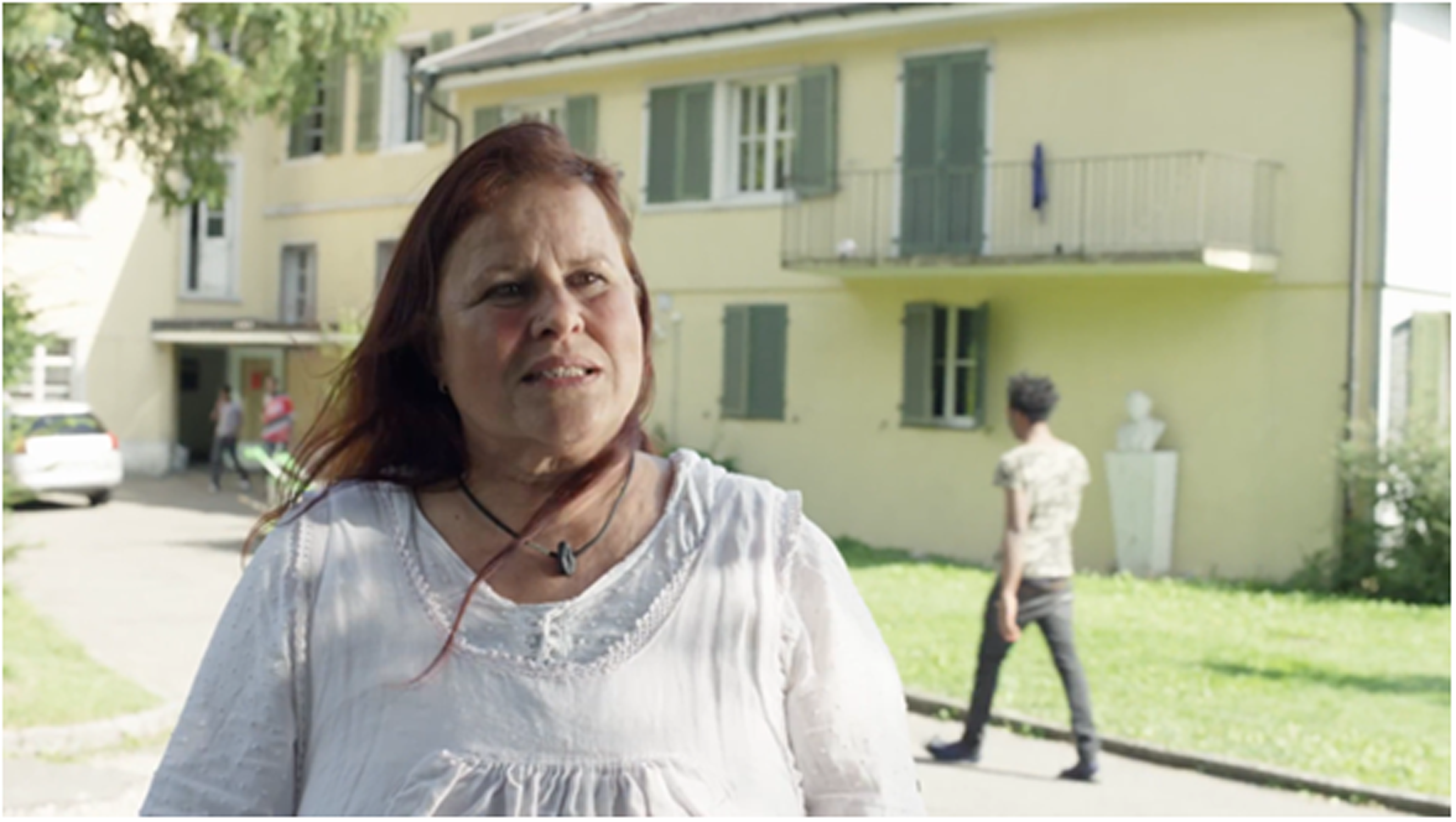
Still from the image film ‘Zämeläbe’ (credit: Kantonspolizei Solothurn [2014d, 2:39]).
Conclusion
In conclusion, the analysed image films seek to portray an image of police forces and officers as necessary, legitimate and trustworthy, yet this image is conveyed exclusively to white Swiss German speakers. For racialised or non-Swiss German speakers, the films communicate that the police and the state are not ‘willing … to defend them’ (Loader and Mulcahy, 2003: 44), that they are not listened to, and that they are not viewed as full members of society. Consequently, such films serve to virtually delineate the boundaries of citizenship itself, thereby transporting the capacity of the police to act as mediators of belonging (Loader, 2006, 2016, 2020) into the digital realm.
This is not to suggest that these exclusions are necessarily intentional. Nevertheless, the curation of the content of these films (Carrabine, 2012; Valverde, 2006) provides insight into the structural and institutional exclusionary mechanisms at work within police organisations, which their members may not even be aware of, yet which nevertheless create exclusion (Naguib, 2017), especially when policing functions as ‘an interpretive lens through which people make sense of, and give order to, their world’ (Loader and Mulcahy, 2003: 45).
This study contributes to the literature in several ways: First, it adds to policing research in Switzerland by offering a comprehensive analysis of the rationale behind the Swiss police's engagement with and use of media. In this study, I found similar motivations for media use by the police as it was found in other countries, namely the influencing of public perception and portraying the police as legitimate and trustworthy (Lee and McGovern, 2013, 2014; Mawby, 2002; Pudlat, 2012).
Second, this research raises new questions regarding the timing of image work of police forces: it has been noted by scholars that criminal justice agencies engage in this work when their legitimacy is called into question (Loader and Mulcahy, 2003; Walby and Joshua, 2021). However, trust in the police in Switzerland is extremely high compared to other countries (Pfister, 2020). Nevertheless, as I have demonstrated, Swiss police forces still feel the need to increase their legitimacy. This suggests that image management is employed pre-emptively rather than in response to waning legitimacy. The timing of image work and the reasons for its use should therefore be studied more intensely.
Third, while existing research has shown that the police create a mythical world in their visual communication through selective over- and underrepresentation of certain demographic groups, the content of these depictions was the opposite of what I discovered. For instance, Walby and Wilkinson (2023) observed that the police exaggerated the presence of queer, female and minority individuals on Instagram, presenting an idealised world while ignoring police violence against these communities (cf. Walby and Joshua, 2021). In contrast, my findings show a severe underrepresentation of marginalised groups. This could be explained by different discourses on marginalised groups in different countries or the general acceptance of police forces. However, more research is needed on this topic as well.
Fourth, examining how the police act as mediators of belonging through their use of the media provides conceptual innovation and novel insights for police and media studies and general policing studies. It shows that decisions on membership status are not only made during direct encounters, such as stop-and-search tactics, but also through media use. Furthermore, it shows that membership boundaries can be delineated not only through exclusionary methods, but also by a selective inclusion of certain demographic groups, such as white individuals who speak the local dialect.
Footnotes
Acknowledgements
I would like to thank Mary Bosworth, Jonas Hagmann, Meghna Sridhar, Mia Brönnimann, Freija Geniale, David Mühlemann and the anonymous reviewers for their helpful advice on earlier drafts of the manuscript, and for their fruitful discussions about my ideas. I would also like to thank the participants of the Kriminologische Gesellschaft conference in Tübingen in September 2024 for their helpful comments.

Consent for publication
Consent for publication of the figure was provided.
Funding
The author disclosed receipt of the following financial support for the research, authorship, and/or publication of this article: This research was supported by a scholarship from the Berrow Foundation.
Data availability statement
The data that support the findings of this study are available from the author, upon reasonable request.