







Abstract
The open science movement strives to improve the transparency, accessibility, rigor, and reproducibility of scientific research. Arguing that open science increases the impact of research, the Dutch Research Council (NWO) has been promoting an open science program in the Netherlands since 2009, aiming to make all funded publications open access and research data open and FAIR; that is, findable, accessible, interoperable, and reusable. Our research institute, the Netherlands Institute for the Study of Crime and Law Enforcement (NSCR), is one of the 10 national research institutes that receive long-term structural funding from the NWO. It has therefore also taken up the challenge of moving from a ‘closed’ to an ‘open’ model of science. If implemented in full, this cultural shift would require NSCR staff to relate to open science values in a nationwide system where recognizing and rewarding open science practices remains a challenge. In this article, we use data from an online questionnaire among our colleagues to (1) describe NSCR scientific staff attitudes toward nine open science practices—publishing open access, publishing preprints, sharing open code, sharing open data, sharing open materials, conducting open peer review, using open source software, preregistering research, and disclosing contribution roles—and (2) identify barriers to adopting these practices. We used a mixed methods approach combining descriptive quantitative analysis of five-point Likert scale items with qualitative inductive thematic analysis of open-ended questions. This approach reveals a nuanced perspective on open science practices, overcoming the false dichotomy of all for or all against. Although attitudes toward the open science practices are generally positive, the thematic analysis also identifies 36 barriers that should be addressed to support their further adoption.
Introduction
The open science movement is a global initiative to make scientific research more transparent, accessible, rigorous, and reproducible (The Royal Society Policy Centre, 2012). The modern open science movement gained momentum in the 2010s, following the so-called replication crisis (Ioannidis, 2005; Klein et al., 2014; Open Science Collaboration, 2015; Yong, 2012). It promotes the sharing of data, methodologies, and results to enhance collaboration and stimulate the development of knowledge. Although openness is a cornerstone of science, and its roots can be traced back to longstanding ideals of cooperation and knowledge-sharing, in practice, science has not been fully open. Restrictions on knowledge sharing are argued to hinder the growth of scientific knowledge. Moreover, while openness enables public scrutiny of science, restricted access can lead to quality uncertainty, potentially contributing to a credibility crisis (Vazire, 2017). To address these issues, proponents of open science emphasize the need to translate the abstract principles of open science into concrete practices whose appropriateness can be measured and evaluated.
Open science practices encompass concrete rules and procedures aimed at increasing the transparency and accessibility of scientific research. These include publishing open access, sharing preprints, open code, open data, and open materials, conducting open peer review, using open-source software, preregistering research, and disclosing contribution roles, among others (Allen et al., 2019; Center For Open Science, 2025; Miguel et al., 2014). For these practices to effectively address scientific crises, the broader scientific community—including individual researchers, universities, research institutes, publishers, and funding agencies—needs to collectively adopt them. But adopting such innovation requires a change of culture, which is a challenge in itself (Nosek et al., 2015, 2022). Although positive attitudes toward open science among scholars appear to dominate the debate (Ferguson et al., 2023), and many stakeholders have taken successful initiatives toward open science, the behavioral adoption of these practices, while seemingly increasing (Ferguson et al., 2023), is less widespread. While previous research and initiatives have explored the challenges of cultural change and potential barriers for this adoption (Center for Open Science, 2022; National Academies of Sciences, Engineering, and Medicine et al., 2018; Nosek et al., 2022), empirical studies on the specific barriers that researchers associate with different open science practices in social sciences remain scarce—especially in criminology (for an exception, see Center for Open Science, 2022).
This article aims to measure attitudes toward open science practices, to identify the main barriers that scientists and scientific research institutes in criminology may encounter when adopting them, and to offer suggestions for how these challenges could be successfully overcome. To this aim, we made a case study of our research institute, the Netherlands Institute for the Study of Crime and Law Enforcement (NSCR). We identified nine open science practices and surveyed our colleagues, asking them about their attitudes toward each of these nine practices.
Open science defined
Open science has been defined in various ways (for a review, see Vicente-Saez and Martinez-Fuentes, 2018). A key distinction is between a broad definition that includes the interactions between science and the broader public, and a narrow definition that is limited to the internal organization of scientific work.
Broad definitions of open science—embraced by institutions such as the European Commission and the United Nations Educational, Scientific and Cultural Organization (UNESCO)—emphasize the role of science in society and the communication between the scientific community and the broader public. They explicitly foster inclusiveness by aiming to broaden the composition of the scientific community and improve communication among its members, particularly by enhancing research opportunities for people in low-resource settings, such as researchers and other citizens in developing countries. Their aims are thus explicitly broad and include the equitability, sustainability, and inclusiveness of scientific knowledge production. For example, the UNESCO (2021, p. 9) defines open science as ‘an inclusive construct that combines various movements and practices aiming to make multilingual scientific knowledge openly available, accessible and reusable for everyone, to increase scientific collaborations and sharing of information for the benefits of science and society, and to open the processes of scientific knowledge creation, evaluation and communication to societal actors beyond the traditional scientific community’.
The narrow definition of open science, on the other hand, is limited to principles that foster open communication among scientists to improve scientific progress and the efficiency of knowledge production. Within this framework, scientific data, methodologies, and findings are freely accessible to the scientific community. An example of this definition is provided by Vicente-Saez and Martinez-Fuentes (2018, p. 434): ‘Open Science is transparent and accessible knowledge that is shared and developed through collaborative networks’.
This article builds upon a narrow definition of open science.
Origins of the open science movement and the replication crisis
Although the open science movement has gained momentum in recent years, the drive for openness in science goes back centuries. Eamon (1985) offers a historical overview, emphasizing the early efforts of figures such as Francis Bacon and institutions such as the Royal Society of London in the seventeenth century. Before this time, scientific knowledge was largely confined to the elite, which limited access to discoveries. In the seventeenth century, scientists began to advocate openness, believing that a lack of transparency slowed scientific progress. Bacon, in particular, promoted the sharing of knowledge and collaboration in the spirit of cumulative science for the advancement of science and society. The Royal Society of London, founded in 1660, and its journal Philosophical Transactions (first published in 1665 and considered the world's first scientific journal) formalized the process of sharing scientific discoveries.
The modern open science movement re-emerged in response to what is known as the replication crisis: the inability to replicate the results of many scientific studies (Klein et al., 2014; Open Science Collaboration, 2015). Lack of replicability not only hinders the cumulative growth of knowledge, but also undermines the credibility of scientific findings and questions the reliability of scientific knowledge (Vazire, 2017). In the 2000s, researchers began expressing concern about replicating key studies, particularly in medicine (Ioannidis, 2005) and psychology (Simmons et al., 2011). Since then, the crisis has also been observed in other social science disciplines (Freese and Peterson, 2017), as well as criminology (Barnes et al., 2020; Chin et al., 2023; Niemeyer et al., 2025; Pridemore et al., 2018). It was not until the 2010s that the replication crisis gained widespread recognition, as notorious cases exposed fraud, bias, negligence, and hype in science (Ritchie, 2020; Yong, 2012). These ‘four scientific sins’ are defined in contrast to the perceived virtues of honesty, detachment, scrupulousness, and soberness that are associated with science. Fraud refers to conscious acts of misrepresentation, such as falsifying data and plagiarism. Bias is unjustly favoring one research outcome over the other, such as concealing contradictory results. Negligence means not doing enough to prevent errors, such as failing to check results and correcting typos. Hype refers to exaggerating scientific claims, for example, by overstating their implications. These failures to live up to scientific virtues are seen as symptoms of the crisis, driven by the ‘disease of perverse incentives’ (Ritchie, 2020).
For open science advocates, greater transparency, reproducibility, and efficiency could provide a remedy that would reduce such practices and help generate high-quality, replicable research (Munafò et al., 2017). The more optimistic advocates even view the replication crisis as an opportunity for a credibility revolution (Vazire, 2018).
From the replication crisis to the adoption of open science in criminology
Replication studies in criminology are considerably rare. One study found that only 2.34 percent of articles published in five influential criminology journals between 2006 and 2010 were replications (McNeeley and Warner, 2015). Another study reported that a mere 0.45 percent of criminology articles published in 52 journals up to 2015 were replications (Pridemore et al., 2018). Of these, 75 percent fully replicated the original results, 15 percent partially replicated, and 10 percent did not replicate. Although these percentages suggest that most criminological studies replicate, it is important to note that the replications were predominantly conceptual (81%), 1 and in 57 percent of cases, at least one author had participated in the original study. As both studies classified articles as replications only if their authors explicitly self-identified their work as a replication study, these figures may underestimate the amount of replication in the criminology literature. In particular, conceptual replications may not always be explicitly presented as replication studies. Nevertheless, explicit replication studies in criminology remain rare.
Following the replication crisis, although attitudes toward open scientific practices appeared to be similarly positive across disciplines, their adoption progressed at different rates (Christensen et al., 2020; Ferguson et al., 2023). Among the social sciences, for example, around 60 percent of authors publishing in the top 10 most cited economics journals had openly shared their data at least once in 2011, compared to only 20 percent in sociology (Ferguson et al., 2023). Although adoption increased in some disciplines a few years after the crisis—particularly for certain methodological approaches (Ferguson et al., 2023)—in general, open science practices remained relatively uncommon in the social sciences (Hardwicke et al., 2020).
This trend of moderate to high support but low adoption also holds for criminology (Center for Open Science, 2022). A 2020 survey of approximately 700 authors from 67 criminology journals found that sharing code, sharing data, preregistering studies, publishing open access, and conducting replication attempts should be used ‘often’ or ‘always’ (Chin et al., 2023). Survey data from 2021 to 2022 suggest that, compared to scholars in other disciplines, criminologists show particularly high support for replication studies and reporting null results (Chin et al., 2023), while support for preregistration remains below average (Center for Open Science, 2022). In terms of adoption, criminology lags behind other disciplines, with evidence showing a persistent trend of low adoption even a decade after the replication crisis (2018–2022), in particular for preregistration and open code practices among authors of leading criminology journals (Greenspan et al., 2024). Additionally, a study of open access publishing in criminology found that only 22 percent of articles published between 2017 and 2019 were available to nonsubscribers—about half the rate observed in other disciplines (Ashby, 2021).
Correlates and barriers to open science in criminology
When the adoption of open science practices is the goal, a positive attitude toward them is necessary but not sufficient for change. At the individual level, factors such as career stage and methodological preferences appear to be associated with attitudes toward change in some contexts. One study found that researchers in criminology who were at later career stages were significantly less supportive of open science practices than those in early careers (Chin et al., 2023). However, another study found that, in the social sciences, PhD students adopt open science practices (e.g., open data, open source and preregistration) to a lesser extent than researchers with more publishing experience, possibly because the latter have had more time to apply them (Ferguson et al., 2023). Methodological training and preference can also influence both attitudes and adoption. Survey studies found that social scientists who used experimental methods had higher adoption rates than those who did not, and that the lowest adoption was observed among qualitative researchers (Christensen et al., 2020; Ferguson et al., 2023). However, in criminology, no clear relationship has been found between methodological training and attitudes or adoption of open science practices (Chin et al., 2023). Given these discrepancies, it is important to examine how these factors interact in the context of NSCR.
Beyond individual factors, structural obstacles—referred to as barriers—have been identified as key explanations for the low adoption of open science practices. A report of the National Academies of Sciences, Engineering, and Medicine et al. (2018) structures barriers around costs and infrastructure; structure of scholarly communication; lack of supportive culture, incentives and training; privacy, security, and proprietary barriers to sharing; and disciplinary differences. A study by the Center for Open Science (2022) finds that, compared to researchers in other fields, criminologists mention specific reasons for not practicing open science. For example, one reason for not sharing data openly is the use of protected or restricted-access data; and a reason for not publishing null results is the perceived widespread resistance within the field, despite individuals reporting positive support for it. This suggests that criminologists face unique challenges.
The present study
In the Netherlands, the Dutch Research Council (NWO)—a supporter of Declaration on Research Assessment (DORA), a member of Coalition S and an advocate of Plan S (Stern et al., 2023)—is the primary funding body for fundamental research. Besides that, the NWO provides structural funding to 10 national research institutes that operate with a considerable degree of self-governance compared to traditional university departments, and offer infrastructure, datasets, and expertise in specific disciplines. One of these institutes is the NSCR, which employed approximately 25 full-time equivalent scientific permanent staff and more than thrice as many fixed-term staff in 2024. As an NWO-funded institute, the NSCR is encouraged to adopt the organization's open science principles and policies. For example, publications resulting from NWO funding must be openly accessible immediately upon publication, and research data must be shared as openly as possible, following European Commission guidelines (Dutch Research Council, 2025).
The NSCR was founded in 1991, at a time when open science was not the norm. Thirty-five years later, the open science reform movement has gained traction, urging researchers to make a transition. Yet, transitioning from a closed to an open science model at an institutional level requires significant cultural change, including the adoption of innovations (Nosek et al., 2015, 2022). If the NSCR decides to adhere to the open science principles promoted by the NWO, its staff must not only align with the core values of open science but also acquire the practical skills to implement them. However, in a system still in the process of defining which practices fall under the open science umbrella—beyond publishing in open access and sharing open data—and how to recognize and reward their adoption, achieving cultural change remains a considerable challenge. In this context, the present study aims to assess the attitudes of its scientific staff toward specific open science practices and identify potential barriers to their adoption. RQ1: How do the attitudes of NSCR scientific staff towards open science vary across nine specific practices, and how do the attitudes vary across career stages and methodological preferences? RQ2: What are the underlying substantive motivations behind these attitudes, and what barriers do they present to adopting the open science practices?
Such an assessment could inform readiness efforts before the institutional implementation of these practices, not only at the NSCR, but also at other research institutions and university departments in criminology and other social sciences. Although our research does not aim to formally test theories or hypotheses about attitudes toward open science practices, its findings can contribute to develop theory on how individuals view open science in relation to their own work and how such attitudes vary in shared work environments.
Methods
Sample
The target sample of the current study consisted of all NSCR scientific staff. This included the director, senior researchers, researchers and postdocs, PhD candidates, junior researchers, research fellows, and visiting researchers. In total, 137 staff members (37 permanent staff and 100 fixed-term staff) were invited through email to participate in an online survey on 24 June 2024. Two reminders to complete the questionnaire were sent on July 3 and July 12. Among the 137 invitation emails that were sent, two could not be delivered (i.e. the email address no longer existed), and eight issued automatic replies (i.e. people on leave or no longer working at the NSCR). After excluding those 10 potential participants, data collection ended with a total of 41 responses (i.e. a 32.3% response rate). It is important to note that the willingness to participate is likely to be higher, as some of the email addresses in the target sample belonged to research fellows or visiting researchers who likely do not check their NSCR email address regularly or because staff members were absent without having issued automatic replies.
Instrument
Those who participated in the study completed a brief anonymous online questionnaire that they could access through a link in the invitation mail. This questionnaire was inspired by surveys of Abele-Brehm et al. (2019), and Nivette and Spiegel (2024), but did not contain the exact same questions. Most questions in the survey focused on the attitudes of respondents toward open science practices. The respondents were asked ‘What is your stance on the following open science practices?’ and were further instructed as follows: ‘Below we ask you about nine open science practices. Please think carefully about the possible pros and cons involved in each’. Next, the nine open science practices were presented, including the corresponding description.
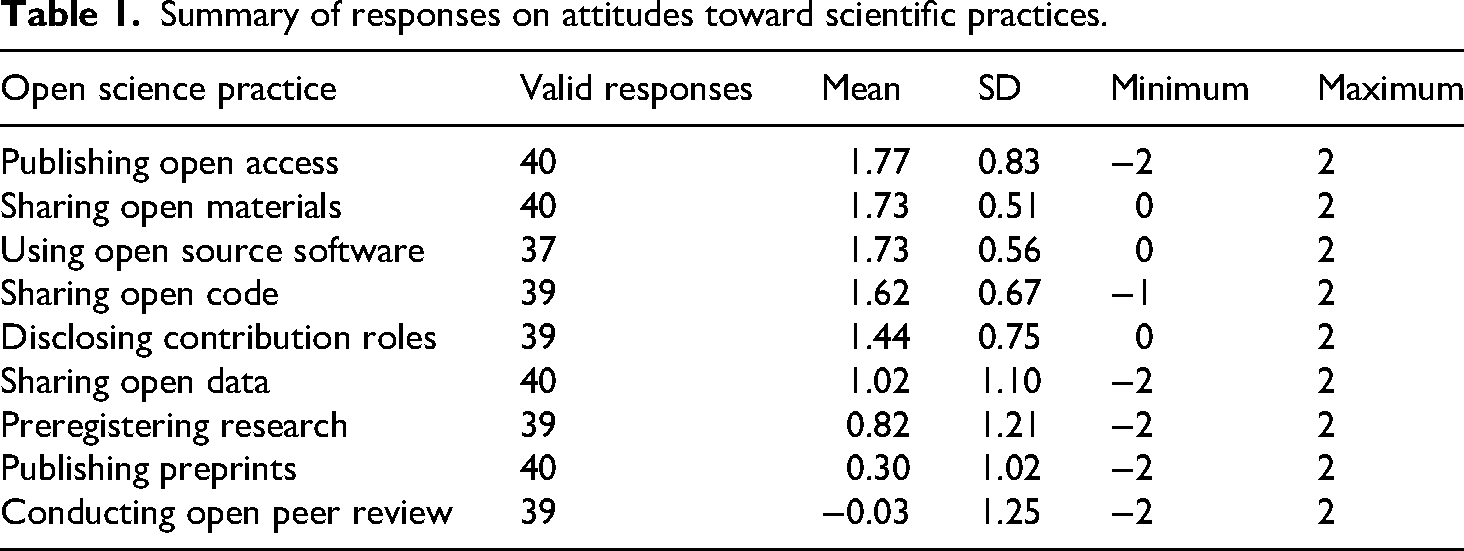
Respondents could then express their attitude toward these practices using a five-point Likert scale, ranging from ‘strongly against’ (−2), ‘somewhat against’ (−1), ‘neither against nor in favor’ (0), ‘somewhat in favor’ (1), to ‘strongly in favor’ (2), or could alternatively choose the answer category ‘don’t know’, which was treated as a nonvalid response in the subsequent analysis. The Likert scale was assumed to measure attitudes at the interval level, and numerical values were chosen so that positive values reflected positive attitudes and negative values reflected negative attitudes toward open science practices, while zero reflects a neutral position. Table 1 presents a summary of the answers to the Likert questions. Each Likert scale was followed by an open-ended question in which respondents could explain their stance in more detail: ‘Why are you against, neither against nor in favor, or in favor of [open science practice]?’. The questionnaire can be accessed through the Open Science Framework (OSF).
Summary of responses on attitudes toward scientific practices.
After the nine Likert scales and open-ended questions, the questionnaire ended with two background questions about career stage and methodological preference. As mentioned, the phase of respondents’ careers was measured since the open science movement is relatively new and cohort effects on open science attitudes could be expected with younger participants having more positive attitudes. The methodological preference was measured as qualitative researchers may have other experiences with some open science practices (e.g. sharing open code) than quantitative researchers, which could have affected their attitudes.
In order to measure their career stage, respondents were asked ‘How many years have passed since your PhD defense?’. The four answer options were ‘I have not yet defended my PhD’ (n = 19; 46.3%), ‘Less than 5 years’ (n = 4; 9.8%), ‘Between 5 and 10 years’ (n = 6; 14.6%) and ‘More than 10 years’ (n = 12; 29.3%). Moreover, in order to measure their methodological preference, respondents were asked ‘Do you predominantly identify yourself as … ?’. The answer categories included ‘Quantitative researcher’ (n = 20; 48.8%), ‘Qualitative researcher’ (n = 4; 9.8%), ‘Mixed methods researcher’ (n = 16; 39%) and ‘Other: specify’ (n = 1; 2.4%). Most respondents had either not yet defended their dissertation or had defended it more than 10 years ago. Nearly half identified as quantitative researchers, while most of the remaining respondents reported a preference for mixed methods.
Analytic strategy
The quantitative analyses started with descriptive statistics, presenting the mean scores and corresponding standard deviations for attitudes toward the nine open science practices. Subsequently, these mean scores were compared across respondents at different career stages and with varying methodological preferences. To ensure meaningful group comparisons, respondents who completed their dissertations within the past 5 years and those who completed them between 5 and 10 years ago were merged into a single category. Similarly, due to small sample sizes, respondents identifying themselves as social theorists or qualitative researchers were grouped with mixed-methods researchers into a broader category of nonquantitative researchers. Additionally, respondents who selected ‘Don’t know’ when asked about a specific open science practice were excluded from analyses related to that practice.
For the qualitative data, we conducted a thematic analysis (Braun and Clarke, 2006). Four researchers participated in the coding process: one as primary rater (number 1 in Table 2) and three as secondary raters (numbers 2a–c in Table 2). Since open-ended responses could include a mix of positive, neutral or negative sentiments and arguments (regardless of the corresponding Likert scale response) they had to be disaggregated into separate components. After becoming familiar with the open-ended responses, the primary rater therefore split the responses into units of analysis called arguments. These included not only formal arguments, but sometimes also rhetorical questions, preferences or enthusiastic comments about open science. Conjunctions such as ‘and’, ‘or’ and ‘but’ were often leveraged to separate different arguments within the same sentence. After splitting the responses, the nine open-ended responses of the 41 participants yielded a total of 504 arguments. Each argument was then assigned a sentiment value, a theme and—where appropriate—a subtheme. Nonresponses were not coded. Drawing on Abele-Brehm et al. (2019), the primary rater assigned a sentiment value of 1 for arguments in favor, of −1 for arguments against, and of 0 for neutral, mixed or unclear arguments. Next, the primary rater followed a bottom-up approach to assign the theme and subthemes, partly relying on prior knowledge of the topic. Themes and subthemes were iteratively refined for consistency and coherence, resulting in a unique coding scheme for each of the nine open science practices.
Initial inter-rater agreement and reliability for argument codes.
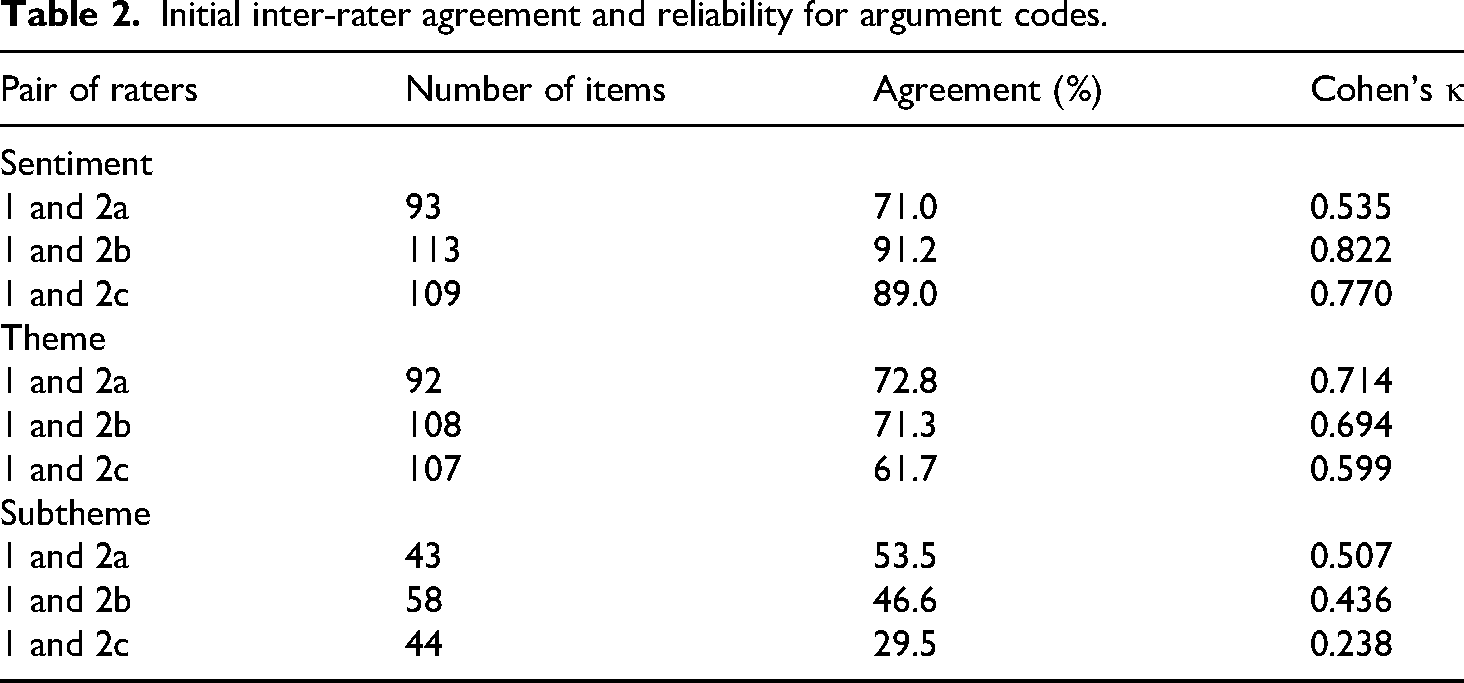
In a second round of coding, three data subsets containing approximately 100 arguments each (M = 105) were sampled from the dataset to assess inter-rater agreement. Each subset was assigned to a secondary rater along with a coding manual. The secondary raters independently applied the coding scheme to their respective subsets in a blinded process, without knowledge of the primary rater's and each other's coding decisions. We then assessed the inter-rater agreement for sentiment, theme, and subtheme by calculating the percentage of agreement and Cohen's kappa for each pair of raters (Table 2). Because most published qualitative studies do not include assessments of inter-rater coding reliability (Cole, 2024), it was difficult to properly evaluate the kappa values. However, based on a widely accepted rule of thumb (Landis and Koch, 1977) the initial degree of agreement was deemed insufficient, in particular for subthemes (to some extent likely due to their partial overlap). We therefore sought to improve coding reliability by having the secondary raters code the remainder of the dataset as well, and reaching a consensus with the primary rater in case of disagreements. In total, the pairs of raters disagreed on the sentiment in 14.9 percent (n = 75) of the items, and on the themes and subthemes in 28.6 percent (n = 141) and 48.3 percent (n = 114) of the items, respectively. Disagreements between the primary and secondary raters from both rounds of coding were resolved through pairwise discussions, lasting between 75 and 150 min. The final coding scheme is provided in the OSF.
Guided by this coding scheme, we structured our qualitative analysis, allowing us to identify arguments in favor; neutral, mixed, or unclear; and against the open science practices. Focusing solely on the arguments against, we identified concerns that we classified as barriers to open science.
The quantitative analyses in this article were conducted using the open-source software R (R Core Team, 2025) in RStudio (Posit Team, 2025), employing the following packages: broom (Robinson et al., 2023), gt (Iannone et al., 2024), here (Müller, 2020), knitr (Xie, 2024), patchwork (Pedersen, 2022), readxl (Wickham and Bryan, 2019) and tidyverse (Wickham et al., 2019). The R scripts can be accessed through the OSF.
Results
We present the study results in two parts. First, we report the findings on attitudes toward the nine open science practices. We rank the attitudes based on the mean value of support obtained, and also break them down by career stage and methodological preference of the respondents. Next, we analyze the correlations between attitudes. In the second part, we present the results of the thematic analysis of the open-ended questions. We begin with an overview of the arguments behind the attitudes toward the open science practices, followed by a more detailed analysis of the arguments against them.
Attitudes toward open science practices
Figure 1 displays the overall level of support for each open science practice, ranked from highest support (publishing open access) to lowest (conducting open peer review). Generally, participants viewed most open science practices positively, including publishing open access, sharing code and materials, and using open source software as the most positively viewed practices. There was comparatively lower support for conducting open peer review and publishing preprints, where participants were more neutral on average. Furthermore, views appear to align across career stages, albeit with some exceptions. In particular, there is more variation in support for sharing open data and conducting open peer review across career stages. Participants who had not yet completed their PhD reported less positive, more neutral perceptions of the two practices compared to those who have completed their PhD. Regarding methodological preferences, both quantitative and nonquantitative researchers report that they are in favor of most open science practices on average. Notably, however, there is generally less support for certain practices among nonquantitative respondents compared to quantitative respondents. Nonquantitative researchers in the sample report less favorable, or more neutral, views on sharing data, preregistering research, and conducting open peer review.
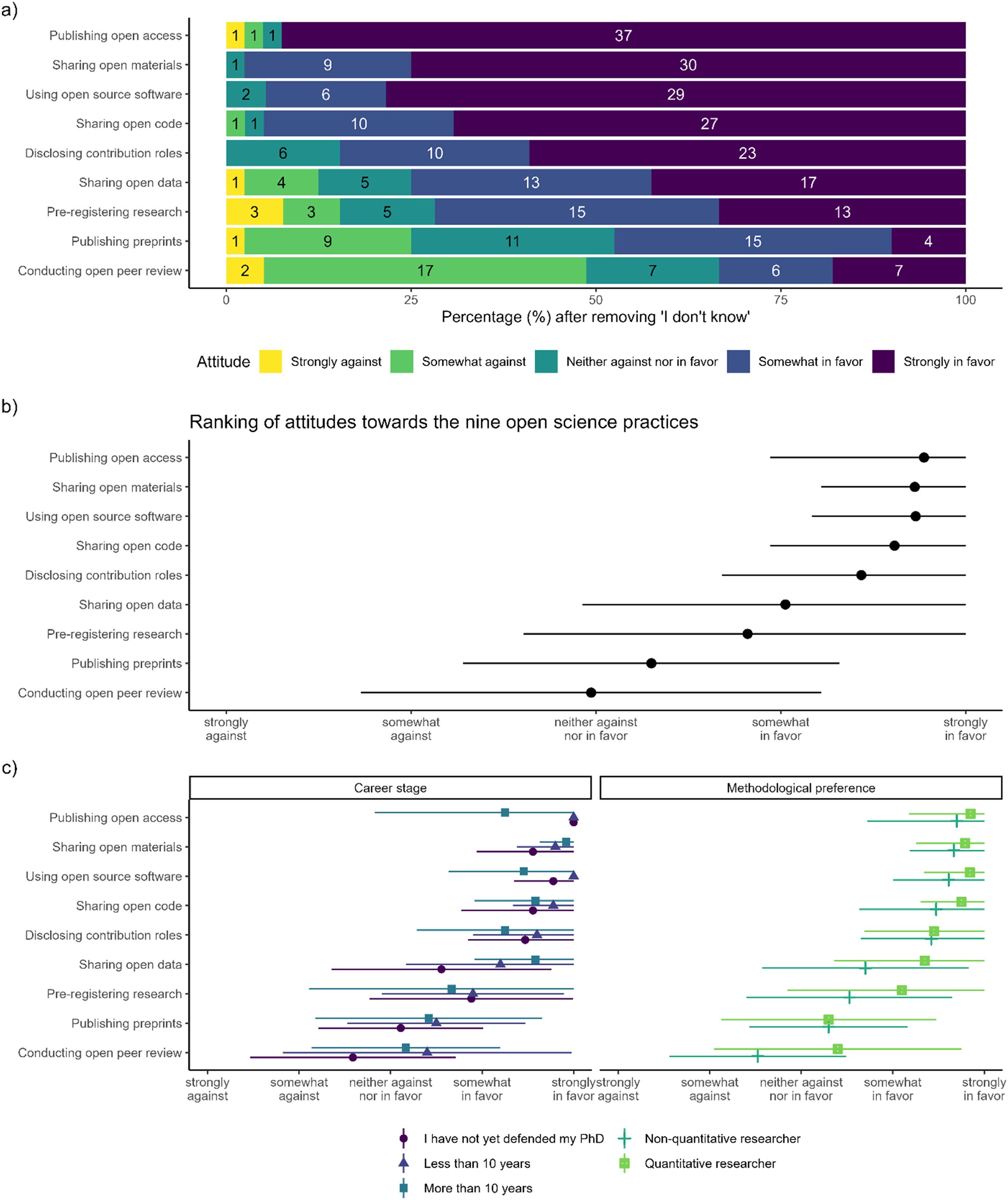
Ranking of attitudes toward the nine open science practices. Panel (a) shows, for each practice, the distribution of the responses on the five-point Likert scale. Panel (b) displays dots representing central tendency (mean), and lines representing the spread (standard deviation), illustrating the variability of the data. Panel (c) disaggregates these central tendencies and spreads by career stage and methodological preference.
Figure 2 shows that statistically significant correlations between open science practices, while positive, were moderate and not consistent regarding their magnitude. This finding suggests that individual participants hold different attitudes toward different open science practices, which challenges the idea that views on open science are one-dimensional.
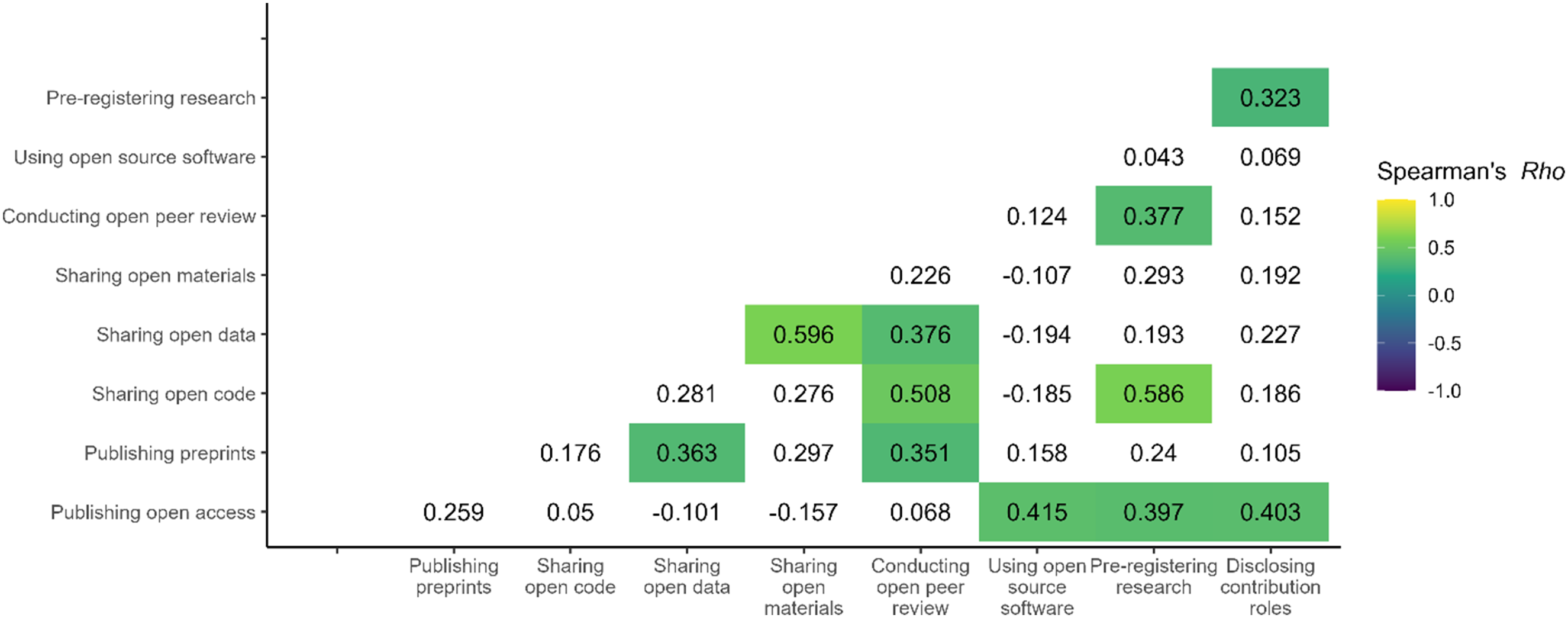
Correlogram of Spearman's rank correlations between the nine attitudes toward open science. Note: Only tiles with significant correlations are colored.
Overview of the arguments for and against open science practices
Most participants provided favorable arguments to explain their attitudes toward open science practices. Of the 503 arguments, 290 (57.7%) were classified as positive, 153 (30.4%) as negative and the remaining 60 (11.9%) were classified as neutral, mixed, or unclear. Considering that a clear majority of respondents reported neutral or positive attitudes toward the nine open science practices (see Figure 1(a)), the number of negative arguments is relatively large. It thus appears that respondents used the open response questions to articulate some reservations they may have with open science practices notwithstanding their overall favorable attitudes. Qualitative analysis offers additional insights that illustrate these mixed perspectives.
Many arguments in favor of open science practices revolved around themes such as replicability, reproducibility, and cumulative science. Arguments highlighting the importance of increasing replicability and reproducibility were prevalent and often intertwined. As one respondent stated: ‘Using open source software/sharing (sufficiently anonymized) data helps making research reproducible and replicable …’ (R4). Regarding cumulative science, several participants emphasized an efficiency argument using the idiom of ‘reinventing the wheel’ to criticize the unnecessary or redundant effort currently required to create analysis code and research materials due to the lack of standardization in measurement. One said that ‘[current research practice] results in everybody doing things their own way and reinventing the wheel over and over again instead of learning from each other and building on previous approaches via open materials’ (R29). Other positive arguments emphasized accountability (e.g. identifying individual contributions or enabling reviewer checks). For instance, one respondent explained that by disclosing contributor roles, ‘… in case of fraud in data collection, the authors involved can be held responsible, but not the authors who only wrote up the results and knew nothing about the data collection procedure’ (R18). Regarding resource optimization, another participant noted that ‘it would be nice if preregistering would lead (more often [than] it does now) to collaborations or comparative studies from researchers in different organizations or countries while research is still ongoing’ (R24). While respondents generally supported open science practices for the aforementioned benefits, arguments related to transparency, data and code sharing, and publishers revealed more mixed attitudes toward open science practices.
Transparency was largely viewed as a means to evaluate the research process, learn from peers, identify errors, and provide constructive feedback. As one respondent explained, open code ‘enhances the possibility to check the quality of research and also provides opportunity for feedback and enhancement’ (R41). However, for certain practices such as open data and open peer review, transparency was perceived as a mixed blessing. Regarding open peer review, another respondent thought that ‘it is possible that people can feel a bit [self-conscious] about the feedback being open access’ (R5). While most respondents acknowledged the value of open data, concerns were raised about sharing sensitive or crime-related data. One participant was ‘very in favor, but only as open as ethically (and legally) possible’, emphasizing that ‘researchers should take care to ensure that no one is identifiable in their data. And if necessary, partially restrict access, and/or use data sharing agreements’ (R10). Similarly, attitudes toward open access publishing were generally positive in principle, but tempered by concerns about costs and commercial publishers. One respondent expressed disapproval of ‘… large multinational companies making money without doing anything on the back of academics, whether or not this is open access’ (R3).
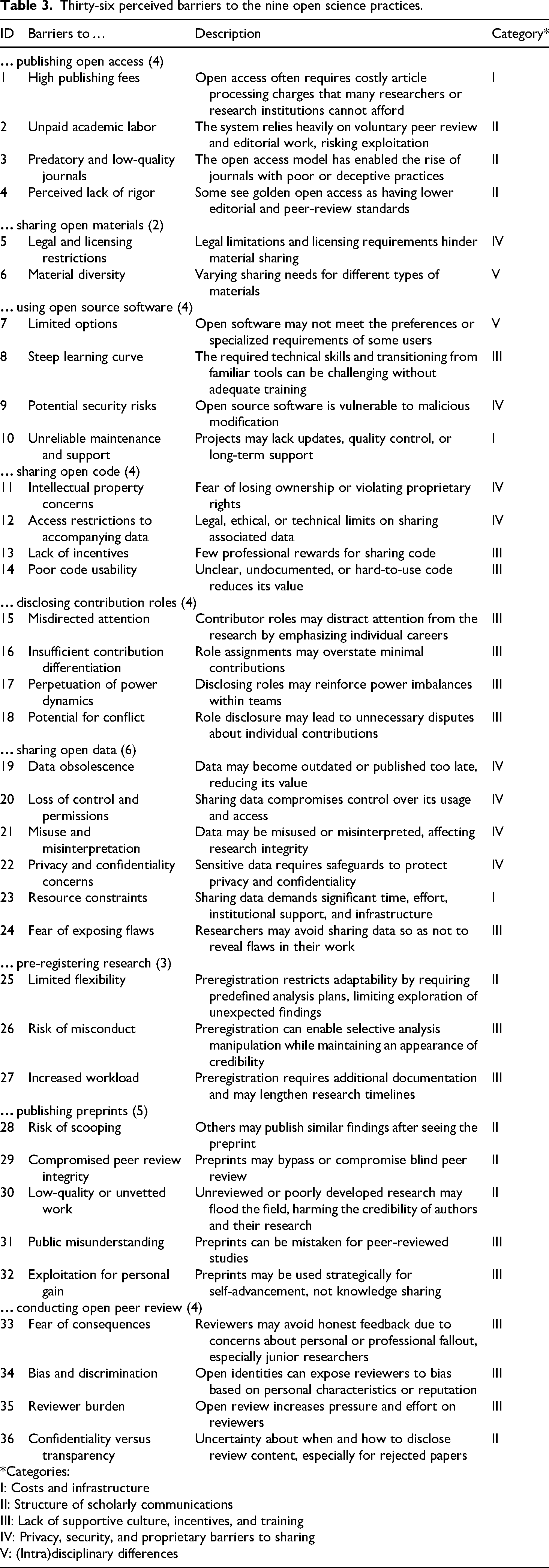
The arguments against adopting the open science practices were diverse. The following subsections present the results of the systematic analysis to identify barriers specific to each of the nine practices, classifying them according to the categories identified by the National Academies of Sciences, Engineering, and Medicine et al. (2018): (I) costs and infrastructure; (II) structure of scholarly communications; (III) lack of supportive culture, incentives and training; (IV) privacy, security and proprietary barriers to sharing; and (V) disciplinary differences. All 36 identified barriers were classified within these categories, with a small adjustment: ‘disciplinary differences’, which originally referred to differences between disciplines, has been renamed as ‘(intra)disciplinary differences’, indicating that it now refers to differences within the discipline of criminology. Table 3 provides an overview of the barriers, grouped by open science practices.
Thirty-six perceived barriers to the nine open science practices.
Costs and infrastructure
This category includes three barriers (#1, #10, and #23) related to the financial and logistical demands of implementing open science practices. Among them, respondents mentioned high publishing fees or article processing charges as a significant impediment to engaging in gold open access publishing. Concerns were also raised about the unreliable maintenance and support of open software tools and platforms, particularly in the long term, which would ultimately render such free alternatives obsolete. Respondents also perceived significant resource constraints related to making data open and FAIR (findable, accessible, interoperable, and reusable), including the substantial effort required for documentation, hosting and other supporting tasks, which can hinder engagement with open data practices. ‘So far there's just too little support for it I think, as it's kind of all left to the researcher’ (R6).
Structure of scholarly communications
The eight barriers in this category (#2, #3, #4, #25, #28, #29, #30, and #36) reflect challenges within current scientific publication and communication systems. These pertain to systemic issues related to norms, incentives and the organization and management of scientific knowledge, particularly in the areas of peer review, publication, and dissemination. In the case of open science publishing, respondents highlighted concerns about unpaid academic labor, viewing it as an unfair foundation of the gold open access model that disproportionately benefits publishers. This publishing landscape is also seen as contributing to the emergence or persistence of predatory and low-quality journals, projecting a perceived lack of rigor on academic output. As one respondent noted, ‘… there are several negative side-effects [to publishing open access] such as the rise of all those predatory journals who basically just publish anything anyone is willing to pay for’ (R8).
Respondents also expressed concerns about the structure and oversight in other open access publishing formats, such as preregistration and preprints. Preregistration was perceived by some respondents as offering limited flexibility, potentially constraining the role of exploration in scientific discovery, or even unrealistic. As one respondent puts it: ‘show me a researcher who says that they can really specify ALL steps in complete detail before data collection, and I’ll show you a liar …’ (R40). Regarding preprints, respondents noted that their very nature—being made public before undergoing peer review—may result in lack of sufficient refinement and therefore the dissemination of low-quality or unvetted work. The publication of this first draft with the authors’ names could result in compromised peer review integrity, as it would no longer be possible to ensure a blind review. Preprints were also perceived as a potential threat to proper attribution and scholarly credit, translating into risk of scooping. As one respondent explained, ‘… some unscrupulous scholars [are] using pre-published ideas without citation’ (R21). Relatedly, participants mentioned tensions surrounding the editorial management of open peer review, particularly when dealing with rejected manuscripts or peer-review reports (and the responses to them), emphasizing the need to carefully balance confidentiality versus transparency.
Lack of supportive culture, incentives and training
Fifteen barriers (#8, #13, #14, #15, #16, #17, #18, #24, #26, #27, #31, #32, #33, #34, and #35) fell into this category, the most substantial one. Collectively, these barriers reveal profound cultural challenges and institutional shortcomings that either discourage or complicate the adoption of open science practices. The underlying causes appear to be a combination of insufficient training, misaligned incentives, and a research culture that often does not favor openness.
The absence of a supportive culture was evident across multiple barriers. Respondents cited a fear of exposing flaws as a deterrent to sharing open data. Others expressed a fear of consequences for writing critical open peer reviews, which they felt could negatively affect their career prospects, including job applications and tenure. Early-career scholars and minority groups were perceived as especially vulnerable to bias and discrimination. As one respondent noted, ‘In some countries, hierarchy still plays a key role. As a younger researcher, you might be criticized more than bigger names in the field’ (R1). Similar concerns were reflected in attitudes toward disclosing contributor roles, which were seen as having potential for conflict and perpetuation of power dynamics, leading to power imbalances or unnecessary disputes within teams. Others raised concerns about inaccuracies in attribution, such as overstating minimal contributions or misdirected attention from the research itself to the individual careers of authors. Collectively, these barriers underscore a lack of a supportive environment for practicing open science, shaped by cultural tensions surrounding transparency and credit in collaborative work.
Another issue that could be related to the lack of a supportive culture is the misalignment between academic incentives and open science practices. One barrier to sharing open code was the lack of incentives for the time and effort required. As one respondent noted: ‘There is almost no incentive for individual researchers to share code. At least not for tenure, promotion, salary, and so on’ (R40). The pressure to ‘publish or perish’, combined with limited oversight over preprint publishing, was seen by some as enabling their strategic exploitation for personal gain, for example, to inflate academic records for job applications or grant proposals. Concerns about risk of misconduct were also raised regarding preregistration. For instance, a respondent remarked: ‘In the case of secondary data … you could have done all the analyses before pre-registering—if you do that, you’re more or less whitewashing your results through pre-registration’ (R2). These perspectives suggest that current academic reward structures insufficiently recognize or incentivize openness.
In the absence of adequate incentives, practices such as preregistration and open peer review are often perceived as burdensome, particularly when institutional support is lacking. Respondents noted that preregistration can lead to an increased workload and extend the duration of research projects, with some viewing it as a procedural formality rather than a meaningful contribution. Similarly, open peer review was seen as adding to the reviewer burden, requiring greater attention to tone, grammar, and sentence structure due to the publicity of reviewer comments.
Another key issue is the lack of training, which would affect not only researchers but also external stakeholders, such as journalists who interpret scientific findings. Respondents identified public misunderstanding as a barrier to publishing preprints, raising concerns that ‘preprints have not gone through peer review, but laypersons or the media will likely not fully grasp what this entails and might interpret findings in preprints as “final” rather than “preliminary”’ (R30). Insufficient training was also reflected in barriers related to poor code usability, where shared research code was often poorly documented, limiting its re-usability and hindering reproducibility. Additionally, respondents mentioned the steep learning curve associated with acquiring the technical skills necessary to effectively use open software tools as an obstacle to adoption.
Privacy, security and proprietary barriers to sharing
Another set of eight barriers (#5, #9, #11, #12, #19, #20, #21, and #22) centers on concerns regarding the risks and limitations associated with sharing data and other research outputs openly, and using open software. These concerns relate to actual or perceived threats to legal ownership, data integrity, privacy, utility, and the safety of research subjects. For instance, respondents were aware of the legal and licensing restrictions to share copyrighted materials, such as codebooks and measurement scales, as well as intellectual property concerns when reusing or sharing others’ code openly. Sharing research code was also viewed as less effective when there are access restrictions to accompanying data, which is often restricted, particularly in criminology where datasets are usually sensitive. Some participants questioned the utility of open data for future research, citing potential data obsolescence. As one respondent noted, researchers collecting data ‘probably want to be the first ones to publish …which means the publication of the data will often occur quite a bit later. While understandable, this might devalue the data for potential other users, as the data become outdated’ (R30).
Respondents also expressed concerns about the malicious use and the diminished oversight that may follow the release of open research resources, particularly regarding open software and open data. Participants mentioned potential security risks associated with open-source software, noting that ‘if it's possible for everyone to be able to adapt it, ... also people with bad intentions would be able to [exploit it]’ (R27). In the context of open data, respondents emphasized privacy and confidentiality concerns, especially in relation to sensitive information from research subjects. Additionally, there were concerns about the loss of control and permissions over how such data are accessed and used. Such concerns reflected fears of misuse and misinterpretation, which could lead to incorrect or harmful conclusions and, ultimately, harm to research subjects. As one respondent noted: ‘I am wary because, as a largely qualitative scholar, I feel protective of respondents. I cannot control others’ interpretations but I am the one who am responsible to respondents’ (R21).
(Intra)disciplinary differences
The final two barriers (#6, and #7) suggest that open science practices are not universal and must be tailored to the diverse needs of researchers within the discipline. The first barrier points to material diversity—the variety of datasets, code, and research instruments, which may require differentiated sharing strategies. The second relates to the limited functionality that, according to respondents, some open-source software have, which may not meet the technical standards, preferences, or workflow requirements of all researchers.
Discussion
Over the past two decades, many scientific organizations have started to promote the adoption of open science principles. However, their implementation in the workplace seems to have lagged behind. Recognizing this discrepancy within our research institute, the NSCR, we distributed an online questionnaire among our colleagues to describe variations in their attitudes toward nine open science practices and to identify barriers to adopting these practices. The nine practices were: publishing open access, publishing preprints, sharing open code, sharing open data, sharing open materials, conducting open peer review, using open source software, preregistering research, and disclosing contribution roles. In line with previous surveys of scholars from criminology and other social science disciplines (e.g. economics, political science, psychology, and sociology) (Center for Open Science, 2022; Christensen et al., 2020; Ferguson et al., 2023), the quantitative analysis of Likert-scale responses demonstrated an overall strong support for open science practices. In particular, we found very positive attitudes toward publishing open access, sharing open code and materials, and using open source software, and more neutral attitudes toward open peer review, and publishing preprints. Although in our study attitudes did not vary a great deal across career stage or across methodological preference, early-career researchers and nonquantitative researchers were less positive about sharing open data and open peer review than more experienced and quantitative researchers. The statistically significant correlations between the nine attitudes were all positive but moderate, which suggests that it is not useful to aggregate them into a single metric. Future research using larger samples and more items could attempt to identify interpretable clusters of attitudes, for example, based on the research stage to which they apply (planning, execution, and dissemination).
When further examining differences in attitudes toward open science practices by career stage, we also found patterns consistent with previous studies that reported no or minor differences (Chin et al., 2023; Ferguson et al., 2023). This suggests that the relationship between seniority and attitudes toward open science practices in criminology might not be substantially different from that of other social sciences, such as economics, political science, psychology, and sociology. The limited weak relation between seniority and attitudes implies that the adoption of open science practices is not simply a process succession, whereby younger generations with new ideas replace more conservative older generations.
In terms of methodological preference, we found that researchers who preferred quantitative methods showed more positive attitudes than those who preferred qualitative, mixed-methods, or theoretical approaches. Similarly, Christensen et al. (2020) and Ferguson et al. (2023) found that scholars who reported using quantitative experimental methods had more positive attitudes toward open science, followed by quantitative nonexperimental researchers, and finally those who used qualitative or theoretical methods. That qualitative scholars show more reservations toward open science practices could be explained by their lower levels of awareness and engagement with them (Christensen et al., 2020; Ferguson et al., 2023), although our thematic analysis also shows that qualitative researchers, for example, express concerns about the potential impact of practices such as open data on the anonymity and safety of research participants, and the confidentiality of their responses. This is particularly important in criminology, where research participants often include offenders, victims, and members of the criminal justice system.
Notwithstanding the generally positive attitudes toward most of the nine open science practices, through the qualitative thematic analysis of open-ended questions, we identified no less than 36 different barriers that would need to be addressed in order to stimulate the further adoption of open science practices. Respondents raised several potential negative effects and byproducts of open science practices that need to be addressed for open science to become more widely adopted in our institute. Two out of five barriers related to the lack of supportive culture, incentives, and training (41.7%); another two-fifths corresponded to the structure of scholarly communications (22.2%) and privacy, security, and proprietary barriers to sharing (22.2%); while costs and infrastructure (8.3%), along with (inter)disciplinary differences (5.6%), made up the remaining portion. Overall, the barriers do not appear to be unique to criminology but are rather generic and likely applicable to other social sciences.
The barriers for qualitative researchers are perhaps particularly challenging to address. Our research is in line with previous studies that show qualitative researchers face particularly challenging barriers in regard to data privacy and anonymization, concerns about reusing and interpreting secondary qualitative data, and gaining informed consent (Gore-Gorszewska, 2024; Mozersky et al., 2021). Indeed researchers have noted that the infrastructure and formal guidelines for sharing qualitative data is still lacking (DuBois et al., 2023). DuBois et al. (2023) examined the process of making qualitative health data available for secondary use, including what to share, how to de-identify data, and how to document and reuse the data. They found that even if qualitative researchers wanted to share data, there were few repositories that are equipped to share and provide guidance on responsible sharing of qualitative data. More attention is needed within criminology to discuss these critical questions and develop clear guidelines about what qualitative data to share, when and where.
Although prior research on this topic is scarce in criminology, one previous report provides useful context for interpreting our findings (Center for Open Science, 2022). Specifically, regarding barriers to preregistration, the report found that nearly half of criminological researchers indicated a lack of familiarity with the practice, almost one-third pointed to the absence of a dedicated repository as a reason not to preregister, and about one in three stated that they did not see it as relevant (Center for Open Science, 2022). The authors of the report attribute these responses to a potential lack of education on the topic. However, our respondents did not mention any of these barriers in the open-ended questions. Instead, they focused on issues such as increased workload, lack of flexibility, and risk of misconduct. This may suggest that awareness of preregistration is high enough in our institute to focus concerns on the practical challenges of implementing practice. It may also reflect that the use of open-ended questions in our study enabled the identification of issues that the closed-ended questions in the previous survey overlooked. Either way, the barriers identified here provide a fresh perspective in the field, offering a more nuanced understanding of concerns surrounding each of the nine open science practices. This analysis, in turn, lays the groundwork for addressing the lack of support for or adoption of these practices.
It should be noted that the scientific staff of the NSCR does not constitute a representative sample beyond its own context, and therefore the quantitative findings cannot be generalized to other populations. In addition, although the response rate of 32.3 percent is not much lower than in other online surveys (Wu et al., 2022), it may introduce bias. For example, researchers less familiar with open science, or more generally those without strong opinions toward open science, might have been less likely to participate in our study, potentially influencing the results by making attitudes look more polarized than they really are. While acknowledging the restricted sample frame as a limitation, we emphasize that it also comes with a considerable advantage. By conducting the study in a single institution, we explored the variability in attitudes among researchers who face the same institutional opportunities and constraints. Our findings demonstrate that even within a single institute, researchers have different attitudes toward open science practices. The qualitative findings about motivations, beliefs, and perceived barriers may also reflect shared experiences within the NSCR, but they are not to be judged primarily by their generalizability.
Our research findings apply to cognitions—attitudes, beliefs, perceptions, and motivations—but not to behavior. Because attitudes do not necessarily translate into behavior, it cannot be assumed that reducing perceived barriers will inevitably lead to behavioral change. As some studies have already done (e.g. Chin et al., 2023), it is important that future research not be limited to attitudes, but also include questions about actual open science practice.
As a research institute, the NSCR primarily faces challenges related to the nine practices included here. Although these practices are commonly discussed in the literature and are embedded in the NSCR's routine work, our selection was necessarily limited to avoid imposing unnecessary constraints on the respondents. In doing so, we excluded practices such as citizen science or open education. Although we acknowledge the importance of these practices, we selected those most relevant to our mission as a national research institute to promote open science communication and efficient knowledge production. It is possible that other university departments or research institutions, particularly educationally oriented institutions, report different attitudes or obstacles towards open science practices.
Footnotes
Acknowledgements
We are grateful to our colleagues at the NSCR for their time, interest and valuable contributions to this study. In particular, we thank Frank Weerman (NSCR & Erasmus University Rotterdam) for his thoughtful feedback and assistance in revising the questionnaire. We are also thankful for the feedback provided by Réka Solymosi (University of Manchester) and two anonymous reviewers, which has helped to improve the manuscript.

Ethical considerations
The authors of this study considered that ethical approval from an Ethics Committee or an Institutional Review Board was not necessary.
Consent to participate
All participants provided written informed consent prior to participating.
Author contributions
Funding
The authors received no financial support for the research, authorship, and/or publication of this article.
Declaration of conflicting interest
The data for this study were collected from a sample of the scientific staff at the Netherlands Institute for the Study of Crime and Law Enforcement (NSCR). NSCR is also the primary or secondary affiliation of the authors of this article, all of whom participated in the survey.
Data availability statement
The datasets generated during and/or analyzed during the current study are not publicly available due to: (1) the researchers not having asked for explicit consent from participants for open data in the informed consent and (2) concerns about anonymity given the study population raised by some participants, who indicated that they might have responded differently to the questionnaire if they had known their data would be openly shared. For these reasons, the data are available only from the corresponding author on reasonable request, defined as a written request specifying the intended use of the data, and a data management plan that ensures the confidentiality and privacy concerns of the participants.