






Abstract
Background
Relational and moral dimensions of prison life are widely recognised as important components of prisoners’ well-being and institutional functioning. However, fewer studies have examined the relative contribution of staff–prisoner and peer relationships to overall prison climate, particularly whether these associations ‘travel’ beyond Western contexts to understudied prison systems such as Serbia. This study investigates how these relational dynamics relate to prisoners’ overall evaluations of prison climate within the five largest prisons in Serbia, while accounting for individual and institutional factors.
Methods
A cross-sectional survey included 577 prisoners (86% males, average age 39.9 years) using the Measuring the Quality of Prison Life (MQPL) survey. Most participants (75%) were held under a closed regime and had been incarcerated for more than 1 year (73%). While over half (52%) had non-violent offences, 39 percent had received at least one disciplinary measure. Hierarchical regression analyses were used to examine the predictive value of two MQPL dimensions (staff–prisoner and prisoner–prisoner relationships) on prisoners’ overall evaluation of the prison climate, controlling for individual-level characteristics, institutional conditions and prison-fixed effects.
Results
Hierarchical regression showed that adding relational dimensions increased the explained variance in prison climate from 23 to 51 percent. Staff–prisoner relationships were the strongest predictor (β = .56), while peer interactions (β = .09), regime type, and lockdown had smaller effects. Climate was rated moderately positive. Functional day-to-day staff interactions coexisted with low institutional trust and signs of social withdrawal among peers.
Conclusions
The findings suggest that prison climate theory is portable beyond Western contexts. Relational dimensions, particularly staff–prisoner relationships, retain strong associations with climate evaluations in Serbia even after accounting for structural and institutional factors. However, regime conditions and routine restrictions remain relevant boundary conditions. The Serbian case further indicates that institutional order may coexist with low trust, distinguishing functional authority from trust-based legitimacy.
Introduction
Prison climate has become one of the central concepts in comparative penology. It captures lived experience of imprisonment and is consistently associated with prisoner well-being, institutional order and rehabilitative outcomes (Auty and Liebling, 2020; Ilijić et al., 2024a; Skar et al., 2019; Van Ginneken, 2022). In contemporary research, prison climate is often operationalised as quality of prison life and understood as a multi-domain construct that includes the social/relational, emotional, organisational and physical environment as perceived by both prisoners and staff (Liebling et al., 2012; Ross et al., 2008; Van Ginneken and Nieuwbeerta, 2020).
This study is motivated by the question of how much relational and structural factors each explain perceived prison climate, and whether influential relational theories from Western contexts apply to penal systems with different institutional conditions. A large body of empirical work demonstrates that relational quality, especially staff–prisoner relationships, correlates with broader evaluations of prison climate in many settings (Crewe, 2011; Crewe et al., 2015, 2023; Hall, 2016; Järveläinen and Rantanen, 2019; Liebling et al., 2021; Milićević, 2025; Waite, 2022). At the same time, recent work cautions against treating staff–prisoner relations as the single dominant factor across different contexts, especially when considering physical environment and formal structures like regime type or security level (Hacin and Meško, 2018; Madoc-Jones et al., 2016; Milićević and Hacin, 2025; Palmen et al., 2022; Pape and Johnsen, 2026; Skar et al., 2019; Van Ginneken et al., 2018). Contemporary prison climate research now treats the relationship between relational and structural influences as an empirical question to be tested in concrete institutional settings, rather than assuming a universal order of determinants (Barquín et al., 2019; Pape and Johnsen, 2026; Van Ginneken and Nieuwbeerta, 2020).
A second, related gap makes this question even more important. Most evidence on prison climate comes from relatively stable, well-resourced Western European and Anglophone prison systems, which set the main standards for theory, measurement and comparison in the field (Neubacher et al., 2021; Ross et al., 2008; Van Tiem et al., 2025). Much less is known about prison climate in transitional or post-socialist contexts, where penal institutions may face organisational strain, high staff and prisoner turnover, and ongoing reform processes (Hacin et al., 2022; Kantokoski, 2025; Milićević, 2025; Oleinik, 2007). In such settings, relational dynamics may be influenced by distinct historical trajectories, penal cultures and resource-related constraints, potentially altering how prisoners evaluate everyday legitimacy, safety, predictability and organisational functioning (Oleinik, 2007; Pascaud and Kazemian, 2025; Van Tiem et al., 2025).
Located in Southeast Europe, Serbia represents a particularly relevant case to address this question and investigate the portability of relational climate theory, that is, whether the relational models of prison climate ‘travels’ beyond their usual Western settings (Liebling et al., 2021; Neubacher et al., 2021). It is a post-socialist, reform-oriented penal system formally aligned with European standards, yet operating within persistent material and organisational pressures (Aebi and Cocco, 2025; Milićević and Hacin, 2025). More broadly, European prison systems differ substantially in prison population trends and characteristics, reinforcing the idea that penal philosophies, and not only institutional conditions, vary significantly across Europe (Aebi and Cocco, 2025; Hacin, 2025). Considered in this way, the applicability of ‘Western’ prison climate is essentially a comparative issue, not just a question of geographical diversification. Although research from the Balkan region is growing, Serbia remains largely overlooked in comparative studies of prison climate (Milićević, 2024; Nivette, 2025).
In this context, the present study contributes to comparative prison climate research in two ways. First, it advances a relational legitimacy framework by identifying staff–prisoner and prisoner–prisoner relationships as key areas where moral performance and institutional legitimacy are demonstrated and experienced. At the same time, it acknowledges that structural constraints and the physical environment may act as boundary conditions, not just background factors. Second, the study examines the relative contributions of these two relational domains to perceived prison climate in Serbia's largest prisons, focusing on closed and semi-open wards where formal security levels are similar, but prisoners’ experiences differ empirically (Ilijić et al., 2024b; Milićević and Glomazić, 2025; Van Ginneken et al., 2018).
Relational dimensions and the moral foundation of prison climate
Understanding prison climate requires attention to both structural conditions and the quality of social relationships within institutions. Classic work has often been organised around two perspectives (Van Ginneken and Wooldredge, 2024). Deprivation Theory, proposed by Sykes and Messinger (1958, as cited in Sykes, 2007), emphasises the ‘pains’ and constraints of imprisonment, arguing that restrictions on liberty, autonomy, security, and social contact shape prisoners’ adaptation, social organisation, and coping strategies. In contrast, importation model, developed by Irwin and Cressey (1962), argues that prisoners bring pre-existing experiences, values and social identities into prison, shaping how they interpret and participate in prison life. While these perspectives remain useful for understanding variation in prison experiences (Dhami et al., 2007; Souza and Dhami, 2010), contemporary prison climate research moves beyond this strict deprivation–importation dichotomy towards relational and moral dimensions of imprisonment (Van Ginneken and Nieuwbeerta, 2020). The quality of everyday interactions, perceptions of fairness and respect, and experiences of legitimacy are considered central to how prison life is evaluated (Crewe et al., 2015, 2023; Higgins et al., 2022; Liebling et al., 2012).
Within this relational turn, the concept of moral performance has become particularly influential. Prisons are treated not only as secure institutions, but as moral and social worlds shaped by legitimacy, fairness, humanity and staff uses of authority. Moral performance captures how authority is enacted in daily practice, and how these practices are interpreted by those subject to them (Crewe et al., 2015; Liebling, 2004, 2011b). In this framework, institutional legitimacy refers to the perceived rightfulness of institutional authority; when staff exercise authority in ways experienced as procedurally fair and relationally respectful, prisoners are more likely to view rules and decisions as rightful and prison as legitimate, safe and predictable (Crewe, 2011; Crewe et al., 2015; Liebling, 2004, 2011b). Conversely, perceived arbitrariness, disrespect or inconsistency can undermine legitimacy and magnify the experienced ‘weight’ of imprisonment. Prison climate is therefore not only a function of material or security-level conditions but also of how power is exercised and interpreted through interpersonal encounters.
Staff–prisoner relationships represent a core mechanism through which legitimacy is produced or undermined (Kyprianides and Easterbrook, 2020; Milićević, 2025; Molleman and Leeuw, 2012; Molleman and Van Ginneken, 2015). As Liebling (2011a: 485) argues, these interactions are ‘at the heart of the whole prison system’, linking the everyday use of authority to institutional order, legitimacy and the broader moral climate (Liebling et al., 2012; Skar et al., 2019). High-quality staff–prisoner relationships, characterised by fairness and trust, are frequently associated with more positive evaluations of legitimacy, safety and overall climate (Crewe, 2011; Felix et al., 2023; Hacin and Meško, 2018; Waite, 2022). Conversely, interactions perceived as inconsistent or dehumanising directly undermine the moral authority of the institution and lead to negative climate evaluations (Crewe et al., 2023; Higgins et al., 2022; Logan et al., 2022; Worley et al., 2021).
Peer relationships also shape adaptation to imprisonment and perceived prison climate (Ilijić et al., 2024a). Supportive prisoner–prisoner relationships can decrease the pains of imprisonment and improve prisoner well-being, while conflict, exploitation or distrust can intensify insecurity and make day-to-day life more threatening (Chong, 2013; Kyprianides and Easterbrook, 2020; Skar et al., 2019). Therefore, it does not come as surprise that contemporary prison climate research conceptualises peer relations as part of the broader relational ecology of imprisonment, operating alongside staff–prisoner relationships (Pape and Johnsen, 2026). Emerging work on social ties in prison further reinforces peer relations as a meaningful component of prison climate rather than merely an adaptive survival strategy (Peng et al., 2026).
Importantly, the balance between relational and structural influences may vary across institutional contexts. For example, Van Ginneken and Nieuwbeerta (2020) demonstrate that prison climate includes both shared, context-level components (e.g. unit- or prison-level patterns) and individual-level variation in perceptions. While regime type, staffing levels and architectural design can influence prison climate, relational dimensions frequently emerge as stronger predictors of prisoners’ overall evaluations in many studies (Auty and Liebling, 2024; Beijersbergen et al., 2016; Kyprianides and Easterbrook, 2020; Pape and Johnsen, 2026; Van Ginneken et al., 2018). Yet much of the evidence base comes from the contexts characterised by relatively stable institutional structures and well-developed professional cultures (Neubacher et al., 2021; Ross et al., 2008; Van Tiem et al., 2025). In a post-socialist system such as Serbia, organisational pressures, limited treatment resources and ongoing institutional transitions may reshape both the formation of relationships and their meaning for perceived climate (Oleinik, 2007). Accordingly, it is methodologically and theoretically justified not to presume a single universal ordering of determinants. Whether relational dynamics hold in transitional or resource-constrained penal systems remains underexplored.
Serbian prison system: Institutional context and recent prison research
The Serbian prison system is governed by the Administration for the Enforcement of Penal Sanctions under the Ministry of Justice. Its legal foundation is in the Law on the Execution of Criminal Sanctions, which defines social reintegration of convicted persons as the primary purpose of their imprisonment (LECS, 2019, Art. 2). The penal network has 29 publicly operated facilities, classified by security level (open, semi-open, closed and maximum security), where prisoner placement is determined by risk assessment and sentence length (Bobić et al., 2022; Vujičić and Karić, 2020).
Serbia offers a relevant setting for testing the applicability of Western relational models, given its unique structural and organisational challenges. SPACE I 2024 reports a prison population rate of 177.1 per 100,000 and a prison density of 97.9 per 100 available places (Aebi and Cocco, 2025). While the system is not formally overcrowded at the national level, individual cell accommodation is not standard practice; prisoners are typically housed in shared cells with an average of 3.6 occupants (Aebi and Cocco, 2024). Although the statutory minimum floor space (4 m2 per prisoner) aligns with European minimum standards for shared accommodation (Council of Europe, 2020; CPT, 2015; LECS, 2019), ageing infrastructure and uneven prisoner distribution create qualitative constraints and limited privacy that occupancy rates alone do not fully capture.
In 2022, during our data collection, there were 7324 sentenced individuals within a designated capacity of 9064 places (Aebi and Cocco, 2024). Total prison population, including pre-trial detainees, was 10,787 within an overall system capacity of 11,957 places in 3018 cells, corresponding to a prison density of 90.2 per 100 available places. Staffing patterns further highlight the custodial orientation of the system. This ratio was 2.6 prisoners per staff member and 4.5 per custodial officer, but only 18.4 percent of total staff were assigned to rehabilitative or vocational tasks. Furthermore, a high turnover ratio (63.1%, when the European average was 52.3%), reflects a dynamic and potentially volatile environment (Aebi and Cocco, 2024).
Despite legislative reforms and infrastructural upgrades, the system faces persistent underfunding (daily detention costs are significantly below the European average), limited rehabilitative programmes, and a shortage of specialised staff (Jovanić et al., 2020). Recent monitoring has documented restricted out-of-cell time and elevated peer conflict in closed wards, alongside emerging good practices in dynamic security training and structured prisoner work engagement (National Mechanism for the Prevention of Torture – Report for 2023, 2024; National Mechanism for the Prevention of Torture – Report for 2024, 2025).
Previous research in Serbia provides a further rationale for focusing this study on relational dynamics. One study suggests that general living conditions appear to have little impact on prisoners’ perceptions of treatment quality, with positive staff–prisoner relationships and perceptions of fairness as the key predictors of favourable treatment evaluations (Bobić et al., 2022). Other work identifies peer dynamics as a major source of distress and emotional disturbance, with negative or challenging interactions having a significant impact on how stressed and emotionally unwell prisoners felt (Ilijić et al., 2024a). Research among female prisoners indicates that external family bonds and formal staff support are prioritised over peer networks, and that staff–prisoner relationships are among the most positively evaluated aspects of prison climate (Batrićević et al., 2023; Savić and Knežić, 2019).
Importantly, another MQPL-based study found a clear pattern: prisoners in semi-open wards reported significantly higher overall quality of prison life than those in closed regimes, and the authors explicitly described semi-open wards as housing low/medium-risk individuals who may receive extended privileges (e.g. temporary leaves) conditional on behaviour and programme participation (Ilijić et al., 2024b). Unlike studies focusing narrowly on perceived treatment (Bobić et al., 2022), this study captured broader evaluations of prison climate that may be particularly sensitive to regime-related variations. This distinction provides additional methodological justification for focusing on closed and semi-open wards: these settings offer broadly comparable formal control while retaining meaningful variation in lived experience.
The MQPL framework and its assessment of social relationships in prison
Several instruments have been developed over recent decades to assess prison climate, including the Essen Climate Evaluation Schema (EssenCES; Schalast et al., 2008), the Measuring the Quality of Prison Life (MQPL; Liebling et al., 2012), and the Prison Climate Questionnaire (PCQ; Bosma et al., 2020). Collectively, these measures have advanced prison climate research and contributed significantly to our understanding of individual- and unit-level climate effects (Peart et al., 2024; Van Ginneken and Nieuwbeerta, 2020).
In this article, we conceptualise prison climate as prisoners’ perceived quality of prison life across relational, moral, organisational and safety domains, consistent with MQPL-informed research. Grounded in the concept of moral performance and informed by prisoners’ lived experience, the MQPL assesses fairness, trust, legitimacy, safety and everyday interaction within prison, and aligns closely with our focus on relational aspects of imprisonment, particularly staff–prisoner and prisoner–prisoner relationships. It operationalises prison life through five overarching categories: Harmony, Professionalism, Security, Conditions and Family Contact, and Well-being and Development (Liebling et al., 2012). Importantly in the context of cross-national application, the MQPL has been culturally adapted and psychometrically validated in Serbia (Međedović et al., 2024; Milićević et al., 2024). Using a locally adapted and psychometrically validated instrument improves measurement stability and increases sensitivity to context-relevant features of prison systems, including the Serbian penal context (Pascaud and Kazemian, 2025).
Within the MQPL framework, the Harmony domain captures the moral and relational character of prison interactions, primarily through the Staff–Prisoner Relationships subscale (Liebling et al., 2012). Although the original instrument lacks a dedicated scale for general peer dynamics, a measure of prisoner–prisoner interactions can be constructed from conceptually relevant items, following approaches adopted in previous research (Ilijić et al., 2024a; Kyprianides and Easterbrook, 2020).
Current study
This cross-sectional study examines relational dynamics among prisoners housed in closed and semi-open wards in the largest prisons in Serbia. Specifically, it assesses the relative contributions of staff–prisoner and prisoner–prisoner relationships to perceived prison climate when controlling for individual and institutional factors. Given evidence that prison climate varies across regimes and institutions (Ilijić et al., 2024b; Milićević and Hacin, 2025; Van Ginneken et al., 2018), the study focuses on closed and semi-open wards to ensure comparability in formal control and security while allowing meaningful variation in lived experience. By empirically evaluating whether relational dimensions retain explanatory power alongside structural conditions in a post-socialist penal context, the study addresses the broader question of whether the ordering of relational and structural determinants observed in Western research holds under different historical and organisational conditions.
Methods
Study design and procedure
Participants were recruited from five penal correctional facilities (Sremska Mitrovica, Niš, Zabela, Belgrade and Požarevac) between May 2022 and January 2023. These institutions were selected to provide a cross-section of Serbia's central prison system, as they are the largest and most established facilities that house sentenced prisoners, and vary in size, security level and prisoner profile. By also including the country's only women's prison (Požarevac), the study was designed to capture the experiences of female prisoners as well. To ensure institutional comparability, facilities with substantially different populations or operational models (e.g. open-type or juvenile institutions) were excluded. As a result, smaller, specialised, open-regime, and pre-trial facilities are not represented, and their organisational dynamics and relational climate may differ.
Convenience sampling was used. Eligibility criteria included voluntary informed consent, at least 30 days served, no disciplinary segregation at the time of data collection, and functional literacy in Serbian. While these criteria improved comparability across institutions, they may have resulted in a more stable sample, potentially underrepresenting relational deficits among more marginalised prisoner groups. Participants were informed of the study's purpose, assured anonymity, and reminded of their right to withdraw at any time. Questionnaires were administered in person by the research team during a single session, usually in the prison dining area, using a paper-and-pencil format. Researchers remained present to assist and collect completed forms in sealed envelopes.
This study is part of the broader PrisonLIFE project (https://prisonlife.rs/en/) and was approved by the Ethics Committee of the Institute of Criminological and Sociological Research (Nos. 103/2020, 38c/2022, 274/22, 119/24) and conducted in accordance with the 1964 Helsinki Declaration and its later amendments.
Measures and variables
In this cross-sectional study, a Serbian version of the MQPL survey was employed (Liebling et al., 2012; Milićević et al., 2024), which had previously demonstrated acceptable-to-good reliability (Cronbach's α = .60–.97; Međedović et al., 2024). Both the original and versions adapted for different jurisdictions have demonstrated similar psychometric properties (α = .56–.89; Ilijić et al., 2024a). The MQPL consists of 126 rated on a five-point Likert scale and grouped into 21 dimensions under five overarching categories: Harmony, Professionalism, Security, Conditions and Family Contact, and Well-being and Development. The scores are calculated as an average of the corresponding items. Higher scores indicate a better quality of prison life, and those above 3.00 suggest positive evaluations, while those below this neutral threshold indicate areas that need improvement (Liebling et al., 2021).
The MQPL also includes one global item as an indicator of the broader prison climate. This 10-point scale item captures prisoners’ perceptions of their treatment and conditions within correctional institutions, with higher scores indicating a more favourable perception. Additional data were obtained from self-reports (age, time served, work engagement, discipline measures and cell lockdown) and official records (sex, education, prison regime, sentence length, offence and recidivism).
The regression model included individual, institutional and relational predictors of overall prison climate. The outcome variable was prisoners’ overall evaluation of prison climate, directly measured using a single global item. Individual-level variables included age (in years), sentence length (in months), time already served in the current sentence (coded as 0 = 12 months or less, 1 = one year or more), and type of criminal offence (0 = non-violent offence, 1 = offence involving elements of violence). Additional control variables included prior imprisonment, engagement in prison work, experience of disciplinary measures and extended cell lockdown (0 = no and 1 = yes). These variables were included as controls to account for compositional differences between prisoners.
Institutional-level variables comprised prison regime (coded dichotomously as 0 = closed, 1 = semi-open wards) and dummy variables representing the individual prisons (the reference category for the prison variable was Niš). This allowed us to account for differences in institutional context and organisational environments across facilities.
Relational climate was assessed using two MQPL-based scales. The first was Staff–Prisoner Relationships score, one of the seven dimensions of the Harmony domain (Liebling et al., 2012). It captures the moral and relational character of prison interactions, including perceived fairness, trust, emotional support, safety from staff-related harm, and the accessibility and integrity of staff conduct.
The second scale, Prisoner Interactions with Other Prisoners, was constructed from five MQPL items. Because the MQPL does not provide a dedicated scale for routine peer interactions, this measure was developed in line with previous research (Ilijić et al., 2024a; Kyprianides and Easterbrook, 2020). The focus is on feelings of safety, trust and social ease. High scores indicate positive peer relations and low interpersonal threat, and whether prisoners feel safe to be themselves in front of others. Consistent with this focus, the subscales Care for the Vulnerable and Help and Support were excluded because they primarily assess targeted or situational assistance rather than the general relational climate.
Data analysis
Participant characteristics and study variables were analysed using descriptive statistics. To identify predictors of overall prison climate, we conducted a hierarchical multiple regression. Standardised coefficients (β) were used to compare predictors, and unstandardised coefficients (B) to interpret their effects. Variables were entered in three steps to examine the incremental contribution of relational climate beyond individual and institutional factors.
In step 1, individual-level control variables were included: age, sentence length, prior imprisonment (recidivism), time served, engagement in prison work, disciplinary measures and offence type (violent vs. non-violent). In step 2, institutional-level variables were added: prison regime, cell lockdown and dummy variables for individual prisons. Including prison dummy variables allowed us to account for clustering of individuals within institutions and to control for unobserved between-prison heterogeneity. In step 3, we entered Staff–Prisoner Relationships and Prisoner Interactions with Other Prisoners.
Participants were included if they responded to the overall prison climate item and had sufficient data to compute both relational scale scores. Scale means were calculated when at least one item was non-missing (Međedović et al., 2024). Our final sample of 577 participants exceeded the minimum requirement of 178 for 16 predictors (Tabachnick and Fidell, 2019). Since we used a listwise deletion strategy, the final output contained no missing data. Statistical significance was set at p < .05.
Preliminary analyses indicated no serious violations of regression assumptions. Skewness and kurtosis for all key variables were within acceptable ranges (−2 to +2). Although Kolmogorov–Smirnov tests were significant, histograms and standardised residuals (range = −2.78 to 2.64) showed no substantial deviations from normality. Principal component analyses with oblimin rotation supported single-factor structures for both scales (Staff–Prisoner: KMO = .93, 65.92% variance, α = .92; Prisoner Interactions: KMO = .67, 39.81% variance, α = .62; Table 1). Although the Prisoner Interactions scale demonstrated lower internal consistency, the mean inter-item correlation of .24 fell within the recommended range for short psychosocial scales (.20 to .40; Piedmont, 2023), supporting acceptable internal coherence (Sitarenios, 2022). The scale was therefore retained to preserve comparability with the original MQPL framework and previous research, but also because prisoner interactions represent a theoretically important dimension of prison climate (Chong, 2013; Kyprianides and Easterbrook, 2020; Peart et al., 2024; Van Ginneken, 2022; Williams et al., 2019). Multicollinearity was not detected (tolerance = .46–.94; VIF = 1.06–2.19). The Durbin–Watson statistic (1.92) indicated independence of residuals. Residual plots supported linearity and homoscedasticity, and no influential cases were identified (Cook's distance max = .024). Eight outliers (±3 SD) were removed prior to analysis.
Descriptive statistics, internal consistency, and factor analysis for staff–prisoner and prisoner–prisoner relationship items and scores (MQPL).
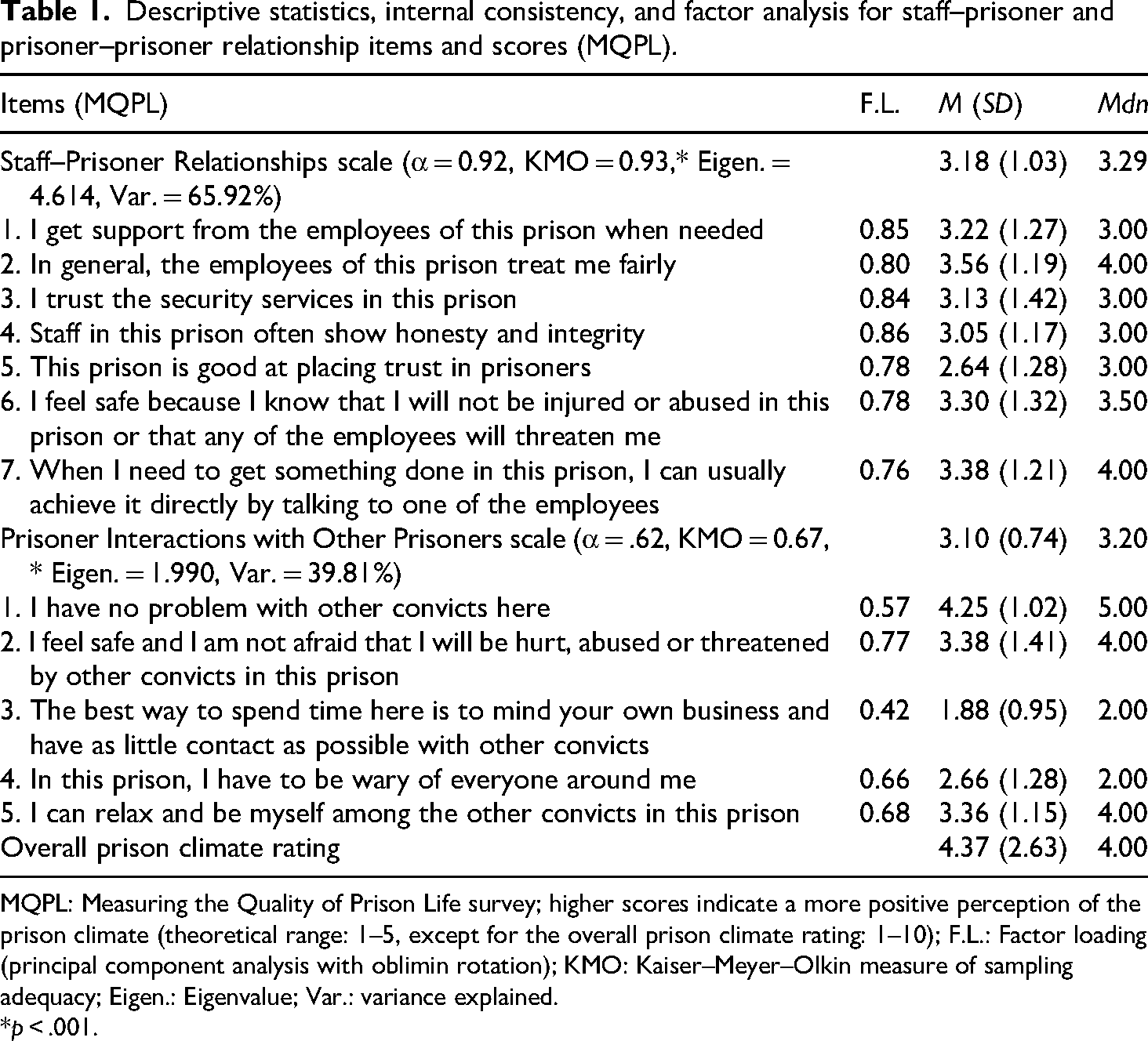
MQPL: Measuring the Quality of Prison Life survey; higher scores indicate a more positive perception of the prison climate (theoretical range: 1–5, except for the overall prison climate rating: 1–10); F.L.: Factor loading (principal component analysis with oblimin rotation); KMO: Kaiser–Meyer–Olkin measure of sampling adequacy; Eigen.: Eigenvalue; Var.: variance explained.
*p < .001.
Sample
The study sample comprised 577 sentenced prisoners (Table 2), representing 7.88 percent of the national sentenced prison population of incarcerated individuals (n = 7324; Aebi and Cocco, 2024). Participants were primarily housed in Sremska Mitrovica and Niš prisons (30%, each). Based on the total population in the institutions included in this study (n = 5113; Administration for the Enforcement of Penal Sanctions, official communication, 2023, Nos. 138/23), the overall response rate was 11.28 percent. Participation rate in the women's prison in Požarevac was 34.35 percent. Among the male institutions, response rates were 9.82 percent in Sremska Mitrovica, 11.53 percent in Niš and 7.91 percent in Zabela. The Beograd prison reported a comparatively high response rate of 35.71 percent. Taken together, the four male prisons had a combined response rate of 10.20 percent.
Sample characteristics (n = 577).
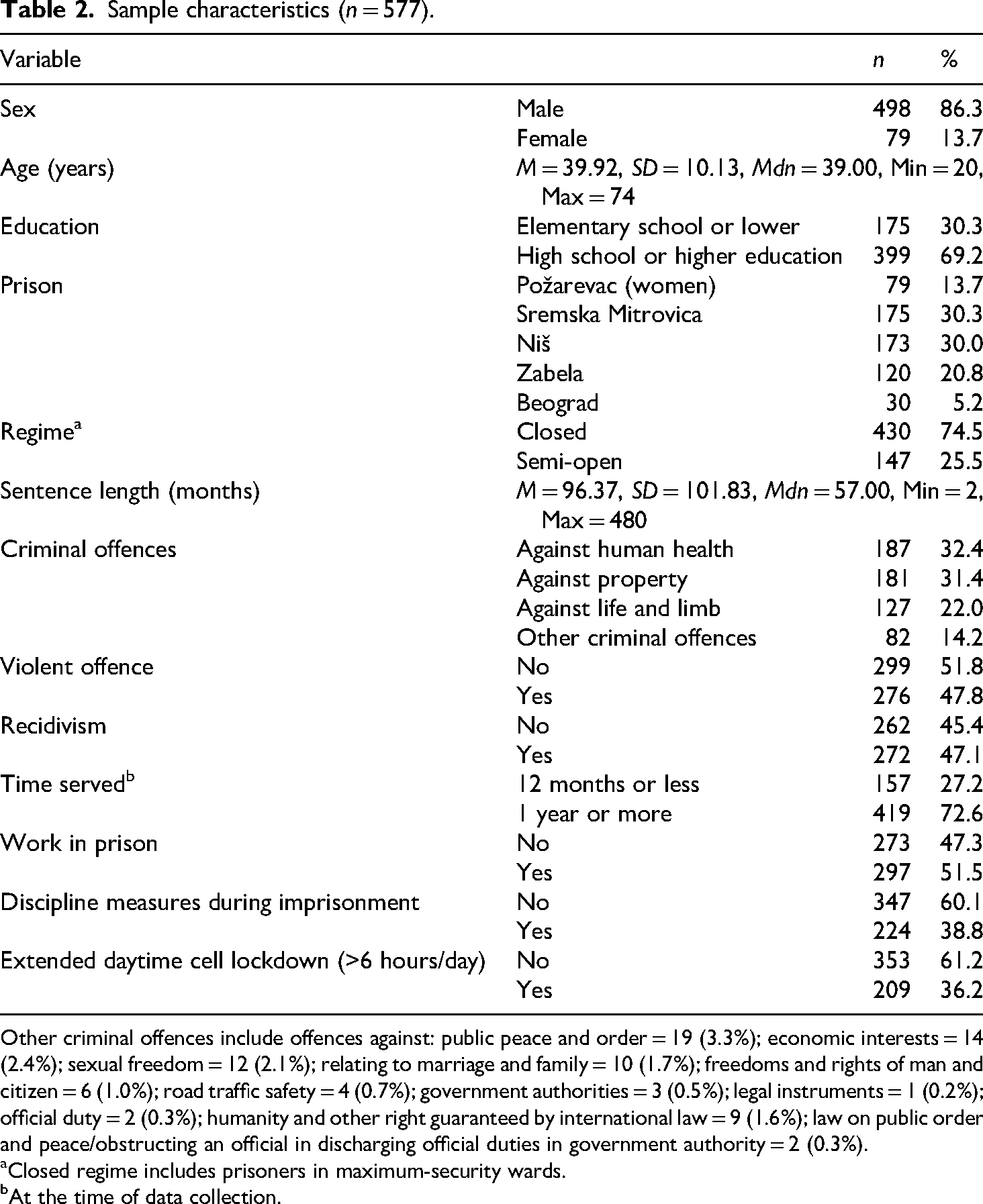
Other criminal offences include offences against: public peace and order = 19 (3.3%); economic interests = 14 (2.4%); sexual freedom = 12 (2.1%); relating to marriage and family = 10 (1.7%); freedoms and rights of man and citizen = 6 (1.0%); road traffic safety = 4 (0.7%); government authorities = 3 (0.5%); legal instruments = 1 (0.2%); official duty = 2 (0.3%); humanity and other right guaranteed by international law = 9 (1.6%); law on public order and peace/obstructing an official in discharging official duties in government authority = 2 (0.3%).
aClosed regime includes prisoners in maximum-security wards.
bAt the time of data collection.
The average age of participants was 39.9 years, with the majority being male (86%) and held under a closed regime (75%). The average sentence length was approximately 8 years (range: 2 months to 40 years), and the most common offences were related to human health (32%) and property (31%). Over half (52%) had committed non-violent offences. At the time of data collection, 73 percent had been incarcerated for more than 1 year, while just over half (52%) were employed in prison. Finally, 39 percent reported receiving at least one disciplinary measure, while 36 percent reported experiencing extended cell lockdown (over six hours daily; Table 2).
As no public registry on the socio-demographic and criminological characteristics of the prison population is available in Serbia, it was not possible to formally assess the representativeness of the sample beyond presented variables. However, comparison with national census data suggests that participants had lower educational levels than the general population, which is consistent with previous research on incarcerated populations (Machin and Sandi, 2025).
Results
Descriptive statistics, reliabilities and factor analysis for MQPL items and scores are presented in Table 1. Overall prison climate had a mean of 4.37 (SD = 2.63) on a 10-point scale. Among the relational dimensions, which were rated on a five-point scale, staff–prisoner relationships received a mean score of 3.18 (SD = 1.03), while prisoner-to-prisoner interactions were rated slightly lower (M = 3.10, SD = 0.74). Among items related to staff–prisoner relationships, the highest mean score was found for perceived fairness of staff treatment (M = 3.56), followed by the ability to resolve issues through direct communication with staff (M = 3.38). Conversely, the lowest average score was noted for the item assessing prisoner trust-building within the institution (M = 2.64). Regarding peer relations, the highest mean score was observed for the perception of having no problems with fellow prisoners (M = 4.25), suggesting generally positive interpersonal experiences. The lowest average scores were found for items about social withdrawal and general wariness, specifically, the belief that one should minimise contact with others (M = 1.88) and the need to be cautious of everyone in the prison, including staff (M = 2.66).
Staff–prisoner relationships had the strongest correlation with overall prison climate (r = .67), while prisoner–prisoner interactions showed a moderate correlation with prison climate (r = .48) and a strong correlation with staff–prisoner relationships (r = .56), suggesting that peer relations are associated with both climate perceptions and staff–prisoner dynamics. We found weak correlations between the type of prison regime and overall climate (r = .28), with semi-open conditions associated with the most positive outcomes. Finally, several individual and contextual variables (e.g. age, sentence length, employment in prison and disciplinary measures) also demonstrated weak to moderate correlations with overall climate (Table 3).
Correlations between examined variables.
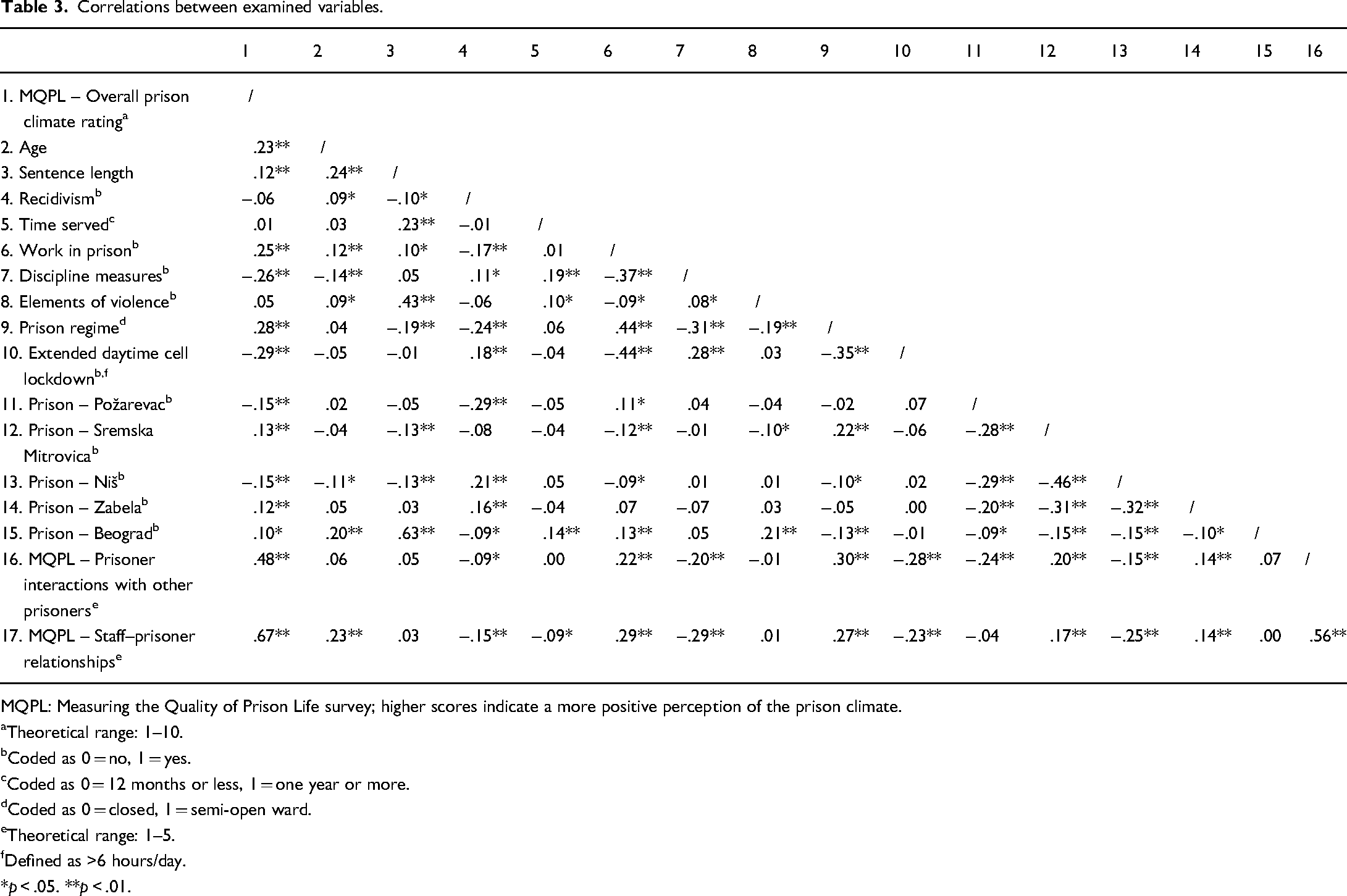
MQPL: Measuring the Quality of Prison Life survey; higher scores indicate a more positive perception of the prison climate.
aTheoretical range: 1–10.
bCoded as 0 = no, 1 = yes.
cCoded as 0 = 12 months or less, 1 = one year or more.
dCoded as 0 = closed, 1 = semi-open ward.
eTheoretical range: 1–5.
fDefined as >6 hours/day.
*p < .05. **p < .01.
In step 1 of the hierarchical regression analysis, individual-level control variables explained 14 percent of the variance in overall prison climate ratings (Table 4). Older age (β = .17), work engagement (β = .16) and the absence of disciplinary measures (β = −.19) were associated with more positive evaluations of prison climate. Sentence length, time served, prior imprisonment and offence type were not significant predictors.
Hierarchical regression analysis of individual, institutional and relational predictors of overall prison climate.
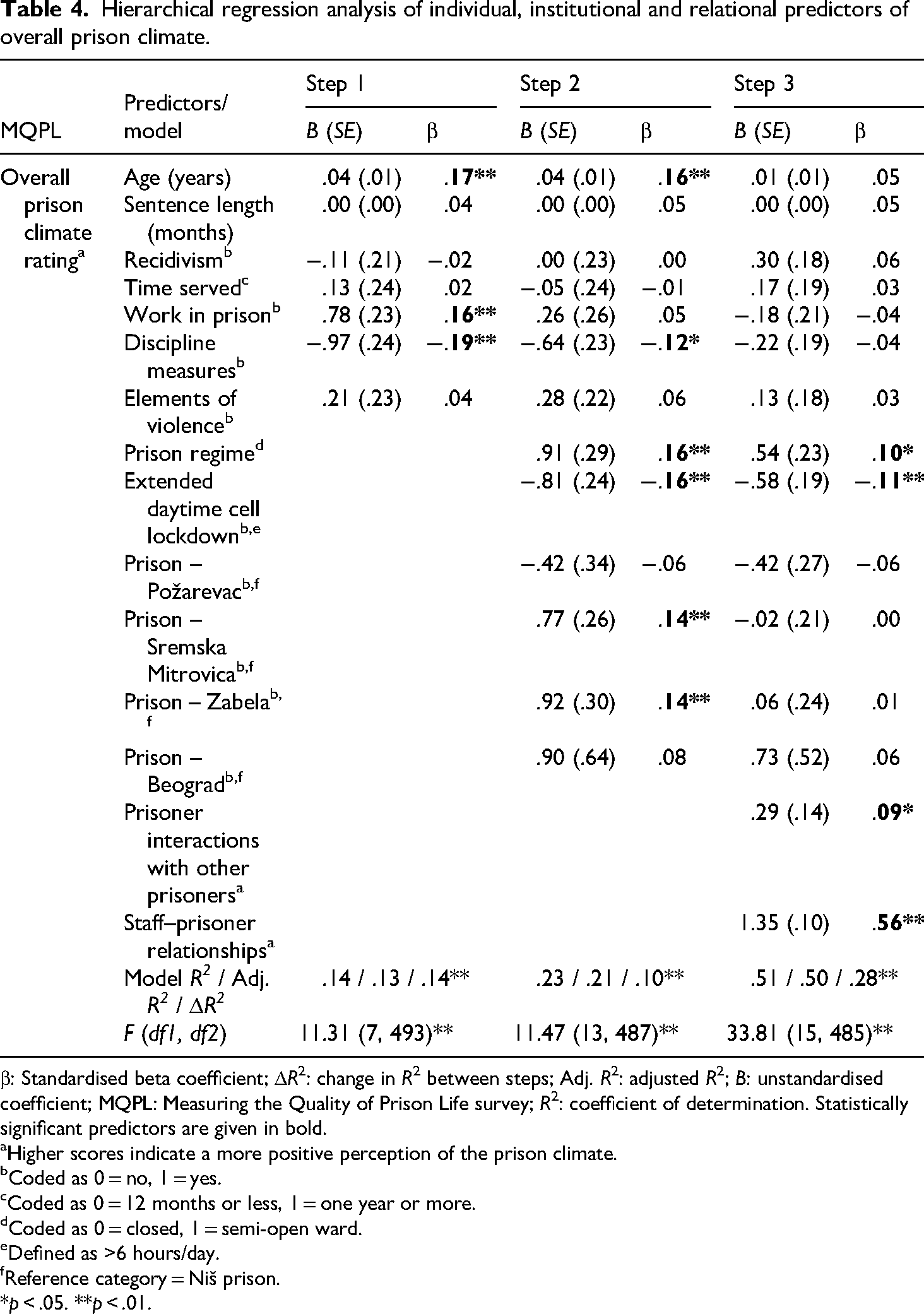
β: Standardised beta coefficient; ΔR2: change in R2 between steps; Adj. R2: adjusted R2; B: unstandardised coefficient; MQPL: Measuring the Quality of Prison Life survey; R2: coefficient of determination. Statistically significant predictors are given in bold.
aHigher scores indicate a more positive perception of the prison climate.
bCoded as 0 = no, 1 = yes.
cCoded as 0 = 12 months or less, 1 = one year or more.
dCoded as 0 = closed, 1 = semi-open ward.
eDefined as >6 hours/day.
fReference category = Niš prison.
*p < .05. **p < .01.
In step 2, institutional-level variables were added, increasing the explained variance to 23 percent (ΔR2 = .10). In addition to age and disciplinary measures, prison regime emerged as a significant predictor (β = .16) with prisoners in semi-open wards rating the prison climate 0.91-points higher on average than those in closed wards. Spending more than 6 hours per day locked in a cell was linked to lower climate ratings (β = −.16), with an average decrease of 0.81 points. Significant differences were observed between institutions: prisoners in Sremska Mitrovica and Zabela reported more positive climate evaluations relative to the reference category (Niš), while Požarevac and Beograd did not differ significantly.
When relational dimensions were included in step 3, the explanatory power improved significantly, accounting for 51 percent of the variance in prison climate ratings (ΔR2 = .28). Prison regime (β = .10) and extended cell lockdown (β = −.11) remained significant but with reduced effect sizes. Positive peer relationships were modestly associated with higher climate ratings (β = .09), with a one-point increase corresponding to a 0.29-point increase in the ratings. However, staff–prisoner relationships emerged as the strongest predictor (β = .56); a one-point increase in perceived relationship quality corresponds to a 1.35-point increase in the overall prison life rating.
Discussion
The central question addressed in this study was whether relational prison climate models developed in Western contexts retain explanatory power in a post-socialist, resource-constrained environment like Serbia. Using the MQPL framework and cross-sectional survey data from Serbia's largest prisons, we examined the relative contributions of staff–prisoner and prisoner–prisoner interactions to overall evaluations of prison climate (quality of prison life) while accounting for individual and institutional factors. We found that adding the relational variables substantially increased the model's explanatory power beyond individual and institutional factors. The reduction in previously significant prison-level coefficients suggests that some of the differences between prisons are statistically accounted for by variation in relational experiences. In the final model, staff–prisoner relationships showed the strongest association with climate (β = .56), while peer interactions (β = .09), regime type (β = .10) and cell lockdown (β = −.11) retained smaller, yet significant, associations.
The correlation structure is broadly consistent with UK-based MQPL findings, in which relational dimensions emerge as the strongest correlates of overall climate, followed by institutional regime (Auty and Liebling, 2020; Crewe et al., 2015). Individual-level characteristics showed comparatively small or inconsistent correlations, which aligns with the MQPL framework's conceptualisation of prison climate as primarily structured by social and relational dynamics rather than individual characteristics alone (Liebling, 2004; Ross et al., 2008).
Staff–prisoner relationships and functional authority
These findings address the study's central ‘travel’ question, leading to three key implications. First, the findings demonstrate model portability: core relational dimensions, particularly staff–prisoner relationships, remain strongly associated with climate evaluations in Serbia even after controlling for other factors. This suggests that the importance of these variables is not limited to UK or Western prison contexts, but extends to other systems (Crewe, 2011; Crewe et al., 2015; Liebling et al., 2012). Second, the results identify boundary conditions. Boundary conditions are contextual features that influence how relationships function in practice (Worley et al., 2021). In this study, regime type and time spent locked in cells remained relevant for perceived climate. These findings support the perspective that relational dynamics function alongside structural features, rather than making them irrelevant or redundant (Van Ginneken et al., 2018, 2019; Van Ginneken and Nieuwbeerta, 2020). Third, beyond portability and boundary conditions, the descriptive patterns indicate context-specific relational dynamics in Serbia. Prisoners tended to view everyday interactions with staff as broadly functional, with perceptions of fairness, direct communication, and safety scoring highest, and institutional trust-building lowest. Most participants reported no interpersonal problems with other prisoners, yet they endorsed social withdrawal and expressed general caution towards others in the prison, indicating a lack of trust and a difficult social climate. In other words, our findings indicate that institutional order can coexist with relational caution.
This combination is analytically significant. It indicates that in Serbia, prisoners may distinguish between frontline staff practices, which they view as procedurally acceptable or workable, and deeper institutional trust, predictability, and legitimacy, about which they remain sceptical. In MQPL terms, this reflects a relational climate where ‘order’ and daily operations are maintained without strong institutional trust (Crewe et al., 2015; Liebling, 2004, 2011b). For example, interactions may be courteous and efficient, yet limited to basic procedural tasks (Liebling et al., 2021). Our regression results further reinforce this interpretation. Specifically, staff–prisoner relationships showed the strongest standardised association with climate, with a one-point increase in perceived relationship quality corresponding to a 1.35-point increase in overall climate ratings. At the same time, the lowest item scores concerned institutional trust and social withdrawal. This pattern aligns with relational legitimacy perspectives, which link prisoners’ climate evaluations to the perceived fairness, consistency and humanity of authority in daily, routine interactions (Crewe, 2011; Crewe et al., 2015, 2023; Liebling, 2011b).
In systems with limited resources or organisational strain, staff may focus on procedural order and basic communicative fairness, without having the capacity to build deeper trust (Crewe et al., 2015, 2023; Palmen et al., 2022; Van Ginneken et al., 2020). For example, the average staff-to-prisoner ratio in Serbian prisons is approximately 1:2.7, and facilities operate at 97.9 percent of their official capacity, illustrating the extent of the pressure faced every day (Aebi and Cocco, 2024). In addition, broader pressures such as overcrowding, architectural limitations, high workloads, or strict regimes can limit the development of deeper institutional trust and further relational engagement (Beijersbergen et al., 2016; Crewe et al., 2015; Molleman and Van Ginneken, 2015). Shared cells and high turnover, independent of official density rates, may also increase interpersonal tension and reduce opportunities for trust (Van Ginneken, 2022). According to our results, prisoners tend to evaluate daily staff interactions workable and fair but remain sceptical about broader institutional legitimacy. This suggests that in transitional or resource-constrained settings, relationships may function procedurally, but without trust-based legitimacy being fully established. The Serbian case does not contradict relational theory. It helps clarify the difference between maintaining procedural order and functional authority, on the one hand, and building institutional trust under conditions of organisational strain, on the other. Specifically, our findings clarify that while relational theory emphasises the importance of respectful and procedurally fair interactions between staff and prisoners as the foundation for legitimacy (Crewe, 2011; Hacin and Meško, 2018; Liebling, 2011a; Ryan and Bergin, 2022), under conditions of organisational strain, these interactions may be sufficient to maintain order but insufficient to foster genuine institutional trust.
Peer dynamics and modest climate effects
Peer dynamics showed a modest independent effect on climate, yet their explanatory power was lower than that of staff–prisoner relationships. This pattern aligns with the broader relational ecology view that staff–prisoner relationships shape the institutional frame of legitimacy and predictability (Crewe et al., 2015, 2023; Liebling, 2004; Neubacher et al., 2021), while peer relations influence more localised feelings of safety, belonging, and day-to-day support (Chong, 2013; Kyprianides and Easterbrook, 2020; Peng et al., 2026; Van Ginneken et al., 2019).
In Serbia's case, findings on interaction between prisoners suggest a ‘quiet’ social environment, meaning that a relatively low level of reported problems coexists with widespread social withdrawal and distrust. For example, even when conflict is rare, a prisoner choosing to eat alone in the shared dining area or quietly avoiding eye contact in the corridors can contribute to the overall sense of mistrust or emotional distance in the prison ward, which further affects how safe and supported individuals feel in everyday life. Statistically, a one-point increase in the peer-interaction scale corresponded to a 0.3-point increase in overall climate rating, holding other factors constant. Similarly, recent research in Serbia has shown that positive interactions among prisoners are a key predictor of their well-being (Ilijić et al., 2024a). In practical terms, this means that even small improvements in peer cohesion (e.g. prisoners feeling comfortable eating together rather than alone) could slightly enhance perceptions of safety and well-being. However, the most significant improvement in climate still came from positive staff–prisoner relations.
While previous research on prison climate frequently associates positive peer interactions with improved well-being, safety and adaptation (Calles-Rubiales and Ibáñez Del Prado, 2020; Gibson, 2021; Kyprianides and Easterbrook, 2020; Peart et al., 2024; Van Ginneken et al., 2019), the Serbian context indicates a social environment defined more by limited social trust than by overt hostility or interpersonal conflict. In systems where institutional trust is limited, prisoners may be especially guarded with each other. Recent network-based research shows incarcerated people can form strong peer support ties, which can provide emotional and practical support (Peng et al., 2026), but our results suggest that in Serbia such networks, even if present, do not evidently translate into a broader climate. Future studies using socio-metric methods could clarify how informal peer bonds shape the prison climate.
On the other hand, this cautious peer climate observed in our study may reflect informal norms that discourage openness and reinforce social distance. Research on prison subcultures shows that perceived informant behaviour or breaches of normative silence can create distrust, encourage social withdrawal, and destabilise the social environment, even without overt conflict (Worley, 2011). In such settings, relational order may appear intact, but underlying trust remains fragile.
It is also important to note that our analysis is based on prisoner reports only. Prior work shows that staff and prisoners often perceive climate differently, with staff typically reporting more positive relational climates than prisoners do (Gibson, 2021; Peart et al., 2024). Including staff perspectives in future research would be valuable to assess how relational dynamics are experienced across institutional roles and confirm whether the functional-but-low-trust pattern is shared across groups.
Regime and structural constraints as boundary conditions
In this study, institutional and regime-related conditions remained relevant as contextual factors. Regime type continued to predict overall climate ratings in the full model, with an effect size comparable to those of peer interactions and extended lockdown, though substantially smaller than staff–prisoner relationships. This suggests that the Serbian prison climate is shaped both by relational processes and by formal environment, directly (through routine restrictions and spatial organisation) and indirectly (by influencing the frequency and quality of interaction, staff availability, and perceived accessibility). Our data, mainly from a closed-regime sample, show that climate can vary notably by security level: prisoners in semi-open wards rated climate on average about 0.5 points higher than those in closed wards, but spending more than 6 hours per day locked in a cell was associated with lower climate ratings by 0.8 points. Still, staff–prisoner relationships remain the primary driver of perceived climate.
Comparison with other contexts reveals a specific distinction. Whereas therapeutic or lower-security Western prisons often exhibit stronger trust-based relational climate (Gibson, 2021; Peart et al., 2024; Reading and Ross, 2020), high-security and control-oriented settings tend to show greater social distance, distrust, and scepticism (Madoc-Jones et al., 2016; Palmen et al., 2022; Ross et al., 2008; Williams et al., 2019). However, in Serbia, the combination of a generally functional order and low trust resembles what we would expect in high-control settings under strain: staff maintain routine fairness, but prisoners remain cautious. This pattern must be seen alongside Serbia's broader structural pressures, as shared-cell accommodation, limited staffing, high population turnover and restricted out-of-cell activities in closed wards reflect an operational model that prioritises security and order rather than intensive relational engagement. Even in systems that are not formally overcrowded, shared accommodation and spatial density can negatively affect prison climate (Van Ginneken, 2022). These constraints likely contribute to the functionally stable but low-trust relational climate identified in this study. Ultimately, both relational and structural factors matter, and their interaction shape the unique Serbian climate profile.
Finally, the observed institutional differences across prisons indicate contextual or between-site heterogeneity. This pattern is consistent not only with broader climate research demonstrating that prison climate reflects both context-level patterns and individual-level perception (Barquín et al., 2019; Van Ginneken and Nieuwbeerta, 2020) but also with previous Serbian MQPL-based analyses documenting statistically significant differences in multiple climate dimensions across prisons and regimes (Milićević and Hacin, 2025). In this context, ‘travel’ should be seen as partial and conditional. While the MQPL framework highlights the importance of relationships and legitimacy, the relational aspect of climate depends on institutional capacity, regime constraints and the way daily life is organised.
Strengths, limitations and future research directions
Our study provides one of the few quantitative examinations of relational and structural determinants of prison climate in a Southeast European, post-socialist context using an MQPL-informed framework and including both men's and women's institutions. Its primary contribution lies in evaluating whether relational-legitimacy assumptions derived from Western systems retain explanatory power under different organisational conditions, namely, whether prison climate theory ‘travels’ beyond its Western origins. By also documenting a pattern of functionally stable yet low-trust relational dynamics, the findings extend existing knowledge by clarifying how legitimacy may operate differently in transitional penal settings.
However, a series of limitations should be mentioned. Because there is no comprehensive, publicly available registry of prisoner characteristics in Serbia, it was not possible to determine the sample representativeness relative to the national prison population. Nevertheless, the study was primarily designed to examine associations between relational and structural dimensions and prisoners’ overall evaluations of prison climate rather than to provide nationally representative prevalence estimates. The study also focused on the largest prisons and included only closed and semi-open wards, potentially overlooking differences in smaller or more specialised facilities. This may limit the generalisability of the results beyond the institutions and regimes included.
Although prison-level dummy variables were included to account for institutional differences, the data remain clustered at the prison level, and the modelling approach does not differentiate individual and institution-level variance. Consequently, between-prison differences should be interpreted as indicators of contextual variation rather than precise estimates of institutional effects. As the analysis is cross-sectional, the observed associations should not be interpreted as causal, and conclusions regarding the long-term impact of relational deficits remain limited.
Participation was voluntary, and response rates varied across institutions, which is a common limitation in prison-based survey research. This introduced the risk of self-selection bias, as prisoners with more pronounced positive or negative experiences might have been more inclined to participate. Due to a lack of data on non-respondents, it was not possible to assess potential response bias by comparing participants with those who declined to take part. The study did not incorporate staff perspectives or differentiate between professional roles, and certain prisoner groups (e.g. pre-trial detainees, prisoners in open regimes, disciplinary segregation, or acute medical or psychiatric care) were excluded; their prison experiences may also differ substantially.
Additionally, the MQPL subscales Care for the Vulnerable and Help and Support were excluded because they capture targeted or situational assistance, which, although important, was not the focus of this study. Moreover, the Prisoner Interactions scale demonstrated relatively low internal consistency, suggesting that findings related to peer dynamics should be interpreted with some caution. This outcome likely reflects the heterogeneous and multidimensional nature of prisoner interaction experiences in general, including safety, vigilance, avoidance and social ease. Finally, all key variables were based on self-reported perceptions of prison climate and relationships. While this aligns with the conceptual foundations of the MQPL framework, it also means that the findings reflect subjective evaluations rather than objectively measured conditions.
Several questions remain regarding how organisational culture, staff training and policy reforms influence relational climate over time. Although both men's and women's institutions were included, gender-specific patterns were not examined and warrant further investigation. Future research should also incorporate staff perspectives and examine the experiences of different professional and prisoner groups. Studies could also apply multilevel models to better account for the clustering of individuals within units and prisons and to differentiate individual- and institutional-level variation in prison climate. The research should be expanded to include a broader range of facilities and prisoner groups and repeated using a longitudinal design.
Conclusion
This study demonstrates that relational dynamics, and most notably staff–prisoner relationships, show the largest standardised association with perceived prison climate in Serbia, followed by peer relationships. At the same time, the continued significance of regime type and routine restrictions indicates that structural conditions remain relevant boundary conditions rather than becoming analytically irrelevant once relational factors are considered. However, the Serbian case reveals a distinctive relational pattern: staff treatment is experienced as broadly functional (e.g. relatively higher ratings for fairness and direct communication), yet institutional trust remains comparatively low, whereas prisoner-to-prisoner interactions are characterised more by generalised caution and social withdrawal than by open conflict.
Our findings extend existing evidence by showing that a prison climate may appear stable and orderly while lacking the relational qualities that are often considered critical to legitimacy and rehabilitation, such as trust, partnership, and social cohesion. However, international research has shown that respectful, partnership-based and trust-oriented interactions foster safer and more constructive institutional environments. By examining a context in which these ideal conditions are only partially present, this study further extends existing knowledge by demonstrating how relational deficits may restrict institutional functioning, and, thus, rehabilitative efforts, even in the absence of open conflict or institutional disorder. This finding has important implications for understanding how prison climate operates in resource-constrained or transitional systems, where relational quality may depend less on formal policy models and more on institutional history, organisational culture and everyday interactional practices. Serbia, as a post-socialist and reform-oriented penal system, demonstrates that formal alignment with European standards can coexist with significant organisational strain and limited relational depth.
These findings also contribute to debates about whether the concept of prison climate ‘travels’ across penal and cultural contexts (Liebling et al., 2021; Neubacher et al., 2021). While the moral performance framework and the MQPL methodology appear transferable (Milićević et al., 2024; Pascaud and Kazemian, 2025), the Serbian case suggests how their relational aspects are conditioned by transitional institutional settings. In this sense, the prison climate as a construct ‘travels’ to this Southeast European context in the sense that relational evaluations remain highly relevant. However, in resource-constrained systems, relationships may function effectively in maintaining order without generating strong trust in institutions. This distinction, which is noted in our study, clarifies that functional authority and trust-based legitimacy are analytically separable dimensions of prison climate.
Overall, this study contributes to a more geographically inclusive understanding of prison climate and whether the ordering of its determinants remains the same under different historical and organisational conditions. The implication is not that structural factors are secondary, but that in this setting the quality of everyday relationships, particularly between prisoners and staff, emerges as a key correlate of perceived climate alongside regime type and routine restrictions. These findings suggest that improving the prison climate in transitional settings may require not only fair day-to-day practices but also efforts to build institutional trust and meaningful engagement beyond routine security.
Future research should build on this work through multilevel modelling approaches and longitudinal designs, and by including staff and gender-specific perspectives. Further investigations are needed to establish how institutional reforms aimed at strengthening legitimacy and trust (e.g. through relational practices and professional cultures) affect relational dynamics and perceived climate across different regimes and prisoner groups.
Footnotes
Acknowledgements
We would like to thank prisoners who generously shared their experiences with us and survey authors who kindly permitted us to use the MQPL survey in the PrisonLIFE project. We also acknowledge the contributions of all team members involved in data collection. We are grateful to the anonymous reviewers for their insightful and constructive comments, which significantly strengthened this manuscript.
Funding
The authors disclosed receipt of the following financial support for the research, authorship, and/or publication of this article: This research was supported by the Science Fund of the Republic of Serbia, grant no. 7750249 (PrisonLIFE). This article represents the result of the author's engagement following the Working Plan and Programme of the Institute of Criminological and Sociological Research for the year 2025 and 2026 (based on contracts No. 451-03-136/2025-03/200039 and 451-03-33/2026-03200039) with the Ministry of Science, Technological Development and Innovation of the Republic of Serbia. Funding was not involved in study design, data collection, analysis and interpretation of data, writing of the report and decision to submit the article for publication.
Declaration of conflicting interests
The author declared no potential conflicts of interest with respect to the research, authorship, and/or publication of this article.
Data availability statement
The data that support the findings of this study are available in Data Center Serbia for Social Sciences repository. Restrictions apply to the availability of these data (Milićević et al., 2024). Milićević, M., Međedović, J., Ilijić, Lj., Pavićević, O., Vujičić, N., & Drndarević, N. (2024). Assessment and possibilities for improving the quality of prison life of prisoners in the Republic of Serbia: Criminological-penological, psychological, sociological, legal and security aspects – PrisonLIFE [Data set]. Data Center Serbia for Social Sciences. 