







Abstract
Background
Occupational therapists may be encountered with a variety of ethical issues. The aim of this study was to explore ethical issues of Occupational therapist’s practice in adult physical dysfunction field.
Methods
Ten graduated Occupational therapists were selected by purposive sampling method. Data were gathered by semi-structured interview. Data were analyzed by content analysis approach.
Results
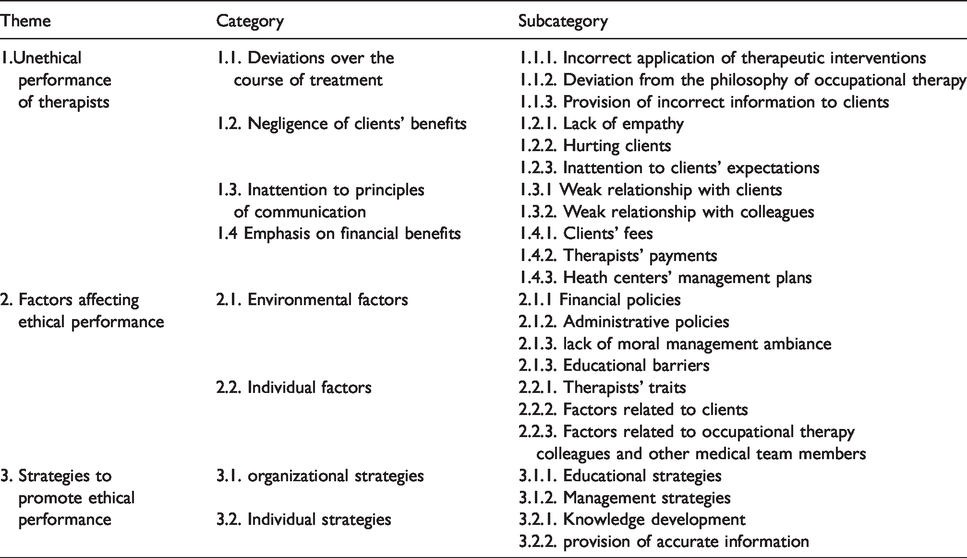
Data analysis ultimately leads to the emergence of three themes which reflects Ethical issues in Occupational Therapy. These themes include: unethical practice of Occupational therapists, factors influencing ethical practice and Strategies to improving ethical practice.
Conclusion
The findings show that occupational therapists have various ethical problems related to client’s rights in addition to their clinical practice, that according to the participants in this study, lack of awareness about professional ethics related to the occupational therapy and also lack of comprehensive monitoring rules in this field are the major causes of unethical practice.
Introduction
The issues associated with professional ethics are primarily underscored when in specific occupations and professions, certain values become dominant and those values are incompatible with other values in those occupations and professions. Most probably, business owners perceive these values as the leading and overriding ones while others may not understand those values. 1
Ethical issues are important concerns of all fields of science, including biomedical and medical sciences, and consequently, such issues are considered significant in the area of rehabilitation and occupational therapy as well. Occupational therapy is part of rehabilitation science and its professional responsibility is to improve the life quality of patients and clients in terms of their daily living activities. A prominent feature of occupational therapy and its clinical practices is that occupational therapists should always have a strong sense of responsibility, perform their duties in a specialized manner, and consider ethical issues regarding those who are involved in their profession. 2
Occupational therapists’ failure to observe occupational therapy code of ethics in Iran, including harming clients, benefiting them not as much as it is required, and disregarding communication principles in dealing with clients, brings about the violation of clients’ rights, and as a result, clients are adversely affected. Therefore, it is required to conduct research on the notion of ethics and ethical issues in Iran so that by determining influential factors, the relevant ethical principles are formulated and localized, and consequently, such principles become a suitable practice guide for those who are involved in this profession. Furthermore, through analyzing the data gathered in this study, it is feasible to identify the factors raising ethical problems and to make appropriate decisions regarding these factors to alleviate those problems. To the best of the researchers’ knowledge, no study has been undertaken on the ethical issues of occupational therapy in the field of adult physical disabilities in Iran. There are several empirical investigations in occupational therapy and other areas. For instance, Rezaee et al. undertook a study entitled ethical issues of occupational therapists in the field of mental health. Based on the results, they concluded that occupational therapists in the field of mental health had numerous problems regarding ethical principles. 3 In another study in the field of pediatric occupational therapy, Kalantari et al. introduced a variety of factors as the reasons for the violation of ethical principles. 4
There is a small number of studies on ethics in occupational therapy. Among them are the study conducted by the Hastings Center on the outlook of ethical concerns in rehabilitation, 5 the study done by Hansen on the extent and frequency of ethical issues in the clinical practice of occupational therapists, 6 and the study undertaken by Barnitt on the identification of ethical dilemmas in occupational therapy and physical therapy in the UK through the qualitative method and the content analysis approach. 7 As another study, Foye performed a study entitled Ethical issues in rehabilitation: A qualitative analysis of dilemmas identified by occupational therapists. This study aimed at determining the scope of ethical issues that occupational therapists face in their clinical practice. 8 All the aforementioned studies have concerned the identification of ethical problems and their sources in specific cultural contexts and fields of occupation. Hence, it is essential to detect ethical issues in the clinical practice of occupational therapists dealing with adults with physical disabilities in Iran so as to explore the attitudes of occupational therapists and propose effective solutions to the identified problems.
Methods
Design
In this study, the qualitative content analysis approach is used. The content analysis approach is a research method for drawing valid, reliable, and replicable deductions from data on a particular subject matter. This approach makes it possible to produce knowledge, delve into new insights, repeat realities, and gain a proper practice guide to activities. The approach used for this study is the conventional content analysis approach. 9
Participants
The participants of this study were the occupational therapists who had graduated from private, semi-private, and state medical centers and the centers affiliated to the State Welfare Organization. The participants included six male and four female occupational therapists with the minimum working experience of 3 and the maximum working experience of 19 years (mean = 8.7 years). To choose these participants, purposive sampling was employed. In qualitative research, sampling continues until data saturation is reached. In this study, the data were saturated after eight participants and to get assured, two more participants were also interviewed. The participants' education degree varied from undergraduate to doctoral degrees. The inclusion criteria included having at least a bachelor's degree, having a minimum of two years of working experience, and working in the field of adult physical disabilities.
Data collection
In this study, the data collected through semi-structured interviews and Fieldnotes. The interview started with open questions and continued with semi-structured and exploratory questions. The interviews were conducted in the clinics in a comfortable and casual atmosphere.
Ethical considerations
Initially, the necessary explanations about the purpose of the study were given to the participates and they gave consent to participate in the study. All subjects gave their informed consent for inclusion before they participated in the study. After that, the interview was conducted in the place preferred by the participants. The interviews were recorded and transcribed, and the transcriptions were analyzed. Each interview took between 40 to 80 minutes.
Data analysis
The transcription of each interview was analyzed line by line and meaning units were extracted from the textual data considering the purpose of the study. In the second step, the meaning units were codified, and in the third phase, the codes were classified. In the end, the categories and subcategories were formed. The categories and subcategories obtained from the interviews were combined and compared, and similar codes were put under one category.
Rigor
To ensure the validity of the data, peer review was used. The comments of two nursing full professors, who were quite familiar with qualitative research and four occupational therapy assistant professors on the extracted concepts, classifications, and codes were collected. The experts who were familiar with qualitative research were asked to give their opinions on the extracted themes and categories and based on their comments, the required modifications were made. Moreover, there was constant information exchange between the researcher and the professors over the course of research. The allocation of sufficient time to conducting the study, the incessant involvement of the researcher in the study, the appropriate selection of the participants with different academic certificates and enough working experience from different age groups, different cities, and different clinical training centers, and the establishment of a good relationship with them were other ways of enhancing the validity of the data. Concerning the observance of ethical considerations, not only were the oral and written informed consent obtained from the participants but also the data were classified, the participants had the right to withdraw from the study whenever they wanted, and they were provided with the transcriptions of their interviews and the conclusions drawn from the data.
Results
The obtained results indicated three themes as follows: “unethical performance of therapists”, “factors affecting unethical performance of therapists” and “ways to improve ethical performance of therapists”.
Each of these themes has its categories and subcategories (Table 1).
Ethical issues in occupational therapy.
Unethical performance of therapists
The unethical performance of occupational therapists reflects how much they know about and understand unethical clinical behaviors in the field of adult physical disabilities. Unethical performance includes all immoral behaviors that are considered as unethical in the context of occupational therapy and in the culture of a specific society.
The data analysis reveals four categories of unethical performance as follows:
Deviation over the course of treatment
This category indicates that occupational therapists should use the best therapeutic principles for their clients, employ evidence-based treatments, and avoid providing preset and similar interventions for all clients regardless of the needs of clients. They should take steps in the right direction within the framework of the philosophy of occupational therapy. One of the issues in this framework is to take a holistic approach to treatment. They should not employ techniques and interventions irrelevant to occupational therapy in clinical settings. In the face of any ethical problems, they should adopt the best clinical reasoning. In addition, they should provide the necessary information to their clients to increase their awareness, for instance, informing them about the treatment process, being honest in providing information, giving proper prognosis, and providing a full description of their duties to clients.
As one participant stated: “In clinics, one should use evidence-based treatments and make use of valid studies. We should not act otherwise.”
Another participant stated, “I have many colleagues who have their own specific intervention and consistently use the same intervention for all their cases.”
Negligence of clients’ benefits
In order to provide the best services, occupational therapists should have enough empathy for their clients, utilize their maximum knowledge and potential, provide appropriate services within the predetermined time, and do not waste clients' time. They should not engage in their personal affairs during treatment sessions. Furthermore, therapists should take steps to benefit their clients and make every effort to promote their condition. They should not aggravate the pain of clients and observe the safety tips and precautions in treating them. They should consider the client-centered principle during treatments
According to one of the participants, “their purpose is to waste time, and they (therapists) do not know much to help their clients”.
Another participant stated, “Do not use wrong techniques for patients, that is, do not use risky and dangerous techniques for patients, for example, do not damage patients' tendon.”
Lack of attention to principles of communication
In the context of treatment, communication refers to communication with clients, their family, and caregivers, and communication with medical and rehabilitation team members and other occupational therapy personnel who are involved in providing services to clients. Unethical behaviors related to clients include: disrespecting clients, labeling clients, establishing immoral relationships with clients, therapists' failure to understand clients' personal and cultural conditions, therapists' failure to put aside their personal beliefs and thoughts, and therapists' failure to provide security and earn clients' trust.
The issues associated with colleagues are as follows: judging the quality of the clinical practices of colleagues inaccurately, depriving colleagues of job opportunities, interfering in the clinical practices of colleagues, and avoiding to refer clients to other team members for personal reasons.
As one of the participants stated, “the trace of immorality can be found in our referrals, for example, you know a client has a speech problem, however, because you have problem with the speech therapist working at that center, you do not refer your client to him/her”.
Another participant said, “Usually, therapists are hot-tempered, the therapist is a bad-tempered person and may treat patients harshly … Of course, I have seen therapists who shouted at or stigmatized their patients, or I have seen those who were impatient and did not answer their patients.”
Emphasis on financial benefits
This category of unethical practices refers to financial and economic concerns as well as the issues stemming from the management of clinics and medical centers. In such cases, whatever the occupational therapists or managers of medical centers do primarily revolves around financial gains and they do not care much about the quality of services. They impose unnecessary costs, increases medical costs, or may refuse to accept those clients who have financial problems. From another angle, they may abuse healthcare insurance or use non-specialist personnel, such as occupational therapy students, to provide services to clients.
As one of the participants stated, “due to having a lot of clients, some centers are used to hiring technicians, for example, a person who is expert at literature becomes an occupational therapist. Recently, they employ students to provide services to clients”
Another participant stated, “Sometimes you see the client is rich, imposing extra costs on him/her is regarded unethical. You should not impose charges based on clients' economic status, and you should consider the tariff of your field of occupation.”
Factors affecting ethical performance
Various factors are involved in the development of ethical behaviors in any society. The results of this study indicate that factors influencing ethical practices are of two types: environmental factors and individual factors.
Environmental factors
The environmental factors are under the influence of the healthcare and educational systems. These systems directly or indirectly shape moral and unethical behaviors. The environmental factors can also be considered as the underlying source of ethical behaviors because if this infrastructure malfunctions, the likelihood of developing ethical behaviors reduces. The environmental factors include financial policies, administrative policies, the lack of moral management atmosphere, and educational barriers.
One of the environmental factors is financing policy dealing with ways of settling the financial and payment issues of the healthcare system. In this policy, in order to increase revenue and reduce costs, managers apply certain policies. Based on the results of this study, the adverse effects of these policies are targeted at occupational therapists and clients. The next factor is executive policies which are associated with the management of the administrative section of the healthcare system. These policies concern the issues related to recruiting personnel and human resources, and monitoring various wards, and providing facilities for healthcare settings. Another factor is the provision of an ethical-based management environment which is an indispensable part of any organization and inclines different members to practice ethical behavior. If it does not function properly in the healthcare system, medical staff do not pay attention to ethical issues, and ultimately, an unethical atmosphere prevails working environment. Another influential factor in the formation of ethical behaviors is educational barriers. If ethical behaviors are taught by outstanding and experienced teachers and professors via novel methods, it is feasible to prevent numerous unethical behaviors as it is widely believed that many ethical problems have their roots in the lack of sufficient and proper training in ethics.
In this regard, one of the participants asserted, “considering ethics, nothing specific was taught to us at the undergraduate level, and we did not have any courses on ethics at the graduate level”.
Another participant uttered, “One of the reasons for the decline in the productivity and efficiency of the governmental systems is the lack of enough supervision on the staff of those systems.”
Individual factors
Individual factors are those in which therapists, colleagues, or clients play a major role in raising ethical problems. All these factors should be identified and effective actions should be taken to resolve them. Individual factors include therapists' characteristics, client-related factors, and factors associated with occupational therapists and other members of the treatment team. Therapists' lack of experience, their gender in relation to clients, their inability to justify the important role of occupational therapy in clients' treatment, their limited knowledge on occupational therapy code of ethics, the lack of interest and faith in their field of study, their impatience and low tolerance, and their lack of up-to-date information are among therapists’ characteristics leading to ethical problems. Given their responsibility, therapists are required to possess proper individual characteristics. The next factor is related to clients who bring about ethical problems and incline therapists to perform unethical behaviors. These factors are clients’ limited information on their rights, lack of awareness about the positive role of occupational therapy in their treatment, their irregular attendance in therapy sessions, their economically unfavorable status, their difficult conditions, fear of being rejected by their therapist, their excessive expectations from therapy, and lack of personal hygiene. The other factor is associated with the occupational therapists' colleagues and other members of the treatment team who somehow raise the problems of ethics, for example, differences of opinion with colleagues, delay in referring clients, and much focus on maintaining relationships with colleagues.
One participant declared, “I think, the reason for the occurrence of a lot of problems is that occupational therapists do not have enough experience”.
Another participant said, “in occupational therapy, clients are not aware of their fundamental rights, and do not know whether the treatment applied to them is right or not.”
Strategies to promote ethical performance
The proposed strategies are different ways to decrease ethical problems. The issue of professional ethics and how to institutionalize them among occupational therapists is of crucial importance, and managers and occupational therapists should endeavor to propose different strategies to institutionalize professional ethics in the field of occupational therapy. This study also attempts to provide some strategies using the views and experiences of the occupational therapists participating in it. This theme is divided into two categories: organizational and educational strategies.
Organizational strategies
Organizational strategies refer to a set of strategies through which the authorities in the high-ranking sectors of the healthcare system make essential decisions on how to institutionalize professional ethics. These strategies are categorized into educational strategies and management strategies.
Education is deemed as an important element in promoting and institutionalizing professional ethics; therefore, special attention should be devoted to this factor and it should be among the top priorities. Professional ethics should be taught not just to M.A. students but also graduates. In this way, they stay updated, and by using their up-to-date information, they accept and treat their clients and adopt proper ethical reasoning to solve new ethical issues. The next strategy pertains to the managers and heads of the organizations of the healthcare system. They are responsible for making important decisions on economic and administrative matters to improve professional ethics. These factors include the supervision of competent organs, the approval of occupational therapy insurance, and the provision of well-defined tariffs, and the provision of sufficient medical facilities and workforce for medical centers.
As one participant stated, “including a course on ethics in the field of occupational therapy is very important and we should be taught how to put those ethics into practice. Our education should not just be theory-based. In this way, students do not understand anything. It should be based on case studies, meaning that, there should be practical and very clear explanations”
Another participant declared, “Another issue is insurance. If clients have insurance coverage, our problem with clients is much less, their satisfaction increases to a great extent, and they are more eager to continue their therapy sessions.”
Individual strategies
These strategies are particularly related to occupational therapists who need to make significant decisions to improve their ethical performance and the ethical performance of society. These decisions may be associated with enhancing their knowledge or raising their clients' awareness. These strategies are divided into two categories: knowledge development and the provision of accurate information.
Over the course of their profession, it is required for occupational therapists to enhance their expertise not only in various diseases and different types of interventions but also in professional ethics and accurate clinical reasoning. Another obligation of occupational therapists is to provide necessary information to clients and their families. If occupational therapists fulfill their responsibility accurately in this regard, clients’ awareness of their rights boosts, and consequently, they are less likely to be abused. Moreover, in this way, certain misunderstanding between occupational therapists and clients is resolved.
In this vein, one of the participants uttered, “to perform more ethically, we should certainly have some information on ethics and moral principles, and in this way, we gain insights into what they mean. Such information can be found on the Internet or books on ethics”.
Discussion
Ethics is a sophisticated and challenging discipline. Despite the well-designed studies undertaken by prominent philosophers, some issues of ethics have not been clarified yet. 10 To the best of the researchers’ knowledge, the current study is the only study on the ethical problems of occupational therapists in adults with physical disabilities in the cultural and social context of Iran. As a result, professional ethics in the field of occupational therapy still remains very vague in the Iranian context and many questions are left unanswered. This state of affairs justifies the need for further research on ethical issues in Iran for the purpose of taking the right measures to reduce the existing problems. One of the problems frequently mentioned by the participants of this study was therapists' deviation from the treatment path. To put it in better words, therapists overlook the philosophy of occupational therapy which emphasizes the control of the symptoms of the disease, the involvement of clients with physical disabilities in daily activities, their encouragement to participate in those activities, and the enhancement of their sense of satisfaction through occupational therapy. Maybe, the main root of such ethical problems lies in the management and organizational policies. In their research, Kalantari et al. underscored the organizational factors. According to them, financial attitudes toward treatment with the aim of earning more money and the ethical behaviors of managers and colleagues were among the factors raising ethical problems. 4 In his research, Barnitt considered unprofessional and unqualified employees as one of the main reasons for ethical problems. 7 In 1984, Hansen deemed inappropriate treatment as a result of systemic constraints as one of the most important sources of ethical issues. Such constraints decreased the quality of the provided services. 6 In his phenomenological research in 2008, Kinsella introduced systemic constraints as the most significant cause of moral tensions. In his research, insufficient time for interventions, inadequate and unprofessional staff, a large number of clients, lack of resources and facilities, and inconsistent responses of managers and officials were among the major factors of systemic constraints. 11 Although the supervisory institutions lay the blame for unethical practices on occupational therapists, many of the ethical issues stem from a beyond-individual and systemic variable and emerge from factors that are out of therapists’ control. 12 Social, cultural, economic, political, and educational issues shape the issues of ethics in reality. In fact, the performance of staff and therapists are formed by the macro-level policies of the medical education and healthcare system. There are different views on this point: on the one hand, a person may associate ethics with therapists, and on the other hand, someone else relates it to the macro-level policies. 13 In this regard, many critical questions are raised regarding the obligations of the government and the management sectors in terms of systematic instillation of the ethical issues in occupational therapists and the facilitation of this process. This process is of particular importance as it encourages therapists to stay in this system. However, the ignorance of this process causes many concerns since the factors related to it impact upon the mentality of the person, leading to his/her occupational burnout. If it continues, the therapist may leave his/her job or in certain cases, he/she may decline the quality of his/her performance. 3
The factors affecting ethical performance are inadequate training in occupational therapy codes of ethics and the lack of therapists’ awareness of these codes of ethics. These factors have a crucial role in the unethical performance of therapists. Moreover, among the proposals offered by the participants to improve ethical performance is educational strategies. In fact, individual strategies are somehow intermingled with educational strategies. Therefore, addressing the issue of education as one of the influential factors in ethical performance and one of the strategies used to promote ethical performance, gains further importance. According to the participants of the study, among the strategies considerably improving the ethical performance of occupational therapists are the improvement of the education system and the inclusion of a course in ethics in the undergraduate curriculum. The therapists' limited knowledge of ethical codes and the lack of up-to-date information are the results of the inadequacy of the education system because there is no official course on ethics in occupational therapy at the undergraduate level. However, in developed countries, since 1987, teaching ethics has begun at the undergraduate level and has officially included in the curriculum. 14 The results of the current study show that as training centers do not provide continuous education and post-graduation training workshops, there is a lack of opportunity for occupational therapists to update their information. Ethical decision-making is a cognitive skill, and training ethical principles and gaining a proper understanding of the existing ethical issues is its prerequisite. Without formal training in ethical issues, therapists go through the process of ethical decision-making in an individual and intuitive manner, 15 and it is more likely that their ethical reasoning is unprofessional and incompetent and they are not able to handle the issues of professional ethics they face properly. As Dieruf indicated, to improve ethical performance, it is required to teach clinical and moral judgment so that occupational therapists manage to perform ethically in various clinical settings. University curricula can facilitate ethics-based decisions, 16 in particular, continuous, and interactive educational interventions that bring about the resolution of ethical issues. 17 Also, in Foye's qualitative research, occupational therapists emphasized the need to increase their awareness of interactive frameworks so as to solve ethical issues in treatment. 8
Other strategies leading to better ethical performance of occupational therapists are to have a well-functioning supervisory system monitoring competent organs and to improve financing policy, for instance, the approval of the occupational therapy insurance and the provision of official well-defined tariffs. Based on the obtained results, one of the unethical practices of occupational therapists is “their excessive emphasis on monetary profits.” Among the subcategories of this factor is the treatment costs paid by clients and the payment of therapists. According to the participants, the possibility of the occurrence of unethical behaviors in this category is greater due to therapists' and clinic owners' seeking profits. Therefore, therapists may do a series of unethical practices to attract more clients, as an example, they may offer any commission to doctors or other medical staff, take advantage of supplementary health insurance, or abuse physical therapy insurance in favor of their clients. Since in Iran, there is no proper insurance coverage or tariff for occupational therapy, occupational therapists direct their attention to other types of insurance, including, physical therapy insurance or other types of supplementary health insurance, and as a result, they perform many unethical behaviors. They may also impose their own tariffs on clients based on their socio-economic status. Therefore, to reduce these problems, it is essential to enhance management strategies. In his qualitative study, Kalantari highlighted that the inadequate financial support of families encouraged occupational therapists to provide wrong reports for insurance companies so that their clients could receive money from complementary health insurance. This runs counter to the principles of professional ethics as occupational therapists should provide authentic reports on the documentation, nature, and quantity of services. 4 Foye and Kirschner examined ethical issues in occupational therapy. One of their outstanding findings was reimbursement policies and pressures defined for occupational therapy within the system of insurance.8,17 It can be concluded that although in developed countries, there is no problem in terms of insurance and tariffs, such problems are still raised, and merely by providing a specific predetermined formula, the severity of ethical problems cannot be eliminated. So, extensive studies are required to empirically investigate the proposed solutions and analyze the obtained data meticulously.
Conclusion
The findings of this study reveal that while doing their clinical practices, occupational therapists have numerous unethical behaviors including failure to provide appropriate services, the lack of an effective relationship with clients and colleagues, and attention to personal benefits. These unethical behaviors can be attributed to the lack of knowledge about the principles of professional ethics in the area of occupational therapy and the lack of comprehensive rules in this regard. According to the participants' viewpoints, this gap can be bridged through incorporating an undergraduate course on ethics and holding periodic workshops on ethics in occupational therapy after students' graduation. In this way, it is possible to raise occupational therapy students' awareness and institutionalize ethics among them. Furthermore, it is necessary to formulate and approve certain laws on the management of the private and public sectors of occupational therapy and to notify the qualified authorities to supervise those sectors so as to reduce the severity of ethical problems. Ultimately to eliminate these problems, further research is certainly needed.
Footnotes
Declaration of conflicting interests
The author(s) declared no potential conflicts of interest with respect to the research, authorship, and/or publication of this article.
Funding
The author(s) received no financial support for the research, authorship, and/or publication of this article.
