







Abstract
A simple, effective and inexpensive method was proposed to reuse ground tire rubber (GTR) powder by preparing a superhydrophobic surface via a molding process. The obtained superhydrophobic surface was based on low-density polyethylene (LDPE) / ground tire rubber (GTR) thermoplastic elastomers (TPEs) where the styrene-butadiene-styrene block copolymer (SBS) was used as compatibilizer and series sandpapers were used as templates. The mechanical properties, hydrophobic properties, surface morphology and self-cleaning property were investigated systematically. The results showed that both of the mechanical properties and superhydrophobicity could be greatly improved with a certain amount of SBS. The superhydrophobic surface based on molded LDPE/SBS/GTR (weight ratio = 40/15/60) TPE exhibited excellent superhydrophobicity (with a contact angle of 164.6° ± 3.0° and a tilt angle of 4.4° ± 1.9°). Furthermore, abundant tearing microstructure could be found obviously by morphology observation. Optical images indicated the surface possessed of low adhesion force and self-cleaning property.
Introduction
Lotus leaves can quickly slide the water falling on it, and the dirt can be easily removed with a rain shower, the ability to repel water spread out on a surface, termed superhydrophobic property. 1 The water droplet suspends on the bulge of the roughness structure and the air was trapped in the projected area, this effect can be observed in nature on the leaves of lotus. Inspired by the extreme water repellence and self-cleaning property 2 of the lotus leaves in the world, superhydrophobic surface, with contact angle (CA) greater than 150° and tilt angle (TA) less than 10°, has been widely used in amount of industrial and biological applications, such as self-cleaning traffic indicators, antennas, stain-resistant textiles3,4 and antifouling coating, which have triggered significant research because of their numerous practical applications and potential novel applications during the past decades. 5
A few empirical models were proposed, which led to the understanding of the relation between the surface roughness and surface wetting properties.
Researchers have long known that the relation between surface roughness and surface wetting properties, and a few empirical models were proposed. For an ideal solid surface, which is chemically and physically homogeneous and completly smooth, the CA of a droplet on it is given by Young’s equation, and for a realistic solid surface with complex chemical composition and roughness surface, the early theoretical works about its CA were presented by Wenzel model and Cassie–Baxter theory. Wenzel equation is used to describe the wettability for a liquid droplet at a rough solid surface as follows:

Where θr and θ are contact angles on roughness solid surface and flat surface; the r is the roughness factor of the same material. In 1944, Cassie 6 and Baxter outlined a model to describe the wettability of a heterogeneous surface as follows:

Where the f1 and f2 represent the area fractions of solid surface itself and the trapped air, respectively, and the θ1 and θ2 are intrinsic contact angles of solid surface and the air, respectively. θr is also the contact angles on roughness solid surface. Cassie’s model assumed that a composite aera is formed when a droplet contact with a roughness solid surface and the liquid is completely lifted up by the heterogeneous structure, Cassie–Baxter equation is used when a droplet lies on the surface traps air pockets underneath it, 7 hence, the droplet can roll off from the surface easily.
From these models, it can be revealed that the combination of suitable hierarchical structure with micro/nanoscale and low-surface-energy materials is responsible for the superhydrophobic property.
Microcosmic structure and chemic component are two prerequisites in fabricating a superhydrophobic solid surface. Moreover, the surface energy can be lowered by modifying the existing surface chemistry and generating textures on the solid surface. In order to decrease the surface energy, 8 the maximal CA on a smooth solid surface is not easy to increase up to more than 120° only by chemical modifying, so preparing a rough surface with microcosmic structure is a more useful method to obtain a superhydrophobic solid surface with greater CA.
Artificial superhydrophobic surfaces have been fabricated by chemical modification, such as chemical vapor deposition, 9 electrospinning,10,11 etching,12,13 laser etching,14,15 sol-gel, 16 and templating6,17; however, these methods are energy-consuming, low efficiency 18 and environmentally unfriendly. Among of the methods above, the template-like method is an economic, efficient and operable method to obtain the microcosmic structures on the substrates. The template-like method used in our study shows the availability of the templates and the convenience of replicating operation.
Dramatic growth of used polymers around the world was recorded due to the increasing number of vehicles and other integral daily objects. 19 LDPE is one of the most widespread large-tonnage synthetic polymers and was reused in many kinds of products. A large number of waste tires are also needed to be recycled, land filling is one of the most common but undesirable methods of disposing the waste tires as it causes a mass of environmental issues and holds no promising future; moreover, waste tires exposed to the air pose fire threat, especially during summers and it is difficult to be extinguished. To avoid discarding this material in the environment after its end of life, tire recycling was developed as the main solution to manage used tires. 20 Up to now, several attempts have been made to utilize the used tires by reclamation, 21 devulcanization, 22 pyrolysis, 23 energy recovery, 24 high pressure and high temperature sintering,25-27 and others. Ground tire rubber (GTR) powder, made from tires shredded into crumbs, processed eminent mechanical properties, 28 can be widely used in numerous polymer products such as thermoplastic elastomers (TPEs) and thermoplastic vulcanizates (TPVs); however, GTR was used sparingly in most of the methods. Up to now, there is almost no report on the study of recycling waste ground tire by fabricating a superhydrophobic surface based on LDPE/SBS/GTR TPEs.
TPEs can exhibit both the elasticity property similar to that of the rubber materials and the thermoplastic property similar to that of the thermoplastics. 29 The resin phase in TPEs gives the strength properties while the rubber phase in TPEs gives the elastic elastic recover ability. Due to these unique properties, TPEs are widely used in industry such as electrical cable, sports equipment, automotive, construction, 30 and eco-friendly materials. However, thermoplastic/GTR blends suffers in term of elongation at break and toughness. 31 Properties of GTR filled thermoplastic depend on the nature of the rubber phase and the resin phase, 32 GTR content and interfacial compatibility of the interface interaction between GTR particles and the matrix. Interfacial compatibility of the ingredients is an especially important factor to achieve the desired properties that should not be neglected. 33 Tires are highly engineered and complex assemblage of components that possess a wide range of properties34,35; LDPE is a kind of common, non-toxic, inexpensive thermoplastic, 36 which can improve the crystallization behaviors and rheological properties of the blends. 37
By far, TPEs based on the thermoplastic/GTR blends, though still in its infancy, have shown the most promising future which is capable of commercialization. 38 In this manuscript, we report a simple, effective and inexpensive method to fabricate a surface with excellent superhydrophobic properties based on LDPE/SBS/GTR TPEs, the maximum content of GTR was up to 60 phr. Mechanical properties, hydrophobic properties and self-cleaning property were investigated respectively.
Experimental
Materials
LDPE (LD200BW type) was commercially obtained from Yanshan Petrochemical Co. Ltd, China, with a melt flow index (measured at 190°C and 2.16 kg) of 2.3 g 10 min−1. GTR powder with 80 mesh was supplied by Qingdao lvye Co., Ltd., China. SBS, grade YH-792, was commercially obtained from Yueyang Petrochemical Co., Ltd., China. It was a linear SBS with polystyrene block percentage of 40 wt.%. Metallographic sandpapers with different grades were supplied by Shanghai Grinding Wheel Co., Ltd. Ethylene glycol was purchased from Tianjin Bodi Chemical Co., Ltd, China.
Preparation
Step I: Preparation of matrix
Commercially available LDPE, SBS and GTR powder, as described above, were used for the preparation of the matrix. LDPE/SBS/GTR blends were produced via a three-step process.
Firstly, the GTR powder was put in an oven (DHG-9025A, HASUC Co Ltd, China) at 80°C for 2 h. Subsequently, LDPE, SBS and GTR powder were compounded in a two-roll mill (SY-6215-AL1, Shiyan Precision Instruments Co Ltd, China). The mixer temperature was kept at 165°C with a constant rotor (cam type) speed of 43 r·min−1. A certain amount of LDPE resin and SBS were charged into the mixer and allowed to melt. After 3 min, the as-prepared GTR powder was added and the mixing was continued for another 5 min, then, the blends were directly removed from the mixer and passed through a cold two-roll mill (X (S) K-160, Shanghai, Qun Yi Rubber Machinery Co Ltd, China) in the molten state to obtain a sheet. The concentrations for the blends were expressed in parts per hundred GTR by weight (phr). Finally, The sheet was compression-molded in a plate vulcanizing machine (50 T, Shanghai Qun Yi Rubber Machinery Co Ltd, China) under a pressure of 15 MPa at 165°C for 9 min, followed by cold compression in another molding machine (25 T, Shanghai Qun Yi Rubber Machinery Co Ltd, China) under a pressure of 15 MPa at 23°C for 8 min.
Step II: Fabrication of the superhydrophobic surface
The superhydrophobic surface was fabricated via a two-step process.
In the first step, the as-prepared blends were cleaned carefully with petroleum ether and cut into specimens with the size of 2 × 2 cm2, the series sandpapers was cut into templates with the size of 3 × 3 cm2, and put one of the precleaned blends on the top of a sandpaper template, then quickly move them into a flat mold in a plate vulcanizing machine (SKZ401, SKZ Industrial, Co Ltd, China) at 165°C for 8 min. In the second step, the sample was molded under a pressure of 3 MPa at 165°C for 3 min, then move the mold into another vulcanizing machine under a pressure of 1 MPa at room temperature for 5 min. Eventually, a superhydrophobic surface was obtained after stripping the sandpaper by hand. To switch the roughness and wettability of the molded surface, six types of sandpaper were used as templets, including W5, W7, W10, W14, W20 and W28.
Characterization
Mechanical properties
For the measurement of tensile properties, dumbbell-shape specimens were prepared according to ASTM D412. The tearing strength was tested according to ASTM D624 using unnotched 90° angle test pieces. Both tensile and tearing tests were performed on a universal testing machine (TCS-2000, GoTech Testing Machines Inc, China) at a crosshead speed of 500 mm·min−1. The Shore A hardness was determined using a hand-held Shore A Durometer (LX-A, Shanghai Liu Ling Instrument Factory, China) according to ASTM D2240.
Hydrophobic properties
Water CA and TA were measured using an LSA100 Surface Analyzer (LAUDA Scientific, Lauda-Königshofen, Germany). The quantitative purified water droplets were used in hydrophobic test. A total of 5 CA measurements were done on different areas of the surface samples which were averaged and reported as range of values with the aid of standard deviation, the volume of the water droplet was 7 µL. The method of TA measurements was the same as CA tests and the volume of the water droplet was 20 µL.
Microscopy analysis
The microstructure of LDPE/GTR blends samples and LDPE/SBS/GTR TPEs samples were observed by field emission scanning electron microscope (FE-SEM, JEOL-6700F, Japan Electron Co., Ltd., Japan). The specimens were sputtered with thin layers of platinum and imaged using FE-SEM.
Results and discussion
Mechanical properties and hydrophobic properties of series LDPE/GTR blends
Table 1 shows the mechanical properties of series LDPE/GTR blends, it is evident that the sheet of pure GTR could not be prepared successfully.
Mechanical properties of series LDPE/ GTR blends (LDPE content ranges from 10 phr to 90 phr).
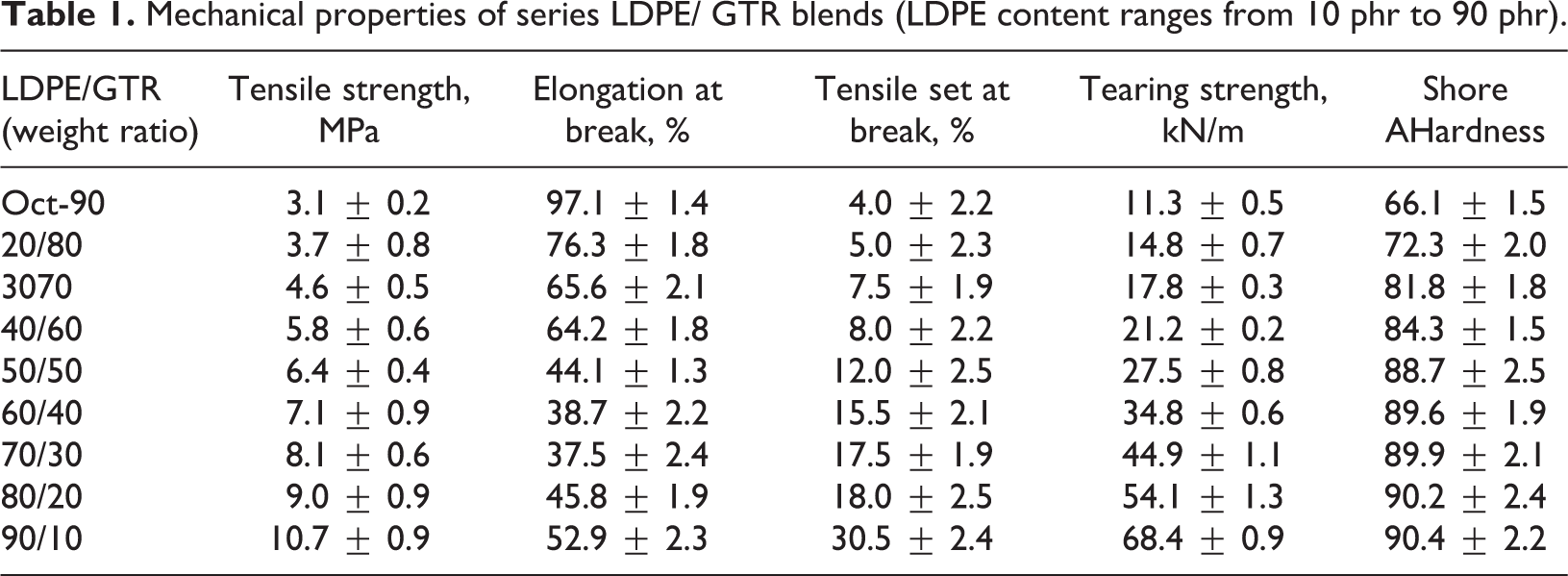
From Table 1, it can be seen that the tensile strength, tensile set at break, tearing strength and Shore A hardness of LDPE/GTR blends were increased significantly with the increasing of the LDPE content in LDPE/GTR blends, implying that the content of resin phase was a major factor that determined the mechanical properties of the blends. For brevity, blends were coded according to the LDPE/GTR weight ratios; e.g. L4G6 represented a blend specimen in which the LDPE/GTR weight ratio was 40/60.
In order to obtain superhydrophobic surfaces based on these blends, template-like method was used to improve the hydrophobic property of the blends. Different types of sandpapers were used as templets because of the rough structure on their surfaces; moreover, these sandpapers, with different abrasive particle size, possessed different surface roughness. W10 sandpaper, with a moderate abrasive particle size (7∼10 µm), was chosen to be used as a templet for the exploring experiment.
The results of static water CA and TA of the series molded surfaces based on LDPE/GTR blends are provided in Figure 1, and the W10 sandpaper was used as a template. As we known, it is generally considered that a surface with CA smaller than 90° is named a hydrophilic surface, while a surface with CA greater than 90° is called a hydrophobic surface. Polymer materials is usually considered essentially hydrophobic.
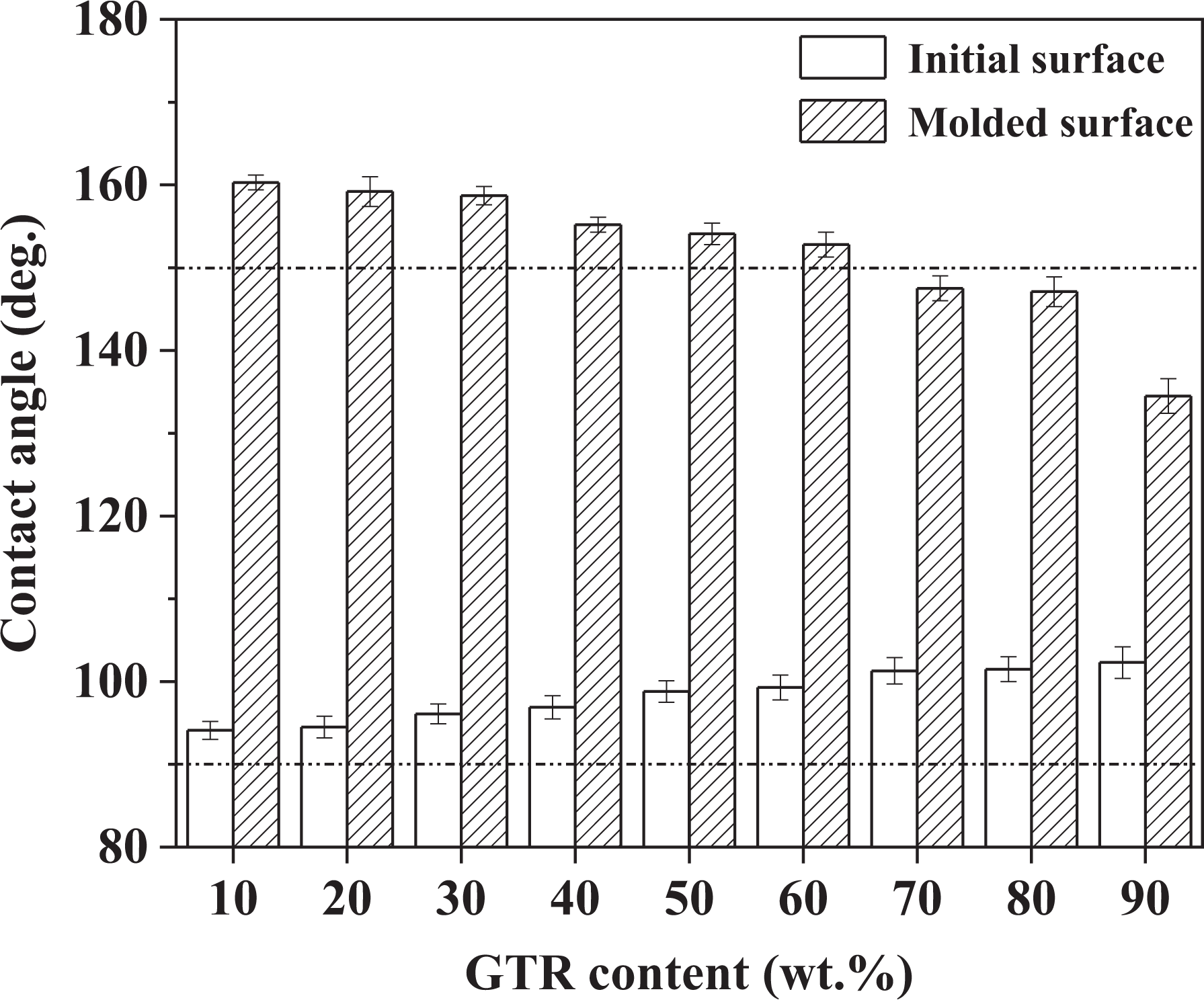
The hydrophobic property of series initial surfaces and molded surfaces based on LDPE/GTR blends.
From Figure 1, the static water CA of initial surface based on series LDPE/GTR blends were all greater than 90°, indicating that all of the series initial blend surfaces possessed hydrophobic property. Comparing with series initial surfaces, the static water CA of series molded surfaces were increased enormously, and it can also be seen that GTR powder dosage was a crucial factor for the preparation of a superhydrophobic surface based on LDPE/GTR blends. According to Figure 1, the CA values of L3G7 and L4G6 surface were close to 150°. In order to research the maximum loading of GTR powder in LDPE/GTR blends while maintaining good hydrophobic property of the molded surface, L3G7 and L4G6 were chosen as substrates for the following experiment.
Figure 2 shows the hydrophobic property of series molded surfaces based on L4G6 and L3G7 where different types of sandpapers were used as templets. The CA values and TA values of series molded surfaces based on L3G7 are presented in Figure 2(a), it was obvious that all the molded surfaces could not match the conditions of superhydrophobic property.
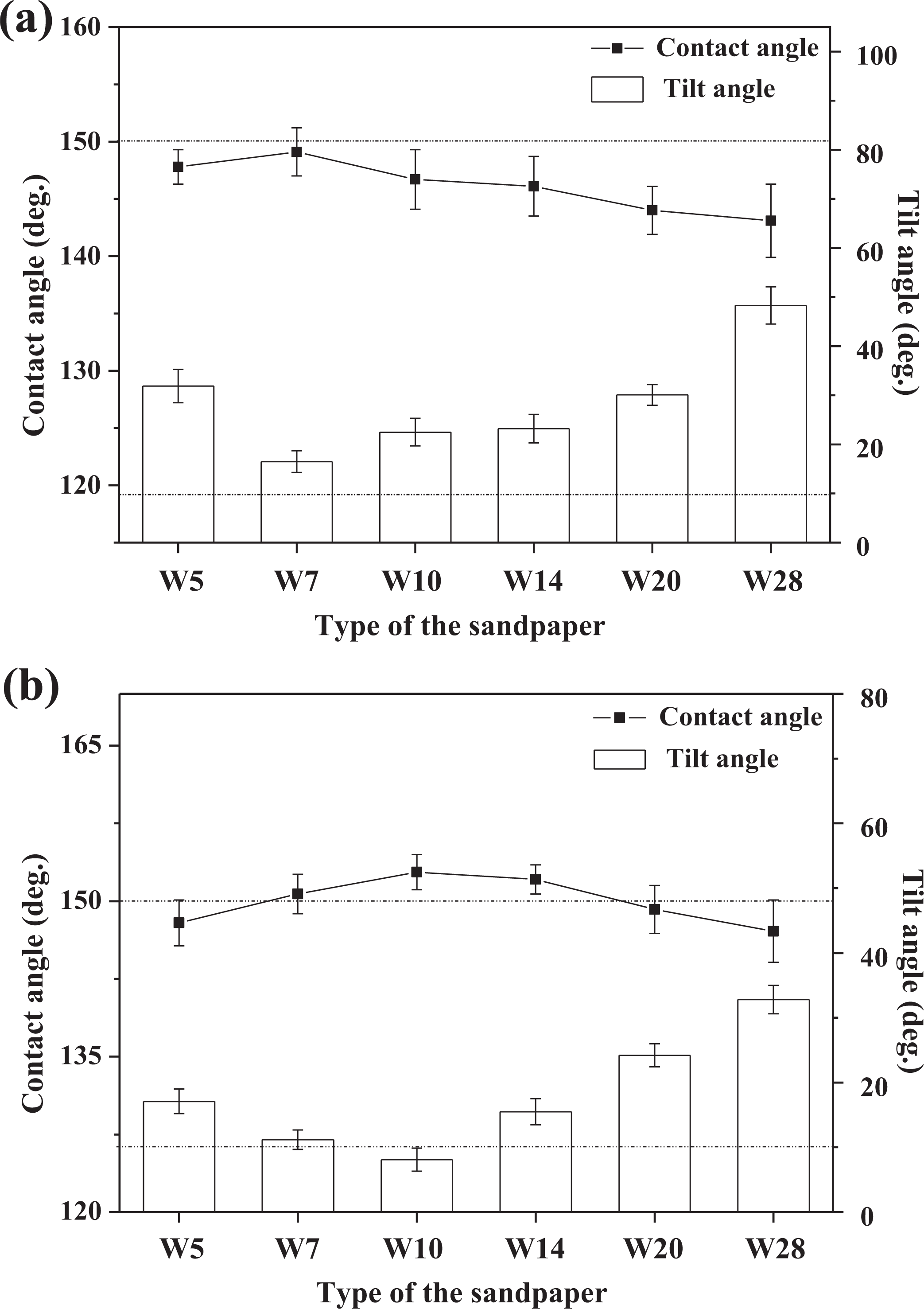
The CA values and TA values of series surfaces molded with different types of sandpapers of (a) series molded surfaces based on L3G7; (b) series molded surfaces based on L4G6.
For Figure 2(b), it can be seen that the CA values of series molded surfaces based on L4G6 were all around 150° and the CA values of series surfaces molded with W7, W10 and W14 sandpapers were larger than 150°, however, the TA values of series molded surfaces were all larger than 10° except the surface molded with W10 sandpaper. According to the definition of superhydrophobic surface, only the L4G6 surface molded with W10 sandpaper was satisfied with the conditions; hence, L4G6 was chosen for the following experiments.
Mechanical properties and hydrophobic properties of series LDPE/SBS/GTR blends
It should be noted that the mechanical properties of L4G6 were unsatisfactory, especially the elongation at break, which means the prepared blends could not be attributed to the thermoplastic elastomers. In order to improve the mechanical properties of L4G6 effectively, SBS was used as an interface compatibilizer.
The tensile strength, elongation at break, tensile set at 100% elongation, tensile set at break, tearing strength and Shore A hardness of LDPE/SBS/GTR blends with different SBS dosage are provided in Table 2. As can clearly be seen from the data in Table 2, with the increasing of SBS dosage, it was surprised that the elongation at break was enhanced significantly. The values of the elongation at break were all larger than 100%; moreover, the increment of elongation at break was more than 300%, ranging from 64.2 (at 0 phr SBS) to 261.6 (at 21 phr SBS). The loading of SBS can also affect the tensile strength and tearing strength obviously.
Mechanical properties of the series LDPE/SBS/GTR blends.
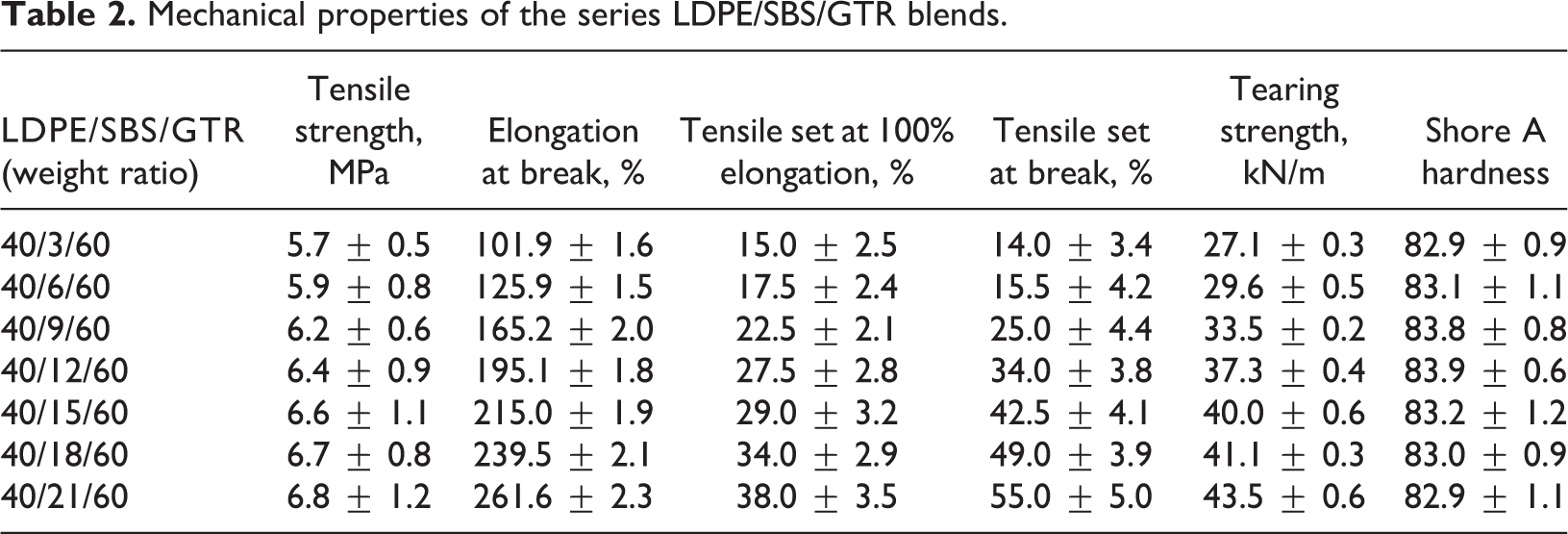
Comparing with the data in Table 1, the values of tensile strength with 0 phr SBS content and 21 phr SBS content were 5.8 MPa and 6.8 MPa, and the tearing strength was ranging from 21.2 MPa to 43.5 MPa with the SBS dosage from 0 phr to 21 phr. However, the loading of SBS had almost no influence on the values of Shore A hardness. The values of tensile set at 100% elongation in Table 2 were all lower than 50%. According to ASTM D1566, the series LDPE/SBS/GTR blends can be considered as elastomer. For brevity, TPEs were coded according to the LDPE/SBS/GTR weight ratios; e.g. L4S15G6 represented a TPE specimen in which the LDPE/SBS/GTR weight ratio was 40/15/60.
It is noted that when the loading of SBS was larger than 15 phr, the SBS dosage in LDPE/SBS/GTR TPEs could only influence the elongation at break slightly. Therefore, in the following experiments, L4S15G6 were used as substrate to fabricate superhydrophobic surface.
Table 3 shows the abrasive particles size of series sandpapers and hydrophobic properties of L4S15G6 surfaces molded with different types of sandpapers.
Types of sandpapers and hydrophobic properties of series molded L4S15G6 surfaces.
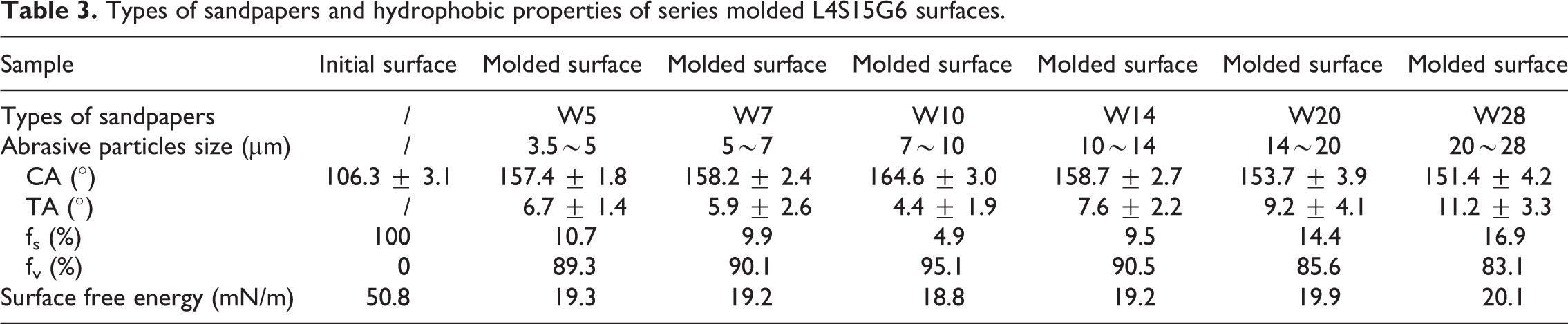
As shown in Table 3, the CA values of the series TPEs surfaces molded with W5, W7, W10, W14 and W20 sandpapers were all around 150°; moreover, the TA values of the series TPEs were all around 10°, indicating that the L4S15G6 surface molded with series sandpapers showed the valuable superhydrophobic properties. Moreover, it should be noted that the L4S15G6 surface molded with W10 sandpaper achieved the highest CA value (164.6° ± 3.0°) and the lowest TA value (4.4° ± 1.9°), which indicated that the L4S15G6 surface molded with W10 sandpaper possessed outstanding superhydrophobic property.
Usually, the super-hydrophobicity behavior of the realistic solid surface was related to the surface energy. 38 The surface free energy values of the initial L4S15G6 surface and the series molded L4S15G6 surfaces are listed in Table 3. From Table 3, it can be seen that the surface free energy of the L4S15G6 surface molded with W10 sandpaper was decreased obviously, from 50.8 mN/m for the initial surface to 18.8 mN/m for the molded surface, and it can also be seen that the CA values of molded surfaces was improved obviously with the decreasing of surface free energy.
In order to explain the superhydrophobic phenomenon more deeply, Cassie–Baxter model was used as a method of fitting CA values in Table 3. This model was calculated by the following equations:

Where fs and fv are represented of the area fractions of L4S15G6 itself and the trapped air, respectively; moreover, θr represented of CA values, and θs and θv are intrinsic CA of L4S15G6 and the air, respectively; usually, water droplets are spherical in air and the computation of cosθv were considered as 1. It should also be noted that fs + fv = 1, and equation (3) can be modified as follows:

According to the equation (4), the values of fs in series molded L4S15G6 surfaces could be calculated, and the results of fs and fv are shown in Table 3. According to Cassie–Baxter model, a superhydrophobic surface with a higher fv possessed better water repellency. From Table 3, it was obvious that the L4S15G6 surface molded with W10 sandpaper has the largest fv and possessed the best superhydrophobic property.
The CA, TA, fs, fv and the optical images of series molded L4S15G6 TPE surfaces are presented in Figure 3.
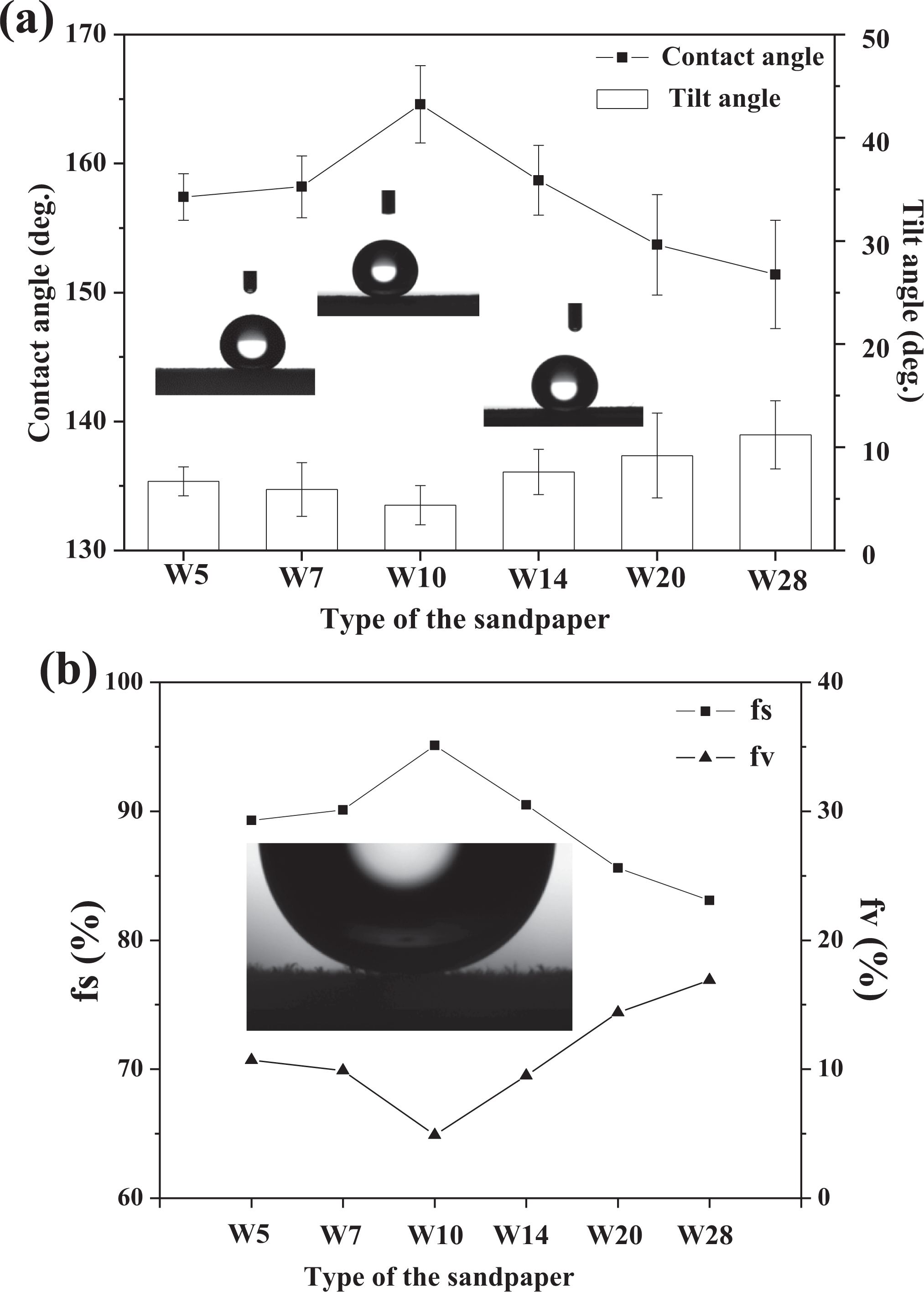
The CA, TA, fs, fv and optical images of series L4S15G6 surfaces molded with different types of sandpapers of (a) CA values and TA values of series molded L4S15G6 surfaces; (b) fs and fv of series molded L4S15G6 surfaces.
Figure 3(a) shows the relation between the types of templets and the super-hydrophobicity of the series molded L4S15G6 surfaces, the insets are optical images of CA measurements. It can be clearly seen that the highest point of CA values appeared at W10, and the lowest point of CA values appeared at the same point, indicating that the TPE surface molded with W10 shows the best superhydrophobic property.
Comparing with that of Figure 2(b), the superhydrophobic property of L4G6 surface molded with W10 sandpaper was improved remarkably with the addition of SBS. The CA of the surfaces were increased from 152.8° ± 1.7° to 164.6° ± 3.0° and the TA were dereased from 8.1° ± 1.8° to 4.4° ± 1.9°.
From Figure 3(b), it can be clearly seen that the maximum of fs and the minimum of fv were also appeared at W10, which means Cassie’s theoretical prediction was applied to the superhydrophobic surfaces based on L4S15G6. The inset is optical image of contact surface between water and L4S15G6 surface molded with W10 sandpaper.
As mentioned above, surface free energy and roughness are two essential factors that can influence a solid surface’s ultra-hydrophobicity; moreover, a surface with super-hydrophobicity results from the decrease of surface free energy and the increase of surface roughness. In order to reveal the roughness factor of the experimental phenomenon, FE-SEM images of L4G6 samples and L4S15G6 samples were observed.
The corresponding SEM images of L4G6 samples and L4S15G6 samples are shown in Figure 4. From Figure 4(a), it can be seen that obvious cavities could be observed in the initial L4G6 surface, indicating that the GTR particles were separated from the matrix due to the weak interface interaction between GTR and LDPE during the molded process. From Figure 4(b), it can be observed that the initial L4S15G6 surface were almost flat, which proved that the interface combination between the GTR powder and the resin phase can be improved remarkably by using SBS as a compatibilizer.
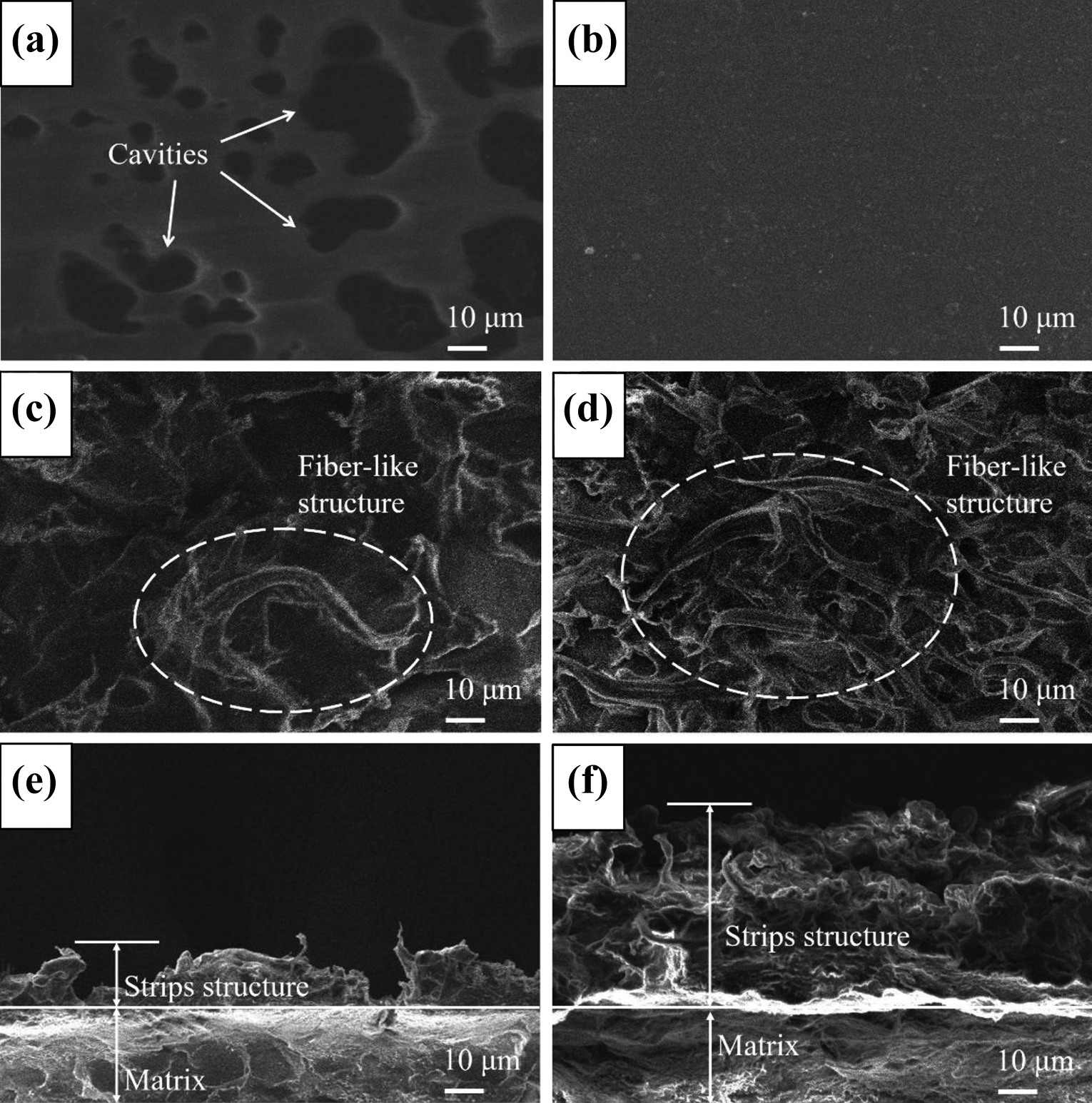
FE-SEM images of series surfaces based on L4G6 samples and L4S15G6 samples of (a) initial surface based on L4G6; (b) initial surface based on the L4S15G6; (c) the L4G6 surface molded with W10 sandpaper; (d) the L4S15G6 surface molded with W10 sandpaper; (e) fracture surface of the L4G6 molded with W10 sandpaper, and; (f) fracture surface of the L4S15G6 molded with W10 sandpaper.
For the L4G6 surface molded with W10 sandpaper, as shown in Figure 4(c), only a few step—like textures and fibers—like microstructures were appeared on the surface, moreover, some areas were still flat. It can be clearly observed from Figure 4(d) that the L4S15G6 surface molded with W10 sandpaper was successfully inherited the step-like textures in the surface of the sandpaper; moreover, there were a large amount of fibers-like textures on the surface, which were resulted from the plastic deformation of LDPE matrix in L4S15G6 and would inevitably increase the surface roughness and the super-hydrophobicity of the molded L4S15G6 surface effectively.
Figure 4(e) and (f) shows the cross-section FE-SEM images of the liquid nitrogen fracture on each sample. From Figure 4(e) and (f), it can be seen that the micro-scale strips were observed obviously which was also resulting from the deformation of LDPE matrix. The thickness of strips structure on L4S15G6 surface is about 40 µm; however, for L4G6 surface, the thickness of the strips layer is about 20 µm. For the superhydrophobic property, the micro-scale strips in the molded L4S15G6 surface could trap the air and reduce the contact area between water droplet and L4S15G6 surface remarkably, and the water droplet could suspend itself on these strips easily.
In order to explain the difference on the superhydrophobic property between the molded surface based on L4G6 and L4S15G6, the superhydrophobic parameter, surface free energy and thickness of strips structure are listed in Table 4.
Comparison of L4G6 surface molded with W10 sandpaper and L4S15G6 surface molded with W10 sandpaper.
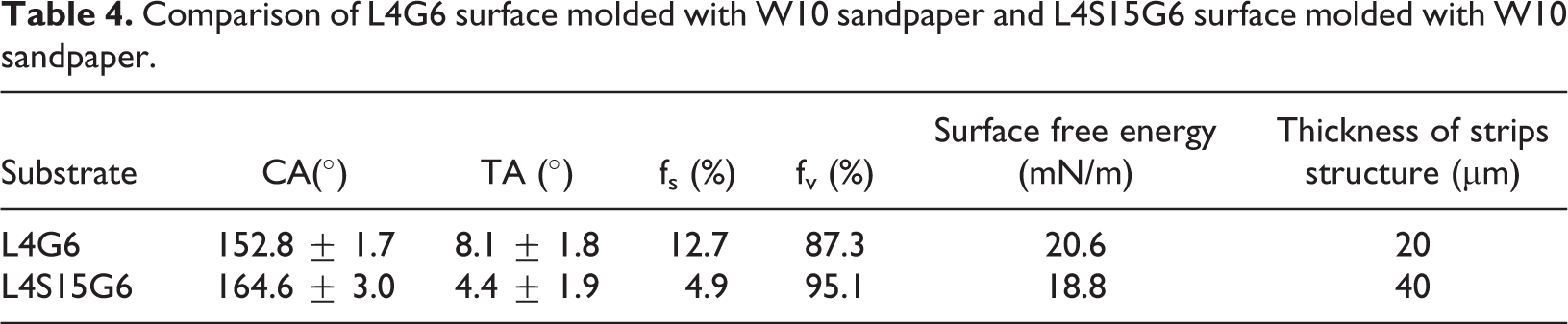
Firstly, according to the Cassie–Baxter model, for a superhydrophobic surface, the CA values can be improved obviously with the increasing fv. From Table 4, it can be seen that the experimental results are in agreement with the theoretical analysis. Secondly, the wettability of a solid surface can be modified through changing the surface free energy, and the decreasing surface free energy can increase the CA values of a solid surface. It can be observed in Table 4 that L4S15G6 surface had lower surface free energy and therefore possessed the higher superhydrophobic property. Finally, as mentioned above, the improvement in the surface roughness can also improve the hydrophobic property of a surface.
As shown in Table 4, for L4S15G6 surface, the value of CA and the thickness of strips structure were both higher than that of L4G6 surface; moreover, from Figure 4(c) and (d), what is certain is that the rough structure of L4S15G6 was more complex, and it is the reason for the greater super-hydrophobicity of the molded L4S15G6 surface.
From Tables 2 and 4, we can know that the mechanical properties and hydrophobic properties of L4S15G6 were much better than that of L4G6.
The elemental compositions of the W10 sandpaper and the L4S15G6 surface molded with the W10 sandpaper are reported in Table 5, which were measured by using energy dispersive X-ray spectroscopy. In our study, the abrasive particles of W10 sandpaper were Al2O3 particles. From Table 5, the Al element could not be found in the molded L4S15G6 surface, indicating that the abrasive particles were stuck firmly in the sandpaper surface, and no abrasive particles were adhered to the L4S15G6 surface after the molding process.
Element content in the surface of W10 sandpaper and L4S15G6 surface molded with W10 sandpaper detected by EDX.

Adhesion behavior and self-cleaning property of the superhydrophobic surface
Without complicated mathematical equation, it seems hard to quantitatively verify the existence of either the Wenzel or the Cassie–Baxter model. However, adhesion behavior is a simple and intuitive way to observe the superhydrophobic property of a surface, which is different from CA measurements and TA measurements. The L4S15G6 surface molded with W10 sandpaper was chosen to research the adhesion behavior and self-cleaning property because of the excellent superhydrophobic property.
Figure 5 shows the adhesion behavior of a water droplet on the L4S15G6 surface molded with W10 sandpaper. As the series photos shown in Figure 5(a), a water droplet hangs from a needle (the diameter of the needle is 0.5 mm), pressing it on the surface for about 3 s, then lift the needle and the water droplet were separated from the surface. From Figure 5(a) (1) to (5), it can be observed that the water droplet separated from the superhydrophobic surface spontaneously with the movement of the syringe, even vertically extruded the water droplet on the superhydrophobic surface, it was still on the tip of the needle instead of the surface, indicating that the surface revealed low surface adhesion after molded with sandpaper. When a water droplet (20 µL) were allowed to stand on the superhydrophobic surface, it can rapidly slide off at a very small inclination (5.6°) as shown in Figure 5(b), which means that the superhydrophobic surface possessed excellent water repellency.

Series of screenshots showing the adhesion behavior of a water droplet on the superhydrophobic surface based on L4S15G6 of (a) staying attached to the needle tip after in contact with the superhydrophobic surface; (b) sliding off the superhydrophobic surface subsequently in a small inclination.
The phenomenon, as shown in Figure 5, indicating that a water droplet on the superhydrophobic surface based on L4S15G6 is in the Cassie wetting model regime where the micro/nano-sized fibers-like structures are formed between water droplet and the surface; moreover, the super-hydrophobicity is achieved.
The foreign dirt adhere to the superhydrophobic surface can be easily removed when the water droplets pass through the surface, termed self-cleaning property. It is one of the most significant properties of the application and function of superhydrophobic surface. Self-cleaning property can be easily observed on a superhydrophobic surface; however, very little research had been done on it. The self-cleaning performance of the superhydrophobic surface can be observed in Figure 6. From the series pictures in Figure 6(a) to (f), the foreign particles (collected from dry soil) on the surface were disappeared after a water droplet (10 µL) passing through. Figure 6(c) shows the granules were engulfed by the water droplet. Subsequently, the particles were all carried away in the water droplet as can be seen from Figure 6(f).
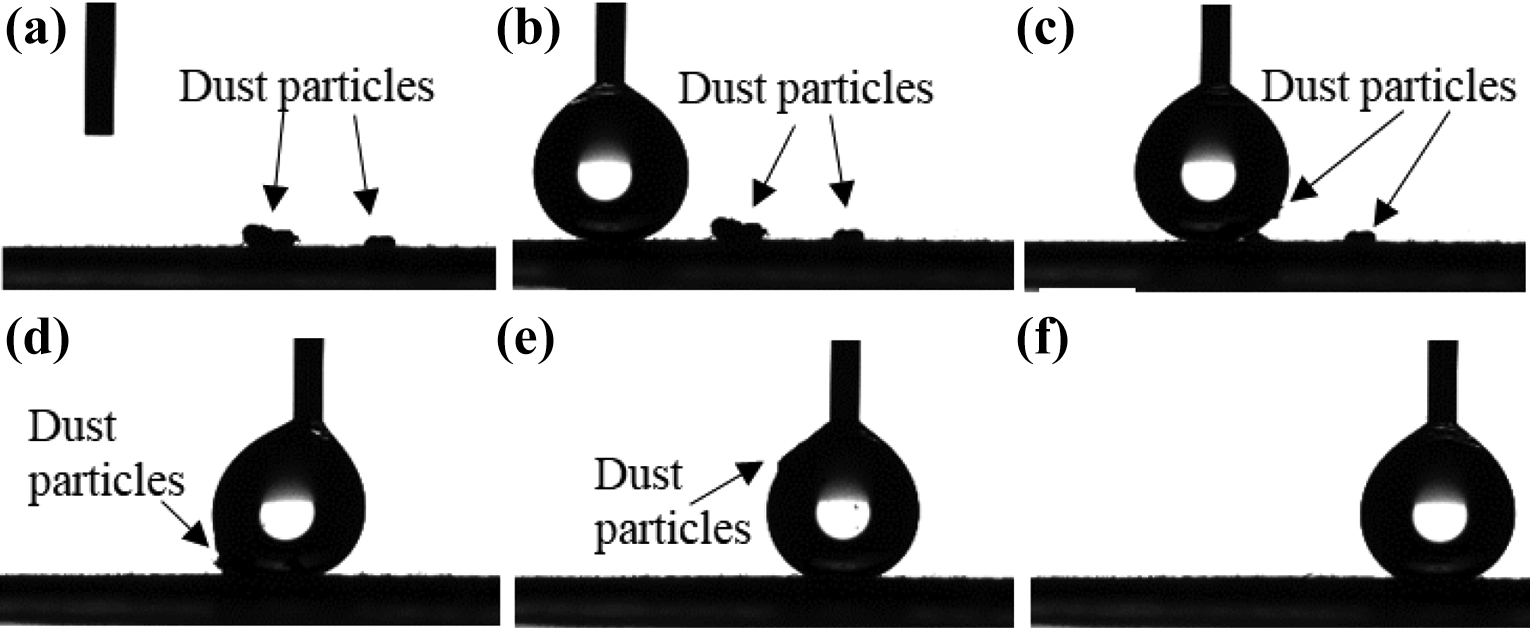
Self-cleaning property of the superhydrophobic surface based on L4S15G6.
During the whole process, the water droplet rests on the surface as a spherical shape, which shows that the superhydrophobic surface possessed the brilliant self-cleaning property.
Conclusions
In summary, the superhydrophobic surfaces based on LDPE/SBS/GTR TPEs were prepared through a simple, effective and inexpensive way. The mechanical properties, microstructure and the of the series molded surfaces were researched systematically. GTR powder dosage and types of sandpaper were two crucial factors for the preparation of a superhydrophobic surface. The existence of SBS can remarkably improve the mechanical properties and hydrophobic properties of LDPE/GTR blends.
The L4S15G6 surface molded with W10 sandpaper has the most outstanding superhydrophobic performance (CA = 164.6° ± 3.0°, TA = 4.4° ± 1.9°), the surface also exhibits low surface free energy (18.8 mN/m) and high GTR powder dosage (with 60 wt.%). The SEM results showed that quantities of step-like textures and fibers-like structures plays a vital role in trapping air on the superhydrophobic surfaces. The wettability tests confirmed that the experimental results on the superhydrophobic surfaces were correspondent with Cassie’s theoretical predictions. Moreover, the obtained superhydrophobic surface shows excellent adhesion behavior and self-cleaning property.
Footnotes
Declaration of conflicting interests
The author(s) declared no potential conflicts of interest with respect to the research, authorship, and/or publication of this article.
Funding
The author(s) disclosed receipt of the following financial support for the research, authorship, and/or publication of this article: This work was supported by Shandong Provincial Natural Science Foundation, China (ZR2017MEM021).
