







Abstract
Implementing school choice programs and bolstering parental engagement are both frequently touted as critical steps in improving educational outcomes in US schools. Many policy makers contend that by providing parents with more schooling options for their children, parents will become more involved in their children’s education, resulting in better and more equitable opportunities. The authors consider whether more school choices necessarily translate into more robust parental involvement, by chronicling for 5 years both the opportunities for and barriers to engagement that parents encountered in the Clarksville School District as it underwent a significant period of reform. The authors conclude that school choice does not always have a positive impact on parental engagement, and engagement in turn does not always translate into better or more equitable opportunities. In some cases, increased choice may present additional challenges to parents as they struggle to find accurate information, weigh a variety of problematic options, and consider the impact of their personal decisions on their children and on the overall well-being of the district.
Parental engagement has been cited as a key element of school reform since the passage of No Child Left Behind, in which states were encouraged to develop parental involvement practices that ‘foster achievement to high standards for all children’ and are geared ‘toward lowering barriers to greater participation by parents in school planning, review, and improvement’ (United States Department of Education, Office of Innovation and Improvement, 2004: 8). A main aspect of education reform that encourages such engagement and relies on its effects is school choice.
The anticipated benefits of school choice are greater equality, in terms of access to educational options and opportunities, as well as improved quality, as a result of competition pressures. While parents participate in school choice programs often in search of advantages for their own children, proponents argue that involvement in this manner may have a broader impact, as schools must innovate and improve to meet consumer demands (e.g. Chubb and Moe, 1990; Hadderman, 2002; Osborne, 1999). Moreover, supporters of school choice argue that a market model allows all parents – and not simply those with the financial means – to participate equally in making educational decisions for their children (e.g. Friedman and Friedman, 1980; Manno et al., 1998; Viteritti, 2003). Critics warn about possible negative effects of choice, and particularly about inequalities and increased stratification through creaming and other mechanisms (Ben-Porath, 2012; Ladd, 2012), but even among them many agree that parental engagement can improve through choice and provide various positive outcomes.
Indeed, many researchers describe the benefits that parental engagement produces both for school climate and individual student achievement. This engagement may take a variety of forms, from volunteering in classrooms to helping with homework to communicating with teachers and administrators, and researchers argue that parental participation can lead to higher test scores, improved attitudes, and better behavior among students (e.g. Epstein, 1995; Epstein and Salinas, 2004; Gutman and McLoyd, 2000; Ingram et al., 2007; Munoz, 2000; Van Voorhis, 2003).
This article asks, how do emerging choices allow for parents to engage in their children’s education through the selection of educational experiences for their children? In addition, what barriers prevent parents from engaging and from making informed and beneficial choices? In what ways do the choices themselves limit parents’ effective participation?
This article is organized around the different ways in which parents engage in their children’s education within the framework of school choice. We explore what happens when parents gather information about various choices, create new choices when there are seemingly none, take part in collective action to establish new choices, and engage in policy discussions surrounding school choice. These questions are investigated through the lens of the Clarksville School District, 1 a small urban district in a continuous state of crisis, observed for 5 years as it underwent reforms typical of many districts nationwide. We find that the mostly poor, minority, and migrant parents in Clarksville invest considerable resources – both time and money – to learn about educational options for their children and utilize them. We also find that where there are not good options, they try to create them, and that they engage collectively and with policy makers to improve the range of choices available to their children. Overall, the availability of further choices sometimes serves to empower parents to work to improve their children’s education, but in other cases it silences parents’ preferences, creates further undesirable choices, or wastes parents’ time and other resources without creating a positive impact on schooling. Ultimately, we argue that while school choice is often framed as an opportunity for more parents to better engage in their children’s education, each choice comes with its own set of barriers. Not only is school choice of questionable relation to educational equality, but even its instrumental support for greater parental engagement is not as straightforward as it might seem.
Methods
The data in this study were collected through an ethnographic approach using a variety of methods – interviews, document analysis, and participant observations – as a means of collecting ‘insider accounts’ (Hammersley and Atkinson, 1995: 124). It was analyzed using grounded theory, coding transcripts, and field notes in order to identify themes in the data (Creswell, 2007; Maxwell, 2005). McGinn came to Clarksville in September 2007, as part of a 3-year project with one of the three members of the state-appointed Education Empowerment Board (EEB) in Clarksville. Her research continued in Clarksville for 2 additional years after the Education Empowerment Board disbanded.
Throughout this time in Clarksville, the effects of school choice programs on parental engagement in the district became apparent. From 2007 to 2012, 78 stakeholders were interviewed on this and related topics. Most interviews were one-on-one, though four interviews were group interviews, ranging in size from 2 to 11. (For a complete list of interview subjects, including the date(s) of interview(s), their specific role(s) in the district, and each stakeholder’s race and gender, see Table 1.) Interviews were semistructured and adhered loosely to protocols designed to capture respondents’ understanding of events in the district as well as the role(s) of parents. In addition to interviews, McGinn also conducted observations in a variety of settings, including School Board meetings, and participated in the Truancy Intervention Center’s activities. Newspaper and journal articles pertaining to the Clarksville School District provided additional information where needed.
Interview respondents, 2007–2012.
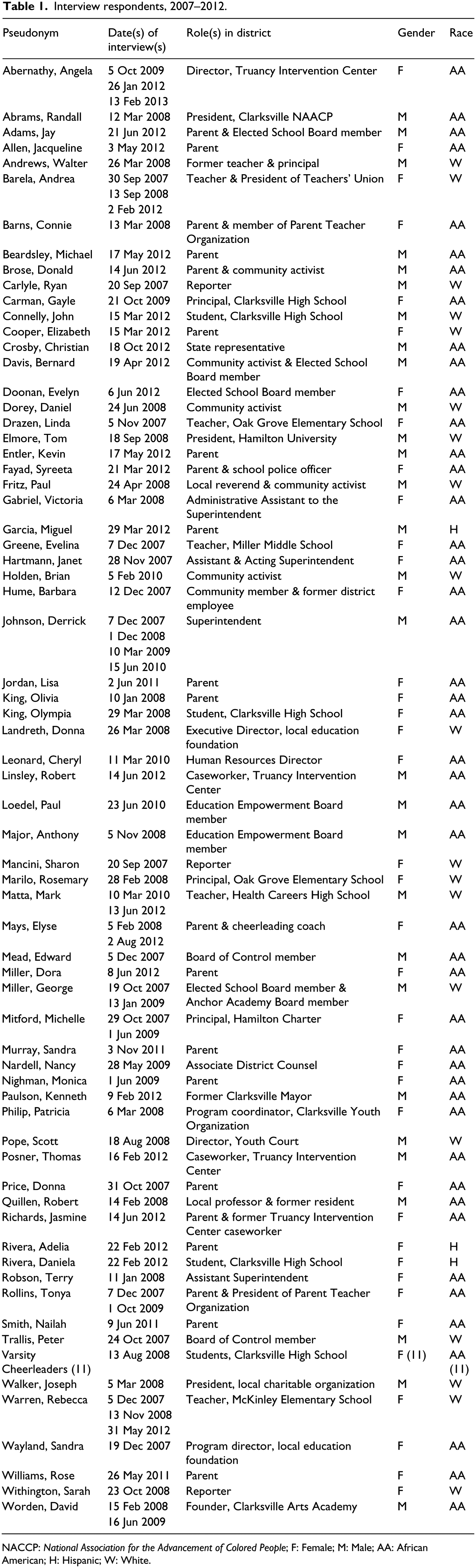
NACCP: National Association for the Advancement of Colored People; F: Female; M: Male; AA: African American; H: Hispanic; W: White.
The context and the choice set in the district
Clarksville is a small, predominantly African American city, with a population of a little over 40,000. The Clarksville School District has a total of about 4000 students, with approximately 45% of this number enrolled in charter schools in 2012. Clarksville consistently has lower rates of educational attainment than surrounding areas, and the district ranks among the lowest in the state in terms of standardized test scores.
As Derrick Johnson, the superintendent of the Clarksville School District from 2007 to 2010, noted, ‘Choice is only good if you have good choices’ (Field notes, 11 March 2010). Given the small size of the district, the public options within the Clarksville School District were limited. In 2007, there were four public elementary schools, two middle schools, and one high school, all of which were characterized by low state standardized test scores and experienced safety problems. Some Clarksville parents opted to send their children to nearby private or parochial schools. Charter schools provided another alternative. At the time of this study, there were four charter options in Clarksville: Hamilton Charter School opened in 2006 as a partnership school with Hamilton University, a small university near the center of Clarksville; Clarksville Charter School (CCS), which was founded in 1998 by a local lawyer, Reuben Chevalier, who is also the founder of a for-profit management company that operates the school (which enrolls more than half the district’s students in grades K-8, and almost two-thirds of the district’s kindergarteners); Anchor Academy, started by local community members; and various cyber charter schools.
In an effort ‘to provide a strategic partner for every school in the city’ (Field notes, 15 November 2007), the superintendent developed three new partnership schools. Clarksville Arts Academy was created under the vision of a local music professor; Health Careers High partnered with the local hospital and was designed to prepare students for professions in the medical field; and Science and Technology High received support from non-profit organizations to create programs that focus on STEM (science, technology, engineering, and math) subjects.
Thus, during the time of this study, between 2007 and 2012, a number of educational options became available to Clarksville families. At first glance, more options from which to choose may seem to translate into more opportunities for parents to engage in their children’s schooling. While we can certainly identify ways in which Clarksville parents became involved directly as a result of school choice, each of these forms of participation came with its own sets of barriers. We turn now to exploring the different types of engagement.
Gathering information
André-Bechely (2005) explains that parents engage in ‘choice work’ when they participate in activities relating to school choice, including ‘gathering information about schools, talking with people about schools, [and] visiting schools’ (p. 269). Many parents in Clarksville expressed the desire to make informed decisions regarding where to send their children, and they described doing this type of ‘choice work’ to learn about various schools. With the introduction of more choices, parents did have the opportunity to gather new information about different educational options. However, acquiring information was not always a straightforward process, and parents encountered a number of barriers as they sought to make the best decisions for their children.
For some parents, the process of learning about local schools began early in their children’s lives. For example, Donna Price, a parent at Hamilton Charter School, reported worrying about her son’s education since the day he was born. She explained that she followed the progress of Hamilton Charter School in the newspaper, and when her son was ready for school, she ‘went to [a] meeting [about the school], signed up, managed to get him in through the lottery that they were holding’ (Interview, 31 October 2007). Price said that she was drawn to the school because of its ‘progressive attitude towards education [and its] broad-spectrum type of curriculum, including art, Spanish, [and] music’ (Interview, 31 October 2007). In fact, the school has a strong reputation in the community. Illustrating Cobb and Glass’ (1999) finding that charter schools rely on ‘word of mouth’ advertising, Principal Mitford explained that Hamilton Charter does not need to recruit, as ‘our parents really are our ambassadors . . . we’ve had a lot of, you know, community feedback that has been really positive, and last year we had a waiting list of 300’ (Interview, 1 June 2009).
In contrast to Hamilton Charter, other schools are not as accessible, and parents reported encountering a number of challenges as they tried to learn more about them. For example, many parents who try to make educated decisions regarding Clarksville Charter described having a difficult time finding relevant information. Some parents explained they were unable to get honest answers from their children’s teachers and from school administrators. Andrea Barela, President of the teacher’s union, said it is hard to find anyone employed at Clarksville Charter who will talk about the school. She said even teachers who have left CCS refuse to talk about their experiences, and she cited two examples of acquaintances who used to teach at CCS and still will not discuss the school, noting ‘nobody [associated with the school] will say a word’ (Interview, 2 February 2012).
Even when parents seek out seemingly objective information about the academic programs at CCS, they encounter problems. The mission statement posted on Clarksville Charter’s webpage stresses the ‘results-driven academic environment’ of the school, and an article in a local newspaper supported this claim, reporting that CCS has higher average state standardized test scores than the other public schools in Clarksville. However, the article also noted that these scores were subject to a state investigation, due to ‘erasures on many tests where most or all corrected answers were switched from wrong to right, a statistical improbability’ (Local newspaper, 18 March 2012). While the state recently ended its inquiry into the matter, clearing the school of wrongdoing, it did so in a confusing manner. A representative from the state explained that its investigation ‘did not yield clear conclusions notwithstanding the overwhelming evidence of testing irregularities’ (Local newspaper, 14 October 2012). Given these problematic test results along with the refusal of CCS officials to release financial information about their management company, parents often feel they are kept in the dark regarding many issues surrounding the school.
Still other schools actively tried to share information with parents. For example, Clarksville administrators wanted to make sure that families were aware of new partnership schools the district was developing. Thus, the Superintendent, Dr Johnson, took a number of steps to market these schools to the community. In the spring and summer of 2008, he used board meetings as one forum to describe these new opportunities, and the Clarksville local newspaper ran a series of reports about construction on the schools. In the fall of 2008, Dr Johnson hosted a ‘Parade of Schools’, inviting community members to spend one Saturday with him, riding a school bus to visit and tour the district’s new schools (Field notes, 23 October 2008). After the schools were open for a year, Dr Johnson implemented more formal recruiting procedures. In the spring of 2009, Dr Johnson explained that he was sending his Assistant Superintendent ‘on the road’, to share the district’s ‘high school choice programs’ with the community (Field notes, 19 March 2009). At an Empowerment Board meeting a year later, he explained that rising ninth graders in the district would have the opportunity to visit all the district’s high schools at the end of March, and families could attend ‘open houses’. In fact, he described the high school selection process as a ‘chance to get parents re-engaged’ (Field notes, 11 March 2010).
Despite this outreach, some stakeholders felt they did not have enough data to make educated decisions. Tonya Rollins, President of Clarksville High School’s Parent Teacher Organization, argued that the development of the specialty high schools was a good idea that was poorly executed. She explained that the district did not successfully communicate the purpose of these schools to parents: I said we really need to market [these new schools] . . . people have left this district because they have been tired of the education being subpar, so if you’re gonna say we’re gonna turn it around, we need to market this. We need to let parents know, who are paying for their kids to go to school, in private schools, or moving to get into other districts, whatever it is, we need to market this, we need to say, these are the opportunities, that we have partnerships with, you know, local businesses. We need to sell this and package this so it’s phenomenal. And our own students didn’t even really get any information, it was just like the schools are open, and you just have to figure it out on your own, and if you want to go here, then maybe you can. (Interview, 1 October 2009)
Mark Matta, a teacher at Health Careers High, also noted that attendance at the two schools was often determined by geography: ‘Science and Technology had more students from the West end of Clarksville, and Health Careers had a lot more from the East side, right, just because of where the schools were positioned’ (Interview, 13 June 2012).
Other stakeholders were somewhat suspicious of new programs in the district, as initiatives tend to come and go in Clarksville. When asked if she would consider sending her children to one of the specialty high schools, Monica Nighman replied, See, I don’t know anything about that. That’s just too new. And I heard it’s a mess . . . I don’t have enough information to . . . I would have to take off and go check that out and what I’ve heard, no, that’s just something they threw in there, you know, that’s something they’re gonna have to nurture. (Interview, 1 June 2009)
Likewise, Evelyn Carroll, a local pastor, shared her concerns at a board meeting. She was particularly nervous about moving students to new buildings. She explained, ‘People promise us stuff all the time, what happens if [the students] move and don’t get what we were promised?’ The Board Chair assured her that the Board was equally concerned with the longevity of the programs, and Dr Johnson said her point was ‘very well taken’ (Field notes, 10 April 2007).
In the end, stakeholders were right to be wary. After the Empowerment Board was dissolved in 2010, and Dr Johnson left for another district, the two specialty high schools quickly deteriorated. The elected School Board, citing budget cuts, decided to merge the two schools. This merger led to a number of problems including overcrowding, conflicts between students coming from two different neighborhoods, withdrawal of partner support, and unstable leadership.
While some parents argued the partnership schools might have been more successful if the district had marketed them more effectively, most parents would agree that charter schools in the district aggressively advertise in the city. For example, though CCS provides little in terms of information for parents, it does offer parents a number of concrete incentives for sending their children to the school and for becoming involved in their education. George Miller, a former School Board member, bemoaned the district’s inability to compete with CCS and explained that CCS has a great ‘ability to market’ its school, ‘with all the new frills’. He described what happened when the school district held a kindergarten registration drive at the administration building. That same day, across the street, ‘eight busses were loading up, going to [a nearby amusement park], with anybody and everybody who would register for Clarksville Charter’ (Interview, 13 January 2009).
Similarly, cyber charter schools have also found creative – and opportunistic – ways to advertise. In the 2011–2012 school year, as the district experienced deep budget cuts that led to school closings and overcrowded classrooms, some cyber charter schools actively sought to increase their market share. During this time, School Board meetings became increasingly contentious, with parents sharing how upset they were about conditions in the schools and demanding answers from the Board. At one of these meetings, the Board members did not allow all the parents in attendance to speak, and the meeting ended abruptly amid cries of protest from angry parents, as they expressed concern about the quality of education that their children were receiving. That night, when McGinn walked to her car, she found a flier on the windshield. Looking around, she saw fliers on the windshields of every car in the administration building’s parking lot. On the flier, there was an advertisement for a cyber charter school, announcing in bold, capital letters that it was ‘ENROLLING TODAY’. Under the headline, two African American children posed, smiling in front of a computer (Field notes, 12 January 2012).
Although marketing is, indeed, one way to share information, there is clearly a degree of bias as schools try to present their programs in the best light possible. Moreover, in a study of the impact of social networks on school choice, Schneider et al. (2000) argue that formal networks (such as advertisements or newspaper reports) are frequently the main source of information for poor and minority parents as they try to make decisions regarding their children’s schooling. Schneider et al. explain that while poor, minority parents may have strong connections with close family members and friends, they lack quick access to a wider range of people and institutions, and therefore they may have a more difficult time gathering accurate details about local schools through informal means. In Clarksville, some formal networks, such as the district’s ‘Parade of Schools’, provide concrete information. However, other formal sources, such as glossy advertisements and trips to amusement parts, are not as instructive.
Creating choices where there are none
Early in this study, Michelle Mitford, the Principal of Hamilton Charter School, stated in an interview that it would be beneficial to explore the ways in which parents in Clarksville are ‘constantly searching for different choices [or] educational options’. She explained, ‘You’ll see every once in a while that [parents] move their kids from here to here, from this school to that school, from this to that, because they’re trying to find what works for their kid, and their family’ (Interview, 1 June 2009). Viteritti (2003) argues that the parents of children who attend failing schools do not want their children to be there; rather, ‘they are there because they have no choice’ (p. 14). Indeed, Monica Nighman, a staff member at Hamilton Charter School with children in Clarksville public schools, underscored some parents’ desperation to find an appropriate school for their children. She recounted interactions with parents seeking to enroll their children in Hamilton Charter: Yeah, cause they’ll say to me . . . my child is just so lost, my child is just a quiet child, and that when you go in [to district schools], they’re just shocked, they come home, they’re so upset, they’re this and that, you know, because of all these things that’s going on in their classroom. Or they were in a school before that was a smaller setting, and you throw ’em into a room with, like, 30 children that are just – ‘I have to get my son out of there’, and that’s all they say. And even if they don’t come here, they can’t go to the district. (Interview, 9 June 2009)
For most families in Clarksville, however, moving to another district is not an option. Similarly, while some parents managed to send their children to parochial or other private schools at great financial sacrifice, for most this was not an option. In an initial interview, Dr Johnson explained that with the ongoing state of crisis, anyone who could afford to leave Clarksville had already left, describing the remaining residents as ‘a body of people that are captives, that just have to stay and continue’ (Interview, 7 December 2007). However, for some of these families, continuing in the district means finding ways to create choices – through both honest and deceptive means – when none seems to exist.
First, many parents described relocating within the city limits – or pretending to relocate within the city limits – as a way of choosing which Clarksville elementary school their children attend. Assistant Superintendent Janet Hartmann explained that parents have been stretching the attendance boundaries since she began her career in the district. As a Principal of one of the more desirable elementary schools, Oak Grove, she had ‘75 kids my first year that I had to talk to parents and say, “Your child doesn’t belong here”, [because] they didn’t live in the attendance area’ (Interview, 28 September 2007). Rosemary Marilo, who held the position of Principal at Oak Grove more recently, had a similar experience. She recalled asking one of her teachers, ‘How many kids in this school live in your house?’ because so many children who attended Oak Grove used this teacher’s address (Interview, 28 February 2008). Donald Brose, a parent who briefly worked as a nonteaching assistant in the district, described searching for a parent whom the district was unable to contact. He discovered that she was using the address of a vacant home. When he found her, she admitted that she was lying about her address and implored Brose, ‘Don’t tell them that I’m using that address’ (Interview, 14 June 2012).
The Director of the Truancy Intervention Center, Angela Abernathy, also noted that parents may have their children’s grandparents or other family members register their children for school, so that the children can attend a particular school in that family member’s neighborhood. Adults are required to provide proof of legal guardianship when they register their children for school, but secretaries often do not follow the district’s protocol. Abernathy explained that sometimes school staff members may register a child without proof of guardianship because they know the family personally or because someone came to the office and ‘gave ’em such a hard time’ (Interview, 13 February 2013). In some cases, the grandparents may indeed be taking care of their grandchildren; in other situations, however, the children live with their parent(s) but use the grandparents’ address to attend a school in a different area in Clarksville. These cases often come to Abernathy’s attention when the grandparent (or other relative) receives a fine because the student they registered has been truant. In court, the grandparents protest, ‘I shouldn’t get this fine, because I’m not the legal guardian’. When Abernathy explains that the student has to attend school where his or her legal guardian resides, the relatives argue, ‘This is my grandchild, I’m not gonna let my grandchild go there!’ (Interview, 13 February 2013).
Not all parents have to lie about their address – some parents are able to live near their preferred school. Parent Lisa Jordan explained that despite her overall displeasure with the school district, she does like Central Elementary School: ‘I’ve always, none of my children have never been to another school, we’ve always seen that we lived right where Central was at’. In fact, she noted that ‘in the last five years, I moved across the street, so that was even better, so, and I like Central’ (Interview, 2 June 2011). When she recently had to move closer to another elementary school, Jordan explained that she talked with the Principal and was able to keep her son at Central. She explained that because of her son’s attention deficit hyperactivity disorder (ADHD), she felt that McKinley Elementary School would be ‘a bad choice for him’. Jordan was able to keep her son at Central, but the district would not provide transportation for him, which posed a significant challenge for Jordan (Field notes, 12 May 2011).
Similarly, Nailah Smith described convincing two consecutive Principals of Central Elementary School to let her younger children continue attending the school after the catchment area changed and her children were supposed to attend Wilson Elementary School. Smith implored both of these principals to allow her children to stay at Central: I said, ‘My kids aren’t gonna make it at Wilson,’ like, I’m gonna be at Wilson every day, and I will probably be the mother like, ‘Errr,’ you know . . . I said, ‘My kids aren’t gonna make it there, like, they are not used to what’s going on at Wilson. I’m not used to what’s going on at Wilson.’ . . . I basically spoke for my kids and told [the principals], you know, what they’re . . . accustomed to, and it was like, ‘Okay,’ you know. I guess a parent that cares, that’s all the principals like, you know, for a parent that cares, you know. [The principals said,] ‘I understand where you’re coming from,’ so it, that worked. (Interview, 9 June 2011)
In this case, Smith tried to convince the Principals of Central that she would be an asset to their school – and truly a nuisance to the staff at Wilson Elementary School. Smith believed the Principals were impressed with her caring attitude and understood her concerns, so her children did not have to transfer. In fact, Abernathy confirmed that ‘the principal can make a decision, like, you can ask for a school transfer, there’s actually a transfer form’. She added, ‘good kids, not a problem, they can move all over the city of Clarksville’ and usually their Principal will allow them to remain at the school in which they originally enrolled (Interview, 13 February 2013).
Thus, parents manage to create a variety of options for themselves within the Clarksville School District, even when no choices seem to exist. In some cases, parents lie to the district about their addresses; in other cases, parents work with school administrators and staff to secure what they see as more desirable placements for their children. Although many parents believe they are helping their children by seeking out the best options within the district, some researchers contend that this constant movement is detrimental to students’ education. For example, in a review of literature that addresses this issue of student transience, Rumberger (2003) finds that ‘students can suffer psychologically, socially, and academically from mobility’ (p. 8). Moreover, Rumberger points to research that demonstrates a connection between high rates of mobility and low overall test scores, higher administrative costs, and a lack of ‘cohesiveness’ in the entire school community (pp. 11–12). Indeed, in Clarksville, Linda Drazen, a teacher at Oak Grove Elementary, found the ever-changing composition of her classroom to be a significant challenge to her instructional practices and students’ success. She explained, you have the fact that you have a lot of kids that are transient, that move from one school to another, or move from one district to another, the parents don’t stay . . . And that’s a big . . . hindrance to our children. (Interview, 5 November 2007)
Drazen explained that as a result of being moved around, children frequently miss days of school and encounter difficulty when trying to catch up on what they missed, especially in a district with oversized classes where students are sometimes ‘just another number’ (Interview, 5 November 2007).
Moreover, it is important to emphasize that when parents try to locate strategically within the district in order to choose a better school for their children, they do not have a significant number of options from which to choose. At the time of this study, there were four public noncharter elementary schools in the district, and none of these schools was particularly successful as measured by students’ scores on state achievement tests. In fact, according to the State Department of Education’s Academic Achievement Report for 2011–2012, none of the elementary schools in Clarksville made Adequate Yearly Progress, and all were in some form of Corrective Action under No Child Left Behind. Test scores in all four schools were low, as illustrated in Table 2.
State-standardized test scores at elementary schools in Clarksville, 2011–2012.
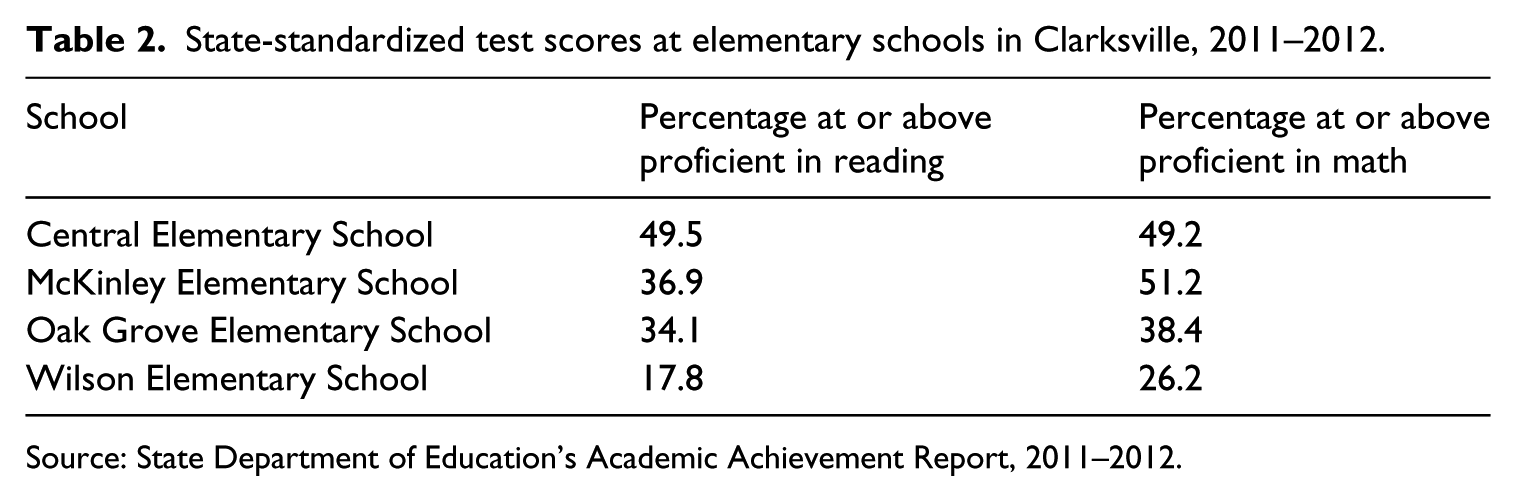
Source: State Department of Education’s Academic Achievement Report, 2011–2012.
Even if parents specifically enroll their children in the highest performing elementary schools in the district, their children still attend a failing school. In addition, when parents talk about better school climate, they typically speak in a manner of degree, considering which schools provide the least stressful environments.
In light of the poor academic performance of district schools, some parents also tried to send their children to neighboring public school districts while remaining in the district. Even if parents and students are not concerned with lengthy travel times, an out-of-district placement may not be a realistic option for most Clarksville families. Peter Trallis, a member of one of the former state-appointed Control Boards in Clarksville, described what happened when he reached out to neighboring districts. He explained, ‘Under the No Child Left Behind, if your school is failing, and they all were failing, you had to offer an option. We wrote to every school district in [the county], they all refused [to take our students]’ (Interview, 24 October 2007). A member of the state-appointed Education Empowerment Board (EEB) that followed Trallis’ Control Board explained that while the EEB never had occasion to reach out to neighboring districts – as the EEB governed during a time of district expansion – there was certainly a widespread narrative in Clarksville that neighboring districts ‘refused to take Clarksville students’ (Personal correspondence, 13 August 2013).
Collective action
Within the framework of school choice, another way that parents may engage in their children’s education is by working together to open new schools that better reflect the community’s values and families’ needs. In fact, proponents of charter schools argue that they increase group equity, as charter laws give parents and communities the opportunity to create schools that meet the particular needs of their students. For example, Levin (1999) explains how some community activists and parents in urban neighborhoods believe that the public schools are designed for White, middle-class students and therefore these schools neglect or even alienate poor, minority students. In this sense, charter schools provide a means for parents to develop educational programs that cater to students who may be overlooked in the traditional public school system (Hadderman, 2002; Levin, 1999).
In Clarksville, Anchor Academy Charter School was the result of this type of collective action. George Miller, a former elected School Board member, explained how he helped a group of concerned community members start the school. From his vantage point as a board member, he saw, a group of parents, they were still raising Cain. I said, ‘Wait a second, they just passed a law for Christ’s sake, go get your charter, go do your own school if you think you can do it better than us. Go do it.’ And that’s how I got involved. (Interview, 19 October 19 2007)
Miller said that he helped these parents with the application, as the school was ‘a mom and pop thing’, and he was able to provide some knowledge of the educational system and local politics.
Reports in a local newspaper explain that the organizers of the Anchor Academy were parents with a history of engagement in the district, as the three founders ‘were instrumental in bringing a 1990 lawsuit against the district over its treatment of special education students’ (Local newspaper, 21 August 1997). From the beginning, a primary goal of the school was to involve parents. One of the school’s founders explained, ‘We are going to offer true collaboration between parents, professionals and the community, not just on paper . . . That’s been thoroughly lacking (in the school district)’ (Local newspaper, 30 March 1998). For example, as part of the school’s plan, parents would have the opportunity to be trained to become paid teacher’s aides (Local newspaper, 21 August 1997).
Given Anchor Academy’s emphasis on involving parents, it is not surprising that parents described feeling welcome in the school. In fact, parents and school officials often spoke of the school in terms of family. Jasmine Richards explained that her oldest son attended Anchor Academy since the day that it opened. She valued the sense of community in the school, noting, ‘we were really like a family there’ (Interview, 14 June 2012). When asked what helped create this welcoming environment, she said, Because everything happened from within. You didn’t have to go to a main building for this, or you didn’t have to go to a certain department to have this done, everything was in house, the principal was, you know, the overseer of everything, and I think we only had two principals, but they were very open to the families . . . We had lots, I’ll say get-togethers where we would come together and talk about the kids, what we can do to make things better, the PTO was phenomenal, lots of parents engaged in it, you know. And the teachers were . . . just really open and friendly and not just with me, not just because I was one of the parents who was always there. So, it made it very comfortable for myself and my children. (Interview, 14 June 2012)
George Miller agreed, noting, ‘Anchor Academy had a rare way of getting everybody, the families involved. There was more of a family oriented, a lot of parents in the building, which led to a lot of calmness in the building . . .’ (Interview, 13 January 2009). In addition, for a time, Anchor Academy enrolled students in kindergarten through 12th grade, the only charter school in the district to go beyond 8th grade. Jay Adams, a member of the most recently elected School Board, reported that when he first moved to the district, he and his wife were drawn to Anchor Academy because the school enrolled children in every grade. As a result of Anchor Academy’s K-12 offerings, Adams could have all of his children in the same building. Adams explained that this type of setting helped create a ‘family . . . environment’ and ‘that’s why a lot of people chose the charter back then . . . because you can keep the siblings in one school’ (Interview, 21 June 2012).
Despite positive reviews for its safe and caring environment, Anchor Academy was not free from controversy. In 2003, the Chief Administrative Officer of Anchor Academy accused the school’s Board of Directors of acting ‘unethically’, explaining that board members were also employed by the school and voted on matters relating to their salaries (Local newspaper, 23 March 2003). The Board members denied wrongdoing but resigned after receiving a petition from parents. By the beginning of the following school year, an evaluation team from the Clarksville School District determined that the school should remain open; however, they raised several questions about the quality of education at Anchor Academy – especially in the high school (Local newspaper, 9 October 2003). Likewise, parents reported concerns regarding the quality of the school’s academic programs. Tonya Rollins, who enrolled her children in Anchor Academy as an alternative to Clarksville High School, found that it was not ‘conducive for learning’ (Interview, 7 December 2007). Robert Quillen, a local professor who studied the area’s charter schools, came to a similar conclusion about Anchor Academy. He explained that his research team had lots of conversations with folks who were interfacing with Anchor Academy [and we found] just how far off the Board of Trustees and the . . . administrative staff were, in terms of . . . what the initial mission was and what they were actually doing. (Interview, 14 February 2008)
Peter Trallis, a member of one of the state-appointed Control Boards, was blunter in his assessment of the school. Trallis explained when he was on the board, they had plans to close Anchor Academy, but there was a strong negative reaction in the community, noting, ‘They didn’t care that their kids weren’t learning, they wanted safety above everything else’ (Interview, 24 October 2007). Trallis said that his board was unable to close the school for a variety of reasons; however, Anchor Academy was eventually taken over by the school district in 2008 when it did not improve its test scores.
For many parents, the district takeover of Anchor Academy provided just one more example of the negative impact of politics in the district. Although district officials argued that the takeover of Anchor Academy was a direct result of the school’s low scores on state tests, many stakeholders argued that the closing of the school had more to do with district politics than with the school’s performance. In fact, charter schools have a contentious and unpredictable history in the district. While the current Governor supports charter schools, the former Democratic Governor was not as enthusiastic. When the district was controlled by the all-Democrat Education Empowerment Board under the Democratic Governor, the EEB made some decisions designed to limit the growth of charter schools. For example, not long after the board was appointed, the EEB tried to impose a ‘cap’ on charter school enrollment. Eventually, the charter schools won a lawsuit contesting the proposed cap. However, in some charter schools, there is still a constant worry about the future. As parent Donna Price explained, ‘You never know what’s going to happen in the next year, it seems that every year [there’s] something new . . . we have to worry about how things are going to happen for our school’ (Interview, 31 October 2007).
Parents at Anchor Academy experienced a great deal of uncertainty about the future of their school. Shortly after the EEB was appointed, Anchor Academy’s charter was up for renewal. By state law, the school had to prove that it was doing better than the district’s regular schools in order for the Board to grant this renewal. According to a member of the EEB, the EEB decided to ‘play hardball’ with Anchor Academy ‘because we needed to reduce the number of charter schools, and we had visited the school and could tell it wasn’t very good’ (Personal correspondence, 15 February 2013). Therefore, at a meeting before Anchor Academy’s charter renewal hearing, the EEB proposed a deal that would only allow Anchor Academy to stay open if their test scores were as good or better than the district’s scores. While the Board was confident that Anchor Academy’s scores would be too low, Anchor Academy accepted the terms of this agreement. Indeed, when the test scores were published later in the year, they were not high enough, and the school could not remain a charter (Personal correspondence, 15 February 2013). Parent Jasmine Richards said she ‘literally cried’ when Anchor Academy became a district school, and she felt that the school lost its ‘family sense’ (Interview, 14 June 2012). Thus, the example of Anchor Academy illustrates both the potential of communal action, as well as its limits in a representative governance structure situated within a contentious political context.
Engaging in policy discussions
Finally, many parents took part in policy discussions regarding school choice. Board meetings frequently served as a forum for debate regarding the district’s partnership schools, as well as the various charter schools in the district. Some of these conversations were district initiated. Dr Johnson, Clarksville’s Superintendent, used EEB meetings as a setting in which to discuss parents’ hopes and concerns regarding the partnerships. During the 2007–2008 school year, Johnson frequently included updates about the new schools in the reports he gave, and he invited community feedback during the public comments portion of the meetings. While many parents and community members spoke positively about the proposed schools, others raised critical questions. Some were concerned that outside funders might have too much control over these partnership schools, and they raised questions about who would be in charge of the schools’ budgets. The superintendent explained the money raised by the partners would go into the treasury funds of their nonprofit companies. However, Johnson said that the district and the partners would work together to decide what to do with that money (Field notes, 29 November 2007). A local reverend frequently asked the superintendent questions about community involvement in these partnership schools; in particular, she worried that community members would not be included on the schools’ boards of trustees. The Superintendent explained that the district would have representation on the boards, along with the partnering organizations. While the superintendent and EEB members were not always able to answer all of the stakeholders’ questions, they did endeavor to involve the community in the process of opening the new schools and keep them informed of the latest developments.
After Dr Johnson and the EEB left the district, the district suffered severe budget cuts, and the partnership schools floundered. In order to save money, the new administration decided to combine the district’s two specialty high schools into one, a move that created a number of logistical problems for students and staff. Early in the 2011–2012 school year, some parents went to the elected School Board seeking answers. However, the School Board was unable – or unwilling – to explain what was happening at the school. For example, at one meeting, several parents asked the board what the merger of the two schools would mean for the graduating seniors. One parent, who had a senior at Health Careers High, inquired if her son would be finished in December. She was confused, because he had two periods of English, and she did not understand why he was doubling up on English credits if he would be in school for the entire year. The Superintendent told her the extra English classes were due to an increased focus on literacy, but she would not definitively say if the seniors would be done early, deferring to the Principals of the two – now one – schools. In fact, all the seniors from Health Careers received letters in the mail in December telling them that they were done with high school and need not return after the holiday. Other parents raised concerns about safety and the lack of instruction at the newly combined, overcrowded high school. One mother stood up and shared her child’s roster, which consisted of substitutes for the first two periods, followed by a free period that was supposed to be a lab, followed by lunch, followed by gym (which functioned as a free period), and then English, her only academic class (Field notes, 15 September 2011).
One Board member, whose own children attended the merged high school, said she had been spending 20–30 hours a week in the school. She explained, ‘We’re not sure of what’s going on, but we’re trying to uncover the problem’. She blamed the school administrators and counselors for scheduling problems, and she urged parents to believe that the Board was trying to help, but she said that they were ‘cash-strapped’. She pleaded with parents to work with the Board. Before the meeting ended, one parent raised a final question, asking if the science labs for the former Health Career High students had been set up in the new building. Board President Melvina Bagley said they were. Another parent in the audience corrected Bagley, explaining that while there were labs in the school, they were not ready for use. Dr Hartmann sat shaking her head, and the meeting was adjourned (Field notes, 15 September 2011).
In addition to discussing partnership schools, parents also take part in community-wide conversations about the role of charter schools in the city. As parents try to decide what option is best for their own children, they are often confronted with what their choice will mean for the district. For example, when Donna Price decided to enroll her son in Hamilton Charter, she said she experienced pushback from other parents who argued ‘that we should be supporting the school district rather than yanking our kids out and sticking them into the charter schools’ (Interview, 31 October 2007). Ryan Carlyle, a local reporter, shared that people ‘went crazy’ when Hamilton University first suggested founding a charter. He summed up the community’s sentiment as follows: ‘We don’t need another freaking charter! Especially don’t need one from Hamilton. Let Hamilton fund their own damn charter’ (Interview, 20 September 2007).
Just as with Hamilton Charter, many parents considering Clarksville Charter School for their children are forced to think about the impact that their decision will have on the financial well-being of the district. In particular, CCS – with its government support and wide profit margin – is often cited as part of a larger plan to rid the Clarksville School District of regular public schools entirely. Mark Matta, a teacher at one of the district’s specialty high schools, felt there was a real threat that the district could disband, explaining that nearby school districts are ‘still not gonna take our kids, right, but a charter school will take our kids’ (Interview, 13 June 2012). Evelyn Doonan, an elected Board member, echoed this sentiment, explaining that ‘the way the [educational] system is set up, it almost looks like the system is set up to fail so we can have a charter school where the individuals can make the money’ (Interview, 26 June 2012).
Jasmine Richards, who had children at both Anchor Academy and CCS, responded in an interview to Superintendent Johnson’s argument that charter schools drain money from public schools: . . . I feel that is an untruth. I can understand where he’s coming from when he says it, because any time you have to give out money and you’re broke, so like, if I had that money back, I can do what I need to do. But at the same time, the community, the charter schools were doing the right things with that money so the parents were taking their children out of . . . Clarksville School District schools and putting ’em in a charter school . . . I never liked the district, I never wanted my children in their public schools, once I saw how things were go – I really didn’t . . . My oldest daughter was very advanced, but after so many years in Clarksville School District . . . I watched as she slowly just got in the mix . . . I couldn’t let that happen again [with my other children]. (Interview, 14 June 2012)
For Richards, regardless of its impact on other schools in the district, CCS provided a safe environment where her son could participate in a gifted program that challenged him, unlike his coursework in district schools. While Richards understood the concerns her fellow residents have about charter schools, she justified her decision to enroll her children in charters based on their needs and her past experiences in the district.
Thus, at public meetings and in private conversations, parents debated the merits and drawbacks of school choice, particularly with respect to charter schools. These debates highlight the complexity of school reform in Clarksville, and they illustrate how parents sometimes felt torn between helping their own children and supporting the whole community. While many parents believed charter schools were the best option for their children, they also conceded that charter schools drained valuable resources from the district. This choice that parents often had to make – between what is good for their children and what is good for their community – raises questions about the impact of school choice, particularly in poor districts. In other words, what does it mean that parents have to make this decision? Under a market model of education, does individual success necessarily have to come at the expense of community well-being?
Discussion
The introduction of choice as a way to increase equal access to quality education is commonly seen as dependent on parental engagement. It is assumed that for choice to properly function as a market mechanism to improve school quality, parents as consumers will need to learn about existing options, advocate for new options and through their aggregate actions support the development of an education system from which all children – and thus society – benefit. As this study illustrates, the opportunity to choose schooling placement for children is more tenuous both in the avenues it creates for parental engagement and in its impact on school quality or equitable access. For parents to choose wisely, they sometimes need financial means that are not available to them, and sometimes they rely on information networks that are limited in their reach and effectiveness. The perceived absence of good choices sometimes opens the door for parents to ‘game the system’ or try to create choices where there are none, through using false addresses or other illicit means. Even when parents engage collectively and create new options, as in the case of Anchor Academy, engagement alone does not promise quality academic offering, and sometimes the activism and communality of the process covers lack of capacity in required areas of schooling. Finally, the effort to engage with local policy makers is often thwarted by public officials who are less than forthcoming, by obscure or ever-changing policies, and by administrative and other means that limit the opportunities for parents to influence their children’s education.
In sum, while we see parental engagement as an important aspect of education reform, the data in this study suggest that more caution should be used when advocating for greater engagement through school choice. Even when the population affected by the policy is relatively homogenous in terms of its class and ethnic background, and concerns about creaming and other stratifying effects are less pronounced, school choice can both support and impede parental engagement, and the outcomes of such engagement, when it is practiced, are not always positive for the individual children involved or for the district community.
Footnotes
Funding
This research received no specific grant from any funding agency in the public, commercial, or not-for-profit sectors.