







Abstract
Professionalization in adult education is necessary, and several initiatives are underway to improve the professional situation as well as the competences and skills of adult educators. The relevance and importance of adult education is often stated. Large-scale assessments such as the Programme for the International Assessment of Adult Competences show how important adult education is for societies and economies. They give information on participation and participants. At first glance, the Programme for the International Assessment of Adult Competences lacks detailed information on adult education institutions and professions. A second glance allows explore what people do as part of their work. Those who state that they teach regularly or occasionally will be explored here in more detail. Findings from this study reveal several characteristics of people who teach, including age, gender, academic background and industries. In particular, our analysis suggests that more than 80% of those who teach did not have formal degrees in education sciences. Moreover, those who teach frequently have higher skills, older ages and they have better job positions than those who do not teach. The majority of those who teach are males. Lastly, the results indicate that seniority and prestige in all 14 countries examined in this study are highly relevant to people who teach.
Introduction
Academic interest in what constitutes a profession and the process of professionalization has a long history often traced back to what became known as The Flexner Report (1910) which focused on medical education in the USA and Canada. In 1915, Flexner went on to propose six criteria that could be used to distinguish professions from other occupations (Flexner, 1915).
Professions such as medical doctors, judges and schoolteachers are often employed in the public sector in jobs related to health, justice or education, which provide a public good. Mapping these characteristics onto employees in education, it is usually agreed upon that they apply to schoolteachers, but seldom to adult educators (Martin et al., 2017; Schüßler & Egetenmeyer, 2018). However, the availability of new and internationally comparable datasets makes it possible to describe those who teach, in order to show that beyond those with educational studies there are also many people who teach in one form or another, but who have other academic backgrounds.
This paper aims to show that those who teach can be found in many industries, that they form a large subpopulation and their job status is far from being precarious. The majorities of those who teach have indefinite contracts, senior job positions, are more skilled and use technology more often than their population averages. The findings we will provide will challenge earlier findings on precarious jobs and low professionalization, because they do not only cover public adult education. Because of the richness and relevance of the findings, we organize this paper with a strong focus on empirical results. Still, the analysis is driven by a careful theoretical discussion on professionalization and a sound literature review on earlier findings.
This article is based on a comparative analysis of data drawn from the Programme for the International Assessment of Adult Competencies (PIAAC) about the characteristics of those who teach. For the analysis, we selected 14 countries (Japan, Republic of Korea, Singapore, Denmark, Finland, Germany, Czech Republic, Slovenia, Ireland, United Kingdom, Italy, Spain, Turkey and Canada). The selection of countries is explained below in the methods section. We first review the theory and literature about characteristics of adult educators in terms of professionalism. Next, we provide a brief overview about which data are available, their theoretical background and their limitations.
The data will first be displayed as a comparison between countries. After describing the numbers of adults in each country who actively teach, we will describe these groups in more detail by their characteristics. Limitations concerning the differentiation between school and adult educators will be discussed. Finally, the relevance and implications of the findings are presented.
One goal of this analysis is to contribute to the international discussion of professionalism and the importance of data-based comparative research promoted by the Wurzburg Winter School Series (e.g. Egetenmeyer, Schmidt-Lauff, & Boffo, 2017). We would like to contribute a comparative baseline that hints at the scope and characteristics of the adult education profession in the participating countries.
One core finding is that the proportion of those who teach as part of their job is quite large. On average, in the 14 countries under consideration, 29% of the workforce teach regularly and an additional 11% teach occasionally.
Literature review: Characteristics of professions and of those who teach
Flexner’s (1915) criteria regarding professionalism were influential in the early 20th century and vestiges of them remain today as one form of tracking progress along the continuum of professionalization. One of the core questions posed by Flexner and others is whether ‘professions’ are special types of occupations (e.g. medicine, law, schoolteachers). If so, they are supposed to have several distinctive characteristics and functions (Combe & Helsper, 2017). These characteristics include diverse academic pathways, prestigious job status with high job security and a certain level of seniority. If these can be categorized as ‘hard facts’ associated with professional work, there is also a ‘soft aspect’ (Combe & Helsper). That is, professional work is also characterized by the interaction between professionals (e.g. doctors, therapists, social workers, teachers, trainers, lawyers, judges) and their clienteles (e.g. patients, trainees, students). These ‘soft skills’ include the necessity to handle unsolvable paradoxical problems, which are caused by unavoidable conflicts between contradictory tendencies of orientation towards the tackling and handling of clients’ problems. For example, the professional has to formulate prognoses about the unfolding of the clients’ social and biographical processes, although there are no stable empirical grounds for them to be based on in the fluidity of social life. (Schütze, 2000, p. 49)
For this analysis, we define professionalization as follows: Professionalization is shown in the interaction of academic education with the professional field and the prestige in the job. For our specific questions, these are a degree in education (field of study) and a profession in education (field of industry). Prestige is expressed by seniority (age), an indefinite contract (type of contract) and skilled occupations (job position).
Still, several case studies and reports show that professionalization in terms of the formal study of adult education is low and that job status is often precarious. Findings and theoretical interpretations paint a picture of ‘low’ or ‘ongoing’ professionalism among teachers of adults (Martin et al., 2017). Adult and further education started in several countries from a grassroots movement (Bierema, 2012, p. 25) or a major political shift (Guimarães, 2009; Jõgi & Gross, 2009), but did not always lead to the development of formal study programmes with clear career pathways (Käpplinger, Popovic, Shah, & Sork, 2015). Although some countries may require the completion of a specific course of study in adult education before one can work in a particular sector or type of programme, there are many settings where no such qualification is required (Käpplinger et al.).
Moreover, earlier findings of a nation-wide survey in Germany (wb-personalmonitor) that report precarious job status for adult educators, are based on the public sector of adult education (Martin et al., 2017), but do not cover occupations in commercial or industrial sectors. Here we may find prestigious jobs and seniority more often than previously expected.
This German wb-personalmonitor on adult education staff and teachers (Martin et al., 2017) is a good starting point for examining similar issues using the PIAAC data. The wb-personalmonitor covers only publicly funded adult education. Companies, freelance trainers and coaches as well as commercial training centres are excluded from the survey. PIAAC data offer the possibility to go beyond this limitation. Moreover, the survey was conducted in Germany. The empirical evidence examined below based on the wb-personalmonitor serves as a foundation for our comparative analysis using the PIAAC data.
The German wb-personalmonitor survey provided evidence of the characteristics of adult education staff in Germany, including age, gender and academic background. The population covered by the German survey consists of those employed by publicly funded as well as commercial training institutions, as well as freelance teachers and trainers of all kinds. Koscheck and Ohly’s (2017) analysis only covers the sector that is accessible to the public, excluding private adult education providers. According to the wb-personalmonitor, adult educators are on an average of 50.5 years of age. Between 2014 and 2016, the average age has increased from 47 to 50.5 years (Martin, 2017a, p. 64). An earlier survey of teachers in adult basic education found that half of them are above 50 years and only teach one course a week (Grotlüschen, 2011). From the standpoint of training organizations, the increasing age of adult educators leads to concerns over the change of generations (Franz & Scheunpflug, 2009). However, seniority seems to be a relevant characteristic for this profession because longer work experience and greater accumulated knowledge may be positively related to increased credibility and teaching effectiveness. We argue that age is a positive factor in this area.
Women and men are equally represented among those who teach and work in adult education in Germany (Martin, 2017a, p. 66). The majority (70%) work as freelancers (Elias, 2017, p. 74), which reflects the type of contracts typically held by teaching staff in German adult training centres.
Among German staff in adult education, 64% hold academic qualifications, well above the German average of below 20% (Koscheck & Ohly, 2017, p. 110). Roughly, a quarter (26%) studied in one of the educational sciences programmes (including teacher education programmes) (Koscheck & Ohly, p. 114). Gauging from the percentage of practitioners having obtained degrees in educational science, professionalization among those who actively engage in adult education is low in Germany.
The degree of professionalization can be compared not only by degrees and certificates, but also by the competencies of the people who teach. A comparison of teachers’ literacy and numeracy skills with students’ performance based on PIAAC and PISA (Programme for International Student Assessment) data from 31 countries shows a positive relationship (Hanushek, Piopiunik, & Wiederhold, 2019). Moreover, the literacy and numeracy skills of teachers explain some of the differences in the comparison of student performance between countries (Hanushek, Piopiunik, & Wiederhold). As far as we know, there is no comparable study available for adult educators. Literacy and numeracy proficiencies are basic competences that form the basis for further competences such as problem-solving in technology-rich environments (OECD, 2013).
Earlier findings on technology and professions led to the label ‘high touch, low tech’ (Vrbancic & Byerley, 2018) to refer to occupations which rely primarily on human relationships and related soft skills rather than ICT (information and communications technology). While in many businesses, technology enhances productivity, this is not always the case in parts of the health and education sectors (Arcand, 2015; Mottarella, Fritzsche, & Parrish, 2005; Vrbancic & Byerley, 2018). Having close contact with clients, patients and students may be a good approach in many cases. It also has negative aspects if it is associated with resistance to the use of ICT. German scholars claim that adult educators tend to have lower levels of experience with digital media and e-learning (Herber, Schmidt-Hertha, & Zauchner-Studnicka, 2013).
Jobs in adult education consist of many more roles than teaching, even if teaching is relevant for all of them (Martin, 2017c, p. 99). Before proceeding with the analysis, it is worth noting that our use of PIAAC data that follows focuses on the population who actively teach, excluding management staff of training institutions and people who lobby or advocate for adult education on a policy level. This analysis uses the self-reported activity of ‘teaching’ as a core and defining activity for (adult) education staff. Those who teach also includes persons who teach in schools.
Findings show a precarious job status of adult educators in the public sector, while little is known about those who teach elsewhere.
Research questions
The following section presents a set of research questions for examining three issues related to people who teach in the PIAAC sample: academic pathways, competence as measured by the PIAAC skill proficiency and ICT use.
RQ1: Do those who teach have a low level of professionalization but do they have a higher job prestige?
We assume that the findings from the wb-personalmonitor will be confirmed by the PIAAC data, even if the PIAAC datasets include schoolteachers. We assume that the majority of people who teach have not studied educational sciences (with regard of the field of study and the field of industry). Conversely, we expect a prestigious job status with higher seniority and higher job positions and indefinite contracts (in terms of age, position and contract).
We do not control participation in education and training in this context. Specific academic qualifications are crucial for our definition of professionalization. Acquired qualifications, e.g. on-the-job training or non-formal education, are not part of our definition.
RQ2: Do those who teach have higher skills in literacy, numeracy or problem-solving in technology-rich environments than others do?
Compared to the overall country average, German adult educators more often hold academic degrees (Koscheck & Ohly, 2017, p. 110). We wonder whether this is also the case in other countries. Formal qualifications are different across countries and thus difficult to compare. The skills in literacy, numeracy and problem-solving in technology-rich environments measured under the PIAAC programme fit better for the purpose of comparing skills of those who teach across countries and not only within countries. We assume that the skills in the two domains are higher among persons who – regularly or occasionally – teach than country averages, with a varied picture in the cross-country comparison.
RQ3: Do those who teach have lower ICT use than others do?
German adult educators have little experience with the use of ICT. We therefore assume that people who teach use ICT to a lesser extent than the country average.
Methods: Selected country datasets and selected variables
Results of the PIAAC were first published in 2013 (OECD, 2013). It is the latest of a number of surveys on adult basic skills administered by or in cooperation with the OECD, e.g. the International Adult Literacy Survey (OECD & Statistics Canada, 2000) or the Adult Literacy and Life Skills Survey (OECD & Statistics Canada, 2005). To examine the characteristics of those who teach, we draw on national PIAAC data files from 14 countries of the first round (2011/2012) and second round (2014/2015) of PIAAC (OECD, 2013, 2016). The selection covers countries represented in the COMPALL Conference in Wuerzburg, 2018, plus Canada as an example from North America. The rationale for selecting these countries is the large variation in size, culture, economy and configuration of the adult education sector, as well as the assumption that the countries represented at the conference have an interest in gathering and analyzing basic comparative data. The selection consists of all three representatives from Asia in the first two PIAAC rounds – Japan, the Republic of Korea and Singapore – and of representatives from different regions of Europe. Denmark and Finland are two representatives of the north of Europe. Germany, Ireland and the United Kingdom are representatives from Central Europe. The Czech Republic and Slovenia are two post-communist states. Italy from the south and Spain from the southwest of Europe plus Turkey represent the southeast of Europe.
The data provide extensive information on practices of skills in workplaces and in everyday life. These variables are derived from a set of questions about different types of skills used at work. The data belong to the job requirements approach and follow the logic of supply of skills and demand of skills (OECD, 2011, p.12) in market economies. PIAAC is a study that tries to inform and compare economies in order to improve their economic performance. This focus on economic performance on the first sight makes it less interesting and usable for those in the educational sciences, and often the variables have to be re-interpreted from an educational perspective (Grotlüschen, 2018).
The set of job requirement variables covers teamwork and communication skills – such as presenting and teaching. It also covers decision-making and supervision, job autonomy and satisfaction and much more. One limitation of these data is that they are based on self-reports which may contain cultural biases and reflect social desirability. Sadly, the variables do not cover all activities of adult education, so there are limits to the inferences that can be drawn.
Activities in adult education relate to micro-, meso-, macro- and mega-levels (Egetenmeyer, Schmidt-Lauff, & Boffo, 2017, p. 10). These roughly map onto the setting inside the classroom (micro), the organization of teaching and training programmes (meso), national policies (macro) and supranational policies (mega). Adult education work takes place on all these levels and the content of jobs usually goes beyond teaching itself, although teaching constitutes the main activity for adult educators on all levels (Martin, 2017c, p. 100).
While it is difficult to locate people within the PIAAC sample by their engagement at meso-, macro- and mega-levels of adult education, PIAAC data arguably provide a good proxy for activities at the micro-level. In particular, two of the skill use questions are related to activities at the micro-level of education, namely teaching and giving presentations. We chose to use the variable of the frequency of teaching people (F_Q02b) instead of the one on presentations (F_Q02c) out of the concern that giving presentations is an integral part of a wide range of occupations yet may lack an educational focus. By contrast, the frequency of the variable teaching people in the PIAAC data reflects regular teaching at least once a week or occasional teaching at least once a month in the workplace. Of course, this includes schoolteachers as well as adult educators. We discuss the data while fully aware of this fact.
To answer our research questions, we focus on a variable about giving instructions to other people at work (F_Q02b). The question was asked to employees (‘How often does your job usually involve instructing, training or teaching people individually or in groups?’) and to people who are unemployed at least in the past 12 months (‘How often did your last job usually involve instructing, training or teaching people individually or in groups?’). The response options were ‘every day’, ‘at least once a week but not every day’, ‘less than once a week but at least once a month’, ‘less than once a month’ and ‘never’. We collapsed the first two categories under the description ‘at least once a week’ and the last two categories under the description ‘rarely or never’. The middle category was unmodified. We describe those who give instructions at least once a week as teaching regularly. We have not omitted any parts of the sample, but consider all persons who have indicated that they teach. Reducing the data to only those who did not study education would have excluded the majority of schoolteachers, but also have excluded adult educators who did study educational sciences.
We also modified the variable ‘Current work – Type of contract’ (D_Q09). Due to the small number of cases, the categories ‘a temporary employment agency contract’, ‘an apprenticeship or other training scheme’ and ‘other’ were combined as a new category labelled ‘other’. Finally, we modified the variable ISIC1C ‘Industry classification of respondent’s job at 1-digit level (ISIC rev 4), current job (derived)’. All values without an industry classification such as ‘valid skip’ were set as missing.
According to the unweighted numbers of cases, the sample has a total size of 77,681 cases. Country samples vary from 21,764 in Canada to 2,698 in Turkey. The big sample size in the Canadian dataset means that when reporting international averages, a possible bias has to be taken into account.
The IDB Analyzer and SPSS programmes were used for the analyses. In order to answer the research questions, descriptive analytical methods were chosen (frequencies and means). The population shares are displayed in graphs by country and frequency of teaching. Significance of differences is controlled by using the standard errors with regard to the sample weights (5% level). To keep the standard errors intact, we did not eliminate cases from the sample. To verify the hypotheses, sociodemographic variables such as age, gender, contracts, formal education were integrated into the analysis. The next step involves competences (literacy, numeracy and problem-solving in technology-rich environments), which have been measured in PIAAC with Plausible Values. All 10 plausible values were applied.
Findings
Figure 1 shows that there are considerable differences between countries in the number of people who teach. Note that schoolteachers are included in all figures.
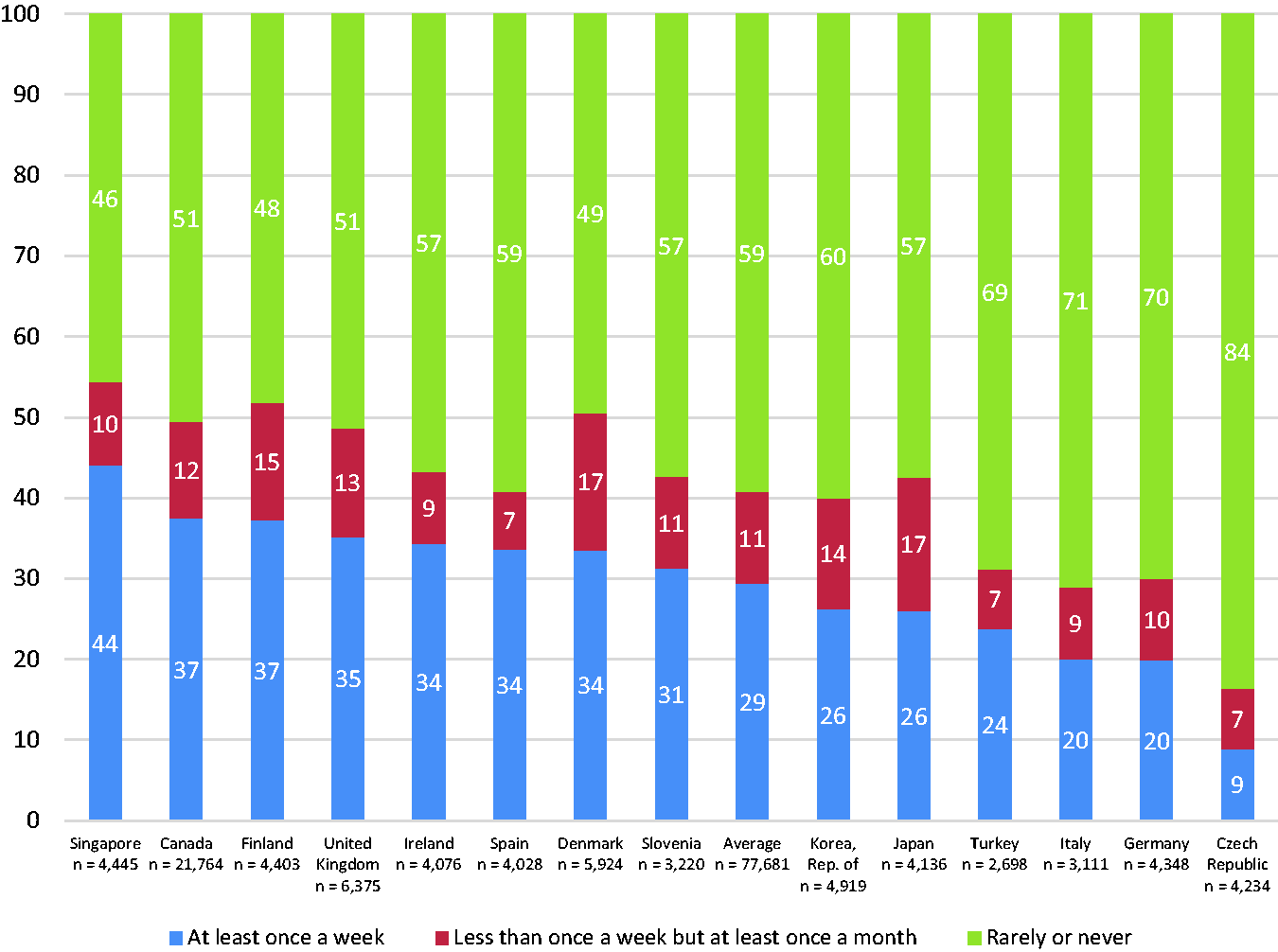
Teaching people by country (percentage).
On average, 29% of the sample across all countries teach at least once a week and 59% teach rarely or never. The comparison between countries reveals clear differences without showing regional patterns. In seven of the countries, more than one-third of adults teach at least once a week. In three of the countries, a quarter of adults teach at least once a week.
On average, of the people who teach regularly, 57% are men and 43% are women. In almost all countries, there are more men than women among those who teach regularly (Figure 2).
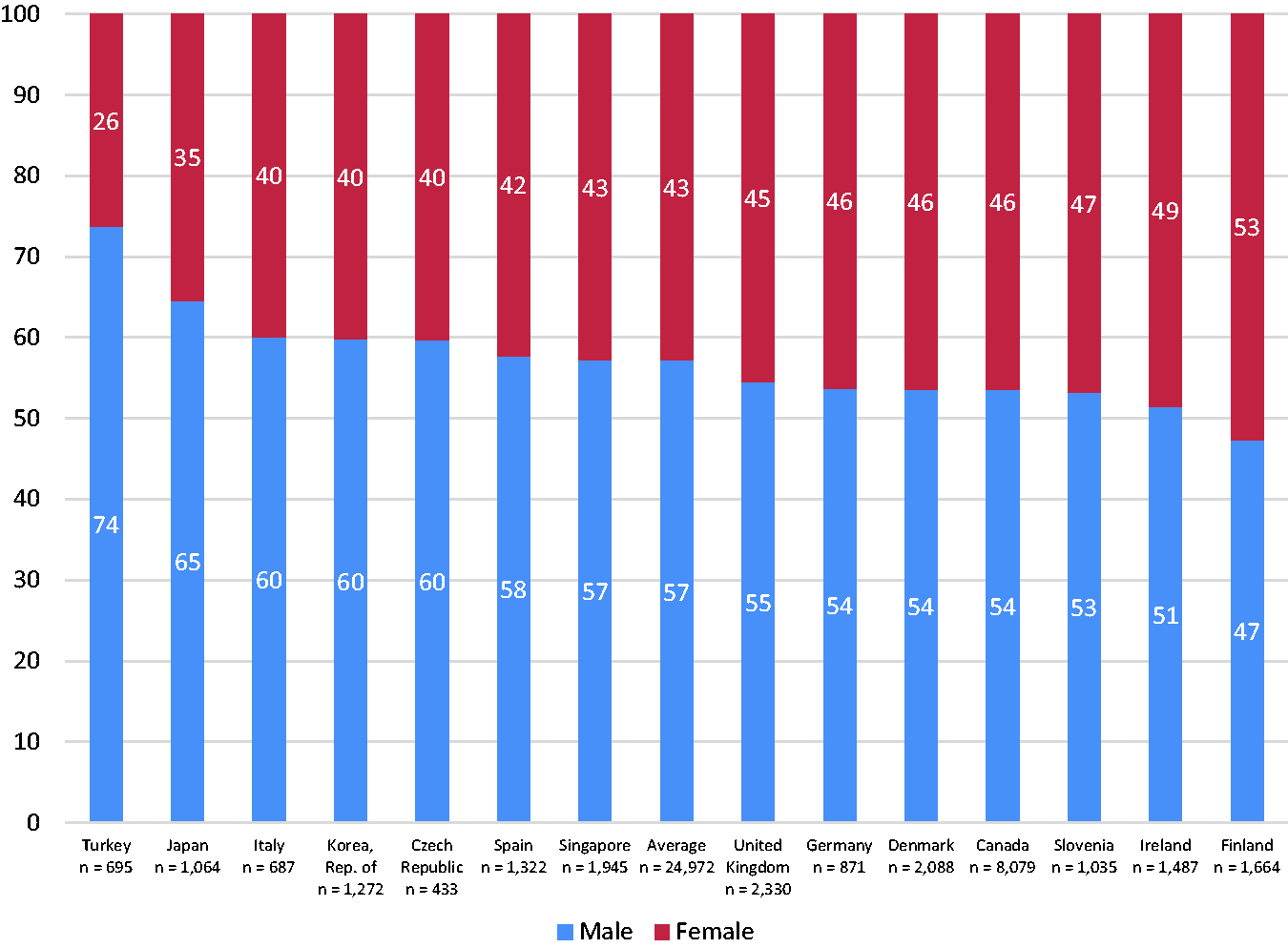
Teaching people at least once a week by country and gender (percentage).
An exception is Finland (47% male, 53% female). In about half of the countries, the difference is more than ten percentage points (Czech Republic, Italy, Spain, Turkey, Japan, Korea and Singapore). The largest gaps are found in Turkey (74% male, 26% female) and in Japan (65% male, 35% female). Canada is near the average with 54% men and 46% women.
RQ1: Those who teach have a low level of professionalization but have high job prestige
One part of the operationalization of ‘professionalization’ is the field of study pursued by those who teach. We then checked the business or industries in which they worked. Another group of subtests focuses on prestige and seniority in terms of contract, job position and age.
The majority of those who teach did not study educational sciences
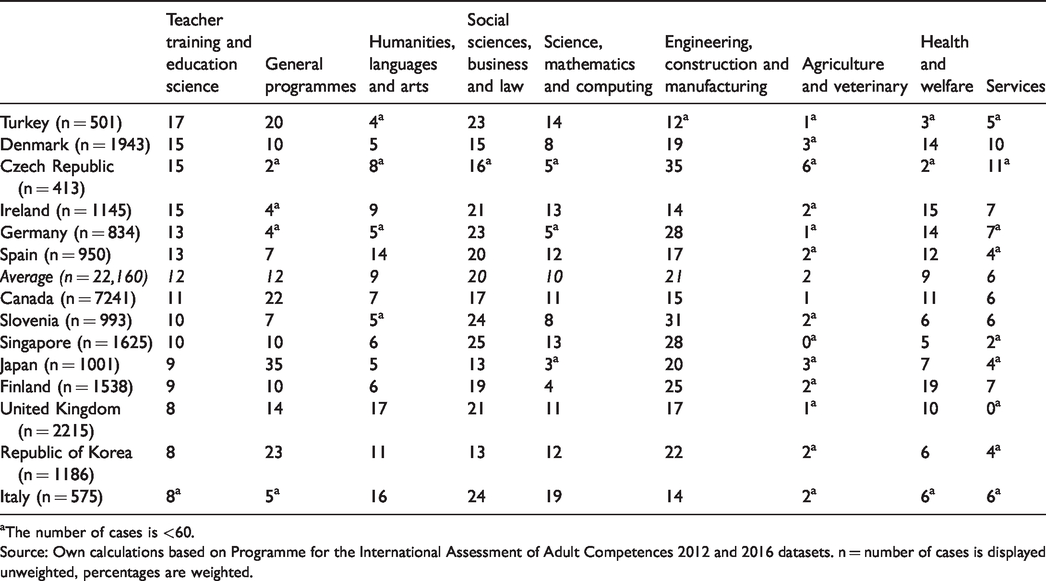
Examining the fields of study of those who teach regularly reveals a wealth of different areas (Table 1).
Teaching people at least once a week by country and area of study (percentage).
aThe number of cases is <60.
Source: Own calculations based on Programme for the International Assessment of Adult Competences 2012 and 2016 datasets. n = number of cases is displayed unweighted, percentages are weighted.
Only a small number of people studied in the area of teacher training and education science. On average, 12% of those who teach regularly have studied teacher training and education science. The range is between 17% in Turkey and 8% in the Republic of Korea and Italy. Among people who engage in teaching, the predominant academic background is in engineering, manufacturing and construction. For this category, the range is from 12% in Turkey, 14% in Italy and Ireland to 35% in the Czech Republic. In the area of study of social sciences, business and law, values vary from 13% in Japan and the Republic of Korea to 25% in Singapore (average for all countries is 20%). Japan and the Republic of Korea form a contrast to this pattern. In both countries, most of the people who teach studied general programmes 1 (average for all countries is 12%). In Japan, about one-third of the people who teach regularly studied general programmes. Other countries with a share of more than 20% from the area general programmes are the Republic of Korea, Turkey and Canada. In the Czech Republic, Germany, Ireland, Slovenia and Spain, this area of study only plays a marginal role. Another notable area of study in some countries is health and welfare. Denmark, Finland, Ireland, Germany, Spain and the United Kingdom have 10% or more in this area (average for all countries is 9%). The other countries have percentages below 10%.
The majority of those who teach are in business or engineering industries
To distinguish between different economic sectors, PIAAC data use the United Nations’ International Standard Industrial Classification of All Economic Activities (ISIC). ISIC classifies 21 sectors (UN, 2008). People whose jobs imply some type of teaching mainly work in four economic sectors. These are
Education Manufacturing Wholesale and retail trade; repair of motor vehicles and motorcycles Human health and social work activities.
The education sector accounts for about a third of the people who teach in the Czech Republic. For the other European countries, the range is between 16% and 21%. For Canada, the value is 14%; the average value is 17%.
A quarter of the Slovenian people who teach regularly are employed in the manufacturing sector – the highest number in this sector for all countries. In Canada, Spain and the United Kingdom the proportion is lowest at 10%, Japan and the Republic of Korea are at 20% and Singapore at 14%. On average, 16% of those who teach regularly are employed in the manufacturing sector.
The wholesale and retail trade; repair of motor vehicles and motorcycles sector has a range of 8% for Czech Republic (n = 33) to 15% for the Republic of Korea. The average for all countries is 11%.
Especially in Denmark, Finland, Ireland, the United Kingdom and Germany, the sector human health and social work activities accounts for approximately 20% of the people who teach regularly. For Japan and Canada, the value is 13%. In the Republic of Korea and Singapore, the value is 6%. The average for all countries is 11%.
The majority of those who teach have indefinite contracts
The majority of people who teach regularly have an indefinite contract. The average for all countries is 76%. In Denmark, Finland, Germany, Slovenia, the United Kingdom and Italy, more than 80% have indefinite contracts. The Czech Republic, Ireland and Spain have values >70%. Turkey has the lowest value for a European country with 57%. This percentage is similar to the 59% of people with an indefinite contract in the Republic of Korea and in Singapore. Japan also has more than 80% with an indefinite contract. For this aspect, data are not available for Canada.
On the other hand, Turkey (26%), the Republic of Korea (22%) and Singapore (17%) have a high proportion of people without any job contract (average for all countries is 7%). In the other countries, this is rare.
The majority of those who teach are in higher job positions
Another classification structure is the International Standard Classification of Occupations by the International Labour Organization, also part of the United Nations classifications. For this paper, we use broad categories consisting of four classes because of the low number of cases: (1) Skilled occupations (e.g. legislators, senior officials and managers; professionals; technicians and associate professionals); (2) semi-skilled white-collar occupations (e.g. clerks; service workers and shop and market sales workers); (3) semi-skilled blue-collar occupations (e.g. skilled agricultural and fishery workers; craft and related trades workers; plant and machine operators and assemblers); and (4) elementary occupations (e.g. labourers). (OECD, 2013, p. 132)
Teaching activities are often performed by senior age groups
A similarly differentiated picture emerges when looking at the distinction of teaching persons by age. As described above, for Germany the wb-personalmonitor has determined an increasing average age for adult educators. Based on this, we assume a high number of older people teaching. Our focus is on seniority. Therefore, we explicitly consider those people who teach regularly who are older than 44 years old. Of the people who teach regularly in Turkey, the fewest have an age over 44 years. The proportion is 19%. Of those who teach regularly and are over 44 years old, Germany and Denmark have the highest proportion with 46%. The age distribution in Japan, the Republic of Korea and Singapore lies between these European countries. In Japan, the proportion of adults over 44 years of age who teach regularly is 40%, higher than in Singapore (34%) and the Republic of Korea (32%). Canada is above average in the 44+ age group (41%). The average for all countries is 37%.
RQ2: Those who teach have higher skills in literacy, numeracy or problem-solving in technology-rich environments than others do
PIAAC measures three domains of skills: literacy skills, numeracy skills and problem-solving in technology-rich environments skills. These are displayed on a scale with a range from 0 to 500 (OECD, 2013). Not surprisingly, the mean literacy scores of those who teach at least once a week are higher than the mean literacy scores for the respective national population and for people who teach rarely or never (Figure 3).
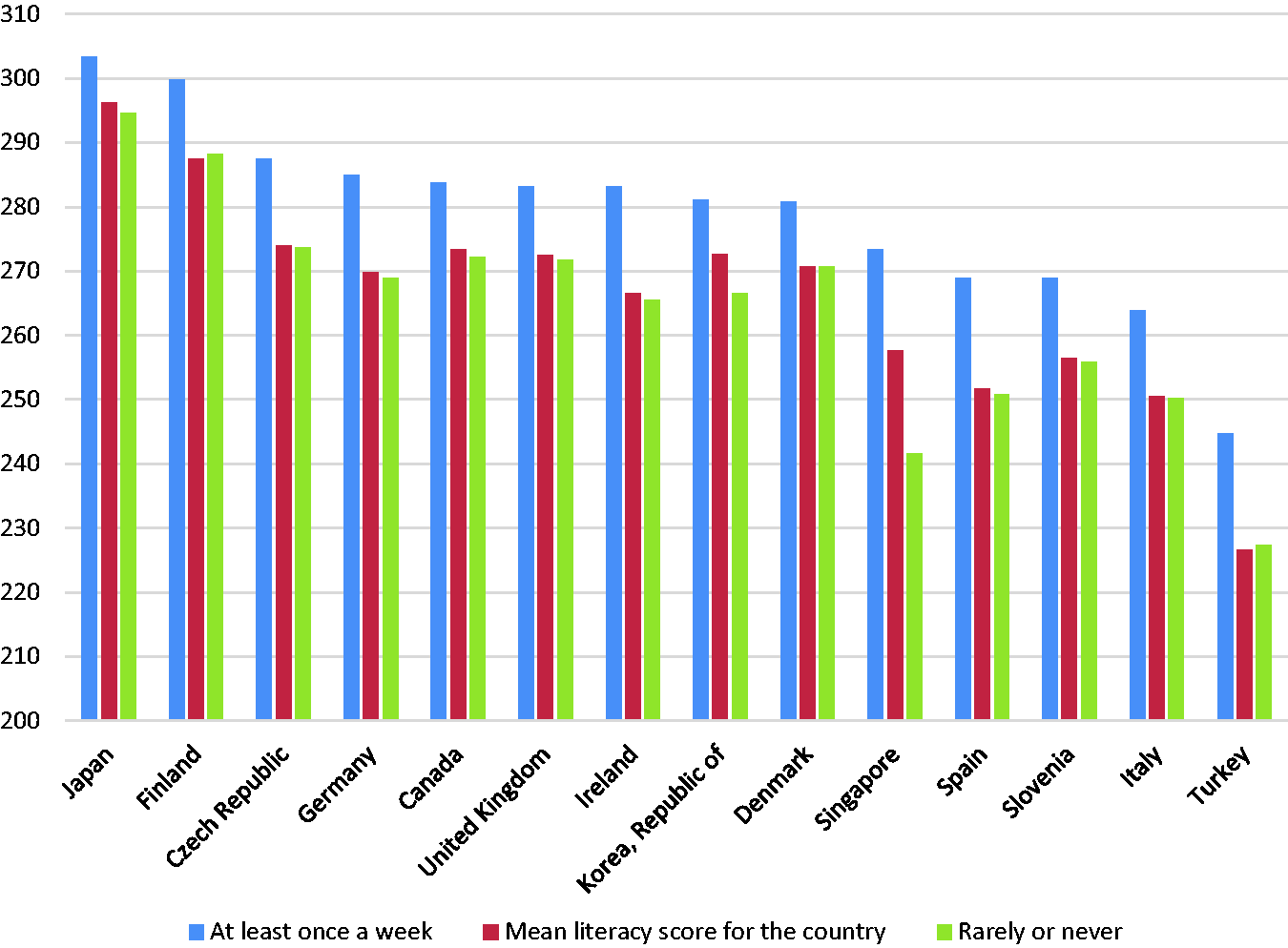
Mean literacy score by country and teaching people (points).
Figure 3 shows a comparison between the mean literacy score of those who teach at least once a week, the mean literacy score of the country in question and the mean literacy score of those who rarely or never teach. The largest difference between the people who teach rarely or never and people who teach at least once a week is in Singapore. The difference is 31 points (242 points to 273 points). In contrast, the smallest difference can be found for Japan (295 points to 303 points).
The biggest difference between the national literacy mean score and the mean literacy score of people who teach at least once a week exists in Turkey with 227 points to 245. In almost all countries examined, the literacy mean score for the country does not differ significantly from the literacy mean score of those who teach rarely or never. Only for Singapore and the Republic of Korea, the difference is more than one point. The literacy mean score for Singapore is 258 points and for people who teach rarely or never, it is 242 points. On the same measures, the difference is 6 points in the Republic of Korea.
Figure 4 shows that this pattern for literacy also applies to numeracy. Those who teach have a higher mean numeracy score than those who rarely or never teach. Again, Singapore shows the biggest difference between people who teach rarely or never and people who teach at least once a week (240 points to 277 points). The smallest difference between these two categories exists for Finland and Canada. The difference for Finland is 10 points (283 points to 293 points) and for Canada 11 points (276 points to 265 points). The biggest difference between the mean national numeracy score and the mean numeracy score for people who teach at least once a week exists in Turkey. The value for this case is 28 points (219 points to 247 points). In summary, we note that in most countries the literacy and numeracy scores of those who teach rarely/never correspond to the respective national average and that those who teach frequently thus represent a particularly highly skilled group.
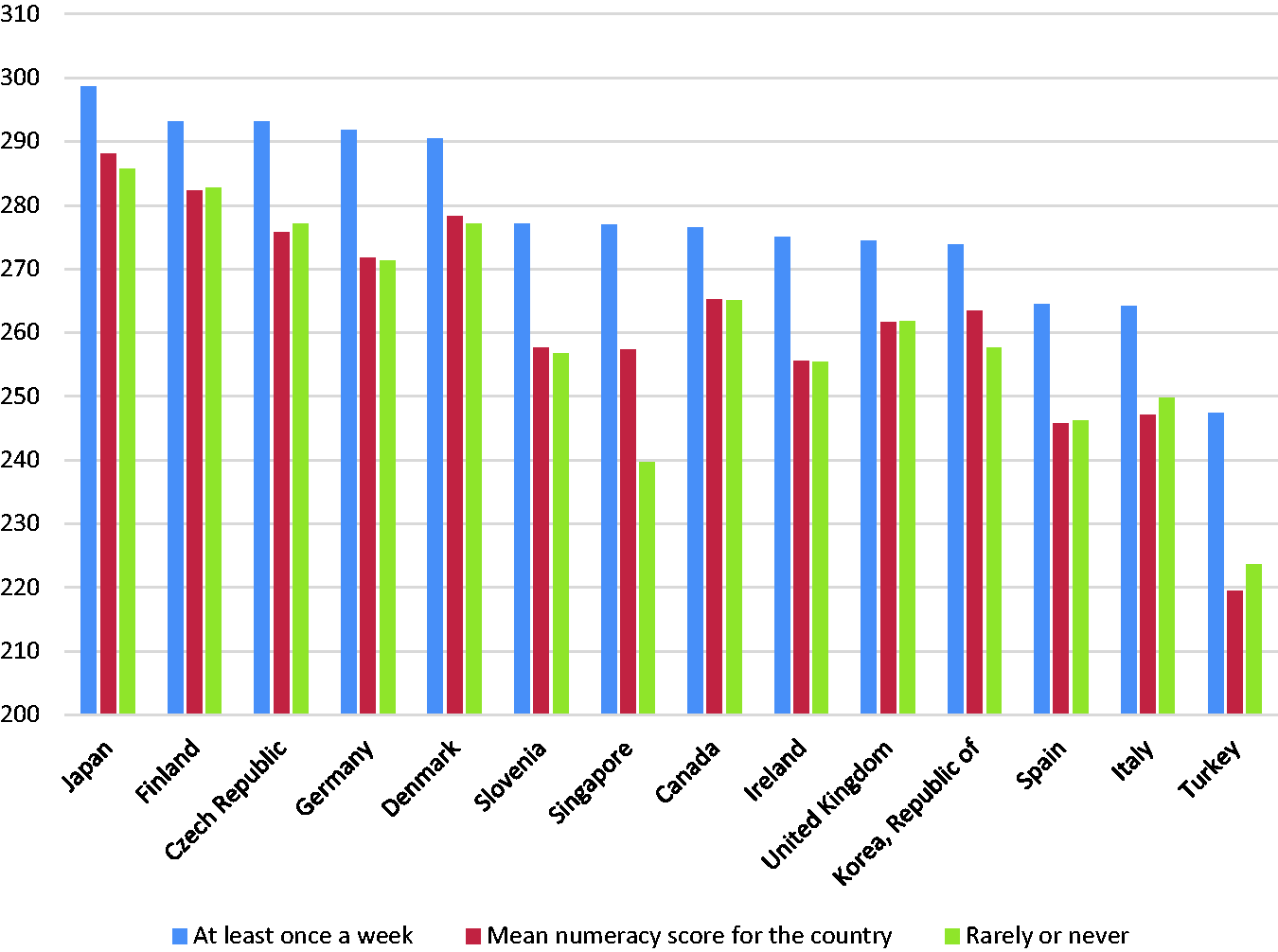
Mean numeracy score by country and teaching people (points).
The results for skills in problem-solving in technology-rich environments confirm the distributions as they exist for literacy skills and numeracy skills. For this reason, no presentation has been made here.
RQ3: Those who teach have higher ICT use than others do
The PIAAC data contain a number of variables describing the use of ICT. ICT use is grouped into ICT use at home (use of ICT in everyday life) and at work (use of ICT at the workplace). An index variable exists for each of these areas. Both indices for ICT skill use contain the frequency of using e-mail, internet for information purposes, conducting transactions online, spreadsheets, word and real-time discussions (OECD, 2013). Due to the small number of cases for the individual gradations of ICT use, we have made a dichotomous classification. The indices for ICT skill use are scaled in 20% steps. We call people who use over 60% of ICT skills ‘high ICT users’. In the following analysis, we report the difference between the percentages of people who regularly teach and the national average. This difference is shown in percentage points. As an example, in Singapore, 47% of people who teach regularly are high ICT users at home. The number of high ICT users at home among all Singaporeans is 43%. The gap among high ICT users at home is therefore 4 percentage points.
Table 2 shows a comparison between people who teach regularly and the country average by ICT use at home. In all countries, those persons who teach use ICT at home more often than the country average. The difference is highest in Slovenia (11 percentage points) and Turkey (10 percentage points). Japan has the smallest difference (2 percentage points).
Using ICT at home: difference between the percentages of people who teach regularly and the percentages of the country average.

Source: Own calculations based on Programme for the International Assessment of Adult Competences 2012 and 2016 datasets.
ICT: information and communications technology.
People who teach regularly use ICT more often at work than the national average (Table 3). This applies to all countries examined. The highest gap among high ICT users and the country average exists in Turkey (12 percentage points). Canada, Germany, Ireland and Spain have a difference of 5 percentage points, which is the smallest difference between people who teach regularly and the country average.
Using ICT at work: difference between the percentages of people who teach regularly and the percentages of the country average.

Source: Own calculations based on Programme for the International Assessment of Adult Competences 2012 and 2016 datasets.
ICT: information and communications technology.
Discussion
Limitations
When focusing on adult education, one limitation of this description of adults who teach regularly (i.e. once a week or daily) or occasionally (i.e. at least once a month) consists in the mix of teaching in schools and teaching adults. There is no clear method to separate these two groups:
First, reducing the data to only those who did not study education will surely exclude the vast majority of schoolteachers, but may also exclude adult educators who did study educational sciences. The other way around, some teachers have entered the educational system without studying educational sciences (Blömeke, 2006). This is also a recent problem in Germany, but the PIAAC data collection took place in 2012. Still, this first criterion is the strictest and will be used for discussing the findings. Second, excluding the public sector would exclude some teachers, but in many countries school teaching also takes place in the private sector. Furthermore, excluding the public sector reduces the data to private adult education. Third, looking at the industries and excluding education would safely remove schoolteachers from the dataset, but will also exclude adult educators who work in the educational sector such as second chance schools and adult basic education. In many countries, this would affect large parts of the adult educational sector.
Moreover, for displaying descriptive data and population shares, which includes working with replicated weighs, reducing datasets is not recommended. 2
Overall, because more than 80% of those who teach did not study educational sciences, this group dominates the descriptive data reported here. We therefore assume that the findings roughly apply to adult educators (i.e. those who regularly or occasionally teach adults as part of their work), even if the ‘people who teach’ contain up to 20% schoolteachers plus the share of schoolteachers who did not study educational sciences. However, the statement remains that around 80% have no pedagogical background. We consider them to be ‘de facto’ adult educators because of their function (which does not have to be their main task in the job). For this reason, studies do not go far enough when they (such as the wb-personalmonitor) focus exclusively on the education sector. This may be useful when considering teaching at school, but not for adult education.
Moreover, the subpopulation of those who teach has been described according to the hard facts that characterize professions. It would also be interesting to describe the soft facts, such as job satisfaction, job autonomy, readiness to learn, learning at work and participation in adult education and training. German findings show that even precarious job positions may correlate with high job satisfaction (Martin, 2017b, p. 140). It would be interesting to investigate this more deeply.
Relevance
Analyzing data from 14 PIAAC participating countries, this study presents a picture of people who teach regarding their academic backgrounds, various industries associated with their workplace, their competence as measured by PIAAC skills in literacy, numeracy and problem-solving, and their frequency of ICT use at work and at home. Overall, a substantial share of the adult workforce (29%) in these 14 countries claim that they regularly teach. The overall shares are large in several countries, varying from 9% in the Czech Republic to more than 44% of the population in Singapore. The proportion of those who teach is much higher as expected when only teaching within the adult educational sector is taken into account. For Germany, this large proportion is a valuable addition to former research such as the wb-personalmonitor (Koscheck & Martin, 2017, p. 50). The wb-personalmonitor only covers the public adult education sector, but not teaching activities in companies. With PIAAC data we were able to widen this focus with the important result that the number of those who teach – at least in Germany – is probably 10 times as high as the numbers of those who teach solely in the public adult educational sector.
RQ1 reveals that if one uses a match between one’s academic field of study and his/her profession as an indicator of high professionalization, the PIACC data suggest that those who teach generally have a low level of professionalization. The share of studies in educational sciences among those who teach is low and varies from 8% to 17%. Across all 14 countries, more than 80% of those who teach did not study educational sciences. The formal career pathways of the majority of those who teach do not match the characteristics of other ‘professions’ such as medical doctors, lawyers, judges or schoolteachers. On the other hand, the majority belong to the highest class of occupations, more than three-quarters have indefinite contracts and senior age groups are over-represented. This indicates seniority and job prestige. Therefore, the RQ shows an ambiguous picture of the degree of professionalization. High job prestige contrasts with a low proportion of degrees in educational studies. It might be the case that people have opportunities to teach others after climbing up the career ladder at later ages and stages of their careers. We propose that this combination of characteristics, including age, skills, technology and professional position reflects what we call ‘seniority’. We further believe that this seniority is positively correlated with the prestige of those adult educators who teach outside the public educational sector.
There have been intense and controversial discussions for many years on whether or not professionalization in adult education is desirable. Some scholars argue that adult education should strive for greater professionalization (Cervero, 1992; Egetenmeyer, 2016; Käpplinger et al., 2015) while others claim adult educators’ diverse backgrounds and variable contexts of practice should be acknowledged and further professionalization should be resisted (Collins, 1992; Nicoll & Edwards, 2012). Of course, the more recent discussions have occurred in a shifting global context where national qualifications frameworks, competency-based training, the desire for greater transferability of qualifications and increased mobility of labour have influenced policy makers and academics alike (Jütte & Lattke, 2014). There are pressures from outside the field to specify required competencies, develop more uniform preparation programmes and for greater accountability for the outcomes of practice. A major complication of responding to these pressures is that many of those who teach adults do not identify themselves as adult educators (Bierema, 2010) and may not realize there is a potentially useful area of academic study they could pursue.
The findings also reveal that the vast majority of those who teach do not teach in schools, because in most cases, being a schoolteacher requires a formal degree in educational sciences or in teacher education. Roughly 80% of those who teach, do so outside a formal school setting. Instead, they teach in several industries, including manufacturing, trade sectors and social and health sectors. This may suggest that those who teach are employed in training institutions that offer further education in their specific sector. This may also indicate that they have a regular job and once a week meet with colleagues whom they teach. It might also be the case that they have a regular job and give classes in the evening at a different institution. Or they teach youngsters, newcomers and apprentices in their companies or institutions.
The findings on the skills of people who teach (RQ2) show average skills in literacy and numeracy significantly higher than the national average for most of the countries. Those who do not teach have skills on the national average, while those who teach represent a particularly highly skilled population. Higher competences of the teachers have a positive influence on the performance of the learners. It is therefore positive to note that those who teach regularly have on average higher skills than the national average. There are significant differences between countries. For example, the skills of regular teachers in Turkey are still below those of Italian people who never teach.
Those who teach as part of their work not only show higher literacy and numeracy skills but also apply these skills more often when using ICT. The findings concerning ICT use (RQ3) indicate that those who teach use ICT more often than others both at home and at their workplaces. This may seem surprising since it contradicts some earlier findings (Arcand, 2015). The difference may be attributed to different samples between this study which is based on PIAAC and previous samples taken in other surveys. The PIAAC sample includes individuals who teach in all economic sectors, including manufacturing, engineering, business, health and social work; whereas earlier findings are based on samples only focusing on training institutions that are accessible to the public. The answers on where they use ICT most (home or work) vary between countries. This may depend on whether those who teach find full ICT equipment at their workplace (such as in trade industries) or not (such as in schools). Thus, the availability and accessibility of ICT may be a reason for the high ICT use at work. The digitalization of society and the world of work is progressing steadily. This results in new learning needs. The regular use of ICT requires a certain competence, which can then be passed on to learners. The frequent use of ICT by people who teach is therefore positive. There seems to be a need for better ICT equipment in the workplace in individual countries.
Widening the perspective from the publicly funded sector to the general workforce was possible with the PIAAC data. It enriches the understanding of adult education with regard to people who did not show up in earlier surveys. It will remain difficult to identify adult education and training for comparable surveys, and PIAAC only offers fair proxies. For those who care about professionalization in adult education, PIAAC gives a sound base for further, in-depth research.
We displayed the results for all countries under consideration, but further research will be required to fully understand country differences. For the case of Germany, the comparison with the wb-personalmonitor revealed interesting comparison with prior findings. Similar and more detailed analysis is possible for other countries. We strongly recommend small-scale analyses with deep understanding of countries’ educational systems and historical background that may start from the findings displayed here, but narrow them down and use qualitative approaches to explain some of the country differences laid out here.
Finally, if we were to characterize those who teach across the 14 countries examined in this study, they are a group of highly literate, technologically skilled, well-educated, established and senior men and women.
Footnotes
Declaration of conflicting interests
The author(s) declared no potential conflicts of interest with respect to the research, authorship, and/or publication of this article.
Funding
The author(s) received no financial support for the research, authorship, and/or publication of this article.
