






Abstract
This article reports a study that investigated Vietnamese doctoral students’ motivations to pursue their doctoral study outside their home country. Analyses of in-depth interviews with 19 participants revealed what made a PhD abroad imaginable to them, thus revealing the motivational factors for Vietnamese doctoral students to sojourn for their academic undertakings, including professional requirement and academic development, life enrichment and self-exploration, prior transnational experiences and funding availability. Using the conceptual tools of imagination and capacity to aspire, the study highlights not only the capacity to navigate the horizons of aspirations of Vietnamese doctoral students but also the unevenness of imaginative spaces among them. Going beyond the push-pull framework or the traditional binary of external-internal motivation, this study, with a particular focus on imagination and aspiration, emphasises the capacity of the doctoral students and the socio-cultural context that made a PhD abroad a possibility for them. It further illuminates how their capacity to aspire was different from one another, leading to dissimilarities in their imaginative space and maps of horizons.
Keywords
Introduction
Scholars have extensively explored factors affecting international students’ decisions to study abroad (Chen, 2016; Jafar & Legusov, 2021; Wu, 2020). The push-pull model was originally developed to explain the factors influencing human migration and has become one of the commonly used tools for researchers to examine international education flows (Mazzarol & Soutar, 2002; Li & Bray, 2007; Lee, 2017). By far, extant literature on international student mobility that employs the push-pull model seems to demonstrate how education in developed countries, mostly in the West, or the Global North, is more appealing to students than education systems in the Global South. Such lopsided portrayal suggests that pursuing education in well-known systems will lead to future economic gains as well as other social capitals. This interpretation of the drivers behind educational mobility, however, may lead to an understanding of students as ‘strategic calculating actors’, driven by rational, economic motives and the literature on student migration generally has been characterised by ‘narrow conceptualisations of choice’ (Lipura & Collins, 2020, p. 54).
Among international students, international doctoral students have significantly increased in quantity (Nerad & Evans, 2014). As Yang et al. (2017) note, due to the specialised nature of doctoral study and the exclusive focus on research, some of the previously identified findings among general international students may not apply to international doctoral students in particular. They are an interesting group of people with ‘complex overlappings of socioeconomic and mobility types … which defy neat migratory and motivational categorisations’ (King, 2002, p. 99). While researchers have focused on how international PhD students’ motivation influence their academic engagement and level of persistence in their doctoral studies (Stubb et al., 2011; Wao & Onwuegbuzie, 2011), we know surprisingly little about what motivates students to pursue an international PhD undertaking in the first place (Tarvid, 2014). In other words, whereas previous literature tends to look into the students’ motivations during their doctoral candidature, there is quite a limited amount of research on their motivations for an overseas doctoral programme. This paper attempts to address these research gaps by investigating the reasons to pursue a doctoral programme overseas of 19 Vietnamese PhD students. It extends the literature of international doctoral education in a number of ways. First, in Chen’s (2007) argument, it is important to look into international graduate students’ decision-making because their advanced education and research capabilities are expected to contribute to the growing occupational, cultural, and economic landscape. Therefore, understanding their motivations for an academic sojourn at the highest level of education can provide insights to policy makers and institutions in the destination countries in terms of recruitment strategies and student services and facilitation. Second, since a number of studies on international doctoral students skew towards academic issues in doctoral education such as doctoral attrition (Lovitts, 2001), supervisory relationship (Magyar & Robinson-Pant, 2011), or disciplinary enculturation (Huang, 2009), it is often assumed that the primary motivation to enrol in an international doctoral programme is research development. Meanwhile, other personal factors are often undermined in investigating prospective students’ decision-making process. This study therefore aims to provide a more comprehensive to the question of ‘Why sojourn’?
The article will continue with a brief review of the literature on motivations for international study and doctoral education as a strategic plan of human development in Vietnam. Using imagination and capacity to aspire (Appadurai, 1996, 2000, 2004) as the conceptual tools, the research provides a more nuanced understanding of how a PhD study overseas became imaginable and aspirational to Vietnamese PhD students. The methodology section will recount on how the research was conducted, followed by the presentation of the findings and discussion with relevant literature and conceptual lens. The paper will conclude with a summary of the findings and suggestions for future research of similar inquiry.
Literature review
Doctoral education as Vietnamese strategy of development
The number of Vietnamese students studying overseas has risen significantly. Current statistics show that Vietnam has become one of the top countries to send students abroad. According to UNESCO, the number of Vietnamese students studying abroad in 2012 doubled that in 2006, rising from 23,334 to 53,802 (Schulmann, 2014, cited in Dang & Tran, 2017), which indicates a very favourable trend of Vietnamese to study outside Vietnam. Simultaneously, over the past two decades, the Vietnamese government has implemented strategic policies to encourage both self-funded and scholarship-funded overseas study through a multiple governmental schemes such as Project 322, 911 and recently Project 89. In a report by Ilieva et al. (2017), Vietnam is also portrayed as very strong in both regional and global scale for having national policy and regulatory environment to support international student mobility. As (Tran et al., 2014) comment, the promotion of student and staff mobility of the Vietnamese government is regarded as a strategic vehicle for human resource development in order to enable Vietnam to catch up with the growth levels in the Asia-Pacific region and to improve the quality of the domestic tertiary education sector.
Recent years have also witnessed a remarkable increase in the number of Vietnamese students undertaking a PhD overseas thanks to Vietnamese government’s funding schemes (Project 322, 911 and 89). With Project 322 (2000–2014) (funding for study at both Masters and Doctoral levels) and its replacement by Project 911 (2010–2020) (only for study at Doctoral level), the Vietnamese government’s main initiative was to promote overseas study with the state budget. By 2017, there were an increase of over 2300 Vietnamese students sponsored for a PhD outside Vietnam. Project 911 funding was supposed to be allocated for 10,000 PhD candidates who would pursue their studies at overseas universities by 2020 (Government of Vietnam, 911/QĐ-TTg, 2009). However, only less than half of the scholarships had been offered when the project completed its last selection cohort in 2017 (Department of Education and Training, Australian Government, 2018). The recent Project 89 has been planned to provide financial support for another 7300 university lecturers to acquire their PhD degree. In short, the Vietnamese government has paid heightened interest in doctoral education which is a fundamental tool in enabling the Vietnamese tertiary education system to enhance quality, keep pace with regional and international developments, and open up further opportunities for human capacity building for the nation (Nguyen, 2013; Welch, 2010).
Motivations for a study overseas
International students’ decision-making process of pursuing education abroad is a highly sophisticated process through which they need to search for information, evaluate alternatives, and predict problems (Maringe & Carter, 2007). The benefits of international education to international students have been well studied in previous literature. The list includes a new and exciting chance to mix with people of different nationalities (Brown & Holloway, 2008), personal and professional development (Xu et al., 2020), enhanced intercultural learning and competence (Gu et al., 2010), higher employability upon graduation (Tran et al., 2021), and developing intercultural, cosmopolitan or social capital (Tran & Pham, 2016). In doctoral education in particular, international PhD students accumulate transnational social capital through ‘valued relations with significant others’ (Jenkins, 2002, p. 85), for example, contacts and collaboration with experienced researchers in academia. The transnational social capital enables access to and can be converted into other forms of capital, including ‘cultural capital (publications, internationally oriented habitus, language skills) and symbolic capital (reputation, credit, power)’ (Leemann, 2010, p. 616). Lewthwaite (1996) and Gill (2007) argue that encountering new academic, social and cultural environments, students’ mono-national perspective is shifted to understanding and embracing differences, and to some extent, integrating ‘diverse perspectives into their own value systems’ (Gill, 2007, p. 175). This shift can lead to a growth in tolerance and openness to new practices, codes of conducts and values, and sojourners gradually develop ‘a multinational frame of reference’ (Truong, 2013, p. 23).
Among very few studies that directly investigate the reasons why Vietnamese students want to pursue their studies abroad are those by Nguyen (2013) and Tran (2019). Nguyen (2013) claimed that the reasons for Vietnamese students’ international education experience stemmed from the increasing demands for skilled workers, the low quality of the domestic higher education, the general trends of globalisation and regionalisation, the governments’ strategy of human development as well as families’ desire to improve their children’s career prospects. Tran (2019), based on the push-pull theory, found out international experience was important for students’ career development, especially those who wanted to start their own business or run their parents’ business. Vietnamese students in his study also demonstrated their desire to experience foreign cultures and improve their foreign language skills, while criticising the poor quality of Vietnamese higher education and life standards. Although the push-pull framework is helpful to explore this line of inquiry on students’ motivation for international study, it pays inadequate attention to individual-level factors such as students’ social background in opposition to the focus on macro infrastructures such as research resources or labour markets. This is the reason why this study deviates from the traditional push-pull framework to engage with Appadurai’s (1996, 2000) theory to shed light on a wider range of both individual and non-individual related factors to offer more nuances in understanding the issue. By using Appadurai’s (1996) theory of imagination, this paper seeks to answer how an international PhD became imaginable to Vietnamese doctoral students and why they aspired international mobility for doctoral education.
Conceptual framework
This paper is underpinned by the theoretical tenet of imagination and capacity to aspire by Appadurai (1996, 2000, 2004). In his seminal work Modernity at Large: Cultural Dimensions of Globalisation, Appadurai (1996) offers a new framework for analysing the cultural dimensions of globalisation. Based on Anderson’s (1983) notion of ‘imagined communities’, Appadurai (1996) argues that imagination plays a new and powerful role as a social practice in globalising times and that imagination has become ‘a collective, social fact’ (p. 5). According to Appadurai (1996), ‘imagination has broken out of the special expressive space of art, myth, and ritual and has now become a part of the quotidian mental work of ordinary people in many societies’ (p. 5). He argues that mass migration and mass mediation are forces of modernity which have exerted a global inflection into imagination to become part of the logic of everyday life. Therefore, ‘more people than ever before seem to imagine routinely the possibility that they or their children will live and work in places other than where they were born…’ (Appadurai, 1996, p. 6). Appadurai’s theory further emphasises that imagination is mediatory and active. Instead of being mere fantasy, simple escape, elite pastime or mere contemplation, imagination has become ‘an organised field of social practices, a form of work’ (Appadurai, 1996, p. 31). It is now central to all forms of agency, playing an important role as a form of negotiation at the complex interface ‘between sites of agency (individuals) and globally defined fields of possibility’ (Appadurai, 1996, p. 31). However, imagination is not as neutral as it seems. From the spatial sense of imagination, Appadurai argues that imaginative spaces are unevenly distributed, which indicates that people do not have the same imaginative potential because of uneven economic and cultural flows in the world.
Appadurai (2004) links imagination to aspiration to argue that different imaginations and aspirations lead people to become different kinds of people. Aspirations are ‘some aim or target and a preference or wish to attain it… [suggesting] rather implicitly that some effort must be exerted to realise the desired aim or target’ (Bernard & Taffesse, 2014, p. 198) Appadurai (2004) describes the capacity to aspire as the ability to read ‘a map of a journey into the future’ (p. 76). According to him, this capacity is ‘a navigational capacity’ which explores the ‘possibilities’ and ‘probabilities’ around one’s social environment, nurtured by continuous interaction. Aspirations are complex understandings of the future pathways available to people (Prosser et al., 2008). Aspirations are never simply individual but are always ‘formed in interaction and the thick of social life’ (Appadurai, 2004, p. 68). As Bok (2010) suggests, students’ capacity to aspire is both influenced by past experiences with reading and successfully following their map of aspirations, in combination with their confidence to explore unmapped possibilities. Following Appadurai’s theory (1996, 2000, 2004), this study uses imagination and the capacity to aspire to study how a PhD abroad became imaginable to Vietnamese PhD students, revealing their motivations for a doctoral study mobility.
Methodology
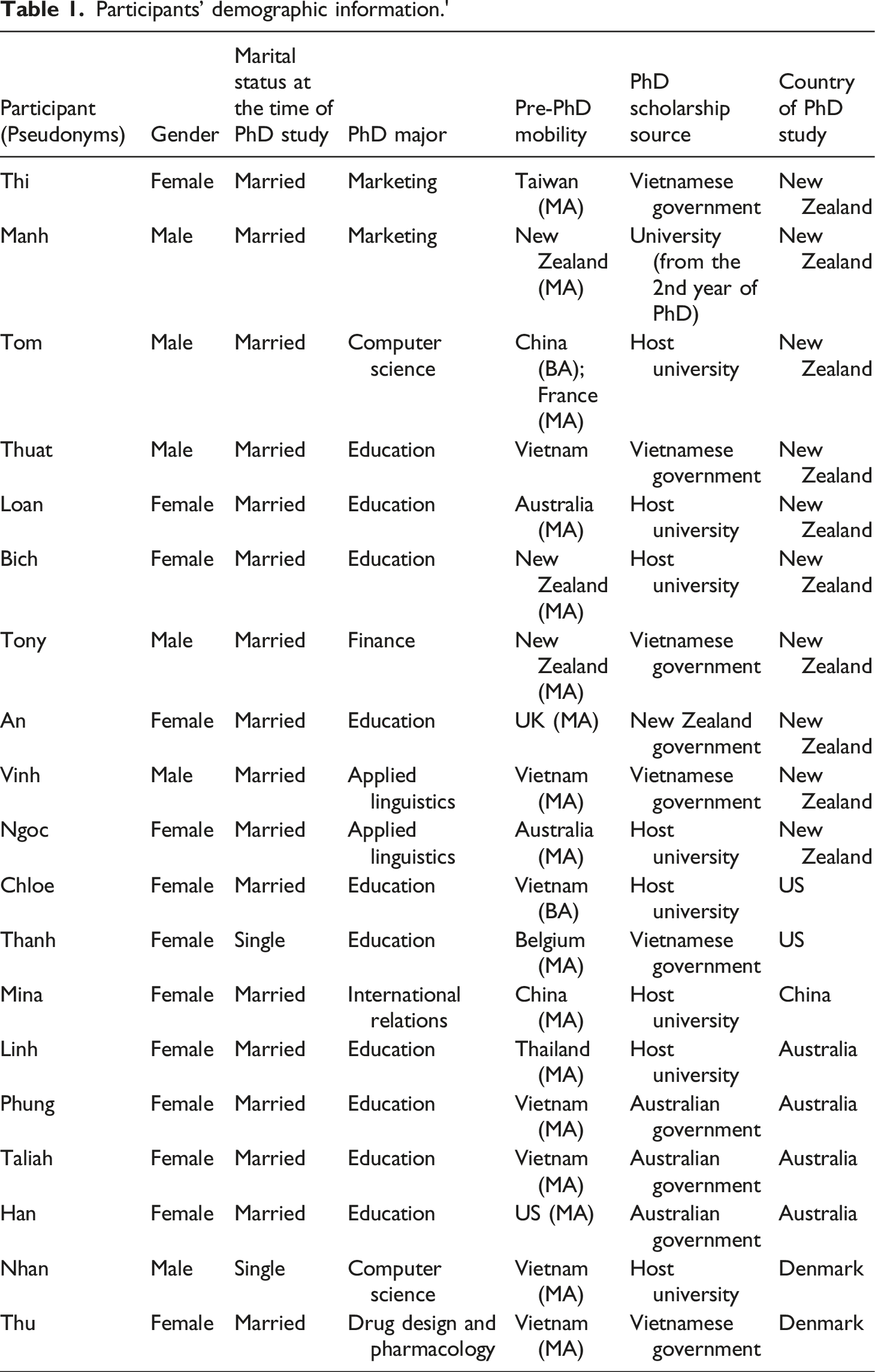
Participants’ demographic information.
The analysis process followed these six steps. First, after each interview, I listened to the audiotapes while memos were taken as initial interpretations. I conducted open coding (Strauss & Corbin, 1998) by which I analysed specific quotations of students’ words to decipher codes and themes. Transcripts were read line-by-line to make sure the interviewee’s voice was being understood. For instance, I recognised the patterns of financial issues and scholarships, international experiences, academic development, and ‘see the world’ or ‘explore the world’ in many of the interviews. I noted them down for further analysis. In the second step, I transferred my prior memos to and made further notes on the right margin of the transcript pages if necessary. For instance, when one participant said he did not know about other sources of scholarship, I wrote ‘Why’? in the margin and looked back at the transcript for possible explanation and make comparisons with other participants. In the next step, I started to build initial conceptual levels, meaning the actions and events previously identified through memos and notes before adopting an axial coding (Strauss & Corbin, 1998). Axial coding refers to the agreement or alliance between two or more categories that eventually form a larger group of categories sharing the same underlying characteristics. For example, I grouped similar categories together to form themes, for instance, ‘increase knowledge’, ‘update skills’ and ‘learn new things’ are grouped into the category of ‘academic development’. In selective coding, I further refined my categories, validating relationships between categories to make sure different categories are unified around main themes of the participants’ aspirations (Strauss & Corbin, 1998). For instance, I combined categories of ‘academic development’, ‘professional duties’ and ‘teaching development’ into one big theme of ‘professional requirement and academic development’.
Findings and discussion
This section presents the thematic findings that lay out the enabling factors for an imaginable international PhD undertaking of the Vietnamese doctoral students, including professional requirement and academic development, life enrichment and self-exploration, prior transnational experiences, and scholarship matters.
Professional requirement and academic development
A doctoral degree was a must for the majority of the participants (except for Nhan, Manh and Mina) because they had worked in the higher education sector in Vietnam as university teachers with various years of teaching and research experience. When asked why they chose to go for a PhD, most of them mentioned job requirements as the main reason. A doctoral degree was required for being university lecturers in Vietnam and this qualification was expected to be obtained in order for them to keep their job. Specifically, Vinh described the degree as ‘the lecturer-thing’. Thu testified to it, saying that working in a university was her career path and a doctoral degree was ‘surely a must’. Tony, another lecturer, had a similar answer, saying that ‘all university teachers need to have it. If you are in a place where everyone does the same thing, you eventually have to do it too’. Thi had an envisioned future of her post-doctoral career of teaching post-graduate courses instead of teaching undergraduate programmes only, which she considered less ‘a promotion’ than an acknowledged professional advancement. Thi also mentioned ‘the deadline’ when asked about her decision to undertake her doctoral study. ‘There is a deadline for each teacher in my university where I work. Mine is May 2020’. The deadline was also critical to Thuat’s motivation for a PhD. ‘I had to do a PhD as soon as possible, otherwise, they [the university] would just keep pushing me’, Thuat admitted.
These snippets have given us a glimpse into how the national policy in human development resources turned into a professional expectation for the participants and subsequently became necessary as a career booster for them. Professional requirement being a primary motivation for a PhD study has been well discussed in prior research (Guerin et al., 2014). In my study, however, a doctoral degree as a professional requirement has become a social practice that enabled the imaginative space in which the participants imagined themselves thriving in their academic career and being qualified to work in their professional areas. A PhD became a ‘social fact’ that the imagination of achieving a PhD was now ‘quotidian mental work’ of ordinary people (Appadurai, 1996).
Most interviewees were self-driven by their own aspiration to academically perform better, in their words, ‘to gain further knowledge, to gain confidence of being a researcher’, or to ‘update my knowledge, teaching methodologies’. The drivers for a cross-national mobility came from their eagerness to learn more, ‘expand my horizons’ as in Chloe’s statement or ‘to be recognised, to be mentored, to be academically supervised, in a professional way, rather than self-learning and self-teaching and do small research projects’ as in An’s explanation. Vinh, another example, talked about how he had studied different programmes in different fields and he still wanted to ‘learn more, to expand my mind. I love learning, that’s all’. This echoes with other participants like Bich and Loan who stated that ‘I love learning, I just want an opportunity to learn more’ or Taliah who joked that she could just ‘keep learning for the rest of her life’. Those among the few participants who were not working in higher education institutions like Manh and Nhan also emphasised their curiosity and needs for further study. Nhan insisted ‘there is a question unsolved in my MA study. It lingered in my mind. I thought I should do research on it’. It can be concluded that what mattered to the participants was how they would grow throughout the PhD, rather than the diploma itself. In An’s words, ‘the degree is not the end of doctoral study’.
The students opted for foreign credits in their degree because they believe they would be able to capitalise on what they presumed as world-class research resources and networks, and opportunities to ‘be exposed to and internalise internationally recognisable standards to enhance academic quality and integrity’ as Vinh added. These symbolic and social capitals, according to the participants’ explanation, was what a degree at home could not offer them. Phung repeatedly emphasised advanced knowledge as what she associated with an international doctoral programme. Meanwhile, Thuat, Vinh, An, and Ngoc all shared their concerns over the actual improvement in research capacity they would have achieved if they had taken a domestic programme. Thuat, for instance, took a domestic Masters study and his comment was that ‘it was boring. I didn’t think I had gained anything significant. So I guessed a PhD would be no better’. Among all 19 participants, Taliah was the only one who got first-hand experience with a doctoral study in Vietnam which she reluctantly gave up when she almost reached the end of the candidature. Taliah described her domestic PhD experience and the reasons for her drop-out. I had many difficulties during my time doing the domestic PhD. Workload was the most stressful. There was a conflict in time division between my study and my teaching. [...] What I really needed at the moment was time for my study. [...] Furthermore, the pressure of doing a PhD in Vietnam came from the lack of resources, not just materials but also mental support. I was under huge stress. It took me several months before I finally decided to give up. That whole process was really painful.
As yet, the incomplete doctoral study in Vietnam taught her to be selective and set the aims for her PhD abroad. ‘I knew I should learn to live and live to learn. I should achieve the balance’, Taliah explained. The intrinsic motivation of research interest and knowledge broadening was what drove the participants forward and, quoting Han, kept them ‘going till the end’ of the programme. The academic contexts and resourcefulness of the educationally advantaged countries were what the Vietnamese students intended to utilise for their professional development and what they expected from their PhD endeavours.
In prior studies (Jablonski, 2001; Guerin et al., 2014), the necessity of a doctoral programme completion has been described as part of a ‘stark reality’ (Guerin et al., 2014), a professional requirement and therefore the primary motivation for a PhD enrolment. The findings in this study confirm that of previous research, suggesting that the main driver for a doctoral degree is to secure and enhance employability as it is a realistic preference of the job. However, while previous studies see it more as an extrinsic motivation, this paper considers it a string of thread that wove the students’ imagination of a successful career pathway with the creation of an imaginative space which not only allowed an imaginable doctoral study, but also an imaginable international doctoral study. This paper suggests that working in the higher education system created an imaginative space for the majority of participants to find an international PhD imaginable. This imaginative space was placed within a certain socio-political context that advances a discourse revolving around a PhD overseas. With the promotion from the Vietnamese government in recent decades, an international doctoral study has been part of people’s imaginary, particularly those working in the higher education sector. In other words, a PhD has been streamlined to be a normal practice that was imaginable to the students. The imaginations are not simple fantasies as Appadurai (1996) remarks, but real existing social practices. As distinguished by Appadurai (1996), the idea of fantasy has an individualistic connotation that leans towards the sense of privacy and possibility to dissipate. Meanwhile, imagination has a collective sense that is powerful enough to create collective ideas of nationhood. Since an overseas PhD study was what many people in the participants’ circles of network achieved, it became imaginable for them. Many participants got the idea of sojourning from their colleagues and friends who were part of their imaginative spaces. Henceforth, they were able to imagine a future of knowledge expansion, academic enrichment and prestige, and opportunities attached to the qualification (Jablonski, 2001; Loxley & Seery, 2012; Kowalczuk-Walędziak et al., 2017).
Life enrichment and self-exploration
Seeing a PhD abroad as life experience enrichment was another contributor to the participants’ aspiration to study overseas. The interviews revealed that international doctoral study represented a good chance for the students to broaden their horizons and obtain a global perspective. Tom, for instance, half-jokingly said: I am very interested in exploring the world. Studying abroad, I think, offers a great opportunity to explore the world. Otherwise, it will cost a lot to travel. Working as a teacher can hardly afford traveling.
Vinh, similarly, mentioned his wish to have a global reach: One of my wishes was that I’d see more of the world, that's why I chose to study abroad. [...] I had the feeling I was constrained in a small, narrow space, although there was the Internet or digitalised events. I had chances to learn from and work with foreign academics when they came to where I lived. But I was curious about how people worked in other places than Vietnam.
It is worth mentioning that staying in Vietnam does not mean that the PhD students could not have international education experience. The mobility of academics and researchers promotes international education on a global scale. Thuat, for example, had had transnational education experience in Vietnam before their PhD endeavours. I took some courses offered by Victoria University from Australia in Vietnam. Some well-known faculty members were invited for visiting lectures, such as [name of professor] and [name of an Australian-Vietnamese professor]. But studying in Vietnam was no longer appealing to me.
A PhD overseas was Thuat’s choice because it would be ‘more fun, more interesting. It was meaningless to study just because of the diploma’. What he meant was that it would be easy for him to undertake a doctoral study in Vietnam for the sake of the degree and still had international exposure from international visiting fellows. An shared the same opinion with Thuat. According to her, if it had only been to obtain the diploma, there would be no point in travelling overseas to study. In Thuat’s and Vinh’s cases, a geographical mobility was now what they imagined to be more profitable for them in terms of academic development and transnational life experience. The international education exposure could not be contained in the movement of academics coming to Vietnam. The students, however, found an urge to fly out of Vietnam to have a real sense of life and work ‘out there’.
Apart from enriching life experience, the participants also mentioned self-exploration as encouraging factors in their decision to embark on the journey. Typical cases in point are as follows: I started to find my teaching routine boring. I started to lose the momentum [...] My husband had completed his PhD in Germany not long before that, and if he could join me to go abroad for my PhD, it would be a chance for family bonding after a long time of separation due to his study. And it would be a new, memorable experience for the whole family together. (An) I want to escape from my life in Vietnam. I wanted a break. (Linh) I want more transnational experiences. I like stability, I am not quite a wanderlust-type person, to be honest. But I always love life experiences. I mean, it is not necessary to travel to too many places. I prefer if I go somewhere, I will live to explore that place, to enjoy, to experience what’s allowed. (Taliah)
A sojourn of several years living far away from home was imagined to carve a pathway for personal development and life betterment for those like Taliah who preferred stability but want to enjoy life to the fullest, or for Phung who wanted to have ‘a significant achievement that made me really proud of myself’, or for Thuat who believed he was ‘young and still have time to explore’. For these participants, their overseas PhD journeys would be a start of something new, ‘an escape’, ‘a break’, which triggered stimulating sensations and a sense of satisfaction as the need for higher achievement was met. This resonates with the findings of previous studies (Wu, 2014; Xu et al., 2020) that overseas study is often sought as a means of self enhancement and actualisation. Students are motivated to take part in international higher education as they will gain new experience and a global outlook (Marginson, 2014). Li (2012) terms it as ‘soft currencies’ which can be understood as a sense of cosmopolitanism, cultural and social capitals, transnational mindsets, international work experience and life enrichment. Foreign exposure is expected to yield these benefits and henceforth a PhD overseas seems to be a wise choice. The expectations for diversity in life experiences and personal development were part of the students’ horizons of aspirations (Appadurai, 2004). Their aspirations for a change in their ‘boring routine’, for ‘a break’ or ‘an escape’ highlighted their capacity as a site of ‘interplay between agency and social structures’ (Archer et al., 2013, p. 59). Since they were no longer happy with their life in Vietnam, and they wanted to seek something ‘more fun, more interesting’ and meaningful, a doctoral sojourn was imagined to provide them with ‘concrete experiences with the good life’ (Appadurai, 2004, p. 69).
Prior transnational experiences
Prior transnational education experience was also a motivation for Vietnamese PhD students. Specifically, as they had received international education in the previous levels, they wanted to continue the experience abroad. This argument is corroborated with statements from my interviews with 15 out of 19 participants who completed their previous qualifications or had some academic training abroad. Thanh won a scholarship to finance her Masters study in Belgium, and the study was described as ‘a significant learning process’ that made her realise ‘what was taught in Vietnam was intolerably easy’. The programme in Belgium was, metaphorically speaking, a door to open the international academic world to Thanh. As she wished to be ‘academically challenged’, she could only continue to walk through the ‘door’ to other places instead of closing the ‘door’ by studying in Vietnam. Tony’s story was another example: If you do an MA abroad, then a PhD abroad will make more sense as it is a system that you are more familiar with. Everything seems clearer to you. If you do a PhD in Vietnam [after an MA overseas], you actually have to start to know a new system.
It is interesting to notice the paradox from Tony’s observation. Studying in the home country does not necessarily mean students know how to navigate and survive the system. In contrast, what is often assumed to be foreign and unfamiliar can actually become more navigational and manageable to them if they have prior experience in similar foreign systems.
Other students like Thu, Chloe, An, and Bich also chose a PhD study overseas because of their previous experiences. Thu, for instance, finished her MA in Vietnam, but she had a four-month internship in a university laboratory in Denmark, and the ‘many first-times’, in Thu’s description, while working and collaborating with international academics sowed the first seeds of her aspiration to pursue her further education outside Vietnam. I had never had an idea of studying somewhere else when I was at high school or when I was studying at the undergraduate level. It had simply never crossed my mind. I admired those who went overseas for their study but I had never thought I would do the same. But when I was doing my MA, there was a call for an internship in a laboratory in a Danish university and my MA supervisor advised me to give it a try. When I came back from the internship, I decided to do a PhD abroad because I no longer wanted to continue my education domestically. [...] The working environment there [in Denmark] was amazing, totally different from what I had in Vietnam. Facilities, equipment, everything was better. And people there too. They helped me a lot. The living environment was wonderful as well.
Similar to Thu, Chloe had a one-year exchange programme in the US when she was doing her undergraduate study. The academic and life experience made her decide to come back to the US for her doctoral education. Chloe said ‘life in the US suited me well. I really enjoyed the time there’. From the students’ accounts, it could be argued the earlier academic and research exposure became part of their imagination of the quality environment they would have when they took a PhD abroad, whether going to a new country or coming back to where they had been to before. Although the prior experience factor is not often found in previous studies of similar inquiry, in this research, it rises as one of the most important elements making a PhD abroad imaginable to the participants. To a few of them, it was even a deciding factor leading to their foreseeable and inevitable future of an international doctoral study.
Linking imagination to aspiration, Appadurai (1996) argues that people use a ‘map’ of social norms to explore the future themselves, which is a ‘map of aspirations’. People possess ‘the capacity to aspire’ (p. 59) and have different opportunities to practise using this map; therefore, they have different ‘horizons of aspirations’. In this study, the participants might share similar conditions that made up their imaginative spaces such as the opportunities to study abroad or working in higher education where an international PhD was a normal social practice. However, since each participant was situated in a different social environment, their imaginative spaces were constructed differently, which influenced their imagination of who they are, where they want to be, and henceforth, their decision of living abroad. Specifically, since the participants had different education experiences, their maps of aspirations were constructed differently. Their prior experiences led to preferences of international education over domestic training, which was not merely individual, but rather culturally located and formed in the ‘thick of social life’ (Appadurai, 2004, p. 67).
Scholarship matters
Among 19 participants, 18 of them received a full scholarship to finance their study and Manh’s study was covered when he was half way through his programme. Apart from those who worked in universities and therefore eligible for the Vietnamese governmental scholarship, others sought various channels to secure the financial condition for their living far from home, including foreign governmental scholarships (such as Australian or New Zealand government scholarship) or university funding. Foreign government scholarships were well popular among the participants since, as An and Phung explained, the monthly stipend was higher than, even doubled, what the Vietnamese government could offer. It meant that foreign government funding would be better for those who brought family with them to the study countries. Another source of funding came from the host universities. Compared with governmental scholarship awardees (both Vietnamese government and foreign government), those who received university scholarship had less commitment. Specifically, they were not required to return to Vietnam at the end of their programme and work for a public institution for a period of twice or three times the duration of their doctoral study.
It can be argued that the scholarship reward is evidence for a capacity to aspire, and it reveals how agentive the participants were in order to make a PhD overseas imaginable. Some of them chose to apply for the Vietnamese government scholarship as it was the direct channel they had, and it seemed to be ‘more convenient’, ‘more direct’ and ‘an easier option’ to them. Thanh attributed her scholarship reward to her being ‘already fit with a certain frame’. What Thanh meant was that the Vietnamese government scholarship was made accessible to university teachers like her, and that she did not have to compete nationally or internationally to achieve it like with other types of scholarships. Thuat who previously worked in a modest institution in the centre of Vietnam further explained: ‘I didn’t have any experience, I actually didn’t know about different sources of scholarships available to me [except for 911]. There was only one colleague of mine who also conducted her PhD outside Vietnam, but she left a year after me’. This statement accounted for Thuat’s self-claimed lack of experience, and it was totally in contrast with Phung, An, Taliah or Han who used to work in a big university in the capital city of Vietnam where a number of their colleagues did their MAs and PhDs overseas.
In Thuat’s story, as he was one of the very few who did a PhD overseas in his institution, he was not aware of other possible funding options and went for the direct resource made available to him, meaning the Vietnamese government scholarship. Similar to Thuat, Thu described herself as ‘inexperienced’ because she could not ask for ‘experiences from senior colleagues or friends’. In her explanation, when her senior colleagues or teachers studied abroad, it was long before her time and ‘the policies and systems at the time were different, and very few my friends studied abroad, that’s why I couldn’t ask them for information or experience’. In contrast, Phung was also granted the same funding as Thuat, but knew she could be more financially comfortable if she took the Australian government scholarship like her many colleagues did. Another example was Tom who was also eligible for Vietnamese government sponsorship but reached out to his host university in New Zealand to finance his study so as to not be restrained by the returning commitment and be more flexible in his post-doctoral mobility. It can be explained that different people, though sharing certain similarities like Thuat, Phung or Tom had different opportunities to practise the maps of aspirations, and hence, they had different ‘horizons of aspirations’ (Appadurai, 1996). When they had various choices of scholarships, for example, they had alternate imaginings of how their life abroad would be. Such imaginations suggest that their lives were not just mere outcomes of the ‘givenness of things, but often as the ironic compromise between what they could imagine and what social life will permit’ (Appadurai, 1996, p. 54). The way the participants chose between scholarships also demonstrated their ability to navigate the ‘dense combination of nodes and pathways’ (Appadurai, 2004, p. 69) that lie between the present and the imagined future. It showed how the students moved from ‘wishful thinking’ to ‘thoughtful wishing’ (Appadurai, 2004, p. 82).
Appadurai’s (1996) argument of how uneven ‘the capacity to aspire’ (p. 59), or the imaginative potential, is distributed in many societies is reflected in the unevenness of imaginative spaces among young people and professionals in Vietnam. In one study, Nguyen (2018) discusses this uneven distribution from the point of national policy as she makes a comparison between before and after the national human resource development strategy was implemented by the Vietnamese government in 2000. According to Nguyen (2018), while the possibility of studying a doctoral degree prior to 2000 was imaginable for only a few, it has now become part of the imagined possibility for many, especially government professionals. In my study, the argument of uneven distribution extends further than comparing the pre- and post-2000 national policy. I posit that the uneven distribution of capacity to aspire stems from the differences in the doctoral students’ workplaces, their direct networks such as colleagues and friends, their own previous educational experiences, and the priority of allocation of scholarship sources. For the three participants who were non-governmental workers (Nhan, Manh, Mina), they seemed to enjoy more freedom in post-study mobility and have less commitment and restriction, but they had limited scholarship resources as they were not the priority of governmental scholarships including both Vietnam and foreign governmental scholarship. On the contrary, 16 participants who could have the government-sponsored funding offered to them seemed to have similar capacity to aspire, but then their ‘maps of aspirations’ (Appadurai, 1996) varied from one another because these maps of aspirations were composed of different aspirational notes and pathways such as their colleagues, academic and social environments, social networks, as well as their own experiences.
Conclusion
The study has illuminated how and why an overseas PhD study became imaginable Vietnamese PhD students. Using imagination and capacity to aspire as the underpinning theoretical concepts, the paper unravels the main motivating factors for doctoral undertakings outside Vietnam. The motivation was put at the intersection of academic development, life enrichment, prior transnational experience, and funding availability. Rather than lending credence to dyadic division of push-pull factors or the classical duet of intrinsic and extrinsic motivational goals, the findings from this study look at motivations as elements to form an imaginative space in which the participants practised their maps of inspirations to navigate alternate imaginings of their future overseas doctoral study. A focus on the imagination has brought to light the complexities and multiplicities of the factors that led to the decision the Vietnamese doctoral students made on their sojourn, including scholarship application and selection. By focussing on imagination and capacity to aspire, the article highlights how uneven the imaginative space is among those who share similar socio-cultural contexts, as well as how different their aspiration nodes are. This in turns allows for our understanding of students’ agency in pursuing border-crossing educational activities without neglecting nuances in their personal backgrounds, and personal and professional experiences.
Although useful insights were gained via the in-depth interviews, the main limitation associated with the study is the small sample size and sampling method adopted, as snowball sampling is often criticised for controlling the types of participants as well as the data quality (Biernacki & Waldorf, 1981). Although the author tried to involve participants from multiple disciplines and PhD study countries, the majority of the interviewees ended up majoring in Education and studying in New Zealand and Australia. Despite this limitation, this study is still important and useful. Given the increasing number of Vietnamese students studying overseas and the scarcity of research on doctoral students’ overseas study motivations using the conceptual tools of imagination, the present study opens up several other avenues for future research. For instance, comparative studies between doctoral students and other groups such as Masters and undergraduate students can be conducted to investigate how the capacity to aspire among these groups differ from each other. In addition, further studies may be conducted to explore students in various cultural groups such as students from Vietnam, China and India, which are the largest source countries of international students worldwide.
Footnotes
Acknowledgements
The author would like to thank Professor Toni Bruce and Dr. Esther Fitzpatrick for their valuable comments on the first draft of this paper and their constant encouragement throughout the time this project was conducted. The author also thank the two anonymous reviewers for their critical feedback on the earlier version of the article which helped the author to greatly enhance the quality of the paper.
Declaration of conflicting interests
The author(s) declared no potential conflicts of interest with respect to the research, authorship, and/or publication of this article.
Funding
The author(s) received no financial support for the research, authorship, and/or publication of this article.
