






Abstract
This paper explores the theoretical underpinnings and practice-based research insights on Content and Language Integrated Learning (CLIL) as applied to adult basic education for immigrants with limited or no formal schooling, within the context of Norway’s newly introduced model for adult basic education. Using a scoping review methodology, the paper synthesises theoretical propositions, empirical research findings, and national policy documents to examine the applicability and limitations of CLIL in this unique educational setting. Positioned as a pedagogically oriented inquiry, the paper proposes key principles for implementing the CLIL approach in adult basic education for learners with limited or no formal schooling, along with tentative recommendations for pedagogy and research. The findings emphasise the importance of tailored literacy instruction, interdisciplinary teacher collaboration, and resource-oriented perspective. While grounded in the Norwegian context as a strategic case, this study offers insights relevant to other countries seeking to facilitate the smoother and faster integration of adult immigrants into national labour markets and society.
Introduction
This paper aims to map both the theoretical underpinnings and practice-based research insights on Content and Language Integrated Learning (CLIL) when applied to adult basic education for immigrants with limited or no formal schooling. The rationale for this focus lies in recent reforms in adult basic education in Norway that have placed increased emphasis on the integration of language and subject learning across curricula. In particular, the newly introduced module-based model for adult basic education (referred to by the Norwegian acronym FOV) explicitly promotes the integration of Norwegian language learning across all subjects. This policy direction positions Content and Language Integrated Learning (CLIL) as a central pedagogical principle for adult education centres working with immigrant learners, including those with limited or no prior formal schooling.
The need for this mapping arose during the development of a research project proposal aimed at supporting teachers’ professional development (PD), in light of the requirements for implementing Norway’s new model for adult basic education. During the conceptual phase of this project, it became apparent that teachers were expected to enact CLIL-based practices in a highly complex instructional context without a sufficiently consolidated research base to guide pedagogical decisions. This prompted a systematic exploration of what is currently known about CLIL in adult basic education for immigrants with limited or no formal schooling, and whether relevant insights could be drawn from adjacent educational contexts.
An initial literature search focused on key strands of research in CLIL (e.g. Cenoz et al., 2014; Marsh, 2008; Mehisto et al., 2008), adult second language literacy (e.g. Tarone et al., 2009; Young-Scholten & Kreeft Peyton, 2020), and adult immigrant education in Nordic and European contexts (e.g. Monsen & Pájaro, 2021; Kreeft Peyton & Young-Scholten, 2020). While this body of literature offers rich theoretical and empirical insights into CLIL and adult language learning more generally, it also revealed considerable conceptual ambiguity regarding what constitutes CLIL across contexts. In addition, there is a notable lack of research on its implementation in adult basic education for learners with little or no formal schooling.
Additionally, research on the classroom implementation of CLIL in adult basic education for immigrants with little to no formal schooling appeared to be scarce both nationally and internationally. Existing Norwegian research has largely focused on newly arrived pupils in compulsory or upper secondary education, rather than adults (e.g. Kjelaas & Fagerheim, 2024). Internationally, studies on CLIL or content-based instruction with adult learners tend to involve participants with prior schooling experience, such as university students or literate adult migrants (e.g. Durgunoğlu et al., 2021; Walenta, 2018). Research explicitly addressing CLIL in basic adult education for literacy learners remains limited, despite the growing policy emphasis on integrated language and content instruction in adult education systems.
As a result, the need to engage in a more in-depth discussion of the issue, as well as explore potential ways of translating available research-based knowledge on CLIL from adjacent educational settings, became evident. The study has two main aims. Firstly, to examine how existing theoretical perspectives and classroom-based research on CLIL can inform the understanding of CLIL in adult basic education for immigrants with limited or no formal schooling. In particular, the paper asks what form of CLIL is relevant for this context, given the distinct yet heterogeneous learner profile.
The second aim is to identify key pedagogical strategies for implementing CLIL in adult basic education and to formulate tentative recommendations for pedagogy and future research. These recommendations are based on a synthesis of academic literature, national policy documents, and instructional support materials available to teachers working within Norway’s new adult education framework.
The recommendation might be highly relevant to other national context where adult basic education models emphasise the integration of language and content learning to facilitate a smoother and quicker integration of adult immigrant into the national labour markets and society at large.
Guided by these aims, the paper addresses the following research questions: (1) What does existing theoretical and empirical research suggest about the applicability and limitations of CLIL to adult basic education for immigrants with limited or no formal schooling? (2) What insights can be drawn from related educational contexts to inform CLIL-based pedagogy in adult basic education? (3) What tentative recommendations for pedagogy and future research emerge from a synthesis of the available literature?
In terms of methodology, this pedagogical inquiry, based on a scoping review, draws on a qualitative paradigm to present and synthesise theoretical propositions, empirical research findings, and national policy documents related to Norway’s newly introduced model for adult basic education. This is consistent with Arksey and O'Malley’s (2005) conceptualisation of the purpose of a scoping review, namely, it tends to map key concepts, types of evidence, and research gaps within a broad field of inquiry, particularly where the body of literature is heterogeneous or fragmented. Rather than evaluating the effectiveness of specific interventions, a scoping review allows for the synthesis of theoretical literature, empirical studies, and policy documents in order to clarify conceptual boundaries and identify directions for future research. This paper does not evaluate the effectiveness of CLIL interventions. Instead, it examines how existing theory, research, and policy can be meaningfully interpreted and adapted for an underexplored educational context. For this reason, the chosen methodology is particularly appropriate.
Norway, like many other European countries, is streamlining its national policies and educational provision models in adult immigrant education in response to the pressure to create a more time-efficient, flexible, and sustainable system for integrating adult immigrants with various educational background into the labour market and society at large. Norway is an interesting case, given recent developments in national adult basic education discussed later in this paper. It provides a contextual frame for exploring authentic challenges in adult basic education for immigrants with little or no formal schooling. It also serves as a basis for investigating pedagogical approaches grounded in the real-life needs of learners and educators.
Though the paper is placed in the Norwegian context, the theme of migrant and refugee adult education in Europe is well-known with the discourse focussing on speedy and successful integration of immigrants as a crucial element in promoting social cohesion and economic growth on the continent. Language of a host country, as the main access point to education and the labour market, has naturally played a central role in the initiatives launched by the Council of Europe to facilitate language learning. For instance, project ‘Linguistic Integration of Adult Migrants’ (LIAM), in existence since 2006, aims at offering support to policy makers and practitioners to facilitate migrants’ integration in civil society. 1
The paper is structured as follows: it begins by outlining recent developments in Norway’s educational provision model for adult immigrants. This is followed by a section on learner profile of adults with limited or no formal schooling based on international academic literature. Next, the theoretical foundations of CLIL are examined, complemented by insights from empirical research focused on the relevant educational context. Finally, a synthesis of key principles for implementing CLIL in adult basic education is presented, concluding with tentative recommendations for pedagogy and future research that offer valuable insights well beyond the Norwegian context.
On Recent Developments in Adult Basic Education in Norway
The main law that stipulates immigrants’ rights related to educational provision in Norway, The Act on Integration through Training, Education and Work (the Integration Act), states the main objective as follows: The purpose of the Act is to ensure that immigrants are integrated into Norwegian society at an early stage and become financially independent. The Act aims to help immigrants acquire good Norwegian language skills, knowledge of Norwegian society, formal qualifications, and a lasting connection to working life. (The Integration Act, LOVDATA, 2024)
The Norwegian context presents an interesting case because of the implementation of the new Education Act on August 1, 2024, that also introduced a new model for basic education for adults, FOV in Norwegian, at a level below upper secondary education. FOV replaces primary and lower secondary education for adults and introduces new curricula. The curricula for FOV are adapted to adults’ educational needs and differ in content from those designed for younger students. FOV is module-based, intended to provide flexible, individually tailored education. It is organised into smaller units (modules) that can be combined in various ways to fit the competence level and needs of individual adult learners. Participants are assessed and placed at the appropriate level, receiving a certificate of competence for each completed module.
New curricula have been developed for each of the seven subjects: Norwegian for language minorities, Norwegian, Social Studies, Natural Sciences, Mathematics, English, and the Basic Module – basic reading and writing instruction. Each subject is divided into four modules, with level 1 being the lowest and level 4 the most advanced. Importantly, the modules are described as having ‘an adult, second language, and resource perspective’. The overarching rationale for FOV is stated as follows: ‘[…] no one should have to complete more education than necessary to achieve their desired final qualification’ (The Norwegian Directorate for Higher Education and Skills, 2025).
How Are Teachers Supported in the Implementation of FOV?
On its website, the Norwegian Directorate for Higher Education and Skills offers a set of so-called ‘support resources’ intended for use by adult education centres across Norway as supplementary materials for the implementation of FOV starting August 1, 2024. The category ‘subject content and language’ of the resources features short info texts, podcasts, and short videos featuring teachers and leaders from some of the centres that participated in the trial of the new model run by the Norwegian Directorate for Higher Education and Skills. In these material teachers share some of their experiences from practice. The materials have been made available to help other teachers implement the new educational modules of FOV and curricula in practice. The resources are useful as they offer insights into the experiences of the trial participants. However, they are inevitably random examples that may inspire new ideas but do not provide a comprehensive approach to managing the complexity of the task, especially given the wide range of local needs and circumstances – both in terms of the diverse adult student population and the competences and resources available for teaching staff. This left teachers in a challenging situation: they were expected to provide the new educational model starting August 1, 2024, but were essentially left to a large degree to their own devices to design the content and ensure the structure of the modules is flexible enough for adult students to tailor their education to their individual needs. In addition, such a flexible educational model, where instruction in the Norwegian language is intended to take place across all subjects, requires a substantial level of cooperation among teachers of various subjects and across different levels.
Despite the introduction of new curricula with competence aims for each module in every subject, there is still limited didactical support available for teachers and leaders outside of those participating in the trial run by the Norwegian Directorate for Higher Education and Skills. The trial ran from 2017 to 2023 at 28 education centres in 26 municipalities. It is difficult to state the exact share that the trial participants represent at the national level, as there is currently no comprehensive overview of the total number of adult education centres in Norway. Since each municipality is responsible for providing education to adult learners, one can assume that the number of adult education centres may be close to the number of municipalities, namely, 357, which means that only around 7% of the adult educational centres participated in the trial. It is known that 10,200 individuals attended adult basic education during the 2023–2024 school year, and that 62% of them were women (The Norwegian Directorate for Education and Training, 2025).
The website of the Norwegian Directorate for Higher Education and Skills is intended to stimulate reflection on the new educational model as it provides starting points for teachers to discuss their ideas and newly gained experiences locally with colleagues and leadership. Teachers’ competence in CLIL, which is a prerequisite for the implementation of FOV as it has been designed and described, should therefore be developed as part of their core teacher training and through ongoing PD opportunities. In this regard, it is important to note that, according to The Integration Act, the official requirement for teachers of Norwegian as L2 is 30 ECTS credits (The Norwegian Directorate for Higher Education and Skills, 2024). This requirement, introduced as recently as 2021, specifies that the 30 ECTS credits must cover topics such as the structure of the Norwegian language, including a comparative perspective with other languages (language typology); multilingual development; aspects of second language acquisition (including motivation, cognitive, and affective factors); and didactical approaches to teaching Norwegian as L2. Alternatively, teacher training may include instruction in basic literacy and numeracy for adults and younger learners, but from L2 perspective. The introduction of the requirement is undoubtedly a step in the right direction, though a question of whether this can be considered sufficient amount of training for such a complex instructional setting may be raised. Further, it is stipulated that until 2029, there is an exemption from the requirement of 30 ECTS credits in Norwegian as L2 for in-service teachers who were employed in a teaching position before 2021. This is a necessary step toward securing teaching staff, largely due to a serious shortage of teachers in Norway in all levels of the educational system. Norway appears to be in the company of other European countries where teachers working in CLIL programmes lack qualifications in this area (e.g. Pérez Cañado, 2016). Similar challenge has been reported in the Australian and Canadian contexts (Cammarata & Cavanagh, 2020; Turner & Fielding, 2020). In addition, research in Norway has shown that even after completing core teacher training programmes, many teachers lack the necessary skills to effectively educate minority-language students (Lødding et al., 2018), and that, despite positive attitudes toward linguistic and cultural diversity in schools, they often lack the competence to manage diverse classrooms (Iversen, 2020; Vikøy & Haukås, 2021).
Considering the outlined challenges and contextual factors, it is reasonable to assume that teachers in adult basic education, particularly without background in language education, may face challenges. These challenges likely stem from a lack of competence not only in specialised areas such as CLIL, but also in more fundamental aspects of multilingual development and literacy. Other challenges include the lack of instructional support, and access to the resources necessary for implementing FOV. The next subsection explores some of these issues in greater detail.
Preliminary Evaluation Report on FOV
A preliminary evaluation report issued in February 2024 (Dahle et al., 2024) points to several challenge areas in the early implementation of FOV. One of them is providing CLIL consistently through all subjects and module levels or, in other words, to ensure the integrated subject content and Norwegian language training. Another key challenge is that participants with little formal schooling and weak Norwegian skills need more support. The report shows that adult education centres face challenges at both ends of the modular system. Some experience the greatest difficulties at higher modules, where ensuring participants have sufficient vocational competence for examinations is demanding. Others report that challenges are most pronounced at lower modules, particularly for participants with limited schooling or weak literacy skills and emphasise that addressing these challenges requires specialised expertise.
Several suggestions are proposed in the report to address the identified challenges. One recommendation is to strengthen Norwegian language learning across other subjects by emphasising basic skills in all subjects and offering mother tongue instruction and support. It follows then that particular emphasis is placed on teachers’ need for competence in CLIL. Another suggestion comes from participant teachers, who express the need for arenas where they can collaborate across disciplines to develop and share best practices, thereby continuing their PD in close alignment with the local context and the needs of their adult students.
Adult Learners With Limited to No Formal Schooling: Learner Profile
Adult learners with limited or no formal schooling make up a population with distinct yet largely heterogeneous needs and characteristics. In this paper, I adopt Faux and Watson’s (2020) way to refer to this group of learners as literacy learners. I also adopt Faux and Watson’s (2020) instructional focus on the conceptualisation of literacy as reading and writing skills and the employment of these skills in a daily life. I fully recognise that there is a wide consensus among literacy scholars that the term (and its derivative multiliteracies) encompasses a much broader sociocultural, cognitive, and psychological dimensions rather than a set of skills (e.g. Huettig, 2015; Street, 1984).
Although, globally, adult illiteracy rates for those aged 15 and older are decreasing, illiteracy has not been eradicated, particularly in countries and regions facing socio-economic disparities and military conflicts. It is notable that male illiteracy rates are decreasing faster than female (World Bank Group, 2026), and so the gender gap persists (World Population Review. Literacy Rate by Country, 2026).
In their chapter on teaching and tutoring adult learners with limited literacy skills, Faux and Watson (2020) outline the key characteristics of being a literacy learner in an adult age that educators should consider carefully. They begin by stressing the heterogeneity of this group of learners: ‘We recognize that learners my speak several languages but not read or write in any of them, and that some may speak a language that does not have a written form’ (p. 126). What follows is a range of literacy learner categories, as outlined by Burt et al. (2008) and summarised in Faux and Watson (2020). These include, for instance, pre-literate (where L1 that has no written form), semi-literate (with limited access to literacy instruction), non-alphabet literate (where L1 uses a non-alphabetic script), and non-Roman alphabet literate (where the script is alphabetic but not Roman-based). Next, adult literacy learners often face a unique dual challenge: developing oral proficiency while simultaneously learning to read and write in a new language. This contrasts sharply with the experience of children, who typically acquire literacy in their L1 only after achieving a foundational level of oral proficiency. Another critical learner characteristic involves the wide range of motivational states and life experiences that adult learners bring into the classroom. These may include, on one side, the pressure to adapt and function in a new country, the responsibility of providing for their families, and the emotional impact of trauma related to forced migration or other personal and cultural experiences. On the other side, it is important that the outlined and very real challenges adult learners face do not lead to a one-sided, deficit-based view of their abilities and potential to achieve educational goals. This same group of learners possesses valuable life experience, competencies, and agency which, if recognised and supported, can serve as a powerful foundation for learning. Taken together, these characteristics are essential to consider in understanding what it means to be an adult literacy learner.
On a more instrumental level, research on adult learners with limited or no literacy skills reveals consistent trends in literacy development, specifically, that progress tends to be slower, including in oral language acquisition (Condelli et al., 2010; Tarone et al., 2009). Several factors contribute to this slower pace. Learners who rely solely on listening skills lack access to written input, which limits their exposure to language in its full form. Additionally, age-related cognitive changes can reduce the efficiency of processing oral input (Tarone et al., 2009). Other contributing factors include limited access to education due to family responsibilities, health issues, or broader societal challenges such as inadequate educational infrastructure in the host country (Young-Scholten & Kreeft Peyton, 2020).
Furthermore, Kurvers’ (2015) synthesis of research on emerging literacy among adult L2 learners in the Netherlands found that the metalinguistic skills of adults with no formal schooling were more similar to those of young pre-reading children than to adults with some educational background and basic literacy skills. This highlights the advantage of having even limited reading and writing abilities – whether in one’s L1 or an additional language – when learning a new language. This finding aligns with a substantial body of research on the transfer of linguistic competence across languages in multilingual individuals (e.g. Cummins, 2019). Additional findings from the study indicate that adult learners who acquire reading skills for the first time in an additional language tend to follow developmental stages similar to those of children learning to read in their L1, with the alphabetic principle playing a central role. In such cases, it is the adult learners’ general cognitive abilities that support their literacy development. However, this process is often constrained, and their literacy skills tend to remain at relatively low levels (Schellekens, 2011). Lastly, an important conclusion in Kurvers (2015) research synthesis concerns the variability in terms of successful development of literacy skills by these adult learners. The author emphasises certain learner characteristics (age, prior schooling, amount of contact with target language speakers) and instructional practices (time spent on small-group or individual work, use of multimedia and portfolio, and resource-oriented perspective on adult learners’ linguistic repertoire) as key factors facilitating the development of high levels of proficiency in a target language by the adult learners in question.
CLIL as a Concept
As noted earlier, CLIL is central to the newly introduced module-based basic education for adult immigrants in Norway, FOV. The concept of CLIL has been widely adopted in many European countries, inspired by the success of Canadian and U.S. immersion and dual-language programmes (Mehisto et al., 2008; Nikula et al., 2016). The literature on CLIL or rather manifold of the CLIL varieties is vast. As a point of departure, CLIL is generally referred to as educational practices that give explicit attention to both language and subject content (Marsh, 2008). Nowadays, CLIL serves as an umbrella term for a range of programmes and pedagogical strategies, with varying balances between language and content learning, depending on whether the goal is native-like proficiency in a target language, functional bilingualism, or a middle ground between the two (e.g. Cenoz et al., 2014). Dale and Tanner (2012) propose viewing CLIL as a continuum of bilingual education with Content-Based Language Teaching (CBLT) at one end of the continuum and immersion at the other end. Here, CBLT is a model dominated by language teachers teaching topics based on subject content to students whose L1 is not the language of instruction, while immersion presupposes subject teachers teaching content in a target language. CLIL therefore may take form of either of the ends of the continuum or any of the various forms of instruction situating between the ends, depending on the degree of emphasis on language teaching and learning versus content teaching and learning.
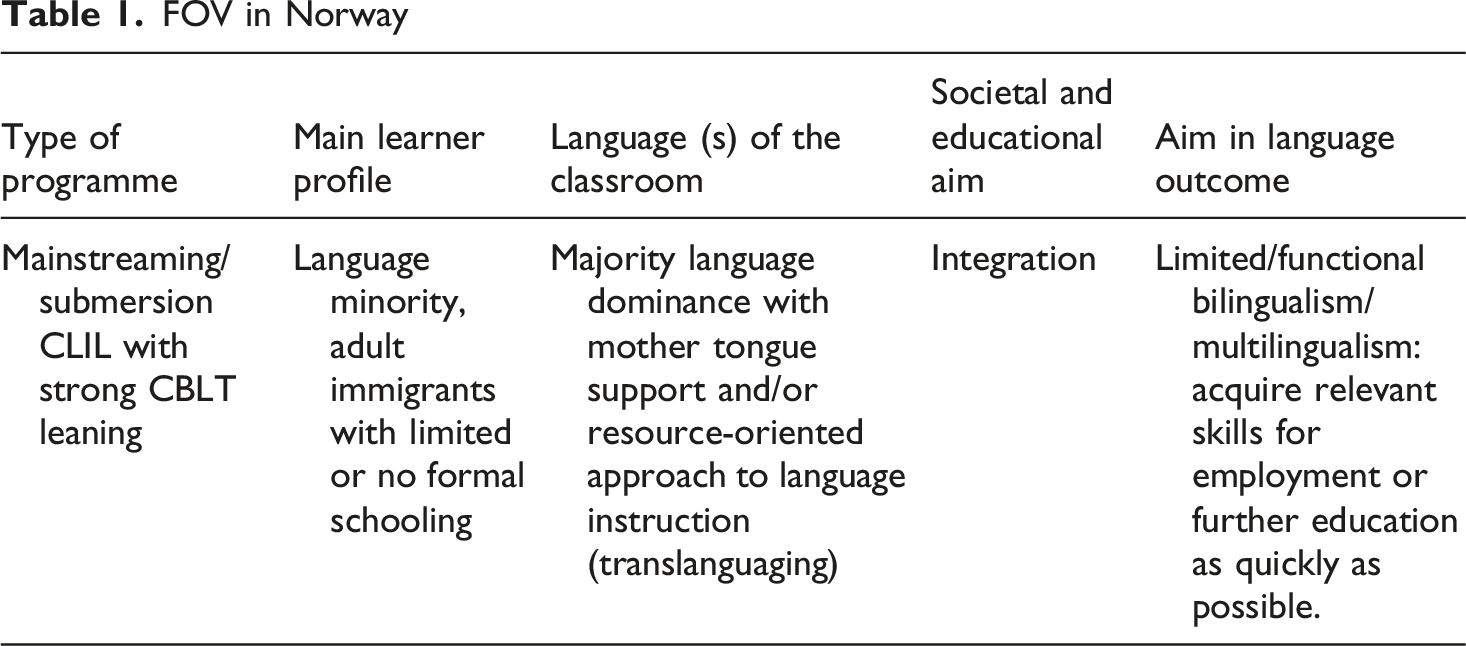
In the context of the new adult basic education in Norway, CLIL has apparent similarities with CBLT since the focus is on teaching and learning a new language through content instruction in that language. CBLT originated in the context of US public schools to cater for the needs of English language learners (Herrera & Murry, 2016). A well-known scholar of adult literacy development, Thomas G. Sticht (1997) stresses the difference between CBLT and ‘general literacy’ or ‘general language’ instruction. The former ‘focuses upon the substance or meaning of the content that is being taught’, while the latter merely incorporates ‘topics or subject matter simply as a vehicle for teaching reading and writing’. Thus, this approach treats language as a functional tool to achieve communicative goals beyond simply learning a new language (Gibbons, 2015). In addition, Krahnke (as referred to in Larsen-Freeman & Anderson, 2000) points out that no explicit effort is given to language teaching separately from the content as it is assumed that learners will learn language in a more natural way when it is embedded in the subject content. Language is practised in authentic contexts, which links learning to real-life goals. This is particularly relevant for adult immigrants, whose motivation to learn Norwegian is rooted in their need to build a life in a new country. CBLT form of CLIL appears to be most consistent with the intention behind the newly introduced FOV model, namely, to ensure the integrated subject content and Norwegian language training. However, in the Norwegian model, CLIL also shares similarities with immersion, as instruction is delivered by both language and subject teachers. Despite the requirement for teachers working with adult immigrants to complete 30 ECTS credits, there are important caveats. First, this requirement only applies to teachers employed after 2021. Second, it is difficult to argue that a 30 ECTS course is equivalent to a comprehensive language teacher training. Furthermore, the Basic Module in FOV, where foundational reading and writing instruction plays a more prominent role than in other modules, does not align fully with the CBLT profile.
FOV in Norway
Insights From Empirical Research on CLIL
CLIL has been extensively researched since the end of the last century. According to Meyer (2011), research on CLIL has demonstrated positive effect on both language and content learning, yet the author also notes that there are unresolved issues in CLIL classroom that require further research. Similarly, Cenoz et al. (2014) point out ‘there are important empirical gaps in our understanding of its effectiveness’ (p. 265) despite a large volume of studies in the effectiveness of CLIL for language learning. Cenoz et al. explain the scarcity of more finetuned and critically framed empirical research in the field by pointing to a lack of conceptual clarity and methodological challenges. These challenges stem from the wide variety of CLIL-oriented programmes and approaches, as well as the diverse contexts and student populations in which they are implemented. The authors also advocate a more balanced approach to CLIL research. This approach extends beyond ESL/EFL contexts, places greater emphasis on content learning, and provides links to classroom practice. Importantly, it also accounts for the diversity of learners engaged in CLIL-oriented programmes.
Regarding the theme of this paper, a literature search revealed that CLIL in adult basic education is still heavily under-researched, both in Norway and internationally. In Norway, the focus has primarily been on newly arrived immigrant students in compulsory and upper secondary education (e.g. Kjelaas & Fagerheim, 2024). Some valuable research-based insights into adults’ L2 learning in basic literacy skills instruction can be found in Monsen & Pájaro’s anthology (2021). Specifically, Monsen (2021) presents an ethnographic study on basic literacy instruction, focussing on ‘Sarah’, a refugee from the Democratic Republic of the Congo who is deeply committed to learning to read and write in Norwegian. The study highlights critical issues regarding the inadequate quality of literacy education Sarah received. At the same time, it emphasises her strong determination to succeed, which, along with the conscious efforts of her teacher and a broader support system to empower her agency, positively influenced her learning journey. Another chapter from the anthology by Tkachenko (2021) addresses a highly relevant topic of work-based language learning using vocational texts, but it does not specifically focus on basic education for adult learners with limited or no formal schooling. Therefore, it is uncertain whether the didactical approaches investigated in this research can be easily transferred to the context of basic adult education.
International classroom-based research on CLIL and CBLT offers some more general insight into the affordances of CLIL-oriented approaches in adult education. For instance, Durgunoglu et al. (2021) report on a study involving 26 adult learners of English as an additional language in the US. The participants, who had formal schooling experience from their home countries, followed the programme called CILIA (Content Integrated Language Instruction for Adults) programme, designed to improve vocabulary and comprehension through integrated civics and history content. The authors report significant gains in vocabulary (intentional, incidental, and morphological) and content comprehension among adult English learners. In addition, learners responded positively to the integrated approach, appreciating the relevance and depth of learning. Importantly, the author cautions against transferring the results to contexts where adult learners lack formal schooling. Next, Walenta’s quasi-experimental study on balancing linguistic and extra-linguistic gains in CLIL (2018) showed that adult Polish university level learners of English benefited from the grammar dimension of CLIL compared to purely comprehension-based instruction.
Several studies focussing on the effectiveness of CBLT/content-based instruction for adults in higher education setting found positive results in terms of improving their English proficiency (reading, listening, writing, and speaking) compared to more traditional communicative-based method of teaching (Arulselvi, 2016; Pu & Lu, 2021; Vanichvasin, 2019).
To sum up, as with the Norway-based studies, the findings of the international research are not readily transferable to adult learners with limited or no formal schooling. It follows, then that the empirical research presented here can make only a limited contribution to the discussion on synthesising CLIL-based approach in adult basic education, as it does not fully address this context.
What do We Know About Teachers’ Competence and Collaboration in CLIL-Based Educational Settings?
As previously mentioned, according to the preliminary evaluation report (Dahle et al., 2024) the key challenges identified during the FOV trial were related to (i) teacher competence and (ii) teachers’ collaboration across subjects and levels, despite participating teachers themselves reporting a clear need for such collaboration. In this regard, it is useful to explore what insights the research literature might offer on these two issues.
In terms of competence required of teachers working in CLIL programmes, the most comprehensive model of the key components of CLIL teachers’ competence (and the integration between them) has been developed by Morton (2016, 2018). Broadly speaking, the model can be summarised as containing the following components: • Teachers’ mastery of content knowledge including discipline, language of instruction, and the role of literacy within a specific discipline. • Teachers’ pedagogical knowledge includes generic (theories of leaning and development, classroom management, student profile, relational aspects, etc.) and specific pedagogical knowledge targeting literacy integration into subject-matter instruction (making content accessible through scaffolding and didactics related to both discipline and language). • Teachers’ awareness of interactions relates to the most important component, namely the mastery to integrate the two components above. Cammarata and Haley (2018) further stress that the success of CLIL-based instruction requires teachers’ awareness of the links between (i) discipline and language (language varies across disciplines); (ii) discipline and literacy (literacy skills vary depending on the type of text); (iii) literacy and language (e.g. multimodal literacy requires specific language use).
The model, like any model regardless of its complexity or level of detail, requires further adjustment to the actual instructional context. In the case of FOV, the literacy aspect of teacher competence must include the knowledge necessary to adapt to the characteristics and needs of literacy learners, as described earlier.
Due to the multifaced nature of teachers’ competence in CLIL settings and documented lack of CLIL specific competence in many national contexts, a substantial number of studies focused on the issue of teachers’ PD to support CLIL teachers. In a nutshell, there are several salient themes that emerge from research on CLIL teachers’ PD. First, the importance of collaboration among teachers, and specifically, interdisciplinary and teacher–researcher collaboration. Due to the dual nature of CLIL, interdisciplinary collaboration among teachers is essential to achieve CLIL goals. For instance, Davison (2006) and Lo (2014) showed teachers collaborating effectively across disciplines to map learners’ prior competencies in order to co-design lessons what would meet the learners’ needs. The positive impact of interdisciplinary teacher collaboration was also reported by Lu (2020) who showed that subject teachers in Taiwan demonstrated a wider range of strategies to support language instruction in their classes. They reported engaging in more reflection on their practice as subject teachers teaching language because of co-designing and co-teaching a CLIL course with language teachers.
Researcher–teacher collaboration has been the focus of several studies using lesson study or design-based research. These approaches seek to advance teaching practice through a cyclical process. This process involves identifying authentic classroom issues, collectively designing and implementing solutions, and evaluating outcomes. As Turner (2024) points out, such close collaboration that is taking place in real-life classrooms, is particularly useful to work on the ideas and pedagogical approaches that teachers, for various reasons, might find less feasible to implement in their classrooms on their own to begin with. Positive outcomes of teacher-researchers collaboration in CLIL contexts for practice were reported, for example, by He & Lin (2018), Yuan & Lo (2024).
The second theme in research on teacher collaboration in CLIL settings concerns the development of professional CLIL teacher identity, which is an important prerequisite for teachers to feel confident to teach both content and language in an integrated manner. A study by Cammarata and Tedick (2012) documented that teachers working in immersions programmes often identified themselves as subject content teachers first and foremost due to their educational background and did not perceive language instruction to be as large part of their work as content instruction. Other studies (Cammarata & Ó Ceallaigh, 2018; Ó Ceallaigh et al., 2024) showed that teachers were able to shift their identity perception towards a more balanced CLIL teacher identity provided they receive CLIL focused training. In summary, this and other research (Fielding & Harbon, 2024; Leavy et al., 2018) conclude that CLIL teachers often feel isolated in their efforts to develop competence in CLIL. They frequently lack opportunities to build their identity as confident CLIL educators and need systematic guidance to support this development. This connects directly to the third theme: the importance of, and need for, professional learning communities or networks that bring together teachers from diverse backgrounds and with varying levels of experience with CLIL models, along with researchers and other stakeholders.
Finally, another theme in CLIL teacher development highlights the need for teachers to be given time and space to apply newly acquired knowledge and practices in their own contexts, as well as to reflect on this process collectively (e.g. Ballinger et al., 2024). This theme is, of course, not unique to CLIL teacher professional development, but rather an axiom applicable to all teacher development more broadly.
Key Principles and Tentative Recommendations for CLIL Pedagogy and Research in Adult Basic Education
This section aims to identify key principles for implementing the CLIL approach in adult basic education for learners with limited or no formal schooling. It also offers tentative suggestions for pedagogy and research based on the synthesis of theoretical and empirical insights presented in this paper. The section begins with overarching principles and then narrows its focus to adult literacy learners.
The Overarching Principles of CLIL Pedagogy
Coyle’s (2006) work on the theory of fundamental pedagogical components of CLIL has been widely adopted in the field of CLIL research. The framework, named The 4Cs Framework, comprises four building blocks synthesised from research findings across CLIL research projects in various contexts. These building blocks involve ‘[…] the interrelationship between subject matter (content), the language of and for learning (communication), the thinking integral to high quality learning (cognition) and the global citizenship agenda (culture)’ (Coyle, 2006, p. 9). These, of course, are fully relevant for the FOV instructional context and can be utilised as a starting point to think about the pillars of CLIL in adult basic education.
Building on the 4Cs Framework, Meyer (2011) operationalised CLIL pedagogy through a set of ‘quality principles’ intended to support lesson planning and materials development. These principles are particularly relevant in adult basic education, where instruction must accommodate highly diverse learner profiles and emerging literacy skills. One core principle concerns the provision of rich input combined with effective scaffolding. Research consistently shows that embedding language in meaningful, authentic, and cognitively engaging content promotes deeper engagement with both subject matter and language. In adult basic education, this requires careful scaffolding to ensure accessibility while maintaining relevance and authenticity. Scaffolding is therefore essential to support learners in transforming input into learning, enabling them to construct meaning through higher-order thinking processes (Anderson & Krathwohl, 2001). Such scaffolding should be grounded in a resource-oriented view of adult learners’ competences, a perspective shared by both CLIL research and the FOV model. Designing rich input alongside appropriate scaffolding is a complex task that demands interdisciplinary teacher collaboration and a thorough understanding of learners’ prior knowledge, experiences, and affective needs (Meyer, 2011; Morton, 2018). For literacy learners, this also entails dedicating sufficient time to mapping competences and building relationships. The latter may sit in tension with policy expectations of rapid progression.
Closely related to rich input is the principle of rich interaction and meaningful language output. In this sense, CLIL pedagogy aligns strongly with task-based approaches that promote authentic communication and problem-solving through language use. Here Swain’s (2006) concept of ‘languaging’ offers a useful framework to highlight how cognitively demanding tasks stimulate learning by requiring learners to use language to reason and construct meaning. The progression from languaging to translanguaging as a pedagogical framework, one that fully embraces a resource-oriented perspective on language learners’ entire linguistic repertoire represents a logical next step in this naturally multilingual context. Actively drawing on adult students’ full linguistic repertoires can support problem-solving, meaning-making, and meaningful interaction in and beyond the classroom. This is particularly relevant in contexts where learners’ ‘funds of knowledge’ (Taylor et al., 2008) are encoded in languages other than the language of instruction. While the scope of this paper does not allow for a comprehensive explanation of translanguaging as a concept, its relevance in adult basic education is strongly supported by the resource-oriented perspective of the FOV model, which clearly reflects recent developments in the field of multilingual pedagogies.
Finally, the intercultural dimension principle is integral to CLIL-based instruction. Linguistically and culturally responsive pedagogies emphasise the integration of learners’ cultural experiences into teaching to enhance relevance, inclusion, and identity affirmation (Gay, 2010; Ladson-Billings, 1995, 2014). While the theoretical foundation for such approaches is well established, translating them into practice remains challenging due to their context-sensitive and relational nature. This underscores the need for continued, practice-oriented research, ideally through teacher–researcher collaboration, in the still underexplored field of adult basic education.
Adult Literacy Learners
In discussions about the key principles of the CLIL approach in adult basic education, particularly for learners with little or no formal schooling, it is essential to emphasise once again that literacy learners, as defined earlier, represent a distinct group of adult learners. Their unique needs and characteristics require additional adaptations of the key principles previously outlined. For instance, as Faux and Watson (2020) highlight, the challenge of designing or sourcing appropriate materials is often compounded by the lack of resources tailored specifically to adult literacy learners. This includes materials in the learners’ home languages, which they bring with them into the classroom. In addition to meeting criteria such as level-appropriateness, authenticity, and cultural relevance, researchers recommend that teachers incorporate materials with visual cues (e.g. pictures, maps, and diagrams) and ensure that these materials offer tactile experiences. At the same time, they should support the development of oral skills alongside reading and writing (Grabe, 2009; Wrigley & Guth, 1992). Another important consideration is the approach to teaching reading and writing in the target language. As Faux and Watson (2020) explain, several approaches may be appropriate depending on the grapheme-phoneme correspondence in the target language, as well as the characteristics of the learners’ other languages, which they draw upon to make sense of the new language and reduce cognitive overload. Ultimately, perhaps the most important adjustment teachers can and should make when working with adult literacy learners is to examine their own preconceptions, beliefs, and expectations about the learning process for this student population. As Fish et al. (2007) point out, these learners may be beginner readers, but they are not beginner problem-solvers. At the same time, both planning instruction for literacy learners and the learning process itself are likely to be more time-consuming and effortful than may be initially expected, as summed out below: This is not a quick process, and teachers can expect learning to proceed slowly, with frequent repetition. Adult emergent readers, like their younger counterparts, are learning how to learn and are developing academic skills for the first time. Unlike children, though, they are accomplishing these difficult tasks in a new language. (Faux & Watson, 2020, p. 133)
Tentative Recommendations
Building on the scoping review of theoretical perspectives, empirical research, and policy developments presented in this paper, this section outlines a set of tentative recommendations for pedagogy and future research in adult basic education for immigrants with limited or no formal schooling. These recommendations do not constitute prescriptive solutions but rather synthesise key insights emerging from the analysis of CLIL as a context-sensitive and multifaceted approach.
In terms of pedagogy and teachers’ PD: • Adaptability of CLIL Principles: CLIL must be tailored to meet the specific needs of adult learners with limited or no formal schooling. • Global Relevance with Local Adaptation: Teaching strategies, like TBTL and translanguaging, can be transferred across contexts but require cultural and linguistic adjustments. This also includes the issue of fostering metalinguistic awareness in contexts where learners have not previously been exposed to the practice of engaging in metalinguistic reflection on language. • Material Design and Accessibility: Teachers need support to create or adapt materials that are cognitively and linguistically accessible, authentic and relevant, especially for adult literacy learners. • Use of Visual and Tactile Aids: Instruction should include visual elements and hands-on materials to support literacy development. • Oral Language as a Foundation: Oral skills should be emphasised early on to support the development of reading and writing. • Flexible Literacy Instruction: Reading and writing approaches should consider the phonological systems of both the target and learners’ language(s). • Teacher Reflexivity: Educators must reflect on their own assumptions and biases about adult learners and literacy. Building strong relationships should be emphasised and intentionally nurtured. • Resource- and Asset-oriented Approach: Instruction should be built on adult learners’ strengths including their general problem-solving skills, entire linguistic repertoire, broader life experiences and cultural funds. • Teacher Support: Teaching literacy in a CLIL context requires specific competencies, as well as more time and collaborative effort than traditional instruction. Teachers need more hands-on support through professional development models and sustainable professional networks to facilitate interdisciplinary collaboration and development of teacher’s identity as CLIL educators.
In terms of suggestions for future research avenues: • Contextual Studies on CLIL Adaptation: More research is needed on how CLIL can be effectively adapted for adult learners with little or no formal education. This includes: o Material development and evaluation. o How to best draw on learners’ linguistic repertoire and cultural funds in CLIL settings. • Teacher Beliefs and Practices: Further inquiry is needed into how educators’ beliefs shape their instructional choices and how these evolve in CLIL contexts. • Longitudinal Impact Studies: Long-term studies could assess the effectiveness of CLIL approaches on literacy development and integration outcomes. • Cross-National Comparisons: Comparative research across countries can reveal how different policy and educational frameworks influence CLIL implementation in basic adult education. • Assessment Practices: Research should examine how assessment tools can be adapted to fairly evaluate progress in both content and language learning in the module-based educational models that are designed to facilitate fast mapping and placement as well as prompt progression of learners through the levels of competence. • Professional Development Models: Research is needed on effective training models that prepare teachers for CLIL in adult literacy contexts. • Digital and Technological Integration: Investigate how digital tools can support CLIL instruction for adult learners, especially in resource-limited settings.
Conclusion
This paper contributes to international scholarship on adult basic education for immigrants with limited or no formal schooling by addressing a context that remains largely under-researched despite growing policy relevance. Framed through its three research questions, the study offers a structured and transparent examination of how CLIL can be understood, adapted, and applied in a highly complex and underexplored educational context. The scoping review approach enables a systematic mapping of theoretical perspectives, empirical evidence, pedagogical considerations, and policy-oriented knowledge. It helps clarify what existing research suggests about the applicability of CLIL to adult basic education, as well as where significant gaps remain.
Addressing the first research question, the paper demonstrates that while CLIL has a strong theoretical foundation, much of the existing empirical work does not adequately account for adult literacy learners. In response to the second research question, insights from adjacent fields – such as adult second language literacy, content-based language teaching, and multilingual pedagogies – are critically examined for their relevance and limitations. The third research question enables the paper to move beyond mapping towards synthesis, resulting in tentative yet grounded recommendations for pedagogy and future research.
Overall, the paper contributes to international scholarship by providing a research-informed, context-sensitive framework for thinking about integrated language and content instruction in adult basic education. It highlights the importance of tailoring CLIL principles to adult literacy learners and underscores the need for further empirical, cross-national research to support inclusive and effective educational provision for adult immigrants with limited or no formal schooling.
Footnotes

Ethical Considerations
This research does not involve human participants; therefore, ethical approval was not required.
Funding
The author received no financial support for the research, authorship, and/or publication of this article.
Declaration of Conflicting Interests
The author declared no potential conflicts of interest with respect to the research, authorship, and/or publication of this article.
Data Availability Statement
This research is not associated with any specific dataset.
Declaration of Generative AI in Scientific Writing
During the preparation of this work the author used M365 Copilot and Grammarly to improve the readability and language of the manuscript. After using the tools, the author reviewed and edited the content as needed and take full responsibility for the content of the published article.