







Abstract
This article links the concept of crowdthinking from the perspective of graphic design and its interface with other disciplines in the development of the Argentine export sector. How do the symbolic, functional, and economic aspects influence in the added value of the product? And how does the interaction between disciplines generate this added value from a crowdthinking perspective? How did graphic design develop from its productive methodologies? The work aims to critically theorize on current interfaces and links between disciplines in Argentine companies to develop communication from cross-border products, focusing on the different actors involved, production processes, and work methods.
Keywords
Introduction
Aiming to further explore the links between the concept of crowdthinking, graphic design, and foreign trade, this article addresses the issue from the general to the particular. We will take the concept of crowdthinking from its etymological perspective, as a platform of collaborative work, focusing on the types of interaction between different disciplines, delving into the particularities of the concepts of transdisciplinarity, multidisciplinarity, or interdisciplinarity; its links with the productive development in the field of graphic design; and its influences in the Argentine export sector.
In the first instance, the links between the conception of crowdthinking and that of graphic design from a historical perspective, the types of links between disciplines in the productive networks of what is now known as design, will be addressed. A first working hypothesis could be that the concept of crowdthinking is closely related to the ontology of design and from that perspective you can analyze its interrelation with other disciplines in the development of the Argentine export sector. How do symbolic, functional, and economic contributions influence the added value of the product and how does the interrelation between disciplines happen to generate that added value from a crowdthinking perspective? How is graphic design developed from its production methodologies?
In this article, I search to critically theorize about the present issues of the interfaces and links between disciplines in Argentine companies for the development of communication of exportable mass consumption products, focusing on the different actors involved, the productive processes, and the work methodologies.
Methodology
Guy Julier’s 1 approach in The Culture of Design was taken as a research methodology to study the phenomenon of design, where destructuring, analyzing how it is produced, separated from how it is consumed, and how it is theorized, without closing the focus of the analysis on the product itself and allowing a complex and deep approach to the subject. In this article, following that methodology, the study focused on the productive networks of design, researching how the conception of crowdthinking influences the links between disciplines in the specific field, using as a matrix of analysis, the classification proposed by Carlos Scolari 2 in Hipermediaciones that differentiates the types of links between disciplines. This distinction was intersected with the development of the historical evolution of productive methodologies of what we know today as design up to the present, where the interdisciplinary takes a differential density, influenced by the current socio-economic conjunctures affecting the productive network of design with outsourcing processes and new types of partnerships.
In order to analyze the current situation of this conception of crowdthinking, a survey was carried out in 2013 on 500 Argentine exporting companies, with qualitative and quantitative information on their productive realities, and the results were compared with the study carried out the same year by the Metropolitan Design Center (CMD) in Buenos Aires 3 on the impact of design on the productive structure of small and medium-sized enterprises (SMEs) in that city. Besides studying the productive network linked to design, the results enabled us to consider as indicators the main demands, tasks, and areas that used resources from disciplines related to design in the field of study. These results were compared to another study that was carried out in 2017, within the framework of the current research, on 40 SMEs from across the Argentine territory that are similar in scale and productive sectors but are more design-oriented. All these companies were selected for the Good Design Hallmark, an official award granted to products that show high levels of innovation, but have taken different paths as far as foreign trade is concerned. Their main shortcomings in that area were analyzed in order to improve their exporting performance, and recommendations will be made on how they could use design to help overcome these obstacles.
Historical development of the conception of graphic design based on crowdthinking as a productive methodology
The formalized history of design as a stand-alone category, inaugurated by Nikolaus Pevsner 4 in England in 1936, identifies William Morris as a pioneer of Modern Design by uniting artisanal and artistic production, creating, for example, the arts and crafts in what could be considered a proto-crowdthinking. This productive collaboration between the art and crafts allowed to overcome many preconceptions of each of the disciplines, as exclusive centrality in a technology, in a type of product, or in a language, this promoted a deepening in the notion of “the project”, thus creating a new discipline, which later took the name of design. In this way, Morris designed projectively, books, textiles, furniture, among many other things, as a planner, went through the roles of editor, cabinetmaker, goldsmith, architect, dressmaker, typographer, jumping from one discipline to the other, transdisciplinarily. Transdiscipline is the ability of a person to acquire knowledge of other disciplinary fields, without losing their identity. 5 This perspective marked a methodological line, in these origins of what today we call design, with period’s icons such as Charles Rennie Mackintosh, Hermann Muthesius, or Peter Behrens. For example, the latter worked transdisciplinarily for the German energy company AEG, designing the lamps that were produced, the clothes the workers wore, the factory building, the company brand, the communication, and even the typefaces with which AEG presented itself, thus marking a milestone for design, inaugurating what is called integrated design. Behrens’ disciple was Walter Gropius, the first director of the Bauhaus, where theoretically the discourse was formed, the doxa of what is known as design, with aims such as “to train professionals who could create from a spoon to a city,” 6 who followed this initial conception of transdisciplinary work (Figure 1).
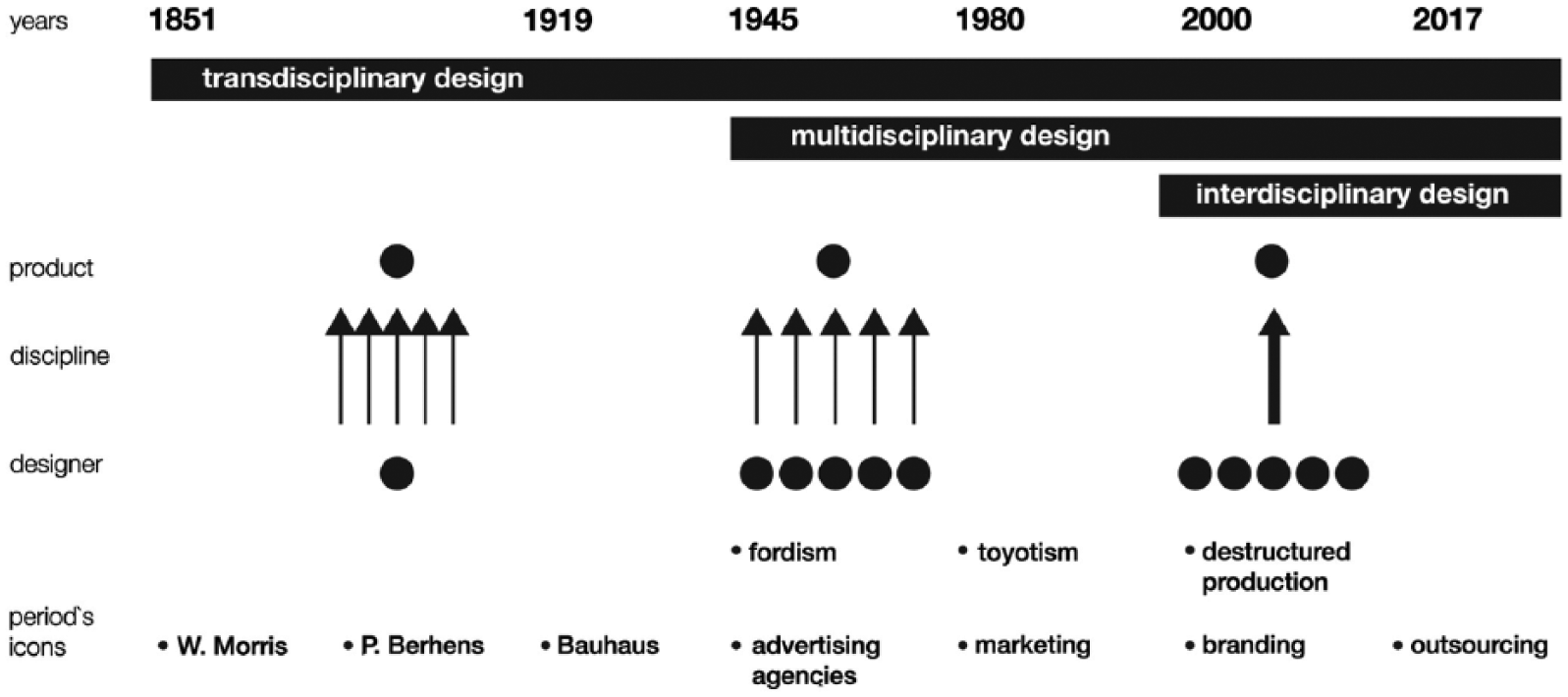
Concept of crowdthinking in the development of productive structures and their interaction with design.
During this preliminary process, it can be noted that design arises as a consequence of the first industrial revolutions. The production of manufactures determined the economic growth of bourgeois sectors that were immersed in societies identified as national states. The improved productive capacity translated into a higher economic, military, and geopolitical development. Industrial technology needed to generate its own way of doing things, its own theory, its own aesthetics and ethics, and this process made it easier to build a discipline. It was in the Bauhaus school that this process reached maturity, especially from 1925 on, when it moved to Dessau and the theory for industrial production started to gain substance, replacing the influence of expressionism with other avant-garde movements that were more linked to industrial aesthetics, such as constructivism, futurism, or De Stijl, from Holland. The Bauhaus motto for design that called for a unity between art and craft was changed to “art and technology— a new unity,” in which technology was seen as an industrial one. From the very beginning, the transdisciplinary perspective was explicit. However, it was in this second stage that the different specializations or project subdisciplines within design began to take shape, as the discipline reached maturity. For example, the printmaking workshop, as it was called when it was run by Lyonel Feininger, was restructured by László Moholy-Nagy in 1925 and evolved into a typography and advertising workshop. This development was an important step since the definition of graphic design began to take a more contemporary shape. Herbert Bayer, who was Moholy-Nagy’s disciple and successor in that workshop, would specialize in project design, and he would be one of the first designers to call himself a graphic designer.
Crowdthinking in the industrialization of design
Post world wars, in a context of capitalist boom crossed by the cold war, graphic design is already recognized as an emerging subdiscipline that is taking autonomy on its own. In the United States, advertising agencies such as Hewitt, Ogilvy, Benson & Mather take the relay and stimulate the service industry, including graphic design services. Digital technologies were being born, without having still contact with this industry. From this conception of crowdthinking, the productive methodology in those years advertising agencies was Fordist. 7 They set up for their productions an assembly line in which the art director, the editor, the photographer, as the case may be, worked providing their specific knowledge, interrelating in what Scolari 2 defines as a multidisciplinary methodology, that is to say, that each discipline brings their concrete knowledge, almost without crossing with other, to develop a product.
In the mid-1980s, digital technologies became popular and gave a new impetus to graphic design, by exponentially expanding the possibilities of production, although digital collaborative platforms were still not on the scene. Anyway, the concept of crowdthinking takes another nuance in the field of communication, the growth of the concept of marketing, which took place at that time, occurred along with agencies that produced from Toyotism, setting internal work teams according to the needs of the client, from multidisciplinary structures with the focus on promotion and sale. Additionally, humanistic disciplines, such as sociology, linguistics, or communication, gain a renewed force, will bring a greater conceptual depth to the field of graphic design, and the focus will shift from the search for Gute Form to the search for a dialogical communication. At the same time, globalization promotes the arrival of multinational agencies to Argentina.
Collaborative structures
From the year 2000, the concept of crowdthinking is positioned at a deeper level of the productive structure of graphic design. The notion of interdisciplinarity booms, which implies a more cohesive articulation between the participants of the productive process, synchronizing the knowledge and contributing at each stage of this process, is no longer a sum of knowledge, but a confluence that implies a new knowledge, or a new way of seeing things and doing them.
This notion of interdisciplinarity will be stimulated by a powerful combo: decanting of the growth of humanistic disciplines and blurring of disciplinary boundaries in all areas of contemporary knowledge. Complemented by the impact at a social level generated by the creation of decentralized collaborative environments, such as the Web 2.0, the open source philosophy, or journalism 3.0, among other digital collaborative platforms, thereby generates a metalanguage that self-feeds voraciously and has a growing scope. This phenomenon is also possible by the redistribution of information, due to the natural dynamics of the networks, creating an active attitude from the users, who put themselves in the place of “prosumers” 2 as active content generators. Thus, interdisciplinary is given tacitly in these media.
In this context, the concept of branding is consolidated. The term refers to the process of making and constructing a brand through the strategic management of the total set of assets linked directly or indirectly to the name and/or symbol (logo) of a company, such as products, communications, environments, and behaviors, that identifies a brand influencing its value, both for the customer and the company, and the diversity of partners with which the company will have contact within the social fabric. Unlike marketing, which has as main objective promotion and sales, branding focuses on designing the identity, and it conceives it from an interdisciplinary perspective. This new work methodology was developed from new business structures, where crowdthinking gained a preponderant place. Just as Toyotist structures reorganize their parts according to the type of demand, in this new productive typology, these branding studies build their interdisciplinary work teams according to the demand, but with components external to the company. Guy Julier identifies this process in the Italian footwear and leather goods sector, where different workshops establish work links independently with interdisciplinary structures.
At present, as a consequence of the international economic crisis that began in 2009, there is a growing trend in the global panorama toward outsourcing, from an increasingly decentralized perspective. It has been developed in productive aspects, since last century, 1980s, mainly by the manufactures of industry (MOI). This effect deepened and reached business components previously not considered as possible to be outsourced, impacting on a very large number of components of the productive structures, profoundly determining the possibilities of graphic design in the development of exportable products as we will see in the following section.
Interdisciplinary structures in the productive framework of Argentine exporting SMEs
Exporting SMEs are crossed by the aforementioned notion of interdisciplinarity, although this phenomenon is tacitly given. My current research sought to deepen the impact of this process. Between August and November 2013, we conducted a survey on a sample of 506 Argentine exporting companies, both MOI and manufactures of agricultural origin (MOA), since it is understood that the manufacturing sectors are those that have the capacity to create added value, using interdisciplinary processes for this, unlike the industries that export primary products. Furthermore, the industrial manufacture sectors are the ones that showed the most growth in recent years, accounting for 70% of total exports in 2015. 8 It should be clarified that an exporting SME needs to have a business stage of a certain development, due to the number of variables and complexities it has to solve, and that the acquisition of design professionals in the different stages of the productive and commercial processes of the companies appears as a priority element as the industrial network and the company itself develop. 3
We inquired about the exporting characteristics of the surveyed companies that incorporate design and on how the interaction with the other areas of the company developed from an interdisciplinary perspective. Moreover, that interaction played an important role at the time of its internationalization. The results show that 73% of the companies’ surveys stated that they had design professionals. We contrast these results with those provided by a survey conducted in 2012 by the SME Observatory and the CMD, published as PyME + Diseño, Segunda Encuesta 3 in a total of 600 Autonomous City of Buenos Aires (CABA) companies in the textile, clothing, footwear, leather goods, publishing, and furniture sectors (of which only 19% were exporters), and 51% of the Metropolitan Area of Buenos Aires (AMBA) SMEs in four industrial sectors under analysis hired design professionals in the past 2 years. That propensity is more pronounced among medium-sized companies (about 70% contracted design). This allowed us to observe a relation between the size of the company and its conception of interdisciplinary work, in which design is contemplated. Taking into account that the CMD study revealed that many of the companies that were formed prior to 2001 do not have internal design areas, younger companies, although smaller in size and with less resources, understand design from an interdisciplinary perspective.
Relevant data of the PyME + Diseño, Segunda Encuesta 3 are that among the specific activities for which professional designers are hired; 34% work “design new products,” 33% design “web, multimedia and/or digital,” and 29% develop “corporate or institutional image design.” These are seen in similar proportions, but when we deepen on the type of hiring of these services, we see that for both product design and corporate image, the hiring was internal, allowing a greater degree of interdisciplinary insertion within the productive network of the company. From 33% of digital design contracting, only 25.7% was outsourced.
Additionally, we could see in both surveys that most of the companies that contracted design services specifically to insert their products in international markets did so with internal contracting modalities, and to a lesser extent, mixed, which accounts for the companies need to intertwine disciplinarily at a higher level of complexity the contributions of design for foreign trade. Data show that 32% of the exporting companies made significant improvements in their products in order to meet the requirements of the destination markets and 27% directly had to produce a new product.
Notably, within the exporting SMEs, two trends can be found within the concept of crowdthinking with different instances of growth. On one hand, we have the traditional conception of a company, in which design is seen as something exogenous, almost cosmetic, where generating collaborative and strategic spaces of production is hard. Beyond their scales, this is often the case when business issues are generational. On the other hand, there are a growing number of companies that are created by designers, mainly in the so-called cultural industries sectors, such as clothing, jewelry, or leather goods, where the business vision is not deeply ingrained, with the presence of scale, growth possibility, and commercial strategy problems. It is in this relation between the business vision and the strategic design that one can glimpse an important growth from the contributions of the crowdthinking conception.
In addition, strategic design—or strategic design management—is not widespread among companies. Only 6% hired professional design services for research/strategic consulting according to PyME + Diseño, Segunda Encuesta. 3
A significant fact is that when enquired on the needs for future design hiring, the need for digital developments leads the list in both surveys analyzed.
A kind of interdisciplinary dynamic, as a complement in the relations between business sectors and government agencies, can be seen. 9 International markets are structured with different commercial agreements, states create alliances and barriers structuring the international economic policies, and in this way, an economic control that subordinates the development of global societies, generating a differential between countries producing raw materials and countries producing manufactured products, is exercised from hegemonic commercial centers. 10 This scenario determines the possibilities of including design in the commercial exchange, becoming this design an indicator of the autonomy and development of a company and of a country.
Both surveys were carried out by government organizations, while performatively working with interdisciplinary crowdthinking conceptions, assembling teams conformed by designers, sociologists, communicators, and foreign trade experts.
There are different levels in which design can be incorporated into a manufacturing company, and it can potentially have an important impact in the growth of a company. In the current year, while I was in contact with Argentine exporting SMEs that have already incorporated significant levels of design and have been selected as samples because they developed outstanding products distinguished with the Argentine Good Design Hallmark, I was able to analyze the main shortcomings that prevent them from boosting their exports. In the following sections, I will include a list of such shortcomings, as well as possible contributions that design could make to help overcome those obstacles.
Shortcomings related to structural productive aspects
Companies need to improve productive capacity and increase the scale of production.
Improving company structure and incorporating new areas.
Analyzing the need to internalize processes that are currently outsourced.
From the point of view of functional and logistical aspects, product-oriented design takes production into account and improves processes, such as scale. On the other hand, in order to draw capital, investments, or credit for new machinery, institutional design enhances brand strength and helps build confidence among financial sectors.
A project-oriented design methodology helps analyze productive processes in order to improve them. Incorporating an in-house design department helps deepen and integrate the strategic contributions that the discipline can make. Most of the manufacturing companies that were analyzed outsource different processes due to scale and cost issues. As these projects grow, they can internalize processes that were previously outsourced, which may provide some competitive advantages, such as a faster response to demand or a better model-updating performance, to adjust to specific markets. Design can provide important support in these processes.
Shortcomings related to commercial aspects
Companies do not have a good price formation strategy. They normally generate prices from costs, with little market analysis.
They underestimate the value of the different parties involved in the commercial process. They do not see the distributor as a business partner, and they do not take scale into account. They prioritize retail sale.
They have poor knowledge of taxation and refunding aspects.
They have not developed an exportable offer.
They have not adjusted their commercial strategy to an international trade scenario.
As a general rule, in the face of such issues, design can help professionalize processes and adjust the brand strategy, boosting the commercial strategy. On the other hand, it can help improve the sales structure. The shortcomings will be much easier to overcome as good product and brand design improve commercial performance and enhance the company’s reputation.
Shortcomings related to communicational aspects
Companies need to improve how they tell their stories—they have not developed brand image beyond the product.
They need to better exploit the differential value of the product.
They need to improve the logics of their vision and mission.
In this aspect, design is a major factor that can help determine what story to tell and how that story will be told. Ezio Manzini 11 suggests that some of the key functions of design are solving problems and generating meaning. In international commercial fairs, it is striking how there is an increasing demand for stories, from the fair curatorship to the search for potential buyers. It is then that the project differential has an impact by creating a less primitive economy—the commercial variable is not only the price, especially among circles in which design is appreciated.
Shortcomings related to the product itself
In many cases, the products of the SMEs that were analyzed were not totally suited for exportation due to the kind of materials, due to weight, size or packaging issues, or due to lack of adjustment to habits and codes of the target markets.
They need to develop homologations and certifications for target markets.
A company with integrated product design dynamics can better overcome this kind of shortcomings, since it will have an intrinsic capacity for analysis, adjustment, and development. However, there is an aspect that affects all these kinds of shortcomings, generating imponderable factors, such as tariff barriers, which are used in many cases to limit the access of some kinds of manufactures as opposed to primary products.
Conclusion
Design can be included in different aspects of the company: productive and technological, organizational, communicational, institutional, and/or commercial, allowing to develop a kind of disciplinary crossing and depending on that a particular knowledge according to each area. As proposed by Gui Bonsiepe, Design at its highest level of integration to organizations can be redefined as the company’s project thinking or design thinking, associated with the ability to read scenarios, understand contexts, visualize opportunities and trace trends that allow to reorient and resignify products, services and communication resources.
12
And that notion of integration will necessarily be given interdisciplinarily. Such interdisciplinary integration is related to much larger and more complex production scales, mainly with the objectives of internationalizing products. Therefore, its benefits and impact become more significant in economic terms.
As for the export capacity of an SME, the number of advantages that this process provides is remarkable, with interdisciplinary structures being the ones that naturally best face this development. In that scenario, from a crowdthinking perspective, the contributions of the design are substantial, although in many cases are underestimated. For many manufacturing companies, the design area may be outsourced, while an administrative area could hardly be.
The methodological processes used to incorporate design settle in companies at very different rates, being conditioned by international conjunctural contexts. For example, one can note the repercussions that the conception of Fordism had in design industrialization post-World War II, while in most manufacturing industries, it already had larger preponderance by that time. Additionally, at present, we can see that the notion of interdisciplinarity comes naturally in areas more related to design than in others, without being this process sufficiently valued by the business managements. Statistically, a high degree of outsourced design hiring can be seen, being the growth of outsourcing, a phenomenon of this time, the deep development and strategic growth that interdisciplinarity allows with internal structures, is thereby wasted.
We can see a parable in the future of the events that we analyze, regarding the links between the concept of crowdthinking and the concept of design. The notion of interdisciplinarity has developed as the last stage of integration in collaborative work, without this conception necessarily containing a positivist connotation, since the transdisciplinary and multidisciplinary conceptions are still valid. But it is precise from this interdisciplinary perspective that the notion of design was historically shaped. Just as design is identified as an autonomous phenomenon based on the union between art and technology, two disciplines converging interdisciplinarily to generate a new one, we can find an intrinsic link between the conception of crowdthinking and the ontology of design. If we analyze this perspective of the relationship between disciplines taking into account the cases in which new disciplines are born, we can see their interactions and their theoretical and methodological dynamics, and we can observe that the closest definition is the notion of indiscipline. It is a concept developed by Dr Enrique Del Percio, 13 who points out two key aspects to disciplinary innovation which are latent in its etymology. First, Del Percio points out the detail in the link between disciplines, in which one discipline enters into the other or goes in. This implies an immersion of a discipline into a new practice but without losing the point of origin. For example, as an artist, Morris studied and became immersed into technical and industrial matters and also matters related to craftsmanship, without losing sight of social matters. The second aspect that Del Percio points out is that the notion of indiscipline implies a perspective that is rebellious, revolutionary, certainly chaotic in nature, a need to think outside the box, to push limits in order to create something new. The incipient next stage that can be seen today is the consolidation of design management as an autonomous discipline, conformed interdisciplinarily by the contributions of the business logic and the contributions of the logic of strategic design. The way opens to research how digital media and crowdthinking technologies can contribute to this process.
Footnotes
Declaration of conflicting interests
The author(s) declared no potential conflicts of interest with respect to the research, authorship, and/or publication of this article.
Funding
The author(s) received no financial support for the research, authorship, and/or publication of this article.