







Abstract
Parquet Deformation is an architectural studio exercise introduced by William Huff in 1960s. It aims to improve students’ reasoning of spatiotemporal variation by utilizing sequential shapeshifting of patterns. This article examines the outcomes of this educational research from a perspective of design computing with a purpose to remark its pedagogical significance. A multilayered reading about the exercise will reveal its historical, theoretical, and artistic backgrounds. Then the common structural elements and different construction approaches are explained along with a novel design and analysis method. The proposed method embeds variations of two-dimensional pattern deformations on a third dimension. It enables various analyses such as the measurement of regularity and locating the attractor points. This study is expected to exemplify how computational thinking and new digital tools change the way designers would approach to such systematic compositions.
Introduction
Deformation is associated with defective and extracanonical forms, structures, and behaviors, while its common synonyms are distortion, misshaping, and disfiguration, but not shapelessness. These meanings presume a notion of formal, structural, or behavioral regularity already defined beforehand to infer the “deformed”. Designers’ interest in exploring variation through deformation can be tracked back to early 16th century, when Dürer 1 studied physiognomy on his “Treatise of Human Proportions.” Dürer’s drawings introduce referential deformation as an early method of parametric design by which he articulates a relativist notion of beauty based on variety (p. 274). 2 Another popular example is Thompson’s 3 “On Growth and Form,” in which he introduces deformation as a research tool to analyze formal links between different species (pp. 1026–1095).
Early examples of systematic pattern deformations can be seen at Day’s 4 (pp. 29–41) studies on textile ornaments. However pattern deformations are popularized by Mauritus Escher’s artworks in 1930s. Escher’s pattern deformations represent an iconic bridge between art and mathematics. This paper is about the design geometry underneath pattern deformations from a perspective of architectural education.
In contemporary architectural geometry, deformation is defined as “an alteration of shape which is based on an underlying mathematical principle” (p. 451). 5 Oxman and Oxman 6 (p. 18) define the characteristic of structuring in which “the static pattern of configurations, tessellations or any form of structural order can be mediated into a system of both generative and differentiated potential.” This argument reveals that the classical notion of static, formed pattern is changing into a more exploratory, deformable understanding. Zaera-Polo 7 depicts a history of pattern studies in architecture, emphasizing “a conceptional shift in the Computational Design Era” (p. 18). This is regarded as a conceptional shift; because it is not only about geometry, but also about other types of patterns that are regarded as inputs of designing. Garcia 8 explains the reason of this conceptional shift with the development of digital design technology which is “making it possible to process multiple layers of patterns such as social, economical, cultural, formal, etc., and their deformations simultaneously with desired precision” (p. 13). Today, patterns and their deformations can be utilized faster and more efficiently with the increasing computational efficiency of digital design tools. The mathematical underpinning of patterns and their deformations makes it possible to be integrated into the algorithmic design and optimization processes. Pattern deformations can be utilized in building surfaces in order to achieve a desired building performance or adapt to an external condition while keeping the continuity of the structural system. For example, Trinity EC3 building designed by FOA in London has facade patterns which are calculated according to the angles of the building surfaces to the sun. A similar utilization of pattern deformations can be seen in kinetic building surfaces. The hexagonal skin of Al Bahr Towers completed in Abu Dhabi in 2012 is an example of such kinetic structures designed for solar efficiency. These utilizations reveal the analytical nature underneath the designerly conception of deformation. It is becoming a significant research topic to introduce students of architecture with systems thinking in the form of patterns. In this article, we examine a studio exercise, “The Parquet Deformation,” in order to remark its potentials for design education today.
William Huff and the Parquet Deformation
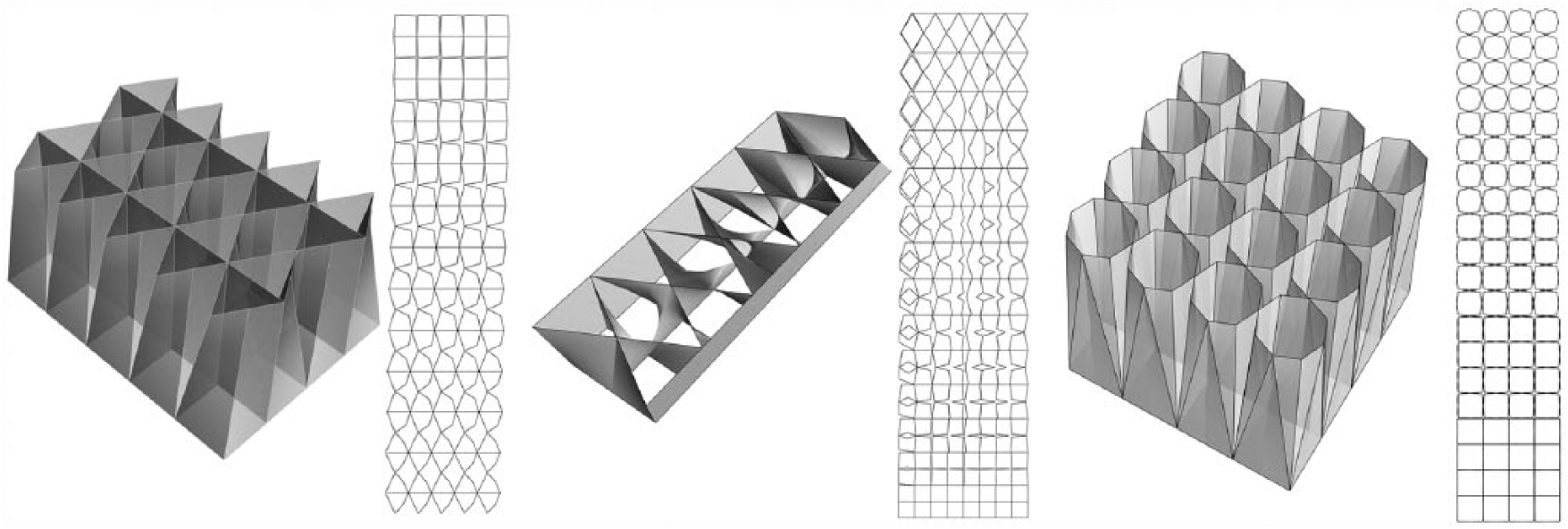
The Parquet Deformation is a design exercise initiated by an American architect, William Huff at Carnegie Mellon University, Ulm School of Design (Hochschule für Gestaltung, HfG), and State University of New York (SUNY) beginning with 1960s (p. 80). 9 The exercise is about tessellations of the plane that gradually shapeshift on one or more directions by predetermined or improvised transformation rules. Students are encouraged to think about topological relationships between the sequences of a continual shapeshifting while developing a reasoning about a pattern as a structural whole. In the classical application, this is expected to be studied by morphing the cells of a pattern while sustaining its linear continuity without leaving gaps or overlaps (Figures 1–3).
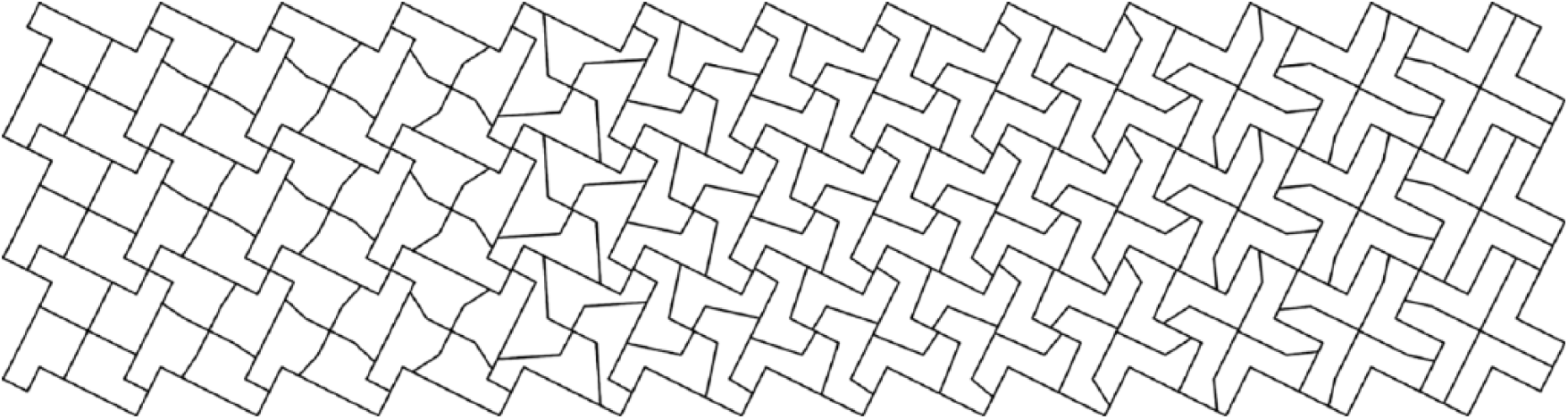
“Crossover.” Designed by Richard Long at William Huff’s studio in 1963. Reconstruction by the author after Hofstadter 10 (p. 194).
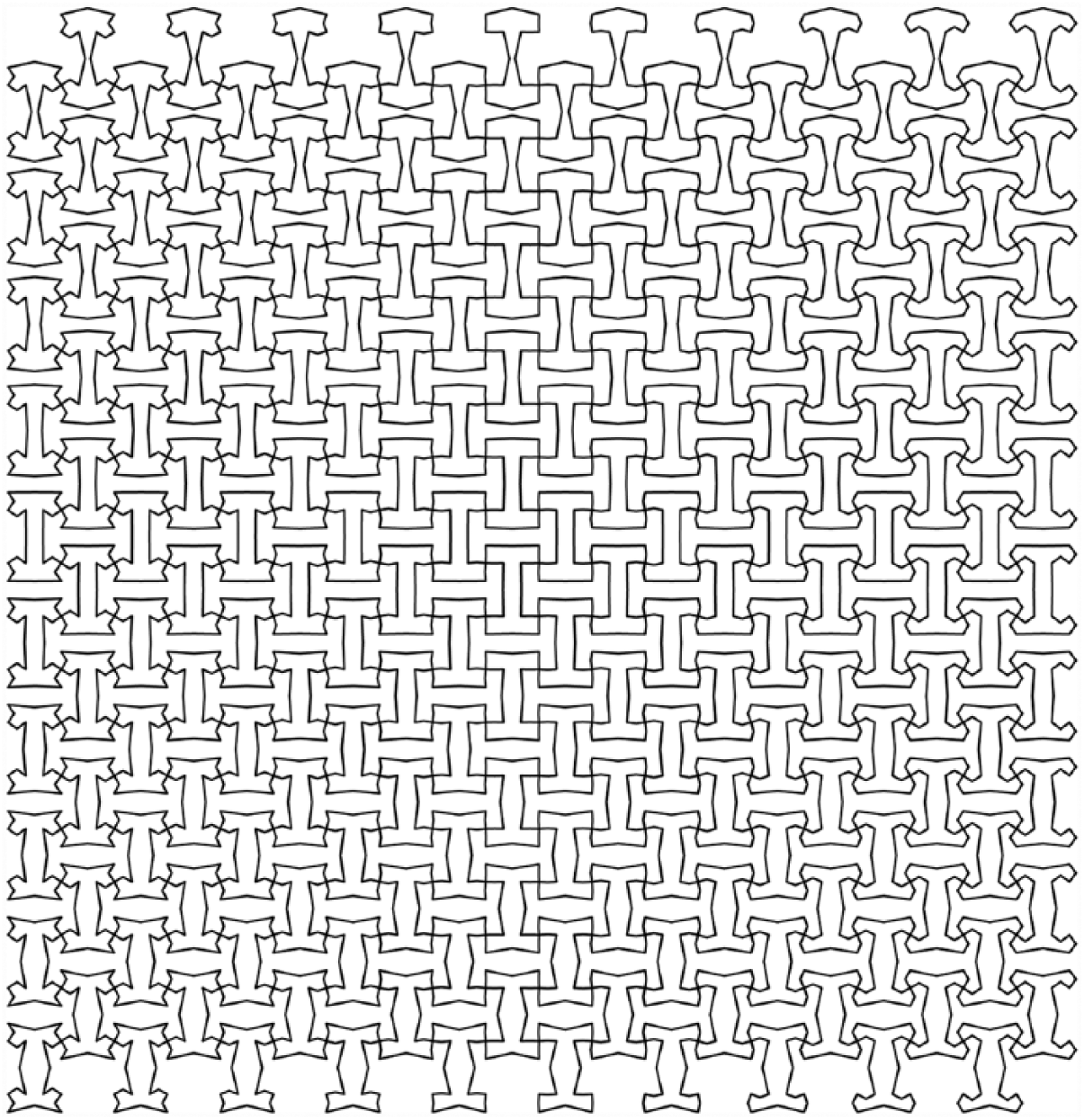
“One at the Center.” Designed by David Oleson at William Huff’s studio in 1964. Reconstruction by the author after Hofstadter 10 (p. 210).
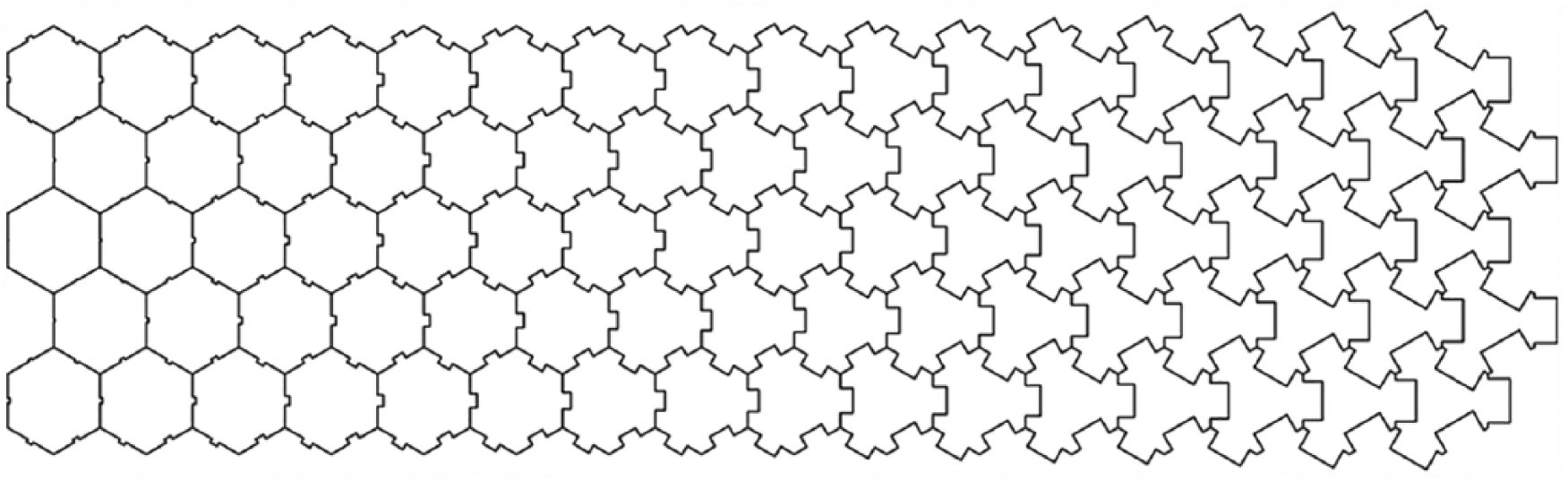
Trifoliolate. Designed by Glen Paris at William Huff’s studio in 1966. Reconstruction by the author after Hofstadter 10 (p. 198).
Outcomes are not intended to be viewed only spatially but also temporally, which is described by Huff 11 as a visual music with themes, events, intervals, rhythms and repetitions (p. 30). He also denotes that the exercise is rooted in two analytical disciplines; monohedral tilings from geometry, and the idea of continuous deformation from biological morphology (p. 30). 11
In his later writings, Huff redefines the exercise from different perspectives. For example, he compares the examples of Parquet Deformations with ancient Sino-Japanese landscape handscrolls while discussing the meaning and importance of temporal and spatial variation in different visual cultures (p. 307). 12 In another context, he connects the geometric background of such compositions with syngenometry, a structural level of symmetry mentioned in molecular chemistry (p. 45). 13 This diversity of explanations brings out the questions: What are the personal, historical, or artistic connections of William Huff that led to a 30-year long research between geometry, design, and meaning? In order to answer these questions, we need to understand the educational discourse of Huff.
It is possible to capture the theoretical climate of Parquet Deformation by following Huff’s background as an architect and educator of the Late-Modernist period. His research in the Basic Design studios (p. 92) 14 began with his two visits to HfG Ulm as a graduate student between 1956 and 1957, and as a visiting instructor of Basic Design (Grundkurs) between 1963 and 1968.15 –17 An Argentinian painter, Tomás Maldonado, was the director of HfG then who is known as one of the pioneers of the famous Ulm Model. Educational discourse of the Ulm Model was to integrate scientific and intuitive aspects of designing via systems thinking. 18 After HfG was closed down in 1968, the Ulm Model is still believed to be a significant period of architectural education regarding its experimental curriculum. For example, Neves and Rocha 19 claim that today’s conceptual framework of computing without computers has early roots in the first-year education of Tomás Maldonado at Ulm, while the integration of mathematics and art in design was theorized and practiced without any use of computers. If the initial definition of Parquet Deformation is a part of a special curriculum rather than a stand-alone invention, what are the other parts of the curriculum that might help to understand the exercise?
According to HfG Ulm’s archives and several issues of Ulm Magazine, numerous design exercises with similar purposes were developed throughout the short life of HfG. For example, Herbert Kapitzki’s “Spatial Operations in the Plane” (Räumliche Operation in der Ebene), “The Symmetry Exercise,” and Maldonado’s “Raster” approach similar educational purposes from different angles.16,19,20 It was stated (p. 80) 9 that several problem types including “The Programmed Design,” “The Conflicting Depth Cues,” “The Figure-ground Figure without Ground,” and “The Parquet Deformation” are described as the derivations of Maldonado’s previous studio experiments. Moreover, in his article at Ulm Magazine, Huff 16 explains Maldonado’s influence on his exercises (p. 26). However, it was William Huff who described the exercise clearly, conducted it continuously at his design studios for decades, and published his opinions and studies even long after the closure of HfG. This confirms that the development of Parquet Deformation exercise was not a personal invention, but a collective academic production. Then why especially this exercise became so popular?
Most of the secondary references on William Huff and his exercise mention the contribution of an American cognitive scientist, Douglas Hofstadter. The idea underneath the exercise is amplified by Hofstadter in 1983 when he published some of the student works of Huff at one of his journal papers and a chapter of his book.10,21 Hofstadter describes and comments on the generative process, temporal qualities and the emergent nature of Parquet Deformations. He also explains his own ideas on the key role of human creativity in the design process of such compositions. Shortly after Hofstadter’s publications, the exercise started to capture a wider range of multi-disciplinary interest especially on the fields such as theoretical computer science and array grammars.22,23
Another key personality for the exercise was an American architect Louis Kahn (p. 25). 16 William Huff worked at Kahn’s office between 1958 and 1960. This coincides between his two visits to HfG, both as a student and as a teacher. Hofstadter 10 (p. 196) addresses their connection by quoting Kahn’s admiration to Huff’s Basic Design discourse. In addition, Huff 13 often mentions Kahn’s ideas on “Order, disorder, change and chaos” while explaining own point of view on the relationships between geometry and design (p. 41). Although any direct effect of Louis Kahn on the particular studio exercise is questionable, this connection indicates the theory of Structuralism that influenced a generation of architects and educators when studio exercises such as Parquet Deformation were developed.
In addition to the pedagogical and architectural influences, the examples of Parquet Deformation have visual and possibly methodical connections with some of the artworks of its period. The most mentioned connection is with the Dutch artist Mauritus Escher’s artworks in late 1930s, especially the “Metamorphosis” and “The Day and Night.”10,24,25 Nevertheless, the ultimate objective of Huff’s exercise was not only to produce inspirational geometric compositions, but also to experiment the development of a new attitude in systems thinking at the early phases of design education. Deformation of patterns was also one of the subjects of the art movement Op-Art which had strong roots at Bauhaus School. For example, the works of the collective group named Anonima in 1968, including Francis Hewitt’s “Size Change” and Ed Mieczkowski’s “Block Knock” present visual resemblances with Huff’s Parquet Deformations. Although there are similarities with these artworks, Huff’s long-term research was not only about creating visually inspiring results but also studying methodical diversity.
Recent studies on Parquet Deformations focus on the Computational Geometry underneath. Kaplan 26 (pp. 57, 190) studied the mathematical principles of pattern deformations in his dissertation and in various publications. He also studied Escher’s artworks and the continuous deformations of Islamic Patterns. 27 , (Kalpan 2005) Parallel to Huff’s exercise, John Sharp studied similar compositions he named as Morphing Tilings. 25 In 2006, Cooke 28 developed “BulliEpu,” a computer application in Java which generates Parquet Deformations. Although the Parquet Deformation and similar exercises are still being conducted, the academic studies on this topic are limited (Figure 4). Li 29 is one of a few former students of Huff who succeeded her background into an academic publication.
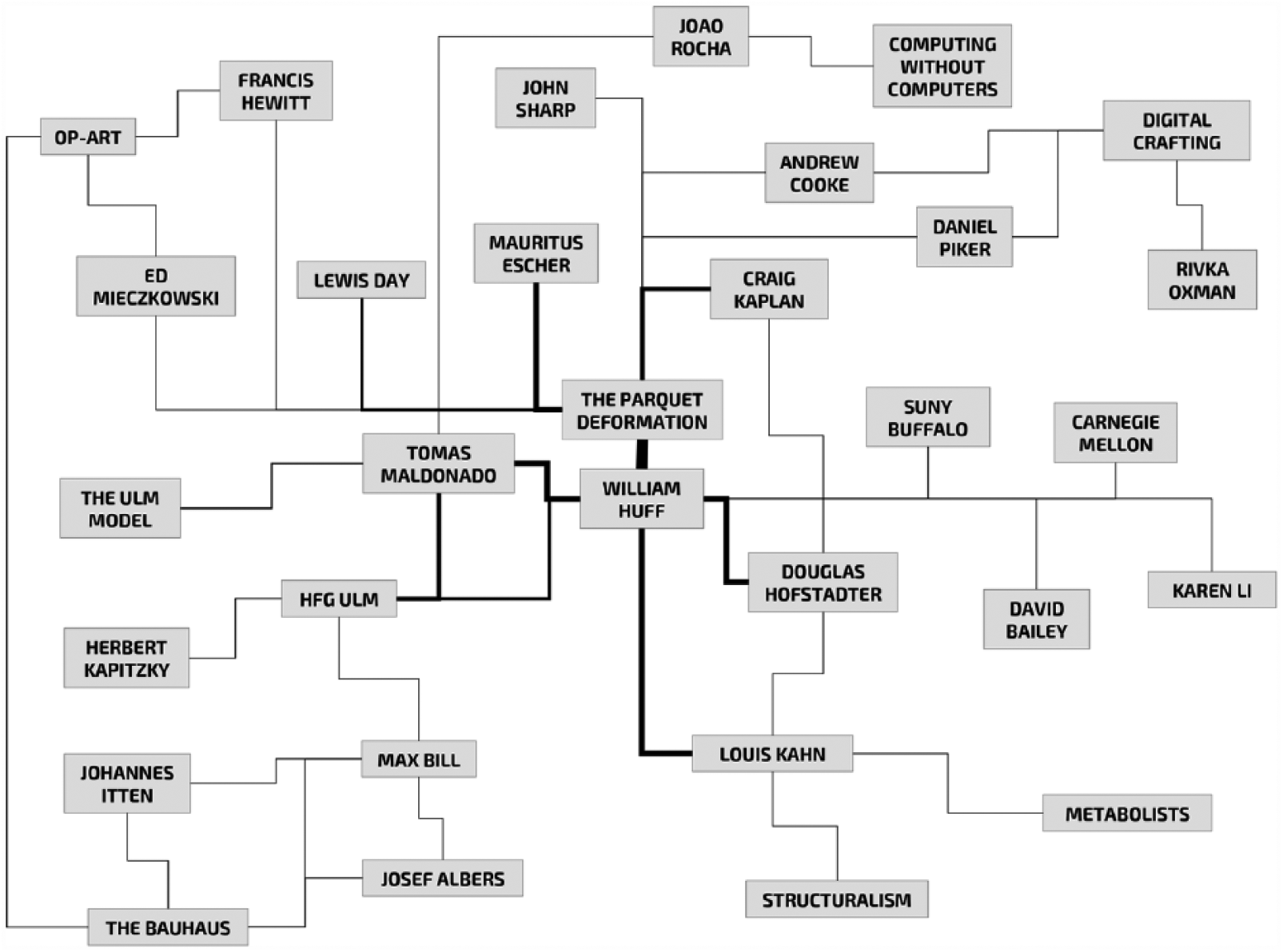
Contextual map of the Parquet Deformation exercise.
Current applications in architectural education
Undergraduate first year architectural geometry course
In the Architectural Geometry course at İstanbul Bilgi University, first-year students of architecture, interior design and industrial design are assigned to a series of pattern exercises. After studying how to construct regular and semi-regular tessellations by Euclidean method, students are asked to develop emergent patterns derived from the execution of sequential transformation rules (Figure 5). Outcomes of this first phase are usually one- or two-dimensional deformations based on monohedral lattices.
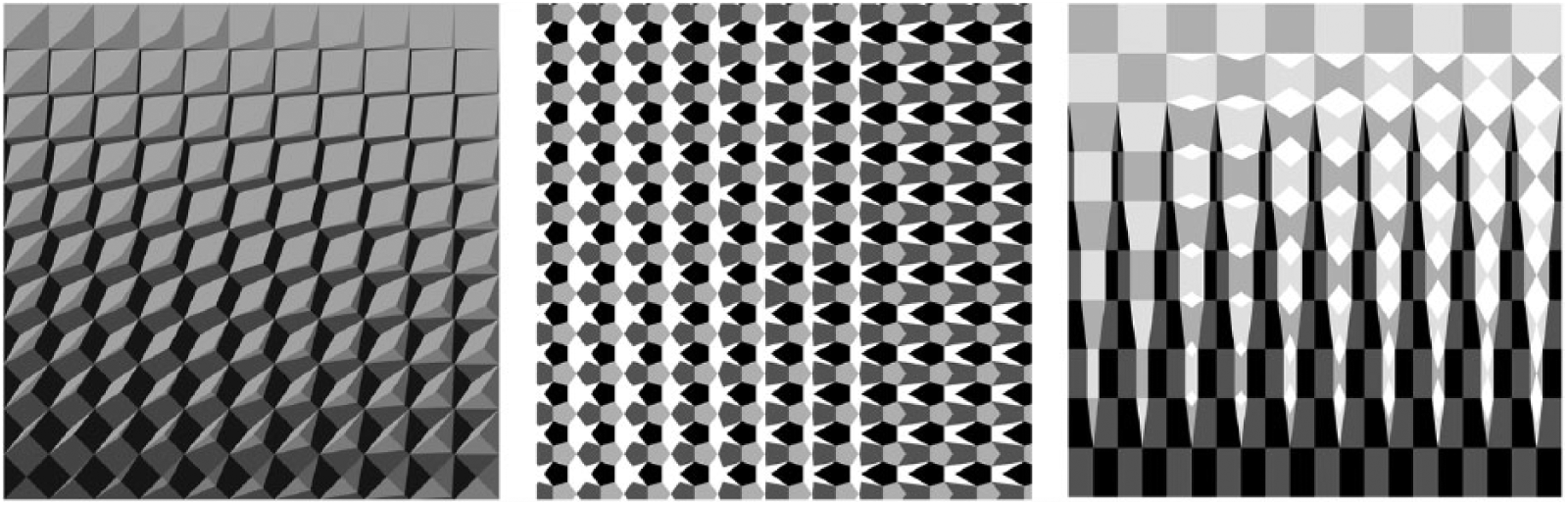
Pattern Deformation exercise First Phase; Architectural Geometry course in 2012 Fall Semester at İstanbul Bilgi University Faculty of Architecture. Students: Adnan Faysal Altunbozar, İzgi Güven, and Elif Özüçağlıyan.
In the same curriculum, another exercise approaches the same pedagogical goal from a different perspective. This time students are encouraged to explore how geometric patterns can unfold diversity by manipulating the underlying reference system; the lattice (Figure 6). These exercises are found useful in the introduction of geometric systems and the exploration of their emergent capacities.
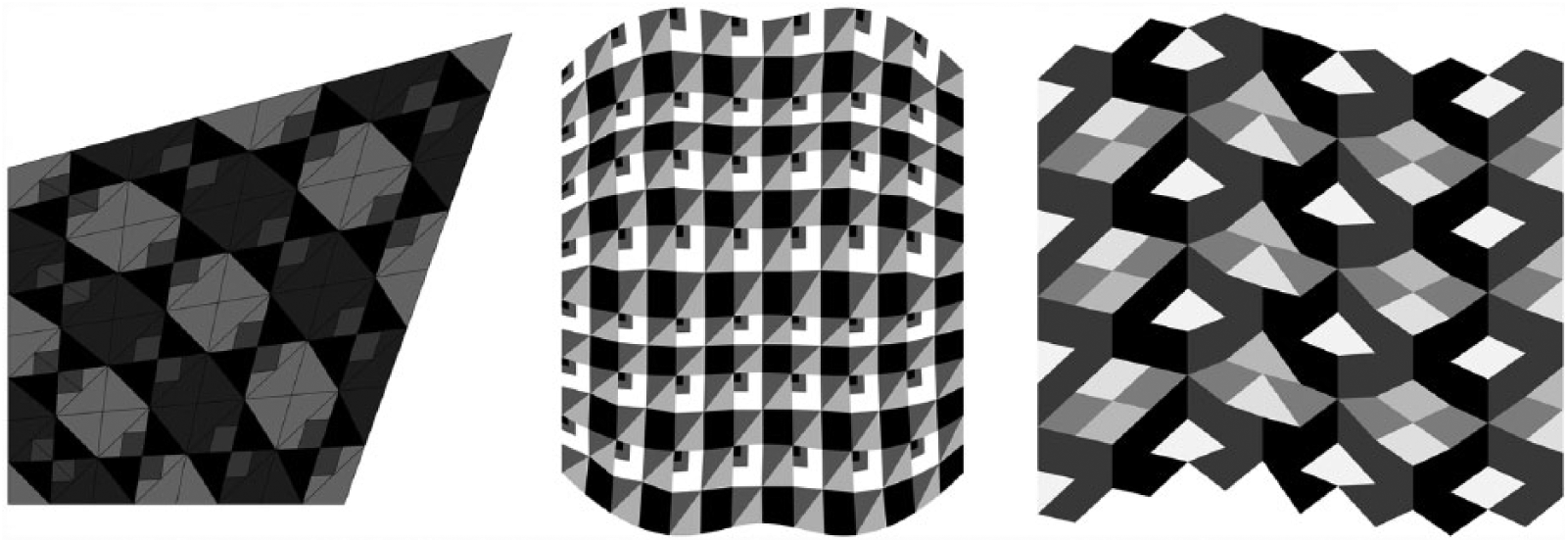
Pattern Deformation exercise Second Phase; Architectural Geometry course in 2014 Fall semester at İstanbul Bilgi University Faculty of Architecture. Students: İdil Erdoğan, Ceren Atik, and Hüseyin Kuşçuoğlu.
Undergraduate first-year computation-based basic design studio
In addition to the two-dimensional pattern studies, the sequential deformation of three-dimensional systems is studied in Computation-Based Basic Design Studio at the same university. One of the projects of this studio is called “Growth and Evolution,” in which the students are expected to design and realize three-dimensional components that generate a shapeshifting whole (Figure 7). The purpose of this project is to encourage students in finding ways to construct their own design logic while being able to explicate the reciprocal relationships between geometric components and the diversity generated in the macroform.
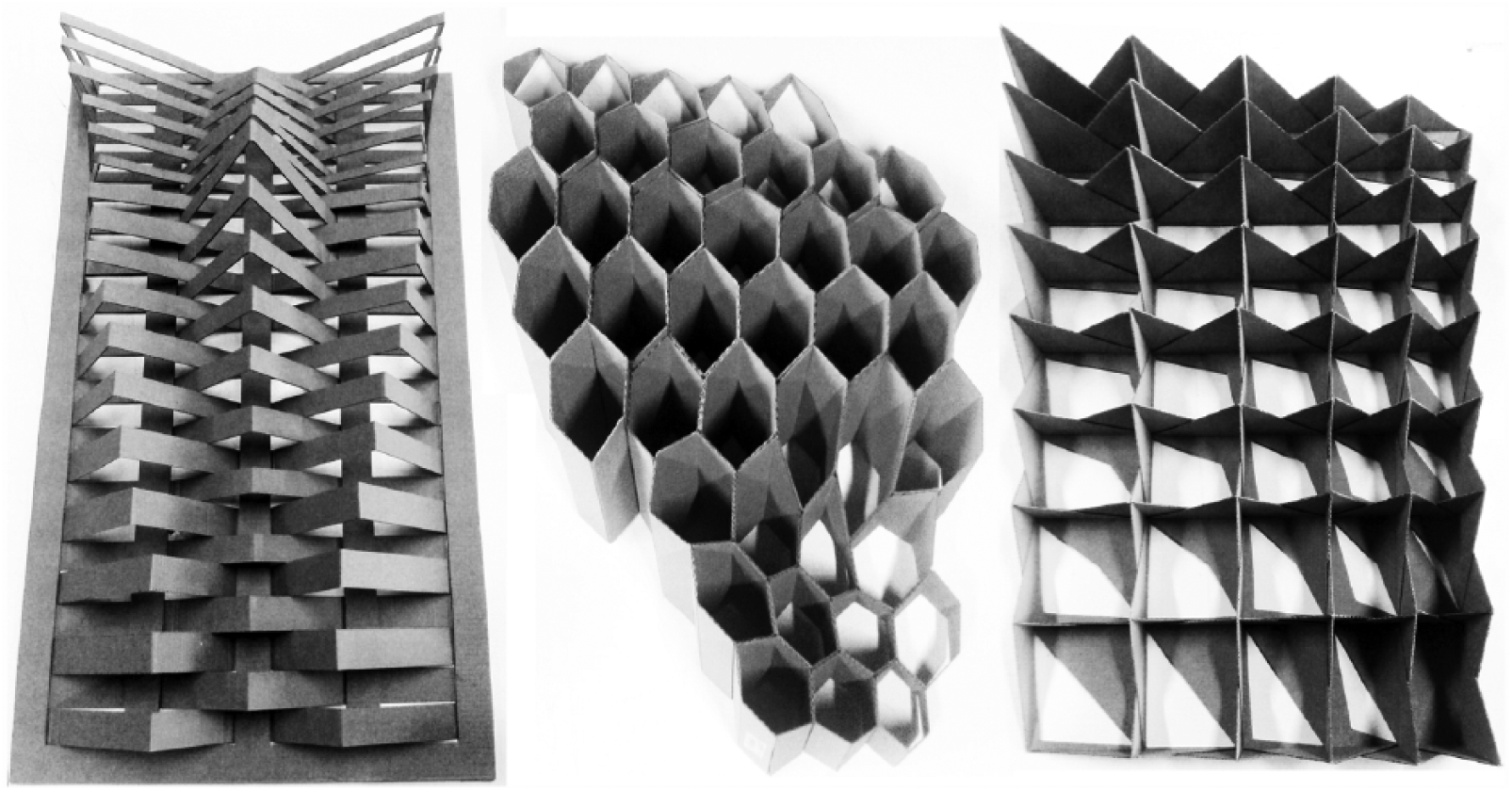
Growth and Evolution exercise; Second semester Computation-Based Basic Design Studio at İstanbul Bilgi University Faculty of Architecture, 2014. Students: Melis Gültunca, Ecem Karabıyık, and Cem Mert Şimşek.
Graduate studio of computational design
Pattern deformation is also a suitable topic for the introduction of new Computational Design tools. In the example above, students are asked to analyze and reconstruct Islamic Pattern deformations by utilizing scripting languages (Figure 8). Readers are referred to Çolakoğlu et al. 30 for further information about this educational experiment and its results.
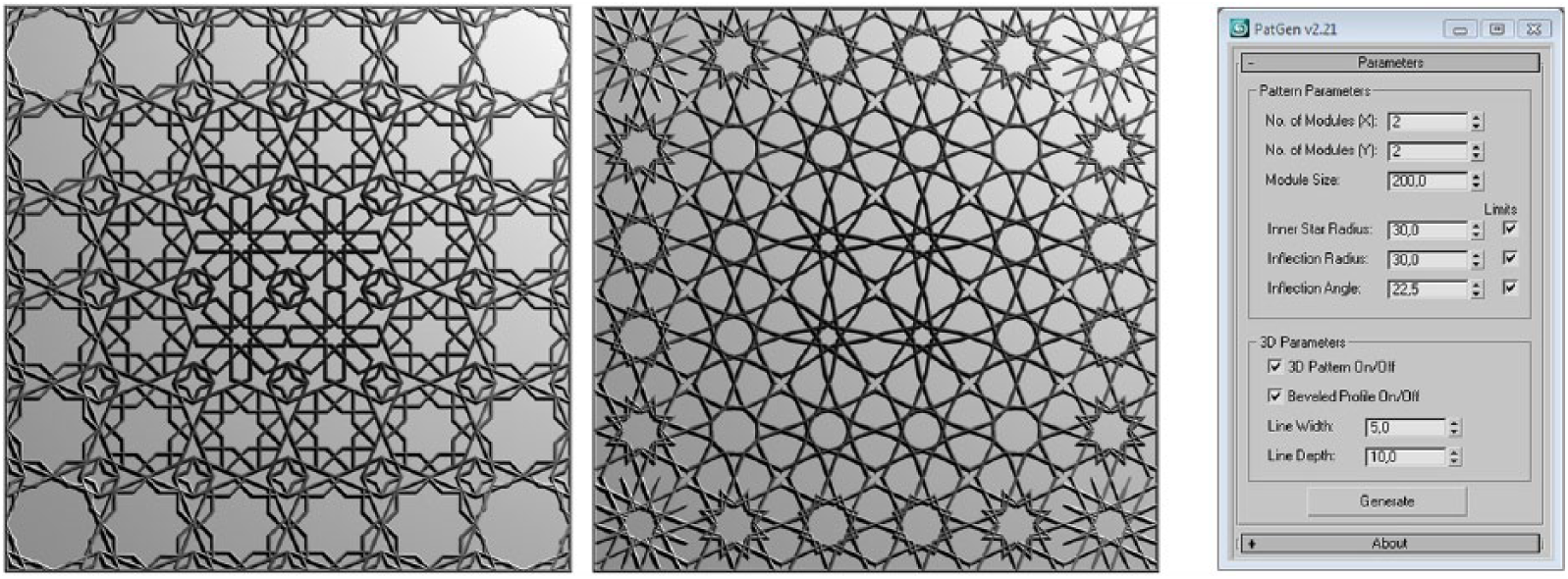
Islamic Pattern Deformations. Left: Deformations of the pattern. Right: Interface of the tool created with MaxScript. Graduate Studio at Yıldız Technical University Faculty of Architecture Computational Design Unit in 2008. Student: Serkan Uysal.
Above examples show some of the pedagogical applications of pattern deformations in design education. In the following chapter, the geometric structure and construction approaches of pattern deformations are analyzed to explain the common body of knowledge required to develop such applications.
Structure of Parquet Deformations
Design process of a typical Parquet Deformation might be seen as an interference to a regular pattern. In the classical application of the Parquet Deformation exercise, there are usually no single regularities but two or multiple ones considering the shapeshifting of a pattern into another. This is why instead of a linear construction process every possible outcome of a Parquet Deformation could be described as an equilibrium between the stasis of the pattern(s) underneath and the dynamism of the interference, organized as a sequence of moving image. Huff 13 explains the tension of this equilibrium as a way of ordering disorder. On the basis of this assumption, the structural analysis of these patterns begins from the decomposition of this equilibrium. The intrinsic properties of a Parquet Deformation represent the common geometric elements, while the external properties are various algorithms that drive the design process.
Intrinsic elements: lattice and prototile
Although student works of the original exercise reveal a wide range of variations, there are common elements which exist in most of the designs. These elements are called the lattice, the prototile and the family of parquets. Lattice represents the underlying structure of a Parquet Deformation. The term is used by Huff 11 (p. 30) while describing the types of tessellations that a Parquet Deformation might be constructed onto. On the other hand, a prototile represents the smallest cell of a lattice that all parquet variations are generated from. The term is used by Kaplan 26 while describing every distinct shape inside of the lattice (p. 28). In the original definition of the exercise, lattices are generally monohedral. This means that there is only one type of prototile on the lattice that is capable for generating parquets.
These elements help to explain some properties of Parquet Deformations while not fully explaining any design product alone. It is possible to define Trifoliolate (Figure 9) by utilizing above terminology as “a single-prototile polygonal deformation, generating 16-tile family of parquets, based on a regular lattice of hexagons and a single-direction (horizontal) deformation.” Although the above statement is suitable to describe the main characteristics of the composition, there are still unlimited number of variations that could fit into this definition. Therefore, the term “single-direction deformation” needs to be better explained in order to complete the definition.
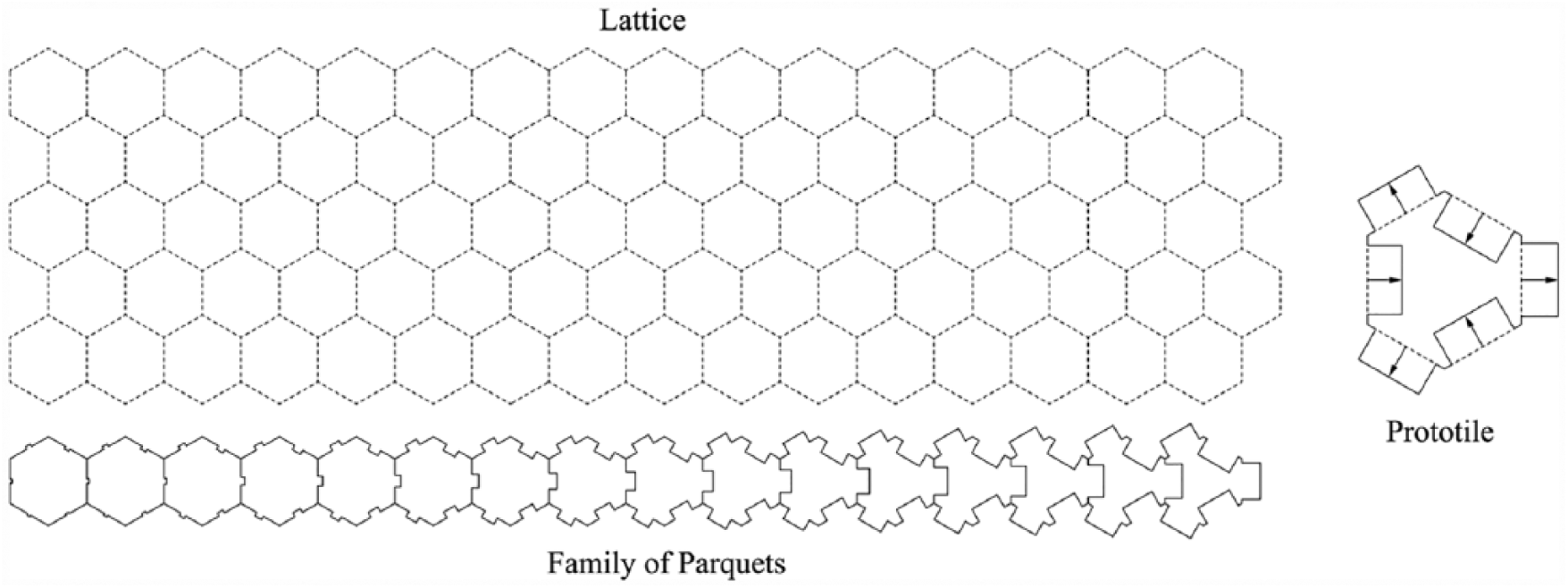
The intrinsic elements of the Trifoliolate.
External elements: algorithmic design approaches
Huff 11 describes the parquet variations generated from a prototile as “families of parquets” (p. 30). This set of tiles pack the plane without gaps or overlaps. There are various algorithms to calculate the family of parquets. These algorithms are defined as external as they are mostly independent from the lattice and prototile designs and can be re-used in multiple design situations. Below the most common algorithmic approaches are categorized and explained by the reconstructions of a classical example, the Trifoliolate. It is one of the basic examples of Parquet Deformations while the geometric relationships between the intrinsic elements and the effects of the external elements are clearly visible.
Algorithms of synthetic geometry
In this ancient geometric approach, the pattern is constructed using only an idealized compass and straightedge. The straightedge has no markings on it and can only be used to draw straight lines. Therefore, distances cannot be measured numerically, but can be translated using compass moves and intersections. This set of tools also requires a set of axioms called the Euclidean Geometry. For example, the intersections of straight lines and circles can be identified as points, and a straight line could be drawn using two points. In the reconstruction of Trifoliolate by the Euclidean method, the parquets are drawn by intersecting axes generated by intersection points of various circles. The whole deformation is generated by the angle differences between these axes and the fixed lattice (Figure 10).
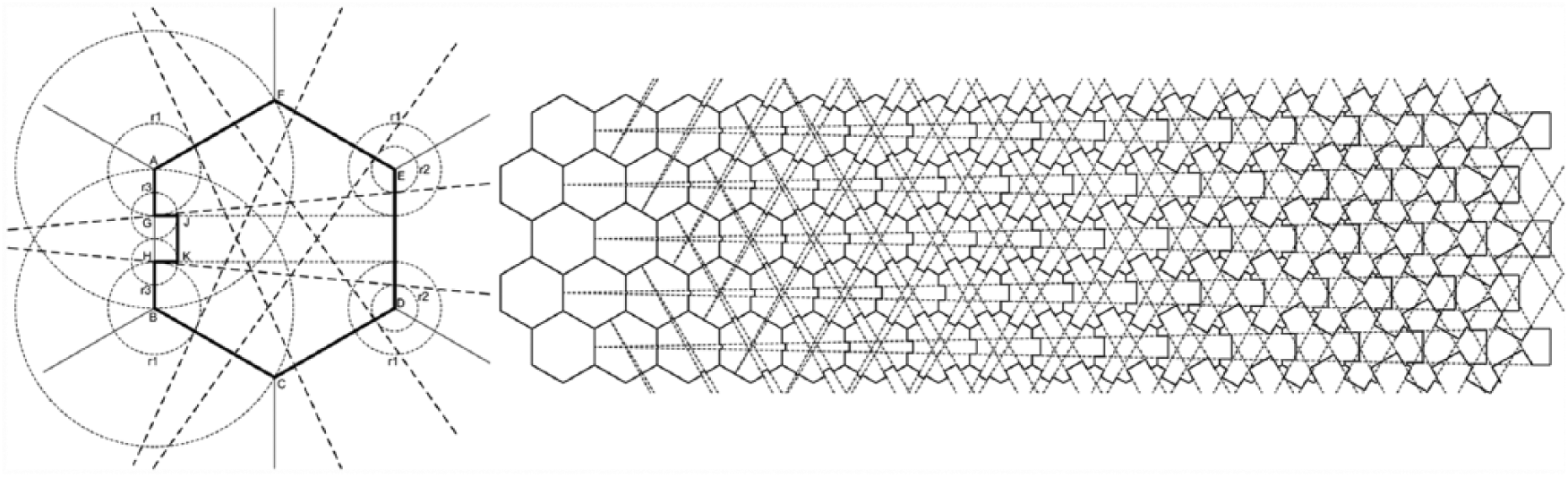
Trifoliolate; the general principle of Euclidean construction. Left: Creating a set of deformation axes on the prototile. Right: Creating a sequential Parquet Deformation via extending these axes on the lattice.
The tools and the axiomatic view of this approach enable every step of construction to be related with the outcome of a previous step, making it possible to describe the whole process as a pure geometric algorithm. This approach is mostly independent from the interface of the design medium. According to Neves and Rocha, 19 there was no or very limited computer accessibility at HfG Ulm when Huff developed the exercise. While Hofstadter 10 is comparing hand-drawn and computer-generated patterns, he mentions Huff’s student works as hand-drawn. On the basis of these evidences, it is possible to argue that at least some of the original Parquet Deformations might have been designed and drawn using a similar approach described above.
Algorithms of analytic geometry
In an another set of construction approaches, the family of parquets are generated using numerical values. Then a varying parameter scheme is mapped on the lattice in order to generate a sequential shapeshifting. The mapping can be an iteration of a mathematical operation or a division of a range of numbers. This approach is suitable to introduce students with the basic algorithmic concepts of control-flow statements such as loops, and their effects on the exploration of emergent forms. Below Trifoliolate is regenerated by an approach of rule-based iteration (Figure 11).
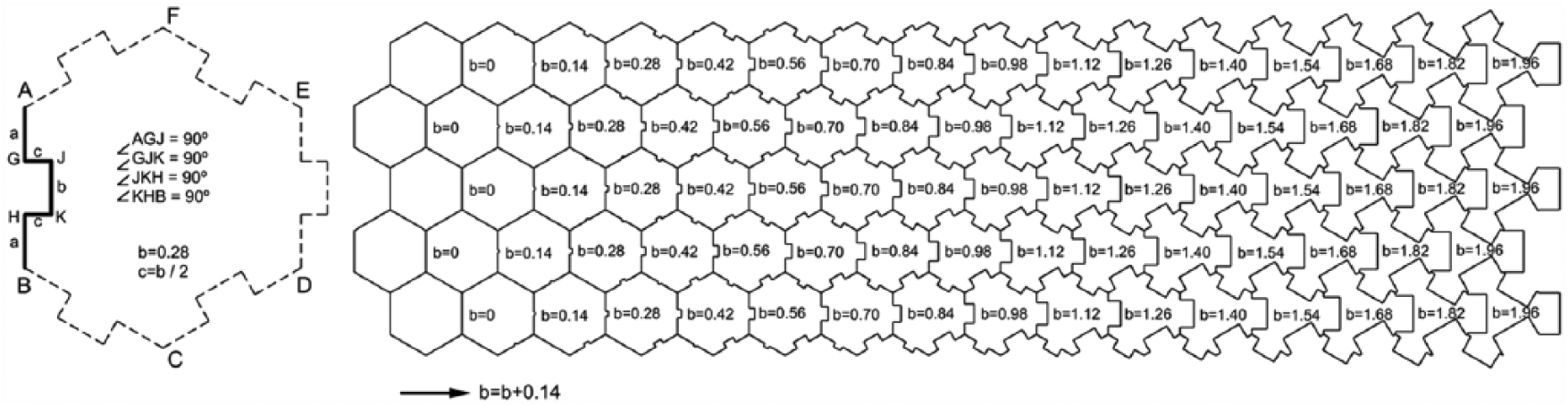
Trifoliolate; the general principle of rule-based iteration. Left: The Carthesian definition of the prototile. Right: Generating a numerical scheme on the lattice.
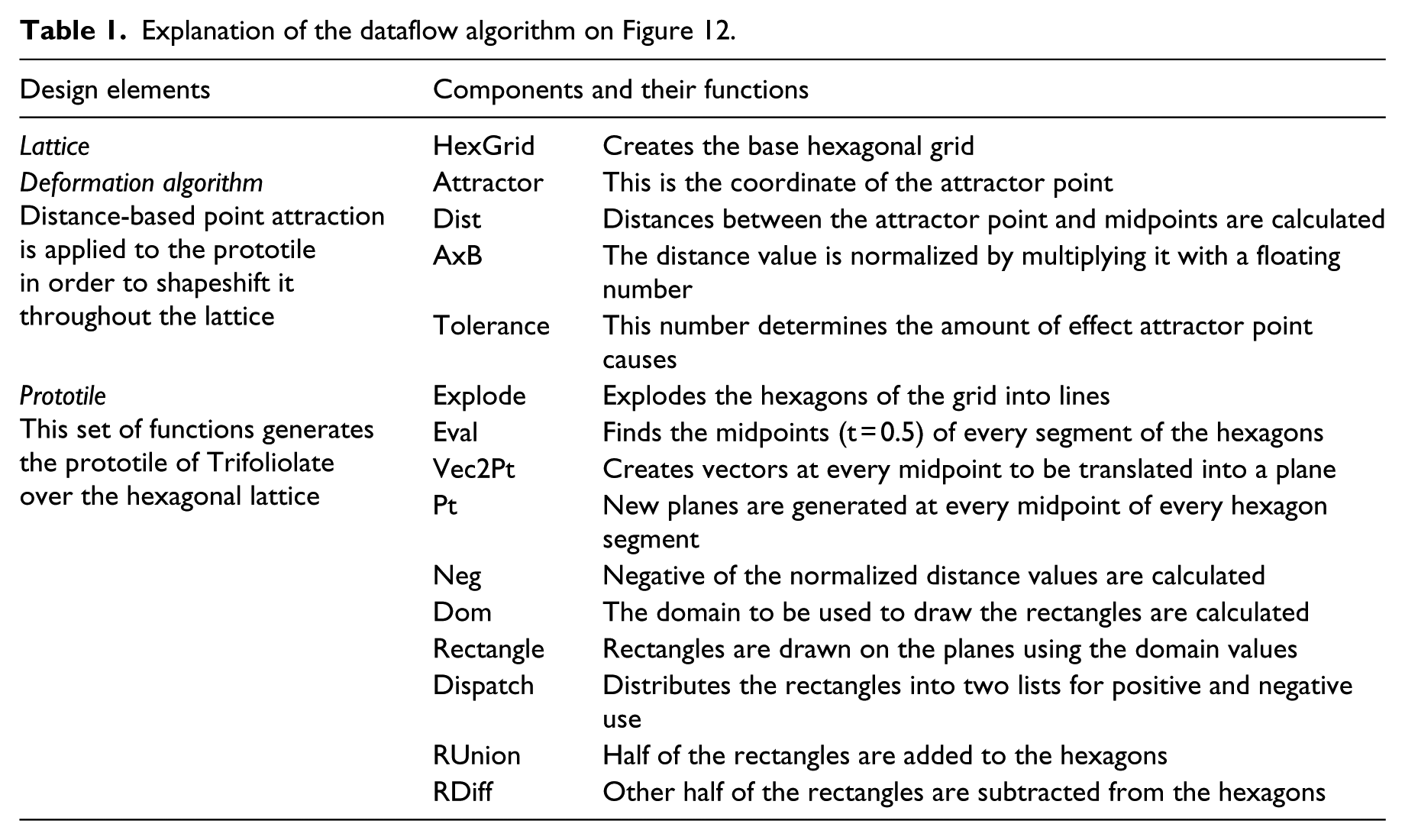
In another analytical approach, invisible geometric objects are used as references. The use of such references creates a special characteristic, expressed by Huff 31 as “hidden harmony.” Again the main goal is to generate and map a numerical scheme on the lattice. However, this time the numerical values are calculated by the distances between the centroids of the cells and a set of invisible attractor objects (Figure 12 and Table 1).
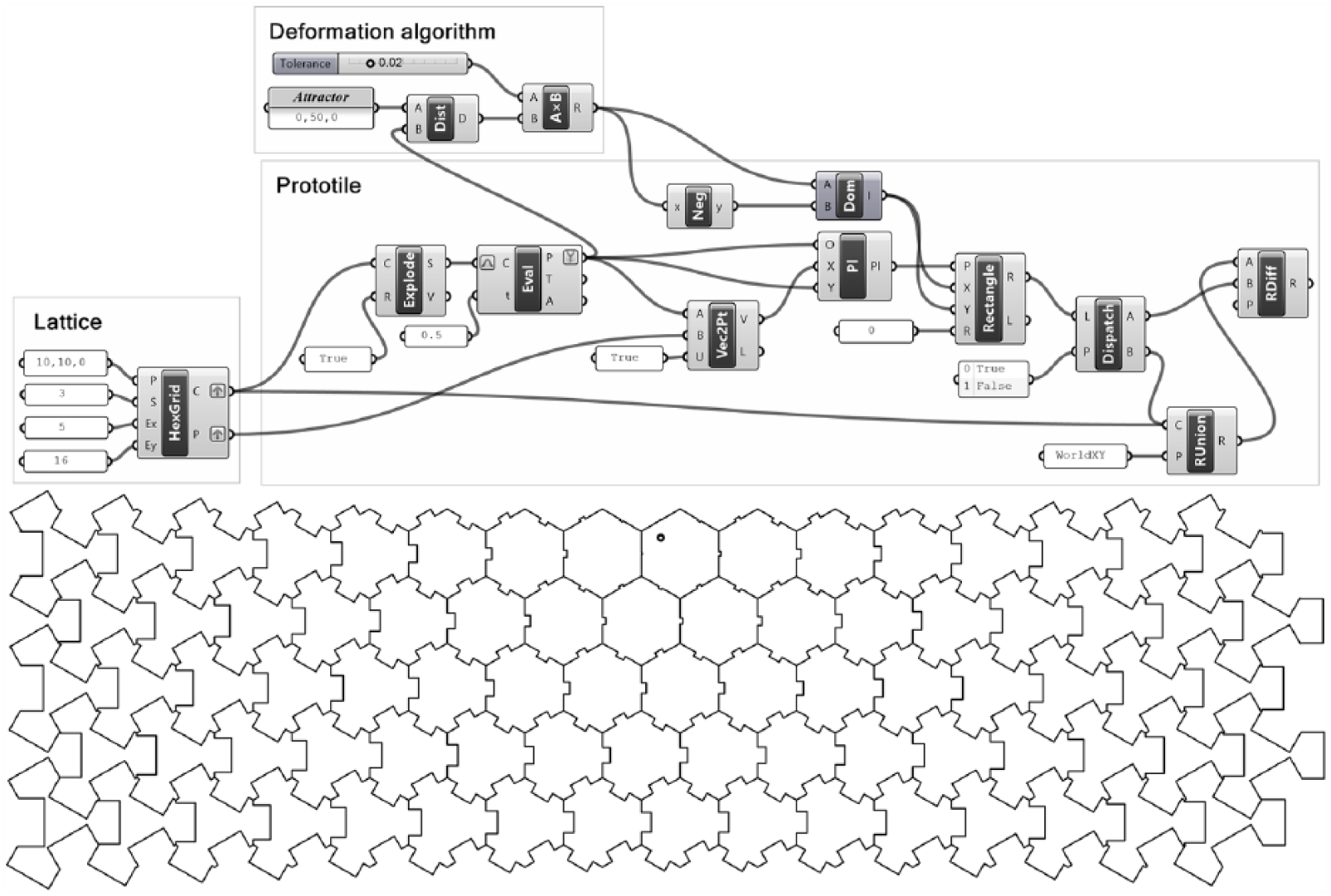
Distance-based point attraction algorithm, generating an instance of Trifoliolate. Above: The Grasshopper definition. Below: An instance of Trifoliolate generated by the algorithm.
Explanation of the dataflow algorithm on Figure 12.
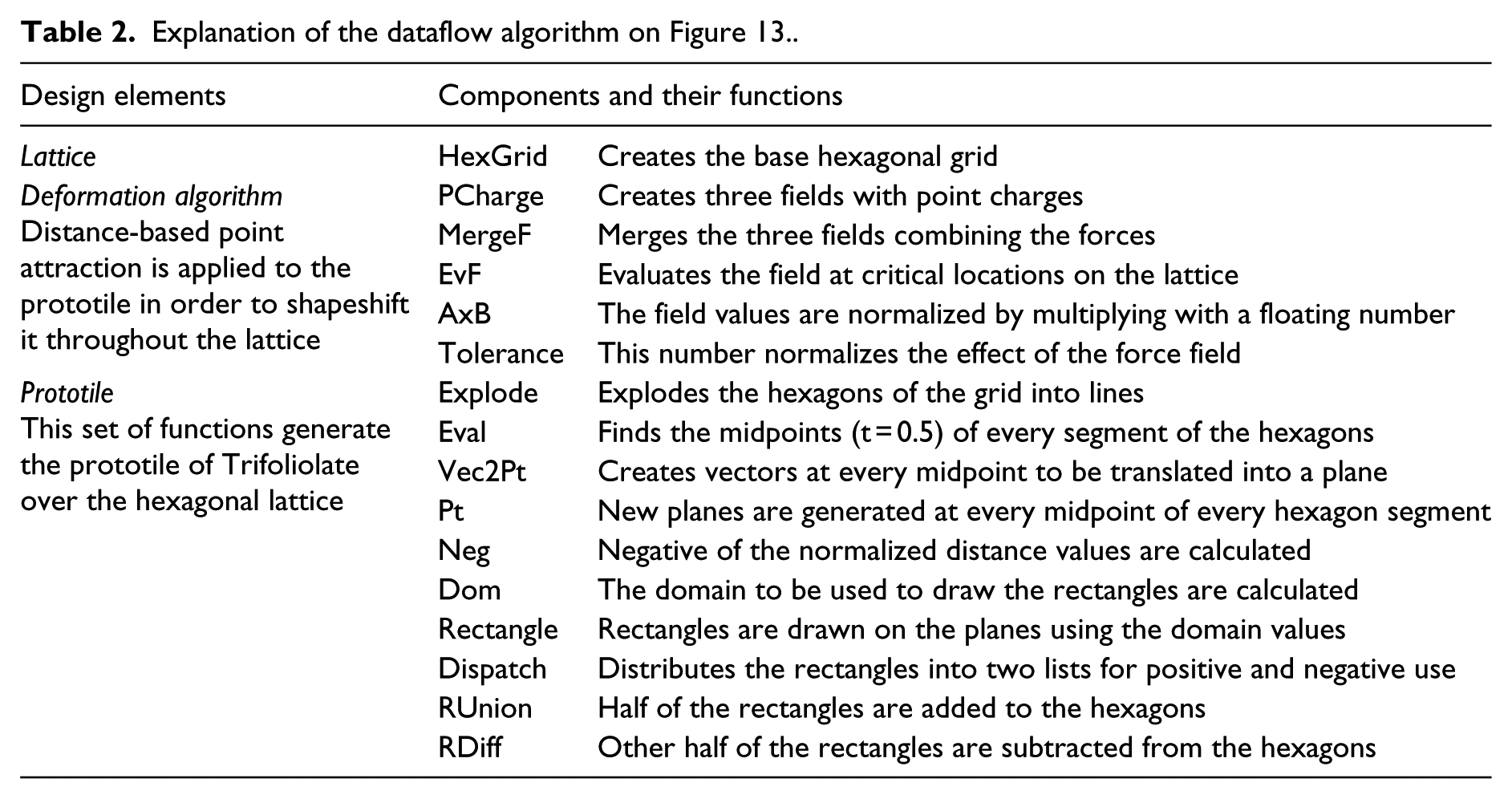
The numerical schemes could also be constructed via using other mathematical models such as scalar and vector fields. Functionality and purpose of this method is similar to the distance-based attraction, as points, curves, or surfaces are defined as sources of charge. After these definitions, a scalar or vector value could be calculated for every point on the field. These kinds of fields are getting increasingly functional in today’s parametric design environments. Below, Trifoliolate is generated via the approach of fields (Figure 13 and Table 2). The only difference between the two approaches is the method of calculating a numerical scheme on the lattice. The rest of the definitions (Lattice and the Prototile clusters) are the same (Tables 1 and 2).
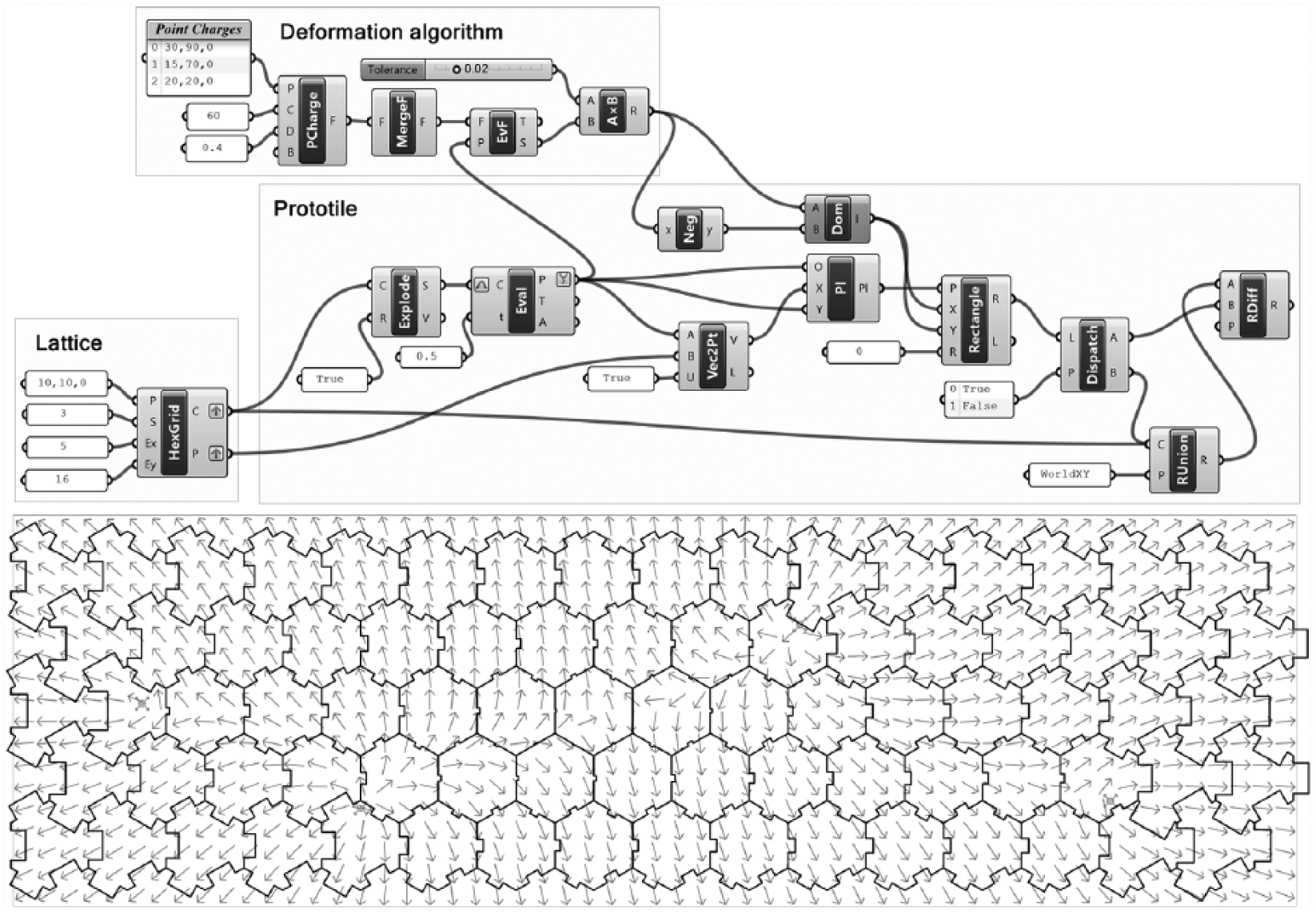
A vector field, generating an instance of Trifoliolate. Above: The Grasshopper definition. Below: An instance of Trifoliolate generated by the algorithm.
Explanation of the dataflow algorithm on Figure 13..
The independency from the intrinsic content of the pattern helps designers to create algorithms that process any digital data or signal as an input of their design.
Algorithms of hybrid methods
The hybrid approach presented in this article is based on the conception of dimensional analogy best exemplified by Abbot’s 32 famous educational novella “Flatland: A Romance of Many Dimensions.” In this approach, a 3D Prototile is created to embed all possible variations into a surface geometry. Every possible variation of a Parquet Deformation might be constructed by multiplying the 3D Prototile, creating and projecting its sections. The shape of cutting plane or surface determines the resulting pattern deformation (Figures 14 and 15 and Table 3).
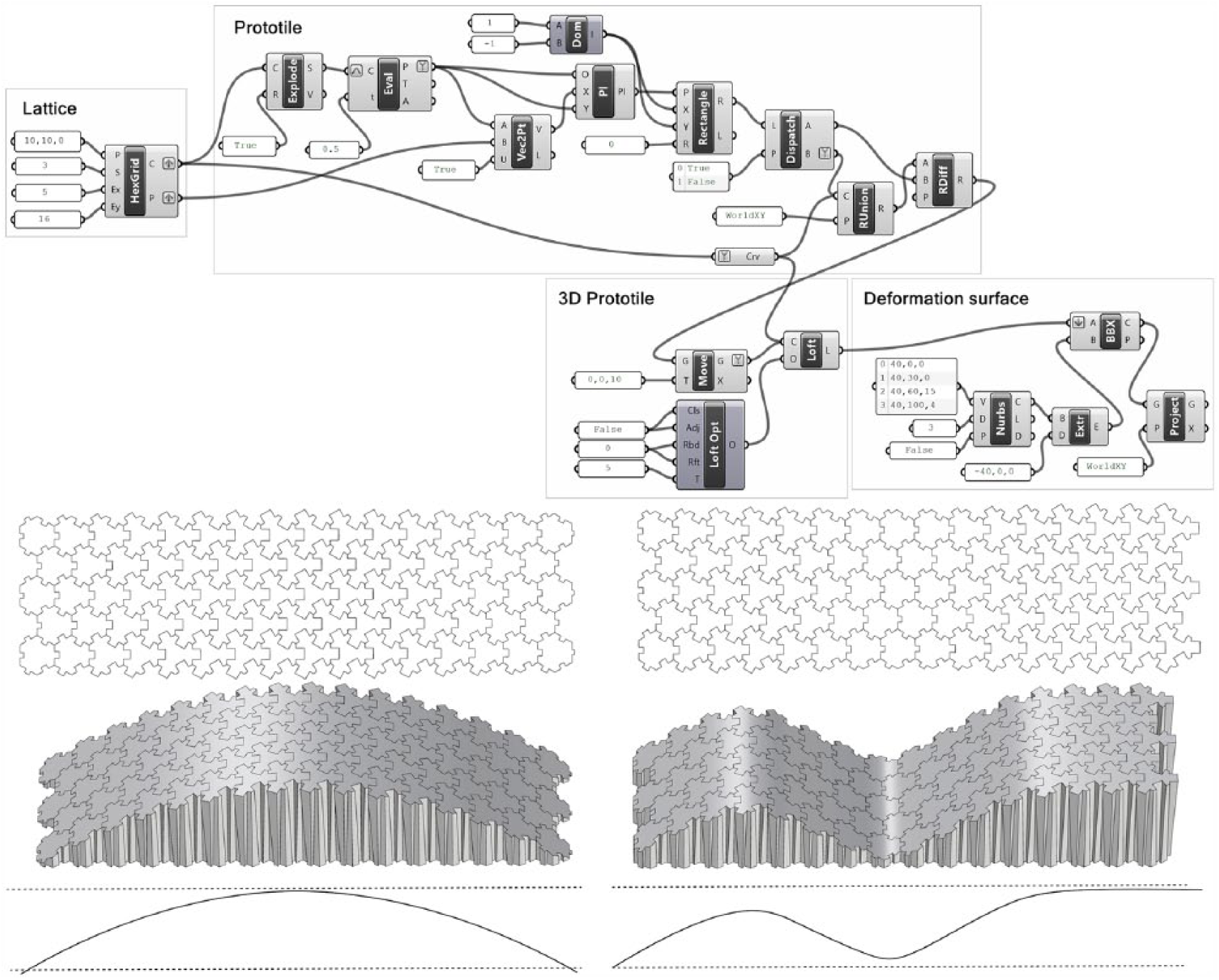
The approach of Dimensional Analogy. Top: The Grasshopper definition. Bottom: Instances of Trifoliolate generated by the approach.
The “Loft Deformation” exercise; Architectural Geometry (2014) class at İstanbul Bilgi University Faculty of Architecture. Students: Ceren Sezgin, Ayşe Yılmaz, and Ece Erdoğdu.
Explanation of the dataflow algorithm on Figure 14.
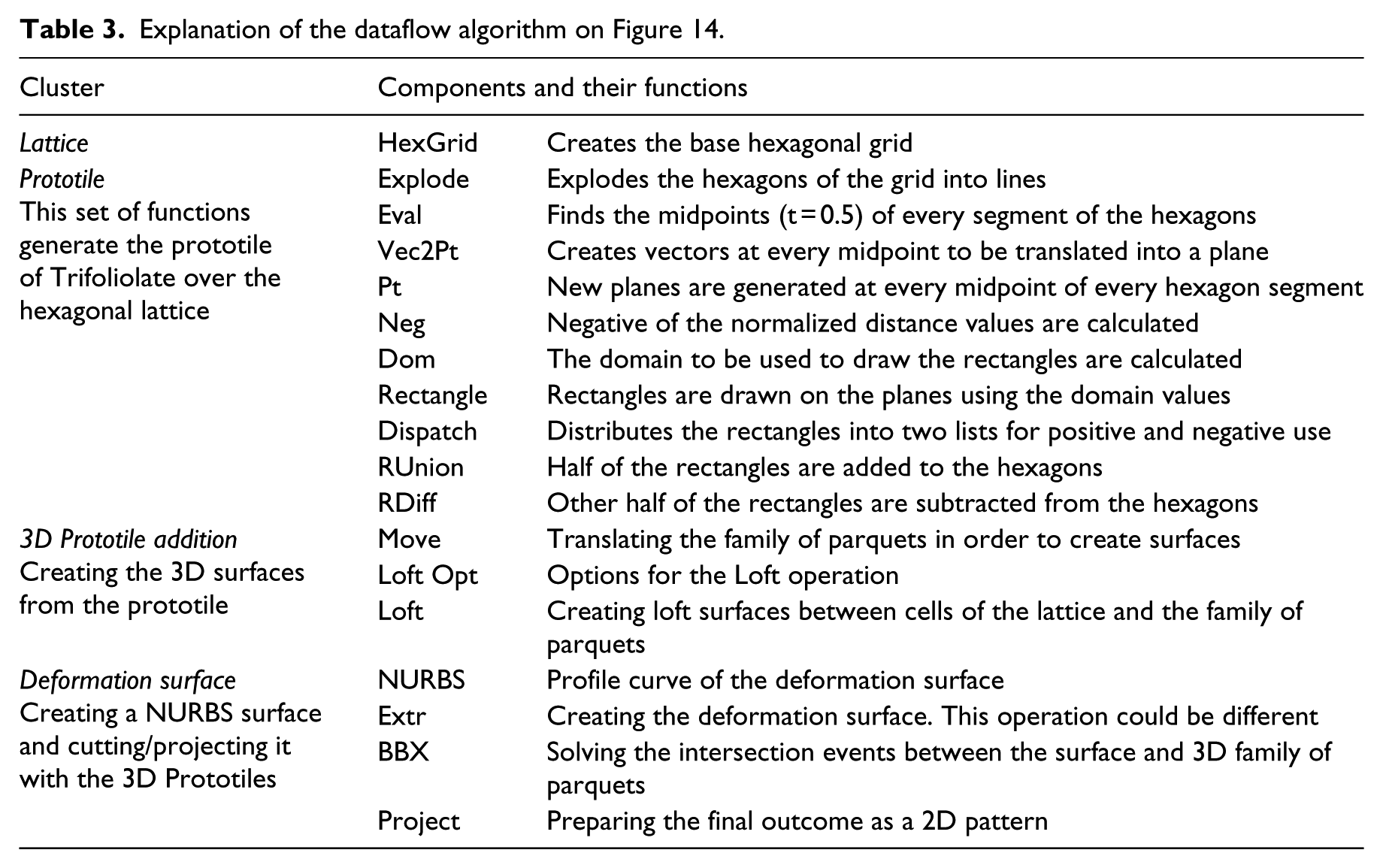
Figure 14 and Table 3 shows the Grasshopper implementation of the proposed approach. Prototile and Lattice clusters are the same with the previous approaches, and a sub-cluster of 3D Prototile creation is added. A Deformation Surface cluster is also necessary for this algorithm. The computational cost of this algorithm is higher compared to the algorithms in Tables 1 and 2. This is because of the 3D surface generation and sectioning functions utilized in this approach. However, the flexibility presented by this approach is better because of the possibility to use different cluster designs for the Deformation surface. Below are some of the properties of the deformation surface that could be used to analyze the resulting pattern deformations.
Topological connectedness
A classical Parquet Deformation has a deformation surface which is simply connected (genus 0), whereas connected surfaces with genus 1 or more lack sections and projections, leaving gaps in the resulting pattern. Therefore, the topological connectedness is a primary property of a deformation surface. Therefore, it is possible to use a polynomial graph surface such as Non-Uniform Rational B-Splines (NURBS) to develop these surfaces.
Draft angle
Draft angle analysis is used to show if an injection-molded object would be removed from molds easily. If the draft angle of a deformation surface is positive everywhere this means the resulting pattern resembles a classical 2D Parquet Deformation. On the other hand, if a deformation surface has places where draft angle is zero or negative, there is an overlapping and multiplication in the resulting composition. This is not an expected result from a regular Parquet Deformation; however, it shows a methodical potential of the proposed method which is not present in other deformation approaches described in this article.
Curvature
The intrinsic (Gaussian) curvature of a deformation surface represents a mathematical basis for explaining the local and overall regularities of a pattern deformation. If the Gaussian curvature of a deformation surface is zero at every point, the surface is curved consistently. This would result a pattern deformation that is shapeshifting regularly, meaning that the amount of change in every step of the deformation is constant. If the deformation surface has no Gaussian curvature and it is parallel to the projection plane of the pattern, then there would be no deformation on the pattern. While moving across two points on a deformation surface, a positive or negative change in the Gaussian curvature results a change in the amount of deformation (Figure 16).
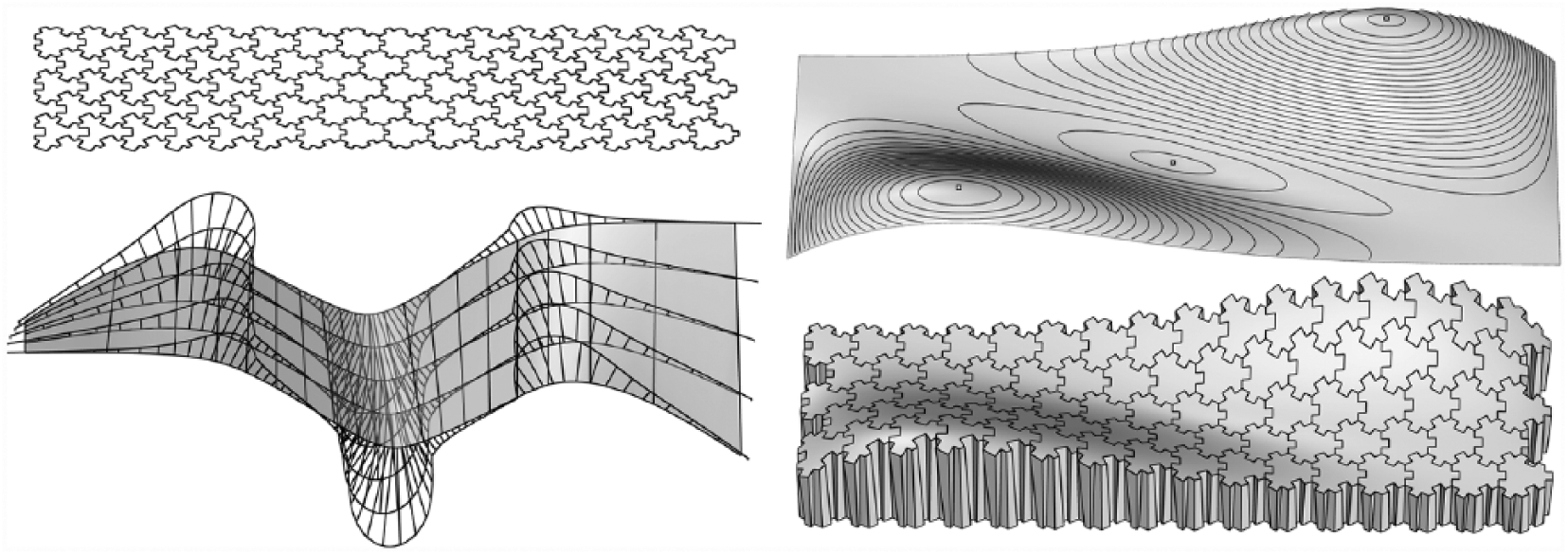
Left: Regularity of the deformation is visualized by measuring the changes of Gaussian curvatures across the pattern. Right: Finding the attractor points of a pattern deformation via the critical points on the deformation surface.
Critical points
Critical points (local maxima, local minima, and saddle points) on the deformation surface represents places where significant changes occur in the resulting pattern. The maxima and minima of a deformation surface represent central places on a pattern deformation where the shapeshifting is concentrated. This is similar to the attractor objects used by designers to change and manipulate patterns as described earlier. The proposed method could be utilized to locate the unknown attraction points or shapes or to translate between standard iteration algorithms and its geometric counterparts (Figure 16).
Conclusion
Short-term exercises in architectural education aim at students’ constructive development of their own attitudes. Some of these exercises evolve over time, reflecting the theoretical manifestations of their periods. They can be regarded as containers of pedagogical experience, helping us to follow the historical development of a particular design concept over academia. The Parquet Deformation is one of such exercises. It is still an up-to-date educational tool in introducing students with the basic concepts such as emergence, growth, evolution, exception, and system. It is also a significant example of computing without computers in design education. It reminds that order (i.e. algorithms; with or without computers) and human imagination are not opposite but reciprocal, helping to produce what Dürer calls as the total beauty of variation. It is becoming important for students of architecture to recognize the potentials of methodical diversity of pattern studies while developing their own design attitudes. This would help them to see the possibility of being not only consumers but also developers of geometry.
The geometric relationships underneath pattern deformations are usually directed by the intrinsic capacities of cells, and the deformability potentialities of underlying lattices. In other words, the capacity to be deformed is related with geometric properties of a pattern itself, while the capacity to deform a pattern is highly related with the setting, properties and the forces of the n-dimensional space it exists in. From this perspective, a pattern deformation can be described as an equilibrium between the intrinsic deformability capacities of a geometric pattern; and an external capacity, or algorithm that is supposed to direct the generative process. Scripting languages introduce designers with algorithmic methods such as component-based design, attractor objects, and force fields that are transferred to design processes with a need to define these external capacities. The new generation of architects develops or transfers such methods in design processes, making it possible or easier for themselves to control the generation, optimization, and adaptation of complex patterns. It is becoming an important issue for design education to keep up with this new generation.
The proposed approach of construction opens new discussions for the design and analysis of pattern deformations. It represents an intersection point of analytical and synthetical geometry, from Huff’s computing without computers, to today’s parametric design environments. The workflow presented in this article is an example of this intersection and could be further developed as a tool for designers and students.
Footnotes
Acknowledgements
The author would like thank David Bailey for sharing his own drawings and references about the original exercise of William Huff. Pattern Deformation exercises mentioned in the paper is conducted at İstanbul Bilgi University Faculty of Architecture first-year Architectural Geometry course, coordinated together with Benay Gürsoy and Aslı Aydın. Growth and Evolution exercise mentioned in the paper are parts of the first-year Computation-Based Basic Design studio of the same university coordinated by Şebnem Yalınay Çinici. Islamic pattern generator script mentioned in the paper is created by Serkan Uysal, in a Computational Design graduate studio coordinated together with Birgül Çolakoğlu at Yıldız Technical University Faculty of Architecture.
Declaration of conflicting interests
The author(s) declared no potential conflicts of interest with respect to the research, authorship, and/or publication of this article.
Funding
The author(s) received no financial support for the research, authorship, and/or publication of this article.