







Abstract
This study sheds light on a holistic understanding of muqarnas with its historical, philosophical and conceptual backgrounds on one hand and formal, structural and algorithmic principles on the other hand. The vault-like Islamic architectural element, muqarnas, is generally considered to be a non-structural decorative element. Various compositional approaches have been proposed to reveal the inner logic of these complex geometric elements. Each of these approaches uses different techniques such as measuring, unit-based decoding or three-dimensional interpretation of two-dimensional patterns. However, the reflections of the inner logic onto different contexts, such as the usage of different initial geometries, materials or performative concerns, were neglected. In this study, we offer a new schema to approach the performative aspects of muqarnas tectonics. This schema contains new sets of elements, properties and relations deriving partly from previous approaches and partly from the technique of folding. Thus, this study first reviews the previous approaches to analyse the geometric and constructional principles of muqarnas. Second, it explains the proposed scheme through a series of algorithmic form-finding experiments. In these experiments, we question whether ‘fold’, as one of the performative techniques of making three-dimensional forms, contributes to the analysis of muqarnas in both a conceptual and computational sense. We argue that encoding vault-like systems via geometric and algorithmic relations based on the logic of the ‘fold’ provides informative and intuitive feedback for form-finding, specifically in the earlier phases of design. While focusing on the performative potential of a specific fold operation, we introduced the concept of bifurcation to describe the generative characteristics of folding technique and the way of subdividing the form with respect to redistribution of the forces. Thus, in this decoding process, the bifurcated fold explains not only to demystify the formal logic of muqarnas but also to generate new forms without losing contextual conditions.
Introduction
The nature of muqarnas and vault designs are based on the transition from two-dimensional (2D) geometry to three-dimensional forms. It is obvious that this transition is an additive, progressive and creative process. Throughout history, the transition from a square layout to a circle layout in three dimensions has been a challenging topic not only for artisans but also for philosophers and mathematicians. Among the countless attempts, Al-Biruni’s egocentric projection map in which the information of a sphere was projected onto a planar surface in the 11th century and Gerardus Mercator’s 1569 map based on the projection of spherical information onto a cylinder were crucial precursors. From a different perspective, in the 18th century, Leonhard Euler proved the inevitable information loss during the translations between a sphere and a planar surface. 1 Euler changed the direction of the problem and was not concerned with creating a precise map of the world. In his problem, he did not focus on the problem of geometry. Instead, he focused on ‘geometry of position’ through seeking the properties which result from this position, without regard to the sizes of the Cartesian world themselves (Figure 1).
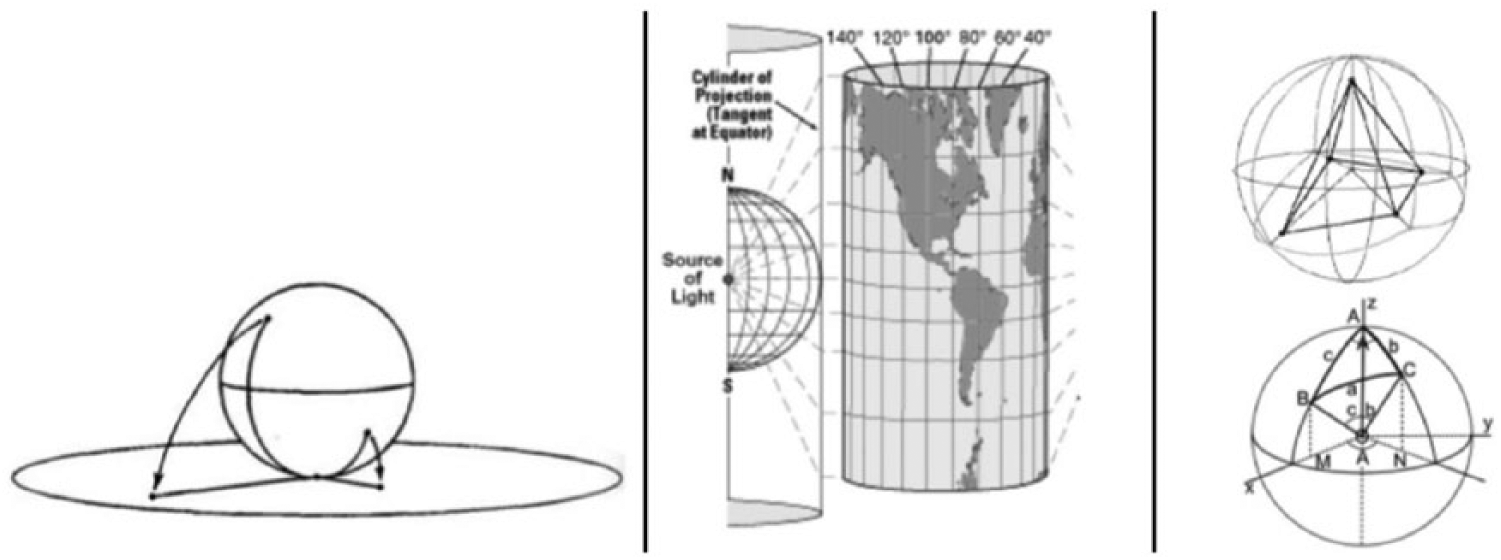
When it comes to architecture and constructing a dome or vault, the transitions from a square, a rectangular, a trapezoidal or a warped polygonal plan to a shell have been a field of experimentation, especially in masonry. Master masons had explored various formal and spatial possibilities of vault-like structures. This accumulation of construction knowledge resulted in the emergence of specific archetypes such as vaults, dome, muqarnas, pendentives and squinches. This experience in construction also provided general conventions in terms of developing solutions for complex forms and irregular plan types. On the other hand, these conventions which became common knowledge in construction (which cover well-defined proportions, material selections, distances of spatial spans and sequence of construction phases) sharpened the limits of possible creative responses. Related to material properties, the traditional methods of construction and the well-known constraints resulted in predictable constructions and common architectural elements.
In our case, the conventional representations grounded in the transitional paradigm were in accordance with the common constructional strategies of the age. Specifically speaking, the act of constructing a vault-like architectural element for a master mason is an unit-based, hierarchical (in the context of organization of the units) and additive process. Similarly, departing from 2D drawings, the three-dimensional (3D) muqarnas generation process muqarnas were generally explained as orderly horizontal layers of small units, one on top of another.5 –7 Mostly, muqarnas generation processes involve vertical and horizontal geometrical transformations. Complex forms comprised different hierarchies, where each hierarchy is associated with its own logic and details.
In order to enrich the very vocabulary of ‘muqarnas’ in general terms, new tectonic sensibilities are to be explored by questioning computational approaches. Departing from Felix Klein’s descriptions in Erlangen Programme in 1872, Cache introduces four geometrical transformation ages in architectural history: isometric, proportional, projective and topological. From Cache’s point of view, the isometric and proportional characteristics belong to classical architecture, projective refers to the late medieval stereotomy and the topological level indicates the period from the early modern perspective to contemporary digital technology. 8 In parallel with the digital revolution, Cache and Deleuze who are both interested in mathematical functions in different contexts come up with the idea of ‘fold’. As Cache quoted from Carpo, the idea of ‘fold’ is one of the main conceptual bases that would drive digital design for the next 20 years. 9 The ‘fold’ was also popularized by a generation of architects and has been discussed through varying disciplines and terminologies such as philosophy, geometry, design and geography in a topological sense. As an example, Deleuze takes the German philosopher and scientist Leibniz (who invented infinitesimal calculus that would later become the foundation of mathematical physics) as main reference and basically claims that the basic idea of the Baroque indicates an operative function, not a trait; and namely a function of folding matter in variously intricate ways. 10 The productive character of Baroque comes from the very multiplicity of other ‘folds’ like Greek, Roman and Gothic ones rather than a simple singularity. Following this determination, Deleuze’s fold describes a variable, endless and infinite model of contemporary collectivity. This approach obviously grounds on geometrical (especially on the interpretations of the curvilinear geometry of the era), mathematical (the problem of finite and infinites) and philosophical (the well-known tension between the inside and the outside, the matter and the soul, the high and the low, the facade and the closed room, etc.) propositions as well as conceptual analogies. In this regard, as a reason to dealing with Deleuze’s studies, contemporary fold concepts offer horizons and meanings to significant form studies related to the fact that the way we encode, translate and transform the geometrical information has been evolving from isometric to topological approaches with the new era.
We argue that revisiting the late medieval stereotomic systems through a logic of fold with today’s concepts harbours generative and derivative potentials for new morphological possibilities. To open, this study is an attempt to look at and decode historical construction systems from an out-of-the-box point of view, from the digital age’s concepts and vocabularies. We propose the term ‘bifurcated fold’ as a particular implementation of the fold operation.
The fold and bifurcation
The fold plays an important role for contemporary designers for three main reasons. First, the fold method is adequately easy both to perform and to understand the relationship among dimensions, which makes the method possible to be questioned in computational and algorithmic terms as well as in a physical sense. Second, the fold refers to an open and dynamic disposition where every situation co-exists with its extension. Performing this infinite operation shifts the motivation to perpetual generative nature of making a fold. Third, from a structural perspective, the ‘fold’ offers the chance to re-articulate the orthogonal loading system concept. Different from the basic principles of the well-known structural systems such as load-bearing or frame based systems, the fold comprises an anti-hierarchical load disposition.
The term ‘bifurcation’ was first introduced by Henri Poincare in 1885 to describe the sudden qualitative or topological change in the system’s behaviour resulting from a small change in the parameter values of a system. 11 In the scope of this study, different from Poincare, bifurcation refers to a process or a geometrical operation resulting in a branching for a stable redistribution of forces on a surface. The reason for choosing the term ‘bifurcated fold’ is to emphasize not only the force-distributing nature of folding but also the change in the topological structure through folding operations. The main characteristic that distinguishes the ‘bifurcated fold’ approach from previous studies is that the flexible and interactive nature takes information from both the designer and the states of surface geometry cyclically.
Bifurcated fold is a conceptual and operational layout for understanding and making vault-like forms. In other words, the term ‘bifurcation’ is selected because of the qualitative and topological changes resulting from the force-flow diagram of the geometrical form.
In the application of the bifurcation fold approach, an initial surface geometry is required. In the absence of an initial surface geometry, a 3D form can be generated from 2D patterns. From an algorithmic point of view, the process can be defined as follows: for each A is a point on
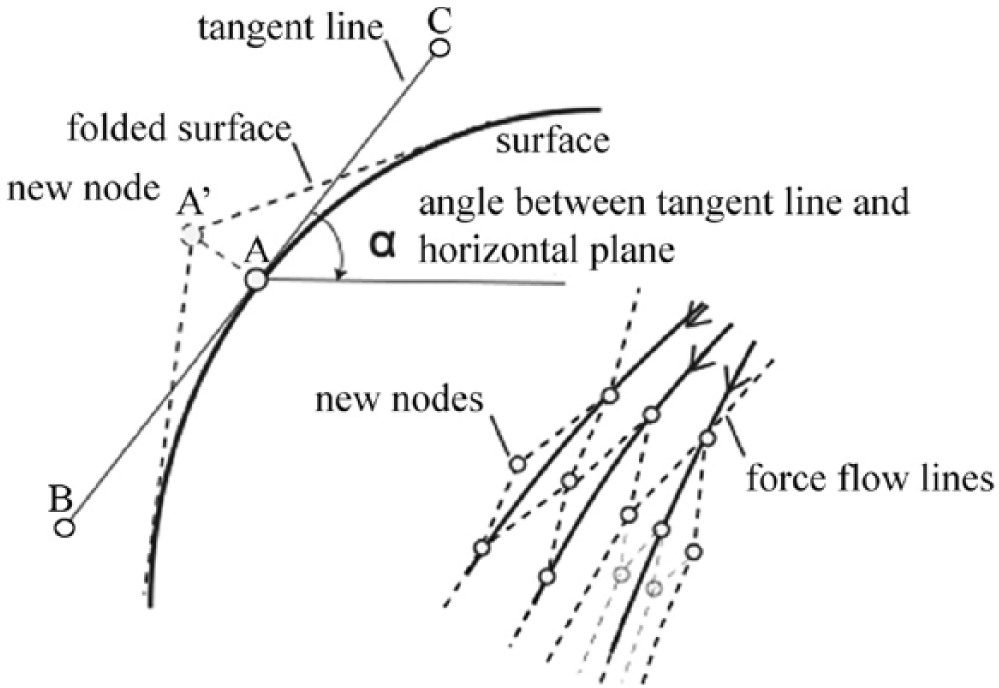
Branching rules for bifurcation.
The bifurcated fold approach is derived from not only muqarnas studies in the literature but also empirical experiments and algorithmic modelling exercises. Bifurcated fold as an integration of muqarnas encoding and the technique of fold is introduced to describe the proposed method which includes force-flow, subdivision, layering and projection techniques.
This article presents the outcomes of four phased form-finding experiments: encoding vault-like systems, proposing an algorithmic form-making method derived from initial experiments, evaluating the performative behaviour of 3D formal explorations and implementation of bifurcated fold on case studies. As a case study, we analysed and decoded the muqarnas samples of different periods ranging from the 11th to the 15th century, such as the Friday Mosque of Isfahan, Fatima Masumeh Shrine Mosque of Qom and the cellular vault of a 15th-century building, The Basel Minster.
Related studies on muqarnas
As an architectural element, it is possible to see muqarnas in a widespread geographic area from Spain to India (Figure 3). There are different opinions about its origin and development, tracing back to 4th or 10th century. 12 It is commonly said that the word muqarnas refers to a stalactite vault, which conveys the relationship between the word and the potential meanings of formation. There are different debates on how, where and when the root of the word was derived. The Encyclopaedia of Islam 13 defines muqarnas as ‘a type of decoration typical for Islamic architecture all over the central and eastern parts of the Muslim world; for its counterpart in the Muslim West, see mukarbas (same as mocarabe)’. Diccionario de la lengua espala explains the word mocarabe as ‘the formation by geometric combination of interlocking prisms, externally cut in concave surfaces and used as decoration in vaults, cornices, etc’. Examining the annotations on ‘qurnas’, ‘karnasa’, ‘coronis’ and ‘muqarnas’, Wolfhart Heinrichs has been searching for the concrete basis for the word muqarnas in different languages. However, Heinrichs still keeps his critical distance to the commonly accepted etymology for muqarnas. Among these semantic or phonetic similarities, the verb ‘qarnes’ in Syriac means to ‘hammer’, with its passive participle being ‘muqarnas’. 14
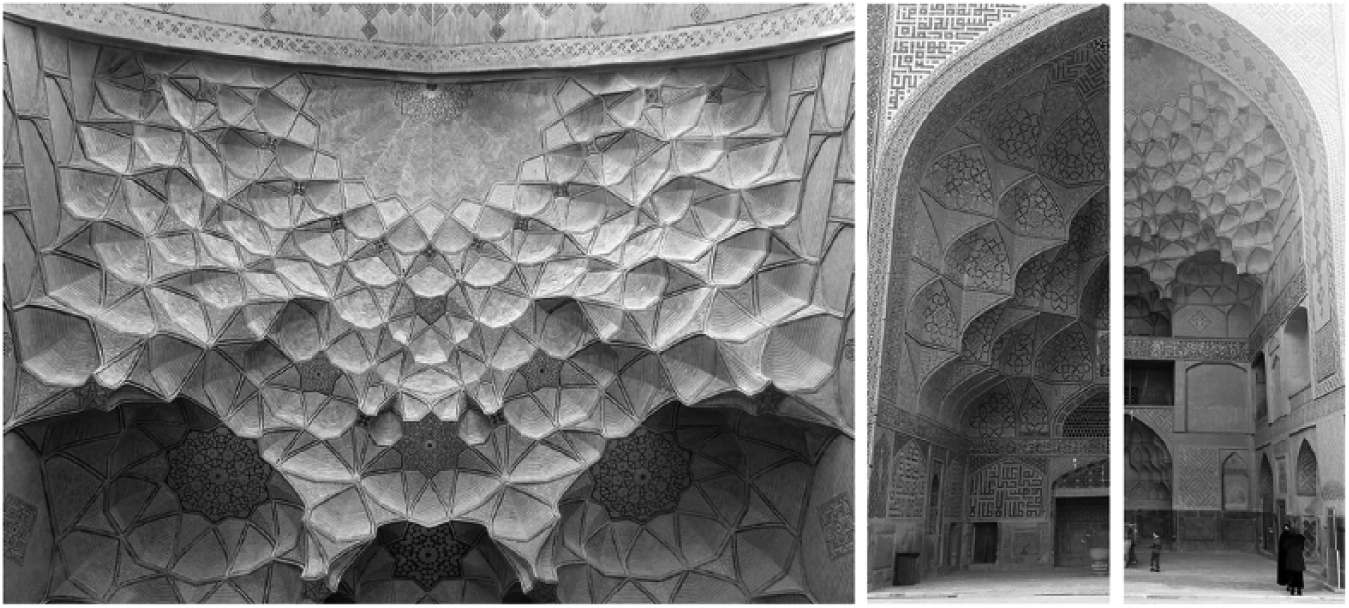
Left: a bottom view of muqarnas formation at Jameh Mosque, Isfahan. Right: front views of different portals at Jameh Mosque, Isfahan.
Despite its pervasive presence in the built environment, there are only a limited number of written studies on muqarnas available. Muqarnas has been examined under different titles in the literature such as stalactite vault, 7 muqarnas vault7,15,16 and muqarnas dome.15,17 Most of the studies on muqarnas focus on its decorative potential and neglect the structural potential of this vault-like form. A few recent studies examine the structural, functional and performative potentials of muqarnas18,19 and algorithmic reconstructions.20,21
We investigated the related studies across three decade-based thresholds in order to gain a comprehensive understanding. Those thresholds are Description (1985–1995), Decodification (1995–2005) and Interpretation (2005–2015). The proposed approach here is treated as related to all three thresholds (Table 1).
Decade-based thresholds of muqarnas studies.
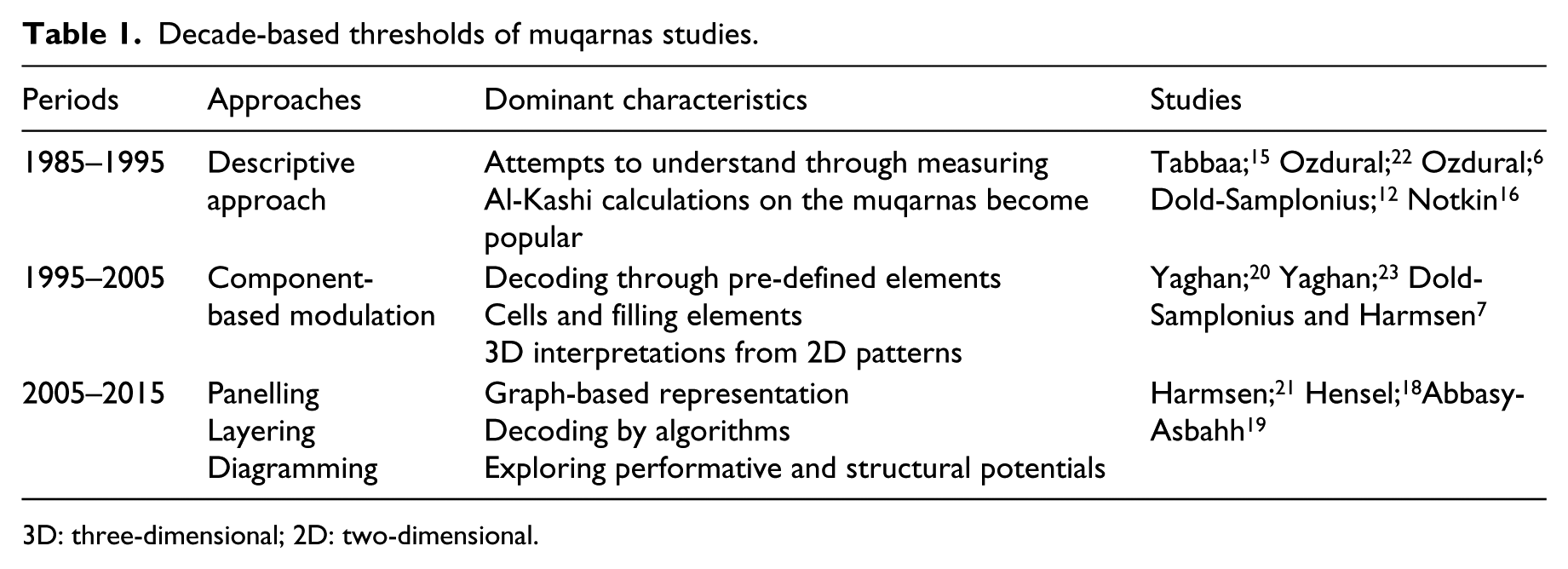
3D: three-dimensional; 2D: two-dimensional.
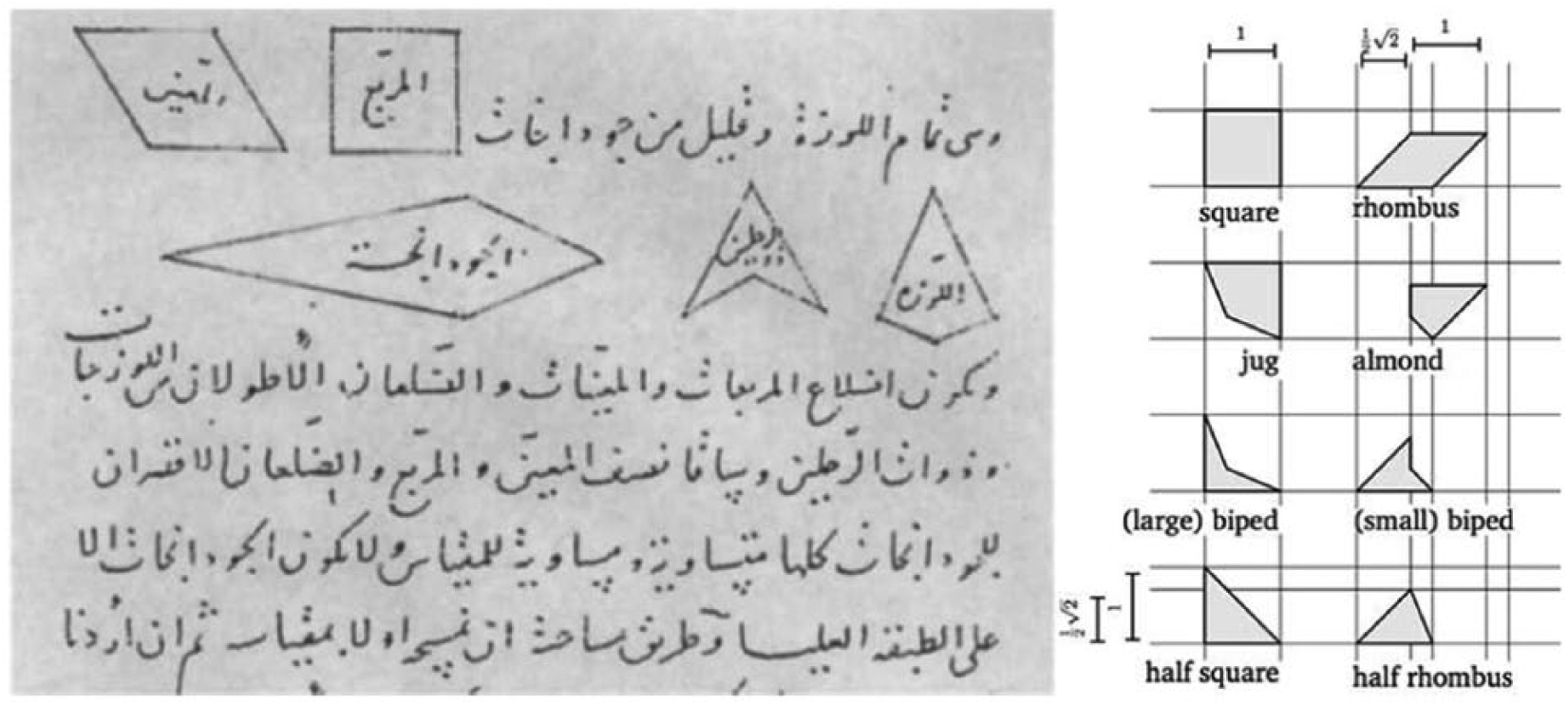
From the first period, the manuscripts of Al-Kashi and his calculations were studied.6,22 Those calculations and definitions constituted a basis for further studies. 21 Some 2D and 3D geometric relations (Figure 4) by Al-Kashi were introduced by Ozdural. 22 Al-Kashi classifies muqarnas into four types as simple, clay-plastered, curved and Shirazi. Al-Kashi’s descriptions of 2D plane projections of muqarnas involve geometrical vocabulary elements such as square, rhombus, half-rhombus, almond, small biped, jug, large biped and barley kernel.5,7,21 Those typological definitions are helpful in explaining the production process in detail. On the other hand, the aspects of design and compositions were neglected in Al-Kashi’s concrete descriptions. 22 The construction process of muqarnas usually started with the drawing of plane projections. 21 Plane projections of muqarnas can be considered to be simple un-interlocking patterns. In these cases, the arrangements of muqarnas elements were mostly symmetrical and the niches were also equal.
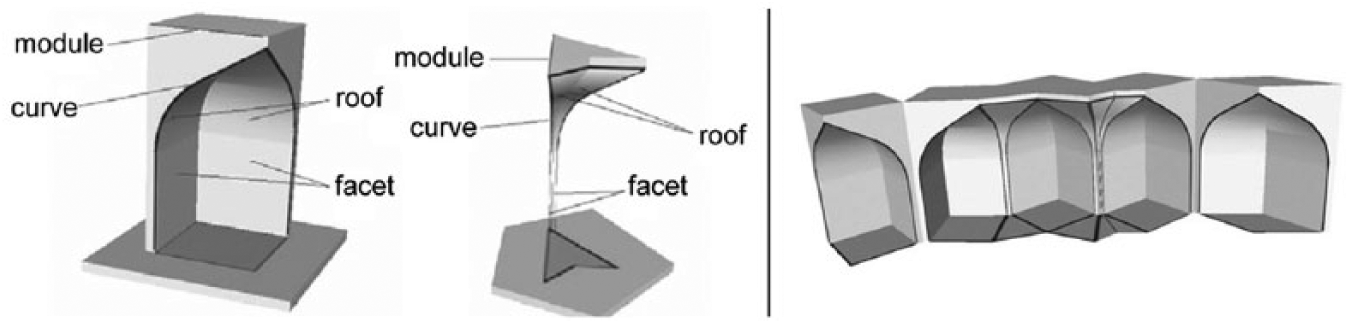
Another categorization by Al-Kashi, which has been used in many muqarnas studies, is the assumption of ‘cell’ and ‘intermediate elements’ (Figure 5). The upper part of each cell involves ‘roofs’, vertical surfaces involve ‘facets’ and the filling elements complement the compositions. 24
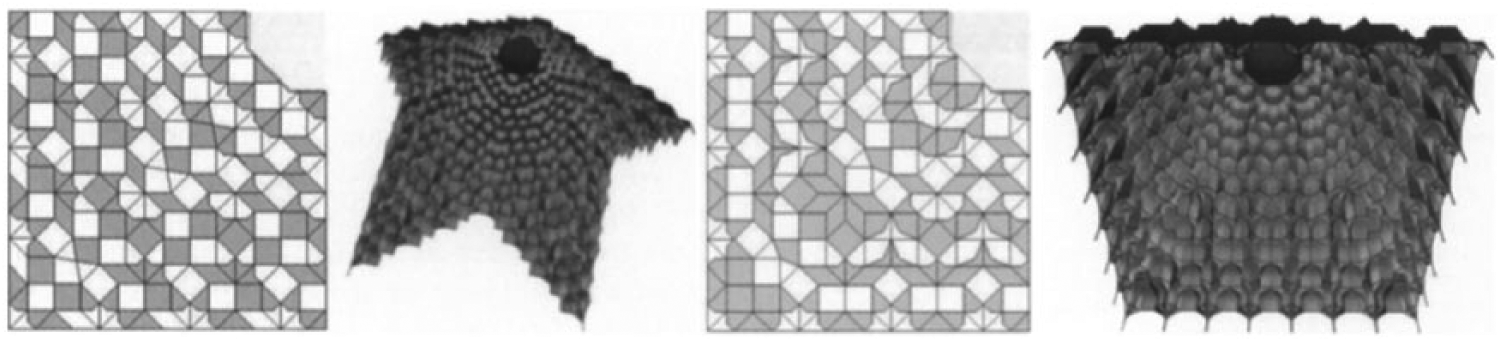
Dold-Samplonius and Harmsen’s 7 study can be considered as a 3D interpretation of the second period. They examined how different combinations of cell elements might constitute a row from the pre-defined elements such as square, intermediate half-rhombus, intermediate biped and rhombus. Dold-Samplonius and Harmsen redrew the 2D pattern and 3D form based on Harb’s studies and also interpreted the same basis and produced a different 3D formation (Figure 6).
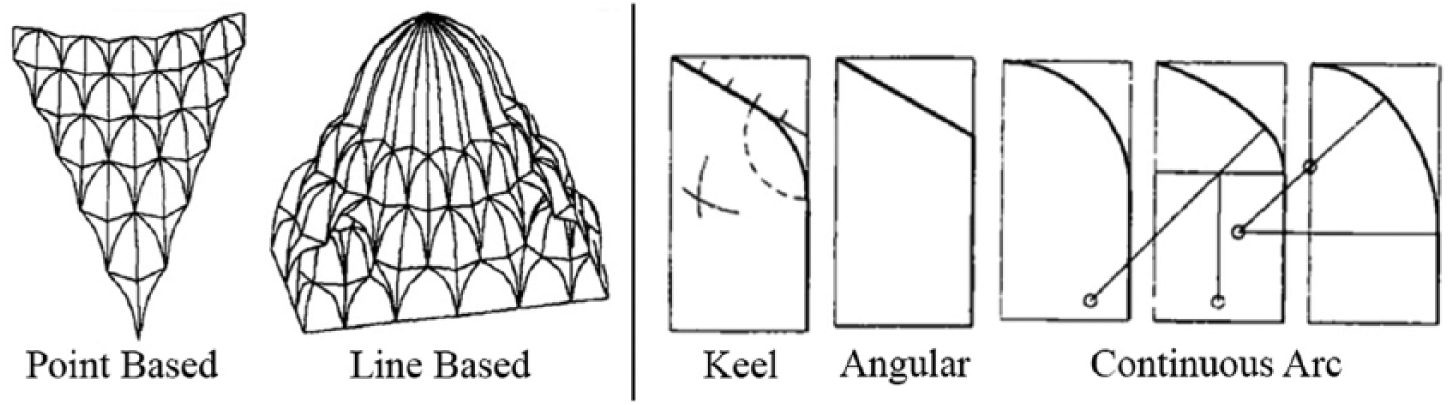
In relation to muqarnas codification, some categories such as scale, level of complexity, cornice or vault category, the place that muqarnas settle (square-base/central column/eight arch) and form of the niche were used by Notkin, 16 and point-based/line-based (Figure 7, left) definitions were used by Yaghan. 23 Apart from the keel-type (Figure 7, right) definition of Al-Kashi, Yaghan 23 contributed the terms ‘angular’ and ‘continuous arc’ to describe the geometrical possibilities of a muqarnas curvature.
Left: base type of a muqarnas. Right: articulation of a muqarnas unit. 23
As it can be traced back in the earlier 2000s, a common tendency in muqarnas studies is to use pre-defined typologies and definitions. However, 3D muqarnas formation might provide new insights to the mathematical understanding of form beyond its aesthetic and ornamental qualities in the digital age. In other words, muqarnas formation has the potential to be decoded by a series of rules, algorithms or topological relations instead of only considering the pre-defined components. In the third decade threshold, a few recent studies examined the structural, functional and performative potentials of muqarnas organization18,19 and reconstructions.20,21
After 2005, the widespread availability of digital modelling and fabrication techniques might have triggered the emergence of new perspectives on muqarnas. Graph representation and computer-based deconstructions by Harmsen 21 might be considered to be an earlier example of muqarnas encoding which is open to multiple and generative readings (Figure 8).
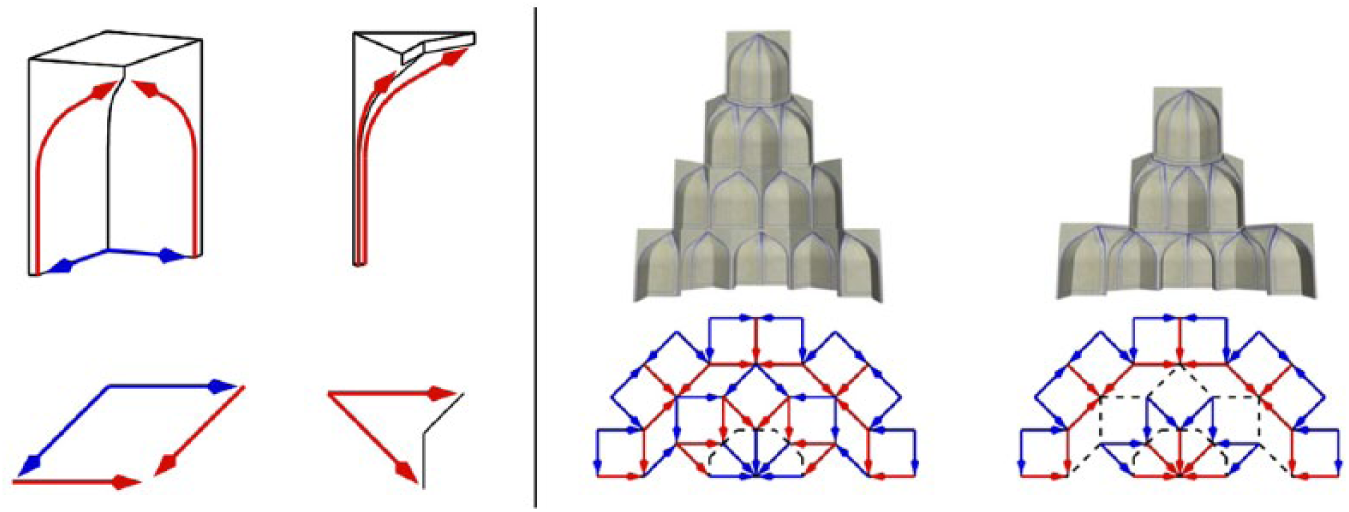
Diagrammatic representation of muqarnas. 21
In addition to the studies which approach muqarnas as an architectural archetype, Moussavi contributed with conceptual investigations to the method of construction of the vault-like forms. Moussavi’s 17 approach of vault-like forms through the Deleuzian concept of ‘affection’ provides a relational ground to understand the common features of muqarnas, dome, vault and folded plates. Diamonding, ribbing, cellularity, segmentation, bifurcation, crystallinity, stellated-ness and stallactiformity are some of the prominent features of vault-like forms.
Traditionally, the knowledge of how to construct a vault has been gained and transferred by mason masters in a similar way to muqarnas. A cellular vault (a vault subdivided into prismatic surfaces) is an important step for generating solutions for irregular plan types and the irregular distribution of columns. 17 The dimensions and properties of the materials, the span distances and plan layouts played a crucial role and also acted as a strict constraint in the development of vault design until the 18th century. From the 18th century, studies analysing the structural behaviours of vault lead to significant developments in vault design. 26 Later in the 20th century, physical experimentations based on hanging models by Antoni Gaudi, Frei Otto, Sergio Musmeci and Heinz Isler made original and novel contributions to extend the boundaries of the known in terms of form-finding. Apart from the form-finding experiments derived from vault formation (Figure 9), most of the vault studies followed the component-based stereotomic system logic of vault construction. Countless studies on vaults involve design–construction–test cycles, which lead to better understandings of the structural behaviour of forms and materials. In the digital age, more advanced approaches, modern structural analysis models 26 and various computer-aided form-finding tools27 –31 are available for revisiting vault formations.

Left to right: Antoni Gaudi, Frei Otto, Sergio Musmeci and Heinz Isler. 32
The emerging digital design approaches and computational thinking might contribute more to exploring the unvisited potentials of muqarnas. Such a reinterpretation of muqarnas could help develop a more general base for the application of the technique for non-standard geometries too.
Decoding the mathematical and geometrical characteristics of muqarnas
Decoding a formal, spatial or structural element via an algorithmic recipe is not a new topic in architecture. The algorithmic method of describing a construction process can be traced back to the 15th century in Al-Kashi’s book Key of Arithmetics, which covers arithmetic and geometric definitions of muqarnas construction for artisans. 5 As discussed in the previous section, computational tools and methods accelerated the variety of algorithmic decoding studies of muqarnas. In our case, and in contrast to the previous encoding studies in the literature, in order to gain better understanding of the complex geometric relationships, a series of unstructured modelling and fabricating exercises were held.
This section presents the encoding and modelling exercises on muqarnas and our proposal of an open-ended bifurcated folding process involving force-flow, subdivision, projection and layering techniques for computational generation of new spatial and structural possibilities. Beyond folding a singular paper plate, bifurcated fold is examined through the logic of computation in relation to the explored techniques and processes.
Physical and digital muqarnas modelling exercises can be divided into two parts according to the typology of the geometric elements: point–line and surface studies (Figure 10). Considering the dominance of geometric operations, these studies resulted in two directions: subdivision and layering. Point–line explorations were material-free exercises, in which the focus was on structural, topological and part/whole relationships through encodings of the wire-frame elements. In other words, point and line studies can be considered as edge-based abstraction, reduction and interpretations of the 3D geometries. Adapted from a specific tessellation method, subdivision techniques were examined with respect to the transition relations in muqarnas between two vertical layers. The second geometrical element, surface, was approached for the purpose of the generation of 3D forms from 2D patterns consecutively. In these exercises, parameters such as angles, proportions, basic translation and transformation operations were examined to achieve folded-plate forms and interpretations. A layering algorithm in Python programming language was developed as an interference of surface explorations which allows the manipulations of the internal relations dynamically via interactive layer line selection by the user.
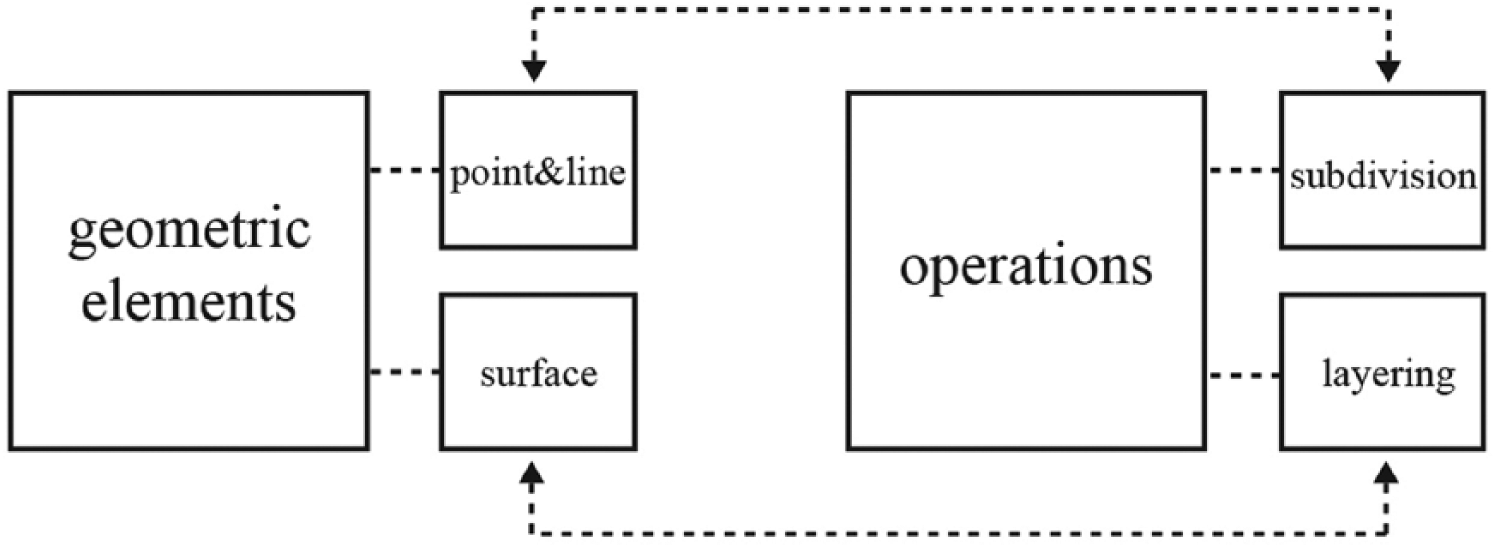
An overview on the unstructured modelling exercises.
At the very beginning of the explorations, we started to work with physical models. We modelled a scale-free line-based muqarnas part from the Friday Mosque, Isfahan (Figure 11). The model starts with an octagon frame. Operations such as selection of midpoints, translations along the Z-axis, adding new points and connecting the vertices were used. Translation of the 3D model’s information into a digital environment involved some reductions and interpretations.
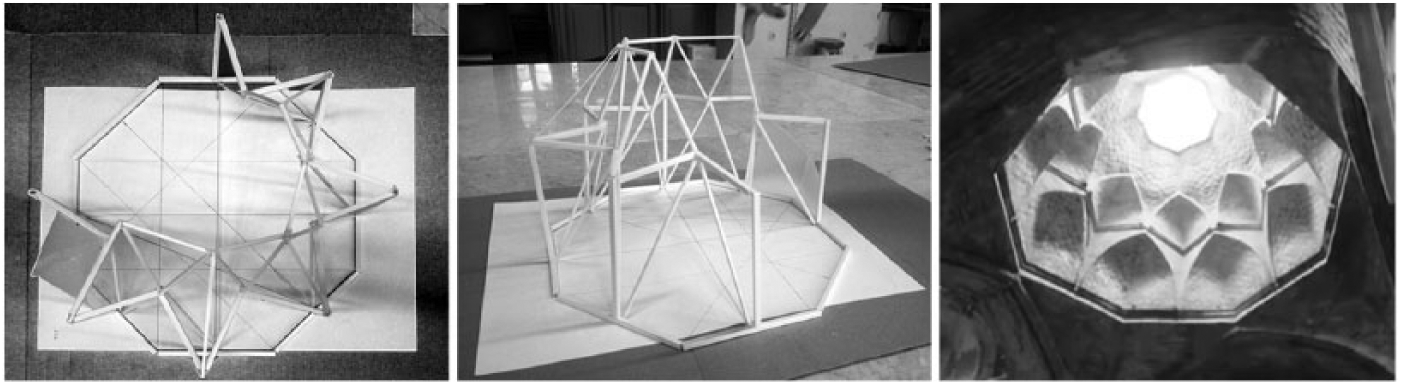
Partial contour model of a muqarnas of Friday Mosque, Isfahan.
The composition starts with one square. With 45° rotation, the second square is constructed on the top. Extracting the octagon from the two intersecting squares, adding circles to the sides of the octagon and extracting new intersection points, the subsequent steps can be seen in Figure 12 in detail. After translating the physical model into digital, we unfolded and built the model with a laser cutter. In the constitution of the digital modelling process, we studied in different environments such as 3D modelling (Rhino), modelling in visual scripting environment (VSE) and using the Python programming language embedded in VSE. For 3D modelling, we followed the steps we carried out in the physical modelling process. We used points/vertices, lines and layers (the horizontal polygons representing different levels). The process derived as a result of layer-focused studies is shown in Figure 13.
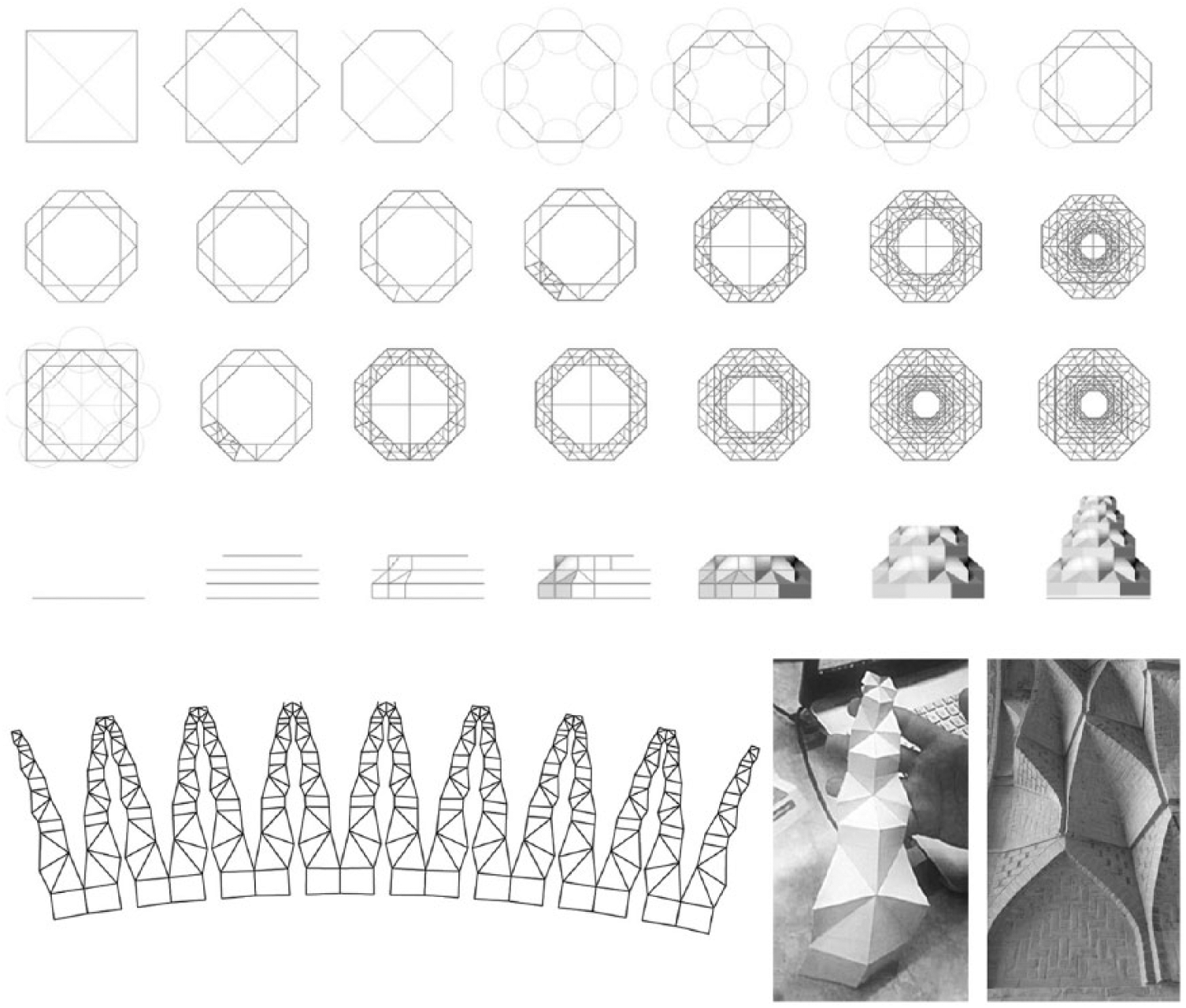
From 2D pattern towards 3D formation; digital and folded physical modelling of a muqarnas part of Friday Mosque, Isfahan.
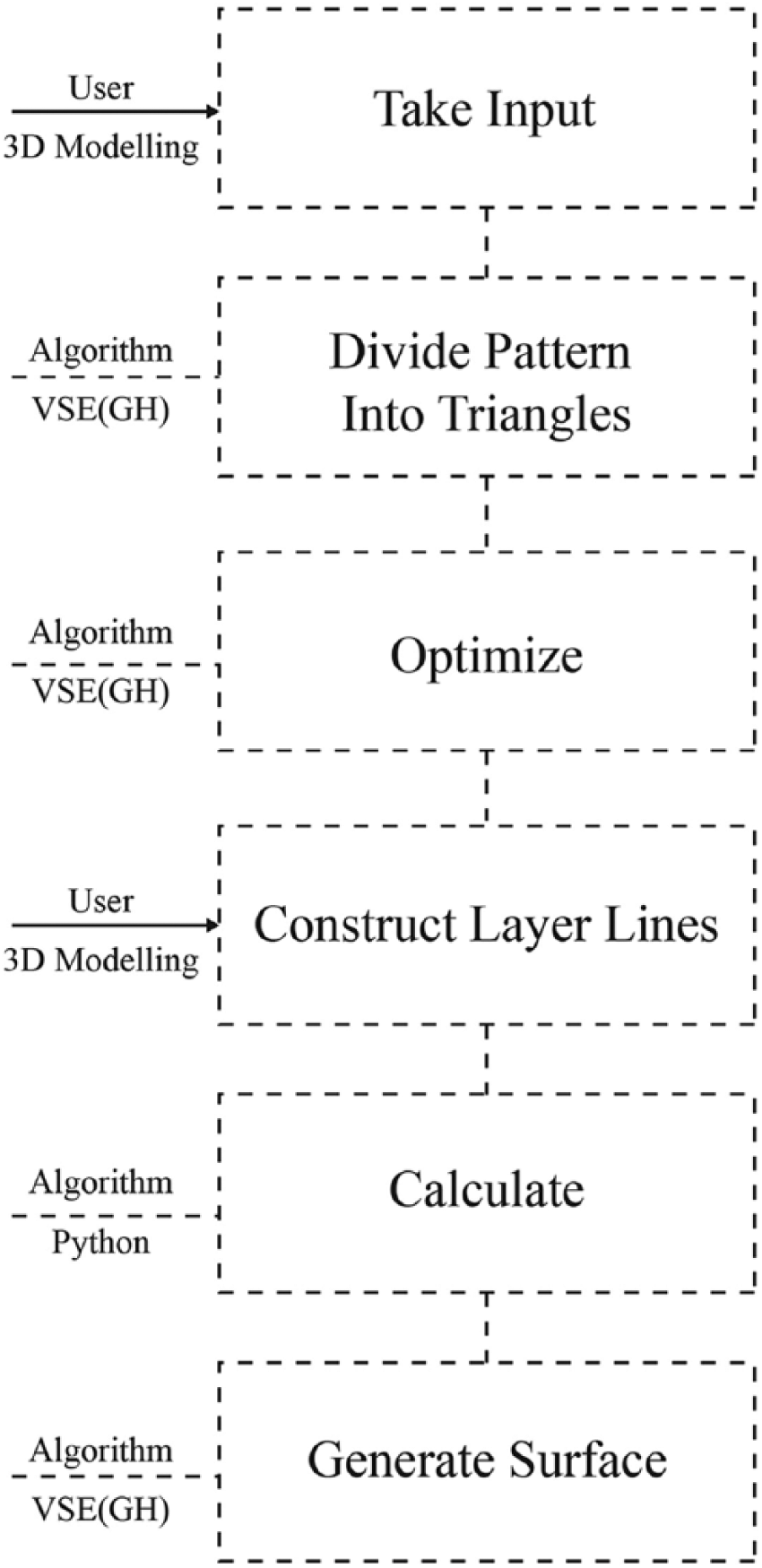
The algorithm schema of the 3D form generation process through layering.
This ‘layering’ approach consists of six steps. To start, an initial 2D pattern is required to be used as an input. This pattern can be either a 2D projection of a muqarnas pattern or any defined pattern. One of the constraints is that the neighbourhood conditions (adjacency) of the points should be taken into account. The initial pattern may include continuous lines, open and closed polygons or discrete points. However, in the second step, when the whole 2D geometry is selected, the algorithm excludes the open polygons and discrete points. Afterwards, the code excludes the overlapping points and generates triangular shapes. In the fourth step, the user is expected to draw layer lines by selecting adjacent points from the vertices of 2D patterns until all the points are selected. The code still works without selecting all the points; the unselected points are excluded in the next step. A sample layer selection and its outcomes are shown in Figure 14.
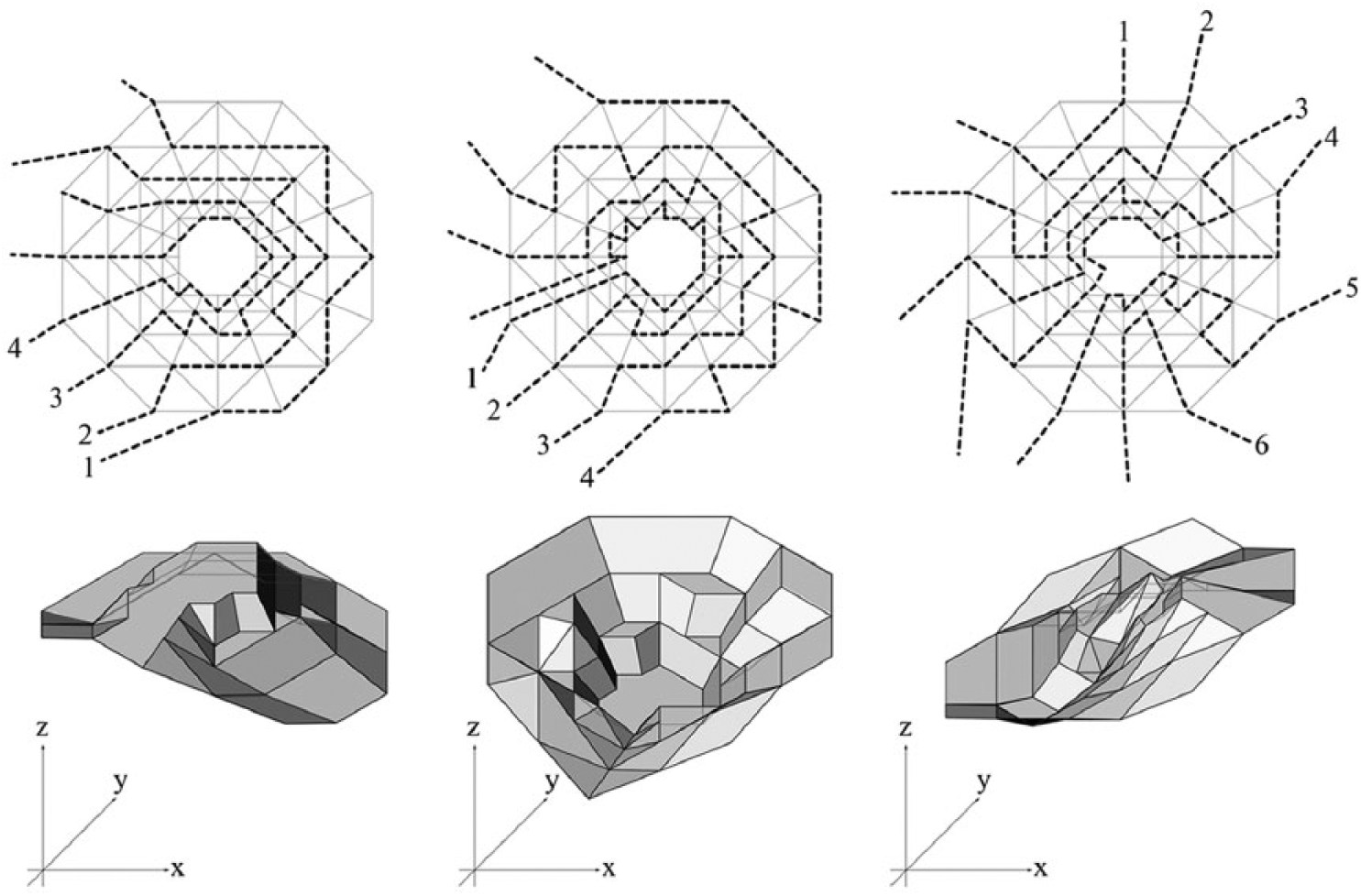
Implementation of layering approach to the 2D patterns derived from the previous phase.
Further to manual selection of the points, the Python code takes point list as a layer information, selecting from the lowest layer to the highest layers in order. Overlapping points are excluded. Calculations are made for each triangular field. The two vertices of the triangle are expected to belong to one layer, while the third point is selected from an adjacent layer. After providing this condition, the algorithm generates triangular surfaces as an outcome. The height parameter for the layers can be dynamically changed via VSE. This algorithm can be applied to different surfaces, although the boundary conditions and exceptions have not been tested yet.
In the scope of this study, the Karamba add-on for Rhino was used for force-flow analysis. Subdivision refers to a visual division algorithm generated in VSE which takes a closed polygon as an input. The workflow of this process is shown in Figure 15. The projection refers to projecting the vertices of 3D surfaces onto a 2D planar surface. Layering is open to user intervention by changing layer information via the selection of ordering of polygons or points (Figure 14). As a consequence of our explorations, we propose an open-ended surface folding process involving force-flow analysis, subdivision, projection and layering techniques in Table 2 (Figures 15 and 16).
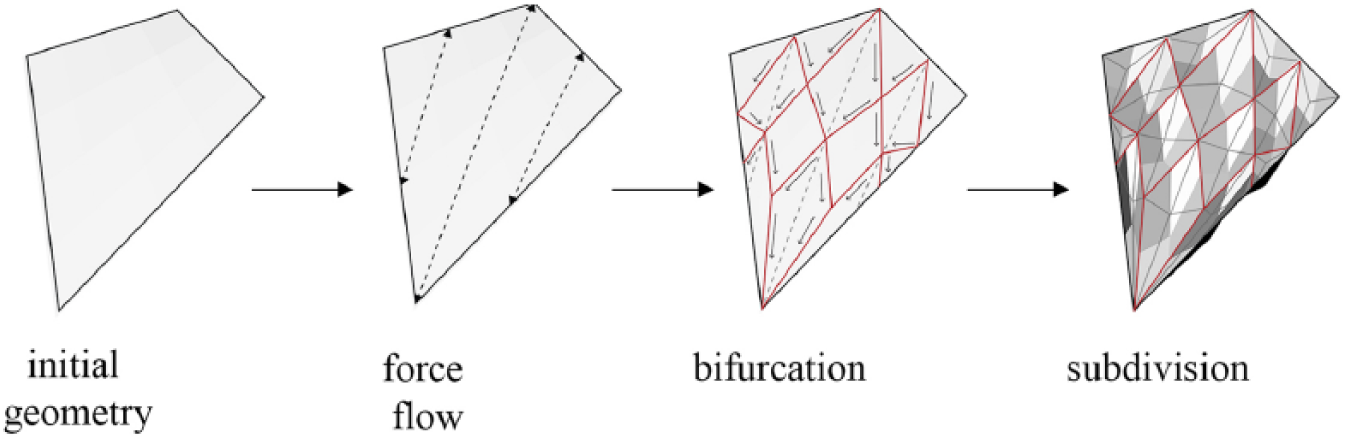
The schematic display of the bifurcation process.
Subcomponents of the bifurcated fold process.
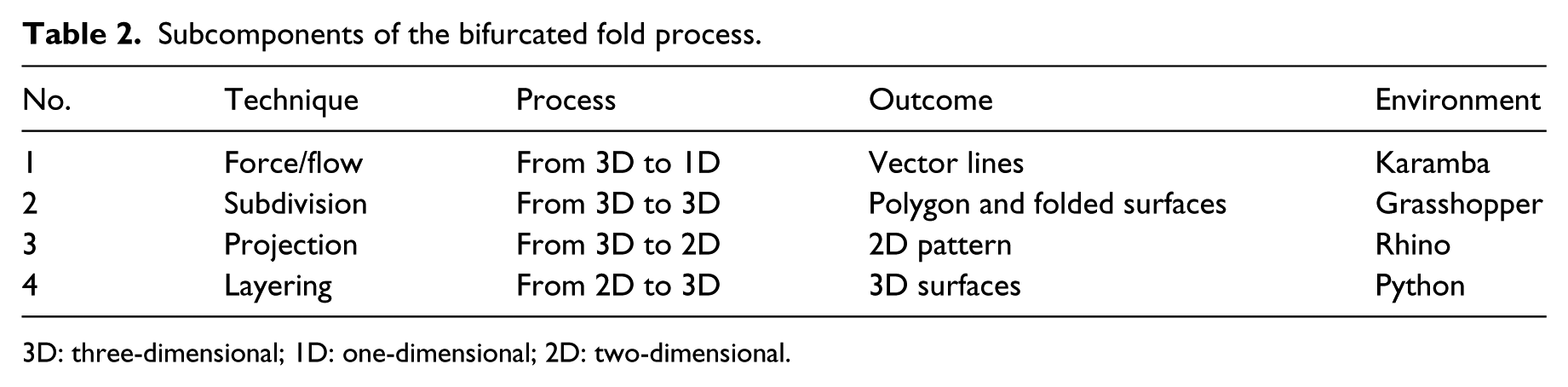
3D: three-dimensional; 1D: one-dimensional; 2D: two-dimensional.
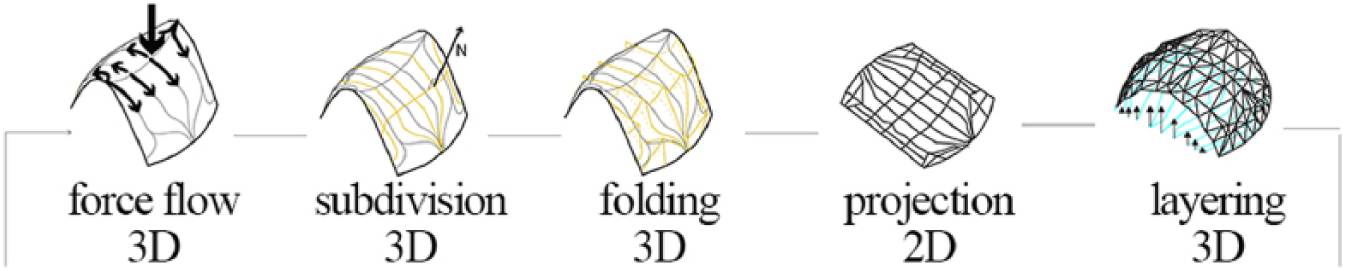
Diagram of the techniques described in Table 2.
In this table, projection and layering techniques are closely related to the generation process of muqarnas; force-flow and subdivision techniques are adopted to refer to the structural features of vaults. The techniques related to the operation of bifurcated fold do not have a sequential order. The operation involves different combinations of force-flow analysis, subdivision, projection and layering techniques. The order between each technique is varied to explore the new equilibrium states in form generation.
Achieving curvilinearity through muqarnas tectonics
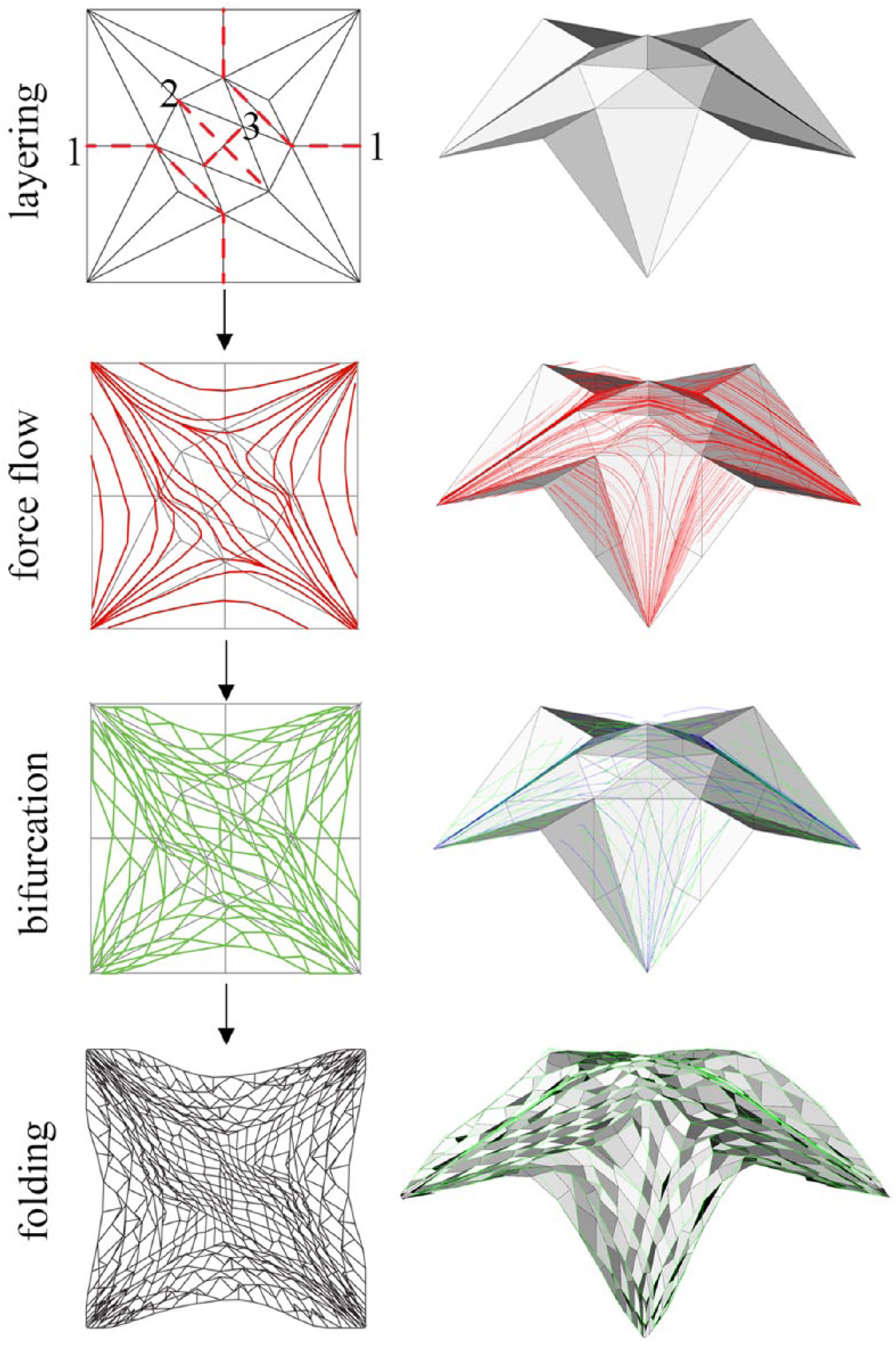
This section involves the outcomes of the implementation of bifurcated fold operation into partial models derived from the Fatima Masumeh Shrine Mosque of Qom (Figures 17 and 18) and the cellular vault of the 15th-century building, the Basel Minster (Figures 19 and 20). As shown in Table 3, the implementation of the phases requires an order. However, during the intertranslations among 2D projection, 2D pattern, 3D form and 3D folded form, the user can decide the initial input. The layering operation, which aims to generate a 3D planar and/or curvilinear surface based on a 2D pattern, involves user intervention.
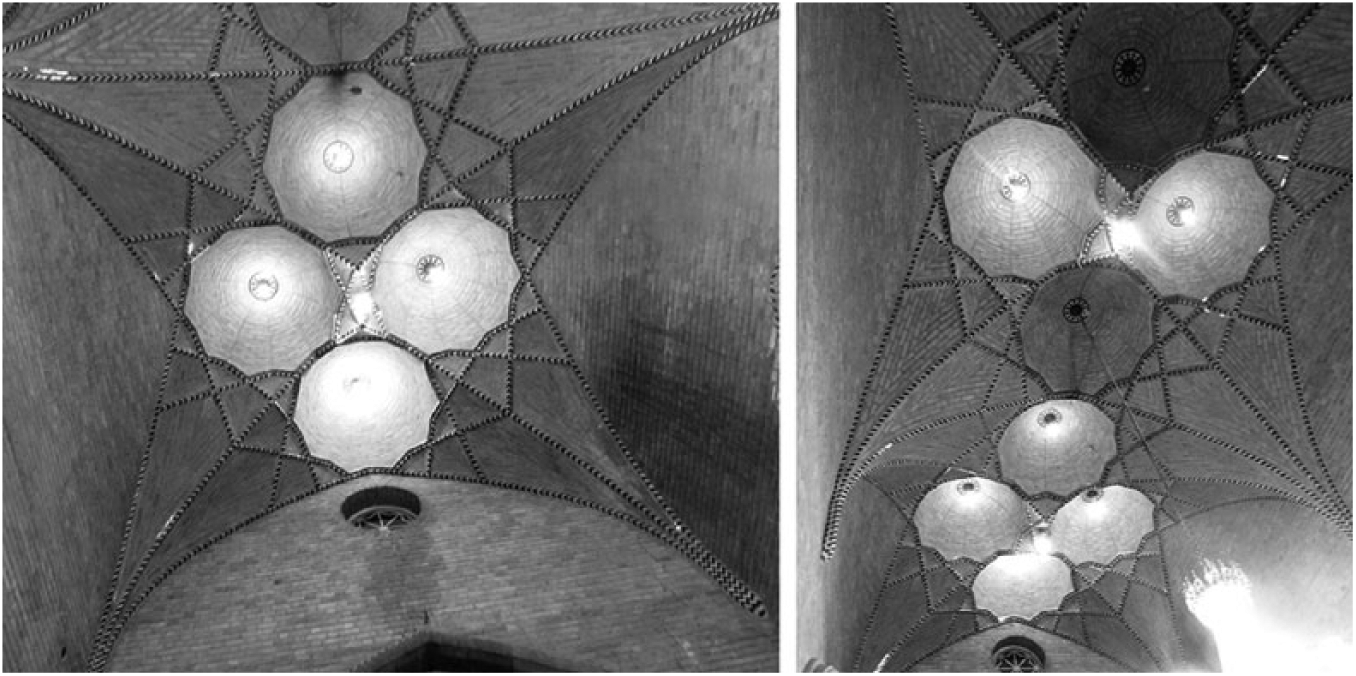
Ceiling muqarnas of Fatima Masumeh Shrine.
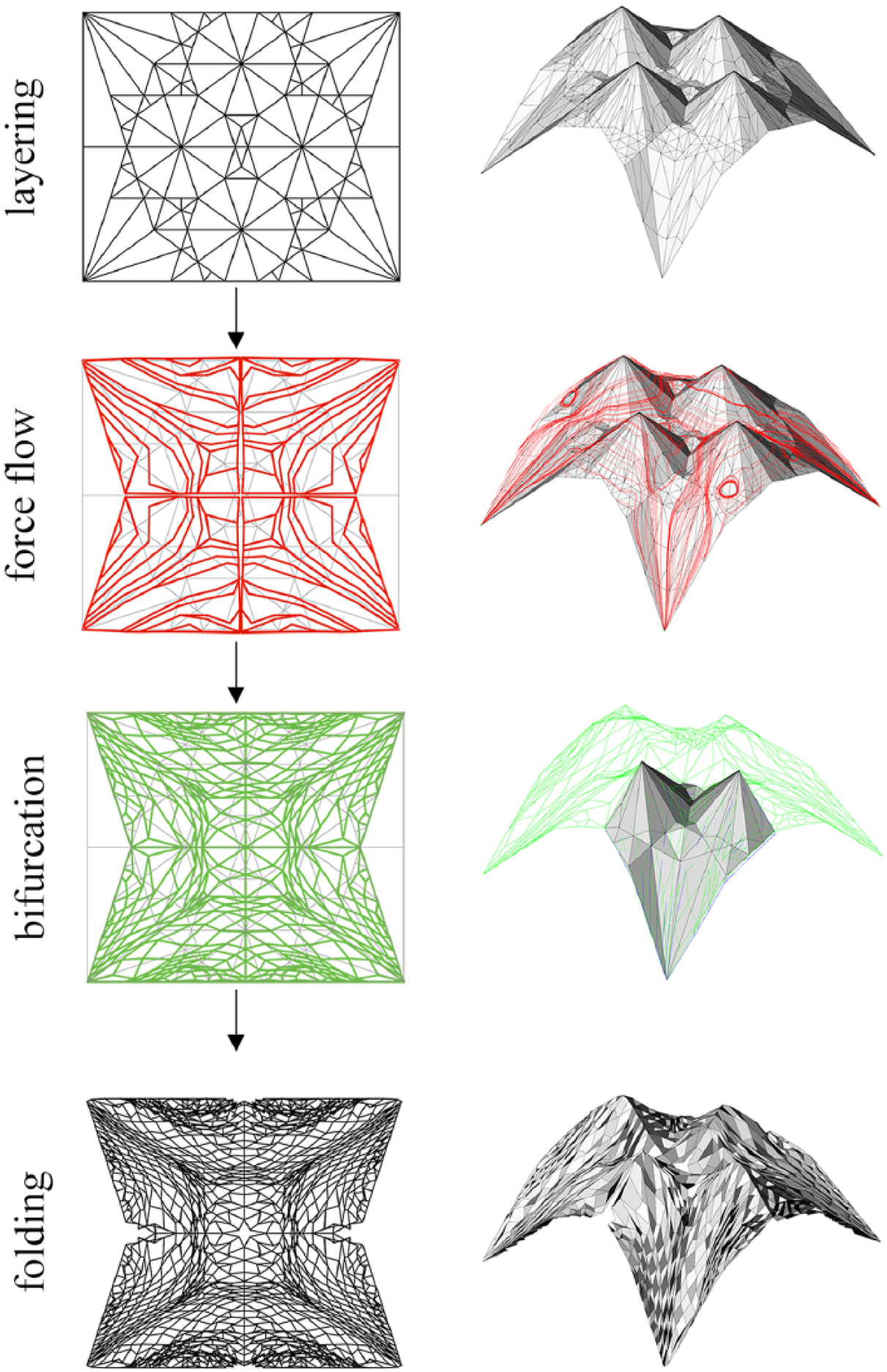
Form-making explorations based on Fatima Masumeh Shrine.
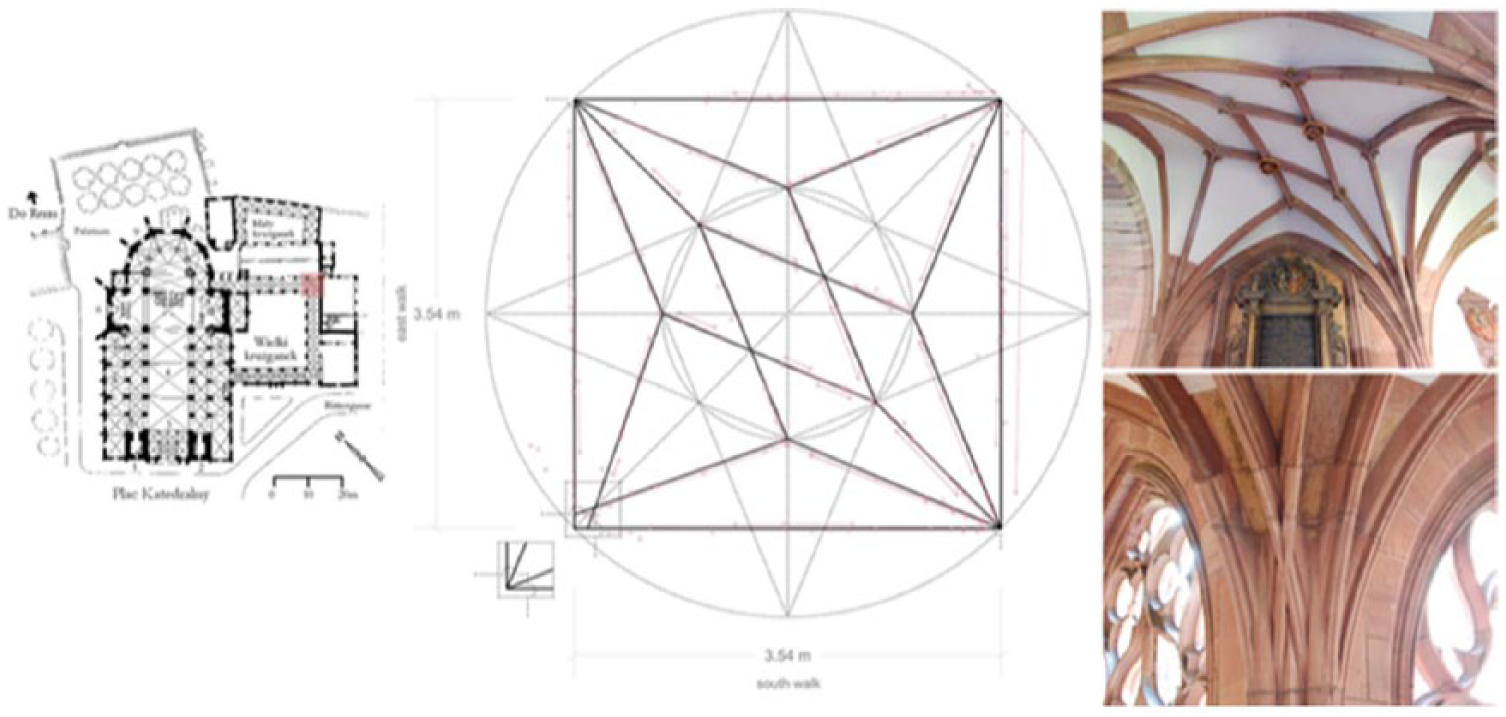
Left: ground plan of Basel Cathedral. Middle: projection drawing of the vault. Right: detail photographs. 33
Generating 3D variations derived from the Basel Minster Vault.
Possibilities of open-ended bifurcated fold process.
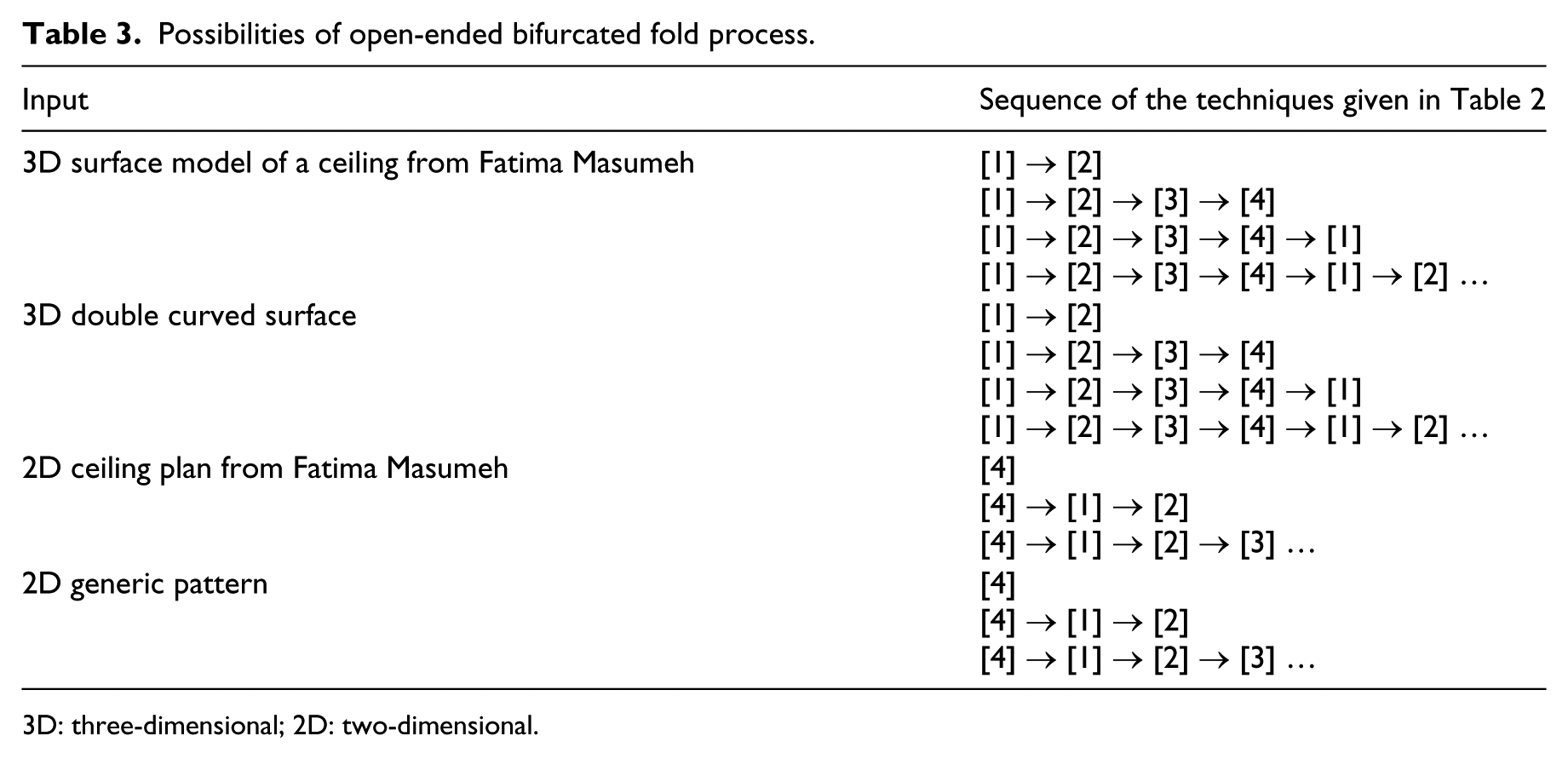
3D: three-dimensional; 2D: two-dimensional.
Both Fatima Masumeh Shrine Mosque of Qom and the Basel Minster have similar visual and operational patterns with bifurcated fold. In this section, these examples are interpreted and re-generated through the knowledge we gained during the analysis of muqarnas tectonics. 3D double curved surface or 2D geometric pattern adopted from the plan layout of these examples is used to start the generation process. The techniques (1, 2, 3, 4) explained in Table 2 are applied in different orders to explore new structural forms.
The complexity of the geometry and the spatial possibilities depend on changing the number of steps. Furthermore, the layering step (4) involves user intervention during the 2D layer generation process for 3D formal explorations.
We observed that unit-based assumptions resulted in similar outcomes both in a physical (Figure 11) and digital (Figure 12) environment. In addition to these, the hands-on modelling and fabrication with the laser cutter provided a better understanding of the geometrical organization before/during preparation of the algorithms. The form exercises in which visual and verbal scripts were used together had potential to generate diverse results. Despite the developed algorithms being defined and closed, the selection of the initial pattern and the user decisions during the layer definition enriched the outputs with unexpected results.
Conclusion
This article starts questioning the origin and the nature of a specific vault-like form: muqarnas. Since the very beginning of its emergence, muqarnas construction has carried the potential to be codified with maths, geometry and algorithms. Al Kashi’s 5 manuscripts provide core knowledge for artisans, introducing spatial and geometric relations (angles, dimensions, adjacency), rules (mathematical definitions, construction rule/order) and vocabulary elements (units, cells, roofs, filling elements). Those earliest assumptions and definitions have the potential to be reinterpreted by an algorithmic approach.
The value of what is called ‘fold’ is first to enable us to see the potentiality of a well-defined architectural element beyond conventional descriptive frameworks like measuring, unit-based decoding and 3D interpretation of 2D patterns. Trying to examine the formal rationality of muqarnas through a non-hierarchical and continuous system thinking (fold) which is permanently rejuvenated within its simple actions creates a chance to understand its ‘being’ and formation in an open and dynamic disposition. Folding is indeed a method of doing rather than analyzing. But this character of folding naturally shifts the standard, static and result-oriented explanation to a more complex level of comprehension that includes questioning about the process, rather than the product. Furthermore, since it always conveys the traces of each move, it provides to interpret the complete process step by step within an algorithmic flow in computational terms.
Second, the logic of fold and its specific implementation called ‘bifurcated fold’ operation can be considered as the unique contribution of this study, which carries the potential to open new horizons in the conception of performativity. Bifurcated fold is an open-ended surface folding process which specifically includes force-flow analysis, subdivision, projection and layering as sub-techniques and where each technique offers a distinctive transition between dimensions (from 3D to 1D, from 3D to 3D, from 3D to 2D and from 2D to 3D). While examining previous examples, we explored the similarities and the formal relations of the two selected samples by applying the bifurcated fold approach. The combinatorial capacity of such an approach interests us for its multiplicative character in relation to the idea of change and diversity. By pushing these representational qualities to their respective limits, we suggest here an archetypal correlation between form, structure and representation of muqarnas. We argue that encoding vault-like systems via geometric and algorithmic relations based on a logic of the ‘fold’ provides informative and intuitive feedback for form-finding explorations specifically in earlier phases of design.
This article presented a new schema to approach the generative, structural and performative aspects of muqarnas tectonics. By improving the basics of a well-known design technique fold, a more open-ended analysis and generation method has been implemented: bifurcated fold. The method remains unique in the way it gives a chance not only to make an analytical demystification but also to generate new opportunities. Empirical attempts to comprehend muqarnas tectonics in physical sense are accompanied with digital form-finding experiments regarding performative characteristics.
Footnotes
Acknowledgements
The authors would like to thank Prof Dr Toni Kotnik for his valuable comments on the earlier versions of the article. They also would like to thank İnanç Şencan and Furkan Tüzemen for their contributions in scripting and development of computational models.
Declaration of conflicting interests
The author(s) declared no potential conflicts of interest with respect to the research, authorship and/or publication of this article.
Funding
The author(s) received no financial support for the research, authorship and/or publication of this article.