







Abstract
Digital design paradigms in architecture have been rooted in representational models which are geometry centered and therefore fail to capture building complexity holistically. Due to a lack of computational design methodologies, existing digital design workflows do little in predicting design performance in the early design stage and in most cases analysis and design optimization are done after a design is fixed. This work proposes a new computational design methodology, intended for use in the area of conceptual design of building design. The proposed methodology is implemented into a multi-agent system design toolkit which facilitates the generation of design alternatives using stochastic algorithms and their evaluation using multiple environmental performance metrics. The method allows the user to probabilistically explore the solution space by modeling the design parameters’ architectural design components (i.e. façade panel) into modular programming blocks (agents) which interact in a bottom-up fashion. Different problem requirements (i.e. level of daylight inside a space, openings) described into agents’ behavior allow for the coupling of data from different engineering fields (environmental design, structural design) into the a priori formation of architectural geometry. In the presented design experiment, a façade panel is modeled into an agent-based fashion and the multi-agent system toolkit is used to generate and evolve alternative façade panel configurations based on environmental parameters (daylight, energy consumption). The designer can develop the façade panel geometry, design behaviors, and performance criteria to evaluate the design alternatives. The toolkit relies on modular and functionally specific programming modules (agents), which provide a platform for façade design exploration by combining existing three-dimensional modeling and analysis software.
Introduction
Undoubtedly, computational advancements have played a pivotal role in changing our built environment from being the materialization of drawings into constructed form as it was introduced in the Renaissance, into becoming the materialization of digital information. 1 Advances in digital design and fabrication have presented an exciting opportunity to merge digital and physical tools and processes for constructing non-standard building structures (Figure 1). In turn, it has created a demand for architects to address the complex character of design problems in a more methodological and integrated way to provide sustainable solutions that can cater for environmental and structural parameters. 2 As the complexity of building design increases and environmental performance standards have become more stringent, architectural designers have an important responsibility to employ design and creativity for developing new design methods which reduce building complexity and achieving more coherent solutions. Gero argues that computational approaches can be used to increase the capacity of designers to explore large solution spaces and manage the complexities of architectural design. The evaluation of a large space of possible design alternatives is essential in architectural design, as it has been shown by Woodbury et al. 3 and Gero and Sosa. 4 To enable architects to explore large solution spaces and evaluate multiple design alternatives, computational design approaches are considered crucial to successfully manage the conflicting inter-domain objectives of building design. This work presents a multi-agent systems (MAS) framework that draws on stochastic methods and implements agent-based models to incorporate design generation and evolutionary schemes with environmental performance in the early design stage of façades.
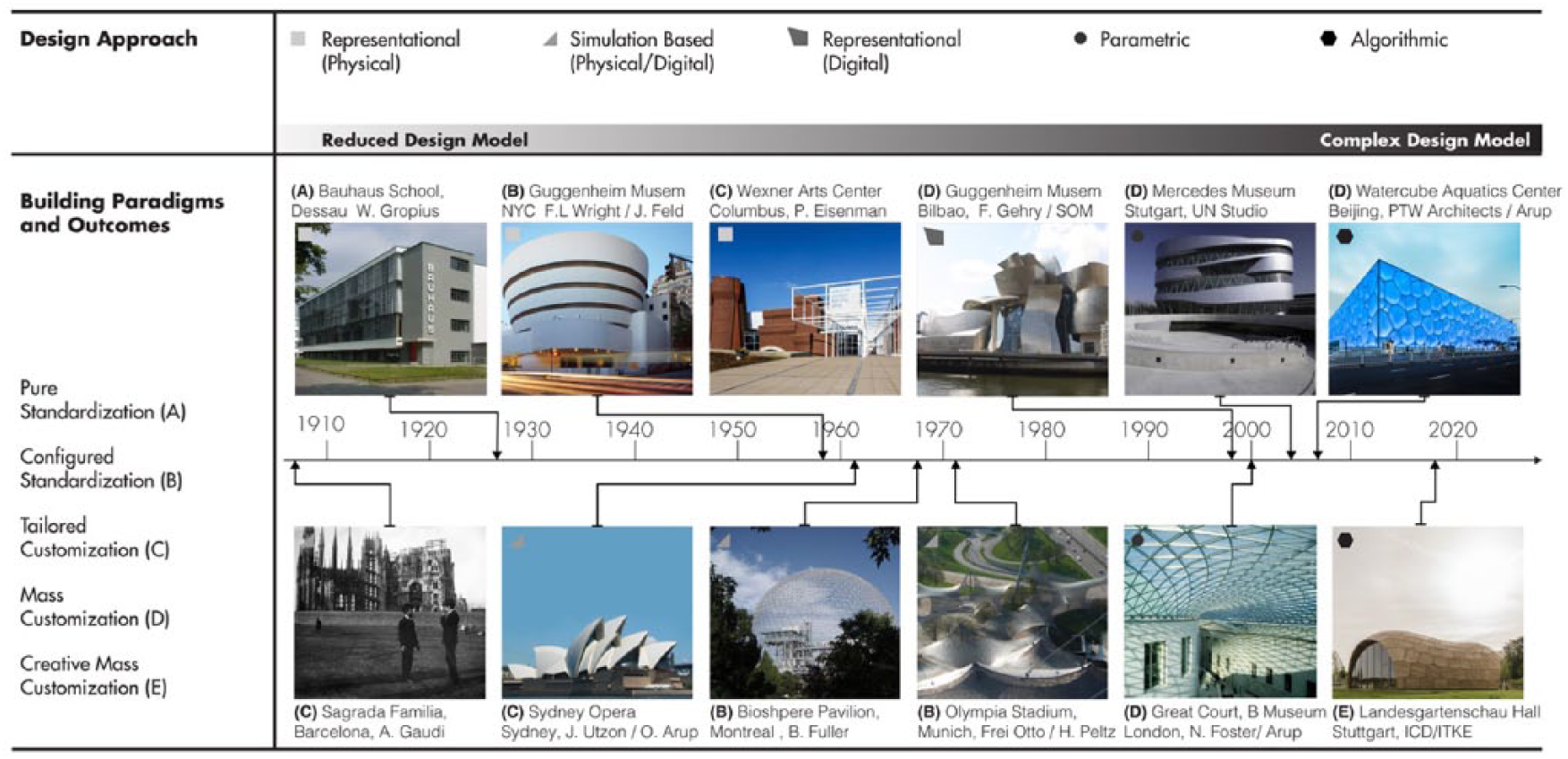
Timeline illustrating the increasing complexity in building structures in terms of the design approach and building paradigm used.
Building envelopes (façades) play a major role on the environmental performance of a building and therefore are a good example where environmental parameters can be used as a design driver for computational design exploration. Façade panels are considered to be a complex building component because their design combines structural, environmental, functional, and also aesthetical parameters, as the façade highly impacts the image of the building. 5 The high-energy footprint of commercial buildings (i.e. office buildings) has raised awareness and caused a shift from the early fascination of generating free from non-Euclidean geometries with no performativity whatsoever, toward approaches which focus into developing initially parametric and more recently building information modeling (BIM) models which can be adjusted based on their performance and/or other analytical data.
However, even today, each domain in the Architecture Engineering and Construction (AEC) field still provides largely independent solutions, which are already defined outcomes before being passed from one discipline to the other. This lack of discipline integration and inefficiencies in the design process has resulted in a built environment which accounts for 40% of global energy consumption and up to 30% of global greenhouse gas (GHG) emissions. 6 Therefore, up to 46% of the energy consumption is locked in for long periods due to the life span of buildings.
Taking into consideration environmental parameters such as daylight and heat gain in the early design stage shows great potential for reducing energy demands of a building but can also be used for increasing occupant comfort inside the building.7,8 In recent years, we have seen an increase in both complex fenestration and paneling systems, on one hand, and an increased use of environmental analysis as a means to rationalize design alternatives, on the other hand. However, daylight simulations tend to be time-consuming and apart from few exceptions there is a lack of generative tools that can enable designers to produce multiple design alternatives and get design performance feedback early in the design stage.
The direction of architectural design
Architectural design so far has been rooted into descriptive (perspective) modeling which is used to produce the geometrical models which are then passed to engineering disciplines to conduct analysis before it moves to construction. Early research efforts focused in developing computer-aided design (CAD) tools which reduced complexities relating to drafting and the automation of drawing production rather than developing new design methods and tools which transcribe fundamental formative processes into architectural design. 9 Parametric and subsequent performance-based design emerged as an integrated approach, which allows designers to consider environmental and structural parameters in the early design stage and with it has come a new maturity that promises to transcend the formal and geometric innovation that was mainly driving the interest in using digital technologies. 10 The literature suggests that to be able to explore multiple design solutions and gain intuition on how design decisions affect the performance of a building, designers need to take advantage of computational methods that will allow them to predict the models’ behavior and rapidly generate design alternatives by coupling design parameters with performance metrics. 11
An increasing number of researchers have started developing rigorous computation-based approaches for exploring architectural form based on the concepts of form finding and optimization,12,13 evolutionary computation and emergent behavior, 14 digital fabrication, 15 and rule-based models. 16 Even though there has been a significant research effort in this area, currently there are several competing approaches on how to integrate computational techniques in the design process. Most of today’s digital designers bounce between multiple, yet disconnected design tools, and a centralized all-in-one solution. The former approach (distributed) is easily observed by the introduction of numerous specialized analysis tools which appeared over the past two decades in digital design.17,18 While the plurality of tools allows designers to use specific tools for specific tasks, its disconnectedness does not allow designers to account for multiple criteria synchronously in their projects, and the addition of multiple tools onto the design process after a point makes it overcomplicated and inefficient. The latter approach (centralized), which is manifested by the rise of BIM, anticipates a linear design process where multiple design teams add their information into a central building model which is managed by one software package. 19 If a designer was to run multiple analyses on a centralized building model, each model element would have a big number of properties and geometry types with it. This is because each kind of analysis requires a different type of modeling. Thus, adding or altering an element in a centralized model would either be slow or unfriendly to iteration. Although BIM is already being used widely for producing construction documents and suits later design phases, it proves to be more slow and rigid for early design stage where architects prefer quick design alterations.
The shift toward a maturity stage of this digital era in architecture, also referred to as the third digital turn by architectural theorist M Carpo, 20 requires architectural researchers to develop new kinds of abstractions and move away from the reductionist models, if they wish to wisely use computational methods for architectural purposes.10,21 In other words, architectural design practice has to move forward from a “less is more” approach which relies on top-down planning and is based on experts’ assumptions toward a “more is different” approach where personal assumptions are formalized into computational models and are supported and validated by data (Figure 2).
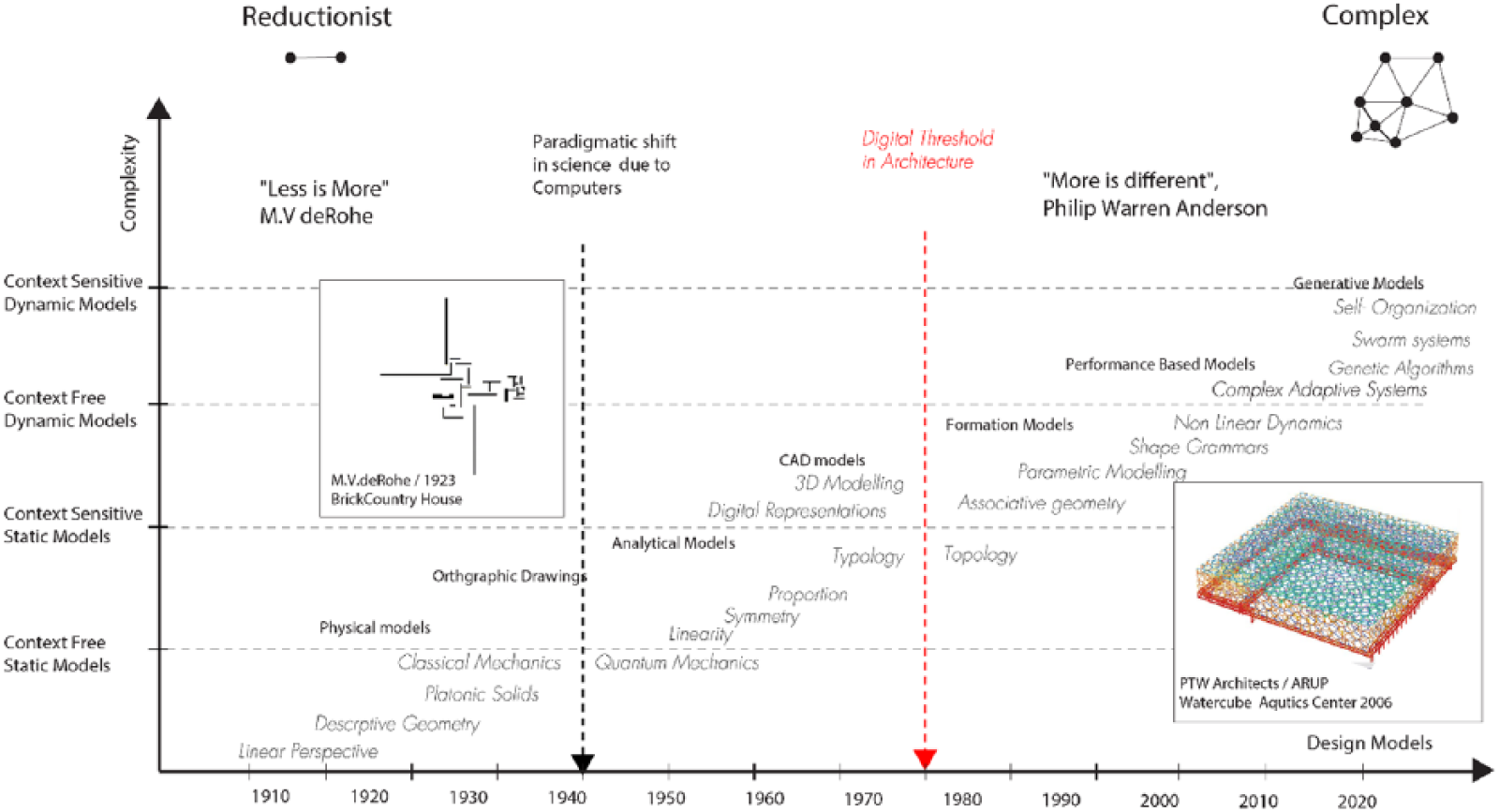
Timeline showing the evolution from reduced to complex design models in relation to the type of model (dynamic/static) and whether it considers or not environmental parameters.
Problem description and research question
From the above discussion, we can summarize that current design methods in architectural design are mostly computer based but not computational. In addition, we identify two main research approaches: a centralized and a distributed one. Both have advantages but share the same philosophical fallacy: they have focused on developing sophisticated design tools but have not reconsidered the existing methods and workflows designers tend to follow. This work attempts to address the following questions:
How can we explore generative design through an MAS approach were design problems are decomposed into different agencies?
How can we develop abstractions to meaningfully correlate multiple design domains (architecture, environmental engineering) in the early design stage so that the designer develops intuition of the impact of specific design decision on building performance?
How can we develop tools that allow uses drive design exploration by manipulating stochastic algorithms and easily defining heuristic functions?
This work presents a MAS framework for design exploration which focuses on the early design stage. Instead of developing an “all-in-one” design tool or yet another disjointed design tool for a specific task, this work presents an agent-based design methodology where different design domains are modeled as agencies into one coherent framework which is built on top of existing three-dimensional (3D) modeling software. Such methodology supports design exploration via heuristic search by allowing the designer to model design goals per his or her intentions. The methodology is manifested by a prototypical MAS toolkit which seeks enhanced workflows between existing software and helps designers to model the solution space of a design problem at stake.
The structure of the study is the following: In section “Related work,” the basic characteristics and applications of MAS are described. In section “Proposed methodology,” the developed MAS methodology and framework are explained, and in section “Experimental design—agent-based façade design,” a design experiment is described where we apply our framework.
Related work
Multi Agent Systems (MAS)
Research has shown that the complexity and uncertainty, which are often encountered in design problems, can be effectively addressed with distributed computation and artificial intelligence.22 –24 The nature of design problems is “ill structured” and therefore designers must engage in defining abstractions in order to explore design alternatives and optimize solutions.25,26 The capacity of distributed systems, in this case MAS, to abstractly model requirements as agent goals and to adapt to local conditions, has rendered them appropriate for solving a large class of real-world problems in a number of domains, including software engineering, financial markets, pedestrian flows, security, and game theory.27 –29
An MAS is defined as a computerized system composed of multiple interacting agents within an environment. Agents can act together to achieve more complex goals that any one agent can achieve on its own. Minsky termed as “agency” is a group of agents acting together which later evolved in the field of MAS.30,31 MAS is considered an example of distributed artificial intelligence (DAI) and such systems have shown capacity to develop intelligence via heuristic search methods and reinforcement learning.
Even though there is a considerable overlap between MAS and agent-based modeling and simulation (ABMS), it is important to point out that an MAS is not always the same as ABMS. The main difference between MAS and ABMS is that the latter is used to search for insight into the collective behavior of agents by following simple rules, such as complex adaptive systems (CASs). On the contrary, research on MAS is targeted on solving specific engineering problems and the agents’ behaviors and structure can be modeled per problem and not appropriately according to a natural system. The ABMS terminology tends to be used in scientific fields such as biology, while MAS is more common in engineering and technology. There exist several properties such as emergence, aggregation, non-linearity, autonomy, diversity, and mechanisms, such as planning, tagging, internal models, building blocks, that are common (between ABMS and MAS) and serve as a reference for designing and developing agent-based models that can be synthesized to form an MAS.22,27,32,33 Due to their modularity, MAS is adequate for producing portable, extensible, and transferable algorithms, with better integrated development environments and more applications.22,34
The relevance of CAS and MAS for design
MAS is closely related to CAS, which is characterized by their ability to self-organize and dynamically reorganize their components in different ways and across multiple scales. 35 Social insects are a popular analogy for describing the potentials of using MAS approaches for solving complex problems. Termites, for instance, have been colonizing a large portion of the world for millions of years building collectively sustainable structures which utilize available resources.
Studying how social insects and other animals (i.e. beavers) are building their own habitats 36 can serve as a starting point for developing new abstractions in architecture and engineering using an MAS approach. However, it also requires a deeper understanding of how such evolutionary and generative mechanisms in nature can be described with mathematical models. Mathematical modelling is essential for describing and simulating such processes with computers. 37
This research direction toward the sciences of complexity as they are named has been greatly supported by findings from researchers working at Santa Fe Institute (SFI) who questioned reductionist models and helped establish complexity theory as a separate field. 37 Following the founding of SFI, there have been a number of applications that range from economy to advanced manufacturing, where models derived from CAS were used to solve real-world problems and predict the behaviors of systems. 37 This is where the importance of modeling comes into play. Modeling an artificial system such as a building is very different from modeling an ant colony.
Unlike a CAS which already exists, such as an ant colony where scientists are trying to understand the interactions between ants and use that to make testable predictions, a building model does not exist. Due to the added complexity of creating a model of something that does not exist, the building models we are currently using are simply descriptive and not at all predictive. Digital models in architecture have been successfully used for formal explorations, but only in few cases, they have been used to make predictions for other types of structures or for studying the construction process and performance of the structure. 38 However, as the complexity of our built environment increases, developing predictive models which are based on concepts of emergence and DAI are considered crucial for avoiding inefficiencies resulting from reductionism and centralized top-down planning.
Such concepts form the basis of MAS and can serve as platform to develop new design paradigms which do not rely on reductionism and linearity but embrace non-linearity and systems thinking and are moving away from a “less is more” toward a “more is different” approach. Self-organization and emergence are a set of dynamic mechanisms whereby structures appearing at the global level of a system from interactions among the system’s constituent unities are executed on the basis of purely local information, without reference to the global pattern which is an emergent property of the system, rather than a property imposed upon the system by an external ordering influence.37,39
Application of MAS in AEC
Application of MAS in the AEC industry has been less pervasive. Beetz et al. 40 classify MAS in AEC under three domains of design generation, namely, knowledge capturing and pattern recognition, simulation and performance of building designs, and collaborative environments. In the fields of engineering and construction, researchers have been exploring the applicability of MAS from different perspectives, such as for collaborative design, construction scheduling, and structural optimization, to name a few.40 –43 Agent-based simulations have been used in digital fabrication and building construction for their capability to abstract, adapt, and simplify real-time complexities into simple basic rules. 44 In addition, there has been significant research in developing MAS for autonomous collective construction both at the level of algorithms and at the level of hardware.45,46
In the field of architecture and computational design, the focus of the research so far has been mostly on design generation (form and aesthetic) and simulations.47,48 Approaches to design generation can be classified as linear and non-linear based on algorithms that operate either in top-down or bottom-up fashion.49 –51 Many have argued that top-down approaches offer control though not enough design flexibility as they operate on fixed design topologies that are sequentially decomposed. 52 On the other hand, bottom-up algorithms can be challenging to apply for design purposes and often exhibit a lack of control in the design outcome. 53 In the literature, most of the research works in agent based approaches for architecture have focused on the generative aspect of agent-based simulations and have mainly implemented variations of a simple ontological agent model that of boids.42,54 –58 Snooks argues “swarm intelligence” can enable the encoding of design requirements either into agent behaviors of different populations that belong to interrelated sub-systems or within a population with adjustable or differentiated behaviors of one system.42,59,60 The distributed nature of agent-based models enables the mutual negotiation of relationships between different design parameters, such as program and form or structure and ornament. 59 Similarly, Menges has used swarm-based agent models in order to establish communication, across different design environments (architectural design, structural design), and/or different hierarchical levels (global geometry, material structure) and thus allow for the uninterrupted flow of information from input parameters into multiple design constraints.14,61 Focusing more on pattern recognition and the representational aspect of design problems, Achten has proposed an MAS framework for graphic unit recognition in technical drawings. This approach suggests that singular agents may specialize in graphic unit recognition and MAS can address problems of ambiguity through negotiation mechanisms. 62
However, outside the field of architecture, engineers have been focusing on developing MAS environments based upon more complex agent models. Along those lines, Marcolino et al. 63 have presented a novel approach, which combines agent models (social choice) with number theory, and is applied to optimize building design. This approach presents teams of uniform and diverse agent populations with different design and performance goals. The developed system aggregates the agents’ opinions, which relate to a predefined range of design requirements, in order to provide designers with a larger number of pareto optimal design solutions. 64 Soibelman and Pena-Mora have implemented an agent-based reasoning model that enables designers to explore conceptual structural designs for tall buildings more rapidly. In their approach, an MAS (M-RAM) generates solutions by implementing a distributed multi-constraint reasoning mechanism and provides the designer with previously adapted solutions for evaluation. 65 In the field of building performance evaluation and control, Dijkstra et al. 66 created a custom platform, AMANDA, to simulate pedestrian flows in urban environments. Meissner et al. 67 have used MAS and agent-based simulations for the support and integration of fire protection engineering into the planning process, while Klein et al. 68 have used MAS in combination with Markov decision problems (MDPs) in order to develop alternative building management and control systems in relation to occupant habits and preferences.
Despite the aforementioned applications, the encoding of the design requirements (i.e. building design requirements) into agent behaviors and the definition of agent classes upon the decomposition of a given design problem are most often highly complex and consequently hard to achieve.41,69 Therefore, although there is considerable development and utilization of distributed/bottom-up models in computer science and other fields of engineering, the direct implementation of MAS achievements in AEC is not as straightforward due to the gap in the degree of formalization of problem requirements during the building design process. 10 More specifically, in the field of computational architecture, the majority of the research has relied upon a simple MAS model and swarm intelligence models and has mainly focused on the generation of geometry-centric and aesthetically intricate design outcomes and not so much for optimizing form or gaining design intuition. Thus, we can conclude that little research has been done in combining generative processes with analytical processes and user-related data (i.e. daylight) in a distributed fashion, as well as in adapting and utilizing more sophisticated agent-based algorithms such as MDPs and team formation models. We have also noted that there are two critical impediments to the furtherance of MAS in general and specifically for architecture: (1) there exists a lack of methodologies to enable (software) designers to clearly specify and model their applications as MAS and (2) the lack of widely available MAS toolkits that support designers to effectively explore larger solution spaces.
Proposed methodology
An MAS design framework has been developed that consists of a computational methodology and an evolutionary design tool. 70 The proposed methodology aims to integrate performance-based daylighting design exploration and optimization into the early design stage by offering an agent-based stochastic search method which can be customized to match the designer’s specific needs. The designer can develop the basic 3D geometry and the software can generate design alternatives which are evaluated for performance metrics defined by the designer.
The framework evolves around the hypothesis that designers will need to develop new types of abstractions (i.e. mathematical models) which can be used to describe design problems in generic problem-solving algorithms to be able to deal with increasing complexity in building design.
In this proposal, a new agent-based design framework for computational morphogenesis is presented where the modeling of design requirements from different design domains into agent behaviors is suggested. The framework focuses on the early design stage and the objective is to enable designers to couple geometry with different types of numerical analysis in an agent-based fashion and automatically generate and evaluate design alternatives using principles of evolutionary programming (Figure 3). The implementation of custom types of agents allows us to traverse the solution space, extend existing form-finding methods such as particle spring systems, and couple them with analytic data via heuristic functions. Strategies for exploring the solution space can be achieved by introducing different hierarchies and behaviors between the agents. The fundamental novelty of this methodology is that different types of agents are implemented for each aspect of the design cycle, namely, synthesis, analysis, and evaluation, and are combined in teams in order to achieve specific design goals defined by the design team.
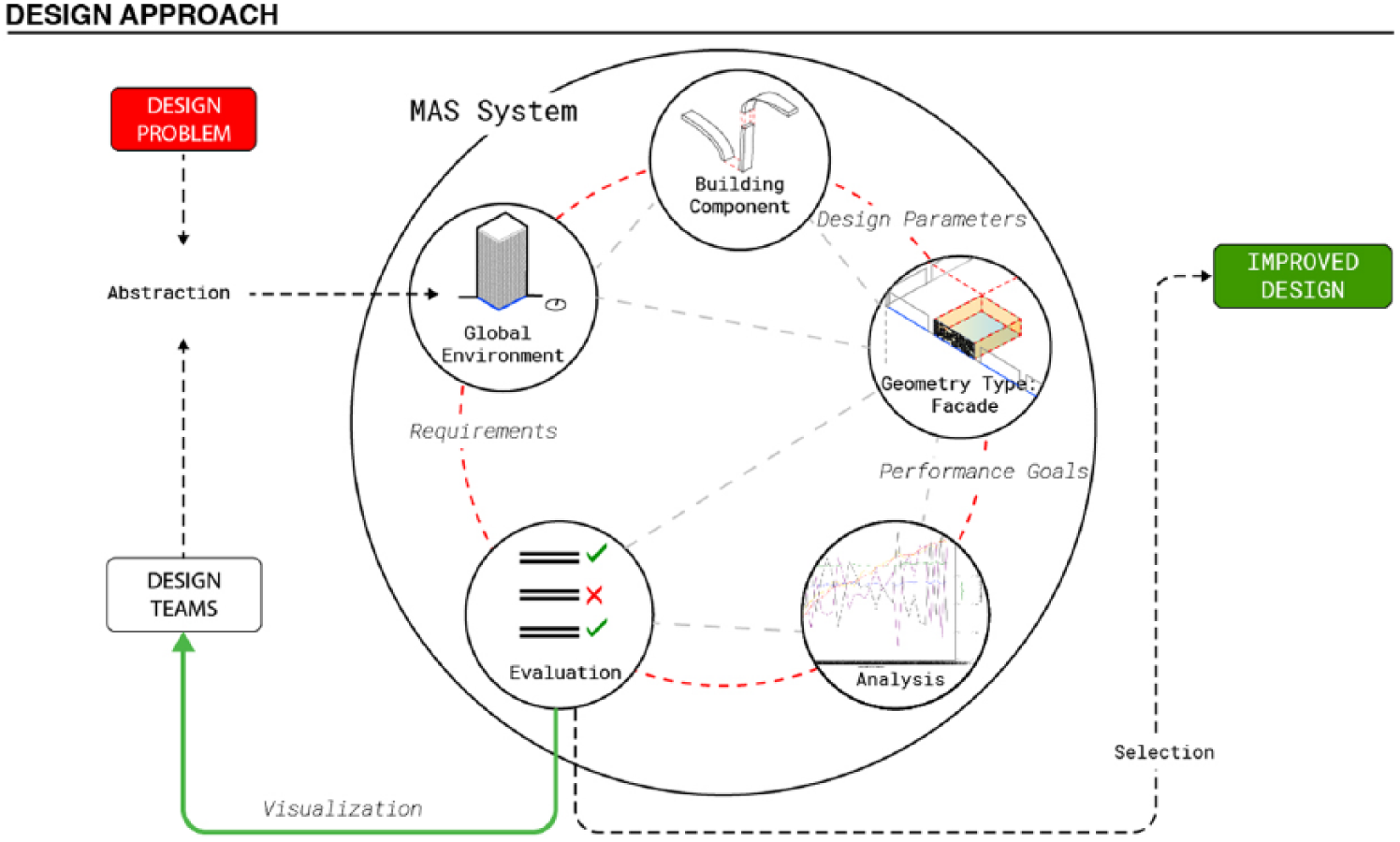
Diagram illustrating the overall design approach including design problem decomposition, designer interaction, results, and feedback loops and the decomposition of the system into subdomains including design generation, simulation, analysis, and evaluation.
A multi-agent design system is implemented using a combination of open-source tools and by accessing the API of Rhinoceros, a commercial 3D modeling environment that is used across different design and engineering disciplines. Within this framework, a number of design solutions are generated, evaluated for multiple environmental performance metrics and presented to the designer so that he or she can take informed decisions early in the design stage. This method represents initial steps toward integrating performance-based goals with geometric formation in the early design stage using a decentralized and agent-based approach. The objective is to enable designers explore multiple solutions by setting environmental parameters as well as basic geometric input (Figure 4).
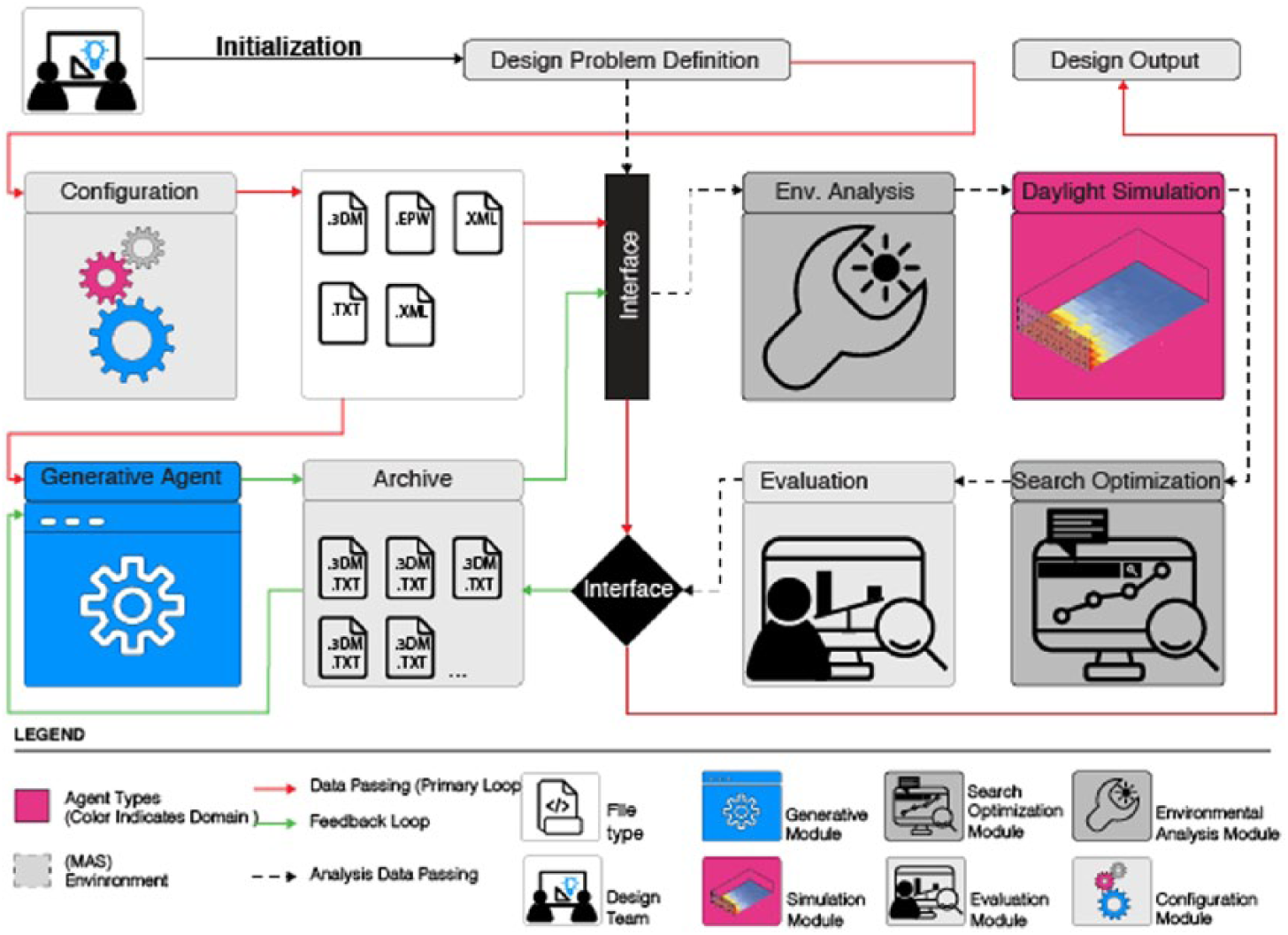
MAS framework diagram showing agent classes and interdependencies between agents. Numbers in each component indicate the process workflow.
Custom agent class development
Our approach is developed in two stages: (1) the generative aspect of design, where agents act autonomously, and (2) the optimization of generated outcomes, where agents act collaboratively and negotiate to find optimal solutions. Our system explores these complexly coupled relationships between and internal to the generative and analytical design processes.
First, a set of generative agents and behaviors are modeled, based on a given design site’s location and orientation, a building façade bounding context, and designer-defined parameters that append to building components (i.e. length, width, thickness, type). Initially, the systems’ agents act autonomously and develop design alternatives, which satisfy local rules and constraints from the geometric domain, avoiding specific areas that are reserved for window openings and views and collision checking for constructability. During a second loop, the designs are analyzed by a set of specialist and user preference agents, which communicate their data back to the generative agents in order to adjust parameters to regenerate design alternatives based on specific user preferences and performance goals. Five different classes of agents are modeled, with actions, properties, states, and goals (Figure 5). Our agent classes include the following:
Generative agent that relates to the design intention and geometric properties of the building component and is responsible for generating façade panels that regulate the amount of light that enters the office space;
Specialist agents with several different sub-classes (based on the types of analysis) for analyzing and evaluating the generated designs’ performance;
Simulation agent that is responsible for simulating analytical results and/or user preferences and presenting them to the designer;
Evaluation agent is responsible collecting available analytical data and based on heuristic functions evaluate and rank design alternatives;
Coordination agent ensures each agent is aware of other agents’ states and is responsible for the communication and coordination of the different classes.
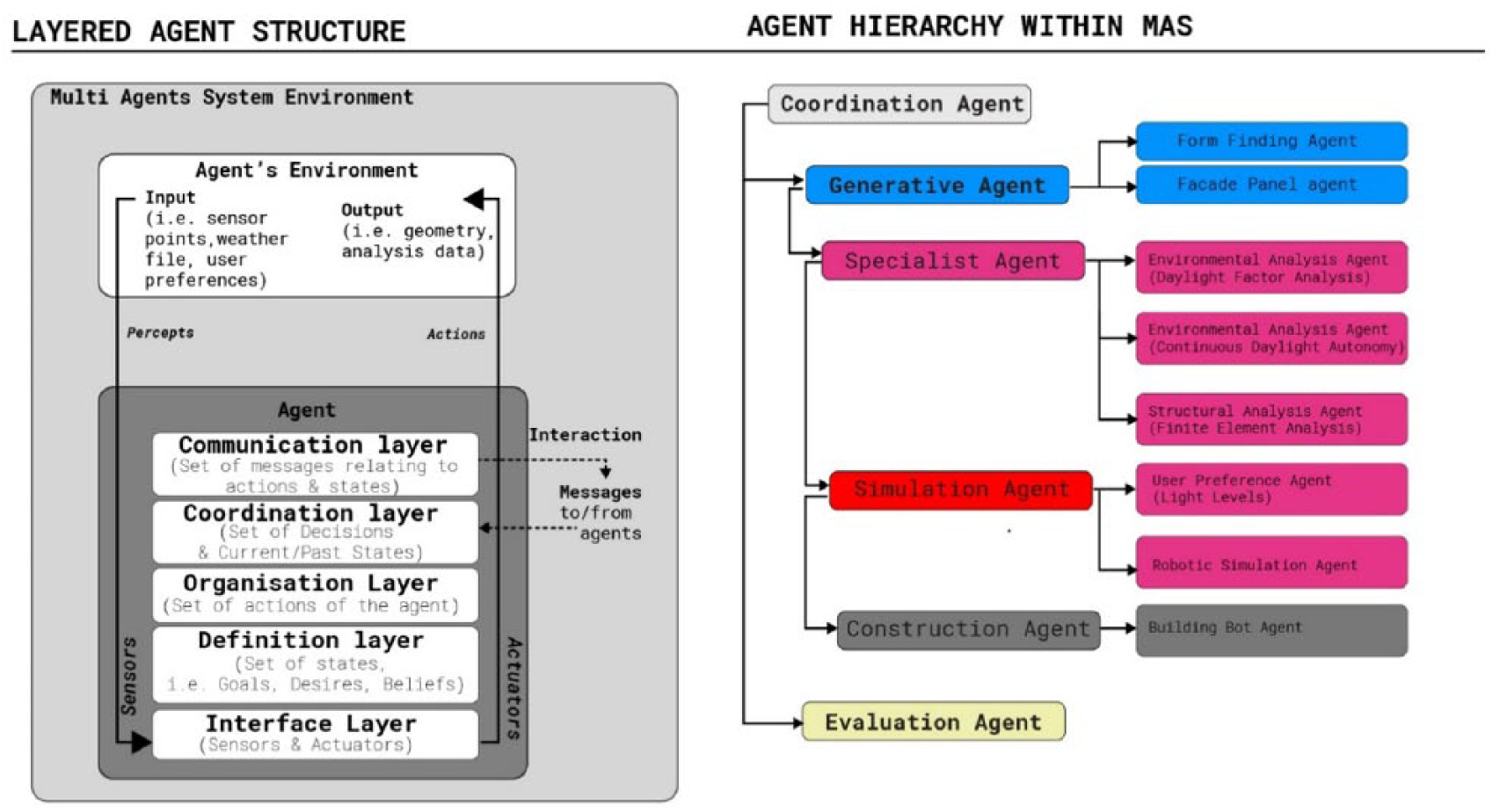
Diagram illustrating the typical agents’ internal structure, agent types and agent hierarchy within the MAS for design. In the table, in the bottom, we list the design parameters of the agent panel.
All agent types have the same number of layers, but their definition is based upon a specific domain (i.e. structural engineering) and a basic set of principles that are related to the specific domain and affect the agent’s behavior. Behavioral rules may vary in complexity and levels of information taken into account during the decision-making process. The level of information for each agent can be either on established analytical methods for environmental and structural design or on the designer’s experience. For instance, the behavior of a generative agent with the goal of designing a façade is dependent on a set of input parameters which are coupled with basic principles that can be found across environmental design methods such as (1) orientation, (2) sun positions, and (3) level of light with regard to use of space.
Agent coordination, evaluation, and negotiation
Communication and negotiation mechanisms among the agents are established in order to update the behavior of the generative agent(s) and improve their geometric results. Text file messages update values and/or actions to negotiate across different agents. At each iteration, the agents check the state of other agents, report their state, calculate their utility, and predict future actions based on the utility. The effect of their actions and behaviors on other agents is dependent on the hierarchy established among the different agents (i.e. generative agent is higher in the hierarchy than the specialist agent) or the degree of importance of each agent’s related behavior which is expressed as a utility. The target of the negotiation for each agent is to satisfy its own goal while minimizing the negative side effects on the other agents. The satisfaction of each goal is measured by the increase or decrease in each agent’s utility.
Hierarchy among the agents is established and applied by a coordinating agent that communicates and controls the rest of the agents. Figure 5 illustrates the basic structure of an agent and the established hierarchies among the system’s agent classes. The designer is responsible for designing the interaction mechanisms between agents and different input design parameters. The designer also couples different types of analyses with design parameters and establishes trade-off processes among the agents (Figure 6).
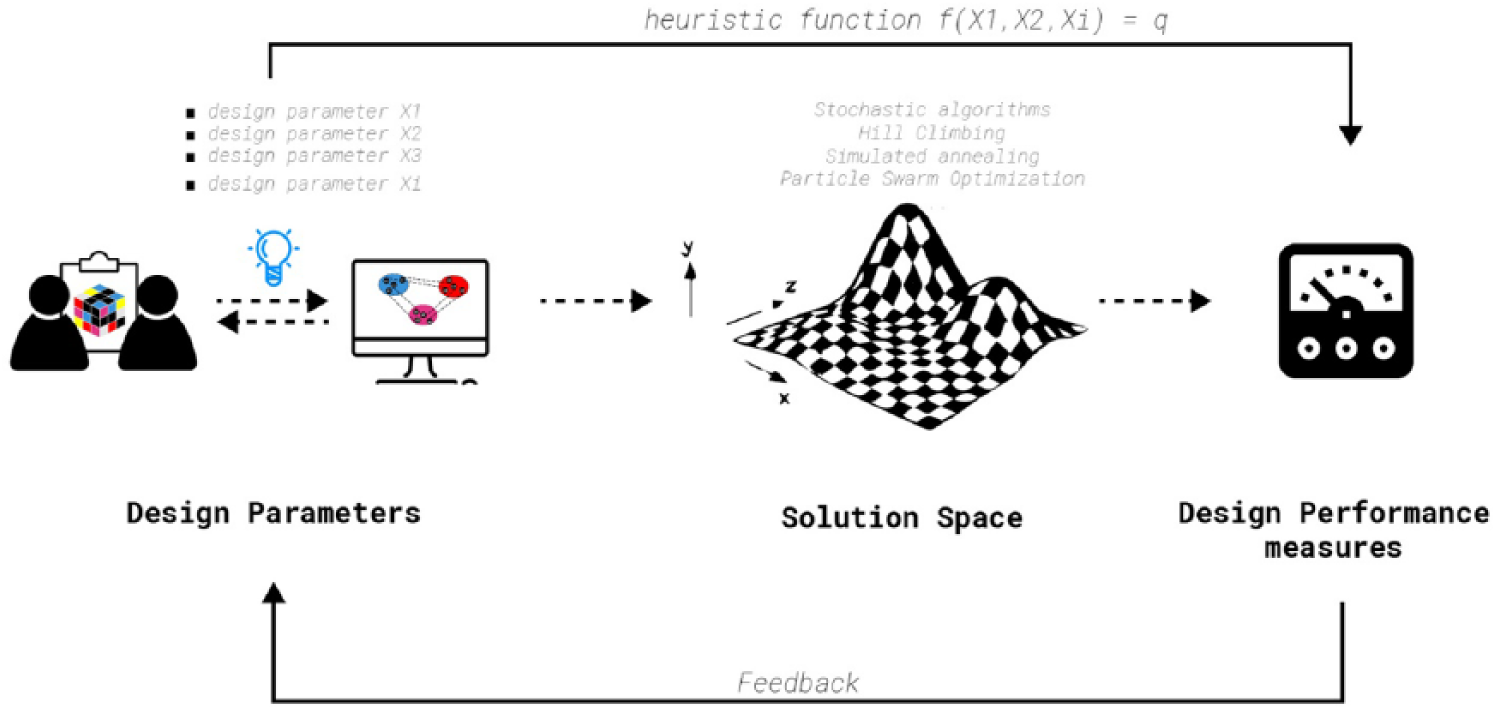
Diagram showing the basic steps for implementing a heuristic search computationally (from left to right): the definition of design parameters and a set of performance measures. The design parameters are related to the measures via a heuristic function which forms the solution space/landscape which is being traversed using stochastic algorithms.
Stochastic search exploration and optimization
For a MAS design tool to be able to generate design solutions, the design problem needs to be abstracted and represented to a population of agents in a tractable way. This is a particularly difficult task since problem requirements are not formalized until the later stages of the building design process. In architecture, the majority of agent-based design approaches have focused in adapting the basic behaviors of boids models developed by C Reynolds 71 in order to fit the context of specific design problems (i.e. simulation). In this work, we develop multiple types of agents where the variables and constraints are distributed among the agents such that no agent controls all the variables. In such situations, the design problem is defined as a distributed constraint satisfaction problem, and each agent may only interact with a few and not all agents in the system. Local interactions become a feature of the agent and therefore agents within such networks can be part of a team and thus must cooperate with each other to achieve a design goal or they may each have individual targets and goals.
To provide clarity, an “agent” in our work is denoted as a software-based programming block and/or computer system that shares the following properties: (1) an agent exists within an environment and responds to it while interacting with other agents and is therefore “situated” in that its behavior is based on the current state of its interactions with both the population of the agents as well as with the environment; (2) an agent may have explicit objectives that condition its behavior and is directly related to specific performance criteria in which the goals are not solely targeted to maximize effectiveness but are used to assess and improve the decision-making process; (3) an agent can adapt and change its behavior based on a utility function which uses analytical data or the agents’ own evolution and interaction history. In this case, individual adaptation requires agents to have memory to keep track of their actions usually in the form of a dynamic agent parameter (utility) and therefore (4) an agent has resource parameters that indicate its current stock of one or more resources (energy, material, information). 22
Each of the properties is expressed as layers within the internal structure of an agent (Figure 5). Thus, the established typical agent structure in this work includes (1) an interface layer through which the agent communicates with their environment, (2) a definition layer which describes the set of states and goals of each agent, (3) an organization layer which decides the type of actions to be taken by the agent at a given time based on analytical data, (4) a coordination layer which keeps track of past and current decisions, and finally (5) a communication layer which establishes that the agents are able to communicate among themselves. The key assumption is that given an architectural design problem, it can be distributed among agents which cater for different aspects of the problem under consideration. In particular, the implementation of separate agent classes is proposed which have goals related to different steps of the design process, namely, (1) synthesis: generative agent; (2) analysis: specialist agent, (3) evaluation: evaluator agent, and (4) coordination: coordinator agent.
In the proposed MAS framework, the four generic agent types, each focusing on the design goals, are applied to different design cases. Each agent type appends to different design domains and the goals are defined by the designer based on available data and design intentions.
In this article, we present a design experiment where agents are simple programming modules and can perform different design actions (i.e. generate geometry) based on their type and state. 70 However, we have performed experiments where whole computer systems are considered as agents and the agents’ actions relate to the implementation of specific commands within the system. 64
Design exploration using heuristic algorithms
As a first step toward steering the behavior of the generative agent for producing design alternatives we couple its input parameters with analytical values obtained by a specialist agent stochastic search algorithms. By developing simple heuristic functions the designer specifies the relationship between design parameters with analytical values. This relationship is based on the designer’s experience or based on a sensitivity analysis that allows his or her to check which design parameters have bigger impact on the specific analysis. For example, if we perform a daylight analysis, then the specialist agent collects a numerical value that reflects lux values, 70 while if we perform a structural analysis, the specialist agent collects a numerical value that reflects displacement. 72 The specialist agent passes the input parameters to a commercial analytical solver and collects the analytical values which it communicates to generative agent.
At each iteration, the specialist agent is responsible for performing the analysis and communicating the analytical values to the generative agent (update values of generative agent). In case we have multiple analyses, a weighted value is attached to each design parameter which indicates the impact of each design parameter to an analysis. For each of the parameters that is updated, a credit (i.e. +1) is attributed to each agent if the obtained value at the sensor point with highest impact is closer to the target value (Figure 6).
If the obtained value is further than the target value, a penalty is attributed (i.e. −10). Based on this credit or debit, the generative agent can decide toward which direction to update a design parameter.
We initially implement two basic local search algorithms, hill climbing and simulated annealing, since they are fundamental heuristic algorithms which prove to be applicable and perform quite well for a wide range of problems.
For each of the approaches, we develop a custom heuristic function which associates a design feature (i.e. window position on a façade) with one or more analytical result (i.e. the amount of daylight entering a space). In order to be able to draw conclusions, we see how the different algorithms perform on (1) generating unique solutions each time they run and (2) operating on a small versus a big sample size. In order to be able to validate the results, we reduce the problem into finding the optimal position of a generic façade surface and search linearly to map (brute force) the whole solution space.
We observe the relationship of the parametrization of the design features in relation to the analytical results and attempt using this information to more efficiently guide the search based on this relationship and the performance of each of the approaches below.
Daylight metrics and design performance goals
To enable a comprehensive understanding of daylighting performance and how different design features affect it, the proposed method considers five different types of daylighting metrics.
From those, three are already established metrics and relate to (1) illuminance levels such as daylight factor analysis (DFA), (2) energy consumption with regard to artificial lighting such as continuous daylight autonomy (CDA), as well as (3) illuminance levels with regard to user-defined values such as useful daylight illuminance (UDI). Reinhart 73 provides an in-depth description on the calculation of the above metrics, and Gerber 70 describes their implementation using an MAS approach. In this work, we introduce two additional metrics which are used to calculate the maximum light variance and the level of light diffusion within a space. For calculating the variance, we select the minimum and maximum light values over the specified time across the space, while for measuring the level of light distribution, we compare daylight values between neighboring sensor points. Last but not least, in order to help designers build a holistic understanding of how specific design decisions about the daylight affect the energy efficiency of the building, we perform an energy analysis to measure the heating and cooling loads.
All the metrics are calculated using simulation software developed by the Department of Energy (DoE) which we access via Ladybug and Honeybee tools. For the CDA, the user needs to define the minimum acceptable lux values, while for the UDI, the user needs to define an upper and a lower bound. The user must also specify which periods of the day and year he or she is interested in analyzing the generated design, that is, 9:00 am–12:00 pm, 9:00 am–5:00 pm, and winter, summer, spring, and autumn. The user also defines the size and height of analysis plane and a specific resolution which is divided into a number of sensor points (in this case, 2623 points). At each sensor point, for the DFA, we calculate the amount of incident daylight in lux, while for CDA and UDI, a percentage is calculated based on whether daylight provides illuminance within the user specified range for a specific time period (part of the day, part of the year). For calculating the final goal-based illuminance on a sensor plane, we average the received values for CDA and UDI for each sensor point. The office space is analyzed annually in simulation and the results are used to (1) inform the position of the opening, (2) change the probability of placing an agent type, and (3) change the depth of the façade.
Experimental design—agent-based façade design
As a first step to test the capacity of our system to output intricate yet well-performing design alternatives, we tested the MAS for the generation of alternative façade designs on a generic office building geometry located in Los Angeles area using three different types of panels. We apply our system for the generation of whole façade geometries and we are looking for the optimal positioning of windows with regard to performance goals that relate to daylight distribution and energy consumption. A basic design setup is defined with four global and eight local parameters. The global parameters are as follows: (1) location of the building, (2) input design surface, (3) orientation of the surface, and (4) number of openings.
The local parameters include the following: (1) generative angle, (2) panel types, (3) panel length, (4) extrusion length, (5) extrusion type, (6) extrusion angle, and (7) clearance between panels (Figure 7). The hypothesis of the design experiment is that by running daylight simulations on a base case in a given location (i.e. Los Angeles), we can couple design parameters with performance goals via agent behaviors. By observing the relationships between the design parameters and the goals, we can extract “interpolation” functions that allow the system to predict performance of generated design solutions of any given design surface (in the same location).
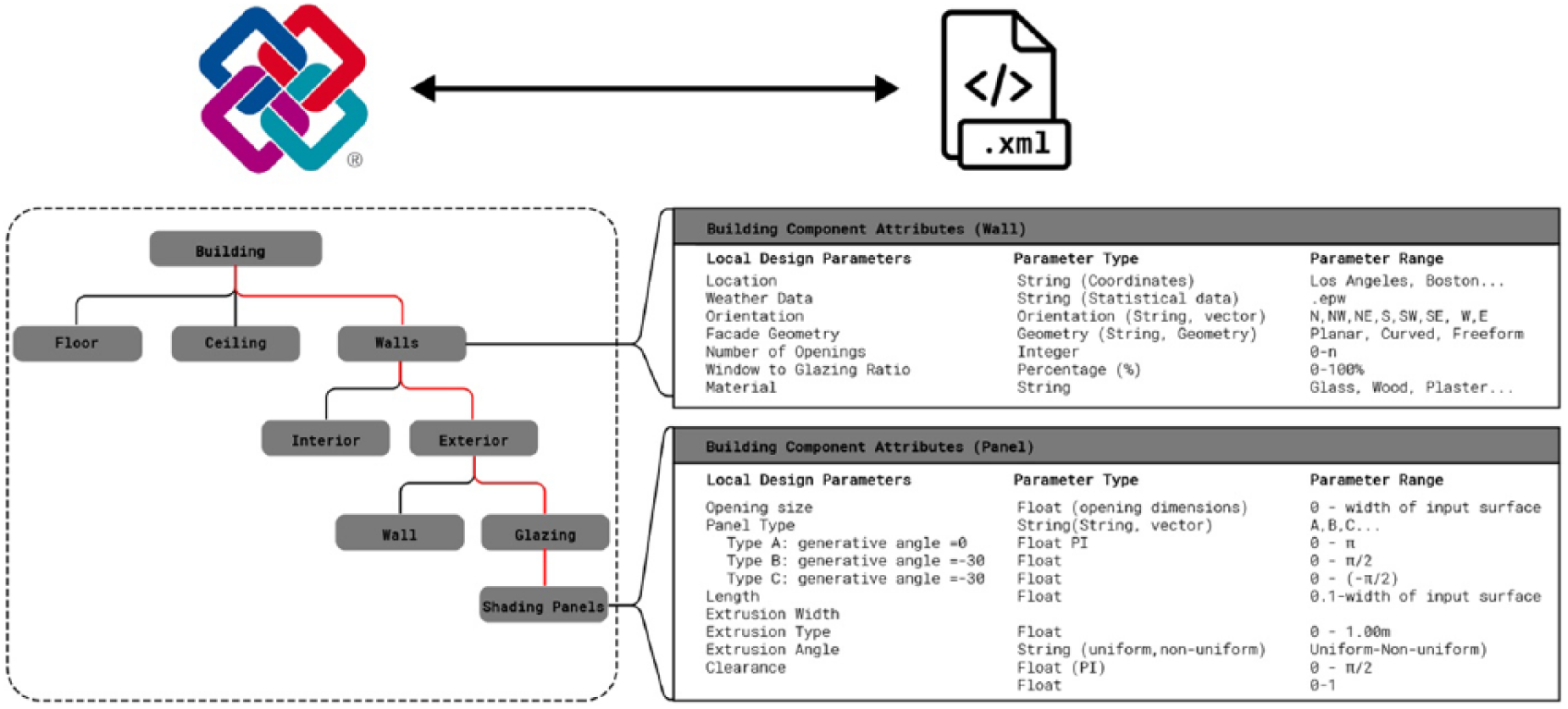
Schematic of simple building data model: relationship between components and object attributes (left) and table with local and global design parameters of the façade panel agent (right).
The designer is enabled to narrow the solution space effectively, efficiently explore multiple design solutions by defining agent behaviors, and select a design scheme depending on the performance goals he or she has set. The objective of the work is to be able to show that (1) stochastic optimization can be used in architectural design for design exploration; (2) heuristic functions which are not coupled to specific geometrical features (shape of openings) but rather in more abstract relationships (glazing ratio, number of openings) can be developed and used for multiple design cases; (3) non-uniform agent-based façade designs which incorporate environmental feedback can outer perform the standard façade paneling systems.
Design process
The designer initially provides a geometry which describes the whole (massing model) or part (one bay) of a building envelope as well as a file with the location and weather data. He or she then defines a number of desired openings, the building component, and a basic generative mechanism (local design rules). A generative mechanism can include more or less complex design parameters which in most cases pertain the design problem. In this work, the design parameters are the following: panel type, angle, length, extrusion length, extrusion uniformity, and maximum number of components.
Through a graphical user interface (GUI), the designer can test and visually evaluate different aggregations of component on the façade surface (Figure 8). When satisfied, he or she can save the configuration in an xml file. This file holds the core design information which is then run iteratively for a number of iterations (defined by the designer) and values are being updated and optimized based on the performed analysis.
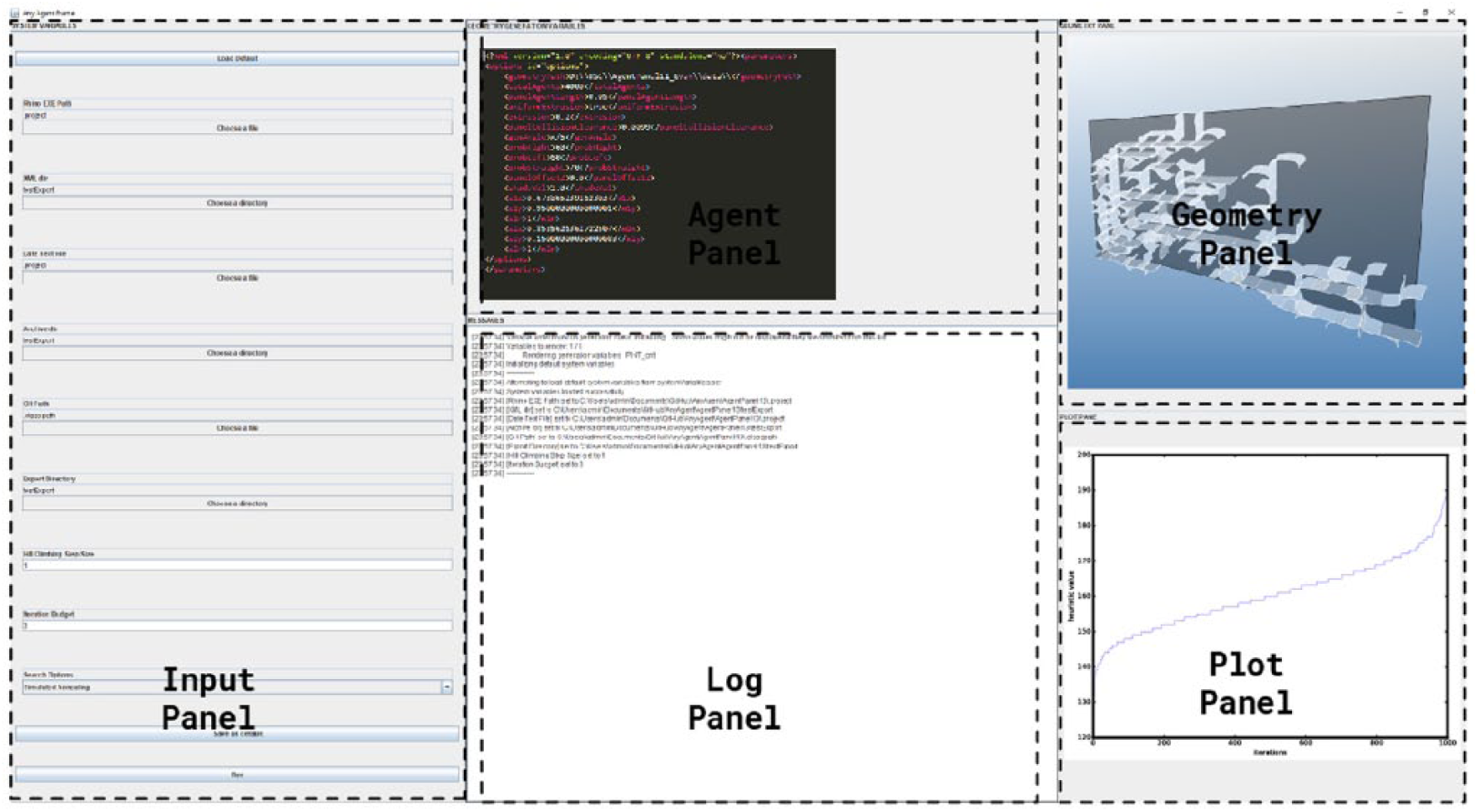
Graphical user interface of the MAS where the designer defines input façade geometry, weather file, agent parameters, type of analysis, duration of simulation, and stochastic algorithm.
Each panel is defined as an agent and has three different states and eight design parameters (type, probability, angle, length, extrusion, extrusion type, extrusion angle, and clearance). The panels fill the design surface in different configurations (based on probability) while trying to avoid areas which are reserved for the openings (window, clear glazing). The number, size, and relative position of the openings, as well as the extrusion length, are updated by the stochastic algorithm at each iteration (Figure 9).
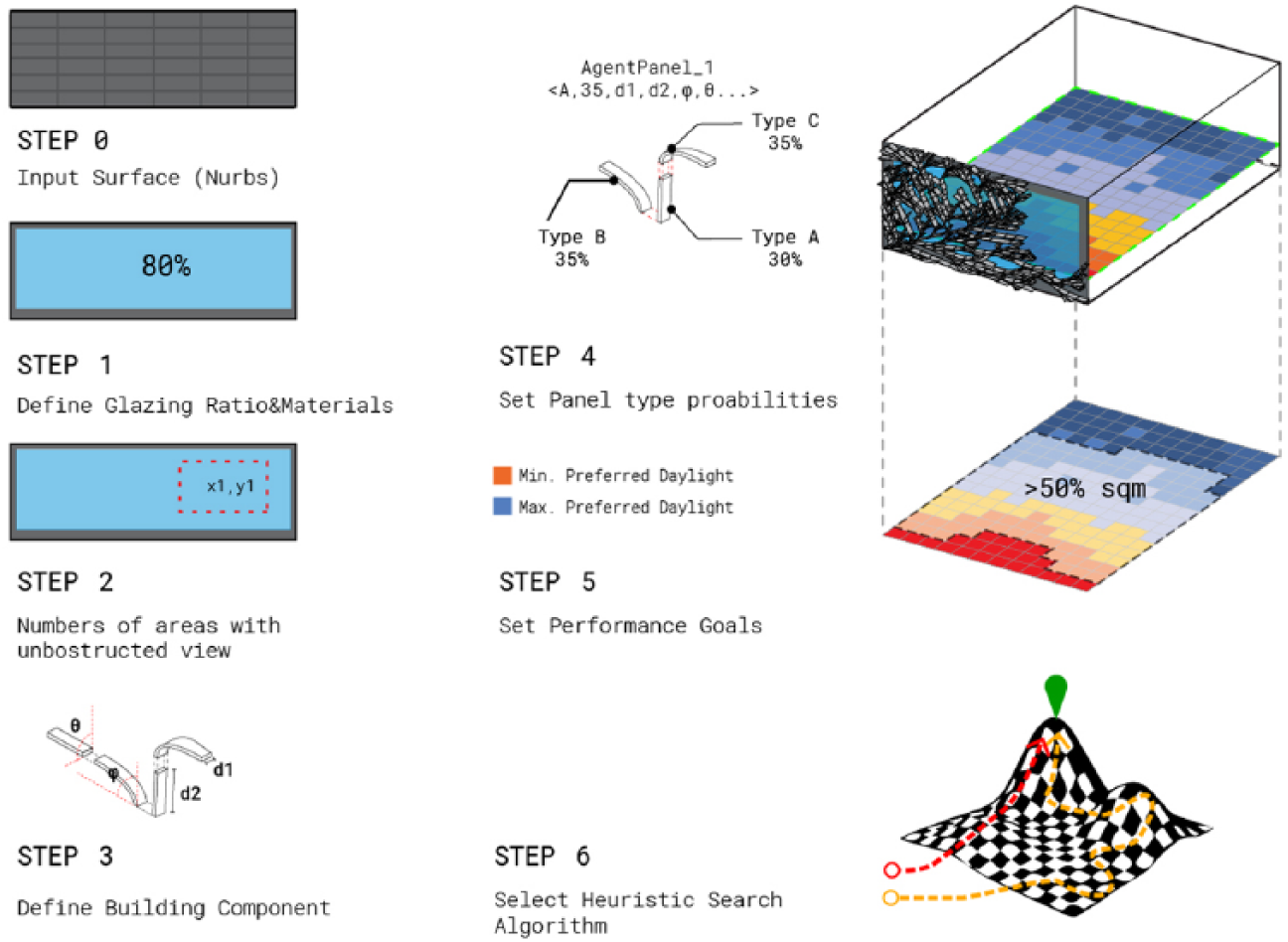
Diagram illustrating the design process of the experimental design in steps.
In order to be able to search for optimal alternatives the designer defines (1) the type of analysis (i.e. DFA, CDA, UDI, etc.), (2) the resolution of the analysis, and (3) analysis period (i.e. daily, annual). He or she inputs user-collected data relating to user preferences and sets the targets for the heuristic function. The optimality can be adjusted by the designer and in this experiment relates to the following goals: (1) decrease building energy use (annually) by increasing natural light availability, (2) provide more distributed light over a day (daily cycle), and (3) meet preferred levels of light by users.
At last, he or she runs the system and selects (1) type of search method and (2) type of analysis output. Once the system completes a cycle of iterations, it can suggest to the designer possible positions for openings based on the defined performance goals. In addition, the designer can evaluate the results visually both aesthetically (geometry) and quantitatively (energy performance) through graphs which show the trade-offs between different goals (i.e. daylight and total heating load).
Experimental runs
First, we test the generative capacity of the system to generate and evolve designs on different input geometries and different design parameters for the agent. Multiple iterations are performed with different initial conditions and different parameters to illustrate the generative capacity of the system (Figure 10). In Figure 11, a set of design alternatives are shown which are generated by the system and vary from the normative horizontal louvers to complex panel designs. We point that the diversity in the designs is achieved either by its environment (design surface) or by encoding different agent behaviors.
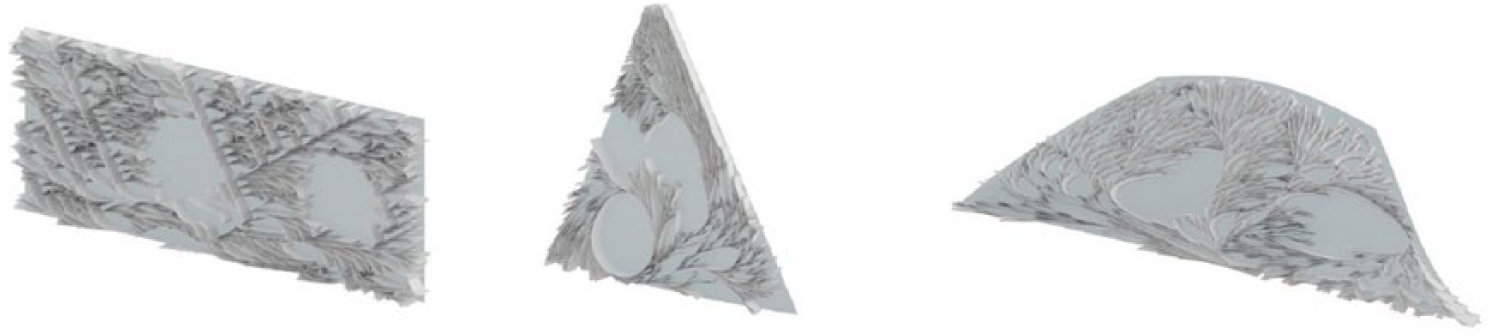
A set of evolutionary façade designs where the same agent panel is applied on different input surfaces.
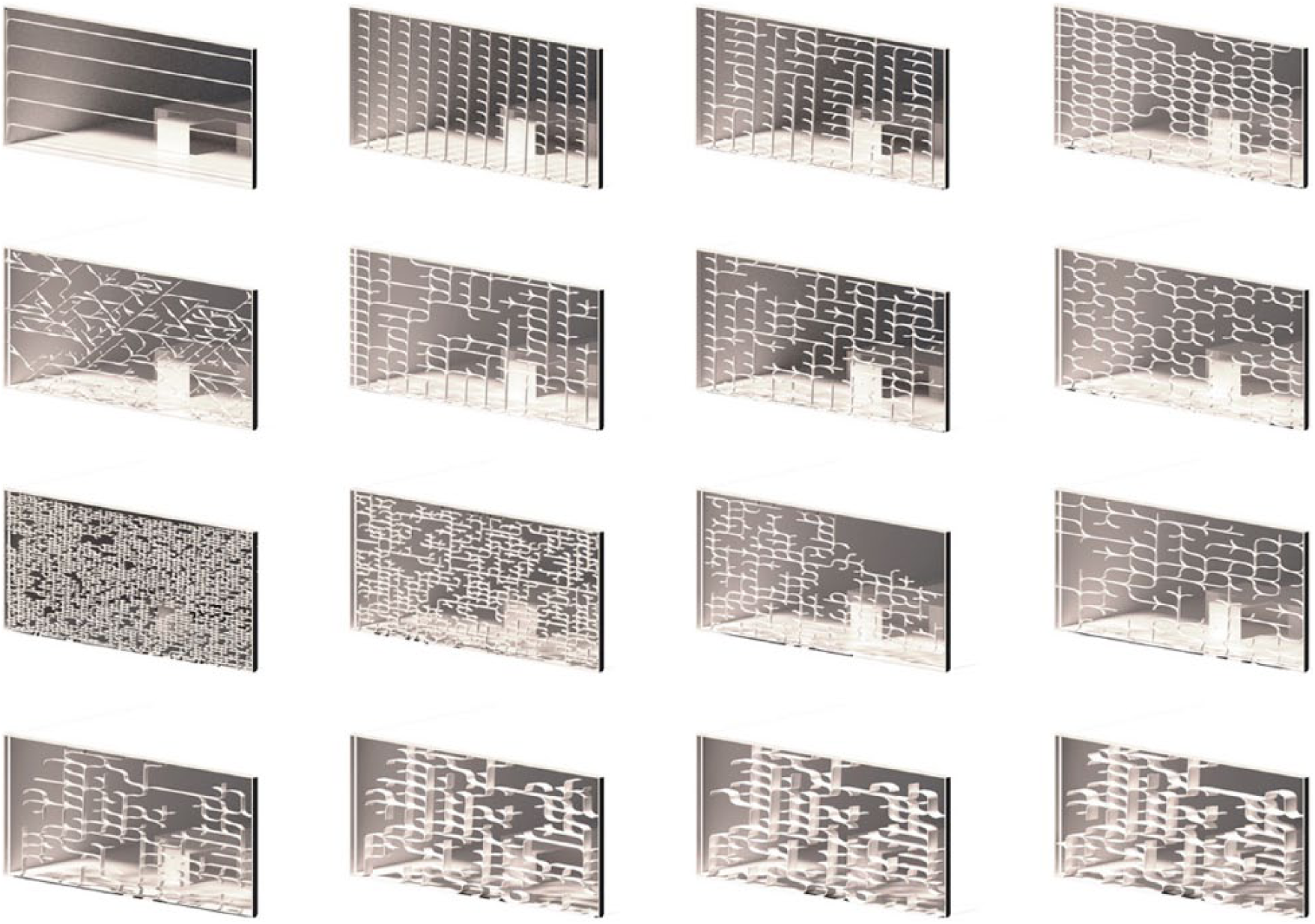
A set of evolutionary façade designs on planar surface. The design parameters that change from to bottom are the panel type probability and sequence, length, and extrusion of each panel.
Second, to compare the performance of generated designs and traverse the solution space more efficiently, we couple design parameters to performance goals. By doing this, we explore if there is any relationship between the design parameters and the environmental performance that can be mathematically described into a heuristic. Given the set of performance goals defined by the designer, two separate heuristic functions are developed which are described below.
We are initially executing a linear search (brute force) to map the extents of the solution space in relation to the positioning of n number opening (n = 2). Each design alternative is given a unique identity (hash ID) and at each step the system checks whether the geometry exists to avoid generating duplicate geometries. Subsequently, a dictionary is created with all the IDs for an easy lookup. Once we have mapped the solution space, we run the system iteratively using two basic stochastic algorithms, namely, simulated annealing and hill climbing. Although both algorithms are not the most efficient in computational terms, they are suitable for open-ended problems 74 and form a good starting point for testing our framework. In Figure 12, the performance of each algorithm is graphed with regard to the DFA. It is evident that using any of the two algorithms, we can reduce significantly the search space by a factor of 0.023 and 0.006 accordingly.
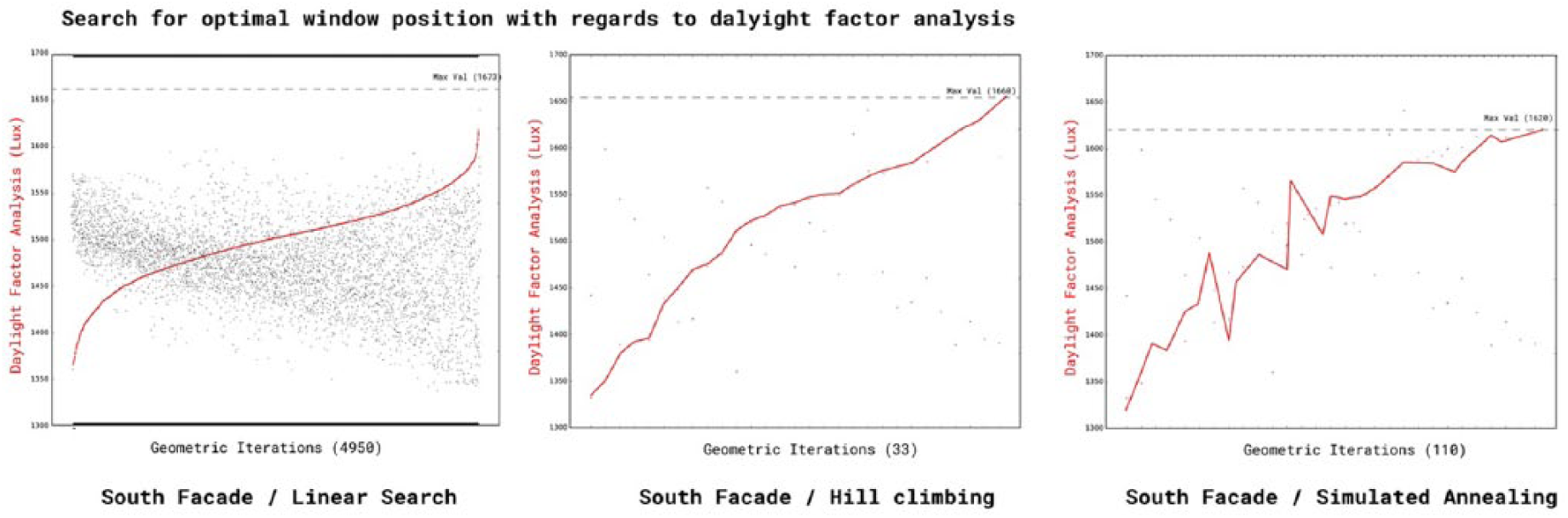
Comparative graph of experimental runs showing three different search methods for placing openings on a south facing façade: linear search (all possible solutions), hill climbing, and simulated annealing.
In addition, in Figure 13, the combined results from multiple analyses are plotted and are visually communicated to the designer using parallel line plots. 75 The plot includes all the design IDs, performed environmental analysis, façade orientation, heuristic search algorithm, and simulation time. The designer can interactively adjust the boundaries of each analysis and filter out alternatives that do not meet his or her requirements. In this way, the designer can (1) gain intuition on how design parameters affect environmental performance, (2) compare if there is diversity among the solutions of each run, and (3) evaluate how good each algorithm performs in a multi-objective context. In this case, for us diversity means design alternatives which have similar performance but have distinct geometries.
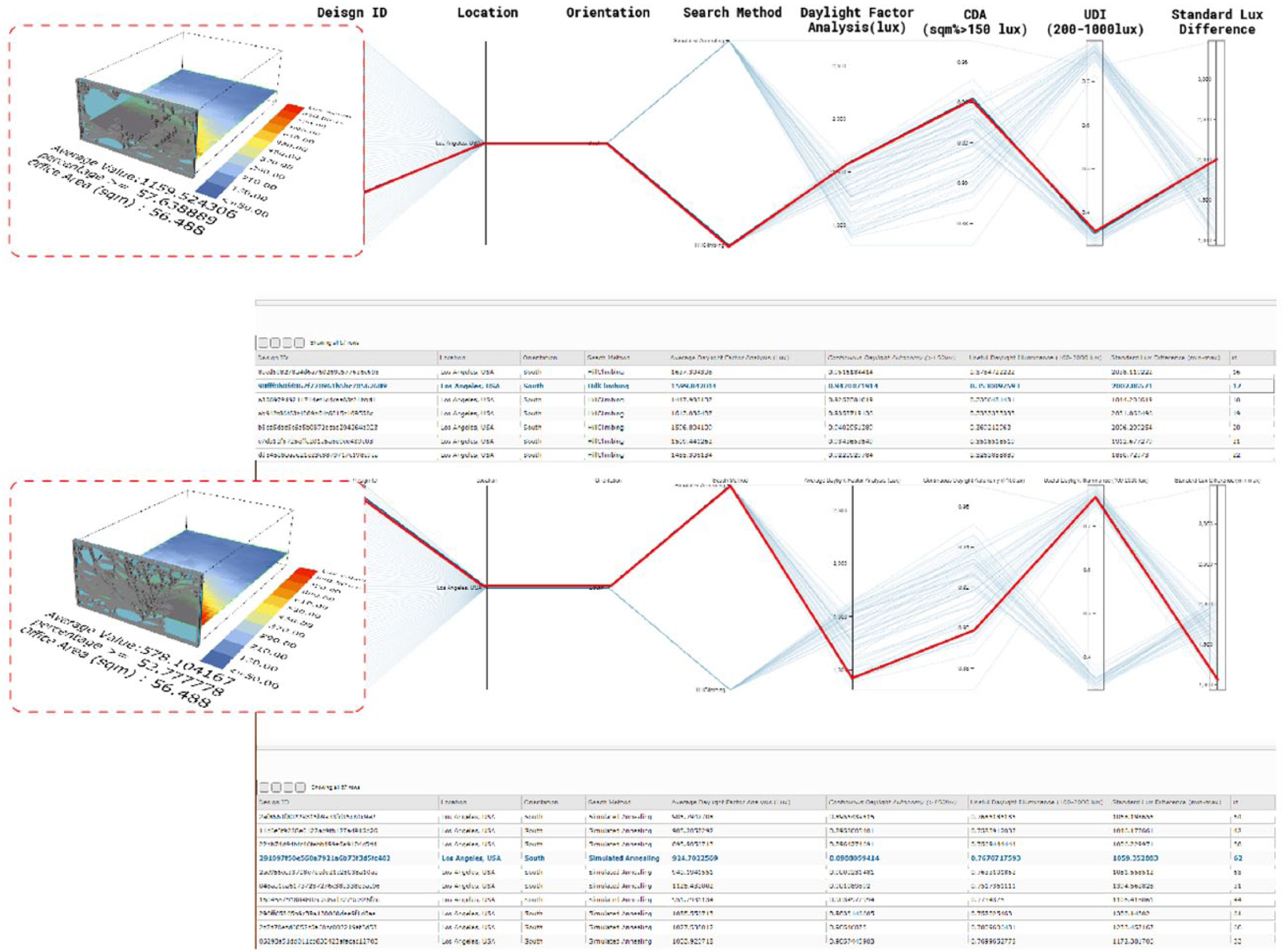
Design alternatives presented to the designer along a series of environmental performance metrics in a parallel line plot.
Conclusion
The experimental design has shown that it is possible to develop a multi-agent design system that can generate complex 3D models of façade designs that are both evolutionary (non-deterministic) and intelligible. Once several design alternatives generated the agents that can use the created designs as a basis for adjusting their probabilities to produce designs with predictable environmental behavior.
Through the development of different agent classes, we can couple design parameters with environmental goals in a bottom-up fashion, where agents interact locally without having overview of their global behavior. By providing a base geometry and an orientation, we can control the growth and behavior of the agents within specific regions. The distributed character of the MAS allows design flexibility (designer can provide any geometry) and user preferences can be used to set the boundaries of the goals and behavior of the agents.
In this experimental design, the generation of alternative façade panel configurations is based on all the possible positions for n = 2 openings on a given design surface, a south façade bay of a generic office building in Los Angeles. Specifically, using the basic stochastic search algorithms mentioned above, we showed that the solution space can be traversed efficiently, by associating a specific or multiple design parameters in a heuristic function. Hill climbing algorithms seem to converge faster but simulated annealing seems to provide more diverse design alternatives that capture better the set of defined performance goals (Figure 14).
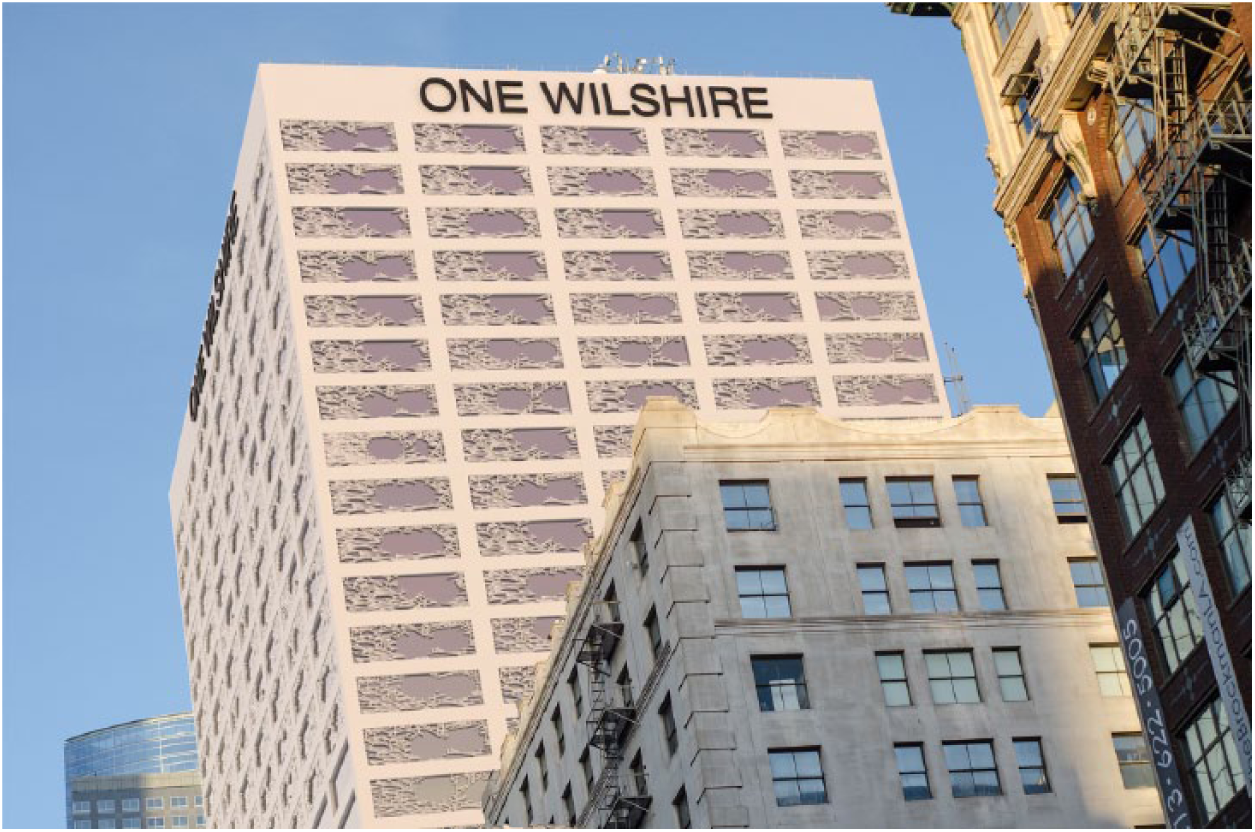
Rendering with optimal generated designs applied on the façade of an actual building in downtown Los Angeles.
From the simulation data, we conclude that our framework
Offers a method for decomposing a design problem into multiple design domains and creates distributed agencies which are modular, flexible, and have distinct goals but interact with each other to generate design alternatives;
Has the ability to generate unique outcomes which are informed by different context conditions (base geometry, weather data, window position);
Provides the designer with intuition of how different design features affect design generate design outcomes that perform within a given bounded performance target (measured in lux).
The next steps of the research will focus on developing the framework further and testing the scalability of the tool by applying it for the generation of structural building components. We aim to implement two more stochastic algorithms, namely, particle swarm optimization and ant colony optimization, and compare them both for their capacity to generate diverse design alternatives and for their capacity to generate well-performing solutions. By accumulating and comparing simulations our long-term objective, we can generate online databases that are easily accessible in order to discover relationships and patterns between design features and performance metrics. This will enable designers to search for alternatives by developing Markov decision models for the generation and adjustment of building components. Once the design component at stake is described as an agent behavior, using existing analytical data, the MAS design tool will be able to predict the impact of design changes on the design performance and provide suggestions to the designer. This will allow to traverse the solution space faster and generate design alternatives that meet the designers’ intentions and the building occupants’ preference while satisfying environmental performance targets.
Footnotes
Declaration of conflicting interests
The author(s) declared no potential conflicts of interest with respect to the research, authorship, and/or publication of this article.
Funding
The author(s) received no financial support for the research, authorship, and/or publication of this article.