







Abstract
This research investigated the relationship between emotional intelligence of university students and their resilience ability during crisis: the pandemic of Covid-19. A large-scale quantitative approach was applied with a national survey in the midst of the fourth wave of Covid-19 outbreak in Vietnam. The research obtained data from 2252 students from various universities in Vietnam. Results showed that experienced positive affect and negative affect fully mediated the relationships between students’ self-emotion appraisal and their resilience during the pandemic. Surprisingly, other-emotion appraisal decreased positive affect while increased negative affect, though both affect types mediated the other-emotion appraisal-resilience relationship. The two types of affects also played mediating roles in the relationship between the ability of using emotion and resilience among students during the crisis, and the moderation was partial. Finally, while students’ regulation of emotion was not related to either their experienced negative affect or resilience, it was indirectly associated with students’ resilience during the pandemic via the mediating role of positive affect. Implications for theoretical development and practice in higher education were discussed.
Introduction
Like other sectors worldwide, higher education has experienced unprecedented crises owing to the Covid-19 pandemic. During this crisis, students were forced to engage in the online learning system without ample preparation (Ali et al., 2020). Consequently, their student life has been psychologically and socially impacted in different ways (Xiong et al., 2020). There has been evidence revealing that university students had to suffer various mental health problems, such as increased academic stress, anxiety, and depression symptoms (Debowska et al., 2020; Salari et al., 2020) during the pandemic.
Resilience, often defined as an individual’s ability to maintain normal functioning in hardship and stressful situations (Armstrong et al., 2011; Brewer et al., 2019; Fletcher & Sarkar, 2013; Vella & Pai, 2019), has proven its importance in coping with challenging or traumatic conditions as well as in preparing for future crises (Bande et al., 2015; Brewer et al., 2019). Resilience not only predicted students’ academic performance (Ahmed & Julis, 2015; Brewer et al., 2019; Cleary et al., 2018), but also positively impacted their well-being (Beauvais et al., 2014; Brewer et al., 2019; Priesak & Alcock, 2015). There have been three waves of resilience research that are (1) identifying factors to enhance resilience, (2) examining how those factors improve resilience, and (3) investigating how to intervene resilience when it is not natural (Vella & Pai, 2019).
Research pertaining to resilience’s determinants and how these factors impact resilience has been continuously conducted (Liu et al., 2020; Vella & Pai, 2019). Pioneers in the field have made great efforts to reveal several impacting factors of resilience such as positive self-concepts, self-esteem, self-efficacy, optimism, hope, and positive adaptation (Brewer et al., 2019; Cilliers & Flotman, 2016; Fletcher & Sarkar, 2013; Willis & Burnett, 2016). However, there is still a need to investigate antecedents and their influencing mechanisms on psychological resilience, particularly meta-cognitive and emotional processes of the resilience-stress relationship (Brewer et al., 2019; Fletcher & Sarkar, 2013). Brewer et al. (2019) also added that that previous empirical studies lacked predictive power due to small sample sizes. Moreover, one of the most promising interventions to promote students’ resilience is emotional intelligence (EI) improvement (Brewer et al., 2019). Nevertheless, there has been little evidence on the impact of EI on students’ resilience. Thus, we fulfilled this research gap by proposing and examining EI as a predictive factor of resilience and its affecting route to resilience through positive affect (PA) and negative affect (NA) triggered during a traumatic event. This was proposed because there have been initial findings indicating that EI could affect different stages of resilience process that were stress appraisal, meta-cognition in response to emotions triggered, and choosing coping strategy (Dong et al., 2014; Kim et al., 2012; McRae et al., 2012; Parke et al., 2015).
Indeed, when appraising stress, those with high EI often perceive it less severely than those with low EI (Parke et al., 2015; Schneider et al., 2013). They also deploy coping resources and strategies more effectively (Naatanen et al., 1999) and have more quality social relationships (Armstrong et al., 2011; Li et al., 2015) than those with low EI. Thus, they can shorten the duration of being stressed and also recover quickly, which is one hallmark of resilience, when comparing with their counterparts. As such, EI and resilience may have a positive relationship.
Moreover, during the process, PA and NA could play mediating roles. Evidence has shown that EI could trigger PA and attenuate NA when ones confronted difficulties or stressful situations (Ciarrochi et al., 2000; Extremera & Rey, 2016; Xiang et al., 2021). Those with high EI could create and keep a high level of PA in traumatic events when comparing with low emotionally intelligent people (McRae et al., 2012; Parke et al., 2015). They also suffered less NA and better decreased its negative effects on mental health (Dong et al., 2014). Several studies have also shown that PA fostered, whereas NA inhibited individuals’ resilience (Nath & Pradhan, 2012; Sommer et al., 2016; Trigueros et al., 2019). Therefore, PA and NA may mediate the relationship between EI and resilience. This is consistent with broaden and build theory suggesting that PA broadens though-action repertoires while NA “narrows people’s attentions, making them miss the forest for the tress” (Fredrickson, 2001, p. 221). Through the cognition broadening, PA builds enduring personal resources and enables individuals to develop suitable and sufficient resources (Fredrickson et al., 2008) to cope with stressful events in a proactive way, which boosts resilience (Kong et al., 2018; Loh et al., 2014; Xing & Sun, 2013). In contrast, NA may direct personal resources to a specific threat, thereby enhancing avoidance strategy and mitigating resource development effort in stress coping (Nath & Pradhan, 2012), leading to slower resilience.
This research took higher education as examining context and undergraduate student as unit of analysis. Students’ resilience has been receiving more attention due to its positive relationship with the two among three key concerns in higher education: students’ health, well-being, and employability (Brewer et al., 2019). However, research about undergraduates’ resilience in relation to their predictors, for example, EI is limited, continued research about their relationship is meaningful. The current research was conducted in the midst of Covid-19 pandemic, which might help to obtain more valid data on students’ resilience ability, as this outbreak brought many difficulties to university students. We also conducted a national survey with big sample of undergraduates (2252) which could improve the predictive power of research results. Findings from this search may be helpful to draw some implications for higher education policies to prepare for future crises. In sum, this research contributes to the theoretical development and practice in school management and administration by investigating whether resilience can be facilitated by EI and affect, evidenced from Vietnamese university students.
Theoretical background and hypothesis development
Emotional intelligence
Since 1990s, EI has been remaining a controversial topic and continues to receive attention from divergent fields of management, psychology, and education (Law et al., 2004; Côté, 2014). There have been three main streams of EI: ability-based, trait-based, and mixed model of EI (Côté, 2014). While Mayer and Salovey (1997) defined EI as an ability of individuals concerning emotional information processing and using them for decision-making (ability-based EI), Petrides and Furnham (2003) defined it as a personal trait containing a composition of moods and self-perceived ability regarding emotional self-efficacy (trait-based EI). The mixed model of EI developed by Bar-On (1997) basically includes all aspects of ability- and trait-based EI and some other additional capabilities of people, such as self-management and optimism. The differences among three streams’ definitions and included key concepts have become the roots for debates concerning EI’s validity for research and values for practice. However, great effort has been made to differentiate EI with cognitive intelligence and big five personality, especially for ability-based EI (Côté, 2014; Kluemper et al., 2013). Consequently, it has become the most preferred model for research (Côté, 2014; Fernández-Berrocal & Extremera, 2016).
Basing on ability-based EI developed by Mayer and Salovey (1997), Wong and Law (2002) developed a perceived EI which comprises of four components: self-emotion appraisal and expression, other-emotion appraisal and recognition; self-emotion regulation, and use of self-emotion. They argued that this definition may represent a mutually acceptable definition of EI discussed in the literature, and its corresponding measure may avoid some cross-cultural differences relating to emotional concern because the respondents reveal their final judgment about emotional issues regardless of methods used to fit with their cultures. This research employed the definition of EI and its short instrument developed by Wong and Law (2002) as it is more suitable for a national survey. Accordingly, EI is an ability of individuals concerning emotional issues relating to the ability to understand deep emotions and express them naturally, perceive and understand emotions of surrounding people, use emotions effectively, and regulate emotions to more quickly recover from psychological problems.
Positive affect and negative affect
PA and NA are daily experienced and both of them play important roles in our lives, as they can impact our behaviors (Nath & Pradhan, 2012). PA refers to an emotional state which is characterized by high levels of energy and pleasurable engagement, happiness and gladness, vibrancy and vitality, and satisfaction (Khosravani et al., 2017). Conversely, NA is an emotional circumstance characterized by a variety of moods, such as anger, sadness, disappointment, and feeling of worthlessness (Khosravani et al., 2017). PA and NA are main factors to explain individuals’ psychological distress and well-being (Zautra et al., 2000). Evidence has shown that they have differentially predicted coping styles, life experiences, and health concerns (Alarcon et al., 2009; Extremera & Rey, 2016; Gable et al., 2018). Regarding PA-NA relationship, some researchers have argued that they are independent (Watson & Clark, 1997), whereas others have posited that an increase in one affect would result in a decrease in the other (Dyck et al., 1994; Gable et al., 2018). This study considered PA and NA differentiated concepts, as despite co-existence, they fluctuate over time (Bledow et al., 2013) and are rarely experienced simultaneously (Fong, 2006; George and Zhou, 2007).
Resilience
To date, there has not been any agreed definition of resilience, and researchers have employed it in various contexts of management, psychology, sociology, and neuroscience (Fletcher & Sarkar, 2013; Herrman et al., 2011; Liu et al., 2020; Vella & Pai, 2019). Literature conceptualized resilience as the interactive influence of psychological characteristics within the context of the stress process (Kong et al., 2018; Liu et al., 2020). Generally, research often conceptualized resilience as an individual’s ability to maintain normal functioning in hardiness and stressful circumstances (Armstrong et al., 2011; Brewer et al., 2019; Fletcher & Sarkar, 2013). There are two salient elements of resilience broadly discussed in the literature: adversity and positive adaption (Fletcher & Sarkar, 2013; Kong et al., 2018). Adversity refers to negative conditions ranging from daily difficulties to negative life events, such as “deficient parenting, poverty, homelessness, traumatic events, natural disasters, violence, war, and physical illness” (Herrman et al., 2011, p. 259), while positive adaption is the ability to adjust changing conditions to withstand shocks and hardship (Smith et al., 2008) and recover quickly from them (Grover & Furnham, 2021). Students’ resilience in this study refers to their ability to overcome possible adversities caused by the pandemic of Covid-19 and to function their daily student life without obvious disruptions (Bande et al., 2015; Fletcher & Sarkar, 2013). Empirical studies have revealed the importance of resilience to well-being in both daily difficulties and life events (Liu et al., 2020; Southwick et al., 2014). Nevertheless, research on influencing factors of resilience has been insufficient, causing difficulties in theoretical development and practice. The current research examined one emerging determinant of resilience that has recently been discussed: EI ability.
Relationship between EI, Affect, and Resilience
Individuals’ resilience is their ability to confront and adjust themselves to stressful conditions incurred by adversities in life (Fletcher & Sarkar, 2013; Kong et al., 2018; Liu et al., 2020). According to Fletcher and Sarkar (2013), individuals who suffer stress would experience three main stages that are stress appraisal, meta-cognitions in response to emotions triggered by stress, and selection of coping strategies before returning to normal. Defined as the ability to deal with emotions, EI may impact resilience process through all three stages, particularly when negative emotion evokes (Armstrong et al., 2011; Schneider et al., 2013). Individuals with high self-emotion appraisal often perceive stress less severely than those with low emotion recognition ability (Parke et al., 2015; Schneider et al., 2013). Moreover, they are more likely to react quickly by deploying coping resources and strategies more effectively (Naatanen et al., 1999). As a consequence, high EI people often experience shorter period of stress and recover better than those with low EI. Armstrong et al. (2011) also stated that high other-emotion appraisal ability enables individuals to be more sensitive to how others feel, thus their sympathy will be developed better (Li et al., 2015), which is the foundation to build up quality social relationships. Due to receiving more psychological support from social circle, individuals with high EI may recover better from hardships than their counterparts (Armstrong et al., 2011; Soenenset al., 2007). Furthermore, individuals with high emotion regulation can trigger more PA and reduce NA as well as buffer their effects on well-being (Ciarrochi et al., 2000; Extremera & Rey, 2016; Xiang et al., 2021). Therefore, they are more likely to choose active coping strategies, such as problem-solving, re-appraisal, and physical exercise (Salovey et al., 2002) when facing stress in lieu of passive coping strategies often recorded in people with low EI. Consequently, they overcome difficulties and recover from adversities without serious disruptions. Empirical studies have also reported a direct and positive relationship between EI and resilience (Armstrong et al., 2011; Magnano et al., 2016; Sarrionandia et al., 2018; Trigueros et al., 2020). Hence, EI and resilience may have a positive relationship.
Vast majority of research has revealed that individuals with high EI may trigger more PA while they are more likely to mitigate NA compared to those with low EI, especially when confronting negativity or stressors (Extremera & Rey, 2016; Kong et al., 2019; Parke et al., 2015; Xiang et al., 2021). According to Parke et al. (2015), they can produce and sustain PA during and after stressful events because they apply re-appraisal strategies more often, compared to low emotionally intelligent people (McRae et al., 2012). Moreover, owing to the usage of emotional control ability and deep-acting techniques (Kim et al., 2012), they experience less NA and better attenuate its maladaptive effects on psychological well-being (Dong et al., 2014). Therefore, this research proposed that EI and PA/NA has a positive/negative relationship, respectively.
Broaden and build theory (Fredrickson, 2001) explains how PA and NA impact life outcomes including resilience (Kong et al., 2018; Loh et al., 2014; Nath & Pradhan, 2012; Xing & Sun, 2013). Accordingly, PA is one of the most important factors that trigger people to find positive meaning in traumatic events (Kong et al., 2018). The tendency to experience PA more often helps individuals to actively develop physical, cognitive, psychological, and social resources (Fredrickson et al., 2008) to cope with stress and hardship. For example, joy triggers the urge to make trials and errors, go beyond the boundaries to seek for creativity while love may enhance cognitive thoughts and promote actions to spend time exploring with loved ones to develop safe and close relationships (Fredrickson, 2001; Fredrickson et al., 2008). Individuals experiencing more PA have more intention to apply active techniques when confronting stress, for instance, re-appraisal (Parke et al., 2015) and doing physical exercises (Salovey et al., 2002). This mechanism of thought and action broadening and capability building would result in an increase in resilience (Kong et al., 2018; Loh et al., 2014; Xing & Sun, 2013). On the contrary, NA narrows individual’s attention to a specific threat (Fredrickson, 2001; Fredrickson et al., 2008). People who often experience NA may need to allocate their personal resources to solve emotional problems, thus insufficient resources are left for them to cognitively confront adversity effectively. Furthermore, they often opt to avoidance strategy in stress coping (Nath & Pradhan, 2012). Hence, people who experience more NA are inclined to suffer more serious symptoms and longer time when confronting traumatic events. Empirical studies have also shown that PA fostered, whereas NA impeded individuals’ resilience (Nath & Pradhan, 2012; Sommer et al., 2016; Trigueros et al., 2019). Therefore, PA/NA and resilience may have a positive/negative relationship, respectively.
From the aforementioned rationale, we proposed that EI (all four aspects) may impact resilience through the mediating effects of PA and NA. The hypotheses were formulated as follows.
(H1): PA/NA mediates the relationship between self-emotion appraisal and resilience
(H2): PA/NA mediates the relationship between other-emotion appraisal and resilience
(H3): PA/NA mediates the relationship between use of emotion and resilience
(H4): PA/NA mediates the relationship between emotion regulation and resilience
Methods
Data collection and procedure
The data were collected in the fourth wave of Covid-19 in Vietnam, from June 2021 to August 2021. Our sample included 2252 undergraduate students from numerous universities (10) in Vietnam. We chose four biggest universities in Hanoi capital, the other four in Ho Chi Minh City, and the other two in Da Nang, all three are the most dynamic cities in Vietnam. We asked for support from universities’ student unions to distribute our online questionnaires and cover letters to potential participants through the school’s email systems. The research was approved by the ethical board of Vietnam National University before being conducted. We explicitly stated in the cover letter that by answering and returning the questionnaire, respondents voluntarily participated in our research. There were 55% females in the sample, and the mean age was 20.27 with a standard deviation of 1.57. Students divergently majored in different fields of humanities and social sciences, engineering, and technology. To increase the response rate, the associations assisted us to send three reminders to potential participants via the email systems during two months. We compared demographic information among students responded in the different three waves with T-test analyses. However, there was no significant difference found in the sample. With the assumption that late responses can be representatives for non-responses, we concluded that there was no serious non-response bias, allowing us to proceed to our main analyses.
Measures
To assess EI, scales developed by Wong and Law (2002) were used. Sample items were “I have a good sense of why I have certain feelings most of the time,” “I always know my friends’ emotions from their behavior,” “I would always encourage myself to try my best,” and “I am quite capable of controlling my own emotions” for self-emotion appraisal, other-emotion appraisal, emotion using, and emotion regulating aspects, respectively. Students’ resilience was evaluated by instruments adapted from Smith et al. (2008). An example was “I tend to bounce back quickly after hard times.” A five-point Likert scale indicates the level of respondents’ agreement with provided descriptions regarding their perceived emotional intelligence and resilience abilities, ranging from 1 = strongly disagree to 5 = strongly agree. We assessed the frequencies of PA and NA experienced by students during a month by asking questions adopted from Watson et al. (1988). A five-point Likert scale was also used with 1 = never to 5 = always. The questionnaire was developed following the translation-back translation procedures and tested with a pilot sample of 50 students from a university in Vietnam.
Analysis
Means, standard deviations, and correlations among variables.
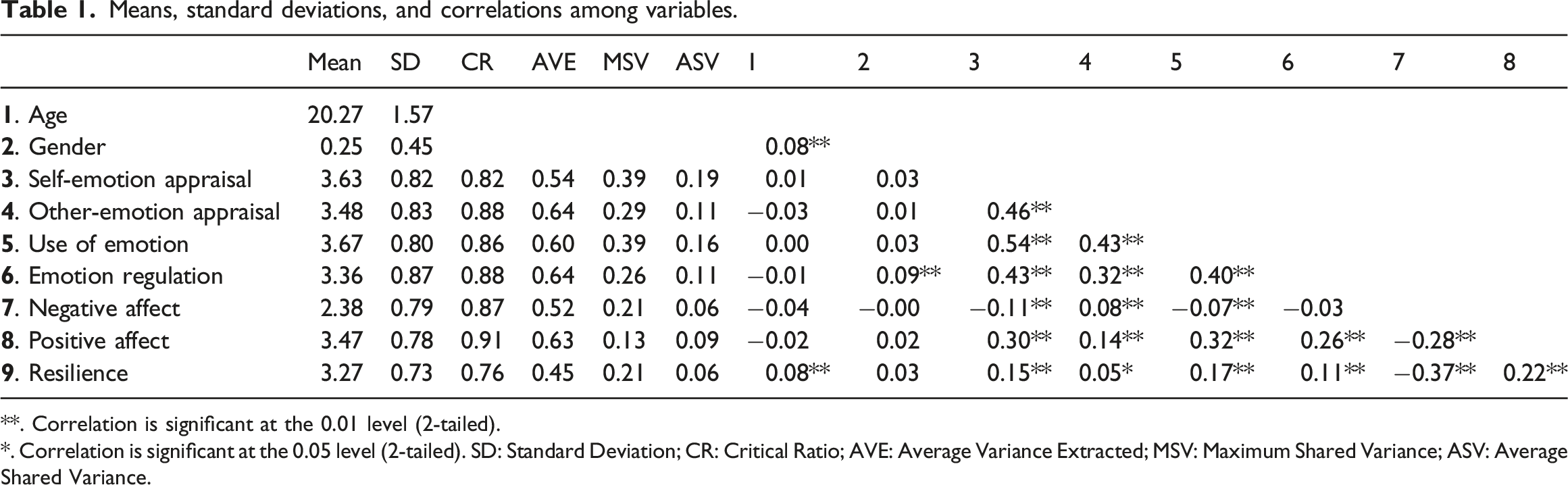
**. Correlation is significant at the 0.01 level (2-tailed).
*. Correlation is significant at the 0.05 level (2-tailed). SD: Standard Deviation; CR: Critical Ratio; AVE: Average Variance Extracted; MSV: Maximum Shared Variance; ASV: Average Shared Variance.
The measurement model had an excellent model fit with degree of freedom = 420, chi-square = 1444.32, comparative fit index (CFI) = 0.97, Tucker–Lewis index (TLI) =0.96, incremental fit index (IFI) = 0.97, goodness of fit index (GFI) = 0.96, adjusted goodness of fit index (AGFI) = 0.95, standardized root mean squared residual (SRMR) = 0.04, and root–mean–square error of approximation (RMSEA) = 0.03. According to Hu and Bentler (1998), all indicators indicated a good fit for the model, allowing us to proceed to structural equation modeling to check the hypotheses. The structural equation modeling had an excellent model fit, with chi-square = 2032.088 and degrees of freedom = 512, CFI = 0.97; TLI = 0.96; IFI = 0.97; GFI = 0.96; AGFI = 0.95; RMSEA = 0.03, and SRMR = 0.05.
Results
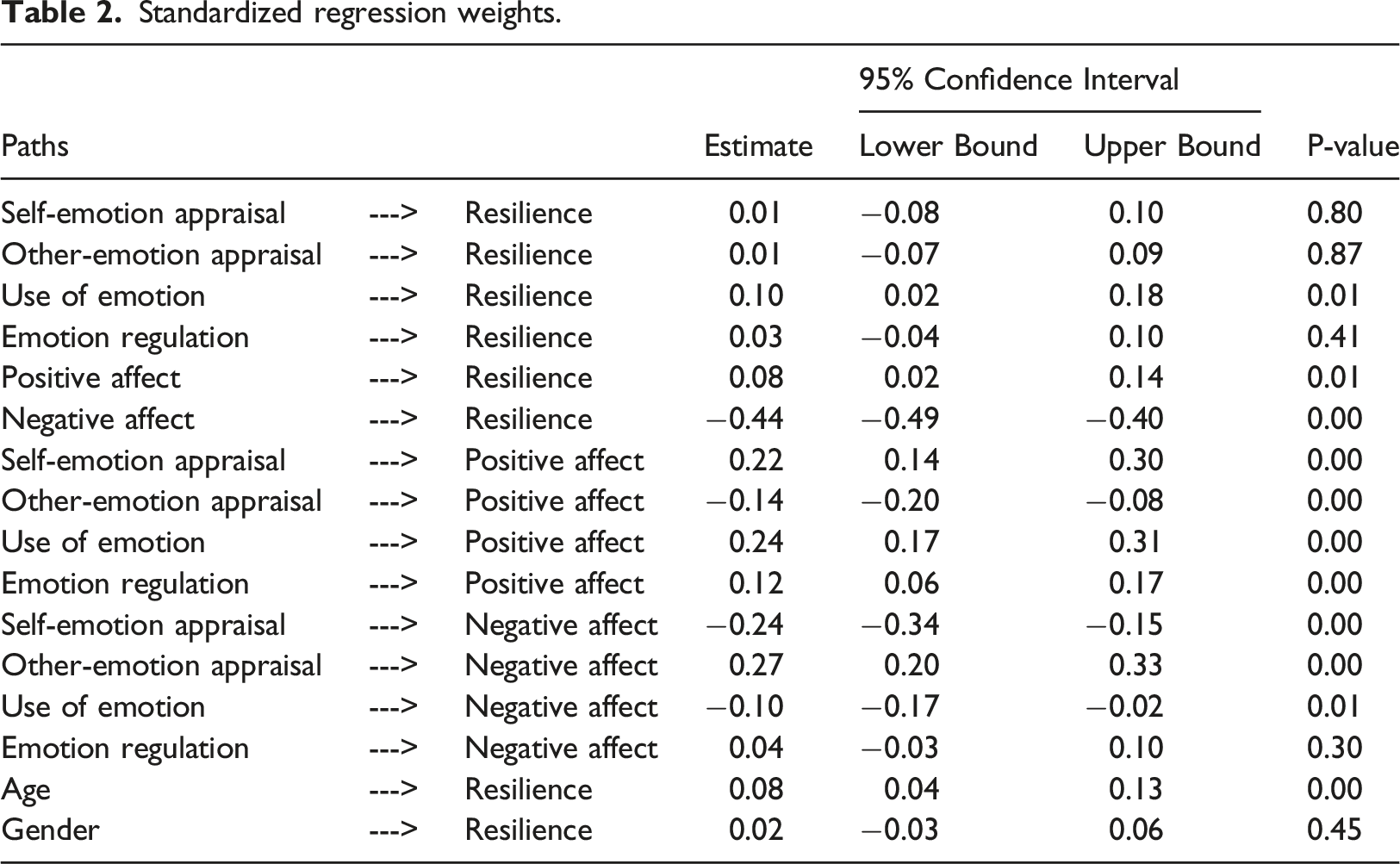
Results showed that among four aspects of EI, only the ability to use emotion was directly related to students’ resilience. The coefficient was 0.10, 95% confidence intervals (CI) were [0.02, 0.18]. Self-emotion appraisal, other-emotion appraisal, and emotion regulation were not significantly associated with resilience among students in the crisis (all p-values > 0.05).
PA increased resilience, with an effect magnitude of 0.08, 95% CI = [0.02, 0.14]. However, NA decreased resilience, with an effect magnitude of −0.44, 95% CI = [-0.49, −0.40].
Self-emotion appraisal was positively related to PA, coefficient = 0.22, 95% CI = [0.14, 0.30], while it was negatively related to NA, coefficient = −0.24, 95% CI = [-0.34, −0.15]. Therefore, as proposed, PA and NA fully mediated the relationship between self-emotion appraisal and resilience, making hypothesis 1 supported.
Other-emotion appraisal was also related to PA and NA, but in reverse directions with our hypotheses. Particularly, the effect magnitude was −0.14, 95% CI = [−0.20, −0.08] for the relationship between other-emotion appraisal and PA, and that was 0.27, 95% CI = [0.20, 0.33] for the relationship between other-emotion appraisal and NA. Thus, hypothesis 2 indicating that affect mediates the relationship between other-emotion appraisal and resilience was supported, but with opposite directions to our proposals.
Consistent with the hypothesis 3, PA/NA mediated the relationship between the ability of using emotion and students’ resilience during the crisis, and the mediation was partial. The coefficient of emotion using ability-PA relationship was 0.24, 95% CI = [0.17, 0.31]. The coefficient of emotion using ability-NA relationship was −0.10, 95% CI = [−0.17, −0.02].
Standardized regression weights.
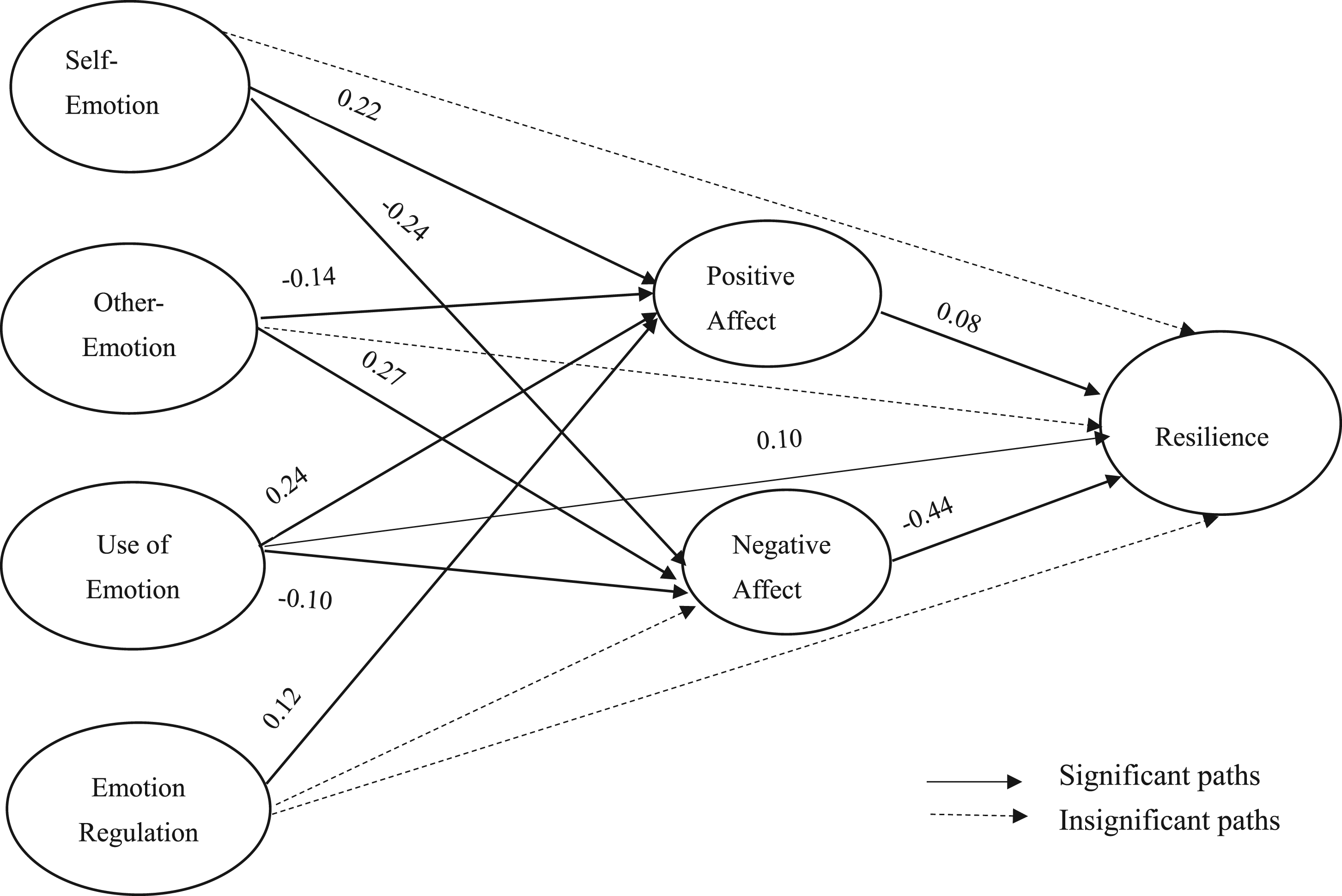
Conceptual model and the results.
Discussion
There have been four highlights in this research’s findings. First, being consistent with our rationale, results showed that experienced PA/NA fully mediated the relationship between students’ self-emotion appraisal and their resilience during the pandemic (H1). A direct relationship between self-emotion appraisal and resilience was not found, which was contradictory with research on alexithymia indicating that people with low emotional recognizing and understanding ability often fail to detect stressor and utilize coping strategies (Armstrong et al., 2011). Therefore, they are more likely to suffer high level of stress and could not quickly recover from such circumstance, which is one hallmark of low resilience ability (Li et al., 2015). It is noteworthy that previous research reported findings in normal time. As stated, our data were collected during the fourth wave of Covid-19 in Vietnam which was the most serious and traumatic time during the pandemic in that country. Perhaps, even with high level of understanding self-emotion, without adequate resources due to strict lockdown policy of the government, students were less likely to confront difficulties from sudden distance learning and thus, their resilience process still took time and suffered. This notion is consistent with research conducted by Brewer et al. (2019), Howe et al. (2012), Paul et al. (2015), and Ungar et al. (2014) revealing that one of the important factors to foster resilience among students was social support from peers or teachers, or even interventions from schools. Not surprisingly, during the pandemic, such support and linkages were limited.
A full mediating role of PA on the relationship between self-emotion appraisal and students’ resilience was found, which was similar to the findings of Trigueros et al. (2019). The empirical studies confirmed the importance role of EI and PA in educational contexts (Trigueros et al., 2019). However, in Trigueros et al. (2019)’s work, NA did not impact students’ resilience, which differed from our results. The sample of Trigueros et al. (2019) included secondary students surveyed in normal time, whereas our participants were higher education students surveyed during the pandemic of Covid-19. NA during this crisis would be triggered more often and more seriously than it is in normal time. Moreover, most of our respondents lived far from home which was different from secondary students. Without support from families, maladaptive effect of NA would be more severe during the pandemic, thus clearly inhibiting students’ resilience.
Second, H2 indicating that affect mediates the relationship between other-emotion appraisal and resilience was supported, but with opposite directions with our proposals. In other words, a high ability of other-emotion appraisal decreased PA, whereas increased NA among students during the crisis. It was difficult to compare with previous studies, as research on emotions in education was limited and fragmented (Pekrun et al., 2012; Trigueros et al., 2019). We proposed that in extreme conditions like the tough time of Covid-19 with loads of uncertainties, the ability of recognizing true emotions of others may turn maladaptive. In Vietnam, some cities failed due to the overwhelming of healthcare system and the disruption of food and medical supply, forcing people to suffer from negative news and events daily. In such situations, knowing the truth behind others’ emotional expression may make students more worried and inhibited their recovery process from stressful circumstances. Sharing this perspective, Armstrong et al. (2011) suggested that emotional awareness of others did not help to differentiate more and less resilient individuals, and to cope with traumatic events, intrapersonal aspect of EI may work better than interpersonal dimensions like other-emotion appraisal.
Third, being consistent with the H3, PA/NA played partial mediating roles in the relationship between the ability of using emotion and students’ resilience during the crisis. The emotional using ability of students was directly related to their resilience during the pandemic. With a high ability of using emotional information to guide decision-making, individuals may direct their activities to those which could cheer them up or soften their NA incurred by the crisis. For example, research has implied that emotional expression and sharing could help to release stress (Wastell, 2002). Especially, emotion using ability in the instrument used in this research was more or less similar to motivation and self-efficacy (Wong & Law, 2002), thus a direct relationship with resilience may not be surprising. This has made emotion using ability differ from other three sub-scales of Wong and Law’s instrument.
Finally, another surprising finding of this research was that students’ regulation of emotion impacted neither their experienced NA nor resilience during the pandemic. However, it was associated with PA, making PA a full mediator in the relationship between emotional regulating ability and students’ resilience during the crisis of Covid-19 (H4). As research suggested that EI could increase along with ages, we argued that students’ ability to control and manage emotions in this study might still be limited. Indeed, among four aspects of EI, emotion regulation was reported to be smallest with a mean value of 3.36. Especially, experience and behavior engagement was implied in the instrument used in this research (Wong & Law, 2002), thus evaluated emotional regulating ability of Vietnamese students might be insufficient to decrease high level of NA triggered during the pandemic as well as to help students be more resilient when they had limited social support due to severe lock down policy. Emotional regulation was positively associated with PA, which was consistent with previous research (Ciarrochi et al., 2000; Extremera & Rey, 2016; Kong et al., 2019; Xiang et al., 2021). Results implied that in the crisis, EI may help, however, students may need additional support from the society to function normally.
Conclusion
Implications for academics
The research investigated relationships between EI, affect, and resilience among students during the outbreak of Covid-19 in Vietnam. Findings highlighted the importance of all aspects of EI to facilitate resilience among students during the crisis via the mediating effects of PA and NA. However, there were some surprising findings which were not consistent with our rationale and some evidence found in the literature. For instance, emotion regulation was not directly related to students’ resilience. In addition, other-emotion appraisal was negatively associated with PA, whereas it was positively related to NA.
The findings may be due to the context differences in a severe crisis like the pandemic of Covid-19 compared to research conducted in normal time. Literature showed that social support was crucial in the process of resilience (Armstrong et al., 2011). It seemed that the insufficiency of social support in the Covid-19 outbreak with strict lock down policy made individuals suffer more loneliness, depression, and lost feeling (Debowska et al., 2020; Salari et al., 2020). Future research on resilience in aversive circumstances may integrate EI ability and social support to get more comprehensive results. This research direction is aligned with the conclusion from a review study conducted by Brewer et al. (2019) that social support was one crucially contextual condition to develop students’ resilience.
To the best of our knowledge, this study pioneered in examining a relationship between EI and students’ resilience via moderation from PA and NA. Therefore, it answered the call by Vella and Pai (2019) to investigate predictive factor of resilience and the mechanism how it works. Vella and Pai (2019) also indicated that research on antecedents of resilience over the last decade lacked strong validity in results due to small sample sizes. With a national survey and a big sample, this research improved that limitation and provided a solid evidence on the EI-resilience relationship. Nevertheless, it is noteworthy that research on resilience might be considered to be conducted in difficult times as without adversity, how could resilience be observed and measured? (Kossek and Perrigino, 2016).
Implications for practice
The research had a few implications for practice. To assist students to overcome adversity and prepare for future crisis, EI and resilience should be considered in their learning curriculum (Brewer et al., 2019). Social support may also deserve attention to increase students’ resilience in crisis (Brewer et al., 2019; Howe et al., 2012; Paul et al., 2015; Ungar et al., 2014). Furthermore, as EI can be effectively trained (Hodzic et al., 2018; Mattingly & Kraiger, 2019), proper interventions may be conducted to improve students’ EI. Intrapersonal abilities of emotion, for example, self-emotion appraisal, emotional using and controlling abilities might be more important than other-emotion appraisal in the crisis, thus they should receive more consideration.
Limitations and future research directions
There are a few limitations to be noted in this research. First, cross-sectional data were used, therefore, it may be difficult to indicate causal relationships among studied variables. Future research may consider collecting longitudinal data. Second, though some researchers have claimed that EI evaluated by Wong and Law’s scale may obtain behavioral aspects and integrate cultural characteristics (Wong & Law, 2002), EI scores in this study were self-reported, and this could become another limitation of the research. However, due to a big sample size, a short scale would be more efficient. Future research may employ performance-based EI test developed by Mayer et al. (2003) to increase objectivity in data. Among variables, resilience had a low composite validity (CR = 0.45), and this is the third limitation in the research. Moreover, the current research did not investigate the possible outcomes of students’ resilience, such as life satisfaction and academic performance. In order to draw a comprehensive picture about students’ resilience in the crisis, such effects should be further explored. Another shortcoming was that this research studied undergraduates only, future research may broaden sample boundary to increase the varieties of participants. Finally, cross-culture investigation may be an interesting direction for further research as evidence showed that differences in culture matter in how people express and control their emotions as well as exhibit resilience (Fletcher & Sarkar, 2013; Herrman et al., 2011; Wong & Law, 2002).
Footnotes
Declaration of conflicting interests
The author(s) declared no potential conflicts of interest with respect to the research, authorship, and/or publication of this article.
Funding
The author(s) disclosed receipt of the following financial support for the research, authorship, and/or publication of this article: This research is funded by Vietnam National Foundation for Science and Technology Development (NAFOSTED) under grant number 502.02-2020.05.

Ngoc Nhu Nguyen is currently a lecturer at Faculty of Business Administration, Van Lang University, Ho Chi Minh City, Vietnam. She earned her doctoral degree at Hiroshima University, Japan, majoring in organizational behavior. Her research interests include emotional intelligence, creativity and innovation management at all levels, and educational management.
Tuan Phong Nham is an associate professor of strategic management at VNU, University of Economics and Business, Vietnam. His research interests include strategic management, innovation management, entrepreneurship, and knowledge management. He has published over 30 articles in a variety of journals such as Singapore Management Review, Market journal, Asian Academy of Management Journal, Journal of Knowledge Management, Sage Open and so on.
Yoshi Takahashi is an associate professor of human resource management and organizational behavior at Graduate School of Humanities and Social Sciences, Hiroshima University, Japan. His research interests include human resource development/management, organizational behavior, small and medium-sized enterprise management and entrepreneurship. He has published over 60 articles in a variety of journals such as International Journal of Training and Development, Personnel Review, Asia Pacific Journal of Marketing and Logistics, Sage Open among others.