







Abstract
An extensive literature has been produced to interpret the transformations that have taken place in education as an expression of the expansion of neoliberal rationality in public policies. This study adopts a mixed method, combining quantitative (text mining) and qualitative approaches (computer-assisted discourse analysis), with the aim of determining/verifying/analysing the permeability of the educational projects of state secondary schools in the city of Barcelona with regard to the neoliberal educational paradigm. Taking into account the occurrence of specific node words (such as work, competition, quality, and company), the results highlight the construction of an educational discourse focused on teaching oriented towards the needs of the new labour market, thus allowing schools to become one of the institutions that contribute to shaping a new type of subject: the flexible, emotionally stable, self-enterprising person who always needs to acquire new skills to increase her ‘human capital’.
Introduction
The relationship between educational systems and contemporary capitalism has been widely studied by researchers over the past 50 years (Baudelot and Establet, 1971; Bourdieu and Passeron, 1972; Laval et al., 2012). Back in 1972, expanding on the work of Baudelot and Establet, Bourdieu and Passeron pointed out how the school was an institution dedicated to reproducing those differences in class, gender and geographical origin (metropolis or province) that existed in societies where the Fordist form of capitalism was dominant.
Although interest in education was already present in the theories espoused by Ludwig von Mises and Friedrich von Hayek, the refounders of liberal thought in the 1930s (Devine, 2017), it is only from the mid-1950s onwards that it became possible to identify the traces of a liberalist proposal oriented towards market interests and based on reducing the State’s role in managing the education system. Indeed, in the Role of government in education, Friedman (1955) – the theoretician among the Chicago boys, a group of Chilean neoliberal technocrats that would assume a central role during the Pinochet dictatorship (Silva, 1991) – outlined some ways of adapting education to the principles and rules of the market. This is an important text for the purposes of this article because it introduced concepts that many years later would become part of neoliberal common sense: ‘minimum amount of education’, ‘education industry’, ‘parents’ choice’, ‘educational service’, ‘competition’ and ‘human capital’. Friedman argued that the State should limit itself to setting a minimum level of education, in kindergarten and primary school, provided by any type of institution, public or private, and families would choose the most suitable type of school for their children on the basis of state funding. The competition between educational centres would in itself guarantee improvement in all centres. With regard to secondary education, and in particular vocational and technical training, the State would guarantee a loan to those who requested it, which individuals would then repay in instalments as they began to earn money. The core of the economist’s proposal consisted, then, in the complete subordination of education to the rules of the free market, understood as a natural entity that regulates and corrects inefficiencies and inequalities.
Beginning in the 1970s, Friedman’s liberalist proposals were first introduced in Chile through Pinochet’s coup, and then later in democratic countries by Reagan in the US and Thatcher in the UK (Harvey, 2005). Some authors (Fernández Liria et al., 2017; Giroux, 2015) call this transformation process the ‘commodification of education systems’ and refer back to Faure et al.’s (1972) contribution to the UNESCO initiative, which provided guidelines according to which States were to specify a programme of essential education policies to reduce the mismatch between education and the labour market.
As well as introducing the concepts of permanent education and learning to learn, Faure’s text pointed to the need to ‘link education to life, associate it with concrete goals, establish a close relationship between society and economy, invent or rediscover an education system that fits its surroundings’ (69).
Thus, for UNESCO, the motivation for the need to reform education was ‘the gap between its content and the living experience of its pupils, between the systems of values that it preaches and the goals set up by society, between its ancient curricula and the modernity of science’ (69). Following UNESCO’s intervention, other international organizations followed suit with further guidance documents, advice, reports and studies to contribute to the radical transformation of education, supported by the work of private think tanks, such as the Heritage Foundation in the US and Foundation for the Analysis of Social Studies in Spain (Saura, 2015; Weaver and McGann, 2000).
In the aforementioned texts, conceiving education as an instrument of action linked to the economy and labour market is justified by the need to innovate schools, whose inadequacy is attributed to socioeconomic problems such as unemployment, low productivity and poverty (Apple, 2005; Bonal, 2003). By way of example, the Uruguay Round was held between 1986 and 1993, this being the eighth round of multilateral trade negotiations, out of which the World Trade Organization (WTO) was born. Among the results of the negotiations was the General Agreement on Trade in Services (GATS), which understood education as a ‘service’ and guided member states down the path of liberalization. The World Bank, 1995 itself, which has been one of the international organizations interested in the world of education since the 1960s (Heyneman, 2003), in 1995 published a document entitled Priorities and strategies for education: a World Bank review, which definitively clarified the role these organizations assign to education (Fernández Liria et al., 2017). Based on the consideration that contemporary societies are characterized by a rapid increase in knowledge and a sustained rate of technological change with more frequent job changes during individuals’ lives’, the drafters of the document established two priorities for education: ‘it must meet economies’ growing demands for adaptable workers who can readily acquire new skills, and it must support the continued expansion of knowledge (The World Bank: 24).
Many authors (e.g. Fernández Liria et al., 2017; Laval, 2004;) have interpreted the demands of these international economic organizations as directions to (a) transform educational institutions into organizations that resemble companies in terms of their operation; (b) make the presence of private economic actors within public educational contexts more widespread; (c) promote a kind of ‘consumer choice’ (Apple, 2005); (d) promote an educational practice capable of forming a new type of subject, that is, individuals capable of constituting themselves as ‘human capital’ (Ciccarelli, 2018; Foucault, 2005) or as entrepreneurs of themselves (Bruno et al., 2010). In the first place, the dissemination of New Public Management, which has the objective of ‘optimizing’ public administration (Knafo, 2020), has, in the specific case of schools, on the one hand led to the introduction of policies aimed at reducing public investment, and on the other to the introduction of ‘business’ notions of ‘quality’, ‘innovation’ and ‘performance’ (Ball, 2016; González-Vázquez, 2015) in school discourse. The use of such notions has in turn led to the lexical and functional transformation of professional figures and promoted the implementation of educational plans aimed at improving efficiency and competitiveness between institutions. An example related to competition between institutions and the ideology of family choice can be seen in internationalization projects (such as the International Baccalaureate, for example).
Secondly, some authors (e.g. Ball, 2012, 2014; Díez-Gutierrez, 2022) have identified traces of private actors being present in public education agreements with big data multinationals (Google, Microsoft, etc.) over the provision of platforms (e-learning, electronic records) and digital tools (computers, digital whiteboards), as well as agreements with companies dedicated to specific aspects of education (robotics, emotional education, bilingualism, etc.), Private Financing Initiatives and outsourcing processes.
Thirdly, other researchers (Bruno et al., 2010; Hill and Kumar, 2009) have pointed out how, as also suggested by recommendation of the European Council (2018), the construction of a curriculum based on basic competences can promote the production of neoliberal subjects (Nairn and Higgins, 2007). In fact, an academic pathway based on the achievement of certain competences (functional literacy, multilingual competence, mathematical competence and competence in science, technology and engineering, digital competence, personal, social and learning-to-learn competence, civic competence, entrepreneurial competence, competence in cultural awareness and expression) would guide educational action towards the formation of individuals conceived as emotionally balanced people (Ecclestone and Hayes, 2009; Solé Blanch, 2020; Sorondo, 2020) capable of constantly keeping themselves up to date in order to cope with labour flexibility, and with a self-awareness corresponding to that of an entrepreneur/consumer capable of conceiving each action as a necessary investment to constantly increase their ‘human capital’ (Foucault, 2005).
The discourse that serves as a backdrop to this new conception of education is that of the labour market, considered to be constantly changing and therefore in need of the aforementioned constantly updated ‘human capital’ (OECD, 2019).
Based on an awareness, which we share with the above authors, of the transformations that have been taking place in the educational field in recent decades, this work aims to explore how and to what extent neoliberal culture has permeated educational discourse. Considering the transformations in the educational field caused by the combined action of supranational, national and regional organizations, we question whether it possible to detect elements of the neoliberal educational discourse in what are known locally as Educational Centre Projects (ECP)? Can the pedagogical culture and educational proposals of educational centres be considered as responses to the demands posed by the neoliberal order?
Specifically, in order to address the questions raised, we have analysed the Educational Centre Projects (ECPs) implemented by state secondary schools in the city of Barcelona with the following objectives: (a) To determine the weight of node words that can be considered indicative of the omnipresence of neoliberal culture in education in each individual ECP and in the whole corpus. (b) To analyse possible correlations between the words and the contexts in which they appear, with the aim of determining to what degree the educational institution can be considered, at least at the level of design intentions, an agency that contributes to constructing neoliberal subjects.
Rejecting the dataphilia (Lambert et al., 2015) of a neoliberal culture obsessed with Big data, we dwell on a micro-device and analyse the discursive apparatus of Barcelona’s educational institutions in order to reveal practices inscribed in neoliberal power networks. Thus, we use linguistic data not as fixed objects but as a political and critical move, process (Koro-Ljungberg et al., 2017) that allow us to unveil hegemonic practices and mechanisms of governmentality.
Methodological considerations
The research applies a mixed methodology to corpus-based discourse analysis in order to analyse the ECPs of state secondary schools in Barcelona. This methodology uses text mining for the quantitative part and discourse analysis for the qualitative part.
The choice of this method (Fitzgerald, 2022; Stubbs, 1994) observes the need to address two orders of problems. The first refers to the large sample size to be analysed, in our Case 84 documents. The second refers to the subjective dimension of the choice of linguistic features for analysis (Stubbs, 1994). In this case, text mining guarantees an exhaustive and objective search for all examples of a particular feature in the corpus. What corpus-assisted discourse analysis examines are not only the occurrences of individual node words, but also the occurrences of collocations, that is, the occurrences of words located in the vicinity of the chosen words. These statistical results allow us to reinforce discourse analysis mainly based on the interpretation of words in their context. Indeed, as Stubbs (2001) stated, repeat instances of collocations throughout a corpus show that the meanings are not personal and idiosyncratic, but widely shared. Regarding the importance of collocations, Sinclair (1991) pointed out that there is a large overlap between lexical patterns and semantic structure and ‘very little reason to postulate an independent semantics for the description of purposes’ (121).
The decision to analyse ECPs was due to the fact that all centres are obliged to prepare this type of document (Llei d’educació, 2009), constituting the text by means of which the educational centre introduces itself to families and students.
According to the Catalan Government’s Department of Education, the ECP is a document that includes features identifying the centre, its pedagogical and organizational principles and linguistic goals. This document specifies the centre’s values, objectives and action priorities, the curricula taught and its cross-disciplinary approach in the areas, subjects or modules of education in values and other teachings.
The list of state secondary schools divided into Compulsory Secondary Education (from 12 to 16 years old), Upper Secondary (Bachillerato) and Vocational Training, was obtained from the Catalan Government’s School Map of Catalonia Web site (Generalitat de Catalunya, n.d.).
Voyant Tools (Sinclair and Rockwell, 2016), an open code web platform that allows documents to be text mined in different formats (pdf, txt, etc.) or by introducing the URL of web pages, was used to perform the qualitative and quantitative analyses. This tool can also be used, as in our case, by downloading VoyantServer, an independent version of the server that can be run locally, thereby avoiding possible problems with data loss.
Building the corpus
The Educational Centre Projects were searched for and downloaded from the list of state schools. The PDF image files were transformed into PDF text using optical character recognition software (OCR2Edit).
Word lists provided by Pompeu Fabra University were used in the pre-processing phase, (de Yzaguirre i Maura, n. d.) and from Ranks NL (https://www.ranks.nl/stopwords/catalan) to prepare the list of words that had to be filtered (stop words) before the automatic text analysis process, since they were not relevant for collection (Appendix A).
Subsequently, the documents were uploaded to VoyantServer v2.6.3, which was used for tokenization (process of segmenting the unstructured text into words, called tokens) and standardization of the corpus (process of text transformation to obtain a canonical form) (Bolasco, 2021).
The full corpus produced by Voyant Tools can be found in Appendix A.
Node words (lemmas) of the neoliberal paradigm in education
Based on the aforementioned academic literature as well as the papers of Block et al. (2013), Themelis (2020), Fitzgerald (2022), the following node words were identified: work, competences, quality, company, digital, innovation, emotions, international, performance, competition.
Of course, identifying certain terms as explaining the omnipresence of the neoliberal paradigm in education does not hide the ‘intrinsically polysemic dimension’ (Laval et al., 2012) of those words. That being said, however, we did base our somewhat subjective selection of node words on an examination of the recurrence with which these concepts appeared in the aforementioned literature.
Next, we analysed polyforms, that is, meaning segments formed by two or more adjacent words within the corpus (Bolasco, 2021).
We then calculated the following statistical functions in combination with the node word queries: (a) the distribution of keyword frequencies within the entire corpus (the tool provided by the software is called Trends and provides a linear graph and the corresponding data table); (b) the frequency of individual node words within each document in relation to their frequency throughout the corpus (the tool is called Document Terms and provides the calculation of the index term frequency-inverse document frequency, TF-IDF, and Z-Score); (c) the appearance of a node word in its context (the tool is called Contexts and allows us to set the length, from a minimum of five to a maximum of 50 words preceding and following the node word; we chose to set the Context slider at 10; concordance analysis, that is, of the node word in context, constitutes the qualitative part of the study); (d) the correlation (r: Pearson correlation coefficient) and significance (p); that is, checking the synchronic variation of term frequency (the tool for this is called Correlations); (e) the network graph of the words that appear with greater frequency in the proximities of the node word (the tool use for this was Link, or Collocated Graph; the Context slider can be used to modify from a minimum of three to a maximum of 30 words on each side of the node word. We chose to set the Context slider at between 5 (preset) and 10).
The algorithms for the statistical magnitudes used can be verified by accessing the Voyant-tools documentation (Sinclair and Rockwell, 2016), with the exception of calculation of the IS index, relating to the statistical presence of polyforms. This index was calculated by the authors using the formula (1).

The index was then standardized (ISr) by dividing the result by
When we needed to indicate where a lemma/segment was located within a centre’s ECP, we used the abbreviation doc (for document) followed by a number that indicates the specific ECP, and the abbreviation pos (for position) followed by another number that precisely indicated the position of the lemma/segment in the document (Appendix A). As can be seen in Appendix A, from 0 to 51, ECPs were collected from secondary and/or upper secondary schools; from 52 to 83, documents were collected from vocational training centres.
Is there a syntactic-discursive relevance of lemmas referring to the neoliberal paradigm in education?
This section reports the results of our research. Firstly, the lemmas (node words) were analysed by considering the distribution of their frequency within the corpus. Secondly, the correlations between the words and the contexts in which they appear were examined.
Node words and their graphic, polyform forms.
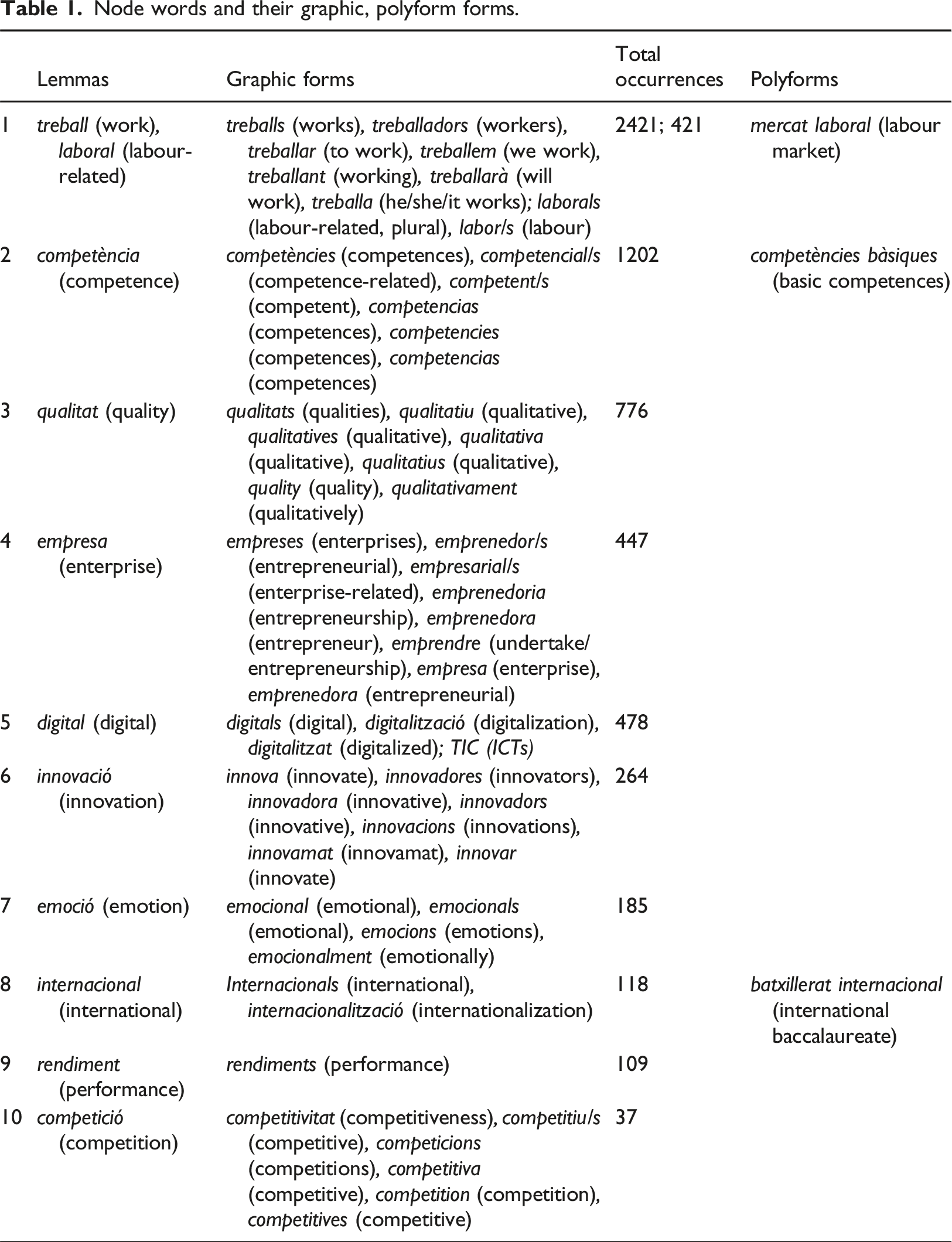
The analysed corpus consisted of 557,514 tokens (total number of occurrences) and 22,863 unique verb forms. The validity of the quantitative analysis is derived from the value of the corpus size. Given that 25,000 occurrences is stated as the minimum size of a corpus (Bolasco, 2021) to justify an automatic text analysis, we can consider the extraction of text from the considered corpus statistically valid.
With the exception of the node word treball, which ranks sixth in frequency within the corpus, the node words used in the queries to analyse the corpus had lower frequencies than the words that are more common in search documents of this type (such as centre, projecte, and educatiu).
A query was made for each node word, using a lemmatization process whenever grammatically possible; that is, recognizing the grammatical category of a word and tracing the graphic form to the lemma to which it belongs.
Lemma: Treball/laboral
Lemmatization (without taking into account the following graphic forms that had a low frequency: labor, 5 occurrences; labors, 2 occurrences) produced the graph shown in Chart 1, which shows that the node word treball (and, less frequently, the node word labor) is uniformly present in the corpus. Node word trends treball / laboral (lemmatization).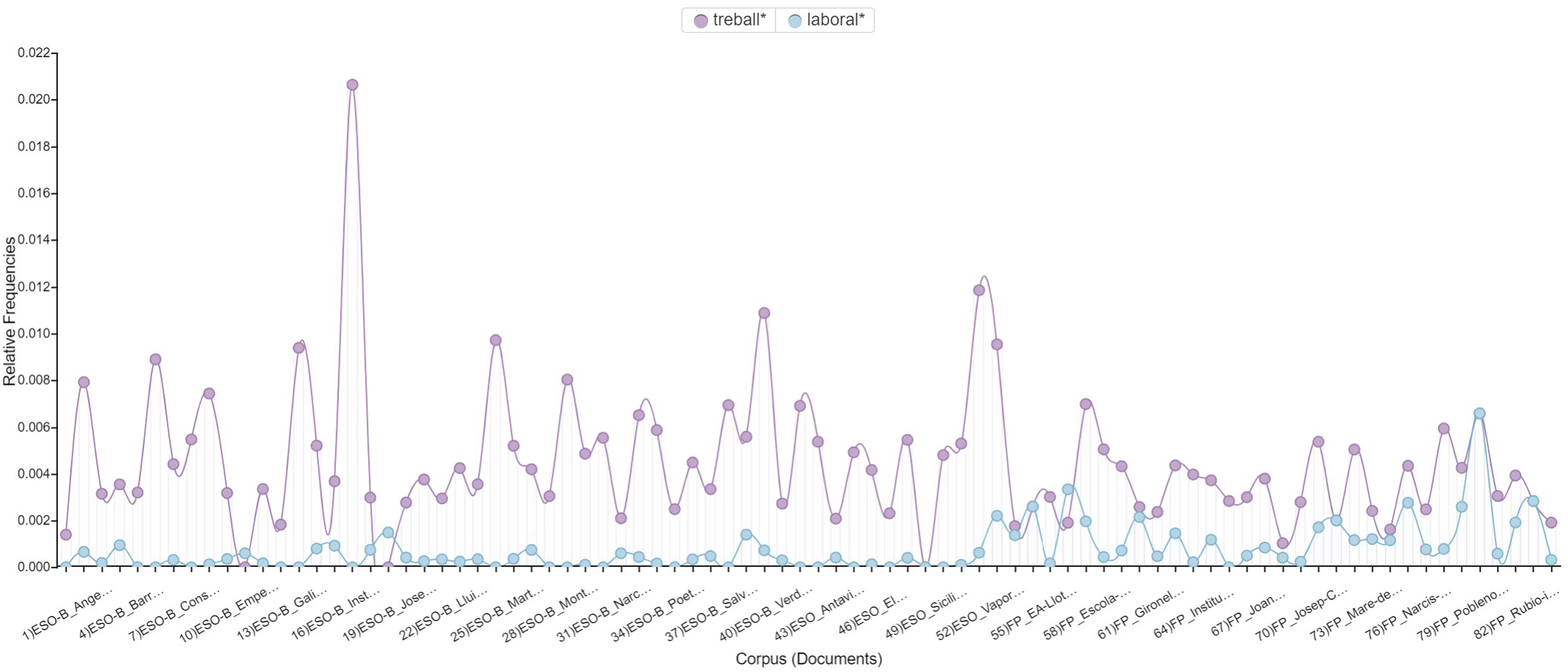
The above data are confirmed by the results from the Document Terms tool. In fact, one of the pieces of information that can be obtained is the TF-IDF index, which, for the node word object of the query, was zero for all of the documents in the corpus (distribution uniformity throughout the corpus).
The analysis of these node words in context shows a clear differentiation in the use of the terms labor and treball. In the former case, we can include all those propositions that indicate the intention of the writer of the document to functionalize the centre’s educational products according to the students’ subsequent career pathways (e.g. allowing students full social and workplace (labor) integration – doc 11, post 1869; the requirements of the labour market – doc 78, pos 2167; etc.). In the latter case, on the other hand, the propositions that contain the word treball almost always refer to teaching activities implemented by teachers that take place in the centre and in which students participate (e.g. encourages participation and teamwork - doc 0, pos 1783; in the fieldwork – doc 16, pos 540; has to favour cooperative work – doc 2, pos 2903; etc.). Only in some cases (like these: transmit values inherent to the working (labor) environment: professional responsibility, teamwork, punctuality, good presence – doc 3, pos 5422; integrate fully into a job (treball) and increasingly more complex society – doc 22, post 1961) does the meaning of the word treball overlap with that of the term labor. Checking for existence of the polyform labour market resulted in an ISr of .48, which means that the segment absorbs 50% of the meaning of the component forms: both the polyform and the word labor thus provide useful information in other contexts (the occurrence count considers that in some cases only the word market – mercat – or the segment job market – mercat de treball – is used to express the same meaning as labout market – mercat laboral).
Significant correlations were revealed (minimum coverage 75%) for the term laboral with words such as formació (training) (r = 0.14, p<<.05), educatiu (educational) (r = 0.20, p < .05), and alumnat (student body) (r = 0.13, p = .01). By also including the word mercat (market), the collocates graph revealed terminological collocations that confirmed the general use of the word treball and highlighted the proximity of the term labor to the words mercat, formació, alumnes (students) (Figure 1). In addition, the word mercat established a bridge between the two terms treball and laboral. Collocates graph for node words treball, laboral (and mercat) - context 7.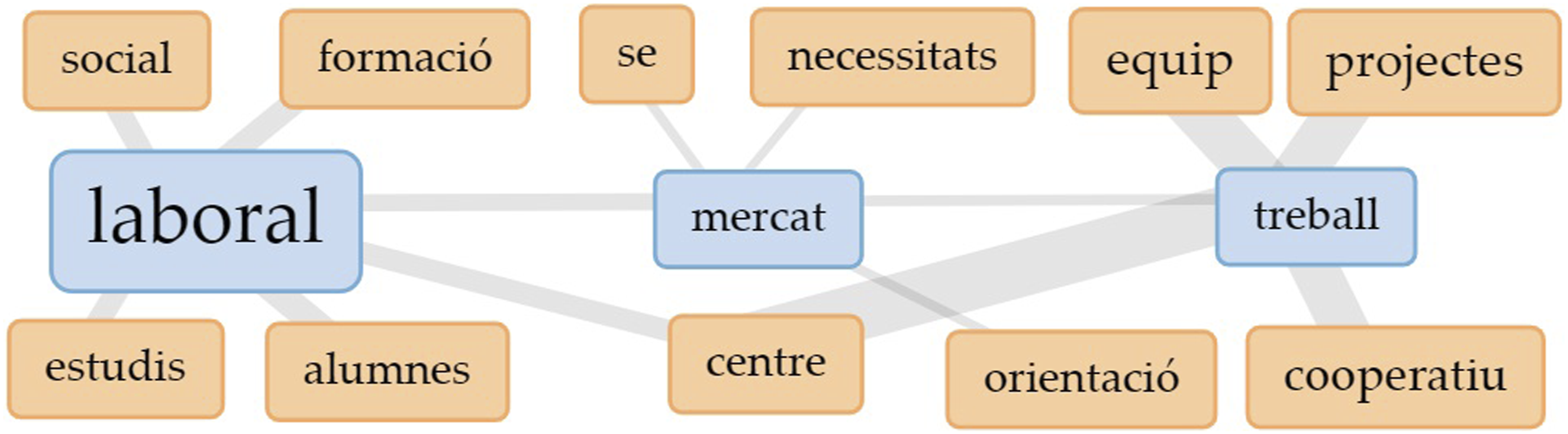
Lemma: Competència
The relative frequency of the lemma competència appears uniformly distributed throughout the corpus. The Document Terms tool also confirms this result (TF-IDF approximately zero). The Trends are as presented in Chart 2 (Appendix B).
The analysis of the node word in context (Appendix A) revealed the existence of significant polyforms. For example, the polyform competencies bàsiques (basic competences) had 227 occurrences and an ISr index of 0.57. Although the polyform aprenentatge competencial (competence learning) appeared relatively little in the corpus documents, if more complex linguistic forms were considered (quasi-segments such as aprenentatge més competencial – more competence-based learning), its significance increased. By way of example, we present the following segments that contained the lemma competència: aprenentatge competencial – competence learning (doc 1, pos 1018); aprenentatge de caràcter competencial – competence-based learning (doc 3, pos 3436); currículum competencial – competence-based curriculum (doc 6, pos 5219); promoure l’aprenentatge competencial dels alumnes – promoting students’ learning of competences (doc 8, pos 3872); afavorir el tractament competencial dels continguts – fostering the use of competences in the content (doc 23, pos 3303); millorar el rendiment competencial de l’alumnat – improving students’ performance with regard to competences (doc 30, pos 206).
However, no significant correlations were found between the node word competència and other terms.
A graphic visualization of the relationships (Figure 2 – Appendix B) of the node word and its most significant graphic forms highlights the importance of the polyform competències bàsiques (basic competences) and hints at important relationships with the terms persones (people), ciutadans (citizens), alumnat (student body), alumnes (students).
Lemma: Qualitat
The node word qualitat (whose different graphic forms have a very low frequency) had an almost uniform appearance throughout the corpus, with a slight prevalence in documents from vocational training centres (Chart 3 – Appendix B).
The analysis of TF-IDF and Z-score confirmed the previous data, with the exception of one document (doc 75), in which the word appears with a particularly high frequency, which is from an educational centre related to vocational training.
The term qualitat appeared in very diverse contexts, including: relationships with companies, the type of education aspired to, the centre’s policies, teaching, administrative management, the service offered by the centre (e.g. Les relacions amb les empreses s’han de guiar fonamentalment pels principis de lleialtat, col·laboració, personalització i qualitat - relationships with companies must be fundamentally guided by the principles of loyalty, collaboration, personalization and quality - doc 2, pos 16,154; qualitat educativa - educational quality - doc 36, pos 1234; pla de qualitat - quality plan - doc 65, pos 6167; la qualitat de l’educació, que possibilita l’assoliment de les competències bàsiques i la consecució de l’excel·lència - quality of education, which makes it possible to achieve basic competences and achieve excellence - doc 11, pos 1599; docència de qualitat - quality teaching - doc 8, pos 4033; gestió de la qualitat - quality management - doc 52, pos 669; qualitat pedagògica - pedagogical quality - doc 55, pos 5708; política de qualitat - quality policy - doc 52, pos 1469; qualitat del servei - service quality - doc 40, pos 799; projectes d’innovació i qualitat - projects aimed at innovation and quality - doc 60, pos 2048; grups de discussió tindrien un funcionament anàleg als dels ‘cercles de control de qualitat’ d’algunes empreses - discussion groups would have a similar operation to those of the “quality control circles” in some companies - doc 17, pos 4187). Although they did not turn out to be polyform according to the calculation of the ISr index (<<0.50), some of these segments were nonetheless useful for content analysis (e.g. política de calidad - quality policy: although not statistically a polyform, the segment had a high occurrence if only vocational training centres were considered).
Some values of the Pearson’s correlation coefficient (r) and the Significance (p) allowed for consideration of the correlations centre-qualitat - centre-quality (r = 0.39, p = .0003), projecte-qualitat - project-quality (r = 0.19, p = .012), educatiu-qualitat - educational-quality (r = 0.15, p = .021), educativa-qualitat - educational-quality (r = 0.09, p = .053), treball-qualitat - work-quality (r = 0.09, p = .096). The coverage of the corpus was high (minimum coverage 85%). When lowering the minimum coverage to 80%, the correlation treball-qualitat (work-quality) decreased and the correlation alumnat-qualitat student-quality appeared (r = 0.11, p = .041). The Collocates graph (Figure 3 – Appendix B) highlights relationships with terms such as política (policy), gestió (management), centre (centre) and sistema (system).
Lemma: Empresa
The frequency distribution of the node word empresa (enterprise) and its graphic forms indicated its greater presence in the documents produced by vocational and technical training centres. However, given the high specificity of this node word, the occurrences of the term in documents from secondary and upper secondary schools were also significant (Chart 4 – Appendix B).
The IT-IDF calculation (values slightly higher than zero for some docs) and Z-Score (values lower than 1.5) confirmed the importance of the term for the docs produced by vocational and technical training centres and its non-insignificance for docs produced by secondary and upper secondary schools.
The use of the node word empresa (enterprise) in context almost never needed to be disambiguated, with the exception of the use of the graphic form emprendre (undertake/entrepreneurship), which was sometimes used in the sense of undertake (e.g. in propositions such as compromisos que com a centre, volem emprendre amb la nostra societat - commitments that as a centre, we wish to undertake with our society - doc 77, pos 394). The most common expressions were: Aprendre a emprendre - Learn entrepreneurship (doc 16, pos 74), Promou aliances amb les empreses del sector - Promote alliances with companies in the sector (doc 52, pos 2188), fomentant la creativitat, la iniciativa pròpia i l’esperit emprenedor - fostering creativity, own initiative and the entrepreneurial spirit (doc 12, pos 1645), necessitat de tenir una iniciativa emprenedora - the need to have entrepreneurial initiative (doc 68, pos 2964), El foment de l’emprenedoria - Promoting entrepreneurship (doc 2, pos 780), mesures flexibilitzadores, emprenedoria i innovació - flexible measures, entrepreneurship and innovation (doc 70, pos 8581), Formar ciutadans autònoms i emprenedors - Training autonomous citizens and entrepreneurs (doc 22, pos 2312), etc. In the context, the analysis also highlighted the existence of a discipline called Economia i empresa - Economics and Business (doc 40, pos 1420), Estades en empresa - In-company programmes (doc 64, pos 484) reserved for teachers (as also confirmed on the Web site of the Catalan Government’s Department for Education, relating to professional training). There were also many projects related to the business world (e.g.: Projecte d’economia i empresa - Economics and business project - doc 69, pos 6020).
The most significant correlation (minimum coverage 45%) appeared to be the one between the terms empreses and centre - companies and centre (r = 0.23, p = .03). These were followed by competències - competences (r = 0.04, p = .04), formació - training (r = 0.05, p = .19) and educativa - educational (r = 0.04, p = .25), while emprenedor (entrepreneur) also displayed correlations (minimum coverage 30%) with alumnat - student body (r = 0.04, p = .009).
The Collocates graph (Figure 4 – Appendix B) illustrates the proximity to the word node and its graphic forms of terms such as centre - centre (which also established bridges with three different graphic forms of empresa - enterprise), formació (training), alumnes (students), aprendre (learn), educatives (educational) and ciutadans (citizens).
Lemma: Digital
The frequency distribution of the lemma digital (Chart 5 – Appendix B) was almost uniform within the corpus, with a slight prevalence within the documents of the secondary and upper secondary schools, also confirmed by calculation of the TF-IDF index.
The analysis of the node word in context revealed its relationship with the concept of competencias básicas - basic competences (capacitats digitals - digital skills - doc 82, pos 4205; les competències digitals - digital competences - pos 52, pos 2421; aprenentatge de les eines bàsiques digitals - learning basic digital tools - pos 28, pos 1251; model educatiu basat en la digitalització - educational model based on digitization - pos 40, pos 863).
The ISr index for the polyform competènci* digital* was 0.18, a value that gives sufficient importance to the existence of the polyform, also considering the considerable difference in frequency within the corpus of the words competència (competence) and digital (digital).
No statistically significant correlations were found.
The Collocates graph (Figure 5 – Appendix B) indicated the proximity to the node word of the terms competències (competences), aprenentatge (learning), alumnat (student body), docent (teacher), centre (centre).
Lemma: Innovació
The distribution of frequencies for the node word innovació (innovation) (Chart 6 – Appendix B) within the corpus was almost homogeneous. This was also confirmed by the calculation of the TF-IDF index. Although some documents had a non-zero TF-IDF for this node word, this occurred both in documents produced by secondary and upper secondary schools and VT centres. Only one document had a relatively higher value than the others (doc 7, TF-IDF = 0.003).
The analysis of the node word in context (Appendix A) related it to the market and technological changes (e.g. el centre haurà d’estar atent a les innovacions del mercat – the centre must be attentive to market innovations – doc 35, pos 9976; oberts a les innovacions i a l’evolució de les noves tecnologies – open to innovations and the evolution of new technologies – doc 59, pos 669) and thereby justifies the need for educational innovation (e.g. desplegament de la innovació educativa del centre – deployment of the centre’s educational innovation – doc 8, pos 5098). In some cases, innovative spirit was related to entrepreneurial spirit (esperit emprenedor i innovador – doc 78, pos 2125), while the graphic form innovador (innovative) appeared in the context of the network of vocational training centres that promote innovation. The graphic form innovador (innovative) was related to the terms centre (centre), projecte (project), grup de treball (work group), esperit (spirit), marc (framewerk). The word innovamat (innovamat), on the other hand, referred specifically to a mathematics programme.
Calculation of the Pearson coefficient always returned negative correlation values (not useful for the purposes of this investigation). The graph of the words most frequently (Figure 6 – Appendix B) found in the vicinity of the node word (together with its graphic forms) displayed associations with the terms ser (be), educativa (educational), empreses (companies), formació (training), escola (school), metodologies (methodologies), canvis (changes).
Lemma: Emoció
This lemma did not have a high frequency. The frequency distribution graph (Chart 7 – Appendix B) showed a greater presence (not pronounced) of this node word in the documentation produced by secondary and upper secondary schools (a fact also confirmed by the TF-IDF values).
The analysis of the node word in context returned associations such as the following: educació emocional - emotional education (doc 5, pos 407), controlar les emocions - control emotions (doc 80, pos 2545), capacitat de gestió emocional - capacity for managing emotions (doc 32, pos 1783), competents a nivell intel·lectual i emocional - competent at an intellectual and emotional level (doc 23, pos 711). Although the polyforms educació emocional (emotional education), controlar les emocions (controlling emotions) and gestió de les emocions (managing emotions) yielded low percentages of occurrences of their component forms, as we will explain in the discussion, they make a strong contribution when it comes to meaning.
All that being said, however, no statistically significant correlations appeared.
The Collocations graph (Figure 7 – Appendix B) highlighted certain words located near the node word: educació (education), vinculació (linking), controlar (control), gestió (managing), alumnes (students), social (social), adquirir (acquire).
Lemma: Internacional
The frequency distribution of this lemma (Chart 8 – Appendix B) shifted towards the documents produced by vocational training centres (Trends and TF-IDF calculation).
In context, the node word was mainly related to marketing: it makes the public aware of options with regard to educational pathways competing with those of other schools/centres, with the aim of characterizing the institution as being cutting-edge (e.g. llengua estrangera com a lengua de comunicació internacional - foreign language as a language of international communication - doc 1, pos 3101; mobilitat a nivell internacional - international mobility - doc 57, pos 3966; competència internacional de les empreses - international competition between companies - doc 57, pos 9338; dimensió internacional del centre educatiu - international dimension of the educational centre - doc 58, pos 10536; batxillerat internacional - international baccalaureate - doc 74, pos 412; dimensió internacional de la formació professional - international dimension of professional training - doc 75, pos 7564; programes internacionals - international programmes - doc 2, pos 339).
The Pearson coefficient provided information on the existence of weak correlations between the node word and the following terms: empreses - companies (r = 0.02, p = .02), aprenentatge - learning (r = 0.02, p = .03), laboral - labour (r = 0.02, p = .01), educació - education (r = 0.02, p = .03), ensenyaments - teaching (r = 0.02, p = .01). The minimum coverage was 25% (which confirms the higher frequency of the node word in the educational documentation produced by vocational training centres).
From the collocates graph (Figure 8 – Appendix B), we obtained the proximity of words such as batxillerat (upper secondary), projecte (project), empreses (companies), participació (participation), mobilitat (mobility), and centre (centre).
The results for the lemmas rendiment and competició, not being semantically and statistically significant respectively, are given in Appendix B, together with the table of node words with all their graphic forms, all the charts and figures relating to the findings of the statistical analysis.
Exploring the correlation between words and contexts of use. Towards a pedagogy of the labour market?
Using corpus-based discourse analysis, this study examined the language used in ECPs at state secondary schools in Barcelona. The research presents important empirical evidence and contributions on the way in which these documents were written, that is, their explicit and implicit purposes. By verifying the frequency of node word occurrences and their distribution in the corpus, using correlations and analysing these words in context, the underlying linguistic patterns in the production of educational discourse have been brought to light.
The analysis of the corpus revealed a homogeneous distribution of the lemmas treball (work), laboral (labour-related), competència (competence) and qualitat (quality) in the educational discourse used in the ECPs. This suggests that the terms carry both meaning and weight. While on the one hand the context in which the lemma treball is used expresses a pedagogical vision that attributes a central role to the cooperative dimension and refers to a constructivist model of knowledge, on the other hand, this position appears to contradict the frequency with which the term laboral is used. This finding, emphasized by the presence of polyforms such as mercat laboral (labour market) and competències bàsiques (basic competences), seems to suggest that the educational missions of the studied schools are linked to the needs of the labour market, and therefore a conception of school as a service oriented to the market (Laval et al., 2012).
Therefore, according to Connell (2013) we argue that these results point out that education in the liberal era serves a specific purpose: human capital formation. Indeed, in respect of this, the use of lemmas such as treball, labor and competència in the ECPs would appear to promote a conception of knowledge, that, as Bruno et al. (2010) stated, serves as a simple support for ‘savoir-faire’.
In fact, a very frequent pattern in the examined corpus is that of the lemma competència (competence) declined in its adjectival form (aprenentatge competencial - competence learning - doc 1, pos 1018; currículum competencial - competence curriculum-doc 6, pos 5219) acting as a modifying label for a series of lexical elements. This pattern of usage contributes to designing a homogeneous educational model in which, regardless of the type of school or centre (secondary, upper secondary, VT), competència (competence) is made the central attribute.
We agree with Boarelli (2019) in recognizing that competences push educational systems to abandon the construction of critical knowledge in favour of organizing instrumental knowledge.
In such a technical and utilitarian perspective of knowledge, the aims of educational institutions become those of promoting the learning of standardized forms of conduct. This interpretation is confirmed not only in the way in which the lemma competència modifies the most frequent collocations (professionals - professional, alumnes - student, persones - people, ciutadans - citizens), but also in the way in which the lemma empresa (company) occurs.
In fact, by illustrating the proximity of terms such as centre (center), formació (training), alumnes (students), aprendre (learn) and educatives (educational) to this node word and its graphic forms, the Collocates graph for the lemma empresa (company) highlights the central role that the training of people as citizen-entrepreneurs assumes in educational projects. In this respect, the educational systems analysed through their ECP discourse emerge as tools that shape a particular type of subjectivity: the self-entrepreneur, human capital (Ciccarelli, 2018; Foucault et al., 2005), making other processes of subjectivation that are not adaptive to the labour market impossible.
It should be noted that a dominant pattern of positive attributes emerged around the graphic form emprenedor/s (entrepreneur/s), encoded in lexical elements such as ciutadans (citizens), autònomos (the self-employed), compromisos (commitments), capacitat (capacity) and iniciativa (initiative). The appearance of these words in the context of ECPs reveals that the entrepreneurial ideology is strongly associated with an active, dynamic, global and positive way of being a citizen.
We agree with Fitzgerald (2022) in recognizing that strongly linked collocations can be helpful in understanding the semantic load of a word, suggesting that co-occurring words are connected in people’s minds and act as triggers for unconscious associations, thus providing clues to the kind of ideological work these co-occurring words are carrying out.
Therefore, the frequency with which these groups of words co-occur represents a ‘packaging of information’ (Hunston, 2002: 119) that contributes to the ‘incremental effect of discourse’ (Baker, 2006: 13) and reveals how the meaning of a lemma is influenced by those words that tend to appear next to it.
In this regard, when observing the behaviour of the lemma emoció in relation to its collocates, we see that it tends to co-occur with groups of words related to the semantic domain of management and oversight (overseeing, managing), revealing attitudes and assumptions that have little to do with the psychological well-being and affective development of the student.
Thus, the lemma is resignified within a linguistic order and a universe of meaning, reinforcing and normalizing the neoliberal ideology that reduces the person to functional capacities, valued for their abilities or human capital.
The lemma emoció is situated, therefore, in an ambiguous balance between a humanist meaning and another pertaining to the use of technologies of the self, thereby constructing a neoliberal subjectivity (Foucault, 1994; Sorondo, 2020). In fact, analysing the context of use of the polyforms reveals that the actions of the educational institution are related to students acquiring emotional competence through formalized pathways on emotions (by way of example, the project Escolta’m instigated by the University of Barcelona’s Institute of Educational Sciences, or training in Mindfulness given by private organizations such as Fundesplai) or, in other cases, through the introduction of the professional figure of ‘emotional educator’.
The permeability of the educational project pursued by the examined schools/centres with respect to the neoliberal discourse is also revealed in the context of use and placements of the lemma qualitat. The node word qualitat is representative of a language, but also of some administrative-organizational practices directly taken from private enterprise. Regarding this point, we would point out that a good number of schools/educational centres (1 secondary-upper secondary, 20 VT) have requested and obtained the ISO9001 Quality Certification, a standard initially developed exclusively for companies (Munene, 2013). In the context of ECPs, the word qualitat acquires relevance mainly as a factor of competition (this also applies to the node word internacional) between institutions in terms of teaching quality and excellence of results. In this regard, the notion of quality, in its neoliberal sense, challenges schools to conform and become accountable (Teather and Hillman, 2024). Indeed, the use of this word, and the related organizational processes for ‘achieving’ it, appears in the documents as a means of ensuring meaningful learning for ‘users’. It therefore represents a marketing element that allows the school/centre to compete with others (Gibbon and Henriksen, 2012).
The results of our research allow us to formulate some hypotheses regarding possible implications. Firstly, the insistent use of terms such as qualitat, innovació, and internacional runs the risk of transforming the document, which publicly represents the educational centre, from an informative tool on educational pathways into a sort of ‘advertising brochure’, pushing the school into the competition of the education market.
Secondly, we believe that for teachers and students, the constant reference to notions such as treball/laboral, competència, competència basica, empresa, and digital may turn the school into a transmission mechanism between the neoliberal matrix and the technologies of the self (Han, 2020). This could lead, as the interviews with teachers in Lambert et al.'s (2015) research highlight, to phenomena of self-exploitation among teachers. Similarly, they could contribute to the marginalisation of students who challenge the normativity of the neoliberal order, to the emergence of disorders (Saunders, 2007) or problematic behaviour such as social withdrawal in young people (Coeli et al., 2023).
Conclusions
From a Foucauldian perspective focused on the microphysical aspects of power, we have considered ECPs as elements of the micro-device employed by the ‘school/educational centre’ and, therefore, as part of the material-discursive articulation of power, in a non-discontinuous but non-homogeneous relationship with molar devices, that is, with the policies of education (Foucault, 2013).
Rejecting a neoliberal approach, concerned with the production of data capital, we used linguistic data to reveal public discourses on education and challenge hegemonic structures. In this sense, we make the data perform an act of parrhesia (Koro-Ljungberg et al., 2019) by revealing how educational discourse is shaped by neoliberal ideology and transforming them into a force to resist governmentality (Foucault, 1980).
This approach has allowed us to recognize in the educational discourse present in the ECPs elements whereby a dominant global paradigm (the neoliberal discourse) interacts with local choices/decisions. Specifically, in the homogeneous distribution of certain lemmas, and in the frequency of certain occurrences and their positions within the corpus, we have detected a discursive space that recognizes the regime of truth (Foucault, 2005) with regard to the neoliberal culture/order and accepts the enunciability criteria of its contents.
In this sense, we conclude that the pedagogical culture of the centres examined, as it emerges from the analysis of the documents, can be considered a – conscious or unconscious – response to the questions posed by the neoliberal order.
We are aware of the limitation that research of this type inevitably entails, namely, the non-mechanical coincidence between the discourse of an institution’s projects and the specific educational action implemented by the institution and its individual professors. Therefore, we recognise that the analysis of the documents of educational institutions is not sufficient to account for the complexity of sociocultural processes and that more qualitative studies are necessary to verify to what extent this discursive order translates into teaching practices and educational experiences and the degree of intentionality with which the educational institutions contribute to the construction of subjectivities responding to neoliberal desires. It must also be taken into account that the keywords representative of the neoliberal paradigm in education are present in documents that, diffusely or concentrated in sections or parts, contain references to notions that belong to socio-critical discourse (cooperation, solidarity, critical thinking, etc.) or notions characterized by strong semantic ambiguity (emotion, quality, innovation). This ambiguity limits the possibility of verifying whether there was an intention in the use of these lemmas on the part of the authors or if, on the contrary, it was the result of a passive adherence to the dominant cultural and pedagogical model.
All of that being said, however, we believe that our work can help to bring visibility to certain trends and processes currently being included in the educational discourse of ‘local devices’, helping to advance knowledge of the transformation processes that are affecting the world of education.
Supplemental Material
Supplemental Material - Tracing neoliberal discourse in school documentation. The analysis of educational projects in Barcelona state schools
Supplemental Material for Tracing neoliberal discourse in school documentation. The analysis of educational projects in Barcelona state schools by Gianluca Coeli, Pere Soler-Masó and Anna Planas-Lladó in Policy Futures in Education
Footnotes
Acknowledgements
I would like to express my deepest gratitude to Maria Antonietta Chieppa, for her unwavering support and encouragement throughout this research. Her patience and understanding have been invaluable. I sincerely thank the anonymous reviewers for their valuable feedback and constructive comments, which improved the quality of this paper.
Declaration of conflicting interests
The author(s) declared no potential conflicts of interest with respect to the research, authorship, and/or publication of this article.
Funding
The author(s) received no financial support for the research, authorship, and/or publication of this article.
Ethical statement
This study was approved by the Research Ethics and Biosecurity Committee at the University of Girona (Project Code: CEBRU0002-23) on 22 March 2023.

Supplemental Material
Supplemental material for this article is available online.
References
Supplementary Material
Please find the following supplemental material available below.
For Open Access articles published under a Creative Commons License, all supplemental material carries the same license as the article it is associated with.
For non-Open Access articles published, all supplemental material carries a non-exclusive license, and permission requests for re-use of supplemental material or any part of supplemental material shall be sent directly to the copyright owner as specified in the copyright notice associated with the article.
