







Abstract
This study explores how critical media literacy interacts with the way emergent education leaders respond in culturally diverse environments. As the demographics of students and teachers in public schools and universities in the U.S. continually flourish, there is an increasing indication that the cultural gap is widening. The resulting friction and resistance amid continuous social, political, and economic uncertainties can be attributed to diminishing empathy and resistance to diversity, encompassing the fatigue experienced within culturally diverse school settings and undermining cultural responsiveness. By incorporating coding and analyses of data from a subset of 12 subjects purposively selected from a pool of 21 interviews, this qualitative research demonstrates that emergent leaders in education who have a multidimensional and critical understanding of media are more likely to have a higher degree of responsiveness to cultural diversity and differences and are less likely to experience cultural fatigue. It argues that the integration of media literacy in a culturally responsive curriculum encourages collective efficacy and critical consciousness in educational systems change and leadership.
Keywords
Introduction
As technology has become ubiquitous in social institutions, educational spaces and settings have extended into the digital world, allowing organizations, members, and processes to be shaped by mass media. As a result, media presentation and representation steadily govern our views, experiences, and reasoning. Critical media literacy has long addressed economics and politics of power, hegemony, and marginalization, many of which are elements of critical consciousness that are fundamental in cultural responsiveness, transformative leadership, and other equitable educational practices. According to Kellner and Share (2007a), critical media literacy interrogates ideologies of power and recognizes representation and hegemonic practices. Their framework and approach suggest that consumers and creators alike question the social construction, language, positionality, politics of representation, institutions, and agenda. Understanding the social interaction and repositioning process in critical education is crucial in the study of educational policy and practice.
Recent efforts to achieve social equity have tended to decontextualize racism. In response to cultural shifts in the educational landscape, policy and legislation have recently implemented remedies to bridge these gaps. However, unintended effects of frustration and fatigue towards efforts to advance social equity (Farmanesh et al., 2020) have come about despite programs intended to facilitate understanding of cultures present in American society. An actionable and more effective plan toward anti-racism and systemic change suggests an awareness of the tempering of dominant groups, critical retrospection of history, and reconstruction of educational practices at teacher preparation and leadership levels. This approach necessitates reevaluating values and beliefs with regard to socially just and racially equal communities. As “media challenge both the authority and the ability of the schools and political institutions to regulate access to knowledge and to set political agendas” (Hjarvard, 2008: 107), change leaders are challenged to respond to the consequences of adapting to mediatized and culturally diverse educational settings.
Negotiating external demands with internal regard to enact policy, demanding contextualization and integration of belief systems, is critical to lasting commitment to sustainable change. Implementing an integrative and comprehensive logic model affords policy actors an individual and collective sensemaking of root causes, experiences, and behaviors, reinforcing equitable practices in culturally diverse settings (Fullan, 2020; Hall and Hord, 2020). Since social issues in education are guided by how problems are framed and how they impress on values and beliefs rather than led by argument, media processes will parallel and exacerbate systemic inequalities. However, emerging education leaders working towards culturally responsive and transformative leadership are capable of disrupting the repressive framing of different groups and their experiences when equipped with critical consciousness in media literacy. In order to respond to a rapidly changing demography and social landscape, change leaders need to be dispositionally ready to enact inclusive and equitable education strategies and challenge unjust power, structure, and attitude. Emphasizing social practices in coherence- and sensemaking towards collective efficacy, educators cultivating critical media literacy are innovating to restructure education and challenge social systems.
Incorporating leadership values and consolidating experience with programming and practice are fundamental in making sense and meaning of policies in national reforms. Sensemaking is unique to how each leader relates policies to social reality and how the interpretation of policy and leadership logic consolidates to inform how these leaders practice change leadership (Rigby, 2015). Thus, context and value ensure lasting commitment to education reform and sustainable institutional change. Furthermore, transformative educational leadership informed by curriculum inquiry affords legitimacy and real-world sensemaking for democratic education.
Critical media literacy is based on the idea that information is shaped by people, that messages are constructed through discourse, and that knowledge reflects our positionality, identity, and experience (Kellner and Share, 2019). The concept premises that information may include or exclude ideologies to promote or discredit specific values, that there is a cost and motive to every message delivered and accessed, and that knowledge is never impartial and will either advantage or disadvantage (Kellner and Share, 2019). Recognizing that evidence can be presented or withheld to promote particular agendas is integral to the critical understanding of knowledge representation. Because policy decisions are contingent upon knowledge, limiting information can nonetheless hinder social justice. Although with critical consciousness and collective efficacy, change leaders can engage in the process of critical inquiry and cultural responsiveness.
With school climate increasingly seeing diversity and disparity on the rise, so has discussions around cultural responsiveness. Culturally responsive leadership and culturally relevant pedagogy has been written by educational researchers such as Geneva Gay and Gloria Ladson-Billings. Cultural responsiveness is an approach that utilizes cultural and experiential lenses to allow students and teachers to form trust, symbiosis, and rapport. It demands that leaders are critically conscious of the symbolic representation of power. It involves critically evaluating the presentation and misrepresentation of culture and how this marginalizes and minoritizes specific populations and groups. As such, transformative leadership necessitates the negotiation of differences and active participation in challenging deficit-thinking education, reflecting conversations elicited by critical media literacy. Critical activism and cultural responsiveness maintain a perspective that acknowledges the tension in negotiating and enacting policy and practice of equity and justice. Critical literacy in today’s media is praxis, connecting theory to practice and content to the lived experience of education leaders and practitioners. In a democratic education, there must be a balance between independence and dependence, for the community is a collection of individuals.
This study focused on how emerging education leaders respond to diversity in mediatized educational institutions, hypothesizing that emergent education leaders who have a multidimensional and critical understanding of media are more likely to have a higher degree of responsiveness to cultural diversity and differences and are less likely to experience cultural fatigue. Further, it aims to elucidate the mechanism by which critical consciousness in media literacy mitigates cultural fatigue and fortifies cultural responsiveness. The following two research questions guided the inquiry of this study: Research question 1: What significance does the consolidation of media literacy and critical consciousness play in how education leaders respond in culturally diverse environments? Research Question 2: In what ways does this significance help recognize cultural fatigue to improve outcomes of culturally responsive leadership?
Literature review
This literature review synthesizes research across three major strands—critical media literacy, cultural fatigue, and transformative leadership—to explore how emerging education leaders respond to cultural diversity. It provides a conceptual and empirical foundation for understanding the interplay of media awareness, emotional responses to diversity, and leadership practices in culturally diverse educational environments.
Critical media literacy in education leadership
Current research in educational leadership, as published in Volume 20, Issues 2-4, 2021 of Leadership and Policy in Schools, highlights transformational leadership, emotions in educational leaders, and job satisfaction and stress, which complements the present study. A synthesis of literature on media literacy, cultural fatigue, and cultural responsiveness was used to guide the research questions, particularly how critical consciousness in media shapes culturally responsive leadership. Building upon the theoretical framing, prior research also bridge the role of self-awareness and competence and responsiveness in culturally diverse settings. Critical media literacy, rooted in multiliteracies and advocated by scholars like Kellner, Share, and Yosso, emphasizes social practices and media interpretation as tools for navigating cultural differences. It is a tool to challenge information, power, and control in production and consumption, essentially asking how we use media and how media uses us (Copps as cited in Domine, 2009; Kellner and Share, 2007b). It extends to democratic education by fostering awareness of cultural representation and power structures (Yosso, 2020).
Transformative leadership through media literacy
In exploring leadership practices, research has shown that critical media literacy contributes significantly to the development of transformative leadership. Studies on media literacy as a critical pedagogy have demonstrated its role in 21st-century culturally responsive leadership, effecting change in multicultural attitudes and discriminatory practices (Yosso, 2020). The skills and attitude needed to negotiate differences are essential in interacting with social justice in a participatory culture and engaging in democratic education.
Based on the tenets of transformative leadership theory and using decontextualized and coded data to find themes, Shields and Hesbol (2020) described how educational leaders operationalized transformative leadership, dealt with associated challenges, and managed the constant shifts in demographics. Shields and Hesbol (2020), using a critical transformative multi-case study, found that transformative practices and beliefs were evident in the three education leaders and that the enactment of strategies for inclusive and equitable education for a diverse population was observed in these cases. The findings suggested a dire need for education leaders to be “dispositionally prepared” (Shields and Hesbol, 2020) to respond to the rapidly changing demography and social landscape.
These transformative leadership practices align with the competencies assessed by the New Media Literacy (NML) scale developed by Koc and Barut (2016). Designed to measure critical engagement with media—both consumption and prosumption—the scale was validated through a study of 1311 university students. Grounded in the interrogation of power and participation in media, the skills measured by the NML scale reflect the critical awareness required for both cultural responsiveness and transformative educational leadership (Shields and Hesbol, 2020).
Recent studies affirm that media literacy training helps shape inclusive attitudes among pre-service teachers (Arsal, 2019). Those exposed to culturally diverse content and reflective practices showed greater positive shifts in multicultural perspectives. A critical understanding of media helps reduce discriminatory responses, address perceptions of cultural mismatch, and foster culturally responsive leadership. This critical consciousness counters deficit discourse (Yosso, 2002), mitigates bias (Leal, 2021), and supports educational transformation (Koc and Barut, 2016).
Cultural fatigue and the challenges of diversity
Cultural fatigue is an emerging concept in educational leadership research, reflecting the emotional and psychological toll that diversity initiatives can place on individuals and institutions. While diversity is often framed as inherently positive, recent studies challenge this assumption by showing that, when diversity efforts lack critical reflection, they can lead to stress, frustration, and disengagement rather than inclusion (Farmanesh et al., 2020; Franklin et al., 2014; Smith et al., 2016). This tension underscores the need to examine how leaders navigate the complex realities of diverse educational environments, directly connecting to Research Question 1, which explores the significance of integrating media literacy and critical consciousness in leaders’ responses to diversity.
Research has identified multiple forms of fatigue related to diversity work. Compassion fatigue, for instance, occurs among educators and helping professionals who regularly engage in the emotional labor of supporting individuals across cultural and socioeconomic differences (Stamm, 2010). Diversity fatigue captures the weariness that professionals experience when faced with persistent challenges of inclusion and equity, often resulting in decreased motivation and performance (Donahue and Parsons, 1982; Farmanesh et al., 2020; Smith et al., 2021). Racial battle fatigue highlights the cumulative psychological strain experienced by students of color on historically white college campuses (Franklin et al., 2014; Smith et al., 2016). Across these concepts, a common theme emerges: without tools to critically understand and respond to these stressors, both leaders and communities risk becoming less effective in fostering genuine inclusion and responsiveness.
The cultural mismatch between institutional values and the lived experiences of diverse stakeholders further compounds these challenges. Sladek et al. (2020), drawing on cultural mismatch theory, demonstrated that when students perceived misalignment between their cultural backgrounds and those of their institutions, their emotional and physiological stress levels increased. In their study of Latino students, culturally responsive messaging was shown to lower cortisol levels, a biological marker of stress, suggesting that institutional alignment can mitigate the negative effects of mismatch. These findings point to the need for leaders to move beyond surface-level diversity messaging and engage in practices that actively address underlying tensions and foster authentic belonging.
By synthesizing this body of research, a clear implication for leadership emerges: diversity initiatives that overlook the emotional complexities of fatigue risk reinforcing the very inequities they aim to dismantle. This insight directly connects to Research Question 2, which examines how recognizing and addressing cultural fatigue can strengthen culturally responsive leadership. Leaders equipped with critical media literacy are better positioned to interpret and challenge dominant narratives, mitigate bias, and create environments that foster meaningful inclusion rather than performative diversity efforts.
Extending the lens: Philosophical and global perspectives
Recent philosophical and global perspectives further contextualize this study’s focus on leadership, diversity, and critical media literacy. These perspectives emphasize that effective leadership is grounded in responsiveness to cultural contexts and commitments to equity, opportunity, and access. In today’s interconnected world, the viral dynamics of contemporary media have heightened the complexity of educational leadership. Leaders are increasingly called to act as public intellectuals, navigating rapidly evolving information environments while safeguarding both the dignity of learners and the integrity of discourse (Papastephanou et al., 2020; Peters et al., 2021).
Papastephanou et al. (2020) highlight the urgency of addressing inequities through education, framing leadership not merely as an administrative task but as a moral responsibility to expand access and opportunity. At the institutional level, questions surrounding whether universities can function as “ethical academies” (Tesar et al., 2022) underscore the role of leaders in shaping cultures that embody fairness, belonging, and justice.
Positioning critical media literacy within this broader frame shows its potential to empower reflective leadership. By equipping leaders to question dominant narratives and challenge inequitable structures, critical media literacy helps them foster environments that honor individual dignity while promoting excellence in culturally complex educational settings. This perspective links local challenges of diversity and fatigue to global imperatives, situating educational leadership as both context-specific and globally relevant.
Summary
Taken together, these strands illustrate that the sustainability of inclusive leadership depends on preparing leaders to engage both critically and compassionately with the challenges of diversity. The literature establishes three key insights: 1. Diversity alone is insufficient. Without critical reflection, diversity efforts may inadvertently generate emotional strain, cultural fatigue, and even reinforce inequities. 2. Critical media literacy offers a unique intervention. It provides leaders with the tools to understand how cultural differences are represented, to navigate complex information landscapes, and to mitigate the affective challenges of diversity. 3. Transformative leadership involves integration of theory and practice. Development of critical awareness and strategies to apply that awareness facilitates leaders in culturally diverse and emotionally demanding contexts.
Despite these advances, a critical gap remains. Existing research has not sufficiently examined how emerging educational leaders actually deploy critical media literacy to navigate and reduce cultural fatigue in real-world practice. Studies have explored media literacy as a theoretical concept and transformative leadership as a goal, but little empirical work connects these two domains in a way that addresses the emotional dimensions of diversity work.
This study addresses that gap by investigating the significance of integrating media literacy and critical consciousness in leaders’ responses to culturally diverse environments (Research Question 1) and by exploring how this integration helps leaders recognize and mitigate cultural fatigue, thereby improving the outcomes of culturally responsive leadership (Research Question 2). In doing so, it positions critical media literacy as both a practical tool and a theoretical bridge for advancing transformative, inclusive leadership in diverse educational settings.
Research methodology
Research design
This study employed a qualitative research design, using semi-structured interviews conducted via Zoom. To achieve both depth and breadth in exploring the research questions, the study was guided by a pragmatist worldview. Data were collected over 3 months and analyzed in the subsequent 3-month period. The focus of the qualitative data collection was to understand facets of cultural responsiveness, cultural fatigue, and critical consciousness—particularly participants’ self-perception of critical media literacy.
Participants and sampling
Participants were graduate students enrolled in the college of education at an R1 research university in the southwestern part of the United States, all of whom held current or prior leadership or teaching positions. A total of 21 participants were interviewed, from which 12 were purposively selected for in-depth analysis based on data richness and relevance to the study’s aims. Non-probability purposive and convenience sampling were employed to examine the relationship between critical media literacy and cultural responsiveness within the context of educational leadership. Data richness was operationalized using three primary indicators: 1. Depth of Narrative Detail - Participants who provided rich descriptions of experiences related to cultural responsiveness, critical consciousness, and cultural fatigue were prioritized. 2. Representation Across Key Constructs - Selection ensured variation across the spectrum of critical media literacy, critical consciousness, and cultural responsiveness levels, as identified in initial open coding. 3. Demographic and Contextual Diversity - The subset reflected variation in race/ethnicity, gender, socioeconomic background, and leadership context (K-12 vs higher education).
Data collection
Semi-structured interviews served to understand the ways media literacy and cultural responsiveness interact. In this study, culture encompasses racial, gender, ability, socioeconomic, and linguistic diversity. The two primary research questions guided the topic of exploration and subsequent interview. Background, contextual, and questions addressing the research topic solicited feedback on the interaction between critical media literacy and cultural responsiveness to diversity in educational circumstances/events. The interview protocol included questions adapted from Schmidt (2012) and Frye et al. (2010). Questions describing media use, how new knowledge and information were obtained, and types of media consumed informed critical media literacy. Questions were structured so that a description of critical media literacy transitioned to a portrayal of their culture and its representation in media and concluded with experiences of multiculturalism, cultural fatigue, diversity, and culture gaps. Interview questions were structured to generate conversations about identity, representation, power, and responsiveness to diversity in education.
Data analysis
The analysis proceeded in three stages: 1. Open Coding: All 21 transcripts were reviewed line-by-line to generate initial descriptive codes. This stage allowed for unrestricted exploration of participants’ narratives. For example, early codes included “code-switching,” “cultural mismatch,” and “media mistrust.” 2. Eclectic Coding: Codes were then grouped using an eclectic approach, combining descriptive, process, and values coding. For instance, initial descriptive codes such as “media bias awareness” and “algorithm influence” were clustered under the higher-order category Critical Media Literacy. 3. Axial Coding: Finally, axial coding was used to establish relationships between categories, linking critical media literacy, critical consciousness, cultural responsiveness, and cultural fatigue.
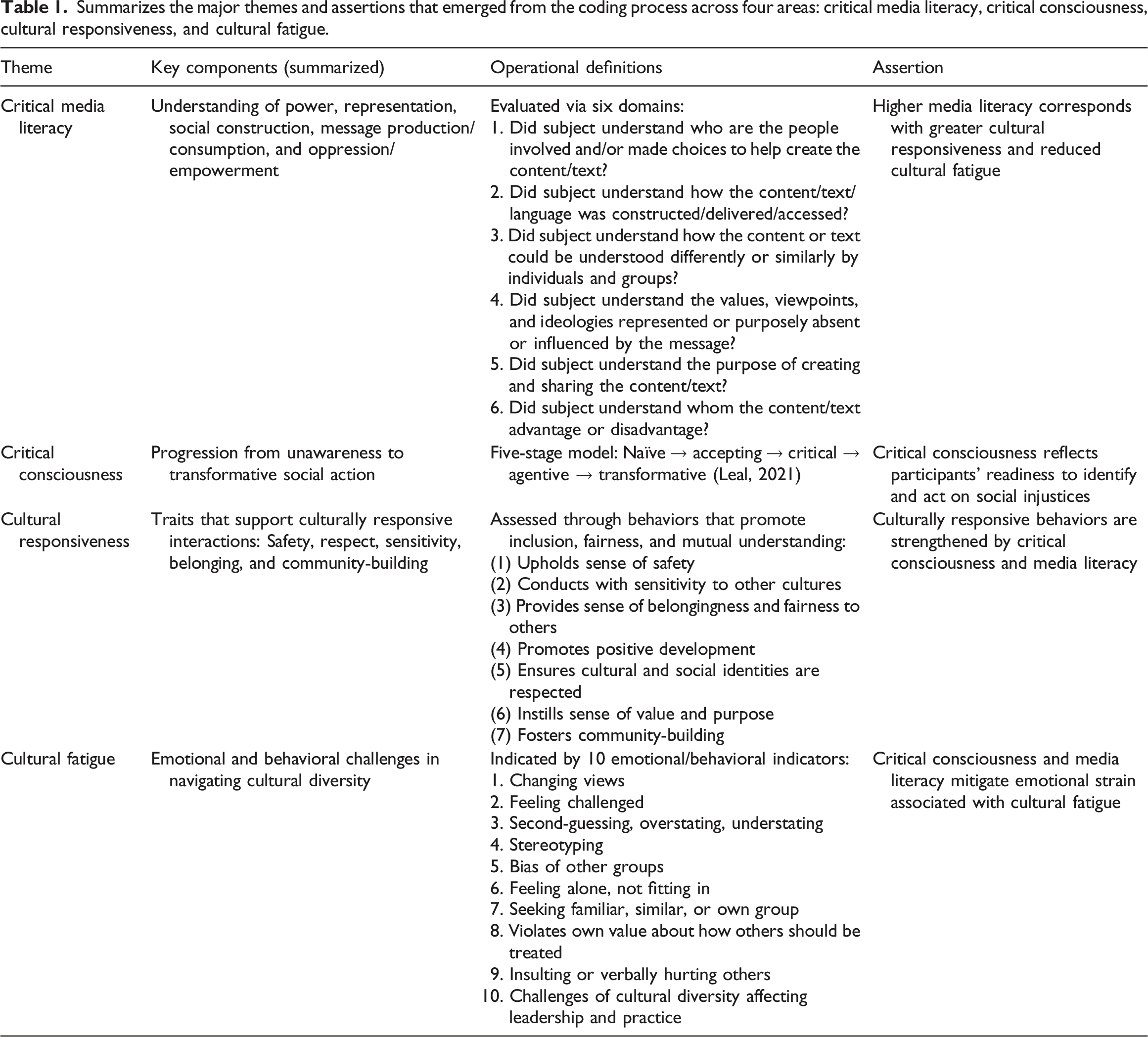
Summarizes the major themes and assertions that emerged from the coding process across four areas: critical media literacy, critical consciousness, cultural responsiveness, and cultural fatigue.
Given that coding was conducted by a single researcher, peer debriefing and iterative coding and reflexivity were implemented to mitigate bias, enhance trustworthiness, and to ensure reliability and validity. Throughout the coding process, preliminary themes and interpretations were reviewed with academic and research advisors to challenge assumptions and ensure analytic rigor. Coding was conducted in iterative cycles, with frequent return to the original transcripts to check for misinterpretation and over-reliance on preconceived ideas. Reflexive memos were kept to document decision-making.
The analytic process moved beyond simply categorizing participant statements by systematically connecting them to the study’s theoretical framework and research questions. The final themes reflect both deductive alignment with existing literature and inductive discovery of participant-driven insights. The study sought to balance the limitations of a single-coder design and ensure that interpretations authentically represented the voices of participants.
To assess critical media literacy, transcripts were coded using Kellner and Share’s (2019) critical media literacy framework. This framework examines six domains: 1. Social Constructivism - Who creates the message and why 2. Language and Semiotics - How messages are constructed 3. Audience and Positionality - How messages are interpreted 4. Politics of Representation - What ideologies are present or absent 5. Production and Institutions - The purpose behind the message 6. Social and Environmental Justice - Who is advantaged or disadvantaged by the message
Interview data were coded for participants’ understanding of media production and consumption, power dynamics, and the influence of media messages. This included examining how participants think about using media—and how media, in turn, influences them.
Participants’ critical consciousness was further analyzed using Leal’s (2021) adaptation of Paulo Freire’s concept of conscientização. This process maps participant development across five stages: 1. Naïve - Little or distorted awareness of societal challenges 2. Accepting - Initial recognition and questioning of societal inequities 3. Critical - Deepened understanding of equity issues 4. Agentive - Personal action in response to societal inequities 5. Transformative - Collaborative or institutional action for change
Cultural responsiveness was assessed using seven key behaviors (see Table 1). These traits were then used to assess participants’ ability to build rapport and cooperation across diverse settings. Finally, cultural fatigue was indicated by emotional and behavioral responses such as confusion, isolation, stereotyping, and challenges in navigating diverse leadership contexts.
In the last round of analysis, interview data were color-coded into three levels—high (green), medium (yellow), and low (red)—across all four categories. This visual coding enabled the identification of patterns and potential relationships among critical media literacy, critical consciousness, cultural responsiveness, and cultural fatigue.
Ethical considerations
Several measures were implemented in this study to ensure the safety and privacy of the participants. Approval to conduct this study was obtained from the university institutional review board. Participation was strictly voluntary. All participants were required to provide written informed consent. The names of the participants and contexts were kept confidential in the data collection, analysis, and reporting of findings. Precaution was taken to protect and maintain data security, including but not limited to storing research information in password-protected files.
Findings
Interplay of critical media literacy, critical consciousness, and cultural fatigue
Participants’ experiences revealed a dynamic and reciprocal relationship between critical media literacy, stages of critical consciousness, and cultural fatigue. Across participants, higher critical media literacy co-occurred with more agentive and transformative stages of critical consciousness, alongside fewer or more manageable experiences of cultural fatigue. Participants with nominal to modest levels of critical media literacy tended to center their own cultural reference points and used accommodative strategies (by such means as sharing and exchanging values) without interrogating inequity, aligning with naïve and accepting critical consciousness stages. Those with moderate critical media literacy recognized power and representation yet often neutralized conflictual topics, which, according to participants, seemed to constrain growth in cultural responsiveness.
Participants with high levels of critical media literacy described confronting inequities directly, sustaining difficult conversations, and reporting less or better-resolved fatigue—patterns consistent with agentive and transformative stages of critical consciousness. They demonstrated readiness to engage actively with social justice, challenge inequities, and negotiate uncomfortable conversations about power and representation. However, it is important to stress that these findings do not suggest a direct causal pathway in which high critical media literacy alone reduces fatigue. It may equally be that participants with advanced critical consciousness are already predisposed to engage critically with media. Rather than a unidirectional effect, the data support a mutually reinforcing process, where both constructs deepen over time and together shape leaders’ cultural responsiveness.
How cultural fatigue manifests across the consciousness continuum
Cultural fatigue clustered in patterned ways across stages. Participants at naïve and accepting stages of critical consciousness often recognized negative representation yet avoided contesting it, reporting code-switching and feelings of disconnection and dehumanization. Those around the critical stage perceived institutional contradictions—diversity-serving rhetoric versus underserved realities, for example—but tended to normalize discomfort, which yielded minor, persistent fatigue and limited leadership growth. By contrast, agentive and transformative participants reframed tension as an opportunity for advocacy and learning; they engaged openly with representation and equity issues, reported trust-building with students, and described self-mitigating strategies that kept fatigue from accumulating.
These patterns suggest that fatigue is not merely an individual stress response but a function of how inequity is interpreted and engaged. Leaders who read media more critically and locate problems structurally, rather than individually, reported less corrosive fatigue and more impactful culturally responsive practice.
Conditions that shape development
Differences in participants’ critical consciousness and responses to cultural fatigue appeared to be shaped by three interrelated factors: 1. Prior Personal Experiences: Lived experiences of navigating diversity or marginalization were drawn from to interpret media and act responsively. Those with richer intercultural experiences exhibited deeper reflection and higher resilience, while those without such histories displayed more emotional reactivity and disengagement. 2. Institutional Culture: Institutional culture, whether inclusive or ambiguous, directly affected participants’ willingness to apply critical awareness in practice. Contexts with explicit, enacted commitments to equity (beyond performative messaging) scaffolded agentive and transformative practices; ambiguous climates correlated with avoidance and suppression of identity. 3. Patterns of Media Engagement: Patterns of media use, particularly active production and analytical engagement, distinguished transformative leaders from passive consumers. Active engagement with media nurtured critical interrogation of dominant narratives and applied this lens in their leadership work, while passive consumption correlated with fatigue and neutrality.
These factors suggest that transformative responses do not emerge in isolation but are cultivated through both individual experiences and external influences and that fatigue is not merely an individual stress response but a function of how inequity is interpreted and engaged.
Practice-oriented corollaries
Although this study does not establish causation, several actionable corollaries follow from the patterns observed: • Structured critical encounters: Purposeful and guided engagements with contemporary media controversies linked to real-world leadership decisions facilitate movement from mere recognition toward agentive and transformative responses. When framed through critical media literacy, such encounters nurture leaders’ capacity to interrogate power, representation, and positionality in complex social issues and operationalize critical media literacy as praxis, linking analysis of mediated narratives to tangible acts of leadership. • Institutional scaffolds: Enacted, rather than performative, institutional commitments to equity, through explicit norms, reflective protocols, and leadership support for discomforting dialogue, help mitigate avoidance and polarization in educational discourse. Such structures promote the transition from descriptive awareness of inequity to critical, actionable sensemaking, reinforcing culturally responsive and inclusive practices. • Media Prosumption and Counter-Narrative Creation: When leaders engage as both consumers and creators of discourse, generating counter-narratives or community-facing explainers for example, they extend their critical consciousness from reflection to action. This active construction of meaning not only deepens analytic skill but also strengthens transformative leadership, reinforcing inclusion and equity as lived institutional values.
While the findings highlight clear patterns across levels of media literacy and critical consciousness, they also underscore the need for caution in interpretation. Cultural responsiveness cannot be reduced to a linear effect of literacy on fatigue. Instead, the evidence points to a developmental process where personal, institutional, and media practices interact to shape leaders’ readiness for transformative action.
Discussion
This study demonstrates that emerging education leaders with higher levels of critical media literacy are more capable of interpreting cultural complexity and responding to diversity through critical and transformative action. The analysis revealed that the interplay between critical media literacy and critical consciousness shapes leaders’ ability to recognize inequities, navigate cultural differences, and mitigate the emotional toll of cultural fatigue. In mediatized educational environments, where social narratives and representations often frame perceptions of diversity, these capacities become essential for maintaining equitable and responsive leadership practices.
A key contribution of this study lies in reframing critical media literacy not merely as an analytical skill but as a leadership disposition—one that fosters both critical self-awareness and ethical responsiveness in diverse educational contexts. Participants who demonstrated stronger critical media literacy were more likely to locate inequity at structural rather than individual levels and to engage constructively with cultural tension rather than avoid it. This finding underscores that culturally responsive leadership in mediatized contexts depends on a leader’s capacity to interpret and challenge dominant narratives while maintaining empathy and relational trust. Such leaders create inclusive spaces that value difference as an asset and a source of learning and collective growth rather than as a challenge to be managed.
Moreover, the findings suggest that leadership development should attend to how emerging leaders learn to read, produce, and critique media representations of culture and power. Leadership preparation programs that fail to integrate this dimension risk leaving future leaders ill-equipped to respond to the complex ways in which bias, ideology, and representation shape educational discourse and practice. The participants’ experiences revealed that leaders who engaged critically with media were better able to recognize and resist performative diversity initiatives, instead cultivating genuine inclusion grounded in critical reflection and social awareness.
In this sense, integrating critical media literacy into leadership and teacher education offers a pathway toward more reflective, justice-oriented preparation models. For instance, engaging pre-service and in-service leaders in collaborative analysis of media portrayals of education, race, and policy could help them connect abstract principles of equity with real-world mediatized contexts. Embedding such reflective inquiry across coursework and practicum experiences would encourage leaders to identify how narratives of cultural deficiency or “neutral” policy perpetuate inequity—and to develop counter-narratives rooted in empathy, cultural understanding, and social transformation.
Finally, the findings extend the theoretical dialogue between transformative leadership and critical media literacy by showing that both constructs are mutually reinforcing and developmentally situated. Rather than treating critical media literacy as an add-on to leadership training, it should be understood as an interpretive framework that deepens critical consciousness and supports the ethical dimensions of leadership practice. Through this lens, leadership preparation becomes not only a technical endeavor but also a moral and cultural project: one that prepares educators to engage with the emotional and ideological complexities of diversity in ways that sustain both personal well-being and institutional equity.
In summary, this study advances the argument that preparing culturally responsive leaders in mediatized educational settings requires an intentional integration of critical media literacy into leadership formation. By equipping leaders to analyze and respond to how culture and power circulate through media, preparation programs can cultivate the reflective, agentive, and transformative capacities necessary for educational systems that are both equitable and humane.
Implications
The findings indicate that critical media literacy should be treated as a core leadership competency within teacher and leader preparation, given its alignment with agentive and transformative stages of critical consciousness and its association with reduced cultural fatigue. Rather than adding new, prescriptive requirements, programs can embed critical media literacy across existing courses and clinical experiences to strengthen culturally responsive practice. Programs can emphasize three key areas of competency development: 1. Analytic and Reflective Practice - interrogating representation, power, and institutional interests in policy texts, news, and internal communications; identifying where narratives exacerbate or alleviate cultural fatigue. 2. Dialogic and Relational Leadership - preparing leaders to facilitate critical conversations that prioritize safety, belonging, and fairness while monitoring emotional load. 3. Transformative and Action-Oriented Application - producing transparent, equity-oriented communications (e.g., briefings, family updates, community communications) that reframe problems and justify practice with evidence.
These competencies can be developed through structured reflection modules, simulated leadership scenarios, and community-based learning experiences. For instance, candidates might analyze real-world media representations of education policies, engage in peer-led dialogues about bias and equity, or participate in community partnerships that apply critical media literacy to local leadership challenges. Such activities translate theory into practice and deepen leaders’ readiness to respond to the emotional and systemic dimensions of cultural diversity.
Programmatically, these practices can be embedded within existing courses or fieldwork without requiring major structural changes. Faculty development focused on critical media literacy pedagogy and reflective facilitation can further ensure that preparation programs sustain equity-driven approaches across curricula.
In essence, integrating critical media literacy within leadership and teacher education builds leaders’ capacity to read, interpret, and reshape dominant narratives, transforming awareness into agentive, culturally responsive action. This approach not only addresses the challenges of cultural fatigue but also strengthens leaders’ ability to sustain inclusive, equitable educational environments in an increasingly mediatized and diverse social landscape.
Limitation and recommendations for future study
While this study sought to represent the diversity of educational actors, the relatively small sample size and focus on emerging education leaders who were also students limit the generalizability of the findings. These participants provided valuable reflections on identity, cultural responsiveness, and navigating diversity, but their student status offered less insight into the complexities of leadership practice in real-world settings.
Additionally, as the study relied on a single coder, interpretations may reflect a degree of subjectivity despite efforts to maintain analytic rigor through systematic coding procedures. The qualitative design yielded rich and contextualized data, but the absence of quantitative measures limited the ability to detect broader trends or confirm patterns across larger populations.
Future research should broaden participant recruitment to include practicing leaders and teachers to better capture diverse experiences and contexts. Refining interview protocols to more explicitly explore critical media consumption and production may also deepen understanding of how leaders interact with media narratives. Incorporating multiple coders would enhance intercoder reliability, and a mixed-methods approach could combine the depth of qualitative data with the breadth of surveys or other quantitative tools. Such studies would provide a more complete and generalizable picture of the relationship between critical media literacy, critical consciousness, cultural responsiveness, and cultural fatigue.
Conclusion
This study underscores that culturally responsive leadership in mediatized educational settings develops through a reciprocal process between critical media literacy and critical consciousness. Rather than treating media literacy as a peripheral analytical skill, the findings demonstrate that it functions as a core interpretive and ethical capacity—enabling leaders to read, question, and reconstruct cultural narratives that shape educational realities. Leaders who critically engage with representations of identity and power are not only better positioned to recognize inequities but also to transform cultural fatigue into reflective and agentive practice.
Through qualitative analyses of emergent education leaders’ experiences, this research revealed that high levels of critical media literacy were consistently associated with advanced stages of critical consciousness and more constructive emotional responses to diversity. These patterns suggest that cultural fatigue is not simply an individual burden but a relational and structural phenomenon shaped by how leaders make sense of inequity. The study contributes to leadership theory by illuminating how media engagement mediates leaders’ emotional and cognitive processing of cultural difference—thereby extending transformative leadership frameworks into the digital and representational dimensions of education.
The results further indicate that critical media literacy can serve as a protective and generative resource for leaders navigating the complexities of diversity. By equipping leaders to interpret dominant discourses critically, challenge performative inclusion, and build authentic belonging, media literacy strengthens both relational trust and institutional coherence. This insight carries practical significance for leadership preparation programs: embedding critical media literacy across coursework and field experiences can cultivate leaders who are dispositionally ready to engage with the ideological and emotional demands of equity work in a mediatized society.
While this study’s scope was limited by its small, purposive sample and single-coder design, its findings offer a foundation for continued inquiry. Future research could employ mixed-methods or multi-site designs to examine how critical media literacy interventions shape leaders’ sensemaking, emotional resilience, and policy engagement over time. Investigating how institutions can operationalize critical media literacy at systemic levels—through professional learning, communication practices, and curriculum design—would deepen understanding of how cultural responsiveness can be sustained across contexts.
In sum, this research positions critical media literacy as both a theoretical bridge and a practical catalyst for culturally responsive leadership. By linking how leaders interpret mediated culture with how they enact equity and inclusion, it reframes leadership as a communicative and moral practice responsive to power, representation, and diversity. As education continues to unfold within mediatized environments, the capacity to critically engage with cultural narratives will remain essential to cultivating equitable, empathetic, and transformative leadership.
Footnotes
Author note
This research was conducted while the author was a doctoral student at the University of Arizona. The author is now affiliated with Merit University, Los Angeles, California, USA.

Ethical considerations
This study was approved by the Institutional Review Board (IRB) of the University of Arizona. Participation was strictly voluntary, and all participants provided written informed consent to participate and for the publication of anonymized findings. Measures were taken to ensure participant safety and privacy, including data anonymization, confidentiality, and secure storage in password-protected files.
Funding
The author received no financial support for the research, authorship, and/or publication of this article.
Declaration of conflicting interests
The author declared no potential conflicts of interest with respect to the research, authorship, and/or publication of this article.
Data Availability Statement
The data supporting the findings of this study are available in the University of Arizona’s institutional repository and may be accessed upon reasonable request, subject to ethical and legal considerations.