







Abstract

Dear Editor,
The COVID-19 pandemic has had a profound negative impact on us all; not only through directly causing over 212,000 deaths in the United Kingdom alone (as of November 2022), 1 but impacting on other aspects of health, especially mental health.
The pandemic significantly changed the working conditions of most healthcare professionals with many being deployed and/or working outside of their usual scope of practice. Pressures included: dealing with a novel disease with an uncertain trajectory and little evidence to guide treatments. Healthcare workers faced the burden of deciding which patients would access limited resources such as intensive care beds and when to withdraw treatment. Those with little previous experience of caring for dying patients were faced with a steep learning curve in providing end-of-life care for a vast number of patients during extremely challenging circumstances. 2 A study 3 examining healthcare workers’ experiences of providing palliative care during the COVID-19 pandemic, found that this was particularly challenging as traditional care was restricted by increased work pressure, use of personal protective equipment (PPE) and other infection control measures. Less connection with patients left staff feeling distressed that they were unable to relieve suffering and provide ‘a good death’. This resulted in staff suffering from compassion fatigue, moral injury, severe anxiety and increased risk of burnout and Post-Traumatic Stress Disorder (PTSD). 4
The pandemic did not strike equally and is known to have had significantly worse impact in more socio-economically deprived areas. For example, in England, the north was hit with a higher death rate, longer periods of lock-down and worse impact on mental health. 5 Within our Trust in the North-East of England, we sought new innovative ways that could potentially support the mental health of healthcare professionals. With no clear evidence-base for which interventions are effective, 6 we looked to methods used to support people working under extreme pressure outside of the healthcare setting.
Creative writing has previously been used to treat war veterans with PTSD 7 and so members of our Specialist Palliative Care Team (DW, MM) collaborated with the team at The Open University (SC, SBD), who conceived an innovative arts-based pilot. The intervention utilises group workshops (held virtually) and self-directed Creative and Expressive Writing, with the aim of alleviating stress and anxiety of healthcare workers. 3 × 90-minute workshops were delivered over 3 months via MS Teams to clinical staff. Staff were supplied with a workbook in advance of each session, and staff were guided through the exercises by team members.
After each workshop and at the end of the process, staff have been surveyed using psycho-social wellbeing questionnaires (drawing on the Warwick-Edinburgh approach). Whilst 61% (n = 11/18) of participants reported feeling anxious at the thought of writing at the beginning of the process, this reduced over time. These workshops (and workbooks given to allow staff to use the methods in their own time) were found to be positive by healthcare staff. After the final workshop, anonymous feedback included 100% of respondents either ‘agreed’ or ‘strongly agreed’ with the following statements:
The workshop has helped me to feel good about myself
The exercises helped me express myself
I believe this workshop has been valuable to me
I feel enabled to use the techniques I have learned
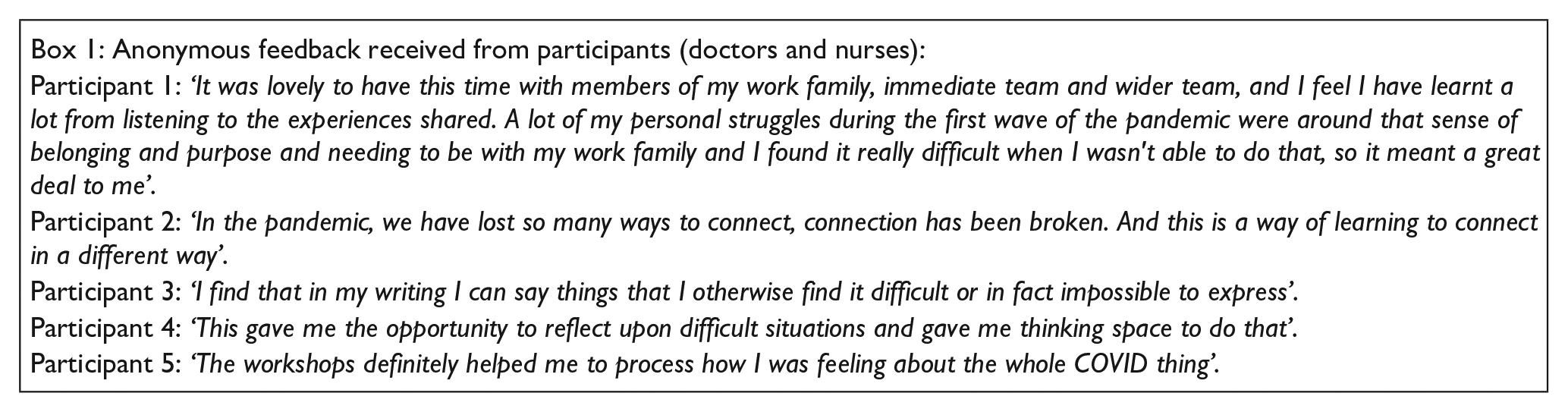
Further anonymous feedback has been provided in Box 1.
Sessions were well attended (although small in number, n = 18 at the initial series of workshops in 2020), but participants continued to attend all sessions and many requests were made for further sessions to be delivered. This led to the workshops being rolled out at other national health service (NHS) sites across the North-East of England, with further evaluation ongoing.
Although, it is acknowledged that this may not be an appropriate method of psychological support for everyone, there is no one-size-fits-all solution. We have provided a creative and innovate approach, which can be applied remotely and replicated more widely to provide much needed support to health care professionals. Although, long-term follow up of the cohort is needed to determine if this method improves mental health in the long-term, short-term feedback has been extremely positive. New methods that merge healthcare and the arts are an exciting, under-researched areas with potential to promote wellbeing and improve mental health, much needed as we continue to work under significant competing pressures in the NHS as we move into a third winter under the burden of COVID-19.
Footnotes
Acknowledgements
This work would not be possible without our unique collaboration with Dr. Siobhan Campbell (SC) and Dr. Sally Blackburn-Daniels (SBD) from The Open University.
Authors’ note
This work has now received 1st prize awards in the COVID-19 categories at both the ‘Bright Ideas in Health Awards’ and ‘The Open University Research Excellence Awards’.
Author contributions
DW, MM, SBD, SC all contributed to each aspect of the study and agree on the final version of this letter.
Declaration of conflicting interests
The author(s) declared no potential conflicts of interest with respect to the research, authorship, and/or publication of this article.
Funding
The author(s) disclosed receipt of the following financial support for the research, authorship, and/or publication of this article: SBD & SC were awarded some internal funding from The Open University to support working on this project.