







Abstract

The past few years have witnessed an explosion in the use of ‘informal’ social media channels to disseminate scientific information and conduct survey-based research.1,2 This editorial details the different social media channels used for scientific communication and suggests best practices for the scientific use of social media.
Social media channels/platforms
Twitter is the platform most commonly used for scientific communication. Various scientific societies (including the Royal College of Physicians of Edinburgh) and journals have dedicated Twitter accounts. The scientific content posted on such Twitter accounts generally reaches out to a wider audience (including individuals not associated with healthcare or scientific research). It also serves to reach out to doctors or scientists to help them keep abreast of the latest advances in the field. Most journals would have editorial board members dedicated to deal with their social media outreach. The 280-character limit on Twitter provides an incentive to summarise the intended information in a concise form (a good exercise for junior doctors or scientists on how to communicate using few words). The use of threads (numbered as 1/, 2/ and so on) enables a chain of communication to present related information using multiple tweets. The use of hashtags enables the outreach of Twitter content to a wider audience which follow such hashtags. A commonly used hashtag in medical academic circles is #meded (intended to convey medical education). Tagging along Twitter accounts also enables the outreach of the tweet to a specific audience who might be more interested in its content. 3 A recent proposal has been floated to increase the character limit of tweets to 4000 characters, which shall enable the presentation of more detailed information in a tweet. 4
Facebook is another platform used by scientific journals and societies. The audience on Facebook is more diverse, therefore, it serves as a good platform for social media outreach to lay persons. This is particularly useful for activities related to patient education and advertisement for recruitment of patients in clinical studies. 5 Instagram is a social media channel based on the sharing of images. It serves as a tool to share interesting images from published reports or for graphical abstracts (detailed later). 6 Linkedin is a platform intended for professional interactions. Some journals also have a presence on Linkedin where short snippets with or without images or graphical abstracts can be shared to increase attention to published articles. 7
Best practices on social media for scientific interactions
Discussions on social media can flare up into aggressive bullying sometimes with little provocation. It is important for social media teams of scientific journals to always maintain a strictly professional tone to interactions. If there are any aggressive comments to the content posted, it is best to reply once affirming the scientific position and thereafter avoid further confrontation by repeated replies. It is imperative that social media editors of journals should promote all articles published in their respective journals without bias or preference to specific articles or to their own published content in the journals.1,8,9 Whenever patient images are posted from journal articles, it is essential to confirm whether the said patient had given “consent to publish” their images. 9 Even then, such images should be published or posted after de-identifying them as much as possible. Even for patient images not published in journals which are otherwise posted for teaching purposes, obtaining written consent to publish and de-identifying such photographs is essential. 9
Journals generally permit the sharing of copyrighted content through their own social media channels. However, practices may vary in this regard and should be clarified in principle from the journal or publisher in question. 10 Editors responsible for social media outreach should use graphical abstracts to summarise the information from a given article, particularly for original articles. Graphical abstracts could be created using Microsoft Powerpoint or using professional softwares such as Biorender or Canva. An example of a graphical abstract summarising the content of this article is provided in Figure 1.
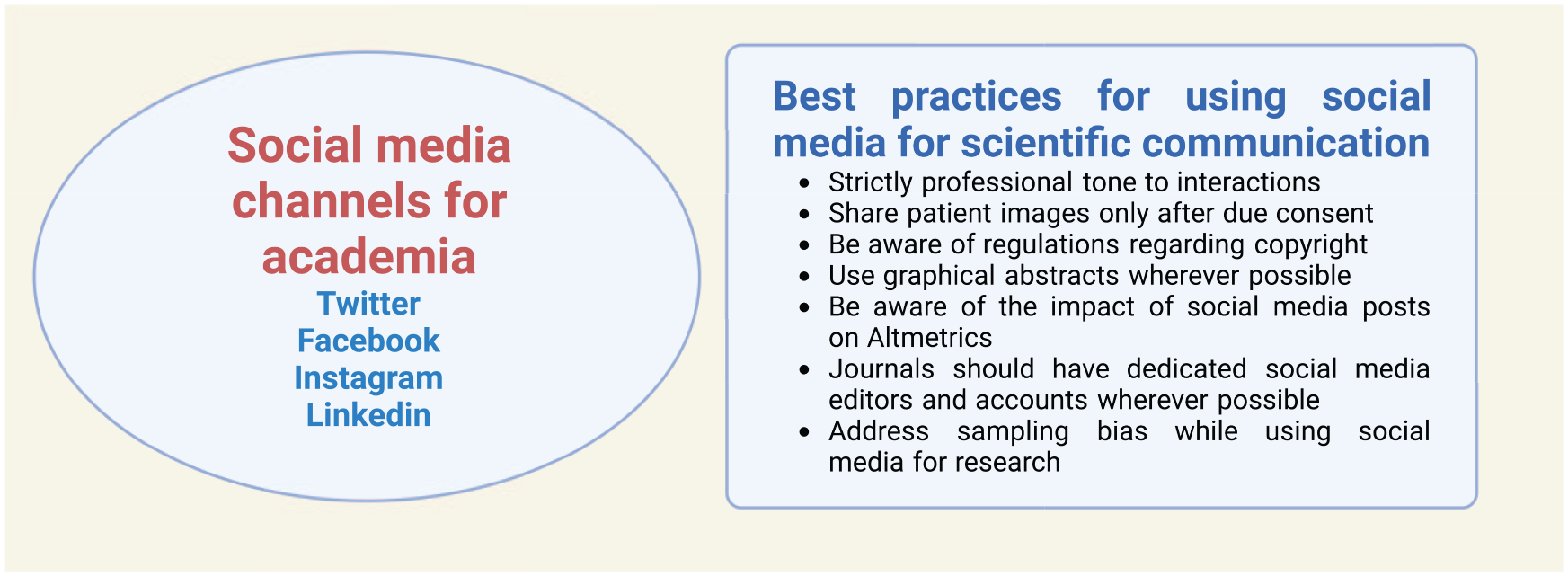
Social media channels and best practices for use in scientific communication and research.
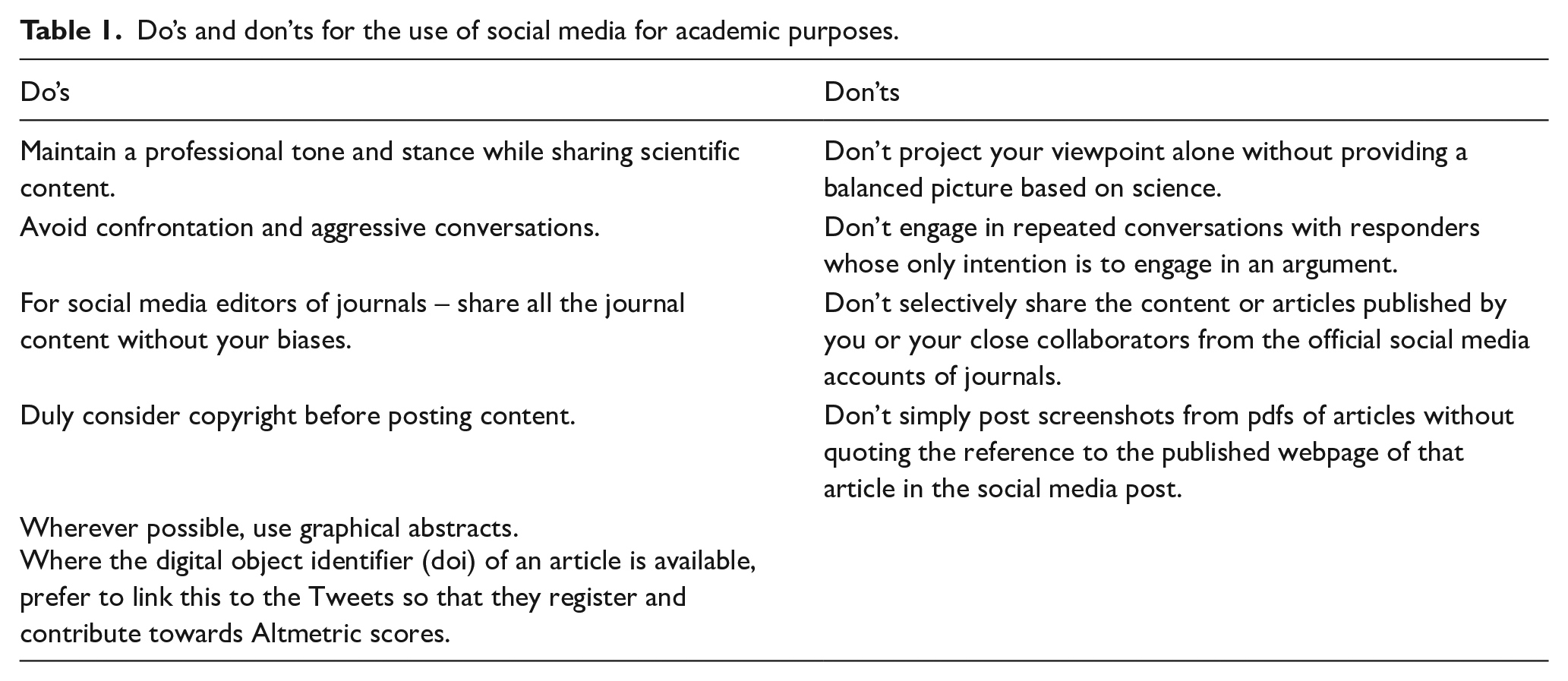
Altmetrics is increasingly used to understand the impact of published papers. Social media posts on Twitter and on specific Facebook pages (but not others) contribute to the Altmetric score. 11 However, Altmetric scores do not seem to correlate with the citations received by a paper. 12 Table 1 highlights the do’s and don’ts for the use of social media for academic purposes.
Do’s and don’ts for the use of social media for academic purposes.
The use of social media for academic research
Social media is often used to understand the perspectives of a wider audience from diverse geographic regions on medical or scientific issues of contemporary interest. This has particularly become more prevalent since the advent of the COVID-19 pandemic, when face-to-face interactions largely gave way to online interactions. Circulating questionnaires among patient groups may enable the understanding of patient perspectives. However, utilising social media for research has its own drawbacks. Sampling bias is a particular concern as the respondents are likely to be active on social media and internet-literate and may not be representative of the entire audience. To ensure the representativeness of online surveys, it is imperative to have a sampling strategy to ensure the targeted distribution of the survey to the relevant audience and if possible to have a survey form available for offline completion as well. 2
Conclusion
Clinicians and scientists active on social media platforms should be aware of the promises and pitfalls of social media for disseminating science and medical education. Journals and scientific societies should consider drawing up best practices for the use of social media by their members.
Footnotes
Declaration of conflicting interests
The author declared the following potential conflicts of interest with respect to the research, authorship, and/or publication of this article: Dr Durga Prasanna Misra is the Deputy Editor-in-Chief of the Journal of the Royal College of Physicians of Edinburgh (JRCPE) and serves as editor/editorial board member/reviewer for several other international journals.
Funding
The author received no financial support for the research, authorship, and/or publication of this article.
