







Abstract
In the past few years, the online influencer industry has exponentially expanded, fuelled by the COVID pandemic lockdown, increased social media platforms and lifestyle appeal of influencership. This phenomenon has likewise infiltrated the medical field, where many healthcare practitioners have taken to social media platforms for content creation and influencer marketing. There are many reasons that underlie medical influencership – some may use it to improve public health literacy and correct medical misinformation, engage in medical advocacy or use the platform simply as a means of humanistic expression of the medical career, while others may seek to advertise private practice/medical products, boost personal reputation, and gain popularity and monetary benefits. Regardless of the underlying motivations of the medical influencers, some have fallen afoul of professionally accepted practices and ethical boundaries in their use of social media platforms, leading to serious consequences such as professional sanctioning or termination of employment. In this article, we hope to provide a comprehensive review of the ‘good’ (positive practices), the ‘bad’ (practices with possible unintended negative consequences) and the outright unprofessional or unethical behaviours aspects of social media use by medical influencers and offer practical strategies to ensure responsible and meaningful use of influencer platforms at both the physician and health systems level.
Introduction
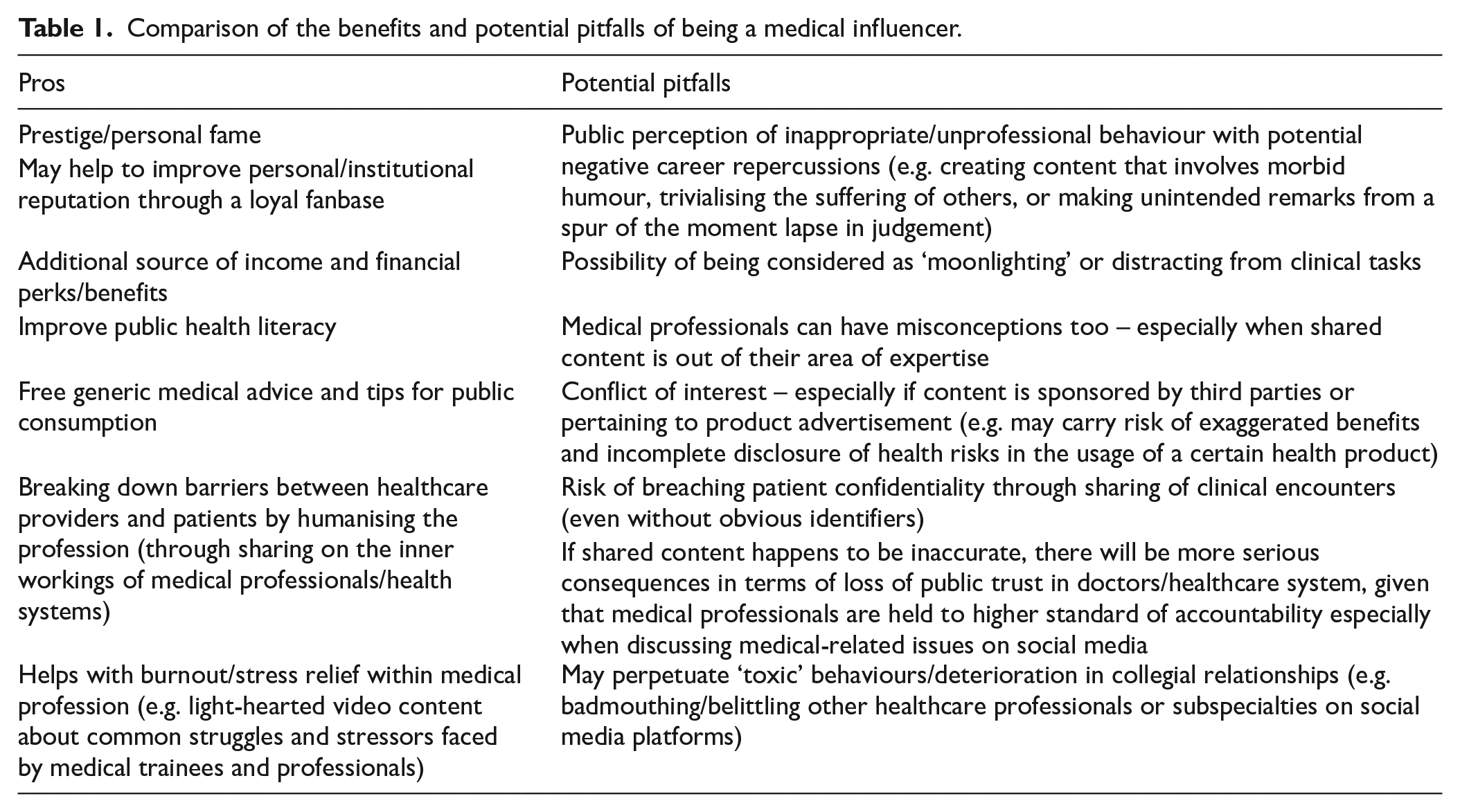
In recent years, there has been an exponential rise in the influencer industry, contributed by the recent COVID-19 pandemic with prolonged lockdowns and necessity of job restructuring, 1 widespread consumption of social media platforms (Facebook, Instagram, TikTok, X and YouTube), 2 and the overall appeal of being a social media influencer (work flexibility, freedom, prestige, additional income and freebies, and having a loyal following/fanbase). 3 Worldwide, doctors have similarly jumped on the bandwagon of being social media influencers, otherwise known as medical influencers, for various reasons – such as to provide health education and correct misinformation, engage in medical advocacy, to humanise the medical profession through sharing about life on the job, to garner fame, promote their medical practice, or for monetary gain (e.g. through sponsored product advertisements/endorsements).4 –8 However, regardless of the underlying intent, influencer physicians have increasingly fallen afoul of the professionally accepted practices and crossed ethical boundaries in their use of social media platforms for the aforementioned reasons, leading to termination of employment, fines and suspensions. 7 While some of the punitive actions taken against healthcare professionals who breached local hospital social media guidelines have been considered to be harsh, 7 we do believe that it is ultimately important to hold physicians to high professional and ethical standards of social media use (especially pertaining to medical-related matters where they are seen as the ‘experts’ by members of the public) especially at a time where public mistrust of the medical profession has been steadily on the rise. 9 Therefore, in this article, we sought to review the good (positive practices), the bad (practices with possible unintended negative consequences) and the outright unprofessional or unethical behaviours aspects of social media use by influencer physicians (Table 1), and discuss potential strategies to ensure responsible use of these platforms for meaningful endeavours, without undermining the reputation of the medical profession.
Comparison of the benefits and potential pitfalls of being a medical influencer.
Positive practices of medical influencers
First, medical professionals can use social media to educate and engage the public on important health-related matters, 10 engage in medical advocacy 11 and combat medical misinformation. 5 In addition, during the COVID-19 pandemic, where there was rampant medical misinformation amidst political/ideology tribalism, physicians such as Dr. Austin Chiang 12 and Dr. Karan Rangarajan 13 have taken to posting witty, bite-sized TikTok videos to explaining COVID-19 infections, vaccinations and available scientific data to educate their followers. As Dr. Chiang opines in a commentary published in Nature Reviews Gastroenterology & Hepatology, physician presence on social media can be helpful in improving public health literacy and dispelling misinformation about health-related matters and the medical profession. 14 Elsewhere, clinical psychologist Dr. Julie Smith has utilised social media to raise awareness about mental health issues, provide practical advice on coping strategies and cognitive-behavioural therapies that can be adopted amidst the stressors in daily life. 15
Second, through credible and accurate social media content on health-related matters and inner workings of healthcare teams, medical influencers can help to humanise the profession and promote positive health-seeking behaviours. As Dr. Schmidt writes, his video skits ‘can help patients see the humanity in their doctors, distancing them from the sole context of highly charged and stressful direct encounters. . . and make patients more comfortable seeking healthcare and interacting with their doctors in the clinic or hospital’. 10 It is also reported that mental health influencers, through their work on social media, may play an important role in normalising the discourse on mental health issues, combating stigma and breaking down the actual/perceived barriers to help-seeking behaviour. 16
Third, for a profession known to have high rates of stress and burnout, 17 there may be a role of medical influencers in helping to combat this phenomenon through their content creation 10 and physician advocacy efforts. 18 It is known that humour is an adaptive coping strategy that can help healthcare professionals to reduce workplace-related stress. 19 For example, medical influencer ‘Doc Schmidt’ often posts humorous video snippets of certain absurdities inherent in medical training and practice on his Instagram and TikTok channels, which quickly became popular within the medical fraternity due to the relatable nature of these shared experiences. 10 Elsewhere, in the United States (US), the MedFluencers, a physician influencer agency, has recently put together an event with key stakeholders in the medical industry to spotlight the issue of burnout among healthcare professionals and explore possible mitigating solutions to this urgent problem. 18
The spectrum of negative practices of medical influencers
There are negative social media practices of medical influencers that range from actions with unintended negative consequences to clearly unprofessional or unethical behaviours as determined by medical ethical principles and professional norms. In the realm of medical ethics, we classically take reference from the Beauchamp and Childress’ ethical pillars of upholding beneficence (act in patient’s interest), non-maleficence (do no harm), patient autonomy (relates to consent and confidentiality) and justice (resource allocation).20,21 Medical professionalism, on the other hand, is broader and often contextualised to local medical councils and standards of practice – but typically covers aspects of good clinical and business practices, handling conflict of interest, having appropriate patient-physician relationships, and maintaining collegiality within the medical fraternity. 22
First, there are often valid patient confidentiality and privacy concerns when medical influencers share about interesting real-life clinical encounters on their social media platforms to express their views and engage their followers. It is important to recognise that even without obvious patient identifiers (e.g. names, personal identification numbers), the nature of clinical case, time of clinical consultation and other unique information presented can potentially be traced back by a third party to the specific individual in question, and thereby still constituting a breach in patient confidentiality.8,23 In a previous study that analysed Twitter posts of clinical encounters by physicians and healthcare providers, it was found that 32% could likely be identified by friends and families of the patients. 23 Moreover, popular medical influencer physicians with publicly accessible social media profiles could be easily followed by their own patients on these platforms.
Second, medical influencers may occasionally share content about their work on social media platforms that may be construed as insensitive, for instance, when it involves morbid humour or appears to trivialise the suffering of others. At its worst, healthcare professionals (and even medical students) have been sanctioned and disciplined for mocking/denigrating patients, writing racist/sexist content or posting of explicit photos on social media platforms.7,24 For example, two recently censured medical influencer cosmetic surgeons in Australia had, for many years, shared inappropriate clinical content on their social media platforms including intimate patient encounters with graphic imagery, unprofessional behaviours such as staff singing/dancing during liposuction on an anaesthetised patient, throwing patient’s body parts around in the procedure room and inappropriately posting sensationalised content that trivialises surgical procedures or promotes unrealistic patient expectations.25,26 Elsewhere, a reality-television Emergency Room nurse who posted a photo of the messy aftermath of an empty trauma room with the caption ‘Man vs. 6 train’ after the medical team has treated a patient who was struck by a train was allegedly fired almost immediately after the insensitive post. 27 Sometimes, even seemingly benign jokes or comments about patient encounters can erode patient-physician relationships and foster mistrust – for instance, a fictional skit about malingering patients posted on TikTok triggered a movement where many members of public shared encounters where they felt their medical providers dismissed their complaints. 28
Third, when physicians share medical-related information and even personal views on social media platforms, they need to be mindful that being medical experts in the public eye, they would be held to a higher level of accountability in the accuracy of information and views expressed. It is not uncommon for physicians to succumb to medical misconceptions or have misunderstandings from cursory reading of scientific literature, especially when the content is out of their direct area of expertise. For example, a well-meaning US family physician Dr. Jeffrey VanWingen faced significant criticism a few years ago for his viral video on safe handling of groceries during the COVID-19 pandemic that included inappropriate advice on washing fruits and vegetables with soap (which is not approved for use on food items). 29
Fourth, when sponsored content, product endorsements and advertisements are involved, there is inevitably a conflict of interest between the physician’s duty to provide accurate, objective and beneficial medical advice to patients and their promotional work for the sponsors. This can sometimes to lead to misrepresentation of product benefits/risks (e.g. overstating benefits, understating risks, lack of individualised care), and at worst, false advertising with detrimental health consequences and erosion of public trust in healthcare professionals. For example, in the burgeoning field of aesthetic medicine, there have been concerns about financial conflicts of interest and false product/service advertisements (e.g. misleading information about provider credentials, expertise or popularity, exaggerating product benefits, doctored/unrealistic images or failure to adequately disclose risks).30 –34 In 2017, a large-scale cohort study found a lack of public awareness of marketing regulations in the aesthetics field and were unclear about the differences between plastic and cosmetic surgeons, and the training credentials involved or needed in performing aesthetic surgeries. 32 This inevitably results in market failure due to lack of information/knowledge on the part of the consumers. The nature of social media content is such that they must be entertaining and attention-grabbing to generate views and virality. As such, medical influencers may feel unduly pressured to generate content that may compromise the decorum expected of the profession physicians or veer into controversial topics and clickbait content to meet their influencer objectives. This may impugn the integrity and societal perception of the profession.
Multi-level strategies in self-regulation of medical influencership
As physicians, we must always seek to put the patients’ interests above our own, which similarly applies to appropriate use of social media platforms to educate, engage and promote products/services/brands to the public. 6 By extension, this means that we must consider the implications of our social media activity in terms of medical professionalism (interprofessional collegiality, respect for patients/colleagues, perceived/actual conflicts of interest) and ethics (beneficence, non-maleficence, autonomy, justice). Therefore, we propose the following mental framework that physician influencers should consider when putting out specific social media content in the public arena.
First, when creating educational social media content, consider:
Who is my target audience and how will they benefit from this content?
Is the content I’m providing factual or speculative/opinionated?
Am I an expert in this topic?
Is there likelihood of falsehood or potential harm or alienation of specific individuals through this content?
Have I included the appropriate disclaimers and caveats when sharing about this topic? (e.g. personal views that do not represent the healthcare organisation, generic educational information that do not constitute specific/individualised medical advice)
Second, when posting social media content about working life, observations or views about the hospital/healthcare environment, consider:
Is there any way the clinical information posted can be traced back by patients/families/friends to the original individual and how can it be anonymised further?
Have I sought appropriate consent to share certain information on the social media page from the patient/surrogate (and have they agreed to the final content that will be posted)?
Does the content posted reflect negatively on patient-physician relationships or interprofessional collegial relationships?
Is the content potentially offensive, discriminatory/stereotypical, or trivialising patient suffering?
Third, when posting sponsored content, product/service advertisement, always aim to practise good habits of ensuring transparency and accuracy of provided information. This would include accurate disclosure of provider qualifications/expertise/experience in the area (e.g. avoiding misleading or inaccurate credential information), potential conflicts of interest (e.g. product sponsors), evidence-backed benefits/efficacy (e.g. with links to official health organisation websites, published studies) and possible risks/alternatives.
Ultimately, when in doubt, always consider the content posted from the perspective of a member of the public or consult the objective opinion of another individual before uploading a post on social media. As Chiang writes, ‘how activities portrayed outside the clinical setting can also shape patients’ opinions of one’s clinical competence as well as influence perception of the medical profession as a whole’. 14 Perhaps, the concept of the ‘reasonable’ doctor or patient standard 35 can be extended to social media use by medical influencers – where we strike a healthy balance to ensure uploaded content that a fellow colleague or patient/public individual would reasonably find offensive or inappropriate, while not unnecessarily curtailing the freedom of speech/expression.
At the health systems/medical education level, there needs to be ongoing development and increased awareness of local institutional social media policies and case-based training on appropriate use of social media platforms for various intents and purposes. 36 Social media policies of health systems should provide detailed information on the dos and don’ts in professional conduct, accuracy of published information, posting of patient stories and product/brand endorsements. 37 Beyond local regulations, there is also a need to look into stricter influencer market regulations and enforcement in terms of direct-to-consumer advertisements, particularly when it comes to promoting health products and services that can have serious health implications.32,38
Conclusion
In summary, the rise in medical influencership is expected to remain as the prevailing trend – therefore, the medical fraternity needs to be educated on the positive and negative practices of social media use for various medical or non-medical related endeavours. Importantly, to preserve public trust in medical practitioners, it is necessary to self-regulate the medical influencer field to ensure practices adhere to standards of medical professionalism.
Footnotes
Declaration of conflicting interests
The author(s) declared no potential conflicts of interest with respect to the research, authorship, and/or publication of this article.
Funding
The author(s) received no financial support for the research, authorship, and/or publication of this article.
