






Abstract
Despite the growing emphasis on global competence in the realm of education, comparative research examining students from both Global North and Global South contexts remains scarce. Grounded in Bronfenbrenner's ecological systems theory, this study comparatively investigated how student-, parent-, and teacher-related intercultural attitudes link to students’ global competence across six diverse societies, namely Hong Kong, South Korea, Croatia, Malta, Chile, and Panama. The participants were selected from the 2018 Programme for International Student Assessment (PISA), and the ordinary least squares (OLS) regression analysis was employed as a statistical approach. From the perspective of countries/economies, student-, parent-, and teacher-related intercultural attitudes had the strongest connection with students’ global competence in Hong Kong and South Korea, a moderate association with that in Chile and Panama, and the weakest correlation with that in Croatia and Malta. From the perspective of variables, student-related intercultural attitudes displayed the strongest connection with students’ global competence; teacher-related intercultural attitudes exerted a moderate association with students’ global competence; as well, parent-related intercultural attitudes showed the weakest correlation with students’ global competence. The empirical findings were discussed in relation to international comparative insights. Critically, the research conclusions reflected not only diverse stakeholder roles related to corresponding postcolonial legacies and nationalist landscapes but also the urgent need to decolonize global competence frameworks that risk perpetuating educational hegemonies under the guise of cosmopolitanism.
Keywords
Introduction
Cultivating global competence has increasingly been viewed as a key approach to equip students with enough comprehensive skills to thrive across diverse cultures, to collaborate with others from different social contexts, and to solve global conflicts and challenges (Boix-Mansilla and Jackson, 2011; OECD, 2016; Yemini et al., 2018). Globally competent individuals can examine local, global, and intercultural issues, understand and appreciate different perspectives and worldviews, interact successfully and respectfully with others, and take responsible actions towards sustainability and collective well-being (Bailey et al., 2023; Beckwith, 2022; Brett et al., 2024). Many countries and international organizations have prioritized the nurture of students’ global competence within corresponding education proposals or assessment frameworks (e.g., Australian Government and AusAID, 2011; Boix-Mansilla and Jackson, 2011; OECD, 2016, 2018; UNESCO, 2013, 2015). However, although related efforts have been invested and valuable insights have been achieved by many contributors on the research of global competence, they were focused more on external conditions including conceptual differentiation (e.g., Beckwith, 2022; Han and Zhu, 2024), frame construction (e.g., Bailey et al., 2023; Ledger et al., 2019), theoretical origin (e.g., Mannion et al., 2011; Tan, 2026), curriculum guidelines (e.g., Chou et al., 2015; Evagorou et al., 2023), and teaching methods (e.g., Kerkhoff and Cloud, 2020; Yemini et al., 2019). From an international comparative standpoint, very little research has examined how internal psychological factors (e.g., intercultural attitudes) naturally and profoundly impact students’ global competence (Nob et al., 2025; Wu and Zhang, 2024). More than that, hardly any research has simultaneously examined how student-, parent-, and teacher-related intercultural attitudes relate to students’ global competence. This is a serious research gap because students’ global competence is actually influenced by diverse perspectives of multiple stakeholders in their real-life situations (OECD, 2019, 2020; UNESCO, 2013, 2015).
On the other hand, since the initiative of fostering students’ global competence originated in the developed countries of the West, it has thus led to an imbalance in research on global competence worldwide. In this regard, most of previous studies on global competence were mainly related to Western developed countries like the United States (US), England, Germany, Netherlands, Australia, New Zealand, Japan, and Israel (e.g., Beckwith, 2022; Blumenthal and Grothus, 2008; Böhm et al., 2016; Brett et al., 2024; Davidson and Liu, 2020; Dvir et al., 2018; Evagorou et al., 2023; Yemini and Furstenburg, 2018; Yemini et al., 2018), and research on that in developing countries or economies is extremely limited. Moreover, prior studies indicated that global competence has a distinct embodiment with regard to national differences and educational gaps: Students in developed countries generally have higher global competence compared to their counterparts in developing countries (Lee and Stankov, 2023; OECD, 2020). This potentially exacerbates the educational gap between the South and the North of the world. Therefore, it is necessary to conduct comparative studies that simultaneously contain countries from the Global North and the Global South in order to draw more comprehensive conclusions in nurturing global competence, which is beneficial to mitigating the omission of voices from the Global South (Cobb and Couch, 2018; Grotlüschen, 2018; Tan, 2026). In fact, just as the 2018 Program for International Student Assessment (PISA) pointed out: A worldwide comparison can provide a comprehensive insight into students’ global competence across different countries and cultures, whereby leading the future educational landscapes (OECD, 2020, 2021). In this regard, covering large-scale student, parent, and school questionnaires collected from various countries or economies, PISA 2018 provided a valuable opportunity for examining the multiple roles of student-, parent-, and teacher-related intercultural attitudes in global competence across the Global North and the Global South.
A brief review of related work
Concept and debate of global competence in PISA 2018
Global competence has received increasing academic attention in recent years (e.g., Beckwith, 2022; Chui and Leung, 2013; Goren and Yemini, 2017; Nob et al., 2025; Yemini and Furstenburg, 2018). In the framework of PISA 2018 released by the Organization for Economic Co-operation and Development (OECD), global competence was defined as “the capacity to examine local, global and intercultural issues, to understand and appreciate the perspectives and world views of others, to engage in open, appropriate and effective interactions with people from different cultures, and to act for collective well-being and sustainable development” (OECD, 2018: 7). In this connection, global competence is a multidimensional conception that encompasses four interrelated components: Knowledge, cognitive skills, social skills and attitudes, and values, which are interdependent and overlapping, justifying the use of the singular term of global competence (OECD, 2018, 2020). PISA 2018 global competence assessment referred to two components: (1) A cognitive test only related to the construct of “global understanding”; (2) A series of self-reported questionnaire items from students, as well as extensive background information from parents, teachers, and principals with regard to students’ global competence. In particular, the cognitive test assessed knowledge and cognitive skills, and the student questionnaire evaluated knowledge, cognitive skills, and social skills and attitudes; whereas, the assessment of values was integrated into the holistic evaluation process, without additionally specific measurement items (OECD, 2018, 2019).
Nevertheless, the PISA 2018 global competence assessment framework has constantly been criticized by some scholars since it was released (Bailey et al., 2023; Grotlüschen, 2018; Han and Zhu, 2024). Broadly, related criticism and controversy primarily included the following several aspects: A prioritization of Eurocentric knowledge system and a neglect of discourses and voices from the Global South (Grotlüschen, 2018), a social-economic ideology of elitism within the Western context (Ledger et al., 2019), a neoliberal orientation and its foundation in a US-based social imagery (Robertson, 2021), a lack of attention to personal emotional experience (Auld and Morris, 2019), a nature of narrow instrumentalism and individualism (Engel et al., 2019), a human capital approach set in terms of global knowledge economy proxies (Martini and Robertson, 2024), and a methodological inadequacy from the perspective of test-takers for the ambiguous terms and inscribed assumptions (Chandir, 2022). Despite these critiques, the PISA 2018 global competence framework retains considerably analytical vitality: It remains the first and only instrument to enable large-scale international assessment and comparison of global competence worldwide, and scholarly engagement with it continues to expand. Moreover, beyond the conventional application in Western-centric or Global North contexts, research examining global competence in terms of developing countries or the Global South is increasingly emerging as a vital and growing field of inquiry (Dyrness, 2023; Nob et al., 2025; Robertson, 2021).
Contextual characteristics and global competence
Understanding potential variations in students’ global competence across different demographic groups is crucial to designing effective interventions and ensuring equitable educational opportunities. Previous studies indicated that students’ global competence may indeed differ across contextual characteristics. For instance, Solhaug and Kristensen (2020) investigated the relationship between gender and intercultural competence among Danish and Norwegian upper secondary students, drawing on inclusive citizenship, gender socialization, and feminist standpoint theories. Their findings revealed nuanced differences: Boys tended to score higher on empathy and knowledge dimensions, while girls displayed higher scores in awareness; as well, no significant gender differences were found for the relations dimension. Prior research also consistently indicated that higher economic, social, and cultural status (ESCS) is positively associated with students’ global competence (Kohel, 2016; Pike and Sillem, 2018). As for school context, studies indicated that students in private schools tend to exhibit better global competence (Lasten et al., 2022), and students attending schools in more economically developed areas embody greater global competence (e.g., Jang et al., 2023; Zhang et al., 2025). Clearly, global competence is not evenly distributed across various contextual characteristics: It is patterned by the very social structures that schooling both reflects and reproduces. Researchers therefore may explore how demographic markers - gender, ESCS, and school sector and geography - influence students’ readiness to engage with cultural differences and global problems. Understanding these contours is essential for educators who aspire to interrupt rather than reinforce these deeply entrenched inequities.
Multiple stakeholders’ intercultural attitudes and global competence
The attitudinal precursors of global competence have attracted the attention of scholars in the existing literature. In terms of student's intercultural attitudes, research revealed that intercultural sensitivity is significantly beneficial to students in handling distinct cultural issues, which refer to a crucial profile of global competence (Banat et al., 2022). An empirical study in light of PISA 2018 dataset found that intercultural adaptability is positively associated with students’ attitudes towards immigrants (Tomul et al., 2024). Also, it was reported that students who have higher openness to learning about other cultures, greater respect for people from other cultures, and better global mindedness are more likely to have better global competence across Indonesia, Philippines, and Thailand (Nob et al., 2025). With regard to parents’ intercultural attitudes, research reported that children's global competence is positively connected to parents’ interest in learning about different cultures, but has no link to the number of intercultural actions taken by parents (Jang et al., 2023). As well, a meta-analysis demonstrated that parents’ intergroup attitudes are positively correlated with their children's intergroup attitudes (Degner and Dalege, 2013). As for teachers’ intercultural attitudes, research indicated that their beliefs toward various cultural groups avail students’ global competence (Jang et al., 2023; Wu and Zhang, 2024). However, a comparative study across China, Germany, Turkey, and Mexico revealed that teachers’ multicultural and egalitarian beliefs have no significant associations with students’ self-efficacy regarding global issues, respect for people from other cultural backgrounds, awareness of intercultural communication, and global mindedness (Zhang et al., 2025). As core stakeholders, it can be seen that student-, parent-, and teacher-related intercultural attitudes have shown mixed relationships with students’ global competence.
The present study
A selection of Hong Kong, South Korea, Croatia, Malta, Chile, and Panama
Following an international comparison perspective, the present study aims to investigate how student-, parent-, and teacher-related intercultural attitudes are related to students’ global competence across Hong Kong, South Korea, Croatia, Malta, Chile, and Panama, in light of PISA 2018 global competence cognitive test data. The reasons for selecting participants from these six countries/economies are overall twofold: Data conditions and cultural factors. On the one hand, although 27 countries/economies engaged in the global competence cognitive test in PISA 2018, most of the participating sites did not include parental data. Actually, only these abovementioned six countries/economies completely covered student-, parent-, and teacher-related questionnaires, which can therefore provide a holistic perspective to connect plural stakeholders’ intercultural attitudes to students’ global competence. On the other hand, the six countries/economies refer to various cultural settings across Asia (Hong Kong and South Korea), Europe (Croatia and Malta), and Americas (Chile and Panama), whereby taking into account the cultural diversity in global competence realm. As well, this study allows for an international comparison with six countries/economies instead of one region contained, thereby avoiding a neglect of distinct factors on students’ global competence across various cultural settings.
Sociocultural contexts and educational landscapes across the six societies
Hong Kong and South Korea are two typical examples of East Asian societies. Hong Kong's colonial legacy has engendered unique sociopolitical and educational landscapes characterized by hybrid identities and linguistic complexity. British rules established English as the language of prestige while preserving traditional Chinese culture to maintain social cohesion (Vickers et al., 2003). Post-handover, the local ‘biliteracy and trilingualism’ language-in-education policy aims to balance Cantonese, English, and Putonghua, yet colonial hierarchies persist through English-medium instruction stratification (Bray and Koo, 2004; Wang, 2023). The multicultural education framework for ethnic minorities remains assimilationist, focusing narrowly on Chinese language acquisition while neglecting structural barriers to equity (Gao and Gube, 2020). In fact, these situations reflect how colonial power structures continue to shape educational stratifications and identity politics in postcolonial Hong Kong. Also, South Korean demographic transition, characterized by ultra-low fertility and increasing labor migration, has further precipitated acute tensions between entrenched ethnic nationalism and emergent multiculturalism (Park, 2017). The national multicultural education policies, while ostensibly promoting inclusion, frequently operate within assimilationist frameworks that privilege South Korean cultural homogeneity (Grant and Ham, 2013; Lim, 2010). Actually, these educational initiatives ostensibly support multicultural students yet often reinforce social hierarchies by framing diversity as a deficit requiring state management rather than genuine pluralism (Lee, 2009). Consequently, South Korea's multicultural education system embodies the broader societal struggle between maintaining ethnic purity and accommodating unavoidable demographic diversification.
Croatia and Malta are two European countries. Croatia's post-socialist transition and European Union (EU) accession have been marked by persistent cultural value gaps, particularly regarding high power distance and incomplete social value alignment with EU norms (Wang et al., 2025). Concurrently, its multicultural education system operates through constitutional models guaranteeing minority language rights, yet these arrangements often reinforce ethnic separation rather than integration, especially in post-conflict contexts (Paravina, 2022; Pehar et al., 2020). Švarc and Dabić (2019) further note that bureaucratic inertia from the socialist era continues to hinder Croatian educational innovation despite formal Europeanization. On the other hand, Malta's sociocultural environment is characterized by strong Mediterranean values emphasizing family, honor, and religious traditions, alongside a robust national identity that has historically shaped attitudes toward newcomers (Baldacchino, 2009). As immigration remains a relatively recent phenomenon, Maltese society is progressively adapting to its role as a receiving country. The educational system reflects this evolution through its bilingual framework integrating Maltese and English, while increasingly accommodating diverse linguistic backgrounds through multicultural pedagogies that support migrant learners’ integration and inclusion (Camilleri Grima, 2013; Vella, 2013).
Chile and Panama are two typical American societies. Chile's educational landscape reflects enduring colonial legacies wherein Spanish linguistic hegemony, rooted in nineteenth-century state colonization and internal colonialism, has systematically subordinated Indigenous languages through epistemic violence and racialized hierarchies (Webb and Radcliffe, 2016). For a long time, despite constitutional recognition of multiculturalism, Spanish maintains exclusive social prestige, perpetuating asymmetric power relations that marginalize Indigenous knowledge systems (Williamson, 2012). In response, the intercultural bilingual education (IBE), institutionalized through indigenous law and general education law reforms, attempts to revitalize ancestral languages by incorporating traditional educators and community-based pedagogies (Aguayo et al., 2022). However, critics argue that IBE remains constrained by assimilatory structures, discretionary implementation, and insufficient state commitment to genuine linguistic decolonization (Nauhelpan and Antimil, 2019). Likewise, Panama's sociolinguistic landscape reflects enduring colonial language power structures and contemporary multicultural educational reforms. Spanish, introduced by Spanish conquistadors in the early sixteenth century, maintains hegemonic dominance as the official language of government, education, and commerce, while indigenous languages were historically marginalized until receiving official recognition in 2010 (López, 2021). This linguistic hierarchy exemplifies colonial legacies where Spanish functions as the language of power, relegating indigenous languages to subordinate status despite constitutional protections (Pérez Fernández, 2011). In response, Panama has also implemented an IBE system, mandating bilingual instruction in indigenous comarcas through programs like JADENKÄ, which integrates ethnomathematics and indigenous knowledge to enhance academic outcomes and cultural identity among local students (Näslund-Hadley et al., 2025).
Reflexive instrumentality: critical deployment of a contested framework
As noted above, while acknowledging critiques of the PISA 2018 global competence framework, such as Eurocentric bias, neoliberal underpinnings, and potential to naturalize the Global North advantage, this study justify its critical deployment here on three grounds. Firstly, despite its ideological limitations, the instrument remains methodologically indispensable as the sole existing mechanism enabling systematic and large-scale comparative analyses across diverse societies. Its standardized design permits examination of the Global South contexts - specifically Chile and Panama - that have been historically marginalized in global competence research, thereby generating empirical visibility for educational systems typically excluded from international scholarly discourse. Secondly, the deliberate selection of six societies spanning Asia, Europe, and the Americas directly confronts the framework's Western-centric limitations by refusing the conventional focus on OECD-dominant cases. Centering underrepresented educational systems within a comparative design transforms the analysis from a unilateral imposition of Northern standards into a reciprocal examination of how global competence manifests across divergent postcolonial, nationalist, and multicultural configurations. Thirdly, this study employed the global competence assessment instrument not to validate its normative assumptions but to interrogate how stakeholders’ intercultural attitudes operate within and against structural inequalities. By examining whether corresponding intercultural attitudes function as mitigating resources across these divergent macrosystemic configurations, this study repurposes the framework as a means of exposing the very hierarchies it has been accused of perpetuating, thereby advancing a reflexive and context-sensitive approach within the realm of global competence and thus contributing to scholarly efforts toward epistemic pluralism in global competence research.
Theoretical foundation
Bronfenbrenner's ecological systems theory (Bronfenbrenner, 2005; Bronfenbrenner and Morris, 2006) provides a comprehensive framework for understanding human development as a dynamically and contextually embedded process shaped by interactions between individuals and their environments. The theory conceptualizes the environment as a set of interconnected structures, each contained within the next, comprising five interconnected systems. The microsystem refers to immediate settings where individuals directly engage in face-to-face interactions, such as families, schools, and peer groups, emphasizing that developmental outcomes are fundamentally shaped by the quality and pattern of these proximal processes. The mesosystem encompasses the interconnections between two or more microsystems, recognizing that development is optimized when experiences across settings are mutually reinforcing rather than contradictory. The exosystem incorporates external environmental settings that indirectly affect individuals, including institutional structures and social networks that the person does not directly inhabit but that influence their immediate contexts. The macrosystem consists of overarching cultural values, belief systems, customs, and laws that permeate all other system levels, establishing the ideological parameters within which development occurs. As well, the chronosystem captures both the historical period in which development takes place and the timing of specific life events and transitions. This theoretical architecture is particularly suited to examining educational landscapes across diverse national contexts, as it explicitly attends to how developmental processes are simultaneously impacted by transparent interpersonal characteristics, subtle institutional arrangements, and wide cultural-historical conditions.
Clearly, the development of students’ global competence can be systematized through Bronfenbrenner's ecological systems theory (Bronfenbrenner, 2005; Bronfenbrenner and Morris, 2006), which implicitly posits that global competence is shaped by interconnected environmental systems operating at multiple levels. At the microsystem level, students are embedded in immediate settings where they directly interact with parents, teachers, and peers, and these proximal processes constitute the primary mechanisms through which intercultural attitudes are transmitted and internalized. Student-related intercultural attitudes (e.g., respect for people from other cultures) represent individual-level psychological attributes that form how students engage with diverse cultural backgrounds. Parent-related intercultural attitudes (e.g., attitude towards immigrants) operate through family socialization processes, wherein parents mold intercultural orientations and shape children's early cultural schemas (Degner and Dalege, 2013). Teacher-related intercultural attitudes (e.g., multicultural and egalitarian beliefs) function within the school microsystem, where teachers’ beliefs and behaviors create differential classroom climates that either facilitate or constrain students’ global competence development (Ganley et al., 2019; Wu and Zhang, 2024). The mesosystem encompasses the bidirectional interactions between these microsystems, such as the alignment or tension between parental and teacher intercultural values, which collectively determine the consistency or inconsistency of attitudinal messages students receive across home and school contexts.
Beyond immediate interpersonal contexts, the exosystem includes broader institutional and structural factors that indirectly influence students’ global competence development, specifically the contextual characteristics examined in this study. For example, ESCS reflect demographic attributes that pattern access to intercultural resources and experiences; school sector (public versus private) and school location (village to large city) represent institutional and geographic stratification mechanisms that distribute opportunities for global engagement unequally across student populations. These exosystemic factors moderate the extent to which microsystemic intercultural attitudes can be activated and converted into global competence outcomes. The macrosystem encompasses overarching cultural ideologies and historical narratives - such as postcolonial hybridity in Hong Kong, ethnic nationalism in South Korea, post-socialist transition in Croatia, Mediterranean value conservatism in Malta, linguistic hegemony and assimilationist IBE in Chile, and colonial language power structures alongside emergent indigenous linguistic revitalization in Panama - that differentially legitimize or delegitimize certain forms of intercultural engagement, thereby shaping how student-, parent-, and teacher-related attitudes manifest in global competence across the six societies. Additionally, the chronosystem captures the dynamic evolution of these factors across historical time, acknowledging that global competence development is situated within shifting sociopolitical contexts. This ecological framework underscores that students’ global competence emerges not from isolated individual attributes but from convergences between student-, parent-, and teacher-related intercultural attitudes and contextual characteristics embedded within distinct macrosystemic configurations.
Research questions
Therefore, in light of the existent literature and the research background, this study was designed to answer the following four research questions (RQ).
Methodology
Participants
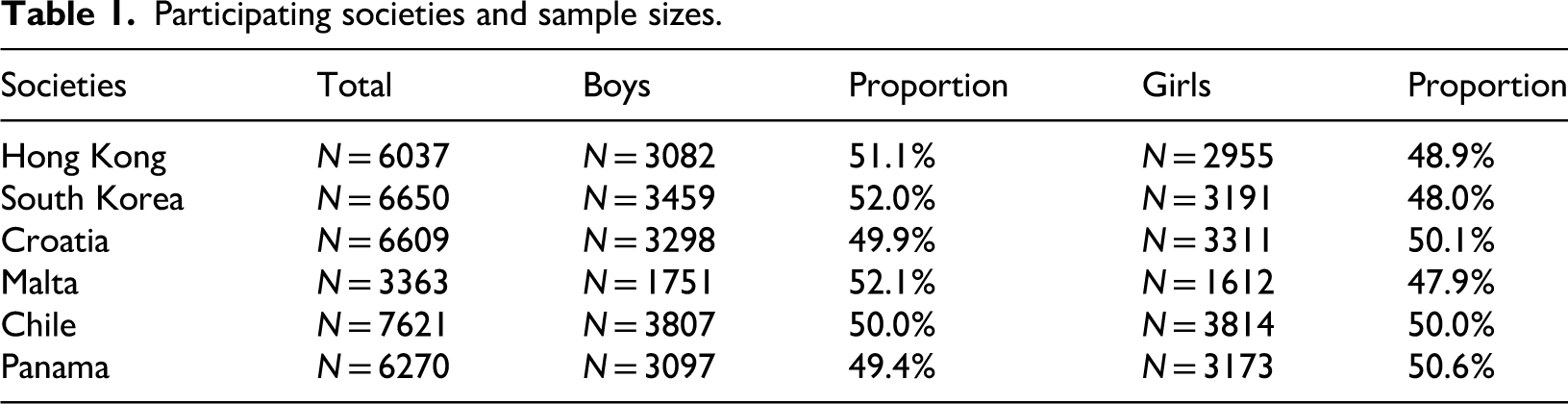
The participants were obtained from PISA 2018, a large-scale international assessment administrated by the OECD. PISA 2018 surveyed the reading, math, and science literacy of 15-year-old students in 79 countries/economies, and further explored individual- and context-related influencing factors. In particular, PISA 2018 developed a new assessment framework: Global competence cognitive test (OECD, 2018). Methodologically, a two-stage stratified cluster sample was selected for each cohort: In the first stage, schools were sampled with probability proportional to size (PPS); in the second stage, an equal probability sample of an agreed number of students (the target cluster size, TCS) was selected from those sampled schools (OECD, 2021). Notably, the PISA 2018 global competence cognitive test covered 27 countries/economies in total. As noted above, six countries/economies from Asia, Europe, and America were selected as samples due to data conditions and cultural factors, namely Hong Kong, South Korea, Croatia, Malta, Chile, and Panama. The multiple imputation method was used to handle missing data. The final samples included 6037 students from Hong Kong, 6650 students from South Korea, 6609 students from Croatia, 3363 students from Malta, 7621 students from Chile, and 6270 students from Panama. Table 1 displays detailed data information.
Participating societies and sample sizes.
Variable description
Dependent variable
In this study, the outcome measure was global competence scores earned by 15-year-old students of the six societies, operationalized as their performance on the cognitive components of the PISA 2018 global competence assessment. The assessment of related cognitive components contained 69 items grouped into 18 units. Specifically, 37 items tapped cognitive sub-processes such as selecting sources, reasoning with evidence, and explaining complex problems; 18 items probed cognitive sub-processes like recognizing perspectives and worldviews and examining connections; as well, the remaining 14 items focused on cognitive sub-processes as considering actions and evaluating potential outcomes (OECD, 2019, 2020). Students’ cognitive responses were converted into ten plausible values (PVs) that jointly describe the distribution of global competence proficiency. For the entire OECD sample, each PV was standardized to a mean of 500 and a standard deviation of 100 (OECD, 2020, 2021). Following the common practice in international large-scale education assessment research - where all PVs are highly correlated and a single PV yields unbiased population estimates - the first PV was retained for statistical analysis (e.g., OECD, 2009; Nob et al., 2025; Spiezia, 2010).
Independent variables
Student-related intercultural attitudes included awareness of global issues (GCAWARE), interest in learning about other cultures (INTCULT), attitude towards immigrant (ATTIMM), intercultural adaptability (COGFLEX), intercultural perspective-taking (PERSPECT), respect for people from other cultures (RESPECT), awareness of intercultural communication (AWACOM), and global-mindedness (GLOBMIND). Parent-related intercultural attitudes contained awareness of global issues (GCAWAREP), interest in learning about other cultures (INTCULTP), and attitude towards immigrant (ATTIMMP). As well, teacher-related intercultural attitudes covered multicultural and egalitarian belief (SCMCEG) and intercultural discrimination (DISCRIM). GCAWARE was answered on a four-point scale: “I have never heard of this”, “I have heard about this but I would not be able to explain what it is really about”, “I know something about this and could explain the general issue”, and “I am familiar with this and I would be able to explain this well.” INTCULT, COGFLEX, PERSPECT, RESPECT, and INTCULTP were assessed with a Likert-type format ranging from 1 to 5, respectively, as follows: “Very much like me”, “Mostly like me”, “Somewhat like me”, “Not much like me”, and “Not at all like me.” ATTIMM, AWACOM, GLOBMIND, ATTIMMP, and AWACOMP were assessed with a Likert-type format ranging from 1 to 4, individually, as follows: “Strongly disagree”, “Disagree”, “Agree”, and “Strongly agree.” SCMCEG was assessed on a continuous scale ranging from 1 to 4, severally, as follows: “None or almost none”, “Some”, “Many”, and “All or almost all.” DISCRIM was assessed with a Likert-type format ranging from 1 to 4, respectively, as follows: “None or almost none of them”, “Some of them”, “Most of them”, and “All or almost all of them.”
Notably, to address the concern regarding potential conceptual overlap between explanatory variables and outcome measure, this study clarify the distinct nature of these constructs across four key dimensions. Firstly, measurement approach: As noted above, student-related intercultural attitudes are assessed through self-reported questionnaires using Likert scales, whereas global competence is measured through a standardized cognitive test comprising 69 items. Secondly, core content: The attitudinal variables capture students’ subtle affective orientations and dispositions toward cultural diversity, while the cognitive test evaluates demonstrable knowledge and thinking skills. Thirdly, specific constructs: Intercultural attitudes encompass interest to learning about other cultures, adaptability, perspective-taking, and respect for others; whereas, global competence comprises selecting information sources, reasoning with evidence, explaining complex problems, recognizing perspectives, and evaluating potential actions and outcomes. Fourthly, theoretical distinction: Attitudes represent psychological predispositions that may facilitate or hinder global engagement, whereas global competence constitutes measurable cognitive capabilities for analyzing and responding to global issues. Therefore, such a fundamental differentiation between self-reported affective tendencies and performance-based cognitive assessment ensures that the explanatory variables and the outcome measure remain conceptually and empirically distinct.
Contextual variables
Contextual variables involved gender (ST004D01T), ESCS (ESCS), school sector (SC013Q01TA), and school location (SC001Q01TA). Gender was coded as 0 for boys and 1 for girls. ESCS was evaluated by the standardized index composited from parental education, parental occupation, cultural capital, family wealth, and a range of other household possessions. School sector was coded as 0 for public and 1 for private. School location was coded as 1 for a village, hamlet or rural area, 2 for a small town, 3 for a town, 4 for a city, and 5 for a large city.
In this study, student- and parent-related attitudinal variables were assessed based on the student and parent questionnaires, respectively; while the teacher-related attitudinal variable of DISCRIM was assessed based on the student questionnaire, according to the technical guidance of PISA 2018 (OECD, 2021). Additionally, the other teacher-related attitudinal variable of SCMCEG was disaggregated from school-level data and then matched to each student. In light of previous studies, aggregating level-1 or disaggregating level-2 variables is an effective operation to maximize the value of research variables in nested data like PISA (e.g., Aditomo and Köhler, 2020; Huang, 2016; Klein and Kozlowski, 2000; Marsh et al., 2012; Morin et al., 2013). Moreover, according to contextual exposure theory (Blalock, 1984; Diez Roux, 2004), teachers’ behavioral patterns toward students exhibit high consistency within the same school, constituting a shared institutional climate or school culture (Konold et al., 2018; Marsh et al., 2012). In other words, students attending the same school, regardless of their individual backgrounds, are homogeneously exposed to the overall behavioral style of the corresponding teacher population (Morin et al., 2013; Wang and Degol, 2016). Therefore, assigning the school-level value to all students within a school serves as a high-reliability approach to reconstructing the authentic interpersonal contextual constraints that students actually face, a context that is exogenous, shared, and structurally non-selective for students (Aditomo and Köhler, 2020; Blalock, 1984; Diez Roux, 2004; Huang, 2016).
It should be noted that a series of calibration procedures were officially used to manage initial scale values for both student- and school-level independent variables (OECD, 2021). According to PISA 2018, all derived and composite variables were standardized to a scale where the mean is 0 and the standard deviation is 1, based on weighted likelihood estimates (WLE) approach and the item response theory (IRT) scaling (OECD, 2021; Warm, 1989). In this connection, the positive values indicated that the levels of corresponding variables (i.e., GCAWARE, INTCULT, ATTIMM, COGFLEX, PERSPECT, RESPECT, AWACOM, GLOBMIND, GCAWAREP, INTCULTP, ATTIMMP, SCMCEG, and DISCRIM) exceed the OECD average scores, and the negative values demonstrated the opposite. Table 2 shows corresponding item examples for all composite variables in PISA 2018.
Item examples for composite variables in PISA 2018.
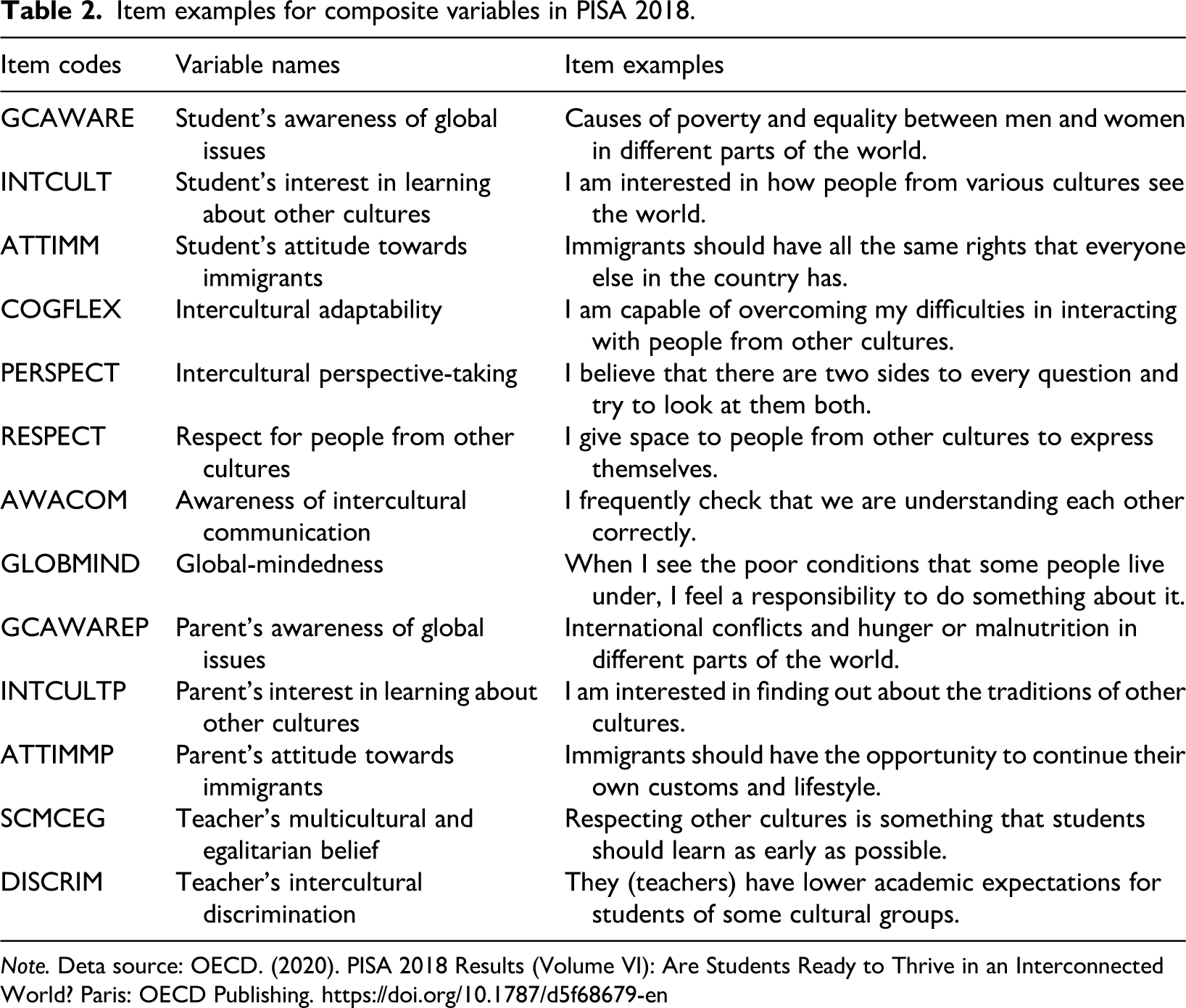
Note. Deta source: OECD. (2020). PISA 2018 Results (Volume VI): Are Students Ready to Thrive in an Interconnected World? Paris: OECD Publishing. https://doi.org/10.1787/d5f68679-en
Analytical procedure
Stata 17.0 was used as the main statistical software in the current analytical process. In order to explore the multiple roles of student-, parent-, and teacher-related intercultural attitudes (i.e., GCAWARE, INTCULT, ATTIMM, COGFLEX, PERSPECT, RESPECT, AWACOM, GLOBMIND, GCAWAREP, INTCULTP, ATTIMMP, SCMCEG, and DISCRIM) in students’ global competence, this study employed the method of ordinary least squares (OLS) regression analysis. The research model is displayed below.
Results
Descriptive statistics
Before proceeding with the OLS regression model, the present study firstly demonstrated the information of descriptive statistics and correlation analysis for all study variables (i.e., global competence, gender, ESCS, school type, school location, GCAWARE, INTCULT, ATTIMM, COGFLEX, PERSPECT, RESPECT, AWACOM, GLOBMIND, GCAWAREP, INTCULTP, ATTIMMP, SCMCEG, and DISCRIM) across Hong Kong, South Korea, Croatia, Malta, Chile, and Panama. Table 3 demonstrates the mean (M) and standard deviation (SD) for study variables and Table 4 indicates the correlations between study variables and students’ global competence across the six countries or economies.
Descriptive statistics.
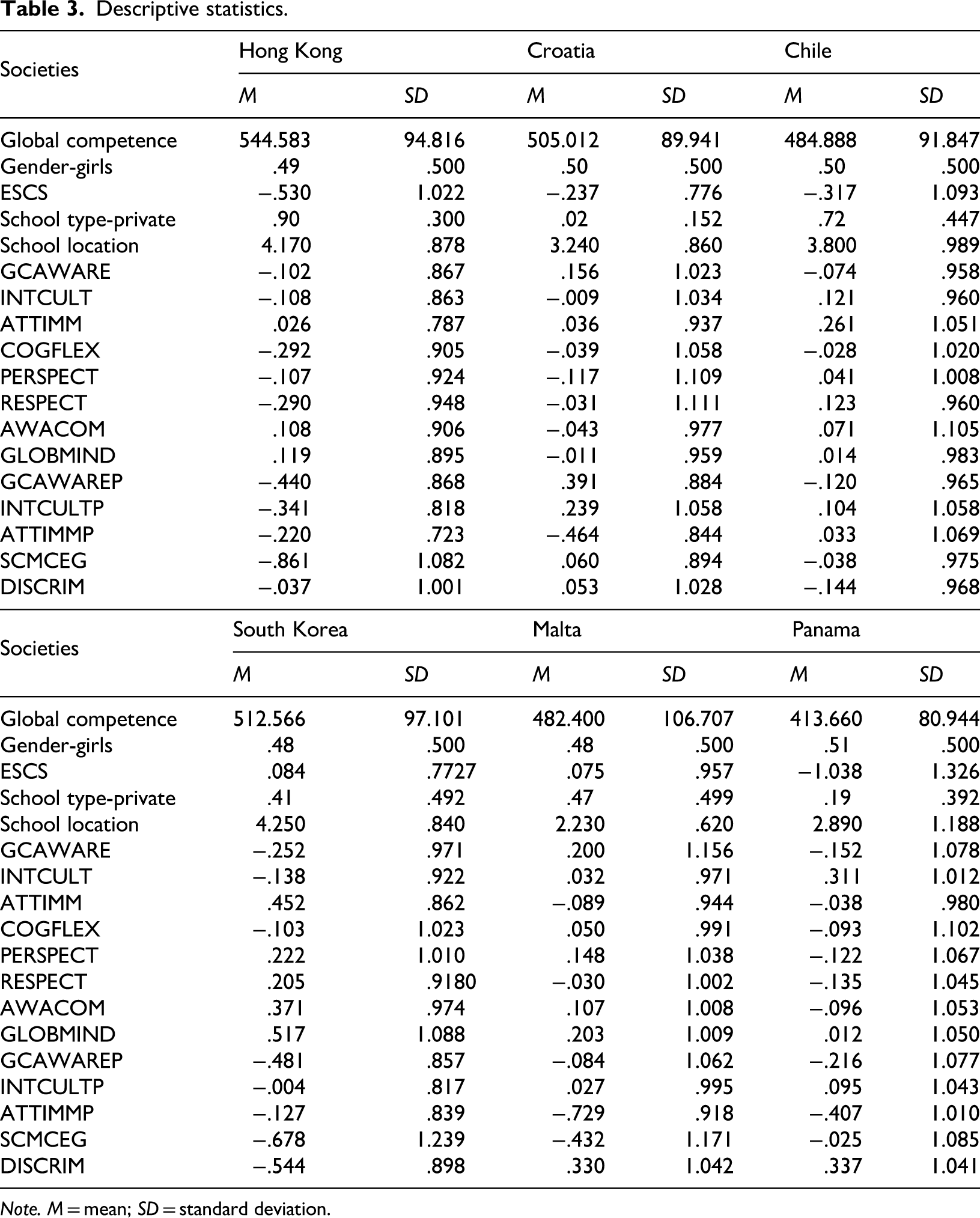
Note. M = mean; SD = standard deviation.
Correlations between study variables and global competence by society.
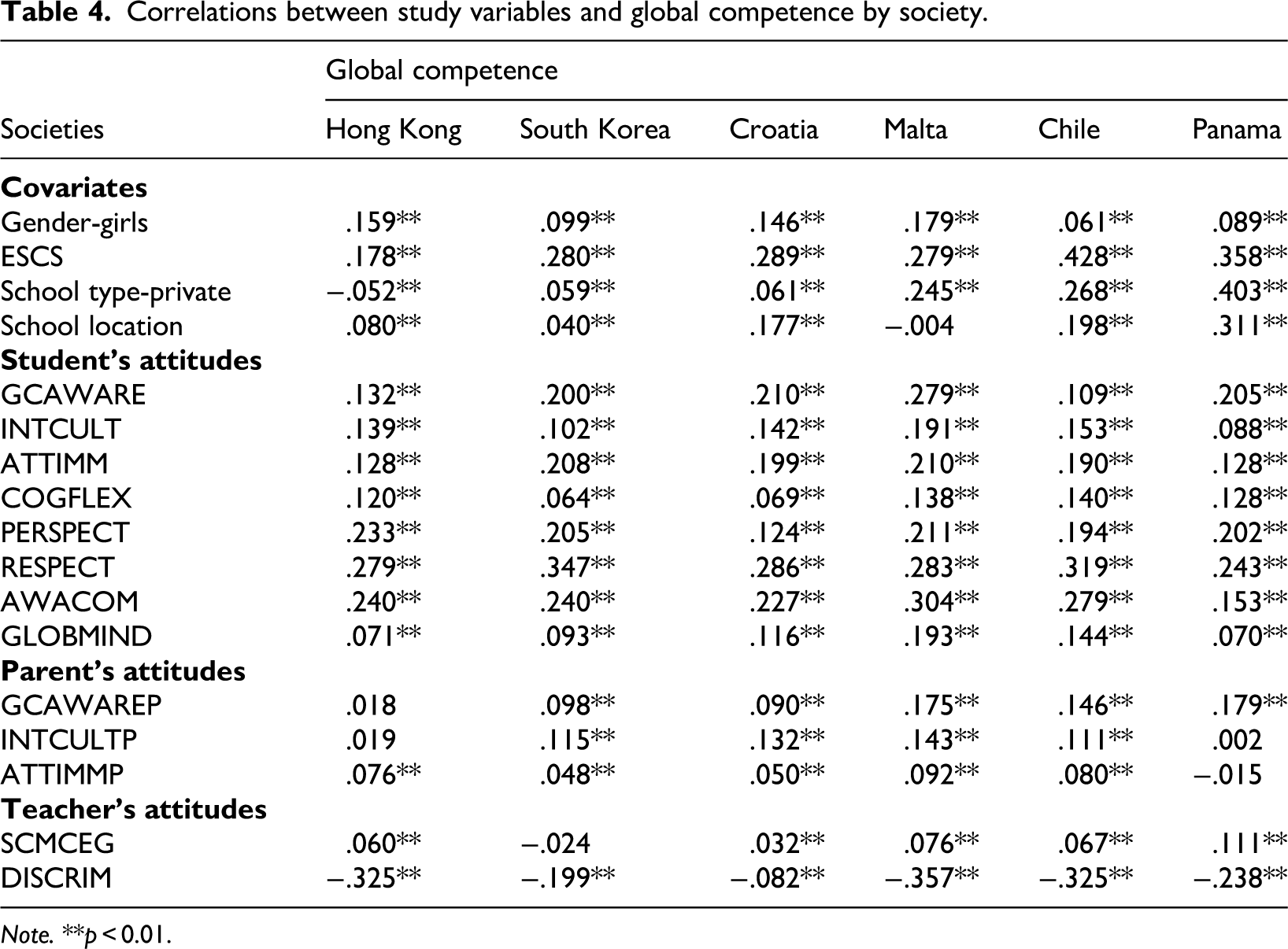
Note. **p < 0.01.
OLS regression analysis
The results of OLS regression analysis are shown in Table 5. As for contextual factors, it was found that girls perform better than boys in global competence across all countries/economies except Chile, students with higher ESCS show better global competence among all countries/economies, students report higher global competence in private rather than in public schools across most countries/economies except Hong Kong, and students show greater global competence in schools located in bigger cities for all countries/economies except South Korea and Malta. With regard to attitudinal factors, it was found that global competence is significantly and positively correlated to ATTIMM, RESPECT, and AWACOM, but significantly and negatively related to DISCRIM in all countries/economies; GCAWARE is significantly and positively linked to global competence across all countries/economies except Chile, PERSPECT is significantly and positively associated with global competence among all countries/economies except Croatia, and COGFLEX is significantly and negatively relevant to global competence for all countries/economies except Chile; Additionally, INTCULT, GLOBMIND, GCAWAREP, INTCULTP, ATTIMMP, and SCMCEG have a relatively weak association with global competence in all countries/economies.
OLS regression analysis for global competence across the six societies.
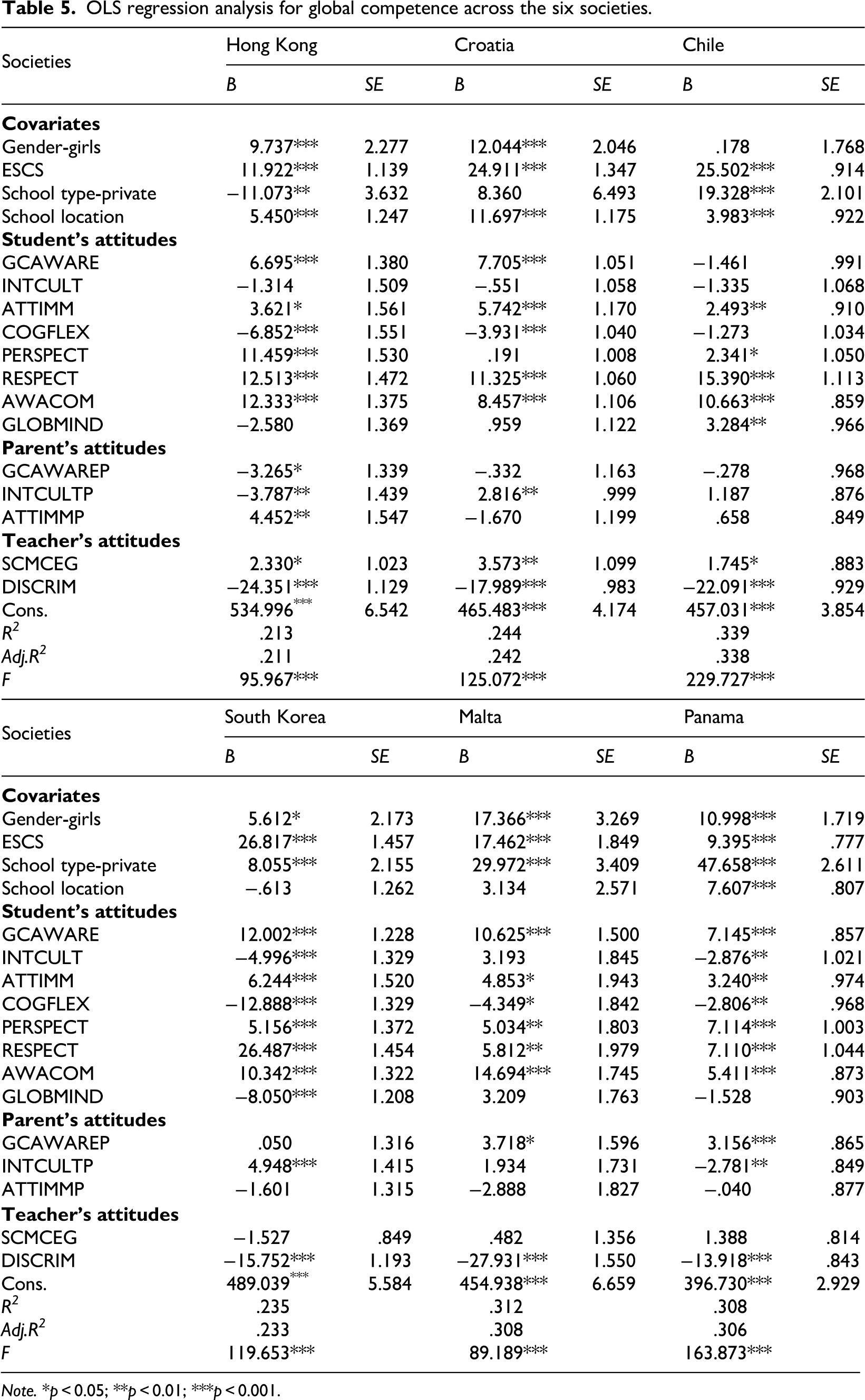
Note. *p < 0.05; **p < 0.01; ***p < 0.001.
Discussion
In light of Bronfenbrenner's ecological systems theory (Bronfenbrenner, 2005; Bronfenbrenner and Morris, 2006), the current study comparatively examined how student-, parent-, and teacher-related intercultural attitudes associate to students’ global competence across Hong Kong, South Korea, Croatia, Malta, Chile, and Panama in PISA 2018. The OLS regression analysis was employed as statistical approach, and four research questions has been addressed. Accordingly, the common and distinct conditions of global competence for the six countries/economies have been explored. From the country/economy perspective, it was found that factors shaping students’ global competence are generally shown to vary across these societies: Student-, parent-, and teacher-related intercultural attitudes have the strongest connection with students’ global competence in Hong Kong and South Korea, a moderate association with that in Chile and Panama, and the weakest correlation with that in Croatia and Malta. From the variable perspective, the research findings revealed that the strongest factor on students’ global competence is student-related intercultural attitudes, the moderate factor is teacher-related intercultural attitudes, and the weakest factor is parent-related intercultural attitudes. The discussion was conducted across three dimensions: The rationale of PISA 2018 global competence assessment framework; the relationship between multi-stakeholder's intercultural attitudes and students’ global competence; as well, the connection between demographic factors and students’ global competence.
Multi-stakeholder's intercultural attitudes and global competence
As for students’ intercultural attitudes, this study revealed that attitude towards immigrants, respect for people from other cultures, and awareness of intercultural communication are all positively linked to students’ global competence for all the six societies: Hong Kong, South Korea, Croatia, Malta, Chile, and Panama, reflecting some previous studies (e.g., Lee and Lee, 2019; Nob et al., 2025; Wu and Zhang, 2024). When students are open to immigrants, they are more likely to engage with diverse perspectives and experiences. This openness fosters a sense of empathy and understanding, which are fundamental to global competence. In fact, evidence from Indonesia, Philippines, and Thailand also revealed that students who have a positive attitude towards immigrants are better prepared to navigate the complexities of a multicultural society (Nob et al., 2025). Also, respect for people from other cultures is a cornerstone of global competence, which means acknowledging and valuing the differences between various cultures. Indeed, respect for people from other cultures can enhance social integration and mutual understanding, thereby leading to a more diverse social fabric (Nob et al., 2025; Zhang et al., 2025). Inversely, a lack of cross-cultural respect, or ethnocentrism, is very damaging. For instance, it was reported that ethnocentrism is unfavorable to impartial worldviews in Croatia, thereby exacerbating cultural distance rather than fostering ethnorelativism or cosmopolitanism (Milas, 1998; Trošt and Marinšek, 2022). Likewise, a strong sense of national identity in Singapore and prominent religious nationalism in Morocco have become barriers in developing students’ global competence (Benzehaf and Zyad, 2025; Ho, 2009). These may serve as supportive examples of how ethnocentrism and insufficient intercultural respects shape global perspectives. As well, effective intercultural communications require an understanding of cultural differences and the ability to navigate them. Students who are aware of these differences are better equipped to interact in a global context, avoiding misunderstandings and conflicts and further building bridges between different cultures. In conclusion, the current findings may reflect that attitude towards immigrants, respect for people from other cultures, and awareness of intercultural communication are universal key factors that transcend cultural diversity in shaping students’ global competence.
Also, students’ interest in learning about other cultures and intercultural adaptability are particularly worthy of attention, which are negatively associated with students’ global competence across most societies in this study. Such findings can be explained through multiple psychological mechanisms. Firstly, intercultural contacts may inherently elicit anxiety. Stephan and Stephan's intergroup anxiety theory posits that when individuals anticipate interacting with cultural outgroups, they generally experience fear and discomfort, which can activate self-protective motivations that undermine rather than facilitate cross-cultural openness (Stephan and Stephan, 1985). In fact, such anxiety often leads to defensive boundary maintenance and avoidance, thereby inhibiting global competence development (Stephan, 2014). Secondly, engaging with cultural diversity overall imposes measurable psychological costs. International learning environments have been found to compromise students’ senses of inclusion and psychological safety, particularly when cultural misunderstandings occur in practice (De Leersnyder et al., 2022). These psychological costs can impair the very cognitive skills that global competence assessments aim to measure. Thirdly, cross-cultural adaptation frequently triggers cognitive dissonance. Exposure to values, norms, and perspectives that conflict with one's own cultural schemas probably produces aversive psychological discomfort (Maertz Jr et al., 2009). Reducing this dissonance demands sustained cognitive resources, which may compromise performance on demanding cognitive tasks such as the PISA global competence test.
The above findings may also reflect a systematic adaptability paradox rooted in structural tensions between multicultural education landscapes and persistent cultural boundary maintenance. In Hong Kong, students navigate a postcolonial linguistic hierarchy where English-medium instruction stratification perpetuates colonial power structures (Bray and Koo, 2004; Wang, 2023), rendering cross-cultural adaptation potentially interpretable as complicity with elite privilege rather than genuine intercultural growth. Further, the local assimilationist multicultural framework further constrains adaptive dispositions by framing ethnic minority integration through deficit-oriented Chinese language acquisition (Gao and Gube, 2020). Similarly, South Korean multicultural education operates within an entrenched ethnic nationalist paradigm that manages diversity as a demographic threat requiring state correction, rather than embracing pluralism (Grant and Ham, 2013; Lee, 2009; Park, 2017). Here, interest and adaptation may signify contamination of cultural purity rather than cosmopolitan competence. Croatia presents a post-conflict constitutional model where minority language rights, while formally guaranteed, often reinforce ethnic separation rather than integration, compounded by post-socialist bureaucratic inertia and incomplete social value alignment with EU norms (Paravina, 2022; Švarc and Dabić, 2019). Maltese students adopt defensive identity boundaries when confronting nascent nationalism and Mediterranean value conservatism, and the bilingual education system primarily serves national consolidation rather than global openness (Baldacchino, 2009; Camilleri Grima, 2013). As well, Panama exemplifies incomplete linguistic decolonization: Despite constitutional recognition of indigenous languages, Spanish hegemony persists, reducing IBE to a symbolic gesture rather than a transformative practice, with limited scope for genuine intercultural engagement and adaptation (Näslund-Hadley et al., 2025). Clearly, students may report attenuated global competence due to culturally-specific framings of intercultural interest and adaptability, wherein these dispositions are embedded within and constrained by local sociopolitical structures.
Beyond that, from a measurement perspective, this might involve semantic displacement across these divergent societies. For example, the term ‘adaptability’ in the PISA questionnaire implies the mobility assumption prevalent in Western mainstream societies, which involves a more positive meaning (OECD, 2020); whereas, in the educational discourses of these five societies, ‘adaptability’ might carry the meanings of submission, threat, or instrumental burdens. Additionally, this might also involve self-reported biases in social expectations: In highly competitive environments such as Hong Kong and South Korea, underestimating adaptability could be a strategy of modesty (e.g., Du and Jonas, 2015; Ma et al., 2018); whereas, underestimation adaptability might be a strategy for protecting one's identity in Croatia, Malta, and Panama (e.g., Camilleri Grima, 2013; Pehar et al., 2020; Pérez Fernández, 2011). Collectively, these patterns underscore the contextual contingency of global competence realm and highlight potential critical limitations in employing decontextualized self-report measures across various societies where cross-cultural interest and adaptability carry divergent political and cultural significations.
In terms of parents’ intercultural attitudes, it was found that the roles of parental awareness of global issues, interest in learning about other cultures, and attitude towards immigrants in students’ global competence display mixed and society-specific characteristics. Notably, the finding in Hong Kong is particularly worthy of attention: On the one hand, all three aspects of parents’ intercultural attitudes significantly relate to students’ global competence; on the other hand, students’ global competence is negatively associated with parental awareness of global issues and interest in learning about other cultures, but positively associated with parental attitude towards immigrants. The mixed findings may be related to the following reasons. Influenced by an emphasis on educational competition in East Asian Confucian culture, parents in Hong Kong pay particular attention to their children's academic performance (Kim et al., 2017; Shen et al., 2024). In the process of cultivating children's global awareness, parents may view intercultural issues more as tools for expanding academic knowledge rather than as opportunities to foster children's cross-cultural communications. In all likelihood, parents might encourage their children to keep up with international news, but the aim is to achieve good grades in academic tests rather than truly guiding them to deeply understand and respect the values and lifestyles of different cultural backgrounds (Kim et al., 2017; Ng and Wei, 2020). Such a performance-oriented educational idea leads students to remain more at academic knowledge in the process of cultivating global awareness, weaking in-depth thinking and practical training on global issues. Additionally, Hong Kong is an immigrant society with multiculturalism, and a large proportion of parents are immigrants (Shen et al., 2024). In this regard, parents’ attitudes not only shape children's cultural identities but also play a crucial role in helping them develop global perspectives and cross-cultural skills (Wu et al., 2020, 2021).
With regard to teacher's intercultural attitudes, the findings demonstrated that teacher's multicultural and egalitarian belief is positively associated with students’ global competence in Hong Kong, Croatia, and Chile, which is reflected by some previous cases (e.g., Wu and Zhang, 2024; Zhang et al., 2025). As theorized by Ganley et al. (2019) and supported by Wu and Zhang (2024), students’ transferable global competence can be improved by observing and engaging with teachers who value diverse perspectives, critique ethnocentric viewpoints, and connect local actions to global consequences. These aspects may involve enhanced cross-cultural flexibility and reduced cultural prejudice, thereby deriving omnifarious benefits from the attitudes and behaviors performed by their educators. Also, evidence from Hong Kong and South Korea indicated that educators equipped with a holistic understanding of the historical underpinnings of specific cultural contexts are more likely to facilitate meaningful discussions on multicultural issues (Kim, 2022; Lam, 2022). Such historical knowledge is not merely a repository of facts, but a critical framework that allows teachers to present contemporary global challenges, such as migration patterns, international conflicts, or economic disparities deeply rooted in complex historical narratives of colonialism, trade, and cultural exchange. The depth of understanding empowers educators to move beyond superficial coverage, fostering a classroom environment rich with critical thinking and nuanced perspective-taking (Kim, 2022; Lam, 2022; OECD, 2020). Consequently, these teachers are probably positioned to impart their attitudes and values to students through both conscious pedagogical choices and subconscious cultural empathy.
However, this study also revealed that teacher's intercultural discrimination is negatively correlated to students’ global competence across all the six societies. In light of the minimization of discrimination theory (Ruggiero and Taylor, 1995, 1997), students operating within a discriminatory school climate generally internalize failures in intercultural communication. This theory posits that in environments where systemic bias is downplayed or ignored, individuals from marginalized groups are habitually discouraged from attributing negative outcomes to external prejudice. Therefore, when cross-cultural interactions falter, the logical explanation - a climate of discrimination or a lack of institutional support - is psychologically minimized. Students are instead inclined to turn the scrutiny inward, attributing the failure to their own perceived inadequacies, such as inherent inabilities or insufficient acquisitive efforts to navigate cultural differences. This pattern of internal attribution initiates a detrimental psychological cycle: Self-blame erodes self-efficacy and fosters psychological anxiety, as students come to anticipate future interactions with apprehension and self-doubt. Such anxiety may result in a self-fulfilling prophecy where the fear of failure impedes the very skills like spontaneous engagement, active listening, and adaptive communication, which are required for success in multicultural contexts (Bracegirdle et al., 2023; Martinez et al., 2023; Ruggiero and Taylor, 1995; St-Pierre et al., 2026). Ultimately, the minimization of discrimination not only obscures the authentically structural nature of problems but also impairs students’ intercultural growth by burdening them with a misplaced sense of personal responsibility and the attendant psychological distress. Therefore, such a situation must be changed within the global system of cross-cultural education: Weakening teachers’ cross-cultural discrimination by cultivating their global beliefs in multicultural contexts.
Demographic conditions and global competence
Demographic characteristics serve as a very crucial element shaping personal development in global landscapes and multicultural contexts (Kim, 2022). In the current study, it was found that girls outperform boys in global competence for Hong Kong, South Korea, Croatia, Malta, and Panama, which may refer to such a fact that girls generally embody a higher level of capabilities in global knowledge, intercultural skills, multicultural interactions, and openness and respect for people from different cultural backgrounds than boys (Jang et al., 2023; Solhaug and Kristensen, 2020). The positive link between ESCS and global competence in all the six societies probably revealed that ESCS is one of the few factors transcending social, cultural, economic, and political contexts to universally associate with students’ global competence (Pike and Sillem, 2018). For example, students from higher ESCS families may be prone to experience more cross-cultural resources, such as exchange abroad and international service learning (Kohel, 2016; Pike and Sillem, 2018). In this study, students generally reported higher global competence in private rather than in public schools across most societies, which perhaps relates to different school choice mechanisms dominated by market dynamics: At the mercy of market-driven selection process, private schools often provide students with more opportunities for international exchanges and intercultural communications (Lasten et al., 2022). As well, students generally reported greater global competence in schools located in cities for most societies. Probably, students within schools at advantageous geographical locations may share more high-quality educational and cultural resources, whereby improving their cross-cultural interactions and global competence.
Limitations, reflections, and future directions
At the research design level, this study has several limitations that warrant attention in future research. Firstly, the analysis relies on the cross-sectional PISA 2018 dataset. Although it provides a globally representative sample and helps identify recurring patterns across key variables, its design limits causal inference. Potential cultural influences further caution against overinterpreting the associations observed. Future studies could adopt longitudinal designs or draw on empirical evidence from diverse cultural contexts to better establish causality and account for contextual specificities. Secondly, the assessment of global competence was based solely on student self-report. To mitigate potential social desirability bias and enrich the data, subsequent research could incorporate perspectives from teachers, peers, and parents, as well as qualitative data such as interviews or observations. Thirdly, this study employed OLS regression analysis to examine how student-, parent-, and teacher-related intercultural attitudes associate with students’ global competence. Future work could extend this line of inquiry by using structural equation modeling (SEM) to test whether the impacts of these factors vary across demographic groups, such as gender, age, educational background, and race/ethnicity. Fourthly, the current case included six societies from Hong Kong, South Korea, Croatia, Malta, Chile, and Panama across Asia, Europe, and America. Therefore, future research may involve more countries or economies, such as African participants, in order to enhance the generalizability of research findings.
At the statistical measurement level, several methodological issues merit further explicit acknowledgment. Firstly, although employing cluster-robust standard errors at the school level can decrease the issue of underestimated standard errors caused by within-group correlations (Angrist and Pischke, 2009; Cameron and Miller, 2015), the hierarchical structure of PISA data renders OLS regression suboptimal compared to hierarchical linear modeling (HLM). HLM can effectively account for nested data by partitioning variance across multiple levels, thereby providing more accurate parameter estimates and standard errors than OLS regression (Hox et al., 2017; Raudenbush and Bryk, 2002). Therefore, future research may employ HLM to investigate multilevel attitudinal factors on students’ global competence. Secondly, although the present study adhered to the official PISA technical guidelines and employed standardized variables (OECD, 2020, 2021), future research may utilize raw scale scores of relevant variables to formally test measurement invariance before undertaking cross-cultural comparisons, by conducting multi-group confirmatory factor analysis (CFA) or employing alignment optimization techniques to approximate measurement equivalence (Asparouhov and Muthén, 2014). Thirdly, several items measuring student-related intercultural attitudes, such as respect for people from other cultures, awareness of intercultural communication, and global-mindedness, may conceptually resemble components of global competence. This semantic proximity raises the possibility of discriminant validity issues, potentially impacting observed relationships through shared measurement error or conceptual redundancy. Future studies may address this limitation by conducting discriminant validity tests, such as Fornell-Larcker criterion or heterotrait-monotrait (HTMT) ratio, in order to ensure that student-related intercultural attitudes and global competence are empirically distinct constructs (Henseler et al., 2015).
Critical conclusions and remarks
Grounded in Bronfenbrenner's ecological systems theory, this comparative study offers a rare empirical examination bridging the Global North and the Global South settings, specifically investigating how student-, parent-, and teacher-related intercultural attitudes are associated with students’ global competence across Hong Kong, South Korea, Croatia, Malta, Chile, and Panama in PISA 2018. From the perspective of countries/economies, the global competence of students in Hong Kong and South Korea is most strongly associated with students’, parents’, and teachers’ intercultural attitudes; the global competence of students in Chile and Panama is moderately connected to the intercultural attitudes of multiple stakeholders; as well, the global competence of students in Croatia and Malta is least relevant to these three aspects of intercultural attitudes. Perhaps, the varying strength of these associations underscores how global competence development is not merely a function of individual or proximal attitudinal factors, but is also fundamentally impacted by the overarching cultural ideologies and historical legacies that define what constitutes legitimate knowledge and valuable skills within each national context. From the perspective of variables, student-related intercultural attitudes displayed the strongest relationship with global competence; teacher-related intercultural attitudes displayed a moderate association with global competence; also, parent-related intercultural attitudes displayed the weakest correlation with global competence. This gradient likely reflects that schools have progressively superseded families as the primary socialization arena for students’ global engagement, positioning teachers as more influential than parents while substantiating student-related attitudinal dispositions as the most important factor of global competence. Consequently, policy interventions should prioritize targeted supports for students and teacher professional development, while treating parental engagement as a supplementary rather than primary lever.
Manifestly, the imperative to prepare learners for an interconnected world has placed global competence at the center of contemporary educational discourse. Central to this competence are diverse intercultural attitudes of multifarious stakeholders that enable effective engagement across cultural boundaries. Previously, intercultural education underlined basic knowledge domain through diverse curriculum designs and teaching methods (Chou et al., 2015; Kerkhoff and Cloud, 2020; Kohel, 2016). Whereas, the current findings may bring some considerations to educational researchers and policy makers: Multiple stakeholders’ intercultural attitudes should be viewed as new training directions. This study revealed the complex roles that student-, parent-, and teacher-related intercultural attitudes play in shaping global competence, while also pointing to ineradicable disparities within the global education realm. The concept of global competence, as operationalized by PISA, is not a neutral metric but a political construct, one that often perpetuates the very inequalities it claims to address (Bailey et al., 2023; Engel et al., 2019; Robertson, 2021). By benchmarking diverse societies against a predominantly Western or OECD-defined standard, the framework risks pathologizing the Global South for its deficits while naturalizing the advantages of the Global North, thus cementing a new form of educational hegemony under the guise of cosmopolitanism (Grotlüschen, 2018; Ledger et al., 2019; Martini and Robertson, 2024). In this context, the findings of the power of intercultural attitudes are actually a critical intervention. It was revealed that the cultivation of respect, open-mindedness, and anti-discrimination is a fundamental cultural resource, yet unevenly distributed. The struggle for a more equitable global competence is therefore not solely about redistributing economic or material resources - though that is essential - but more about critically reflecting on whether existing assessment frameworks may inadvertently favor certain knowledge systems and attach uneven value to different intercultural attitudes (Auld and Morris, 2019; Chandir, 2022; Grotlüschen, 2018). Ultimately, fostering corresponding attitudes among students, parents, and teachers is not just an educational goal but a broader scholarly and policy contribution to the advancement of epistemic pluralism, a necessary step toward re-examining the hierarchies within current global citizenship frameworks and toward forging a more pluralistic and inclusive vision for our interconnected world.
Footnotes

Ethical considerations
The OECD has officially conducted the ethical approval for all participating countries/economies in PISA 2018.
Informed consent
The OECD has officially completed the informed consent for all individual participants in PISA 2018.
Funding
The author disclosed receipt of the following financial support for the research, authorship, and/or publication of this article: This work was supported by the Postgraduate Scientific Research Innovation Project of Chongqing, China: Research on Generation Conditions and Evolution Laws of Global Education Centers, (grant number CYB25082).
Declaration of conflicting interests
The author declared no potential conflicts of interest with respect to the research, authorship, and/or publication of this article.