







Abstract
We distinguish between social capital theory and social capital political discourse in order to reflect upon their relation with one another and neoliberalism. We claim this analytical distinction is useful to understand the existence of a feedback effect between theory and political discourse. During the 1990s, the connection between social capital theory and neoliberalism has been transposed from academia to political discourse, thus contributing to popularise social capital within the public sphere. Over time, however, rising economic inequalities (exacerbated by the recent economic crises) have demonstrated that the neoliberal political agenda is incompatible with the aim to generate social capital. Focusing on the critical case of Britain, we argue that the rapid demise of the Big Society idea might signal a corresponding decline of social capital theory within academia.
Introduction
The connection between social capital and neoliberalism is a double-edged sword. On the one hand, it has greatly contributed to the popularisation of the social capital concept, while neoliberalism gained political prominence during the 1990s. The existence of this link has transformed social capital from a fancy academic theory into an important ingredient of new political discourses. On the other hand, this connection may well be the cause of social capital theoretical demise. This draws from the fact that, in a period characterised by economic crisis and preceded by decades of rising economic inequality, the policy aim to bolster social capital is incompatible with the neoliberal political agenda. On this basis, we theorise the existence of ‘a feedback effect’ from theory to political discourse (from Putnam’s theory to New Labour) and then back from political discourse to theory (from the demise of the big society idea to the requiem of social capital theory). It is important to note that when we talk about this ‘requiem for a theory’, we refer specifically to the potential demise of Robert Putnam’s notion of social capital.
We analyse social capital theory and social capital political discourse in relation to neoliberalism through the metaphor of a parabola. We distinguish between the parabola of social capital theory and that of political discourse, reflecting upon their relation to one another and to neoliberalism. A parabola has three constitutive elements that we use in order to describe the different phases lived by social capital theory and social capital political discourse: an ascending phase, a vertex, and a descending phase. We argue that social capital theory ascended in importance while it was functional to integrate the importance of secondary groups within methodological individualism and rational choice theory (the ascending phase of the social capital theory parabola). While James Coleman’s (1988) seminal work represents the encounter between social capital theory and neoliberalism, Putnam’s (1993) notion represents the ‘critical juncture’, the vertex in the social capital theory parabola in which the academic concept acquires relevance in the political discussion. The vertex of the social capital theory parabola also marks the beginning of the social capital political discourse parabola (its ascending phase).
We use the British case to substantiate our claim for three reasons: (1) Britain is the first country (together with the United States) where neoliberalism has been articulated in a coherent democratic political agenda, (2) the Third Way is the first social democratic political project heavily influenced by neoliberalism (the first New Labour government also represents the vertex of the social capital political discourse parabola), and (3) both Labour (with the Third Way) and the Conservatives (with the Big Society) employed social capital discourse to claim a new political space within civil society. We argue that the rapid demise of the Big Society idea marks the decline of social capital political discourse in Britain. By extension, this demise also indicates a declining prominence of social capital theory within academia.
The remainder of the article is organised as follows: We first describe the genealogy of social capital theory and its intersection with neoliberalism. Next, we discuss the use of social capital discourse within the British political arena and its implication for our argument. Finally, we further illustrate the tension between social capital theory and neoliberalism that might contribute to the demise of this highly influential theory.
The Ascending Phase of Social Capital Theory
Social capital is often defined as the capital accumulated by individuals and groups through their social interactions that can be used to smooth cooperation among people and foster collective action (Putnam, 1995; for an overview of the most influential definitions of social capital, see Adler and Kwon, 2002). Historically, the power of community governance has been stressed by many philosophers from antiquity to the eighteenth century, from Aristotle through Thomas Aquinas to Edmund Burke. Social capital proposes a synthesis between the values contained in the communitarian approaches and the individualism professed by rational choice theory. Putnam bridged the polarity between individualism and communitarianism, highlighting the importance of social engagement to face the crisis of liberal democracy (Bowles and Gintis, 2002). In this way, he revitalised a long-standing debate: the necessity of strong secondary groups, informal ties and trust to guarantee the functioning of society and political institutions during the process of modernisation. This debate was originally brought forward by the founding fathers of sociology (Durkheim, 1996; Simmel, 1969; Tocqueville, 1961; Tönnies, 1955; Weber, 1946; for a discussion see Ferragina, 2010). In what follows, we highlight how Putnam’s conceptualisation simultaneously merges classical sociology and Coleman’s neoliberal re-interpretation of social capital theory. Our review illustrates the tension between these two strands of literature and emphasises the link between social capital and neoliberalism.
According to Emile Durkheim, a society can work properly only through the mediation of secondary groups, which are necessary bodies in grafting atomistic individuals to the life of a nation. Following this debate, Lyda Hanifan (1916) and Jane Jacobs (1961) employed the social capital concept for the first time, arguing that social capital can be accumulated or destroyed according to the appropriateness of the social investment made by communities. Pierre Bourdieu (1980) further developed social capital theory by using the concept as a heuristic tool to complement the analysis of class stratification traditionally based on human and economic capital. According to him, individuals employed social capital, together with economic and educational capital, to get ahead in life and achieve their goals. In parallel to Bourdieu’s notion 1 (see Häuberer, 2011: 35–51), Coleman (1988, 1990) employed social capital theory to associate social relations with the utility function of individuals. In this way, he attempted to capture aspects of social life traditionally neglected by mainstream economics. It is around this extension of rational choice theory to other social sciences and the predominance of methodological individualism that the conceptual trajectory of social capital intersects with neoliberalism (Fine, 2010). Owing in large part to the rising political prominence of neoliberalism, this connection represents the start of the ascending phase of what we call the social capital theory parabola. The rising stature of neoliberalism derives especially from the crisis of Fordism (Amin, 1994) and the re-emergence of high finance (Helleiner, 1996; Konings, 2011; Strange, 1994) as the central engine of economic growth and wealth accumulation (Boyer, 2000).
We use the term ‘neoliberalism’ to indicate a political, economic and cultural paradigm, which redefined state market relations in favour of the latter (Gamble, 2009; Munck, 2005; Saad-Filho and Johnston, 2005). Conceptually, we acknowledge that the term ‘neoliberalism’ represents more a broad label than a singular theory (Boas and Gans-Morse, 2009; Gamble, 2009). Nevertheless, the various strands of neoliberal thought have greatly influenced policy-making and economic governance across the world. For this reason, and together with many other scholars, we consider the term ‘neoliberalism’ to be a valid analytical category. 2
For what constitutes contemporary social capital theory, among various influential conceptualisations (i.e. those of Ronald Burt and Nan Lin 3 ), we focus on Putnam’s definition. His broad definition includes social networks, social norms and trust, and it has been widely criticised for its conceptual looseness (Ferragina, 2013) and for its implicit difficulties of measurement (Häuberer, 2011: 58–85; Paxton, 1999). In spite of these drawbacks, Putnam’s (1993, 1995, 2000) work has heavily contributed to transform the social capital debate, launched by Bourdieu (1980) and Coleman (1988, 1990), from a lively academic discussion into one of the hottest topics ever to have appeared in the social sciences. 4 His argument echoed Alexis de Tocqueville’s (1961) seminal work. The French scholar theorised that liberal democracy is in danger if it is not accompanied by a strong civil society. However, unlike Tocqueville, Putnam disregarded the fact that social capital does not seem to flourish when high inequalities persist in society (Ferragina, 2010, 2012). For this reason, his conceptualisation brought together the concern for communitarian governance (expressed by the founding fathers of sociology) and methodological individualism (embedded by Coleman within social capital theory), at the same time undermining the importance of the link between equality and civic engagement originally posited by Tocqueville.
Putnam’s social capital theory thereby internalises the market mechanisms that characterise the neoliberal project. This notion reconciles individualism with societal concerns, approaches social relations as a matter of economic investment, and transforms collective problems into individual responsibilities (Fine, 1999). It is a concrete example of how the analytical categories of neoliberalism and the language of the stock market have decisively permeated social and political discourse over the last few decades. The reduction of social relations to something similar to financial capital implicitly means to assume that community involvement and social participation are forms of economic activity. However, as highlighted by Smith and Kulynych (2002), the word capital is linked to the development of an economic system based on individualism and competition, which is in antithesis with the model of ‘civicness’ that social capital theorists (like Putnam) and policy makers (in the Conservative and Labour parties) are promoting in their discourse.
To sum up, Putnam’s conceptualisation constitutes the vertex of the social capital theory parabola: a critical juncture after which social capital becomes an academic paradigm (for a critique see Portes, 1998) and an influential element of political discourse. Building on Coleman’s work, Putnam managed to sooth the tension between individualism, the cornerstone of neoliberal theory, and the need for secondary groups to revive democracy, in the end also providing an appealing narrative for the major British political parties.
The Parabola of Social Capital Political Discourse in Britain
Putnam called for the renewal of democracy by emphasising the central role of social capital to countering the deterioration of the social fabric fostered by the modernisation process. Such a call was profoundly rooted in the American political debate (Béland et al., 2002), but it was far less common in Europe (Navarro, 2002: 424). In Europe, the call for social engagement was traditionally endorsed by the Christian-Democrats, which, differently from the American parties, emphasised the importance of social cohesion in reducing the amount of inequality generated by the market. However, in the last decade or so, all major European parties have been advocating social engagement in order to support the current structure of capitalism rather than to reduce economic and social inequality.
In this context, Britain is the first European country where neoliberal ideology drove the political agenda, such as under the Thatcher governments; a social democratic party was strongly influenced by neoliberalism (Ryner, 2010); and both major parties used social capital discourse to emphasise the importance of civil society. Together with the United States, Britain also represents the least likely case in which social capital discourse should lose appeal in the public arena. This is because the rhetorical call to a more active engagement of civil society through the Third Way and the Big Society has been stronger than anywhere else in Europe. Hence, if we observe a declining relevance of social capital within Britain’s political discourse, it is likely that this decline would appear in the future in other European societies as well.
In what follows, we illustrate three different phases of the social capital political discourse parabola by looking at both British political parties: (1) the ascending relevance of the social capital political discourse during the 1990s, (2) the apex of its importance reached during the first New Labour government, and (3) the demise of the social capital discourse with the failure of the Big Society idea during the coalition government.
The Ascending Phase
The shift towards a political discourse heavily influenced by social capital is clearly observable comparing the 1979 and 1997 Labour Party Manifestos and the 1979 and the 2010 Conservative Manifestos. In the first case, traditional social democratic values have been undermined in favour of the Third Way (Giddens, 1998), and in the second, Thatcher’s radical individualism has been revised by the incorporation of the social capital concept within the Big Society discourse (for a review of the Big Society debate, see Ishkanian and Szreter, 2012).
In 1979, the Labour Party professed a complete adherence to social democratic ideals and rejected the choice between a ‘prosperous and efficient Britain’ and a ‘caring and compassionate Britain’ (Labour Party, 1979: 23). Coherent with this position, the main commitment of the party was the reduction of economic inequality, 5 via the introduction of a wealth tax (Labour Party, 1979: 1). In the 1990s, this agenda drastically changed with the progressive dismissal of traditional social democratic ideology. In particular, New Labour de-emphasised the need to tackle economic inequality and instead focused its political strategy on the expansion of opportunities for all, keeping public intervention in the market to a minimum. In this context, the aim to foster social capital creation by holding together the modernisation of the state and the creation of stronger social ties became the flagship of New Labour (Donoghue, 2013). This radical shift that swept through New Labour during the late 1990s can be considered the moment in which the social capital political discourse begins the ascending phase of its parabola.
This change of political orientation was based on a profound revision of social democratic principles. 6 These principles were considered by New Labour to be an obstacle to the activation of evidence-based policy-making. In this context, the prevention of market failures, that is, targeting child poverty and educational disadvantage, was preferred over the redistributive approach endorsed by the Labour Party during the 1970s. The new vision implied the full acceptance of market principles and pushed traditional social democratic values even further away (Ryner, 2010). This ideological shift took place despite the fact that the period between 1979 and 1995 was characterised by the sharpest increase in economic inequality since World War II. 7
The importance attributed to the creation of social capital is symptomatic of New Labour’s interest in civil society. This interest can be explained by the effect of growing individual freedom, fostered by economic and technological modernisation, in a context where traditional forms of solidarity and interdependence are needed to prevent social disintegration; a ‘social paradox’ already identified by the founding fathers of sociology (Durkheim, 1996). For this reason, New Labour considered the creation of social capital as a good antidote to the tension between traditional and modern values.
The Apex
Tony Blair (2000) proposed, like Putnam, to manage social change by unifying moral values, represented by the Tocquevillian quest for community, and scientific evidence, used to inform evidence-based policy-making. The fusion of these two elements in the Third Way is, according to Blair, the only remedy for the social paradox illustrated above. One could say, as Durkheim, that during an age of modernisation and transformation, the values cultivated in secondary groups need to be universally accepted because they confer a human face to a society dominated by competition and the pursuit of efficiency. In this vision, the creation of social capital balances growing individualism with the need for interdependence, serving as a sort of glue to prevent modernisation from heading towards societal disintegration. Similar to Coleman and Putnam, Blair’s Third Way represents at the political level the moment of alignment between social capital discourse and neo-liberalism and, by extension, the vertex of the social capital political discourse parabola.
After merging Putnam’s argument and the Third Way discourse (Blair, 1998; Giddens, 1998), New Labour also bridged theory and practice (Gamarnikow and Green, 1999), through policy making at various levels (Secretary of State for Social Security and Minister for Welfare Reform, 1998), that is, in education (Secretary of State for Education, 1997), health (Donald, 1998), and neighbourhoods (Social Exclusion Unit, 1998); and attempting to measure the direct impact of these reforms on social capital. In this context, the objective of creating social capital, through the empowerment of families and communities and the decentralisation of social services, became one of the main driving forces of New Labour’s political action.
The Descending Phase
In 1979, the Conservative Party Manifesto pledged to strike a new balance between the roles of the state and society in order to enhance individual freedom (Conservative Party, 1979). Margaret Thatcher, in opposition to the social democratic principle of economic redistribution, argued that Britain was on the ‘brink of disintegration’ and economic collapse because of excessive state intervention (Conservative Party, 1979: 2). The focal point of ‘Thatcher’s revolution’ was to give power back to the people by favouring the creation of new wealth. At the societal level, the need to foster individual entrepreneurship via deregulation translated into the controversial vision that there was ‘no such thing as society’ and that no government can do anything except through people looking after themselves first (Douglas, 1987).
More than 30 years later, the Conservative Manifesto of 2010 set a similar agenda to reduce the influence of the state together with the public debt (Conservative Party, 2010: I). However, it refers to values closer to New Labour than Thatcherism in order to achieve these objectives. The faith in individualism has been replaced by the conviction that social engagement in local communities is the only remedy to mend a broken society (Jung et al., 2013). For this reason, the harbingers of change must be found in the social rather than the economic initiative. In this context, the Big Society idea echoed social capital discourse and, in a sense, was descended from Third Way politics. With a focus on community empowerment, open access to public services, and a pledge to more actively encourage the engagement of British citizens within their communities (Slocock et al., 2015), the Conservative Party (2010: I) supported the idea, previously championed by New Labour, that a nation is at its best only if social bonds and a sense of cooperation among the people are strong.
This vision marked a shift from Thatcherite individualism by embracing the belief that ‘there is such a thing as society’ (Conservative Party, 2010: VII). The Conservative Party of 2010 promoted social capital as an important way to cope with social change. Indeed, David Cameron argued in 2010 that in order to tackle poverty and inequality, the government must reform public services by conferring greater responsibility on other social actors, much in line with the Third Way and New Labour’s vision of society as outlined above. In this context, the responsiveness of public services ought to be enhanced by removing obstacles to new providers, that is, charities, social enterprises and private companies, because they can deliver a range of services tailored to local needs (Cameron, 2010). A renewed political culture together with a widespread bottom-up approach should address social issues (i.e. poverty and inequality) more efficiently (Conservative Party, 2010: 35). However, despite proposing a new collective vision of society in contrast to Thatcher’s individualism, the 2010 Conservative Manifesto argued for continuity with traditional ideological values (Conservative Party, 2010: IX). In this respect, the Conservative party followed New Labour’s route, trying to strike a balance between the importance attributed to the creation of social capital and the party’s traditional principles. 8
Although coming from different ideological starting points, both parties have favoured the transformation of the welfare state into an enabling state, 9 with a decided shift from direct public support to private responsibility (Gilbert, 2005). Although the public sector still finances most social benefits in the United Kingdom, since the 1980s, there has been a palpable increase in private spending as a proportion of gross social expenditure (Gilbert, 2005: 5). Both parties have justified this shift from state to private provision with the need to reduce costs and improve efficiency and, above all, the willingness to create social capital by enhancing the role of local communities. This shift took place with the use of a common language. In this ‘new jargon’, social capital creation is a communal aim and community is identified as a territory between the authority of the state, the free and amoral exchange of the market, and the liberty of autonomous, rights-bearing individuals (Rose, 2000: 1400).
In this context, and despite the significant increase in economic inequality generated by the aforementioned policies of the 1980s and 1990s, political rhetoric based on social capital theory helped to conceal the contradiction between the encouragement of civic engagement and the neoliberal political agenda. However, during the recent economic crisis, the neoliberal doctrine that a positive ‘trickle down effect’ can project financial sector gains to the broader economy 10 came under increased scrutiny. At the same time, the lack of economic growth and the inability of Keynesian economic policy to reverse this downward trend have led most European government to implement harsh public spending and welfare provision cuts. 11 These so-called ‘austerity’ measures have amplified social tensions, leaving public opinion far less receptive to political discourses based on social capital theory. In short, in the context of economic crisis, it has become difficult to reconcile a political discourse based on promoting social capital with the broad implementation of neoliberal policies. Hence, political projects like the Big Society have lost their appeal (see Figures 1 and 2; Elliot, 2013; Shubber, 2014).
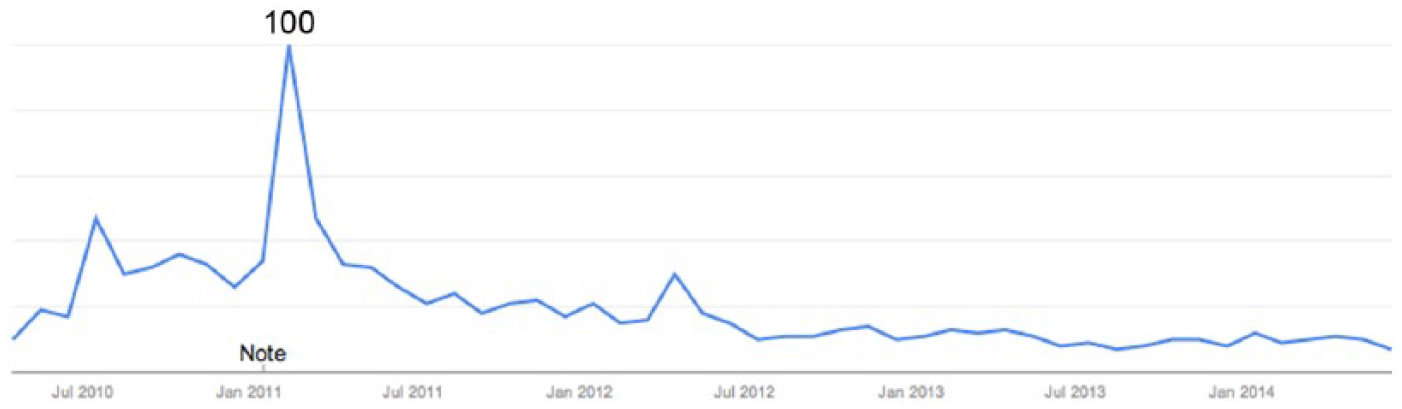
Google Trends: Interest over time of the Big Society in the UK.
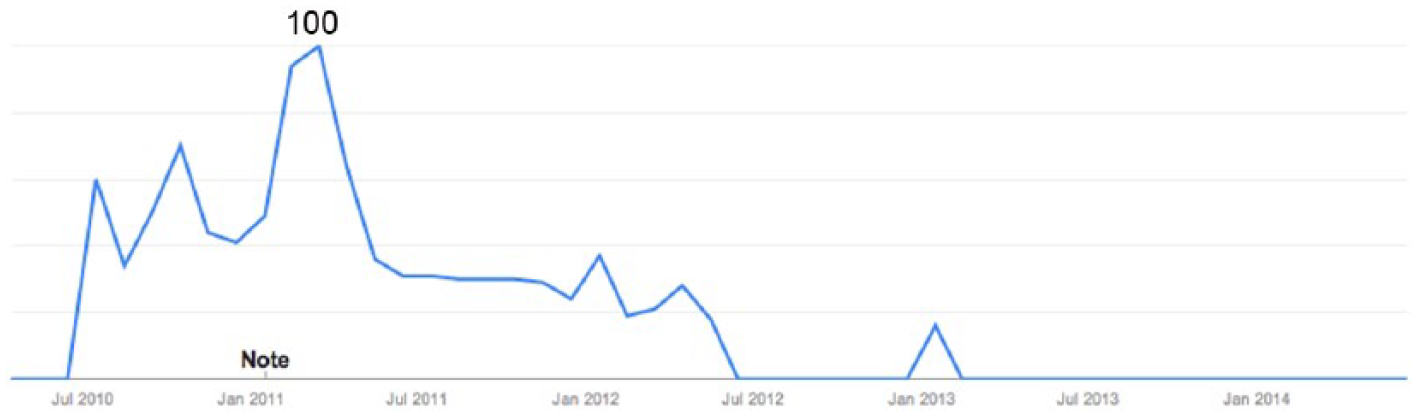
Google Trends: Interest over time of the Big Society in the UK, measured through the category: ‘Government’.
Indeed, data suggest that the Big Society idea did not convince the general public from the start. 12 Only between 11% (YouGov, 2011) and 9% (YouGov, 2012) of respondents to a YouGov survey declared that the ‘Big Society will probably work’, while an overwhelming majority, between 68% and 73% of respondents, during the same time span, argued the opposite. In addition, an Ipsos-Mori (2010) poll found that 57% of respondents agreed that the Big Society was ‘just an excuse’ to save money by cutting public services (Defty, 2014). Beyond public opinion polls, other indicators also suggest the deterioration of the Big Society idea within British society. Despite government willingness to encourage volunteering, the percentage of the UK population actively engaged in voluntary associations declined consistently since the start of the economic crisis. The Office for National Statistics (2014) and Carla Seddon (2012) clearly show that the fraction of people involved in ‘any volunteering’ at least once a month shifted from 48% in 2007/2008 to 41% in 2010/2011. 13 Furthermore, the rapid demise of the Big Society idea seems to be confirmed through the abandonment of it by prominent supporters (i.e. Paul Twivy, see Ward, 2015), scathing critiques authored by independent think tanks (i.e. Civil Exchange), and the sudden deletion of the term from the government’s agenda (Slocock, et al., 2015: 14). Just as the generous use of the social capital idea in policy-making during Tony Blair’s first mandate signalled its conceptual apex, the drop in enthusiasm for the Big Society agenda over the past 5 years seems to reflect a corresponding downward shift in the social capital parabola.
Civic engagement in Britain seems to be in continuous decline despite the effort to hide the inherent tension between neoliberalism and social capital creation. In this context, the individualism professed by rational choice theory and the communitarianism supported by social capital theory seem to contradict each other. We argue that the rapid demise of the Big Society idea signals the descending phase of the social capital political discourse. This is due in large measure to the fact that Britain’s economic environment has changed dramatically in comparison to the context that fostered the Third Way. In turn, Big Society rhetoric failed to smooth the growing social tensions existing in contemporary British society. After years of decisively influencing British political discourse, social capital has entered its descending phase in British politics. In this phase, social capital theory (at least Putnam’s version) can no longer obscure the fact that the neoliberal political agenda has acted as a brake upon civic participation.
Requiem for a Theory?
The social capital concept has influenced academic literature and public debate through the spectre of social disintegration: would anybody disagree with the fact that we need healthy communities and civic engagement to protect our democracies? We have argued that the popularity of this theory is rooted in the connection made with neoliberalism by James Coleman and Robert Putnam. For this reason, social capital theory became an analytical tool to avoid the debate on the effects of neoliberal policies on civic engagement. 14
More specifically, by elaborating the most popular version of social capital theory, Putnam (1993) revitalised Tocqueville’s seminal work on American democracy, showing that ‘the health of liberal democracy’ depends upon social engagement. However, in linking social capital, neoliberalism, and rational choice theory, Putnam did not consider that the intensity of social engagement in a society tends to be strictly related to the level of economic inequality (Ferragina, 2010, 2012) and other structural factors (Costa and Kahn, 2003), such as the universal nature of the welfare state (Rothstein, 2008). Hence, by arguing that the disadvantaged need more social capital to insure themselves against the odds of a competitive world, Putnam implicitly suggests that being powerless is a result of not having enough capital rather than a structural problem of society.
This rhetoric was re-elaborated by the two major British political parties in order to evade important societal questions. In this context, the current shortcomings of the market economy are considered as a given, and part of a framework in which each party has to operate. Hence, the Labour and Conservative parties ended up extensively discussing the importance of secondary groups and the social engagement needed to revitalise democracy, but remained unwilling to tackle the causes of social disintegration. In sum, social capital theory and social capital political discourse, with their blend of scientific elements and moral values, have been widely used to promote a call to social engagement without questioning the fundamental contradictions of the socio-economic system.
However, in a period during which neoliberal governance is showing many drawbacks and the marked incapacity to deliver economic growth (Piketty, 2014), it becomes more apparent that in order to strengthen secondary groups and social engagement, more equality and greater levels of solidarity are needed (as classically argued by Tocqueville, see Ferragina, 2010). Redistribution and solidarity stand at odds with the idea of competition, individualism and market efficiency, which are the basis of the neoliberal agenda. There is a tension between the individualisation of social risks pursued by British political parties and the call to create social capital: it is becoming harder to blame the individual for collective problems.
Prior to the start of the economic crisis in 2008, the tension between rising economic inequality and the demand to strengthen civic engagement was undermined by neoliberalism’s capacity to sustain a certain level of economic growth. We claim that this capacity contributed to a transposition of social capital theory within public discourse, which represented the ascending phase of the social capital political discourse parabola. The limitations of finance as the central engine of economic growth, the material hardships fostered by the crisis, and the austerity measures implemented by governments in response to these challenges are critically undermining the legitimacy of neoliberal policies. In this context, the incompatibility between the neoliberal agenda and the aim to create social capital cannot be concealed by social capital theory. In conclusion, if theory is ‘always for someone and for some purpose’ (Cox, 1981: 128), then the rapid demise of the Big Society idea might also mark the declining prominence of social capital theory, at least in Putnam’s popular formulation, within academia.
Footnotes
Funding
This work is supported by a public grant overseen by the French National Research Agency (ANR) as part of the ‘Investissements d’Avenir’ programme LIEPP (reference: ANR-11-LABX-0091, ANR-11-IDEX-0005-02). Alessandro Arrigoni has received a fellowship from the ‘Fondazione Franco e Marilisa Caligara’ to undertake this work.