







Abstract
Since 2009, the European Union has developed strategies for the Baltic Sea, Danube, Adriatic-Ionian and Alpine macro-regions. These macro-regional strategies represent a new tool of European Union governance that seeks to combine the community’s territorial cooperation and cohesion policy repertoire with intergovernmental ‘regional cooperation’ involving European Union member and partner countries. By establishing comprehensive governance architectures for cross-sectoral and trans-boundary policy coordination in areas such as transport infrastructure and environmental protection, macro-regional strategies seek to mobilise European Union member and non-member states alike in promoting and harmonising territorial and trans-governmental cooperation. Both the macro-regional strategies and the macro-regions themselves have been met with increasing interest across several disciplines, including geography, regional planning, political science and public administration, triggering questions and debates on issues such as their impacts on existing practices of territorial cooperation and their relation to previously established forms of regional cooperation. Authored by scholars based in the above-mentioned fields of study, this contribution seeks to take stock of research on the subject to date, reflect on conceptual starting points and highlight new directions for future research in the political sciences.
Keywords
Introduction
The development of the European Union’s (EU) unique system of governance has long been a key concern of scholars in the fields of political science, geography and regional studies. The introduction of EU macro-regional strategies since 2009 represents one of the most recent products of EU governance. In short, they seek to establish comprehensive frameworks for multi-objective cooperation and coordination of cross-cutting policies involving several actors in a territorially defined ‘macro-region’. Macro-regions, such as the Baltic Sea region, are delimited according to geographical features or ‘common pool resources’ (Ostrom, 1990) that shape the (perception of) opportunities, challenges and, consequently, debates and discourses of the countries concerned. Macro-regional strategies possess a hybrid set of features, partly rooted in EU cohesion policy (Gänzle, 2016; McMaster and van der Zwet, 2016; Stead, 2014a, 2014b), which has had a significant impact not only on the emergence and activities of EU macro-regions themselves, but also on various activities in the area of cross-border cooperation (CBC) (Perkmann, 2003) and, most recently, the European Groupings of Territorial Cooperation (EGTCs) 1 at a smaller territorial scale (Engl, 2016; Nadalutti, 2013). Most importantly, however, macro-regional strategies are also closely intertwined with established practices of intergovernmental ‘regional’ integration in Europe (Cottey, 1999; Dangerfield, 2016; Gänzle and Kern, 2016a, 2016b) and can even be ‘linked with wider processes of globalization’ (Ágh, 2016: 145; Ágh et al., 2010).
This review article critically engages with a growing body of research and literature on EU macro-regional strategies and relates it to dominant theoretical approaches in the fields of political science, geography and regional planning in an interdisciplinary perspective. For reasons of space, we do not engage with the full range of scholarly literature on EU cohesion policy and regional cooperation. Macro-regional cooperation strategies are of interest to political science as they wield new and additional influences on European integration dynamics as well as being a new form of (hitherto neglected) regionalism in the EU (Keating, 2013). Scholars from geography and regional planning, in turn, have begun to reflect on this new form of cooperation as it is closely interwoven with EU ambitions to influence patterns of spatial development and territorial cohesion across Europe. Both geography and regional planning scholars have also started to reflect on the underlying conceptualisation of space that is associated with macro-regional cooperation arrangements. Within political science, on the other hand, more emphasis has been placed on theorising about new forms of government and governance in relation to macro-regional strategies, whereas geographers and regional planners have focused more on issues and debates surrounding territoriality. The literature review reveals that both disciplines offer a range of different starting points for considering and explaining similar phenomena, such as the role and relation of actors at different levels, without being completely separate and distinct. Our reflection underlines the potentials of an interdisciplinary approach.
The research article is divided into three main parts. The first part provides a brief background to the development process and nature of the EU macro-regional strategies. Second, literature from the policy sciences is discussed, particularly on multi-level governance (MLG) and European integration, and from geography and regional planning, focusing specifically on the interlinked issues of policy rescaling, soft policy spaces and re-territorialisation are reviewed. Finally, the third part identifies new directions for future research on EU macro-regional strategies.
EU Macro-regional Strategies and Macro-regional Cooperation: What It Is
Macro-regional strategies first entered the stage when – shortly after the 2004 enlargement of the EU – several members of the European Parliament proposed an initiative to consolidate old and new member states of the Baltic Sea region as a group inside the EU (Schymik and Krumrey, 2009). At that time, some of the traditional frameworks for intergovernmental cooperation in the region, such as the Council of the Baltic Sea States, faced increasing challenges in terms of their function as intergovernmental platforms (Etzold, 2010; Gänzle and Kern, 2016c). The initiative was subsequently embraced by the European Commission and developed into a new form of regionalised strategies, programmes and institutions in Europe. In some academic literature, macro-regional strategies are discussed as a response to pan-European documents such as the Lisbon, Gothenburg and Europe 2020 strategies, the European Spatial Development Perspective (ESDP) and other European territorial cooperation activities (e.g. Dubois et al., 2009; Dühr, 2011; Stead, 2011). Cross-border and interregional cooperation in general, and INTERREG programmes – an important funding source for fostering territorial cooperation projects in the EU – in particular, are widely seen as a precursor to the large-scale macro-regional cooperation arrangements at the supra-national scale (Dubois et al., 2009; Stead et al., 2016).
Macro-regional strategies provide integrated frameworks for cooperation to address ‘common challenges’ (European Commission (CEC), 2016: 2) in specific territories. The strategies aim to coordinate the development of policy goals in international context, and at the same time offer a governance structure to support implementation. As opposed to other institutionalised forms of cooperation in the EU (e.g. the Community initiative which aims to stimulate interregional cooperation, INTERREG) macro-regional cooperation is based on a political strategy rather than a funding strategy. Moreover, the strategic ambition of macro-regions is more comprehensive than international conventions, which provide a contractual framework often in relation to environmental goals (e.g. the Alpine Convention or the International Commission for the Protection of the Danube River).
A key narrative deployed by the European Commission, especially in the early stages of framing the macro-regional strategies, was the three no’s: no new EU legislation, no new EU institutions and no new EU budget should be used to provide direct and immediate support to EU macro-regional strategies. As such, macro-regional strategies build extensively on existing rules, governance arrangements and financial resources both nationally and internationally. Four EU macro-regional strategies for the Baltic Sea Region (2009), the Danube Region (2011), the Adriatic-Ionian Region (2014) and the Alpine Region Strategy (2015) have been endorsed to date and are at a different stage of implementation. At present, these four strategies encompass 19 EU member states as well as 9 non-members.
In general, the governmental arrangements of the four macro-regions build on a similar approach based on specific cooperation themes (expressed in the form of Priority Areas in the Danube Region or Action Groups in case of the Alpine Region) and general coordination through National Coordinators. In all four EU macro-regions, various institutional layers of cooperation existed prior to the establishment of the strategies. These include actor networks, cooperation arrangements, commissions, conventions and political platforms. The macro-regional governance draws on these initiatives by, for example, including various actors from existing networks as observers.
One characteristic of macro-regional cooperation is that the strategies encompass a set of different policy issues and are not limited to single concerns (e.g. environmental protection of common seas or river systems). Nevertheless, some issues feature more strongly in some macro-regional strategies than others, reflecting regional geographical specificities and political priorities. Areas of cooperation in the current macro-regional strategies range from navigation, climate change, biodiversity and infrastructure to economic development, education, skill development, tourism and civil security. These differ from strategy to strategy, reflecting specific regional interests and priorities. The achievements in the four macro-regions vary substantially, partly due to their time frame of development. Most importantly, however, these differ due to factors such as geopolitical context, organisational landscape, administrative capacity and policy priorities.
The European Union Strategy for the Baltic Sea Region (EUSBR) was the first European macro-regional strategy to be developed and contains 17 areas of cooperation (Table 1). The strategy has since resulted in new projects and coordination processes particularly related to water (e.g. climate change and marine governance). The European Union Strategy for the Danube Region (EUSDR) shows varying degrees of activity and commitment in the different themes that it addresses. With a strong commitment to cooperation with non-EU member states, joint transnational cooperation is a key challenge for the strategy. Its main achievements to date include knowledge development and provision and the development of joint political strategies (e.g. issues related to waterways and security). Like the EUSDR, the European Union Strategy for the Adriatic Ionian Region (EUSAIR) also involves cooperation with a substantial number of non-EU member states. The strategy contains a strong emphasis on maritime issues, particularly on maritime spatial planning and the Integrated Coastal Zone Management. The European Union Strategy for the Alpine Region (EUSALP) is the most recent macro-regional strategy. Building on substantial pre-existing cooperation arrangements, a major impetus of the strategy is to involve regional and sub-regional stakeholders in order to influence the development of projects.
Summary of Key Characteristics of the Four European Macro-regional Strategies.
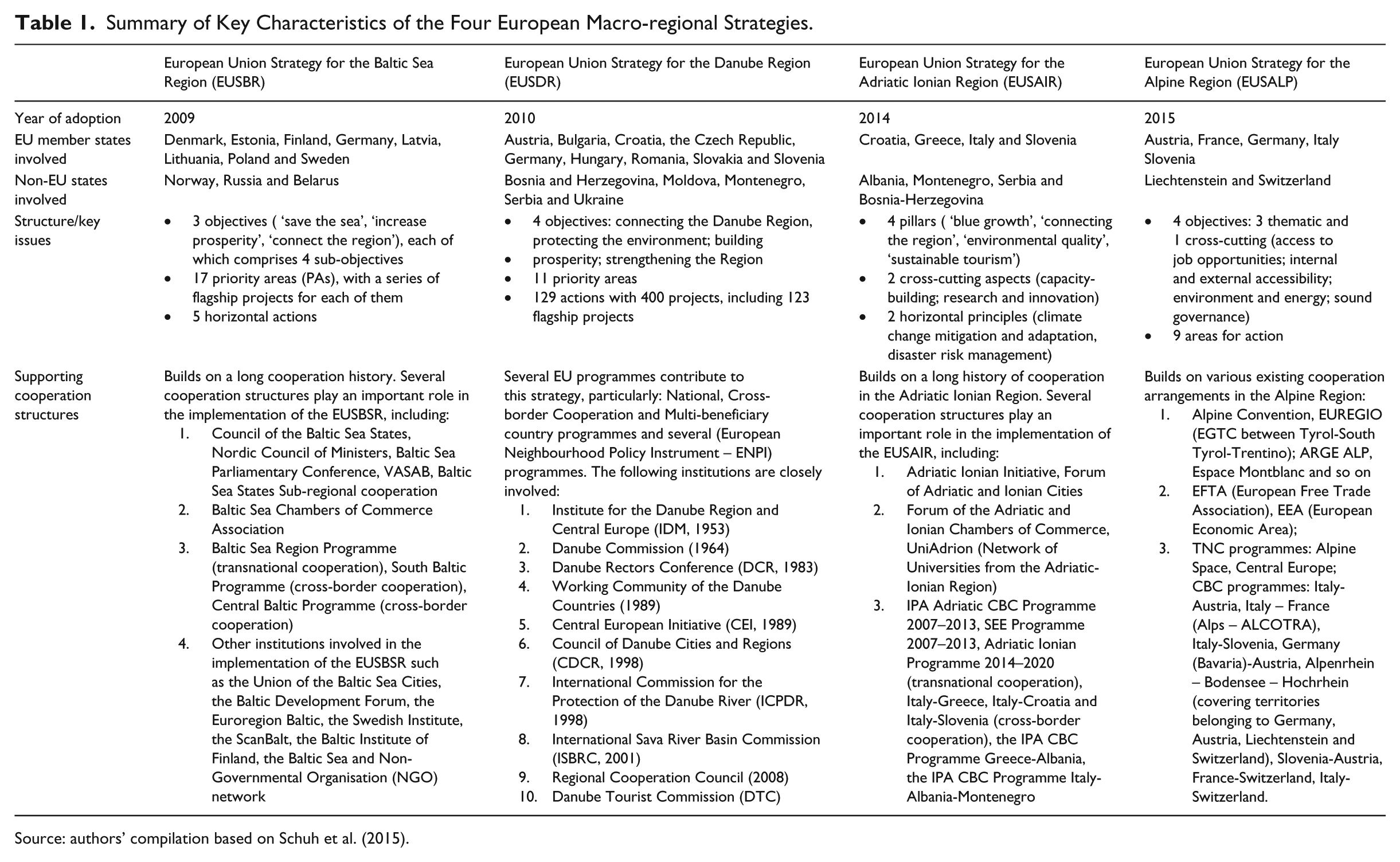
Source: authors’ compilation based on Schuh et al. (2015).
All four macro-regional strategies rely on strong political leadership and commitment, which pose various challenges. In a similar vein, representatives from all four macro-regions are concerned about the challenges to access funding instruments. Discussions on the future place of these strategies in relation to EU cohesion policy beyond 2020 are currently ongoing. A major point of discussion is in what ways the macro-regional strategies could be linked more explicitly to the different funding schemes (e.g. through earmarking). However, the results of these debates remain open because macro-regions do not cover all parts of EU territory.
Considering Macro-regional Strategies in Political Science, Regional Planning and Geography
It is possible to distinguish EU macro-regional strategies both as a process and as an outcome. As an outcome (in the long term), macro-regional strategies are contributing to new ‘place-based’ policies that may ultimately foster the emergence, consolidation and permanence of new regions (i.e. ‘region-building’). Being grounded in EU cohesion policy, the development of macro-regional strategies has implications for both politics and policies at the EU as well as at the national and sub-national levels. Political science research on macro-regional strategies has primarily departed from the debate on old versus new regionalism (see Söderbaum, 2016) using governance approaches such as MLG or experimentalist governance (Chilla et al., 2017; Gänzle, 2017b). While political science was slower off the mark, EU macro-regional strategies gained scholarly attention relatively quickly among (political) geography and regional planning (Dubois et al., 2009; Nagler, 2013), many of which have drawn on political science-informed concepts and theories such as Europeanisation and MLG (Ágh et al., 2010).
Governance Approaches: Multi-level and Experimentalist
Many of the empirical cases informing the MLG arrangements associated with the EU’s cohesion policy, which was introduced in the early 1990s by the seminal work of Gary Marks and Lisbet Hooghe. Hooghe and Marks (2003) distinguish between two variants of MLG. ‘Type I’ MLG is ‘concerned with power sharing among a limited number of governments operating at just a few levels’ (Hooghe and Marks, 2003: 236), whose jurisdictions are general purpose, rather limited and non-intersecting in terms of membership and draw on a system-wide architecture. In contrast to ‘type I’ MLG, whose intellectual basis can be found in federalism, the ‘type II’ form of MLG is an (ideal) type in which jurisdictions are potentially vast in numbers, operate at several territorial scales and are task-specific and flexible in terms of design (Hooghe and Marks, 2003: 237). From this perspective, macro-regions correspond to ‘type II’ MLG. More recently, MLG theory-building has been complemented by Simona Piattoni (2010), who has applied it against the backdrop of EU macro-regional strategies, focusing on dynamics which ultimately result in significant mobilisation effects on relations among member states, between the national and sub-national levels, and between state and societal actors at all levels (Gänzle, 2017a; Piattoni, 2016) and increasingly involve the international level, of which the EU is a part. 2 Analysing the situation in the Alpine Region, Plangger (2018) illustrates that macro-regional strategies may change the structure of the EU by increasing the regions’ potential for empowerment in the EU as they change the mosaic of rules and relationships that make up the EU. This highlights the potential for further investigations into the changing intergovernmental relations between the EU and the national level.
Experimentalist governance, which can be understood as a mode of EU governance coming close to the open method of coordination (Börzel, 2012), has been defined as attempt ‘to conceptualize the institutional innovations that actors in persistently uncertain domains have devised to make best use of the malleability of their circumstances while reducing the dangers it creates’ (Sabel and Zeitlin, 2012: 424). As such, experimentalist governance is ‘a recursive process of provisional goal-setting and revision based on learning from the comparison of alternative approaches to advancing them in different contexts’ (Sabel and Zeitlin, 2010). Although macro-regional strategies do not seek to create regulatory politics, they follow a recursive experimentalist policy-cycle in various respects (Gänzle, 2017b; Gänzle and Mirtl, 2017a, 2017b). This is evidenced for example by the fact that macro-regional strategies constitute broad frameworks and joint endeavours decided among authorities at different territorial levels of government (e.g. supranational, national, sub-national). The significance of macro-regional strategies from an experimentalist perspective lies in their capacity to mobilise institutional and non-institutional actors towards policy goals that have been identified as central to the Union, but which have somehow escaped the reach of the Union. The significance of macro-regions themselves also lies in their capacity to recombine the institutional structures that have been created at various levels to manage and implement these policies in novel but fluid ways (Plangger, 2018).
Although there is growing interest in EU macro-regional strategies in the field of political science, this has not yet been translated into many research outputs. To date, much of the work on this topic from scholars in policy science has remained descriptive and policy-oriented, reporting initial experiences with macro-regional strategies and primarily focusing on single examples of the ‘macro-regional experiment’. Despite the richness of the MLG debate, it is surprising that the effects of macro-regionalisation have rarely been considered explicitly. A reason for this might be a lack of empirical evidence, but also a divergence of macro-regional influences in different regions.
Rescaling and Europeanisation
Similar to the discussion in political sciences around processes of European integration and the supranational or intergovernmental attributes of macro-regions, scholars in geography and regional planning have sought to analyse the macro-regional strategies in the context of two related but separate concepts: Europeanisation (e.g. Gilek and Kern, 2015; Stead et al., 2016) and policy rescaling (e.g. Bialiasiewicz et al., 2013; Chilla et al., 2017; Stead, 2014a, 2014b). The basic rationale is that European integration can bring about changes in powers across existing layers of decision-making but also at new scales both in a discursive sense and in a formally institutionalised sense. These in turn can result in new types of interventions and new actor constellations. Some connections between the Europeanisation and policy rescaling literature have been made in recent publications. For example, López and Tatham (2018) indicate how territorial ‘policy communities’ are captured – to various degrees – by regional governments, hence generating a phenomenon coined as ‘slipstream Europeanization’ by territorial interest groups. Indeed, as regional governments Europeanise, they embrace existing territorial policy communities in their ‘slipstream’ and thus contribute to fostering the Europeanisation of those territorial policy communities. 3
In common with the concept of Europeanisation (see, for example, Graziano and Vink, 2007; Olsen, 2002; Radaelli, 2004), rescaling can imply vertical (and sometimes horizontal) shifts in powers and governance arrangements, both upwards and downwards (i.e. more centralised or less centralised). While rescaling is often defined as a process in which transfer of competences from one level to another (e.g. Gualini, 2006), some scholars have adopted a broader understanding of the concept (e.g. Brenner, 1999). According to the latter, rescaling processes can be described in terms of three dimensions: functional, political and institutional (Keating, 2013: 6), which leads to discussions about the rescaling of mandates and budgets, dominant levels of power, spatial frames, policy networks, policy concepts, rationales, instruments, actor networks, policy agendas and national policy argumentations, policy networks as well as norms and narratives (Stead et al., 2016).
In line with the concept of rescaling, the concept of Europeanisation describes changes at existing levels of policy making as a result of further European integration (Radaelli, 2004). From the spatial perspective, the implications of Europeanisation are fundamental. For example, Evers and Tennekes (2016) illustrate the pervasive relevance of European regulations on spatial development, and Clark and Jones (2009) argue that geographical ‘discontents’ involve territory, identity, and power (ibid: 196). A certain tension arises between the strong influence of spatial implications of European integration and the diffuse political mandates for spatial policy on European level, which has led to complex and strategic forms of ‘territorial governance’ (Van Well and Schmitt, 2015).
Macro-regional cooperation can potentially lead to a variety of rescaling processes. Three processes are most reflected in the recent literature. First, macro-regions are fostering the creation of new networks involving a diversity of stakeholders which can result in a rescaling of actor involvement (Stead, 2014b). Second, macro-regional strategies create new dynamics of agenda setting in the policy fields addressed by the strategies which can lead to a rescaling of policy discourses (Allmendinger et al., 2014; Sielker, 2016a, 2016b). Third, decisions for funding within other EU programmes are not only being shaped by the macro-regional strategies, they are also helping to consolidate political support at new scales (Sielker, 2016a; Smith, 2015).
Soft Spaces and Re-territorialisation
Various scholars from geography and regional planning have welcomed macro-regional strategies as an innovative approach to European policy-making (e.g. Dubois et al., 2009). This new form of macro-regionalisation leads to formal, semi-formal and informal cooperation between a range of stakeholders in a variety of different policy fields (but without recourse to new administrations – one of the precepts of the three no’s – see above). More specifically, the notion of macro-regional strategies as soft spaces of governance has received attention among some scholars. In essence, this debate centres around the coexistence of statutory (or ‘hard’) spaces alongside non-statutory, voluntary (‘soft’) spaces.
Coined by Allmendinger and Haughton (2009), the concept of soft spaces was originally developed and applied in local planning processes to reflect the concurrent presence of both ‘hard’ and ‘soft’ spaces of governance. Since then, the concept has been applied to EU macro-regional strategies in various works (e.g. Faludi, 2010; Metzger and Schmitt, 2012; Sielker, 2016a, 2016b; Stead, 2011, 2014a, 2014b; Stead et al., 2016). The informal character of the institutional structures for developing and implementing macro-regional strategies, the variability with which different thematic areas are arranged as well as the flexible involvement of different actor groups are key characteristics of these soft spaces (Allmendinger et al., 2014; Sielker, 2016a, 2016b; Stead, 2011).
The soft spaces literature has implicit links to the works on MLG by Hooghe and Marks (2003), who differentiate between nested, hierarchical, standardised governance architectures (MLG type I) and intersecting, task-specific, flexible forms of governance (MLG type II). The ‘hard’ spaces have much in common with MLG type I while ‘soft’ spaces share some characteristics with MLG type II through their networked nature. An important question here is whether the non-statutory arrangements in macro-regions can (or will) lead to a ‘hardening’ (or formalisation) of these currently ‘soft’ arrangements (see, for example, Allmendinger et al., 2014; Metzger and Schmitt, 2012). Another question here is related to how new spatial references make a difference to political bargaining and power struggles. This coincides with the question about whether macro-regional strategies imply re-territorialisation – the redefinition of borders. Research by Svensson (2015), who shows how cross-border interactions often remain within existing borders, not only illustrates how the creation of ‘soft policy space’ is challenging but also how the redefinition of borders is likely to be long term (if at all). Nadalutti (2017) indicates that the lack of cohesion in cross-border regions can often be attributed to a lack of ethical values in CBC.
There are considerable overlaps between the academic debates in geography, regional planning and political science and, in particular, European integration and governance studies. Both question the changing relations between different actors, levels and territories and the way administrations, political and private stakeholders seek to identify appropriate governance arrangements. Whereas research in the political sciences often focuses more on structures and systems, research carried out by scholars of geography and regional planning give more consideration to the impacts on territorial development.
Towards a New Research Agenda
All four macro-regional strategies aim to overcome existing institutional barriers to regional cooperation in international contexts. EU macro-regional strategies are a relatively recent phenomenon, and research on the topic is new. The growing political importance of macro-regional strategies is one of the reasons for intensifying research activities in this area. The value of additional research in this area is that it can enrich the debate about contemporary changes in EU governance. Understanding macro-regions and the changes they imply for the EU’s political system provides a more differentiated understanding of a changing EU. In terms of a new research agenda for political science, six key areas are highlighted below, based on our review of scholarship in geography and regional planning.
First, an important area for future research is to study how macro-regional strategies contribute to improve the implementation of EU global legislative acts, such as the Water Framework Directive and the Maritime Strategy Framework Directive in a more regionalized context (Gilek and Kern, 2015; Roggeri, 2015). This is very much related to observations by scholars such as Majone (2014: 319) who states:
[F]or most environmental problems the EU is not an optimal regulatory area, being either too large or too small. In a number of cases – for example, the Mediterranean, the Baltic Sea, or the Rhine – the scope of the problem is regional rather than EU-wide, and is best tackled through regional arrangements tailored to the scope of the relevant environmental externality.
It is becoming evident that macro-regional strategies are starting to influence policy agendas in different sectors, and research is needed to identify the ways in which the strategies can contribute to the implementation of EU directives.
Second, there is a need to better understand the linkage between EU cohesion policy – one of the EU’s key distributional policies – and regional cooperation inside and beyond the EU, such as ‘Baltic Sea Cooperation’ hitherto dominated by actors at the local (Union of Baltic Cities), regional (Baltic Sub-regional Cooperation) and intergovernmental levels (Council of Baltic Sea States). By providing a platform for horizontal and vertical policy coordination, macro-regional strategies address the coordination dilemma that characterises systems of multilevel governance (Egeberg and Trondal, 2016). However, macro-regions may risk reiterating the dominance of certain stakeholder groups. Broader research is needed on the linkages between macro-regional strategies and existing territorial cooperation arrangements and cohesion policy. The case of the EU’s macro-regional strategies could offer a template worthwhile to be studied in order to better grasp how the European Union ultimately attempts ‘to live with the dilemma’.
Third, EU macro-regional strategies should be explored as regional cases of EU strategy building. While there has been some research on the instrument of EU strategies – in particular as part of the Lisbon process – and the domain of EU foreign policy, macro-regional strategies can be conceived as more regionalized and territorialised outcome of these modes of governance (e.g. Bialiasiewicz et al., 2013). EU macro-regional strategies could be investigated as new forms of the EU’s various modes of governance. Issues that could be addressed include the influence of regionalised strategies on policy shaping at the EU and national levels and the extent to which different macro-regional policy approaches differ and reflect the governance styles of the countries involved.
Fourth, from a more normative perspective, analyses could reflect more extensively on the impacts and outputs of macro-regional strategies. Beside reflections on conceptual issues, the political relevance and effectiveness should also be addressed. Institutional aspects of impacts and outputs are important aspects. To date, many impacts of macro-regional strategies are the subject of conjecture, as recently recognised by the European Court of Auditors, noting that ‘EUSBSR’s impact on Member States’ actions […] is difficult to assess’ (European Court of Auditors, 2016: 50). This is of particular importance as the post-2020 regional policy will be different from the preceding periods: the role of macro-regional strategies will be more important in shaping EU regional policy.
Fifth, the contribution of macro-regional strategies to the governance debate could be addressed more fundamentally. An external governance perspective on the EU’s macro-regional strategies would strongly focus on the participatory elements used to draw non-EU countries, sub-national authorities and societal groups closer to the EU (Lavenex, 2015). Other governance approaches, particularly MLG, emphasise the need to study political mobilisation at various levels, not just within the EU but also beyond (e.g. in partner countries). One particular area of focus for new research is the design and shape of the macro-regional ‘governance architecture’ (Borrás and Radaelli, 2011). Despite the three no’s, macro-regional strategies have resulted in the set-up of functional trans-governmental networks and governance architectures (focusing on environmental macro-regional governance and other priority areas) including administrative actors from the European, national and sub-national level. The ‘geographical’ strands of debates on ‘regional governance’ and ‘territorial governance’ could provide inspiring starting points for the more politically oriented approaches. Moreover, the governance perspective on macro-regions has potential for more critical analyses. Revealing hidden agendas and power plays in the multi-level system is a remaining analytical challenge.
Sixth, the question of whether macro-regional strategies provide an entry point for territorially differentiated policy or whether macro-regional strategies will ultimately be able to deliver ‘well-controlled regional differentiation’ (Lehti, 2010: 140) remain unanswered. This question relates to more general questions of autonomy, control and coordination when powers, competences and activities are dispersed away from central government (see, for example, Jensen et al., 2014) and, in this instance, to the macro-regional level which represents an additional layer of power dispersion and evolving forms of governance within Europe. Debates on variable geographies or multi-speed integration processes might find their continuation in the processes of macro-regional dynamics.
In sum, the processes of macro-regionalisation in the European Union present an excellent opportunity for interdisciplinary cross-fertilisation, drawing on existing academic literature on the development of EU regional policy which has been built up over the last few decades. Ultimately, this provides an opportunity for reflecting on the nexus between the political and spatial dimensions of recent developments in EU governance.
Footnotes
Acknowledgements
The authors wish to acknowledge the positive and constructive comments of two anonymous referees. These comments helped to extend the literature review and strengthen parts of the manuscript.
Funding
The author(s) received no financial support for the research, authorship and/or publication of this article.