







Abstract
Politicians’ individual traits can influence policy outcomes. A local mayor has authority over the budget process and can affect the municipal budget allocation. This study empirically examined whether the mayor’s gender affected the gendered budget in Korean cities between 2016 and 2020. Across various econometric designs, our results revealed little evidence that mayoral gender (women, in this case) affects the formulation and execution of the gendered budget. The results imply that the effects of female representation through a female leader are dependent on various socioeconomic contexts.
Introduction
Globally, women are underrepresented in prominent positions at both the local and national level. In recent years, traditionally male-centered politics has begun to change, and the number of female politicians has been increasing despite not quite reaching substantial gender equality. 1 This pattern has attracted the interest of researchers seeking to understand the implications of female leadership on various policy outcomes (Duflo, 2012; Hessami and Lopes da Fonseca, 2020).
Increasing the number of women in leadership positions may improve women’s representation in male-dominated fields, thereby addressing gender disparities (Flabbi et al., 2019; Kunze and Miller, 2017). This suggestion is based on the expectation that female leaders can produce positive spillover effects through their gender-specific characteristics, directing more resources to women’s interests and stimulating women-friendly policies (Funk and Philips, 2019). While this view has been prominent in both academic and policy debates, there is not yet theoretical consensus. Gender stereotypes still bind female leaders’ implicit beliefs (Ellemers, 2018). Moreover, female leaders may distance themselves from their gender identity to be successful in male-dominated areas, leading them to “act male,” which is commonly described as a “queen bee phenomenon” (Derks et al., 2016). In the political sphere, traits other than gender play more crucial roles in decision making, making leaders less accountable to gender issues (Bednar and Gicheva, 2014; Höhmann, 2020; Krook and O’Brien, 2012). Therefore, there are empirical questions about gender needing examination in diverse contexts.
Empirical evidence on whether leaders’ gender affects the government budget has been mixed depending on studies’ specific subject matter and context, and there is a lack of consensus regarding causal relationships. This study contributes evidence to the literature examining whether female-friendly policies emerge when a woman occupies a leadership position. We focused on estimating the causal impact of mayoral gender on local public finance of Korean municipalities from 2016 to 2020 by applying ordinary least squares (OLS) regression, fixed-effect (FE) regression, and regression discontinuity design (RDD).
Overall, across various model specifications, we have found no clear evidence that mayoral gender (female) affected the gendered budget allocation. These results suggest that female representation is not necessarily accomplished with female leadership, as politics is still dominated by men, and factors other than gender, including electoral incentives and party affiliation, may have a powerful impact on leaders’ decision making.
Our study is distinguished from and contributes to the existing literature in two ways. First, we applied a unique dependent variable directly associated with promoting women’s interests and gender equality—gendered budget—to estimate the effect of mayoral gender on related local public finance (Downes et al., 2017; Stotsky, 2006). To our knowledge, this is the first study linking policymakers’ gender to objective gendered budget data. Previous research has generally assumed that policy areas such as health and education are female-specific fields, expecting them to demonstrate gender effects (e.g. Carozzi and Gago, 2020). However, some programs in these areas may not be directly related to representing women’s rights, and many budget projects outside these areas exist that enhance women’s interests. Instead of relying on subjective surveys or arbitrary groupings, we adopted the gendered budget as a new indicator to more precisely identify female mayors’ influence on budget items directly related to women’s issues. Second, we examined a country where a higher level of industrialization and a lower level of gender equality coexist. South Korea is an interesting example in that it has industrialized successfully in a short period but has not made comparable gains in terms of gender equality. In 2020, it ranked ninth in GDP (OECD, 2020) but 108th on the global gender gap index (World Economic Forum, 2020). This large equality gap in the subject of our study distinguishes our work from the existing literature, in which researchers have devoted the most attention to either developed or developing countries (Hessami and Lopes da Fonseca, 2020).
The remainder of the article follows: Section “Literature Review” reviews the extant literature, section “Methods” explains the data and research design, section “Results and Discussion” presents the estimation results, and section “Conclusion” concludes the study.
Literature Review
A growing body of literature has examined the effect of women’s representation in leadership positions on various policy outcomes (Doepke et al., 2012; Duflo, 2012; Hessami and Lopes da Fonseca, 2020). Specifically, many studies have focused on increasing representation of women in the political sphere, as politicians wield significant influence in our daily lives and make key decisions about societal problems. A growing number of women participate in politics, but they are still underrepresented, and the proportion of female politicians is low (World Economic Forum, 2020). Thus, the impact of increasing female representation in politics on policy outcome is becoming an issue of global significance and interest.
Several studies have highlighted the positive effects of female leadership on women’s representation (Baskaran and Hessami, 2018; Beaman et al., 2009; Bratton and Ray, 2002; Kittilson, 2008). Female leaders can actively participate in creating policies promoting women’s substantive interests, such as women’s rights, family and social issues, education, healthcare, and social welfare. Furthermore, emerging female leaders may act as role models to other women. However, female leaders may not necessarily improve women’s representation because they do not necessarily act according to gender-specific preferences (Bagues and Campa, 2021; Carozzi and Gago, 2020; Ferreira and Gyourko, 2014; Schild, 2013; Svaleryd, 2009). For politicians, other factors such as electoral incentives can significantly impact decision making and policy formation (Bednar and Gicheva, 2014; Downs, 1957). It may be even more advantageous for female leaders to demonstrate their masculinity (vs femininity) in the male-centered political arena (Derks et al., 2016).
Literature on the importance of leadership and public finance in local governments is also growing (Besley et al., 2011; Jochimsen and Thomasius, 2014; Jones and Olken, 2005). Amid the spread of government decentralization and grassroots democracy, local governments directly impact many policies affecting residential life. These include allocating expenditures, securing revenues, building infrastructure, and providing public services. Government spending reflects policy priorities, and the mayor plays a critical role in budget allocation at the local level. As in many other countries (Levitt et al., 1997), local government leaders in South Korea have a great influence on budget formulation, and local public finance greatly affects the local economy and residents’ welfare (Jung, 2021; Kim et al., 2020). 2 Therefore, analyzing the amount and composition of government spending affected by female representation in leadership is crucial to understanding public policy direction and performance, and international organizations have suggested that the budget should reflect gender-sensitive features and their societal effects (Downes et al., 2017; Stotsky, 2006). There have been mixed findings about whether female mayors positively affect the budget allocation for women’s representation. Although several studies suggest that female leaders have had a significant impact on funding allocation (Bolzendahl, 2011; Ennser-Jedenastik, 2017; Escobar-Lemmon, Taylor-Robinson, 2009; Koch and Fulton, 2011; Smith, 2014; Svaleryd, 2009), others suggest limited effects on financial allocation (Ferreira and Gyourko, 2014; Rigon and Tanzi, 2012; Schild, 2013).
For empirical research design, many researchers have exploited natural experimental circumstances, such as the quota and random assignment (Chattopadhyay and Duflo, 2004; Rigon and Tanzi, 2012), applying FE models based on observed data (Funk and Philips, 2019; Funk and Gathmann, 2015; Svaleryd, 2009) as well as RDD (Baskaran and Hessami, 2018; Brollo and Troiano, 2016; Casarico et al., 2020; Clots-Figueras, 2011). These empirical studies generally classify specific policies into female areas based on the broader classification to measure the influence of female leaders on the government budget (Funk and Philips, 2019; Holman, 2014; Rigon and Tanzi, 2012). 3 For example, it is assumed that women pay more attention to social policies—welfare, education, environment, and citizens’ rights—so they are designated as female-oriented areas representing the influence of female leaders.
Methods
Data and Descriptive Statistics
We analyzed the period between 2016 and 2020, for which the dataset is available. We included the elected mayors in 229 local governments. 4 Two local elections—the sixth in 2014 and the seventh in 2018—affected local budget allocation during those years. As government officials formulate the budget the previous year, the mayor’s influence manifests the following year. Thus, the 2016–2018 budget was influenced by the elected mayor in the sixth local election and the 2019–2020 budget by the elected mayor in the seventh local election.
We combined datasets from various sources: elected mayors and mayoral candidates from the National Election Commission, local public finance from the Ministry of the Interior and Safety and the Ministry of Economy and Finance, and local government characteristics from Statistics Korea. Table 1 shows descriptive statistics summarizing local public finance characteristics, mayors, elections, and provinces.
Descriptive Statistics.
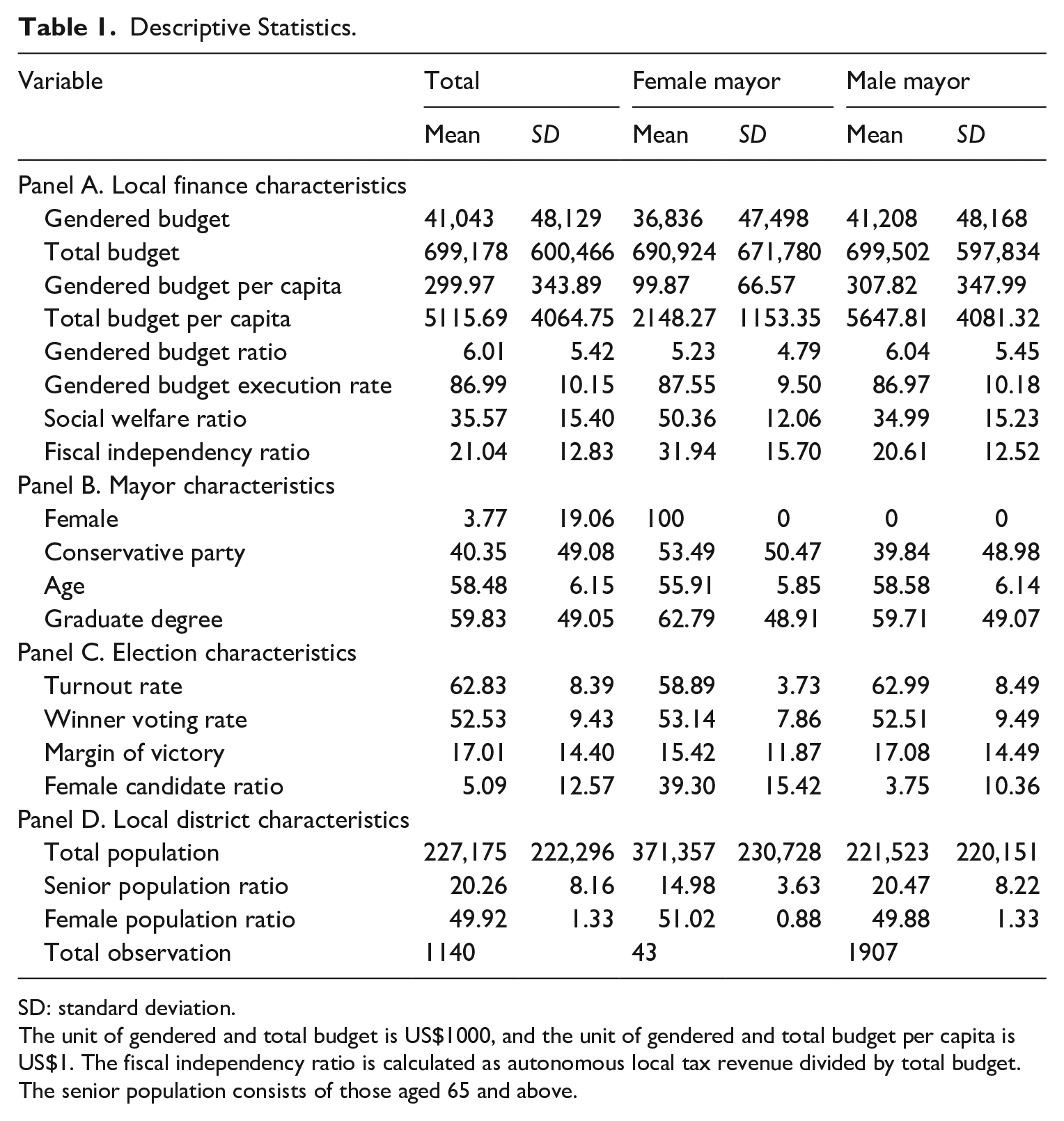
SD: standard deviation.
The unit of gendered and total budget is US$1000, and the unit of gendered and total budget per capita is US$1. The fiscal independency ratio is calculated as autonomous local tax revenue divided by total budget. The senior population consists of those aged 65 and above.
One of the major advantages of this study is the application of gendered budget as a primary dependent variable, data on which have been available since 2016. It refers to the budget organized to improve gender equality and promote women’s interests based on legal foundations. 5 Each year, the central government (Ministry of Gender Equality and Family and Ministry of Economy and Finance) provides specific guidelines—overview, scale, expected effect, and benefit analysis—for each ministry and local governments to analyze the impact of budgetary programs on women, aiming to enhance gender equality. 6
To achieve gender equality, it is not only important to promote women in certain fields, but also to implement policies promoting equal gender representation without discrimination across the areas. Therefore, the budget that promotes gender equality should not be limited to specific areas and instead should apply to all government programs that are evaluated to enhance women’s rights and female-friendly environments. From this perspective, the gendered budget in South Korea presents advantages for analyzing gender equality issues. The constraint of categorizing gender issues based on the division in the budget notwithstanding, female-friendly programs are identified as the gendered budget based on each project’s merits, regardless of policy area. Identifying projects from various fields as parts of the gendered budget enables us to incorporate elements that have been omitted from existing research, including fostering female-oriented science and technology programs in the field of science and technology, providing gender equality education in the national defense sector, and constructing healthcare centers in the agricultural sector. By evaluating effects by the level of each budgetary program, the gendered budget has the advantage of precisely measuring the impact of mayoral gender on local public finance relative to previous research, which has distinguished gender-specific traits in the budget by sector or area.
Empirical Framework
To examine whether mayoral gender affects the gendered budget, we applied several analytical specifications and compared the results to check for consistency. First, we utilized OLS and FE regression as follows:

where
We exploited the advantages of panel data by controlling for various FEs. Region FE
Although the above specification applies to various control variables and FEs, the endogeneity issue is still not free. Examining the relationship between mayoral gender and the budget requires a setting in which the gender of municipal leaders across local districts is orthogonal to an error term. However, there can be municipality-specific traits correlated with both mayoral gender and local public finance, shown in the imbalance of variables between the districts of female and male mayors in Table 1. To control for these confounding effects, we alternatively adopted the RDD in close electoral races between male and female candidates, comparing cases in which a female candidate barely won against a male candidate with cases in which the opposite occurred (Lee and Lemieux, 2010). To briefly introduce the setting, suppose

where
Before discussing the results, we present our test of the RDD’s validity. There should be no manipulation of the running variable (here, margin of victory) and no systematic, significant difference in the balance of covariates in the close elections. Figure 1 reports the results of the McCrary test, which exhibited a little evidence of discontinuities in the density of margin of victory around the cutoff (McCrary, 2008). Figure 2 shows the results of our check for the absence of discontinuities at the zero margin of victory threshold in the distribution of municipal and mayoral baseline traits. 11
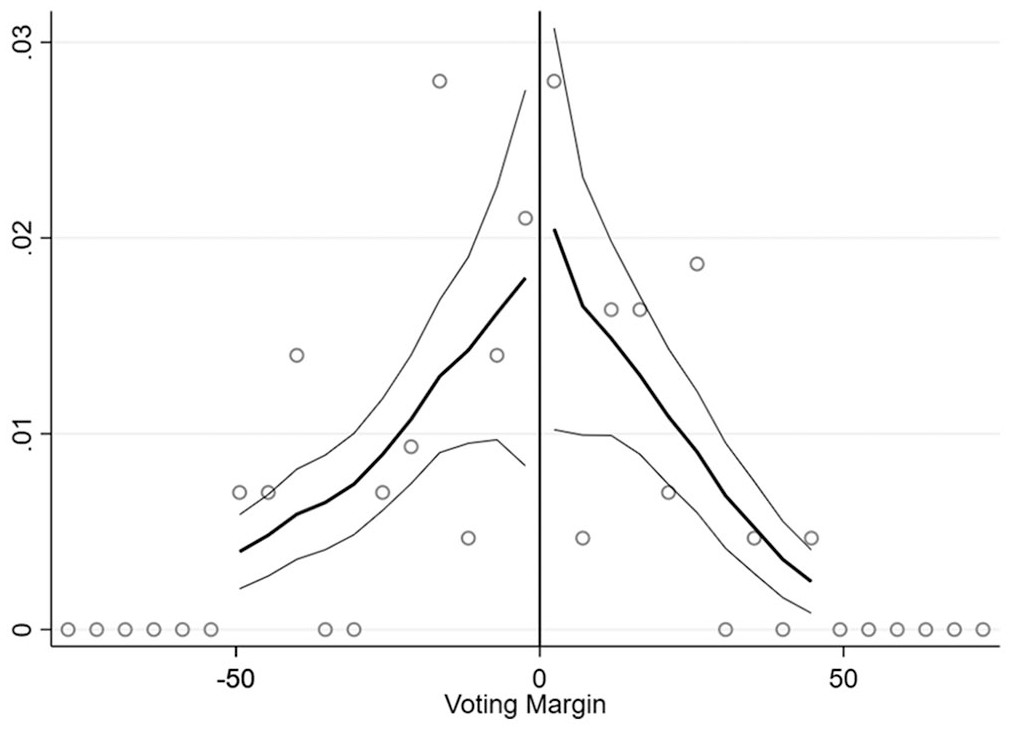
Validity of RDD: McCrary Test.
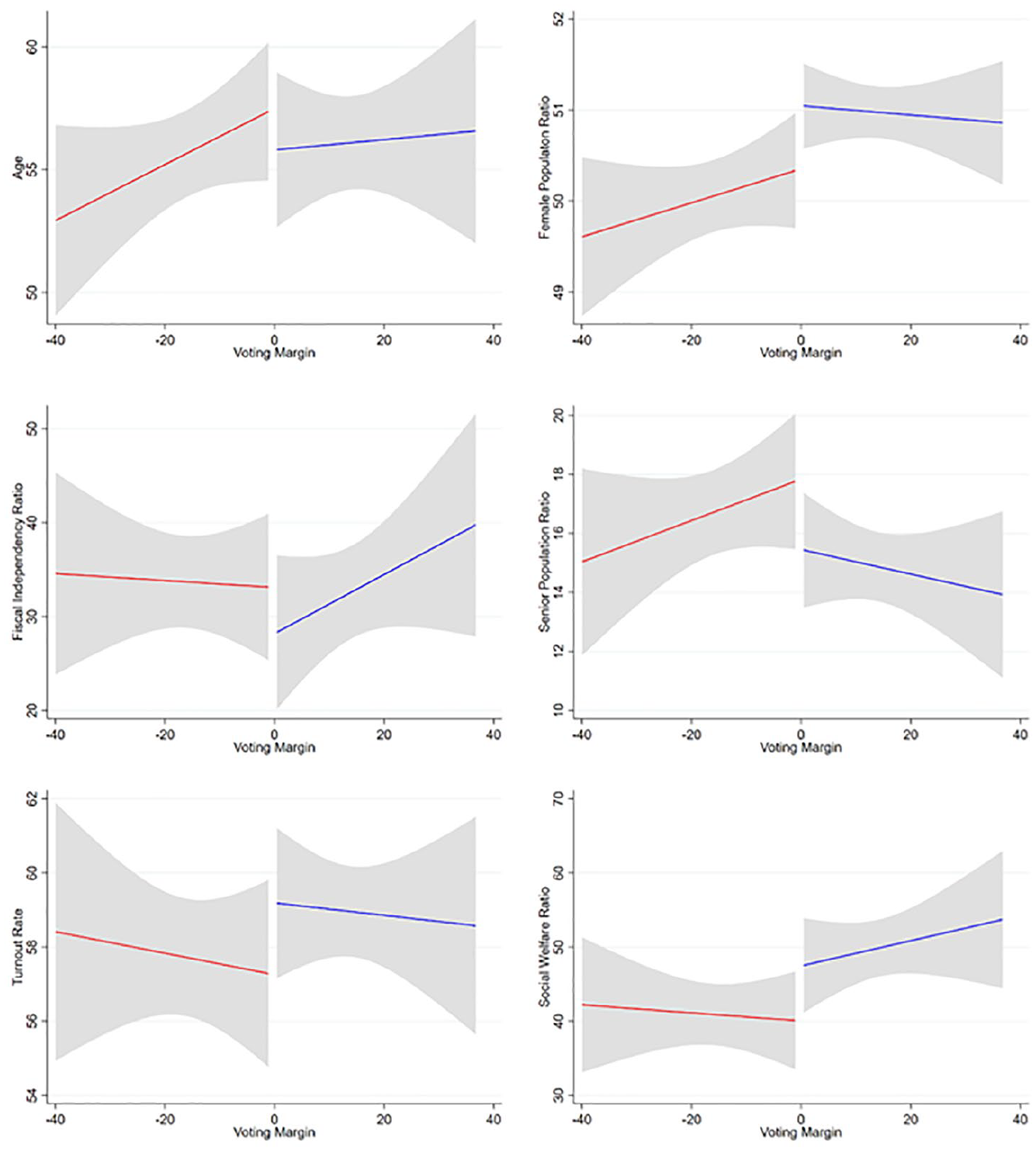
Validity of RDD: Balance of Covariates.
Results and Discussion
Table 2 shows the results from the OLS and FE regression. In most specifications, the female mayor had no discernible effect on the gendered budget ratio, gendered budget execution rate, gendered budget per capita, or logarithmic value of the gendered budget (Columns 1–8). The FE in Column 8 shows a positive impact with a small magnitude of 0.002, but the effect dissipated in the RDD. Table 3 and Figure 3 show the results using RDD. Similar to OLS and FE regression, the female mayor’s impact on the gendered budget was statistically non-significant in close elections, alleviating endogeneity concerns.
Estimation Results from OLS and FE Regression.
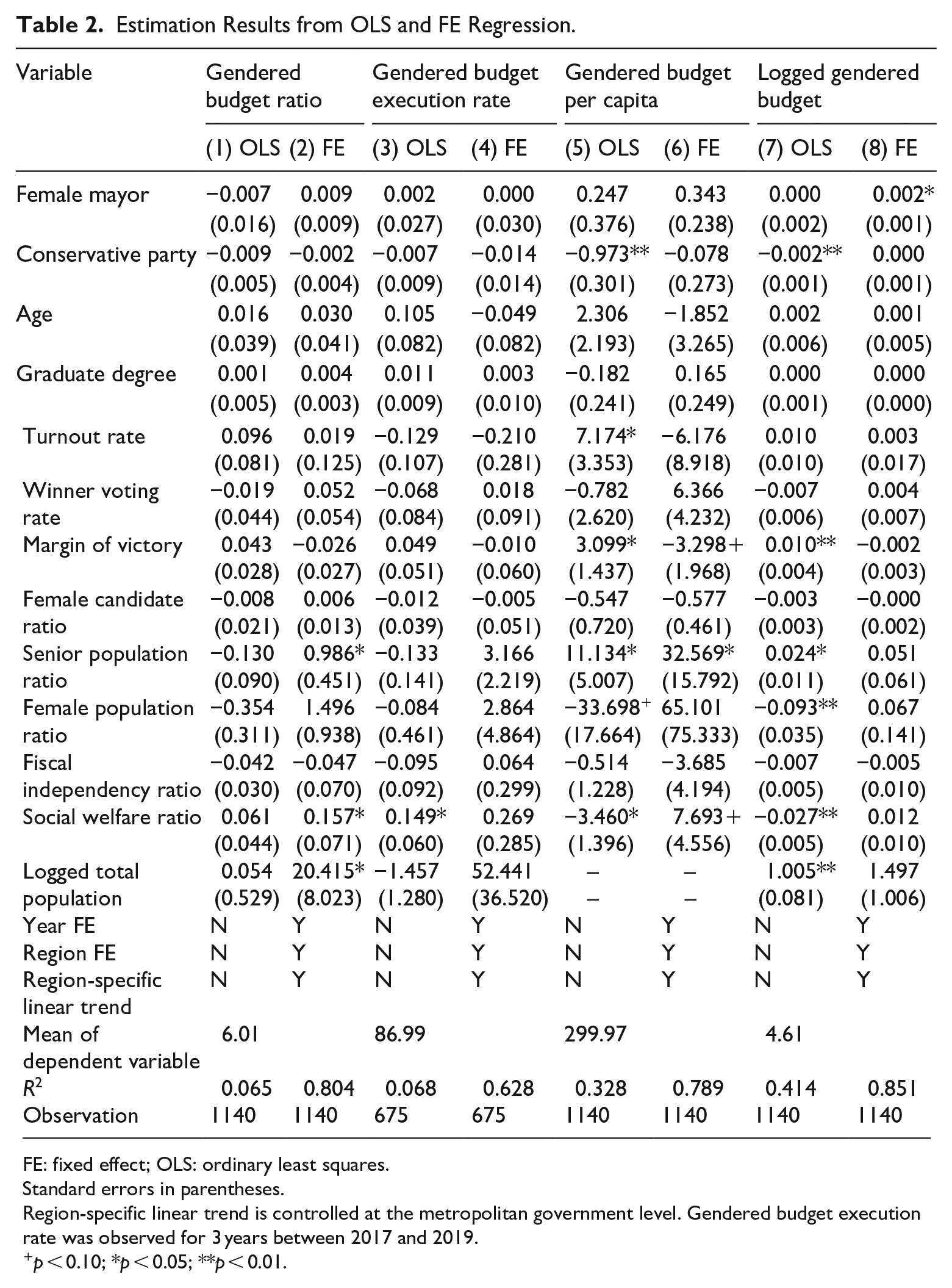
FE: fixed effect; OLS: ordinary least squares.
Standard errors in parentheses.
Region-specific linear trend is controlled at the metropolitan government level. Gendered budget execution rate was observed for 3 years between 2017 and 2019.
p < 0.10; *p < 0.05; **p < 0.01.
Estimation Results from Regression Discontinuity Design.
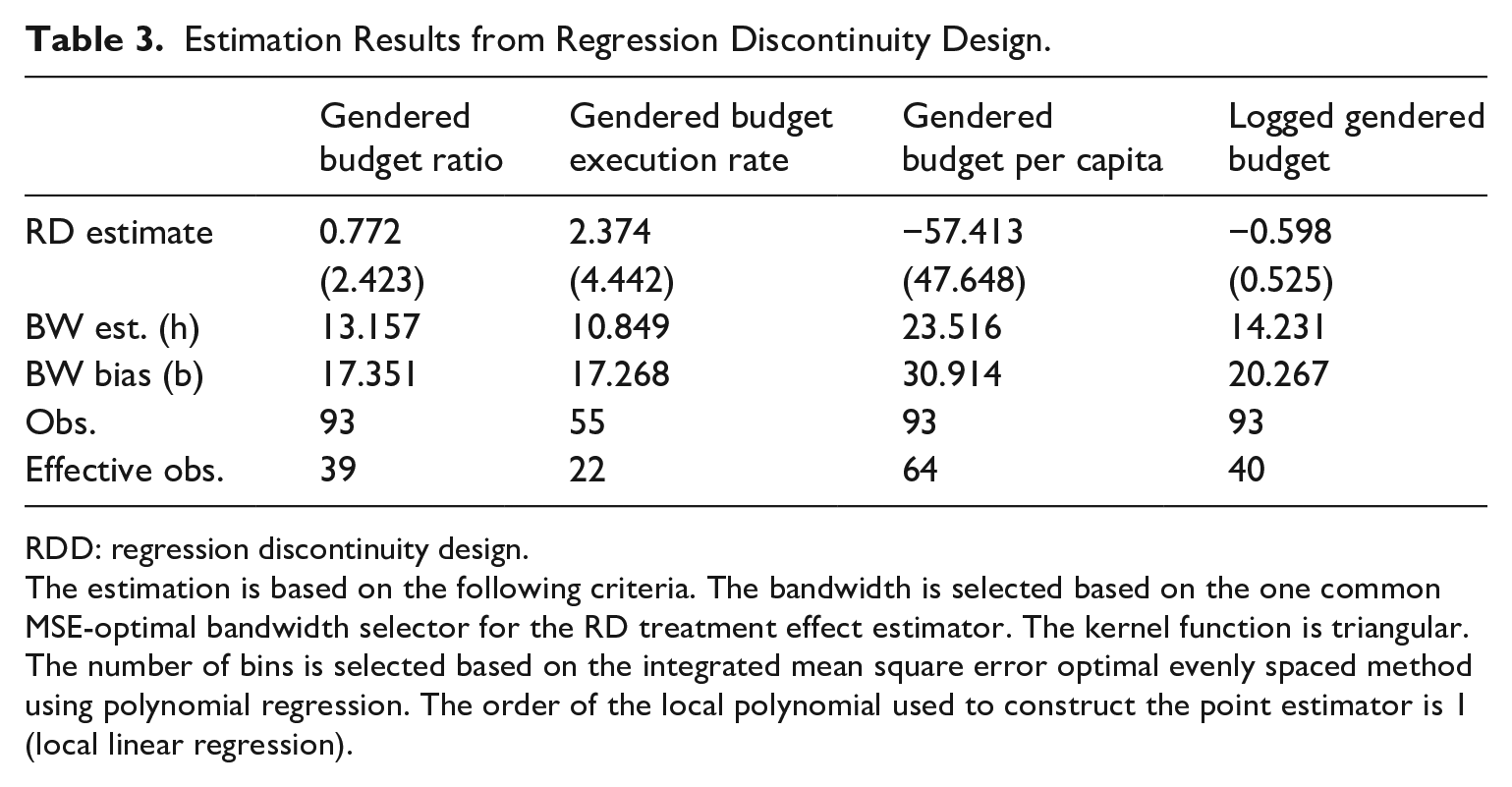
RDD: regression discontinuity design.
The estimation is based on the following criteria. The bandwidth is selected based on the one common MSE-optimal bandwidth selector for the RD treatment effect estimator. The kernel function is triangular. The number of bins is selected based on the integrated mean square error optimal evenly spaced method using polynomial regression. The order of the local polynomial used to construct the point estimator is 1 (local linear regression).
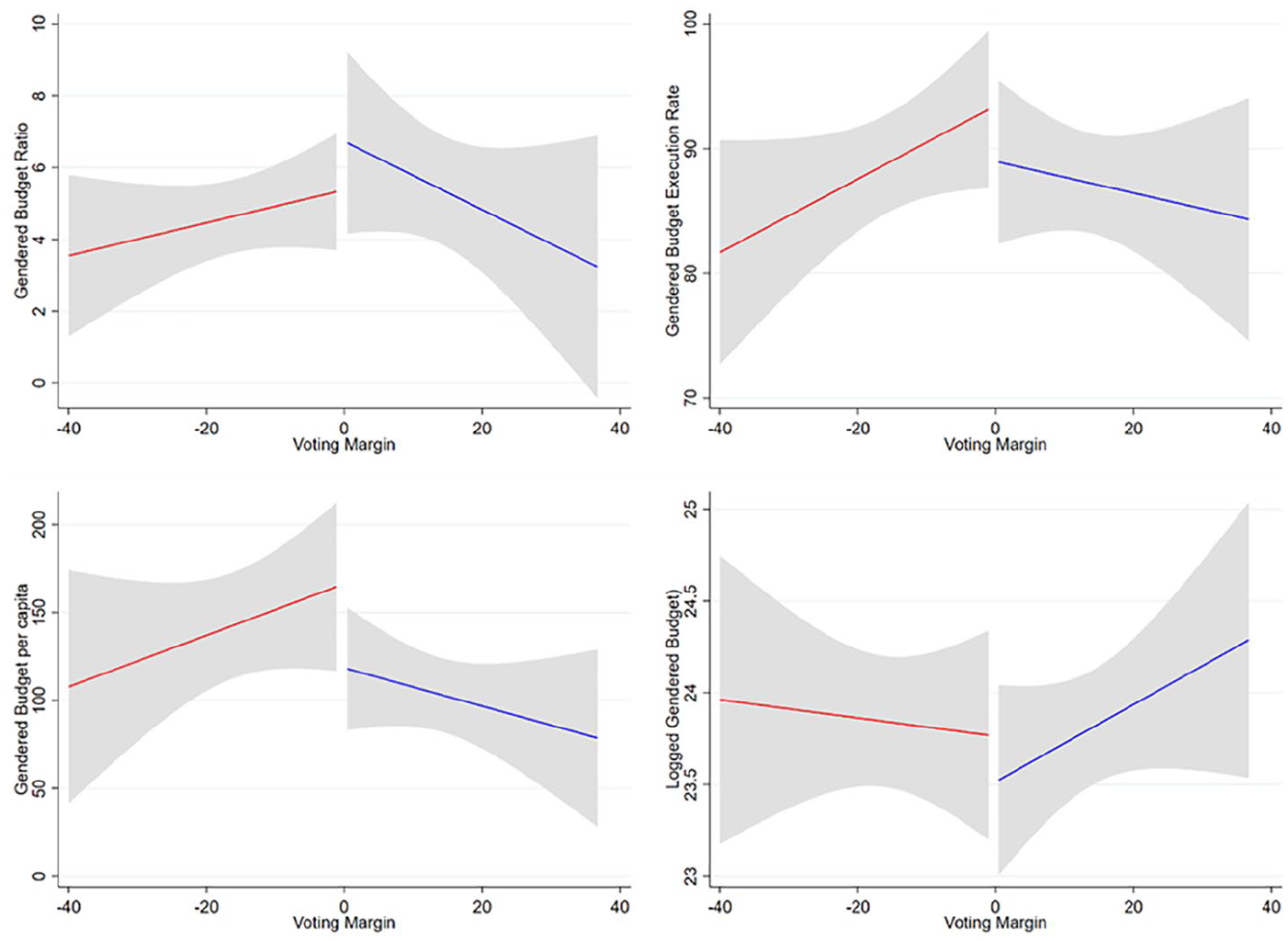
Estimation Results from RDD.
Overall, our main results show no evidence of female politicians in South Korea being more likely to implement gender-sensitive policies recently, even across multiple specifications. However, it should not lead to the conclusive interpretation that female representation in leadership positions is ineffective in promoting female-friendly policies. We can infer what lies behind this null result by considering various institutional background factors.
First, factors other than gender may have a greater impact on the budget allocation; for instance, career-oriented politicians have strong incentives to increase their chances of being elected. These policies may not be directly related to gender-specific issues; rather, they are more likely to be policies preferred by the median voter (Downs, 1957). Second, female leaders may emphasize their masculinity when participating in local government, where female representation is sparse and male-oriented traits seem more effective (Derks et al., 2016; Halberstam, 2019). Third, above and beyond social and personal factors, political factors have an especially profound impact on the budget allocation, such as in decision making based on party affiliation (Binder, 1999; Fleisher and Bond, 2004; Krook and O’Brien, 2012). If the perspective that women’s gendered influence on the budget allocation remains valid, women other than the mayor may have a powerful impact (Gagliarducci and Paserman, 2012; Thomas, 1991). For example, the group of local councilwomen may exert greater influence on budget allocation considering the growing importance of local legislators in recent years.
Conclusion
With the global increase in gender equality, the number of female politicians is increasing. This study analyzed the Korean case through various methods to explore how female mayors affect the gendered budget. The results indicate no clear evidence that female mayors have influenced budgeting related to women’s interests. Our findings suggest that female leadership in local governments, where female representatives continue to be minorities, does not necessarily promote female-friendly changes to the budget.
Footnotes
Declaration of conflicting interests
The author(s) declared no potential conflicts of interest with respect to the research, authorship, and/or publication of this article.
Funding
The author(s) received no financial support for the research, authorship, and/or publication of this article.
