






Abstract
Political theorists affiliated with Latin American and Caribbean academic institutions rarely publish in flagship journals or other important outlets of the discipline. Similarly, they are not members of the editorial boards of high-ranking, generalist or subfield journals, and their research is not included in the political theory canon of what students from other regions study. The aim of this article is not to explain the origins of this silence—though some possibilities are considered—but to describe some of the ways in which it manifests and why it matters. I argue that the exclusion or omission of Latin American and Caribbean voices is a negative outcome not only for Latin American and Caribbean political theorist but for the political theory subfield at large. In response, I defend a context-sensitive approach to political theory, which has the potential to provide greater voice to Latin American and Caribbean scholars while improving theoretical analysis of Latin America and Caribbean.
Introduction
Are political theorists affiliated with Latin American and Caribbean (LAC) academic institutions participating in international debates? Based on their near-total absence from the main outlets of the discipline, we might be tempted to conclude they are not. LAC political theorists neither publish in the field’s flagship journals, nor do they sit on their editorial boards. Similarly, virtually none of the leading political theory and political philosophy handbooks includes contributions from LAC scholars. Given this, it is unsurprising that LAC political thinkers are rarely included in the political theory canon outside their region; however, LAC political theorists do exist. Like their colleagues from other regions, they participate in conferences and write articles and books. In contrast to LAC comparativists and international relations scholars, what LAC political theorists produce rarely travels outside their region.
The aim of this article is to document the extent of this situation and explain why it should concern not only LAC theorists, but also the broader political theory subfield. As I argue in the “The Need for Contextualization” section, political theories (both from outside and inside the region) are not being appropriately contextualized to account for the specific nature of LAC political phenomena. Consequently, LAC politics are undertheorized, and most political theorists working in European or North American academic institutions are thus unfamiliar with the nuances of LAC countries or the ways in which the principles, values, and policies they seek to defend may fail to translate to this context. 2
In response, I defend a context-sensitive approach (CSA) to political theory as a means to overcome this problem. Adopting such an approach is useful, I argue, as a necessary step toward improving theoretical analysis of LAC-specific political phenomena. In particular, a CSA provides new ways of assessing existing mainstream theories and, where those theories are found lacking, can help us develop new and more relevant frameworks.
Likewise, a CSA may represent a potential strategy for providing greater voice to LAC political theorists. In this case, more voice in the international debate could be understood as an indirect benefit that related to the goal of better theorizing LAC politics. LAC theorists mainly import theories and frameworks from Europe and the Anglophonic world with limited possibility of exporting their own theories to other regions. The study of new topics has the potential to produce interesting theoretical insights to be exported and used in the political theory debate worldwide. This is, then, an article about how the method of political theory adopted by LAC political theorists can affect not only their presence in the international debate but also their substantive research agenda.
There are three important caveats to this discussion. First, in order to count a scholar as an LAC scholar, I look only at institutional affiliations at the time of publishing their research. Therefore, I am excluding political theorists who are originally from LAC countries but who do not work in an LAC-based institution. Likewise, I am including those scholars from other regions who are affiliated with an LAC research institution. Second, this article does not address the question of whether there is an authentic or distinctive Latin American Political Theory. 3 This is an important question, but one that cannot be answered here. For this article, it suffices that there are in fact scholars in the region doing political theory. Third, since my expertise is limited to LAC, my focus will be on this particular region. Nonetheless, the same basic problems likely hold with respect to other regions of the Global South such as Africa, Asia, and Oceania (with the exception of New Zealand and Australia). Finally, my argument is exclusively concerned with the epistemological disadvantages of LAC silence; there are, however, other potential causes for concern. For instance, instead of suggesting that the international debate would be enriched by the increased participation of LAC political theorists, someone might argue that including LAC voices is an imperative of justice or democratic representation whether any benefits follow. While this argument is compelling, I will not pursue it here. Rather, my aim is simply to reveal the extent of and the disadvantages that follow from LAC silence.
This article is organized into two parts. First, I describe the nature of the silence of LAC political theorists in the international debate. Second, I explain why contextual political theory may be a useful theoretical approach for better understanding problems that are particularly salient to LAC.
The Silence
This section attempts to show that LAC political theorists do in fact play a limited role in the international debate. The goal of this article is not to provide a full or comprehensive explanation of the causes of the current silence. Rather, its aim is to document more fully the extent of this situation and explain why it should concern not only LAC theorists, but also the broader political theory subfield. Even though it is incorrect to see LAC political theory as a homogeneous group of scholars and theories, the following analysis aims to document the place that LAC political theorists in general (without further distinguishing among different traditions or sub-traditions within the field) occupy in the main outlets of the discipline. My analysis is limited in many ways and should therefore only be taken as a starting point for further study and debate. 4
Consider the participation of political theorists affiliated with LAC institutions in the main, generalist, political science journals (Table 1) and in the main political theory/philosophy journals (Table 2). From Table 1, we can see that generalist political science journals rarely publish content from political theorists affiliated with LAC institutions. 5 This result does not change when we observe the publication patterns of the main journals in philosophy or subfield-specific journals in political theory. For example, Philosophy and Public Affairs (PAPA) and the Journal of Political Philosophy (JPP) are arguably among the most important journals in normative political theory. However, in its almost 50-year history, only two scholars affiliated with institutions in LAC have been published in PAPA, 6 and only one was published during the last 7 years. The same holds for JPP; over its 29 volumes, only two scholars based in LAC have been published there. 7 Table 2 also shows that History of Political Thought—a leading journal in the study of the history of ideas—has published only one article during the last 7 years from political theorists affiliated with LAC institutions. 8
Generalist Journals in Political Science (2014–2020).

AJPS: American Journal of Political Science; APSR: American Political Science Review; JOP: Journal of Politics; POP: Perspectives on Politics.
Political Theory/Philosophy Journals (2014–2020).
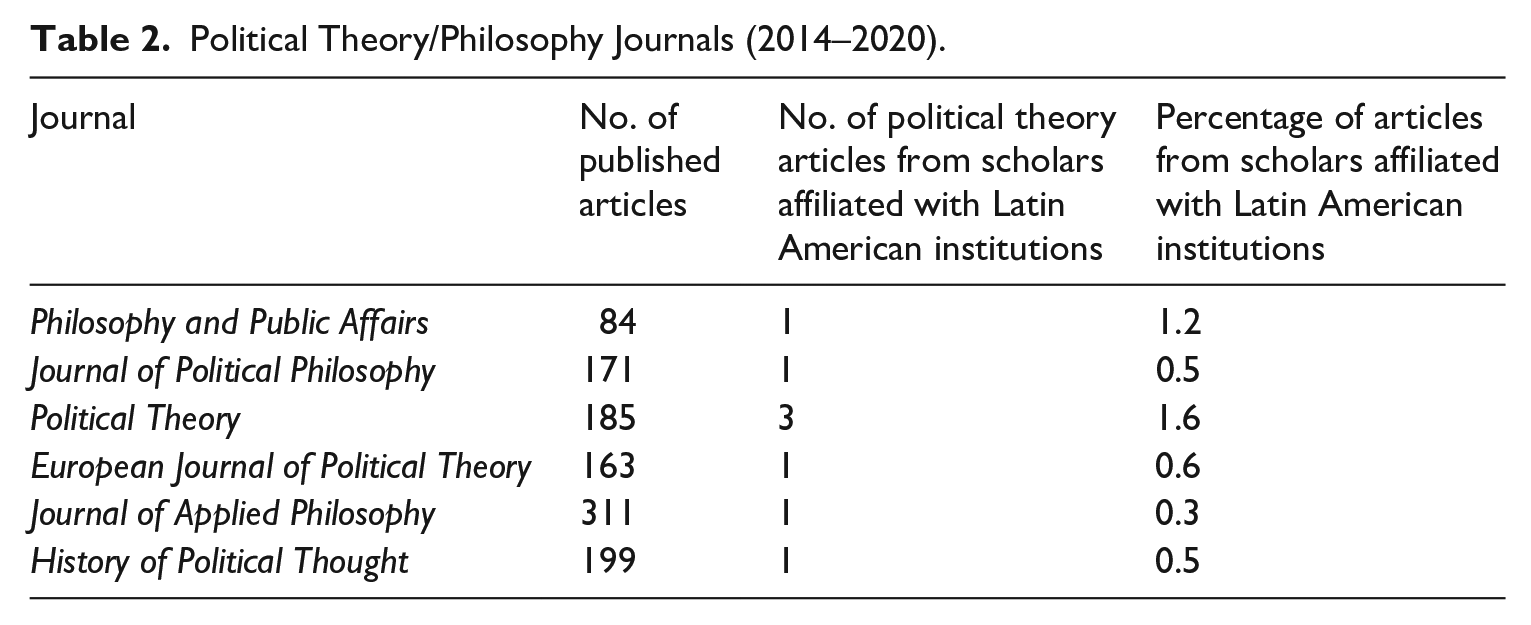
As we can see in both tables, political theorists from this region are absent from the main outlets of the discipline. Naturally, this result can be explained either by the fact that these journals are receiving very few submissions from LAC political theorists or by the fact that their submissions are too low quality to be accepted. As I mentioned in the introduction, I am not arguing that these results can lead us to establish any kind of editorial bias against LAC political theorists. Instead, I am simply arguing that whatever the case may be, LAC political theorists undeniably play a very limited role in the international debate.
This result is consistent with two other points. On one hand, other relevant publications such as the most important handbooks in political theory, political philosophy, and ethics do not discuss topics that are particularly salient to the region or even include in their contributors a single author affiliated with an LAC institution. For example, the Oxford Handbook of Political Theory, edited by John Dryzek, Bonnie Honig, and Anne Phillips (2006), has 50 contributors. Not one was affiliated with an LAC college, university, or higher-education institution of any kind. This same handbook has chapters on political theory focused on the European Union, American exceptionalism, Islamic political theory, and Confucianism. There is no content, however, devoted to discussing LAC politics, societies, or thinkers. The same result holds true for the Oxford Handbook of Political Philosophy, edited by David Estlund (2012). None of the 25 contributors is affiliated with a Latin American institution. Likewise, none of the 45 contributors of The Oxford Handbook of Environmental Political Theory (2016), edited by Teena Gabrielson, Cheryl Hall, John M. Meyer, and David Schlosberg, is from an LAC institution. More recently, the Routledge Handbook of Ethics and Public Policy, edited by Annabelle Lever and Andrei Poama (2019), likewise has no LAC-based contributors in its more than 50 chapters.
On the other hand, as we can see in Table 3, the editorial boards of the main journals of the discipline include virtually no political theorists affiliated with LAC institutions. In some cases (e.g. Political Theory or the European Journal of Political Theory), there are editorial board members from regions of the Global South, although there are none from LAC countries. For example, the European Journal of Political Theory has scholars affiliated with institutions in Ghana, the United Arab Emirates, Singapore, Hong Kong, and China, but none from LAC countries. In fact, as Table 3 shows, only Politics, Philosophy & Economics, and Constellations have even one editorial board member affiliated with an LAC institution. 9
Participation of Political Theorists from LAC on Editorial Boards (2019).
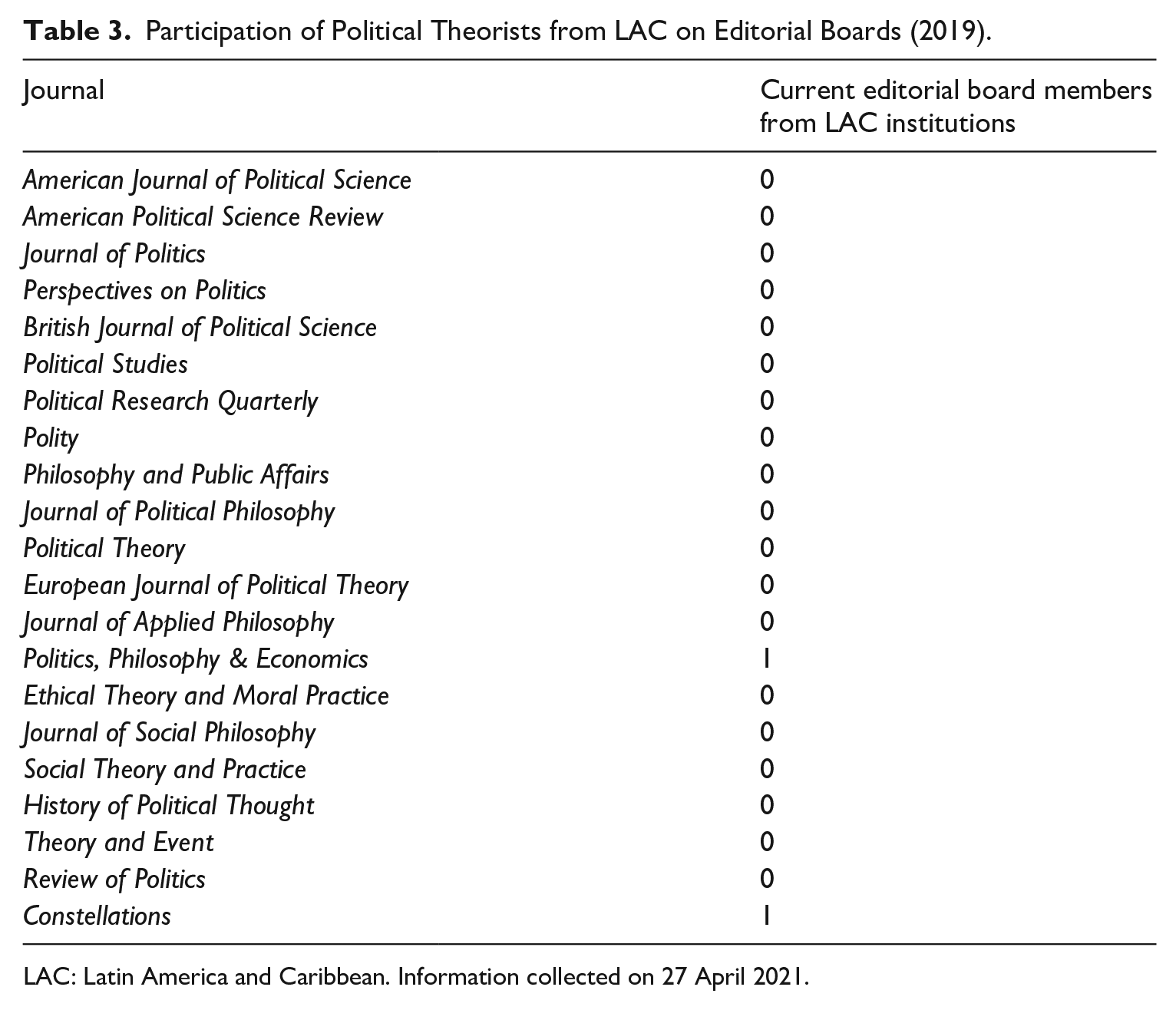
LAC: Latin America and Caribbean. Information collected on 27 April 2021.
We could dismiss these results by arguing that although LAC-based political theorists are not publishing in these outlets, there are Latin American political theorists working throughout North America and Europe whose work is visible. After all, there are several political theorists from the LAC region who are affiliated with northern universities and whose work does appear in these outlets. Nonetheless, this does not seem to be the case, either. By looking at the same generalist journals during the same 7-year period (2014–2020), only 5 of the 202 total political theory articles were published by scholars who received their undergraduate training at an LAC institution. 10 Therefore, the results hold even if we consider a broader category of LAC political theorists.
Up to this point, we know that LAC scholars’ participation in international political theory debates has been very limited. One reason for this could be that political theorists in LAC often play the role of local commentators on theoretical positions from the North. For example, we mostly study and teach works from the North, and write articles and books that tend to look like those written by the scholars from that region. Judging from the type of research we conduct and publish in LAC journals and presses, it would not be controversial to assume that LAC political theorists spend far more time thinking about the ideas of Northern scholars than about the specific problems of our region. This, for example, can be seen in the articles published by the main Latin American political theory and philosophy journals. Neither contextualized discussions on the LAC region nor theoretical analysis of LAC political theorists are often published in those outlets. Instead, most research published in the region resembles work done by colleagues in the north.
Consider, for instance, the study of the history of political thought. The region has a rich history of intellectual and political debate on a variety of issues, including identity, race and ethnicity, colonialism and post-colonialism, political representation, and democracy, among others. We could argue, for instance, that Latin American nineteenth-century intellectuals such as Simón Bolivar, Andrés Bello, Lucas Alamán, José Victorino Lastarria, or José Marti, to name a few, made original theoretical contributions based on their time and place that merit further analysis (Aguilar, 2012: 10). There are exceptions, of course, but the study of these authors is still marginal in relation to the place that LAC political theorists dedicate to studying and publishing on the political thought of major Western canonical figures.
The Need for Contextualization
Unfortunately, most political theorists in both the Continental and Anglo-American analytic traditions are blind to the essential features of LAC societies. Likewise, scholars in LAC institutions are mainly importers of political theories from the North. Again, the consequences are similar: (1) these theories are often inadequate to identify and evaluate problems and ideas that take place in the region and (2) the voice of LAC political theorists can be limited and silenced in the international debate when they concentrate on doing original research on the very same topics, authors, and theories as their colleagues in the north. The first consequence is problematic, as some important political phenomena taking place in the region remain unexplained and unexplored. In addition, we take the risk of embracing theories that assume unfunded universality, while in fact they are parochial. The second consequence is also problematic, as LAC theorists limited to importing political theories from the north may lose the opportunity to export new knowledge based on underexplored topics and research problems. This could potentially give them a more salient voice in the international debate. I would now like to elaborate on these points and argue that theoretical analysis that is contextualized to the particularities of the LAC region has the potential to (a) account for a series of phenomena that are understudied and (b) allow LAC-based theorists to export and not merely import theories from scholars situated in the developed world.
Contextual Political Theory
Consider the following list of defining characteristics of LAC. First, its inhabitants represent 8.5% of the planet’s population, and most of them (80%) reside in urban areas. 11 Second, LAC is highly multicultural and multilingual. Its multiculturalism is the product of a long history of colonialism, immigration, servitude, and slavery. Third, this is not only the most unequal region in the world in terms of income distribution, but it is also one of the most violent areas on the planet. 12 For example, close to one-third of the total number of homicides in the world is committed here. 13 Fourth, LAC lags behind much of the rest of the world with respect to education quality. 14 Students here have the worst learning outcomes when compared with students at a similar per-capita income level from other regions. Fifth, the labor market offers few reasons for optimism. Almost half of the workers in the region are employed in informal activities, without contributing to social security programs. Therefore, it is not surprising that this region has high levels of tax evasion. Tax collection levels are significantly lower than other regions with greater economic development, and there thus are limited resources to produce public goods. 15 Finally, LAC democratic institutions are not strong. For example, while support for democracy as well as confidence in political parties has significantly decreased over the last decade, support for executive coups shows a worrying rise. 16
Most readers probably agree that a region with these characteristics notably differs from the Anglo-American and European context in which today’s leading theories are developed. Understanding this contextual difference is important, as LAC has quite particular social practices and institutions that produce singular implications.
I assume that context is relevant for two reasons. 17 On one hand, it specifies the cases that we should address. On the other hand, it affects the process through which we formulate, modify, and test our theories (Lægaard, 2015: 264). 18 Thus, the form of contextual approach I have in mind simply involves a theoretical exploration of real cases where theoretical concerns come into play. When thinking about real cases, we become aware of what issues must be dealt with in a theoretical investigation (Carens, 2004: 120). At the same time, thinking about how we deal with real problems makes us aware of the conflicts between our theories and our practices. This process gives us a better perspective because it increases the range of relevant considerations to keep in mind (Carens, 2004: 121).
There are two points that should be noted about the contextual approach. First, it is challenging to develop a political theory that has no contextual influence. Therefore, a plausible hypothesis is that when we talk about contextualization, we do so in terms of degrees and recognition. We can have theoretical exercises with a high degree of contextualization that is, in turn, explicitly admitted. For example, analyzing the normative implications of the implementation of food stamps in the United States is a normative, contextual, and explicitly focused theoretical exercise. Although the results of this type of analysis can be used to understand similar programs implemented in other contexts, the investigation has an active contextual component.
However, we can also do a theoretical exercise that has a contextual influence but which does not necessarily reveal that fact. John Rawls’s theory of justice as fairness is an example of this type of analysis. His proposal is not raised as a contextual philosophical evaluation of the United States. However, Rawls’s ideas can be seen as a response to some crucial problems in that particular society. 19 It is difficult to argue that the context plays no role in these studies written with a universal vocation. If this is true, then we could conclude that making contextual theory is inevitable. We only have more or less contextual approaches, with more or less universal implications.
The problem is that most Anglo-American political theory studies are not explicit on this point. As expected, Anglo-American political theory is oriented toward that context, even when it is presented with a universal scope. That often leads us to believe that some notoriously contextual theoretical approaches (although not explicit about this point) have a global scope. However, as postcolonial studies have pointed out on multiple occasions, accepting the European or Anglo-American as strictly universal is a mistake that we repeat frequently. As Dipesh Chakrabarty (2000: 16) suggests, European political thought is both indispensable and inadequate to understanding postcolonial societies. In his own words:
Concepts such as citizenship, the state, civil society, public sphere, human rights, equality before the law, the individual, distinctions between public and private, the idea of the subject, democracy, popular sovereignty, social justice, scientific rationality, and so on all bear the burden of European thought and history (Chakrabarty, 2000: 4).
These ideas nonetheless have not been and cannot be translated uncritically to explain and understand the political development of societies such as those that integrate LAC.
Second, we need to distinguish between contextual political theory and non-ideal political theory. The distinction between ideal and non-ideal comes from Rawls (1999), and there is now an extensive body of literature dealing with this topic. 20 Roughly speaking, ideal theories assume ideal conditions (e.g. full compliance, limited feasibility constraints) as a methodological strategy to determine the correct normative principles. The method has two steps. First, we develop a model of a just society; second, we evaluate to what extent our current communities conform to this ideal model. The use of counterfactual assumptions aims to identify the best scenario that we can realistically achieve. The thought is that since we can be much better than we are today—both in terms of the conditions of current institutions and the moral conditions of the people living under those institutions—it is important not to limit our ideals of justice to current conditions of possibility (Simmons, 2010: 31–32). Unconstrained normative principles can serve as a real guide for achieving a more just state of affairs. Existing constraints can distort the way we understand the values we aim to achieve. In response, we should minimize those distortions by removing these constraints from our ideal theories (Stemplowska, 2008: 337).
Non-ideal theory adopts a different strategy. Broadly speaking, it starts by identifying normative problems triggered by actual institutions and social practices. Once these problems are diagnosed, non-ideal theory prescribes potential solutions. These solutions take into account multiple constraints that may be present now or in the future. Nearly everyone would agree that some level of ideality is needed during the process of prescribing solutions to normative problems. The source of disagreement between ideal and non-ideal theorists is that the latter does not start by defining ideals to be tested in the real world. Instead, it begins by looking at the real world to discover both problems and solutions. Thus, non-ideal theory avoids constructing an ideal to be used as a universal metric. It begins with a diagnosis of specific problems in order to prescribe potential solutions. Non-ideal theory does not seek to develop standards to evaluate an ideal or non-ideal society. The ideal principles from the ideal theory are treated as hypotheses to be tested in practice (Anderson, 2010: 4). When circumstances change, we are likely to need new hypotheses to adjust the diagnosis.
We might be tempted to think that a contextual approach is equivalent to non-ideal theory, as stated before. Both methods, for example, theorize about contextually relevant situations and do not assume that all theories need to be global in scope. We must note, however, that both ideal and non-ideal theories can take context as a departing point to formulate research problems. The difference is that while non-ideal approaches consider the context as a constraint, ideal theories mainly use it to identify issues and devise ideal solutions. For instance, we may locate a social phenomenon that mainly takes place in the LAC region and evaluate it from an ideal perspective. In this case, the context defines the research problem, but not necessarily its solution. The context in which we live provides us with several problems to solve. Some of these problems may not be universally present; that is, they may not be a problem in another context. The solution we may provide, however, can be applied to other contexts as long as they have the same kind of problems. However, it is a mistake to conclude that ideal theory is context-free only because its prescriptions have a scope that may transcend that particular context. Likewise, it is an error to assume that ideal theory developed to deal with problems in a specific context can safely be translated to other settings.
Two Examples
Consider briefly two examples from LAC. 21 These examples serve to demonstrate the limitations of mainstream insights/approaches to evaluating LAC particularities and the importance of contextual analysis. First, consider the case of informal economic activities in LAC. Although the informal sector is not a structural problem for developed countries, it is a crucial institution in LAC and the Global South more generally. At the beginning of this century, the average size of the “shadow economy” for developing countries was estimated to be about 45% of total GDP (Schneider and Enste, 2013). Some of these activities are clandestine, while others are as public as any other formal economic arrangement. But, importantly, some provide essential goods and services to the most disadvantaged and vulnerable members of society. In LAC, for example, millions of people rely on informal economic exchanges for food, clothing, medical supplies, transportation, and electricity, even while these exchanges violate property laws and other regulations. Recent work in comparative politics (e.g. Dewey, 2015; Holland, 2017; Min, 2015) argues that low regulation and enforcement can operate not only as an instrument that politicians can use to gain voters’ support, but also as a redistributive mechanism. Forbearance toward these activities, Holland (2017) argues, constitutes an informal welfare policy that improves the well-being of the poor.
If unregulated and unenforced activities constitute an important instrument to allocate resources to some of the most disadvantaged members of society, then we need to evaluate to what extent enforcement and regulation is desirable. We could make the case that the lack of regulation may be normatively better under certain circumstances. For instance, we could argue that it is not desirable to strictly enforce and regulate street vendors when the most vulnerable members of society depend on their services in order to eat and clothe themselves. There are background conditions that need to be fixed before the adoption of strict regulations and enforcement regimes can be justified.
Nonetheless, informal economic exchanges are often far from harmless. People working in the underground economy do not pay taxes or contribute to social security programs. They often work in unsafe conditions and are vulnerable to a variety of risks. Likewise, consumers of these goods and services are often unprotected. The question, then, is whether to permit informal economic activities such as street vending or to promote the enforcement of regulations that minimize them.
This dilemma is appreciably under-researched and undertheorized (Epstein, 1993; Priest, 1993). Therefore, it is important to examine the role that the state should play in this kind of situation. For instance, it may not be permissible to regulate street vendors when they lack other means to support themselves or when a considerable number of vulnerable people rely on their services for essential goods. These are good reasons to think that we should evaluate the case of informal economic activities through a ranking of alternative societal arrangements rather than by comparing the current situation to perfectly just social arrangements (Sen, 2006). This is because the transition between the status quo and an ideal scenario will be lengthy and involve considerable costs. In principle, the choice between an informal status quo and the universal formal provisions of goods and services is an easy one. Democratic and inclusive societies need to provide access to certain basic services and goods. However, given the current economic and social trends in the Global South, it is not always permissible to promote regulation and enforcement of prohibitions of illegal and informal activities.
It is reasonable to expect very little from theories of justice developed in the North for analyzing this kind of phenomenon. For example, in John Rawls’s conception of justice, informal and clandestine markets play no meaningful role. We need to either adjust that theory or adopt another approach in order to make this phenomenon intelligible and better understand its implications. Informal and underground economies are very much present in LAC, but these phenomena are often neglected by mainstream political theory, which has a strong bias toward formal institutions.
Contextualized political theory may help us to confront problems that might otherwise be overlooked. For instance, it could be a valuable theoretical input for the analysis of the underground economy of the American urban poor and today’s urban ghettos (Venkatesh, 2008, Shelby 2016). As Javier Auyero (2011: 430–431) points out in relation to social scientific studies of urban poverty, there are many ways in which studies in certain locations “can help us to ask original, unexpected questions about other locations—how lessons learned about one urban reality can act as interrogating arrows pointing us toward new kinds of inquiry.” Accordingly, we should not simply try to determine whether informality in LAC resembles that in impoverished American neighborhoods, but to compare and contrast those “processes and mechanisms that lie at the center of the reproduction (and in some cases, extension) of” this phenomenon (Auyero, 2011: 431).
A second example comes from the adoption of conditional cash transfer (CCT) programs in Latin America. Since the beginning of the century, these policies have proliferated across almost all the LAC territory (Fiszbein et al., 2009). In many cases, CCTs were implemented in weak and segmented countries that were unaccustomed to providing welfare benefits to their most vulnerable populations. In this sense, CCTs were an important tool for reducing poverty and promoting the use of some crucial services such as education and health care. In particular, CCTs required their beneficiaries to ensure their children maintain a required level of school attendance and primary health utilization. Thus, in contrast to other conditional welfare policies adopted in developed countries, CCTs in LAC mainly imposed behavioral requirements that in principle are universally required for the whole population. For example, all children are required to attend to primary school and receive some minimal number of health check-ups. CCTs operate as an additional motivational instrument to enforce policies that have a universal scope (Pérez-Muñoz, 2017: 451).
If we accept this, then we should be careful about extrapolating theories developed for evaluating workfare and other behavioral conditional policies adopted in the US and similarly wealthy countries. Conditionality in the case of Latin American CCTs works in ways that can make them more justifiable than their counterparts in the North. They promote conditionalities that are not meant to punish the poor, but rather to promote human development for some of the most vulnerable members of society. In addition, they teach us a lesson about conditional welfare in general: perhaps the main problems with these kinds of policies lie not in the fact that they are conditional, but that conditionalities are exclusively targeted at beneficiaries and implemented in unfair ways. However, this is not necessarily the case for all CCTs. They ask their beneficiaries—and provide incentives—to make sure that their children attend school and receive regular medical check-ups. In other words, in most cases, they require of their beneficiaries what is already required for the general population.
This does not mean that CCTs in LAC are problem-free; far from it. There are, for example, numerous problems with CCT implementation. As some authors have noted, the lack of facilities can explain why some children are not attending school or receiving basic healthcare (Lund 2011: 6). Imposing conditions in a context where there is a deficit in supply of services is unfair. Nonetheless, while we can find thousands of empirical papers on CCTs, very little has been written about these policies from a normative perspective. Again, this exercise could be helpful not only to better understand a crucial redistributive policy in LAC, but also to uncover new theoretical insights for evaluating conditional behavioral policies in other contexts. By looking at the LAC experience, we can learn not only about the particular normative implications of CCTs, but also about what is generally wrong and impermissible with conditional welfare policies in general.
There is an epistemological reason for thinking LAC participation is desirable. 22 Participation of LAC scholars in international political-theoretical debates can help to enrich existing theories, build new ones, and, in general enhance the quality of theoretical discussions. LAC perspectives can help complement or correct mainstream theory when the latter fails to provide a satisfying response to the problems at hand. Fundamentally, LAC political theory could play a crucial role in examining topics that have been absent or underexplored in international political theory debates.
Import/Export Theories
LAC theorists mainly import theories and frameworks from Europe and the Anglophonic world with limited possibilities of exporting their own theories to other regions, limiting their capacity to be heard outside the region. The possibilities of breaking the silence are more limited when their efforts are concentrated in pursuing similar research agendas than the colleagues in the north, as LAC scholars may have different disadvantages in following that path. By focusing on the very same topics (authors, research problems) as their colleagues outside the region, LAC political theorist may lose opportunities to export original ideas and analysis that can be useful to understand other realities in other contexts.
What makes, for example, comparative politics more vibrant in LAC is that scholars in that subfield can provide evidence from different countries, as well as formulate and test alternative hypothesis that can be eventually generalized to understand other realities. The nature of the subfield requires those researchers to investigate the nuances of the context, looking into different institutions and social practices in comparative terms. But the current practice of political theory is different, as it is often a theoretical exercise conducted without a contextual focus. My claim is neither that aspirations to universality should be eliminated nor that all contextual studies should have a global purpose. Instead, my argument is simply that, for example, by spending more time discussing Hobbes or Rawls while neglecting Bilbao or Lastarria, we are losing an opportunity to make theoretical original contributions that can be more appreciated not only within the region, but also outside it.
There are two reasons for thinking that contextualization can help to address the dilemma of importing/exporting theories. On one hand, as I argue above, political theorists from LAC institutions are better positioned to identify and address problems particular to the region. Some of those topics are interesting in themselves and also illustrative of phenomena and questions relevant in other contexts. As I discuss in the previous section, theoretical analysis of informal institutions and underground economies could shed light on the problem of economic informality in other developing regions or in underserviced sectors of developed economies. Its normative implications transcend theories of justice that assume the absence or at least limited existence of informality. However, their implications extend beyond the region. Researchers from other regions interested in the normative study of informal social practices could benefit from this kind of research. On the other hand, contextualization works also to test how certain policies and practices in different regions can have different normative implications in their contexts of adoption. The implementation of conditional welfare policies such as CCTs serves to illustrate this point. This is a kind of social policy whose implementation in LAC produces different normative implications than in Europe or the Anglo-American world.
We find a similar dynamic at work in the debate over bioethics in LAC. Some Latin American bioethicists argue that LAC has certain characteristics that affect the way we may understand and evaluate key issues in bioethics (e.g. Luna, 2006; Rivera López, 2010). For example, issues such as abortion or medical practice and research with vulnerable subjects are highly permeated by levels of poverty, inequality, exclusion, and vulnerability that characterize this region (Rivera López, 2010: 365). Likewise, cultural and ethnic differences in LAC are strongly marked by a history of colonialism, domination, slavery, and servitude. These factors shape the multicultural nature of LAC in ways that differ from the multicultural experiences of developed countries (Rivera López, 2010: 365). The central issue, in effect, is this: general philosophical discussions are very relevant but need to be adjusted to the context. As Luna (2006: 15) suggests, it is necessary to examine the bioethical problems in the context of LAC, even if bioethical problems are broadly the same, since they often manifest themselves differently in this region. For instance, corruption and lack of transparency may affect adoption of policies with strong bioethical implications. We cannot expect, for example, that an organ transplant scheme adopted in Denmark will work in the same way in Venezuela or Brazil. This modifies the background of the bioethical discussion.
Contextualization makes it easier for LAC researchers to be producers of knowledge and not mere consumers of imported theories (Munck and Snyder, 2019: 153). The production of contextualized studies may allow LAC researchers to advance theories from the periphery that inform current mainstream political theory and not the other way around, which in turn may increase LAC political theorists’ voices in the international debate. The goal, of course, is not to defend a parochial research agenda but to enhance general inquiry with deep knowledge of specific cases and institutions (Sylvan, 1985: 202; Luna, 2015: 159). Naturally, this does not mean that LAC theorists should abandon the study of global problems or non-LAC topics and authors entirely. Instead, the point is that LAC political theory should pay more attention to the region than it has done recently.
Conclusion
Mainstream political theory has been parochial in the sense that it typically has failed to analyze political phenomena that are most salient to developing and peripheral regions. In this manuscript, I focused on the absence of LAC political theorists from international debate and the implications of this absence for the field at large. I have suggested that one way of correcting this tendency lies precisely in LAC theorists paying more attention to political phenomena linked to local and domestic social practices and institutions. On one hand, this could help us to avoid the main epistemological disadvantages of LAC silence. On the other hand, political theories that are appropriately contextualized to account for specific LAC political phenomena can allow LAC-based theorists to export and not merely import theories from scholarship in the developed world.
This does not mean, of course, that political theorists in Latin America should exclusively pursue a research agenda limited to studying political phenomena or thinkers in the region. The study of other contexts is also extremely useful to better understand the places where we live. Instead, it simply means that LAC theorists should pay more attention to the realities of the region.
An obvious question is to what extent we should expect that LAC political theorists doing contextual political theory would enjoy higher participation in the international debate. The answer is uncertain. If I am correct about the benefits and importance of contextual political theory, it seems reasonable to expect that contextual analysis will produce novel knowledge that can be potentially valuable both within and outside the region. Let me to illustrate this idea through a musical analogy. As political theorists affiliated to LAC institutions, we are trapped in a situation whereby most of us act pretty much like a professional tribute band. We rehearse and refine our music to sound as similar as possible to the band to which we are paying tribute. We want to appear indistinguishable from the original band. There are, however, two problems with that. First, musical creation, composition, and experimentation can be severely limited in a musical scene that mostly comprises tribute bands. Second, as a tribute band, we are by definition indistinguishable both from the original band and from other tribute bands. We may consequently have more problems finding an audience beyond the margins of our community. Instead, we can borrow the same instruments, scales, and rhythms from our favorite bands from the North and compose original tunes with them, and perhaps the easiest way to do that is by looking at and listening to our surroundings. We can use the same instruments to compose music that reflects and exposes the vicissitudes that shape our context. Once we do that, our music can be distinct in style, exploring new forms and challenges. Perhaps because of its novelty, some of our music will be more valuable outside our region. After all, genres such as tango, bossa nova, samba, zamba, cumbia, and merengue are listened to by million of people around the world, although they are from different parts of Latin America. Something similar if more modest could happen with a political theory that becomes more aware of and concerned with its context.
Footnotes
Acknowledgements
I wrote this paper while I was a faculty member of the Pontificia Universidad Católica de Chile, a position that I held for six years. I received written comments from several colleagues. In particular, I thank Gabriel Abend, David Altman, Maria José Álvarez Rivadulla, Tomás Chuaqui, Jurgen De Wispelaere, Juan Espíndola, Nicole Jenne, Steven Klein, Claudio López-Guerra, Juan Pablo Luna, Alejandra Mancilla, Shannan Mattiace, Julio Montero, Ross Mittiga, Gabriel Negretto, Ryan Pevnick, Joshua Potter, Eduardo Rivera-López, Fernando Rosenblatt, Carsten Schulz, Joshua Simon, Francisco Urdinez and Greg Whitfield. Finally I want to thank the editors and reviewers of PSR. A version of this manuscript was presented in research seminars at the Pontificia Universidad Católica de Chile and the University of Florida. All mistakes are my own.
Declaration of conflicting interests
The author(s) declared no potential conflicts of interest with respect to the research, authorship, and/or publication of this article.
Funding
The author(s) received no financial support for the research, authorship, and/or publication of this article.
