







Abstract
The emergence of the COVID-19 outbreak can be considered a potential driver of changes not only in academic disciplines but also, as most observers underline, in the teaching mission of higher education. This raises the main question of this article, that is, exactly whether and how an external shock such as COVID-19 can impact the comprehensive profile of academic disciplines. By focusing on European political science, the article assesses the differences among scholars in this community in terms of potential long-term reactions. The study, based on the outcomes of an original survey conducted among 1400 European professional political scientists (EPSs) at the end of 2020, aims at detecting the “predisposition to adaptation” of the community, by examining the attitudes revealed by EPSs during the early phase of pandemic. In this regard, we focus on the explanations of different aspects of ‘professional adaptation’, discussing three dimensions that seem to be present in our sample, although with very different weights: passive, proactive and innovative adaptation.
Introduction
The COVID-19 pandemic has presented an unprecedented challenge for the academic community worldwide. Academics have been obliged to deal with significant ‘temporary’ changes in the way they teach, the procedures to manage research projects and the practices of daily academic life, including in-person departmental meetings, conferences, workshops and international mobility.
Worldwide, while higher education institutions have effectively reacted by shifting to online/blended teaching and thus guaranteeing continuity in this fundamental mission (European Universities Association, 2020; International Association of Universities, 2020), the measurement of the pandemic’s impact on the attitudes of academic communities is less clear. In fact, most of the current research on the COVID-19’s impact on the academic profession has focused mainly on career trajectories, the working conditions of young scholars and growing inequalities among generations and groups of practising academics. For example, there is clear empirical evidence of a gender effect: female academics have been affected more negatively than males (Gorska et al., 2021; Minello et al., 2020; Staniscuaski et al., 2020), especially those with children (Myers et al., 2020). From a more general perspective, the empirical evidence is somehow contradictory: according to a general survey (covering 25,000 responses from approximately 40 countries), the majority of academics have managed to continue all their tasks without significant disruption (Frontiers in Public Health, 2020). Conversely, another general survey showed a difference in terms of loss of research time according to the equipment intensity of individual academic disciplines (Myers et al., 2020).
Furthermore, when the focus is on single countries, the result is again rather uncertain. For example, in Austria, Germany and Switzerland, the overall impact does not look negative, and a positive effect in terms of more time reserved for research appears (Raabe et al., 2020). Adaptation and renewal of communitarian character emerge in Norway, Finland, Sweden and Australia (Sjølie et al., 2020). In contrast, in the United Kingdom, a significant disruption in terms of life and professional conditions can be observed (Watermeyer et al., 2021). Obviously, these differences depend on the type of sample, the goal of the survey and the content of the related questions.
Until now, insufficient attention has been given to the potential impact of COVID-19 in terms of possible medium- to long-term changes in the dynamics and characteristics of academic disciplines. In fact, with the only exception of the medical disciplines – whose way of working was severely impacted by COVID-19 and which have been analysed in depth – there are very few studies on the potential effects of the pandemic on single disciplinary fields. 1 Moreover, most of the studies have been interested only in short-term effects, neglecting the significant impact that a critical crisis such as COVID-19 may have on the constraints and opportunities not only in higher education institutions but also in single academic disciplines.
Focusing on the reactions of a specific disciplinary community may allow us to obtain a finer-grained picture of the pandemic’s impact on the academic world and to understand whether this impact could lead to significant medium- and long-term disciplinary changes. The present article tries to fill this gap by focusing on a discipline (political science) representing the whole area of social sciences and humanities. That is, a discipline characterised by weak social relevance can be significantly penalised by post–COVID recovery policies.
We will do this by employing an original dataset from a survey focusing on the responses of European political scientists (EPSs) during the early phase of the pandemic. Our main illustrative goal is analysing the attitudes of our respondents in terms of professional adaptation. However, the survey also allows us to measure the different behaviours of scholars and the changing relations between the perceptions of the social role of the discipline and the prospective long-term visions of EPSs for the post-pandemic context. In particular, we will focus on three different EPSs’ paths of adaptation: passive adaptation, proactive adaptation and innovative adaptation.
The article is structured as follows. The ‘Post-COVID-19 Scenarios for Academic Disciplines: Passivity, Proactive Adaptation and Innovative Adaptation’ section discusses the theoretical framework, presenting our expectations in relation to the dimensions of professional adaptation and explaining the decision to test them in the political science community. The ‘Research Design’ section presents the survey and the methods used to analyse the data, and the ‘Adapting to the Post-Pandemic Scenario: Evidence From EPSs’ Attitudes’ section introduces a selection of descriptive data from the survey and ends with a factor analysis intended to assess the latent dimensions of professional adaptation. A multivariate analysis to test the main expectations is discussed in the ‘Explaining Professional Adaptation Among EPSs’ section. The ‘Conclusion’ section presents implications and suggestions for future research.
Post-COVID-19 Scenarios for Academic Disciplines: Passivity, Proactive Adaptation and Innovative Adaptation
Dimensions of Disciplinary Adaptation
Academic disciplines significantly evolve over time due to changes in the institutional context or in the internal components (Cohen and Lloyd, 2014). For example, political science’s process of institutionalisation proved rather different according to the characteristics of the higher education systems and political systems in the United States and Europe (Farr, 1988; Klingeman, 2007; Lowi, 1992) and even the emergence of different theoretical and methodological approaches, such as behaviouralism and rational choice (Goodin, 2011).
The appearance of COVID-19 may drive changes for all academic disciplines. To assess such potential changes, we need to focus on the notion of adaptation and measure scholars’ reactions to the disruption caused by COVID-19. The aggregate effect of these reactions can shape different dimensions of professional adaptation.
The notion of professional adaptation captures the attitude towards steadily changing behaviours to adjust them to the conditions imposed by new and unexpected situations. While a few disciplines (psychology, sociology and management) make extensive use of this concept, especially when dealing with organisational and career development and the establishment of new working conditions (Johnston, 2016), higher education studies and comparative studies of academic disciplines do not pay sufficient attention to the issue of professional adaptation. In this article, we assume that due to the characteristics of the academic profession (strong individual research commitments, specific structures of professional careers, etc.), a number of contextual variables can impact the level of adaptation, including seniority, gender, level of institutionalisation of the discipline, attitude towards social advocacy and media visibility. Thus, when measuring professional adaptation, we hold that an external shock such as the pandemic outbreak may determine different reactions. In the academic context, reactions may be driven not only by personal traits but also by the contextual characteristics with which individuals must cope. Furthermore, the internal characteristics of the disciplines – that is, shared knowledge and disciplinary identities – can matter. Thus, assuming a meso-perspective, we can consider these reactions in aggregate terms.
Drawing from a broad literature on change and adaptation in organisations (Argyris and Schön, 1978; Feldman, 2000; O’Leary and Ickovics, 1995; Parent and Levitt, 2009; Sarta et al., 2021), three patterns of professional adaptation can be conceptualised: passive adaptation, proactive adaptation and innovative adaptation.
Passive adaptation is a short-term consequence mainly due to emergency measures that a scholar perceives as a temporary condition. This approach should be considered an effort to adjust professional life from the perspective of a return to ‘usual’ activities and outputs. In such a logic, a substantial bouncing back to previous professional commitments is expected after that the crisis has passed, and most innovative behaviours and feelings are doomed to disappear in a relatively short time.
Proactive adaptation refers to the perception that individual professional attitudes should be permanently adjusted. This reaction therefore considers the crisis a critical juncture in one’s professional experience and, ultimately, a chance for some kind of professional improvement. Proactive adaptation implies learning from the crisis and considering it an opportunity to change some professional activities. In the case of the COVID-19 crisis, for example, scholars may be partially, but definitively, changing their research agenda or capitalising on the experience of online teaching to adjust their teaching style. However, proactive adaptation does not consider the possibility that the comprehensive mission of a discipline may drastically change.
Innovative adaptation implies significant changes in the whole set of attitudes and behaviours of a scholar who is now oriented towards not only individual professional improvement but also ambitious changes in the scientific paradigms and a discipline’s mission, borders and practices. Following this approach, the crisis activated a mechanism of exploration (March, 1991) through which new professional dimensions were explored. A redefinition of the discipline itself and a (stronger) social role for the scientific community are now possible. In this respect, the pandemic challenge may be seen as a watershed for the entire community of scholars and not just as an opportunity for individual choices to adapt.
Political Science and Professional Adaptation
Disciplines’ internal characteristics can be relevant factors co-driving the scholarly reaction to exogenous challenges. Thus, it is worth clarifying how the main differences among academic disciplines can be theorised. On this topic, a consolidated literature (Becher, 1989; Biglan, 1973) has conceptualised disciplines in terms of the degree of paradigmatic consensus (hard vs. soft) and degree of practical application (pure vs. applied). Hard disciplines have strong theoretical cohesion, while soft disciplines are intrinsically divergent (because the members of these communities do not share the same theories and methodologies). Pure disciplines are interested only in pursuing their own research agendas and thus are led by internal needs and commitments; applied disciplines are directly committed to solving relevant social problems, and thus, their research agendas are mainly externally driven.
Along this line of reasoning, we argue that the radical differences among academic disciplines can drive different ‘community’ responses amid critical external events, such as the COVID-19 pandemic. For example, we may expect that the more a discipline is hard and pure (i.e. physics), the stronger and more homogeneous the internal cohesion and sense of identity will be, and thus the more a common reaction to a crisis should be expected, ceteris paribus. In contrast, scholars belonging to a soft/applied discipline (such as education) could have very differentiated reactions because they diverge theoretically and can have different fields of application. A hard/applied discipline (i.e. medicine) can display a moderate level of differentiated reaction due to its various fields of application. Soft/pure disciplines (such as history or literature) can have very diversified reactions due to their divergent theoretical identities and tendency to have a completely internally driven research agendas that are very often based on simple individual choices.
Therefore, we expect that COVID-19’s impact on academic disciplines can also vary according not only to personal traits but also to contextual factors (academic rank, seniority, gender and state of the discipline). In this regard, political science can be an interesting field to test the reliability of this framework due to its disciplinary characteristics. Indeed, we can consider political science a soft-pure discipline. It is a soft discipline as it looks diversified and fragmented (Goodin, 2011), and it is a pure discipline because there is only minimal interest in practical application or because its internal research agenda is very often disaligned to societal needs and demands (Stoker, 2010). 2
Due to its soft characteristics and its broad variety of theoretical approaches, political science is characterised by a low degree of identity and cohesion. This lack of a common core in the modes of discourse and argumentation structurally drives high disciplinary fragmentation. In addition, we must consider the vastness of topics explored by political scientists: from electoral behaviour to public policy, from political institutions to international relations, from political communication to political theory and so on. As a result, political science is a kind of confederation of research sectors where competition among researchers is relatively low (Capano and Verzichelli, 2016).
Thus, political scientists seem to shape a diversified community from both cognitive and professional points of view. In Europe, these diversities are reinforced by changing perceptions about the community’s shifting borders (Paternotte and Verloo, 2020) and the different roles played by political scientists from one political system to another (Bandola-Gill et al., 2021). Thus, the focus on EPSs can help understand whether and how diversified endogenous and contextual national conditions can drive scholars’ potential reactions as they face the abrupt effects of the pandemic.
Based on disciplinary diversity and national-specific elements of dissimilarity, we should expect a broad range of reactions to such a critical event. However, even assuming that EPSs would show a significant degree of random variance in terms of adaptation due to the intrinsic diversification of the discipline, our conceptual framework allows us to make some more specific hypotheses concerning their reaction to the pandemic.
The first hypothesis concerns individual-level variables, namely, the role of seniority and gender in influencing adaptation. Here, we hold that a pure discipline such as political science provides low incentives to be interested in real-life problems. Seniors and, to some extent, male scholars may be less prone to deep adaptations, given the privileged nature of their professional position (tenured jobs, time and resource availability, etc.). Young, precarious jobholders and female academics should be more active after a period that has exacerbated the daily constraints with which they must contend (H1).
The second hypothesis contemplates individual attitudes. More precisely, we expect that professional adaptation may be influenced by a number of EPSs’ predispositions dealing with the vision of their own discipline in the post-pandemic context. This brings up questions concerning applicability, social relevance and methodological innovation of political science, even in relation with the role of other (hard) disciplines (H2).
Finally, we assume that the variance described above may be controlled and somehow limited by system-level explanations because of the different structural (national) factors and because of the uneven impact of COVID-19 in the various European countries: EPSs working in less ‘developed’ and more affected areas may be more motivated to professional adaptation, just to ensure the survival of the discipline (H3).
Research Design
The above expectations lead us to measure to what extent the latent attitudes of EPSs go beyond a passive reaction to the impact of the pandemic on their professional lives and to look for ambitions for more pronounced and innovative adaptation. Indeed, the awareness of several scholars about future changes may suggest only a temporary reaction (contingent effects) or more established effects. In the latter case, the conditions for tomorrow’s political scientists may be much more challenging, and the community should share a broad consciousness of the need to cope with these changes.
Similarly, the aspiration to adapt one’s professional attitude may be more or less oriented towards institutionalising a new ‘professional model’. In the latter case, adaptation to a new model may also bring the desire to shape a new (or significantly renewed) public role for political scientists, who would be motivated to leave the ivory tower to establish themselves as opinion makers or even policy makers. It is possible that a specific quest to change the role of political scientists (as policy advocates, political advisors, media influencers, policy makers, etc.) could be differently associated with the different dimensions of adaptation that we have described.
Some measurements of EPSs’ adaptation may be extracted by a survey developed as part of the COST Action ‘Professionalization and Social Impact of European Political Science (PROSEPS)’, a 5-year project started in 2016 and intended to detect the characteristics and attitudes of professional political scientists in all the European countries. Through lengthy preparations, the action members succeeded in creating a comprehensive directory of EPSs selected based on a few specific criteria:
Legal criteria when available (e.g. national accreditation schemes, ministerial regulations);
(a) Institutional affiliation or PhD in political science and (b) research records or teaching activities when official/legal criteria did not exist.
The final contact file included more than 11,000 names (and their respective institutional email addresses), representing the entire population of political scientists in 37 European countries plus Israel and Turkey.
The Computer-assisted web interviewing (CAWI) survey titled ‘Impact of the COVID-19 crisis on the field of political science’ was launched on 9 October 2020 and closed on 4 December 2020 after three reminders. We collected 1400 full questionnaire responses, with an average response rate (respondents/population) of 11.5%, which increases by 12.7% if we exclude from the 11,838-unit sample invalid and rejected contacts and unsubscribed contacts.
The risk of possible respondent bias – to be considered assuming that those who answered were likely to be those more concerned by COVID – is controlled by the size of the sample. Furthermore, notwithstanding rather differentiated response rates by country, the sample is representative of the EPS population in terms of gender and geographical distribution (Figure 1).
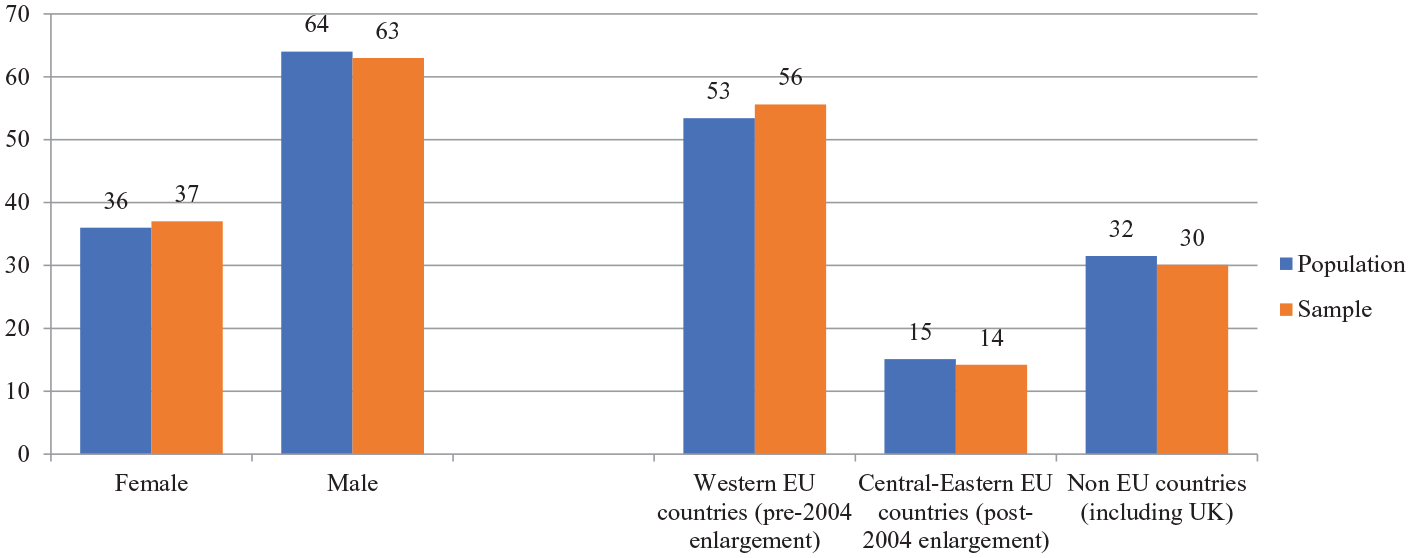
Short COVID-19 PROSEPS Survey: Representativeness by Gender and Geographical Area (%).
In our analysis, first, we refer to a few descriptive statistics and a test of statistical significance (Pearson’s chi-square) to investigate the variance in EPSs’ attitudes with respect to the pandemic. Data are controlled by four structural variables that are likely to affect EPSs’ attitudes: at the individual level, we examine gender and academic seniority – namely, full and associate professors versus all other academic categories – while at the country level, we consider the stringency of anti-COVID measures adopted 3 and the general level of development (Human Development Index (HDI), 2019, based on life expectancy, education and per-capita income indicators). 4 Second, we run a factor analysis in an attempt to distinguish the associations among some of the respondents’ attitudes and connect the latent factors obtained to our theoretical dimensions of adaptation. Finally, we run a regression analysis to test our hypotheses and assess the impact of personal attitudes plus the four structural variables mentioned above on professional adaptation.
Adapting to the Post-Pandemic Scenario: Evidence from EPSs’ Attitudes
Compound Attitudes
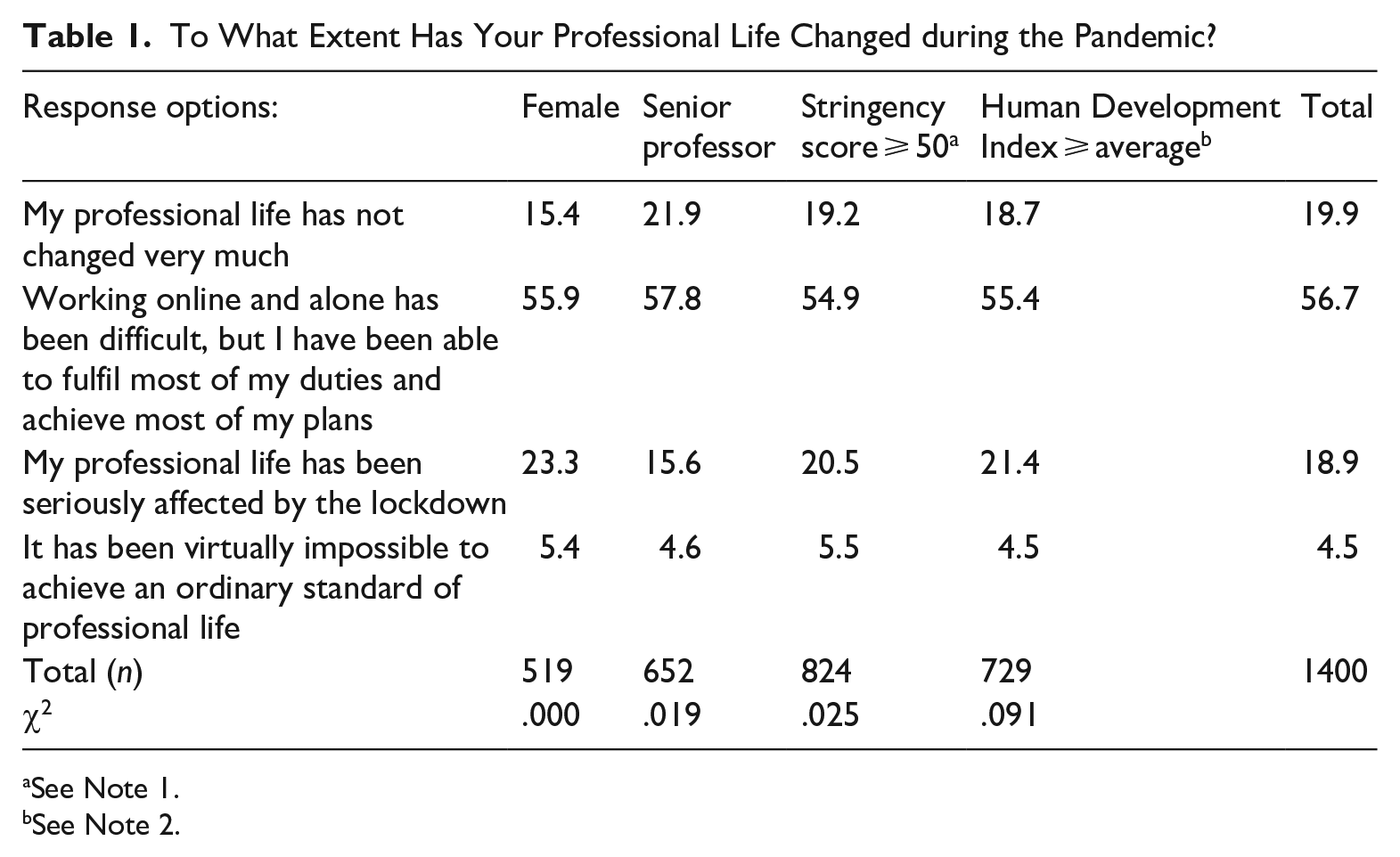
Table 1 shows that the majority of respondents perceived a significant threat to their professional activity, with no significant differences in terms of academic position and country. As expected, a gender effect emerges, although not a huge one, as female scholars seem to be more affected by the major burden of domestic duties during periods of lockdown.
To What Extent Has Your Professional Life Changed during the Pandemic?
See Note 1.
See Note 2.
However, the minority of respondents stating that the pandemic does not present an issue for the evolution of the academic discipline remains relevant (20%). In addition, almost 60% of our sample declared that the smart working mode has allowed EPSs to fulfil most of their duties and achieve their goals. Therefore, if several political scientists envisage some type of change when different aspects of the profession come into play, most appear exclusively concerned with some technical and somehow inevitable temporary effects of the pandemic. This potential variability of reactions is confirmed by Table 2, which shows a rather compound set of attitudes: more than 60% of respondents see a transformation of the methods of fundraising and resource distribution, with female scholars and respondents from ‘less developed’ countries and from countries with stringent anti-COVID measures appearing particularly concerned. Even more pronounced (almost 85%) is the percentage of respondents arguing that political scientists should work more frequently in multidisciplinary teams and deal with policy-related questions. However, only 46% of respondents explicitly wished for an expanded role for political scientists as policy advisors or policy experts.
To What Extent Do You Agree with the Following Statements (Somewhat + Completely)?
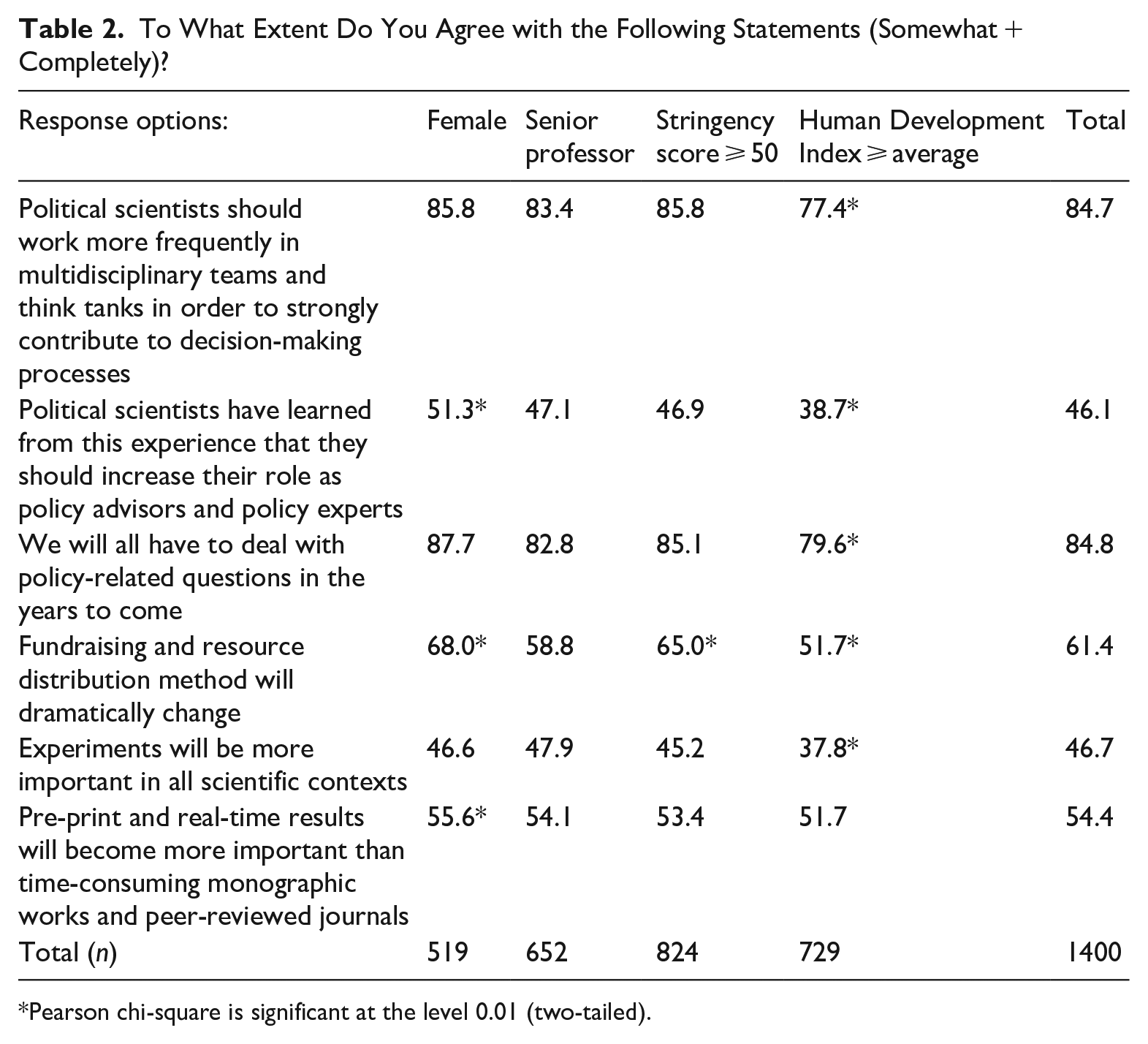
Pearson chi-square is significant at the level 0.01 (two-tailed).
Overall, EPSs seem highly aware of the poor chances of returning to pre-pandemic standards with no costs and no major changes. However, the level of professional adaptation differs significantly according to the type of activity considered. In fact, changing research-oriented activities (i.e. writing papers, reviews and essays at home) has been somewhat or very demanding only for 39.9% of respondents, while 76.3% have had difficulties implementing online teaching and distance learning procedures.
Only a small minority of EPSs (4.9%) have drastically changed their professional agendas to cover the study of the pandemic phenomenon. A significant percentage of respondents partially reshaped their agendas because of personal scientific interest in COVID-19 (42.6%). Personal interest in this problem therefore seems to be more relevant than institutional drivers. However, the relative majority of EPSs (46.5%) did not reshape their agendas, with scholars from ‘more developed’ countries significantly above the average. The data therefore confirm the divide between those who show some scientific interest in the social and political implications of this event and those who have been untouched by it.
Thus, at least two groups of political scientists emerge: those who perfectly represent the ‘pure’ perspective of the discipline, especially in those countries where it is supposed to be stronger, look disconnected from the pressing problems facing society (Stoker, 2010) and less oriented to ‘sacrificing’ their own interests to chase the latest trends. This apparent disconnection from ‘big-world events’ may be driven by the scarce media visibility of EPSs, which also implies scarce involvement in high-level debates on the reality and consequences of the pandemic. Nevertheless, in more developed countries, this may also be a consequence of a conscious choice by EPSs to withdraw into their ‘ivory towers’ (Real Dato and Verzichelli, 2021). On the contrary, there is a group of political scientists who are either more interested in relevant social and political events and, despite the low visibility of the discipline, attempt to contribute or those who already hold roles as policy advisors or as commentators in the media.
Table 3 shows the COVID-related activities undertaken by EPSs who stated that they drastically or partially reshaped their agendas due to the pandemic. The EPSs who concretely and proactively performed pandemic-related activities were much more numerous than those who claimed to have reshaped their agendas only after their institutions decided to cover these issues. In other words, a significant number of EPSs are not merely aware of the change but also feel that future changes may represent an opportunity to reshape the overall professional model.
What COVID-19-Related Activities Have You Undertaken in the Past Months?
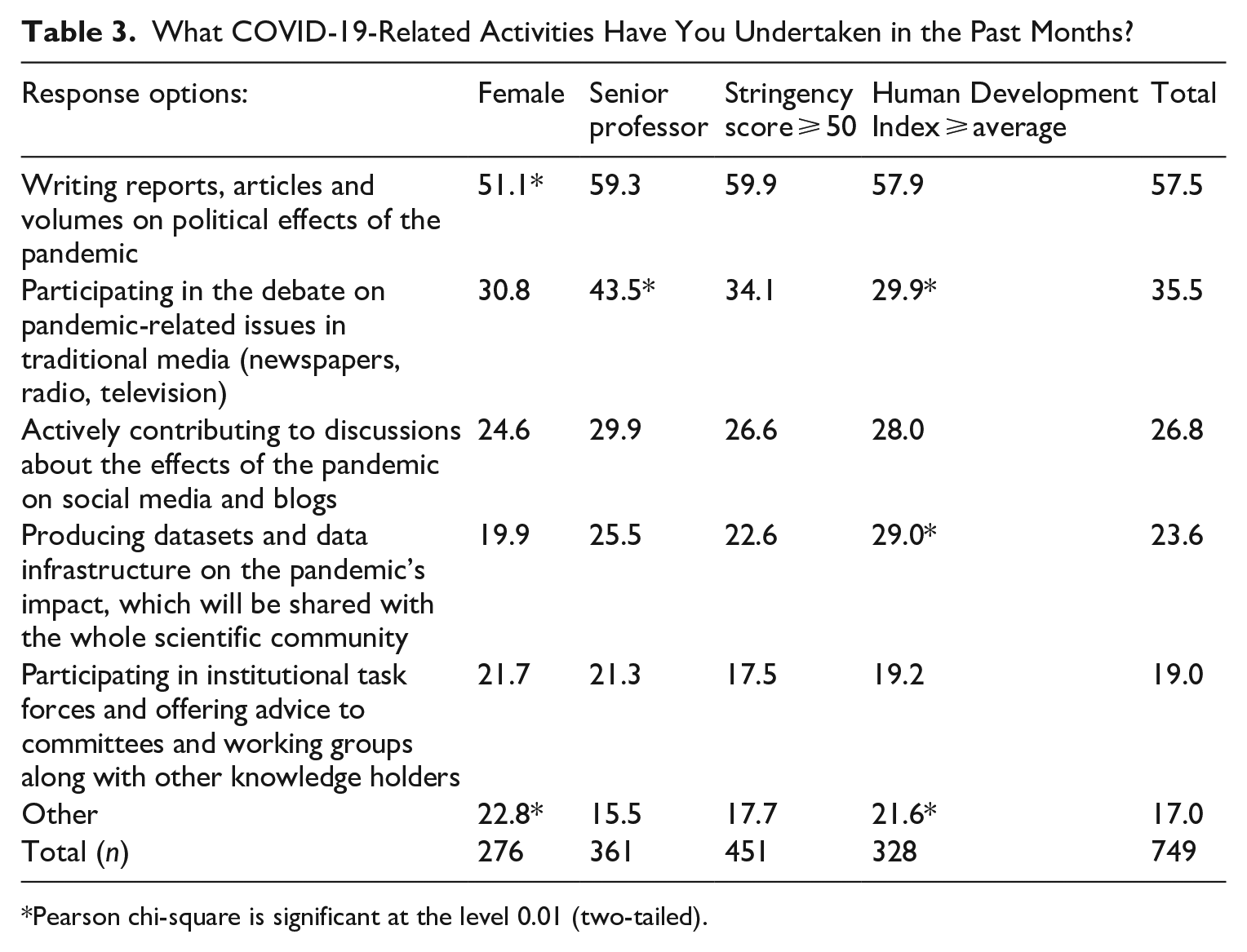
Pearson chi-square is significant at the level 0.01 (two-tailed).
A Post-Pandemic Paradigm? Social and Media Relevance of Future Political Science
We have confirmed that political scientists are somewhat conscious of the pandemic’s impact on the future of the profession. Even more so, they raise specific concerns about the future of the scientific community. According to the survey, the majority of EPSs trust hard scientists (with 52.9% declaring that their public interventions have been clear and effective), although reproaching them for causing confusion due to disparate opinions (45.9%) and for having been unable to communicate clearly (36.5%). Nevertheless, the absolute majority of EPSs criticise the management of the pandemic, which gave too much voice to hard/natural scientists compared to social/political scientists, thus confirming that political science scholars are aware of some potential threats.
This description raises a question about the impact of social relevance and media visibility on transforming the high level of awareness of the changes caused by the pandemic into a comprehensive adaptation of the role of political science in Europe. Thus, we assume that the perception of a lack of social relevance (at large) may be a fundamental component of the overall unsatisfactory prospective vision of the discipline. If this is the case, the viewpoints of a significant number of scholars in favour of a political and advocacy role for political scientists may accompany an expectation of future ‘paradigmatic change’ in the profession in the post-pandemic phase. In contrast, the quest for more visible or proactive roles for EPSs would logically be less associated with the cluster of passivity.
Latent Dimensions of Adaptation among EPSs
To distinguish some dimensions of professional adaptation, we run (Table 4) a model of data reduction including eight attitudinal questions asked to the EPSs plus two indexes computed by adding the results of other questions in the survey. The model explains 50% of the overall variation. Most of the variables point to a first dimension (explaining almost one-fourth of the overall variance) that can be considered a latent factor of proactive (and potentially innovative) adaptation. Indeed, this factor is determined by strong agreement with three positive statements about possible changes of the social role of EPSs:
Political scientists should work more frequently in multidisciplinary teams and think tanks.
Political scientists have learned from this experience that they should increase their role as policy advisors.
We will all have to deal with policy-related questions.
Factor Analysis: Dimensions of Adaptation in the Attitudes of European Professional Political Scientists.
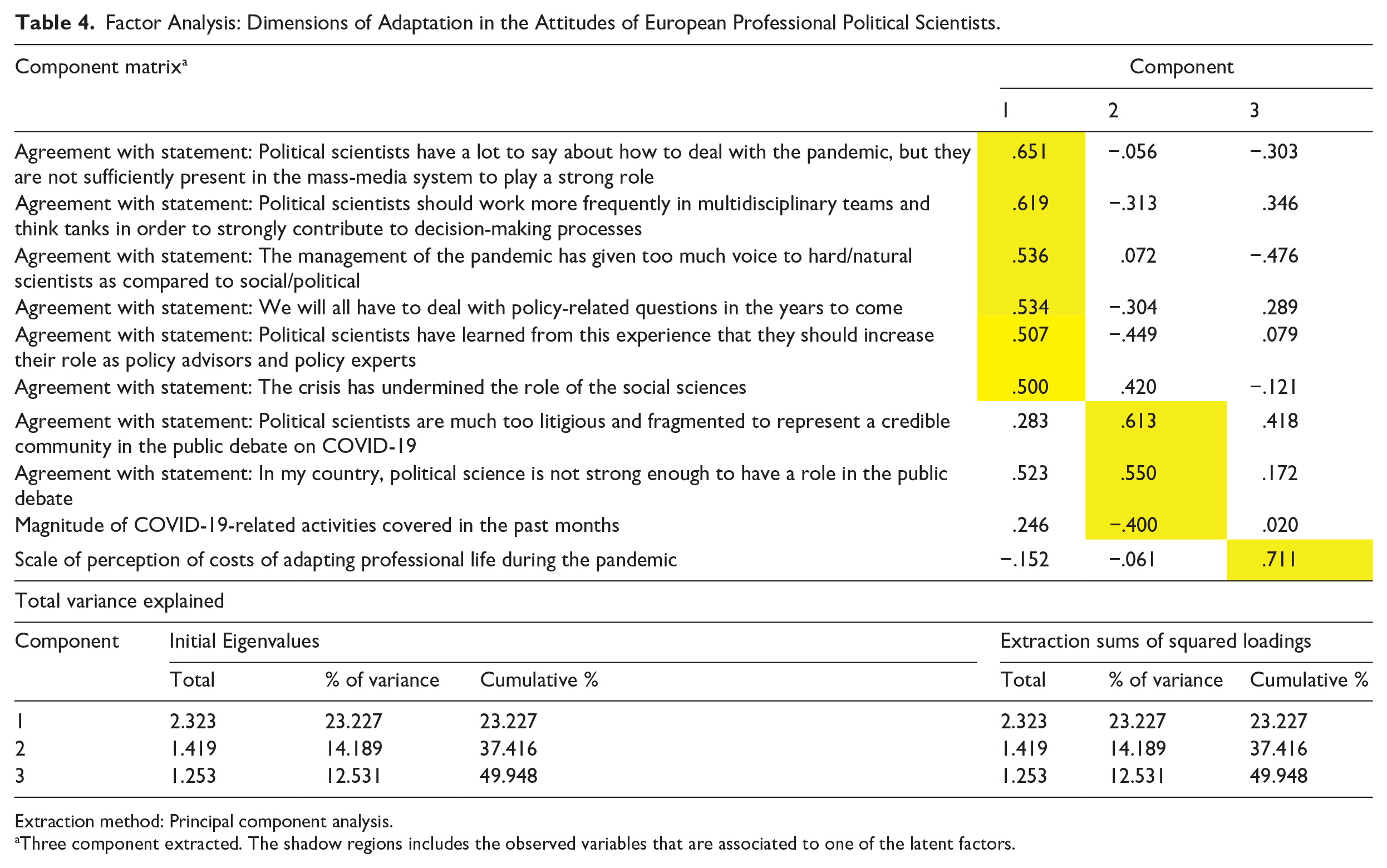
Extraction method: Principal component analysis.
Three component extracted. The shadow regions includes the observed variables that are associated to one of the latent factors.
However, the factor also considers a few concerned statements about the future of the discipline and its weakness in scientific debate:
Political scientists have a lot to say about how to deal with the pandemic, but they are not sufficiently present in the mass-media system.
The management of the pandemic has given too much voice to hard/natural scientists.
The crisis has undermined the role of the social sciences.
If the first latent factor obtained by our model seems to include a set of (at least potential) attitudes towards an innovative idea of the future, the second factor seems to pertain to purely reactive (or even passive) reactions. Indeed, the two attitudes clearly associated with this factor look like disenchanted admissions of the weakness of the discipline:
Political scientists are much too litigious and fragmented to represent a credible community in the public debate on COVID-19.
In my country, political science is not strong enough to have a role in the public debate.
Furthermore, the most interesting information considered by this second latent dimension is the negative attitude of EPSs towards the list of COVID-19-related activities included in an index that we have computed. 5
A third relevant factor in the factorial model has to do with the dimension of ‘pure concern’. The only variable associated with this factor is a scale of perception of costs of adapting professional life during the pandemic. 6 This would confirm that a significant quota of EPSs is aware of the long-term effects of the pandemic on the profession. However, such awareness is not necessarily correlated with a clear positive or negative attitude towards adaptation: neither assertive statements (political scientists should change their way of working) nor passive statements (political science is too weak/ineffectual to change) are indeed considered by this latent factor.
Overall, the factor analysis confirms that the EPSs’ attitudes are rather compound. Signs of passivity and proactivity are evident, but many scholars, despite their awareness of the importance of current changes, do not seem to be assuming new and unusual behaviours and transforming their rational concerns into a clear and innovative perspective on their professional lives. For this reason, we will now focus on the sole explanation for proactive attitudes towards adaptation.
Explaining Professional Adaptation among EPSs
The PROSEPS COVID-19 survey shows great variance and uncertainty among EPSs concerning the future of the profession after the pandemic. A closer look at some of the questions shows the extent to which awareness of the current challenges and predisposition to adaptation combine to distinguish different groups of EPSs’ reactions to the pandemic. Table 5 reports the distribution of our respondents in a cross-tabulation based on two ordinal indexes that we have built named perception of change and attitude towards adaptation. The first index combines the answers to the question about the amount of professional change due to the pandemic and that concerning the costs of fulfilling research and teaching activities (see Note 6). While the lowest value refers to respondents who did not show a perception of costs and did not face major changes, the middle value refers to respondents who answered that working online and alone has been difficult but that they have been able to fulfil most of their duties (regardless of the cost). Finally, the highest value group perceived high costs and stated that their professional lives had been seriously affected by the lockdown or even that it was virtually impossible to achieve an ordinary standard of professional life.
EPSs’ Perception of Change and Attitude to Adaptation after the First Phase of Pandemic.
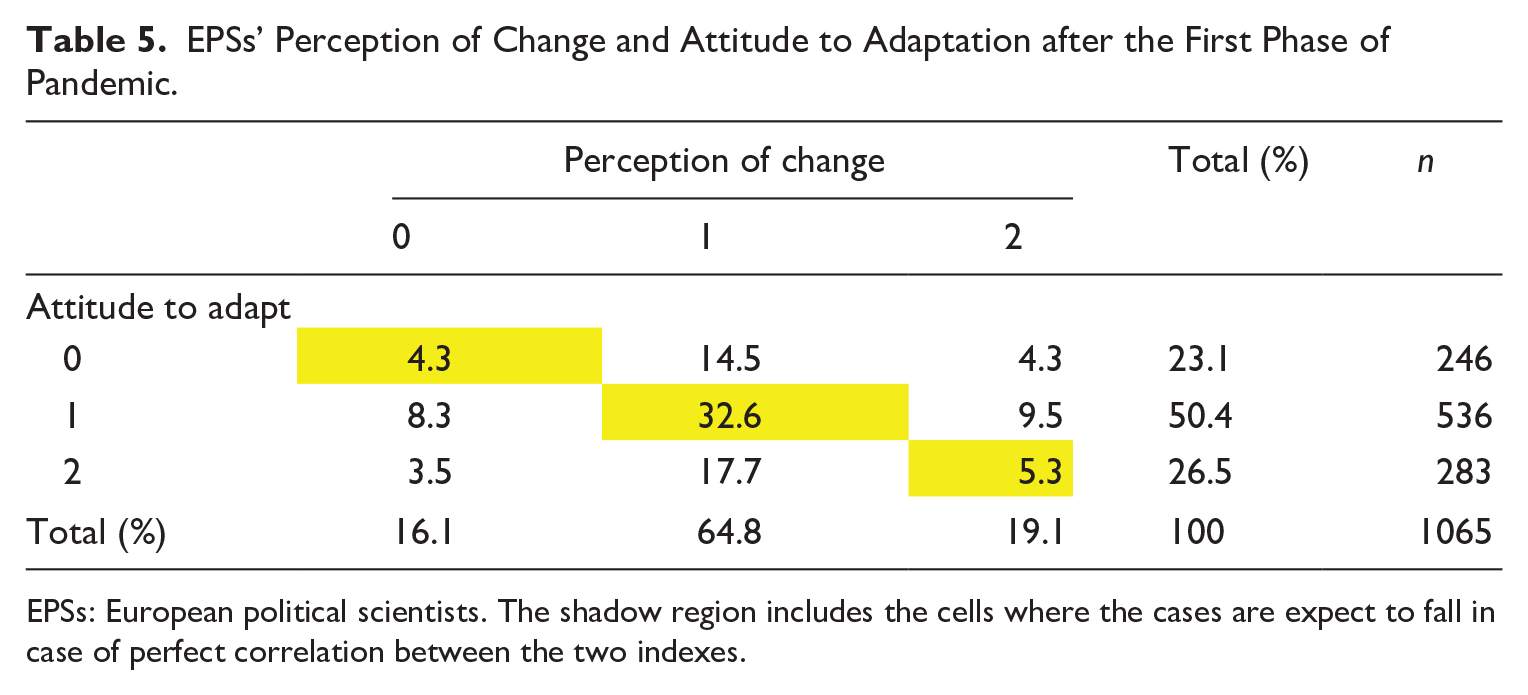
EPSs: European political scientists. The shadow region includes the cells where the cases are expect to fall in case of perfect correlation between the two indexes.
The second variable (attitude towards adaptation) combines the respondents’ answers about reshaping their research agendas with two attitudes: the perception of future challenges to the discipline 7 and the preference for future contributions by EPSs to decision making through an expanded multidisciplinary and advisory role. More precisely, the lowest value includes respondents who did not reshape their agendas voluntarily (at most, some did so because their department/institution decided to cover COVID-19-related issues) as they did not see future challenges and did not agree that political scientists should increase their role as policy advisors or work more frequently in multidisciplinary teams. The middle value refers to respondents who showed a partial degree of adaptation, either because they reshaped their agendas (partially, because of personal interest, or even drastically) or because they perceived future challenges and agreed about the necessity of increasing multidisciplinarity or their advisory role. Finally, the highest level of adaptation refers to people who reshaped their agendas because they saw future challenges and wished for an increase in multidisciplinarity and/or in their advisory role.
Only a small minority of passive scholars (4.3%) made no changes to their agendas and did not perceive major challenges to their usual work. Even the opposite category (with a high level of perception and attitude towards adaptation) is a minority (5.3%), while the central category in the table is the most populated (32.6%). This suggests that the modal attitude in our population is a reasonable reactivity: adaptation is perceived as necessary but not an easy task, in accordance with perceptions of future challenges.
However, other important combinations appear: in particular, 17.7% of highly adaptive but moderately aware EPSs and 9.5% of highly concerned but moderately adaptive EPSs. This confirms the predominance of ‘mixed feelings’. Obviously, this reduces the room for the last category of proactive EPSs who perceive the pandemic as providing momentum for a dramatic change of perspective, envisaging clear challenges for their social and academic role and engaging with significant change in their daily work. However, a clear and strong association between elements of awareness and concrete adaptation appears in more than two-thirds of the respondents.
Other bivariate analyses that we conduct on our set of variables confirm such fuzziness: the random hypothesis of variability of individual, collective and cultural motivations determining different reactions from a soft-pure and fragmented disciplinary community is certainly not rejected. However, other interpretative elements are distinguishable. For instance, the significant correlation between gender distribution and the index of perception of the cost of changes (ρ = .118) confirms the difficulties that women (and particularly mothers) face in adapting their professional lives during the pandemic (Minello et al., 2020).
Therefore, to test our expectations and identify the determinants of a proactive attitude to change, we run a multivariate analysis using the index attitude towards adaptation mentioned above as the dependent variable. The model of linear regression (Table 6) shows a reasonably robust explanation of our index of adaptation.
Determinants of Adaptation of EPSs: Linear Regression.
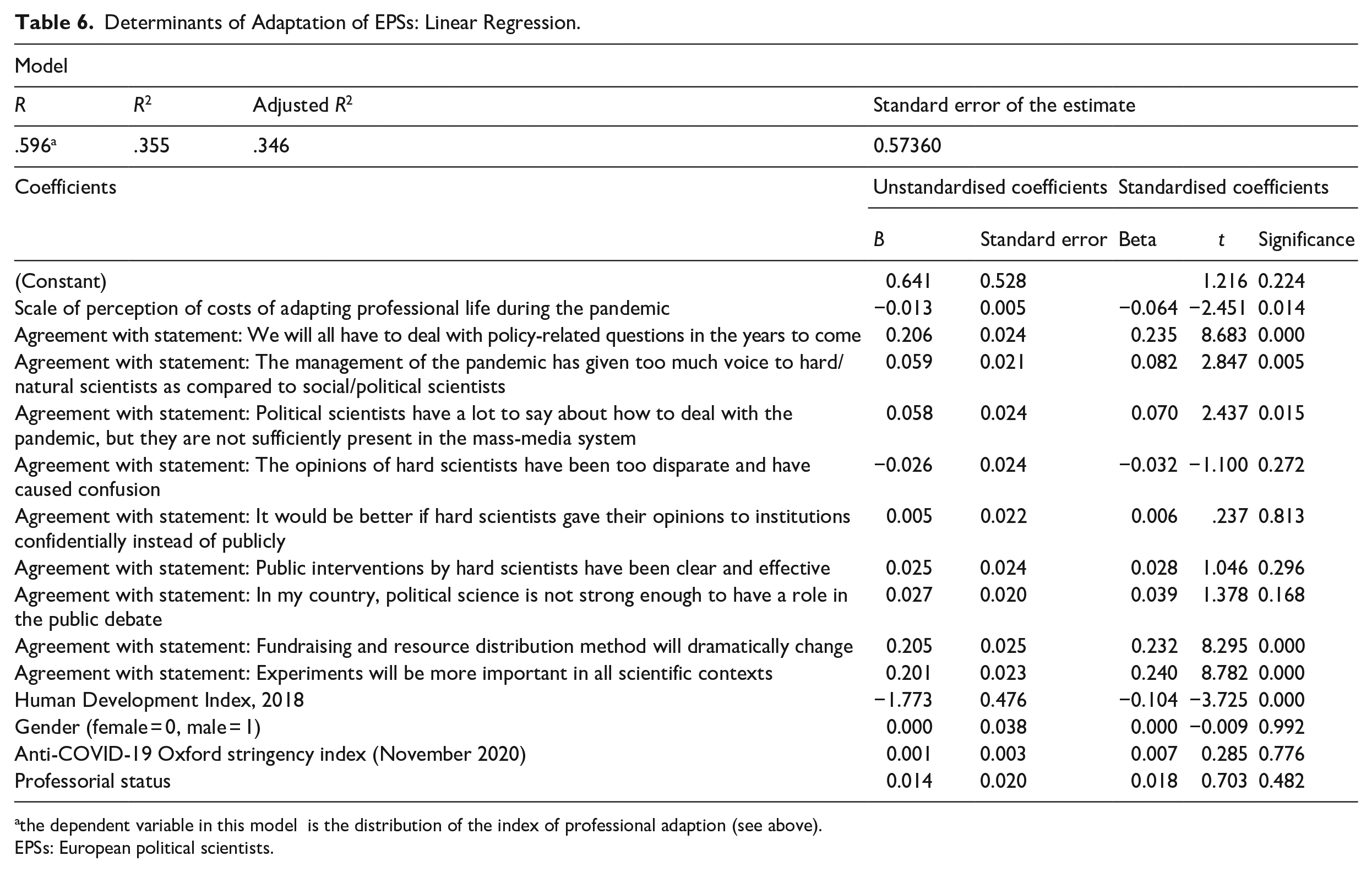
the dependent variable in this model is the distribution of the index of professional adaption (see above).
EPSs: European political scientists.
While H1 about the influence of gender and academic seniority on professional adaptation is not confirmed, a few attitudinal factors seem to be relevant. In particular, the belief in a future of applied and experimental political science and the ideas that fundraising and resource distribution will significantly change and that sooner or later ‘we will all have to deal with policy-related questions’ are the best predictors of a willing attitude towards adaptation, partially confirming our second hypothesis. H3 is also partially confirmed, as only one of the two country variables we have included in the model proves significant: the HDI. While the stringency of anti-COVID measures does not seem to matter, political scientists from (relatively) poor European countries are more stimulated to consider the post-pandemic scenario as an opportunity to adapt their working conditions and styles, with all the attitudinal predispositions constant.
Conclusion
In this article, we have focused on the scope and dimensions of EPSs’ professional adaptation, with the help of data from a specific survey circulated after the first phase of the COVID-19 pandemic. The results are interesting. Our descriptive analysis and the suggestions provided by an explorative interpretation grounded in data reduction and multivariate analyses confirm that most EPSs are highly aware of the implications of the pandemic. However, their awareness has several somehow contradictory implications in terms of a predisposition to adapt their research agendas and professional attitudes.
On one hand, the experience of COVID-19 seems to have persuaded a significant share of respondents that political scientists should expand their social role and be more involved as advisors in decision-making processes. In addition, the analyses show that a few clear divides characterise the distribution of this awareness: male and senior scholars are, overall, less concerned with the importance of the changes ahead. Similarly, scholars from countries with a lower index of human development (mainly southern and central-eastern European countries) and with a perception of a less established political science tend to stress the relevance of future challenges.
The factor analysis helped us identify different dimensions of potential adaptation. Indeed, some attitudes towards proactive adaptation can be reasonably clustered, thus confirming our preliminary proposition that the importance of this historical moment corresponds to an increasing willingness to adapt some aspects of the profession. However, this latent dimension has limited explanatory potential. In fact, two other latent factors emerged, indicating alternative potential reactions. In particular, we have individuated a factor associable with our expectation of ‘passive adaptation’, including those respondents who are less inclined to reshape their agendas and convinced of a sort of intrinsic weakness/subordination of the discipline. Moreover, a third latent dimension indicates what we have called pure concern. In this case, the data do not tell us which potential adjustment of professional behaviour can be expected, since the only crucial element here is represented by a clear perception of the difficulties faced by scholars in this peculiar time. We can therefore suppose that a substantial group of EPSs would be oriented to some kind of (at least) reactive adaptation, but it is too early to know the concrete effect of such predisposition. Therefore, we have argued that a minority of scholars see in the post-pandemic scenario a chance to improve their professional situation, pursuing a pattern of proactive adaptation.
Since very few respondents indicated that a crisis such as COVID-19 could represent a watershed in terms of bringing innovation to the content and social role of political science, our descriptive analysis focused on different mixed feelings about the prospective change in the discipline, due also to other concerns about the scarce visibility of social sciences and their weakness vis-à-vis the hard sciences. The evidence that we have produced anyway suggests the presence of signs of innovative adaptation, supported by scholars who think of the post-pandemic reaction as leverage to change the collective mission of the discipline. The regression analysis focused on our index of adaptation confirms the explanatory potential of a few attitudinal factors, namely, the belief in a future of applied and experimental political science and the vision of a more competitive and policy-related distribution of research resources. Moreover, the HDI remains the only country-structural factor with a relative explanatory potential.
Obviously, a survey cannot assess whether and how perceptions, ideas and individual reactions can truly evolve into persistent and/or aggregate behaviours. However, this variety of patterns of professional adaptation shows that there is room and hope for European political science to learn something from the COVID-19 experience.
Footnotes
Declaration of conflicting interests
The author(s) declared no potential conflicts of interest with respect to the research, authorship, and/or publication of this article.
Funding
The author(s) disclosed receipt of the following financial support for the research, authorship, and/or publication of this article: This study was supported by COST Action 15207: PROSEPS: Professionalization and Social Impact of European Political Science..
